
Start Here: Scott Murray on the Modern Definition of Tracking
Episode 369 of the InGoal Radio Podcast is the first time Lyle Mast has publicly walked through Head Trajectory, the approach to tracking he pioneered. He spent an hour on it with Devan Dubnyk, and by the end Daren Millard had asked the obvious question: “After this, what should someone do?”
It is the right one to ask. Head Trajectory is a subject where an hour of conversation can genuinely change how you watch the position, and then leave you standing on the ice the next morning with no idea where to start.
Part of the answer came up in the conversation itself. The Trac Optics goggles Mast developed exist to close the gap that can make Head Trajectory harder to coach from the outside: a goaltender often cannot tell in the moment whether they actually tracked the puck or only felt like they did. The goggles give them that feedback directly, which is what turns tracking from a note a coach keeps repeating into something a goalie can check for themselves.
The other part of the answer is already sitting in our archive, and it is where we would send anyone who wants to see what Mast’s thinking looks like once it reaches an NHL crease.
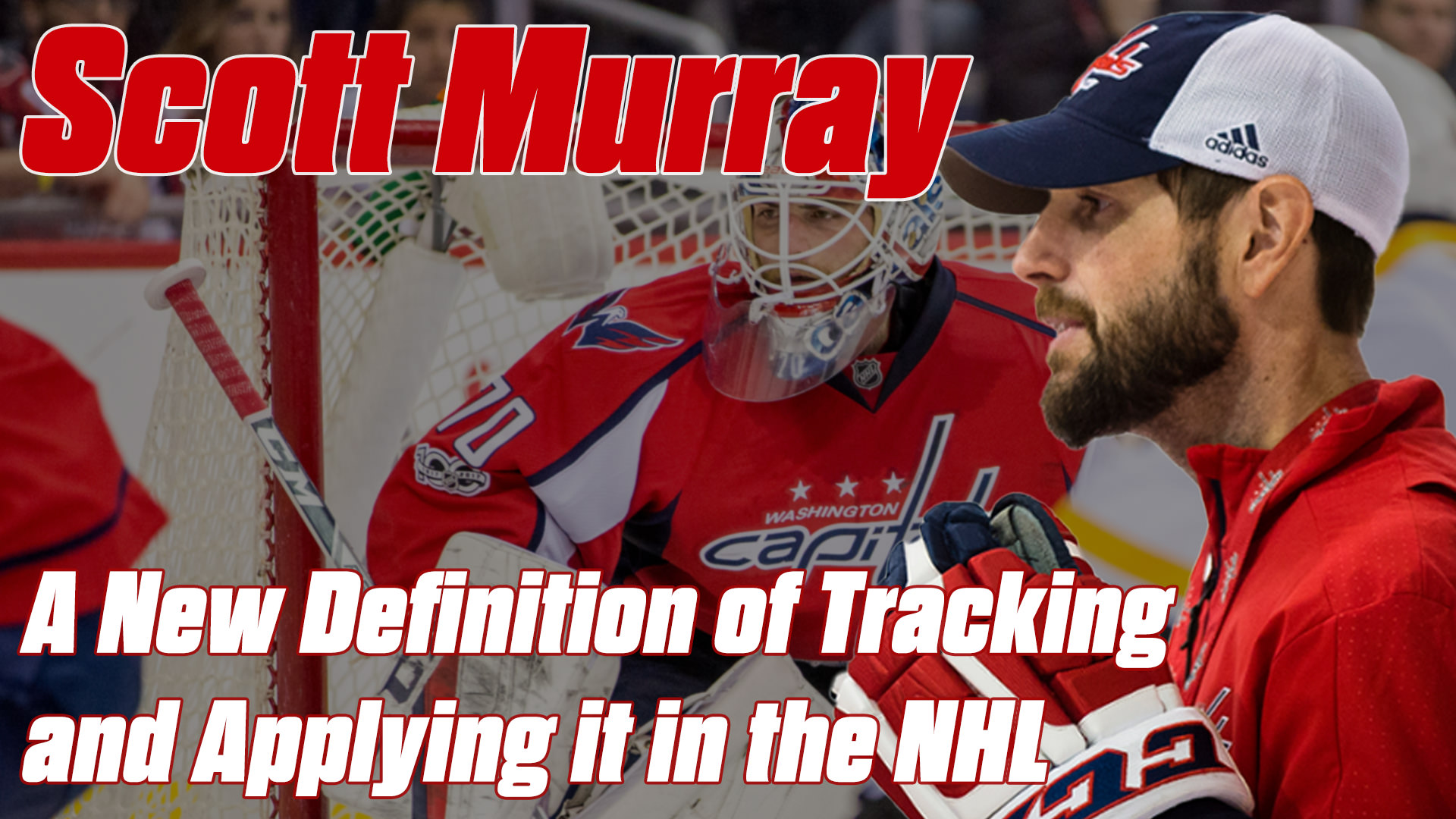
In the summer of 2020, Washington Capitals goaltending coach Scott Murray gave an hour-long presentation at the WHL / Hockey Canada Goaltending Symposium presented by InGoal Magazine, walking through the definition of tracking he learned from Mast and exactly how he applied it with three very different NHL goaltenders. We ran it as a six-part series and added the question-and-answer session that followed as a seventh. Every part is built around Murray’s own video from that day, and all seven are collected below.
WHAT MURRAY MEANS BY TRACKING
The word gets used loosely. Murray’s definition, the one he credits to Mast, is narrower and more useful: tracking is about maximizing efficiency in every part of a goaltender’s movement and positioning, not only about seeing the puck at the moment of the release.
That distinction is the whole series. If tracking is only “watch the puck,” there is not much left to coach beyond reminding a goalie to watch the puck. If tracking is the trigger that sets up how a goalie moves — how the head gets set, whether the body arrives with a delay or without one, whether the goalie ends up with access to the puck or not — then it becomes something you can build drills around, measure, and fix.
Murray did all three, and deliberately did them differently depending on who he was working with. He used tracking situationally with Braden Holtby to attack one specific weakness on lateral plays in the season Washington won the Stanley Cup, foundationally with Pheonix Copley, and developmentally with Ilya Samsonov through Samsonov’s first year in North America.
THE SERIES, PART BY PART
Each part below is an InGoal Premium read, built around Murray’s video and the drills he used.
Part 1: Braden Holtby and tracking as a situational tool
The new definition, where it came from, and the before-and-after numbers on the lateral plays that were costing Holtby goals the season before the Cup.
Part 2: Pheonix Copley and tracking as a foundational tool
Tracking as a movement trigger rather than a visual habit, and what a more foundational build looks like — including how much of it lived in the pre-game skate.
Part 3: Release drills for modern tracking
Where Murray starts a session: stationary releases first, movement added after, unpredictability throughout. Plus the physical tells that give away a goalie whose focus has drifted, and why he is careful not to over-coach it verbally.
Part 4: Lateral movement release drills
Drills built so that vision leads the feet instead of chasing them. “By shooting at any point, it forces them to see it early versus just get there and see then where it is going.”
Part 5: ISO-track drills eliminate the shot, and the movement delays
Take the shot away entirely and the anticipation goes with it. Murray’s progression runs from a single puck carrier, to a pass option, to a screen.
Part 6: Ilya Samsonov and tracking as a developmental tool
Changing where Samsonov played in his net to maximize coverage, with AHL coach Alex Westlund doing the day-to-day work in Hershey, and before-and-after video across broken plays, east-west movement, recoveries, and post play.
Eleven minutes of questions from the goalie coaches in the room: when a goalie should look off the puck to take a read, how stance and tracking affect each other, vision-training tools, and how to translate all of it for younger goalies.
TAKING IT OFF THE ICE
The other half of Daren’s question — what to do between now and the next ice time — has an answer too.
PWHL goaltender Kristen Campbell and manual osteopathic therapist James Wendland filmed two sessions with us at Campbell’s KC Elite Goaltending camp, and the second one goes straight at this. Wendland’s argument is that a goalie who is visually dominant cannot track well, because the eyes are carrying work the vestibular and spatial systems should be sharing. The drills separate them: a rocker board to simulate a skate edge, a Bosu ball with cross-body hand movement to fire the anterior and posterior slings, foot pops on an exercise ball, and then the same Trac Optics goggles to take visual dominance out of the equation altogether.
“When you do that, you increase the capacity to stabilize your body and track a puck,” Wendland said.
Pro Training with Kristen Campbell and James Wendland: gaze stability and goggle work
The full sequence, including where the goggles come in and how much easier Campbell finds the same drill once they come off.
The warm-up series that comes first, and why Wendland treats big-toe activation as central to edge control.
Start with Part 1. It is the shortest route from “tracking is more than watching the puck” to seeing what that actually changes about a goaltender’s feet.