
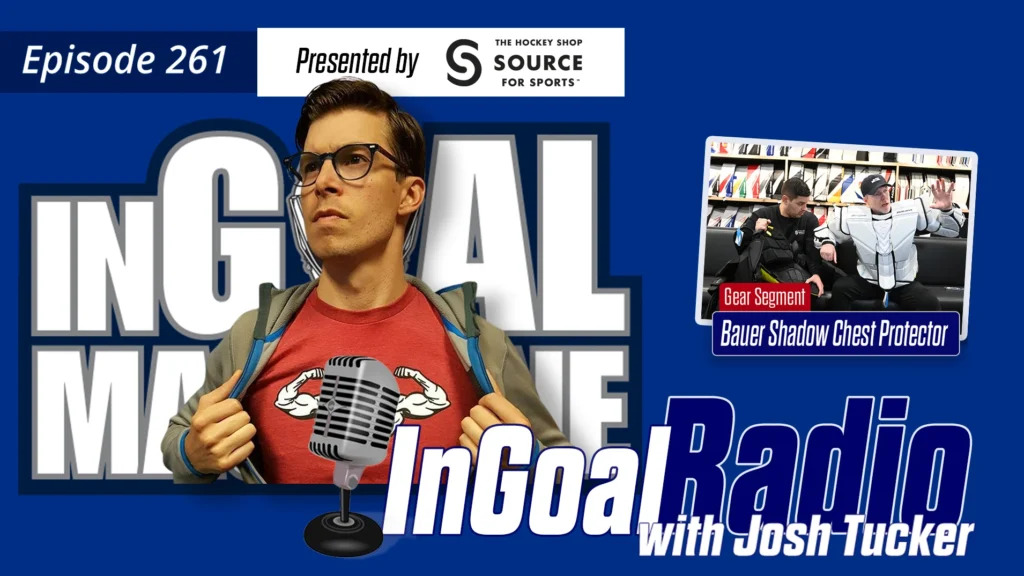
InGoal Radio Episode 261 with Josh Tucker of True Focus Vision

Please subscribe and leave a rating — it helps us reach more goalies!


Josh Tucker of True Focus Vision has worked with over 30 NHL goalies and 12 teams over 18 seasons, using visual system assessments, progressive ball drills, and strobe glasses to sharpen goalie vision. He introduced Marc-Andre Fleury to strobe glasses as a training tool and uses similar methods with active NHL goalies like Jake Oettinger and Charlie Lindgren.
- Visual system assessments can identify specific vision weaknesses that affect a goalie's ability to track and stop the puck.
- Progressive ball drills, used with NHL goalies like Jake Oettinger and Charlie Lindgren, help train the eyes to pick up and process fast-moving objects more efficiently.
- Strobe glasses are a practical tool for improving goalie vision training, as demonstrated when Tucker introduced them to Marc-Andre Fleury.
- Young goalies can develop hockey sense and spatial awareness by spending time officiating as a referee.
- The new Bauer Shadow Chest Protector introduces the first-ever hybrid tuck/untuck system, offering goalies greater fit flexibility.
Episode 261 of the InGoal Radio Podcast, presented by The Hockey Shop Source for Sports, features NHL goalie vision specialist Josh Tucker of True Focus Vision.
Feature Interview
presented by NHL Sense Arena
In the feature interview presented by NHL Sense Arena, Tucker, who has worked with over 30 NHL goalies and 12 teams through his Minnesota-based company True Focus Vision over the past 18 seasons, walks us through some of the tools and methods you can use to improve your vision as it pertains to seeing and stopping puck. From visual system assessments, to the progressive ball drills he does with goalies like Charlie Lindgren and Jake Oettinger, to introducing Marc-Andre Fleury to strobe glasses and how they can be used to improve your goaltending, Tucker shares it all.
Parent Segment
presented by Stop It Goaltending U
In our Parents Segment, presented by the Stop It Goaltending U app, we get into the many benefits of having your goalie spend a little time wearing the stripes as a referee.
Weekly Gear Segment
presented by The Hockey Shop Source for SportsAnd in our weekly gear segment, we go to The Hockey Shop Source for Sports for a closer look at the new Bauer Shadow Chest Protector and the first ever hybrid tuck/untuck system!
Episode Transcript
Intro
We're all familiar with the game Jenga. That's sort of what we're playing as we record this episode of InGoal Radio Podcast to the Hockey Shop Source for Sports Langley, the hockeyshop.com, making this presentation possible. Daren Millard along with the cofounders of InGoal, Kevin Woodley and David Hutchison. We're we're scattered all over. We're kind of flying by the seat of our pants today, and it looks like everything is according to plan right now.
People can hear us. Correct? Hutch, you you're the technical genius.
So far sounds awesome. Love to be hanging out with you.
Woody, are you plugged in?
Coast to coast.
Wait. Wait. Wait. Hold on here. You flying by the seat of our we were supposed to wear pants?
Well, you can get away with the shorts.
It's it's chest up in the view here. Thanks. Thankfully, everybody.
Yeah. We are coast to coast. I'm in Prince Edward Island looking out over the Northumberland Strait as we record this. The internet in rural PEI is not exactly technologically advanced, so I apologize if anything goes squirrelly and Woody is getting ready to go to Hawaii, so we'll be separated by like forty two hours in a twenty four hour earth, and Hutch is somewhere right in the middle.
Now speaking of squirrelly, Daren's gotta actually got a cattle prod for the squirrels to run the Internet and wheel.
We're making it happen, and we're looking forward to the conclusion of the Stanley Cup final, but before we do that, we acknowledge game seven is in advance of this podcast. So we are looking at game seven in the foreground and we're looking at this in a sense of it's gonna be released and people will know the result, but we don't know yet. So I thought it was
Well, sort of. Sort of. Like, it's gonna be We don't know the result, but then a lot of people listen
Do know the results.
The day after the result.
So we would like to congratulate Sergei Bobrovsky on winning the Stanley Cup in 2024. Now, Hutch can leave that in or he can put in congratulations to Stuart Skinner and the Edmonton Oilers with Calvin Pickard on winning the Stanley Cup in 2024. We're covered there, we've congratulated both both sides.
I I and they're both staying in because we're releasing this before the game actually happens, I think, guys.
And so if you listen to it after, it will it will sort of still make sense. And I think we've left out one there's major an omission there, Daren. Yeah. Like, a certain hall of fame goaltender Right. Who doesn't do bot podcast but has done ours twice, we have to extend that to Roberto Luongo as well.
I was kind of hesitant to to mention him just for the fear of the announcer Jinx.
Oh, see, we've just screwed this all up for everyone, but I guess if we do it for everyone on both sides, it's not. Right?
Like Should be.
We're covered.
You know what? This it's gonna go four overtimes.
Oh, I hope it does.
It happens. Well,
I'll be watching on a beach with a Mai Tai, so I don't mind. It's literally 02:00 in the afternoon when it starts where I will be.
What's in a Mai Tai?
Don't know, but it sure gets you crooked.
It makes me feel all warm and fuzzy. That is really good. Oh, game seven, the pressure of a game seven in a Stanley Cup final. Oh, we've watched them before. Woody, you were in the arena in Vancouver for a game seven.
As you look at this, Skinner's in year two and Sergei Bobrovsky is a veteran, all kinds of personal accolades, but the the challenge, the focus, the pressure on these two goaltenders is enormous. I I can't imagine any more situation where things are squeezed together and so combustible.
You're trying to tell me this isn't Tuesday night beer league at Burnaby eight rinks?
Well, your intensity takes it up to to borderline game seven of the Stanley Cup Final.
stand alone. Much more relaxed.
But listen, like That's fair. That's fair. Like, was just gonna say, like, Bob's got the experience. He's been here. And amongst the many things that Skinner has impressed me with, top of the list is probably mindset and mentality.
I mean, we've talked before about how his growth mindset I remember seeing that as far back as Hockey Canada POEs that I was at with him. And he's just continues to show it. Right? So I get it. All it takes is one squeeze of the stick stick at the wrong time, one moment where the legs feel a little heavy and you don't move, you don't react, and that could change it, one mistake.
But I'm not really worried about these guys. Like, kinda goes back to what I said going into these playoffs at the risk of sort of losing the, you know, the narrative about how important goalies are. A lot of what this series has been is is what the guys in front of them have done. I guess I guess Bob stood on his bloody head in the first two of the first three games. But since then, like, even through then, I guess, like, Edmonton's just controlled and created more dangerous opportunities.
And yet, Stewart hasn't made any mistakes on the other one. So it's it's been fun to watch. We have a win from a story or people standpoint on either side of it, I can't wait to see another game of it because it's been good hockey.
Well done, Stu. Wonderful job, Sergei. There we go. Again, we're covered on on both sides. We'll cover
the cup final.
Yep. InGoal Radio, the podcast presented by The Hockey Shop Source for Sports Langley, thehockeyshop.com. We have our Gear Segment with the Bauer Shadow Chesty from The Hockey Shop coming up in just a little bit. Josh Tucker is our NHL Sense Arena feature interview, you heard about him last week. He's from True Focus Vision and you will meet him in this episode and the Stop It Goaltending U app parent segment, why encourage your goaltender to be a referee?
It's all coming up in this episode of InGoal Radio. How was TendyFest before I wanna touch on Pete Fry in a little bit, but give me the lowdown on TendyFest.
It was frantic. It was was big, better than ever. There were goaltenders and their parents crawling all over the place, three sheets of ice, gear being tested everywhere, and we were running around at a million miles an hour because in addition to enjoying the opportunity to meet with a whole bunch of goalies and their families at TendyFest, we were trying to manage Bill Ranford giving an awesome on ice seminar and then doing a Q and A with Woody afterwards in a classroom. And that was a whole lot of work because we don't have the giant Sports Net truck to back our production. We're just running around like those little hamsters on a wheel trying to make it happen.
And Bill did a fabulous job. He's just a great person. He's a great teacher. And I think if you're an InGoal member, you're going to enjoy checking out the video of both of those sessions soon.
I can't wait to see that.
Yeah. It's good stuff. It's good stuff. And and a 100%, like, if you haven't already, yet another reason to subscribe to InGoal Magazine, ingoalmag.com and the premium subscription. We have another ProReads up this week, second in the past three weeks with Charlie Lindgren.
Obviously, last week's featured guest here on the podcast, we felt like it was perfect time to bring him in for another ProReads, like, almost nine minute breakdown from Charlie Lindgren on a couple sort of different save situations. He touches on so much stuff. So, yeah, that to Billy sort of sharing with us, the LA Kings behind the net play system and some unique features that they teach that some of their goalies adopt. I've talked to a lot of those goalies about how it reduces the wear and tear compared to just using reverse all the time, and Bill breaks it all down on the ice with us. Can't wait to share that with the audience.
If you're not a subscriber already, make sure you go check it out at ingoalmag.com.
Easy segue, Washington Capitals and Charlie Lindgren getting a promotion of sorts with the movement of Darcy Kuemper over to the Los Angeles Kings, so both teams that you mentioned there, the Kings and the Capitals involved in that swap. One of two goaltenders at Kuemper that moved in the last few days with Jacob Markstrom going from the Calgary Flames, a deal that we thought was going to happen to the trade deadline but does come to fruition in the off season with the New Jersey Devils. Were we surprised about either one of these deals and what does it mean to the teams and the acquisition of these net miners? Woody.
Were you surprised? I mean, Jacob Markstrom been linked to the Devils, so probably not that it was New Jersey. I guess the only thing is, are some people surprised at the price? I mean, him and Linus Ullmark are the premium, I would argue, premium names on the market, not just in terms of trades, but, like, if you look at the unrestricted free agent list, would you not put them ahead of most the guys that are can be signed without a trade acquisition? And so it's a first round pick, but not even in this year's draft, which some say is a little deeper.
It's next year. You had to defer. You're eating 31.25% of the salary. So, usually, there's a sweetener attached to eating salary. Is the sweetener the fact it's a first round pick?
At the end of the day, New Jersey gets two years of Markstrom for four and a quarter. That's the twenty first or twenty second highest salary cap hit amongst goalies signed for the upcoming season. Like, that's a bargain, especially as goalie salaries potentially are about to get pushed through the roof. Like, Ilya Sorokin's extension for $8,500,000, and he wasn't the starter for the New York Islanders in the playoffs. What's Shesterkin gonna get with the Rangers?
You know? So getting Markstrom at four and a quarter is wow. And for two years, you don't have to commit term in a position that's incredibly volatile. I just mentioned Sorokin's situation. Still believe in him as an elite number one goaltender, but this is the volatility of the position and you're not committing yourself long term to it, and you're getting a guy who, you know, for two thirds of this season should have been a Vezina Trophy candidate, was lapping the field he was so good in Calgary up until they dealt away all his friends and defensemen at the deadline.
I I guess I'm a little surprised that the acquisition price didn't maybe include another piece, but this is the way it is with goalies and has been for a long time. Like, we all see them as incredibly important, and yet when it comes time to trade one, the return is usually, I at least in my mind, underwhelming.
And you made the really good point earlier when we were chatting about this, Woody, that, Jacob Markstrom controlled where he went to and who knows how many teams he opened that up to. The market was limited for him in many ways.
And maybe that handcuffs Craig Conroy, but at least if you take them at face value, Markstrom and Conroy saying that it wasn't as limited as just one team. Like, he never handcuffed them to just one team. So, still, I mean, it's not like they were dealing with 32, but, I mean, I guess you get a first round pick. I at the end of the day, you could also criticize the Devils in some ways because this deal could have been done at the deadline. And whether that's enough to get you into the playoffs or not is almost beside the point.
It would have been enough for Jacob to get comfortable with the teammates he's gonna have next season. And I know the coaching has changed, so the system will change. But we also know that goaltenders getting comfortable in the environment isn't necessarily so much about learning systems as it is the individual tendencies of the guys in front of you. And so giving Jacob a two month head start by pulling the trigger on this deal midway through this season instead of in the offseason, I think, you know, you could argue that was a miss on their end as well. Even if, by some accounts, it wasn't their fault.
They were ready to go on that deal and and someone on the Calgary and pulled it at the last minute. So, at the end of the day, I think it's a great fit. A lot of Markstrom's strengths fit the weaknesses of the Devils defensively. The things they give up, in terms of the high danger chances are things that he has typically defended very, very well. Slot line plays, low slot line plays, the hash mark, breakaways, one of the third worst teams in the National Hockey League in terms of how many one on one chances they give up.
Markstrom numbers all off the charts in in all of those categories. So it's a good fit and a fresh start for Jacob. And for the Devils, him and Jake Allen, after years and years of talking about goaltending in New Jersey, you could make an argument that's one of the better tandems around the league. And last but not least, it buys you some time for Akira Schmid and Nico Daws to continue to mature in the American League, and I think both of those guys are gonna end up being NHL goalies. I love a lot about both those goalies.
They were just asked to do too much too soon.
Picking up on a guy that has taken his time, a soft launch of the career of Dustin Wolf over the last couple of years, so is that presented as his now time in Calgary?
I would think so, although, you know, what kind of team is he gonna be playing behind, that's a tough go. Interestingly enough, they actually got better defensively as the year went on. So Markstrom was asked to stop bullets in his teeth as they sort of figured out a new system and and new things, and then they traded away a bunch of players and at least the underlying metrics. There were some blow up nights for sure. You trade away your top pairing, especially a guy like Tanev and and Hanafin, you're gonna you're gonna give up more chances.
But there was better structure as the year went on and guys buying into a new system. And so, you know, you hope that that continues for Dustin Wolf because you there's gonna be growing pains. You can't just throw him in there and expect him to, you know, do what Markstrom did, which, like I said, for two thirds of a season was the best goaltending performance in the entire league last year. You can't just say, hey. Here you go.
Do what he did. But also don't sleep on Dan Vladar assuming everything is going well, and by all accounts, is coming off of the hip surgery. Dan Vladar went healthy, gave them some really good minutes over the past couple of seasons. There's a reason he got that contract extension. And so I don't think this is just a, hey.
Here's the keys, Dustin Wolf. I think you're gonna see both guys. And I think that's gonna be important because Dustin's gonna need time in practice and with the goalie coaches as he continues to adjust to the highest level of hockey.
Washington's crease situation, Charlie Lindgren takes over as the number one guy with the departure of Darcy Kuemper.
And I'm curious to see where they go beyond that. We see Hunter Shepard Yeah. Who has had some success in limited and and I loved our interview with him. If you go back to the like, I love a lot of things about his approach. Maybe he hasn't gotten a look at the National Hockey League.
And and actually, now that I think about it, he might is he a UFA this summer? He might even be a free agent. So Washington completely rebuilt its goaltending when they signed Kemper and Lindgren at the exact same time two off seasons ago. And now they've moved on from Darcy. It's gonna be Charlie's crease, but they have to make a similarly smart decision when it comes to what the depth chart looks like behind him.
Is it Hunter Shepard? Is he your two? Clay Stevenson with limited pro experience, but moving up the charts quite rapidly and a guy we know very well from some time in Kelowna in the off season and and like a lot about him, his mindset, and his game. He's there in the American Hockey League, but obviously could use some more time and more games played. The decision they need, I would argue, they probably need unless they're convinced that Shepherd, they might need to find the next Charlie Lindgren.
Can they go find a guy for three years at one and a quarter that can follow in those foot steps. That's what you wanna do if you're the Washington Capitals. Is it and it is it is it a guy like Kevin Lankinen who had some underlying numbers that were similarly impressive to what Charlie did when he got this opportunity and made the most of it.
And Los Angeles invested very little monetarily in their goaltending a year ago, go a different route with Darcy Kuemper returning to the Kings organization.
Yeah and listen, like last year was not a great year for Darcy statistically at least, But I don't think you look at this as, you know, the beginning of the end by any means, because his first season in Washington was fine. And he was, I mean, cup winner up until that that Stanley Cup win, like, numbers were consistently above expected, and he's gonna go to an environment with if they maintain the defensive identity that they've had to this point and they they kept the head coach, your your floor, your base level, your expected save percentage is typically higher than anywhere else in the league. They've been one of the best defensive teams in the league. So, every goalie probably wants to play behind that team and for Darcy. The other part too is he's returning to a conference he's more familiar with.
I do wonder a little bit, like, how much going from the West to the East after spending your whole time in the West as much as you know everybody. Like, these are teams he knows more intimately and has faced, and so the tendencies and and trends trends should be a little more familiar to him. And I think the biggest thing about this season is there were just so many injuries for him. I think that that, you know, you're counting on that being the reason this season was so far down statistically from his norms.
Off season to make the transition, he's going to an organization that he's already been a part of, so that should help that switch over to the Los Angeles Kings a little bit more and then the just the motivation to be healthy and to be ready to go. And when it comes to the mind, there's no better person to help you out with that than Pete Fry. Hutch.
Pete Fry. Good friend of InGoal as you know. All kinds of articles over at the site if you wanna learn more about mindset. And Pete again is doing a series of summer seminars, Toronto, Ottawa, Calgary, Vancouver, and which I think is probably of most importance to people listening to this show, a virtual seminar. We will be on hand in Vancouver.
We will be broadcasting it over the Internet. If you would like to check out Pete's seminars, you get $25 off as an InGoal member of the virtual seminar, so great incentive to become an InGoal member. And if you attend one of Pete's seminars in person, he's going to give you an InGoal membership because Pete said he thought it's important that all his students have a membership to InGoal because it's such a great place to learn. Look, guys, I think we've said it many times before. I think we're the best deal in goaltending.
You could pay hundreds of dollars for a new stick a couple of times a year, or you could spend only $50 to sit down with NHL goalies and coaches all year long to learn. So I think it's a steal, but there's so many great ways of getting it now because so many people believe in it. Kevin will tell you again a little bit later how every Stop It Goaltending U app subscription comes with access to InGoals content as well. Our friends at GDI USA are giving it to many of their campers this year. And this week, I just had a great conversation.
I want to welcome Travis Hoy into the fold. He's a BCHL goalie coach, and he is giving all his summer camp students an InGoal membership because he wants them to be able to learn from us all year long. So imagine getting to train in the beautiful Okanagan region of British Columbia with a young innovative coach and then he throws in a year of InGoal for your learning as well. So nice bonus for going to his camps. I would suggest you check out travishoygoaltending.com.
Is your goalie school giving you InGoal? Because if they're not, maybe you should ask. There's one other coming up this week that we'll be finding out. But I was asked to keep it a surprise because he wants to let his students know first later on this week. And if not, check with the coach.
Oh, see? I was probably about to blurt that out. So good thing You to you could you could see that Hutch is like looking, he's like, Woodley's gonna do something stupid again.
He's got breaking news.
And I haven't mentioned all of them, but those are several of the coaches that are sharing InGoal. So we'd love we'd love it and we want to thank all of them for their support as well.
Can't wait for the virtual seminar with Pete Fry. If we were a piece of merchandise on the shelf of the Hockey Shop Source for Sports Langley, InGoal, a membership there would be flying off the shelf.
That may happen before the end of the year. We're working on that. Really? Yeah. Had some
See, almost blew that too.
Well, it's I mean At a the hamsters
I thought you were I I thought you were gonna say that if we were on the shelf at Hockey Shop, we'd be like the expired meat section in your local grocery. Bunch of old stinky guys.
The used used equipment. What's going on over at the InGoal, and the relationship with the Hockey Shop Source for Sports Langley, the hockeyshop.com?
Gear
Well, let's set up our gear segment for the week, but first remind you, going back to last week's gear segment, the G7 pro from Warrior exclusive colorways. And there are a lot of other exclusives that you get when you shop at the Hockey Shop Source for Sports and hockeyshop.com. It's more than just Cam's pretty face. It's more than just the expertise of the staff that he's put together. It's more than just what seems to be an unlimited supply of equipment as we look around the room every time we film there, and we're just surrounded by walls and walls of gear.
It's all that plus taking that expertise and the relationships and leverage he's built with the major manufacturers to give you offers on exclusive content, like the colorways for Warrior, like some specific specs on on different brands and different models of chest protectors with extra protection or pants with extra flaps, colorways, things you can't get elsewhere. So make sure you check them out at the hockeyshop.com. Look for those hockey shop exclusives. There's a bunch of them. Best prices, best people, best expertise, best way to get your goalie gear.
And in the case of this week, best person to talk to about the new Bauer Shadow Chesty, which I hadn't seen before. Cam really dug us into some of the details on what's new, what's improved, and how it blends in with some of their other lines in this week's InGoal Radio Gear Segment at the Hockey Shop. Welcome back to the Hockey Shop Source for Sports. We're down here in Goal Utopia, not down here anymore. Man, we've been in the new store for how long and I still feel like I'm in the basement.
Your mind's in the basement right now.
I'm with you, Cam.
Yeah. Let's get you up and out because
Out of the shadows. And into the shadow. The new Bauer Shadow chest protector. We did the pads, we did the gloves, the blocker last week. Now, it's time for the new chest protector and I gotta say, I am feeling very mobile and very protected and I if I might add, a tad large when I look at myself in the mirror in this.
Likey.
You I mean, you are a tad large, so it's just that's why you're wearing a large. Let's talk about this unit. Lots of excitement as Kevin is moving around quite easily, we might add. Actually, I'd like to use a phrase that you just used before, bulky. But
in a good way.
In a good way. So shadow chest, what's different over the mock, what's really exciting? Let's talk about the overall premise of the chest first. So still building off of their older Supreme models like Bauer Pro, those one ninety fives in the way back when
The way back day.
The original one s's and stuff like that. So we're seeing that similar profile still exist in the shadow chest protector itself. But now, again, some inherent differences. So hold your arm up. Hinge three point o, third generation of it.
Great mobility out of the box. Yeah.
This thing is like, this is out of the box, and we're, like, we're dancing.
So even
with the golf with this.
Well, you you could try. That'd be kinda cool. So even with the Mach E unit itself, we still had some iterations where there was some binding. And as Kevin just demonstrated, in an extreme situation where you are pulled out, there was an ability to have some catching. But here As you didn't notice
still went.
Yeah. As you noticed, it still went. So reason being is more segmentation on this actual outer flap here as well. But as it's coming up, this will now wanna push it completely out of the way. So once the jersey's over top, that will hold everything in place to where it needs to be.
Protection level of the stock unit in terms of for the arms has been beefed up as well. So you're getting more protection out of a fresh arm, but once again, custom still exists and you still have the ability to beef up both that forearm and bicep, as well as the shoulder floaters as well, but that's a different conversation. DTC foam now into the sternum plate. So that's Bauer shock absorbing foam that they're using in their gloves as well. So again, an absorption quality effect to the actual sternum as you're cradling in that chest shot itself but also providing you supreme level of protection.
Oh, good job Cam.
Okay. Set up. Continue on adjustability of the chest.
What's that for? Suspenders. Don't wear suspenders.
Well
If I did,
I think I to. If you did, you do have the opportunity to run them over top of the shoulder floaters and help to anchor them down because now we can talk about the ability to wear this chest tucked, untucked, hybrid tuck. Hybrid tuck. Hybrid tuck. Wait.
What? If we look underneath the chest, we can see how these two plates separate. If he lets go of his hand right there, we can see that we can actually separate these two pieces completely. So I can now get half the chest in, half the chest out, and create that new hybrid tuck that we're talking about, or you can still go fully tucked in, different anchor points in terms of for lacing the chest down, as well as an anchor point down low.
So this layer under here goes inside my pants and this will go outside.
It can or it can fully go inside or it can fully go outside. The choice is yours.
Wow. I kinda like this.
Alright. Spin around like a little top like your favorite thing to do. Alright. Nice breathable back plate allowing some good airflow overall. We can see the adjustment for the shoulder floaters still remains very similar to what we've seen on years past.
It's the inclusion of that ever coveted fun fight strap just for those scrappy goalies. One of the nice features that I do like on the back of the arms that continues over from the mock as well is that extra flap in reverse VH situation. Once you have your jersey on, that will hold that plate down. Just gives you that little bit of extra on that shot that could come over top. Again, great adjustability in terms of for the chest.
Similar Velcro adjustable arms to what we've seen in the past, from Bauer. And again, one more new feature that I've noticed here as well just in terms of the adjustment for that side plate, Just a little bit more flexibility in terms of being able to wrap that around your body a little bit more. So overall, very excited about the new shadow unit itself.
I am digging these arms.
They're pretty good, I am digging the option to hybrid tuck.
I'm digging the fit. I am digging the feel. I am digging the flexibility.
Are you digging the all white?
I'm digging the all white now. I'm not digging the off yellow it's gonna look like in a few months. Is this stock or is this
So if you have any questions, you can give me a call here. (604) 589-8299 or 1-800-567-7790. And if you don't like all white and you want your own color, we can talk about custom. It's beautiful. Check it out.
Alright. Take me back. The first time that you saw the Bauer Shadow Chesty, what what was your impression?
Well, I think people need to go watch the segment on YouTube and Instagram because they will see, and I don't know that we actually mentioned it, but it jumps out right away because one of the ones that I'm wearing is white. And I was like, what? This is quite unique. It doesn't mean they're all white. Doesn't mean it's your only option because, obviously, white gear can discolor a little bit.
But in addition to all the features that Cam talked about, the way it presents, the way it moved, actually, it wasn't about watching it, Daren. It was about putting it on. I was I was really impressed. So, I love the sort of multiple layers. You can tuck one layer and sort of have the belt, like, so you can have that layer of the belly over top of the pants and the other layer tucked in.
I like that. There's lots lots to love, and Cam did a good job of explaining it. But the white was what jumped out. So make sure you go watch it, folks, because Hutch did a nice job this week. We shot b roll, you know, sort of showing off some of those different features that Cam talks about.
You can see it you see it on YouTube. No pressure, Hutch.
No pressure because we haven't edited that video yet. I've been feverishly working away on the video from TendyFest and wanted to make sure that was ready to go. So I'm a little nervous and I'm always nervous when we shoot a chest protector video, Woody, because you get the microphones attached to the chesty and things are rustling around. And so I will apologize in advance if if the audio quality is not so good, but much like we congratulated both goaltenders in the Stanley Cup final. I will also take credit if the audio is fantastic this week.
So all we know is it's a challenge, but it's a sweet chest protector. I love the look of the white shadow. Takes me back to some of the original chesties, that first brown chesty
I was
a university student.
They used to always be be white.
Yeah. It was That's just what it was. So what is new is old or old is new?
Do you guys have a preference? Do do you like colored chest protectors or does it does it matter?
Oh, I I love the ones that have custom colors now. Like I'm all about how can we get flashy? And I think the black ones were progress just because the gear never dried out in my garage. But, if you've got access to a good place to dry your gear, I think the white one looks really sharp.
Yeah. That's that's fair. I I do wonder what it like, you know, we have seen gear get discolored over time, but I it it does depend on how you take care of it. Right? So, and I feel like chest protectors are one of those things that you you tend to wear for a long time too.
Right? Especially when you find like, I I feel like wearing this, this is one that a lot of people are really gonna love. So you're gonna be like, yeah, this one's a keeper and I'm gonna have it for a long time, so, you know, maybe avoid the yellow stains. Right? It's like me, my teeth after drinking coffee. I'm not sure you wanna see that very often.
Mine will look brand new because I don't sweat enough. It'll be great three years in, just like new. We've got the NHL Sense Arena feature interview, Josh Tucker making his way into the studio in just a little bit, but first they Stop It Goaltending U app parent segment and this is really interesting. Why encourage your goaltender to be a referee or an official? And I can think of a couple of real benefits right off the bat, but walk us through this, Hutch.
Well, I think just before I do that, Woody should probably tell us all the great reasons that you should become a Stop It Goaltending U app member, which includes getting a free InGoal membership.
Well, I think one of them, I'm gonna guess, Hutch, probably ties into this because there's my guess is one of your reasons for being a referee is there's probably a certain mindset that might transfer very nicely to being a goaltender. And when I look at all the, like, almost like it feels immeasurable features that come with the Stop It Goaltending U app, one of the nice things is the way they organize them in a way where you can just sort of check them off on a day to day basis. You don't have to dive in. You can. You could dive in for hours, but you can just go through each day, spend a couple of minutes, thirty minutes a week max, and you become unstoppable.
Thanks to the world's most comprehensive app for goaltending. And when I look at their goalie power pep talks this week, one of them talks about confidence. Another talks about not waiting, doing it now, bouncing back from adversity if you've been cut, a mindset of no one cares, blocking it all out and competing. And then you go into the tips, the on ice stuff where they get into the more specific sorta almost like an InGoal version of ProReads, right, where you've got guys playing at a high level sharing how they approach things. They've got call and win this week, learning how high level goalies break down and read and prepare and play a two on one opportunity.
Now Collin Winn, for those unfamiliar, was with Youngstown Phantoms of the USHL this year, and he'll be at Saint Lawrence University next year. So just another example where they get on the ice with a high level goalie, and he explains to you how he sees things just by listening to that. Whether you decide to play the exact same way as him or not, you're hearing different ideas, different approaches, and you'll get better as a goaltender by absorbing them all. So whether it's the Quick Tips, the Goalie one zero one, or the Goalie Power pep talks, there's something for you at the Stop It Goaltending U app. And, of course, you get, as Hutch mentioned earlier, a free subscription to InGoal Magazine if you sign up for the Stop It Goaltending U app.
Combine the best of both worlds when it comes to goaltending development and have it all in front of you on your phone to get better by the time the puck drops on next season.
Parent Playbook
It is an absolutely beautiful resource for goaltenders and you can spend hours going through all the different sections of Stop It Goaltending U, the app. Now goaltending and officials, there's probably no more individual on the ice highlighted more thoroughly and specifically than those two positions or those two roles.
There you go and that's the end of the parent segment everybody.
Really?
No. But that's you make a really good point. Goaltending and referee, great partnership just like InGoal and Stop It Goaltending U App. I I was thinking about this because Woody came back from the US Hockey National Goaltending symposium and mentioned the trouble they're having finding goaltenders and it's not just in The United States, but that's what brought it top of mind for me guys. And we hear the very same thing in a lot of associations about referees.
People often say that being a goalie parent is as hard a role as any in sports. Well, gentlemen, let me tell you, it's not a picnic being a referee parent either because you have two teams all over your kid. But but this week, I still want to encourage all goalies to try being a referee. And I've got five reasons and as often, one little bonus, and I'll share them, then maybe you guys let me know what you think. The first one, number five, it comes in at is don't know.
It feels a little bad saying this one, but you can make a few bucks being a referee, and it's not the reason alone you should do it. But especially as you're trying to move up to elite levels in sport guys, it's pretty tough to find a job, make some pocket money that fits your quirky schedule of training, and referees are always needed and they're generally paid pretty well. And at age 12, it's hard to find a job that can make you a few bucks, but you can as a referee. So that's kind of cool. And it builds some great skills that employers will love down the road as much as any job that a kid could have.
So that's number five. Number four, do you know you can get some calls for your team in a game if you are a referee? I'm not suggesting that referees will help out a fellow referee and just bend the rules for them. Although a few years ago, my son's goalie coach, and I have to say that is not the Vancouver Giants goalie coach, swore to me that his team got far more calls since he joined the team. But I mean, you can literally have a conversation with a referee that will help your team.
And it happens more often than you would imagine. It's happened multiple times for Matthew where he's called a referee over, where a mistake has been made, and they listen to him largely because he's right and because they know that he's an official and they respect his opinion. Just give you one small example. The rules in minor hockey were changed around here so that sleek slew footing, was no longer a two minute minor, but, a two minute minor was awarded for slew footing that gave Matthew's team a power play, but he called the official over and he said, hey, you got a good call there. But just so you know, the rule is now that you have to make that a double minor if you call that slew footing.
You don't have a choice. Call was changed. Two minutes was added. His team got an extended power play, and that certainly made Matty a bit of a hero with his coach that time and that sort of thing happens frequently. So knowing the rules, understanding the rules, and having a great relationship with the other officials definitely helps you.
One I know you're really familiar with, Daren, as being important is that skating an edge work. Right? If you wanna be a good goalie skater, I can assure you that all the miles that you log in player skates to help you become a better skater as a referee will benefit your goaltending. I don't know if everybody knows this, but at least over here, player skates are mandatory as a referee. You can't go out there in goalie skates.
I'm not quite sure why. I think if you can keep up, you can keep up, but but that's the rule here. I think it helps your skating. And it's a big skill in how referees are evaluated as well. And I'm also not sure if you realize that skating as a referee is a little bit different than as a player.
They actually discourage all the starting and stopping that players have to do, and they encourage a lot more edge work, a lot more looping around, and so on, as a referee. And I think that all really helps, you as a goaltender. So we often say that you should play out as a as a goalie if you can. That's not often easy to do. But in terms of getting the skating skills at least and a few other things, a referee can sort of supplement your goaltending in that respect.
Another one that was interesting to me, guys, was understanding the game actually helps your mindset. It's kind of related to what's gonna be my number one reason when we get to it in a second, but but when you understand how tough an official's job is, you actually probably don't get as upset at them and it becomes one less of a distraction for you. It's something that Matthew mentioned to me this season. He said, you know, I used to get angry all the time when the ref made a bad call or he didn't make a call, but I know how hard it is for them. So I just don't get upset.
It's it's really become a non factor. That's just one less thing for you to get stressed about during a game, and I think that makes you a better goaltender. Similarly, you know, if your teammates and coaches are losing the minds over a call, you might find yourself saying, look, guys, I know it's frustrating, but you actually got the call. Right? So so let's move on.
And and that could be helpful as well. So staying calm in those moments because you understand the game, you understand the officials, it's also gonna get you more respect with the officials so that when the time comes and you need to have a conversation with them, and this is a tip for all players and coaches, they're probably gonna listen to you a little bit more. And then the number one reason is as I I think everybody would have imagined is mindset. It takes real maturity to keep your head up and do your job when everyone in the rank on both sides now are getting upset with you even when you do your job well. And it's not just players, but it's adults yelling at young kids who are officiating, which should not happen, but it does, and often with some pretty colorful language.
So if as a a young referee, you can learn to deal with that, it's gonna help you as a goaltender too. There's there's pressure to get calls right. The impact of a decision can can matter to both teams. Even longer term, it can matter if you're calling significant penalties, kicking guys out of games, and so on. That's a lot on the mind for a young young person to to learn to deal with as they're growing up, and and it's a big responsibility.
Look. Even even managing the whole game itself is is a is a big responsibility. So it's not easy, but if you can learn to manage those stresses of the job, I think it's gonna make you a better goaltender in terms of being able to manage what you're doing out there. I do wanna give one sort of shameless shout out if I can here, guys, while we're doing this. We all know how important it is to have a position specific coach to help you navigate the waters as a young goaltender, and often young goalies don't get that.
I'd I'd say the same thing goes for officials. Dealing with all those things, adults yelling at you and so on is not easy as a youngster and having somebody to guide you through that is so important. There's a lot of mentors out there who deal with young officials. I wanna thank all of them. In our case, Cody Gessner is a local referee who has been a mentor to Matthew since he was 12 years old and continues right up to his time playing in the CHL.
They still talk frequently. Without these guys, we would not have the same guidance for our young officials and it would not be the same experience. So thank you to all the mentors. And I promised a bonus. I think having your son or daughter become a referee is good for goalie parents as well.
I'll admit that I was a guy who yelled at referees as a hockey parent, boys. We're not talking bat poop crazy hockey parrot, but I definitely got into it from time to time, and and I'm not proud of it. But I'll tell you that as soon as you imagine it's your son or daughter in those skates and the stripes out there, it's a real eye opener. And, having some good conversations with your kid about the position of being an official and and their experience out there helps you understand it even more. So I think it's gonna help you become a better person and enjoy the game and enjoy your time at the rink more without a doubt just as much as it's gonna help your son or daughter become a better goaltender.
So encourage your kid to give it a try. Become an official and see what it's like.
So I got a question, and this is just my nitpicky little goalie equipment brain working overtime. Mhmm. You're not allowed to wear goalie skates as a referee. Mhmm. With the
evolution At least here. I can't say that for everywhere.
Okay. With the evolution of with the evolution of goalie skates, like, who can tell?
Yeah. Yeah. Yeah. I mean, you can a little bit, but you're right. And so what's the point?
Yeah. I mean, I guess certain ones you could, like, you know, like a True one piece or a True wait. Wait. By the way, that's a nice tease for next week's Gear Segment with the new True Skate being released and us doing an overview with the Hockey Shop of that. But a lot of them, like, I look at my Bauer skates with, you know, the no cowling and or my CCM skates with the no cowling, and I'm not sure most people could tell.
From a distance, I think a lot of people couldn't tell. Generally, the blades are not as rockered, and that's probably the reason because they want those sharp turns as opposed to the starts and stops. But I can do them in goalie skates in in one direction.
I guess if you're the referee I guess if you're the referee though, you're probably supposed to listen to the rules.
You're probably supposed listen to the rules.
Know what
I'm But that actually I I actually I mean, come on. At age 12, that's not gonna make a difference, but it actually might keep a family who already has to spend too much to be a goaltender from having their kid become an official because now they have to buy another pair of skates as well. So come on guys, if if that is your local rule, I would suggest you do away with it at least until they get to the elite levels.
I like what you said about being more patient with the referees because of the tough job that they do and you can relate to that. I was actually going into it wondering if the opposite would be the case where you'd be more critical, but I'm I'm glad that you brought that up because I hadn't considered that.
Well, every everything's perspective, isn't it? I mean, you could look at something as a problem, you can look at it as an opportunity and how do you take it. So so I do think maybe those situations would magnify who you are, but but I would hope that if you're thoughtful and and as I mentioned in the end with my little shout out to all the the referee mentors out there, I think with the right guidance, in all those situations that you can learn to make take that to your advantage of understanding what they're going through as opposed to getting upset about it.
I'm a firm believer that everybody at the age of 14 on should have to take a referee course. Whether you're referee or not, but you take a referee course of any whether you're a forward, a defenseman or a goaltender just to understand the rules a little bit more and so I'm right with you on the benefits of being an official as you play goal.
We've actually talked about having a rules segment on InGoal. Be interesting to know what people think of us doing that. You could email us at parents@InGoalMag.com. Rules specifically related to goalies and the crease and so on because there's actually quite a few things that I think most people don't understand or at least a lot of people don't understand, so it's kind of fun. So even if you take that referee course, I think learning from case law, so to speak, different situations would really help you understand and enjoy the game more as well.
So I I agree with you, Daren, and I think we could take it another step further too.
Kinda goes back to that USA hockey thing about everybody trying goalie. I remember a great story about one of the one of their elite players who was always hard on the goalies having to do goalie for a day, and then after that, had a totally new appreciation for in his mindset towards the goaltenders, both his and the other changed entirely because he had to experience it for a day. In terms of weird rules, it's gonna take some work. We gotta figure out at at some point. I understand that we weren't allowed to tape our knobs with black tape because it could look like a puck, And that's the reason the no colored tape on the knob rule exists.
But at how are we confusing red or yellow or green or purple or whatever for a black puck? Like, why can't we have colored tape? Just make it no black tape. There's a rule that we need to change. It really doesn't mean much.
If I had a $100 for the number of times I found an NHL goaltender who actually didn't know the rule, I would probably have a couple thousand dollars by now. Like, it actually happens. I've explained it to a few guys. I had one guy tell me I was full of it and then call the equipment manager over as I watched him tape his stick with colored tape and the equipment manager's like, no, man, they can't do that. So not name names, but yeah.
It does happen and and I was I'm surprised at it, but that's that's a great point by you.
I remember back in the seventies, a lot of goalies would literally put a full roll of black tape on the knob. And I don't mean the Brayden Holtby be a thousand wraps, but I mean literally put the roll over the top of the stick and then tape it into it with black tape. And it was absurd. I think the idea they said was to make it easier to pick the stick up easier, but you can see where that confusion would have happened in the past. But, yeah, I agree with you, Woody.
Let's get rid of it. It's kinda cool though just to have that knob that's all one color and then that little wrap of white and people say, are you just a crazy goalie here? No. It's actually because of the rules. There you go.
Yep. A statement. A statement. Statement. I I like it because it's just it's sticking it to the man in a way.
Mhmm. But we want people to be officials too, so we don't need them to be sticking it to the man. I'm I'm contradicting myself all over the place. Let's let's slide over to the NHL Sense Arena feature interview. The parent segment is connected great to the NHL Sense Arena feature interview because Josh Tucker was part of the parent segment last week with True Focus Vision, Josh Tucker talked about how it's great to have your goaltendering, have their eyes checked And now we're going to meet him this week, brought to you by NHL Sense Arena.
Gentlemen, have you ever dreamt of having your own rink at your house? Not not just a backyard rink, but but one that you can use all year long because you're obsessed with goaltendering. I mean, I'd like that. I'd like to have my own Zamboni I can drive around in the basement as well. But maybe you wish you could invite a bunch of your buddies over who happen to play in the NHL to shoot on you anytime you want, even if their team's on a road trip. Now imagine adding to that a coach who can give you training plans to follow, diagnostic tools to let you know how you're developing as a goalie, even tools that give you instant feedback on how your position is filling the space in the net.
Oh, and you should probably add in your own off ice trainer to give you eye hand drills and neurocognitive training. Well, you can actually do that now. It's not a dream. In the VR world, at least it's not. Go grab the Meta Quest headset, head over to the Meta Quest store, get a monthly annual, even a game pass to just give it a go, and NHL Sense Arena will give you all of that in the virtual world and so much more.
It's NHL Sense Arena, really guys, it's the number one tool for training as a goaltender away from the rink. We love it. NHL goalies love it, and you will too. Sensearena.com. Learn more today.
I thought you were gonna buy me a rink and do all that stuff for me, but that's way more convenient to put on the headset.
It's a little more convenient. Then you can take your rink and you can put it in your bag and go to Hawaii with it today.
Like Woody. Woody.
Are you suggesting that I take Sense Arena to Hawaii for some photo opportunities and we run a summer contest that we've talked about for three years and never done? Maybe sounds like that.
I'd like you to be actually surfing wearing the headset making saves.
I think you've never surfed before or seen my relative level of surfing because that would be tough. I would un inevitably soak the headset, and I'm not sure it's waterproof. That said, there's pretty much nowhere you can't take it. We we heard Devin Cooley. Remember our interview with him.
He's talking to me he's going sailing with his dad and that he wants to bring it. I think they're going to the Mediterranean. His dad's a big sailor. And so his intention is to have get us some images of him using Sense Arena in the Mediterranean on a sailboat, that would be very cool. Let's go to Josh Tucker.
Feature Interview - Josh Tucker
Speaking of being able to see the game through a headset, Josh has lots of different tools that will help you see the game better in terms of how your vision works. I don't wanna give away this interview, but there's so much more to it. There's a lot of takeaways, a lot of tips. Going back to the parent segment last week, what is the first thing we should do when it comes to improving our young goalie's vision? We get into that again.
And just, you know, for those who aren't familiar, Josh has run True Focus Vision in Minnesota for eighteen years now. He's worked with more than 30 NHL goalies and 12 NHL teams during that time. He's written for us. There's a great Jeremy Swayman ball drop drill, that he produced for us after we saw Swayman doing this exercise to get his eye hands coordination going before a game recently. We've got more of that stuff coming with Jake Oettinger, who happens to be one of his clients as well.
I remember walking into the Dallas Stars locker room this season and seeing that true focus vision symbol, which is like an eyeball with flexing biceps out either side. I'm like, I recognize that logo. And Jake Oettinger opened up the bag and showed me all the goodies that he's using. I go back to the Braden Holtby line. Like, as a goalie, the most important muscle I have is the muscles that control my eyes, so why wouldn't I exercise and and and warm them up and train them the same way I would my hands or my legs?
And so Josh is a guy that does that like nobody else, and we wanted to give, a chance for everybody to get to know him, the work he does, and along the way, some tips and advice for goalies, goalie parents, and, yes, even goalie coaches. Really excited to be joined on the InGoal Radio Podcast. Got to admit, bit of a shocker that we haven't had you on before. I actually had to look because I just assumed we'd had talked in this format. Josh Tucker, visual performance specialist.
We're here at True Focus Vision in Minnesota. One of the benefits of me coming to the USA Hockey National Goaltending Symposium was getting to connect with you because it's in your hometown. You were there at the expo. We connected. Now meeting a few days later.
I feel like you and I have talked so much over the years that I I struggled to know where to start sometimes. So let's start. I've introduced you in articles in the past. I'm looking around your office. I'm looking at all the goalies you were you don't like to brag.
You don't like to talk about the names, but folks, this is like a who's who of NHL guys that I'm looking at. What does Josh Tucker vision specialist do for athletes and beyond? Let's start there with what the job is and what true focus vision does. I'm I'm throwing the biggest picture at you right out of the gate.
Yes. Yes. So easiest way to grasp this is to first understand the visual system can be trained and improved, and the discipline was created initially to help kids with reading issues and I'd love to revisit that when you feel the time is right. In those early days, kids were improving at reading and they also, know, mom and dad were coming in like, hey, Johnny's finally able to catch a fly ball, hit a ball and so they said, hey, there's athletic benefits to this too. So we work with both and on the sports side, my background, I'm a former goalie myself, I coached between between private lessons and coaching high school hockey here in Minnesota for a collective twenty years.
So the position's been a big part of my life and so we work with lots of different athletes but with goalies, it's kind of our sweet spot. And so what we do for them is, I'd say, is it's combination, the eye hand training is a big part of it and that's what is it makes the best posts, it's the coolest looking stuff. I calculated it's, you know, maybe it's less than 10% of my annual hours of how we help people. The main thing we do is we test and quantify a number of dynamic visual skills so it's not we're not the ones that look at whether or not you need glasses, but how the eyes work as a team, how they move, things like that. And then our program systematically brings them all to an elite level and one of the cool things is it's more akin to muscle memory than it is strength or muscle growth.
So once you invest the the time into going through the full program, with pretty minimal maintenance, it should benefit you for the rest of your career. I mean, eventually, time is undefeated, You get older, things get harder.
Raise his hand. He talks about bifocal contact lenses being the last frontier. It's it's tough.
You need a selfie stick to hold your phone far enough away to read it. Exactly. And and concussions can do a number on the visual system and and some people just have visual issues that are more reason more more prone to regression. But for the most part, I mean, I've got people couple of goalies in the NHL right now who I trained when they were kids and I have them in once a summer just to double check and they're still right where we left them Okay. Score wise.
Okay. So you've been doing this nineteen years in the field
Yep.
Fourteen years with True Focus Vision Yep. Why don't we I was trying to think, because I've seen this. Right? I've seen it. We met way back at one of the early net three sixty camps.
You and Chelsea Layton came in Yep. And did walked all the athletes through it. Did the testing, sort of went through how their eyes performed different tasks, convergence, divergence, and worked with them on tools to get better, and that's sort of the snapshot I had originally. Maybe we can share that snapshot with everyone else. Start.
And we'll get to the reading stuff too, because at the end of the day, this is about more than just athletes. Yeah. Josh has shared some examples and things with me of just how this can change lives of kids that struggle to read and just think they're not smart enough, and it turns out their eyes just don't work in a way that allows them to read like most of us assume is normal.
Right.
But I wanna start with the athletes. So first thing you would do, I actually I guess, let's make let's make we'll have we'll spoon this into a parent segment. Yeah. What would be the first thing you tell a parent to do with their young goaltender?
Get an eye exam now.
Get an eye exam now. Now, folk.
You heard that now part. Right? That was important. Now, in an eye exam.
I wanna distinguish, you know, school screenings, they'll catch big outliers, know, team wellness checks, but I mean, I know I know optometrists who are hired to screen NFL teams, they get sixty seconds a guy. It's not enough time to look at everything. Right? Where get an optometric eye exam, insurance could should cover it, should take about twenty minutes. I have had so many people over my years of doing this, you know, for one anecdote I went to a high high end goalie camp where these are some of the best teenage goalies in the country. I surveyed of 40 of them, I said, not counting school screenings, not counting wellness checks, how many of you have actually been to an eye doctor to get your eyes checked? Sixteen out of forty raised their hands. Less than half of the highest projected performers.
You know, so from the neck down, they've all logged thousands of hours training the rest of their body. They didn't even do the step one most basic thing and now and then as the years go by, I I run into these people. Coaches, players that they come up to me just recently was another one, I at a camp and this kid came in and he said, hey, you know, I met you two years ago at so and so camp. I remembered him and he said, I went right to the eye doctor when I got back and I needed contacts. And I said, what do you think?
You know, how is it since you wear him? He goes, it's so much better. And just, you know, I mean, it's so no matter where I speak or present, I start I like to start with that. So I appreciate you asking and that's something, you know, telling the world to go do that, that has no bearing on my business. It's just the right thing to do.
It's just, you know, find out. It it would be a huge bummer that your career comes to an end, and you find out after you could have just put something in your eye and been better. Just instantly better. So that's step one.
Okay. So go see an optometrist now. Okay. Now that said, like beyond that too, like there are other examples that you could give me like where and I think like there's probably parents listening, they're like, oh my kid can see fine. He doesn't know he doesn't need glasses, he doesn't need to go see the eye doctor.
Yeah. You've seen it over the years where the parents shocked Yeah. To find out a kid, whether it's the optometrist or some of the work you do, at how the eyes aren't working, or like a kid is having to compensate for a vision problem, and in their eyes though, they don't know there's a problem because that's their normal.
Yes.
They just assume maybe share an example. Because I think there's parents like, oh my kid's fine. Yeah. And you just don't know because they don't say anything to you because they're assuming you're going through the same thing. That's their normal.
That's what they've grown up with.
Right. Right. Yeah. So so how how children perceive the world through their own eyes, that's the only way they've ever seen it. They don't know, they don't have anything with which to compare it, so I say let's say you just grew up in a house, you never left the house and you had an old, you know, tube television and you're like, yeah, TV's great.
And then finally you go to a friend's house and he's got 4K HD and you're like, what? I didn't know it could look like this. So when we find, I mean we've had, and we're not just talking minor things, I had a 10 year old come in. I had a 10 year old come in and within ninety seconds I knew he was seeing double And started asking him, know, do ever see two of the same thing? He goes, oh, yeah, all the time.
And his dad just just floor hit his jaw at the ground and he just didn't know. And when we have those moments in here, it's it's verbatim, it's the same words in the same order, the parents say, my child never complained about anything so we didn't think anything was wrong, which I totally understand, but the thing is kids won't complain or know that something's wrong because they don't know the alternative or how much better it could be. And so that's why I just say, know, now a standard eye exam is not going to check all the things that we delve into in our work but it's really important. It's a starting point and if you skip it and you know, you might go in and you're better than twenty twenty, great. But you know, if you need corrective lenses, get them.
Get them. Just do it. And it's just such a simple quick thing. And again, going back to the not just the player, but the parents, man. You're you know, one one weekend trip to a tournament is days and hours in this and it's just this is a quick visit and, you know, just get the information.
Okay. Alright. So we've covered optometrists. Now once they come see you, once they wanna maybe take another step, they got their vision dialed in, they know what they need or don't need Yeah. The next step in terms of sports vision or fine tuning.
And I know, like, again, you can find things that need corrected just for everyday vision, we talk about reading, but on the sports side. Sure. When we see at the light board, which you went over with me, I've seen you work on that with NHL guys. The first steps you're looking for, some of the different things you're looking for Yeah. That eyes are doing or not doing as well as they could, and then next steps on training those things.
Absolutely. Yeah. So so first is just kinda understanding what is twenty twenty. Right? It's just at 20 at 20 feet, if you're not twenty twenty, know, it's comparing how we see something that's sitting still at a certain distance.
Right? And then corrective lenses should put us on an even playing field. But I've had a lot of people come in and say, I have great vision. I'm twenty fifteen. It's like, okay.
You know, but that's we know better than to solely assess athleticism by one metric like strength. I've seen plenty of guys who are really strong but you know, if I, you know stole their wallet, know they wouldn't catch me, you know? There it's like so you have to be fast, you have to be flexible, you have to have nutrition, right? There's all these other boxes and and vision's no different. There's this myriad of skills that when we look at goaltending, nothing's set still.
Know, there's multiple moving objects, there's things and so the first things that we would look at would be how the eyes work as together as a team turning inward and relaxing outward. So the terms for that would be convergence, which is inward and divergence, which is outward. And so for the listeners, if you hold your thumb up six inches in front of your nose and look at it, your eyes will cross. Right? They just I would say if there's a laser beam coming out of your pupil, each pupil, those should intersect those lasers at the object we're looking at.
And so up close it's more crossed and straightforward it's more, you know, railroad tracks, they're just parallel. And so I'll use myself as an example on that regard, I was very good at convergence and super low at divergence. So for a visualization think of somebody with kind of rounded back posture, Somebody's on their phone all the time, right? So a trainer or a physical therapist would give me muscles to develop my back muscles and teach my chest muscles to relax. So likewise, most of my visual training revolved on teaching my brain to teach my eyes to relax apart.
So what I experienced on the ice was just a wider field of peripheral vision and awareness and that's huge. Right? I mean, I was so lopsided that I would have preferred a breakaway over a shot from the point. I'm not exaggerating, just everything up close I could I was confident but things further away I would miss pucks I shouldn't. On the flip side, someone who whose eyes have a more natural resting relaxed posture, they will have trouble bringing the eyes in and they tend to you can compensate for this and you can get really good at that but they tend to just kind of catch things out in space, they get good at the way they typically express it to me is I've gotten good at knowing where the puck's gonna end up but they're not truly seeing it all the way in.
Raise his hand.
Yeah. And we just did a little test, and guess what? My eyes didn't converge very well and it matched anecdotally how I feel. Like, I rarely see a puck all the way in.
Yeah. And and I appreciate that you didn't share that with me till after. Right? And and now to
I have no idea what to expect, and I I again, normals. Right?
Mhmm.
And that affected me as a hockey analyst Uh-huh. Or me talking to coaches, because I assume that, again, I'm 50. Right. And I just assumed that everyone else was the same. Like that, you know, like a kid not knowing better, I didn't know that goalies could see it all the way into their glove.
Right? Because I never really did, and then we did the test and it's like, this is why you don't.
Yeah. Yeah. And and just, you know, as you throw yourself under the bus in that regard, you did very well on the peripheral one. Right? And so and I've had goalies, like, high level goalies.
Once I explained the concept of convergence divergence, I've had them predict their scores. I had a division one goalie who said, I'm gonna crush divergence. I'm gonna be terrible at convergence. And he said the same thing. He's like, I read the play really well.
I don't see the puck hit me, like, ever. And he was right. You know? And so first, it'd be kind of those x axis things. Right?
And then some people have a vertical deviation, and that's a tough one. Right? So one eye at rest is higher than the other, or it might be, you know, when they're looking straightforward, it's fine, but as they converge, one goes up and the other one doesn't, right? So there are all these things that happen that are gonna give inaccurate visual information to our brain or conflicting images and make things harder. So and then within that we're gonna see are the left and right eye being utilized equally by the brain.
You know, some people will converge but only their right eye turns in. Right? So they can converge but now they have to turn their head to keep things centered. And so if you're hearing shaking in the background, that's our office dog, Ollie
Who is awesome by the way.
So next we're gonna look at eye movements. This one to me is so impactful and then potentially beneficial or detrimental. So will my eyes go where I ask them to go?
Sitting on Kevin's lab. So next we're gonna look at eye movements. This one to me is so impactful and then potentially beneficial or detrimental. So will my eyes go where I ask them to go? I equate it to for listeners who remember the computer mouse with the little ball in it.
If you did not have a mouse pad and you're trying to fill out a little Excel spreadsheet, it would be super frustrating. Right? The the cursor flies across the screen or you have to roll it three times to move it an inch. And so that's a skill that I see that's big enough where it it'll weed kids out of team sports, where they'll end up gravitating toward cross country or swimming or track where it's just me and just a straight line. Now I'm not saying everyone in those sports has this.
Right. But I've heard bunch of stories.
Can't it's harder to survive the ball sports or things like that.
Yeah. It's just it's just too much, and and that's a a big one on the the reading end too. But and and so for some of our some of our people, it's it's drastically deficient eye movements, but you know, we worked with an NFL quarterback where we were doing checking his eye movements left to right. When his eyes moved from left to right, it was just like like just the this beautiful smooth fluid. Every single time his eyes went from right to left, they would just hit right in the middle, like they take a quick little pit stop.
That's a big deal for him. When he's making his checks to his receivers, that fraction of a second matters a ton. So depending on the, you know, the caliber of athlete with whom we're working, know, we're we're increasingly critical, not in a negative way, but just we look for everything with these high end guys because, you know, at the end of the day, it's those little little things. So in my years of doing this, people ask what's normal, what's average? And I I I say there really isn't one because I see so many things, but some of the commonalities I've had, the eye movements are one of the big ones where once I hit division one or higher, I almost never see eye movement issues.
And if I do, they're minute. Right? They're they're small. If I see something more significant, it's the person has most often had a recent concussion and that's a whole another thing we can get into is the concussions. Right?
But that tells me something. Right? Where it's not a, you know, a scientific study but it's almost two decades of experience and observation that I've seen high end athletes compensate for low convergence. But the eye movements, I've not. I haven't had someone at that level with poor eye movements where these things matter.
And again, that's not a glasses or no glasses thing, that's just, you know, a different skill.
Okay. So now the good news is, we can train this. Yeah. We can think whether it's a young kid to help him read
Yep.
Or see objects and not two of them Uh-huh. Or athletes trying to improve eye movement, convergence, divergence, so that we can catch a puck and see our glove. And you told me some stories of athletes you've worked with that, like, have that moment where they've done the training with you, and the convergence has improved to the point where, oh my goodness, I can actually see it in my puck. I see the puck in my glove.
Yeah. Yeah. It's and I'll reshare what I told you is my the favorite way I've had it expressed to me, a high school female goalie came in, and she was just like, you guys wouldn't believe it. I saw the puck all the way from the stick and I saw it go in my glove. And to a lot of people that are like, yeah, of course you did.
Right? You're a goalie. But if you if you don't have these tools, right? And and so we said, that's awesome. That's awesome.
And she said, you know how coaches are always just on you, like, watch the puck all the way into your glove. And she goes, I just thought that was a metaphor. And I I just love how she put it, but it's it's yeah. These things and that's where, like, with my all my years of coaching, know how frustrating it is where it's just like, why can't you do this to a player? Right?
Now vision's not always the culprit but in some cases, you know, I've had, know, I could find a video of a young lady I worked with a defenseman. She I asked her which what the position she played, she said defense, I said which side? Just honestly making conversation while I set up the gear, she said they always put me on left D and I hate it. She pounded the table. I'm like, woah.
Well, I've never heard someone hate their position this much, but I asked her why she's so fired up. She said, I I can't explain it. When I have to make a play to my right like d to d pass, I panic and I dump it in. But when I'm on the right, I'm fine. And then it was like thirty minutes later we got to the eye movement stuff, her eyes would not go to the right.
It was like Pac Man, it would go around in a circle and then once it got high right, it would jump to the middle and then down to the bottom and wait for the target to catch up to her. Just wouldn't do it. And so in that case, know, let's say she's a goalie. Let's say she's a goalie. Right?
Like, that would be her blocker hand. Right? Her
eyes just aren't
gonna go there. The standard approach would be like, every day after practice, we're gonna dump a bucket of pucks, and we're doing blocker saves, a 100 of them. And now, like, that won't resolve the root of the issue.
Right. Eventually, will you'll learn to recognize the blade release and all the information and know when a puck's going to the blocker, and you can compensate for it as a goalie Yeah. But you're not actually seeing it if your eyes won't let you.
Yeah. And and goalies with that issue, I've seen actually overturn their head, so their so their trailing eye is looking at it to avoid having to look to the side, you know, where it's so do you have the tools you need to do the job? And that's really what I come back to with all my analogies is, you know, if a little kid goes into skating lessons, brand new skates and mom and dad didn't know you're supposed to sharpen them, Johnny's gonna fall and fall and fall and you put him with a skating coach and Johnny's a hard worker, like he's doing his best coat best skating coach in the world. The tools are prohibitive, he'll continue to fall and then, you know, he's gonna hate it.
And So I wanna get into the tools and and how you train this, but I first wanted to ask, like, we we've already established parents, optometrists, now that's the base stuff. Yeah. But the next step in terms of measuring convergence, divergence the eye patterns and how they move, you're in Minnesota. Yeah. I'm in Vancouver.
Yeah. Are there online tools that will allow people to access that and and learn those things through you or do they need to go seek someone out? Or can they do that through you online or does it do they have to come to Minnesota?
Great question. So so both are options, right? So the the term for this type of training would be more vision therapy than sports vision training. So if you're if you're not in Minnesota, you know, that's a good place to look is just Google vision therapy near me. Alternatively, when you go in for that eye exam that I know you're all gonna go get, you can ask you can ask if they're willing to do a little more comprehensive testing where they look at vergences and accommodation.
Okay. So that's where they'll look at, you know, convergence divergence, the resting posture of the eyes, any potential vertical deviations, and how well the eyes change focus or hold focus at different distances.
Okay. So that is something you could do through an optometrist?
Yeah. Some of. Yeah. I think most it's worth asking. Right?
So Okay. A lot of offices, they might they'll likely have the equipment to do it. Okay. It's it's gonna take longer than normal exams, so it might be something for which, you know, you pay extra, which is beyond worth it. And alternatively, obviously, if you're in the neighborhood here or if you're visiting Minnesota for a tournament, we can we can help with facilitating all that.
And in terms of the training itself, we work with people all over the world. Right now, I've got people in I've got goalies in Sweden, Finland, Czechia, Russia, Canada, and just all over the place. And so most of those goalies are goalies that we were hired to work with through NHL teams. Okay. And they're home for the summer, but it's Zoom stuff.
Can do the assessment online? Or is that a little tougher?
It's a little tougher.
Okay.
Just it's it's best done in person.
Okay.
But, you know, once we've
Once you've got the assessment, you can you have the tool you can remotely work with somebody.
Yeah. And that's where if you if you determine that this type of training is something you wanna do, I think you know what? I'm very I'm the first to say that I don't I don't I'm not the top expert or most appropriate fit for different populations, different visual issues, but when it comes to goalies, it's hard it's just such a good fit. It's just, you know, I know how to speak their language, know, apply the conversations to the position, help the help the goalie understand why we're doing what we're doing, how it's going to help them, and then obviously, you know, when we get into the the eye hand portion Right. You know, everything we do is just very goalie centered.
So give me an example. Like, let's stick with the like the eye movement stuff, whether it's convergence, divergence, what would that look like in terms of training? Obviously, with you in person versus remotely, and what are some of the tools that would be required for it? Can you do some stuff online through a computer? Do you, you know, we've seen the Yeah. Standard convergent, you know, worth the beads. I've seen that before. Are there different tools you can do at home or what like what kind of how how Yeah.
So it's it's People are gonna wanna work with you. Yeah. I wanna show them how they can do it without having to everyone come to Minnesota.
Yes. Yes. And so, you know, a handful of years ago, if you did the remote stuff with us, I only did it at that time with, like, contracted by an NHL team. Each guy got a Pelican case. Big old suitcase.
Yeah. And the gear was big.
Kinda stuff the spies with, you know Yeah. Handcuffed to their arm.
Yeah. And so which which was fine. Right? It it was good. And and everything we use now is is very similar material, like, at the core of its functionality but my the turning point for me was during quarantine, know, like everyone else, was at home, my office was closed and I'm like, okay, how am I gonna come out of this better rather than worse?
And so I went mad scientist mode and just just found a way to shrink everything, Rick Moranis style. Right?
And shrunk the pelican case.
Yeah. So now as far as the vision therapy portion, it's in a laptop case, all of it. And so the gear before, it wasn't gigantic but you the guys couldn't travel with it. Right? So that reduced my athletes ability to have higher training frequency, especially at higher levels.
They're on the bus, they're in the hotel. Whereas now, it fits in your backpack. Right? And so our program, we call it the pro package. It's a carbon copy of what we do with our NHL players, which is the kitchen sink if you will.
I sat down during that time of like someone said, what is if you were gonna tell me like everything the best of everything I could do, what would it include? And so it's everything you need for the vision therapy portion where we're gonna get you to the elite levels of all those visual skills. You get to keep the equipment, so from a maintenance standpoint, you have everything you need. If you're concussed and you need to retrain some things, you have what you need. And then we also include a full eye hand kit, where it's a variety of training balls, swivel goggles, strobe glasses, like the works.
And That that
would be the one that I spotted and I am gonna name drop because I've already named dropped him at nhl.com article. You don't like to do it but I will. Because I walked into the locker room
Yeah.
And hanging in his locker stall, Jake Oettinger, is the symbol I recognize, the eyeball with the big flexing biceps coming out of it. Yeah. I'm like, I know that symbol. You've been working with Josh. And so he brought out the bag and showed me some of the goodies.
Yeah.
Yeah. And so I I I bought the company from it's creator, a wonderful man named Jim Nelson, who left a steady job and pension to pursue this because he knew it was right and his primary focus was kids that needed help with reading. And he retired and I didn't wanna see the program go away because I saw how had helped so many people. And I continued working with goalies and at that time, there really wasn't like, knew how to juggle, but that was about it. And so I had this big crop of, like, the top Minnesota high school kids, and I just invited him in like, hey, there's this turf here.
Let's let's let's just have some fun. And where it kinda started was it it always perplexed me, you know, they tell us to throw a ball off the wall and catch it, which is a fine thing to do, but now I'm tracking something that's going from seven feet down to four feet going downward, pucks go from the ground up. And so it, you know, it's it started I I took those giant triangular pile boxes, turned them on their back, and we threw off those to create an upward trajectory and now we,
you know So it's more like we would see as a goal, like pucks coming off
the edge? Yeah. Yeah. And so it's it's really fun looking back at I mean, our our body of drills is just huge now. And so now that's something that is just constantly evolving and growing over the years, and it's just and I've got drills that my rule is if a goalie comes up with an idea that we didn't come up with, they get to name it, kinda like if you discover a new bug.
And so Or star. Yeah. And so Henry's hallway is my favorite. A kid at a camp named Henry, he said, you know, any joke any drills to do when they're in a hallway like two walls? And I'm like, it's a great question.
And so it's it's hard. Henry's hallway is hard but, it's named after Henry. And so so with going back to the remote training, we will be the goalies, like, it private eye hand coach for a year. And so wherever they are, if they can barely do the the foundations, we'll start there. If they're already a stud, we will show them, hey, man.
There's or, you know, hey, goalie, there's there's a lot you can do beyond this. Right. Right? And there's I mean, look around you. You see the pictures around the wall.
There's not there's not one on this wall that we can't challenge. And when I say that, it's not just, like, for the sake of making something super hard, it's still appropriate and goaltender aimed. It's just we've we've worked on it for a decade.
And is that important? Like, I'm gonna digress a little bit. The importance of because you know, like, we we goalies typically start with juggling. Like, that's that's a common thing. Goalies juggle.
Right? Yeah. They can get to a point where they're just juggling, and they're not challenging anything. Is it important to sort of constantly be
moving forward? Yes. And And why? Yeah. So I I tell people, I kinda swung on a pendulum in terms, like, juggling is it's something that we've all been told, like, you're a goalie, you should juggle.
You should right? And I at first, I I I worked on that with kids just because we were supposed to. And then I stepped back like, well, is it that important? Because I met and worked with a goalie, Stanley Cup winner, didn't know how to juggle, and I'm like, okay. Well, it's, you know, so okay.
Is it really that important? But then I swung back and I found this study that was done in Oxford that showed they took a group people to that learned to juggle, and they found it actually created new brain matter in the area of the brain that's responsible for catching things out of the air, which is I'd say very important and appropriate.
Is it really that important? But then I swung back and I found this study that was done in Oxford that showed they took a group people to that learned to juggle, and they found it actually created new brain matter in the area of the brain that's responsible for catching things out of the air, which is I'd say very important and appropriate.
Goalie thing. Yeah. Yeah. Feels like the job description.
And then kept digging, and they they commented that, you know, some got better than others. And once you once the participants got it, there was not a significant difference in terms of the mastery. It was the learning process that created this change. And so my philosophy now, having explored both sides, which I think is important is, you know, I I agree it's not a prerequisite or requirement to know how to juggle, but it opens a lot of doors to other drills. And so my approach is once you master something, we move on and it's not necessarily learning a new drill, it's tweaking it.
Right? So one example is, you know, I get goalies that can juggle and do math problems at the same time. Right? I
would not there be no math, Josh.
Not for you, for them, but you're okay. You just but so we'll take one of the three balls and replace it with a ball that has numbers on it. And now every time that ball passes their their, you know, their eyes, they have to call out which number they see. Right? And if they can do that, we go two numbered balls and one normal ball.
And, you know, then we'll have them switch back and forth where the number ball passes, you have to say the number, then I'm standing 15 feet away, holding up some fingers, you have to say how many fingers I'm holding up, and then switch back in time to say the next numbered ball. And so yeah. I mean, it's That's a lot. Yeah. Brain hurts thinking about it.
Right? And so what I try to do is keep my Goalies visual system in a constant state of improvement. Right? Where especially every juggling drill is essentially pattern based and so it can become very muscle memory Right. You know, heavy.
And I've got goalies who can juggle off the wall way faster than I can, just machine guns. Right? Yeah. Something as simple as I have them move back a foot because they always stand at the same place Right. And they can't do it because the timing's off.
And it's like, okay, you mastered that exact distance, but can you adapt? Right? So
at least the study says that's where we start building the brain matter as well. Yeah. If you're adapting and learning, not getting stagnant.
Yeah. And you know, I think of goaltending, right, so the puck doesn't always go where we expect and sometimes we have to make these awkward last second shifts in where our limbs are going. Right? And so things like, you know, shifting the pattern where I'm not just juggling the air, I'm not just juggling the wall where I'm going, you know, two the first two go off the wall and the third one goes in the air. I mean, I've got some studs right now that have come in that are just starting to train with us and the four foundational, like, three ball drills, they are just as they're as good as it gets.
Like, they could do it for, you know, ongoing. They could do it for twenty minutes.
Right.
We try one of those and it's I mean, their f bombs are being dropped. Right? They're frustrated. It's which is great. And I always, you know, I let them be frustrated, but then I my message is always, like, embrace this.
Embrace how hard that is, because it's been years since you were challenged.
This is probably how hard it was when you started juggling. Yeah, exactly. Yeah. Yeah. And We actually I mean, and I'm gonna have to now we're following up with her, but Julia Alaine, who does sports psychology and and training, when we were talking, we're gonna have her on the podcast, she was at the USA Hockey thing.
I've talked to her about juggling a little bit, and seeing that frustration and how the athlete reacts to it is part of her process and when in terms of learning the juggling. Yes. I I love that when she said that, and I can't wait to dig into it with her. So Shot across the bow, Julia, it's coming. Yeah.
Not that cross the bow, but you just a heads up, it's coming.
I I got one of my NHL guys, I he got so mad during a drill. He kicked a racquetball and it hit me right in the throat, and he was he was instantly apologetic, but I was like, I it's alright. You gotta have a little fire, like, if you if you don't, you know. And yeah. Mean, like, she's the expert, like, you know, maybe that's not what she wants to see, but at least this example, the dude is
Control managing it and moving forward, I would imagine is the lesson. Again, we'll get into it with her, but Yeah.
Yeah. Yeah. It's but yeah. No. That's a great point.
I mean, I see all types of personalities where I mean, for me, it always comes back to, you know, and I see the kids who are quick to quit or say this is dumb. Right? Like, that's that's telling. Right. No.
This is hard and you're not willing to work through it. Very, very different. Because the guy that kicked the ball, he's also he also like, his hat goes backwards, right, like over the top style, and he stays till he gets it. It's just
I I would Competitive. There's a competitive nature, like, if we want that.
And I knew that's what it was.
Yeah. Because I've I mean,
I have videos. I I had a contest going with one of my pro guys where he asked about four ball juggling, and I said, you know what? I'll I've honestly never tried it. I said, let's so I said, let's let's race. First one to get it next time you're in town and play in the wild, you know, you know, buy buy the other one a Coke.
Right? And and so I was in here. I had I had Iron Maiden going because the beat was was really, like, the rhythm that I wanted, just blasting. After hours, I'm getting text from my wife, where are you? And I'm like
Four ball juggling, darn it.
And I got to nine and I dropped one. I punched the racquetball. It bounced off the wall over my head, knocked one of these pictures down, glass shattered everywhere. Right? Because it just like, you know, I it lies dormant in me as my competitive career is behind me, but I hate to lose.
I hate to lose. And so that's where, like, in that moment when you kick the ball, I can't I did the same thing, you know, and it it wasn't and I continued to stay, and I I did win. I got it first.
It, you Both tasted great. Oh, it did. It
did. But, you know, it's yeah. I mean, you know, I digress, but it's I like I like competitors.
So juggling is obviously one that was that that becomes sort of a not staple, but just something we associate with goaltending? Yes. Other ball drills and the important role that they can play in sort of continuing to evolve and adapt your Yeah. Hand coordination, your eye hand system, your visual don't even know. Is that the right phrase?
Do we use the right phrase when we always say eye hand coordination?
Yeah. I eye hand is is more appropriate.
It should be hand eye. Right?
I think
I I think maybe I'm more than that.
And I'll honest, I'm I'm still actively changing my nomenclature. It's n I
Too eye hand? Yeah. See? So you've taught me well. I think that was years ago you telling me it should be eye hand.
So I It was apparently safe. It might yeah. There are couple of people that I've spoken with who are also, you know, experts in the field and I I I respect the heck out of the two guys I talked to and so I'm like, well, I better say it right. And I catch myself like, sometimes I still use hand eye, I think it's just more universally recognized. Right.
But it starts with the eye and then your hand moves, hence the importance of the, you know, like a zoolander. Right? Are you an actor slash model or a model slash actor? Them, it matters. Right?
Yeah.
So we we progressed from from juggling. We've seen the different we saw some you you had one with Jeremy Swayman where we caught it on Twitter, shared it with you, came up with examples. We found one recently with Jake that we're gonna put on the site. Like, those types of drills, progressions through them Yeah. Those are all things you do here in person with your pro athletes and your athletes at every level.
Yeah. But also you have an on online library that people can tap into if they wanna get a membership and walk through this pro process with you.
Yeah. Yeah. So that's a new offering from us where I a book of what we do is in this office and it's it's deeply important to me especially, you know, the reading kids and hockey wise, most of the people that have access to us are local. But I you know, just as a a lifelong hockey person, I also wanna contribute to a wider, you know, aspect. Right?
And and it's not always not everyone's in a position to do our full pro package program.
Right.
Not everyone's as lucky to me and gets to as lucky as me and gets to fly to Minnesota in
the Right? Yeah. So and and so the I hand training is something that, you know, two things. One is is to no fault of their own. Most goalies are just very limited in the number of drills that they've been taught, and I was in the same boat.
You know, summer camp, it's just kind of the four it's like learn to juggle and throw a ball off the wall. Right. And that's it. And and and still number of the pro guys with whom I work, they're still doing the same drills that they learned in, you know, summer camp as well. And and by no means are do we limit things to juggling.
That's just part of it. Right? So, yeah, the website has pretty much all. Most of our eye hand drills, solo drills, partner drills, small group drills. We're we're working on about to add a section entirely for goalie coaches, how to coach the drills, how to utilize them in your camps.
Well, that's a good one for rather to to make sure they've got something that's focused properly and progression, say if you've got a five day camp, they'll have a tool where they can be like, hey, I'm gonna show the either I'm gonna show this directly to my kids, or I'm gonna learn it so I can show it to my kids.
Exactly. And I hear all the time, you know, and I always say like, we can only be an expert in so many things. Right. Coaches approach me constantly like, man, our on eye stuff is so good. You know, we've aligned up speakers for this this and this, but I I need to fill out forty five minutes or an hour every day, and by day two, I'm out of
drills for eye hand. Right. And you normally like you've like you talked about some of the big camps that you've gone to and NHL teams that have brought you in, but you can't be everywhere. So this
is a
chance to maybe do it online.
Yes. Yes. And I love coaching so much. I mean, I I miss it, but I also like, I'm a dad now, and so I will take that trade off. But I I really I I have a deep appreciation for anyone that coaches, and I mean it.
And the like the conversations I had in Saint Paul this weekend was just just people who just wanna help these kids, and I wanna help them help those kids. Right? And so I'm trying to put that out there, you know, at, you know, an affordable rate that they can have access to these things, and I recommend they learn the drills themselves, which is no small task, but also help them make their camps better. If they're if they're a season long goalie coach and, you know, how dare they have a career they have to be at where they're not there every day coaching peewees, but give your kids tools that they can use while you're gone and just give them the tools they need to improve. So that's the vehicle with which we're gonna try to get that out there is yeah.
And just going beyond in terms of what I see the average goalie, their knowledge base of of number of drills, And it's not just the sheer number, it's the very the progressions and regressions. Right? If a drill is too hard, we have regressions to make it easier. If a drill is too easy, you don't have to learn a new drill, you substitute in a different type of ball or you incorporate both hands instead of one hand and and things like that where
Or add numbers to the balls to add a Yeah. Like Yeah. All kinds of different options that are all on the site.
Yeah. And on on this site are I mean, the drills, like, if I go spend a couple days with the pro team, we do these drills. Like, we're doing the hard stuff. Yeah. But those things are in there.
Okay. You we talked about the tools that are in the bag that I saw in Otter's locker. Yeah. I don't know if he had them or if everybody gets them, but we've talked about strobes before.
Yeah.
Now I know Flower uses them. I think since he left Vegas, the goalies there use them. The value of strobes, like, is this an area where we hit the potential? Because it feels like the one where not everyone uses them.
Yeah.
But I know in our past discussions, you feel like there might be more there for goalies.
Yeah. And actually, so the I believe it was the first time Flower ever used them was I I got to go work with him and some of the other guys when they were with Pittsburgh. And we were in this tiny room and I hadn't really fine tuned the reaction boards yet, so we dragged two nets into this little room and we had picnic tables on their sides and there's tennis balls flying everywhere, and and so they're an amazing tool. Would say extremely underutilized, and I think some of it is people aren't sure what to do with them. Right.
Most goalies who I've talked to that have tried them, it's I tried them once at a camp and they say, yeah, those things are cool or yeah, those things are hard, both both of which are true. Right. But
Them being hard is what makes them effective, I would say.
Yeah. It's just knowing what to do with them. Right. And so I equate it to if you ever played baseball and you threw a weight on the bat, you know, so you have the bat, you swing it, feels it's kinda heavy. You put the weight on there, it's super heavy.
You swing it a few times, your brain gets used to that and then you take the weight off and the bat feels super light.
So Actually, would explain why Flower uses it in a pregame situation.
Yes. I would say that the the way to describe the effect of it is it it primes the visual system. So the original technology was by Nike and they were doing studies on it and they approved the efficacy of it as a priming tool. They were about to look into its long term benefits Right. And then they sold the technology to Synaptic and long term benefits, you know, I don't know.
I the guys with whom I use them regularly, they say they feel there is, but regardless, how I recommend people use them is as a primer before competition. And so we do the drill without them to get a baseline. Right? Like I can kinda see like, alright. It's not, you know, I'll do it with goalies in the net.
Right? Throwing balls off the board. Alright. Three went in, but it's not just that. I look at their movement.
Right? Like kind of double movements or little hitches, inefficient movements. Are they catching it cleanly or is it going off the thumb? And then we go through we start at the easiest level and typically when we first start, it's laughably hard. Right?
Like they are it's hard. Yep. But the brain gets used to it and what you're doing is you have to execute a task with less visual information. And you get used to it and then I can see when it shifts where they're starting to make clean saves with it. Right?
And we do about 15, and then we put them on the forehead, take a minute, put them back on, and we move up a level, which You can make
it harder. Yeah. You can use the strobes inherently are adjustable in terms of how how much information they take away depending on the
Yes. Yeah. And it's it seems counterintuitive, but the higher level you go, the slower it blinks. People usually think the faster it blinks, the harder it is. But the more slowly it blinks, the fewer times you'll see the puck or ball In between.
And
root Right.
And your brain has still in the blanks. Right. And then you move up a level, and then it's brutally awful. Everything's going in, you're going the wrong way. But then you cut you just see it.
You can just see it and the goalie can feel it where it's like, okay, I can handle this. And then you repeat that process and I mean, there are eight levels which I've I'd love to hear if anyone's found something to do with level eight because it's like it's just I mean, I did this with a local story did footage
on
our work with Dubnyk when he was with the wild. And I encouraged the host to get in there and do it. And I mean, like, the second or third throw, I mean, he was in a suit and he had him on, like, level four because that's what Doobs was using him at, which I hit the guy right in the nuts. I felt so bad. He was a great sport.
He he showed it on TV. But but anyway, coming back to it, so what you do
Note to self, don't use no glasses with Josh
and the camera runner
or bring a cup. Oh, man.
But so but the the magic happens once you're, like, typically level three is where I go with if you're doing a high speed drill, then you take them off and it's just awesome. You're beach ball. Yeah. And then, so from my observations like with the with the big goalies is, I mean, I'd like, I'm about coming up on the season where I I'm just like praying I don't rip my rotator cuff because I'm throwing racquetballs from 12 feet away as hard as I can. Off board.
I cannot get anything by them. One. But two, their the efficiency of their movement, they look so calm. It's just it's fun to watch.
Everything's clean and right at the ball.
Yeah. And so what I would say is like, you know, any listener who bought a pair and they're just sitting, you know, gathering dust, and it doesn't have to be a fast drill where actually, I got some feedback from my pros, I'm like, do you think? They love the drills where they're in the net. Yeah. Right?
But their feedback was, I can't replicate that on the road. Right? So like, Flower does more basic type drills with them Like Before the game?
Pat like throwing balls back and forth from a guy to
Yeah. Stuff like that. Yeah. And and he but he can do that anywhere. Right?
Because his, you know, he's got his guy that does it with him.
Five feet of space Yep. Kind of thing.
Exactly. And and so I came back and so then, you know, me and a guy and my team, I said let's explore this. And so we scaled back from like, I'm big on if we're gonna do something, let's do the best version of it. Right. But then we scaled it back and we did just some more simple drills and I felt the same effect.
It was still maybe not quite as pronounced, but you can get that effect. The main thing is just going through that process and then taking them off and then you're you're set to go. And so yeah. It's I've got a that's one of the videos on the the the site is like a full walkthrough explaining like, here's precisely how to use those.
How to use the the Stroboscopic strobe goggles.
Yep. It's got its own video.
Last one. K. As I'm famous for asking and then asking five more, so let's see how many threads this pulls. You mentioned concussions. Yes.
Something near and dear to my heart, unfortunately, not so much my head. You see you see when you bring you have an athlete, they've certain levels and all of a sudden they got a concussion, they come back in, you see the difference?
Yes. And I I will start with myself. Okay. So doing this for a living, I've got all the gear here and I went through the training when I was 18. And so I've I've known what score I get on every exercise in our room in perpetuity.
Right? And it was the same for more than well over a decade. Right? My scores were the same. I was in a car accident, lady behind me fell asleep and gunned the gas pedal and I smoked my head and and so I came in because I had read studies and like I've got to be knowledgeable on this stuff, right?
And then I knew conceptually what concussions do to the visual system, and I said well let me see. And so for convergence, I tried like, we have there's like five different cards. Right? I tried card number two, which is one of the easiest ones. I couldn't do it and it hurt.
I ripped the glasses off and I was like, I was frustrated. I was in a lot of denial that I was concussed. Was like, I'm fine. I'm fine. And then my eye movements.
I was in doctor's office, they were checking me for a concussion and he had this this like scarf, red white alternating stripes. And he said, alright, follow the red into all the way to the side, and then when your eyes get all the to the end, pick up the next one, and then follow it and follow it. So he did it the first way and it was fine, and in my head, I was like, this come on. Like, I do the you know, this is
I strain my eyes all the time. I got this.
Yeah. Kevin, he went the other way. I fell off the table. Literally fell off the table. My eyes were just glued to that target and they couldn't come back.
And I said, what happened? He said, you're concussed. I said, do it again. He said, Josh, you're concussed. Said, do it again.
It happened again. I'm just I finally had to accept that I was concussed. And so
As someone who has thought I was doing a simple thing in different concussion tests and ended up almost on the floor, I can relate.
And I was I was actually at that time working with two NHL defensemen. And they were both here ironically for concussion recovery. And one of the early days, actually kicked they made me go home. They knew that they're like, we know the process well enough. You're
You were not well.
Yeah. And like I just would stop in the middle of the room and freeze like, what was I gonna do? And they're like, go home. And one of them one of them told me, you know, Josh, there's a there's a sophisticated way to do this. These were a bit of more of the old time hockey guys.
They said, you know, we had something on the road called the six beer test. You have it on the plane and and and if you get sick, then you're concussed. And so I did try that test and I failed miserably after two. But current literature, depending on the metric they use, says eighty to ninety percent of concussions yield some sort of drop in visual performance. Okay.
And much like the old school approach of lock you in a dark room, it's Yeah. Going Yeah. More proactive recovery. So the visual system, like for me, I I'm very fortunate I had this equipment here, I I had to retrain myself. And so post concussion, this is something that should be on everyone's radar.
I I know you have to see so many specialists and all this.
Yeah. We're not saying don't. But it's
oh, yes. And this is one piece of it. Yeah. Right? But it's and I know it could be a lot, but, you know, just one thing I wanna impart upon people is recognize that, you know, you know, concussions are part of the sport.
And if your child gets one, this is something that should be part of what you look into afterward. And to go one step further, I that's part of why I recommend people have the more vision therapy testing done. You know, one is to see what you're doing and see if this is something that can benefit your game. But then also, if you do get concussed later, you have data with which you can compare it. Because if someone comes to me for the first time and and my team of optometrists, if they come in and they're like, they score low on convergence or accommodation, I can't say if it's coincidence, correlation, or causation due to the concussion.
I know, you know, it's it's nice to have that pre data as well. Baseline.
It's it's it's a visual baseline.
Yeah. But it's, you know, someone who even if it's not caused by convergence like a kid with convergence insufficiency whose eyes won't turn inward, reading can give them headaches because the eyes are working so hard to just turn inward. And now if someone's concussed, part of it might be if their eyes are struggling to converge now
They get
that's gonna trigger symptoms. Right. A lot. And it happened to me and I that's where I mean retraining it helps help me in my process to recover. Awesome.
Okay.
We're gonna have it in the show notes, links and things like that. Yeah. But if people want to learn more, just for now, and like I said, check the show notes folks, but where can they get you? Where can they where can they reach out with questions Sure. About moving forward?
My email is josh@truefocusvision.com.
You're a brave man putting that out there. Where's the website?
Truefocusvision.com. My home address is Ba
Ba Ba.
I'm in the upper right
If you'd like to come take Ollie for a walk tomorrow, I have extra poop bags.
I would love to just put on the radar the reason our program exists and the reason I chose this is my career and the reason I will do this the rest of my working career is the ramifications on reading issues.
Yeah. So truefocusvision.com and our Instagram is @goalievisiontraining. And you know, beyond big picture beyond the goaltending ends, I would love to just put on the radar the reason our program exists and the reason I chose this is my career and the reason I will do this the rest of my working career is the ramifications on reading issues. So on our page, next to the sports page is reading. There's a video on there, five minutes.
If anyone has a kid that's struggling with reading, you know, these same things if the eyes struggle with movement or with convergence, it can really be tough for kids to read. And so I always like to put that out there because, know, helping goalies is a huge passion of mine. But the undercurrents and why why this company exists and the things you know, my wife always says when I come home, she doesn't know who any of these people are. Maybe a couple of them if, you know
Yeah. I don't want this place the maybe.
Yeah. Yeah. Every you know, I I just I just light up anytime I get to work with with him because he's just so fun and and nice. But, yeah, she doesn't she's like she's she'll tell she'd tell you if she were here. I never come home and talk about these guys, but man, do I come home and talk about the kids who lives you've changed.
I've examples of it. So, I I know. Yeah. And It's it's legitimate, folks. It's real.
It's imagine imagine thinking you're dumb because you can't read
Mhmm.
And it turns out your eyes just don't work how everybody else's do, and it's fixable. Yeah. Imagine that would mean as what I I get emotional just thinking of what it would mean to me as a parent. Imagine what it would mean for the kid himself.
Yeah. I I appreciate the opportunity to say that and I know a lot of people in my field are trying to, you know, the same effort to to raise awareness of that because it's, I mean, I I see it. I'm getting goosebumps right now. It happens multiple times this weekend just the confidence just being shattered for kids for something they did not choose and for something they're probably not aware they have. Right.
And that's where this, you know, you may be coming this to this as a goalie parent Yeah. But even again, and it goes right back to the starting at the optometrist. Right? Go get it done because your kids won't be telling you because this is their normal. They don't know.
And the amount of times that, I mean, you would know better than I, but I've heard these stories. I've seen these anecdotes
Yeah.
Where you discover something that is not just, hey, maybe my kid might stop a few more pucks, but hey, we're changing a life here in terms of the ability to keep up in school and things that thought they couldn't do, they can because their eyes are not working properly. So good on you for continuing that work.
Thank you.
Folks, remember, you can get him all the stuff he just mentioned, including his email address. Again, brave of you. But we will have it in the show notes as well. Josh, thanks so much for the time.
Thank you, Kevin.
Outro
I don't know whether it's the most overlooked, no pun intended area, but it is significant and I'm always surprised at how much you can put into your eyes to to train on them, work on them and and make them better.
Yeah, well in my case, maybe it'll actually help. To me, it was, you know, and and we did that interview a little while ago, so now sort of looking back, I can't remember whether we discussed this, but I actually tried some of the the work he does to sort of measure convergence and divergence and discovered that I my eyes did not converge very well. So in other words, I don't I see the puck off the blade. I see the zone really well. As it gets close to me, I lose it.
That's because my eyes don't move together very well. You can do drills and exercises to improve that. So maybe we'll follow along as I start to get into some of that stuff and see, can crappy Woody actually see a puck as it goes into his glove by the end of the summer?
The advice from Josh is one of the most important pieces we've given anybody because as much as we say that goaltending can bring you skills that will help you later in life and and so on. His advice to go and get your eyes checked, this all comes from not goaltending, but being able to read properly, being able to function day to day. The advice that Josh is giving you, the training that he's giving you are gonna benefit you every single waking minute of your day. So just love and Josh is such a great person. He's so fun to be around.
So just love the interview today. What do you thanks for bringing it to us so well.
Well, and that's the one thing. Like, I hope it came through there. Like, for all the like, when he helps kids like, he showed me some videos and and, like, quite literally, no exaggeration, not just because I'm a big softy, like, you're tearing up as you're watching these videos because some of this stuff, you know, when you find a kid that's struggling with school and it turns out he can't read because his eyes just won't move across a page, they jump all over the place, and you can help him train that, and his whole world changes. There's some really emotional testimonials that I've seen, some experiences that that Josh has shared with me that he's gone through, that really to me paint the picture of the person he is. Goal tending is only one small part of it.
His enthusiasm, his passion, and and the way he blends that into a position he used to play as part of that through vision, it's all part of what you get when you work with Josh at True Focus Vision. So it's not just about seeing the puck better, it's the person behind it. And as you said, Hutch, there are few better in the game.
Hopefully, it helps you pick out the next big wave coming your way when you head on to the board in Hawaii?
This explains why I can see the sets coming, but when I get close and fall, that's my excuse.
You don't fall.
Oh, I fall.
You downplay it. You're good.
How I it's the it's the same as when I play goal. That's not goaltending. That's falling with style.
Yeah. But I've seen you play goal, but we're never gonna see you surf probably. So just play it up, Woody.
No pretending here. Although, maybe we'll we'll get a video. I've got a few photos that when the when when my brother-in-law was with me and Tofino and his zoom lenses. I'll I'll share some stuff with you guys.
InGoalmag painted surfboard would be pretty cool.
Oh, that would be sweet.
Think it think about it. Make it happen, Woody.
I'm on it. I'm on
it. Hey, good paddling. Okay?
Thank you, guys. Enjoy PEI, Daren. Hutch, enjoy we're on we're all gonna be on islands.
We are. That's true. Oh, that's really cool. Like, goaltending, you're on an island and you gotta bring your your world together.
Like we planned.
Like we planned it. Thanks to Josh. Of course, Cam and all of you for listening and being with us. Check out the Bauer Shadow Chesty on YouTube with InGoal and the channel there and obviously the world of officiating can use more people and more engaged athletes, goaltenders at the smartest, so why not make that a little bit better. Check it all out and we look forward to talking to you again on InGoal Radio, the podcast.
Comments
Comments are for InGoal members.