
InGoal Radio Episode 265 with Devon Levi

Please subscribe and leave a rating — it helps us reach more goalies!


Buffalo Sabres goaltender Devon Levi revealed on InGoal Radio that he uses a journal to track improvements in his game and daily routines, and incorporates meditation both on and off the ice. Levi also explained how his approach to video review evolves throughout the season, and how he uses Sense Arena as an in-season training tool while managing expectations across NHL and AHL stints in Rochester.
- Devon Levi uses journaling as a structured method to identify improvements in both his game and daily routines, not just as a reflection tool.
- Meditation is a deliberate part of Levi's goaltending process, applied both in daily life and as an on-ice mental performance strategy.
- Splitting time between the Buffalo Sabres and AHL affiliate Rochester Americans provided Levi with valuable lessons about managing expectations as a young pro goalie.
- Levi's use of video review is not static — he described how his approach to film study evolves as the season progresses.
- When choosing a goalie stick length, the Parents Segment advises considering proper fit before cutting down the shaft, as length affects skating and puck-handling mechanics.
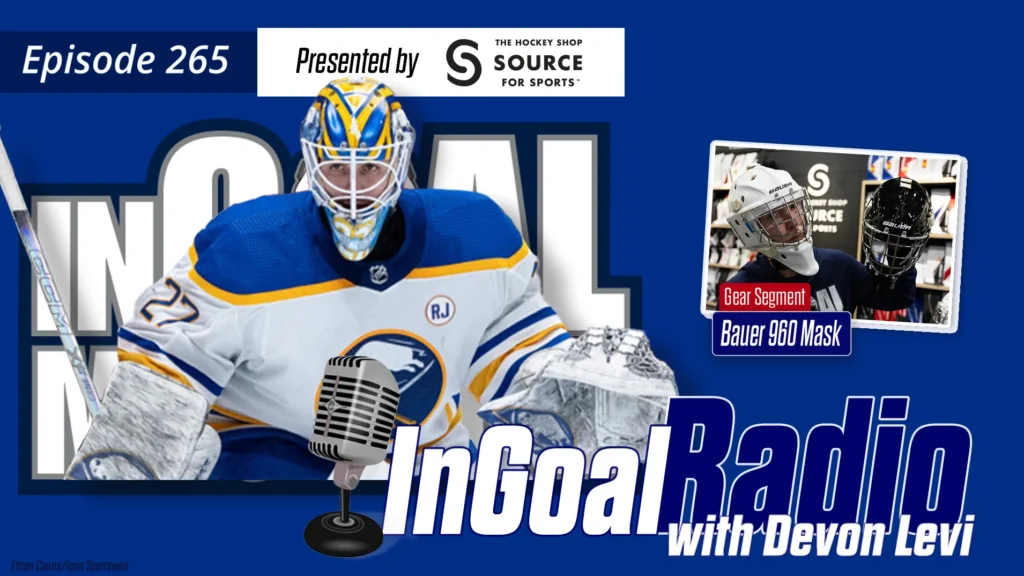
Episode 265 of the InGoal Radio Podcast, presented by The Hockey Shop Source for Sports, features an in-person sit down with Devon Levi of the Buffalo Sabres.
Feature Interview
presented by NHL Sense Arena
In the feature interview presented by NHL Sense Arena, Levi reflects on his first full season as a pro, including the benefits of — and lessons learned from — splitting time between the Sabres in the NHL and their AHL affiliate in Rochester. Levi also talks about how he’s learned to manage expectations, the role mediation plays in the his life (off and on the ice), how his use of video review evolves, how he uses a journal to find improvements in his game and daily routines, and (fittingly given the sponsor) specifically how he uses Sense Arena in-season.
Parent Segment
presented by Stop It Goaltending U
In our Parents Segment, presented by the Stop It Goaltending U app, we dig into questions about sticks — specifically choosing the right length and whether it’s okay to cut down the shaft.
Weekly Gear Segment
presented by The Hockey Shop Source for SportsAnd in our weekly gear segment, we go to The Hockey Shop Source for Sports for a closer look at how much has really changed in the new-and-improved Bauer 960 mask.
Episode Transcript
Intro
Welcome to the InGoal Radio Podcast presented by The Hockey Shop Source for Sports and thehockeyshop.com. This is episode 265. I'm David Hutchison here again with the one and only Kevin Woodley, and we're gonna handle things for another week or two from here in beautiful British Columbia. What's new, Woody?
Not much. Well, actually, a ton. A ton is new. It may be late July and not much going on in the hockey world out side of us, but, man, it is prime time for goalies getting ready for camps, getting ready for going to camp early in their captain skates. And that means we've got a whole bunch of goalies back on the ice preparing, and we had an opportunity to catch up with a bunch of them up in Kelowna last week.
So, really excited. Awesome. Just a great week. Really excited to roll out. Today, the first of several interviews that were gathered while we were up in BC's beautiful interior featuring Luukkonen of the Buffalo Sabres.
So we catch up with him once again and a fantastic sit down as our featured guest presented by NHL Sense Arena. It's, the first of many and the start of a start of a really good roll of content that we've got coming out.
Yeah. It was pretty cool to walk into the gym of James Wendland, who's gonna have another Five Damn Things article for us soon, only to see this week's featured guest presented by NHL Sense Arena wearing an InGoal shirt for his workout. Yeah. Good old Devon Levi. You know, while we're up there, Woody, I heard you say and I completely agree with you that he's one of the nicest guys you're gonna meet in the league.
But I also said there has to be something about goalies because there's so many guys we say that about.
Yeah. I had them I had them up there in my top three, and two of them are are sort of Kelowna regulars. So maybe it's just the relationships we build. James Reimer and who we also have a podcast episode coming out with. Great conversation with James while we're up there.
And Eric Comrie. So, I think in talking around the league, like, you get similar sense about those guys from from their teammates and stuff. There is you're right. I mean, maybe it's the relationships we've built, but there is sort of an all good guy team amongst the goalies.
Maybe it's just the goalies are awesome. Right?
Probably. Yep. There's something to do with it. We have to deal with so much, you know, so much stuff from the defenseman and the forwards that we just band together in a in a goalie union unity of niceness.
I'm looking forward to hearing what you guys were chatting about in the in the interview this week. In our Gear Segment with Cam at The Hockey Shop, we're gonna be taking a look at an update to the Bauer 960 mask. Can I say maybe, Woody, it's an iconic look?
It's well, I mean, remember how excited we got when it actually went on sale because of how rare that is and because there's a new version coming out, an updated version that we thought necessitated the old one being on sale? Well, we've got the new one finally. We'll go over all the features. I would say it is an iconic look. It's one that hasn't changed for a lot of years.
Even if the technology that goes into it, the fits available within it have evolved over years, I do think that that look is still sort of a staple in the industry.
For sure. In our parent segment presented by Stop It Goaltending U, the app, we're gonna talk about sticks for young goaltenders and a few things around that from questions from parents. The segment will be if you'll, pardon the dad joke pun, shorter than most but it is a common question. Before we go too far, could I ask everybody a favor who's listening? As as always, the podcast each week is completely free.
It would mean a lot to us though if you would stop by and leave a rating and a comment with your favorite podcast provider, whether you're on the Apple app or or maybe you're listening on Spotify or somewhere else. If you could just leave a little rating, that would mean the world to us. Really appreciate it. K. Before we check-in with our parent segment from Stop It Goaltending and our featured guest from NHL Sense Arena, we're gonna head over to The Hockey Shop for our weekly look at gear.
Gear
Woody, what's going on over The Hockey Shop?
A sale? Sale? There's a sale. Sale? Sale?
Ringside Rush sale up to 40% off at the hockey shop and the hockeyshop.com right now. They've got discounts on a long list of goalie equipment. Too much for us to mention right now, but I would highly recommend heading over there and checking it out. Like I said, up to 40% off as part of the rink side rush sale that's on right now at the hockey shop and the hockeyshop.com as well. We keep getting into these new segments.
We got another one this week with the Bauer 960. We walked you through the CCM XF Pro stick last week, and we saw a number of goalies using it up in Kelowna and talked to them about it for a review we'll have coming out at ingoalmag.com. But whether it's that or other items, there's constantly new stuff coming in at the hockey shop. So whether it's checking out the sale to save big bucks this summer for your upcoming season or wanting to get, insights or pricing on the newest, the latest, the greatest, they've got it right now at the hockey shop and the hockeyshop.com. Make sure you check them out for all your goaltending needs and check-in with their experts to make sure you get the gear.
It's not just the latest or not just the best price, but the gear that actually works for your game and how you play it.
What I'd love about what you've done within InGoal since day one, Woody, always positive about the gear, just talking about what's right for your game and and you and Cam do that together. So if you've got one of the best in the business, whether it's Cam or whether it's your Bauer 960, you're gonna be curious about what a refresh looks like with an update on a classic. So let's listen to Woody and Cam on the Bauer 960.
Welcome back to the Hockey Shop Source for Sports. Last time we talked to you about the Bauer 960, it's because the old one was on sale clearing out space on the giant mask wall for the new Bauer 960. And I mean, obviously, when you look at it, it's got the classic lines that we've come to know for the Bauer.
Guess what it looks like.
It looks like a Bauer Amazing. Nine
Isn't it?
So But so I'm I mean, given how big a deal we made of the rarity of the last one being on sale and how quickly you sold out of them Yes. I'm assuming there's something new here. I mean, you you don't wanna mess with the classic No. In terms of the look. So what is improved?
What is new in the new Bauer 960?
So mainly, we're getting some internal upgrades, on the mask itself. Obviously, visually aspect side, it's pretty much the same. New 960 logo, if you wanna really call out a bit of a difference. But, again, we're gonna be talking about the core of the mask itself. So, crayvon is their new material taken over for smack wrap.
Remember that? Smack wrap?
I don't actually.
Okay. So basically, what what is crayvon? It's their carbon material. So they're using this all throughout the mask, 12 k or 24 k carbon weave throughout. So still including the fiberglass, you're getting that carbon on top of that as well just to help with overall vibration dampening and impact reduction.
You get their DTC foam, their Defense Cloud Tech with the liner itself, and that goes into the chin cup.
So that kinda replace poron. Right? I guess.
That's correct. Yeah. Similar material, less porous than pour on.
So it's not gonna hold water. Ideally. Ideally.
Ideally. I mean, to be honest and to be totally frank with everyone here, we all know if you've worn a 960 before, they do absorb a lot of sweat. Again, further reduction and attempt to make sure that that is still reduced is in here. They've also hollowed out the ear holes just a little bit more to create a bit better ventilation with the mask. Also, curing in the mask itself.
That's all been improved by this new design liner. Backplate.
Backplate. What's like, is the design different? I don't have an old one because you sold them all. Is it or is it just the foam?
Nope. The backplate is different, designed to fit on your occipital foam better. That's the back of your head. So it rests a little bit better. This helps to improve the fit of the mask.
It stops it from kind of like bulging forward. It's actually carved out a little bit more in terms of that being the difference.
If you've ever fallen on your head or in Cam's case, been dropped on your head Oh, multiple times. You know that it's important to have a little protection on the back plate. It's always it always used to irk me. Maybe it's because I've had a really bad concussion from getting slew footed and hitting the back of my head on an old mask that had no protection back there. But the fact they've integrated the foam in a proper design to sort of protect you from that type of impact makes me very happy as a goaltender.
I thought about it. Would make you happy as a goaltender parent, I would imagine as well. Yes. What else?
Well, there's a mask bag here.
There's one fly on my mask. Oh, no.
One more surprise. We have a black 960.
This is new. Wow. Or new to you.
Yes. Yes. Yes. This oh, black went away with, like, the XPM series of masks way back when, so that would have been, like, 2019 ish, around there. So skid reduction.
We've got black back. We saw it come back in the enemy one. Now we've got it in the 960 as well. So if you're looking to switch up that look and get something a little bit different, you know, you can go buy.
Updated foams, little less water retention. You have better protection.
Nice redesigned chin cup.
Redes and now black stock available in the new Bauer 960. If you've got any questions about fit, sizing, availability, give them a call.
604-589-1899, 1-800-567-790 or thehockeyshop.com. Check us out. You can find us there. Also check it out on all of our social media feeds.
Like, subscribe, all those things. Jazz it up.
Awesome, Woody. Thank you. It was really cool to see that. I know there was such a sense of anticipation after the old ones went on sale, but you can see they've made some some significant changes even though the look is gonna be the same.
I mean, maybe I was maybe looking for bigger. Yeah. I'll be honest with you.
You know? When I went,
I thought this was gonna be like a, you know, a bit of a game changer. I had a hunch. I gotta be honest with you. I had a hunch or, maybe an inkling that this might be them. Right?
We we we talked about the CCM
Custom.
And the fact that CCM now has a 3D printed liner. We keep hearing these rumblings from Bauer. So when they actually put the old 960 on sale, I thought maybe the new 960 might include that 3D printed liner and the ability to customize it. Not yet, but still some really important and helpful changes to the line, to the Bauer 960. At the end of the day, there's a reason Cam sold out of the ones that went on sale so quickly.
It is a popular look. It is a popular fit, and it is a popular mask in terms of safety features, comfort, all the things you've come to expect from. I think you said it right at the beginning, an iconic mask. So an updated version, check it out now at The Hockey Shop or the hockeyshop.com. If you've got more questions, make sure you ask them.
And while we were both excited and hoping for something custom, having seen the process for the CCM helmets and masks, you can understand why it's taking a while for these things to come to market because there's a ton of work behind them.
Well, and there is a process to making sure you get it right. And anytime you launch new tech, especially when you're talking about something as iconic as the 960, you wanna make sure you have every aspect dialed in. And there's been sort of this there's a bold step by CCM to to come out with a 3D printed liner for their masks and now offering a custom, the ability to scan your head. We'll get into that in a future edition, maybe very near future here of the Gear Segment. The ability to scan your head for shape and size and have that because it's three d printed, you can have it custom printed to match.
But as you said, not an easy process, fairly laborious one. So everybody wants to make sure they have their details and their technology and their procedure dialed in before they launch. This is one case where CCM's ahead of the curve on it.
Parent Playbook
Okay. Here we go. Our friends at Stop It Goaltending U the app always bring us the parent segment because they are such a fantastic resource for parents and goaltenders. Woody, what's new over at Stop It Goaltending?
Well, there's something new every week, and that's what makes Stop It Goaltending U, the app, such an important tool for goalies everywhere. So let me just give you a quick rundown of an example of what's new this week. Of course, you've got your daily primers, quick one minute videos every day. But on top of that, for this week, there's a three minute goalie one zero one video with former NHL goalie Andrew Raycroft that breaks down the bump drill. It's got video Love it.
Highlighting proper entries into the RVH, mechanics, and the keys to a good bump across to the other post and a profit proper exit from that post as well as insights on an inside out path into the post, the importance of a 30 degree angle when you go into it, and more. All with Andrew Raycroft, former Bruin, former Maple Leaf, longtime NHLer, and now analyst and and goalie coach, as well a longer thirteen minute goalie systems video with Adam Werner, breaks down plays across the middle of the ice or the slot line as our friend Steve Valiquette would call it, and the keys to managing it. Adam goes through video using NCAA stars, including Jacob Fowler and Matt Davis to highlight the importance of control and depth management. And that is just a quick glimpse into what you get every week. Those are the highlights for this week at the Stop It Goaltending U, the app.
When you download it and subscribe, you get an automatic subscription to InGoal Magazine as well, the best of both worlds. Stop It Goaltending U and ingoalmag.com, a premium subscription. No better way to learn more and become a better goaltender than those two combined. Make sure you check it out now. And, of course, you can check it out wherever you're downloading your apps, whether that is on the App Store or Apple or on the Google Play, or you can check out their down their landing page at stopitgoaltending.com.
Love the partnership we have with our friends over at Stop It Goaltending U and all the new people it's brought to InGoal and the new folks it's brought to Stop It Goaltending U the app. And speaking of partners, there's a big partnership all the time between goalie parents and their young goaltenders trying to help them be the best goalies they can. The segment this week, Woody, is gonna be a little shorter. Well, I thought it would be, but I seem to have learned from the best in the business. So maybe I'll go on.
We'll see what happens here. It fits though really well in the heels of last week's Gear Segment because, as you remember, you were talking about the CCM's XF Pro stick and you and Cam got into it a little bit about balance and weight. And that got me thinking about one of the questions that seems to come in the most from parents and that's asking about sizing the sticks for the youngest goalie. And more importantly, can you cut them down? How do you size them once you've done that?
The truth is, there's no golden rule I know of for sizing a goalie stick. I know some people say a skater stick, you know, should come up to the certain height if you're standing on your skates, maybe your chin or something. But we don't really have that same rule for goaltenders. But parents, especially if you've got the youngest goaltenders out there often wonder, they cut the shaft down because they get these huge sticks for their young kids and they want to make it easier to work with. So often for years, if you checked out on the internet forums, you would see people screaming that you can't cut down a goalie stick because you're gonna change the balance of the stick.
And sure, it makes a difference. But as you and Cam proved last week, balance is in the hand of the holder. There is no right answer. A stick that's too large though or too long will be too hard for a young goalie to handle, period. So cutting down a stick for a young goalie to make it more manageable is okay.
Don't just take that from me. We've heard it from all kinds of coaches and goaltenders, and we'll talk about that in a second. One thing I often have heard people say is, are you gonna do some irretrievable damage by cutting the carbon fiber in the stick? You know, people say that if you get a nick in carbon, it's gonna create a flaw that will lead to breakage. I don't even know if that's true anymore with modern sticks, but that's probably where it came from.
All I can say is people cut them down. I have cut them down with a regular saw. I just pull that plastic plug from the top part that I've cut off and put it back in the shaft after cutting and away we go. Now, can't speak for what that's gonna do for your warranty. Probably it is an issue, but having my kid comfortable on the ice has always been number one for me.
Again, will it mess with the balance? Well, all the major companies are now making sticks with shorter shafts and I'm not aware of any change they've made to the paddle to offset that in terms of the balance. In fact, you can go onto their customizers and get the identical stick in different shaft links. So I think that kind of proves the point that changing the shaft link is not the end of the world. Now the XF Pro is following a recent trend with sticks being a little bit shorter.
Bauer brought in the Hyperlite sticks that were shorter. True has theirs. It's the Hzrdus one I think, isn't it Woody, that they've cut down to make it shorter. This was all popularized of course by Carey Price who cut his sticks down several inches and told us it was about better handling of the puck in tight around his feet. So companies first made that an option on the customizer and then now they've made it stock with a lot of their sticks.
So that happens to bring down the weight for those people who are worried about counting grams and so on. Now, the other side of the fence, we've got parents who don't want to cut them down and they wanna buy a larger stick that will last longer as their child grows. I get that goalie is expensive and when they're younger, the stick is less likely to break. So maybe you think you can get a couple years out of it. And we all, of course, wonder about that old bigger is better.
I remember Woody using longer paddles with that in mind. I'm shall we say average height? But I always used the longest paddle I could because of the size. We and I'm talking about us older guys, used to size our sticks so that when we were in our stance, there wasn't any what we call double coverage. We'd use a longer paddle because we didn't want our blocker overlapping with our pads and our stance and covering the same bit of net with two pieces of equipment.
And while it is okay to look bigger, probably is good to look bigger, proper save execution and mobility are way more important. So today, the trend is to use shorter paddles. With NHL goalies, we know going down to 25, even 24 in some cases, not to mention shaping the top of the paddle that lets them hold it even lower down as you will have seen in articles over at ingoalmag.com with guys like Sergei Bobrovsky, Marc-Andre Fleury, who himself talks about Carey Price. Why? The number reason I hear is simple.
How many stick saves do you make standing up? Pretty much zero. So now we like to size our paddle so when you're in the butterfly, you can hold it to make a stick save comfortably. If we were on video, could show people what that's all about. But this isn't really a lesson on how to size your stick so much as it is just a bit of information that we wanted to share with parents to give them sort of permission to try different things and experiment a little bit.
By the way, having your stick a little bit or your pad a little bit shorter also makes it easier to protect the crease in ways that we saw with that Bill Ranford video for example. Look, if you're out there trying to save a little bit of money or you want to look a little bit larger by getting a larger stick, you're more than likely going to be impairing your kid's performance. You'll reduce their mobility, you'll reduce their ability to make stick saves because the stick, shaft will be more awkward. You can open up holes in the butterfly and they're probably going to have trouble learning to handle the puck too. If it's about money and I get it, may I suggest that if you're in the sizes with kids where there are different options, it's okay to go for the more affordable sticks.
They might be a little bit heavier, but only to an absolutely elite goalie are they gonna know the difference. And most of us will be just fine in that lower price point. Maybe it even makes it easier to get sticks more often as your child grows as a result. So size it properly and maybe next year if it's time to get something larger, you could look at even selling that old one to a family with a younger goaltender. Of course, if you're that age where the shots are hard enough to go through multiple sticks a year, just get the right size.
As I mentioned, it's almost impossible here to tell you though exactly how to size them, so give Cam a call or drop by the Hockey Shop or your local retailer. Talk to somebody who knows what they're doing and they will help you get your kid sized properly for a sick.
I I would say that at the ages where you're most likely to have to cut it down because if you get to sorta you're getting into that taller closing on six feet above the Hutch average height. Just a bit. You probably can get it at a at a length you like it with all so many options as you mentioned of shorter sticks. So if you're cutting it down for younger kids, probably not at a point where the shot velocity is breaking it anyways in terms of avoiding that warranty by doing so, which is one thing to consider.
Also true. Yeah. So try some experiments. You can also borrow sticks from other goaltenders as I often see kids doing at camps. One of those other little bits of value when you go to a good goalie camp is the kids will trade off gear a little bit and see what they like and and that's a good way of learning.
Okay. Thanks for joining us for some parent stuff. If you do have questions, as always, parents at ingoalmag.com and we'll see if we can address some of those for you or just tell tell us what you're thinking about the same topic and we'll share some of your thoughts with everybody. Okay. Woody, our featured guest this week is presented by NHL Sense Arena VR, Devon Levi recorded in person in Kelowna.
Feature Interview - Devon Levi
And this is where I tend to say some nice things about NHL Sense Arena. Of course, it's an incredible VR tool for goaltenders with realistic shots even from NHL players, great drills, training programs with new ones added all the time, including the one that was just released from former PHF goalie and now NCAA coach Abbey Ives. And you've heard here how goalies right up to the NHL use it. Even Joey Daccord using it to warm up in between periods of an actual NHL game. But I think this week, I'll just leave it at this because if you listen to this week's interview with Devon Levi, he'll tell you why he uses NHL Sense Arena.
Because it came up in your conversation, Woody, and that's about as real as it gets.
Yeah. And you'll hear it early on in the conversation. It comes up from him. So because last time we talked to him, I knew he was an avid user, but I forgot to ask, which tells you about my skills as an interviewer, especially given we're sponsored by them. This time, I forgot to make a note to ask, but he mentioned it early as one of the tools that evolved in terms of how he uses it during this season in the NHL.
And so it naturally added a note to my go back to this, and he did and got into the exact way he uses it and how that's changed and how that's evolved. So further validation at the pro level that this is a legitimate tool. I also think it's important to have that validation if you're a young goalie out there and you're worried about what other people might think if you take it to the rink as part of your preparation to play. Listen. Some of the best in the game, whether it's Joey Daccord, whether it's Devon Levi, are using this as a tool in that manner.
So there's no shame in doing it yourself. We heard Joey Daccord talk about using it between periods to dial in his glove. If it's good enough for the best, it's good enough for you. And it's always nice to sort of have that reinforcement from the guys at the higher level that they're not shy about talking about virtual reality as a tool to get better. Devin does just that as part of an interview that covers a lot of different things.
Can you set the scene for that interview? Because as people listen, they're gonna hear a bit of a different sound. A little bit of echo in there, maybe how it sounds when you're chatting in an empty dressing room.
Which is where we had this conversation after a ice time with Devin up in Kelowna. And I will say that he was very gracious with this time for both this interview and a little bit of video work. We've got some video drills coming at ingoalmag.com featuring him and Marco Raimondo last summer in Montreal. Not always the best place in terms of sound quality to sit in a locker room at the local rink, in this case, West Kelowna, but a great spot, a natural setting where the goalies are comfortable. And so that's where we did it.
And I think you'll hear that in this interview because Devin is pretty relaxed and comfortable in the conversation.
I actually think it sounds fantastic, Woody. It just sounds different. One of the things that's really cool about it is it feels like you're sitting in a rink and, you know, rinks have this look, they have this feel about them as you walk in that just feels like home. So I think it's great that you did it there. And with that, Kevin Woodley, ladies and gentlemen, write down the date Monday, July 29.
Kevin Woodley was speechless. Kevin Woodley and Devon Levi chatting in Kelowna, BC.
I had nothing to add. Really excited to welcome back to the InGoal Radio Podcast. Second time and in just a year, less than a year since we saw you in Montreal, Devon Levi coming off your first full pro season. I wanna talk about the lessons from it. Looking back, what stands out to you?
Yeah. I mean, it was a great year. Learned a lot. I thought I got a lot of experience, you know. Playing a full season is definitely different than playing seven games at the end of the end of the year after my my college year.
So And just schedule wise, I would imagine.
For sure. Honestly day. That that was probably the biggest jump. You know, I think I played 50 games this year, which is 15 to 20 15 games more than I think I've ever played. Plus, you know, all the games that you're backing up, and it was definitely a different schedule to try to manage.
There's the there's the physical side where, you know, you wanna be getting your work in, but you don't wanna be overexerting yourself. So it's really trying to fit like for me, it was figuring out what do I wanna start practice with and what do I wanna end practice with. Having those good intentions and regardless, like if it's a good day or bad day, just making sure I'm getting my work in. I have a tendency to wanna stay out for like an extra twenty, thirty minutes, you know, feel the pocket, you know, practice wasn't great that day. But really just having a good focus going into practice, getting good work in and then if I want more reps maybe going watching some video, doing some VR instead.
Something that I could give my body a little bit of a rest because the most important thing is being fresh on game day mentally and physically. So that was kinda that was kinda the battle to try to manage that. The physical part was probably easier than the mental part because mentally, it's it's it's easy to, you know, be thinking about hockey all day for me at least because, you know, I I had school as a distraction the year before where, you know, I could only focus on hockey so much of the day, and then the other part of the day is dedicated to to my academics. And this year was really the full the first full year that, like, I could just be hockey. So I learned how to manage my time a little bit, having some some some things to do away from the ring, some hobbies that, you know, you could take your mind off the game and then be even more fresh going into the next morning.
Not that having hobbies is a bad thing, did you, like sounds like you almost had to, like, force yourself to take brain breaks from hockey a little bit. Is that what you're what you're saying? Like, you had to have something else.
Yeah. Really finding balance in in your everyday life. It it helped me show up to the next day to the rink with a little bit more energy, a little bit better focus. I started to realize that, you know, the more time I spend on, you know, thinking about the game or at the rink or or doing some extra stuff, it takes out of my next day a little bit. I feel like the quality of my reps are maybe a little bit lower.
Yeah. Really finding balance in in your everyday life. It it helped me show up to the next day to the rink with a little bit more energy, a little bit better focus. I started to realize that, you know, the more time I spend on, you know, thinking about the game or at the rink or or doing some extra stuff, it takes out of my next day a little bit. I feel like the quality of my reps are maybe a little bit lower.
So really this year was just focusing on quality instead of quantity cause you're getting that quantity in game. So when you're in practice mode, you have to be really smart about what you want to work on and what you want to do. Cause if you're overdoing it in practice, games are gonna be really hard and then recovering after games is that much harder. So for me, was really finding that balance. And, Mike Condon helped me a lot with that at school, actually.
It was always he was always telling me, like, hey. Do you need this? Do you need to do this? So it was just kind of figuring out what I need and what I don't need just so I'm not in in burnout mode.
I was gonna say the recovery is a lot different when there's a game two nights from now as opposed to the following weekend. Like, when you were in college, there's so there's so much gaps there.
Yeah. At school, you know, you get four days of practice leading up to your games and you get two games, you get a day off after and then it's it's a little bit more of a a scheduled approach to the season where mentally you kinda just you just know what you have to do when you have to do it. It's the same thing every week. I'm in my routine. It takes that, like, thinking and that planning out of it.
But, you know, this year, it was, like, kinda figure it out on the go. That also takes a little bit of mental energy too. So being able to kinda manage myself, my energy, really understand what I need, what I don't need was was really important because, you know, you could do everything and do everything else that every other goalies are doing, and that could burn you out. Do you need that? Maybe not.
So just really listening to your body.
How'd how'd you prioritize those decisions? What what I need, what I don't need? Like, I I guess each one would be unique. Yeah. There a process whereby you're trying to figure that you came to figure out, like, okay, like, this, like, this I really can live without, but this I really need, like trial and error.
It just experience. Yeah. It's it's the only way you know is through experience, you know. There there's some days where, like, I stay out too long on the ice and then the next day in practice, I'm a little bit tired and, you know I like journaling my practices and looking back you could kind of correlate things.
Know the day before if I didn't get enough rest, maybe not enough sleep, maybe not enough you know time doing something else other than hockey. Maybe the next day is the quality of the next day, like, reps wise is is a little bit lower. So just trying to find those, you know, patterns and what results in good performance and what results in maybe a little bit less good.
Okay. Journaling. We've heard we've luckily, not the first to talk about it, but sorta, again, understanding what I did that day so that you can see some of those patterns. How what does that look like for you? Like, after practice, just jot jot things down or like Just so for the young kids, okay, journaling sounds like a great idea.
I've heard other guys talk about it. How does it manifest itself for you?
Yeah. I think it's it's it's great for me because it's it's easy to get like stuck in your day rather than taking, like, a zoomed out approach on your week or your month type of thing. So, you know, let's say at the at the rink, you you you don't have a great day. Kinda journal it. What did I do in the morning?
What did I do night before? Whatever. You know, you you put that down. And then, obviously, like, you can't just look at this one day and be like, oh, like, I got eight hours of sleep yesterday, so I gotta get more sleep. Like, you don't know if it's your sleep.
You don't know exactly what's causing the bad day. Some days you just have bad days and you do everything right too. But it's really that over time, like, where you start to see patterns is when you could kinda just start chipping away at them. Okay. It's hard to diagnose on the spot.
Like, you're not gonna you're not gonna really know just looking at that one day. So having that, like, zoomed out approach is is helped me a lot.
Well, again, was just gonna say that, but if you don't write it down daily, you don't have the ability to go and look back.
Yeah. And you're not gonna remember, like, what you ate the night before or, you know, what you were doing weeks before a game or the week before.
So it's important to do it daily.
Yeah. So I mean, it doesn't have to be overkill. It's kinda you jot down jot down the most important things. You know, what my focus what I do is like I I write my focus down before I go on the ice. What am I what am I gonna focus on in practice?
And then kinda like a little summary of of how the practice went. And how you felt? How I felt, you know, what happened, was my did I stick to the plan? Did I change it a little? The next day, I'll write my new plan.
If it changed a little, then I'll set a different intention or it's the same intention. Then you end up looking back and you're like, okay. When I was going through, like, this rough patch, this was, you know, what I was thinking about in practice. This is what I was working on. Or, you know, I I had a really good few weeks here.
My practices were really good. This is what I was thinking about in practice. So kinda trying to correlate those things and then, you know, that's kind of the on eye stuff. And then you could do some off eye stuff too, like what are you eating? How much you sleeping?
Kinda like those those those kinda daily habits, figuring out, like, what time you woke up, like, maybe you slept in a little bit longer. How did that make you feel? Two hour nap compared to a twenty minute nap on game day. Just, like, jotting down, like, information about your day. And then
So I was gonna say, is it hard to is it harder to to stick with certain schedules as you start to travel and especially depending on where you are? Sometime in the NHL, sometime in the American League, like buses, planes, different sort of the ability to regiment your schedule and make sure you have that that nap on a game day. Whereas I know sometimes on the road in the a, you can be traveling and, you know, guys will show up at the rink and like, it guys have told me it's harder to stick with things there. Like, do you learn through some of those lessons too?
For sure. I think there's a lot of like change on the fly. Right. Because you don't really have
Again, especially from college to
Yeah. For me, least, I didn't have a great feel of like how my week was gonna go. Like, I look at my schedule, like in college, I, you know, it's the same schedule every week. I have a a week that oh, like, I I was burnt out by the end of the week. I need to tone it down a little bit.
But or or maybe, like, I had a lot left in the tank. Like, I I wasn't ready for a day off after that game. Like, you know, I could have maybe put a little bit more into my practice type of thing. You gotta feel for that because it's the same thing every week. But in in pro, you don't get to redo the week and, like, get another chance at it because every week is different.
Right. Sometimes you're playing on the road, home, you got back to back or you got like a, I don't know, a three and six. Like, who knows? You the schedule is completely in flux. You're changing you're you're changing your opponents too, different travel places, different time that you're going to bed, waking up.
So there's a lot of moving parts that you know, you don't they're they're hard to micromanage. So being able to, you know, be be comfortable is definitely a challenge because there's a lot of things, a lot of extra things that are uncontrollable. So that's why it makes the controllables even more important, like dialing in what you can control, your days off or your days at home. The the it makes it that much more important just to have some sort of routine.
You mentioned hobbies. Was there anything that that you can share? I don't wanna put you on the spot. Actually, I probably should ask for, but what do you what do you find that you like to do? Like, is there something new that, like, jumped out at you that was like, hey.
I've never haven't done this before. Did you read different things? Did you what what jumped out for you to what's a good distraction from you for you from the game? Because I know you're a thinker too. Yeah.
So, like, how I approach it was I knew I needed I needed something that I enjoyed that would kinda take my mind off off of hockey so so that I could be fresh mentally the next day. But I also wanted something that, you know, I could still challenge my brain, challenge myself a little bit. And so I ended up taking up painting. I loved it.
So, like, how I approach it was I knew I needed I needed something that I enjoyed that would kinda take my mind off off of hockey so so that I could be fresh mentally the next day. But I also wanted something that, you know, I could still challenge my brain, challenge myself a little bit. And so I ended up taking up painting. Like, I've never painted in my life, maybe when I was, like, in grade two. But I just felt like, you know, working the creative part of my brain, just trying to trying to get something of quality and it's super meditative honestly, it's very enjoyable, I loved it.
And, know, first few paintings weren't great, but then just kinda again getting a feel for it, understanding watching some videos. It's a little bit of a learning curve. Then, you know, I had fun. I had my own place. I'd paint paint something, put it on my wall, started like a little collection.
So it was fun. It was a good it was a good hobby. It honestly, like, took sometimes, like, six hours in my day. And, you know, they're a great six hours. Like, I completely forgot that, you know, I'm a hockey player.
I got a game the next day, for example. And then you realize, oh, get to play hockey tomorrow. Like, that's great. That's fun. Instead of, you know, thinking the whole day about the game the next day, it gets a little bit mentally exhausting, especially with 82 games.
So, you know, that that kinda excitement to, you know, have something else that you're excited for makes you more excited to play hockey, makes you excited to you know, it's just that balance in your life, like, really makes everything more enjoyable.
So, I mean, I'm not an artist. I got a daughter. I don't know where it comes from, but, some of the stuff she creates blows me away. And I see as she was learning sort of the science of the art, like the shapes and, like, drawing faces and stuff. Like, were you a landscape guy?
Did you because I know you have a very, like, science y brain too, obviously. Mhmm. So were you, like where'd you find that balance between this the the art and there is still a a procedure element, a procedure there can be a procedural element to drawing and painting. Did you try and get away from that completely? I'm curious where your brain went on this.
Like, structured and then add the art after or a little bit of both?
Honestly, I just drew it whatever the hell is in the mood for.
I love it. I love it. Okay.
Make know, some days it was like Spider Man stuff. Like, I'm big big Marvel fan. So Yep. Just trying to make some some some Spider Man paintings was was fun. Like, I I drew a beach once.
I just felt like being at the beach. So why not why not paint it? You know?
So Love it.
I kinda like that. Just kinda escaping the moment and just diving into, you know, whatever I was painting. It was it was fun. It was enjoyable.
We're not gonna have a Devon Levi, Bob Ross, like, YouTube art channel anytime soon?
Probably not. It might take, like, twenty years before that happens. But, you know, instruments like music, I love music, listening to music. I I know how to play the piano. Not very well.
Just I learned off of YouTube. My dad taught me a little bit. I did not have a piano this year. I wanted to learn guitar, but I was honestly, I I wasn't ready for the for for the challenge of picking up guitar out of nowhere. I think that'll be a next year thing.
This year was, like, painting. Next year will be guitar. But I did get an Xbox three sixty and got all the Guitar Hero games. I was just playing that. It's a great way to, you know, still, like, work some hand eye stuff and, you know, listen to some music that I like and remind me of my childhood.
Still get to play a little video game, keep it a little, you know, just just, like, fun and, you know, nothing crazy, nothing too hard. Also a little bit of downtime where, you know, I could relax and just enjoy something and not really challenge myself too hard, but it it was just fun. It was a great past that.
That's funny because we do have articles. We actually have there's a science between playing sheet music guitar and the neural pathways required for getting the different chords or Oh,
It's it's as close as
the To a glove. Like, they they actually tied it into a goalie glove hand. Same neural you're training the same neural pathways if you do it off sheet music. It has it has to be read so that there's something about okay. There's an actual transference there.
We've done articles. We'll have to send you a link, but it sounds
like you're talking about Guitar Hero for a second. I got a little excited. Oh, yeah. I'm gonna play eight hours of Guitar Hero tomorrow.
But it sounds like you really discover the importance of not being a goalie all the time. Because you're a guy that I know I mean, talk to Condo about it too. Like, that like, like, you're so dialed in on everything. You need to give yourself a break.
For sure. The season is definitely gets long with 82 games. You know, it's it's it's a great season. It's it's definitely manageable, and you can enjoy it like crazy if if you approach it the right way. You know?
If if you're killing yourself and burning yourself out, it does feel long. So really having that balance, being able to stay in that flow, just like flow through the days. By the end of the year, like, on practice games and game days, like, I kinda treated them the same. Like like going into morning skate kinda felt like a practice day for me. Just, you know, get some work in.
I go take my nap, and only once I wake up from my nap, it's like it's game day. So it keeps that, like, you know, the I'm a little bit fresher mentally, not really trying to focus on the game too early in advance, kinda just have that playfulness and, you know, be be able to just walk into the rink and do my do my thing, you know, not really have to think about it, let it just happen. Because, you know, thinking about how you're gonna perform for 82 games is a lot of thinking, and it's definitely a lot of mental calories throughout a season. It it it all adds up. So, you know, just trying to be smart with the amount of mental calories and physical calories that you're burning.
I love it. What stands out? Like like, you know, like you said, you you had your taste. Right? Like, you you got an understanding of what the NHL was like the year before.
Are there memories that jump out from this year? I don't know if you've even I don't know if you're a guy that's reflected. I mean, it's your first year of of many. But do you look back at this year? Are there are there moments or memories or things that jump out at you as, like, wow.
This is my first time doing this. That was special. Or moments where you found yourself taken aback at all by where you were?
Yeah. I mean I mean, for sure that Montreal game, was taking them back. That was super you know, it was so easy to be in the moment during that game because it's so special.
There's no How many games did you watch there growing up?
Oh, I I mean, my family and I went to definitely a few games every year for a good amount of years. So it was it would I was I was in that building a lot. Very easy to be present in that building because, you know, I there was nowhere else I wanted to be in that moment. So it was super it was a super special experience. Loved playing in that rink.
It it was it was a great year. There were a lot of really cool moments, a lot of ups and downs, and it was it was interesting seeing how, you know, those downs evolve into an up. It's it's pretty cool to see how the challenge and the adversity that you're faced with on one day is the reason why you get to climb that mountain the next day.
Can you give me an example? You comfortable giving me an example?
For sure. So the first time that I got sent down to Rochester, you know, I didn't I didn't expect it. And it was it was my first first first experience with, you know, kinda getting let off. And, you know, it was it it went really well. I had a good talk with with Kevin Adams and and the rest of the coaching staff.
It was the right decision for for me to be able to go and play and get games, get more experience, get comfortable. And, you know, at the you never wanna get sent down. Right. So it it definitely took took a second to kinda process and, you know, understand that this is this is gonna be a great experience. I think I could have gone into that with a negative mind and made it a negative experience, but I took it very positively even though it was it was definitely a challenge.
Definitely a challenge. But what happened was my time in Rochester ended up being unbelievable. I I had such a good time there. It was so good for my for my game. The boys were unbelievable.
I had so much fun. I really felt like my comfort with, you know, being on the ice taking shots, like, kinda rose the more I played there. And and, you know, I was I was able to get settled. I was there for a little bit, and it was it was a great experience. And it that low became, you know, a high, really, really enjoying my time there.
And then, you know, kinda riding that wave of high, I got called back up and I played three games, and those three games were probably the best three games that I I felt in, probably out of all my NHL games. So really seeing how, you know, those those moments of adversity really are there for a reason to to get you ready for for your next climb. You're never gonna go down and keep going down forever. There's always a rebound. And even when you're up there, there's a rebound down.
And, you know, kinda expecting that makes it easier to manage the the highs and the lows. And understanding that it's that one it's like the yin and yang, they follow each other. They're only possible with each other. So, you know, those moments where you feel, you know, are hard and that you have some adversity, just being able to smile in the face of that and knowing that it's good for you is is it's it's really hard to do.
I was gonna say it's easy to recognize it now. Were you able to in the moment? Maybe not immediately, but, like, it sounds like you had some awareness of this even in the moment.
Yeah. Maybe a little bit in the moment. It's more looking back on
Okay.
Wow. That was that was that was pretty cool. But having, you know, having experienced that, you could kinda feel it going into your next moments, your next high, your next low. You kinda know you know that there's light at the end of the tunnel. As long as you you keep being positive and, you know, you you 're looking at the end of the tunnel.
Dealing with us, maybe not InGoal because we ask different questions. Right? But there is an external pressure, I think. And obviously, you're a guy who's been put in a spotlight there in Buffalo. Did you feel that at all?
It felt like watching the answers from a distance, like, you'd really detached yourself from the expectations that others had of you, that you really were in your own space. Was that easy? Am I right in that? Am I reading that correctly in terms of when you're sent down? You're disappointed personally, but there just seemed to be a lot of attention around you where where you were, whether it was the right decision.
Were you able to sort of keep that at distance and just focus on yourself? Is it harder than maybe people think?
Yeah. So, I mean, those difficult moments, like, I feel like I I have a pretty good outlook on, you know, myself and kind of how the season goes where, you know, you you know that there it's not gonna be all pretty and it's not gonna be all ugly. There's there's that balance between the two. Obviously, you want things to go better than not, but, you know, understanding that, you know, it's okay it's okay to have a bad day and just kinda learning from it, like, from from, like, a a bystander perspective, like, not being in it emotionally, being able to detach emotionally from situations and just look at them as as a learning opportunity. That was probably the biggest thing that helped me this year.
My meditation practice also helped a lot. Just really being able to detach from moments emotionally and just understand understanding how to have perspective perspective on certain things. Whether I'm in the game playing and just letting the goal or if it's, you know, if I'm at home after a bad game, even after good games, even after a great save, having perspective, like zooming out and really seeing, like, the whole picture, but not too big where, like, you're thinking about, like Everything. Expectations, what coaches are thinking, what fans are thinking. It's
really just So staying in an athlete minds, like like, not keeping that noise external even as you zoom out.
Yeah. Just exactly. Just focusing on on myself. Really just at the end of the day, you know, you you wanna perform well and you wanna win, but I think it's more important to have, like, a a mastery mindset. Like, obviously, I wanna win a Stanley Cup, and I wanna win every game.
That's the goal. But to go into practice, maybe after a game when you're tired, maybe after a bad game, or maybe after a good game and you don't really wanna practice, but having that mentality that, like, I wanna be a master. Like, I'm not content with just winning a game or winning one cup. Like, being a master at your craft, really honing in on the process is what brings the results. So the results are all part of that.
That's the goal. But to go into practice, maybe after a game when you're tired, maybe after a bad game, or maybe after a good game and you don't really wanna practice, but having that mentality that, like, I wanna be a master. Like, I'm not content with just winning a game or winning one cup. Like, being a master at your craft, really honing in on the process is what brings the results. So the results are all part of that.
You know, they're there, but you don't really wanna look at because they don't mean anything. You could have a really good game and do a lot of things not so good. You could have a awful game and you did everything well. And it's just really the consistency of doing the right things over time that will bring those results. So it's not even worth thinking about the results.
It's more worth thinking about the process and becoming a master at that.
Okay. So the puck is a frozen piece of rubber in an odd shape on a sheet of ice. So bounces happen all over the place. And you're right. You can play you can have a perfect game from a process standpoint and still not get the results.
Tockey. How like, saying that and being able to detachment, where does video fit in between you knowing and being comfortable that that the process was right and this sometimes stuff happens because it's a frozen puck on a sheet of ice? Like, how do you how do you sort of maintain that process versus results? How do you detach from the results? Do you use video as part of that process and review, or do you just know in your head, like, I've had a good game and stuff happened?
I mean, even even having, like, after a good game, after a bad game, it's still good to look at the video.
Okay.
Kinda just take the emotion out of it. You know, when you're playing, you're
kinda in process when you're looking at the video? Like Yeah. Yeah. For sure. I moved, how I
Yeah. I mean, I'm looking at everything. Like, I'm looking at, you know, my technical game, looking at my reads. I'm looking at, like, situationally, like, how did I how how was I, like I remember how I was feeling in certain moments. How how did I manage, you know, the the game when we're up two one with three minutes left in the third type of thing?
Was I able to really focus in and dial it in? And really learning from that, like, I'd I'd look at, you know, some technical things. Okay. Do I wanna play this a little bit differently? Like, maybe my depth, maybe my angle is off.
Do do I was the read right? And then it's kinda situational, like, how was I mentally and emotionally in this moment? And then there's some good moments, some not as good moments that, you know, are are fixable. You you have it right in front of you. It's it's you have your game tape.
You just gotta you just gotta find it and, you know, take the emotion out of it, and just look look at it how it is. Is it is it something I could build off of? Sometimes it's like, guy scores a great goal, you gotta tip your hat. Sometimes, okay, maybe I coulda had that. And, you know, it kinda gives you peace of mind in game when, you know, things are happening.
It's like, sometimes you wanna figure it out in the moment, but also, you know that there's another shot coming, like, in
So you have to trust your process.
So you trust the process. I know I'm gonna do video after the game. I'll talk with my goalie coach, you know, figure that stuff out. Right now, it's just time to have fun and compete. And then in practice is when, you know, I'll I'll maybe make a change.
There might not be a change to be made. Sometimes you you think that you should have had it in the game, and then you go back, look at video with your goalie coach, like, a good play. It's a good shot, whatever the case may be. So diagnosing in game isn't always the best idea. Really just sticking to your process, doing doing it more that more often than not will probably lead to better results, but, you know, it's not gonna be a 100% all the time.
You're not gonna win every single game and get a shot at every game. So it's just consistency with what you're doing.
Meditation, obviously, the focus is on when you meditate on the ice and the Jedi stuff. And I what I got I will have to ask about what you think of the making you move it. But you mentioned also, like, whether it's after a game, like, where does it fit into the other parts of your life? Because, again, I feel like that's almost like the visualization thing. Like, we hear it a lot.
I was talking with Clay Stevenson earlier today, and he was talking about visualization, and the kids hear it, but they don't know what it looks like. How do they how do they fit into their lives as a goaltender to help them? Right? Like, what is it? Is it look through the mind's eye?
For meditate for you meditation, can you help me with that a little bit? Is it like like if I was 15 years old and I was like, how can I how can this help me as a goaltender and in life? Yeah. Outside of, you know, the very public times you do it in game, where else does it fit in your life?
Yeah. You don't have to be in the middle of a game, like, on your knees, like I'm doing it. You also don't have to be at the top of a mountain like a monk balancing
on That's the stereotype. Right? Yeah.
You know, there's you could do it at any point of the day. It's really just a second to focus on what's going on inside rather than outside. You're taking in so much information. You you're not even realizing it. The external stimulus is an absurd amount that you're taking in throughout the day.
So it's important to really filter it and understand what's going on inside and being able to, you know, let stuff out as well. There's so much coming in. So instead of bottling up and grabbing onto it, just understand like, feeling it inside and just understanding how to breathe through it and let it kinda chill out and disappear because it always does. You're never gonna be mad forever. You're never gonna be happy forever.
There's, like, the balance, the ebbs and flows of that. So but really understanding how to kinda let it in and out rather than holding all this stuff that's coming in is pretty important because, you know, that that feeling that you get after you let in the goal, it's like, ah. But if you're if you're able to kinda let that in and out as it comes, like, flow in and out of you, you you don't even realize, but next puck's coming and you're dialed in on it. And, like, I don't sometimes I don't even I'm not even aware of it. It's just from my practice doing it at home that sometimes something that you don't like happens and it doesn't really affect you as much as it did the day before.
It's definitely something to
So it's like everything like it's a daily practice
for It's daily practice. Something to do every day. It could be two minutes, it could be while you're in traffic, it could be at any point. Just taking a second to look within what see what's going on inside.
Okay. You mentioned earlier, I gotta touch back on this real quick because I didn't last time and I I could've gotten in trouble here. Sense Arena, are still using it? Yeah. I'm curious how because we've seen it evolve for guys like like Dak, Joey Daccord told us he used it in in in in an intermission once.
Didn't didn't feel good about his glove, Just went and put it on, put on the cannon, took a went back in the game and just felt really good about his glove and how it felt. Cool. That's interesting. I thought that was a cool set. How does it work for you?
What when are you still I know you're still using it, but how like, how does it fit into your world as a professional goaltender?
Yeah. I think it's a great tool to have. I mean, I I've used it for multiple different reasons this year. I've used it before going on the ice. Sometimes, like, you go on the ice and you feel like you need, like, a 100 warm up shots before you can start practice and before you're really seeing pucks well.
So that kinda just, you know, trims that time down. You you you're already doing some tracking stuff, some movement stuff. So getting on the ice, it's kinda it's kinda I already feel like I'm warmed up mentally. Maybe maybe not physically, you know, you're not, like, doing crazy movements. It's more just, like, trying to set your intention for the practice and just kinda feeling the puck so that when you go in, you just do a few movements and your body's warm, you're ready to practice.
And that's that's how that like, this this this tool is honestly great for taking load off your season. Like, you could reduce your warm up time when you're on the ice. You know, there's there's days where maybe you want a little bit extra work, but, you know, it probably wouldn't be beneficial for you to stay on the ice any longer. You get off the ice and put the VR goggles on, take some shots. You know, it's it's super easy on the body.
And that's that's how that like, this this this tool is honestly great for taking load off your season. Like, you could reduce your warm up time when you're on the ice. You know, there's there's days where maybe you want a little bit extra work, but, you know, it probably wouldn't be beneficial for you to stay on the ice any longer. You get off the ice and put the VR goggles on, take some shots. You know, it's it's super easy on the body.
There is there's so many different ways to use it. Those are probably the two that I used it most on an off day as well.
Just get some reps.
It was it was was great to get some reps too, you know, after after a game that, you know, you you feel like you wanna work on something right away, just putting it on putting on on during the off day if you don't have a chance to skate. It's also great. Actually, what I use it the most for was away games for morning skates. When you get to the rink, the other team skates first and then you go on.
Your time is very finite.
And you don't get you got maybe three to five minutes of goalie skate, goalie shots before you go into the morning skate. And there's some days where it's like, wow. That was not pretty. That was not pretty. Like, doing some of those those flow drills, those two on one drills, two on o drills without having seen a shot before is not easy.
So putting the VR on, getting some shots, getting warmed up a little bit mentally, physically, seeing the puck, hopping in those drills are way easier, way more manageable. So, it's, that's kinda to the extent that I used it, and it it helped me a lot.
Outro
Such a well thought young man. I love that he's trying everything he can to become a better goalie, but he's not chasing change. We learned that if he tries something and it fits, then fantastic. And if it doesn't, then he's got that critical eye that tells him it's time to just move on and and do something different because the number one goal for him is to be able to go out there in games and play without thinking.
Which probably actually hate to. This is gonna sound like a shameless plug, but kinda tells you something about him continuing to go back to NHL Sense Arena is one of those tools that he does rely on.
That is a shameless plug.
But but think
about it.
It is real. Right? Like it's Yeah. I love his approach. I do think, and we've talked about this a lot, you have to be careful, not to try and add too much.
There seems to be a real balance, a real eagerness to learn and to make sure he's aware of all kinds of different options off the ice, on the ice, different tools, you know, whether it's with Adam Francilia, whether it's with James Wendland, whether it's with Grace Withoun last summer. He's always looking for different things. And I'm sure from each he takes pieces that he incorporates into his routine. Even if he doesn't necessarily end up going back to each and every one on a regular basis, there's always a takeaway, and he's always looking for ways to get better without wanting to overwhelm himself with too much information or things that, you know, down the road, he might decide, man, I'm thinking about this in the game rather than just playing the game. So fascinating young man.
I love his approach. I think it's gonna serve him well for a long time in the National Hockey League. And I love that he's so open about sharing it with us because I think there's a lot of lessons that young goalies and even goalie coaches can learn from the way he looks at things and approaches hit both his off season and once he gets into the season.
Another person who seems to approach things that way would be Kristen Campbell, who we bumped into in multiple locations in Kelowna. And she even brought up after, a session with James Wendland, there's so many things that everybody wants us to do every day to become the best goalie we can. You really have to filter what you're doing.
Yeah. And that that's a great sort of reminder that we've got more with Kristen coming up. We ran at ingoalmag.com. If you're a premium subscriber, you can check out the crease movement pattern keys and tips that she gave us after reviewing footage from her PWHL Toronto practice with goalie coach Brad Kirkwood. Of course, the PWH goalie of the year.
We'll have an interview with Kristen coming up here on the InGoal Podcast in the coming weeks, as well as lots more of those drills and insights from her. She's you're right. She's another goalie that has really found a nice balance, always looking for ways to get better, but cognizant of the fact that if you chase it a little too much, you can get caught doing nothing right because you're trying to do too much or too many different things.
It's an interesting balance we see between goaltenders that we meet. You have those like, Devin and Kristen that are always looking for something that can help them become better and as we said, sort of filtering it to know what's right for them. And then you also see a lot of folks that are set in their ways. I know what works for me, I'm not gonna change very much here, you know, right down to I'm not gonna change the strapping on my pads that I had twenty years ago. But at the end of the day, it's always about being true to yourself and being able to know who you are and and what helps you play the best.
Well, I think that can vary depending on the stage you're at in your career. Right? So For sure. For Kristen, sort of the opportunities and the different voices she's been exposed to has has has changed, especially with the evolution of the game, the more professional nature of the PWHL. For Devin, really young in his NHL career, we may find in our conversations with him five years from now that, you know, he's tried a whole bunch of different things, and he's locked in on the ones that work for him.
So, you know, I do think that can evolve over time and depends on the experiences that a goaltender has. And I think in some ways unrelated to those two, it's why, you know, we we get that old cliche about goalies take longer to develop. I think it can, at times, just require more touches, more exposure to more different ideas, and more different organizations before something might click that becomes their foundation. And there's a number over the years. Look back at the Charlie Lindgren interview.
Right? Like, great coaching throughout, but there was something that clicked with the messaging, the wording, and the specific technical advice that was being given in Saint Louis that he has made a foundation of his game. And it's sort of skyrocketed him from a guy who, you know, was playing well in the American Hockey League to a guy who's now a number one goalie in the National Hockey League. And so sometimes sometimes the ideas don't even change. The concepts don't it can be just the way and the voice with which they're presented for some goalies.
And I do think there are so many different ways to play this position. Sometimes it takes a while for goalies to find the one that clicks for them through no fault of their own. So, the idea of embracing more voices and not being stuck in your ways, especially early on in your career, I think is an important one.
It's interesting. It's, it's definitely something we see in teaching. You don't have to feel bad as a teacher that, perhaps your way doesn't get through to a particular child the way another teacher does because it's going be reversed for somebody else. We all have different styles that fit with different students. I think you might also, in a roundabout way, be uncovering a little bit of the reason that it takes goaltenders longer to develop.
For sure, we need that experience of reading the game more than anybody else and I think that's a piece of it. But the lack of goaltending training available as you're younger and growing up surely delays that as well. As you're saying, a lot of these things they're being exposed to only as they get a little bit older and get more access to some of these top people. Young goaltenders, five, six, eight, 10 years old might not have access to as many great concepts, although we're doing our best to share what we can with them.
Yeah. And some of these concepts may be irrelevant at eight, nine, 10 years old anyways. May not they may be tactical things that don't apply till you hit the higher levels. You know, I go back to some of the thoughts on what we see from overseas where where goalies are sort of focused more on the raw skills side of things and and and don't add the tactic or the technical until a later age. And some of the benefits we see in that approach, not saying it's the only approach, not saying it's even the right approach, but it's a it's an approach that, in recent years seems to have paid off, especially for for goalies from, you know, Russia is one of the examples.
So, listen. At the end of the day, whether you're Devon Levi, Kristen Campbell, or an eight, nine, or 10 year old goaltender, there is no one way to play this position. And so keeping your mind open to new voices, that's to me the takeaway. If I'm going to different camps, if my goalie coach changes because I've changed teams, not to just be so rigid and stuck in your ways that you say, no. This is how I've done it always.
I'm not listening to you because my guy says, this is how we do it. You can always take something away. Even if you don't end up doesn't benefit you and you don't agree with it, you don't end up adopting it long term. That open mind towards new ideas. This is what we're all about here at InGoal.
We present you with tools. You decide whether to add them to your toolbox, and I think that's a great way to approach the game in general no matter what age or level you're playing it at.
Well, it's a real privilege for us to be able to learn from so many goaltenders and so many coaches and to be able to share that with all of you. I think it's one of the things that makes the position great, as you said, Woody, that there are so many ways of doing things and we can learn from so many people. So it's our our privilege to bring that to everybody. Anything else going on for you this week before we send everybody back to their TVs to catch up with the Olympics?
I'd just say that there's a whole bunch more where this came from today. We we mentioned that we're up there. We've got several interviews. Clay Stevenson was a fantastic interview with him. Washington Capitals prospect playing at Hershey this year coming off winning a Calder Cup American Hockey League championship, with the Hershey bears.
We've got him. We've got so much queued up there. And also online at ingoalmag.com, we talked about the Kristen Campbell article. We've got drills coming from Devon Levi. As I mentioned earlier from our time with him in Montreal last year, we finally had a chance to review them with Devon when we were in Kelowna.
Just a ton ton of content coming at ingoalmag.com. So if you're not already a premium subscriber, make sure you check it out soon.
InGoal Magazine. Join us for the ride. Okay. Goalies, goalie parents, goalie coaches, thank you as always for sharing your valuable time with us again this week. We hope you enjoyed it as much as we always do.
Our thanks to Stop It Goaltending U the app, to NHL Sense Arena, to Cam and his team at the Hockey Shop, and to you for joining us. He's Woody. I'm Hutch. And for Daren Millard, thanks for joining us again on the InGoal Radio Podcast presented by the Hockey Shop Source for Sports. We hope you have another great week out there in goal.
Comments
Comments are for InGoal members.