
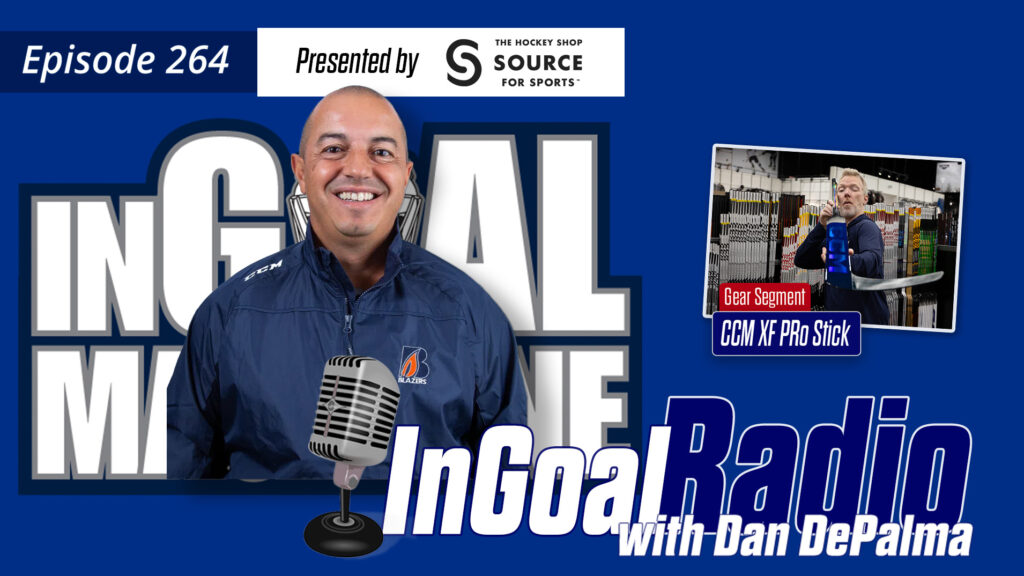
InGoal Radio Episode 264 with Dan DePalma

Please subscribe and leave a rating — it helps us reach more goalies!


Dan DePalma, goaltending coach of the Kamloops Blazers for 15 seasons, has developed NHL goalies including Connor Ingram (Utah Hockey Club) and Dylan Garand (New York Rangers). DePalma emphasizes that lessons from junior hockey development apply to goalies, coaches, and parents at all levels, and he has also coached Canada's under-18 team to gold at the World Championships.
- Dan DePalma developed NHL goalies Connor Ingram, Dylan Garand, and Dylan Ferguson across 15 seasons with the Kamloops Blazers in the WHL.
- Short-format tournament coaching requires a distinct approach, as DePalma explains from his experience winning gold with Canada at the under-18 World Championships.
- Goalie parents who take on a coaching role should set clear boundaries and use that experience to actively support their child's development.
- The new XF Pro goalie stick is earning positive feedback at the NHL level for its redesigned shaft shape, reduced weight, and improved durability.
- Coaching junior hockey for 18 seasons teaches that development principles — patience, consistency, and communication — translate across all age groups and levels.
Episode 264 of the InGoal Radio Podcast, presented by The Hockey Shop Source for Sports, features a fantastic and informative interview with Dan De Palma, the long-time coach of the Kamloops Blazers in the WHL.
Feature Interview
presented by NHL Sense Arena
In the feature interview presented by NHL Sense Arena, De Palma shares invaluable insights and lessons on coaching and development from 18 seasons of coaching junior hockey, including the last 15 with the Blazers, where pupils have included Connor Ingram of the Utah Hockey Club, Dylan Garand of the New York Rangers and Dylan Ferguson, who is coming off his first KHL season and playing for the Ottawa Senators two years ago. De Palma also sheds some light on short-format coaching after winning gold with Canada at the under-18 World Championships, and ahead of coaching Canada again at the upcoming Glinka Gretzky Cup, Aug. 5-10 in Edmonton. The interview is loaded with valuable tips and advice that should resonate with goalies, coaches and parents of all ages.
Parent Segment
presented by Stop It Goaltending U
In our Parents Segment, presented by the Stop It Goaltending U app, digs into questions from goalie coaches about how to handle the job when their son or daughter starts to play with advice that we hope will also inspire more parents to delve into the world of coaching at some level to help their young goalie.
Weekly Gear Segment
presented by The Hockey Shop Source for SportsAnd in our weekly gear segment, we go to The Hockey Shop Source for Sports for a closer look at the new XF Pro stick that has been getting great feedback right up to the NHL for new shaft shape, lightness and improved durability.
Episode Transcript
Intro
Welcome to the InGoal Radio Podcast presented by The Hockey Shop Source for Sports and thehockeyshop.com. This is episode 264. I'm David Hutchison, and I'm here again this time in person with the one and only Kevin Woodley. Daren Millard is in France. And if you're watching Olympic coverage shortly, you may see Daren hosting some sports that don't involve ice, but may in fact involve goaltending.
Kevin, good to see you again, buddy, or to be with you again, buddy. It's beautiful day in BC's Okanagan region, but it's a little dark outside now.
Yeah. It's late. It's been a long stretch. We are in that content gathering mode. We're up in the Okanagan tonight, which also happens to be the home of our guest, although he's a little further north from where we are right now.
Dan DePalma of the Kamloops Blazers. Also, Hockey Canada Canada, World Championship U18 gold medal winner on his way to coach at the Hlinka as well. Maybe not a household name for everyone, but a can't miss episode. A guy that he's too shy to say it, but I know for a fact through my contacts, has had many job opportunities to coach professionally, with NHL clubs hiring him in AHL and development roles. So really excited about that episode.
There's lots of great takeaways. Really excited about what's to come in the in the next few weeks and months, Hutch, because we have been grinding up here Busy. Busy. Busy. Some big names that we've already banked for the InGoal Radio Podcast in the next little while.
Busy. Busy. Busy. Some big names that we've already banked for the InGoal Radio Podcast in the next little while.
Some big names that we've already banked for the InGoal Radio Podcast in the next little while.
I can't wait to share that with you.
Four or five of them so far and more to come. Our featured guest this week is presented by NHL Sense Arena, as you said, longtime goaltending coach of the WHL's Kamloops Blazers and longtime friend of InGoal, Dan DePalma. Our Gear Segment this week is with Cam at the Hockey Shop, and we'll be taking a look at one of the most beautiful sticks we've ever seen, including a nice custom one for InGoal. That's the CCM XF Pro stick, and you've, talked to a few people who've used it.
Yeah. Kinda it's funny because we've got a lot of tie ins up here. We spent a little time on the ice with one of Dan's former goalies from the Kamloops Blazers, now with the New York Rangers organization. Dylan Garand. Dylan Garand.
Longtime friend of InGoal. Get to skate with him just about every summer. Great young man. Great young goaltender.
Fun to watch him. We also have been it just coincidence that we're doing the XF pro stick this week. Got some feedback from Devon Levi on the ice today on the XF pro stick. Raved about it. So did Ty Young, Vancouver Canucks draft pick of the Prince George Cougars in the WHL.
It's some really both of them, the new we're gonna get into some of the new features of it. But I think the biggest takeaway I've gotten, and I got this from Thatcher Demko and Stuart Skinner as well, is how much longer they're lasting, the new XF Pro compared to previous models. Add that to lightest sticks CCM's ever had, and some of the other features we'll get into in the gear segment. Always nice to get that validation from pros. They don't care if their sticks don't last because they get new ones all the time.
But these ones are lasting a lot longer. So really good feedback from them. It kind of matches the feel that we've gotten off the sticks. So can't wait to bring you that. Again, just everything seems to be tying together easily for us on this one.
It is. And it's nice to get
the validation from the pros, but it's nice to get it from our buddy Cam at The Hockey Shop as we will get to in a few minutes. Just a warning, the video that usually accompanies the Gear Segment is gonna be a few days late just because we need to get back to the Lower Mainland Of Vancouver Island before we can finish that editing up and post it. Our parent segment this week is presented as always by Stop It Goaltending U, the app, and we're gonna talk about coaching your child. I've had a lot of questions largely from experienced goaltending coaches right up to the NCAA, asking about how how to manage that role. So we're gonna have a little chat for everybody in that one.
I would before we go too far, Kevin, I just wanna ask everybody listening for a favor. The podcast each week, of course, is completely free. But if you wouldn't mind, could you go and leave a rating and a comment with your favorite podcast provider? Just helps us get word out to more goalie families out there. We'd sincerely appreciate it.
Like this one from Jared who said, the best goalie resource available, the full suite of InGoal content is the best resource for goalies of all ages and skill sets. Hey. Just like the best goalie drills, Kevin, Jared kept it simple and to the point. Love it. Thank you, Jared.
Okay. Before we check-in with our parents segment from Stop It Goaltending and our featured guest presented by Sense Arena, we're gonna head over to the Hockey Shop for a weekly look at Gear Woody.
Yeah. And we've talked about this the last little while. There's new gear coming all the time to the point where once a week is not enough for us to keep up with the gear segment because there's more than a new piece of gear coming in every week and has been for months now. So beyond what we're gonna get into today, the CCM XF Pro stick and all the great features there, make sure you check them out. If you're in person in the Lower Mainland, or we've had people visit from as far East as Calgary to see us there and meet us there.
Well, actually, we've had people come all the way from Australia. But regular peep regular sort of shoppers come up from Seattle and from out in Calgary and Edmonton and, you know or if you can't make it in person to the Lower Mainland, the hockeyshop.com. If if there's a new piece of equipment, they've got it, and they've got the expertise to answer questions on it. So make sure you reach out to them through the website or through the number cams about to leave in the gear segment if you've got any questions. The latest, the greatest, and usually the past generation, what what it's replacing on sale at The Hockey Shop and the hockeyshop.com, no better place, to find the gear that will help fit your game and make you a better goaltender.
Gear
And without further ado, let's throw it to Woody and Cam talking about the CCM XF Pro Stick.
Welcome back to the Hockey Shop Source for Sports. I'm here in Goalie Utopia, and it truly is a feeling of Utopia here in the Goalie department because we have the new gorgeous, like just Gorgeous. Wipe that drool off your mouth Woodley, gorgeous CCM XF Pro stick. If you've been on the Hockey Shop website, you've probably seen it called the AXIS stick. It's not.
It's just the XF Pro and XF stick. Little subtle shot at the web department Cam. They're gonna be upset with me later. Oh, absolutely. In addition to being beautiful, now yours is a Demko model.
It's a little pro return action on yours. Mine is a custom order. Custom is coming, folks. Custom is coming. You've got retail sticks.
Yes.
Let's let's just go through the features because our feedback at Pro has been exceptional from Devon Levi to Stuart Skinner to Thatcher Demko. Demko love this twig. Felt there was a lot less breakage in this twig, and we know at the NHL level, like, guys are ripping shots. A lot of that has to do with the new geometry in the shaft. I think that's a great place to start.
That let's start with that. Start with a hat. So, I mean, this feels great in terms of for even holding, grabbing with your stick. Can we explain a lot? Field?
Yeah. It's a v shaped paddle, but actually starts up here. Mhmm. Traditionally, they call it a t shape, but it's just your traditional rectangle shape at the top. So when you're grabbing the top of the stick, that's gonna feel like regular, but it transitions as you get down to the bottom into more of a v shape, which feels better in the hand.
Actually feels really nice in the hand. If you check out on our website, ingoalmag.com, Devon Levi talking about how much he likes. A great plug for your website, It is a good plug for our website. We'll plug yours later, Cam, if you're you're nice to me. So real that's the big difference.
A great plug for your website, It is a good plug for our website. We'll plug yours later, Cam, if you're you're nice to me. So real that's the big difference.
It is a good plug for our website. We'll plug yours later, Cam, if you're you're nice to me. So real that's the big difference.
The geometry in the shaft, there's also a difference in geometry in the paddle. Correct. Flatter along the front. Yes. Which helps create this graphic that literally pops so much.
It's like, you might actually be able to blind a shooter. You know, like, remember, like, guys that have, like, the chrome helmets and the distracted shooters? Like, that's how shiny this is.
Seen the the chrome look on a couple other brands. It's kinda come up and CCM following suit. Like, the chrome really pops off well and really creates that nice look all around. And in addition to the new paddle shape, there is now a new paddle construction. Paddle blade, they're saying their first ever one piece they say the first ever, I didn't realize this, true one piece construction from the paddle through the blade, which has allowed them to cut weight.
And in addition to the new paddle shape, there is now a new paddle construction. Paddle blade, they're saying their first ever one piece they say the first ever, I didn't realize this, true one piece construction from the paddle through the blade, which has allowed them to cut weight.
This baby on my 25 inch model weighs in at 580. So lighter, better, more durable.
One thing I wanna say about white though, like, it it's very well balanced. Like, one thing is we like as we chase the weight story. Quite often, we can have sticks in a bottom heavy and they feel heavy.
No. But bottom heavy is not necessarily a bad thing to help kind of bring that stick back down. Like, I find the sticks that are too lightweight down low, they like to kind of hover and tip up because you almost like invert your balance point a little bit. So bottom heavy is not necessarily a bad thing. But it feels heavy in your hands if it's bottom heavy, Cam. It can, but that depends on your version of heavy.
Like, I'm used to lifting weights. You're used to lifting sticks. It's fine. If you need a bottom heavy stick to steer a puck into the corner, I would suggest you're lifting the wrong weights. Are you sure, bud?
If you need a bottom heavy stick to steer a puck into the corner, I would suggest you're lifting the wrong weights. Are you sure, bud?
The beauty of this with the new grip and the stick tap grip and the v shaped paddle is not only does it improve feel and grip so that you can steer and control low pucks with this well balanced stick, but it also dampens vibration. Okay. A little bit of you like, viewer interaction here. What do you prefer? Do you prefer something that's, like, super, super, super lightweight as much as possible, or do you prefer a little bit of weight in your stick?
Comment below. We would love to hear you. What else? I think we're close to wrapping it up, but we should talk the curve. The curve.
[crosstalk] New square toe. Exactly. P one. Available in the former price curve, now called the p one. Price curve.
I like that. Yes. He went to a square toe right towards the end for us. So great for rimming it around those boards. We still have the p four curve as well.
Great for catching the rims around the boards as opposed to rimming it around the board. Well, also too, like, I find it's a little bit easier with a heel based curve that opens up at the toe to ride it up along the boards and out. Excellent. Excellent. So if you have more questions, you may call (604) 589-8299 or 1-800-567-7790 or you can check us out at thehockeyshop.com where they will have a bunch of different colorways available for you to check out very shortly.
And by the time you see this, it will no longer be called the Axis XF stick. It will just be called the XF stick because we corrected you. Neat.
Woody, I love the look of that stick. And so many times we've had beautiful sticks, especially that awesome reflective glow about them, and it's hard to capture in video and in pictures. But I think if you check out the video when it is released later this week, you'll be able to get a real good feel about what makes this one look so beautiful. And in addition to the stuff you've heard from other goalies, I've heard that they're just excellent at picking up rims. And I know you guys alluded to that with the shape of the toe and so so on, but nice to know that that's actually, playing true on the ice.
And Cam got into, like, sort of it's not just the shape of the toe, but the rigidity of the blade with the changes in construction. And, again, feedback we've heard, whether it's guys in the NHL right up to Devon Levi, guys playing in the CHL. We talked to Ty Young just today as a matter of fact. And we'll try and see if we can find a way to include that. It'll certainly be in the written review that we have up at ingoalmag.com in the near future.
Just lots to like about the new CCM XF Pro twig beyond what I would call a rather sexy appearance. It is beautiful. It's hot.
It's beautiful. Especially the InGoal one. The design, stop. You just have to check
it out when you see it.
Parent Playbook
Okay. Time for a parent segment. Comments keep coming in. And recently, and I apologize to the listener who sent this in because I don't have it with me here in Kelowna, but someone kindly mentioned to me that they felt the segment is not just for parents because they're learning so much each week. I really appreciate that.
So thank you very much. But before we get to what we're gonna say this week, Woody, the parent segment is presented by Stop It Goaltending U, the app.
The content continues to flow from Stop It Goal Tending and the Stop It Goaltending U, the app. And I'm sure there's a bunch more on the way because they just finished up with their big prospects camp. I believe twenty second annual
Multiple sheets of ice.
Hundreds of goaltenders, guest appearances from coaches like Joey Daccord of the Seattle Kraken. Saw some tidbits on that. Andrew Raycroft's a regular out there and one of their coaches, all the top coaches at the university level on the East Coast involved. So that's the level of expertise and right from the goalies. They've got a tip up recently in the last ten days from Matthew Carone from BU.
They take the expertise of the goalie coaches and the goalies that they work with, and I would argue there's probably few that have more of those just given the size of Stop It Goaltending And they put it in an app in a way that makes it easy for parents and young goalies to digest whether they wanna dig in for an hour or just a minute a day with the quick tips and the daily primers. There's something there that's gonna help you become a better goaltender. Like I said, whether you wanna invest a little bit of time every day or a little bit of time every day and then a bunch of time one day a week, however you wanna manage it, if you use the Stop It Goaltending U app, there is information on there that will help you become a better goaltender. And even better now, if you subscribe to the Stop It Goaltending U app, you get a subscription to another fantastic resource, InGoal Magazine premium membership, ingoalmag.com with all the content that we bring, including a bunch of fresh stuff coming from up here in Kelowna.
These are the best of both worlds, and you can access it both through a subscription to the Stop
It Goaltending U app. Good chance to feel a little bit of what we are lucky enough to feel when we're in a place like this. You can hop onto the Stop It app, and you can learn from a whole bunch of different goalies and a whole bunch of co different coaches, and that's something we love to do. Okay. Today, I would like to talk a little bit about being both a goalie coach and a parent.
As I've said, I've had questions come in from a number of folks right up to the NCAA asking me about being a parent and a coach, but today isn't just for experienced coaches. In fact, I wanna talk a little bit in a framework that's, good for all of us parents. There's something whether you're wondering about coaching your own child or having your child work with someone else even as you are a professional coach yourself. So something for everyone. Kevin was thrilled recently to learn how many people are certified at the bronze level in The United States as goaltending coaches, thousands. 2,200.
There you go.
That's a ton. Hockey Canada also has a certification process which is aimed at giving you the basics. So even if you're a regular coach or an incoming parent coach, you can know how to work with young goalies. We need more certified coaches. I had coffee the other day, Woody, with one of our son's head coaches from his younger days growing up, and what struck him was how little coaching is available.
Maybe there's a weekly session for an association. Maybe there's a coach on the ice once a week who only gets a few minutes alone with the goalies. But compared to the players, he said, it's nothing. It is, in fact, one reason that we started to work with associations to make InGoal available as a resource for all their coaches and families because there simply aren't enough goalie coaches. Now there's a lot of talk about young goalies being too structured and learning not learning to go out there and just stop the puck and well, I'll agree to a point.
It's important to understand what people mean by that. They don't want robotic goalies who just drop and block. They don't want six year olds living in the RVH, But you still have to learn how to skate. You still need a stance. You still need to learn how to catch, how to control your stick.
Can you imagine sending a kid out to play tennis without telling him how to hold the racket? A golfer out onto the course without teaching him the grip. The basics matter and they have to be learned so you can go out there and then just play without thinking. But again, there aren't enough people who can help. So today, I would like to respond to the experienced coaches who want to learn about balancing their role as coach and parent, but also to those who might consider volunteering even if they never played the position.
There are a lot of people responsible for our son being where he is today, but I'm pretty confident that without me volunteering, it wouldn't have happened. He was lucky enough in that sense that he had a goalie coach teaching him the basics at most of his practices growing up. He also had great head coaches who were happy to listen to a goaltending coach to help them make their practices better for the goalies and the players. And those are times on the ice I will honestly cherish forever. It's more powerful even everybody as a goalie coach because you're on the ice working closely just with your child and maybe one other kid, and it's like a bit of alone time enjoying what the two of you love to do the most.
So if you start early when they begin playing, you can learn along with them as well and make a difference for them and their team on the ice at practice. And where your child is most at risk of being ignored, they're getting more attention than most other kids in the position, but not too much because balance is important as we'll talk about. So having said that, hoping lots of you will consider getting out there and helping, your young boys and girls enjoy the position more. But for the goalie coaches who want to hear a little bit more about balancing the role, I'll just tell you a few things, maybe some of my top tips. I never made decisions or recommendations on who should play on a team my son was part of.
Of course, at a young age, that playing time should be equal anyway, but I made this sort of personal policy very clear to the goalies and to the head coach. I do believe there's a role for goalie coaches to help with this in hockey, but I didn't think that the optics would be very good with myself as a as a parent and a coach. Obviously, I worked equally with both kids on the ice. I think that's, of course, it's imperative. My son also happened to be really good friends with all of his partners growing up.
I don't know. Did I have a role to play in that? I hope so. I didn't push as hard as perhaps I thought I should purely as a coach. Our relationship as a father and a son mattered more to me than that athlete coach relationship because because our parent child relationship is gonna be for a lifetime.
I recognized also, and we might hear from Dan DePalma something on some of this later, that there are times that the goalies just need space. So I would back away on the ice. Maybe I wouldn't even go to the rink. To a degree, this is knowing the athlete and you, of course, you know your child better than anyone. And it's a strong belief I have that there's a time for technique and there's a time to just let them play.
When they get to work with other coaches, whether it's a goalie coach or a or a head coach, I step back. I probably give more space there than again, you're probably going to hear a little bit from Dan and his role. I I loved as I was putting this together, listening to the his experience as a coach and mine. And and again, being a parent coach, I felt I had to play a slightly different role than than you'll hear Dan did at times. As my son got older, we worked more collaboratively.
I'd asked for his input more often, his thoughts on what to do, what he needed, what he was seeing or feeling. I think I sort of learned that because of our personal relationship and turns out it's really a good way to work with any youngster that you're coaching. I think that's just good coaching, good teaching. And it's good practice, but it's also set him up because later on when I'm not around, he's more in control of his own game. Now at the u eighteen level, they had a policy of no parent coaches, so that was when that break happened and I wasn't his goalie coach anymore, even though we'd still work together a little bit in the summers.
And when he had another coach, when that time came, he had my support 100%. I think that there's a ton of value in learning to work with other coaches and other approaches, but I also feel it's more important that your child believes in their coach and only have that one voice in their head. So even though I was a goalie coach, when he was working with another goalie coach for a season, all I am is dad. I believe that, if another coach had a different approach than me, I'm not worried about that. I'm I'm I'm not gonna ask my son to listen to what I might do over his coach.
Him buying in completely and trusting his team goalie coach is of far more value than of him trying to manage different opinions on the ice and at home. So I stay out of it. It turns out I probably agree with his coaches most of the time anyway. Actually, at this point also, I would just say I don't even know what he's doing on the ice with his coaches. I keep my distance on that and I respect that relationship that he has with them.
And when he plays now, we just discuss the game as if we're friends. If he wants to talk about it, that's his call and it's under his direction. I have no opinion on how we should play. I just listen. Otherwise, as I've said before, he gets a hug.
I tell him I'm proud. Maybe I tell him something I love that he did on the ice just like any other parent would. So I hope in some of that today that there's something of value for the experienced coaches who now have a son or daughter, taken to the crease. I hope there's some maybe inspiration for some of the rest of you out there to get certified and volunteer while you still can because you 15 or you 18 or whatever level it is that provides team coaches, believe me, it comes all too quickly. So get your chance while you can.
I would also say that certification and getting involved at the younger ages, just to go back to your discussion with, oh, they're overcoached and, you know, sometimes these kids get too much structure too soon. It's not it's not like you're in there trying to teach reverse to eight year olds. It's about making sure that the eight year olds, 12 year olds, 13 year olds even are having experiences that are conducive to them learning. And sometimes that's about having a voice at a practice whereby they're not just sitting there doing nothing for long stretches, or they're not just seeing one shot after another with three second gaps and no time to recover and actually play the position, that you're a voice with them and for them in those practices to make sure the environment not only will help them enjoy the position. We've talked a lot about retention and people wanting to be goaltenders.
And the the structure of the practices even within the team environment will be beneficial to them, but inherently, it becomes better for the team and the players as well. So there's it's don't just think that by becoming that that first level certification goalie coach for your son or daughter at the entry level is about digging into some of the stuff that we get into the weeds with sometimes within Goal, you know, in terms of the really technical stuff. The skills and the skating and the sticks and all those things that Hutch talked about are there, but it's also just about making sure that it's an environment where not only can they learn about the position, but where they're having fun playing it.
Yeah. 100%. The basics are so important. We give it to all of our players and our goaltenders deserve it as well. So if you can help, that would be fantastic.
Speaking of certification courses, I sat in little over a year ago on a great certification, course for new goalies, new goalie coaches, excuse me, new new parents who want to be goalie coaches, and that was led by someone we saw today, Travis Hoy. Travis Hoy of Travis Hoy Goal Tending here in Vernon, British Columbia happens to be one of our partner coaches now. All of the kids going to his camps this summer up here will also be getting an InGoal membership, Kevin. So one of the great young coaches around here, and and we're thrilled to have worked with him.
And to continue the theme of tying this like, everything is just coming together. Another one of those guests that we'll have in the next coming week coming weeks that we've connected with up here was also on the ice with Travis Hoy. Connections they made through Hockey Canada, none other than PWHL goaltender of the year, Kristen Campbell, who we've had a the pleasure of being both on the ice and in the gym with for the past couple of days. So I really gotta say, like, it none of this is planned. It's all just kinda coming organically.
But, boy, do we have a whole bunch of really high end guests coming and some fantastic content coming in the coming weeks.
I edited my bit for the parent segment week and a half, probably two weeks ago, and then actually listened to today's featured guest just today and how much it resonated with what I'd written down for for goalie parents. It was awesome. And and I love this this week's guest. Our featured guest presented by NHL Sense Arena VR is Dan DePalma. And, Sense Arena is is huge as we've heard from a number of people recently.
Woody, we were let me start and then you jump in. We just finished helping Pete Fry, as you remember, host his goalie mindset pro seminars. And one thing that Pete does is have his goalies craft a plan. Might be a thirty day plan, sixty day plan. It sort of depends on what lies ahead for you.
He gives them examples of the sort of things that his goalies have used, including Jeff Glass who wrote down a thirty day plan, followed it, and ended up in the National Hockey League thirty days later. The kids took some time, ten minutes or so, to draw a mind map. And then they shared some of the things in their plan. And guess what? Pete had not mentioned Sense Arena even once that day, but NHL Sense Arena kept coming up in the plans.
I don't know how many kids as they shared their plans around the room said, I'm gonna do NHL Sense Arena every day. I'm gonna do Sense Arena four times a week. It was just part of their plan for getting where they wanna get in the next sixty days. And I know you've also been speaking to a few people who've used Sense Arena around here again. It just sort comes up now.
I was gonna say if you wanna talk about a plan in terms of getting better as a goaltender, it was one of the questions. We had a really long chat with Devon Levi, the Buffalo Sabres today for, again, another interview that we'll bring you in the coming weeks and months. And he meant he brought up Sense Arena as he has less time in the in as a pro hockey player now than he did in college. More games, less rest, more worried about managing his body and feeling good. He's using NHL Sense Arena to make sure he gets reps and touches without having to get on the ice all the time.
And he he uses it in several different ways. But again, to sort of have that come up more up organically as part of our conversation and hear the way he uses it, just further validation that whether it's the aspiring future pros at Pete Fry seminar talking about how good a tool it is and making sure that they've got it in their plan to make sure they're using it regularly, or a guy who's just starting his NHL career with a very bright future talking to us about how he uses it regularly. NHL sense arena, the proof is there. The proof of concept, we've been talking about for a while, but we keep getting this validation all the way up to the highest levels. And so another reminder over the past two weeks between Pete Fry seminar and our time with Devon Levi up here, that this is a legitimate tool for training goaltenders to become better goaltenders.
Goalies who are doing all they can to get ahead are choosing NHL Sense Arena. You should give it a try. Sensearena.com, check it out. Learn everything you can about Sense Arena, give it a try this summer. Okay.
Feature Interview - Dan DePalma
Our friends at NHL Sense Arena present the feature interview every week. And this week, we have Dan DePalma.
Well, Dan might not be a household name for a lot of you, but I can tell you some of the goal he's he's worked with with the Kamloops Blazers certainly are. And I think of guys like Dylan Garand, who we were on the ice with, as we said, just the other day in the New York Ranger system. I think of Connor Ingram of now the Utah Hockey Club, formerly Arizona Coyotes and the success that he said. I think of another guy speaking of worlds coming together.
Who we saw
at this time? At Pete Fry's seminar, Dylan Ferguson coming off a good year in the KHL after a couple really good appearances with the Ottawa Senators in the NHL the year before. Some lessons from Dan DePalma's eighteen years of coaching junior. As I said before, I know there's been opportunities to join NHL clubs in the past. It just hasn't worked out in terms of where he's at in his life and his ability to move and uproot family to this point.
He won a U18 championship, which is how we'll lead off world championship. We'll lead off this conversation talking about getting to enjoy that day with the cup. And I know he's off next week to coach at the Olympic tournament. I believe it's in Edmonton this year. So you may not be familiar with Dan's work to this point, but believe me, this is an interview you don't wanna miss because there's a reason he's helped all those athletes, all those great goalies get to the next level and to the highest levels of the game, and I think that'll come shining through in this interview.
With Kevin Woodley presented by NHL Sense Arena, it's Dan DePalma.
Really excited to welcome to the InGoal Radio Podcast, a gentleman I've had the pleasure of getting to know over the years and many conversations over the years, just none of them formally on the podcast. It's about time we had you on, Dan DePalma. How are you?
Yeah. I'm really good. Thanks. Thanks for having me, Kevin.
I kinda feel like we're we're kinda talking as we got going here. I feel like this is the perfect spot to get you. You're on the road between Prince George, where you started your coaching career in the WHL with the Prince George Cougars, headed back home to Kamloops where you've coached for fifteen years now with the Kamloops Blazers. And you're on your way back after a little celebration with the U 18 cup from winning a gold medal at the U 18 world championships earlier this year. So as you celebrate that with some family and friends, cup in tow, how do you reflect on, you know, what is now eighteen years of coaching in the WHL and that moment, and does it feel kinda all full circle at this point?
Yeah. Hang on. Like, the fact that we're doing this call right on this this corridor is perfect actually because it really has come full circle. You know? Like, no question.
I feel I feel really, really honored and and, and humbled by it all. Can't even believe it's been that long, Kevin, and I've been pretty lucky that people have given me an opportunity and helped me along the way, and I feel pretty grateful. Pretty neat to be back in the cup. I don't have the keeper of the cup with me. I'm the keeper for the for the few days that I have.
So I've tried to be a good keeper of the cup, make sure that it's, it's back in its case and, as we move it around. So it's yeah. It's been it's been a wild few days for sure.
White gloves? Like, did they give you white gloves or what?
No. No white gloves. No white gloves. I just I think I think I'm okay touching it. Right?
I think the white gloves the story behind the white gloves is just to kinda keep that separation between, you know, winners and and
Of course.
Decided I didn't I didn't need the gloves. I can just go right with my fingerprints on it. It's pretty cool.
Well, so so much has happened through your career. Like, you've basically been through an massive evolution of goal. I think anytime you're at it for this long, you've seen the game change. But I just wanted, like, curiosity, You have a day job. You balance and a good day job, and you balance that with goalie coaching.
I know there's been teams interested at at times in the past, and I'm not gonna put you on the spot and make you talk about who, where there's been opportunities to go pro and make this the peer career. What like, that balance between the two, like, how do you have there been tough decisions along the way where you you you decided to stay in the role you're in versus pursue professional opportunities?
Yeah. For sure, Kevin. I mean, I think I think first off, you know, the balance is really, a testament to a lot of others around me that support me, like the the people I work for that, you know, provides, you know, the feed put food in the fridge like I always say. The the teams that I've worked for that, you have been really understanding of, you know, what? I'm gonna do my best and and give as much time as I can.
And and then, obviously, family, first and foremost, at the end of it. Like, you know, it has to be supportive and and and give you the latitude to do it because sometimes, we joke. It's it's almost like two full time jobs at once. But you know what? Yeah.
I mean, I love hockey. I mean, it's a it's a it's obviously a passion. Wouldn't put yourself through this much, of both if you if you didn't love it. And so the, yeah, the dream to to be pro and be in NHL and win a Stanley Cup. I mean, dream never died, at least not for me.
So, yeah, it's been it's been it's been tough, but along the way, you gotta make, you know, the right decisions for the right time in your life, and and and family's number one, and and it just hasn't been the right opportunity or time for me yet. So I've been really fortunate to have a few of them, and and, hopefully, down the road, maybe there's one, the timing works out and everything works out and and can make it happen. So, yeah, that's that's the long and short of it, Kevin.
Okay. So the development you've been a part of, I mean, I know some of the more recent names. You know? Arizona comes through town, and Connor Ingram's with them. I guess now it'll be Utah, but Connor Ingram's with them.
Saw you at the rink at Rogers Arena catching up with him. A guy that I know you know well and were a big part of his career. He speaks glowingly about how how he doesn't get to where he is today without his time with you. You know, Dylan Ferguson, who we know really well. Dylan Garand, who I believe still skates with you in the summer.
I just I wanna put sort of put a pause on that, the guys that you've worked with over the years. And let's compare it. Let's go to the more recent, the u eighteen world championships. You got Carter George who's drafted by the Los Angeles Kings this summer. You've got, Ryson Lindors who is drafted by the Buffalo Sabres this summer.
Those are your goalies at at at an international competition. Short term competition, what's the approach? Like, you're not reinventing the wheel with them, I'm assuming. But what, like, what how does that shift for you? How does that change when you're at a a world championship event like that and you've got a shorter runway up to it?
How do you focus on getting these guys ready to play in a high pressure environment like that?
I think for me, Kevin, I mean, there's a lot of people to lean on through the past. Like, you just name some names. You you know, I I talked to past goalies. I talked to past coaches and really didn't, you know, try to under believe that I had all the answers. Wanted to make sure that I understood, you know, what what is gonna give me the best chance for success to pass along what these guys need so they have their best success because it's really about them at the end the day.
So you know, what? To to summarize it, think at the end of the day, you're just you're trying to get the best version of of that goalie in in that short term event. And so you're you're just trying to be unselfish. What does it take for you to get the best version of you? What are the drills that you'd like to do?
What are the things you like to do on game day? What do you like between periods? What don't you like? Just really dig into the whole the whole, you know, morning till evening mentality. Like, what we've got a day here.
What's the what's the day gonna look like for you as much as we can control to give you the best day that you could have so that you feel the best going into those games? And then and then I always believe, maybe I'm naive, but if you if, you know, if you're if you trust your game and you play your game and and you feel really good about it before the puck drops, I think the pressure starts to alleviate itself. Like, you just you have so much confidence in what you've done and in the process that by the time the puck drops, yeah, there's always gonna be some pressure, but but but you're ready for it. You're ready to take it on. You're not you're not nervous about what might come.
You feel like you're ready for all of it. So that's that was my approach, and and and the guys were great. They were open. They were communicative. Like, they were honest about what they liked and didn't like, and they were good and said, we're doing everything I wanna do.
And so it it worked out real good. And at the end the day, would say, Kevin, they they stop pucks. I don't. So I'm just I'm just there to help. Right?
Just try to help them be their best. And, yeah, it was a lot of fun.
What, give me an example of a drill that like, is there something that might have been different on a game day or a practice day that you're doing with those guys that, you know, where you're still learning after all these years of doing it, something different that they liked in their game? I guess you've probably seen it all by this point, but something that you might not have normally done, you know, with with your guys on a game day, for example.
No. Actually, Kevin, I was surprised. Like, you know, the first couple days, you just start you know, you roll out some things. You don't know them real well, so you just roll out what you think, you know, a good set of drills is to prepare for the little goalie I see get before practice and then use that as the tool to have those first, you know, one on one conversations and said, you know, this is what I think is good. These are the things that I think are gonna help you have success, just some basic drills and whatnot.
You know, but I'm open to things that I have no ego. What do you guys like? They said, no. I love this. Let's just keep doing this.
So it it was it was it was nice because, you know, it just gives you more confidence in what you're doing. Right? That's okay. The the things that we're doing and the and the staples that everybody has that I believe are staples. You know, the guys liked them, and they wanted them.
So it was it was quite easy. It was really seamless to just get going with these guys. It was they were great, and, and we got along really well from day one.
What do you like, staples. When you talk about staples, I mean, I'm I'm sure there's similarities across the board from coach to coach, from goalie to goalie, but what do you see as the staples that need to be in place, you know, whether it's at an event like this or when you're working with their guys in Kamloops?
No. We just wanted to make sure their feet were going. Understand, you know, the footwork that works for them the best. Understand how much they wanna keep their edges before versus maybe not keeping their edges at times. Just try to understand the differences there.
Just, honestly, the habits of, you know, seeing the puck and stopping it, tracking it all the way in, tracking it all the way out, having just really good habits.
Just, honestly, the habits of, you know, seeing the puck and stopping it, tracking it all the way in, tracking it all the way out, having just really good habits. I mean, at a high level, those are the those are the staples that I believe in and and, and try to pass along to the goalies, and and they were on board. They were on board right from day one. Even said, you know what? Like, yeah, sometimes my detail isn't quite there.
These habits, I let go a little bit, and, and it hasn't always worked for me. So it's good that you're we're beating up on some of these simple things because at the end of the day, that's what the game ends. Right?
I was gonna say, it sounds like pretty simple drills. Like, if you maybe and it's hard to do in an in an audio format, but maybe give me an example because I do think a lot of young kids, like, here's you know, this is this is an international stage, under eighteen world championships, the best goalies for their age from around the world competing. And I think, you know, right up the NHL level, think the young kids look for dynamic, crazy, you know, all over the place players and pucks flying everywhere drills, and yet it doesn't matter. It seems the higher level you go, the simpler things get.
Yeah. I mean, usually, your your listeners are a little bit more in tune with, you know, the goalie, the goalie world and the drills and everything like that. So they probably understand. I mean, honestly, the movement is really that this simple. Like, I I learned from years ago.
I got introduced to him. He let me come down and do a couple dev camps with him with the Canucks when he's here. And so for him, there was just four simple shapes that really represented a lot of the movement that the goalie's gonna have in a game. And it's a was a simple t push side to side. It was a simple letter v, which basically is your post top of the crease back to the post and and then a box, which is the old rectangle crease, basically, in that pattern, and then and then an x, basically.
And so those four shapes represent the four movement drills that typically I start every day with. And and the guys, again, you know, you're always wanna do right by the by the goalies. Like, you don't wanna let them down. So, you know, we did that for a couple days. Did this work?
Yeah. This is this is perfect. Let's keep doing that.
So crease crease movement.
It's a simple crease movement, four shapes. I mean, there's there's a secret right there. It's all it's all on the table now.
Well, it's it is funny, though. Right? Like, again, like, I feel like I've been doing this a while now too. And and as I said, you know, it feels like I'm looking for the right term. Like, it almost like sort of social media coaching.
Right? Like, everything that catches people's eyes, the flash and the dash and the quickness, and yet whether it's you at the under eighteen world championships or Carey Price in the summers when we would connect with him, it's all about crease movement.
Yeah. And and you're just trying to say, what what movement is more common in a game? Like, what's gonna happen in a game? What do we wanna make sure that we're we're doing consistently? There's a lot more movement drills.
There's a lot more of it, and and that stuff comes into it. But in a in a short term event, you know, what is just that was that's how we would start every day. And and they liked it, and so we kept doing it because it felt good, give them some confidence to get going, and and then and then we build from there. You know, I I think it's funny. Like, for me, I've always been lucky.
You know, you you coach and you get into introduced in so many different poachers along the way. And I've always believed in simplicity, just do simple real well. And that was Gardner MacDougall. Oh, do simple. Great.
So So when he said that, I was like, yeah. I love that. That's a that's a great way to describe it. So we just keep trying to do keep trying to do simple great.
The the the the more intricate and harder stuff comes. It just comes naturally. The job's hard. There's a lot of stuff that gets thrown at you. So you're going to get that if you, if you just start with a simple do that really well and then build the drills up into some speed and some pressure.
And if you have the right habits, you're gonna you're gonna you're gonna have some all the all the, all that extra hard stuff that that you want by just starting with the simple. That's always been my philosophy. So, like I said, it's honestly, Kevin, my ego is I hopefully zero. And so I take feedback from the goalies. And what can I do better?
What do you guys see when you go other places? And and for the most part, it's not. Let's just keep doing what we're doing. This is good. So well, that's good.
Tells me to do simple and great.
I like that. Simple. Great. As you're working with them in this tournament, was there anything you tried to help them with or talk to them about in terms of managing pressure? I mean, athletes these days probably have sports psychologists by the time they hit that level.
But was there anything that that you could do in those conversations with them or anything you sensed from them in terms of handling that moment, handling that stage? Or is it, like you said, as long as you do everything on the ice to make them like, almost like preparing for a test. Right? When you go into a test and you feel you've done the work, you always sorta you're more relaxed.
Yeah. You know, you're not it's hard to say that you're gonna give them a, you know, a one nugget that's gonna just be like a light bulb moment for them. I I don't know. You have to talk to them. For me, I just try to be really consistent.
I think the more consistent and the more even I am, the more consistent and even they are gonna be. If if if if they see me that I'm a little bit, you know, up and down, I think it's and I I think it's it's gonna impact them because at the end of the day, I'm the closest thing to them on the team. So if if if I'm calm and and consistent, then I'm sure that helps them throughout the process of a practice game and everything like that. So for me, I just tried to make sure that, you know, they they bring it up. They'll say what makes them confident and when they lose confidence, you know, at this point in the season or this point in the game, like, I wasn't confident.
I just okay. Well, then let's make sure that we're drilling into that. Is it something specific you wanna work on, or is it something specific you wanna talk about? So so we did that. I think we did that.
I think that we did that really well. You got to wait too a little bit, but you can't wait too long with the goalie in these type of events. You hope that after a couple days, they come to you with a question. Right? I'm struggling with this.
And then you'd be ready for it. That happened. Right? So I'm I'm I'm in a hard time with this. Not sure why.
What do you see? I think this is why. I think this is what you can do. It's a simple fit. And they're they're so good.
Like, these guys at this level are so good. They can make those fixes on the fly, and it works, and then they get confidence. Right? So in in game, you know what? We're up, down, tough goal against, lots of good saves.
You know what? It just it just became the norm for this group that we're all gonna get in the room, Both interacting with everybody. I made sure they both got a tap on the pads. Literally, just a just a hand tap on the pads to both of them no matter what was going on. And and I I'm sure that that consistency probably gives them a little bit of love and a little bit of, you know, okay.
Like, yeah, we're still going here. Right? We're just we're we're we're moving forward. So those are that to me, I just believe the more consistent and even I am, I think that that can help spill over to them. Again, they suck the puck.
They're the guys that gotta do it. I'm not saying one hand tap is is the savior by any means. Just just be consistent. You want consistency? Be consistent.
I like that. I like that. Now how what about video? And how would that differ from, say, in a season in the WHL, your use of it? In a short term event, do you have to be careful not to give them too much?
Are you looking at opponents? Are you give I mean, some of these opponents, it's not like a dub season where they've they've seen the team recently perhaps. These are new opponents. Are you giving them pre scout material, or do you have to be careful of paralysis by analysis? You don't want them overthinking about things out there.
Just let them go play. Yeah. I I think I think you do have
to be careful with paralysis by analysis. I think every goalie is different. Someone a little more, someone a little less. Again, it's not about me then. What what what do you like?
What what makes you tick in terms of what you wanna see from the opposition and yourself? The good thing about it is I've always felt that you see a lot of the opposition. If you're sitting in on the PK meetings, if you're sitting in on the regular meetings, you're seeing a lot of five on five, the chances that are getting generated, the penalty kill. You're gonna see a lot of who's gonna come at you and who their best players are. So I think just organically, you see that.
If they want a little bit more, you get more. Practice, we get the video out. And and for the short term event, I just you know, I didn't I didn't know right or wrong. I just said we would we would video it. We'd I we'd get it in their hands, and I would ask them, you know what?
Did you see anything? Any questions? Or are we good? No. We're good, Daniel.
Great. Perfect. I like know? So that's good. Like, don't overcoach them there.
And then, obviously, the the, you know, the postgame analysis of a game, I think, is really important to just to go through the game, go through the clips, and there's always way more good than not. I don't care what anybody says when a goalie plays. There's rare occasion where they're not in the net long enough for more good than bad, and and just keep honing in on the good, honing in on the good, what's working, and just keep building off that. So, yeah, that's kind of the the steps we took to to tackle the video piece. And, yeah, again, as long as they're happy and again, that yeah.
I'm the we're the coaches. Right? I mean, at the end of the day, we get to make some decisions. But at the end of the day, if if they're happy and they're getting what they need to be the best versions of themselves, then that's a big part of the job. And then just just just coach and teach.
Timing of the video, like, you know, that you mentioned focusing on the positive and reviewing it, and that reinforcement seems like it would make a ton of sense as you're trying to get them feeling good about themselves. Is that something you do postgame? You want them going to bed with that already in their mind, or it would be a next morning thing for you? And and would that be different in the WHL?
You know what? It was for the most part, it was the next day thing.
Okay.
I'm there. You offer. Do you wanna talk? You wanted anything to no. I'm good.
Let's let's do it in the morning. Let's do it at this time, and I'm just trying to find a time that works best, for them. Again, it's not being too accommodating for me. It's just about just understanding the player, understanding the the the person and what what's what's best for them so that they because at the end of the day, we just want saves. Team just wants saves, and that's what everybody wants.
let's just figure out the the process that works best for each guy and and and go through that process. But then, again, be consistent.
And so then let's just figure out the the process that works best for each guy and and and go through that process. But then, again, be consistent. If this is the process well, a couple times, I I don't know. No. I said, we're gonna do a video.
We're going to do this. So you pick the time. I'll make it work. So you just stick to the process. Stay consistent.
But sometimes guys think they don't need to see it. They just think that, no. I'm good. It was a good game. I don't need to see it.
Well, we're gonna watch it because we're gonna we're gonna keep building. Right? So, yeah, that that was that was more or less how we did it. It was mostly an update day thing for the video. But if they said, hey.
I wanna watch it after we go back to the hotel and have them young. Can we go through it tonight? 100%. 100%. We'll make the time.
We'll do it.
You you mentioned Rolly Melanson and your chance to work with him at development camp. Any other guys that have played played roles, whether it's, you know, shorter term touches like that or longer term mentors in terms of you know, I know you're a guy that's always learning, always looking for new things. Like, are there guys that you know? How'd you get to this spot? How'd you, you know, how you end up coaching in the WHL, WHL, and who were some of the early mentors, and who have you worked with over the years that continue to help you build?
Well, that's a really good question, and and I'm always nervous because I always feel like they're gonna leave people out. I I think I said to you guys in the past, whether we were on a call or not, like, I am really the poster boy for collaboration. Like, I I got so much help over the years, probably because it wasn't, you know, my career. So, no, I don't think anybody ever really felt threatened to help. Like, they just helped me and realized that this maybe I was cashed in and worth helping.
I don't I don't know why people were so so giving with their time and their energy with me. But, yeah, I mean, some names right on I mean, not to dodge the question. I mean, some people along the way really deserve a thank you is a guy like Bill Ranford. His nephew was on the team in Kamloops, and he he was great. I mean, helped me a ton.
He got introduced to Lyle Mast through that. Lyle's been outstanding. We're still friends today. Gosh. I mean, it's just Jeff Reese in Dallas.
You know, you get introduced to him through the Dallas organization because of the InGoal Radio owns the Blazers and the Stars, and and he's a friend today. Mike Rosati in Vegas. He he's a friend. Johnny in. He's a he's a goalie consultant in for the rangers now.
Yeah. One of Francois Allaire. He used to he used to be Francois' right hand man. And when Francois was in the NHL, I recognize all these names. Hey.
And good people to have as good friends for sure. And Jeff Reese, you know, high on that list as well.
Yeah. And, I mean, let's I mean, where do you stop? Like, I don't even know where to keep going. Like, it's just it's been incredible. I've been so lucky.
I mean, it's yeah. I'm I'm leaving people at Dustin Schwartz because of our WHL group that we set up for that short period of time before COVID. I mean, just it's crazy. Honestly, Kevin, if I pick up the phone and reach out to so many people and I've left a ton out, Like, it's it's just it's just so accommodating. It's it's incredible.
So, yeah, I'm really fortunate. And for those that I didn't mention, I'm really sorry. Like, I mean, that doesn't even touch base on the guys that are in the league and guys that were in the league at the time. You know, it's it's been great. I mean and and and I don't mean to sound like like, sincerely, I it's almost overwhelming how much help I've had and how grateful I am over the years.
So, yeah, it's it's it's really been great. And even you guys. I mean, you guys have you guys have been great to me. Like, I'm I I always say I'm a hack, and you guys don't treat me that way. So, yeah, it's been it's been great.
Yeah. Far from it a hack. You mentioned that WHL group, and I know, like, remember sort of, you know, we did a symposium, and and we obviously played a role in sort of helping host that and shared some of some of the articles and video presentations, including yours at ingoalmag.com that came out of it. That type of collaboration within the league, is that still maybe not as formalized as it was when that group was going before COVID? But, you know, we think sometimes it's interesting because I think from the outside, people are like, oh, they're goalie coaches on different teams.
They probably don't, you know, communicate or but I see that right up to the NHL. There's collaboration and sharing and communication. You know, somebody gets a goalie that used to work with another guy. They're quite open about helping, you know, much like a Carter George or recent leaders coming to you know, what do they like? What makes them tick?
What makes them good goalies? What drills do they like? There's a lot more collaboration, I think, in that goalie coaching community, at the highest level than most people would assume. Is it is it still continue at the WHL level?
Yeah. It's not formalized like it was through that stretch for sure, but I think what that did, you know, and and whether that ever gets kick started again or not, what it did is it just it just created a few more relationships that maybe weren't there for the ones that were interested in those relationships. So, like, Kelly Guertin's gonna be out in Kelowna, and he asked if I'm around, why don't you come out on the ice? So you have a relationship with him that I wouldn't have had before. And then suddenly, all of a sudden, you're drafting goalies that they're coaching, and so there's that collaboration there.
Like, you know, Matt Weninger is in Moose Jaw. So I don't do much trips out to Moose Jaw, but I didn't know Matt before. And so I'm on Moose Jaw, and he takes down to the room and we we visit. Right? Obviously, Curtis Moop is in Edmonton, coach Curtis.
So we we talk to each other. Right? Yeah. The list with Taylor Davis and Prince George. I mean, I remember taking my son up and with Tyler Love and Taylor.
And, and so, yeah, make sure every time you're there to try and have a little quick conversation with Taylor, you know, give him props for the great job he's done there and and stuff like that. So it's I think I think it's it's informal as it's become. I think the networking is probably growing a ton as a result of it, and and then it's on us to keep that networking going and keep those relationships going. And I'm a big believer of relationships. You know, if you if if there's a theme in all this, if somebody opens the door to a relationship, I'm gonna walk through it.
And, and so, yeah, make sure every time you're there to try and have a little quick conversation with Taylor, you know, give him props for the great job he's done there and and stuff like that. So it's I think I think it's it's informal as it's become. I think the networking is probably growing a ton as a result of it, and and then it's on us to keep that networking going and keep those relationships going. And I'm a big believer of relationships. You know, if you if if there's a theme in all this, if somebody opens the door to a relationship, I'm gonna walk through it.
And then, hopefully, you know what? I'm a good person. They're a good person, and that relationship just continues with a little bit of effort. So that that builds relationships, and relationships are everything to me.
Speaking of relationships, I know one you've continued with, Dylan Garand, skating with him in the summers. Like, what changes in that relationship when you have a guy from such a young age comes through your system, works with you, and then goes on and still wants to come back and work with you? How how does that relationship evolve? And as you said, he's he's going out now working with different goaling coaches and coming back and probably bringing different ideas to you. Is that I mean, with you know, other other professional they have professional development days in other careers.
Is that kind of your professional development as a goalie coach? All these communications with other goalie coaches and then having a guy like Dylan coming back and getting on the ice in the summers?
Yeah. No question. Like, I mean, Dylan Garand's a a unique young man. Like, he's he's driven and as as thoughtful as anybody you're gonna meet in the position. So I like spending time with him because, first of all, I care about him as a person deeply.
He's a he's a great young man, and I you know, he's he's he's he's like family, can he? One, two, I just love being around him and listening to him think the game, listening to him talk about his game. And and I it's just I just think it's it's healthy. I think it's healthy. I learned a lot.
He he I probably learned more from him than he's learning from me at this stage. And, honestly, I'm being sincere, which is fine. Like, why he comes back and wants to spend time? I think it's just the relationship again, and and it's comfortable. And and so it can be honest.
It can just be really honest and and and raw. So, yeah, just be really honest with him. For most of for most of it with Dylan, for me, it's just just talking a high level, like a conceptual level. What do you think here? What do you think about these situations, or, you know, what's working here?
And and then usually, the answer's probably already something he's not or just needs to be reminded of. So, yeah, for me for me, summer's go back to what you said. It's it is about professional development. I look at my summers as a chance to get better for me. Like, that's my time to to to invest in continuing to learn so that if somebody trusts you to do it, even though it's not my how I build a fridge, like I say, it's a responsibility.
I need to I need to keep learning. If I don't, then I shouldn't do the job. Like, I as much as people want you, if you're not gonna do it right, then don't do it. So so, yeah, I need to keep learning, and that's that's part of my development in the summer. It's it's just an easy one for me, and it works out pretty good.
How have you seen the game, the position change in your eighteen years? Let's say, for example, you know, you're getting a young goaltender in 2006 with the Prince George cougars compared to a young goaltender coming into camp now? Like, how how how different would they be eighteen years apart in terms of the way they play, the skill level of these young kids? Where are we at, where are we going?
It's a hard question.
It's a big question. I'm sorry.
How how how no. No. It's good, though. I like it because it's again, it's just part of I mean, I know we're on a podcast, and people are gonna hear it. But it I think you gotta you be able to think about this type of stuff and answer the question to keep learning.
Right? So for me, I just think like, I I try to oversimplify even that. So when you when you say, like, how's it changed? Okay. Like, I remember Riel Sierra, and Prince George.
And I I know Dylan Garand for just to stay on that on that name for now. And when I watched them play at their best, even that many years later, it's not it's it's actually more similar, I think, than people realize. Maybe, know, you there'd be a lot of goalie coaches that might disagree with me. But when when when Sears was playing his best, and I I mean, it's a it's a long time ago, he kept his edges. He was in great position.
He he set his feet as much as he could. He had motion when he needed it. You know, he was on his toes. He's confident. Played a good play a good goal.
Maybe their reverse wasn't there at the time. Maybe different save selections have changed over time, But I think the staples and the things that make it successful probably haven't changed as much. So then what's changed? Right? Like, the gears changed for sure still in that many years.
So now you've got save selections and techniques that change for sure. So I think that's part of it. But those staples are critical. Right? And I think as time's gone on, you know, we started seeing guys would transition on their knees a little bit more.
And now I think more guys are trying to keep their edges as long as they can. So I think that's really good. And and then what else has changed, Kevin, is what's coming at them more than anything. I think I think I said to somebody the other day, like, you're always trying to react to what's gonna come. You're always trying to build a plan and an answer to the question that the shooters are giving you.
So the shooters are doing something. What's the answers? Hence, reverse. Hence, all these things that are pretty cool, pretty pretty innovative that they that you learn. But then they start figuring out ways to generate chances in a different way.
And and they evolve because they start to study what the goalies are doing, and they're trying to figure out how they're gonna beat the goalies. And there's this back and forth, you know, competition between the players and the goaltenders in terms of, you know, how they're gonna generate chances, how they're gonna change angles now, how they're gonna change, you know, the puck quickly before they release and hide the puck. You had Fraser Minten on the ice the other day, and one of the drills was just a simple cradle drill. And but he he was taking pucks out of the pile, and there was, like, six, seven pucks in the pile. Was really hard to pick up.
And I said, you know why it's hard for the goalie there? Because he doesn't know what puck you're picking up. First of all, he can't see it. So I don't know how that translates to how you're gonna do that when there's only one puck, but the the longer you can disguise and be set and and high pucks, it's gonna be hard for the goal. So it's just this that back and forth of of, you know, almost gamesmanship that whether people realize it or not, it's really happening.
I think that's the biggest change for me, Kevin, is that, you know, the the the answers to the questions, and then more questions need more answers. That's what I think.
Well, interesting too that I asked what changed, and and you went to what stayed the same. And we've heard this from other guys. You know? You mentioned Bill Ranford earlier. It's something he's talked about as well.
Like, holding edges and positioning, the the staples of good goaltending. Not only do they remain, but maybe as as the deception becomes more and more a part of those questions we have to answer, they might be more important than ever, or at least our focus is back on them, tracking, edge work, skating, positioning.
He's just trying to get to the spot. Like, I remember we were talking about a goalie on the you know, for one of the teams who are playing overseas, and, and he was a bigger guy. And the the players will oh, he's a big guy, isn't he? And almost, like, fearful that we're gonna play a goalie that's so big. At the end of the day, he's just trying to get between you between the puck in the middle and that.
So this is what we're gonna do to get him where he can't get between it. Once once he's not in the right spot, he can be five foot ten or six foot eight. It doesn't matter. The net's gonna be open. That's what we're gonna do to beat him.
Right? So it's yeah. You still gotta get to the position. You gotta get to the spot. You're just trying to get in the way of the puck.
And and how are you gonna do that? Right? With balance, with the ability to move, and all that other stuff. Right? But, yeah, I think it's really cool.
I I love the gamesmanship that goes back and forth. I think I think that's really you know, I love the competition. I love the competition of the games. As much as you're in the press box, you're not playing the game, and I've yet to make one save, you know, from the press box, they deserve all the credit. I'll take the blame.
But I just love the competition and trying to figure this stuff out. I think it's great.
So has that conversation shifted as well in terms of your role, or has that always been the case where the breakdown of the other guy, the making sure that you your shooters aren't intimidated, that they understand a game plan, you know, sort of wearing the black hat, so to speak, and being a part of how to create offense on on goalies as a goalie coach. Has that conversation evolved over the years? Obviously, not just in terms of how we do it, but how active a role you have in it.
Yeah. For sure. I think it's for me, it's always been something even when it wasn't asked years ago to just try to build her because I wanna win. Right? So what are we gonna do to win?
Well, we gotta we gotta do a lot of things that the coaching staff prepares for, and then you gotta find a way to score. So for me, it was always like, yeah. Well, astronaut, I wanna provide something of a report even long before I think it was maybe commonplace when a lot of teams didn't have coaches. Right?
Right.
So anyways, fast forward, I think it's it's evolved for sure. I mean, every coach is different. Like, as a goalie coach, you know, I've always said, you gotta understand who you're working with, who you're working for, and what they want too. As much as you're so they're to be of service to the goaltender and be a leader, but also, you know, be of service. You're you're there to be of service to the to the staff, and every staff is different.
Some guys want a little bit more and give you a little more time. Some don't want as much. Some wanna do it the day before. So I think you just like everything I've always said, like, one of my staples, just just be ready. Like, do the work and be ready.
And so when you're asked the question of the coach by your team, by your players, or by your coaching staff, you're ready. And it it might be goalie related, ungoalie related, but but pay attention and be ready. And so that report is part of being ready for me. And, yeah, I mean, you you can build a great report, and and sometimes it just doesn't work because you can't get to the net or you can't get to the situations to get to a goalie. But, yeah, it's a big part of it, I think, Kevin.
I think it's really important, and it's become more something that people are looking for more than you're just giving that people aren't looking for, if that makes any sense.
It does. And and so the other part of that too is, like you said, like, we can break down like, every goalie has relative strengths and weaknesses. It's just and and it and I use the I use the word relative. Right? Because it's just relative. You know, it's not doesn't mean he's bad at something. It's just, hey.
If he's better at this, we probably shouldn't take a whole bunch of shots that allow him to do that. He's less good or, you know, relatively weaker at that, so let's let's do that. But you gotta be able to get to them, as you said. Like Yeah. Those things can exist, and and a team never gets those types of chances, which brings me to how much of that conversation about systems fitting the strengths and weaknesses of a goaltender.
Like, I don't know if you would do that in a short term competition like the like the world championships or if you do it in cam loops, with the blazers and the dub. Like, is that a conversation that's evolving too? Like, hey. Like, if our goalie is really good at that, we wanna make sure we get the other team taking a ton of these types of shots. And here's something that we'll keep working on and getting making him better at.
But in the meantime, we probably shouldn't be giving this up.
Yeah. For sure. Like, I mean, there's if you're participating in in the in the meetings, you're participating, like I said, is the same thing for the goalie is really for me. I don't we don't need to go out of our way, at least at my level, because I'm not there every day. We're just not.
Right? It is what it is. Like so I don't have to go out of our way to create those opportunities to say to the coaching staff. I think that's where I think that's just participate in the meetings. They've always been great.
If you've got something to say, Dan, say it or anybody. So I'll just put up my hat and say, you know, this is something that I think we wanna prevent because it just doesn't play into us very well. Or consequently, in in reverse, this is this is a good clip to show how we can actually work. Yeah. It's it's it's definitely part of the whole game and the whole structure of the game, and I think it's another part of the conversation, just the overall if we're sitting around just chatting, Kevin, not the podcast, which is effectively what we're doing.
You know? It's just just with me. I guess I'm I'll jump it around. You know, like, you you gotta understand the game. Like, you you can't it's not just a goalie coach.
You're you're you're you have to think like a coach. You gotta think like you gotta understand all three zones. You gotta understand the structure. You gotta understand what we're trying to accomplish because it it it's all connected. We talk about the players when they're their best.
They're they're connected on the ice. Well, the game's connected. And that means there's somewhat it it it gets connected to the coaches and the to the goalies and everything in between. So I think I think it's really important in our roles that we're connected to the whole game. And they may not ask me three days in a row what I think.
For the most part, they're they're always encouraging me to give my two cents, which is which is great. I'm I'm grateful for it, but I don't need it. But when they do ask, I'm ready. And I you try to understand the game. And I think that's a huge part of it.
And then finally, your goalie see that too. So they see if they see again, the consistency. If the coach is chiming in on stuff that isn't always goalie related. You know, every time like, I remember really on, you'd look you'd look around the room as people are talking and who's and but oftentimes, if if if the goalie coach says something and it's trusted to say something, the two goalies are paying attention. They're like, oh, jeez.
Like, talking about something else here. Maybe I better be paying attention too. Right? And and so they're learning. They're learning as young guys about the game as a whole, and that's gonna help them understand how they're gonna read plays and and and and make more saves.
The importance of that, and and how have you seen that shift over the years? We hear from other I've heard from other goalie coaches, especially in the last couple of years increasingly, like, young goalies don't watch enough hockey in terms of understanding the game and understanding these things. Like you said, their ears perk up when they see you involved in those conversations. Is that something of a lost art for not for don't wanna paint everyone with the same brush because we know goalies that study the game. But is that is that increasingly something of a lost art for young goaltenders that you see in terms of really understanding and and and and watching and learning to read the game?
I think for some, I think it was honestly, I I bet you had always was low. Like, I think sometimes we get a little modeling today about what's good, what's been lost, and whatnot. I mean, I remember being an ice. I'm just always I'm talking to you. I'm always watching everything about it, like, not just the goalies, everything.
So because I I just loved it. I wanted to learn. And I think that passion drives learning. Right? Like in anything, if you're passionate about something, you're gonna wanna learn more and more about it.
Sometimes your passion, though, just get so focused and you get so laser focused on what you're doing, forget that you need to learn some other things too. So I think there's a lot of kids out there that are that are trying really hard to learn, and they're getting into the goalie camps, and they're and they're learning their craft, and it's awesome. But are maybe not prioritizing enough to learn the game itself and pay attention to the system and sit in on those meetings and make sure you're you're you're learning what's going on. What's our breakout? When I because I when I go behind the net to play a puck, I understand where guys typically are going to be.
I'm not surprised about what's happening as they're coming down to scoop try and score me or what's happening as we're trying to break a puck out of the couple of examples. So I think I think kids today put a ton of energy into it. I think there's a lot of passion into it, and I think we just gotta help them prioritize that too. So they understand that, you know what, games evolve so much that you have so much opportunity to work on your craft, but we still gotta work on understanding hockey too.
I love it. You also mentioned not being there every day, which is just a reality of of working in the WHL. And so I'm guessing, like, it wouldn't travel because you do have a day job. Letting them figure things out on their own. Again, I see it with Ian Clark.
There's days where it's like, why is the goalie coach not on the ice? Why has he left early and the goalies are still out there? And he talks about, you know, making sure that they are sort of masters of their own craft as well. Thoughts on that at at, yeah, your level and maybe some of the younger kids you work with being there to help them, but also, you know, like like we were just talking about, making sure that they're taking the steps to help themselves and and sort of manage their own game because there's gonna be times where they need to.
Yeah. To me, that's coaching. Right? Like, that's that's really what it is. Like, you're gonna talk to bunch of different guys that do this and and and and gals that do it, and and you're gonna get the same probably a lot of the same staples, a lot of same things technically and all that.
There's probably not a lot of difference. It's always been about, you know, the that coaching part of it that differentiates them. And for me, I'll I'll be straight. Like, there's times where I might go and I have the day planned where I'm planning to do some goalie ice and stay the entire practice. And then I just see I just call an audible, and I realize what's going on that day.
And I'm like, no. I'm gonna leave them today. They need to be on their own here today. And I'm gonna I'm just gonna and and my the staff, John Cluisen, Don Hay, Chris Murray, everybody there, they just they just say do what you do. Like, they never question if I leave the ice because I've gotta go back to work or whatever it might be.
Right? But there's times where I make a call shot that I think I need to leave. This is not gonna be the day that they need to hear from me or this or it's going really well and they're on their own and I haven't said a lot to them and I'm just gonna I'm just gonna let them run with it. Right? Like, it's not always a negative.
So I I honestly maybe it's on a an unpopular take, but I I do it a ton. I think it's I think it's smart. I think you can overcoach, and you don't wanna overcoach.
How do you start you we talked a lot about relationships. How do you start a new one? What's it like advice for young coaches? Because we're I mean, we're heading into the summer. We're gonna be into the fall here pretty soon, whether it's camps, workouts, team, goalies joining new teams at various levels, right right down to minor hockey.
New voices, new coaches, new people. What's the best way to just sort of start a relationship? Because relationships have been such a big part of your career, whether it's building them quickly at at a at a world championship environment or, you know, building relationships like the one you have with with Connor Ingram and Dylan Ferguson and and Dylan Garand that that go long past when they've left you, in the WHL?
For me, I've always started them the same. I mean, it's you're usually gonna shake hands, introduce yourself to them, and then right away, it's just like, hey. I'm here for you. Like, at the end of the day, my sole purpose and passion is here for you. So that's gonna drive everything we do, and I'll just say it out loud.
As simple and as, you know, almost too simple as that seems, I just think that that's important to to say because once you say something for me, you gotta live it. Right? Gotta live it. So then it it just puts it puts the onus back on me to remind me who this is about. It's not about me.
It's about them. So I'm here for you. I wanna help you. I'll do that in in any way that I think. I might push you and pull you.
I might one day, you know, be a little tough on you. You know, nothing hockey related, but I'm gonna do everything that I think is is best for you. And and then you gotta prove it, then you just do it. And and like I said, then the game and the position is it's so unique that if you're if you're just kinda hanging around those first two days at a world championship, the first couple practices, inevitably, either gonna come over and good job. That's great.
Don't need to say anything or or the questions start and then be ready with the answers. Right? Just like it's it's it's it's funny because over time, I've I've started to really understand that about everything. It's there's always questions. You need to have answers.
If you don't have the answers, then you gotta figure it out. If you have the answers, somebody else is probably gonna ask you another question, so you wanna be ready to be able to answer that question too. And it's the same in coaching. It's the same in anything. So just just start by making it about the athlete, not about the coach, and and then live it.
And, usually, that's worked out pretty good.
Do you still get questions every once in a while that you don't necessarily have an answer to, and how do you approach that?
I'll I'll just say I don't know. I'd say, you know what? I'm not sure if I know that. This is what I think. This is why.
Not sure that's best for you. What do you think? And just collaborate on it then. Right? Just people know when you don't know.
Like, think about anything in life. When you're when you're trying to fool somebody or or, you know, that'll people have that narrative fake until you make it. I've never been believed in that. I I don't think you do that. I think there's there's people don't want people to fake anything.
They want they want honesty. So if you can't answer questions too many times, that's not good either. That means you gotta you you better learn or do something. I don't find there's too many times you don't have a good answer or or an answer, but you don't be shy to say, you know what? I'm not sure.
Like, this is what I think. What do you think?
Figure it
way through it.
Yeah. Let's figure it out together. I love it. I love it. But, Dan, this has been awesome.
Answer. You don't want you don't you don't want the credit. You just want the answer. I always say, like, another staple for me is I'll take the blame. You get the credit.
When when you know, I'll I'll eat it. I'll eat it for you. You you work hard. You do all the right things. I'll I'll I'll eat the blame.
You take the credit. Because you're the guy stopping the puck. And I think that helps alleviate some pressure too. It just gives them a sense of, you know, what I somebody when I'm not around is right, wrong, or different has my back.
And that's an important part of the job for sure.
Yeah. You don't lie. People in the room people in the room, the coach says, I didn't like that. Yeah. I agree.
I didn't like that one either. I know he doesn't either, so just move forward. And then it it it just ends I'm defending when you don't need to like, you're just being honest, even with the coaching staff, even with all of it. So I think that that's worked. So, yeah, that that just builds, you know, trust around the whole goalie department, I think.
And then, you know what? You don't get into this dance full of crap, or the goalie must be full of crap. That's not helping your goalie if your coaching staff doesn't believe in you as a coach and believe that you're you're you're just gonna defend the goalie every when he doesn't deserve to be defended. And and I don't mean that in a negative way. It's just get a tough day and a tough day.
Move forward.
Good advice.
It's so connected. I think I I think it's so it's so so connected that I think people hopefully and I'm sure guys do understand it better than me and just understand how critical that is.
I love it. Dan, listen. This has been awesome. We got a really good connection for a long portion of your drive. We were a little nervous there for a little bit.
The timing was perfect here. I can't thank you enough. There are so many great lessons in here that I know our audience is gonna take from it. Congratulations again on on the U18 World Championships and and getting to enjoy the the cup with with family and friends the last couple of days, and thank you so much for making the time for us today.
Yeah. No. Thank you. It's my pleasure, and and, yeah, just really grateful for you wanting to have me on the on the on the podcast. You guys do an awesome job.
I mean, you and Hutch are are great, and and you do a lot for goalies. I know that it's I I look at all your posts. I I look at the I watch the reads. I watch the videos just to keep testing and learning, and it's it's fantastic what you guys are are doing. So keep up the good work.
And and, yeah, I really appreciate you having me, and and I hope people enjoyed it.
I'm sure they did a 100%. Thank you so much, And we will we will connect soon. Believe me, there are a few things in there that you're gonna have you're you're gonna regret sharing because I'm gonna be like, hey. You got video of that?
And then you'll go, that's so simple, man. You gotta do better than that.
No. We love simple. We love simple. Dan, thanks again for your time today.
Woody, I met Dan years ago when we helped host that, WHL symposium. So I met him online. It was during COVID times. And not long after when we were able to, our son went on the ice with Dan as we were passing through Kamloops. It was about a year or so before Maddie was eligible for the Western Hockey League draft.
And I just have to say, I came away from the time, obviously impressed by the work on the ice. But more importantly, all I could think of as I left was that if Maddie ever got the opportunity to play in the Western Hockey League, I know that my wife, Jill, and I would have been so comfortable knowing that he could be under Dan's care. And, and that just, to me, says the world about who he is as a person. He's one of the kindest people I know, someone who instantly earns your trust.
Well, and he talked a lot about that in the interview. Right? You know, we can get into x's and o's, clearly, there's value in the work he does technically, teaching, breaking down other goaltenders, another point of discussion, the ability to sort of recognize where the strengths and weaknesses of guys are. But at the end of the day, it's about building relationships and the personal side of things. And when you see as I did this year, I was at the rink when the Arizona Coyotes Coyotes came through town, and they're sitting in the lower bowl.
I didn't recognize him at first, but the Dan was just sitting there and saw him. And we had just started to chat when Connor Ingram was coming off the ice. And immediately, Connor's just calling to him. And you can see the strength, the bond, that relationship that they had built way back in junior and how strong it remains, and sort of just see them just pick right up where they left off. And, obviously, they stay in touch throughout as well.
But and Conor's talked about Dan with us when he was on the podcast too, like, the impact that he had. He'll tell you he's not where he is today without Dan DePalma And that, you know, I think what I saw that day, we'd heard it from Connor. But what I saw that day was a reflection that that's not just a moment in time for Dan when Connor was his goalie in Kamloops. That's a lifelong relationship.
And I think that speaks to the strength of the person that he cares that much about the other people, you know, that he's involved with even when they're not in his life on a day to day basis. And I'd say we've we've felt that at InGoal anytime we've had questions or anytime we've had an opportunity to sort of see Dan, you just feel like you've been talking to him all along. You just pick right up where he left off.
Yeah. It was a fantastic chat you had with Dan, Woody. It was, really, to me, in many ways, a masterclass for coaching, a masterclass for the the simplicity of an approach and what great power it can produce. So thank you very much for that one. Anything else we should be aware of, Woody?
Outro
So busy up here. Do you wanna reveal who we're gonna have on the show next week, or what what what do we wanna share now?
I don't know that we've even established order. That's how crazy it's been up here. Let's figure. Well, maybe we have to put a poll out and see who people wanna hear from for we had a fantastic chat today with Clay Stevenson of the Washington Capitals' organization, an all star in the American Hockey League. We've got Kristen Campbell, PWHL goalie of the year.
We have Devon Levi of the Buffalo Sabres. Fantastic conversation with him today. We're gonna have a sit down with Adam Francilia, the trainer that they're all up here to see and work with. We're still supposed to connect with Mike Richter of the New York Rangers Hall of Fame goaltender before the end of this week. We've got so much coming.
It's just a matter of picking the order to deliver it to you. And we just we we we we can't wait to start start picking those off and getting them out.
It's gonna be a fantastic week. It's gonna be a fantastic summer, and I hope everybody else has a fantastic summer. So goalies, coaches, parents, thank you for sharing some of your time again with us this week. We hope you enjoyed it as much as we always do. Our thanks to Stop It Goaltending U the app, to NHL Sense Arena, to Cam and his team at the Hockey Shop, and, of course, to you for joining us.
He's Woody. I'm Hutch. And for Daren Millard, thank you for joining us again on the InGoal Radio Podcast presented by the Hockey Shop Source for Sports. We hope you have another great week out there in goal.
Comments
Comments are for InGoal members.