
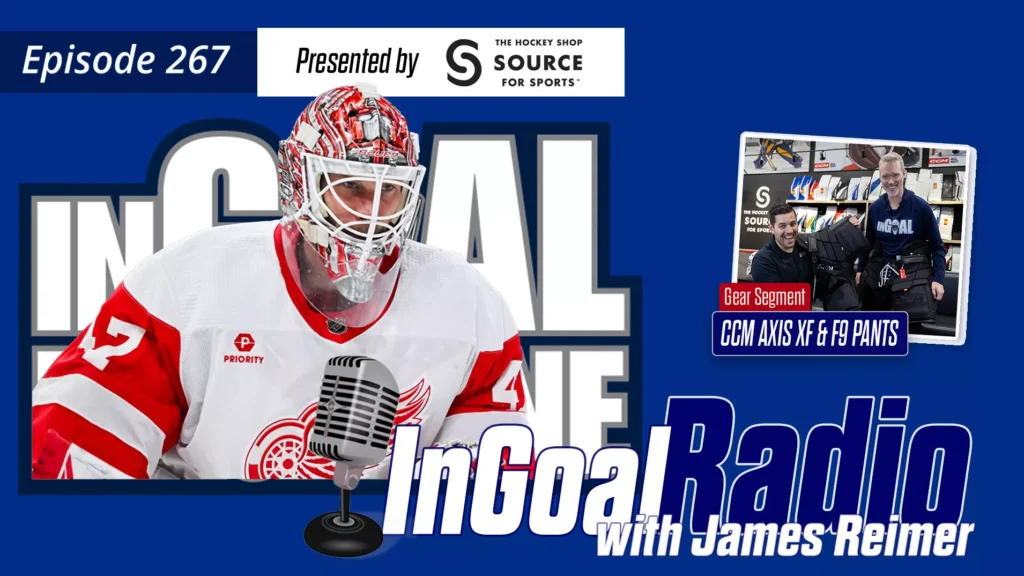
InGoal Radio Episode 267 with James Reimer

Please subscribe and leave a rating — it helps us reach more goalies!


In InGoal Radio Episode 267, James Reimer — who surpassed 500 NHL games with the Detroit Red Wings before signing with the Buffalo Sabres — discusses how his technique, mindset, and offseason approach evolved over 15 seasons. Reimer offers specific advice on quickly building relationships with new goalie coaches and teammates, and how to stay sharp and play your best even when your playing time is limited.
- James Reimer surpassed the 500-game NHL milestone last season with the Detroit Red Wings and has signed with the Buffalo Sabres for the upcoming season.
- Reimer explains how to maintain your game and perform at your best during stretches of limited playing time — a challenge he faced firsthand in Detroit.
- Building fast, productive relationships with new goalie coaches and teammates is a learnable skill Reimer developed across multiple NHL organizations.
- Parents of young goalies struggling with results can help by focusing on love of the game over outcomes, a topic covered in the episode's dedicated parents segment.
- The new CCM AXIS XF goalie pants feature improved padding and better out-of-the-box mobility, reviewed in the episode's gear segment.
Episode 267 of the InGoal Radio Podcast, presented by The Hockey Shop Source for Sports, features an in-person interview with NHL veteran James Reimer.
Feature Interview
presented by NHL Sense Arena
In the feature interview presented by NHL Sense Arena, Reimer shares lessons from a 15-season NHL career that saw him surpass the 500-game milestone last season with the Detroit Red Wings before signing with the Buffalo Sabres for the upcoming season. Reimer talks into how his technique, mindset and offseason approach have all evolved during that time, as well as advice on how to quickly build relationships with goalie coaches and teammates on a new team, and how to find your game and play your best even when you’re not playing a lot, something he experienced in Detroit last year.
Parent Segment
presented by Stop It Goaltending U
In our Parents Segment, presented by the Stop It Goaltending U app, we talk about how parents can help younger goalies who love the game but may be struggling with their results.
Weekly Gear Segment
presented by The Hockey Shop Source for SportsAnd in our weekly gear segment, we go to The Hockey Shop Source for Sports for a closer look at the new CCM AXIS XF pants, with better padding and improved mobility out of the box.
Episode Transcript
Intro
I've longed for this. It's finally happening. We're all back together.
Hello,
David Hutchison, Kevin Woodley, InGoal Radio Podcast presented by The Hockey Shop Source for Sports Langley, thehockeyshop.com. Tell me, what did you guys do to raise the bar while I was gone?
Oh, I don't think the bar was raised, Daren. We just tried to keep the ship floating. Kept our fingers in the dike running from one little hole to the other, trying to make sure the yeah. No. We need you, Daren.
We're so happy you're back.
I tried to go over the bar, Daren, but my junk got caught on and I knocked it off like the Olympics.
Oh, Olympic reference for anybody who wasn't watching the the Olympics.
Okay. I I missed that, and I'm an Olympic junkie. Pardon the pun part? And my wife had to tell me about that shockingly. I'm not even gonna bypass this without making some kind of reference to my relationship with my wife, but my wife mentioned this story to me and was so giddy.
What a incredible moment that was in Olympic history. If you don't know what I'm talking about, Google pole vault and Careful.
Careful.
And failed jump, and you'll you'll figure it. Yeah. Yeah. Exactly. We'll get past this, but just so good to be back with you guys.
And I just want to before we get too far into this episode and tell you what's what's ahead, thank the listeners for all the feedback. Hutch gets them, and he forwards the emails. And the the stuff that that we've received over the last, number of weeks has been just spectacular.
Absolutely, Daren. It's awesome when we hear from people. And I mentioned a couple of times while you were away, I asked people if they would do us a favor, head to their favorite podcast provider and rate the show and leave a comment because it does mean the world to us. And we did, I the one that I sent around the other day that you're talking about was a a great comment. Every episode packs a great goalie specific interview with the best goalies in the world, plus a quick little review of a nice piece of gear.
It's a lot of cutting edge insight packed into sixty to ninety minutes, and the hosts clearly have a fun time bantering with each other. I think he's probably talking about the Gear Segment and Woody and Cam. It's fun and intelligent. And I am Woody's usually the one who tries to butcher people's names, but, the name was Tjarus. I hope I got that somewhat close to correct.
I apologize if I didn't, and I thank you again for leaving that comment. Anybody else wants to do that? It really makes our day because here we are quietly recording on a weekend. There's no audience out there. We have no idea what the reaction is.
Let us know. We love it. Thank you.
Yeah. What's your favorite part of the podcast? Because we might be able to expand on that if, enough people are geared towards a specific area. There's lots of different areas that people can influence. So what we do and what specifically what you guys are able to dictate.
Yeah. And specifically, one of the things that has been getting great feedback, Woody mentioned to me yesterday, on all the parent segments, I've left this little area where you can sign up for a wait list for something that will be coming down the pipe for parents. But more more interestingly, people can leave a comment about, what it is that they want to learn as goalie parent. And I've been getting all sorts of great submissions that feeds my ideas for the parent segment each week. But if you have any ideas for the show and you wanna hear more stuff, please let us know.
Info at ingoalmag.com, and we will all see it.
There's a great book that came out a couple of years ago, by my friend John Shannon, the former executive producer of Hockey Night in Canada, two time executive producer, now, an on air commentator and does his own podcast, Bob McCown. But the book title was called Evolve or Die. And, that's we've been doing this, what, six years now. And you're you're you're always trying to just tweak things and avoid falling into the the the ruts that we all are susceptible to. So having that audience feedback is is one good for our egos if you're enjoying it.
And the other one is it's just great to lead us down a path that that maybe we don't see right in front of us because the forest is hard to see for the trees, but the trees are hard to see for the forest.
Yeah. And that's really influenced the Gear Segment that, Cam and Woody do each week as well because people leave comments over on YouTube where it's published. And, believe me, those comments get addressed in the show quite frequently. So if you've got anything, let us know.
It's the longest we've talked without Woody jumping in. Like, we've had a legitimate conversation.
Is is Woody here, Daren? Oh, there he is. He's over there.
Oh, hey, Woody. How you doing, buddy? He was muted. Boys.
I got your time. Late night late night skate. First one in a long time last night, and it may have killed me. So I'm just gonna nod off and on here.
K, what what was your strategy for recreational goaltenders or adult league goaltenders who maybe haven't skated for a while and will get the odd skate or in a month, will go back to their league and are fresh off a summer away from the game. Are you going all out? Are you focused on little foundational pieces? What did you do last night after not playing for a while?
So first thing is Sense Arena, and the hands weren't the problem last night. What do they say about the legs feeding the wolf? Mine was more like a little stray puppy. The legs were shot. So, have been doing the work, have been doing some of Maria Mountain's beer league workout program.
Just was not ready for an hour forty five in in a humid rink. So I my strategy is just to it's funny, Daren. My strategy, openly discussed with the guy. Because the first thing when I was asked to fill in, I'm like, hey. The level?
I haven't played in a long time. I don't wanna let anybody down. And he's like, dude, just go have fun. And so that was my approach. I mean, I have been doing other things.
I'm trying to I'm 50 now. So getting to continue to play goal requires some work, and I've been doing the work this summer more so than in the past because I'd like to make it through a season healthy. But the approach was just go out and have fun. Now as the game evolved, we're on an Olympic ice sheet. There was a lot of room, a lot of space.
I did make a tactical adjustment to I recognize that maybe the shooting talent wasn't as high as some of the other skates that I take part in. I don't need to be out at the edge of my crease. As the legs started to go, I just started to play deep and just made it really easy to sort of beat every pass up on my skates and and feel like I could hold my edges a little bit better. So the first one was just have fun. And then as the game evolved and I realized the pace of it, I sort of adjusted my tactical positioning relative to what I was seeing.
So that's about as deep a thinker as I get when it comes to goaltending. And it hey. Was accomplished. I had fun. I couldn't walk after, but I had fun.
Okay. Walking's overrated.
Was such a Woodyism. There was such a Woodyism. He basically said, I got tired and couldn't skate. But he said, I adjusted my tactical positioning relative to what I was seeing or something like that. I'm gonna have to pull that quote out.
That was the best, Woody.
You're a writer.
When you're tired, you you make adjustments. So I recognize that. If I was gonna keep out at the edge and having to flail around as they play kick that so
intelligent, Woody. Just accept the compliment and move on. That was good.
Yeah. I'm all I'm all about I'm all about only sounding intelligent. Trust me on that one.
So were you trying to keep your hands up? Was that a focus going into it? Posture being being on top of your crease at the start was what were the approaches before you discovered that, those guys weren't nearly as good as you thought?
Positioning posture pucks is my little we talk all about mantras and things that guys write on their skates. I've always had for the last couple of years, I've used three. The three p's for me are position, posture, and pucks in that order. So I think that and pucks is just sort of keep on it, stay on it, visually attached, head down, tracking. But Yeah.
It's hard to do that when the posture disappears. And so I found that as the legs got tired, the hands wanted to suck back. I wanted to start hinging forward at the chest, at the hips, dropping my chest, and then I lost my hands. And so being able to sort of keep my hands out in front of me as the legs got tired required what? An adjustment to positioning because it made it easier for me to hold my posture and focus on just tracking the puck rather than trying to keep up and keep the all the other things intact.
I think out of those three p's, they actually just they're all important, and they all sort of work hand in hand. And interestingly enough, once you lose one, it's kinda hard to maintain the other. I'm not sure the order I'd stack them in, but those are sort of the three things that bounce around in my head. And if things start to go poorly for a stretch, like there was a stretch there where I let in three quick ones, and it's like, okay. Like, which of these three things right now is not working?
And it was a combination of posture and positioning. I was out aggressively, so I was behind on place and swimming a little bit. And like I said, then my posture goes to crap. My arm I end up sprawling rather than skating, and my hands get pulled back behind me.
You don't know what order you'd stack them in? Interesting.
Yeah. I know. Just just throw us. Thinking about that.
Did you throw a pad stack in?
You know, I I kinda go back to the Toy Story. Remember the original Toy Story movie? For those of us that are old to recall that.
I remember it. I don't know where you're going with it.
Well, because, you know, it's kinda like, when, Buzz does his, like, flies and Woody says, that's not flying. It's falling with style. My pad stacks are sort of falling with style.
So did you throw in a pad stack? Because people don't see pad stacks
very often. It was more of a I'm screwed, stick a leg out, and now I'm going going going the wrong way and that type of pad stack accidentally on purpose.
Sounds like time for us to publish the photo I took of Woody doing a pod pad stack again on social. Time for it to come around again. You can reuse content on social, can't you, these days, kiddies?
The the guys I skate with?
Hold on a second. I gotta go change the password to the social.
They don't see pad stacks ever. So when I do it, when I'm out with them, they they get the biggest biggest kick. They love it. They they howl.
Yep. Absolutely.
Let's, just one, little reference to Sense Arena earlier. That that was awesome. The the work I'm sure that you put in with Sense Arena for this skate that just popped up was was a good help for
you. At the risk of being a Woody, as Hutch said, like, now that I think again, I I I sort of hadn't thought about it in the moment. I was really tired when we started this, but losing my hands because of my posture, like, everything I can do on Sense Arena in terms of catching pucks, that all disappeared once the posture disappeared. Right? And so it's really easy to sit there for twenty minutes and run a couple drills through Sense Arena.
But as the legs go, you can kind of feel the correlation. It's like my hands still work, but if I don't put myself in a position where I can access them out in front of me, they're not as effective. You end I end up for me, I end up making a lot of sort of, like, chicken wing or leaning saves that way just because my hands aren't out and active. And so, yes, the Sense Arena work helped me probably between the ears more than anything because I felt confident. And then in the second half, once I adjusted so that I could keep my hands in a position where, because you know how it is in Sense Arena.
You can if you're doing it, you can see your gloves out in front of you.
Right? Gloves.
Yeah. Yeah. And, well, guess what? I looked down. I couldn't see my gloves because they were you know, I was like Sergei Bobrovsky in in Philadelphia, but a lot less athletic.
Remember back then, he used to, like, have his hands, like, pulled tucked back at his shoulders, and, of course, you can't access them from there. So, I guess, in a way, as much as I said, I was just going out there and playing and having fun. A lot of the things we listen to and learn about on this podcast, kinda all come into play out there. And if you pay attention to the right cues for you, you can salvage what you know, again, for me, was starting to go the wrong direction, ended up finishing well. It's still just a bunch of beer league shooters.
It but for me, it it I turned it around.
There's the value of Sense Arena, guys, that that continues to, give us a foundation if you're putting in that work, with with a headset that's going to help you maybe tomorrow, maybe in September, maybe in November.
In my mind, I looked fantastic out there. I'm sure much like Hutch's, you know, picture of me falling down with style, it was a lot less pretty.
You know, it's funny because, Woody, when you were talking about your beer league strategy and and positioning being one of those things, I did actually immediately think of Sense Arena. And one of the things that it lets you do is experiment in ways that you can't game to game on the ice. You as a young goaltender, you can't just go out at your next game and decide you're gonna try something completely different. And you probably can't even do it in practice because you can't control the environment that you're facing each day. But in Sense Arena, you've got the ability to completely control what you're facing.
You can decide what drills you're doing. You can decide what level shooters you're gonna face. You can even use something like the puck cannon and decide exactly where the shots are gonna go. And so now you have that ability to try something. And and I'm sure you've tried something in a in a beer league game, guys.
And you go out there and maybe you're like, ah, I'm gonna be like Woody. I'm gonna try and conserve a little energy today and tactically control the situation standing on the goal line a little bit. And then it doesn't go so well and you abandon it instantly. Well, with Sense Arena, you have that ability to control that and day in and day out, try something new and see how an adjustment, moving those hands a little bit, moving your positioning a little bit, how that can affect things. I think I told you guys this story once that just for fun decided I would try that stand on the goal line and see how it goes, and it went remarkably well.
It's hard to get that confidence in practice as you try something so radically different, but then in Sense Arena, you try it, nobody's watching, nobody knows what's happening. You get that ability to work over and over. And and I think this time of year is a great time to go and grab Sense Arena. Everybody listening, it's close to the season happening. We're down to three, four weeks depending on what level you're playing at.
You can get into the headset fifteen, twenty minutes a day, try something, work on your game, and you will be a new goaltender come September. It's gonna make you better. As Daren said, we're not sure when it's gonna make you better, but there's a good chance it's gonna be soon, and you will realize those differences because Sense Arena gives you that controlled environment away from the rink, and mom and dad don't have to drive you to the rink to try all these things either. There's no coach screaming at you. Get out of the top of your crease.
You can try anything you want. You're in control. Just go have fun in Sense Arena.
Before I get to the James Reimer interview, I wanna let you know what is ahead with our feature interview. The Gear Segment's coming up and, of course, the parent segment as well. I have the Sense Arena moment this week during a skate where the the coach, had the players just line up on the blue line come in and take one timers top of the circle. And it was just a flow drill. They just loop back and just one after the other.
And he said, you can go in that if you want, but you don't have to. And it was it was this it was Sense Arena on the ice, but in real time, I I stood there and just worked worked in my hands and was shot after shot after shot. I'm like, this is Sense Arena, but on the ice.
That's incredible.
I've I've never had that feeling before. And I've got to sort of channel a lot of my Sense Arena thoughts. So I thought I'd throw that in. Well,
I I'm sure the coach wasn't really worried about your mental health here and you as a goaltender, Daren, but I think it was a great example of something a coach can be doing because can explain the context of a situation to a goaltender and say, look, go in, don't go in. I'm not really worried about what you're doing in this particular drill. Just go have a little bit of fun out there.
And Yeah. It's it's a great way to
learn taking all that pressure off.
That's exactly what it was. And I wasn't going down because the shots were coming so so quickly. You you couldn't do that. But it was just fun to to work on your hands a little bit. And it reinforces patience that you can stop so many pucks without moving around and and just providing that little bit of foundation at the top of the crease that you can stop those pucks.
Hey. One other little thing, not to go back to my skate, but I think this is actually good if you're, like, your old guy and you get invited out, you know, like, the weekly skates, you know, like, with here and there, And I hadn't been to this one before. So like I said, I didn't know the level. I didn't know the players. I didn't know the shooters.
Watch the guy at the other end because I watched this guy, and he was actually really good. And he keep moved really well, kept his legs underneath him, but he always had his hands super active and was making all these really good glove saves in the first game. And you can either watch him and go, oh, hey. Good job. Or you can watch him and go, hey.
Look. Like, he knows these shooters, and they're all trying to tickle the bar because they've got a little time and space out here. And so if I don't get my hands active again, I'm gonna get torched out here. Like, I'm not gonna be able to so watching the guy at the other end, if he's familiar with this gate, you can start to pick up on some of the habits of the shooters that he knows that you don't. And, again, when you stupidly volunteer to take part in an hour and forty five minutes skate for your second one in the summer, that will come in handy by the time it's over and you're dying.
There's lots of opportunities to learn. So, yeah, it's I never thought of it until just now, but I I picked I owe him a lot of credit for last night because I watched him for a while and realized tactically the adjustments that he had made probably playing with these guys on a weekly basis all summer that were working quite effectively because in the first game,
he was dominant. Subliminal scouting.
I think I think there'll be a new book released at Christmas. Amazon, Apple Books, anywhere you want. Kevin Woodley's tactics of beer league goaltending. Grab it this Christmas.
Drop in hockey. How to survive drop in hockey is an aging, decrepit, everything falling apart beer leaguer.
I'm joking, but Kevin is right. He's I love the way he's analyzing this.
There's a book there.
There is. Come on, Woody.
There's a total book there.
More than a pamphlet.
Tales of a beer league goaltender.
Two things. Hour forty five, nobody skates for an hour forty five anywhere. Anywhere. Rec league, junior, NHL, nobody skates for an hour forty five.
It's it's a it's a long one.
That's too long. Yep. Number two, the International Ice Service or aka the Olympic Ice Service. The Olympics don't even play on the Olympic ice surface anymore. Know.
Like so so why we there was one just built recently. Why we build these Olympic ice surfaces anymore is beyond me.
Well, this
Figure skaters don't don't use it because the they don't skate on that that ice. Hockey doesn't play on it anymore. I don't know why we build that wide ice surface. Was it is it 200 by eight by 100 now?
I think so. Yeah.
Is is is the Olympic ice surface? It's 200 by 85. It's In the NHL. Just bizarre.
It's way too big. That's all I know. There's way too much time and space there. I was at the the home of the BCHL Champion, Surrey Eagles coached by Scott Gomez, was where we were playing the other night. And the irony is the only other rink out here where I live is old and tiny, like way below regulation size.
So and that's my one of my weekly skate. Actually, two of my weekly skates in the winter when the ice is in there. So that's my reference point that I play the most at. And then this feels like you're playing in it's, like, twice as big. It's just it's kinda Which
would you rather play on?
Oh, the small one, especially Yeah. The Absolutely. The only reason that I survive my skates in the winter when it's guys that played at a at a much higher level than I could even dream of, like it's all ex pros and juniors in college, is because a, they're very competitive and they back check. So guys are where they're supposed to be and there isn't the type of time and space I talked about last night. And b, because it's in a tiny barn, they're on top of each other.
They don't because if you gave some of those guys time and space against a guy like me yeah. Just say those best of fives would be over in a hurry.
Last twenty years, the greatest trend or evolution in our game was the emergence of the small rinks where kids can play five on five, but touch the puck a lot or adults play three on three. Three on three leagues. They don't need big rosters, and there's tons of goals. That has been awesome. We had them in Markham.
At least I love that that style of of rec league where you needed nine players for a team and you play and you get lots of shots and and away you go.
Yeah. I I almost died at three on three a few years ago, so that's a that's a little much for me. Thank you.
Let's, talk about our NHL Sense Arena feature interview. James Reimer is coming up, and this is going to be a a really fun leaning into his long NHL career.
Yeah. You know, it's funny because we talked to James semi regularly. I went into this interview. Honestly, I even said to him before we started it. We saw him up at Adam Francilia's in Kelowna working out, training there.
And I was like, man, like, I don't know where I'm going with this. We've done the origin story. We've talked about your roots. We've done all these things. And it ended up becoming more of a retrospective lessons from, you know, what is going to be fifth fifteen years, I think.
Like, it's like like, I remember meeting James when he was in the American League with the Toronto Marlies coming through town. Like, that's how far we go back. And he ended up with just a ton of really great insights on everything from working with different goalie coaches because he's bounced around a little bit the last couple of years. How do you walk into a new room and and and, you know, get to know new teammates and fit into a new environment? These are good lessons for body young goalies who are getting ready to start with new teams here in the next month. Of all ages, sports psychologist, mental approach. Like, there's just a ton in here of great advice from a guy who, you know, big he's he's put on some miles in the National Hockey League. He hit a he a big milestone we talked about as well that he reached recently this year quietly, while he was with the Red Wings.
The parent segment brought to you by Stop It Goaltending U is how to help goalie frustration. Hutch, give us a little bit of a insight into what you're gonna be talking about.
Well, I hope it's something that we'll all be talking about because this affects parents. You know, we're all we're all parents of kids and they get frustrated from time to time. This one started with a question from a parent who had, I believe it was a nine year old or maybe it was a u nine goaltender, who's just frustrated by the number of goals that are going in, that it's it's really tough at that level. I'm assuming that they're playing with the regular regulation size nets, and you get this huge discrepancy in inability, in development at that age. And a lot of pucks go in, and here's a kid who absolutely loves the game, works really hard at the game, is passionate about being a goaltender, but it can just wear on you sometimes.
So what can we say to a child in a situation like that? And then and then maybe it's, we'll we'll talk a little bit about it at other ages as well because it's something we all face.
Looking forward to it. The Gear Segment brought to you by The Hockey Shop Source for Sports Langley, thehockeyshop.com, focusing on the Axis XF Pants. So before we get into that, what's happening over with Cam and Company?
We've got you know what it is? It's August. You know what that means, Daren? It's the big back to hockey sale Deal. At the Hockey Shop.
Sale. Yeah. Hockey Shop Source for Sports, hockeyshop.com.
Are you a seagull? That that was that
was his Finding Nemo. Good. That was a good Finding Nemo.
Think Cam already did that in one of the segments. I think that's where it came from.
I think Cam is like one of those seagulls from Finding Nemo on a weekly basis for me. 25 to 50% off Bauer gear, 40% off Warrior gear, 25% off Bauer Supreme sticks, up to 40 off True gear, and 30% off on CCM access too. So lots of different options to save some money as you head back to the rink. Maybe maybe you're getting ready for another beer league season, and you wanna treat yourself. Time for something new.
They've got lots of second price point options on sale. In addition to all the new equipment that we go over every week, including the new CCM line, Axis XF pants. We had the XF Pro stick recently. We've talked about the XF pads and gloves. Like, we've got a ton of stuff there.
Whether it's new, whether it's on sale, you can find it at the hockey shop and thehockeyshop.com. And, of course, if you have any questions about what level of equipment suits your game, what style of equipment suits the way you play the game, Cam and his crew are always willing to help make sure you get outfitted with gear that will make you a better goalie.
Let's get over to Cam at The Hockey Shop, over at The Hockey Shop Source for Sports Langley, thehockeyshop.com, and then I've got a follow-up for Woody on the Axis XF pants.
Gear
Uh-oh. Welcome back to The Hockey Shop Source for Sports. We're In goalie Utopia with Cam Matwiv and the new CCM AXIS XF Pants. Pants. Now hold on because we had a little issue with the sticks, Cam.
It actually is axis x f, not just x f. Here we go. I take our shots where we can get them, folks. He doesn't get much wrong.
No. And I don't let Match get past me either. Except well, maybe here
in the shop, but not on the ice, but that's another story. Axis XF pants Cam. It changes the differences. Nuances. Light.
Really light. It's also very breathable.
Yes. Why is that? Air tech. Oh, see? He's on point this morning.
He didn't just look inside the pant to see the big call out
that says air tech right there. That's okay. We'll show you guys later. I'm gonna be honest. I knew it in part because we've been wearing these pants.
We've had several demo sets. We've some testing. We've done some testing. Feedback has been really positive. The biggest thing I would say is that, you know, when you get a new pair of pants and there's that break in period and the hesitation like, hey, I don't want to wear them to my good skate.
I'm gonna wear them to, a lesser skate, practice something because I gotta get them broken.
Don't want to wear them to my good skate.
Well, you know, the skates were the, you know, good shooters. Alright. Oh, you don't know what that's like. I just live every day of the good skate.
You want them to move. Yes. And these ones out of the box move really well. I just found the break in period was really quick of them. That's been feedback.
We have we have multiple sets and multiple testers and feedback's been really positive. Think that's about segmentation.
Segmentation. So continuing with those segmented hip flaps that you've seen in the previous pro model for sure. They've extended it just a little bit longer just to help seal off that gap that sometimes happens. Especially
having a puck in that gap between the leg and
the Exactly. We'll call it almost your your hip area. Right?
Yeah. That sucks. These these little protection pads have D3o in them too. They do have D3O. Extra absorption and they're segmented, as I said, so the mobility in them is great.
Exactly. Exactly. And then on the inside of the pant, we can kind of start to see that air tech. You know, if we showed off here a little bit better too as well. Nice, lightweight, breathable fabric.
So one of the things that I noticed right away between a pro in similar size from last year is a weight difference for sure. Just for overall feel, especially when you're on in the hips. CCM has always had a little bit of a bigger style of a pant, more of that barrel fit. Bigger better. Bigger can be better for sure when it comes to pants.
And like pants, one of those things you can kinda oversize a little bit without feeling like super restrictive. But in terms of for, like, overall feel and whatnot, especially when I had this on, like, it felt noticeably lighter. K. Noticeably lighter, very mobile. Talk about bigger, better.
I mean, I just like the extra coverage because if I'm not cheating, I'm not trying cam. You can have that with the inner belt. Of course, obviously not legal in the NHL, but with the inner belt for the rest of us, you can cinch it up around and sort of have more of that barrel effect where the pants sort of extending, but you still have that connection
to the pant around your waist. Yes. And you still have your little sneaky clips so that you can tuck in your chest without having to use suspenders. That's a little quick follow-up. On your just center the belt inside the pant.
They're actually four CCM chest protectors. Wait. People don't know.
I didn't know, and I'm wearing these pants and a CCM chest protector.
Clip tucked in. That's the suspenders. Nice CCM feature. Couple more little cool little quirky features of the CCM pant. They also have that zipper goes around the perimeter of the pant itself.
This will drop pant an extra inch on the overall leg and height. So a little bit of extra built in growth room or some adjustability for those looking for a little bit more of a custom fit.
I hope that's the last time that Cam drops traw on the InGoal Radio Podcast Zipper
Segment. Drop the zipper. Settle down. So one more quick thing to kinda go over. CCM also has another new pant.
Oh. The F9. This replaces the 1.9. Similar concept to a gimbal we've seen kind of in the past. Quick differences, we don't have that same air tech, but we can still have a nice lightweight mesh all the way around the outside.
Still very nice breathable fabric. No D3O on the pant. Senior models do not get the zipper, so there's some of our differences that we're gonna notice. Not as thick as the hot not as thick in the thigh overall itself, as well as a bit of a lower count on the nylon itself.
Okay. So one thing I did notice that's on there that's on here that we didn't talk about on on the top level as well as the second price point, Just that different material on the bottom of the leg. If you've had pants that don't have that, you can get that fraying, especially if you get interference. Not all of us are as smart as Cam and put socks over our knee pads. Sometimes there's Velcro sticking out, and this can start to fray.
Won't here because it's got a high wear air that's a speed skin.
It is speed skin.
So they're still using it for some.
Yeah. It's speedy on your pant.
If you have any questions, you can
give me a call. (604) 589-8299 or 1-800-567-790. Are these the right pant for you? Should you tuck or untuck? Are these the pants to tuck or untuck?
All these questions. Cam will answer them or his crew. Make sure you
give them a call at The Hockey Shop and the hockeyshop.com.
If you were going to and this isn't my follow-up, but, it just occurred to me. Uh-oh. If you're going to wear pants straight out of the shop, would you do anything to them? Would you put them in water? Would you put them in the dryer to to bounce them around a little bit?
Is there anything you would do just to get them a little more flexible or movable?
I mean, this feels like we're gonna need to make this a like, listeners, let us know.
Oh, yeah.
You know? Because I I'm I this is one of those ones where I don't. Right? So quite often when we get test equipment, it's out of the box and into the into a game. And as I said in the review, last year when the XF pants came in, I was not playing a ton.
And so there was no opportunity to be like, yeah. I'm gonna take the new stuff out to my crappy skate. It was like right into Monday night, which is one of my, you know, better it's over my head as we've said. Most skates are over my head. And just love the mobility of it.
Now I think it depends on the pant. I think you can put it on at home and check it out and be like, man, this is gonna take a little while to get going. So many of them and then the Axis XF Pro is a great example of this. The way they've segmented them now, they really are designed to sort of have overlapping parts that will protect you, but they slide in and out, like, above and below each other so that they do move pretty smoothly. The other part, I think this would be different at the pro level where you're dealing with a pant that can't have an inner belt, but I just find that as somebody that likes an inner belt and I can cinch it up tight and have the pants sort of sit out around me barrel style, that extra bit of room and space that it occupies to help stop a few more pucks, thank you very much.
I just find that gives you room to move sort of inside of the pant. We just talk about goal pads that were tight to the leg and move with your leg or ones that were looser and moved around your leg. To me, a good pair of pants has a little bit of both. And if you're moving sort of inside that barrel, you're gonna find less restriction points. And, like, think at the end of the day, try it on at home.
You get a pretty good idea of where there is resistance to movement if you just put on a pair of pants around the house and see how they will move. And let's let's hear it from the listeners, if they've got any ideas on if they find a pair that does have resistance and is stiff, how do they how do they get it ready for a game without, getting an opportunity to wear it in a game?
How do you seamlessly get into the RVH if it's a brand new pair of pets? How do people, contact us and let us know what they do? Hutch?
Info@InGoalmag.com.
By the way, that's just a button that he presses. That's recorded. Yeah. That is the voice of God right there. The goalie God.
Only. Awesome stuff. My other one was you wore the AXIS XF pro pants last night.
Yeah. I've been, like I said, been wearing them for a bit. I did. And I'm a guy that in the past, including CCM pants, has felt like it needs a little break I didn't with these. I do find that those points where it becomes restrictive in movement are so minimal that I was able to just sort of hop right out there.
I do appreciate the extra protection in the d three o, just especially along the front of the pant. We know that we know what those ones feel like that they catch a gap in the, you know, upper thigh area, can happen as pants start to wear out. And there's just so much sort of layered segmented protection in that area with the d three o built in that I feel quite safe out there.
Great stuff. The parent segment is brought to you by Stop It Goaltending U. How to help a goaltender deal with frustration? Before we get into that, what's happening with, Brian Daccord and company as they pump out the content.
Yeah. I know, the one good thing about well, not one good thing. One of many good things about Stop It Goaltending U, the app, is the constant influx of new content. New this week, they've got a great new goalie playbook up on Jonathan Quick. So as you can imagine, as they break down his game, and the way he plays it, his tactical playbook, the goalie playbook that they do, obviously, there are some things he does that are very different.
So an opportunity to learn as you watch video of Jonathan Quick and see if there are things in his game that you might like to add to yours. Now I'm gonna, for myself, go out on a limb here and guess that there are things he does from a flexibility standpoint that aren't gonna fit in my toolbox. But that's the beauty of the Stop It Goal Tending U app is you're constantly sort of looking at new ideas from different coaches, different goaltenders from the NCAA right up to the NHL, breaking down film, going over drills, finding things that you can add to your game, and then ultimately, you're your best goalie coach or you're a part of your goalie coaching team. You get to decide what fits. So whether it's the daily primers, if you just wanna hop on the app for a minute at a time, or if you wanna dig deep into video like the great new goalie playbook on Jonathan Quick that's up, there's something for you that will help you become a better goaltender.
Stop It Goaltending U, the app, the world's most comprehensive app for goalies, goalie parents, and goalie coaches. And, of course, the added bonus because of our partnership with Stop It Goaltending U, the app, when you become a subscriber, a monthly subscriber to their app. So unlock all that's in there, and there is a lot. You also get a subscription to InGoal Magazine, InGoal Magazine Premium at ingoalmag.com, and all our great tools and content. And, boy, we've got some great stuff up there as well over the past week.
Between those two things, there's no excuse for you to not get better just like this month, this week. Go check it out.
Parent Playbook
Hutch, great question coming into InGoal Radio Podcast.
Yeah. It's tough for us as parents when we see our kids getting frustrated and it's even tougher when we know that they love what they're doing and that that thing that they love is causing all that frustration, all that upset. What do you guys do? What do you guys do when your kids come home and something you know that they love is is really driving them around the bend and and upsetting them and it's tough on you.
Listen.
Mhmm.
Ice cream. Ice cream. And then maybe after I've had some time to think about it, give them a little bit if if it's something that their kids and they just need to fight through it, you you work with them on that. But, if not, then it's just peer support.
Mhmm. I thought you're gonna ask me what I do when the game's not going well and and all the pucks are going in the net. I was gonna say rage quit, but I guess that's not the that's
not the answer we're going for here. No. I like the I like the ice cream one.
Ice cream's my go to. Yeah.
For sure.
Or a Slurpee or a Slurpee. Like like, we'll we'll go for a Slurpee and and, and have some laughs and and just listen to them vent.
Yeah. It's it's especially tough because, you know, it's something that your kids are passionate about. And, if you're in that position as a parent, you're not alone. This this question came from a parent of a a young goaltender. I believe they were dealing with the large nets.
But you know what? I I don't think it it really matters. I I love that they've let younger kids move to the smaller nets at different ages. I know not everybody agrees with that. I got a note from the head of a national association who doesn't agree with the small nets as as goaltenders.
But at the end of the day, guys, I think, look, we're dealing with the same net, as as NHL goaltenders, and our kids are four feet tall, five feet tall. They're they're generally not the same size as NHL goaltenders. They're not in the same place developmentally. The kids in front of them are not at the same place developmentally. And so there are going to be frustrations.
And I think part of that is just to understand, as as you're saying, think, Daren, accept that these things happen and and know that you're not alone and try to focus on things that we can focus on to help our kids through this. I try and give them a little bit of context when we've been in this situation. It's not blaming anything. Just understanding that those numbers that you see for goals against averages for NHL goaltenders are not gonna apply when you're 10 and 11 years old. Somebody out there might be saying, yeah, but my kid had a 1.5 at age 11.
Well, maybe they're on one of those dominant teams because we see that a lot. Or maybe another kid had a 9.6. Don't take stats, with your kids at that age. I really don't think they apply very much, everybody. What I like to do with them is to focus on something positive.
Give them a goal for each day that has nothing to do with the score. Something as simple as and I've done this, I think I've said on here before with major junior goaltenders. Did you smile? Did you have some fun while you're out there? Tell me something that went really well.
As a parent, learn a little bit about the position and find something that you think that they did really well on the ice and celebrate those things. We don't even need to talk about the score. I I know kids do. I know it's hard to avoid because it gets brought up in the dressing room. It's inevitable, but we can push through that and we can focus on the positive things.
We can tell them how proud we are of them when they battle through things that are tough. Acknowledge that it's tough. Listen and and tell them how proud you are that they're getting through those difficult times. I've told this story before, but but I'll do it again for people who haven't heard it. When I dropped my son off for his first, attempt at a junior a game, he was very young, ridiculously young at that time.
And I said to him quite literally, I said, hey, keep it in single digits, buddy. And we had a good laugh and he went into the rink and, had a great game and kept it far lower than that. But, but it act I was actually semi serious when I said it because he was so young that nine would have been a heck of a story. And, and quite frankly, when he only gave up, I think it was three in that game. I think that speaks to this difference that we have because he was playing on a junior a team and there's a lot more structure at that level guys than people face when they're nine, 10, 11 years old.
There's a lot more similarity in the ability of all the players. When you're nine years old, you can have a kid who developmentally is skating like he's 12, 13 years old, and you've got kids out there that are developmentally well behind. So the game you're facing is just not the same. So we wanna provide some context. As adults, we face it.
Woody faced it last night, I think, when you're playing three on three or four on four in the summer. As he talked about open looks and people not back checking, you have to change the context that you're facing that game with. And, Woody, how would you have felt if you think that every summer skate, you're supposed to walk away giving up only one or two goals? My guess is he would go a little bit snap tastic, but he's smarter than that. And we have to help kids understand the situation that they're in so that they can continue to go out there and and just enjoy the game.
Got to accept that sometimes things suck and that it's okay, and then we just move on and try and help them with that. But the other thing I I just wanted to say, you're gonna hear a bit about it in the feature interview this week. We heard a bit about it from Devon Levi last week or the week before. I'm sorry. More and more, we hear about kids dealing with sports psychologists.
We've had people work with Pete Fry as a mindset coach, and I really encourage that. If it's if it's Pete who creates this incredible positive vibe around every goaltender that he works with, that's awesome. If your kid is going into a sort of a deeper place where things are a little bit more challenging, deal dealing with a sports psychologist as well, might be a good idea. And I'm not sure if everybody knows this. I didn't know it until, fairly recently.
If your sports psychologist is a registered counselor, as many of them are, quite often, mom and dad, that bill can get picked up by the, benefits that your company might offer through work. So it's something that can be a little more affordable than I think you realize. Understand that all of us sometimes need somebody to talk to beyond mom and dad. And if things are getting really, really challenging, it's okay to talk to a sports psychologist. All the NHL goalies that we talk to these days do exactly the same thing.
So don't run away from the problem. Talk about it.
What age would you consider leaning into a sports psychologist?
I don't know that I would think about age. I think I would more consider where is my child at the time and what do they need. You know, I'm getting into territory that I'm not nearly as familiar with, and and I'm not qualified to talk about, psychology at this level, Daren. But I know there have been times that I've looked at my child on the ice as a goaltender and thought, I'm not the guy to handle that issue. And I think if a parent is in a situation where they're a little bit lost for words and they think maybe things are a little bit tougher for their child than than they know how to handle as a parent, it's okay to reach out for help.
It's okay for your child to talk to somebody else. It's okay for you to reach out for help. I'd I'd love to know from somebody a little bit more qualified than me what that age is that you can see a sports psychologist, but I think it's probably a lot younger than all of us realize. I know as a mindset coach, my son was talking to Pete very young. I'm gonna say seven, eight years old, and it made a difference for him.
And I actually had somebody comment once when I put something on social about Maddie working with Pete, and they just said, oh, look at all that pressure you're putting on your child. Seeing a mindset coach so young, you're not understanding this is a game and they're having fun. And my response was quite simply, that's kind of the whole point. I want him to be out there and have fun. There is no pressure.
And Pete is a guy who takes that pressure off. But, yeah, round roundabout way of saying, I'm not sure, Daren. Every child is different, and and that's my approach to them all the
that that you don't know because every child is different and you don't know whether there's an age because for all intents and purposes, if I if I wanna break it down to its basic level, it's it's therapy. And Yeah. There's there's there's no age, limit or or requirement on therapy.
I was gonna ask. I don't think so. Is there any parallel to be drawn between when would you in life consider it for your child? Right. Because I know that I
think that's a great
It is life.
I I know that there are you know, like, both my kids have talked to somebody at at at an age that when I grew up, we never would have considered it and both benefited greatly from it and have continued to go back to that person at different points in their life as they've grown up and and and started in school and things like that. The lessons they learned at a really young age provided them with tools to deal with the pressure and emotion and all the things that come with being, you know, for in some cases, sports related, in some cases, just teenagers, in this fast evolving world that we live in. And so I I think I would answer without having the expertise and a shameless plug. We've got Julia Allain coming up in a couple weeks here, on the InGoal Radio Podcast, and she was at the USA Hockey, as a sports psychologist and mindset coach and has some great tips in there. I can't remember if we talked about age, but I might just drop our line and see if we can add that in.
But I I do think that's the equivalent. Like, hey. If if my kid was struggling this much with something in life and I don't have the answers myself, would I consider do I think outside help would would benefit? I think the same question applies to this.
Yeah. And it starts with you as a parent anyway. I mean, you're not just taking your seven year old and sitting in the room with a counselor without having contacted that person ahead of time yourself. So don't be ashamed as a parent to call somebody and just say, I'm struggling with this situation.
Oh, yeah. How do I manage it?
How do I manage it, and and how do I help my child manage it, and is it time for them to talk to somebody else?
James Reimer coming up, and that's a a great connection to this conversation and how you handle things because he's always been positive. We called him the the great grinner when he was with Toronto because he always had a smile on his face, and it was so just absolutely enthusiastic to watch and and infectious to watch them. And when you said smile, like, send your your child onto the ice and say, smile. I think that's a good lesson for parents too. Watch a practice or a game and concentrate on just smiling the whole time.
And you'll you'll probably enjoy it a lot more, regardless of what's happening on the on the ice, and, you'll you'll come up with a with a a better attitude instead of being stressed because being a bully parent
It's hard.
It's stressful.
Smile is such a good piece of advice, and we I think we tend to overlook it. I'm reminded, Daren, of my first experience this past year. For the first time ever, I had ads to read for radio. My first sort of sponsorship and I'm voicing commercials, and I didn't know how to find that energy, that right level of energy in my voice, that positive vibe you wanna have in in the way you speak in in these types of environments. And the person, the producer who's helping me said, just right before you're about to start your read, just take a big smile and smile throughout it.
And the energy that came through was both natural and as you said, infectious. And I've thought of that every single time since when I go into that studio. If you just smile, everything just sort of gets easier.
I'm smiling now. I'm I'm reading off you, and, it makes me happy. And we've got James Reimer, and that makes me happy too. Good Manitoba product as the NHL Sense Arena feature interview focuses on the traveled James Reimer, but very successful James Reimer.
Feature Interview - James Reimer
Really excited to welcome back to the InGoal Radio Podcast. Third time guest, James Reimer. Been a couple years, though, which means we have some catching up to do. Last time we talked with you, we were heading into the second year in San Jose. Mhmm.
New goalie coach, I think, the time in Thomas Speer. Last year, Detroit, Alex Westlund. Now you're heading to Buffalo, Mike Bales. Let's start off with just sorta what last year was like as an experience, new voice, new coach, new team. Like, that's a challenge a lot of kids go through on an annual basis.
Right? So advice. Yeah. Advice. No.
Yeah. Advice. No. I I think anytime you walk into a new situation, it's it's it's difficult. I mean, when you come back to a team you've been with for a year or a couple years, obviously, you know people, you know expectations, and and and they know you and and and their expectations. And so there's kind of a a continuation process. And when you come to a new squad, it's it's it's awkward at first. It's disjointed.
It it feels weird. But, you know, you kinda just gotta trust, what you know and and again, probably more or even more so who you are as a person. And, you know, I think just genuinely trying to get, get to know guys and get to know coaches and and be intentional intentional about getting to know them, asking questions, and and that way you can kinda get through that that awkward, get to know each other phase, you know, sooner and and not have not have that drag on, which, you know, it's not like it's the end of the world. But, as soon as you get comfortable, the the better it is. I was
gonna say there's the who you are as a person, and there's who you are as a goalie. On the goalie side, when you meet up with a new coach, like, is for example, I don't know, like, now going to Buffalo. Like, have you had conversations with like, at what point do you start trying to learn each other in terms of preferences, what you like to do on the ice, what he likes to do on the ice, that process? And is there times over your career where you've had to, you know, like, you're always listening, I'm sure, but advocate for yourself at times.
Yeah. A 100%. I mean, I think you, you know, you you'll find out pretty quick, usually within the first conversation whether, you know, your goalie coach is is I don't wanna say open minded or closed minded. You know, I think that's I mean, maybe too, black and white, but but is
Varying degrees of openness.
Varying degrees of openness. Yeah. That's that's a good way of putting it. And so and then from there, you kinda gauge, you know, what's your what's your path or what your vision's gonna be. You know, I think I think there's times if if you're really sold on on parts of your game and, you know, and you're in a disagreement with your goalie coach, I think it's important to have conversations, but I don't think you wanna push it too much too much either because I could create a confrontation that that you don't need or attention throughout the whole year.
You know, I think it's I think maybe sometimes it's good to to if you're really passionate or sold or convinced that you need to play a certain way and it isn't exactly 100% the way the goalie coach and the goalie coach doesn't really want to doesn't agree with you. I think it's important not to fight it every single day. But I think there's also a big part. I think from my career too, what's what's been important is you yourself as a goaltender have a varying or a good degree of openness too. I think it's important to be confident about your game and and to understand, what makes you successful.
And and there's kinda some untouchables in your game at times, but I think it's really good to to step back and and, you know, this coach is here for a reason, and and he might have some great ideas. And and it's good to, you know, take him for take him for a spin for a little bit. I mean, I I don't know if there's a goalie coach in my career that I haven't taken, you know, something from.
Okay. I was gonna say I was gonna I thought I was gonna put you on the spot here by saying, give me an example of something where you at least you're maybe at the first you're like, yeah. But then you ended up maybe it's something that you still have in your game even today.
Yeah. Well, you know, I won't name names or anything, but but
Or even like a like a like a technical element or something, you know, something that you didn't think maybe fit and found out after trying and it did.
Yeah. Well well, there was this one goalie coach where we didn't, you know and, obviously, most goalie coaches are are are great human beings. And so we got along great, and and this goalie coach is great for the mental side of the game, which is, you know, I'd say, a 110% of goaltending. And so, that part was great. But, technically, you do we didn't agree on on a ton, but there was one aspect, you know, in regards to in regards to to shootouts where where I never thought about it that way before.
And and we went over it, and I I took it for a spin, and and I end up really loving it. And and, you know, I don't actually really do that anymore because the game has changed so much over my career. But that was but you know I mean? It was it was big for me.
You mentioned you talked about career and the way the games evolve. I wanna get into that a little bit. But, dude, I remember when we first met, like, we're we're getting up there now. This is heading into year 15. I remember in the American Hockey League with Toronto, and here we are, like Oh, yeah. Fourteen years done later, heading into the fifteenth year, 500 games played. Like, I've talked to a lot of guys that see that as a really big milestone. Like, were you aware of it when it happened? Like, where where does that fit for you?
Yeah. Honestly, you know, I'm not a I'm not really a big day person, but but it's I didn't I knew it was coming up, and I always thought it would be cool to get there. You know what I mean? But I didn't really I didn't think it'd be mean, knew it'd be special, and you'd be cool, but it wasn't it was I didn't think it would it would mean that much to me until I actually got it and it happened. And, you know, when you have lots of people, like, congratulating you and whatnot, and then it just forces you to look back over your career and and and then you realize that, like, what has all happened and and taken place in order for for for you to get there.
And so it's it's just special. And then it's almost more so it's yeah. I mean, it was special for me, and I think it's just special for for your family and and my wife. I mean, you know, to speak on that side, like, your wife and your family, they sacrifice so much and they, you know, they put in they put in a a big grind. It's a big grind to to to be, you know, to support someone through professional sports.
And so, it was just cool to to have a little, celebration, you know, especially we're just with the people that that have contributed so much, you know, to your to your career, to your success, and then whatnot.
Are your girls at that your oldest at the stage where she can appreciate what you do? Like, is that
a little bit? Just starting? She's just starting to. You know what mean? Just you just kinda start to see the light coming on in her eyes a little bit, but but yeah.
So, I mean, I I don't know how much for her. I mean, it was cool for her to be on the ice and and and whatnot, but, yeah, more more so just just just my wife, April. I mean, you know, just a huge support and and so just it was pretty cool.
But even if you're young even if your oldest doesn't understand the milestone, is she starting to figure out what dad does? Like, is is there a cool element yet to that? And, like, does it mean anything to you to have them at least it will be a memory for them? Because I know some guys don't they don't they're not playing by the time their kids get to an age where where they can figure out what dad does and and sort of recognize how special it is.
Yeah. Yeah. I think so. I think, honestly, this last year is when it's it started to to click a little bit, you know, where she was where she was starting to understand it. And then, like, you know, even when I wasn't playing, I was on the bench or something, she'd be like, how come you're not playing?
And it was it was almost insulting to her or, like, what you know what mean? And whereas, obviously, before that, she wouldn't even be watching games. She wouldn't even be, like, she wouldn't even come to the, you know, come to the seats really. She'd just be in in the in the family room. Right?
And so, you know, yeah, it's getting to that point where I think, yeah, obviously, she'll have memories, and she's starting to understand it and probably more so this year than than any year. K. So everything has changed. I wanna get we're we're talking
to you right now. We're up at Adam Francillia's place. I know the the the office has changed a lot over the years. Got these kids coming in here just, you know, like, crushing these workouts, making me feel a little nauseous, to be honest, to watch it. Me too.
But the game. Let's start with the game. When you look at it now compared to even a year or two ago, like, what you're facing as a goaltender, what's the biggest change to you?
It's just the I think what's awesome about the game is is how I think the creativity is coming back and and just why I think offensive creativity, which, I mean, sucks for us goalies, but I think it's really good for the game. You know, goalies, we just need bigger gear now. Now that's the only thing. But no. But it's, yeah, even just the speed of the game and the fact that I think guys are so talented and there's such a skill level that there there used to be an ability to it's still the same thing.
There's so much creativity and room out there to make plays that, you know, there's just so much east west, north south. There's just so many possibilities when the play enters your zone.
You know? Defense take away time and space and make it more structured, you know, and so that it's easier to defend and and blah blah blah. But but there's so much creativity and room out there to make plays that, you know, there's just so much east west, north south. There's just so many possibilities when the play enters your zone. And so I think that's the biggest thing.
I mean, I mean, back in the day when I started, you know, it was the game was so much more structured. There's so much, you know, there there was a predict way more of a predictability to it. And now you kinda be you kinda have to be on your toes because it it could go it kinda go either way or right at you. It's just a lot of different scenarios.
Lot had had a lot of guys last in the last year tell me the game's never been harder from a goaltending perspective. That unpredictability has gone through the roof. The shooters know what they're looking for. All those different elements that east teams have figured out that straight lines and a shot probably isn't the way anymore. What's our answer as goaltenders?
Like, what like, you know, what are you focused on even in the gym or on the ice in the summer? Like, what's the next how do we catch back up?
It's a good question. I I honestly, I think it will sway to some extent. I mean, I think a big part of it is just rule changes. And and I'm all for rule changes that make the game more exciting that doesn't ruin the integrity of the game, which is everyone's prerogative. So, you know, and so, you know, the the the game had the rules and the creativity that's now allowed has has improved significantly.
And so, you know, I I think for us, I think what we're doing here in the gym is is learning how to maximize your God given ability. You know what I mean? How can you set yourself up to be in a position to make a save and move dynamically, explosively to that secondary option. You know? You know, is it more depth?
Is it less depth? You know? I don't know. Honestly, I think it's just it's just being able to move and and see the puck. And so that's why I think what we're doing here is so big.
And, honestly, I think teams figured out. I mean, again, you look at the teams that, for the most part, that go far in the playoffs, it's still defensive teams. Know what
Like That that's what changes from the regular season of playoffs. All of sudden, you can hammer that guy in front of the net and take guys out. And to me, that's I was like, we have two seasons as goaltenders a little bit.
Yeah. A 100%. I mean and and there's no knock on the goalies that went deep, but but, I mean, like, obviously, Skinner and and Bob are are phenomenal goalies. But Florida was, you know, the way they play defense. I mean, look at the way they locked up Edmonton's.
Like, Edmonton's got one of the most some of them probably the most dynamic player in the world. And and you have then you have Draisaitl who's right next to him. You got such an explosive team. And yet, when Florida got to their game, it was like the old New Jersey Devils. It's like Edmonton couldn't even get in the zone, you know, at times.
And so, you know, and then you look at Edmonton, like, you know, they've always the knock on them is is, you know, they couldn't play defense. And and this year, I thought they they were able to lock it down big time, you know, in in big parts of of series. And so, you know, I think a big onus is on us, but but the game has changed to to to help offense. And so I think it just it's gonna take a while for for coaches to figure out how to how to defend and and and kinda bring that that structure and predictability back to to our part. So I hear a
lot from guys, if you can't skate, you can't play anymore. Like, that seems to be, like, a common thing. How you skate, how you move, the training we're watching here today, is it about sorta not just is it accessing power? Is it increasing efficiency? Is it all of the above?
Like, is that the next step we to be able to follow those plays and all that dynamic play while still having our hands, while still having our vision, while still having our feet under us? Is that so it sounds really easy, but I just watched it. It looks really hard, James.
Yeah. Yeah. I know. It is. It is.
My my hips my hips tell me every day that it's hard. And so no. Yeah. I and honestly, I think that's it. It's just how do you maximize your your ability?
It's it's how do you have that incredible power without giving something up? I mean, obviously, there's always times we have to open the car door as the saying goes and and and do what it takes to get something on the puck. But how can you 90% of the time, 95% of the time, whatever that number is, be incredibly dynamic and yet incredibly stable. I mean, that's that's kind of the key. You know?
And then I think that's the key for everyone, and then the other key is is it comes down to reads and just your natural ability to stop the puck. I mean, let's let's face it. Mean, anyone in the NHL has an an incredible sixth sense of where the puck's going. But you look, I think, at the from one goalie to the next, you know, elite to average, average to hanging on. It's it's a lot of it.
You know, skill level is the same or or relatively the same. It's and it's a guy's, you know, just ability to have an understanding of where the puck's probably gonna go.
That that sort of anticipation. Now fifteen years in Mhmm. Are you still developing that, and is it strictly learned, like, from experience, or are you still doing work on that? Like, do you still watch video and try and figure out, especially as the game changes in front of you and what it presents from an attack standpoint? Like, you still studying?
Are you still a student of sort of, again, trying to figure out what's coming next, reading the game, which it sounds really simple, but it feels like it's you know, like, I guess the question for us is, can you teach it? Can you learn it Beyond just playing it.
Yeah. Yeah. No. 100%. And, yeah, I it's a good it's a really good point.
I should back up a little bit because there's a part of it where let's say that let's I don't know what the percentage. Let's say it's 50%. You know? You're just you're just born with this ability to see the puck and and to read plays. But then I think there's a massive chunk of it that can be learned.
And and I know for myself, like, I've always been a hockey nerd. I've always loved goaltenders and goaltending, and I've loved hockey. And so I've always watched a lot of always watched a lot of hockey. And and mean, you play a lot of it. You practice, you stay out there, you take rep after rep, and and you just learn you just learn how to read plays.
You just learn what their mindset is. And, you know, I I think, you know, for me, almost gets harder. I have to be more intentional about it. You know, back in the day, you know, me and my wife, we would just have hockey on, and we'd be hanging out and doing stuff in the evenings. But now you got kids and and whatnot.
I was gonna ask how much so hard it was to watch the game these days.
And so it gets a little harder. Although I will say sometimes, you know, before bed, you know, I'll ask my daughter if she you know, and obviously, they'll say yes because they don't wanna go to bed. But it's like, do wanna go to bed, do you wanna go hockey with dad for ten minutes? And so, obviously, it's I love that. You know, I'm I'm cheating it a bit there.
But but, you know, I mean, so now again, you know, as far as being intentional back to the the start of our conversation, it's it's it's being intentional watching video when you get to the rink, you know, set aside time to go over your own game, obviously. But, you know, I like to even for myself, I like to grab the goalie coach or or one of their coaches, depending on on whose role that is on whatever team I'm on. And before the game, just kinda talk about talk about the other team and and offensively, like, where do they to generate chances from? Like, is any is anyone hot right now on their team, like, that you wouldn't expect? You know?
Is there, like, a a third line guy that's got four goals in his last three you know I mean? Just things that you that you you wouldn't know. You know, I I don't like to be surprised on the ice. I wanna be as prepared as possible. So I like to just have kind of a little chitchat and and try and gain as much understanding of the opposite team as I can.
Is that something that evolved over your career? As soon as you said, I think, like, I remember, like, for sure when you were in Toronto with Stevie, like, I I know that preparation was a big like, you know, Steve was a guy who I've talked to other guys and worked with him, like, big on the preparation. Steve Briere, was that was that something that evolved there? Am I am I guessing right?
Yeah. Yeah. That's that's where it all started. He he started to do that. He would put a sheet in front of you and and just kinda talk about, you know, the other team and what they did and what you need to do well, like, kinda your specific game plan to to their game plan.
Kinda tailor
it to what they're doing.
Yeah. Because there's a team one. Right? And the team one applies to you, obviously, but, you know, I like to know exactly that. And then I also whether it's through the goalie coach, a part of that is through the goalie coach or I talk to the the penalty kill coach, and I get him to write up all their, like, top one, two, or three plays that they're gonna run and and how they like to generate.
Because to me, it's like the only structured purely structured, part of hockey is the power play. That's where guys have set plays. So why not understand exactly what every team's set play is and and kinda what they like to run? And so Well, and
your penalty kill coach is preparing that for the penalty kill unit. You might as well be a part of that conversation.
Part of that conversation and and then tailored exactly to to being a goalie and and what that entails and and where you can and I don't like the word the like the word cheat, but, like, where you can anticipate plays. You know what I mean? So I I found that extremely, extremely helpful over the last couple of years.
Just you times out there where you're like, oh, Mhmm. I know this is coming.
Yeah. Yeah. Like, you know, it's like it's as it goes to you know, goes from the half wall to the the goal line guy, and you know that this guy, he never stuffs a puck. He never stuff he never never brings it to the net. So now you can you can anticipate the pass where you can stay on your feet or you can you can Not drop in reverse.
Yeah. And you still, like, you still honor him a little bit so that if he does bring it to the net, you're not like You pop into it. It is. It's not like, you know, other sports, maybe football. I don't know.
Basketball where there's, like, so many, like, pure structured plays. Hockey is still so fluid. I mean, that's what makes the game game great. But but just being able to to anticipate a little bit, have that little bit of of being ahead of the play is
is beneficial. Okay. You talked shootouts earlier, so I'm curious because some guys maybe don't want like, do you do the same thing? Like, if you're heading into a game, do you wanna know what, say, the first four shooters that typically run out? Do you wanna know their aim move, or can that get to that line where anticipation you can get on the wrong side of it sometimes too.
Like, you're looking for something and it doesn't come and it's like,
oh, there we go. Yeah. So I had a horrible experience. So I'm always the kind of guy that I like to watch so many I watch used to watch so much hockey and so much whatever. It was just like, I had a book on everyone.
And I don't really like to know what's their game move.
Quick time out. When you say I had a book, like, literally written down because we found some guys that do that or just all between the ears?
No. Just between the ears. And it to me, it's all, like to me, it's all, like the only thing I wanna know, are you a shooter or do you wanna deek? That's really the only thing I care about. You know?
Because from there, I'm I'm gonna make my reads. You know I mean? And so that's kinda what I wanna know. Are you
do you are you do you like
to shoot or do you like to deek kind of thing? And so that's my biggest thing. And so, anyways, I had one coach who was adamant that I want my goalies to to watch shootouts, and I hated that. Like, I I don't want I don't wanna get stuck and be thinking about what's gonna happen. And so I was always usually pretty good at shootouts above 66% or whatever that is.
And and then it was, like, one of the first games a year, and this guy and and they came in, and both guys didn't do their a moves. And I got ripped o o for two, and we lost a shootout. I'm like, never again storm in the dressing room. Yep. Mad and and, like, just rattled.
Right? And I've never watched another shootout video. But, again, as the game evolves so I haven't watched a video at all until this year. And, again, I'm sitting there, and I haven't my ability to watch and get a book on guys has gone down so much, and there's so many new players coming to the league and young guys are shooting that that I don't really know much about.
It's the young guys that end up first up in shootouts now too.
Yeah. Exactly. Right? And so I was like so all a sudden, there's this this you're getting out there, I'm like, oh, I don't know. I haven't watched you for two years.
I I don't know what your tendencies are. And so I've actually started to watch video towards the end of last year a little bit on on, you know, especially young guys and and whatnot about what, you know, what their general tendencies are.
Okay. So one of the challenges this year, at least from the outside in Detroit, was you went longer gaps than you had the previous two years between starts. Couple of them were, like, two weeks, three weeks, and you had a lot of success when you started. So lessons. Because, again, like, you know, whether it's a young pro that's gonna go through it or a young goalie that goes through it at different parts or even somebody coming off an injury or the start of the season.
How do you stay feeling good and confident about your game when you're not getting to play as much as you normally would? Are there any advice or tips you can pass along there?
Yeah. I mean, there's always, you know, there's always the, you know, work hard and and try and get as many pucks as possible, and and I think that's very important. Like, but I mean, that that should just be your natural inclination. If you don't have that, then you're probably not gonna be super successful anyways. That should be the default.
That should be your default is is, you know, work your butt off to try and find this try and find pucks, find a way to get shooters and and whatnot. Right? And so but to me, it's mental. I mean, you know, like I said earlier, goaltending is is all mental. And so, you know, even this year, yeah, I had a lot of success, especially towards the end of the year, but, you know, what I learned was, you know, early in the earlier in the year, I had a thing where I went a couple weeks, three plus weeks without a start, then we went to Dallas and and the circumstances weren't great.
Like, you know, I'm I'm not gonna go into them that they weren't they weren't ideal as far as preparation and and amount of pucks and and as prepared, as you'd like to be physically. But mentally, you you know, whether I put too much pressure on myself or or whatnot, like, I wasn't in a great mental spot. I wasn't as relaxed and and and confident as as I should have been. And I remember just I remember being frustrated with that, and and my outcome wasn't great. We lost five one.
Yeah. No. But it's a star. It's kind of a wagon.
Yeah. Yeah. Star. It's kind of wagon. Yeah.
I can put in a lot of excuses. But but, you know, and then the later in the year, there was there was a couple very, very similar situations. And, again, I just really focused on just the mental side of the game, staying positive, and and just knowing that, you know, it's just a hockey game. You know, at the end of the day, just a hockey game. What are you gonna play?
Where are you gonna play better? If you're relaxed or you're you're you're tense. You know what I mean? And so so just enjoy it. It's another opportunity to play the game.
And and whatever the outcome may be, you know, you'll have a chance to to respond from there, but just kinda stay in the moment and and and enjoy it. And so and then lo and behold, you play a lot better. Who knew?
And and whatever the outcome may be, you know, you'll have a chance to to respond from there, but just kinda stay in the moment and and and enjoy it. And so and then lo and behold, you play a lot better. Who knew?
Say you had one where you went January 14. You had one brief relief appearance, but February 17 was the next start. And I and I did didn't write down the team because I'm not that bright, but 38 saved. Shut out. So, obviously, that advice worked.
Was that from working with a sports psychologist? Is that just you after all these years sort of recognizing, man, like, I let myself get a little too worked up over it, and that doesn't help me? It's really easy to say these things, James. But how did is there anything that helped you? Any tools you had to help you relax into that start?
Yeah. Yeah. I mean, again, experience. Right? You learn, okay.
This didn't work last time, so let's try doing it the right way. Right. But, I mean, again, for me, like, I think most guys know for me, like, you know, being a being a Christian and having a faith in Christ, that's a that's a big part for me, you know, as far as who I am and your foundation and and perspective, putting things in perspective. And so that's that's a huge part for me just overall. But then another thing I started doing this year is is working with I mean, I'm sorry.
I've worked with a sports sports psych for a while or or a performance coach. And but I joined a a new group this year, and and they've been they've been great. And and that was a big part of it of of just unlocking, you know, that that right mental space or not even that mental I mean, it's a mental space, but just more of, like, overall, like, who do you wanna be? And regardless of if it's six nothing or you're up six nothing or down six nothing, if you haven't started in three weeks or or if you've started last night and and you gotta go again, you're tired, just like, who do you wanna choose to be? And so, I think that's that's, that was a big help for me to just tangible tangible steps of of how we mentally, engaged.
Group of goalies? Group of athletes? Like a like a Oh, group.
Like a performance coaching group. Okay. Nice. Awesome. Novus.
Novus is their is their group.
Okay. I wasn't sure if you wanna give a point there. That
it's funny because it is sometimes it is really easy to say those things. And and in the moment, it's easy to to give away to the frustration. Right? Or the first one goes in after three weeks off, and where does your mind go? Does it stay on the positive?
Or are like, oh, well, of course, I haven't played in three weeks, and then now you're on a spiral. Yeah. That type of training, like, do you wish you'd started some of that stuff earlier? How because I know as a as a pro, probably back to the Maple Leafs, you would've had access to it. How's that evolved for you over the years?
Yeah. A lot. Teams used to have people that you could go talk to. You know what I mean? And I would say I first got involved with it in Florida.
They had a a sports psych there with the team, and he was the first one that truly that I spent one on one time and and started to break down, you know, like, how to be how to put your how to put yourself in a good mind space to be, you know, again, just like we're doing in the gym, you know, with your body, how do you how can you physically unlock, you know, the your your your potential? And then same with that, how can you how can you maximize your mental potential? And so I first started working with a guy in in Florida, and it's it's progressed to now where I I pay a guy, you know, obviously obviously, out of my own pocket to to work individually with with myself. And, yeah, it's been huge. I mean, you know, for for any budding athlete, I I think that's that's such a big such a big part
of it. I was gonna say, like, it's the easiest thing to say and the hardest thing to do, and we say that all the time is being in the moment. Not thinking about the future, not thinking about the past. And find is there any little tip that's helped you, whether it's breath work or something that maybe something you could share that a young athlete and be like, oh, maybe I'm gonna try that to help me stay in this moment?
Yeah. I mean, it's it's funny how how breathing breathing is is is such a big thing, you know, and and just and just pause it. You know, I think for me, it's it's it's, you know, just understanding that you have a choice. You have a choice. Whatever the situation, have a choice.
How are you gonna respond? That's a that's a big one big thing they they always talk about too. It's like
Creates an awareness.
Yeah. Yeah. It's like you have a choice how you things are in bad, things are in good. Like, it's not out of your control. It's like you still have control over over how you're gonna respond.
And so I think I think that's a big part. And to put in there and I'm not gonna name names, but I still think there's especially around sports, there's a there's a stigma about about mental toughness and whatnot. And I do truly think that there's a big part of it of of to be successful in in any pro sport or whatever. Like, there's a there's a level like, we always say, like, oh, it's a grind. It's a grind.
And and when you're when you're playing a high level sport or or in like a high level for your age too, like, is a grind. There's the the ability to be at your best every single day regardless of how you feel. Like, that's that's tough to do. And so you have to learn that. You have to grow that.
You have to develop that. And and a lot of that is just, by experience and grinding. Like, you just gotta grind. Like, we always tell the young guys in the NHL, like, middle of November hits and your body's exhausted. And it's just like, you gotta grind.
You know what I mean? Whatever you got today, that's you need to bring it. Whether it's 80%, 90%, 30%, we need everything you got. And so you just gotta grind. But but there's a stigma, I I don't know, you know, for kids or or young pros or even older pros.
I I don't know what your mindset is around, performance coaching, but you'll be shocked of of how many, elite high end athletes, use coaching. It's not a it's not a it's not a negative. It's not anything about how weak you are. It's it's just simply how can I be my best, and it's such a incredible tool to use? So I encourage, you know, I encourage everyone to to to, you know, try it out.
Okay. So I don't know why you looked at me when you said no matter how old you are on
that answer, but Looked you right in the eye.
Yeah. Yeah. It's like right stared right through my soul. Working with other guys, last one. I mean, you're having a chance to meet Devon Levi who, you know, will be with you in Buffalo next year.
You know, Alex Lyon, we had him on the podcast about a month ago, and he's clearly a guy that thinks the game, like, really deep thinker about the game. How when you go into a new room, new relationships, like, I guess it probably depends on the guy. Like, how much how much are you bouncing off each other? Like, when it comes to maybe not your game technically, but thoughts about the game, approach with the game. How other you know, talk about reads and anticipation.
Like, talking with Alex, like, it feels like that's a big part of his. Right? Like, it was really fun. He's he's clearly really into the position. Yeah.
What are the what would those converse what would those be like, and how does it change, you know you know, when another guy in Devon who, if there's a stone to check out, he's turning it over to Luuk.
Yeah. Yeah. Like, no. No. Al was very cerebral and and a very intellectual guy.
So it was it was fun to to to work with him, play with him. And we had a lot of conversations about I did different stuff. So it was a lot of fun. Yeah. I mean, I I think you have to again, that kinda goes back to how we started of of when you come into the room, new we were in a new organization.
And I think it's important. You don't wanna just start spilling, you know, your soul right away, and all of sudden, everyone's like, what's wrong with this guy? You know what I mean? But but I I think it's you know, as you get to know guys and you get to and you can kinda understand how safe they are, like, how vulnerable you can be with them. You know what I mean?
Like, you know, is this gonna be reciprocated? You know? And then you can start to to uncover different things because, I mean, you know, just like every goalie coach I've taken something from, you know, I mean, I'm just saying it in a generalization, but I don't know. I think the exact same thing, if not more for every goalie I've played with. Like, you sit there every day and you watch them, whether in practice across the rink or in games, and there's no right way to do this thing.
You know I mean? There's no wrong way to do this thing per se. And and so, like, why not? So, like, yeah, if you've you've got a great goalie partner, I mean, it's it's such a resource to bounce things off them.
Well, you think all the things we just discussed, fifteen years in the NHL, all the things you've learned, like, why wouldn't somebody else want to tap into those things? Because you never know which one's going to make that save that might not have happened if you hadn't thought that way. So Yeah. Perfect way to wrap this up full circle. Our first on the air beasting.
So hopefully, you're alright. You're welcome. We don't have to take you emerge.
We're gonna have to amputate this leg, I think. But but we'll A
little tough to play goal without the left leg. If we see a hitch later on this week, we're we're just gonna blame InGoal.
Exactly. Right.
Exactly. It's always good to catch up with you. I appreciate you being willing to share and open with our audience, and I know it means a lot to the listeners. So thanks again.
You betcha. You betcha. My pleasure.
There's a guy that made a career. It wasn't handed to him. I had a manager at one point early in James' journey that didn't think that he had the natural talent. And James blew that guy out of the water, those expectations, because of his dedication and his attitude and the foundation of his skill level coming out of Red Deer.
500 games in the National Hockey League is a goaltender. Like, that is that's an accomplishment and something he talked about there. And and I think it is a testament to perseverance, to attitude, to a willingness to try new things. James has been at, you know, the forefront of a lot of different sort of goaltender quietly been at the forefront of a lot of different goaltending evolutions over the years in terms of seeking out people to work with that are bringing new ideas to the table. And that's helped him after fifteen years continue to evolve and not get stuck in one place even as his career has taken him from place to place to place more and more often in recent years.
And that willingness to sort of adapt to new situations that he talked about. There's some great recommendations in there, some great advice for young goalies who may be headed whether it's at the junior level or even minor hockey. New new teammates, new coaches, new levels, new voices, and ways to sort of make sure you not only survive those changes, but embrace them, and you'll be better for it.
And he's been stung a couple of times on his journey, and he was able to get through it.
Yeah. No. Some situations that weren't great fits, lots of different things along the way. And and, again, that smile you talked about, Daren, and how you how you navigate that. It's, it's it's really interesting to sort of hear his percept perspective on some of those things and how he's come out the other side.
Outro
Fun stuff. Hutch, what's on your agenda for the next week before we get together again?
Oh, that's a tough one.
I like that. You know why? Because we're not back into the rhythm yet. There's still some ambiguity to our schedules.
And it's interesting the way you put that because I don't want to answer it with a rhythm. I don't want to answer it with a rhythm is what I mean. You know, it's so easy to get in. People at you bump into somebody you haven't seen in a while. How are things going?
Oh, yep. Nope. Same old. Same old. Same old.
Same old. So what what what are we doing to take what we're doing within InGoal and the goaltending world and try and push it forward? What are we, what are we gonna be doing that's a little bit different heading into the fall? I teased something there for parents, so that's a little bit on my, on the back burner, something I'm working on. And we've been chatting with Pete Fry about something that might come out, in a little bit.
And, of course, now training camp is just around the corner as well. I got on the ice with my son yesterday for the first time in well more than a month. He's been skating two hours a day every day, by the way, but I'm maybe that's a little bit of a goalie parent thing. I'm trying to stay away and give him his space to do his thing. But that was really cool to get out there and see what he's doing and just to think about what we're doing in those last few weeks to to ramp up and be be ready for camp.
And what's my approach as a goalie parent gonna be like this season? Because it's a little bit different all the time. So, yeah, a lot of things going through my head, Daren, but nothing super concrete that I can report on just yet.
I'm gonna plant it I'm planting a few concrete things for Hutch because as much as he went existential big picture on us in the short term, what I can guarantee you is there'll be fresh content up at InGoal Magazine, ingoalmag.com for InGoal premium listeners In addition
to what my answer was supposed to be, isn't it?
In addition to another ProReads, great one from Charlie Lindgren this past week. We just put up a great sort of warm up skating drill and a couple little extras that Devon Levi does, some he does regularly, and how he feels that if he doesn't do this work before skate, it doesn't really ground in his connection to the ice and to his edges. And inherently, that leads to less patience off of release. So some great video and commentary from Devon Levi's up there now. We've got more drills coming from our time with Kristen Campbell, PWHL goaltender of the year.
That'll be up at InGoalmag next week. Just a ton of content coming from our trip up to Kelowna this summer. More and more of that and lots of fresh new ideas and, of course, all the stuff from the podcast. We've got more coming. We got a bunch in the can.
It's summer's winding down, but we're busy as ever.
Beautiful to be back with you guys saying that one note, keep smiling. K? Hutch, you got a big grin in your face right now. Woody, you're gonna hear it.
Yeah. It's When you're ear to ear. There was a moment last night, there was a little bit sort of a joker grin, but I managed to channel the positive grin.
Oh, that's that's just trying have
some ice cream afterwards, Woody?
No. But I did put a lot of ice on my leg for a good hour afterwards.
Next time, FaceTime me. We'll have ice cream together.
I'm in. PEI dairy bars.
I'm I'm I'm back in Vegas, but after spending a month on PEI, the dairy bars get into your routine. So I'm I'm right there with you. If I can go three days right now without ice cream, it's a it's a big victory. Be good, boys. Be safe, and thanks for listening and, being part of this journey in goaltending on InGoal Radio, the podcast brought to you by the Hockey Shop Source for Sports Langley, thehockeyshop.com.
Comments
Comments are for InGoal members.