
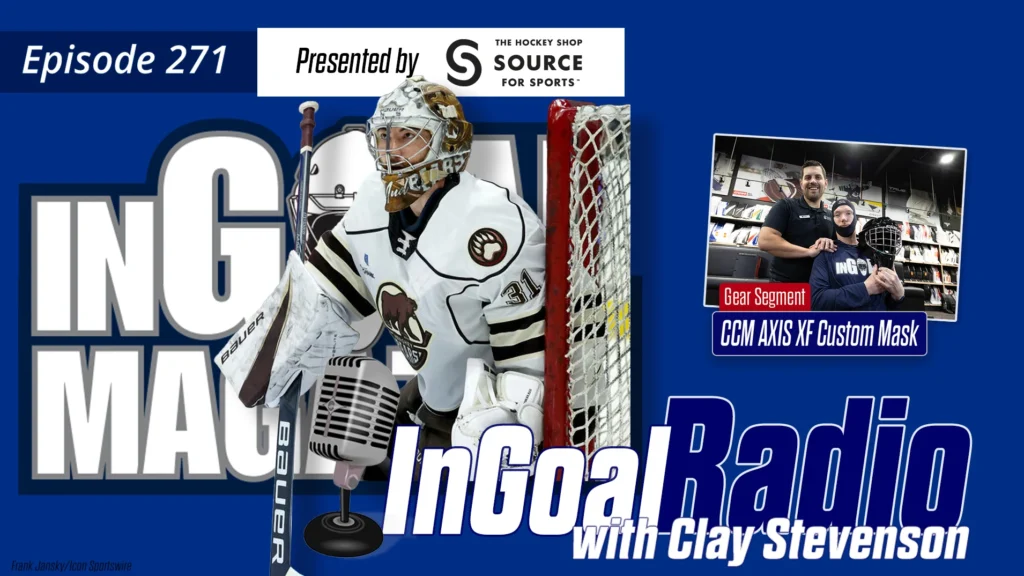
InGoal Radio Episode 271 with Clay Stevenson

Please subscribe and leave a rating — it helps us reach more goalies!


Washington Capitals goaltending prospect Clay Stevenson chose to sign with the organization despite knowing he'd start in the ECHL, passing on teams offering immediate AHL spots and perks like lunch with a Hall of Fame goalie. He went on to win back-to-back Calder Cups with the AHL's Hershey Bears, crediting a wide range of new coaches and voices for his continued development on and off the ice.
- Stevenson chose the Capitals over teams offering AHL contracts and recruiting incentives, betting on long-term development over immediate opportunity.
- Winning back-to-back Calder Cups with the Hershey Bears provided Stevenson with championship experience and key lessons about pro goaltending.
- Working with a variety of new coaches and voices accelerated Stevenson's growth both on and off the ice as a professional.
- Sport psychologist Luciano Sommerville offers specific breathing exercises to help hockey parents manage anxiety at the rink and beyond.
- CCM's new custom AXIS XF mask features a 3D scanning process and 3D-printed liner, offering goaltenders a personalized fit and protection option.
Episode 271 of the InGoal Radio Podcast, presented by The Hockey Shop Source for Sports, features Washington Capitals puck-stopping prospect Clay Stevenson.
Feature Interview
presented by NHL Sense Arena
In the feature interview presented by NHL Sense Arena, Stevenson brings us up to speed on his first couple of years since turning pro and signing as a free agent out of college (and last talking to the InGoal Radio Podcast), a process that led him to the Capitals despite knowing he’d start in the ECHL while other teams were offering an AHL spot (and recruiting incentives like lunch with a Hall of Fame goalie). He shares lessons and insights from winning back-to-back Calder Cups as AHL champions with the Hershey Bears, and how his game has continued to develop on and off the ice after working and playing with a wide range of new voices.
Parent Segment
presented by Stop It Goaltending U
In our Parents Segment, presented by the Stop It Goaltending U app, we check in with sport psychologist Luciano Sommerville for advice on managing parent anxiety, including some breathing exercises that can be helpful at the rink, in the workplace, or anywhere really.
Weekly Gear Segment
presented by The Hockey Shop Source for SportsAnd in our weekly gear segment, we go to The Hockey Shop Source for Sports to learn about CCM’s new custom AXIS XF mask options, including the scanning process, and its 3D-printed liner.
Episode Transcript
Intro
With the cofounders of InGoal Magazine, David Hutchison and that ray of sunshine, Kevin Woodley and Daren Millard. InGoal Radio Podcast. How are we, gentlemen?
Absolutely fantastic. How are you, Woody?
Was last week the week I was grumpy? I can't remember. I've had a really good week. I'm in a positive frame of mind. That that could've that could've been years ago.
It'd be way easier to say it was last week the week I was happy.
Yeah. Okay. Okay. That's Had that coming? Had that coming?
It's alright. Well, you set me off on a good tone, guys.
You want snap? Going snapper?
No. No snap tastic today. What he's in a good mood. Oh, no. Have you
have you played lately?
Played on Friday. First game. Hutch's Hutch's nephew, half my age or less, was it and and and sick what is it? What is David? Like, six foot three?
Six foot? He's he's a big guy.
He's about six two, six three, somewhere in there. Yeah.
And and he's in he's in shape. He's athletic.
Jacked. Yep.
Yeah. He was a goalie at the other end. So you can imagine how it went for me, Daren. I was clearly the second best goalie on the ice, and yet we managed to split a couple of games. So I had a good time.
You know what? The biggest thing for me, the like, I could walk the next day. That's all that matters. At this stage, that's the most important thing. And you wanna know what else matters, Daren?
I had fun. That a boy. Mixed in a couple saves. Had a couple of stick taps from the boys. It's great.
Life is good. It's Happy Woody.
You made it go Woody.
We've never seen that before.
He quit beer league. Right? So I don't have to deal with the jackasses that try and kill me out there. These guys are just out there to have a good time. It's great.
Hey. In summer skates or pickup skates, do you wanna be the better goalie, or do you wanna be the underdog?
Well, I gotta be honest. Normally, the two skates and it's not summer skates because they just started up for the fall. There's one on Monday and one on Friday, and I've said it before. These guys are all way better than me. Like, this is over my head, over my level.
Bunch of guys that played pro. We've had guys actually come back and skate with us in between European contracts. And they they take it seriously enough in terms of setting the teams that it's rarely one-sided. So I get you. Like, sometimes when it's like
But do you wanna be the better goalie or the underdog goalie?
But there's no underdog goalie. You mean, like, in terms of, like, the teams? Like, my team doesn't have a chance to win underdogs at other end. Golly woody. Golly.
Like Are you the better goalie on the ice or be better coach?
Yeah. But nobody knows. So what do mean underdog goalie? Nobody just because I'm old, I'm the underdog?
Nobody's asking what would you prefer? He didn't say you're underdog if you're old. He's saying which would you prefer to be?
I'd prefer to be better. Question. I prefer to be the better goalie because nobody in that room, other than the fact, like, this week, the kids half my age knows that like, they don't know us to know, like, oh, you're the underdog today. So I'm I'm taking better. I rarely am.
Yelling at things here right now. Everybody's yelling at their phone or the the at the podcast. Just yelling like, Woody, it's goalie. You wanna be the underdog, or do you wanna be the the the favorite, the the better goaltender?
I don't know that even in twenty five years of covering the NHL, I've ever looked at a matchup and thought, woah. This guy's the underdog goalie today. Never. I've never thought of it in those
terms. You've never watched a game and said this team has an advantage in that.
Yeah. But, like, you're not playing the other goalie. I've never yeah. It's like they have a better
is where we've had people on here. Bill Ranford, I look at the guy at the other end of the ice, and I wanna beat him.
Wanna beat yeah. But does he think I'm the underdog compared to him? Did he ever go into it thinking he was the underdog?
Maybe not. Is that a mindset?
Do we need to bring on a mindset person to say if you if you go into a game thinking you're the underdog, you've defeated yourself?
Well, that's a fair question. I would not want to go in. But maybe if you're one of those glass half full, glass half empty people, which one
are you? I'd rather be the glass half full, right? We've established that.
Oh, yeah. Clearly you are glass half full of problems. But maybe you'd rather be the underdog because then the expectations are a little lower. However many saves you choose to mix in, Woody, everybody's thrilled.
Hey. They're thrilled that I mix in any saves.
Let me rewind this.
Daren, I'd rather be the better goaltender, and I apologize for misunderstanding your question.
I'm in
a great mood today, and I'm not gonna let my misunderstanding make me go snappy.
Thank goodness Hutch is here to translate for me.
Well, Daren, what kind of question is that? I mean, have you even considered the ice conditions, and did you think about how those pads were done up? And what gear is that guy wearing anyway? Like, it's I don't know, Daren.
My warm up warm up stick
got broken. I'm the underdog as soon as my warm up stick fails.
And I'm the underdog in every skate that I take part in. Will
that when grant the other guy's in the show at the other end, for sure.
And and the other day, I was even with a guy. Andrew Stewart, who runs City National Arena, was the other goaltender in a summer skate. I was the taller goaltender. Sorry, Stewie. He listens all the time.
Big fan of you guys. And I found it weird being in the three on three, being on the same sort of level. I found there was more pressure on me as opposed to any save I make is a bonus. I was like, all of a sudden, there's expectations on me. And so I was curious about that from Woody.
I had no idea it was going to take forty five minutes to get an answer.
Well, it always does. You know, I would
I would rather be the underdog guy.
Okay. I like, if you go in there with no expectations and think of it in those terms, like Yes. But but to me also that I I usually think of that and that's me every skate with these guys because, like I said, everybody that's shooting on me played at a much higher level than I ever got to. So I think of myself as the underdog against I've just never thought of it in terms of the other goalie. But now that I think, hey.
You're right. Like, there are times where the other guy like, the guy that usually comes out played minor pro overseas. And so when all of sudden it's another sort of fellow beer leaguer like me, maybe I feel like I should win, I guess. Maybe that yeah. Maybe you're right, Daren.
See, I you've re you have completely reshaped my thought process about random Monday and Friday skates.
That was a journey, wasn't it, Hutch?
This is pretty funny. I'm just thinking, Daren's describing skating with NHL players. Kevin's dropping. This guy played pro here. That guy's between contracts.
And all I'm remembering is walking into a dressing room here in Nanaimo, and the guy on the bench beside me says, man, we should have my brother here. He played AAA novice.
So here's the funny thing.
Here's True story. True story.
So here's the best thing, and and not to pump nephew David's tires too much, Mr. Hutchison. Yeah. But I had one of the guys that didn't play pro, played junior. Yep. Come up to me after the first game, and nephew David pitched a shut out in the first one.
He was really good. Oh, boy. Come up to me in the first game and asked me where he played because he knew I knew him and asked me where he played. Wow. That's cool.
And so I probably went up to nephew David and told him, don't tell them that you didn't. Because I had that happen to me, like, three, four years ago. We had a guy who played ECHL, maybe a cup of coffee in the A, come out and skate with us. And for the first three or four skates, he just kept hitting me. Like, it it it was almost like my reactions were slow enough that he was trying to put it where I would move away from, but I wasn't moving in time
so few.
Yeah. I couldn't get out of the way fast enough literally.
That's a legitimate thing.
It happens. Oh, yeah. A 100%. Like and he was getting some pretty good looks because he was you know, sometimes the guys that have played for a long time or, like, have been out of the game for a long time but did play, and now this guy's fresh off. And you can just see that difference.
Right? And fifth skate, we're in the warm up stretching, and he comes up to me and asked me, hey. Where'd you play? And, you know, after taking a few minutes to make sure my helmet still fit after you know, because it blew up rather largely, I said, I didn't. I'm just a beer leaguer.
I started in my mid thirties. I don't think I stopped him again for the next month. So you never let never let them know you didn't if they're asking. Take it as a compliment, but just nod and skate away because you might accidentally be in your heads, although cousin David did a really good job and so or nephew David did a really good job and and may have actually gotten in their head. So it was funny to see that.
All that really proves because nephew David is actually my wife's nephew. He is the son of my wife's sister. So we are only related by marriage. All that proves is that my son is a good goaltender because of all the genes on my wife's side of the family and nothing to do with little short un-athletic me.
That's not true. That's not true.
Well, let's he he was good enough that I have him signed up to sort of be the fill in guy for both of these skates. I'm gonna have to I'm gonna I'm gonna have to reel that in a little bit because the standards are gonna get a little too high, and they're gonna punt me.
Did the shooter who asked you where you played take it as an insult when you said, I didn't play?
No. I didn't say it that way. Right? I was pretty humble about it, and I and I realized afterwards that I probably shouldn't have told him that because he just absolutely torched me from that point on. Well, good news.
I think I think he realized what was going on at that point. Right? Like, it clicked like, oh, I'm overthinking this.
It's funny what you said because I I think I probably told this story on here before. I was at an Eli Wilson camp once, and we asked John Quenville, who was playing in the American League at the time, who's the toughest goalie to score on out here? And he pointed to this kid who, working his tail off, awesome kid, but was, you know, playing much above the level where he normally plays by by being with this group. And he said, him. And we're like, what are you talking about?
He doesn't have nearly the experience of all these other kids. And he said, well, because he doesn't get out of the way of the puck. And that's exactly what you're talking about. He just I I'm I'm shooting where I think he's gonna get out of the way of. It was actually fascinating listening to John because he does think the game what do you talk about overthinking it?
It's how many shooters actually go beyond I'm just gonna shoot at that hole and think where's the goalie gonna move out of the way of? I think that's actually really impressive of a shooter. And he he would bring the kids in, frequently, and that was a real value add to that camp is he would actually ask if he could bring the goalies in and just explain what he's seeing as a shooter. I think that was pretty cool experience.
Well, we could deep dive this even further and talk about, and I think it's decreased significantly the last number of years of some of the understandings of the mechanics in space and how we move improve. But for the longest time, like, up until the last five or six years, you could look around the National Hockey League and find all kinds of examples of goalies who are in this space before the shot's released and have moved out of the way by the time it goes behind them out of the net. And people are probably scratching their head going moved out of the way. Yep. Happens more than you think now, and it sure as hell happened a lot more, I think, before we started to dig into some of these, you know, different views on on how we fill space and how we move into space.
Or more to the point, don't move out of it.
Even the simple act of moving out of the way of the puck as you move would be an awesome article for us to illustrate, but we don't wanna throw anybody under the bus. So we might have to get the video camera out and do some shooting on Woody and then talk about how he gets out the of the puck.
Yeah. You want prime examples of getting out of the way of the puck? Put me in that, baby.
No. But quite seriously, it would be a fascinating article because because we've we've all seen it. It's amazing.
How many times have you butterflied on a shot and realized if you would have just stood up, it would have hit you, but you butterfly and
You're starting to see that more and more with with high level goaltenders in training, in in trying to work patience and gosh, you see Juuse Saros do it in the NHL where he just stays on his feet and catches a puck and I think that is a sign of patience. And to to work on that ability is is something we should all be working on.
Yeah. And it goes really good till as happened to me on Friday, I was feeling really as it got going, I started to feel really good and not going down early because they're all gonna shoot high. And then one guy got down sort of off the wing with a with a pass option, and I got a little deep and tried to stay up and tried to stay up, and they just threaded it five hole and, ugh, I hate that. I know I know I know that it shouldn't be something to get mad at. Right?
I've I've had this conversation in the NHL. Goalie coaches with management or head coaches being like, he can't nothing through him. Remember that old mantra we used hear? Nothing goes through you. Nothing goes through you.
And so whether it's a coach or even or even a GM getting mad at the goalie coach because too many have gone in five hole in the last little while and having to explain that, listen. If we prioritize him being down on every one of those to the point where it's early, now you've taken away the five hole goal but given up everything around the perimeter of the net and cost him his patience. Like, that sort of sliding scale dynamic of encouraging patience without like, the same my mindset. Right? Like, oh, I can't go in five hole like that on that.
And I should have been saying, oh, man. Thought he was gonna try and short side me high. I was being patient. You know? Like, it's it's hard.
It's hard. But, like, they fight that battle all the time in the NFL.
Short side high, so you're there. Right?
Yep. And that's the difference with playing with, decent players because eventually they'll start to pick up on that trend and and and try and keep you honest. Of course, my five hole is basically the size of, like, a small, boat.
Refrigerator. Yeah.
Yeah. You you could row it out to sea and catch fish in my five hole.
Andrew Stewart, a great job of staying on his feet, and I actually picked up on some of that in our three on three because I was flopping all over the place trying to do RVH and all that kind of stuff. So
Three on three at 50 plus is not recommended there.
No. It was it was it was it was the neutral zone three on three with with the guys. And it was it was Stewie and I. I don't think Stewie played at he didn't play pro for sure. I didn't play pro.
And we're out there with all these super elite guys, and and it was it was cool. We went back to the room after to our room because we weren't in the main room, and we just looked at each other and went, that was cool. Just to be two just two dudes. Love the game. Playing in a in a skate like that.
It was awesome. I sent Woody a picture actually because I came off the ice.
Well, thanks for sharing with me, Daren.
I I know. I I really cool. Wanted to explain that. I came off the ice, and there was a text from Woody about when we're gonna record. And so I thought, I'll just send it back a a quick picture.
That's why it went straight to Woody. And I'm not
I'm not hurt.
I should not have brought that up at all.
Yeah. I was I was probably busy slaving away editing all the stuff for this week. You guys just have your time.
Yep. And now I wanna rewind it. But it was it was it was it was very, very, very cool.
Good. So
I got a question for you, Daren. Yeah. In that skate with that elite level player, especially in that environment, those little three, are they trying to make perfect passes and cross ice? Or if they get you in a dead angle, are they trying to pick little spots between you and the post if you don't actually go seal?
Oh, they pick spots.
They look they little cute little with there was a guy on Friday that I know does that, so I was looking for it. And sure enough, he tried it, like, four or five times. On plays where normally at my low you know, my level, I'd be like, okay. He's in a dead area. He's gonna look to pass, or or I can and let's be honest.
At at our well, maybe not you, but me, my my conditioning not being what yours is, there are times where you get into those dead angles and you know I should probably use a reverse or use something that covers this and gives me the coverage, but your body's just a little tired and you don't quite feel like dropping that knee into the post. Right? Like, okay. You know? And you think in the back of your mind, you're like, yeah, hold your edges.
That's what they tell you to do here. Right? Just hold your edges. That's the new mantra. And you're the kid.
Yeah. Because it's gonna be it's way too tiring to go
thought process spin through my mind.
But this guy, just because I know he likes to do it and I I so I I made sure that I had the short side sealed even when he got down below the goal line because he'll try those, and there were three or four where he did. And I'm like, okay. There you go. Like, this is why we do this. This is why real goalies do this because goalies at that or shooters at that level will they they see that you're not dropping that leg, and they will try and bank it in off the back leg if you're standing on your, you know, the just stand up crowd.
So it's it's kinda funny to sorta you know, but if he wasn't out there, honestly, in in my skate, he's the only guy that does it to that degree with that level of skill. If he wasn't out there that day, I probably would have taken more breaks on pucks below the goal line.
Hey, Daren. Quite seriously, I'm I'm very curious. You've been out there with these guys enough. Have you started to figure out tendencies with these guys? Who's more likely to shoot where?
Who's more likely to dish it? You don't have to give names away, obviously, but how much have you learned?
Yeah. Each guy's got a little bit of a tendency, and some of them, quite honestly, even when I'm guessing I had this conversation with with a fellow on Friday. I cheated. I guessed where he was going, and he still ripped it by me.
Gave you a better chance. Just not enough.
And and I I said to him, I knew you were going there. I I cheated. He's like, I know you're cheating. And he still he still put it in. But, yeah, there's certain guys that got one guy loves to go five- and and bugs me about it all the time.
And he may not score every time. He doesn't. But on that. But when he does, he just giggles. Love it.
It's awesome.
That's this that's the difference. At your level with those guys, Daren, even when you cheat, like, they they'll see you cheating and be like, oh, he's cheating. I gotta I gotta keep him honest. They'll be like, he's cheating. I'm gonna beat him there anyways.
Yeah. And I try to play it legit. Like, I there's some guys that will come out and will over challenge on on flow drills just to try and keep it. You you gotta you gotta play to the depth that a regular goalie would play even if they score. It's it's not good if you're coming five feet out extra just to pad your own ego kind of thing.
It's true. It's an interesting thought. We're we're a little
because the guys don't like it. The guys the guys get sour.
Yeah. I was just thinking about I mean, we're a little late for it now, but at tryout time, I've actually spoken to a goalie coach who suggests that his goalies read the situation. You're in a tryout. It's a flow drill. They have to shoot.
Take more ice. I know you wouldn't do it in a game, but you're trying to make a team here.
Well, and that's the coach all the co the coach a lot of times the head coach doesn't really all he sees is the puck going in or the puck being stopped. We've had this conversation Yeah. And it shifted. But we've had I've had this conversation with National Hockey League goaltenders. I remember Jason LaBarbera in his career would be like, I know I don't play this way, but I haven't played in a couple weeks.
I need the coach to see me making some saves, so I will come out in these drills because they're not realistic and make a bunch of saves so the coach sees it. That's the National Hockey League where they had an where they, you know, supposedly had a goalie coach to advise. Like, these things happen. These things can matter. So it's no.
I mean, it's kinda interesting. And here's the flip side. Do you if you're coming out that far in a flow drill because you know they have to shoot, you're just basically playing hit me. Mhmm. Right.
Wouldn't you rather be a little deeper and give yourself time to react? And I guess that's an individual preference thing too.
I I yeah. I've never bought that one. Think about think about a puck coming at 80 miles an hour and you're one foot further away. Like, how much time does that really give you? How long does it take Well, I guess not.
Shot to cover a foot?
Well, we're talking and Daren was talking about, like, five feet out kind of thing, like like, flow drill way out there kind
of stuff. Yeah. I've always found that one though to be a bit of a I know psychologically helps,
but I think there's a difference between toes on the edge of the ice and heels on the edge of the ice and actually, like, two or three feet outside the ice.
I remember when my kid was, you know, really, really young and they would bring out guys to tryouts who were much older and the puck would really hurt. I just said, get five feet above so it hits you in the pads, not in the arms. That's the old nineteen seventies style. We used to come out for self preservation as well.
Right. Yeah. Is a quote from my friend Doug McLean who ran the Columbus Blue Jackets, coached the Florida Panthers to a Stanley Cup final. First time they got to a Stanley Cup final. This describes me in Goal, but I wanna give Doug credit for this.
Oh, love it.
I'm like Michael Jackson. I wear one glove for no apparent reason. That's my glove hand. That's my glove beauty.
Yeah. Oh, I would I think I would get that printed up in large print and framed and put on my wall. That's awesome, Daren. Was a photo
of for no apparent reason because
I I I might have a goalie jersey made up with that quote on the chest.
That's awesome.
Gear
So Woody had his big ego, and it was having trouble fitting his head into his mask, which is perfect for our Hockey Shop gear segment presented by in this podcast presented by The Hockey Shop Source for Sports Langley, thehockeyshop.com, as we are going to dive into CCM custom masks.
Yeah. Well, you've heard us talk about the CCM AXIS XF mask and the fact that the liner was 3-D printed. And we kinda tease this back when because we knew this was coming. We just didn't know when. Well, it's here, and it's available at retail.
And Cam and his crew at the Hockey Shop are able to set you up with a custom fitting. We've had the custom fitted skates. Now we have a custom fitted mask. Well, how do they do it? First, they get you the right shell.
Obviously, a lot of companies, including CCM, have given multiple shell sizes to make sure that they get more fit access to more different size and shape heads. But now we can actually customize the way that three d printed liner is constructed so that it's optimum for your shape of head, even my odd shape of head. So we're going to Cam. Cam's gonna explain how it works. Now caveat here, folks.
This is bit of a tough one for us because the audio, there's a lot of he's got a he's got an iPad out, and he's scanning our head while I'm wearing a very unique looking sort of bonnet is what they call it. Not the most flattering thing to put on. It's the closest I've ever felt to an F1 driver, also the silliest I think I've looked. He scans it. There's a whole process.
This is one you really need to go watch on the YouTube channel as well. We're gonna try and streamline it here for audio, but make sure you go watch this one. At the end of the day, we've always said fit is one of the most important things when getting a mask. CCM's given you the opportunity, the the possibility of having your mask actually customized specifically for you without having the shell be a one off construction. So, let's go to camp.
Let's get more at The Hockey Shop Source for Sports. Welcome back to The Hockey Shop Source for Sports where I am getting dizzy because this mask doesn't fit, but thankfully CCM now has, like not just the different sizes, which I already could get a bigger size, basically the first customizable liner 3-D printed molded to your head to design a perfect fit. Never been done before in this manner.
That's certified, CSA certified, PET certified. That's a big deal.
Let's get me into a mask that doesn't feel like it's three sizes too small. Cam, walk us through the details.
And let's get his head scanned up. Alright, we're back. We have Kevin sitting down in our fitment chair. He's holding a stock medium mask, which fits him the closest. We're gonna get that him to put that on right now.
The first step of the scanning process, we want to find a stock helmet that fits him technically the closest, and I want to grab a couple of quick pictures of that all the way around. So next step, because the medium helmet fits in the best, we're gonna move into the scanning process. So now we're gonna get them to fit on the wonderful scanning bonnet. I need you to put this on. Beautiful.
Well, beautiful might not be the word I'd describe, but I feel like I'm ready for something. And we'll go with that one Put my helmet on and do whatever.
K. So now we're gonna grab a couple of quick pictures while he's got the actual bonnet on just to show off. So the purpose of him having the bonnet on is to completely flatten out the hair so we get a complete smooth surface all the way around. So that will be able to scan your face a little bit better and also too to create that right proper custom fit for that home. Okay?
Does hair become an issue here? Mine is like, lush and thick. And when it was longer, like, Specoli style, would that have messed this up?
The only thing that's messed up right now is listening to you talking inside of it. So we're gonna grab a couple of quick pictures of Kevin inside the bonnet now just to show off that proper fit. Okay? We'll get one from the side.
These end up on the Internet, Cam. You're dead. We'll get one from the other side.
Perfect. And now we are going to start our scan. We are scanning his face, building that 3-D mold right now all the way around. And there we have it, full scan of Kevin's head. So that would be what your head looks like.
This is why I never shave my head. Look at that thing.
Couple of options. So you have your option between white or black? White. Cage selection?
Non certified cat eye, but I can't get that hear in Canada.
That's not available in Canada, so it has to be either certified cat eye or a straight bar.
Certified cat eye?
You want the certified cat eye. Alright. Poor style, but that's fine. Cage color, white or black or white or chrome? Chrome.
Chrome cage. What color strap would you like?
Oh, colored straps. I'll take royal blue. I didn't know that was an option. Custom strapping.
You have the option to have your name stamped into the back of the helmet.
Oh, civ one. I mean, it's kind of synonymous with Woody. Player number? One. Because number one says it all can.
One. Learn that one from Roberto. Number one, the sift. Yeah. Number one, sift.
Alright. And we are basically set to place your order.
Sweet. So
we've completed the scan. We're all ready to submit the order. So Kevin could take off the bonnet, but you know what? He looks so good with it on. We're just gonna leave it on for now. So eight to ten weeks, there is an upcharge for custom. Give us a call to find out exactly what that is. (604) 589-8299 or 1-800-567-6790. Remember, this is an in person thing. It's not something that can be done online. You have to come in store to be able to get this done, but either myself or the wonderful team members of the shop will be able to help you find your perfect custom fit for a CCM AXIS XF mask.
We've talked a lot about the importance of fit with masks, about how that's the most important thing, and we've applauded companies like CCM and Bauer for offering a wide variety of fit ranges in each of them. That didn't used to be the case. This takes it to a completely another level. You get the shell shape that's ideal for you and then you get a liner that is custom molded to your face. I can't wait to experience Exactly. It for myself.
Thanks, Kevin.
What just happened there is old school with new school technology in a way. Because guy people had custom fit masks from the beginning of the mask where you put the the
That's the only way you could get them.
Yeah. You get put it on and take a mold to your face and boom. And that was with the the old mask to the to the cage combos. And now we're just without all the plaster, we're we're getting it done.
The difference, of course and those are still available. Right? Like, we think of Pro's Choice that does custom masks for goalies. There's companies take a shell and then pad, you know, the thickness in certain areas to make it fit. None of those are certified.
Right? So this is the first time that you've been able to get a certified for minor hockey, you know, whether it's heck or say like, you get a certified mask with these custom ops. That's the difference.
Now, Hutch, you had a plaster form fit mask made. Right? I did. At some point?
I did. I never had the, the the form fitting fiberglass mask. I did play in the old Jacques Plante fiberglass one. It's when Mhmm. He tried to take what everybody was doing in custom and bring it to retail as as Right.
And there were these tiny little thin foam strips that you would put in it to try and make it fit your face.
Those were road hockey back in the
Oh my gosh. It was terrible. So I have had that and I've done the plaster fitting to do a, you know, a a more modern, mask by a company that isn't in business anymore, but where they custom built the the shell for me. Yeah. Pretty pretty cool to be able to go through that.
Was a cool moment. Like, you felt like you'd you'd passed a certain point in your goaltending journey Yeah. Getting that plaster put on.
Well, look. It's so cool that if there was a company out there that could do for me, whether it's the old Ken Dryden style I see over your shoulder there, Daren, or whatever, the old standard fiberglass mask from when we were kids, if there was a company that would make those custom for me, that's something I would love to have done still just to hang on the shelf. Because I've never been through it for that type of of mask.
You you you guys are romanticizing the old We are. Like, plaster and, you know, two two straws up the nose so you could breathe. You if you recall, and folks can go back to the old episode with Alex Auld where he got in and they got all the plaster on his face, and all of a sudden the question comes, how much time do you have? Right. Why?
Because I forgot the quick dry. So poor Alex sitting there in that mask for a thick part. And interestingly enough, Alex with a very uniquely shaped head, was one of the guys that sort of created some of the pushback in junior hockey because up until that point, you can only wear a certain mask, and it just didn't fit him and wasn't safe in his mind. And I think that's a fair fair assessment. It wasn't safe because it didn't fit properly.
He needed he needed something Mhmm. Something different, something custom. And so, you know, it goes back to there's lot of different debates about, you know, safety and mass, and they're all fair conversations. But, you know, talking to some of the historical mask makers, the guys that have done this for years, like, it really is about having one that fits your head properly. And this is another way to make sure that, you know, the the CCM models available fit your head head better than they might off the rack.
I would love to know, and when all this comes to a conclusion, how different your mask is that was just custom fit with the new technology compared to an off the shelf mask. Like, where where it's where the gaps are are really felt or noticeable.
Maybe we're gonna have to follow-up on the measurement Cam did in my head by actually ordering one of these and and and seeing the feel. It would be interesting especially in this mask. And if it is more connection points with that three d printed material on the face, on the cheek, on the forehead, wherever they are. I guess the forehead would have a sweatband. Feeling those connection points would be very interesting if you felt more of them, and I think you'd notice it right away, especially because and, Hutch, I don't even know if you've had a chance to to to I know you're not playing right now, but even to have it on, the material feels very cool.
Mhmm. Like, it, like, it noticeably in the connection points feels cool against your skin compared to foam. Mhmm. And so I would I I'm curious to know whether you would feel cool whether you are not, like and, obviously, the the three d printing, the design is all about thermal regulation and helping to make sure that the heat escapes easier, But just the surface of it feels really cool, and I wonder if you'd feel cooler in that if you had more connection points with that. I'm not saying you would.
I'd be curious to feel it. My intuition is you might because in the spots where it does connect to me, I noticed that even during a game, even when I'm soaked in sweat, and believe me, that happens quickly, how much cooler that mask feels against my skin.
I think it's worth clarifying for people who haven't seen it. You could go check out the AXIS XF mask stuff we've got on the site, but that isn't a standard foam that they're three d printing. It's like a three d lattice almost. So there's as much air in there as there is material and that's creating some of the gap for you. So it's yeah.
So, you have to see the pictures to see it, but it's it's pretty cool stuff. And when I first saw it in images, I assumed it would be sort of rigid, but it actually feels quite soft as well.
Very very like like there's more and then it it designed so that on impact it much like an impact absorbing foam, it'll sort of protect you by sort of seizing up and and and
But then it returns to its shape. Right?
Right. Yeah. Exactly. Exactly. Sure.
It's not like a honeycomb that just breaks
and Honeycomb's a great way of putting it. Yeah. But but doesn't break here.
But and I can't remember how many different touch points and little lattice points are in it. It's it's
Thousands. A fact Thousands.
Yeah. I think it might be more like tens. It's
I think 10.
Tens of thousands. Yeah. It's it's a it's a fascinating thing to to watch this evolution of an off
the shelf one. Where is it all?
That's what I'm yeah. No.
Of course. Yeah. We will find out.
We need to find out just and and, again, how it how that feels different.
Because it doesn't all need to touch your face because of different
No. But the more it touches, the more it's gonna spread out the impact. Right? I mean, if you just had, say, one touch point, then all that impact goes into that one place on your face. If you if you touch completely, then then you're spreading out the impact and presumably is gonna make things feel better.
Well, and the other part too is I imagine a lot of it would be like we we're talking about face and that's where you might feel it the most, but probably up around hairline and over the back of the head even because the three d printed mold goes all the way. Like, the the three the backplate has this cushioning, this three d printed
Oh, it does.
Cushioning as well. Yeah. It's on the backplate. It's actually it's actually it's a very, very comfortable mask.
What age are are we talking about to go through this process? Because if you're growing child from 10, 12, 16, like, your head is changing a lot.
That's a that's a would be a great question for CCM to what's the range in how long this is going to fit? Because I I think that's a great point. I I bought my son a CCM's top level mask when he was very young. Happened to have a large melon, so it it fit him. And I felt protecting his head was the most important thing.
So we spent the money. So I would have been tempted for sure. I remember Woody's talked before about going into the hockey shop and Cam will actually dissuade parents from buying something too expensive if it's not right for their kid. And I wanted to get some custom skates made for my son and he talked me out of it for the very reason that you're talking about, Daren. He's gonna grow and it won't be too long before these custom things don't fit.
So I'd love to know what sort of tolerance they build into it and we'd have to talk to CCM because we've seen the three d printing in person and it is quite precise. You can imagine that it could fit you quote unquote like a glove and so that very quickly a child might grow out of it. But you gotta think there must be some tolerance built into that. Funny story on a related note. This is old man problem.
How many people have clothes in their closet that they're just hoping will fit again one day or something? I know there's a lot of middle aged
friends like who has multiple pairs of pants with the tags still on them.
Yeah. Yeah. I've got an aspirational shelf in my closet.
I have my I have the suit I wore in my The suit I wore for my wedding, it's sort of a regular semi regular check-in thing for me.
So where's Hutch going on this? I was getting that custom mask made and they sent me the kit to do the plaster. You could actually do it in your home and my wife helped me with it And it sat there on the shelf for the longest time because I kept thinking, well, I'm trying to lose some weight here and I want this thing to fit for the long term. So I'm not going to do the mold until I've dropped 20 pounds. Like that's Swear to you, that's exactly what happened.
Now the funny thing is, and it had nothing to do with my own weight gain or weight loss, when it did come, it actually didn't fit. It was, it was too big. So again, company doesn't exist anymore, so I'm not throwing anybody under the bus. But that's that was being done by hand. That wasn't being done with this three 3-D printing process, which, of course, like I said, we've seen the precision of.
We've got our NHL Sense Arena feature interview with Clay Stevenson coming up, right around the corner. Clay's, just arrived. He's, just getting settled over in the green room, which gives us an opportunity to check-in with Stop It Goaltending U, the app. Our parent segment is on the way, but, the latest from Stop It Goaltending U.
You know what? I think one of the best things I love about Stop It Goaltending U is the different formats they give you. It's a busy time of the year. We've talked about tryouts, minor hockey starting up. Sometimes tryouts are still going on as the games start up.
Got junior hockey starting up. Everybody is busy. So if you don't have time this week to dig into their weekly twenty minute deep dive or even some of their ten or fifteen minute videos, just use the daily primers. Quick one minute videos to help you become a better goaltender. New topics every week, and they usually try and tie them into things that are going on at this time of year for most goaltenders.
So whether you wanna dive in and go down rabbit holes or whether you just want a quick little piece of advice that's gonna resonate, something you can take on the ice that day or after you're done the ice. I think this week was about sort of how to sort of assess and sort of take notes of of things you're working on in practice. Stop It Goaltending U. The app has something for everyone. And best of all, it also comes with a membership to InGoal Magazine, InGoalmag premium and all our subscriber content.
So you get the best of both worlds. You get all our NHL content, ProReads, ProDrills, all the stuff we're putting up on a regular basis at ingoalmag.com, and you get everything that Stop It brings with their now twenty five plus years of experience coaching in the industry. Make sure you check out both subscription to Stop It Goaltending U. The app gets you a subscription to InGoal Magazine to make you a better goaltender.
Parent Playbook
Hutch, you have some company in this week's parent segment.
I do. I have had the question come in many times over the last few weeks. Parents wondering how they can control their own stress, their own anxiety in the rink. It is difficult to be a goalie parent. It has to be amongst the most difficult, sport parenting positions in the world, and people wanna know how they can make the experience better for themselves.
I started to put together answers. I have a lot of things that I do share with other parents. But then I thought to myself, what I'm starting to tell parents here is exactly what I would tell an athlete. Why don't I actually bring in a pro? Because it it felt like I was getting, maybe a little bit out of my lane with some of the things that I wanted to suggest, and I should thought, let's bring in a pro.
And, fairly recently, we have, gotten to know today's guest, Luciano Summerville. He is a registered clinical counselor. He consults with teams and athletes, and it turns out, I didn't know till our interview, with parents as well. And I met him actually because his brother plays in the East Coast Hockey League, his brother Nico, and has been shooting on my son in the summers for the last two or three years, and they've become good buddies. And I found out that his brother was was, a sports psychologist.
And I thought, wow, this is a guy I need to get to know. And, he actually was quite a hockey player in his own right. So we struck up a conversation, and this happened to be something I thought would be interesting to bring him on so that he could help answer that question. What do we do about our own stress as goalie parents? How do we deal with our own anxiety heading into the rink?
I think it's a great connection between the goaltender in your family and the parent and a lot of what is happening on the ice, you can take advantage of. There's a huge connection here. Fascinating conversation with Luciano Summerville on the Stop It Goaltending U, the app, parent segment, and InGoal Radio, the podcast.
This week's parent segment, we wanted to do just a little bit differently. And, it's a common question that's come into us quite a bit, which is how do we control our own personal anxiety as parents, in games? It's pretty tough being a goalie parent as we all know. And we want the best for our kids, we want them to have a great experience and and we take a lot of that stress on board. So how can we deal with it?
I've got a lot of my own answers because I've had a little bit of experience myself. But as I was putting that answer together for someone, I thought, wow, this sounds exactly like what I might say to a goaltender, as well. So let's bring in a sports psychologist. And, my guest today, Luciano Summerville, Luuk as the players call him, played Canadian college hockey, played a little bit of pro over in Europe. He has a master's in counseling and is a registered clinical counselor.
And he helps with performance for athletes and teams and other areas of mental health as well. So Luuk, was not a goaltender but has been spotted at some local high level goalie skates as a shooter and can still rip it. So Luuk, welcome and thank you for joining us today.
Yeah. Thanks for having me on. It's a pleasure to be here.
Yeah. It's great to have you. So, Luuk, you're used to working with athletes feeling stress and the anxiety of performance. What do you say to a goalie parent who's experiencing something similar?
Yeah. It's a That's a really good question and I think probably not unlike lot of the stuff that you've, I'm sure, already touched on in the past or that you might say to someone who is actually a goalie. I would definitely agree with those things. I think a lot of the things that I talk to players and goalies about in regards to, like, performance anxiety, stress, nervousness, like, all that kind of stuff, all the physiological, impacts of, like, going into big performances that come up, I think, are also like, when we talk about those things and the tools that we come up with and the tools that we use to kind of, like, cope with that stress or anxiety, I think a lot of those tools can also be used for parents who are in the stands. And as I'm sure you've touched on before, I think for parents, it's maybe more so difficult because they're in the stands and they really have no control of the outcome or of And what's going on on the so it's really about like utilizing some of those tools and strategies and stuff like that.
But it's also about having that mindset of like, okay, like I need to come to a place where I'm accepting of like what the outcome is going be because that's out of my control and I kind of have to just, like, relinquish that need to control, like, what's going on on the ice and just kind of, like, trust that my son or daughter, whoever's playing, is going to perform and perform at the best of their ability and sometimes that doesn't happen to and that's okay. And just being able to provide a space to be able to support them afterwards in that.
But it's also about having that mindset of like, okay, like I need to come to a place where I'm accepting of like what the outcome is going be because that's out of my control and I kind of have to just, like, relinquish that need to control, like, what's going on on the ice and just kind of, like, trust that my son or daughter, whoever's playing, is going to perform and perform at the best of their ability and sometimes that doesn't happen to and that's okay. And just being able to provide a space to be able to support them afterwards in that.
Can we just take one step backwards because you talked about those physiological responses to stress and anxiety and think it's probably worth normalizing that for everybody to say that it is okay that we're feeling that way. So what are those common responses to anxiety? How does our body tend to react?
I think everyone reacts to anxiety and stress differently. I mean, are some of the more common common, you know, impacts that we might have where, you know, we might notice that we start sweating more, heart rate increases and races, our blood pressure goes up, like all these kinds of things that we might feel physiologically. And there's definitely different techniques that are scientifically proven to kind of like help mitigate some of those, some of those effects that we feel physiologically. For example, if you were experiencing an increase in heart rate, you might want to try just focusing on your breathing and really trying to calm that heart rate down. And I know Andrew Huberman has a technique called the physiological sigh that I've come to, adopt myself, but also that I also, try to teach and, and, help others try to incorporate into some of their practices because it's scientifically proven as one of the fastest and most effective ways of like reducing our physiological response to stress and anxiety.
So
That's so cool to hear because I literally was doing that two days ago. It was not at a hockey game, but I was feeling some serious stress. And and I I've done the deep breathing as a goalie parent before and it kind of works. And then I noticed this one online and I tried it and it it made a difference. Can you tell us a little bit more about how somebody would do it?
Yeah. Absolutely. And and, again, this is not my, like, technique or anything like that. It's something I got from Andrew Huberman, but it is something that I, like I said, I like to use with players and goalies and and athletes and and also non athletes as well. But particularly athletes find it helpful because it's quick, it's simple, and it's kind of like yeah, it's just really effective and and really, like, concise.
So basically, what you want to do is you want to take an inhale, like a regular inhale. But then at the top of that, you're also going to take another extra inhale. So sometimes instead of calling it physiological sigh for especially the younger kids, I like to call it like double breathing because it makes So sense to they take two breaths in and then one long exhale. And what we're doing is, especially like when we're, we're physiologically aroused in like a stress or anxiety response, our breathing tend to get, tends to actually get shorter, which means we're in taking less oxygen into our lungs and we're obviously not maximizing our lung capacity. So what we're doing is we're taking that normal breath in, but then we're taking another extra breath in and really getting down to the bottom of our lungs and maximizing that lung capacity and potential for oxygen.
That first one kind of feels like it's completely full. Right? And then you're overfilling a little bit?
Exactly. Yeah. So it's kind of like really max, like I said, maximizing the potential for oxygen intake in that initial, you know, inhale. And then the long slow exhale is really where we're like calming our nerves and calming our stress response and calming our heart rate and all that kind of stuff.
I find that extra breath, that tension actually creates some sort of physical release as well as it comes out.
Definitely. Yeah. Even after like one or two, even if you're just sitting there and you're not, your heart rate isn't really high, you just do a couple of those and you feel even more relaxed especially in those heightened states where the heart rate's going up, their physiological response is high, you do a couple of those and you are, you'll notice pretty much right away instantly it start to come down.
Highly recommended. Like I said, I've tried it. It's something you can do sort of quietly in your corner in the rink. Nobody knows you're doing it. I think the first time I saw Huberman talk about it, there was actually this huge release of the side that I don't think you need to do to get some benefit of this.
You can be sort of stealth.
Yeah, absolutely. Yeah. It's very subtle, which is which is a good thing too.
Yeah, definitely. So that's one one thing we can try. Is there anything sort of before the game as we head into it that we need to think about?
I think a lot the same things an athlete would take into a game in terms of their mindset and how they prepare is is an important part of, like, being a parent too. And and mind you, all of this stuff is is my experience based on my education and training and also my work with parents who are parents of athletes. Myself, I'm not a parent, so I don't have the firsthand experience. Hopefully someday soon, but then I'll tested to practice what I preach. But for going into a game, like I said, I think it would be not unlike what an athlete would go into a game focused on.
Like you want to focus on your process, you want to focus on some of the things that are in your control. So as a parent going into a game watching your kid, what's in your control? Well, you can control your body language, You can control the stress response if you work on that and work on the breathing and stuff like that. You can control your response verbally or emotionally or whatever that might be. And so focusing on the things that you can control as opposed to the things that you can't control such as results, such as, the way that your child is actually performing on the ice.
I'm sure there could be other things that are maybe out of your control, but that would be my suggestion going into the game is really, like, really being intentional and focusing on, okay, like, what is my what is in my control? What am I what am I, like, what are my intentions going into this? And really, like, being set on that kind of like mindset of like, okay, this is my This is in my control.
I know when we talk to to goaltenders, we'll talk about having a plan sometimes or at least I do. Getting scored on, sometimes things happen that are out of your control there. And more than just don't worry about what you can't control, what will your response be when something out of your control happens? To me, that's a bit of the process. And so for goalie parents, I talk about how are you going to react when the puck goes in?
Because we all would love to see a shutout, but we're probably not going to tonight. What's your personal response going to be other than just don't stress? Like, does that make any sense to have a plan for that?
Yeah. I think going back to the exact same thing I said before with, like, I think a lot of the things that I talk about with athletes would also apply to parents here.
Yeah.
I think it's easy to say some of the cliches like, oh, like, don't worry about it. Like, just be positive. Like, move forward, blah, blah, blah. Like, and we all would love to be for those cliches to be effective, but they're not that effective. So one thing that I like to talk about with a lot of athletes and it works particularly well, particularly well with goalies, especially after mistakes or after goals are scored is having some sort of reset routine.
So, that's like really checking in with themself, thinking about what happened, accepting it, letting it go, and then using some sort of breathing strategy and then, like, okay, like, what's my I need to refocus. Like, what's my intention moving forward? So I use the analogy of, like, shutting off the car, just letting it sit for a second, just being present in the moment, and then restarting the car and, like, refocusing.
So as a parent, is that sort of as I as I go to the game, I'm saying to myself, well, I'm not gonna overreact when that puck goes in if it does tonight. And, and I'll I'll take a moment, I'll take three seconds, five seconds and say nothing, do nothing and just tell myself it's okay. And then maybe try some of that breathing. Some sort of a plan like that, I assume it would be fairly personal, but does that make some sense?
Yeah, absolutely. And I think something else too is, I've been talking to a lot of athletes lately about self compassion. And there's actually three different components to self compassion. There's self kindness, there's common humanity and there's mindfulness. Self kindness is being kind of like accepting and understanding of that failures and mistakes are going to happen and there's going to be setbacks and adversity.
Rather than being judgmental and harsh towards oneself or another person, we want to be kind towards ourselves or towards other people. So as opposed to like self critical, you know, self talk and stuff like that, we want to talk positively to ourselves and to others. The common humanity piece is that, you know, from a goalie's perspective, every single goalie in the entire world, including the best goalies in the world, are going to get scored on at some point. And that's just the reality of it. And so putting that into perspective of, like, zooming out of, like, how big a goal one goal feels and then zooming out being like, hey, like, even the best boys in the world get scored on, it's okay, it's not the end of the world, we're going to get through this and we're also going to learn and grow from this.
So, like, having that piece of common humanity is an important part of that. And then the third part is the mindfulness part of like being okay, like in tune as a parent. So like, what's going on for me right now? What am I feeling? And, you know, normalizing and validating that that's okay to feel that and we also control our response to that too.
So that's a big piece that I like to talk to a lot of athletes about and I think it's definitely applicable here.
And I think as a goalie parent, you talked about being kind to yourself but also being kind to others. And, and and there is that reaction in the moment to either be upset with our child. How could you do that? That's a terrible goal. Or or maybe we're upset with others, you know, to the defenseman because it went off his shin pad or the forward who went straight legged and didn't back check.
We've got to let those things go too.
Totally. Yeah. And if we hold on to those, then we're holding on to unnecessary stress. And I also realize that's a lot easier said than done to let go of But we all need to find our own process of like, okay, what's our what's our outlet? How do we manage and cope with stress and how do we release it?
Oh, we all have maybe you're lucky enough to have training camp in the preseason to sort of get into your system. And and like you said, it's easier said than done. Totally. Yeah. Any tips in that when when it feels for parents like there's something really big at stake?
Trying out for example, you're watching your kid, you just really hope they make their first rep team ever or, you know, they're in a tough battle to play on that team that they've always dreamt of playing on. I think the stakes are a little bit higher. Does does that change the game for parents?
We look to our parents to model behavior and to model regulation. So we really are co regulators of our parents. So if we see our parents at very high stress levels and high anxiety and how they show their emotions and express their emotions, we're probably going to take that on as our own kind of way of doing things in our own way of expressing emotions and experiencing emotions.
I mean, I definitely think that it's increased stress for parents, but I would imagine and and and maybe speaking from more of my own personal experience as being an athlete and having parents that have responses as well is like, as kids, especially when we're growing up, we look to our parents to model behavior and to model regulation. So we really are co regulators of our parents. So if we see our parents at very high stress levels and high anxiety and how they show their emotions and express their emotions, we're probably going to take that on as our own kind of way of doing things in our own way of expressing emotions and experiencing emotions. So I think as we grow older, we learn to kind of like develop our own ways, but also it doesn't differ all that much from how we, you know, learn to do it growing up. So, going into something like a trial or some sort of high pressure situation, if a parent feeling more stressed, then it might rub off on the kid, especially if they're a little bit younger, that they're going to feel more stressed.
And I think from my experience in working with parents, it's often that they, when they also ex- or witness their children experience stress, they want to do anything they can to try and, like, take it away or get rid of it or just kind of, like, push it to the side and be like, you know what, it's fine, like, you're gonna get through it, like, it's okay, like, and because from a parent perspective, I'm assuming that you wouldn't want to see your kid go through anything that's, like, difficult or a struggle, right? So it's, like, hard to watch them do that so you want to take that away and make it better for them But that's also how we learn to get through those moments is by navigating it ourselves. If we're always taken out of those situations, then we're never going to learn how to manage and cope with stress that comes up in those situations. So something that I often talk to parents of athletes about is like something that was taught to me in my master's program, which is a very simple yet profound technique and it- well, not really technique, just like piece of advice and it's get curious, not furious.
And you can change out furious for anything else, it's just curious and furious rhyme obviously. Instead of showing your emotion and, you know, kind of like projecting that emotion onto your kid of the stress and anxiety and whatever you might be feeling, maybe ask them how they're feeling about it and ask them, like, what they're focused on and ask them questions and get curious about their experience of it because I think it's just automatically assumed that parents and kids will have the same or feel the same experience and that's not always the case too. Asking questions and giving them a little bit more autonomy about like how they might be feeling might go a long way.
That's fantastic. There there were two pieces to that that I heard there and, and really resonated with me. One of which has me thinking I need to change my my game here a little bit as well. The first was that as parents, we can project our feelings onto our children and they can start to reflect how we're feeling. And I've I've mentioned that on the show before, how, I think it's important, you know, if there's a playoff game the night before, you don't create more anxiety by telling them, let's get to bed early.
Tomorrow's a big day or let's hey, how are you feeling about tomorrow? It's a huge game. I think we can create anxiety there. But then the piece that maybe I've been missing that that I love that you added there was that we can't just take all the stress away from the kids or we can't just push it to the side and pretend it's not there. Those two things are difficult to balance though, I would assume.
If you want your kid to be able to handle certain situations and adversity and stress and failure and mistakes, which everyone does, because that's how we learn and we grow and that's how we persevere and eventually become successful, then we can't just be taken out of those situations. We have to go through it, not around it or over it or under it or what are just completely avoided at all.
Yeah, totally. Yeah. It's not something that's easy to kind of like, again, relinquish that kind of control. But if we as parents, if you want your kid to be able to handle certain situations and adversity and stress and failure and mistakes, which everyone does, because that's how we learn and we grow and that's how we persevere and eventually become successful, then we can't just be taken out of those situations. We have to go through it, not around it or over it or under it or what are just completely avoided at all.
So I think it's important for kids to be and for adolescents and even adults to go through adversity and to like be able to navigate their own way through that adversity as well.
That's fabulous. Luuk, I have taken way more of your time than I promised to, right at the beginning, but I appreciate you sharing all of that with us. I feel like we could do a deep dive on this and spend an hour, an hour and a half on a longer show. You got fantastic advice. And, and also wonderful for me to hear that you work with parents as well.
I've I've known you've worked with athletes for a while and I think it's important. One last little thing, I don't know, comment from me or I'd love to hear what you think on this is I love that mental health and dealing with mental health is becoming more normalized today in society. And I have definitely spoken to some parents, in the past who've sounded like things are beyond the normal anxiety issue, when dealing with their kids. And at least for me personally, I think letting them know that if these techniques aren't working with you, talking to a mental health professional wherever is okay because we want this to be a great experience for us personally and more importantly for our kids.
Yeah, I think it's it's really, I think the in terms of like the mental health aspect, the stigma has really come down a lot, which is really, really cool to see, especially in the field of sports that for so long had such a strong stigma against talking about things and getting help and that sort of thing. So I'm really, really glad and appreciative that of all the work that everyone's done to kind of like make it more normal and make it more, you know, more mainstream and more acceptable for athletes and non athletes to be able to seek help because I think we all need help at some point and- and it's okay to need help by someone else too. Like, we can't do it alone and- and we need to be able to rely on others and- and support others as well. So that's why I do what I do and why I'm so passionate about what I do and, yeah.
Fabulous. Thanks for taking the time again and, thank you for the important work that you're doing.
Yeah. Thank you very much for having me on. It was a pleasure.
Put you on the spot. What what was your favorite part of that? And I'll start by just saying the the breathing. The the parent doing the breathing during a stressful situation or an intense situation is a great tool to use when you're up in the stance.
Absolutely is. It's something that I've been doing, for years and, something that I had just learned about. So I I I do it and it helps and it works. My favorite part of that was that I had actually sent him an email beforehand and said, hey, just so you know, we'll do anything you wanna do, but these are the things that are running through my head on the topic. And I mentioned that Andrew Huberman technique, the physiological sigh.
I think some some of these guys on the Internet are are much like goalie coaches who need to give fancy terms to things that we all do just to make them sound cooler. I love that Luuk called it double breathing just to make it clearer. What was cool for me was that he'd been doing the exact same thing, with his clients. So so I'd been trying the breathing myself. I discovered Huberman's technique.
I found it actually worked. And then Luciano himself brings it up in the interview. So I I I don't know. Maybe it was a little validating. Nice to know that it works.
And then then frankly, Daren, the most exciting part was when he brought up that he works with parents. It's, it never crossed my mind that a parent would reach out and ask for help, but I think it's a it's a great idea, and I'm glad that that people have chosen to do that with him.
Societal, that's a progress.
Well, it is. And we talked about that in the interview. The whole the whole area around mental health is just the stigma is leaving, and I think that's so important and so good. We all need somebody to talk to from time to time. And and whether that's a goaltender who's struggling or or a parent who's struggling, we have a chance to make things better for all of us.
So why not take advantage?
Woody, serious question. Do you use the double breathing?
I I know of these things I find in the moment that I rarely remembered to do them, but That's
that's the thing with me too. Thank you.
But I have, like, sometimes, like like, talk about checklist. We're talking about Stop It Goaltending U and and and one of the things that they talked about recently. Like, if you are conscious or maybe go into a game and you remind yourself, hey. Like, last last time things got out a little out of control and they and you keep in as you learn these things, you have to sort of just remind yourselves of maybe going into the situation, and then you're more likely to be able to execute them once it once it starts. So, do I do it enough?
No. Am I trying to be more aware of it so I do it more often? Yes. Have I used breathing techniques to slow myself down a little bit in stressful situations outside of hockey? Yes.
I think and that's where the parent thing becomes relevant. And not necessarily as a don't have a kid that plays hockey and find the sport. I do watch volleyball. I do because there's so much it's not as fast paced. It's easy to take a deep breath, and maybe I just do it instinctually.
But, yeah, I I totally can see how it would work, and and it's a good idea to practice it. I just find in the actual games, I I'm usually I'm usually breathing really heavily as soon as the puck drops. Like that as opposed to, you know, the deep sigh.
It's not double breathing. It's infinite breathing
for me. Yeah. Exactly. It's it's it's panting.
But I I I think you you make two important points there. It it is way better to be intentional than than to react. So going into a game, whether you're it's as a goalie parent or as a goalie, having a plan, think is really important. That doesn't have to be a complicated plan. It doesn't have to be 14 different points.
It could be as simple as I am going to not get upset today and I am gonna practice my breathing when things get tense. That's enough. You can make it more complicated. You can deal with situations like what will I do when a goal goes in and all this sort of stuff. But an intentional practice as you go to that game, it actually makes a real difference.
The only thing I actually do as well that we didn't bring up in that is is I do find a little bit of physical movement, reduces stress. We all know exercise helps with stress. I do that myself when I'm I'm feeling things are tough. I'll go for a run. But in a game, obviously, you can't do that.
But I will get up and walk around, and I think that's perfectly fine. You might feel a little weird being that guy pacing up and down. But, if it does help you relax or just to stand up, if there's a standing area in your rink, I find that reduces the stress for me as well.
I get really quiet. Like, I I honestly almost take myself out of the situation, and and that's the way I would handle things during my children's activities and when my daughter was a keeper in soccer. That was the way I handled it. Otherwise, I would get a little too anxious and and not be able to just process it as well. But being proactive, I do television every night during the season.
And think the double breathing, that that tip going into the final two minutes before we go on the air, like, that's that's when I'm most amped up. After the first minute thirty that we're on the air, things calm down. But I have trouble controlling that first ninety seconds because I'm so excited and so ready to go. Doing the double breathing, I think, is that's something I'm going to take to this year and and just try to be a little bit more in control out of the gate and then using it in a reactive sense as well. The the line is taking breath.
Years. Oh, it it's just a process. You get Wow. You get it's it's not nervous. Right.
There's some anxiousness, but it's like it's more excitement that that's there. I I get a rush from being on the air. And sometimes I come out, and I'm just like a fire hose going, and I gotta gotta pull back. And so the double breathing, I I think, is gonna gonna help out massively. The line, take a breath.
Like, take a deep breath. It's it's been there forever. We just
Makes a difference.
It almost became something that was more of a jab or a a shot. Like, take a breath. Take a breath. But it actually does work.
Absolutely does. Well said.
Feature Interview - Clay Stevenson
NHL Sense Arena feature interview. Clay Stevenson is standing by. Welcome in, Clay. We'll get to you in a second. I wanna talk about NHL Sense Arena and what's happening there.
And then just a heads up as how we handle this interview. This is really fun. And Clay's been a cool story. Like, he there's one year where he didn't play. Didn't play a game a couple of years ago and went through college, and it was COVID, obviously, because of that.
And he's come out and his attitude If it doesn't make you excited and wanna just go and play right now, I I think that, you you might need a little bit more, encouragement, around our game.
Hey, guys. Just before we get to Clay, who was an outstanding interview, Woody, I absolutely loved it. Let's just mention Sense Arena quickly, and I'm sure Clay is the kind of guy that would love the detail in Sense Arena. It's a new season. It's a great time to create some new habits, and I think you should make NHL Sense Arena a part of the solution to the problem that so many goaltenders are facing right now.
That problem being not enough dedicated ice time for goalies and not enough goalie coaching. There are so many kids and pretty much every recreational goaltender like Woody who don't have enough ice time to practice and enough coaching to support them. NHL Sense Arena gives you that opportunity. It's got built in training plans from professional coaches, diagnostics you can work through, tools to help you understand what you're doing in your game. You can face NHL shooters like Millard does, or you can face shooters at your own level.
You get to choose what you're doing. Basic drills in there to just work on your hands, see how you fill space, more complicated things to learn how to face different power plays. You can even do eye hand coordination drills, neurocognitive training. It's all in NHL Sense Arena, and it's wrapped up in such a cool tool that lets you have so much fun walking through your own NHL dressing room, pick your team, going on to those awesome outdoor rinks or NHL rinks. It's a whole lot of fun, and it helps you train in a way that goaltenders really need today because we just don't get enough of it on the ice.
NHL Sense Arena, give it a try. Go over to sensearena.com. Add it to your game this year.
Use it for five minutes. Use it for a whole session. Use it for an hour. It's up to you, but it's a resource that's standing by for you to make your game better. To Clay, and set this one up for us, Woody.
Well, there's a little background noise because this was from our trip in Kelowna. We had a little gap between, an off ice training session with Adam Francillia at James Wendland's gym, two names that you will recognize if you're a regular at ingoalmag.com and here in the InGoal Radio Podcast, before they went on the ice. And as I hear from Clay, he had a little more time because he wasn't going on the ice because, of course, he's coming off his second straight American Hockey League championship season. And even though he wasn't the starting goaltender this year, he was still on the ice on a daily basis later in the season than anyone else, and so they had to work that into his process of getting ready for this upcoming season. Wanted to make sure they kept him off the ice longer because he was on the ice so late, you know, on a day to day basis doing drills, doing practice, and all those things.
So, there is a little restaurant background noise as people come in and place their orders. And those people included Devon Levi ironically coming in to to grab his lunch as he went off to the ice. Listen. I I don't wanna take too much of it. Let's just get to Clay because go back and listen to his first interview.
Fascinating story. Great guy. And if you remember back in that first one, he had teams offering him guaranteed spots in the American Hockey League coming out of college as a college free agent. I think the rangers wined and dined him with Henrik Lundqvist, if I remember correctly, like like lunch with Lundqvist in in New York. And yet he chose the Washington Capitals despite the fact Washington told him he would start in the ECHL, and it's all paying off.
So there's some great lessons then, some great lessons now that Clay goes back to. And, frankly, there probably wasn't enough time because I think we could have Clay on for another half hour and keep learning new things. So I means there's a part three coming. Enjoy part two. This is one of my favorite guys to talk to.
Clay Stevenson, the NHL Sense Arena feature interview on InGoal Radio, the podcast.
Really excited to welcome back to the InGoal Radio Podcast, Clay Stevenson. Welcome. Thank you. Coming off his second year, pro. I feel like I just wanna catch up on everything that's going on because it's funny.
The last time we talked to you, you'd made the decision to sign in Washington. Yeah. One of the reasons you made that decision, which kind of, I think, would run contrary to a lot of people like, hey, I want the promise of American League time, was that they told you you'd start in the coast. And so you did. First year primarily in the coast.
Next year, last year, you're in the American League. An American Hockey League championship, by the way, congratulations. We'll get to that.
Thank you.
But also an American Hockey League all star. Yeah. Looking back now was mean, easy to say it's the right decision, but was there ever any time where you looked in that first year and you wished you were up?
No. Honestly, I like I've like I said, from previous conversations we've had, I I went into my professional career with my eyes wide open. I looked at all the outcomes I could have and, you know, it's on you to get better. And, I went to the coast with the purpose to, you know, be more comfortable in the pro life playing a pro schedule and, you know, that just ultimately set me up for success when I transitioned to the American Hockey League.
So what is the biggest adjustment to that pro life? Is it the hockey? Is it the other stuff?
It's it's it's everything. Right? Like, you know, people, you know, maybe don't understand kinda how much free time you have in pro hockey, and, you know, managing what you're doing with your time. And there's a lot of relaxing, obviously, you know, you gotta keep your body rested and keep your body feeling right to, you know, do your day to day activities and be sharp on the ice and be sharp in the games and keep your brain on. So, you know, I kinda got a little into some meditation and stuff, you know, just a little bit after practice here and there and, you know, just make my make sure, you know, I'm feeling good about what I did on the ice and and everything like that.
But, you know, I think probably the hardest thing is just adapting to how many games you play. Right? Like, I come from college and and stuff where, you know, you're only really playing on the weekends and then you get into pro and especially in the East Coast League when you're playing four games a week for six weeks in a row. Like it's a lot, right? And you know, how you're managing yourself that way and how much you're managing your load in practice and whatnot.
And it's really, you know, just figuring out what works for you and developing your system and, you know, just being consistent with it. And that's probably one of the biggest things I learned was just my consistency and my routine and
Yeah. Walk me through some of those lessons. Like, did the routine change? Did it have to change? Because as you said, the number of games played.
Yeah. Were there any surprises there on, you know, like, oh, wow. I don't have the time I used to have that year when I when I was at Dartmouth?
Yeah. I well, in pro, right, like, you're, like, kind of warming up for games, like, you're not really doing it as as a whole team. And then so it's it's you're warming up on your own and you you kind of just to figure out the timing of, you know, when you're on the road, different buildings and, you know, adjusting your warm ups to, you know, whatever environment you're in, I suppose. But, know, it all sticks with the same underlying principle. And I don't necessarily think I really had to change too much.
I've, you know, you you you figure out your warm up really all through junior hockey and, you know, it evolves and adapts and it's gonna keep evolving and adapting for me, you know, as I continue my professional career here. But just making sure, like, you're not doing too too much or too little, you know, just not warming up too much or, you know, exhausting and yourself. Because I I have had times where I've I felt like I've done that, you know, especially my first year in the coast, like I'd get into a game and, you know, I'm feeling like I maybe was a little bit too intense in my warmup or something. And I get in there and I'm feeling a little bit more fatigued, I guess, as the game comes around. But, you know, that didn't happen very often.
And, you know, that could lead to, you know, whatever external factors are happening in your life too. And, you know, whatever is weighing mentally on you. You know, sometimes that's difficult part of it too because, you know, you still as a pro hockey player, you have to it really it doesn't matter what you feel day to day. You know, you have to get on the ice and give the fans your best performance you can give that night. Right?
What walk me through some of the routines. Walk me through some of the keys to your team. What you can share in terms of, hey, how does Clay Stevenson get ready to play a game?
Yeah. Game day routines are definitely a little bit different than practice routines for me. I I I find I think, that that for maybe any any young kids out there listening, you know, you just have to find out what makes you tick on the ice. Right? What puts you in that zone to feel like you can stop the puck as a goalie and
Is that mentally and physically, I'm
I I truly do believe that's mentally and and physically, you know. Throughout my warm up, like, I come to the rink and I like to be in a good mood when I'm at the rink. Like I like to be up. I like to be, you know, laughing, you know, having some conversations and But, you know, there always has to be that underlying knowledge that, you know, you still have to, you know, play a game and, you know, you're serious there and you need to get whatever work you have to do in. But, you know, I just usually start my day, like in the morning, morning skate, you know, get my hips going, you know, maybe head into the hot tub first or something like that, you know, get the get the body feeling loose and then just starts with a rollout.
Then again, like getting the hips going and making sure I'm feeling, you know, mobile before I even step on the ice and making sure, you know, just analyzing the body a little bit, what feels like it needs more, maybe what, you know, stuff like that. You know, you'll you'll add stuff if if you feel like you need it or usually I just stick to my same routine. I feel like it hits hits all all of the points of my body. Right?
Okay. So you talk about meditation. Yeah. Like, where does that is that something that's new? Like you said, killing time and Yeah.
And the only extra time you have pro. Does that fit into your prep preparation to play or no?
I'd say like meditation's kind of just like built in to my workouts or my warmups on game days or usually like not so much. I'm not really like meditating or like find like finding a quiet spot to like go sit with a towel over my eyes. I know some guys do that. I don't, but maybe perhaps I kind of do something like that before my pregame nap where I'm just kind of laying in bed with my eyes closed. Like, I don't really find, like, I I need to fall asleep before the the game.
I mean, it's a benefit for me for sure. But, you know, I just lay there with my eyes closed for a couple hours. And if I fall asleep, I fall asleep. But, you know, just laying there resting, know, your eyes aren't on a screen. You just I'm just sitting there, you know, thinking about, you know, just visualizing some movements in the crease, you know, different patterns that happen on the ice and and stuff like that.
And, you know, if I drift off, I drift off, I drift off, but I'm still just, you know, relaxing and meditating and putting my mind in the right spot before, you know, I'm getting ready to to go to the rink to to play a hockey game. Right? But I feel like that whole game day mentality is it's it's it's an all day affair for me, the kind of, you know, it's not like it's really intense or anything, but it's just it starts in the morning when you get up and you're preparing all day for to play at 07:00. But, yeah, like I said, it's not not anything too too crazy. Just, you know, just what you need and what makes you tick on the ice.
The, it's funny because when you talked about sort of meditating visualization, are you seeing yourself in the game that night? Are you seeing specific opponents? Are you watch are you watching yourself from above? Are you looking out through your eyes at the play? How does like, is it a lot of people hear about that, but they wonder, you know, how do you picture yourself?
What whole picture do you hold?
I think the best thing for me to explain it is is just a feeling. So everything's about duplicating how you're feeling when you're playing your best is how I picture it in my mind. Right? And to do that, you know, you think you think back about how you felt making a really nice save, making really clean saves, like really small shifts through traffic. Right?
How does that feel in your body? Right? And I'm sitting there with laying there with my eyes closed. I'm thinking about those plays, and I'm literally thinking to myself, how does this feel in my body? So, like, I'm looking through my eyes at the play just feeling that movement in my body, how it feels where I'm pushing myself.
And I can just, you know, in your mind, you can feel how that is. Right? And maybe that's a weird way to explain it, but that's how that's how
I Like, think if you think of like a lot of the young goalies or like, not young goalies, like even guys like me that we hear it all the time.
Yeah. Visualization.
But like, how? Like, how do you picture yourself in your visualization? What do you feel? And so it's it's really neat to sort of hear.
Yeah. Can, like, you can feel the weight, like, of your helmet when you look. You can feel, like, if you've you've you've stopped pucks long enough, like, you can feel what that puck feels like in your mind when it hits your glove or how the puck feels, how the pads feel on your legs when they hit the ice, you know, when that seal, you know, you can feel all that stuff if you really think about it. And you can understand, you can see the lanes in your eyes where you should be looking. Well, if you're looking on the right side of the person, you can visualize bodies in front of you, where you should be looking, you know, what kind of depth should I have on this play?
You can feel where you should be in the crease, you know?
I I do. I I do. I mean, I I don't quite play it at that level. Like, you know, when you say feel the the puck in your glove, I mean, I don't catch many clean.
So maybe I'm maybe I'm the wrong guy.
But I can I know what you're I I do get what you're saying? The way you hold your body, that mean, we just we just finished in the
gym Yeah.
With Adam. You know, I know you've worked with James as well, Wendland. How's that changed over the last couple of years? Watching you out there ripping reps with with rhymes and a lot of guys jealous about how well you're moving and how well you're holding your body. How's that evolved since we talked to you a couple of years ago with your work up here in Kelowna?
Yeah. So like, I guess at that time when we first maybe got together, that was my first full summer being in Kelowna. I had a little bit of a cup of coffee maybe the year before, I think. But, you know, everyone struggles with learning how to stack their body the right way, how to move the right way. And, you know, when you when you come in, you know, you've been playing goalie for fifteen years one way and then you're kind of learning how to stack your body in the right way.
It's it's awkward at times because you have to relearn some narrow pathways. Right? And over the since we last talked, you know, I've done so much positive reinforcement on my body that, you know, it's a little bit second nature now because, you know, that was me. I'd look at Beck Warm and, you know, I would be I'd be I wanna move like Beck Warm, you know? He's one of the best I've ever seen.
Also, you know, just a great friend to me and so shout out to shout out to Beck.
I was just
gonna say like but I mean, like, I remember, like, like, loved watching that guy be on the ice. Right? The control. It really was.
It was special to watch. Yeah. Definitely miss him. But yeah. So it's it just it's it's it's a different feeling now that I know that my body is in the right spot when I'm doing stuff.
And, you know, that just in turn makes it so much easier. Like I have so much more control in my body and, you know, I don't counter rotate, you know, I can hold positions, you know, longer times. My core is a lot stronger now. And, you know, that just all helps with, you know, the way you present your chest. You know, I don't have to lean forward anymore.
I can control or I can, you know, fix things when they go wrong from, you know, my core and I don't have to use my limbs as much anymore. And that's a big thing with with goaltending when you're going one way and push your core to go the other way. You have to hold it and and counter counteract to the way your body wants to move. And that's probably one of the biggest things I've been able to to grow upon in in my off ice.
Okay. And the other part too is like some of the tracking stuff, you know, whether it's up here or with Scotty, you know, I know with Scotty, we we you know, he's worked a lot with it too. How's that tied in? It feels like from the outside that stuff would all just fit really naturally.
Yeah. It's it does. It's it's all it's all a toolbox and and what we're all trying to do around here is just add the right tools into our toolbox. And, you know, maybe some guys feel as though they can get something done with a flathead or something, you know, instead of a Phillips or whatever. Right?
And they can still they can still work and and that's alright. And, you know, everyone's gonna have their their own different style and how they wanna do it. But, you know, there's there's some keys with with the tracking and how we're stacking our body that I feel, you know, are somewhat non negotiables when it comes to goaltending these days. And, you know, just keeping your eyes down on pucks, you know, you're not bringing your chin up to to look too much. I mean, there's so
It's a game of inches and and, you know, we're all just trying to optimize how we get into the right position, putting our bodies in the right spots to give ourselves the best chance to stop the puck and, you know, the tracking, the way we work out to stack our body is is just trying to give us the best advantage over the shooters.
much gray area when it comes to goaltending, you know, especially when you get into a game, you know, what separates the greats from, you know, someone that's just good is just sometimes just those split second decisions that a guy has to make to stop a puck. Right? And, you know, some it's a game of inches and and, you know, we're all just trying to optimize how we get into the right position, putting our bodies in the right spots to give ourselves the best chance to stop the puck and, you know, the tracking, the way we work out to stack our body is is just trying to give us the best advantage over the shooters.
What's what have you learned? Can you give us anything like, an example of something, whether it's from Scotty or Yuha? Yeah. Especially that Finnish influence. Right?
We've had him on the podcast as well. Like, any little things that like, oh, hey, this is new or, hey, this makes a ton of sense to me.
Yeah. So a a big thing this year that we were building upon, Yuha and I and even and Shep and I too. Like, we, we wanted to give ourselves the best possible chance to stop the second and third pucks. Right? You know, we were pretty confident that we could make those first ones all year and we had that trust in us.
And the team had that trust in us too. And we we really worked with we really started adding in, like the Linus Ullmark recoil, you know, just working on rushes, playing a little bit more conservatively. So, you know, the puck has to travel so far, especially for me. I I kinda just dialed back my game a lot this year where, you know, the puck's coming from the point, you know, you're just you're you start releasing your edges. So you move back like an inch or so.
And then that gets
It's big drift.
It's really subtle. It's really subtle. And it moves you back just so that you have that little bit of momentum to to reach the back doors in case of a a rebound or a pass or or anything. Right? So the biggest the biggest thing we were working on is just giving ourselves the option to make any save and and in turn with that is how you stack your body in your stance.
Right? And how how athletic are you standing to be able to, you know, reach any destination that you need to and giving your head the best look it can and the cleanest view with the most accurate information to give yourself the best possible outcome.
And building recoil into that. So it's important like Yeah. I think the temptation for some guys when they they you know, mean, we've seen it now, like, Nashville calls it a teeter with Saros. They call it motion in Los Angeles. Like, we're seeing more teams and more coaches sort of get back to that philosophy.
I can hear people out there already saying, I've always drifted backwards. We're not talking rush. We're talking, like you said, a point jump. To do it without anything up on your heels, to be able to hold your stance, your shape, your form, the different stat sacking that you talk about with Adam while you have that drift. Did that take a little while to sort of get comfortable with that, or was it easy?
No. It it it's it's it's everything's uncomfortable when you first start doing it, you know, and anything worth doing is I find. And I'm fortunate enough to be pretty comfortable being uncomfortable. So I think that helps me sometimes. It's fun working on new stuff too.
But it's definitely from, you know, what you're told as a little kid, you know, you you wanna hit the top of the paint, stop, set, set your feet, you know, present big, hit the ground square. You wanna do that anyway, but, like, for for me, you know, being six four is a lot of help in the net regardless, you know. So, you know, I was able just to like, if I'm coming up from the RVH, it's a pass low to high. Like, I'm I'm not springing all the way to the top of the crease. Like, I'm just kind of stepping up maybe a foot or two off the goal line And I'm looking just finding the sight line, setting my feet, maybe getting a little bit of recoil, and, you know, understanding that, you know, maybe I don't need to shift all the way over to this puck coming at me from the blue line that, you know, perhaps if I'm getting ready for the tip or something that it's okay that the puck can hit me in the shoulder or on the shoulder floater floaters.
Like, I don't have to be totally square just wherever I'm most comfortable making that read to shift over and not putting myself at a position and giving, you know, like I said again, giving myself the best chance to make that second or third save. You know, you always wanna take care of that first one so you don't have to. But, you know, again, just being aware of all the possible outcomes that could happen.
I love it. I love it. Now you men you mentioned Hunter, Chepard, Chep. All this guy does is win.
Yes, he does.
Plays plays differently. I think a lot of people you know, heard you talking about this today too. A lot of people don't realize how much structure is there. Yep. But we'll go outside it when needed.
What did what did you learn from a guy like that?
It's, hey. Just so, you know, that mentality, he's Shep's got that killer instinct in that and, you know, he just gets out there and gets a job done. And, you know, that I think that speaks a lot about, you know, what kinda what goaltending is and and how we approach it. You know, Shep and I are two polar opposite goalies in the crease, but, know, we were we were looking at the game through the same mentality. Right?
And we were talking about it and executing saves in the same kind of ways. Right? And, you know, he he's gonna say it's incredible to watch, you know, just, you know, the way he can he the way he understands, you know, where he can cover the net and how he can get there.
It's your definition of a cerebral goaltender. Yeah. Sure. The conversation with him was so enlightening. We learned we learned For so
sure. For sure. You know, and we would talk a lot about, you know, changing our hand positions when the puck's coming in tight and how to get that coverage and so I I felt like, you know, I was getting vulnerable and tight. So, you know, pucks coming through my arms and, you know, we I I also think I should just move to a shorter stick now. My goalie coach from college is just gonna laugh at that now because he fought me on that.
Now that I think I want to do that, but I just think, you know, maybe a shorter stick, you know, I won't have any too as much holes through
There was my a lot guys do that way in the last Cuts of training the last couple of years.
Right? You know, I'm
of thinking a that slow paddle that lets your hand go down.
Yeah. Exactly. I think that's the way I'm gonna lean. The bob. Yeah.
The bob. Exactly. So but yeah, chef is, you know, we we learned a lot. I especially learned a lot from him and I think more of the biggest is just, you know, his mentality and, you know, the calmness and how he approaches it and how he how he is in the rink, you know. It's a he's a fun guy to watch and, you know, just an absolute pleasure to be his goalie partner.
What'd you learn in the playoff front? Like, mean, getting to lift a trophy and celebrate as champion as a champion is a pretty special feeling.
Yeah. Absolutely. Do
you flip back more at that moment or are there lessons that you're processing along the way that will help you throughout your career?
Yeah. I mean, you know, I'm really fortunate to be able to have been a part of the past two Hershey playoff runs. You know, I was the third goalie that first one in '23. And then, you know, I was fortunate enough to be the backup in in '24 here and you know what I learned from from that is is just every team is gonna go through adversity. Like, we were the best team in the league all year.
We had that target on our backs and teams were giving us their best effort every single night during the regular season. And we we didn't have much adversity through the regular season. You know, we were just kind of rolling through teams and, you know, we get to the playoffs and, you know, our coach does a great job, Todd Nelson, managing, you know, us mentally to, you know, get the maximum out of us in practice and leading into games. And yeah, just like dealing with adversity is is huge. Know, our what we built in Hershey is just the culture of, you know, leaning on one another.
You know, we're out there doing it for the guys to your left and to your right and, know, that's pretty cliche, but, know, when I whenever I'm in the crease, like, I truly believe that the guys in front of me deserve the best goaltending performance they can have. Right? You know, they're out there blocking shots. They're working hard to, you know, push the leads for us, get goals, you know, defend and it's hard. It's a hard league.
And, you know, I think anything less than great goaltending is just unacceptable. You know, it always
Has that always been something you've had? Like, I'm guessing to a certain degree, that's always been a part of you. Was it emphasized or stressed?
No. Have you just driven home? It's just driven to me. Like, I just, you know, it doesn't matter. Like, if the team's giving up multiple grade A chances, like, that that shouldn't matter to you.
Like, any kid out there, any parents, like, it's honestly a good thing. Like, if like, not quite, but you should have a good mentality when it comes to like grade A shots that, you know, you still have a job to save those, you know, because, you know, your team deserves that. Right? Like and I that like, those are the moments I wanna be there for my team is making big saves. Like, you don't get that's a it's addicting, that feeling, you know?
You you get when you hear the crowd go or teammates come and it's a big save and it's a transitional save that you can go back on the rush and stuff like that. It's it's huge. It's huge for momentum for the team, you
know? I love it. I love it. I love I think we're gonna end there because it's a part it's such a great answer about mentality. Right? Like, let them soak in that mentality that you've always sort of strive for and is driven home through a championship run. Absolutely. I love it. Clay. Absolutely. I feel like we could spend another forty five minutes here and I'm learning. But just you know what that means?
We need It just means we need another one. Yeah. We will.
It just means we need another one. Absolutely.
Alright, buddy.
Alright. Thank you.
Couple of things. One, going to a a shorter stick. Like, that that trend, there is something there with that. And giggling and connecting to his college coach about sounds like there was a a desire to go down that path earlier. The other part is you can have totally different styles, but the same objective.
And Hunter Shepherd and Clay Stevenson aren't the same goaltenders, but they do connect in what their ultimate target is.
Yeah. Just one of the many lessons that you get talking to Clay Stevenson, and it's that open mindedness. Right? That as opposed to just looking at a guy who plays totally differently from him and, like, being dismissive of it, that's not what I'm trying to do. That understanding you can always take things from each other.
It sounds like a great relationship between those two as well and one that they'll get to continue to work on this year. Although, you know, I think a lot of us were a little disappointed that, that Hunter isn't getting the shot to be the backup guy in Washington this year. I I think we also feel like that's inevitable because as Clay mentioned, all this guy does is win and stop pucks.
Visualization and meditation. And sometimes those lines get blurred a little bit, but Clay does use use both. And I like the idea that he sees himself making these saves in in certain situations.
Yeah. Because we always hear about that. Right? We always hear about visualization and how it go and I I try to ask, and not everybody explains to the degree that Clay did. And that's what I love that because we always hear it, But what does it look like?
Are you seeing the puck from your mind's eye? Are you above yourself watching yourself? Like, how and You're seeing
it from the play by play angle? Yeah.
Clay Clay walked us through the whole I just I love that openness. It's something not everybody has. And, again, I just think when you talk to Clay, you get the sense. And when you get to meet him and and and watch how he works, like, just he's one of those guys has a really pure passion for the position without letting himself get caught up or overwhelmed by that quest for new knowledge and new things.
Outro
Hutch, you are underway with young Maddie at Vancouver Giants preseason. This is my last weekend without hockey. Next weekend, I'll be at the rookie tournament in Los Angeles that the Golden Knights are are taking part in. So, I will speak to you from NHL face off, in El Segundo next week.
Couple of double breathing exercises before you speak to us.
Exactly. Totally. We're just doing the broadcast we're doing the radio broadcast there, and it's, being streamed. So it's
That's fantastic.
Looking forward to to doing that. I love getting to see the kids, a little bit, especially when it's when it's in Vegas, you don't seem to get as much time around them. But when you're at the tournament, you can see them at the hotel or on the plane or or whatever. So kinda kinda move down that path, Woody, where we're where we're getting closer.
Yeah. Canucks have their rookie tournament up in Penticton next weekend with the Jets, Oilers, and Flames prospects all taking part. Not yet sure if I am going. My if nhl.com is sending me there, then training camp starts the week after. So captain skates ongoing, guys back in town, lots of questions about the Vancouver Canucks and the health of their goaltenders as we we talked about in the past couple of weeks, and I'm sure we'll revisit that next week as, as guys are we start to get a better picture of what that's gonna look like, not just here in Vancouver, but around the league.
If you have access to attend a rookie tournament in the National Hockey League, there's several different versions, all over. Traverse City was the OG, but they are a lot of fun, and you will be shocked at how many people you will know in and around the ring. Like, NHL ers, Everett, the coaches, GMs, the scouts, the scouts from other teams that that wanna take a look at the the rookies. It's a absolute stew, a chili, a crock pot bubbling over of of NHL people, and you you can just it's it's almost the closest thing I get to a draft going to the draft where there's just everybody's there, and you can kinda connect and and and make, make good in some of these relationships that you have been tidy on.
Between the that and the fact it's in the Okanagan and there's a bunch of golf courses and wineries around there, and it's making a hard sell on Kevin going to Penticton even if nhl.com doesn't send him.
Just if you play Gallagher's Canyon, just give yourself a mulligan off the tee and drop it a 150 out and away you go because that's the most intimidating tee shot, in golf because of not not because of what you're looking at in the golf course, but what's behind you with the the patio and the restaurant and everybody everybody in the world that feels like is watching you hit that first shot.
You wanna know when it's more intimidating? When? When when Connor Hellebuyck's in your group, I've played that course with him, and he was a Really? He was he was a stick at the time too. So he ropes it right down the middle, and then you've got the people behind you and him standing watching as I probably, like, just bunted at a 100 yards out there.
Thank god for the downhill that carried a little further and didn't humiliate me completely.
Double breathing, Hutch. Double breathing.
I was doing it last night.
Right back to it.
Just to be just to be clear, like, it's just because you want your kids to have fun. Like, honestly, it's not that they have to win. It's not that they have to make this team or whatever. It's just you wanna have a smile on their face when they get off, and it's, there'll be a lot of double breathing this season, I'm sure.
Thanks for listening to InGoal Radio, the podcast presented by The Hockey Shop Source for Sports Langley at hockeyshop.com. We'll talk to you next week.
Comments
Comments are for InGoal members.