
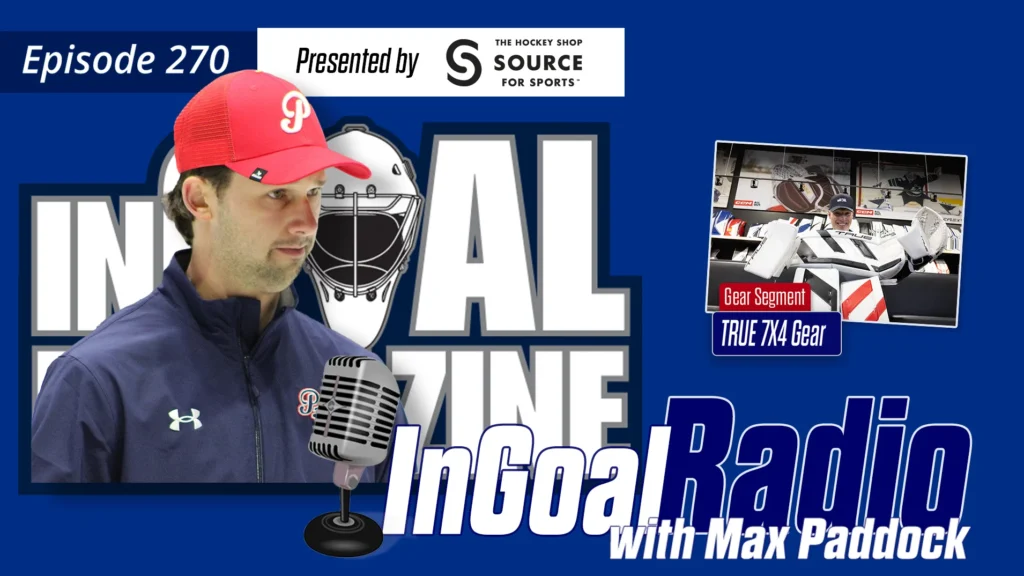
InGoal Radio Episode 270 with Regina Pats Goaltending Coach Max Paddock

Please subscribe and leave a rating — it helps us reach more goalies!


Max Paddock was a Memorial Cup All-Star with the Regina Pats at age 17 before stepping away from hockey to play college volleyball and pursue a kinesiology degree. More than six years later, he returned to the Pats as their goaltending coach. His father Russ coaches volleyball at Brandon University, and his uncle John spent 30 years in the WHL, AHL, and NHL.
- Max Paddock starred for the Regina Pats at the Memorial Cup at age 17 before leaving hockey to play university volleyball, proving unconventional paths can still lead back to elite hockey roles.
- Paddock is completing his kinesiology degree while serving as goaltending coach for the Regina Pats, demonstrating how academic pursuits and coaching careers can run in parallel.
- His family background — a father coaching volleyball at Brandon University and an uncle with 30 years of WHL, AHL, and NHL experience — shaped his multi-sport athletic identity.
- Goalie parents can maximize their child's season by following a structured checklist of key preparation and support elements outlined in InGoal's free parent resource article.
- The True Catalyst 7X3 goalie gear line delivers pro-level features at roughly half the price, making it a strong option for goalies seeking professional performance on a budget.
Episode 269 of the InGoal Radio Podcast, presented by The Hockey Shop Source for Sports, features a fascinating interview with Max Paddock, who went from Memorial Cup All Star at age 17, to playing college volleyball, and is now back in the CHL as a goaltending coach.
Feature Interview
presented by NHL Sense Arena
In the feature interview presented by NHL Sense Arena, Paddock takes us through his unique path back to recently being named the Regina Pats goalie coach more than six years after starting for them at the Memorial Cup, including his break to play volleyball in university while working towards a kinesiology degree he will now finish while coaching. It’s a fascinating journey filled with valuable lessons for other goalies and coaches from an athlete whose family is deeply rooted in both sports — his father, Russ, on the volleyball side at Brandon University and his uncle John having spent 30 years coaching and managing in the WHL, AHL and NHL.
Parent Segment
presented by Stop It Goaltending U
In our Parents Segment, presented by the Stop It Goaltending U app, we list all the important elements that will go into having your best season ever as a goalie parent. That segment is a look back at a more in-depth article at InGoal which is unlocked for all to enjoy without an InGoal subscription.
Weekly Gear Segment
presented by The Hockey Shop Source for SportsAnd in our weekly gear segment, we go to The Hockey Shop Source for Sports for a look at the True Catalyst 7X3 line, which offers several pro-level features at half the price.
Episode Transcript
Intro
There was a huge happening over at the Hockey Shop Source for Sports Langley, the hockeyshop.com. The video crew was in to record some Gear segments, and as a result, Hutch and Woody, the cofounders of InGoal Magazine, are together today on InGoal Radio, the podcast type. Hello, gentlemen.
We would have brought Cam with us, but I was in such a mood yesterday. I don't think he wants to be around me. Just just
Will that be reflected in today's Gear Segment?
Well, not today's because today's was today's is from our last session recording, but let's just see if people can identify which segments Woody was in a mood in in the coming weeks.
Hutch, can you confirm that that Woody was was Woody, a little bit, off his game from a temperament standpoint?
Well, he definitely was, but, you know, he's also a true professional. So when the camera started rolling, Woody was his old self. But usually, he's hammering away at Cam anyway, so I'm not sure you'll know the difference.
He was a little I was a little snap tastic. I think I kept it I kept it within the playing field while we're recording, we'll see. Well, let's just say let's see to our audience. Let's see if you can pick it up. When was Woody in a mood?
That is great. Next couple of weeks, pay attention to the Gear Segment, not just for the information on the gear that that Cam and Woody are talking about, but also the the tone, the inflection of of Kevin Woodley.
It's almost like an audio where's where's Waldo?
You know what, though? One of them and this is a great reminder, folks, whether it's today's Gear Segment with True 7x4 or all these segments we're talking about coming up, you really do need to watch it because I think my mood was altered in a negative manner slightly because I already had a bit of a headache. And then we did the fitting for the custom CCM axis mask, and you gotta put, like, the Formula one hoodie on, like, you know, the drivers do before they start the car, except it's really tight, and I have a really big head. And so as they do a custom scan to give you this custom mask, it puts a little more pressure on my already to already ready to burst noggin, and so my mood perhaps worsened. Although the idea of being able to get a custom mask this way did bring a smile to my face.
You definitely have to wait for the graphics on this one because it's a pretty funny look when you're wearing this bonnet.
Hutch, are you the type of person that pokes a little bit when Woody's vulnerable?
No. Well oh, yes. If if we're if we're not in the middle of a recording session, I definitely poke and try and
get him riled up. There's no question. Once the cameras are rolling, though, I'm
just cringing in the corner hoping he stays in control.
What was Cam's angle? Was he poking or sitting back?
Cam actually I I gotta give Cam credit. Like, Woody snaps a little bit, and it just kinda rolls like water off a duck's back. I don't know if Cam is used to the guys ribbing him over at the Hockey Shop or what, but Cam handles it pretty well.
That's because my chirps are, like, a little too deep for him. There are some deep cuts there,
so I'll go right over his head. You go you go hardcore.
Most of the pucks when he plays.
You go hardcore?
Here I am trying to be nice to Cam, and Woody's just jumping in again. See, I got a little bit out there, big guy.
I got a little bit of residual snap tastic in me today.
Yeah. Because some people can still have fun with their chirps. Other people go, like, right to the bone, like, through every muscle.
I don't think I went don't think I went mean on any of them.
Off camera, he had one little moment that had me cringing, but that's okay.
Gear
Love it. Stop it Goal Tending U. The app, parent segment's coming up, but we've got some great tips for parents to get ready for an awesome season. The Hockey Shop Gear Segment, the True 7x4 line, and the Sense Arena feature interview is Max Paddock. This one I'm excited about.
When I saw his name come across, I was like, I know him. I know his family.
Good old Brandon boy.
I know the the tie in between volleyball. I wonder if we're gonna talk volleyball. And there's a lot of volleyball in there. And, of course, his uncle was the GM and coach of the Winnipeg Jets when I was there. We we we I go way back with the paddocks in in Western Manitoba.
So I'm really and and when I heard him talk, I was like, that's a Paddock. This is great.
Well, listen. Like, not often we're bringing on Western Hockey League goalie coaches, and that's not hey. Listen. There's some incredible ones. We just don't tend to get to know people down to that level.
We've had a couple of this. We had we had Dan DePalmas this summer working with Hockey Canada as well at international championships. Just a guy that we've known for many years, and it was about time we got him on. But not often. Like, sometimes we miss these stories.
And Max's is fantastic, as you mentioned, Daren. Like, from playing in the Memorial Cup to going to school to play volleyball, now back goalie coaching, and there are so many little lessons along the way that I think can apply whether you're a young goalie, an up and coming goalie into junior, or a goalie coach, a goalie parent. So there's just a there's a lot of good things in there. For Max, I'm really happy we got him on the show this week.
It's a journey like no other. And Yeah. It it's And it's No doubt. Unique just how he's got here and the different branches that he took from just thrust in the spotlight as a youngster in that memorial cup to going back and putting the pads away and playing volleyball at the collegiate level. Just really, really cool stuff.
I can't wait for you to hear it and how it all ties together, on the art and the, the presentation of goaltending. So we've got, training camps around the corner. This is the last, podcast episode, in August for InGoal Radio. Have you seen any kits around? I haven't seen a lot of different elements that of goalies that are coming up.
Have you seen any?
I haven't seen very much. I've Yeah.
I feel like quiet on the
old social s lately, sadly.
It hasn't, I haven't seen as like, I think we've gotten to the point where the gear sightings I think maybe we've learned a little bit. Like, you can see guys trying different stuff in the summer, and everybody loses their mind, and then they're right back in what they were using when the season starts. It's not always the case. Sometimes people switch. We've certainly seen a few, like, obviously, Joey Daccord trying a a Bauer blocker.
And I think if I'm not mistaken, Goal Gear Nerd had had some good shots of him wearing so shout out to him for having it, but wearing some some of the new Bauer Konekt 2 skates. We saw obviously, we saw Devon Levi try some different equipment as well, but now back in the CCM and the EFlex 7. And we
That that's that's something that's new, though. The EFlex 7. That was a first sighting. It was first sighting.
This is a tough one for us too, Daren, because it was the first quote, unquote sighting.
But we may have
seen it. EFlex 7, but we may have had hands on it already and and know exactly every detail on it. And that can be a little tough to bite our lip, but that's the the that's just the way she goes sometimes. So, and Devon was trying True while he was waiting for his EFlex 7. And so it looks like he's back in EFlex 7.
So I I just think it's interesting. We just don't see as much of it, and I'm not sure why, but I I do think it's because a lot of it ends up going back the other way so nobody loses their mind as much as they used to. Right? Like, I remember I remember Corey Schneider here, and every gear company was after him. Remember, used to wear the Vaughn pads and the CCM glove and blocker.
And, like, Vaughn was trying to make a CCM style glove and blocker, and every other company was trying to make a Vaughn style I'm not gonna say which company, but there was a company that where their pro rep actually broke the lower component of the boot to shin in order to try and make it as soft as his Vaughn's, like, actually, like, physically
Oh, wow.
Reefed on it hard enough to break the break. And he just wanted him in their gear, and there's just there was enough differences. So, I mean, I've seen it all over the years. Sometimes money talks. I don't think people realize how much sometimes contracts are a part of this.
Sometimes it looks like the money's gonna talk, but then they can't make the gear exactly how these guys wear it. And that's the other part. So many times in NHL locker rooms, what you're seeing on the ice, the label of the gear, and what the gear actually is is not entirely the same because these guys don't like change. Some do. You'll have your Andrei Vasilevskiy who will try anything.
He's perfect for Bauer because he loves innovation. It's a conversation I've had with him. That's why he loves Bauer because he's willing to try all these new things, and he'd be if he can find an advantage, he'll take it. But for the most part, the guys want want want what they've always had. Right?
And so I remember even when when True came out with the thinner thigh rise, it was Casey DeSmith with the penguins in, and it was, you know, labeled the new catalyst. And he's like, no. I but for him and and the thinner thigh rise made a ton of sense. But for him, he's like, no. I just he's like, I'll you can throw whatever you want in the front of it, but I'm not wearing it with a thinner thigh rise.
He wanted his old sorta thicker old school, and I don't know why you'd want it, but he did. Right? So it is fascinating to sorta see how these things play out on social, how these things play out behind the scenes, and the reality of what they ultimately end up wearing most of the time. And getting a peek behind that that sort of final part that not a lot of people get, sometimes you just gotta bite your tongue and and and not tell the world because the companies want everyone to think they're wearing the latest and the greatest.
I am excited about the with the evolution of graphics, what we're gonna see at camps.
Yeah. Isn't it funny that with all those options, some of the some of the guys just stick with stock. Right? Like Oh, we
know it's not easy to design something because we've done it a few times, and we get stalled quite often. We I mean, hard is it when you're designing a stock set and you get to go into the customizer and just change the various color zones? Even that's really hard. You get so many different options, and when you finally do press submit, you're making a pretty serious financial commitment to the gear you're gonna wear for the year. So we get paralyzed almost just on the regular customizer trying to come down to final decision.
It's not hard to come up with cool designs, but which is the one? Now you have that whole landscape of what you can do with the fully custom graphics. That's hard.
Yeah. But a lot of guys like, I mean, think of the guys that are still wearing like, think of what you can do and what you've been able to do for years now with a Bauer graphic. Mhmm. And think of the number of even high like, has Jake Oettinger ever worn a custom other than having a little otter on the side, You know, where where the where your name would normally be? Has he ever had a full like, not everybody's into it.
Right? So it's it's interesting. I mean, you're right. I'm I'm intrigued to see what what new options will be out there, but I don't know. Maybe I'm just getting old there.
Maybe I'm just getting maybe I'm not excited. Like, it's not Christmas morning.
You got you guys have made some great points, but I'll I'll give you just a thought. In the spirit of Jake Oettinger, for one week, we give the goalies carte blanche to put their personalities out there. They don't wear wear them the whole year, but they wear them for two weeks out of a season in November or January or whatever, something to add. We we make it a fun week, personality week. And he's got otters all over his pads or different things tied to different organizations or or the goaltender themselves.
I think that would be cool. Or we have throwback week or throwback month where goalies wear
Tribute.
Their favorite set from their hero or the organization's popular goaltender from the past, and you wear a a tribute set for a specific period of time and the whole league is involved in it. I think that would be awesomely fun.
That'd be incredible. It's making me think to fairly recently did Major League Baseball do a similar sort of thing where all the players could could go wild, and the one that got me was the bat that looked like a pencil. Yeah. Very very similar to that. That was yeah.
I mean, it it would be incredible to do that, and I think it would be picked up by, by everybody. It would be exciting for everybody. Gosh. You even see kids at younger ages going into special games and tournaments and things and wrapping their masks, which you can do kind of affordably now. So but the pros can do it on a different level.
And I think everybody would be excited. You probably have some teams even smart enough to get in there and get fans to vote on which retro setup maybe their guys should go with or something. I I I like both the idea of the personal sort of look on it, Daren, the otters everywhere. I like the idea of the tribute one. Maybe we could have two weeks at different parts.
One could be personal and one could be tribute.
Yeah. Okay. Snap tastic fun smuggler is coming into the conversation. You know what? Smuggler.
My kids call me a fun smuggler. Yeah.
Listen. No. I think they're right.
Yeah. I know. But here I'm gonna throw a little I'm gonna throw a little catch at you. And the irony is this is coming as as nhl.com and the NHL network, and all the NHL components are celebrating goalie week, and they're highlighting the unique personalities that we get to see. But the reality is the league would have to fund this because there are teams that would not.
Who's the fun who's the fun smuggler? It's not you.
Plain and simple. I hate to say it, but there are teams that won't pay for custom paint on one offs. There are teams that won't pay for custom pads on one off. So maybe the wrap solution, Hutch. We've seen it in the past.
Right? We've seen equipment managers have to wrap pads in a completely different color for special event games. So I'm with you, Daren. I think the possibilities are endless.
You don't think collectors would be lined up to buy this stuff from the teams, and then that would cover cover the cost of it. And you might raise some money for the various foundations.
And the league could run that even.
The league would have to. This is what I'm saying. The league would have to because the teams don't know how to. Even teams that do spend money on custom gear. I once walked into a closet with a pile of gear shoulder high, shoulder high, Daren, entire corner of the room.
Did the quick math on the type of setups we're looking at and just scattered everywhere. At least a $100,000 in gear. Some of it over two years old. But as we know in the goalie world, on the auction market and as it gets older and out of date, it loses value. If it had been sold properly at the time, people would have been lined up to buy it because a lot of it was gear you can't get Right.
At retail. It was custom made, for example, by the in Montreal.
So if we do it if we do it properly, it would work.
Team just doesn't know how to do it. They don't know how to make money off it, so they just let it sit and rot. It would work. We just have to have people that actually know what they're doing running it.
Let's just get Woody to stop. He doesn't need to be putting the damper on everything. We're gonna make it work, Daren.
Who would you guys Yes.
And when it works, let's go have some fun.
Who would you want? And if if it's your favorite goalie and you play for, let's say, the Tampa Bay Lightning, and your favorite goalie is x, y, or zed growing up, you could still wear a tribute set to that person if your manager would would let
you That would be tricky. Really? That would be tricky. Really? Well, I guess it depends how you wanna do it.
I mean, if if you're the Philadelphia Flyers and then you show up in blue and white Toronto Maple Leafs No. No. You would it would have be
sort of in the in the flyer colors, but the same. Like a Felix Potvin from the days you could yeah.
Well, you know that's mine. Right? That that would be my choice because he was my favorite set of gear as a youngster. I guess I wasn't that young when he was playing, but, and and he did that that was back in the day when a lot of guys actually had personalities that they would carry from one team to the next, looks that they would carry. So so Felix definitely transitioned that look from from Toronto to Vancouver, LA, Boston.
Am I missing any Islanders? But so it could certainly be done. You're right.
It would be it would be creative. His his look a little bit?
Yep. Yeah. It would def and it it could be done. It would be it would be great fun to see. Who would you who would you do, Daren?
I'm I'm I'm Felix Potvin fan. If I have to do a colorful set, what what would you do?
My favorite setup was always Bob Essensa or Mike Richter's. Now, like, they weren't they weren't true absolute distinctive. It was more a color pattern and that became them, but I but I love those. Maybe it was just the red, white, and blue, but but I love those. I would love to wear the Essensa I've got Essensa mask in in my office here.
I I would love to wear that if in either any combination of colors, but I think that would be cool with with his his look.
Woody? And what what Woody?
I I would probably have to go, because I've seen it done. And interestingly enough, the news we talked about last week with the change of the goalie coach here in Vancouver means it might be possible again. And by the way, this happened to be one of the sets that was lying around. The Kirk McLean tribute.
You didn't identify which clause that you were in with all the gear, but then you just outed the
No. It's out. It's out. It's out. It's out now.
Like, oh, well. I'm gonna get a note on this one. It was it was kinda hard to ignore the all that gear. Listen. I I love Demko's tribute to Kirk McLean.
I thought that was fantastic. Incredible. And I'd love to see that one again. I loved it when Kirk skated out for the for the anniversary year in a set of gear that was built specifically to look like the set he wore because he didn't have his originals. I actually helped source that for the Canucks and for Kirk because they didn't have it.
And he was gonna skate out in, like, generic white gear or generic black pads. And we actually got the guy that had a tribute set connected him with Kirk through the and the team, and he loaned him the gear to skate out. And it was just was one of the biggest moments of the night, like, in terms of the reaction of the fans to Kirk who's a hero in this city, but in that gear, especially. Like, that was iconic Vancouver Canucks. I I that would be tough to beat, in this market.
But if we're going the other way, the just whatever, you know, otters all over Jake's pads kind of thing. I you know what I'm probably doing? And maybe it's because I rewatched this on a on a plane recently. Venom. You know, the comic book character, the sort of black Spider Man creature?
I'm probably doing that. And it's mostly because when I watch a movie, I realize that he has two voices in his head at all times. And given that's how I play the goal with multiple conversations bouncing around my brain, not in a positive manner, given that's how I podcast sometimes with multiple voices bouncing around in my brain and not in a positive manner, I think I think that might be appropriate.
Was it Kelly Hrudy in San Jose that had the the shark teeth on the bottom of his pads? I believe it was. Like, that would be a cool
Is it Kelly? That would be good. Cool.
Something like
There's some teams you can have a lot of fun with on this.
I'm gonna volunteer. I'm gonna talk to some people and try to just plant the seed and see if we can because it's a great marketing tool. It it would get the league all kinds of publicity if you do it in maybe a dog day of this first week of December when you're you're looking for a little bit of just jump after your through the first eight weeks of the season.
How about Skinner's AXIS XF pro setup tribute to fear last year?
Amazing. That was
that was exceptional. For the heritage game. That was exceptional. I'm in. There we go.
We've we've got something to to to to focus on. Let's get into the gear segment, this week brought to you by The Hockey Shop Source for Sports Langley at hockeyshop.com. You guys are talking about True.
Yeah. And, hey, before we get into the the True seven x four, and, again, another second price point product, it's that time of the year where, you know, you're heading back to the rink. You maybe don't have time. Maybe you find you need something new. Maybe you're planning all along, but you knew you were buying off the rack.
You weren't custom ordering. You know what? Not everybody needs the most expensive gear. Not everybody needs the pro level gear. The reality is and we've had this happen with you know, we had testers in in the second price point Bauer play multiple seasons, multiple seasons of major phantom hockey in the second price point.
You don't always need to spend it. So it's usually about half the price. That's true of the seven x four as well. But there are other, like, the past lines in Bauer, in CCM. They're on sale right now, and only a few days left in the back to hockey sale by the time this podcast is out.
So make sure you check it out at the hockeyshop.com. Savings up to 40 or 50% off depending on the brand. Tons of great deals to be had. So in addition to all the new stuff and and this year's product, which we're gonna talk about now with Cam, make sure you check out the website to see if there are still some savings left on something that will help you this season. And, again, it might be Pro Gear.
Highest end stuff's on sale too. I guess the more it's worth, the more you actually save when you apply that 40% off. They've got something for everyone over at the hockey shop and the hockeyshop.com.
Let's get to it. Over at the Hockey Shop, Source for Sports Langley, it's Woody. This one, he's in a good mood. Hanging out with Cam.
Welcome back to The Hockey Shop Source for Sports. I'm InGoalie Utopia. 30,000 plus square feet. We've got our own section over here with all the latest, the greatest, and the second price point options. Yes.
Opportunity for goalies at different levels to save a few bucks and still get gear that's high performance is gonna work for them. Today, we're gonna go over the True Hzrdus second price point and junior gear. Yes. Cam seven x four, I believe, is the NovaScript. Seven x four.
[crosstalk] On the second price point? On the second price point. Okay. So? What's different?
What's the same? What changes? Let's talk about it. So, yes, continuing from the Hzrdus line. So you have your PX4, which is your top end, hand built by the Le Faves in their Montreal factory.
Let's talk about it. So, yes, continuing from the Hzrdus line. So you have your PX4, which is your top end, hand built by the Lefebvres in their Montreal factory.
[crosstalk] Okay. Then we have our 9x4. Same materials but built overseas. Correct. I'm learning.
And now we have our mid price point. So 7x4. Correct. Although I couldn't help but notice that some of the pads say X four and some of them are missing that. We do have all the right pads.
Although I couldn't help but notice that some of the pads say X four and some of them are missing that. We do have all the right pads.
Hockey Shop Sense is also spelled funny too. So that's, I mean, you know what? It's just par for the course. We're good here. Okay.
We've got the right stuff. Yes. We've got the right stuff. So, let's talk about the pad a little bit. So, first thing that we can talk about right off the bat, stiffness profile.
It's a very, very stiff pad. Even in from the 9X4? Refresh my memory. Yes. So it's always been a stiff pad.
I mean, Hzrdus line is designed to be the stiffer of the two, the flat face design. Maybe a little bit closer, close comparable on the wall. Maybe I think of like an, you know, an access pad that comes to mind. This is definitely straighter. Yes.
As well. Feeling overall stiffer for sure. So true continues with that thinned out thigh rise allowing the pads to cross in that deeper, lower wider stance without them interfering or chunking up between each other. We've also seen the deletion of their Fast Glide material and gone with a weave slide surface. So we've seen this on the 9x4 as well.
Obviously, when it comes to the PX series, you can choose whatever material you want. We've we've seen for a long time. This is nothing new in terms of like a goalie world. Again, the little bit of that presentation of or I would say, technically it's a myth now that weave slides better, but it doesn't. Yeah.
We've had a little science behind that on a certain setup. That might not be the case with this one. However, it might be a little bit better than what the fast guide material is, which we've also kind of found out with a little bit of scientific. Maybe doesn't slide as well as the name suggests. Yes.
So weave. Weave. On the side surface, nice balance, nice big calf wing as well. This is gonna aid in your stability of the overall pad. Again, with something this rigid, we want to make sure we can able to sit straight, be able to present that pad forward without it kind of flopping over on you.
The other thing I noticed Cam is you mentioned the stiffness of the pad. That includes down to the boot. Like quite often we've seen pads that are stiff from the shin through the thigh but then have that flexible boot. They've given you an option to have a pad and at least in the in the seven x four that is quite, not only quite stiff all the way down to the bottom but quite a steep boot. Like, we've seen a lot of Very steep.
Angle. Is this is a much steeper angle on the seven x four. Again, it's gonna direct rebounds off that boot a little differently. Gonna behave a little differently. If you've got a flat boot and you're in a butterfly, the tendency sometimes can be to kick that right back out in front of you.
This should kind of like the old CCM Premier, remember it had that steep boot? That very big angle? To flex it off to the corner, so there's a benefit there. Yes. It is quite different than most of what else is on the market right now in terms of being that steep.
[crosstalk] My question is how does it affect fit? So, I mean, is gonna kick the pad up on your leg a little bit in terms of for fitting wise. Now the one thing that I can't stress enough though is that this will soften up a little bit more over time. Okay. So some of that height that's initially starting out with will be lost a little bit as that pad does settle down on you a little bit.
And that's a bit more of a core of the seven x pad itself. You can see that gap there too. Like there's room for it to flex forward. Correct. In terms of like overall collapse, like I'm not expecting very much though.
Like it still should come into your fitting and factor in terms of how high this is gonna sit up on your leg because of the straightness of that boot for sure. Anything else on the pads? Oh, Pro Laces. Mean, second price point, but still comes with Pro Laces, which is a bungee system. Yes.
Which differs from the nine x four pad which comes with that crazy long lace hybrid skate lace bungee system thing. This is just a straight bungee pro lace. This is a straight bungee pro lace. Velcro at the end.
Yes. Still has their inside. I like I like the use of nylon that that continues to ruin the pro fixed end point. You know, I'm about my fixed end points. That's rotation system FRS. So there you go.
Second price point still has their FRS, which has been quite popular right up to the pro level. Yes. Very good in it before the change. Yep. So overall, again, we see some of that similar features coming from that Catalyst line as well in terms of, like, that back of the pad in terms of the overall fitment and the fabric rotation system, the integration of that nylon strap, removable outer knee wing in case you do want to strictly go down with your overall knee strap.
Again, some great overall features in terms of for that lower price point. Okay. So removable, like Yep. But you're gonna have to unstitch to remove it. Yep, it's just unlace and untie the knot.
Okay. Take it off. So, gloves, blockers. Oh. Do we need to get into the little guy?
Yes. Sorry, this does go all the way down. Intermediate and junior price points available. Intermediate was available in the Catalyst. Junior was not available in the Catalyst.
Which this is a junior price point for it should be, is a lot more flexible. So, it's gonna be less rigid. Your leg, it's gonna move with your leg and not have which for young kids is important, right? You don't want that stiff a pad on a young kid. A lot more flex.
Modified fast rotation strap, not the same FRS system that you see. It's a little easier to get in and out of. Yeah, correct. Not the same that you see in the intermediate. Nice sturdy knee block for a junior pad as well.
It's really nice. Correct. Yeah. So even though it is marketed as, again, that stiff style of pad, that junior has quite a bit more flex. The intermediate, a lot closer to that senior pad, still very stiff.
Basically, a shrunk down senior version. Okay. Blocker. Glove. Quick.
Blocker. Okay. Blockers. I mean, not unlike we haven't seen from True before. Very, very similar to that Catalyst blocker.
Overall fit and feel wise, you know, balance on the center of the hand, a little bit of a thicker blocker as well. I mean, significantly thicker blocker compared to where some the other trends are This with Lefebvre is a Lefebvre blocker. Feels very rich for like a mid price point model though and that's I think same thing goes for the glove as well. The biggest difference you'll notice I think is the weight but I mean, that's kind of true of pardon the pun, true of true gloves.
Going to weigh a little more just because they do have that traditional construction still. So, overall, I mean in terms of nice easy break, it kind of feels like you're kind of closing around something. It feels like, you know what I mean? Like the way it sort of as opposed to just like the flap closing like that, it feels like it's closing like that. It's good you're using a five ninety angle.
It's unfortunate that you picked up a catalyst glove but the Hzrdus glove and catalyst glove are the exact same break angle. It's okay. I noticed these things Kevin doesn't, but he's at least showing off the fact that they're the exact same break angle. And folks, don't worry. They're gonna feel the same.
It's just the graphic that's changing between the two. Don't worry, Kevin. That's why I'm here. That's why I'm here. Have brought this glove out and spent five minutes getting it set on his hand so that he could show it off.
I would say the mistake was probably yours. I'd make an excuse too if I got, you know, made a mistake. Listen. That's fine. Listen.
Let's get into the junior gloves because I gotta say, like we talked about the pad, this kid's glove just, I mean, that's that closes nice. This is designed to fit a junior hand. It actually fits a junior hand like Kevin's. Host weight It for closes nice and easy right out of the box. There's not much effort in this.
This is definitely similar five ninety break. Got a offset very tee and single tee on purpose. Again, that's just helping to aid with that tee folding over nice and easy out of the box. Again, if we're So important for kids to be able to sort of control If we're in this age
category and we're struggling trying to find a glove to close, this is definitely something we're checking out for sure. Yeah, that's nice. Blocker, junior size, I mean Small. Small, yeah. I mean, it doesn't little flimsy on the board but it's not like anybody's shooting pucks that are gonna cause injuries.
No, we need a lightweight blocker that we can get our hand in and get control over for sure. Oh, because I'm an adult. There you go, you made it. So if you have any more questions about this line, give us a call. (604) 589-8299 or 1805677790.
I have a question. Yes, Cam. We always say lower price point. How much lower Cam? Let's let the people know.
I know they can check it out online at the hockeyshop.com to check themselves, but ballpark, what are we looking compared to a pro level? Some recent price adjustments too as well. So you'd be about half. About half of what you're playing for the pro level. And what's the pro level called, Cam?
Because you gotta remind me. P x four. P x. And nine x four. Similar price?
Because technically speaking, it is a pro pad and the nine x four. They're both similar price. They are both similar Okay. Price half bad. Yes.
Not bad. Not bad. Roughly. Just beware, like we said, beware the fit and differences in style compared to the boot being a little steeper. I think it's important.
It's not a like, it can be a positive. You just have to be cognizant of it, especially with so many other companies going to a Try flatter it on. And make sure it fits properly. If you got any questions, give Cam and his crew a shout. They'll help make sure you get a pad that fits your leg properly and fits your game.
And don't worry, we'll match the right glove to the right pad. Well, unless Cam goes and gets it off the wall and sets me up for failure. I don't set anybody up for failure. I just, you know, take us out of The Hockey Shop.
You guys are right to to remind people about the YouTube version of those gear segments. We get something out of every offering. But to slide over there and just click subscribe on YouTube for these Hockey Shop Gear segments on InGoal Radio, the podcast, because there's so much more when you can actually put eyes on on this gear.
You can, and then you can also leave comments. So I think it would be really cool if some people went over, watched a few of these videos, and just left a few comments for Woody. Looking a bit grumpy today, buddy. Woody, smile. What do you want?
What what are your favorite messages for Woody? Leave it over on YouTube in the comment section.
Oh, I walked into this one, didn't I?
Yep. I think it's good.
Yeah. People are really good. Like, people have been really good about writing to us. We've had all kinds of notes come in around the adult goalie clinic concept. Oh.
Today's theme today's theme has been Woody's grumpy, so let's start hearing those comments, but let's make them public over on YouTube, please.
Or what would you wear for a tribute set or a one off if we did the goalie two weeks, during the season where guys got to wear, some the of franchise's great setups.
They We'd love to we'd love to hear that. In info@InGoalmag.com.
Let us know. Hey. Speaking of that, I do gotta throw back real quick to the adult goalie conversation because Hutch is right. They continue to come in. And the one that we get the most about is the one we mentioned in Rochester, which our friend Dan Stewart of the Saint Louis Blues coached at.
And Cam Matwiv, who's been a big supporter of InGoal, and and we're big fans of him. Remember the article that was written about his journey in goaltending for, International Goalie Day on November 1 a couple of years ago is still a can't miss one. We we put up every year on that day to mark the occasion. He sent me a bunch of notes on sort of the, quote, unquote, bones of the weekend. Ten and a half hours on the ice over three days.
That's a lot.
25 to 25 to 30 goalies.
At our age?
They break them down into four to five groups by age ability. Hey. Listen. At our age, Chris is Chris is of our vintage and with a lot of work done to continue playing, and he's in there. Six stations on the ice.
There's a coherency with each session's mini lesson. Each station has a coach and assistant and shooters as needed. They go from five to 06:30 on Friday to get some rust off. Saturdays, nine to twelve, lunch, nap. Nap.
You gotta have the nap in the AHL goalie clinic, and then three to six again.
That's awesome. Everyone
has and then Sunday, ten to ten to one a ten to one, 10AM to 1PM, shootout to close, prizes, a nice trophy. You get to keep for a year, and then a barbecue after at the hotel parking lot. This one in Rochester, I I keep trying to remember exactly what it's called. I believe it's called watch the puck clinic. Usually, it ran, late July this year, so that's sort of roughly the schedule.
I think we're gonna have a lot of adult goalies listening over the past couple of weeks that are gonna be they might have to double the capacity next year because it sounds like the people that go go every year, and there's a real camaraderie there. But, hopefully, they're up for growing it because it sounds like they're doing a hell of a job with it, and we we might just have a few more adult goalies making Rochester part of their July vacation plans in the future.
I'm up for the tailgate at the end of it. That's for sure.
Up for the nap.
I'm up for the nap. Yeah. See, we were remember
we were talking about making it, and it should be a week or a weekend, and you gotta incorporate golf and outings and things like that. I think the nap is the outing. Right. Just like when you're in kindergarten, you know, where you have a little time out and everybody curls up into finds a little spot on the carpet to curl up.
I know there's a lot of goalie coaches out there teaching young kids in camps, and they wish they could throw a nap in it for the kids.
You gotta make sure the car is positioned away from the sun, roll down the windows, and you hopefully, there's a little bit of breeze going through there. Put the seat back, and you just get a good solid 45 in.
Oh, forty five minutes is long. That's a deep sleep. Let's be honest, though. Maybe if I mixed in a few more naps, I wouldn't be so grumpy.
Hold on.
Woody had napped yesterday. It would have been a great morning. He just needed to nap until about 6AM.
You just soaked up the fun from my nap. That's terrible.
I apologize.
I I I love that whole camp philosophy and format. Awesome stuff. I you guys know I was I was talking about Isaiah last week and working with with Rob. And Isaiah and I have been skating together with the summer skies for about three weeks now. And the other day, I was having trouble with the three on three game.
You know, we put the the nets on the boards and you play cross ice and you play three on three.
Yep.
And I said to Isaiah, I I lost to him all three games, which I I should, but it wasn't going well in the last game. So I was asking him for tips on this, and he he gave me some stuff to just to be able to get a little bit of that. And then I thought back to him.
Nice. What were the tips? Were the tips? Lots of kids out there play three on three in one end.
So Well, because I was having trouble being, with my decision making of being aggressive or passive because I didn't wanna get beat by a 20 foot shot, so I'd be a little more aggressive, and then I get dangled backdoor because that's so it's so fast, and guys are are tipping pucks in. But if I sat back, they would just roof it on me. I'm I'm an undersized guy. So and and he said he was giving me some tips about baiting players and come out, look big, and then fall back fast, like, way faster than you normally would to to make sure that you're tracking that. But when the first player first looks up, because they only get one chance in three on three cross ice to really look up and see what's going on, he goes, you gotta you gotta play mind games with them.
And and it and it worked. Nice. I was much better the next day.
Might it might have been just my day, but think having something to think about from Isaiah was a little bit of a confidence booster. And so the at Algoli camp would be like that.
Sounds like Woody needs to get Isaiah for a little ProReads. If we could even do a three on three one in ProRead, that would be fun.
Listen. Listen. I got some advice for you on three on three cross ice, Daren. Don't play it in your fifties. I need to ask where the defibrillator was.
It it it was insane. And the guys would give it to me. Right? Like, come on. Because you're you're playing teams.
You can play best of three. And part of me would be like, guys, I'm 54. But the other part is I don't wanna say that because I don't want them to know my age because then they won't let me come out again. I wouldn't pass that.
Like, three on three is three on three is tough enough, like, in the small rinks and the nonstop action, and you just base there's not a there's no such thing as a breather. Great. Three on three cross ice with, you know, professionals, AHL, NHL level shooters. Yeah. I'd be like, thanks, but no thanks to myself.
Although, for the opportunity to get to do what you would do, I would put up with it.
Nice. Stop It Goal Tending U the app, the parent segment. Get to the tips in just a little bit, but what's happening with Stop It Goal Tending U the app?
Well, the daily primers for the past week, interestingly enough, Daren, like, this wasn't planned, but it ties very well into Isaiah, how to manage anticipation. So five one minute segments during the week on how to manage anticipation. We talk a lot about ProReads and reading the game. Well, anticipation, knowing or thinking you know what's coming, you also have to manage it. Can't cheat it too much.
Maybe you can cheat it sometimes. Can you, as Isaiah talked about, bait it and dictate what's happening? So a full week of discussions, quick little hits on how to manage your anticipation. There's a quick video of power pep tunes with Jake Oettinger, and then a full breakdown, ten minute video on goalie headspace and personal judgment. That's all there in the past week at the Stop It Goaltending U app.
New content every week, whether it's the quick hit primers, medium length videos, or a deep dive each and every week that you can really sink your teeth into. No better way to become a better goaltender than subscribing to the Stop It Goaltending U app. And as a bonus, the only other way to become a better goaltender, every subscription to Stop It Goaltending U comes with a subscription to InGoal Magazine, InGoal Mag Premium. Put those two things together, and you've got more goaltending content than any other place in the world. That's what you get out of your Stop It Goaltending U subscription in combination with an InGoal Magazine Premium subscription.
Check it out now on the App Store for iOS or wherever the heck you Android people get your apps. Like, I I I can't remember, Daren. But they the people listening, they know where they should go if they've got an Android.
It is like a different language. Whatever side of the fence you're on, you don't understand the other side.
I I had it somewhere. I know it's there somewhere, but maybe it's Google Play or something like Yeah.
And I don't know how you get around it, and people are so loyal to the other side that they they just will not listen.
Yeah. Don't don't be angry at me, all you people that are on Android, just because I'm a I'm a slave to the Apple environment.
We see enough in the YouTube comments of the fans of True slagging the fans of CCM and the other way around, and let's not get into iOS and Android to add to the fuel. I That fuel the fire.
Puzzled when I'm on the I'm an Apple person, and then all of sudden, I've got a green bubble. Like, why is that green bubble? Oh, you got an Android? And I'll say it like that, and I'll be like, don't judge. I'm like, sorry.
Parent Playbook
Sorry. I didn't. Anyway, the the great tips to get ready for the season, Hutch.
Absolutely. September is upon us, and I thought it was a good idea actually to revisit an old article that I wrote and put up at ingoalmag.com. It is unlocked. So if anybody would like to go and review this, they certainly can. It's 10 tips for having your best season as a goalie parent.
I'm gonna do my best not to dig too too deeply into them because as I said, they're available over there on InGoal. But Woody and Daren, if you feel like hopping in on any of these, please feel free to. Number one, comes up in tryouts, but, also early in the season. Please make sure you're cheering for the other goalie on your team even in tryouts. There's that desire to maybe see your kid do better because somebody else doesn't do as well, but karma and the hockey gods, they're gonna get you.
So make sure you're cheering. It's a team sport. Your kid's, your kid's partner needs to be a buddy of his as well. So the second one, please don't make excuses when talking to your child or anybody else. It's not about that goal went in because your team plays bad d or they're not back checking or whatever.
We just straight up, if if the game is a tough one, the game's a tough one, and we have to be ready to deal with that. Don't compare your child to anybody else. One of the toughest things as a goalie parent is when we're looking at the other end of the ice and wondering why that kid has stronger defense or that kid has better opportunities or he's got gear that my kid doesn't have, all sorts of things. Let's just focus on helping your child enjoy the game the best you can, and I think you'll enjoy the game better as well. Find something good each game to celebrate.
I brought that one up many times on here before, but, when somebody comes up when your your son or daughter comes off the ice, comes out of the dressing room, have something that you saw them do on the ice that you really loved. Might be their attitude. It might be, their work ethic. It could be a save they made. Something good every game.
Goalies really don't like it when you say great game when they know it wasn't. So this year, don't be doing that. If, your son or daughter comes out and they've had a tough night, you know they're probably not gonna be happy. Saying great game is is not usually the way to cheer them up. Give them a hug.
Tell them you love them, and, tell them you understand it was a tough night. Number six, praise their effort, not the results. Don't get excited about their goals against average, the shutouts, the wins. I mean, they're all fun, but the most important thing I think is that they're out there having fun and working hard. So I like to spend a lot of time just talking about how hard they worked in practice, how hard they worked in the game, and making sure that you know that you love them for who they are and not the results on the ice.
As I said, praise working hard, but also take some time to praise them having fun out there because that's why we play the game. I I think it's really important that we focus on that as well, and don't forget that's why we're there. Maybe you've heard of that guy named Marc Andre Fleury. He enjoys the game. We enjoy watching him have fun playing the game.
I think we should encourage our children to be the same. Number eight, another theme that comes up in the parent segment a lot, help your children to become independent. Our goal is to raise happy, confident, independent kids, and we need to help them do that through their hockey. Let's not be the person that does everything for our kids, and all they have to do is to walk into the dressing room, put their gear on, and go out on the ice. There's a whole lifestyle around being a goaltender, and we need to help our children from the very youngest age learn to take, accountability for their game and their preparation for the game.
Number nine, I think we wanna support our children's mindset at home this season. Take some time when we're at home, helping them understand that there's only certain things they can control out there. Reinforce having that good attitude when they're out there. Help them understand that sometimes the practices aren't about goalies. Two on o drills, three on o drills.
Let's not reinforce that that sucks for them. Let's help them have the right attitude so that they can understand there's still something they can get out of every practice. So read some of the mindset articles over at InGoal from Pete Fry and all sorts of other people and learn how you can apply that at home with your kids. And then the last one, I think we all as parents need to model how we want our kids to grow up as goalies. If we have a tough mindset at the rink, if we're grumpy, if we're stressed, if we're nervous, I've used this theme a few times before as well.
If we treat every game as the same no matter what the level is, then our kids are gonna be able to do that as well. So they they're gonna reflect their attitude and how we're acting around the rink. So I think it's important that we be that calm, cool, collected, relaxed person, even if inside our stomachs are turning as they tend to do. So those are my 10 tips for having your best season ever as a goalie parent. Head over to ingoalmag.com and find that article and read through it and see what you think.
I would love to hear from you if you have any other tips for being a really good goalie parent and having a great year. You can hit us up at parents@ingoalmag.com. Let us know. Next weekend, we're gonna follow on from this theme. We had a question from a goalie parent come in asking how he can control his own anxiety in the rink.
It is really tough being a goalie parent, and we all feel anxious, from time to time, if not all the time. So we're gonna talk about that next week. And if you have any tips for parents who are feeling anxious at the rink, let me know those too. Maybe they'll get incorporated into next week's segment.
I was actually gonna ask you about how you approach the drive to the rink when if it's tryouts or whether you're in a bit of a rut or your child's in a bit of a rut. Do do you talk about the game? Do you talk about something else? Do you try and build them up? Curious how a parent should handle challenging times or stressful times.
Everybody's got their own answers, Daren. As I as I say all the time, I wanna preface, I'm not telling you how to be a parent here. Everybody's child is different, and you know your child better than I do, so you probably have your own approach. For us, I think we've always just tried to keep it light. You know, I told the story before when when Matty played his first junior a game as as a youngster.
I left him at the door of the rink and, again, teaching independence. I just parked the car out front and then he could walk in on his own. I said, somewhat jokingly, somewhat seriously, just try and keep it in single digits, buddy. We try and keep everything as relaxed as we can. We don't hype it up.
We don't try and talk through the nervousness every now and then. Maybe he's got a few cues that he's using in a game he might mention to me, but, no. Generally, it's his game to play. If he wants to direct some conversation, he can. But for the most part, it's just keep it light and loose, I think.
When you're walking through that list, I couldn't help myself but think, how would Woody answer this?
Well, Woody's a volleyball dad. So and we had a volleyball player on the, well, we have one on the podcast this week.
I think that, it's great advice. I was actually thinking more in terms of as a, gear segment at the Hockey Shop, dad.
Good boy.
Maybe there's a few moments I could handle a little bit better and a little bit differently based on Hutch's advice. So Cam, if you're listening, my friend, and I know you do, I'm gonna I'm gonna digest all of these, and I'm gonna try and be better in the future because certainly there were a number, that check boxes on some of the feelings and mistakes I've made as both a volleyball parent, but also just in terms of how to approach things and put yourself in a in a better state of mind for a lot of things in life. I at the end of the day, we find a lot of ex goalies that succeed at a lot of big things in other avenues in the world, and I think it's because of their the mindset required to be a goalie. And there are some lessons that apply also to being a goalie parent that, you know, frankly, I still need to learn in my fifties.
The late great Gord Downey, the lonely end of the rink. Right? Goalie parents often find themselves at the lonely end of the rink because it's just stressful. And I don't know whether you pace, whether you keep to yourself, whether you force yourself to sit with the other parents, I I don't have any tried and true perfect answer for you. But it's it's challenging when you're a goalie parent, and that's just part of the position.
We'll talk a little bit more about it next week, but I think it's definitely an individual thing because even for me, it changes season to season, team to team, how I end up handling the situation personally. But at the end of the day, as I said, to close this out, I'm doing my best just to stay cool, calm, relaxed because that's what I want my son to feel. Although the nice thing is now that he's playing junior hockey and he's not living at home during the season, I can be as anxious and crazy as I want to be because he's not gonna see any of that anyway. So it's all good. I can flip out at home and go snap tastic.
Yeah. The only the only challenge for Hutch, though, is he has to watch this when he when he does go to the games and invites Woody. He has to remind him that we're sitting in the parent section because because Woody needs to keep
his might have happened once or twice.
Woody needs to keep his mouth shut about all the mistakes being made on the ice because the people Oh my god. That kid can't skate. Those parents might be sitting nearby. So
I'll finish off with this. Goalie parent, this goes back a number of years. The goalie himself, and I got this story secondhand, but from from the the the athlete. He was playing minor hockey, and they always laughed at how this guy's dad would stand along the glass and listen to the game on the radio. And they're like, that is so cool that he's listening on the radio all the time, but it was minor hockey.
And the kids finally figured out that the game wasn't on the radio anyway, but he always stood there with a transistor up to his ear. And they're wondering, what's what's he listening to? And, well, as it came out, there was no radio in the in the transistor radio that he was holding up. It was a flask, and that's what he was holding up. And that's how the dad was getting through the game.
And he just held it up to his ear like he was listening to the radio the whole game. I thought that was ingenious as a as a funny one, going going way back when you could do that kind of stuff in and around the rink. Sense Arena.
It was a different world.
Max Paddock, Bring us up to date on this story. And, also, before we get into Max, Sense Arena, what's happening with NHL Sense Arena.
As I've said already, we've got a new hockey season upon us. It's it's September as people are listening to this. We're all excited to get going and have our best season ever. Why not make NHL Sense Arena a part of that? The fact is goalies do not get enough attention in practice.
We talk about that here a lot, guys. And even if you're lucky enough to be able to afford a private coach, even the most fortunate of us might only see them once a week at best. But NHL Sense Arena can be your goalie coach this season. There are a number of training plans available for you to follow, all kinds of them now, and they're adding more and more all the time. The shooters can hit their spots.
They always show up. You can be led by top professional coaches and goaltenders through the training plans at in NHL Sense Arena to guide you in your practice every single day this season if you would like. And you can do it all in the comfort of your home, and mom and dad don't have to drive you to the rink and back. So it's a real positive for moms and dads as well. As we said before, you have to learn to be your own best goalie coach too.
So you can also go in there create your own training program. You can review your saves from different perspectives. You can see your stats to know how you're tracking the puck, reacting to shots. Even seeing how you fill the space in the net, you've got more tools in NHL Sense Arena guys than any coach has on the ice today. So this season, head over to sensearena.com and give NHL Sense Arena a place in your training to make 2425 your best season ever.
Wasn't around when Max was a goaltender, with the Regina Pats of the Western Hockey League, making a splash in the Memorial Cup, but he has watched it evolve into a tool that he might be able to use with his goaltenders, but that's only a fraction of the, journey that, is available in this conversation, Woody.
Yeah. We already teased it. I don't wanna give too much of it away. Obviously, anytime you go from the bright light to the memorial cup, and and as you'd mentioned, Daren, like, they're in a hurry at a very young age. There's lessons learned.
But then to go from there to out of playing volleyball at a collegiate level, not, like, at a high collegiate level. And now back into the game, as a coach, I I I just wanna like, the timing is perfect because WHL camps are all starting this weekend as we including his first as a goaltending coach as we unveil this podcast episode. I think just let's just let Max tell the story himself. Let's get into it. Enjoy it.
It is unique, and there are a lot of great lessons that come from it.
Feature Interview - Max Paddock
It's another Brandon boy on InGoal Radio, the podcast presented by the Hockey Shop Source for Sports Langley, thehockeyshop.com, the feature interview presented by NHL Sense Arena.
Excited to welcome to the InGoal Radio Podcast, first time guest, but I have a hunch we're gonna be hearing from this guy in the near future. Max Paddock, new goaltending coach for the Regina Pats, and someone who at the age of 24 has already authored a pretty unique, fascinating journey into the world of goaltending back to the world of goaltending from playing in the dub to playing university hockey, university volleyball, and now back to goalie coaching. I guess first off, just welcome and congratulations on the new job. How excited are you for this role?
Yeah. Thank you. I'm super excited. Obviously, played, in Regina and it's super exciting to get back to back to my Western League roots.
Let's start with your journey in Goal because and and those two sides, volleyball and hockey. Obviously, I I've had the pleasure of meeting your uncle John, who a lot of people may know as longtime NHL player and NHL executive for sure. But then your dad's also an Olympic volleyball player. So this sort of two sport thing has probably been a big part of your life throughout.
Yeah. That's exactly right. From both the time I can remember, I've been playing volleyball and hockey. My dad was the started the program at Brandon University for volleyball in 2005. So from from the time I can remember, I've been going back from the from the rink to the hardwood and the volleyball courts.
And, yeah, it's been it's been a huge part of my life from the beginning, basically.
Similarities, benefits, growing up in both? I can I I have a daughter who plays? She's a libero. She wanted nothing to do with hockey. And then one year, the coach tells me, you know, the libero is the goalie of the volleyball team.
Yeah. Yeah. That's exactly that. There is I mean, you gotta be athletic. Right?
That's that's the biggest similarity. Just understanding being able to play multiple sports is always a benefit. Right?
I was thinking footwork too. Like, remember Henrik Lundqvist played tennis in the off season. Right? So you're using your hands. You have to be active with your hands, and then you're moving all over in terms of footwork.
I I I would think there'd probably be similarities a little bit there as well.
Well, exactly. And even, like, just playing defense. Right? We're taught in volleyball to have our hands out, and you wanna you wanna dig the ball in front of you. Right?
Similar to in hockey, you wanna catch pucks in front of you. So I think that's that's the biggest piece that I've kind of put together out of footwork.
And, yeah, it makes sense sort of your band your your balance and your stance mechanics are probably similar too in terms of from a defensive position.
Yeah. Yeah. You're you're in an athletic stance. You know, your your shoulders are in front of you. You're you're trying to keep the ball in front of you.
Right? But, yeah, it's it's been difficult transition to go back into volleyball, but, yeah, there's always some similarities to draw in there.
Well, I mean, difficult to go back after a lot of years away because I'm guessing once you started playing in the WHL at age 17, you're pretty much committed to one sport. Walk me through the journey up to that point. You were playing both. When did you make the decision that that hockey and an opportunity to play goal for the Regina Pats, was was too much to sort of keep doing both?
Yeah. And it was was obviously a tough decision, but it happened when I was 16. So I didn't make the paths right off the bat when I was 16. I got a chance to play at 16 years old just due to some injuries and whatnot. But I was still playing volleyball at the time when I was back home in Brandon.
And I think getting called up when I was 16 and getting a chance to play really kind of solidified that this is what I wanted to do. And obviously, it's it's tough to turn down the chance to play in the WHL at 16, 17 years old and especially, you know, from from being from Canada, it's, you know, our sports sort of thing. But, both of both of the sports have been great to me, but it was a pretty easy decision, I think, to just transfer into hockey.
Okay. So walk for those of so for those that didn't see you, obviously, Cup first year with the Regina Pats, Memorial Cup all star right into the final game. But just rewind a little bit. Your mentors, people that guided you along the way, maybe describe your game for us for those that, you know, when you were playing goal, how did you see yourself as a goalie, and how did that evolve?
Yeah. That's a great question. And to be honest, I wasn't super technically sound. And that's not a knock on on the goalie coaches I work with. That was just the way that I played.
But Dan Ferguson at the rink now, I guess it's called when I originally started, it was GDI. He's been a huge, huge help for me. Murray also at the rink. Tyler Plant, who's the goalie coach and Brandon, or some of the guys that I've worked with and kind of helped me get to where I needed to be in the in the WHL. And as far as my playing style, like, as we kind of talked about multi multi sport athlete, I was just athletic.
Like, I kind of understood. I would say I had a decently good hockey IQ, but I wasn't the best skater. I wasn't super technically sound. I just kind of relied on my athleticism to make saves and probably should have worked on my skating and and my technical side a little bit more than I did. But, I mean, it it went the way that it did and yeah.
So so I'm I'm curious now. Like, you're coming back as a coach. You've been coaching. So it's not like you just all of a sudden flipped the switch. You were doing some coaching while you were still playing in university, getting your kinesiology working on your kinesiology degree and also playing volleyball.
Are like, do you hold yourself up as a cautionary tale or what? Like, you say, hey, guys. Like, I used to not all this stuff I'm asking you to do, I maybe didn't do enough. Like, how how how do your experiences and and your insights into your own game self reflectively inform your coaching?
I think just yeah. Exactly that. The way that I played, some mistakes that I made along the way are great pieces to give to the kids that I work with. You know, like, hey, this this didn't work for me. Not saying that it might not work for you, but, you know, we we should probably hammer down on some of these points.
And I think that that's definitely a coaching strategy that I've used in the recent past. And I think going forwards with the past is something that is gonna be a big part of how I how I coach these guys. Because to be honest, I don't have the experience that some other coaches in the WHL have. Obviously, I'm 24. I'm I'm kind of new into the game.
But what I do have is that experience of being in the situations that these guys have been in recently. Right? It's only, I guess, only four years ago that I was playing as a 20 year old in the WHL. So whether it's the good, the bad of, you know, the whole season, right, you go through the highs and lows, and I'm just excited to kind of be there and support those guys through it and kind of guide them with whatever they whatever they kind of go through.
Can you think of an example of where you're coaching? Obviously, just starting back with the pads, but at other levels doing private coaching where, you know, something you see in an athlete that maybe you you can see yourself in there, but you want it want them to maybe do differently because the game even in four years, the game's evolved. Any examples pop out of of, you know, where you've been able to use that to sort of help guide somebody who, you know, on a different path, so to speak.
Yeah. I think the biggest one that I can think of, and I'm just even thinking to a private lesson I did yesterday was I had this kid who was a good athlete. Like, you can tell, like, he's he's catching pucks. He's doing all sorts of things. He's diving all over the ice, but he didn't wanna skate.
Like, he and and with me, structure that I do in my private sessions for the fifty minutes to an hour or whatever it is, is I like to skate, like just do pure skating, whether it's edge work, some crease movement stuff for the first fifteen to twenty minutes. Because, again, it's super important. You can't really it's gonna be hard to make a save if you can't get to the puck first. Right? So it's it's been, I shouldn't say a battle with this with this kid to get him skating, but I think he's starting to understand that, you know, it's it's a big part of being a goalie.
And, you know, it it happens all the time. Kids wanna just stop box. They don't really wanna work on their skating, but I think that's something that you kinda gotta drive into them at a younger age that it is an important part, and it'll it'll help you make more saves.
Do you do you when you're doing that, do you do you look back and be like, yeah, I would've hated this one too.
Oh, absolutely. I just wanted to get on the ice and just make saves. And it sucked when when Dan Ferguson would run run me through the ringer and but it definitely helped me. I just as a young kid, it makes sense. Right?
You just wanna get in there and stop the puck, but there's other things that you gotta work on too.
So how do we find that balance? Right? Because you're you're you're now you're in a development position. Now you're gonna get athletes that are more refined, right, by the time they get to you. But, you know, you've you've you've done privates.
You've been doing some coaching. Like, you know, how do we make that part fun? Is there are there any ways, any examples, any ways you've found to sort of dial it up a little bit, or do we just gotta because we we do the same thing in InGoal. We're always like, everybody wants the the sexy drills with multiple components. And, you know, we just had one with Kristen Campbell last week.
Right? Like, so much of their practice is just simple movement, but making sure you do it right. How do we how do we get more kids to have fun with that?
Yeah. I think it's it's always gonna be a challenge. Right? Especially just because the skating can be so I don't wanna say dry, but it's it the the basic stuff works. Right?
There's some challenges that you can put into it. I think the big part too that I use a lot is through you guys. Right? The the pro drills and some of some of those skating drills I showed to our goalies and be like, hey, Guys in the NHL are doing this. Right?
If if you wanna get there, this is maybe something that we would have to do. Right? And that just kind of clicks into their mind. Like, okay. If the pro guys are doing it, then maybe I should start doing it too.
Oh, hey. We we like to hear that.
Yeah. Yeah. And I think that kinda helps them realize the importance of skating. And then from there, we can kind of do more, and they're more open to to new drills and and maybe the simpler stuff too.
Okay. You mentioned that the you know, you're gonna be going in there as a as a coach only four years removed from playing, but seven years removed from your first experience. Walk me through what you remember of, you know, that first taste of the WHL. Because for you, it went quite quickly. Like, bang, you're in there.
You you said you had that taste at 16, but at 17, you're in there. You're playing a lot. You're in the Memorial Cup. You're hosting the memorial cup. There's a lot of pressure.
I'm guessing you learned a lot that year. And and, again, you'll have insights on a young goaltender. To me, that's tough. Like, stepping into that stage, how big these programs are in there in these towns as a young man to sort of deal with all those pressures. What were some of the ways you manage them and some of the lessons you hope to impart on the young goalies you'll have coming through Regina now?
Well, I think just at the age I was, you know, I was 17. First full year in the league, and we had kind of struggled off of that as a host team. Like, I think at Christmas time, we were maybe just above 500. Like, we were we had a good team, but we just, for whatever reason, couldn't put it together. So we made a couple trades at the deadline.
And then from there, we were we were rolling pretty well, and we started winning games. And that kinda helped build my confidence for myself. And I think, honestly, just being a little bit naive. Like, it was my first year, full year in the league, and I didn't really understand how hard it was to get to the Memorial Cup, to be successful in the WHL because the year prior, as a 16 year old, we made it to the WHL finals. So my first year, kind of, I guess, as a third stringer call up, made it to the WHL finals.
And then my second year, we're hosting a memorial cup. So
It seems easy.
Yeah. Right? Like, it's like, oh, this is just how it goes. But yeah. Then we we made it to the first round and our division was really tough.
Like, we had Moose Jaw won the the regular season championship. We matched up against Swift Current who went on to win it. And they had, you know, Stuart Skinner and net for them. And we lost them in the first round in game seven. I think the score was two one in overtime.
So we were right there. And then they, of course, went on to win the WHL championship. And we had a lot of time. We had about forty five days off of just it was a grind. We went home for about a week after we lost.
Once we came back, it was full on, like, training camp. We were skating two times a day, working out every day, and it was it was a mental grind. And I think just with some guidance of from some of the older guys that sort of paved the way, like Josh Mahura, who just defenseman who just won a won a cup with Florida. We had Sam Steel who has paved out a pretty good NHL career. So through those guys' guidance, they were professionals already at 19 years old, and they kinda just showed me, showed us the way.
Like, this is it's gonna suck, but this is how we, just gotta grind through it.
Can you share some specifics? Because those listening, like, you know, what what what kind of things like, when you say this is the way, what are what are the the things that maybe, like you said, you were naive to. You you didn't know this was the requirement at this level.
Yeah. I think the biggest part for me, and I was I was underweight playing in a WHL. Like, I was probably a hundred and fifty sixty to a hundred and fifty pounds.
And you've got 20 year old men out there coming down on you.
Yeah. And so that was a big part for me was getting stronger and overall just taking care of your body. Right? Because like I said, it was a grind. And I I was 17 years old, and I had a hard time moving at the end of the day.
And I I realized quickly that, like, taking care of your body before practice, like, not just showing up and stepping on the ice and expecting to be ready to go, Doing my hip mobility stuff, strengthening my hips after practice, that sort of thing. Like, we call it prehab, like, or you get into, you know, an injury and now you're having to rehab it. We call it prehab. So just taking care of stuff before it becomes an issue. That was the biggest piece that I learned because coming from my U18 program, it was just kinda like show up to the rink after practice and jump on the ice and go on.
Not that that's anyone's fault back here in Brandon, but that's just the way that it was, and that's all I knew. So I think that that was the biggest lesson for me was learning how to manage the the load and being ready for it too.
Now what about the spotlight? What about dealing with and maybe like you said, there was just some naivety there, but, like, the memorial cup's a big deal. Like, we have some American listeners that might not fully understand, but we're talking national television, you know, panels up on the desk in the concourse, breaking down things after every period. Like, the spotlight shines bright on that. How did you handle that in retrospect?
Yeah. I think it was the naive being a little bit naive definitely helped. But I was fortunate this summer going into this season, I had done some work with Pete Fry. Okay. Yeah.
There you go. Yeah.
And so he was amazing just kind of also setting the foundation for me and giving me a little couple pieces to work with. And so just going to that first game, like, I just, you know, felt like I had confidence. Right? Like, I was walking into the arena and the one the one word I had and he never told me to use this one, but I just walked in there and I would just tell myself, I'm gonna be the best goalie in the ring tonight. Like, that was my that was my word that I used as soon as I opened up those doors to go into the Brand Center was I'm I'm the best goalie in the rink here.
And whether that was true or not, that's what I've had to feel, and that's what kinda gave me confidence. And the other part too is going into it, was just thinking simply. Like, it's just it's just another game. Right? Like, I'm still playing hockey.
There's still gonna be sixteen minutes here, three twenty minute periods. Nothing really changes. I think that that's kinda what helped ground myself from, you know, straying off into different thoughts was it's just hockey. I've been doing this my entire life. And as I said before, that training camp helped get me prepared.
You know, like, I've been practicing two times a week or two times a day, working out like I'm ready. I've never been any more ready for this.
I was gonna say, CHL Memorial Cup all star team, top goalie. So that I would say you were you were ready for that then. Like, when that that saying, I'm gonna be the best goalie in the ring seemed to pan out for you. That idea of confidence and confidence anchors and all those kind of things, it sounds like because I I I didn't realize you'd worked with Pete, but I wanna just I wanna just almost like the skating. Right?
Like, just let's reiterate this a little bit. You can't wait till you have a problem to try and fix it. Like, the guys that we talked to, Cayden Primeau, the biggest thing he realized this year was working on the mental side and developing these habits and these, you know, things that reinforce your confidence needs to be a daily practice just like skating or working out.
Yeah, exactly. It's it's part of your practice is making sure that that stuff is ready for you to use when you need to use it. Not okay, crap. Now I need to use it and I've never practiced it. Right.
So I think that it's Pete does a lot of great things, and I I'm hoping that our guys are gonna be able to work with him. I haven't had a chance to talk to Pete yet about that or our GM, but he's got a great track record. Obviously, he's worked with some NHL guys, lots of WHL guys, CHL guys.
Is there is there something that, when you look back on that as much as you you you know, hopefully get your goalies working with him, is there something that you take a simple tool you took away from him that you try and reiterate with the young goalies you're working with as a coach or that you'll bring us one of your primary messages with Vagina? Again, like, the full picture work with him, but is there one little takeaway that you'd be like, hey. Other than you guys need to work on this on a daily basis, what would be the one little tip you'd you'd give to a young goalie right now?
I think the the one thing that I really remember from Pete was when he would talk about changing your thought process or your words around getting scored on. Right? Like, he uses the words, you know, I didn't come up with that save. I think that's a big thing for especially younger goalies. Like, they get so down on themselves because they just look at him, you know, I keep getting scored on.
I keep getting scored on. It's like, no. You've made a lot of saves and you just didn't come up with that one. Right? And just trying to change their mindset around that at a young age, especially from like 12 you down, like getting them right at the foundation of that and understanding that you didn't come up with a save.
It's not that you got scored on. It is that you didn't come up with a save. And I think if you can change your mindset around that, then that kind of builds them a good foundation of of where where they need to go in terms of that mental side of the game.
Love it. Okay. So we're through the Memorial Cup and managing sort of that pressure. You guys had some good years, but sometimes that like, it can be tough when you're because junior hockey works in cycles. Right?
There's anytime you get to the top of the mountain, there's usually a down coming because you've had to give up assets to get there. What was the like, the rest of your career, were there more lessons from that as much as I focus on the the first year? Are there more lessons from the rest of it that you'll be passing along? Maybe more important lessons even on managing some of the the downs that come after those ups as a team. I don't mean just individually, but as a team too.
Yeah. For sure. And you nailed it. We after Memorial Cup, we weren't very good.
That's that's the reality for most junior hockey teams. Right? It's very cyclical.
Exactly. And as I said, a little bit earlier, the year before we we kinda went all in to go win the WHL championship, and we came up short then too. So we were kind of like two years of going for it, and we lost our our prospect pool and our draft stock. So there were some tough years. And my 18 year old year coming back, I had went from, you know, the backup to kind of taking the starting job near the end to now I was supposed to be the guy.
And, you know, I was this Memorial Cup all star. And that was a lot of pressure that I hadn't really dealt with my entire life because I was a tenth round draft pick to the WHL. Wasn't really, I guess, supposed to be in that spot. So it was the first time kind of playing with pressure. To be honest, I didn't handle it very well.
When I went into the season, I kind of was probably a little bit too confident. I kind of thought that it was just gonna happen. You know? Like, I had just played really well in the memorial memorial cup. This is gonna be this regular season is gonna be easy.
Like, if I can play in Memorial Cup, regular season's gonna be a breeze. And that wasn't the case. I I had to learn that lesson really quick, and it kind of definitely pulled me behind the eight ball in terms of catching up. And not the numbers matter, but my numbers were not very good at all. And I was playing behind the eight ball season because of my thought process going into it of, you know, I was too, I guess, maybe not arrogant, but I just kinda thought that it was gonna happen.
The WHL is a really hard league, and you can't just show up and and play. You gotta put in the work before.
So how okay. So a couple things there in terms of how you dug yourself out of that. Focusing on numbers. I know guys right up to the NHL. I know goalie coaches right up to the NHL.
They know they have guys that keep looking at their numbers. And sometimes you talked about team cycles. Sometimes you take ownership of it as a goalie because you're a part of it. But sometimes, like, sometimes you could play well and the numbers aren't great. Like, that's just the reality of sometimes the quality of shots we face and all those things, and yet guys have trouble detaching themselves.
Hell, the hockey world, scouts, all those things, they have trouble sometimes detaching themselves from the numbers and just looking at the process. I'm guessing that's something you're probably preaching as a coach now, but how do we do it? Like, do we get goalies to not worry so much about those things?
Well, it's it's a great question, and I'm I haven't fully figured it out yet.
Working on it.
Yeah. And I found for myself, like, when I was playing good, I didn't care what the numbers were. But once they started, you know, getting in a slump, then it's like you start checking out everything and you're reading into the numbers a little bit too much. And I think the one the one piece that I used, and it's not so much in the big picture of numbers, but in games, was I used five minute segments in games. So, you know, from the twenty minute mark to the fifteen minute mark, what was the score?
And maybe not the score, but just let's let's slow the game down in that sense and not sort of look at, you've got sixty minutes here. I gotta have a, whatever, nine twenty five safe percentage in the sixty minutes. It's let's try and just win these little mini games per period. And that's kinda what really helped ground myself that I found.
Keep you more in the moment that way.
Exactly. Exactly.
Okay. Fast forward as the career winds down and the decision to go play you're headed back east to the Maritimes Yeah. To to school to play hockey. And walk me through how you go from that to being out here, actually, just down the road from me on the West Coast
Yeah.
Play playing Canada West volleyball. Walk me through that story because you switched back again. You went back from hockey after after your WHL career ended. For those unaware, playing in the WHL, there's scholarship that comes to that, and and a lot of guys end up going to school. By the way, for again, for those listening, especially our American our American listeners that may not be aware, uSports hockey is really bloody good hockey up in Canadian University.
So, it's full of guys that played in in in the CHL. Your path, though, hockey and back to volleyball. Walk us through how that happened.
Yeah. It's quite a quite a wild path. But so as you said, I went to Acadia University for one year to play hockey out on the East Coast, and I loved it. It was a great time. Great school.
Loved my teammates, but unfortunately, had some injuries. And and as I kind of alluded to about being in Memorial Cup and taking care of your body and stuff like that, I I still didn't do a great job of it. And I was always playing undersized, and that's a lot of stress on your hips and and your body and whatnot because I wasn't physically strong enough. And it kinda sorta started to catch up to me once I got to Acadia. And so I needed surgery on both my hips.
I had surgery done on my right shoulder earlier on in my career after my 18 year old season. And I had I've had probably four or five diagnosed concussions. And when I was at when I was at Acadia, I had probably my worst one. I think it was around November, December. And I actually ended up going to the hospital for it.
Everything was worked out fine. I I recovered fine. But I noticed after that, I started playing a little bit more hesitant, a little bit more scared. You know, guys are driving to the net, and I'm starting to pull up and not fully be fully in the moment. And that was hard on me, and I feel like I wasn't able to give my teammates everything that I had.
And that kinda made me feel like I was letting them down, and it just wasn't as enjoyable. You know, showing up to the rink for practices, kind of being scared to get hit in the head or ran over again. And it was it was hard. And so when I went home in the summer, I went home fully thinking that I was gonna go back to Acadia and and give it another shot, you know, have the summer to to rest up and and be ready to go and everything was gonna be all good. And I actually went on the ice for a skate early, like end of May, and which I normally don't do.
I normally take all of May off, most of June off, maybe get on the ice near the end of June again. But I was like, ah, like, they needed a goalie. And Brandon, like, there wasn't a ton of goalies around at the time. Fine. I'll I'll strap on the pads so we can play three on three, whatever.
And he actually got ran over again and got tripped and fell on a breakaway, and I sprained my MCL and my PCL. And then that was was it. I was like, okay. This is this is it. And so I healed up and getting to the volleyball story now.
Brandon University has a pretty strong volleyball program, and so they needed another setter. I'm a I'm a setter in volleyball. They needed the setter to run their six on six kind of scrimmage. It's like, okay. I'll I'll go out there.
You know, I I haven't played in a while, so it might be ugly, but I'll give it a try. And one of my best friends played on University of Fraser Valley, and so he was there. So we kinda got started talking like, oh, yeah. It would be it'd be cool to come back and play and whatnot. And so I kept coming back to these open gyms is what we called it.
And then after about two weeks, he my best friend, Bruce Wilson, he called our coach Nathan Bennett at UFV and was like, hey. We got this guy. He's kinda got a weird story. He played hockey, but he's pretty good volleyball player. Might be able to help us out.
He's he was in the leadership group within his hockey team. If he can't play, he can definitely help us out around the dressing room and maybe just be a practice player. And so I went there, fortunately enough, kind of as like a walk on, I guess. So my first month was was a bit of an eye opener. I was definitely
It's good. I was gonna say, it's good volleyball. And also, there is also a concussion risk when you're up at the front of the net and jumping it like these guys fly.
Yeah. Yeah. We they can hit think one of our hardest serves this past year was I think we got up to 120 kilometers per hour. So with a top spin and the court is 18 meters in length. So that comes at you pretty quick.
But, no, it was good. So my first year, I was a serving sub. So kinda just getting in the game every now and then. And then this past year, I was able to step in and become the starting setter on the team. And for those that don't know, volleyball setter is kind of like the quarterback.
In football, you're you're running the offense, and it was awesome. I really loved my time there at UFV. I wish I could have won back, but the opportunity to become a goalie coach in Regina was just too good to pass up.
Okay. So a couple things I wanna ask there, but, you talked about running being the quarterback. And one of the things that jumped out, especially when you talked about your roots and sort of having to work on the technical side of the game and being more instinctive and athletic is my guess is one of your strengths would be reading the game. Pro processing the game. You've got five teammates on the court with you that you're sort of and I and, again, my daughter plays, so I have a glimpse of just how complex some of those systems can get, and everybody needs to be where they're supposed to be.
And you running things needs to know where everyone's supposed to be and trust that they'll be there when you set that ball. Similarities there too? Like, am I right that you read the game well for as a hockey goaltender? Would you list that as one of your strengths, processing where everyone's gonna be and anticipating a little bit?
Yeah. Exactly. I think that that's kind of where I got my advantage back from not being as good of a skater as probably the rest of the pack was being able to anticipate. And that's a a great transferable skill. Right?
Because in volleyball as a setter, you have to have what the offense that you wanna run-in mind before the play happens. And so you have to be one, two steps ahead of the play and kind of anticipating where the ball is going to go, where you need to be. And that's that sounds a lot like being a goalie. Right? Understanding where guys are going, where the puck is gonna be going, and how do you get there as quickly as you can, especially as a setter.
Okay. So now you're not gonna be able to go into Regina and make all your WHL drafted or existing WHL goalies become volleyball players. So the question becomes as a coach, what other ways were you able to like, do you think that that is a skill that can be developed? And, you know, how do you think you go about that with some of your young athletes? How do you get them better at that anticipation level?
Because that's one that we get a lot. There's a lot of kids that come up that look incredible in goalie school, but when the game starts playing, they're not ahead of the game.
Mhmm. Yeah. I think that that's a tough piece to work on. You can definitely develop your hockey IQ. And I think that the best way to do it for me that I found is you just gotta you gotta watch hockey.
Right? Like, you can't just go into these x and o drills and expect to just kind of develop your hockey IQ out of that. You gotta watch hockey. And I think you guys do a great job with the ProReads and stuff like that. Like, I've shown some of our younger goalies that stuff and kind of they hear from me all the time on on anticipating stuff, and it it's good for them to kinda hear it from the pros, as I mentioned before.
Right? Like, you can't just go into these x and o drills and expect to just kind of develop your hockey IQ out of that. You gotta watch hockey. And I think you guys do a great job with the ProReads and stuff like that. Like, I've shown some of our younger goalies that stuff and kind of they hear from me all the time on on anticipating stuff, and it it's good for them to kinda hear it from the pros, as I mentioned before.
And then a lot of the stuff that we do and if we have the the space to do it, is a lot of game simulation stuff, power play stuff, and understanding the handedness of guys, whether they're right handed, left handed, the speed, you know, if they're driving to the net, whether they're a one timer option, that sort of thing. And and we'll really break that down. And I think the big part too is getting them understanding, especially at the younger age, that you're a lot quicker on your feet and beating beating the pass on your feet is is key, especially as you get older. I think a lot of the younger kids wanna just slide because it's cool and it's fun, and then you can do a windmill save or whatever. But as you get older, it players get smarter.
They might weigh you out. And if you're sliding, you're gonna be out of position. And then you, of course, expose a lot more of the upper part of the net. So I think out of all those things, just watching more hockey, beating the pass on your feet is all all things that kinda go hand in hand.
I guess you would, you know, once you get to your level, you can augment. If they're not watching enough hockey, stress it, but also augment it with video sessions of your own. I love the plug ProReads, by the way, but, that would be one of the ways I'm guessing. Do you find the same thing? We're starting to hear this from more and more goalie coaches.
Kids don't I mean, in an age where we're on our phone for one minute clips, kids don't watch full games of hockey enough as as young goalies.
Mhmm. Yeah. And, like, it's great to watch the saves. And I was I was guilty of it too when I played it. Like, I would just go on nhl.com and and watch the highlights or watch, you know, the top 30 saves of the month, whatever it is.
But in doing that, you don't fully understand how they got to that point. Right? Like, how did they break the puck in? What were their like, how did they get to that save? That sort of thing.
And I think that's the only way that you can do that is by watching the full game. Right? And then you don't you don't get the or in watching the full game, you understand the scenarios that they might be in. You know, what's the score? What time of the game is it?
All those things kind of go together, and that's why watching the entire game is a lot more effective as just, you know, watching the highlights or watching them make saves.
So it's a good lesson for young kids there because I I I I do think we're hearing this more and more at the goalie coaches feel you, you know, that you you can tell you could say that Max Paddock and Kevin Woodley at InGoal Magazine said, I need to stay up late tonight to watch to watch my local team 07:00 start on the TV. More hockey. I wanted to go back. You said you mentioned not going back. I didn't realize.
You you still had some eligibility left when you made this decision to go to Regina. So a tough decision. And and I wanna make sure I have this correct, but you you I don't know if you've completed or you were studying kinesiology?
Yeah. Yeah. So I was studying kinesiology, and I still have a year left, give or take. And I think that's gonna be great. And obviously, as we know, goalies in the Western League aren't paid.
Like, they're not it's not a full time position.
Goalie coaching. Yep.
Yeah. But I'm I'm fortunate enough that I see it as I was a student athlete and I'm a student coach. So I'm I'm fortunate that I'm gonna be pretty much on the road with the guys the whole year. I'm gonna be there every day. I think that's that's great for for our guys.
And I'm gonna be doing my school on fully online now, which is
So you're gonna you're gonna be able to set a great example for those kids about how to use time management on the bus effectively.
Exactly. Well, that's the goal at least. Eight in there somewhere. But, yeah, it's gonna be awesome to be able to finish up my school online, but but be on the road with the guys. And I think that that's an opportunity that I don't think any other Western League team is able to offer.
And I think that's great for the goalies too because I know when I played, a lot of the struggles were on the road. Right? There's some hard places to play on the road. And the other thing with that too is I found as a backup, like, you're you're skating for an hour after practice on game days, whatever the case is. And that's kind of where I built a lot of bad habits because our goalie coach wasn't there.
Right? And we're doing these skates that are designed for the players, and I'm just kind of standing there, not really taking them too seriously and building bad habits. And I think me being able to be there on the road with them now will be able I'll be able to give them some good feedback and also just kind of keep them ready to to play when their when their time is called.
Do you think there's an opportunity there? And I don't wanna leap ahead or or, you know, be too presumptive because I know it's a new staff, but is there an opportunity there to make sure that more of those is it important to make sure that more of those drills are let's say goalie friendly, but goalie beneficial. And is the way to sell that to a team to make them understand that drills that are more game like will also benefit the shooters? Whereas some of those drills you probably remember, you know, where you're out there basically as a target, the reality of them for the players is those they're getting shots they're not gonna get in a game all season, and they're getting them over and over and over again. Are they really building habits that are relatable to scoring in a game situation?
Can we can we combine the two and make sure everybody benefits in those that extra hour where everybody else is left and there's a handful of guys out?
Yeah. And it's not always gonna be perfect. Like, there's always gonna be some drills that are just designed for the shooters, and that's fine. But I'm fortunate, like, our coaching staff is great. They listen listen to what I have to say, and I'm going to be able to kind of go back and forth.
We might do, you know, one goalie drill, then a player design drill and kinda go back and forth and see how that goes. But our coaching staff is great. Like, they they listen to me. They understand that the goalie is a very important part of the team. And whatever I can do, they can do to help us win.
They're all ears. So I'm really fortunate for them.
Okay, last one. I did want to touch a little bit on the kinesiology degree that you're going to be finishing. You talked about the hip surgeries, the shoulder surgeries about not prehabbing maybe enough, learning that lesson early on, but by then, sort of there needed to be more work early. How has the kinesiology degree impacted your thought on this position that the human body was just not designed to play? And and some of your thoughts on how the how will it affect how your goalies train and play?
Yeah. Totally. It's once you get into the kind of the anatomy and the exercise physiology stuff and you kinda see, oh, that's that's maybe not how hips are supposed to be bent and knees are supposed to be bent. But yeah, I think just trying to stay on our feet as long as we can. Especially the RVH position isn't great.
And obviously, you have to work on those sort of things. But doing it in a more focused manner, not just kind of doing a thousand reps of sliding into the post, doing your RVH, just trying to manage your hips. And obviously, if they have issues, I think it's a great, great thing for these guys, and they're going to know it to just speak up. Right? And, you know, if you have a little hip hip pinch, you know, take the day off or go see your athletic therapist.
Don't let it kind of linger. I found you got to get on top of those things right away because if you let them linger, then that's when bigger problems start to come up.
Excellent advice, Max Paddock. I am really excited now. Even more excited because WHL coaches, as you said, don't typically travel. So I've gotten to know a bunch of them over the years, but I never see them in my backyard. It sounds like we might actually see you in Vancouver here this year.
Yeah. I will be in Langley. I think we play there near the end of November, December. So I'll be there. You should come by.
Make sure you send me a message. Remind me. I'll mark it on the calendar. It is twenty minutes from my house. I look forward to meeting you in person.
Good luck with your first season in this role. I can I can see the excitement and the smile on your face right now? I'm excited for you. Such a unique journey to this and clearly lessons that are gonna pay off, not just for you in this path, but for the young goalies you work with.
Yeah. Thanks, Woody. I appreciate the time.
Outro
Student athlete riding the buses as a coach. When he first said it, I thought student goalie coach, but he is. That that it there's just two different channels of that. One's a goalie coach. One's a
standout. Perspective, isn't it? Yeah. Yeah. Great perspective that he's bringing to it.
And, I think, I think he's gonna have a great season.
Fun stuff. I'm curious to see how he it. I know he's done some private lessons and the challenges of getting kids to skate, and that was interesting and and finding because no no nobody really wants to skate. We all know it's an important tool, but you just wanna stop pucks. And, the challenge of of going and finding different methods, to get your your athlete onboard.
Fun stuff, Woody. I I didn't see that one coming, so you unearthed another great story for us.
Yeah. Well, hey. Well, thanks to Max for reaching out to us. Listen. Like, obviously, because the day job puts us around the NHL so much, that's where we end up with a lot of our guests and a lot of our material.
But as we saw from the trip to Minnesota and The USA hockey thing, like, that's not where all the great advice, great lessons, and great stories come from. So, if any of our audience out there, any of the listeners have some ideas of of, you know, goalies, goalie coaches, even goalie parents, goalie psychologists, anybody in the game you think we should be talking to that we haven't already, hit us up. Let us know. I'm glad we found out about Max's journey. I wasn't, familiar with it myself, and I'm glad we got him on on as a guest to sort of share not just the journey itself, but the lessons that have come from it as he now transitions into coaching.
I think there were a lot of good ones there.
It's cool name drop by hearing Tyler Plante referenced in that conversation. Tyler was his, goalie coach, as a as a youngster with the minor hockey system in Brandon. Tyler was the goalie coach with the Brandon Wheat Kings and is the goalie coach in the summer with somebody that's gonna be in your background backyard this year in Jiri Patera with the Abbotsford Heat and the Vancouver Canucks. So they've got a relationship there. So it might be some another avenue.
I'm not saying we do this all Western Manitoba. But
Hey. Listen. There's lots of it. Jiri Patera might not be in my backyard in Abbotsford. The way things are going with the health of the goalies above him in the depth chart, he might be starting the year in the National Hockey League.
And when he does if he does end up in Abbotsford, a new goalie coach there in Justin Pogge. So, love to catch up with him because you talk about perspective. Boy, does he have some good ones given all the things he went through from world junior championships in 2006 to, you know, sort of the pressures that had nothing to do with him in Toronto when he started his career at the Maple Leafs, but were obviously attached to him. And I think at some points felt, you know, with the duke and Andrew and all those things, wasn't his fault, but I think it affected sort of the pressure that came with that position. So a lot of great lessons from him.
I was right in the middle of all that, and he was he was appointed the savior before he finished the world junior championship
that year. Tough sort of set of expectations to skate into for him, but had a heck of a career overseas in Sweden. Has done some coaching with Hockey Canada, now the goaltending coach of the AHL Canucks. So, another fascinating journey. It's not always a straight line, is it guys?
But, the path along the way can provide a lot of great lessons, not just for the person that's on it, but for those of us who get a chance to listen and and sort of share in those lessons secondhand and maybe avoid some of the things or learn how to manage some of the things that that other person has been through, and that's what we're all about here on the InGoal Radio Podcast.
What's happening when the mics are turned off in two minutes? What are you guys gonna do now that you're together
on this? Celebrate all the we're you know what? We're gonna celebrate all the fantastic content that's been up at InGoal Magazine over the past couple of months, and it continued last week. Ever wanted to sit down and do a video session with Joseph Woll of the Toronto Maple Leafs, who I think is one of the best thinkers of the game. Like, I love this kid, his mindset, and the way he thinks the game.
We've got another one of those up at ingoalmag.com. Another in our series of drills featuring Devon Levi and Marco Romano as off season goalie coach Montreal. We've got more stuff coming from Kristen Campbell in the very near future. A really interesting drill. Doesn't involve pucks, Daren, but you're making saves because you're making the moves and the saves with your eyes closed.
Grease patterns with your eyes closed and visualization. Got some real special coming from her in the next week. So there's lots of great stuff at ingoalmag.com. We might take a few minutes to grab some breakfast and celebrate it, but then we're gonna be back to grinding out content for our audience.
If I could do a little shameless plug, because Woody is the master
of the shameless plug. Well, because I have no shame. So that we
could hang out together, David Stark, runs the Athletes Podcast, which is a fantastic podcast interviewing elite performers across all sports in the world, was kind enough to lend his studio space to us today. We're at the head office of the Athletes Podcast where Woody and I can hang out together and do this recording. So thanks to David, also a goaltender himself.
That's wonderful stuff.
Love it.
Yeah. Cross over. Yeah. May maybe one day we'll do a crossover episode. We've talked about that because there's a lot of great athletes out there who are goaltenders but are elite performers in other sports, and perhaps there'll be a way we can do a crossover episode sometime.
That's a great note. If there happens to be anybody in the Belfast Giants organization that listens to our podcast, we would very much like Peter Chek to be a guest. Thank you very much. Speaking of elite athletes in other sports.
Done. See if I can send a note over to them. You guys ever, do any open water swimming or in a pool where you're not doing a a lane swim, and you look up and you've realized you're on the other half of the pool from where you you thought you were, like, you you're going crooked. That's the way I would be if I was doing blindfolded or eyes closed crease movements. I would end up in the Zamboni Tunnel.
I would totally lose track of where I was.
Blindfolded crease movements. That sounds like fun.
Well, listen. It's not quite blindfolded, but eyes are closed for Kristen Campbell and the Toronto PWHL team when they do these drills. So, again, I can't wait to share it. And, Daren, my experience in that is not I know what you talk about the pool, and I think for sure I've had that happen in the pool. Mine was a little mine was not paying attention and getting caught in a, an outflowing channel and and then sort of looking back at the shoreline and realizing just how far out I was and just how far down the sun had gone and just how hard it was gonna be to get back to shore and that momentary panic where I thought maybe they might be finding me the next morning floating out to sea.
So been there, done that, still have little panic attacks when I'm out there because of it.
Well, you're allowed to get angry over that one. I'll I'll give you a pass on that one.
Not angry. That is It doesn't help. It's not there's a difference between fear and anger, and that was definitely fear.
Kristen Campbell, another Brandon person. Thanks, guys. Enjoy your your weekend. We're we're everywhere. We dominate.
The old Brandon edition. The Brandon Goalie Mafia.
Where are your weekend tribute sets? Thanks for everybody, for your participation. Let us know on your tribute sets or what you would wear or suggest, your team's goaltender wear, if we ever got into a two week stretch where goalies could show off their personality, and it would be a league, league supported presentation. We'll talk to you next week on InGoal Radio, the podcast.
Comments
Comments are for InGoal members.