
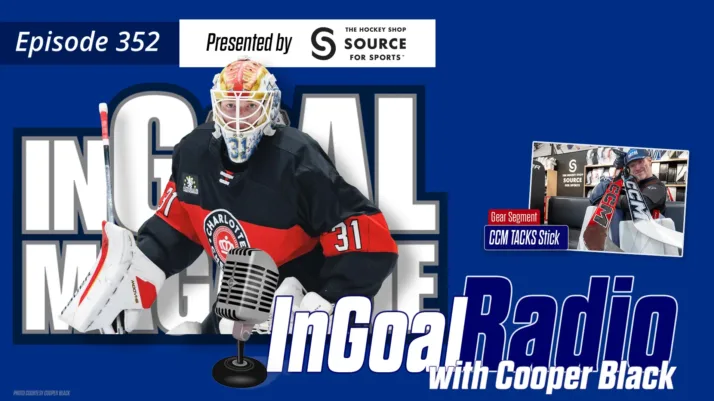
Episode 352: Florida Panthers prospect Cooper Black

Please subscribe and leave a rating — it helps us reach more goalies!


Florida Panthers prospect Cooper Black, the biggest goalie in pro hockey at 6-foot-9, discusses his unusual path from Michigan high school hockey to signing a pro contract, including being cut multiple times along the way. He received a cold call from Hall of Fame goalie Roberto Luongo during the recruiting process and has had to manage custom equipment challenges, including size 16 feet — four sizes larger than the biggest blade and holder any company manufactures.
- Cooper Black, at 6-foot-9, faces unique equipment challenges including size 16 feet that are four sizes bigger than the largest blade and holder any manufacturer produces.
- Roberto Luongo personally cold-called Black during the recruiting process, an unusual direct outreach from a Hall of Fame goaltender.
- Black was cut multiple times before signing a pro contract, making his path to the Florida Panthers organization an unconventional one.
- Black describes managing what he calls 'psychopath' aggression — learning to rein in his instinct to dominate given his exceptional size.
- Jet Greaves of the Columbus Blue Jackets provides Pro Reads tips on handling scans, screens, and scramble situations.
Episode 352 of the InGoal Radio Podcast, presented by The Hockey Shop Source for Sports, features a fantastic interview with 6-foot-9 Florida Panthers prospect Cooper Black.
Feature Interview
presented by NHL Sense Arena
In the feature interview presented by NHL Sense Arena, Black shares his unique path from playing high school hockey in Michigan to signed pro, including lessons from being cut several times along the way. He talks about the recruiting process, including a cold call from Hall of Fame goalie Roberto Luongo, reigning in "psychopath" aggression for his size, his in-game mantras, several exceptional tactical and technical tips, and the unique equipment challenges that come with being the biggest goalie in pro hockey, including the challenge of having size 16 feet — four sizes bigger than the largest blade and holder any company makes. In the Parent Playbook, presented by Stop it Goaltending U the App, we share lessons and advice for any goalie and parent going through the recent draft process at the junior levels.
Parent Segment
presented by Stop It Goaltending U
In the Parent Segment, presented by Stop it Goaltending U the App, we share lessons and advice for any goalie and parent going through the recent draft process at the junior levels.
Pro Reads
presented by Vizual EdgeWe also review this week’s Pro Reads, presented by Vizual Edge, featuring Jet Greaves of the Columbus Blue Jackets and Team Canada with great tips on scans, screens and scrambles.
Weekly Gear Segment
presented by The Hockey Shop Source for SportsAnd in our weekly gear segment, we head to The Hockey Shop Source for Sports, for a look at the new CCM Tacks stick, with durability reinforcements and the best blade feel of any composite.
Episode Transcript
Intro
Thanks to our sponsor, The Hockey Shop Source for Sports Langley, thehockeyshop.com. This is InGoal Radio, the podcast. We got a great one coming your way today. Our Gear Segment is fantastic, dealing back into the CCM Tacks line, Vizual Edge ProReads with a Team Canada member of the World Junior World Hockey Championship. World Junior.
That's a different story. Jet Greaves coming up. It's Daren Millard along with the cofounders of InGoal Magazine, David Hutchison and Kevin Woodley. What's happening, fellas?
That's a good question.
Yeah. Anything going on?
The Stanley Cup playoffs, although we're we're no longer as directly involved in those as you are, Daren. So but, you know From afar. You know, it's anytime you you you know, I know you as a practice goalie are out there grinding away, but if ever the team needs confidence, me and Hutch are happy to step in and, you know, boost the guy's morale.
Does that that make Daren a black ace?
No. I'm I I don't have anything to do with it anymore. Like, that I'm I'm fully with between the American Hockey League and the three goaltenders that the Golden Knights have on their team, I'm I'm I'm so far away. As as Berkey says, he slipped to number nine. He slipped to number nine.
Tumbling down the death chart.
Is Henderson out there? Is that is that why you've got the American League guys in town too?
Henderson is still going, but they're they're around. They play they face elimination actually as we record. They face elimination tonight in a best of five series. They're down two one, but Carl Lindbom from fantastic there. Akira Schmid is the third goaltender with the Vegas gold knights, right now behind.
Of course, Carter Hart, doing a great job and, Adin Hill. So, there's there's there's no lack of goaltenders around the Las Vegas Valley.
Why do minor league teams play such short series? I mean, around here, a junior b team goes four out of seven in the first round. Our feature guest this week, Cooper Black, his Charlotte checkers were eliminated in a three game series. Now you're just talking about a five game series. What's going on?
They they have more teams make the playoffs for one. So they have five rounds of playoffs, in the American Hockey League. So you go best of three, best of five, and then I believe seven seven seven.
That's the first two are It's a lot. Shorter series. Yeah. It's a it's a lot, and I mean And travel
if because the Pacific division, let's just look at the and the American Hockey League, not to get too deep into the weeds here, but but travel is it's it's not a bus division. You gotta you gotta fly, and you fly in commercial, and it's expensive. And so they try to keep the the cost down. So the best of three in the first round, because there was a certain distance between San Jose and Vegas, all three games were played in the higher seed building. Wow. So Henderson got
I actually I actually believe in the the first round, if I'm not mistaken, that actually it like, that is across the board for the best of three. Home team gets all home team gets all three games. So you you grind to get in one of these low seated spots thinking you got a shot, and you gotta go in two or three on the road, which I mean, hey. Like, there has to be it sucks that it's a three game series as Cooper talks about in the interview a little bit, but there is an advantage if you're the higher seat. You're at least hosting your all three of those games.
So, and at the end of the day, as Daren said, with all those rounds, like, I covered the Calder Cup final for the Abbotsford Canucks last year. And by the time it ends, we're well into June just like the NHL. So it is a it is a absolute absolute grind.
My son's team is heading into the BCHL final where they will face sixteen hour bus trips, and the series will be the traditional two two one one one. That's insane.
And I know that's going on because I was talking to Alex Auld whose son was playing on the team that lost to your opponent in the semifinals. And he's like, they literally like, the off day between the one one one is spent entirely on a bus.
On a bus.
Yeah. It's bananas. Oh, and
they can't do three years. Apparently, the higher seated team gets to choose whether it's two two one one one or two three two.
And Prince George, of course, is used to the travel because they have to do so much of it during the regular season. So it's an advantage, but it's it borders on cruelty, to be honest with you. Like, if there were labor laws surrounding junior a hockey, it would violate so many from a work safe perspective.
Well, it beats the thirty hour bus trip in the Western League. So
Yeah. There you go. Anyways, hey. Listen, folks. We're burying the lead here.
We are. The lead is our featured guest, David Hutchison's former billet, Cooper Black, the tallest goaltender in hockey, six foot nine, pro hockey at least. I've listened to this interview. It's a long one. It is incredible, loaded, packed full of great stuff.
You're gonna get to know this young man, and I think you're gonna like Hutch is gonna be a fan of him by the time you're done. So I wanna make sure we get that in there early, Daren. I apologize for sort of stepping on the toes of your bus driving here. But, yeah, we'd we'd mentioned his name a couple of times. I gotta say, like, folks, stick through our meandering here because there's a payoff at the end of this interview with Cooper Black.
It's great.
So think about that. The goal is four feet high. And he's six foot nine.
What do you mean it's only four feet high? Sure feels a lot taller. Doesn't it?
Good lord.
Doesn't it?
I'm shrinking.
But but but just in your mind, do do the the the graph there. Four feet high and he's six foot nine.
Yep. Pretty much waist at the crossbar.
And he talks about that glove position all like, there's so many unique elements to this conversation and yet also so many things that reiterate some of the lessons we've heard before. Like, they some of the things apply the same as six foot nine that as they do at six foot, and many do not, including the gear. So it's just, like I said, had to get the extra tease in there ahead of it. It is a fantastic interview.
How would the stance be different for Cooper compared to somebody who's five eleven?
Well, we get we get into it in the interview, but but the easiest example is just where you hold your glove. If you imagine, well if you imagine puck perspective, you get your head down to the puck on the ice and look at what the puck is seeing and where coaches Cooper's entire life asked him to hold his glove where most of us hold it, he's literally covering the glass, not the net. And, he on his own, it, created a sort of his own stance, which is it looks more conventional today. If you went and watched him play in Charlotte, you would see a more conventional stance. But when he played locally here, he pretty much held both hands at his knees and it looked kind of goofy.
But if he went puck perspective, it covered the net perfectly.
Old school Connor Hellebuck in his early days.
Yeah. I like those days. I like that glove down there. That an Old school traditional
His his NHL goalie coach did not.
No. No. I I understand that part too. He worked on that. But when when you get those those hockey card that pop up in your social media feed and you see the the glove down there, name that goaltender. It's always always kinda cool to to do that. Of course, most of them are from the fiberglass mask date. So we'll we'll get to to Cooper Black in just a little bit. I wanna talk about, what's happening over at the hockey shop.
Gear
Source for Sports Langley, thehockeyshop.com before we get into our gear segment.
Well, like, we've we've talked about for several weeks now, and it continues. Just new gear arriving on the daily. Cam sent me a list of stuff we have to talk about over the next month. We're gonna head over there and start filming some more ones. There's new second price point gear from Brian's.
We've talked about all the new stuff coming in from CCM. We've got a launch coming up on May 22 for the new Bauer Fuse line. And, of course, the Hockey Shop Source for Sports being as big an outlet as they are and with the relationships they have, they've actually got the Bauer team in that weekend over the May 22 weekend. Make sure you check out all the Hockey Shop socials for your chance to win an exclusive first night early sneak peek. And then if you're on hand for the following day, they're basically taking over a good chunk of the hockey shop so that you can so that you can try the gear with their people on hand.
You know, get fitted. They're calling it a Bauer Fit Day. And so it's an it's an incredible opportunity, and it's something that I think if you're if you're whether it's the Bauer line or or any of the other new gear coming, now is the time to check them out. Make sure you check out all their socials or check them out at the hockeyshop.com. Not just for that, but as we've talked about with all this new CCM gear we're reviewing, the new stuff coming in means the old stuff is on sale.
So great deals, all the newest, all the latest, all the greatest, and on May, a chance to get fit by the guys that actually are the team behind Bauer's new line.
Even if you wear a different manufacturer's gear, like, go check that out just to see what's different, what's unique, what you might be able to put into your setup with with your gear. I love being able to try out different manufacturers. There is no luxury.
Yeah. Know. And and and there'll be some other events like this this summer. There is no Tendi Fest this year, which was the great chance to go try it all on on the same day. That's on hiatus for one year, but a chance for the Bauer line at least on May 22.
Make sure you check it out. And speaking of new gear, we have been checking out the new CCM Tacks stick, and we have feedback from pros including Ann-Renée Desbiens, Stuart Skinner, Jet Greaves. Like, this twig, there's a lot of times where, you know, it's the carbon fiber, it's it yeah. It's it's lighter. It's more durable.
They'll add layers. They've done that here for sure, but there isn't, like, a necessarily a a feel that's different. Their stiff, soft blade on this, which is stiff at the toe, soft, and we'll let Cam explain a little more, notably different amongst all the goaltenders that have tested it for us so far. Like, they noticed the difference in terms of feel pucks off the blade of the stick. So that's a that's a big one.
Let's let's Cam. Let let Cam, explain the rest to
It's that time of year, Cam. Yes. Oh, another one that's kind of floating on me. Oh. Really light stick. Something new. This way comes.
CCM Tacks Pro. What do you got there?
I got a Tacks Pro.
What are the differences?
Well, it says Tacks on it.
Beyond the name. You're gonna see the name on the back. Right? Little tax?
I mean, great some great great
graphic They pop.
Yeah. The grip. Oh,
it's nice.
It's continuing the trend of the season with
Good graphics. Yes. Okay. What about good performance, Cam? Oh.
What can you
tell overall stick replacing that Axis XF stick. Okay. Overall, feel wise, very, very similar. I mean, wasn't a whole lot that they needed to really redo. It was a great stick.
It was a great stick, but in adding some of that vision kind
of Technology?
Feel wise, that's correct. So first overall, like initial impressions when you go to go pick up that stick, the balance is Yeah. Quite That that that'd be one to to kinda take home. It's like weight's one thing, but balance is another for sure. Stiffer stick.
I'm trying to look how close it is to the handle where the balance point is. That's what you want. You want them close to the balance point. Like I'm a I'm a magician.
Almost tacked that to my head right there. So I maybe maybe accidentally showed off something
sneaky there.
And you did. We'll get to that in a second. That rounded style shaft. So let's start off with that.
Yeah. Shape new shape geometry on the shaft that we saw, it's this continues because, again, less breakage.
That's the hope. Always the hope. In our experience. Great overall feel when it comes to even again popping that glove on. A little bit chunkier, but it's still tapered at the back. Right.
Again It's like the shape of your hand. It's like yeah. It's almost like
the shape of your hand.
That's right. Almost like someone thought about that.
I know. It may have been there as they thought about it.
So grip right where you actually grasp the stick in particular and that will be stock off the wall in that overall feel wise. Anything else you can tell me? It says Tacks on it. What else? Stock curve is gonna be your p four, but you also have p one available too as well with your heel base curve.
And custom is where we're gonna start to see.
Well, we're gonna before we get to custom, you missed a point. Oh, And it's go one that has jumped out in our testers.
You were itching to say it, so I thought I would let you have it. Sure.
Do you know what it is then?
Go for it. He doesn't know what it is. Do I? They've changed some of the blend in the the blade.
Yes to what?
I can't give you the specifics, but I can tell you what it was designed to do because I didn't know it was designed to do it till we'd already felt it do it, which is always good when your testers say, hey. It feels like this, and then you check-in with CCM and they're like, we've changed that so it's designed to feel like this. Softer is the wrong word because it's still great. We've had junior goalies out picking off rims off the wall and you don't want too much flex. I don't want to say it's like a foam core feel.
There's just way more feel off the blade of the stick. It's noticeable. If you've used it, it's noticeable.
Define that feel as not
just super stupid rigid which, like, again, when you go to a carbon stick, we've just gotten used to a really rigid, almost like no feel to it. It just I don't know. It softer is the wrong word, but it feels softer.
So you can get more control out of the Yes. Way use
That's the word we It just feels like the puck is not just hitting it. It feels like it's sort of absorbing it a little bit. Does that make any sense?
Well, hopefully it does.
It's kind of the feedback we've got and now we can talk about the custom which I've been kind of hiding. You can get a trigger grip. Ours came with a trigger grip. We got two of them, so we've already got one out in play. Haven't taped this one up.
We're saving it to do this segment with cam but really like this, whether you wanna grip it down here, here, or just there, a nice option that you can do in a custom order. That's Like I said, super attractive stick.
That rounded shoulder is stock.
Yeah. That's sort of not quite the full bob, but sort of partial bob.
Yeah. Definitely not a full bob.
We've seen But steep steep shoulders, especially on the inside that goalies really like to be able to get their hand down on.
Correct. So great overall feel. Again, available to order custom.
Where do get you if they want to order custom?
(604) 589-8299 or 1-800-567-7790. What are the minimums on a custom order? You get a minimum of two this year.
That's not bad. So if you're looking to try, you like this stick, you know, and there are a lot of features to love about it, and you're looking to try a trigger grip, you don't need to order a pack of six, you only or a pack of three, you only need to order two to give it a shot. I you know, like I said, I I never had a trigger grip. Obviously, see guys in the NHL with it. Hadn't tried it myself.
Just hadn't bothered. Do love it. Do love it. Might not go back.
K. Go through the blade again.
Stiff toe, softer in towards the heel of the blade, so a little more feel, but without sacrificing the durability and the ability to sort of stick that toe into the boards and stop a hard rim. So it's it's something that existed on their player sticks before. And Desbiens told me, like, the vibrations at the pro level where you're stopping hundreds of shots a day, like, she notices less wear and tear, she believes, on her arm. Like, she just it doesn't hurt it doesn't feel it She definitely notices how much softer it is. I feel like pucks come off it when you're trying to control the rebound.
Like, he still steer it off the toe and ratchet it up and out of play, but there's there's definitely more feel to it off that sort of heel to the midpoint of the curve on the blade. And, course, they've got the AluPly aluminum strips in the shaft, the new shaft geometry to reduce breakage. They've got carbon rib in the paddle. Again, little more stiffness, rigidity from a durability standpoint. So lots of new tech in there, like as most goalie sticks have each new year, they bring out new things, but them bringing this field component over from the player side into the blade.
It's funny because I had one goalie tell me, it's it's kinda like foam core. And then I asked another goalie like, hey. Does it kinda feel like a foam core stick? And they're like, what's a foam core stick? So, they're young kids that'll be like, what's this whole feel thing?
What is I don't I'm not I I didn't know you could feel the puck, and, it's different for sure, but it's in a positive way.
I think that the vibration impact on goaltenders over the course of a season is one of the more under talked about impacts on a goaltender's health or or feeling with with with the hand and the arm just being pounded all the time. And that's why guys wear that that spongy taper around the the the top of the paddle just to reduce that a little bit. So any anything that that takes that away shot after shot after shot after practice, is a real benefit to the to the hand, to the wrist, to the forearm, to the elbow. It's big time.
Yep. Agree completely.
Awesome stuff. By the way, the Tacks line. I went through the customizer twice last week, and I just I can't stop doing it.
And what'd you come up with?
I've got two two setups. I just because you guys love going through because Hutch, you your your family loves the customizer as a as a family. And I've got a theme with the I call them the the Spider Man eyes with with the red right in the middle, and then I I I do one goldish on the outline and one black with some gold. But it's really cool to be able to go through the customizer on the on the Tacks.
I think that somebody needs to do the full Spider Man theme with that because it when you do it, when you set it up a certain way, it's evident and then have the mask. Yes. Mask painted to match for sure.
Be really cool with those. It just the the way it's it's there waiting for you if you take advantage of it. Let's just put it that way with the with the Spider Man eyes. Vizual Edge brings us our ProReads. This week, chatting with Jet Graves.
What's happening with Visual Edge?
Well, the ProReads is chatting with Jet Graves, but I think, like, the the best testimonial for Vizual Edge probably comes in our feature interview, and that is Cooper Black talking about the difference that Vizual Edge made in in just sort of the way his eyes function and how he sorta used it and then went back to an old rudimentary test that that we used to use in in hockey and in sort of eye skill and and everything performed better. And that's that's what it's all about. Like, Vizual Edge is all about testing your different skills visually, convergence, divergence, depth perception, different sort of aspects of sports vision. It identifies weaknesses and then it comes up with a program to fix it. And we've had a lot of pros over the years talk about using it and talk about seeing the benefits and you'll hear Cooper Black talk about it in this interview.
It really is, we've all had those nights where we feel great, everything's good and then those nights where we don't and we think, oh, we're just off. Well, Vizual Edge believes that that's not technique. It's your eyes and your brain not processing the play fast enough and they fix it. And so Cooper is a great example of somebody who feels like it's been fixed. Fifteen minutes, three sessions a week on your laptop or tablet.
It's what NHL goalies or in this case, NHL contracted goal is used to make the game slow down when it matters most. And remember folks, if you're not an InGoal member, that's fine. We'll still save you 10%. Use the discount code InGoal, I n g o a l, all caps. But if you are a member of InGoal, you can go to any ProReads and get a discount code that will give you double that amount off.
Perfect time to do it. We're into May. We're into the off season. Go download Vizual Edge. Subscribe to Vizual Edge.
Test your eyes. Get your eyes fixed by the time the puck drops on next season. Cooper uses it. I've talked about my daughter playing college volleyball using it. It identified a weakness in-depth perception.
She's seen her results improve both on the Vizual Edge testing and on the court. So this this stuff really works. And and like I said, make sure you listen to the interview because there's a great testimonial for it contained organically within.
Will it help with nearsighted, farsighted?
No. You know what I find it really doesn't help with for me? Closing my eyes. So evidently, you close your eyes when the puck is shot, Vizual Edge can't do that. Like it, you know, it does not come with toothpicks to prop them open so that you actually watch the puck.
Evidently, that's my biggest problem.
I I told you that Steve Valiquette story when he was on 100% hockey, maybe two months ago. He said, every goaltender, like, flinches to a certain extent. Some some's more obvious, but but, like, guys flinch. It's it's it's not it's not like the old days where they stood up and pulled up, but the eyes the eyes flinch. And he noticed that back when when he played and he went to Home Depot and bought a two by four and a hammer and nails and practiced hammering the nails into the two by four without clinching or closing his eyes.
That's that sounds like Steve Valiquette. I love that.
Isn't isn't that isn't that wild? But he said, like, even today, if if you had the close-up of the of the goaltenders mask and a guy let loose a shot or whatever, you you would see some kind of reaction. And the the best idea or best course of action is try to minimize as much as as as you possibly can.
And then So even today, guys do The difference would be back then you needed to come up with unique ways and now we have programs like Vizual Edge Yes. That can can help sort of develop it.
But somebody's running to Home Depot this afternoon after listening to this.
Well, I mean and then, you know, I mean, I wish I'd done that as a kid, not that I played goal as a kid. But but then I'd actually be maybe if I maybe it wouldn't have helped me as a goaltender. It might have improved my flinch mechanism and closing my eyes, but it also would have meant that my family allows me to use tools. Because right now, I'm pretty much Probably
would have helped your hitting, though, Woody.
Well, power tools are strictly off limits for you.
Yeah. They're forbidden.
We can give you a hammer.
Yeah. Chances are I'll hit something that I'm not supposed to.
So I I when Valiquette told me that story, I I went out to the garage and did it. And and he's right. You're like, you you hit a nail like that, your eyes your eyes blink. So I did it a few times just to see, can I do it without making the the the face flinch, so to speak? It it wasn't like Paul Mater back in the day standing up and and doing the the the full flinch on a slap shot.
Sorry, Mike. But there there is a reaction. And if you can minimize it, it makes your game a little bit better. So there's just a little
Daren's just bragging that he actually has wood and nails and a hammer in his garage because he's a real rough and tumble everyday handyman.
I have a great I have one of those, not toolboxes, one of those tool stands, like, on wheels and everything. I love it. Like, full compartment with drawers and everything. I get it's it may I still pile it up in the dining room table. Like, if if I'm doing a project, the the stuff stays in the house.
But I I have a great pretty good setup in the garage.
I have a
tool box bike tools? Is it all bike tools, Daren? Let's be honest.
Allen keys?
Allen keys, derailleurs.
Yeah.
You name
I have been pretty good when the chain pops off, when I'm doing something, of getting the chain back on while I'm still riding.
That's a skill.
Yeah. I wouldn't necessarily think it's a good thing for me though.
Anybody listening, that skill doesn't involve putting your hands into the chain. Let's just be clear if anybody's listening, think
about involves looking down and then all of a sudden, I'm going towards the shoulder.
Hey. There's there's no chains on the Peloton. I'm safe, boys.
No. You're you're solid. If you're falling off that thing, we're in trouble. Although,
we do also have a treadmill in the house that my wife uses. And I thought because she's, like, try I'm trying to walk more and the weather wasn't great. And she's like, well, you can use the treadmill, but I really think you should put the harness on if you're gonna use it. And she wasn't kidding.
Oh, ye of little faith.
But there's there's a difference between having little faith and just being plain old responsible.
Yeah. No. She just knows And looking out for somebody. Yeah. She knows me.
She knows me.
Parent Playbook
Yeah. Stop It Goaltending U, the app, presents our parents segment. We got junior hockey drafts that have taken place, and we're in that season right now. Before we get to that, a word about Stop It Goaltending U.
Well, we're into the off season, and so it's a great time of year to look for more voices, more ideas. Well, how about getting twenty five years of NHL goalie experience at your fingertips on your phone or tablet? How about tapping into the parenting expertise that helped Joey Daccord reach the NHL and excel? That's what you get with a subscription to Stop It Goaltending U, the app. All the knowledge from Brian Daccord, who's been an NHL goalie coach, scout, and director, as well as all the insights and expertise from his staff at Stop It, which includes a long list of veteran NCAA coaches and in the summers, former pros.
All delivered in easy to digest chunks, including five short daily primers, weekly style analysis, and breakdown videos, as well as drills that you can take onto the ice with your team and your coach this summer. Plus, you get a subscription to InGoal Magazine included. The best of both worlds. Check it out now at the App Store or Google Play and get a subscription to Stop It Goaltending U, the app, and InGoal Magazine all bundled together.
Hutch.
Yeah. Guys, draft day. The, WHL held their draft recently, and I think the USHL as well. And if you are a goalie family whose young goalie was eligible for either of those drafts, this week probably felt like one of two things, either a celebration or a quiet ache that's, hard to put words to, and I wanna talk to both those families today. As a corollary, the families who might be looking forward to other drafts around North America as their kids head into junior hockey.
If your kid was drafted, congratulations. Honestly, it's just take a minute, let it land, enjoy it. But I want to share something from experience and I share it with as much of a smile as I can. There is no moment in minor hockey where you will feel more valued as a parent and as a goalie than draft weekend if you're lucky enough to hear your name called. Those calls come in.
You get welcomed. They give you the best seats at one of the games. Nobody treats you better. Enjoy every second of it because you've all earned it. Just know that the team's interest in mom and dad tends to drop pretty close to zero by the following season.
And look, that's fine because at that point, it's about your kid and the work they have to do, not the family experience of draft weekend. This is the beginning. It's not the destination. It's just the beginning. The draft is an invite to compete for a roster spot to prove yourself in a new environment against better players.
That is a gift, but it's not a guarantee of anything. The families who handle this best treat draft day as exactly that. One day, then back to work. Enjoy it. Celebrate it.
Then back to work. Now, if your kid wasn't drafted, I want you to sit with this for a second. Josh Ravensbergen wasn't picked in the twenty twenty one WHL Bantam draft, not by any of the 24 teams that took a goalie that day, including our son act actually, when he was picked in that draft. Josh went back to his local program. He skated harder.
The goalie coach vouched for him with Prince George and he got a tryout and he made the most of it. Then last June, the San Jose sharks took him thirtieth overall at the NHL draft. The same system that passed on him produced a first round pick. But here's what I want to say carefully because Josh's story, an incredible one but it's also a very specific one. Not every kid who gets passed over gets that call.
What I've seen over a long time watching this game is that the path you imagined, the one that ran through the draft through this particular league, it's only one path. And when that particular door doesn't open, it can feel like a wall, but it isn't. There are kids who didn't get a WHL or USHL look who found their game in the BCHL, the NHL, kids who went the college route and played four of the best years of their life.
Not every kid gets the camp invite. That's real and it's okay to acknowledge that. What I've seen over a long time watching this game is that the path you imagined, the one that ran through the draft through this particular league, it's only one path. And when that particular door doesn't open, it can feel like a wall, but it isn't. There are kids who didn't get a WHL or USHL look who found their game in the BCHL, the AJHL, kids who went the college route and played four of the best years of their life.
Kids who walked on somewhere, earned ice time nobody handed them, and ended up places they never would have predicted at 16. Kids who took a different path entirely and found that hockey became something they loved again once the pressure of the next level wasn't the only thing defining it. None of those are consolation prizes. They're just different doors. And sometimes, the one that opens is better than the one you were waiting for.
Your job as a parent doesn't actually change based on what happened this week. Keep them working. Keep it fun. Keep the process the focus, not the outcomes. And if your kid is sitting with some hurt right now, let them feel it.
That part is real. Then remind them that this moment is not a verdict. It's not a ceiling. It's just where the path bends. Every path is different.
Keep going. Good luck, everyone.
Well said. That was motivational.
I hope so. I hope so. And, you know, there are so many other moments beyond the draft where, kids bump into walls, where things don't go as expected. And, and I as I have been saying for many, many years, pretty much no matter what happens, the only thing you can do is get back at it and keep working hard.
There's so much pressure around these things, like, especially getting to these hockey academies and, like, the kids are all talking and, man, just the amount of extra pressure that gets like, beyond what the parents experience. Some of the stories I've heard I have friends that teach in some of those schools that are associated with that, and, like like, school stops for that day for some of those kids, and they're all around it. And if you're the kid that, you know, it's it's like it's like the most extreme version of being the last kid picked, you know, in in a PE class or something. Just to the extreme, the amount of pressure. And I've I've had these stories shared with me, and it's bullying's too strong a term, but, man, if it borders on cruelty.
And and that can be a tough thing to sit with and sort of knowing how many others have gone through that and come out the other side and had careers that nobody would have forecast in that moment is a nice reminder that it is just one small step of the journey, and it doesn't matter. There are kids that will be picked very high that do nothing with it, and there are kids that won't be picked at all that do everything. Maybe even use that as a motivation. So not easy to sit with, but, hopefully, that reflection allows people to sort of realize that, it is just one step.
But the system is what it is. Right? Like, there's no better way to to do it for the organizations.
No. And I I don't think, Kevin, I've heard some of those stories as well, and I I don't think he's pointing that at the Western Hockey League or the USHL or wherever. It's you put a group of 15 kids in a room and nine of them are getting drafted and six of them are not, that's really, really tough. No matter what those kids say to each other, it's gonna be extra disappointing. And then I hate to say it, but after getting drafted and getting to your junior team, the pressure just ratchets up even more.
But that is the system and, it would be nice if it would be nice if it was better. I'm just gonna say that for now.
Well, I mean, one of these days, we'll have to have somebody over like, to your point, Daren, the way it's structured now, like and I I was not critiquing the system in any way, shape, or form. It's more like kids are gonna be kids. Like, there's
Mhmm.
There's an element of and some are gonna be supportive to to Hutch's point. There's gonna be environments where those kids that don't get picked feel totally supported and pats on the back. But, you know, for every one of those, they're or maybe it's every 10 of those, there's one where it's not supportive, where where it can be really difficult. So, but I I'd be curious to see what the different you know, like in Europe where it's club systems all the way up, right, where you're sort of under that umbrella and you're not worried about getting drafted and, you know, like
But then you don't have the freedom. Like, there's
Yeah. Okay. The the the the the free the freedom freedom to get yanked out of your home at the age of 15 and go live in another place and basically have no power over anything. So I like, there's there's pluses and minuses on both sides of it. It would just be interest I'm not saying one is right and one is wrong.
It would be very interesting, however, to sort of have a look at the some of the comparisons and how it how it affects some of the kids differently.
I'm just playing devil's advocate to you because I I certainly would not have been favor of my children going away at 16.
Well, some days I'd like them to leave.
15, 14.
Some days they try.
Yes. Please, could you just leave? Quality parenting for Woody?
Yeah. We should do our parent segment following Hutch's parent segment
Be the polar opposite.
Different they are.
One of these things is not like the other.
You can choose to listen to good and Woody's parent segment or Hutch's parent segment. I wonder what our downloads would be compared to to Hutch.
We're the we we're like that. We always talk about my goal attending being like a how not to video. Me and Daren would be the how not to. Exactly.
Or the day I finally stopped spinning everything positively.
The dark side. Welcome to episode 451 where the InGoal parent segment is gonna be the dark side of Hutch.
It probably won't take another 100 episodes, Kevin.
Our parent segment would be, don't listen to us. Let's get into the parent segment. Don't listen to us with with Woody and Millard. Alright. The the NHL Sense Arena feature interview is fantastic this week.
Cooper Black standing by. Hutch did a a just a wonderful interview conversation, catch up discussion. This is not necessarily an interview. It's it is just a a a full, beautiful, wonderful, discussion, brought to us by NHL Sense Arena.
NHL Sense Arena. And last week, we told you that, May is goalie month, and our friends at NHL Sense Arena are going all in celebrating the position that we love around here. And look, being a goalie is the best job at Hockey in hockey, and NHL Sense Arena gets it. So they built a platform for goalies with so many features. It really is mind blowing.
We know about the training plans with NHL and pro coaches, the goalie advancement program, drills, mental training with Pete Fry, neurocognitive training, real NHL shooters, the list goes on and on. And all this month, they are also going to roll out the red carpet for those of us playing goal. They're loading up with dozens of prizes, weekly giveaways including jerseys, NHL Sense Arena subscriptions, special goalie content, interviews, behind the scenes videos, and a few surprises they're not even tipping their hand on yet. This week, it was a Connor Hellebuyck hoodie and a USA Hockey gold T shirt celebrating celebrating his partnership with USA Hockey. The grand prize is a custom painted goalie mask designed by former NHL and longtime pro and friend of the show, Kasimir Kaskisuo.
There's gonna be one mask for one winner painted by a guy who has lived in the crease. And they are also asking all of us to get involved. Share your story with them. Maybe Kevin will share his story. Send your short one to two minute selfie sharing your goalie journey to goalie@sensearena.com.
Share it with them something about why you play goal. What's your best goalie story? What's your favorite part about playing? Some of you will see your story shared on Sense Arena social to over a 100,000 people. All the details are on their socials, so check it out.
Get your headset on. Keep stopping pucks. May is your month.
Feature Interview - Cooper Black
Well, now, normally, I would go to Kevin Woodley, to set up the feature interview. But let's flip it right back to you, Hutch. And, what are we looking for in this conversation with Cooper?
Well, Cooper is a member of our family ever since he, billeted with us about five years ago, and we have stayed in close touch. He and Matthew are still very good friends and had many a great conversation about goaltending over the years as you can imagine. He is a very well thought and well spoken young man. I have wanted to get him on the show for a very long time, but we wanted to sort of let him get settled in his role in the American Hockey League. As you will hear and hear today, Florida brought him on very carefully, very deliberately.
And, now that he's ensconced himself in the role of a starter, I thought it was time to to have a conversation with him. He thinks the position, as I said, very well and, and I just wanted to be able to share some of those thoughts. And as we often find with young up and coming goaltenders, they're very willing to share a lot of their thoughts, a lot of their experiences. They haven't had that time that many of the NHL guys are to become a little bit more guarded with the media. And and, of course, Cooper knows that, I've got his back.
So he was more than happy to dig into a lot of things.
Enjoy. Cooper Black on InGoal Radio, the podcast with our NHL Sense Arena feature interview.
It is my great pleasure today to welcome Cooper Black to the podcast. Cooper is a goaltender for the, Charlotte Checkers in the American Hockey League in the Florida Panther system. More importantly, he is like family to us. Cooper billeted with us way back when when he played in Junior for the Nanaimo Clippers of the BCHL, and we have stayed close ever since. And I've been looking forward, Cooper, to welcoming you to the show for a long time.
Well, thanks for having me. I've been I've been waiting for it. I've been I've been excited to to get the opportunity to come on here and get to chop it up with my my billet Dad, the biggest podcast there is for goaltenders.
Right on. I've always enjoyed our conversations, and you think the game at such an interesting level and very well thought and just looking forward to bringing your story to, to all of our listeners. Anybody who's followed Cooper, heard us speak about him in the past on the show, will know that he is probably almost certainly the tallest goaltender in professional hockey right now at six foot nine inches. We will come back to the height, how that affects his game, affects him as a person a little bit later. Let's just start where we do with most people, Cooper, and tell us, how did you get your start in goal?
Yeah. I mean, my my parents moved up to Northern Michigan when I was really young. I lived in I I was born in Detroit area. Lived there till I was three years old or or whatever. And and we ended up moving up to to Northern Michigan, a little little town called Alpena. 10,000 people, I think 30,000 in the entire county, even though I know you guys don't have those in in in the great country of Canada. We have similar stuff.
We have similar stuff.
Similar. Close to whatever. But, yeah. So they moved up here, and my my dad grew up playing football and and a bunch of other sports. He was born in, Southern Ohio.
[crosstalk] And so he he got up here and kinda started to get into hockey himself because you're living in Northern Michigan. It's you're not in Canada, but it's it's honorary Canada, maybe. I don't know if we'll Pretty darn Pretty darn close. Maybe maybe dual citizen almost. But so we ended up moving up here.
He played those sports, was in the sports, and kinda was like, okay. Well, if I'm gonna play hockey, you gotta get my kid into it. So I started playing skating when I was, like, three years old or something something along those lines. Then I kinda took a little bit of break there with because of, the the way the gear felt and then came back to it and never looked back. So I've kinda played youth hockey here for most of my life, had a interesting, path, I'd say, to to pro and stuff like that.
I don't think most people played high school hockey unless it's from Minnesota.
Minnesota, they certainly do. Yeah.
Yeah. Yeah. So I played, I played at your house when I was a squirt. I think that what is that for you guys? Atom or something like that?
No. It's like it's 10 years old or whatever. Oh. So I was, like, 10 years old. Yeah.
And so I, started playing I played goalie then. Got asked to do a tournament actually down at Bay City my last year of my right before squirts, and someone asked me, like, hey. We need a goalie. I was kinda like, alright. Yeah.
Like, sure. Whatever. Gave it a gave it a go and, absolutely loved it. Like I said, never looked back. I was pretty much the only goalie because town's so small for for my team growing up.
And I even in high school, I played one year of triple-A when I was 14, I believe. So my sophomore year of high school, I went down and played, a year of triple hockey for U15 Little Caesars and then, came back home because quite frankly, was just homesick just to put up one. Any any any kid that moves away at at 14 is That's young. Gonna have a
It's so young.
Yeah. So, and then what was it? Then I yeah. So I came back, played two years of high school hockey, didn't even didn't even train my between my junior and senior year, didn't train at all all summer. Like, there were summer skates, but no goalie coaches, no nothing.
I was literally working at McDonald's, so I was probably serving up some burgers and fries to to use. So but did So
you when did you have a goalie coach for the first time?
First time I ever had a goalie coach like, are we talking Extended.
Like, not inexperienced with, but
Like, when I played that one year of Little Caesars U15, we had a we had a guy named Rob Ladell, who I still work with, and he he came out and worked with our team. But even then, it was only limited kinda once a week, whatever. And then I I after that, I I literally didn't have a, like, goalie coach until my senior year of high school. We started working with the guy in it's another small town west of where I live called Gaylord, Michigan. His name is Taylor Carey, and I worked with him for for that season.
And then after that, I still worked with him, and then I kinda relinked up back with, Rob Loudell, and I also worked with AHL. So those those three guys were kind of the guys I picked up when I first graduated high school. But like I said, I literally had no goaltending coaches, like, at all, pretty much. I mean, here and there, but just like camps, you know, whatever, but not nothing consistent. And if you go look at clips of me in high school when I was 17 years old, you could you could tell.
So it's, you know, different path, like I said, than most, but at the end of the day, it ended up working out the way it was supposed to.
Everybody has a different path and and perhaps there are advantages to having not been so immersed in the sport when you were younger.
Yeah. No. For sure. Like like, I think that a lot of a lot of people just focus on only one sport now, only playing hockey or at least whenever I I see parents, I feel like they push their kids into one sport. It's like, dude, get them to go play baseball.
Get them to go play soccer. I mean, I've played I've played soccer up until my sophomore year of, high school. Like, so you know? And and I played other sports too. I played football.
I played, I played, oh my gosh, baseball. Like, I was all over the place. I played everything.
Great.
So you know? And I I feel like for kids, that's that's important to go do because no one's meant to play one sport year round. A, it's mentally fatiguing, and and, b, it's not like, you're not gonna enjoy the sport as much, and you're not gonna be as diversified athletically. Right? If you're going and doing different movements, other things, then when you go back to hockey, you're gonna have a little bit of edge on guys who are only playing hockey, only doing that movement.
In terms of the athleticism and the ability to sort of battle out there and and Yeah. Create them things.
Yeah. I mean, like, you don't wanna be too robotic. Yeah. If you're only if you're only robotic, then you're you're kinda hamstring yourself. And, obviously, I think, to some degree, if if you're only playing one sport, you're not you're not getting into those different positions and you know?
And and it's not even just that. It's like, you know, for for kids, it's you're gonna enjoy playing hockey more if you take a little bit of a break from it. It's not you're not meant to play a sport year round. That's why the that's why the pros, you know, all those guys who are making millions of dollars are only you know, whenever the season ends, they take a couple months off because it's too much. You can't do it all the time.
And then you you took a bit of a I don't wanna say a different path, but a long winding path through junior to NCAA to pro. Can you just give us a a a quick over of the different stops on the way before you landed on our doorstep?
Yeah. No. So after that last year of high school where I kinda brought up the whole McDonald's thing. Yeah. I I was gonna go to Michigan State.
Like, I was admitted into Michigan State to be a vet. Like, basically, they have a private I don't know. Like, a weird they have, like, an offshoot or something like that where you go in and, you apply and and you get in. They basically fast track you into being a vet. So I was I was dead set on doing it.
We're talking the profession vet, not like a hockey vet here. We're talking veteran vet. Yeah.
Yeah. Yeah. Like a yeah. So, like a like a veterinarian. Yes.
Yeah. Just to be clear. So I was I was dead set on going there. And then my senior year, like I said, I kinda had a a good year, and I was like, alright. Well, I mean, I love this sport, and I don't really wanna give it up.
And, you know, why not take a stab at trying to play juniors and and see if I could eventually play d one? Because because at the time, I mean, for me, even thinking I could get to d one was was kind of a stretch. I was just like, okay. Like, yeah, it's possible. But at the end of the day, it's it's you know, you played high school hockey.
There's not very many high school hockey guys that end up playing d one, let alone pro hockey. So I ended up going and trying out for a bunch of teams. Like, I tried out for, Brampton Beast, I think, in the, OJHL. I tried out for the Pembroke Lumber Kings. I tried out for the Muskegon Lumberjacks.
Tried out for the Chippewa Steel and the NHL, and I got cut from all those teams. Like, got cut, like, not some of them didn't even make the final final game.
Okay.
And then I went to went to Maryland Black Bears' camp. And I to fully transparent here. Like, by the team I was on was a wagon. They didn't do a good job. Like, you know, you know, I always get that one team in those camps that just Right.
Steamrolls.
Yeah. To so to be clear for everybody here, like, go to a camp, they split everybody up into teams because they play a lot of sort of intra squad games as part of these tryout camps. They try and make them even so everybody gets their fair share. And you're saying, maybe not.
Yeah. That wasn't even. Yeah. And I'm sure I mean, obviously, with with Mattie, I'm sure you've seen a thing or two, like, at those camps. So it's it's hard.
They they, you know, they don't see these kids hands. So Yeah. Whatever. It doesn't matter. I got a little off track there.
But, anyways, so I go to this camp, and I get scored on literally the first shot. I'm not even a minute in. And I'm sitting there. I'm thinking, dear god. Like, I can't like, this is how this is gonna go.
Didn't give up a goal the rest of the camp.
Right on.
I don't know how. I don't know what happened. I I had a good weekend. And then on top of that, the team was good, and we end up finishing and winning the tournament, whatever. Made the final game, have a good game.
End up making the the training camp roster. So I go in, and I'm the third guy going into the training camp. I don't even play we played a scrimmage against the New Jersey Hitmen. We had or not Hitmen. New Jersey I don't even know their team anymore.
Whatever. It doesn't matter. We play we we go in and play a game. I'm not slated to play either of those games. The other two goalies play at both the games.
The one guy doesn't do well. The other guy ends up playing solid. So I'm playing in a tournament the next weekend. I end up going and give up one goal. Then I go then then the next guy goes in.
The guy who started the first game struggled, struggles again, and I go in and have a shutout. So now I end up taking that guy's spot. They send him home when we get back, and that's how I end up making the team. But, like, I wasn't even slotted in to be on that roster at all. Kinda was a backup goal that whole year and, you know, and then COVID hit.
That was that COVID year. So, and then after that, I had a good enough year in the NAHL, as the backup to get drafted to Omaha where I went, and that was right after COVID. So I went into yeah. So in that so I actually played with Jacob Dobes. So he was the starter there.
I did
know that. So Dobes Dobes was a starter. I actually actually roomed with him too.
Oh, yeah.
Which is kinda funny. I know it's it's funny how that all works out. But our team that year, I don't know if you're familiar with the name Arsenii Sergeev at all. The, he he's with Calgary. He actually played his first NHL game this year too.
Oh, nice.
Yeah. But so yeah. So he was with the Wranglers. He it was him, me, Jacob Dobes, a kid named Chase Clark. I was the only one that wasn't drafted out of the four.
So our team was kinda, like, stacked for goalies. Anyways, I go in there. Again, I'm supposed to be the backup. And just to put it blunt, like, I I probably wasn't ready. I kinda got torched in practice.
Like, just being honest, I would go into practice. I'm it wasn't really great in practice. And then the first game, I I only ever played one game there. I gave up this is objectively. I gave up two goals on point shots with screens and stuff like that.
You know? Maybe I could have had one of them, but, like, they weren't horrible goals. Mhmm. Coach just yanks me and is, like, mother effing me on the bench, like, giving it to me. Basically, telling me to play like a big goalie.
That was in November. Don't see the ice again for, like, a month. And then he calls me in the office. And, I mean, not to I don't wanna well, yeah, whatever. Basically told me I'm I'm gonna be working a nine to five.
Like, I I hold that to my face.
I'm be
working a nine to five. Yeah. And so I'm like, I'm I'm like, what do I do now? And so I ended up going back to the Nahl. He traded me to Odessa, Texas where we ended up we had a we had a great group of guys, but just our team was not very good.
For whatever reason, we couldn't find a way to we'd find ways to lose. It was just one of those teams where, you know, whether it's me not making a save or someone missing an open net, like, we couldn't we couldn't score. So I went back to Odessa for the last half of that year, and I remember actually being in the car in, like, August because I'm thinking to myself, like, I don't I don't really wanna go back. I wanna try and go to the BCHL. And I get a call from Colin Birkas, who's the head coach of the Nanaimo Clippers, now, but he was the assistant coach then.
And, basically, it was like, hey. Like, are your thoughts on coming to Nanaimo? I was like, sign me Like, get me there. I wanna be there. So I end up going out there, and and had a good camp and met met a pretty awesome family that I got to live with for for a year.
And, and then that was that. I had a good good last year, two years with them, went into school.
Funny. I remember the first conversation we had. We connected on the phone. I remember the rink I was standing in. I can't remember what game was on as we were chatting.
And and I knew Cooper would be an interesting guy from that moment because normally, it's you meet a billet. Nice to meet you. You hear a little bit about their background story, but we immediately got into talking goaltending and stuck with it for quite a while. And we're we're gonna have a little fun together. So Yeah.
Well, I think I found out. I didn't even think I don't even know how I end up finding out that you were the InGoalmag guy. Like, maybe maybe you said something to me, but I I remember when when I found out that you're InGoalmag like, one of the InGoalmag founders, I I was like, no way. Like, there's like, someone's lying to me. I thought I was getting lied to, honestly.
Oh, that's funny.
Yeah. Obviously, come and find out that I'm I get to live with you guys and got some some pretty cool insight on things living with you guys too. You know? You get that awesome office setup and and all the Visual Edge or the the visual training stuff that you guys get, all the other things, the insights and stuff like that. I got some some interesting some interesting tea that was that was given out.
Yeah. Unfortunately, we couldn't get Cooper testing any gear for us because we don't order it in forty two plus two. We'll we'll get to your your gear in a little little while later. I yeah. I hear heard the I had the Beatles in my in the back of my head playing long and winding road as you were telling me all about your story and all the different camps and all the different teams. Oh, yeah. And I just think it's a great lesson for for kids of all ages because you kept playing the game because you loved it and eventually you found your path and and your place.
But just I I don't I don't wanna spend too much time on this because we we wanted to focus on the pro side of things, but just any thoughts on all those different camps you went to and would you do it differently if somebody said to you, should I take my kid to a junior camp? It's all it's all a scam. They're just trying to make some money is is the common complaint from parents. Do do you think those were valuable experiences even though you got cut umpteen times?
You know, I I think it's tough because I think there are valuable lessons to be to be learned from them. Obviously, it is expensive, and I understand that. And I'm sure you understand too to some degree that there's frustration involved. And, you know, depending on the team, some teams, quite frankly, might not even need the position that you are. Right?
Like, there's only so many goalie spots that you could fill. And if they've got two goalies already returning, what are you you know, it's gonna be tough to to beat one out. But, I think for me, the the biggest thing was just just going and, understanding that even if you fail, that there's still another opportunity down the road. You know what I mean? And to learn from that.
So, okay, I went into Brampton's camp. Remember my bill of dad, who I'm suiting my other bill of dad. I've got a 100 of them. Think So true. As I'm sure you're well aware of with how many different places I played, kinda was was actually at that camp with me.
Kinda was like, dude, you need to stop thinking. Like, because I was clearly overthinking going to that into that camp. So, you know, from from even though I who played horrible, like, played god awful at that camp, you know, I I picked something up valuable from that one. And then I go to Muskegon, some of the goaltending coaches were there. They were teaching things.
So even though I wasn't making these teams, I was taking pieces of information that I learned, okay. This works for me. This doesn't work for me. I can't overthink, you know, like or whatever it may be. Like, you're still gonna learn from from those camps.
So I don't I don't think it's a that's really a bad thing to to go in. And to some degree, mean, the the more opportunities you you put yourself into succeed, eventually, you're you're going to. You know what mean? Like, you're putting the work behind the scenes that if you keep putting yourselves in those situations, you're something's gonna click eventually, you know?
Yeah. If you're looking for your opportunity to get lucky, you you have to put yourself out there for for that. Right. If you just stay home, no experience is gonna suddenly Right. For your opportunity.
Yeah. You can't be you can't be scared to fail because at the end of the day, that's the only way you're gonna learn. I feel like that's under I I I heard this on a a quote sometime. It's a underexplored emotion. You know what I mean?
You know? Like what was that?
Failure is?
Yeah. Yeah. Like, hurt but yeah. Not emotion, but, you know, like, it's an underexplored feeling. Yeah.
So, for people to put themselves out there and to feel, you know, that they they failed, you know, I mean, you're you're gonna learn from those. Take the take the opportunity to learn. Don't just view it as a failure and be like, oh, that sucked. It was this person's fault or that person's fault or it was politics. You know?
Oh, I mean, use it. Learn. Make yourself better.
Absolutely. So Cooper came to Nanaimo, had a fantastic season, led his team as a 20 year old to the BCHL finals, came up against a wagon of a team from Penticton, unfortunately. One of the things I remember, I don't I don't know what your perspective was, Cooper, because you were facing a barrage of shots, but I actually thought Penticton would be a hard team to play for as well. Because what I what I noticed in that was they pressed so hard offensively that the rare occasion where their goaltenders had to face a shot, it was probably a breakaway or a two on o.
Yeah. No. I mean, for sure. And I think for me in college too, I got some of that experience. Not I didn't experience that personally, but almost I I viewed guys who who had to deal with that as well.
You know, there are guys like Quinnipiac. That team was the same way or Cornell was the same way. But, no. I I I'll never forget. I actually thought his name was Caden Lane.
I don't even know what he's up to now, but, I just remember, you know, he he he didn't get the most shots again. He didn't get asked to make crazy backdoor saves, but the two breakaways or the the two open slot shots that he had a game, he'd be ready. So, like, you know, it's hard.
It's a different mental state.
A 100%. You know? And I think that you gotta be, you gotta be mentally strong to be able to to deal with deal with that. I mean, that's a tough situation going, you know, ten minutes, and then all of a sudden, your your second shot of the game is a breakaway. You know?
So I'll never forget thinking that even though Penticton was really good, that he that that they had a good goalie. And if if they didn't have him, you know, that that series probably isn't the same because the first three games were all really close. They we I'll never forget how close those were. And then, obviously, game four, we kinda get shellacked. Think it I think it was, like, eight to eight to one, and the shots were, like, 56 or something to, like, 12.
I just I just remember that being being tough. But, yeah, I know. It was a unbelievable experience that whole playoff run. I I actually was talking to a bunch of those guys, the other day. Just you know, you get so close when you go on those runs, and, obviously, Maddie's kinda going on one right now.
So I've been I've been pulling for the clips. I know they they're up what is it? Are they up two zero right now or three zero?
They're up they're up three zero as as we speak with, game four going tonight. If they if they manage to pull out the series, they go to the the championship round after this.
Knock on some wood.
Matthew has never worn number 30 in his life, but he is wearing it this year in tribute.
Now we got a dog. Black. So that's kinda funny. Sorry about that. The mailman just walked across the street.
I didn't didn't hear it. It's all good. Okay. So so what did you learn a junior? What did you you learned through your experience in college?
And and then we'll be able to hop into the pro game here.
I'll never forget going from juniors to to college where, you know, on a backdoor pass in juniors, the guy, nine times out of 10, at least in where I played, isn't really gonna pick a corner. He's kinda just trying to hit the net. So if you're in the general if you're in the right area, you know, he's he's probably gonna hit you for the most part. And then you get to college and, you know, you get some skilled guys.
The biggest thing I felt going up by levels, I didn't necessarily find that the the actual speed of the the game was fast. Like, I didn't feel like I couldn't keep up with the game. I just felt like the guys executed at such a high level that that's the part you gotta adjust to. I'll never forget going from juniors to to college where, you know, on a backdoor pass in juniors, the guy, nine times out of 10, at least in where I played, isn't really gonna pick a corner. He's kinda just trying to hit the net.
So if you're in the general if you're in the right area, you know, he's he's probably gonna hit you for the most part. And then you get to college and, you know, you get some skilled guys. Like, we played Harvard when, they had Matthew Coronato, Sean Farrell, Henry. I can't remember the guy's first name, but Lafreniére. So they they had a bunch of like, those were that's, like, three first round picks and a and a second round pick.
So now you're playing these guys, and they get a backdoor pass. They're gonna hit a corner. So now you gotta be able to hold your feet and and make a read. And then you get the pro, and it's like, okay. Now now now it's you're never gonna hit the chest.
So there are definitely a ton of adjustments. There's I mean, there's a long, long list, and I I think that you said we're gonna get into that a little later on on the more specifics kind of the things that we
Yeah. For sure. Definitely definitely love to.
You know? And there and there's things you learn along the way. Remember when I was in coll or in juniors, I was playing pretty deep, and then I went to college. And because I can skate somewhat decently for my size, I started playing more aggressive. And then when I got back to pro, had to dial back.
So, you know, there's ebbs and flows. You find things that work for you in your game and things that don't, and you just kinda take that and learn. I think that's why goalies develop later. Right? I think I don't know what the number is, but I think, like, average age for an NHL goalie to to be full time or debut or something is is, like, 26 or is, like, 25, 26, or 27, like, somewhere in that range where a player is is earlier.
Because so much of goaltending is just situations and what you've experienced, and and, you know, it's reads. For the most part, if you if you can read at a high level as a goal, you can make up for a lot of other things. And and to me, that's that's why playing getting ice time is so important is because that's the only way you're gonna practice that. And that's and that's how you're gonna prove yourself.
Absolutely. Gameplay is is vital. And, and sometimes we get a little upset when we talk around here about practices because they don't often resemble gameplay, especially if
you're rolling. Can't get into those too deep, but yeah. No. You're not wrong. You're not wrong on that one.
There's there's a couple times where that that happens, and you're just kinda sitting there like, alright. Cool. Another five on o drill. Awesome. Then you make the save, and, you know, you go to the play the rebound out, and you're you're there.
You feel like you you played it perfectly, and they hit the backdoor guy that's sitting there with nobody on the floor. Pass. Yeah. With the fourth pass, and you're like, okay. You guys are you guys are cool.
Awesome. Like, everybody always goalie knows what
you're talking about right now, Cooper.
Yeah. Congratulations, guys. You you scored after making five passes. Cool. Celebrate my face.
Well, Nutsky. Yeah. Yeah. Oh, man. Yeah.
Good. I love to know you've had the same experience as everybody listening. I was like, from from a young age. It's funny. Listen.
Great couple of years at Dartmouth, and then it was you were one of those sort of coveted NCAA free agents they talk about late in the season every year. I would love to know what that experience was like. I know we talked a couple of times throughout it, but but, just what's it like to be a college player that is recruited by multiple NHL teams?
Yeah. I mean, it's honestly, like, the best way to put it is is kinda surreal. I mean, if you would have told me when I was 13 years old playing Bantam hockey that I was gonna have the opportunity to eventually sign a contract with the NHL team, I'd I'd be like, you're lying. Like, sorry. Like, Like, cool, man.
It's like, whatever. I'm still pushing
the numbers.
Yeah. Yeah. So I'd be still work yeah. I'm just thinking I'm still working at McDonald's serving up fries and shakes, but, no. It was it was pretty surreal.
And, obviously, the experience itself is cool. You know, you get to talk to all these different organizations and see what they think about you and and how they they wanna develop your game. And and honestly, for me, signing, that was the most important part. It wasn't it had absolutely nothing to do with picks or people who were there or anything like that. It it literally was for me, who did I feel comfortable with, and who did I feel like was gonna help me develop as a goaltender at Boston?
I ended up landing on on Florida. I I couldn't have been couldn't have been happier. I'm so happy that I I ended up with the the spot I ended up because I feel like over the last two years, I've really gotten the opportunity to develop and get some group, like, fantastic coaching, from from our goalie coach. We call him Sly, but his name is Sylvain Rodrigue. Yeah.
He's an unbelievable dude. Great locker room guy. All the boys love him. He's a he's a jokester, and and we've got a lot of lot of good inside jokes. So love getting to work with him every day.
Awesome. I'd love to dig in on a lot of that in in a minute. Can can you just tell us though a little bit more about that experience of of being recruited? You don't need to name any of the other teams. I don't wanna put anybody in a bad spot.
Would just like to know I mean, you had a family adviser at the time, agent now. Does it all come through them? Do you get some calls from some people on other teams? What kind of promises are they making you, if any? Just what's happening behind the scenes that we don't get to know about?
Yeah. I think the you know, there's a lot of times your AHL knows people will be in the building. Obviously, not all the time. I I I got the opportunity to go to some dev camps as well. So, like, I remember Peter Budaj who worked I don't know if he's still with the Avalanche, but, like, we were going down to Arizona State to play play them for two games, and he shot me a text like, hey.
If you're here your game this weekend, like, good luck. And not everybody's gonna text you. You know what mean? Like, not every scout's gonna text you, but I think that that was just kind of a relationship building part. So it's it's interesting to see how different teams approach it.
Some some will wanna build that relationship with you. Some will just kinda wanna sit back and and watch. And then when when it comes time to sign, they'll they'll kinda be like, hey. Like, we were at this game, and we thought this and this. But, get you get some guys coming down post game too.
You know, I I remember I talked to a couple teams after after some games and stuff like that. They're gonna go to every game. They're gonna wanna see your they're gonna wanna see your games where you pitch a shutout. They're gonna wanna see the games where you get pulled out. I like we went to Harvard, and I remember there were there were a couple teams there at Harvard, and I ended up get getting pulled or whatever.
And, you know, they they end up shooting a text the next day and be like, you know what? We're glad that happened. We're glad we get to see this. Now go on go out there and and bounce back. And they went the next week until when I played Clarkson, and I end up pitching a shutout.
So, you know, I think it's important for teams to be able to to see that you can bounce back from that, and, and that and that's why they're going to all those games. So or and I remember too Florida Florida had a, a dinner meeting with my agent actually before my Quinnipiac game. I go out there, and Colin Graff, who's a great player, ends up scoring, like, three goals on me in the first period. And I know they're up in the stands. I'm sitting there like, oh, dear god.
Whatever. You end up I end up finishing the game, and we end up losing, like, four to zero or whatever. But end up having a a good game or whatever. And it's, you know, there's some pressure involved for sure knowing that teams are there watching. But at the same time, if they like you, they're gonna they're gonna they're gonna sign up.
And you if you're sitting there and you're thinking about who's in the stands and, you know, what are they thinking, you're not you're not gonna do yourselves any favors. So a lot of a lot of, you know, teams were there watching. And then once it hit, I think, maybe, like, February time frame, teams started talking a little bit more about me, like, you know, like, okay. Where are you thinking? What are you thinking?
When I honestly didn't know if I was gonna leave, I was to be honest with you, I was pretty dead set on going back to school for my junior year. And then once our season ended up ending, I ended up getting some, you know, obviously talking to to all the teams that wanted to sign me. And, you know, after listening to them and and kinda hearing development plans and opportunities, it it kinda came down to, you know, maybe, like, three or four teams that I thought for me, you really be the the one. You know? Because, obviously, for me, it was important to know that I was gonna get an opportunity to play in the AHL right away.
There are a lot of teams that were like, yeah. Come play, but you're gonna start off in in the coast. Like, I remember Pittsburgh, was was pretty like, was trying to sign me or whatever. And, but but I was gonna have to start the year and and Wheeling. Not that playing in the ECHL is bad by any stretch of imagination, but for me, leaving college, I I definitely at least wanted the opportunity to start playing in the AHL.
And so for me, like I said, Florida, at the end of the day, was kind of the one that that ticked the boxes. They got the whole goalie department on there. They they had, Chomski's the the GM on there or one of one of our GMs on there. You know, I just felt really comfortable. I think for trying to put find a good way to put this.
But when you're, like, talking to these teams, it's very I wouldn't say stressful, but you're, you know, you're trying to pick out what their true intentions are because, obviously, to some degree, they're gonna tell you what you wanna hear.
Yeah. Right. They'll sell you.
I mean, it's a business pitch. At the end of the day, right, like, it's a business pitch. They're gonna try and sell you, you know, and you gotta pick out kind of what you what you fully believe on believe in and what you you think might be, you know, a little, quite frankly, a little bit of malarkey or whatever you wanna say. Mhmm. And so for me, I think I just felt very, very, very comfortable with the the Florida organization because they were just so transparent through the whole process.
They had been to the games all year. I'd had conversations with them. And then when it came time to sign, you know, I I just felt very like, hey. Like, they just felt very you know, this is what we see. This is what we wanna work on.
This is where, like, you know, we we see you in a couple of years. Like, they were just very straightforward. They didn't beat around the bush, and I appreciated that. So not and not to say that other teams that I talked to weren't like that, but at the end of the day, was just for me, Florida was just the one that I I felt most comfortable with. I'd gone to their death camp.
I met their staff. And and at the end of the day, that was, like I said, the ones I ended up selecting. So and and again, couldn't be happier.
Well, we've spoken on here many times about how progressive they are in the goaltending world and as leaders and having a whole goaltending department and obviously some absolutely legendary hall of fame names in that department.
Speaking of A couple.
What is it like when you pick up your cell phone and it's Roberto Luongo calling you for the first time?
Yeah. That one was pretty that was pretty Did you know
the call was coming or did it just come out of the blue?
Honestly, I don't remember. And I wish I did because that that would have been pretty pretty awesome. I think I think it was out of the blue, if I remember correct. Because the first time I actually spoke to him, I think, was when he invited me to the dev camp. So this is my after my freshman year.
K. And I believe I actually think I was at home for spring break, and I think he called me for because I I actually remember where I was, like, standing in this kitchen. But yeah. So he called me and was like, hey, Cooper. It's Roberto Luongo.
I was like, oh, alright. How are you, sir? Like
Yeah.
And he's like, I'm I'm like, good. Whatever. And so we end up talking. I just remember after they called me, like, alright. That was pretty cool.
That really happened?
I'm like, texted my dad. I'm like, hey, dad. Guess what? He's like, what? I'm like, you're never gonna know you're never gonna guess who called me.
He's like, who called you? I'm like, Roberto Luongo. He's like, oh, well, that's pretty cool. So so I was pretty pumped after that. I mean, obviously, he's he's an unbelievable human.
So Yeah. But yeah. So it's it's definitely funny when you see Roberto Luongo is calling you. You're like, ah, alright. Better better make sure I got time for this one.
So it doesn't happen as often as you think just because they don't wanna bug you. But Sure. You know, we still have conversations here and there. And a lot of it gets you know, the the department's so I don't even know what you'd say, but they're they're very in tune with each other. They know what they wanna tell each like, tell the the players up and down the pipeline.
So whatever's coming from the top is getting taught down there. It's not you know, Roberto's not telling me to do one thing and Sly tell me to do another. They're they're all on the same page. That was the word I was looking for. They're all on the same page.
Yeah. They all want you playing the same way. You know, also, for for the most part, most of the the conversations and and teachings go through Sly. But it's still cool when you're at camp in the start of the year to kinda be able to have him watching and and give you some pointers and stuff like that. So
First ever guest on the InGoal Radio Podcast, Roberto Luongo.
Roberto was?
And I believe episode 100. I I'll have to look at which episode. And another guest on the podcast was Francois Allaire. Francois Allaire. Experience with him.
A guy that campaigned for his inclusion in the hall of fame here many times.
He's not?
He is not. They have never put a goaltending coach in the hall of fame.
They have the goaltending guru.
They have considered goalie coaches like assistant coaches and they sort of toss them aside and say, you're not a head coach, so you're not coming in. And they have not recognized the impact he's made on the game yet.
Wow. Mhmm. Wow. Well, maybe maybe that's something you and me can go picketing outside the hall of fame when when we get some free time here. Unfortunately, we're not in playoffs anymore.
So maybe you can fly on over to Toronto and I'll I'll fly flying as well, and we can we can go start picking right out front.
Kevin Woodley will be leading the parade. I can promise you on that one. He's he's definitely chairman of that campaign. Have you spoken with Francois much as as you're
talking Yeah. He, he was at one of the the games actually kind of in in March, and so we were just chatting after, you know, obviously, great conversations, lot of fantastic advice. You know, I mean, it's a learning year for me still even though Monday's my second year. Like, technically, I was still a rookie. So at the end of the day, I I still had tons to learn, still do have tons to learn.
And, you know, having him there you know, we already talked about how awesome Roberto is, but he's he's one of those guys that are kind of an unsung hero. Not many people probably, at least, that aren't in the the goalie world probably know about him. But like you said, the impact that he's had on the game and and the the knowledge and the understanding that he has about it is like, he's probably forgotten more about hockey than than I've known in my entire life. Like, that's how that's how much that guy knows. So pretty awesome being able to to have him in the department too.
I mean, they're all Frenchies.
Gotta work on your French too, buddy.
I do. I do. But, no, he's, like I said, he's he's he's great at what he does and getting to have him in there as well and and giving advice and and watching games is is awesome.
So last year was your your first year as a pro. And I I would like to talk about that development plan that they had and and appear to continue to have for you. But just first off, just give us your first impressions of of your first pro experience. So dev camps are pretty cool, but it's still not the same thing. You walk into your first sort of main camp or your first year in the American Hockey League.
Is there sort of a pinch me moment there, or or what's it like?
Yeah. I actually do have a story about that one, and I I tell it every once in a while because it's kinda it's kinda jokes. The, when you're playing college hockey, you know, everyone's, what, the oldest, think, guys are in that is are 25 maybe. Nobody's nobody's got kids or anything. So you see kids running around, whatever, you're like, oh, whose coaches like, which which coach's kids are these?
Like, you know, it'd be like, oh, like, know, these are these are our head coach Reed Cashman's kids or this is Tib's kid or whatever. Those were my coaches named in college. But, anyways, I get I'll never forget. I get to pro after signing my p or ATO or PTO, whatever it was. I don't even know what I signed.
I signed something. And so I get there. And first day, I'm in the lounge eating breakfast, and there's, like, three kids just running around, like, causing a ruckus. It was hilarious. And I look at our captain at the time, Zach Dalpe, and I'm like, whose kids are these?
Like, which coach like, which coach's kids are these? Like, are these Sags' kids or or, like, Jordy's kids? Like, whose are these? And he's like, bro, they're mine. I just started dying laughing.
I'm like, dude, I'm so sorry. Like, I don't care. I'm just like, you know, it's it's all new for me. So that was definitely kinda like my my first impression. Then before I even skated with him, that was literally day one right after I got breakfast.
It's like, alright. Well, yeah, I guess this is a little bit different. So Wow. That was definitely an interesting an interesting day for me. And he was he was a good guy about it too.
He's just like, oh, yeah. No, man. Anything you need. So he was awesome when I first got there. We had a ton of guys that were were super, super great.
Definitely veteran team.
Veteran team.
All all the way to the Calder Cup final?
Yeah. Well, that was that was the year before. Oh, see. There you go. But there were a bunch of guys that were there Yeah.
The year before too. And he was the captain as well. But
Yeah. And I asked you that question. I sort of thought I would get the well, yeah. No. The the pinch me moment was was seeing the training facilities or this guy shooting on me and I'd never seen a shot like that before.
That's that's awesome. I love that one. I also remember getting a text from you that was a photo of you stepping onto the team plane for the first time, I think, and that must have been pretty cool.
Yeah. The the those are the more the reason I told the the kid one is that's more of, like, kind of a a funny No. I love it. I love it.
It's cool.
Don't think about. But, yeah, for sure. I mean, there's tons of I mean, even still, I mean, don't sound stupid. Know, you should always when you're when you're playing a sport, like, regardless of if you're a rookie or a ten year vet, you should you should act and feel like you belong there. You know, like, to some degree, you gotta make sure you gotta have the confidence.
I'm not saying act. Look, I see your face right now. You're looking No. No. No.
No. You're scaring me.
No. No. Like, I agree with you. But but actually what I loved about that first story, Coop, was that that it was so real. And and it says to every kid who feels nervous at whatever level of the game where they're setting up, that that that's normal.
And you're gonna feel a little bit like a fish out of water. And Oh. And here's my fish out of water experience, but then the guys were great with you about it as well. Yeah.
Yeah. And like and and all I was going with with that last part was basically, you know, even if you're nervous because I still get nervous, and I'm and I know for like, it doesn't matter who you are. You're gonna get nervous. It's impossible not to. But to some degree, like, you gotta have a little bit of confidence in yourself and swagger to be like, I belong here because that's gonna translate to omni ice.
So even though it's like I still get moments where it's like, okay. This is this is crazy. You know? I I had a skate my first year when I after I signed or whatever. It was training camp, and I and I literally it was I was behind.
It was Bob and I don't even remember who the back of of Knight. It was Bob and Knight were playing the game that night, but most of the, like, the big guys on the Panthers, Verhaeghe and Reinhart and Ekblad and all those guys weren't. So I was out there alone with all the studs, and I'm sitting there. I'm like, okay. Like, welcome welcome to the NHL.
Like, you know, hey. Like, here we go, bud. Go go up there and perform. So I'm just out on a skate with with all these guys. It's just like I mean, I just signed, so they were definitely definitely picking some corners on me, but I was having a blast.
I'm, like, trying to stop Reinhart, and all these other guys. So cool experience. Barkov, all those guys, you know, it's still it's still surreal. I mean, at the end of the day, I can sit here and say that, you know, I you're you're playing pro, you know, I shouldn't feel that way, but it's still cool.
Of course.
I mean, Sid's sick. That's awesome. If you line up across from Sidney Crosby, you're gonna be like, alright. Like, that's Sidney Crosby.
No kidding. No kidding. Could you describe what it's like that that first skate at that level? I mean, what are the shots? Have to feel a little bit different.
They probably feel different
when they
hit you, but I mean, just just visually, I mean, you said that you felt you could keep up with the game at whatever level, but there's still a difference.
Yeah. And and what I mean by I meant, like, speed wise, like skating. Like, I don't know. I but but, I mean, obviously, the shots were, like, night and day difference from the ECHL. That's definitely a huge part of it.
I mean, the releases are are just wicked. Some of the things that those guys can do are it's just stupid. Like, I'll never forget the my first or one of my first preseason games, actually. Was came down on me on a breakaway and just went top left corner, and I literally was laughing. Like, I'm like, oh my god.
I'm like, alright. Like, because neither had gotten pulled, and we sent our, like, basically, our b league team to play their entire NHL roster. And so I went in third period, especially, like I said, breakaway just upstairs. I'm like, alright. Yeah.
That was pretty cool.
Got a few things to work on.
Yeah. You got the whole rink just screaming the the Icemen fans or whatever freaking out. Like, yeah. Alright. But, yeah, I mean, that that definitely like, that adjustment was definitely, one that I needed to to get used to.
And, I I think too I I know we can get into this a little bit later, but I was playing really, really aggressive in college. And that was one of the things that almost every NHL team that I had a phone call with basically was like, we're gonna make you play deeper. Like, you have to play deep. We don't care that you can skate for a big guy. You're playing deeper because this isn't gonna work.
I'm sitting there like, okay. Like, yeah. Sure. Like, whatever. Like, oh, yeah.
And then I go on for my first practice, and I'm playing the same way I do at school. And, I mean, it's just like pass around me, pass off the pad because guys are that good. They'll hit a tiny spot on your pad so it goes right to the teammate's stick, and they're just bearing. It's like, oh my like, dear god. I can't can't stop anything right now.
So that was definitely, like, a a a pretty big welcome as well.
I'd never heard anybody describe pass off the pad to a specific part of the pad to try and
get to a
game.
Oh, okay. We're I'm not saying like he's picking the you know what I mean? No.
I I actually would believe if it happened. I'm not debating you, Cooper.
I think
I thought you were chirping me there.
Not at all. Like, I was like, that would be an eye opener for me.
Yeah. They I mean, they definitely hit spots where they know they're gonna get, like, they might know that they're not gonna swore from that spot, but they know that it's gonna be really hard for you to control a rebound. So they're gonna be aiming in that general area, and you're probably gonna put something there for a team. And when you're playing, you know, 12 foot outside the the crease because I'm a psychopath or I was a psychopath at at college, and I was lining up at the hash marks on a face off.
Yeah. Like like, I never I never harassed Cooper about it when he was playing college except I have since. For anybody I don't know if you can find some old highlights on or maybe Cooper could send me a photo or two. But I haven't seen this much aggression since 1970 and Cooper's twice the height of anybody who played in 1970. So it was it was amusing.
Yeah. I had I our my coach wanted me to play out farther and I took it to another level. I don't really know what was going on.
You cut down so much angled. Nobody coulda hit hit the end boards, let alone the net.
Hey, man. I was at the end of the day, I was making the first save and and any rebound after, Jesus Yeah. Take the Jesus take the wheel.
Yeah. Here we go. That's awesome. Hey, you talk about ProReleases. Can you can you describe at all what's different?
Is it just that they get off faster? They get off at different angles? They're just on you before you expect them to leave the stick? What's it like?
I know it sounds generic, but I mean, everything. Like, I mean, I can go on I'll go on more detail than that. But I think the the biggest one is the speed and the ability to hide where they're gonna shoot. They just they're so good at deceiving you and making you think it's going a long way. Everybody nowadays does a toe drag.
Right? But there's some guys that have figured out how to make it look like they're pushing it to the far side, and they turn their toe over last second. So, like, you'll literally start reacting as if it's gonna go blocker, and then it goes glove. And it's just like, okay. Like, you're not getting for the most part, at least in the ECAC or people like to call it the easy AC. I've heard
of that. No one's doing that, like, for the most part. I mean, even Coronado, when I played against him, he wasn't hitting me with that. And, obviously, that was college and now he's a stud in the NHL and, whatever. But it's just it's a different world, in that sense.
And, I mean, guys will hit spots, you know, no matter where. They'll they'll have a puck in their feet, and they'll be able to hit a spot that you're just like, I don't even understand how you're you're hitting that. And there's there's days where, you know, all you just have to tip the cap and you're like, yeah. Like, that was a nice shot. Because at the end of the day, when you're playing goalie, you're playing the odds.
Right? You're playing the percentages. You're trying to you're trying to take away the the most on a net without giving up holes, and there's gonna be good shots. You know? For the most part, if it's from the center of the ice, you can't cover everything.
And if they make a nice play, you know, good for you. But if you're stopping it nine times out of the 10, you're making you're making some some good money. If you're in the NHL and you're stopping the puck nine times out of 10, you're, you're you're a lifetime NHLer, especially nowadays.
Well above average nowadays.
Yeah. Well, it's well above average. So at the end of the day, like, you know, it it that that's what it is. But, yeah, I mean, like I said, it's it's the release speed, the ability to hide it. It's not so much the shot speed.
You know, once once guys get to college, everyone pretty much shoots the fuck the same, like, speed unless you're radish and you have an absolute missile. But yeah. I'd say it's probably those those things.
And I guess I guess there must be moments, whether it was junior or college, where you felt comfortable sort of relaxing because nobody can get a shot off in that spot. And all of a sudden, as you move up levels, almost everything's dangerous.
A 100%. Totally. You know, like, guys in in the BCHL, if if I got beat from the top of the circle, it's literally because I was sleeping. And then that's not to put that's not just like, you know, trash on the league because it you know, Nadeau well, I don't if it's Josh or Bradley. I think it was Bradley Nadeau.
It's the one that's, that's in Chicago now. That won, like, rookie of the year last year or whatever. But he like, he was in the league. It's just, you know, guys aren't as developed, and they don't know all the little tricks and stuff like that. So it's just, you know, you you're not really worried about that.
Whereas, like, now in pro, I mean, if you're not careful, like, a guy's gonna go when you're RVH, even at my height, if you're not careful, the guy's gonna put it right by your ear. Like and he's gonna hit it every time he wants to. I mean, obviously, he'll miss three out of 10, but the other seven times, he's gonna hit that spot. So, you know, it's it's you're not you're not getting lucky. That's for sure.
There's not a lot of free misses. You know? There's there's times where in in college, I remember there's a completely wide open net. I bit whatever I drop, and the guy misses an open net. You're like, perfect.
This is awesome. Yeah. It's early Christmas.
It's not happening now.
In pro, I mean, you know, obviously, McKinnon misses that one timer.
We need to hear about that.
The Olympics We don't need talk about better. Definitely didn't I mean, yeah. That we definitely didn't deserve to win that game. We totally deserve to lose that game. All praise Connor Hellebuyck.
Anyhoo.
I love Connor here too. It's all good.
Anyways, all I was going with that was basically, like, he misses that shot, but he also scores 90 goals a year or whatever. You know, not 90, but you get my point. Like Yeah. Yeah. Yeah.
He's he's not very often he's missing that shot. Whereas in in juniors and college, you know, you're gonna get a little bit more lucky. So You're
get lucky multiple times a game in junior.
No. Yeah. Oh, in juniors? Yeah. Yeah.
In juniors? Yeah. Yeah. For
sure. Let's just talk a little bit, to go back to your choice to go to Florida because you and I did not ever talk about this, but my opinion as an outsider watching you play was that Florida had a very deliberate way of bringing you along. And I I've often on here brought up that I thought goalie should be developed much like professional boxers are. Not that I know anything about boxing, but they they talk about how they they find them matches at progressively higher levels so that they can develop. They can still build their confidence.
They can face different things. And and I think I sort of saw that in how they brought you along where you got a little bit of coast time, but not a lot. They brought you into the a, but they were selective about the games they gave you and eventually, of course, into a starter's role this year. But does any of that resonate? And and what did they tell you about the development plan?
Yeah. 100% that resonates. I I, you know, I I think the biggest thing for me throughout this whole process is not feeling like you have to rush. And I think goes for any kid or anyone looking to, you know, progress through levels and to improve. You know, as long as again, as long as you're putting in the work and you're not slacking off.
But if if you're putting in the work and you're you're getting coached and you're doing all the right things, there's you don't need to rush to get to the next level. Like, you can you can move on doing what you're doing as long as you're you're working along the way. So for me, you know, obviously, cool. It'd be awesome to play in the NHL, but at the same time, like, if if for me it's gonna be better development wise to play to get that opportunity next year or the year after, cool, whatever. Know, as long as I'm doing my job in the AHL, I feel like I've been doing and I've been progressing, eventually that opportunity is gonna come.
And there's no reason to rush it. So going back to your point, yeah, 100%. Know, they definitely last year, I was the third guy. We had three goalies and I definitely got baby. And, you know, there's nothing wrong with that.
Know, like you said, they they put me in situations where they felt like I was gonna have an opportunity to succeed and and learn and and gain confidence, which I 100% did. You know, at the end of last year, I was way more confident of the goalie than I was at the start. I learned a ton. And then going into this year, I wasn't even supposed to be the wasn't even supposed to be the starter. Busy was actually supposed to be the starter, and then he got claimed off waivers.
So I got a little bit of luck there.
But You both got a great opportunity.
Yeah. Exactly. He ends up killing it, which is awesome because he's a fantastic guy. You know, I've only I've only had a, you know, a handful of conversations with him, but I actually was on the plane ride back with him after preseason right before he got claimed that we had a great conversation on there because we have the same agent. Great dude.
Like, couldn't say enough good things about him. But, anyways, you know, I end up getting the the starting opportunity this year and, you know, make the most of it and kinda ran with it for the year. You know, at the end of the day, you're right. Like, they they're not trying to push me. They're trying to put me in situations where I'm gonna succeed, give me an opportunity to keep learning.
For goalies, like I was talking about earlier as well, you know, experience in in older age, you know, make you a better goalie from from the reads that you've you've experienced throughout the games you've played. So for me, I'm not in any rush to to to try and progress. Not that I don't wanna play in the NHL one day or or next year or the year after. Everybody wants to do that. But I think just understanding that, you know, it is a process and you gotta you gotta buy into it is is the most important thing.
Have they said anything to you about what that next step is now that you've taken a a bit of a bigger jump than I think people expected this season? Have they sent you away with some marching orders for the summer? Have you had like a a wrap up meeting at the end of the season saying, here's what we see, and now here's what you're gonna work on or what next year might look like? And I don't mean where you're gonna play or anything like that, but just think what what's the next step in Cooper's development?
Yeah. I mean, there's there's still a ton of things I need to be working on. You know, at the end of the day, everybody's always gonna be working on something. We haven't really had that conversation yet just because I think for for them, you know, they just had three years straight at being in the the finals. Everyone's exhausted.
And then, obviously, for us, unfortunately, we kinda choked in playoffs. And, I mean, Springfield's playing good hockey right off, and they're up two one on Providence right now who were the league leaders in points. So essentially, president's trophy for for the HL. And but we so, you know, I didn't really have
to No. But you got two out of three in the first round. What's with that? Yeah.
Don't You
get four out of seven in junior hockey.
I know. It's frustrating for us because we had the same amount of points that we did last year when we went to the finals. Mhmm. And we didn't get a bye week just because we happen to have two other really good teams in our division. And, you know, at the of the day, like, the fact that six out of eight teams make playoffs in our division is kinda like, meh.
Like, why don't we just do the top four and do a best of seven? But, who I know. At the end of the day
There you go.
At the end of the day, that's the the hand we were given, and we we're still the better team when we should have won, and we didn't. So but, anyways, yeah. No. They we haven't really had that conversation just because, you know, I I think everyone's kinda, like, gonna give a little time, and there's no rush. You know?
I'm not skating until late June, early July because it's important to take time off, especially with how late we went last year. I I I literally only took a week off of the gym and then was back skating, you know, within three weeks. So, I think it's important for everybody to kinda take a break and, you know, there's no no rush. But once once that time kinda rolls around, you know, early June, I'm sure there'll be some more conversations had. And there's there's some things that you even for me that I noticed throughout the year that I really wanna, work on.
So I'm gonna have that conversation with them and kinda pitch what I feel I need to work on, and would love to hear what they think I need to work on. There, we'll we'll build out my my summer training and, you know, I'll see see where we're at when we we get to camp.
Right. And you talk a lot during the season, so I don't want to give the impression that, you haven't had a conversation with a goalie coach until the season's over.
I haven't had any conversations with him. He he just stands up in the stands.
Every day. Every single day.
Yeah.
Tell us a little bit about what you have learned as as a professional. And and now maybe we can dig just a little bit deeper into your game from a technical perspective. I and I I bring that up because I I know you think the game at such a deep level. And and I'll I'll just start about, let's start about traffic because one of the things that comes up on this show all the time is that as you progress through the game, traffic gets tougher and tougher and tougher. And then I was talking to to our son, Matthew, the other day and he said, actually, you know what?
I was I was talking to Coop the other day and and he said, it's not that the traffic is tougher. It's that the guys can hit their spots. So can you tell me a little bit more about that one?
Yeah. I mean, you know, going back to our our welcome to the NHL or not NHL, the welcome to pro story. You know, my first game I start, I'll never forget, there's second period, and there was a guy on the right half wall, and he was walking towards the middle. And I had traffic in front of me. And I remember thinking to myself, if I go from looking on the inside or sorry, the the short side to the far side, I'm gonna be fine because there's gonna be a hole.
You know, it's the size of a puck. I knew there was gonna be a hole, and I was willing to take that risk because I I came for college. And in college, as we were talking about earlier, you know, guys are gonna hit that spot. So I'll never forget. I go as soon as I go from looking inside or short side to far side, I watch the guy shoot it.
And as soon as I saw the release, I knew I was in trouble because he had hit that exact spot. And, you know, the goal horn goes off, and it's kinda like, oh, alright. Well, you know, there it is. So I don't think that necessarily the the traffic gets harder, like you said. It's more the the guys are just able to to hit their spots, and the guys who are out front are more dangerous.
You know? I'll never forget the when we played Penticton, BCHL is is more of a run and gun league. There's a lot of rush. There's not a lot of traffic. And their game plan for me clearly was to get traffic, and I struggled with it because I didn't have to deal with it all year.
That was something that I never really dealt with, that season, and all of a sudden they start hitting me with it. Then I get to college and the same thing happens. And, you know, I played traffic the same way in the in in college. I did juniors for the most part. Obviously, I I tweaked some things, but I get to pro.
not reaching outside your body when the puck is shot. People just as soon as they see that puck's leaving the guy's stick, they drop. When in reality, you have a lot of time from if the guy's shooting from the blue line to hold your feet. So really, at the end of the day, if the guy's shooting from the blue line, you should be holding your feet until that puck's around the hash marks.
And one of the things that the goalie department really worked on with me and I find has really helped my game is not reaching outside your body when the puck is shot. You know? People just as soon as they see that puck's leaving the guy's stick, they drop. When in reality, you have a lot of time from if the guy's shooting from the blue line to hold your feet. So really, at the end of the day, if the guy's shooting from the blue line, you should be holding your feet until that puck's around the hash marks.
Like, if you freeze or go frame by frame, you should see yourself dropping by the hash marks. And the reason I say that is because when that guy lets that puck go, if you're holding your feet instead of just dropping right away, you're able to use that to drop shift. You know? And I know everybody talks about shifting in the in the pucks and whatnot, but especially from the point in pro where guys are so good at hitting those spots, you have to you can't straight drop because otherwise, you're gonna start reaching. And what happens when you reach in pro?
Guys tip pucks
Tipping around.
Start going through you and their bad goals. If you give up a a a tip and it's through you, doesn't matter that it's tip. It's a bad goal. Whereas if you give up a tip and it went around you, oh, well, that's a tip. Tough like, that's a tough I'm not saying that you can't stop it, but, you know, that that's that's kind of one of those goals that you can you can accept.
So I I think That only makes sense.
Sorry. This and I probably wouldn't agree with anybody else but, my buddy Cooper. But that only makes sense if you can say there was a technique you could have used to get to that puck, which you're describing with the drop shift. Right? But but to simply say nothing through me, you might as well just wall up and drop straight and it didn't go through me.
Right. Right.
But you're you're saying as long as there's something you should have done, then we can talk about that.
Yeah. I'm not saying to from the point just to to drop straight down and just build a wall and then just, oh, anything goes around me or whatever. Oh, it's in the back of the net. Yeah. The reason I'm what was that?
I said some guys do.
No, I know. Right? But Yeah. Yeah. And and you know, that's you you just give up on tracking the puck.
And you know, obviously that's one thing I'm still working on quite frankly, at the end of the season, got a little robotic. I almost relied too much on this where I did I I did the drop shift and the drop shift was fine. Sometimes you're gonna have to have a little bit of an adjustment, and that's okay. But as long as we're not opening up long holes where we're, like, reaching, that's what you gotta avoid. Because if you as soon as you start reaching, any good any good player who's in front of you that has a good stick isn't gonna put it right back.
And even if he's not intentionally doing, it's gonna happen. It's gonna go off somebody's skate. It's gonna go off somebody's hip. It's gonna go off shin pad, whatever. So I think at the end of the day, like, really emphasizing the fact that you're trying to hold your feet and drop shift instead of just straight dropping.
And then once you drop shift, obviously, you can then you can kind of play with your hands or whatever, but it's gonna it's gonna cut out a ton of goals that otherwise you would have had either going through you or like or or around you. You know, you wanna try and get the center of that logo to where that puck is gonna be tipped. Because then there's less there's less angles, you know. It's it's kinda what we're talking about earlier too with the the percentages. So
Of course. And that it's another reason you have that patience to not make that move until it's halfway to you sort of thing.
Yeah. You know where that is And obviously, the game happens fast. So you're not like sitting there. You're like, hey, now the puck's at the hash marks. Okay.
Now I can drop. But But you do have
more time than you think at at every level.
100%.
Might have no time at your level, but you have a little time.
Absolutely. I feel rushed.
But what what what else have you learned along the way? What have you learned from some of your partners, for example? You've you've played with some some great goalies. You're like you said, you're the rookie. You're the young guy.
What what's it been like playing with some of these guys?
Yeah. I mean, I I've I've been pretty lucky honestly with the the vets I've had. We had last year who played in Minnesota and San Jose. Guy again. Great goalie too.
For me, to see him on that playoff road was pretty awesome. Learned some things along the way. I think the biggest that I took from him was on on breakaways. A lot of guys, including myself, I still do this, and I need to keep working on this this capital thing. That's what that's what Sly always calls it is.
It's the capital thing. Do the capital thing. So, basically, what I what I'm saying is a lot of guys when a shooter is on a breakaway, when they get closer, a lot of people will bring their stick in and get really, really small and really, really tight. Capo was always, like, saying if you
I hear you.
Let your blocker if you're drifting, right, and you kinda let that blocker slowly come out with you, it's gonna keep that stick in that lane for the five hole. Instead of when you bring your hand back, when the guy gets in tight, a lot of times it ends up on that heel. Mhmm. Or yes. Or ends up straight out.
Mhmm. And it exposes that five hole. If anybody should be talking about getting exposed five hole to me because my height. Everybody's looking to biggest
five hole in hockey.
Yeah. So everyone's always looking to go five hole on me. So for me, you know, and I I like, this is why I say I need to keep working on this because I still get beat five hole. But when I do when I do the capo thing, it actually works quite well. And I find that when the guy is shooting blocker, you know, you're not obviously straight on out.
Because as soon as you straight arm out, then you can't react. But when he shoots blocker, he's got a very, very small area to, you know, to try and beat around that blocker because you're kind of cutting off that angle. And then at the end of the day, you know, at that point, you're you're just playing hockey.
So you're not extending that blocker as you retreat on the breakaway. You're just sort of deliberately maintaining that separation that that Yes. You would normally have in a stand?
Yes. Yeah. Yeah. Yeah. You don't wanna bring you don't wanna bring everything in tight.
Like a lot of people get really crouched and get super tight.
Because you have that wall up, nothing through me sort
of Right. Exactly. They're think yes. They're thinking that they're building a wall, but the issue is you're actually exposing yourself five hole because your stick's gonna sit a little bit more up on a hill. But yeah.
So that was one thing I picked up from Capo that that I really liked and and thought was interesting. And then, I had Louis Domingue this year who I'm sure people have seen is is is I mean, quite frankly, an unbelievable puck handler. And I haven't actually tried this yet, but he plays with his hand on top of the the knob. So instead of, like, you know, how you normally hold a stick. Right?
Yep. He he he almost puts the the top of the knob, like, where the the what would you call it? Like, the plug on top? Like, you know what I'm saying? Like, the places yeah.
So he would put his palm on where that plug is Oh. And almost play with his hand on top of the stick. Yeah. And he found that that gave him more, like, more power and found that he could make plays a little bit better. And I thought that was really interesting.
I didn't mess with it too much because he actually showed me that a little bit later in the year. You know, I don't like messing with things too much once once we get close to playoffs. But, I mean, obviously, he's an Imagine
some leverage when you're going in to stop that rim if it's a really hard one.
Exactly. And that's and that was one of his arguments. When your hands, like, know, a lot of times when you're playing the puck, if you're holding the stick normally, like, your wrist is, like, kinda weak because you gotta like, it's such an awkward
Mhmm.
Angle to hold it on. Whereas when you, you know, hold over top, it gives you a little bit more, you know, fluidity with your wrist, and you're able to kinda puck hand a little bit easier is what he found. So that's one thing that he does that that I thought was really interesting. But, you know and and, obviously, Sly teaches me a ton of things. We've worked on a a lot.
I I RVH a lot earlier than most people. One of the big things in pro, that that we work on was especially because the game is so fast now, and guys are so smart. After a shot, for the most part, unless it's out of the zone, you're sliding into your post for for an RVH. And I'm not saying, okay, if it goes up to the point, you're not sliding into your your RVH, obviously.
But if there's still a threat, you're not gonna find your feet.
Right. Exactly. But so if you're if you're a threat to shoot quickly, you know, you're RVH ing into your post because guys will off the end wall, even if you make a nice save into the end wall, they'll just turn and fire because they know that it's extremely hard to control that rebound. Or they know if you're slow, they're gonna bank it up on you. So if you're getting up onto your feet to go right back down into RVH, what's the point?
Like, what are we you know what I mean? So it cuts out movement. And especially in pro, one of the most important things is giving yourself as little extra movement as possible. That's one thing that's why I always says. You wanna cut out as much extra movement as possible because the less you're moving, the less you're thinking, and the easier it is to read the game.
As soon as you start moving a bunch, you're opening up holes, you're you're you're causing yourself more trouble than it's worth. Same thing. Right? When you're tracking, you wanna try and keep a level like a level head. Right?
So if you're getting up to go back down, to get up to go back down, it's a lot harder than if you're just already there, able to eat it. So just a couple of things that that I've learned. That's fantastic. Is
there anything about how you now play the game, how the game is played as a pro that wouldn't apply if you go back several levels of hockey? Like, is if you played like you do right now, would would that have worked in junior? Or would or or would you just be that much better in junior because it does work? Just one way to put it all. I I've often wondered if we and and and I guess I'm thinking partly about the RVH thing and and it doesn't apply to you really, but Yeah.
But we're we're not gonna teach a five year old the RVH all the time and just slide on to their knees. But so now that's the extreme. Is there a level where playing like a pro might have a disadvantage?
I mean, that's a good question.
Honestly, I don't know if
I have to it. And and I might yeah.
And, honestly, I don't
think I have, like, a a 100% answer to it. I think really it's gonna depend on you, your play style, and, like, you know, and obviously size. Right? So for me, if I'm RVH ing into the post, it's not a big deal for the most part. I mean, unless I'm slouching, my shoulder covers the, like, the upper 90 part of the bar.
So for me, I'm not really worried about that play. Whereas, you know, a 13 year old going into that, it it it could be a little bit different, you know. Or, you
know Maybe they should regain their feet on that scenario
that we
were talking about before.
Maybe you should regain your feet. Or or, you know, a great one I could think of is Dylan Garand or Devon Levi. I play absolutely nothing like those guys. I could not be a more polar opposite style than those two players because they're just so elite at skating that if I try to do what they do, if I try to play the way those guys played, it wouldn't work. You know, I would give up eight goals a game.
And if they try to do the same thing I was doing, it wouldn't work because I play so deep. So, you know, I think I think it's not so much a question of, like, necessarily pro to to juniors or pro to I mean, obviously, youth hockey is a is a far comparison. More so, like, pro to juniors or pro to a high level triple a. But, you know, I I think it's more gonna be your your personal play style and and and how you play the game. I don't know if you would if you would think the same to some degree or
what you thought so. And it's really interesting the way the way you're bringing up because what it has me well, I'm thinking about the fact that you play so deep now, and it's a theme that comes up here all the time. It is is something everybody seems to realize as a pro is that you need to play deeper and you can't. Even small goalies have have developed that ability to play deeper for all the reasons. The the lateral movement, in particular.
Yeah. That wouldn't necessarily work for for those same kids when they were younger kids, same goaltenders. You might not be able to play so deep ten years ago, because maybe you couldn't react to the shots properly. Maybe you couldn't read the shots at that point. Maybe you need that extra depth.
Mhmm. You have to develop as a goaltender even though it's in general probably the better way to play. It doesn't mean you're ready for it.
100%.
Don't know if that makes sense or not. I'm just we're just
No. No. I agree. I don't think that my high school self could keep up RVH wise, like RVH skating wise, to be able to play down all the time. Right?
You know, any for the most part, most pros can RVH well enough that they could if they wanted to, they could play the way I play, if that makes sense. You know, I don't think there's any guy that can't RVH. So, like, you go to high school kids, there's tons of people who play high school hockey that can't RVH pitch properly or or, you know, the
Or move fast enough. It.
Yeah. Right. Exactly. So, like, what happens like, a goal line to top of the circle play happens. You know, for me right now, that's not a problem.
I'm able to get up and on my feet quick enough. But high school me, I would have gotten burned. I can't do that. You know what I mean? So I just think it I think it's just gonna depend on on on you and, you know, kinda I I agree with what you said a 100%.
I like what you're saying about RVH skating too because I yeah. I think most people that listen to this show will understand that goalie skating is not player skating. But, when you talk about being a good skater, you're not just talking about those moments on your blades.
No. It's everything. You know, like, I mean, you gotta be able to do it all. And I think that honestly was one of the biggest moments for me development wise. One of my summers, I just pretty much hammered skating.
Like, just hammered skating. And I mean, obviously, you cannot take shots. But, you know, if if you can't skate, it doesn't matter how good you track the puck. It you're not gonna be able to be in the right position. So I think it's super important for for kids to be able to skate.
I think one of the reasons I was able to, you know, play hockey and, you know, be be able to skate so well as a goalie is because I didn't play goalie right away. And I think that kinda goes back to earlier where it's like, if you specialize a kid too soon, that could be a problem. Whereas if you let them play a player, you know, learn how to skate properly, and then they really still wanna be a goalie, like, then let them be goalie.
Honestly, I think one of the reasons I was able to, you know, play hockey and, you know, be be able to skate so well as a goalie is because I didn't play goalie right away. And I think that kinda goes back to earlier where it's like, if you specialize a kid too soon, that could be a problem. Whereas if you let them play a player, you know, learn how to skate properly, and then they really still wanna be a goalie, like, then let them be goalie. But, like, when parents are putting their kids in that as, like, a mini mite, you know, it's it's kinda yeah. Exactly.
Present company accepted.
But it's okay. But, you know, I also like his opinions. I'm not saying that that's the right way to do it.
No. I mean, like I don't disagree with you.
It's it's an opinion. You know, at the end of the day, I mean, Matty's a great goalie. So it ended up working out for him anyways, you know. And I'm sure the pros that were goalies when they were I mean, you might as well.
Well, and there's and there's a great I mean, there's so much more to it. Right? I mean, in in his case, he's he's played many sports and is is a great skater for other reasons. There's there's some kids that just wouldn't play hockey if you wouldn't let them be a goalie. So I'd rather than be playing hockey.
There's there's no right way.
There's that to it. Yeah. A 100% too. Yeah. I yeah.
And I mean, my opinion is my opinion. I it's not even a you know, I'm not saying that that's the right way to do it. It was just a thought more so.
No. No. It's it's a it's a very common one and and I'm sure the right one. But we've we've touched on the size, Cooper. So six foot nine, you've been listed at six foot eight in most places.
I have been beating the drum that it's six nine for years because there's still a mark in our kitchen where I measured you. And I I actually wondered whether you didn't want to be seen as six foot nine, seriously, until yesterday when you corrected me and said you were six nine. Because maybe maybe there's a point where people think you're too tall to be a goalie. So
Yeah.
What are the challenges of being everybody would love to be taller as a goaltender except perhaps you. What are the challenges of of playing at your size?
Yeah. I mean, there's definitely a lot of expectations, you know, in the sense of, oh, like, he's huge. You should never get beat. And you're like, oh, I find a way. Oh, you trust me.
I find ways to get beat. You know? I I think it it definitely is a challenge. Blow shots, you know, it kinda go into my hand placement. It's very, very different and very interesting, just because I am so tall that if I hold my glove the way most people do, it's gonna be literally covering above the crossbar.
So it's you know, I had goalie coaches growing up that would be like, oh, hold your glove higher. Hold your glove higher. It's like, I'm looking at the same camera you are. My glove is above the post. You know?
So And and let's use the That's probably true from anybody's view. But then in goaltending, we often talk about the puck perspective. Put your head down at the level of the puck. Look up at Cooper in his stance and imagine if he held his hands the same way a five foot ten goaltender did. Yeah.
Way above the crossbar.
So you have a unique stance. Maybe it's not quite as unique now as it was five years ago, but it's unique.
Yeah. It's it's definitely still a little weird. Still working on it. But, you know, there's there's I think the biggest thing is definitely, like, it's hard to get down on pucks. Yeah.
Like, low shots. If if somebody really wants to put, like, a low above the the, pad shot, it's hard. You know? Going from, you know, if I if it's a goalie that's six foot versus six foot nine, I mean, that's a whole nine inches of difference that your brain has to visually analyze.
Mhmm.
So, you know, it's it's it's definitely hard, to get down on those low pucks, especially when you have longer limbs and stuff like that. You know, you can open up more holes. So, you know, there's more opportunity for I'm gonna do air quotations here, objectively bad goals. You know? Because for the most part, if you give up a goal that goes through you, it's a bad goal for the most part.
I'm not saying there's obviously situations, but you wanna you wanna limit those.
And a lot of people will argue that, especially goalie parents will be like, no. No. No. That wasn't a bad goal. The reality is that's the way it's going to be perceived moving up.
So let's wrap our heads around that and move through it.
Yeah. It's it's not so much that I'm saying like and again, like, you know, situations happen and whatever. But when when you see the guys getting gripped professionally, like, that's the reality of the world you live in. Whether you agree with it or not, unfortunately, that's Relevant. It's that's that's how it is.
And, you know, that's one of the things that they also preach here in Florida is, you know, if if it's a that's a goal that goes for you, for the most part, it's a bad goal. As well as not again, not all short side goals are bad, and not all far side goals are good. Mhmm. But for the most part, if you're gonna get beat, get beat far side. Don't get beat short side.
So there's like rules of thumb, you know, that that go along with it.
Sorry. Not to get away from the Height. Yeah. The height thing. And but but you're reminding me of a time that we've mentioned on here before on the ice with Rob Talos, Florida Panthers goaltending coach.
James Reimer was the goaltender on the ice with us, that summer. And Rob was explaining how I'm okay. I mean, obviously, we wanna stop every puck, but if you're gonna get beat here in this scenario, and I think it might have been an RVH scenario, it's certainly a sharp angled shot. I'm kind of okay with you getting beaten far side. I'm not okay with you getting beaten short side.
Even though they might be equally difficult to stop, the guys on the bench are gonna be completely demoralized if it goes in short side. So
we're gonna kinda lean that way a
little bit. Yeah. And it chain it changes momentum. Like you like you said, you know, like, the momentum is huge. So if the guys see you giving up a bad goal that they think is a bad goal, even if it's not a bad goal, it doesn't matter.
It still affects them. So, you know, definitely that's definitely something to to think about. But Have have you picked that
up as a pro in in in the opposite direction? Thinking about what would be seen as a bad play for the players that you're facing? I think it was Alex Lyon who came on here, for for some ProReads, and he's described a few scenarios where he's kinda playing the odds that Johnny's gonna do this because if he does that, he's going back to the bench and he's getting ripped.
You know, I think everybody has their own way of reading games and stuff like that. I think some people for instance, some people love to know shootout tendencies. Like, some like, goalies. Like, they'll do okay. I I wanna see everybody's shootout.
Like, who like, for instance, who on Philadelphia like, what's Zegras' move? Because Zegras has a good shootout percentage or Troy Terry on Anaheim or whatever it is. You know? And I think for me, I like to have an idea, but I don't wanna guess because it's a very, very dangerous game once you start to get into guessing. Because I'm not saying that is guessing, but to some degree, like, if you're, like if you're writing something off that it's probably not gonna happen because, you know, you think it's gonna be a bad play and then they make that play, if you get scored on that.
That doesn't look very good either. Doesn't look very good. And and I'm and I've fallen victim to it a 100 times. 100 times. You know?
Two on ones, for instance. Oh, my guy's got the pass. I've got the shot. You get super wide. You get like, you're like, I'm gonna stop this shot.
You You know, and then the guy makes a nice play, and the pass goes across, and you're fish out of water. And then you look like an itch. Mhmm. So you know what I mean? It's it's kinda like a fine line.
I'm not say I'm I'm not saying that it doesn't work because he's he is right. You know, there are plays that are bad plays. Like, hey. If the guy's driving the net and he's got a backdoor pass available or he can shoot it at you short side, I'm probably gonna be thinking he's gonna pass it backdoor. You know?
But you can't That might be the
exact scenario actually that he was referring to.
Yeah. Exactly. It's a it's a bad play. If he shoots that puck, it's a bad play. But players make bad plays.
Goalies make bad reads. It's it's a part of the game at the end of the day. So I'm not saying that that's wrong, but I'm just saying, you know, it's you gotta be careful with completely writing things off.
No. And I and I'm not suggesting he was writing off either. It might have been Yeah. Yeah. Yeah.
You know, 60% of the weight on this foot because something's going here maybe instead of 50. But
And he's right. You should be you should anticipate. He's talking more anticipation.
Yeah. Yeah. But he says it in a beautiful way that makes it very entertaining too. So
Well, he's also a nasty goalie who's playing at the initial right now killing it.
So Very well. Absolutely. He is. Hey, back to the height because people will kill me if I don't ask. Yeah.
How tall are those pads?
Would I be able to see
over top of them, Cooper?
I I think we don't do we have a picture of Mattie on them or no? We might not. If we I feel like I thought we did. Anyways, they're 38 plus ones. And she well, so my old ones were thirty eight plus ones.
I think the ones I wear now, because I switched to true, were thirty seven plus two just because the the way they they fit or whatever. Yeah. I don't know. I would love to get bigger pads, but mister Kevin Woodley yeah. Mister Kevin Woodley.
Well, he didn't mess with me up, but but K Woodley. Yes. Mister K Woodley wouldn't let them be legal, I don't think. So unfortunately, I I I can't.
It surprises me that that's all they are. You taller in the top half of the torso or the bottom half?
Bottom half by far. Like my legs are the longest. Yeah. Like, I don't I'm not really sure the the measurements there. Feel like we had
some moments sitting on the couch here and found that a bunch of us weren't that different than you when we're actually sitting on the couch that you are all laced.
Yeah. I mean, yeah, Maddie's probably not too dissimilar. I mean, at the end of the day, like, you know, I've been playing with him my whole life, so I'm not it's not really that big of a deal. But the bigger adjustment, the pro was honestly the the pants and the chesty. The because they round them out.
Right. When you get the the the pro, the and then not even the chesty, but the pants. It's like, oh my gosh. The amount of box that in college would hit my hips or hit, like, the in the thighs in between the legs, and they just stick to you or they'd go in the corner. And then you get the pro, it's like, what is going on?
Like, my pants are broken. Everything's going in now. Like where did my pads go? Like this is bogus. Was an adjustment.
Do you actually work on that then in practice? Is there anything you can do to adjust or is it just come?
No. I mean, that's just getting used to the new the new gear. Yeah. I mean, it's just an adjustment you gotta, you know, expect, and I think you just get quick on making reason. I mean, obviously, there's guys that have been playing the league for years, but so I it's not that big of a deal.
It's just like one of those little things that I kinda noticed. So and especially with
my does fit with the no pucks through you sort of mentality. Like, you better close-up. You better seal up.
Yeah. Yeah. So How
about your stick? Like, I there is a trend towards smaller paddles, but I I think there's a lot of people here would think you'd be working with a oversized paddle.
Yeah. No. I a lot of people actually think I use like a 27 or a 28, but I because they can make those, I guess. Didn't know that
was I think 20 the max in the in the NHL. I'm not sure.
Yeah. I think I I think they were gonna give me an exemption for like a 28. They were talking about it.
Okay.
Or so I don't remember. But yeah. So I use a '26, just because my arms are pretty long. I got monkey arms. So the so so where the the blade sits is a little bit better.
I I don't like having my my blade off the ice a ton. So I would like, I can't use a 25, but it actually a 25 fits me better when I drop down into the the butterfly, which is kind of funky.
Which is which is why most people tend to fit for the butterfly.
Yeah, you should for the most part. You can get used to it especially. What does Matty use?
I think he's a 25 now. I'm I'm holding up
for
right now. Matty six three with I think it's a 25. Holding up for Cooper right now. Then Evgeny Nabokov stick in the back and in the front is Laurent Brossoit who is about six three six four. And I think this might be a 23 inches paddle.
Oh my gosh.
Yeah. And and I actually asked him the very same thing and said, yeah, I've got I've got really long monkey arms.
That's insane. That is a small I cannot believe you used that.
Yeah. Yeah. That was Holy.
So That's crazy.
We're all proportioned differently. Interesting. So if you are a parent of a small 10 year old thinking you need to buy a 27 inch paddle for them, contact Cooper Black and he will
You're burning money if you do that. You're literally burning money for for no reason at that point.
Oh, man. Okay. How about those skates? I mean, you described yourself as a good skater, and I'm thinking you're probably skating on downhill skis. Like, what are you wearing?
They don't even make skates that are big enough. So I actually use this is this is it's like a yeah. I don't even know how I do this, but the my so my skates are size thirteen and three quarters. I've got size sixteen feet for reference. So I've got size sixteen feet.
My skates are thirteen three quarters. Wow. And the tuuk is a size twelve. So the biggest tuuk that they make is size twelve. So, like, I'm missing the holder that the Yeah.
The yeah. Yeah. Yeah. The the holder and blade as well. So the blade is a size twelve.
That's the biggest one they make. Okay. So so so literally, I use a a a blade that doesn't fit my skate. It's, like, small, if that makes sense. I think it's
to your advantage, just giving you something smaller to pivot on if you get used to it.
Yeah. But it's farther back on the ball of your foot. I don't know. I I'd be curious to see what the difference would feel like if I had a bigger a bigger blade, like about a size fourteen tuuk blade. I wonder I would be I'd just be curious.
Is there anybody
from tried that? To convince them I've tried to convince them to make make a bigger tuuk blade. They told me to go pound sand.
Go into business. Call us after that.
Yeah. Yeah. Exactly.
Go Well, yeah. If there's anybody from US speed skating listening, I don't know if somebody out there might have a blade for Cooper. We'll get him since in some clap skates.
I started buzzing around in the ones that, like, detach on the back or whatever. Yeah. That would definitely be a a sight to see.
That would be a whole lot of fun. I hope I haven't forgotten any large goalie questions for Cooper. If if I have, we will get them answered for you. Yeah. Another time.
Hey, you called me once and said you were gonna give well, I know you were giving Sense Arena a go. You're still using it? And what's your experience with it?
You know, I used it in college and I really enjoyed it. And honestly, I think it's a really good tool. I'll use it occasionally for like, if I'm not skating in a morning skate and I really feel like I need to get some vision training, I'll do that. But what I actually started using was, I don't know if you've seen Visual Edge. Absolutely.
I started I started using Vizual Edge, and I do that every week. I do it actually the day before a game. I'll go through do a whole thing, and then on the game day, I'll do, like, a little game day routine or whatever. Yeah. And, honestly, I couldn't couldn't recommend that enough to people because I I was you know the little ball on the string where, like, there's balls that you're supposed to, like, focus Yep.
So I tried at college, one of our guys gave me one, and, like, my eyes freaking out. Like, I couldn't I couldn't get them to line up properly up and down the the the string. I did the visual edge for couple, like, couple months, and I went down to Savannah, and they had one. Like, oh, like, no way. Like, let me mess around with this thing.
I was just curious. Like, I was shooting up and down this thing like no problem.
Wow.
So it 100% works. And, like, I didn't change anything else. It's not like I was doing, you know, other vision training or, you know, it's not like I was playing hockey differently. I was still track you know what I mean? Like, I didn't do anything differently.
So that was the only thing it could have been. And so I use it, and I I love it. So I'd honestly recommend it to to people to to give it a go and and work on their their training.
At this point in the conversation, Cooper and I got a little distracted as two people who know each other so well could and, didn't wanna leave out though one of the good answers that he gave because we we ended up eventually talking about confidence and how having so many tools at your disposal about thinking the game as much as he does, can sometimes lead you out on the ice, well, thinking too much.
I think for me, that's always been my issue. No matter what, it's always been a confidence thing and overthinking and, you know, worrying about, oh, what's the coach thinking or what are the fans thinking? And What I found is you gotta find ways to think as little as possible when you're that type of person because as soon as you start thinking, it's it's over.
You know, I think there's people that are just very confident in what they do. You know? And I think for me, that's always been my issue. No matter what, it's always been a confidence thing and overthinking and, you know, worrying about, oh, what's the coach thinking or what are the fans thinking? And What I found is you gotta find ways to think as little as possible when you're that type of person because as soon as you start thinking, it's it's over.
And I'm sure he feels the same way as his best games are when he's not thinking at all. So anything he can do to get in that headspace. And it's it's gonna be different for everyone. For sure. I found some things that work for me.
Like, I I don't look in the stands. Because if I look in the stands and I say, oh, like, there's so and so. Oh, what's so and so? Like, why am I thinking about that right now? I don't need to be thinking about that right now.
Or, you know, I've got mantras that I'll I'll say as well, in my head just to try and kinda literally
keep track any of those publicly?
What?
Are you willing to share any
of Yeah. Don't mind. It's it's honestly, they're you're probably gonna think I'm a a spaz as something wrong with me, but it's it's zero zero game. You got nothing to lose. Have fun.
That's that was it. Zero zero game. Got nothing to lose.
Have fun. I wouldn't think anything untoward of you for that. That's perfect.
And and that's always my that's like my mantra, like, I go for my little skates, there's a game. Got nothing. Just keep having fun. Like, keep having fun. And then when I'm on when I'm on the goal line for the anthem, I've got, like, okay.
Like, I go through, like, sage or whatever. Like, I'll be like, okay. Point shot, shift into it, track it all the way up, And then two on one, gauge of speed, read the hand, good angle. To round two, good depth, find the open guy, also good angle because angle
because you're trying to you're trying to simplify and not think too much, and you've got more mantras than any goaltender I've ever met before. But
the reason I do that is because if I'm if I if that's all I'm thinking about, then I'm not it's I'm not think it sounds so stupid. It sounds so backwards. If that's what I'm think if if those are the things I'm thinking about, those are all positive things in in for me. Yes. Like and and they're so and I've said them so many times that it's like numbing.
Like, I don't really, like, register, if that makes sense. I'm not sitting there like
Yeah.
And it's just filling my brain so I can't think about other things. So if I'm filling my brain with positive things
Love it.
That are basically numbing, I can't think about other stuff. So as psychotic as that seems, it works. No. It's not. To some degree, sometimes it works.
So then there's other times where I just think I can't play hockey.
That's what makes the position so much fun. We are always always learning.
Because when you have when you have one of those good games, it's there's nothing else like it. Yeah. There's literally no other sport, no other position. Can't be critical.
I've kept you way too long. Why don't we just wrap this up with with look back on it all, whether you are talking to little Cooper at 13 or another 13 year old who enjoys watching you play. What have you learned on along the way that you'd like to tell them?
Man, that's kinda you're kinda putting me on the spot here. Honestly, it it is so stupid and so generic. But I I think for me, like, the reason I've been able to do what I've done is because I have fun doing what I do. I drive a I mean, you know, I drive a a a godly amount in the summertime. I'm driving, like, twenty hours.
But I just enjoy what I'm doing, so I'm more than happy to to commit to doing it. And I I think regardless it doesn't even have to be hockey. Like, it can just be anything in life. Like, as long as you're enjoying what you're doing, I think you'll be you can be successful in in that field. Once you start, you know, doing things because your parents want you to do them or or doing things because you think it's gonna make you, I don't know, cool or have more friends or whatever, it's it's pointless.
So I think for me growing up, it'd just be like, just keep doing what you're doing because you love it. And and thing the good things will follow after that.
Perfect.
And I was generic. I know it's super generic. And I know it's probably not what you're looking for, but
It's not. It's actually it's it is what I'm looking for. It is not generic. I think it's absolutely perfect because it's keep playing for the right reasons. Keep them in front of you.
Yeah. You tell a 13 year old to keep a stick on the ice or be patient, I mean, that's all well and good. But Yeah. But this is what the game is all about. And I think it's fantastic, Cooper.
And I appreciate you sharing it. I appreciate you doing it in kind of a vulnerable way. And and I think it's it's great. Looking forward to part two. We may have already done part one and two here today.
Yeah. I know. I
I loved it.
I know. I might have chatted your ear off,
but No. No. I kept you going. This is fantastic.
I appreciate you having me on here. Anytime getting to talk with big big pop of Hutch is is a great time for me. So thank thanks again.
Well, let's do it let's do it again the day after your debut in Florida.
Alright. Sounds like a plan. I'll make sure that happens.
Outro
So I get to you get to bounce stuff off Cooper about, what's life like working in in professional hockey, working with different goalie coaches, different levels?
All the time. It's so fun. It's it's like, like any of us would with our kid. How was practice? What was different when you made it to a new team?
Like just any of those conversations you might have around the dinner table, Cooper is more than happy to engage in. So the text messages fly around all the time. As I I may have mentioned in there, I I remember the first time he stepped on a plane with the panthers for an exhibition game and I get the photo from him of what it's like to to step onto a plane and just those cool moments of, of I've arrived. It's, it's it's awesome. And and we we had those right from day one.
I I probably told the story, One of the coolest moments ever for me as a parent in hockey was when our son Matthew at just barely age 15 played a BCHL game for the Cowichan Capitals against his billet brother Cooper Black playing for the Nanaimo Clippers. It was just an unreal experience that night. But what made it really special was when the game was over, the two boys sitting around the couch in the kitchen sharing each other's highlights of the night and talking about what happened on this play, what happened on that play. Like what an incredible moment that was. It, it was really special.
I I did want to mention, one, we got into some real specifics of course, as you know in that interview. And there was another tip that, Cooper had shared with me at one point that I didn't bring up in the interview. I just so much going on. But it relates to this week's ProReads. So it sort of came up in my mind as I was editing this week's ProRead and, in the ProRead, Kevin can talk about it in a second, but a big piece of the beginning and the sample that we share on social this week is Jet Greaves looking off the puck.
And Cooper once mentioned to me that a goalie coach, that he worked with had taught him that you don't have to completely turn your head when you look off the puck. You don't have to go nose to the guy on the backdoor to know exactly where he is. You just need to turn far enough that you can see what's happening in your peripherals and that makes it just a little bit quicker, just a little bit safer. Just turn your head enough that you can scan. So, that got me thinking about this week's ProRead, Woody.
Yeah. I know. And and perfectly timed because I talked about our ProReads sponsor, Vizual Edge, who we heard Cooper talk about there, but I didn't bother to talk about the ProReads. It's Jet Greaves this week on the way over to the world championships. And, you know, not a ton in here that we can break down without giving it away, but he really does go over the importance of when to look off, how important and how key it is to his game, and how it sets up another key, which is managing screens.
So, there's sort of three parts to this one. It's it's the it's the scans, it's the screens, and it's the second chance sort of chaos around him. And and Jet Greaves, is as thoughtful as anyone, does a great job of explaining the importance of all three and how one fuels the next in a difficult sort of screen and second chance opportunity around the net. So we we always appreciate. Thanks to Jet Greaves for taking the time to do that with us.
Make sure folks you check it out. Ingoalmag.com is where you can check out the latest ProReads. And, of course, well over what do we like, 300 of them now? Like, imagine, like, we Cooper talked about that in interview. Like, one of the most important things as a goaltender is learning to read the game and your anticipation and your reads, and there is no better way to learn to read the game.
If you're not a subscriber already, you could literally spend hours with us watching NHL goalies, break down video, and explain the decision making process. It will help you be a better goalie reading the game, hearing from some of the best in the league about how they do it.
Hey, Hutch. Did you notice earlier how Woody got a little distracted? Like, I was talking to him, and then he gave me, like, a two word answer because he was
I I know exactly when it was. It was after the Gear Segment and when I should have said I said, well said, I should have said that's what Anne Renee Desbiens says about the stick. I was I got a little What
were you doing?
I was making a note about something that I was gonna say that I've already forgotten to say. So, yeah, we're good.
It was the shortest answer or commentary in Woody history, and Hutch and I both looked
at You knew you knew that I'd I'd I'd wonder. Yeah. I could see I could see going on there? And I knew right away, I'm like, oh, this was a per that was a perfect opportunity to say that's what Ann-Renée Desbiens said about the stick and the blade and the CCM Tacks. So this you know what I'm doing is is is my mind drifts more frequently these days as I age.
I'm just basically setting up so we can keep talking about all the great products and things that we later in the podcast. We can come back
You're to just you're never quick. You're layered with your feedback and your commentary on this and and that was just that was succinct. Okay. Let's call it that.
Yeah. Yeah. I wasn't paying attention.
It's the only way I can ever be succinct. Squirrel.
What? Squirrel.
But it never happens to him. Like, he he's he's always dialed in with he may wander during his commentary, but it's it's never just like quick boom and and back. It kinda caught me by surprise. But that was
I'm glad you're paying attention.
Well, just just
I'm not sure he is because I've seen you wander a lot.
Hutch and I just looked up and went, what was What was up?
Going on there?
Two words out of woody.
It was more like, is everything okay over there? Like, what reading? Are Is he having a
is he yeah. Is there been a family emergency? Is he having a stroke? Why is he only saying two words?
By the way, we had another team start a second goaltender in the Stanley Cup playoffs, Minnesota, but which which we kind of like, they were on our radar Yeah. For potentially doing that, and and they went down that path. So check another team off the list of of playing multiple goaltenders in this year's postseason.
Yeah. And I thought that was it was interesting. It was a decision that was, I think, panned in the aftermath. I would love to have
Oh, the aftermath.
Yeah. Yeah. I would love to have a conversation with Freddie Chabot because I I I'm telling you, like, lot of
these I didn't mind it going in.
Didn't mind it either. And I'm not sure like like, watch. If you get the best set of if the goalie coach who knows his goalies the best felt like they needed a reset, whether it's physically, mentally, Jesper's never played that many games under this much pressure on this stage before. Never mind the fact that the first two were in Colorado at altitude. I mean, I've I've seen he's in incredible shape, so it's not like that.
But, like, it's a lot of hockey's. And and and at a stage and a level and a pressure point, he's so if he thought that that day was necessary to get him back to a 100%, maybe he felt that it drifted a little bit. And b, if we wait if we think there's a chance we're gonna need Gus and we wait any longer, it becomes that much harder. And c, we're we know we're throwing him into an environment where we should have the full attention of our team defensively because they didn't defend in game one. Honestly, you know, in retrospect, people rip the decision.
I think if you wanna go retrospect, you may have been able to say, like, if you thought this was happening to Wallstedt in any way, shape, or form, you could have pulled the a Vegas Golden Knights like they did with Marc-Andre Fleury coming off a seven game series and started Robin Lehner in game one against the Colorado Avalanche ironically in the next round. So I I had no problem with it in large part because I I'm willing to bet that there was a this wasn't random. There probably was a very specific thought process and knowing Freddie Chabot and how dialed he is into his guys, there's a reason for it. Wouldn't be surprised to see Wallstedt come out and be sensational in game three and four. And then for all those that second guess it, you might be able to be like, hey.
Maybe there's a reason.
See, that was the answer I was looking for earlier, Hutch.
Yep. We didn't do a lot of Nicely done. We didn't do a lot of playoff stuff. We haven't talked about it that much, but, man, there's some great stories, boys.
Like You talking about playoffs?
Wedgewood, Lyon, guys that have been around it for a long time. We got a great story that'll go up this week on Alex Lyon, sort of playing off one of our earlier conversations with him from Collin Delia. Jakub Dobes. And Wallstedt. I know the Wild are down two o in this series, but, like, Wallstead is a rookie.
A Frederik Andersen? Oh. Yeah. Frederik Andersen's got the most experience of anyone. Like
And I wasn't sure that he was gonna start the playoffs for them.
Yeah, man. When you look here's the thing. Look at how good he was in the first two rounds last year. It was almost this level. Right?
Like and that's no. But, again, the question becomes, is great that they're keeping these series short? Chance to be, I think, the first team in history to go eight and o to start a playoff run-in the In the salary cap bar. Modern era. Yeah. Yeah. And that gets him rest in between series because the only question I've never questioned Frederik Andersen's game. The only question to me is, as the playoffs go on, at some point, does he need a rest? And because they've gone through this, if you make that decision down the road here, man, a lot of pressure on Brandon Bussi, not pressure, but just he hasn't played in so long. Right? Like, he just hasn't played in so long.
But what we know of that young man is he'll be able to handle it if it even gets to that at some point. Not not because Freddie struggles, but because there may you may hit a point where he needs a night off. So, if you get into a six and seven game series, it's there is a lot of fascinating conversations around the position right now. I do not know that, like, Frederik's the only guy with experience in the second round of play. Like, we think of there's a lot of great goalies, but is there a the guy?
Like, somebody who's been the guy before? Like, the top you know, like, there's not a lot of that left. Frederik is, but at a, you know, getting up there in years. So it's it's no one answer to this position. It's what we love the most.
There are no absolutes. And I think there are questions being asked around based on the guys that are getting there right now.
Well, there's no Stanley Cup champions left. Right?
No. No. Yeah. You're gonna have a first time winner regardless. The guy.
The guy.
What kind of reflection was that?
The guy. We got a lot of guys, but don't have the guy. The guy. Like, when Daren Millard gets into the net, they're like, there's the guy. He's the good guy.
There's there's a guy with gear.
Yeah. He looks like that.
He looks good. He looks really good. Great catching up with you guys. We'll talk to everybody next time on this journey of goaltending on InGoal Radio, the podcast presented by The Hockey Shop Source for Sports Langley, thehockeyshop.com.
Comments
Comments are for InGoal members.