
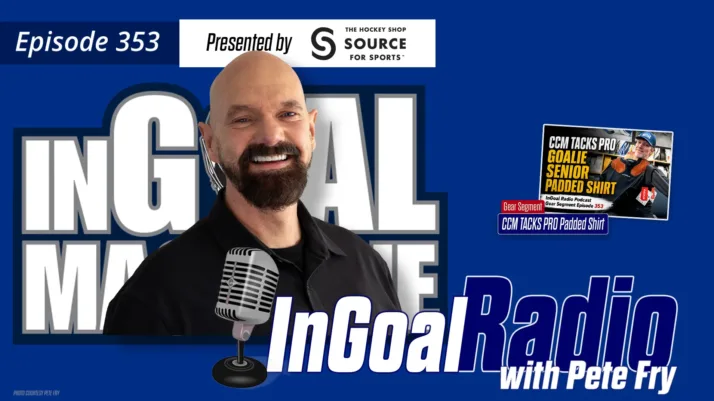
InGoal Radio Podcast Episode 353: Pete Fry

Please subscribe and leave a rating — it helps us reach more goalies!


Goalie mindset coach Pete Fry works with Montreal Canadiens rising star Jakub Dobes and Anaheim Ducks prospect Damien Clara, focusing on reprogramming the subconscious mind to build confidence and manage pressure. Fry uses visualization techniques designed to help goalies step into the blue ice with confidence, and he also offers dedicated programs to help goalie parents manage their own anxiety.
- Pete Fry uses subconscious reprogramming and visualization techniques to help goalies like Jakub Dobes manage pressure and build confidence.
- Damien Clara, Anaheim Ducks prospect and Italian Olympian, is among Fry's notable clients working on the mental side of goaltending.
- Fry offers a specific visualization exercise designed to build a goalie's confidence when stepping into the blue ice.
- Goalie parent anxiety is a distinct service Fry now addresses through books, live events, online programs, and private coaching.
- Brandon Bussi of the Carolina Hurricanes shares Pro Reads insights on managing net drives and plays behind the net.
Episode 353 of the InGoal Radio Podcast, presented by The Hockey Shop Source for Sports, features the return of Goalie Mindset expert Pete Fry.
Feature Interview
presented by NHL Sense Arena
In the feature interview presented by NHL Sense Arena, Fry shares some insights into his headline-making work with rising Montreal Canadiens star Jakub Dobes, including the importance of reprogramming the subconscious mind, Anaheim Ducks prospect and Italian Olympian Damien Clara, and more. He talks about how he helps clients manage pressure situations, walks us through a visualization designed to build confidence stepping into the blue ice, and shares advice to help goalie parents manage anxiety, something he now offers among his myriad of books and programs, including private coaching, live events and online options at his website. (https://www.petefry.net )
Parent Segment
presented by Stop It Goaltending U
In the Parent Playbook, presented by Stop it Goaltending U the App, we dive deep into a listener questions about goalie burnout, including advice on how to spot and manage different signs.
Pro Reads
presented by Vizual EdgeWe also review this week’s Pro Reads, presented by Vizual Edge, featuring Brandon Bussi of the Carolina Hurricanes with some great insights into managing net dries and plays behind the net.
Weekly Gear Segment
presented by The Hockey Shop Source for SportsAnd in our weekly gear segment, we head to The Hockey Shop Source for Sports, for a look at the new CCM Tacks undershirt, with D3O protection over the collarbone, extra rib and bicep padding and a skate-cut proof wrist area.
Episode Transcript
Intro
Thanks to our friends over at The Hockey Shop Source for Sports Langley, thehockeyshop.com. We are coming to you in the championship window. A lot going on in the hockey world. The world championship, we've got the Walter Cup final taking place where the conference finals in the National Hockey League, the Centennial Cup championship game is going to be played in a couple hours within recording of this. Daren Millard along with David Hutchison and Kevin Woodley.
A lot of trophies, a lot of banners being prepared to be handed out.
Yes. There is. Let's start with the one that's in the well, you mentioned a few that are in the fun. We got Mem Cup coming up later this month here in BC in Kelowna. And our featured guest, Pete Fry has, works with one of the goalies in that from Kitchener Rangers.
So it's a little tease to our featured guest this week. PWHL, Montreal Victoire, and Ann-Renee Desbiens, Ottawa charge, Gwyneth Phillips, and all CCM Tacks Walter Cup final in the PWHL. Both of them in the new gear, so I was enjoying that the other day.
Hutch, you gotta keep your eye on all different, levels of hockey. The Memorial Cup tournament is fantastic. I love that that event, the way that they structure it, with the four teams. It's, probably one of the more consistent formats that we've seen over the years, because everybody seems to be tweaking, their tournaments. Centennial Cup brings together a bunch of teams, and it's a week and a half long, team, tournament.
But, what's what's got your eye?
Personally, I'm kinda stuck on the BCHL finals right now because, Mattie's team, the Nanaimo Clippers are now tied after a double overtime loss last night. And, and that has got me thinking about the Centennial Cup, which you mentioned. BCHL no longer eligible since they pulled out of Hockey Canada. And, and the Memorial Cup, yeah, obviously following that, good good friend of the family is playing for Everett and congratulations to them for winning the Western Hockey League championship for the first time, in their history, which is kind of surprising given how consistently good they've been at least in the years I've been watching. But, Daren, you've got a lot more experience with the Memorial Cup than I do.
So what are your memories?
The way that the excitement builds off of winning a championship is something that's always stood out to me. You just won your league, and then you're going to something that's two or three steps
of the yard And
it's almost unfair because you don't get a chance to enjoy winning your league. But but that that situation with three champions and then the host team, which is always good, the with the cycle of building it up. And every game's on national television, and it's it's a it's a marquee event. It's something that that I absolutely enjoyed and and vowed at one point, I will go back to as a fan.
It always attracts, like, NHL people like crazy. Obviously, you've got potential draft picks and guys that have already been drafted and all those things there. Like, this year, I'm guessing that whatever press box or scouting booth areas they have will be absolutely jammed because it's in Kelowna. And Kelowna at the May, not a bad place to be. Did a memorial cup by in Kelowna when the rockets won, when, way back. I mean,
Did a memorial cup by in Kelowna when the rockets won, when, way back. I mean,
We're talking like Tyler Myers and Jamie Benn era?
Oh, yeah. Way back.
It it was it was it was a ton of fun, and just being in that area at that time was was really cool. So, yeah, good on Bruce Hamilton and company ready to put on an amazing event with the Memorial Cup. But we also have the Western Conference and Eastern Conference finals that are going to start this week, and we're we're guaranteed to have at least half the field has leaned on one goaltender throughout. Only half. With with Frederik Andersen going eight and o, and Carter Hart has carried the entire load for the Vegas Golden Knights.
Everybody else has used the least, has used multiple goaltenders.
We just saw four goalies in game six of Buffalo Montreal last night. Like, all four guys got into the game. It's been it's been different. It's been crazy. It's been overdue, dare I say.
As we increase the number of tandems in the regular season, my argument has always been, if you use two all year, how are you gonna succeed asking just one to play all the games come playoff time, something they haven't done all season? Like, it's just sorta but there's been a resistance to it. I think that resistance is gone. And sure, some of its performance teams, I mean, in a league where you're never out of it, you can fall behind early, pull the guy who's gotten you to that point, and rally as the Buffalo Sabres did last night. But it's man, it's it's been different.
And I'm still you know, I'll be curious to see whether that number increases. Obviously, in Vegas, Daren Carter's been been excellent. I thought he got better in the second round even from the first round. His game looks great. And in Carolina, like, I think you would have gone into the playoffs not as a criticism, but just from an age and and and games played standpoint, expecting them to be one of the teams that maybe got both guys in.
But because they swept both rounds, there's been less wear and tear on on 37 year old Frederick Anderson. So really curious to see how this goes once we get a, you know, a a counter I mean, I think we have, what, twelve days between series by the time the Carolina Hurricanes figure out who who their who who their opponent is in the Eastern Conference final.
And and Colorado has started both guys Right. During this run of being eight and one.
Not a shock, right, the way they split the year. So it's I mean, are we seeing a new era? Like, we talked about this last week. There's not a single big money, like, high, high top of the league salary wise goaltender left in the postseason. Just they're gone.
Most of them didn't make it. Vasilevskiy was out in the first round, although not because of his own doing. He was great. So it's just, you know, are we will we see this shift continue in terms of signing habits in the off season? Not that we're gonna have the same game of musical chairs that we've had in the past.
I think the irony is the game of musical chairs that occurs for goalies every July 1 didn't occur last year for the first time. Like, it really wasn't nearly as crazy as it had been pretty much every year up to that point. In part, because so many teams locked up the guys they had because they seemed scared of the unknown, like the devil you know will sign this guy long term. And as we see goalies sort of more interchangeable in these playoffs and guys who are on lower salaried and shorter term contracts have success, it might have been a mistake. Like, I hate to say it.
Someone's gonna come knock on the door for my goalie card. Like, I'm waiting for that. Mister Woodley, give us the card.
We didn't hear the knock.
But but but the way the trend goes Hutch can digitally put it in later. The way the trend is going, like, honestly, if there's one thing I avoid as a general manager with goalies, it's probably term.
One Stanley Cup champion in the field in the in the final four, and that's with Buffalo and Montreal to be determined right now. And that guy's supporting Carter Hart in a backup role in Adin Hill. So it it is a fresh field of starting goaltenders when it comes to championship experience or that moment of lifting the trophy over their heads. We got a new piece of equipment coming up in the Gear Segment, an updated piece of equipment, we should say, with the batted, padded base layer from from CCM, courtesy of our friends over at the Hockey Shop Source for Sports Langley, the hockeyshop.com.
Well, we talked about Ann-Renee Desbiens and Gwyneth Phillips wearing the new CCM Tacks gear. This new undershirt is part of the CCM Tacks line, part of all the new Tacks equipment that's arrived at the Hockey Shop Source for Sports. The new pads, the gloves we've gone over, the stick, we continue to get great feedback, not just from goalies like Ann-Renee Desbiens, but from our testers here at InGoal as well. The feel on the blade, Daren, we gotta get that down to you because you're as old as we are. You know what what when I say it feels like foam core, you know what that actually means.
That's all in stock at the Hockey Shop Source for Sports right now. And as you know, when they get the new stuff in, Bauer Fuse launches next week with a big event at the Hockey Shop, May. As the new stuff comes in, the old stuff goes on sale. I was there last week. They have a ton of inventory still yet to move so they can clear space on the shelves for all the new stuff that's coming.
So make sure you check them out, not just for the latest and greatest, but for deals on what it replaces at The Hockey Shop Source for Sports Langley and thehockeyshop.com. As for this shirt, Daren, I feel like this, you can't even say it's a new twist because it is actually completely new. Everything is different on this. It's a major upgrade for CCM on the undergarment. It's to the point where I think I teased this months ago.
Gear
We knew it was coming. The problem was we couldn't get a demo because every time they took a demo shirt into an NHL locker room, guys wanted to keep it. So without further ado, I'll let Cam explain why.
Something new. Look at that, a yellow bicep there now.
First time in my life.
Wow, wowie, wow, wowie, wow. A little protection. This is brand new folks. Previously unrevealed, although we've been working with it and testing it for a little while, a little humble brag there for the InGoal crew, the new Tacks Pro undergarment shirt, d three o, cut proof wrists, like what more do you want here? Super breathable.
I actually was upset that Cam made me put this on and he chose a size that might have been a little too snug for my over served belly, but I was hot before I put this on. It's actually cooler now. Like, this is, like, got a cooling effect. I like it. Wow.
[crosstalk] It's not often that we get excited about Well, we don't get a lot of new stuff. Everything's sort of a reinvention of something previous. This is brand new, never seen before. See? So what do you like?
What do
you like? Tacks Pro undergarment padded shirt. Couple things to unpack here. Let's start off with this because it's quite a bold showing. ANS six cut protection on your wrist.
Great feature. Say you're extended out, somebody starts skating through your crease, anything like that, that's not giving you that protection. I think it's a great feature and a great addition. We've started to see, like, more companies focus on cut proof, especially for goalies because we seem to be left out a little bit Yep. With, you know, say, the back of pants now having cut protection.
Now adding of this, I think it's a great feature starting off with. Next thing that really, really jumps out at you is the d three o in that collarbone area and shoulders. That's really giving you that nice impact protection, especially on those like roll up high shoulder saves, things like that. That's gonna give you a little bit of that extra padding but they're not done there yet either. Arm out. Off the bicep. Wrapping around quite nice.
Try the arm if you're in a
little reverse. Exactly. Extra protection. Well, within that too, hold your arm back up. Rib protection.
Exactly. For that same kind of idea. If you're into that RVH, you need to be able to make sure that, you know, in case I get you with that underneath shot right there, it's just right there in particular, you know? So very breathable fabric. As you can see, Kevin was already saying how hot he was and now he's nice and cool.
Coolest I've been in a while, Cam.
Wow. Hey. Wow.
Folks, I can tell you that this was introduced. Obviously, they've had it as a sample product for a little while here at CCM. Some of the pros that have tested it, basically, the response has been not to give it back and put it right into play. We've got some junior players that are in it right now, instantly in the bag, instantly in use in games. A lot of them really like it.
This is a bonus, not something they were necessarily looking for, but especially as you get into playoffs at the higher levels, the scrambles, as Cam mentioned, the absolute yard sales in and around the crease. It's actually kind of remarkable we don't hear about more guys getting stepped on, and this adds an important layer of protection. Collarbone, obviously, is a big one. Biceps under the arms. Yep.
Bulk you up a little bit. They make you a little bit taller in the shoulders ever so slightly.
Just that hair taller. So Yeah. So Quick note though. Yeah. Padding, non removable.
It is what it is.
Okay. We
watch the whole thing as.
We haven't done them. Like, our trial is basically cold water wash, hang to dry. Yes. And you're okay. I know a lot of guys out there on their shirts just don't wash them and that's disgusting folks.
So it's Kevin. You can cold water wash these. Just make sure you hang dry. Wouldn't be throwing the d three zero in the heated dryer. But because of the materials, dries fast.
So couple notes final notes with it. There's a premium shirt, premium price point. But it.
Care of it, it's gonna last forever.
Exact well, maybe not forever.
[crosstalk] Nothing lasts forever, unfortunately. But Including our relationship, Cam. Keep poking me in the ribs, and we're gonna be in trouble.
604-589-8299, 1-800-567-7790, or you can check it out at the hockeyshop.com. And just Kevin's really excited that his ribs are protected.
Cam, which way to the beach?
Would have been good if you, like, did a live change during that thing and and putting it on, like, taking it off, tarped off, and then having
it Yeah. Nobody wants to see that, Daren. Reminder folks that that
That woulda that woulda explode at the YouTube.
Reminder folks that you can watch all of our gear segments over at YouTube and you can watch them safely. You don't have to see like, when I go golfing in the middle of the summer in 30 degree heat, we don't get much 30, but when it gets to 30, I wear pants and people are always like, God, it's so hot. Why are you wearing pants? And I always say to my fellow golfers, this is for your protection because the whiteness of my legs may cause a blinding effect no matter how good your sunglasses are. So we don't have to worry about anybody having to see me getting changed and and the whiteness of the rest of my undersun exposed body as part of this.
However, I will say my biceps have never looked better than in that shirt because the protection around them is both puffy and protective. I like it a lot.
Hey. What's the biggest advancement or biggest change from the previous generation of the the padded base layer from CCM?
What would you say? What would you say, Hutch? Your your Matthew's been wearing that one.
Yeah. He's he's loving it. He's just like those pros. We gave him a unit to test and he hasn't, hasn't used anything else since and it's been a couple of months now. The D30 works fantastically.
It's a it's a wonderful material we've talked about here many times. And, and then those cut proof
Wrists.
Wrists. I and and I think if I'm not wrong, I think what we've seen in the industry is a technological advancement because I seem to remember the early cut proof stuff was hard, not very flexible, not super comfortable to wear and now we've got technology that allows us to make everything we wear more protective, which of course, parents especially love, but also more accepted by the players using it now.
The one thing I will say, I think we we chatted about this briefly in the past about and then we may have in the segment, I can't remember, filmed that a few weeks ago. The dryer, I air dry mine, I hang dry mine just like I have with the previous Bauer with the pour on the pants and the shirt, just because, you know, these are not cheap items. I will say that. And you don't want to damage them. But according to CCM, you can throw that in the dryer with the D3O point in there.
It's constructed in a different way. I've had different neck guards that have accidentally gotten too close to a drying rack and had issues with the D3O changing shape, but that won't be the case the way they've built this one out. So you can actually throw this in the dryer. I'll be honest. I'm with you though. I still haven't. I'm
with I
still haven't. I'm not sure I'd take the risk, but according to CCM, you can't. Maybe, maybe don't throw it on the highest heat, but you can toss it in a dryer and you will be fine. The one thing I say is like all those undershirts that have like, like it just wicks away sweat, right? Like very breathable material.
Those always dry so fast anyway. So you can take them out of the washer, hang it up and thirty minutes later you're dry. So that's the official word is you can dry it. The InGoal word is, well, it's not like I can say you It's just, wouldn't.
Hutch, what's your add on there? Well, I was
just thinking that the nice thing about these shirts is that they wick away, but when things wick all that sweat away, it means you better be hanging that chesty up when you get home at night because it's gotta go somewhere.
Daren's like, what are these guys talking about? I I I I I'm a practice goalie for the Vegas Golden Knights. People take care of my gear.
I take care of my own gear.
Practice giving you a hard time.
But but I do I do spray it down. I use, a coach's room on the side, like a public coach's room so I can leave my gear there. I spray it down so those guys don't have to breathe in my aroma during the course.
My aroma.
Like It's the thing that greets you as soon as you walk in the room. So I think that's that's important to be able to take care of your ear because you're right. It does have to go somewhere.
Daren or Woody, because I know you've got your favorite thing. Lots of people are listening to this saying, okay, what do you spray it with?
Can't remember the exact model that I'm using right now. I get it off Amazon. It's a it's a sport equipment.
You get it at the hockey shop, do you? Excellent. Yes. Good for you.
So Power. Power. Power from the hockey shop, Daren. Well said.
Yes. Well,
some of the stuff I can't get from the Hockey Shop.
Yeah. That's true. They probably don't ship chemicals and and liquids across the border as easily as there's other things.
Some things that I'm I have to navigate due to customs. Alright?
Powair has been really good for us up here. Although it the best thing I ever had, was it it doesn't exist anymore. It was from a company and it had, like, a skull and crossbones in a hockey helmet on the cover. Do you remember that stuff, Hutch?
I haven't used it, but I
remember you having it and I remember why you liked it. The the background story on it was fantastic, Daren. Basically, the developers that brought it into a sports spray product. I'm not gonna use names, but this guy had the stinkiest gear from his career. And the wife was like, this like this has got this can't come into the garage anymore.
This is just ridiculous. And didn't wanna replace the gear. And his buddy, who let's just say worked in another industry, said, I've got this stuff.
Now legal industry.
Now legal.
At the
time at the time it wasn't, Daren. I've got this stuff we use to cover the smell of our grow ups. It's all natural, full out hippie hippie stuff. And he's like, it's all and so he used it. And they actually for a while marketed as a sports brand.
And it was credible, incredible. But hockey moms don't that's not a story, a marketing story you can tell the hockey moms and selling it, you know, with the skull in the in in the helmet on the it it was a little too edgy for maybe, you know, a point of sale purchase at counter. But my god, did it work.
I like the the backdoor.
And that listen. Like, nothing says this is gonna work at hiding the smell of your hockey gear. Like, if it doesn't, we go to jail.
So product development, they nailed. Marketing.
They nailed. Yes. Yes. Marketing. Not so much.
Not so much.
The
Vizual Edge ProReads this week catching up with Brandon Bussi, and what a marvelous year that that he had established himself as a full time national hockey leaguer courtesy of Vizual Edge ProReads, leaning on his experience.
Well, do you want the puck to look like a beach ball? Kinda like the way it's been look looking for Brandon Bussi's playing partner, Frederik Andersen, during the Stanley Cup playoffs? Every goalie has that night here and there where the puck looks huge. You're ahead of every play. You feel calm, patient, in total control.
Then there are the nights where you're half step late. You see it, but you don't really see it. You're reaching. You're guessing. You're fighting it.
It's not your technique. It's your eyes and your brain not processing the play fast enough. Vizual Edge fixes that. It measures how well your eyes track and process the game then gives you a custom plan that trains it. Three fifteen minute sessions a week is all it takes on your laptop or tablet.
We heard last week from Cooper Black about how he's used it and what a big difference it's made in his game. And, of course, you can save 10% using the code InGoal, I n g o a l, all caps. But if you're a member of InGoal Magazine, if you have a subscription, go to any ProReads, and you will get a code that will allow you to access double the discount on a subscription to Visual Edge. So make sure you check that out at ingoalmag.com. Click on any ProReads and get your exclusive member only discount to save even more Vizual Edge, it'll help you see the game better just as Brandon Bussey does in this week's ProReads presented by Vizual Edge.
And I don't wanna give it away. This is the tough part about these video sessions and and talking about them on the on on the podcast is you don't wanna give too much away. But I will ask this question because this is a multiparter. Starts with a net drive, and Brandon does a great job of talking about how he uses his stick in certain situations. There's a great video of him reorganizing on the post as the rebound goes behind the net, and then it finishes with a pop pass into the middle.
And so my question for you, Daren, and for all goalies listening and parents, as that pop pass goes from behind the net and you're on your post, let's say it's headed up around short side hash mark, maybe inside closer to the middle. Are you pushing out at that shooter, or are you pushing into the middle of your net? Which is your priority for your first push off that post? Jeopardy music cute. Daren Millard.
Middle.
Oh, k. Mister Hutchison. Middle, but I think there's a bit of a read there. I I I think if you've been doing was it last week's ProRead where there was some scanning off the puck? If you've been scanning off the puck, you probably have a feel whether you can get a little bit of depth or not.
Okay. My answer is I just fall forward on my face and watch the puck go over top of me. It's what happens most times. Happened last week to me. But
No. Where you play, they just shovel it into you because they can't get it over you.
That hurt.
That was good.
But That was a shot at the players, not you. Yeah.
It was shot at the level I played too, which is not very nice either. I love you, Hutch. So so now that I'm totally rattled, I'm not gonna give you the answer, but you can get the answer from Brandon Bussi at ProReads presented by Vizual Edge. And this is the beauty of it. There's not always just one answer, and that's what I love about this session with these goalies.
They walk us through the different options, and Bussi is great. We've got an overhead view on this that he goes over as well. You can see why he's had the six I know he's not starting in the playoffs for Carolina. Freddy Andersen's had a hell of a hell of a playoffs last couple of years, and he's run with it this year. Brandon Bussi is legit.
You can see how well he thinks the game in all his ProReads with us, and it comes through again this week. We've got two more with him. We can't thank him enough for his time. And for all young goalies out there, like, in the off season, we hear about goalie IQ and hockey IQ all the time and that maybe that's one of the separating factors. There's no better way to improve your goalie IQ than by watching these videos.
We've now got over 300 of them online from goalies like Brandon, like Connor Hellebuyck, like so many. Hutch has given me a sign here. Do we have over 400 online now?
No. I think it's over three fifty, though.
Over three fifty. Okay. We have so many of them. And so make sure you check it out. And like I said, get your discount code, save 20% on a Vizual Edge subscription.
They'll help you see the game better and see the puck better. We'll help you read it better.
Hey. There's also a new entry for the Goalie Dictionary out of this week's ProRead. And we don't need to answer the question here, but what is head drive?
Oh, yeah. Yeah. And he and I and I followed up as soon as he used that phrase. I followed up and asked him and he walked us through it. Head drive. Yeah. I liked it.
Not gonna tell anybody what it is. You gotta go check it out.
I I think depth is important on that play by the way. It's just Especially in the NHL. You gotta be able to get a certain amount of telescoping out towards the puck, but it's it's
To Hutch's point, it depends on how close he it depends on the read. How close he is? Is he a one time option? Is it going across his body? Like all those things factor into it. Also, goalie skating is not always on your feet and if you are a better skater on your knees so to speak, you've got more opportunity to gain a little depth. Some some people can only get
Also, goalie skating is not always on your feet and if you are a better skater on your knees so to speak, you've got more opportunity to gain a little depth. Some some people can only get to the middle.
Sense. Goalie skating isn't always on your feet. Yeah. Well, it's just moving up for my buddy. So you're ability moving. Who you slammed earlier.
Yeah. Sometimes it's on your belly. Yeah.
Honestly, I think it's more
Some swim. Of
Is it just me or there are more and more goalies doing that these days? They just dive across head first onto their bellies.
Just saw that.
It popped into my head. How much better the ice conditions are at every rink that we play at today compared to Hutch when we broke in. How many times do you see the squeegee come out before practice now compared to way back at your public rink, at your junior rink, at your NHL rink. It it never never happens now, and it used to be a standard thing.
I'm not gonna bury
it in a race, but it it still happens. Yeah. We're not all in the NHL, Daren, but it
Impressive that it doesn't happen to you in Vegas.
Better technology for sure. I started I one of my earliest hockey memories was playing a game when they were still towing that drum around and not an actual zamboni, so that's how it was. No horses in my day.
Because those No. They they had to move on from that because the the horseshoes would, like, really cut off the ice. Worse than the figure skaters.
Well and they leave The all the horse the horse
poop didn't help either.
Great for the lines though. Like, if you gotta go in the right direction, blue, whatever.
Yeah. I was just happy to be able to play in a building. Not too many years before me, they were just outdoors. Right?
Parent Playbook
Pete Fry's coming up in just a little bit with our Sense Arena feature interview. But first, the parent segment segment courtesy of Stop It Goaltending U the app.
How would you like twenty five years of NHL goalie coaching experience at your fingertips or at your fingertips, on your phone, on your tablet. You wanna tap into the goalie parenting expertise that helped Joey Daccord reach the NHL? That's what you get with a subscription to Stop It Goaltending U, the app. All the knowledge from Brian Daccord has been an NHL goalie coach, scout, and director, including currently with the Detroit Red Wings, as well as the insights and expertise from his staff at Stop It, which includes a long list of veteran NCAA coaches, all delivered in easy to digest chunks, including five short daily primers, weekly style analysis and breakdown videos, and drills you can take onto the ice with your team and coach this summer. Plus, maybe best of all, but we're a little biased here, you get a subscription to InGoal Magazine, included with your subscription to the Stop It Goaltending U app.
So go check it out on the App Store or Google Play and get the both best of both worlds through Stop It Goaltending U, the app, and a subscription to InGoal Magazine. Hutch.
Gentlemen, this week, we are responding to an inquiry from a parent who is worried about their child, facing burnout as a goaltender, but I wanted to address it, of course, to all parents. So if you are listening this week, maybe because something feels off with your goalie, maybe they're dragging their feet to practice, they've gone quiet in the car on the way home, or they've maybe even said out loud that they don't wanna play anymore, I want to start with two things. First, I'm sorry. That is a really hard thing to witness as a parent. We all want our kids to be happy.
Second, the fact that you noticed matters. A lot of parents actually miss it or maybe they just explain it away. You didn't. That's already the most important step here. Burnout is real and it's a lot more common than we tend to talk about.
We went it through it with our son, Matthew. The year he was going to try out for that vaunted brick tournament, he was just nine years old at the time. And, that spring, he was really actually quite clear with us telling he wasn't enjoying hockey anymore. Part of it was a coach whose enthusiasm had, tipped into yelling at young kids even when Matthew wasn't the target. He was absorbing at every practice.
But, clearly, there was, there was more to it. So we pulled him. No tryouts for the brick. Nothing after spring hockey ended. We stepped back from hockey entirely for the summer.
We had a lot of honest conversations and we made it completely clear to him. Come fall, this is your choice. Play goal, switch to playing out, try a different sport entirely, we'll support anything. We love you no matter what. In the end, he chose to come back but I'll tell you it was close.
What mattered most to us though was that he knew without any doubt that the choice was his. Goalies of course carry a very specific kind of weight. Anybody listening to this podcast knows this. It's different from what skaters go through. Every goal is on them.
They're isolated by position physically and emotionally. When the team is struggling, goalies absorb it differently than anyone else on the ice no matter how supportive you, the coach, and the team might be. And of course, often they aren't. A forward can have a bad shift and skate it off. A goalie lives with it.
If your kid is burning out, that dynamic may be amplifying everything else. So before you panic, learn to read what you're seeing. Not every tough stretch is burnout. Every player, every goalie goes through patches where the game feels heavy. The question is whether it's passing or whether it's a pattern.
I would suggest that you watch for them dreading going to practice. Not just a bad day, but maybe physical complaints before games, stomach aches happen a lot in young kids, irritability after hockey that bleeds into the rest of their day, maybe just going through the motions on the ice, pulling away from teammates, and maybe the most telling, they used to just light up when they were talking about hockey and now they don't. If it's touching multiple parts of their life and it's been weeks, not days, you're probably dealing with something real. So when you
have the conversation, lead with curiosity, not concern. I know that's hard when you're worried, but are you burned out puts kids on the defensive. Try something softer. What's your favorite part of hockey right now? Or just ask them, what's going on?
And then listen. You know the old adage about God gave us two ears and one mouth so you should listen twice as long as you talk? Don't try and fix. Don't try and problem solve. Don't immediately call the coach.
Just listen. What you're trying to understand, is it the position? Is it the team? A specific person? The schedule?
The pressure? From the game or, honestly, maybe somewhere closer to home? You need to know what's driving it before you can figure out whether it can be addressed or whether the right move is to just step back. It's okay if they don't wanna be a goalie anymore. Maybe they never really chose it.
Maybe they were just the kid who ended up in net. Even amongst our many pro guests on this show, that's one of the most common reasons they started. Maybe your kid loved it once and something's taken that from them. Maybe they just wanna be a player now. All of that's okay.
What you wanna get to gently without pressure or judgment is the real answer because I don't love this anymore is very different from I used to love this and now I don't. One's just a natural evolution. The other might be something you can help them fix. Now a word about sticking it out. Some people will tell you life is hard.
Kids need to learn to push through and to a point, that's true. Unless something is genuinely toxic, I wouldn't want a kid to quit a team mid season. There's something real to be learned in honoring a commitment to your team. But let's not confuse resilience with endurance. Making a child stay in a situation that's crushing their love for something they chose isn't character building.
It's just hard. There are also situations and parents you will know when you see them where mid season is exactly the right time to leave. Now, the bigger picture. Variety and rest are not optional. One of the things we come back to hear every year at InGoal is your goalie needs a full life and they need rest.
Sports, yes, but multiple ones if possible. Friends outside of hockey, family time, unstructured time where nobody is coaching them or evaluating them or asking them to perform. That variety isn't a distraction from hockey development. It's what keeps kids whole. For Matthew, that was always golf and baseball rarely at a competitive level, just somewhere he could have fun.
Even today in the middle of the BCHL playoffs, he gets out to play what is effectively beer league baseball once a week. And this one, can't say strongly enough, take time off every year. Again, something the pros have said on here repeatedly. It doesn't matter how much they love the game. Burnout doesn't announce itself.
It builds quietly month by month until it arrives all at once. By the time you're seeing the symptoms, it's been building for a while. The antidote isn't just a week off in August. It's building rest into the rhythm of their hockey life from the start. At the top levels, hockey becomes something very close to a job, not just at the National Hockey League level.
The kids who last, the ones who still genuinely love it at 18, 20, 22 are almost always the ones who had enough life outside the rink to keep coming back to it by choice. That's what we're building towards, not just better goalies, kids who love what they do.
Well done. I love the, advice in a challenging can be a challenging time for for people navigating that razor's edge of burnout.
Yeah. The razor's edge of burnout and and the razor's edge of knowing what to do as a parent because as as I talked about that, wanting your kid to learn how to how to deal with a difficult situation, how to persevere when the time comes and and where is that balance? Because we certainly don't wanna raise a child where every time something gets difficult, we ride in on our white horse and save them. And, so it is a tough time for kids
Perseverance. And
Right? Course you do. But there are times when when it's just become too much and and maybe because we as parents let it become too much and and we have to, we have to decide if that's the case.
I think of Jakub Dobes. Right? We're in the midst of this big run and all the pressure he's on. I think of his conversation with us last year. We talked about all the time he takes off at the start, you know, as soon as the season ends and and and he stays in St Louis, but he's not training with his old coaches there.
He waits till he gets back to Montreal, and, you know, clearly, that hasn't been a problem for him.
Feature Interview - Pete Fry
Alright. Pete Fry can also help you guide, through different different challenges in the world of, goaltending and and hockey. Had a conversation with Kelly Hrudey earlier this week, and he dropped Pete's name several times. I felt kind of on the inside of things because I'm more familiar with with Pete being able to know some of his background. And he's going to join us with the Sense Arena feature interview this week.
He is indeed. This week's feature interview, as always, brought to us by NHL Sense Arena. You know, we talk a lot about on the show about, leaving no stone unturned. And if you're following, InGoal lately, you'll have seen our conversation with Scott Wedgewood, which was published yesterday. He's the latest pro to tell us that mental training isn't just a novelty for him, it's part of his routine.
Another NHL goaltender who decided the edge was worth finding. Last week, it was Cooper Black telling us about using NHL Sense Arena and there have been many, many more. In a few minutes, you're gonna hear directly from Pete Fry who provides the mental performance training inside NHL Sense Arena, so we're gonna let him do the talking. He's just one more reason, one more person telling us that mental training and NHL Sense Arena is a serious tool for serious goaltenders, which happens to also be a whole lot of fun. So this summer, wherever you are, make NHL Sense Arena part of your training.
It's used by pros for a reason. Check it out today and, of course, use the code I g m 50 to save even more.
And it's goalie month at NHL Sense Arena, so check out all their socials. They got lots of cool prizes they're giving away.
It's the NHL Sense Arena feature interview, connecting with our good friend, Pete Fry, on InGoal Radio, the podcast.
Welcome back to the InGoal Radio Podcast. I was I probably should've done a little math here, Pete, but I've only got so many fingers on these hands, and the brain doesn't count beyond what I can see. Multiple time guest, Pete Fry. In the news these days, especially up here in Canada around Stanley Cup playoff time, I've been reading stories out of Montreal about Pete Fry. You talked to Elliotte Friedman.
We've got stories in the Montreal Gazette about all your work with Jakub Dobes. So I wanted to touch base with you, not just about that, not just about some of the other prominent clients you've got headed to the memorial cup, guys you started working with, ahead of their appearances at the Olympics, but also go through some advice for the offseason for both young goalies, older goalies, and goalie parents. But let's start with where the spotlight is.
We always talk about where you put your spotlight. Right? Where you put your flashlight.
Yes.
And the hockey flashlight is very much on Jakub Dobes or the Montreal Canadiens right now, at least on this side of the border. Our last hope to end thirty plus years of Canadian misery in a Stanley Cup run. Talk to me a little bit about let's just start overall. How long you guys been working together? We've had him on the podcast.
He talked about your work together as part of that. And and we've I think we've seen that his mental strength come to the forefront during, you know, some inevitable ups and downs of a playoff run.
Mhmm. Yeah. First of Woody, thanks for having me on. It's always great to be on here, you know, especially like you are goalie to goalie here as well. And you do you guys do a great job.
You and Hutch within InGoal Mag. I'm so honored to be on again. Yeah. So so to answer your question, I I started working with Jakob when he was with the Laval Rocket in the American Hockey League. Marco Marciano, who's a fantastic person, great goalie coach, and he sent Jakob to me when he was in Laval.
And it's funny because initially, he called me and I'm pretty sure Marco wouldn't mind me sharing this, but he's like he's like, he doesn't wanna work with you. Right? He's like, he doesn't I go, what do you mean? He goes, well, he doesn't know. He doesn't he doesn't know much.
He just doesn't doesn't know. Just doesn't know. I said, well, I'll just hop on with him. Let let's just get him on one session and and we'll take it from there. Right?
So he he basically came on and from then it was just he was all in. He dived right in. Right? I think I think he was skeptical at first, like which some people are because they just don't know. Right?
You don't know what you don't know and you're not quite sure how, you know, it's gonna affect you when you play and the difference that that the whole mental part is going to to make because it's it's a little bit of a soft topic in the sense of, how do I know if this makes a difference for me? And so I think that was the question. But he could feel the results immediately. And I find goalies do know once they go back on the ice or even when they wake up in the morning and now they're not getting the negative questions in their head. They're getting the wow, I feel like a wall.
I am a wall. And all of a sudden, that whole self talk changes and they realize that this is literally everything for my success.
It's funny that you talk about it in those terms in terms of a goalie being a little reticent to get started, and then diving right in. We've got a story going up this this week at ingoalmag.com with Scott Wedgewood based off an interview we did with him earlier. And, obviously, he's on the other side of this bracket in the Western Conference in the in the Western Conference final. And he talked about getting to a stage in his career where he didn't think like he was mentally weak per se, but he hadn't sort of turned that stone over and had a look. And he talked about you train your body, so why wouldn't you train your mind?
And he's like, you know, it was one of those things where he hadn't done it, so let's go down a different path here and see what changes. And here we are, you know, I think it's four years later, he's gone from bouncing around a little bit to being in a cup final. I don't know if that's the only thing, but, you know, in talking to him over the years, it's definitely a part of it. And so how you sort of frame your mindset. So walk us through some of the things with Jacob.
Like, we've seen, and I and I wanna get your opinion on this. He's an emotional goaltender. That's not a bad thing, is it? Is it just a matter of channeling it in the right way?
It's all on how you use it. Yes. It's all on how you use it. Right? And really, Jakob is phenomenal.
You were at the game in Vancouver when Montreal played Vancouver. I think it was this year. I think it was this year. Yeah. And I was just watching him like he's there.
He's basically a consummate winner who has not been awarded the trophy yet. Right? I I can just just by watching him how, you know, his confidence had changed. He was so confident out there. It's like, he easily gets to his spots on time.
And and it's it's just just a powerful thing to see. But, yeah, I I I I do with Jakob what I do with all the other goaltenders that I work with. There's really nothing different and you know he buys in just like the other goaltenders do. And there's a lot of confidence first of all, because you think about it. You know who says it really good is a non goaltender.
A non goaltender, Conor McGregor. Everyone thought I was gonna say Conor McGregor, but Conor McGregor. Says his success, he goes it's 100% mental. And then he says life is an illusion. Now a lot of people look at that, they go, What do you mean life is an illusion?
That's strange, we're here, we're really here. Yet if you look at it, you could take 10 goalies and put them in the same situation, the exact same situation, and they're all gonna feel a little different level of confidence or nervousness in that same situation. And here's why, because at any one time, even right now, we're not responding to reality. We're responding to the movies and the sounds in our head. And those movies and sounds in our head, they could be a powerful orchestra, or your favorite Guns N' Roses song when you're playing, and the pitches of you making save after save.
Or they could be comments of fear and anxiety and images of not making the saves. And those two different versions of movies and sounds in our head create a whole different reality for ourselves. And thus the goal becomes totally confident or totally not confident.
You mentioned in one of the articles in the Montreal papers, the idea of I think we've seen it, we've talked and we've had on the website a lot of the different tools, different things you can do. We talked about the flashlight and where you focus it and all those different things. But you talked about reprogramming the subconscious mind. And I think as you talk about those pictures, I'm guessing that's part of it. When you say it, walk me through what that means to you, training them and what how you think it it sort of presents itself through the goalies once they understand it.
And it controls every To me, the subconscious controls everything. If you look at it like this, we have our conscious mind, which is our mind that can judge, that can be critical, that can make decisions. And then we have our subconscious mind, which is simply just a computer. That's it. That's it.
Yet, if you look at it like this, look at your conscious mind like a tiny little golf ball. And look at your subconscious mind like a big huge hockey arena. And the power is in that subconscious mind, yet it cannot judge. So if you understand how it works with They don't teach this stuff in school. Number one we think in pictures no matter what.
So if I say car, what shows up in your head? My car. Yeah, picture of your car. Right? You have a nice car by way.
I remember seeing that when we went out for dinner after the Tendy Fest? No, number one. And number two is every word that is said, and this rhymes, so it's easy to remember, every word that is said forms a picture in your head. So words are critical. Words are super important.
And that's something that, you know, a lot of coaches need help with that, because they use words that make the athletes kind of push them down to his feet. Everyone's Can give
me an example of Give me an example of a word a coach might use, because we'll have coaches listening. Some even goalie coaches might not be aware they're doing it. A word they use that drops their goalie's confidence down a level subconsciously. Perfect.
Can can I hold that just till I cover the next three things?
It'll make it easier. Yeah. We we will. We're we're gonna go into some great examples here. Okay.
Gotta keep the listeners on edge. No, I'm just joking. We just gotta It makes it easier. So the third thing is, the subconscious mind does not respond to negatives or don't. So if I say, don't think of that car Kevin, don't think of your car, what shows up in your head?
No, I'm still looking at the same car. It isn't
nice You're looking looking at at same same car, even though I said don't. Don't do it. Right? Don't give the puck up. Don't let in any early goals.
Right? So we're actually giving some examples out right now. So it doesn't understand the word don't. It's like a Google search. If you say don't find yellow cars, it'll pull up a whole bunch of yellow cars.
And the next is, after the word don't, it doesn't know the difference between what's real and what you imagine. And to show that, to prove that to people, just think of going and watching a scary movie. It's around Halloween or something like that, or you go to a haunted house in Halloween. Your conscious mind, the golf ball mind knows it's totally fake. It knows logically it's not real.
It's a movie, it's made up in a studio. But what happens? Why do we get scared? Because the supercomputer, the subconscious mind doesn't know the difference between what is real and what we're imagining. Thus the power of visualization.
The power of words. You're a wall. You're a brick wall. Every time you get set for a save you hear the word power. You feel like the powerful wall that you are.
And then the fifth thing, what the subconscious mind does is whatever images it sees, it'll move you towards them. It'll move you towards those images. So if you look at that and you Okay, well, so if I see a movie of me being a powerful wall, it'll move me towards that that image. I see a movie of me stopping the puck, it'll do whatever it takes to help me stop that puck. It's almost like you you ever gone to Goldstream on the island, or I'm sure there's some place on the mainland where you watch the salmon spawn, they're swimming upstream.
Oh yeah. Been there.
That birthplace where they were born, even though they swim miles and miles away, it's implanted in their subconscious mind. The subconscious mind pulls them back to that place where they were first born. And so the same thing with pictures and movies in our head. So going back to the examples for some coaches, I can remember an example of a goalie called me after the game and he said, I'm getting ready to go out there for the third period. I was having a good game.
There was one save that I didn't make that I yeah, I probably should have had, but I was I was feeling good. I was feeling confident going out for the third period. This is the Western Hockey League. I'm not gonna say any names for her
But but we know it's not a low level.
Yeah. We know it's not a low level. And and the coach looks at me right before I go on the ice. And he looks at me, he gets this really mean look in his face and he goes, whatever you do, no horse poop goals. That's all he said to me.
Sorry, am I allowed to say that? We can edit that out.
We got beeps. We got beeps.
Okay. We got beeps. Yeah. Anyways, that's exactly what the coach said. I'm just repeating what the coach said.
And so he went out there, they lost the game. He's like, Pete, I couldn't get that thought out of my head. So I have strategies now that I give goaltenders to do that. You are gonna do Which we can talk about that for a moment as well too if you want to, but there's strategies that you can do to deal with that because ultimately you are in control of the movies and sounds in your head, yet the people around you do influence them and coaches are one of the biggest influencers. They need they need this stuff
big time. So as soon as your head coach tells you not to give up a bad goal, what's in your head? Bad goals. That's all you're thinking. And you're outside now you're whether you're consciously or subconsciously, you're thinking about it as opposed to just going out and playing.
So give me a tool next time that kid his coach says, no horse poop goals. How does he get that picture or that phrase out of his head?
Yes. And it's so important. It's so important to stay on the positive track. I'll give you an example, the gold medal game this year. Canada was all over The U.
S. Like they were all over The U. S. It'd be easy for the American players to, Guys, what are we doing? We're getting it all wrong.
And you hear Ka'Chuck, he said two things. He said, stay confident we're winning this. Think of that. Stay confident we're winning. Think of the pictures in the head of all the players on that team.
Well, confidence and winning are two pictures I don't have in my head, Pete. But I for them, I understand where you're going.
What do you hold it? Come on. You know what? Even this is something interesting.
I know my self deprecation probably doesn't help me as a goaltender, Listen, does
I'm a big comedy guy. I love comedy, and I would do you know, I'd make the joke that I was just feeling terrible after a game. I jumped in front of a bus and boom it went through my legs. You know that old joke, I don't know who said that. But I stopped doing that because the subconscious mind does not know the difference.
Right? Does not. So you just gotta be aware of it, that's all. If if you do if you do the odd joke once in a while, that's fine. Just make sure you have more positive stuff.
Okay. I'll work on the positive Hey Woody. Yeah. It's no you talked about horror movies and I was picturing my game tape, so that's not a good start.
That's funny. We gotta do a custom visualization for you.
Yeah. It would be ugly, people. Well, you know,
It'll that be beautiful, Woody. I guarantee you.
So, you know, some of the other like, that balance, all these things you work on with these guy well, I wanna get into the emotional side of things too. Yes. Because and and I I and I'm
not trying to dwell on Dobish even if he is in the spotlight. But That's weird. We've seen this with other goalies around the league where coaches, head coaches, sometimes even the goalies themselves have this picture in their wow. Maybe picture in the mind. They have this idea of what an NHL goalie is supposed to be, and it's stoic, and it's quiet, and it's focused, laser focused from the time they get to the rink.
Nobody talked to me, and for some guys that worked. But if it's not your personality, if you're Jakob Dobish and you're an emotional creature, then trying to contain who you are even within games isn't always the best thing. Is that something that's it's important? Like, how do you work through that when maybe your advice to them to being themselves doesn't always fit within the cliches or the stereotypes that other people that are evaluating them in hockey are looking for?
Well, I look at it like this, humans, and then once again, is where schools get it wrong as humans, we're always working perfectly to get the results we're getting. So we gotta understand that. We're always, we work per So no matter what, if a person is getting totally frustrated, right after not making a save, and they're yelling or they're getting mad, they're working perfectly to get frustrated. Right? If they are getting really depressed, they're working perfectly to get depressed.
Because what happens is there there's certain movements that they do, there's certain images they picture in their head, there's certain ways that they breathe that get them to that frustration, that get them to that depressed mode or whatever that is. Okay. And what we got to do there is we can simply just reach in and we can change that. We can say okay the moment that that happens, instead of instead of looking down and having a picture you slamming your stick, right? What if you just stay neutral?
Or what if you smile and you interrupt that pattern? Right? And so I chatted with Jacob the day after they had the press came out where he was visibly upset on the air. Visibly upset on the air and you know, kinda went viral and stuff like that. We laughed about it.
We basically laughed at him. He's like, it's yeah. I'm fine. It was just an emotional it's just an emotional release. So I think he has learned to almost Michael Jordan ish to take his emotions and bottle them up and turn them into making the next save.
Right? And looking at it like because I always say, our table of goal is this. What if? What if? Because the the meaning that we put to something is everything.
Right? So when we don't make a save, it could mean a 100 different things to a 100 different goaltenders. Right? A 100 different things. So what if we look at it like, let's say try this next time you're playing, next time you're playing.
So you don't make a save. What if you look at it like, that's strange. That's that's not like me. I'm Woody. I'm the freaking powerful wall.
I normally stop that puck. Isn't that weird? That just means I'm gonna make the next fifty, sixty, 70 saves. Right? So it kind of flips the script.
Fifty, sixty, 70 saves is probably just a period for us in beer league.
Just a period for you. Precisely, precisely. So so to get back to your question, yeah, Jacob has learned to bottle that up and use it as fuel for himself.
But it's okay to let it out. So if you're playing fiery, because he's got an element of fire to his game. That's okay. Where do you where do you sorta like when you when you watch that?
Yeah. Because you you yeah. Because you gotta look at it at the end of the day and say, is that working for me? Am I getting the results? Is it working for my team?
Right?
So so it's okay until it's until it becomes a distraction or it's or it's not working for you?
Until it's too much. Yes, yes. So for yourself personally as a goaltender, if there is some type of little release right after just really quick, that's probably all right. Although it may not serve you, because every action that you take leads to another action, and we gain momentum. Whether it's a momentum in getting frustrated or momentum in being totally confident.
So as long as we have a reset, and as long as we're by the time the puck has dropped, we're totally confident again. That's the key is that after not making a save, when the puck is dropped next, am I fully dialed in on making the next save? Am I fully confident? If I'm not, then I need to change what I'm doing from the time that puck goes in, I guess you would say, until the puck is dropped. That's all.
I just gotta change my strategy.
And there's a fieriness without pucks going in too, engaging with forwards Yes. Being in the battle. Can that again, like, we a lot of times it'll be like, oh, is this goalie distracted? Is he worried too much about those things? But if that's part of your personality to sorta maybe hype level get you engaged and into a game, it's okay?
Yeah. Because it it it for some of these guys, it's a war out there. Right. Right? It's like, I'm stopping the pocket at all costs.
I'm playing like I have the my family in the back of the net. I'm playing like I'm protecting my family.
And so that mentality can it it for the right personality can serve them. Yes.
Yes. Okay. Yes. Yes. Yeah.
As long as at the end of the day, the the number one main focus in their mind is stopping the puck, the puck and the play. The puck and the play. As soon as something else takes over, then they gotta go back to the puck and the play.
And have those reset mechanisms to make sure. And we've talked about this over the years many times. Nobody concentrates, you know, from morning skate till the end of the game. Nobody concentrates from the drop of the puck for the first period to the end of the third period. It drifts for different reasons.
It's all about mechanisms to bring it back.
Yes. Yeah. Anchors, focusing, resets.
We've we've done a lot of those things. The the the confidence anchor, the physical confidence anchor, has that evolved for you over at all over the last couple of years? Any guys that you can share examples with? I mean, we we talk about Damian Clara who with the ducks, who represented Italy and really, really stood on his head over at the Olympics, which must have been so cool. There must have been so much pressure to be the Italian goalie in Italy playing for the Olympics.
Yeah. You
know, how those guys manage those different things.
Yeah. For sure. So so confidence anchor, I think it has evolved because you know, we started off, we would just use it as a movement. So it's just a movement. Right?
Yep. Feeling confident, do that movement. Feeling confident, do that movement. When you need to feel confident, you do that movement. Just like Pavlov's dogs.
Ring the bell, boom, when he feeds the dog. So next time he rings the bell, the dog's going to salivate with no food in sight. Same thing with confidence. We've also added it where now they're looking at their crease and they're stepping into their crease. Like they're seeing their crease as full of confidence.
And so when they step in, and I can do a live one with you, whether we do it here now or I could do it after. I I could show you how it works, and it is really powerful.
Give give it to me. Let's go. Let's do it. Let's hear it.
So so so here we go. I'm gonna move my chair from behind me. So are you able to stand up, Woody?
Yeah. I mean, you know Yeah. As an old an old man, I can stand up a little bit. Here we go.
Calm one, you're you're you're you're going up levels. What level are you now?
For me, the level is it's all about the age.
Yeah, I
know, I know, but it says age, just say level now. Don't say age again,
just say level. Yeah, I'm at the most advanced level.
Yeah, it's a video game. Life is a video game. So imagine that, imagine a game, can you think of a game when you totally dominated and you're just stopping every puck, making every save?
I won't make a self deprecating joke here, Pete. I got one. It was everything in my power, everything in my power my friend, but I got one buddy, I got one.
So want you to imagine, so imagine you're staying on the goal line in that game, and you got your crease in front of you. Right? Take a look at what your crease looks like. Right? And look at that.
And then what I want you to do is to just step into that crease in that game and feel it now as if you're there right now. Okay? And as we go right back to from your own eyes, see what you were seeing. Maybe you saw the black puck clearly, maybe the puck seemed huge to you, maybe the plate slowed down, you easily got your spots. See what you were seeing, add the colors, make it brighter, move it closer, make it bigger.
Hear what you were hearing, hear it even louder, and feel that confidence that you felt. Feel it right now through every single cell in your body. And let me know when you've got that confidence back, when you're feeling totally confident, just like in that game.
I think we need Jeopardy music. I'm good.
You're good. Okay. So now step back on your goal line, and I want you to change that crease right up. You have a game coming up?
Yes, I do.
Okay, imagine that crease is in that arena and that game coming up. Take a look at it right now. Take a look at that crease. And remember, every crease is basically the same. So see that crease, it's full of confidence.
And now what you're gonna do step into that crease. Again, this is a game you have coming up and let's lock it in Kev. You're a wall. You're a brick wall. Now do your arm moving.
You're a brick wall that stops everything coming your way. You feel like you can stop every puck. You feel like you can make every save. You are powerful in the net. You are dominant in the crease.
You are a puck stopping machine. You are a wall, a brick wall. Other goalies wanna be just like Woody. Woody is a powerful goaltender, a save machine, feeling like he can stop every puck, feeling that he can make every save. Carey Price has nothing on you.
Fire off your anchor. You're a winner. You're a champion. Fire off your anchor. Okay, what's your favorite pregame meal?
Would you step back on the goal line again? What's your favorite pregame meal?
Oh, it's usually a protein shake.
Okay, okay. So now see the crease in front of you, and let's test it out. So when you're ready, I want you to look up and take a look at the crease, but then look up. Imagine the crease is below you in your next game. Then you're gonna step into it and fire off your arm movement.
Let me know what level of confidence that brings you to a scale of one to 10. Go ahead.
I feel pretty good. I feel I feel pretty good right now, Pete. That that's a 10 for me.
Frickin' right. That's what it's designed to do. That's what it's designed to do. Right? And and that way, you know, you you get that certainty as a goaltender that you're gonna have that feeling.
Because one of the problems with most goalies, with being a goaltender in general, is there's so much uncertainty. And as humans, if we have too much uncertainty, it can drive us crazy. That's why I just had James Gartner on the podcast. Yeah. He's a great goalie coach on the island.
Right? Yeah. He's also a coach at Shawnigan. And so I asked him, I said, what do you think about coaches that don't tell goalies if they're gonna play until right before the game? He goes, that's crazy.
I go, exactly because that just brings more uncertainty to the guys.
Right. So rather than wondering how we're gonna play today or trying to find the things that we did last week to play well, and that can get superstitious. I tie my left skate in front of my right skate, whatever. Or it can be a routine that helps you get there, but it'd be like, oh, what you know, did I play deeper last game? Did I?
You have this mindset thing that takes you into that state and removes some of that uncertainty in terms of how you're feeling.
Yes. Yes. Yes. Because you think of it, I'm sure you can recall. I imagine you feel the most confident and play your best after you've made three or four great saves.
Yeah. It's funny because you mentioned the game, find a game, and the game that came to mind recently was me actually screwing up the time, getting there in a rush, but just calmly getting my stuff on knowing I would make it stepping up for puck drop and just playing deep and seeing everything coming at me and just reacting. Not thinking And you dominate Yeah. And so that I mean, that's what I was trying to go back to. And my my logical brain, the golf ball brain, wants to think of it in terms of, okay, I was tracking.
I was just focused on watching the puck, and I was playing super deep at the beginning because I hadn't warmed up. I hadn't and so is that the solution?
Well, the you know
what that
tells me.
But getting the confit but but, again, like, regardless of what triggered it, tactically or technically, feeling that confidence was I I I could sort of feel and envision that.
You know what that tells me is that, it tells me that we need to do some mental work with you because on the on the other game Oh, shocker. Because on the other games, your conscious mind was probably getting in the way thinking about it too much. And what if I miss this? You're doing those self deprecating jokes on the way to the game, stuff like that. So that's all it tells me.
We do a powerful, what I call a rapid neural transformation, like a visualization for you before the game. You can listen to it every game, and we do some content and stuff like that. You'll you'll you'll be you'll be rocking it.
Or I just tuned into NHL sense arena because I can get you in my head anytime there. How's that? What walk me through that process, how that came about. And for those that don't know, Pete is is now a feature in NHL Sense Arena. And it's mostly just it's mostly there's other things, but mostly it's just visual this confidence visualization and Pete talking you through that and a lot of the stuff that we just did basically.
Yeah, for sure. Brian Daccord reached out to me, right? Because he's big on helping develop a goalie part of Sense Arena, and asked me if I would do some stuff on the mental side for it. And then we just put the project together, and it was really good. Daughter Ashley, who's the president of my company, she helped big time.
Were in We were on the road when we got all this stuff done. I forget where we were. We were anyway, if we're on the road, we had to do I had to go in the in our Airbnb. I had to go like in the basically in the closet and do all the audios in there and
stuff. Make it sound really good. Makeshift studio. Yeah.
Yeah. We we did it really good. Her and then Ben. Ben, who's our our chief of marketing and stuff, he helped big time. And so we were able to get get it all done.
And I'm glad glad to be a part of it. Sense Arena is a a great tool for goaltenders.
Okay. So you've got I wanna talk a little bit about off season. We've got some some big names in the playoffs. Talked about Damian Clara, at the Olympics. Pressure, you've got some Memorial Cup athletes.
I think you've got, is it Kirchner with Kitchener?
Christian Kirsch. Yeah. Christian Kirs.
Christian Kirs with Kitchener. Like, there's a tongue, like, right there. I'm stuck. I'm stuck. Gonna I'm gonna don cherry that with all the k's in there.
He's heading to the memorial cup. I'm guessing you'll be up in Kelowna for the memorial cup to see him. Yes. What you know, what type of advice, whether it's Damian Clara stepping onto the Olympic stage in his home country as a Ducks prospect, stepping onto a Memorial Cup, though like, playoff time. Playoff time is full of pressure.
Is it a matter of just not changing anything, or do you have to recognize as an athlete that the spotlight is brighter?
Well, let let let's talk about pressure. Let's talk about pressure, really. Where does it come from? Right? Because it it it if you think of it, once again, 10 goalies going into a game could all have a different sense of the pressure, so to speak.
Right? And even saying the word pressure, if you have a game and you say pressure, how do you feel when you even say that word? The heart starts beating a little faster?
Yeah. Oh, yeah. Like, there's there's yeah. No. I I had a recent game at a level I hadn't played in a while, I was nervous about it because I wanted to be invited back.
And so the pressure was to perform so that I would get, you know, hopefully an opportunity to do it again because they don't tolerate fools. So, absolutely. I think for me, it the mind just starts swimming and thinking about all these different technical things rather than just going out and play.
Mhmm. Exactly. Exactly. So so give you an example, last year the Memorial Cup. So so I worked with Austin Elliott.
Yep. And so he won the Memorial Cup last year and after, and I worked with the team the night before. The London Knights brought me in to work with their team the night before and and get them ready for the championship game. And after, I asked Austin, I go, did you treat that game any different than the third game of the season? He's like, no.
No. And and and Jacob talked about it after game seven in Tampa. Right? After game Which is really cool because just go going back there, going back to the pressure. Think of it.
You're you're game seven, you're playing against a goaltender who he really looks up to. Right? He really looks up to Vasilevskiy. One of the things that I had him visualize the night before was imagining the handshake line at the end, and Vasilevskiy congratulating him and saying, you know best of luck in the next round. Something like that.
So he see that. But basically
We walk into the picture we create in our mindsets.
We walk in the picture we hold of ourselves. Yeah, we walk in the picture we hold of ourselves. So pressure is really internal. Once again, if it's a playoff game, or a World Cup championship game, whatever that is, we're not responding to the reality of what's happening again. We're responding to the movies and sounds we create in our head.
And so we can create movies and sounds of all of a sudden, and if everyone and try this, Woody, this. Close your eyes for a moment, and everyone listening, close your eyes for a moment, unless you're driving. Close your eyes for a moment, and I want you to imagine, imagine you're about to play in a game, and it is a memorial cup championship game or Stanley cup playoff game. And I want you to now start to imagine all the fans on your team cheering for you, but imagine all the fans on the other team. We're going through like a little negative visualization at first, just to create the pressure.
Imagine what the reporters are gonna write about you. Imagine what if you make the save or you don't make the save. And so what it means, you can all of a sudden, you can make yourself very quote unquote nervous in your mind.
Literally felt the anxiety sink in there.
Exactly. So now now let's just take take a breather. Think about what your favorite pregame meal is real quick. Let's just interrupt that state. Okay.
Oh, that blueberry acai protein shake's going
Okay, down blueberry acai protein. Okay, there we go. So now, let's go back to it. So you have that game coming up now. Now what I want you to do is, is I want you to see it in black and white in your mind.
Take the color out of it and turn the volume down and imagine, is there a song that you love, Woody? Like like, you know, you feel confident when you when you listen to it?
Yes. But I'm not gonna share it because my musical taste has been a subject of discourse on this podcast before.
Oh, Woody, come on. I gotta know just personally.
Okay. I'm gonna do this. Is gonna be this is gonna cost me. Taylor Swift, long live.
Okay. I've never heard of that song, but that's okay.
It's a good one, Pete. I'm sending it to you right after we're done Okay.
So everyone listening, imagine your favorite song playing, and then let's just step into that game with, you know, just flow and relaxation. And watch yourself on the movie screen in that game that you have coming up. But you're watching yourself, you actually pretend that you're in the fourth row of the movie theater, you're watching yourself on that movie screen. And you're just watching yourself dominate. And now you can turn the black and white into color, that's fine.
And see it on the screen as you dominate, as you're hearing your favorite song, and as you dominate maybe on saves off the rush, feel free to reach into that movie screen and tweak out what you're doing, so it looks perfect to you as you make saves off the rush. And once you think you have it tweaked out so it's perfect, now what I want you do, I want you to step into that movie from your own eyes. Put yourself right there in your game coming up. You still hear that song in the back of your head, that powerful song, but now you're making these saves off the rush from your own eyes. And notice how now the play seems to slow down for you.
You easily get to your spots. You're having fun out there. And notice how the black puck seems huge for you. Okay. Now come out of that, Kevin.
How did you feel during that one?
Way better. It's funny. You can actually feel it. I don't know if it's in my head or my chest or it's like sort of a little tingly would be the wrong there's a lot more warm and fuzzies than the first one you presented, which I could actually sort of feel like a sink almost physically when you talked about the crowd and all the the negative influences.
Yes. Yeah. And those are the movies and sounds in your head, you have the ultimate power to create. Now of course, people around you will influence them. Right?
So so parents gotta be careful. Oh, you got a big game tonight. Right? Like things like that.
Parents, are you listening? I know Hutch has talked about this in the Parent Playbook before. Don't add pressure.
They got that sniper on their team. He's really good. He really likes to score putting all the negative images in the head. Right? Things like that.
So so we gotta be careful because
it's Okay.
So I read that.
Yep. Okay. So give me give me some different language for the parents on the way to the game.
Great question.
Yeah. It's a it's a it is a big game, and they do have a sniper on that tee. But give me some positive language that's gonna help their young goalie go in there feeling confident. And do I will. I will.
Should they build it together with their young goalie?
Yeah. Let's talk about that. And can I preempt that real quick with a little bit of a plug? Yep. Because we just entered, no one knows about it yet, but we just introduced a parents course called the mental game for parents.
All my I didn't even know that. So good coincidence. Yeah, there you go, there
you go. And all the goalies that I work with, their parents get it complimentary, but we really haven't marked it at all. No one knows about it yet. We're gonna get it out there at some point, but so it's all there. But let me talk about it, let me give you some feedback.
So as parents, number one, I want you to look at it like the difference of, and I always we've done articles in InGoal on the athlete mindset compared to the fan mindset.
Right.
Right? So as parents, just think of the athlete mindset. Think of the athlete mindset. So things you every word that you say, remember, every word that is said forms a picture in your goaltenders head. So sometimes it's good to just be quiet.
Right? Let them talk. And sometimes it's good just to say stuff like, you don't do anything different this game. You just go out there and you focus on stopping the puck, tracking the puck and stopping it, and enjoying it, and feeling totally confident. And just keep it simple.
We're always, our subconscious mind, it's always being programmed. Our brain is always, there's been tons of studies, our brain's always being rewired. That's why someone can go from being totally nervous and anxious to all of a sudden now they're feeling totally confident before a game. So some things not to say is remember the subconscious mind doesn't understand the word don't. Don't go down too much, or don't stand up too much, or don't play the puck too.
Like like anything that you do not want them to do, don't just don't say it. Do not say it. There I said the word don't. But it's hard to phrase that in a way. And just talk in terms of positive stuff.
Walter Gretzky was probably one of the most successful hockey parents as far as communicating to his son. He would say Wayne, what are you gonna do when you're behind the net today? And he wouldn't say it in a pressure way, he would say it in a fun way. What are you gonna do when you're behind the net? I'm gonna do this and this and this.
And when Wayne was talking about it without even knowing it, he was visualizing it. You could as a parent, could ask questions if you want. I would keep it down to four, like Ian Clark says four kind of key things. Number one is post play. What are you gonna do on post play today?
You could say something like that. What are you gonna do on plays off the rush? What are you gonna do on shots through traffic? And what are you gonna do on any scramble plays? That's it.
Just keep it simple. Keep it simple. If if they even want to talk about that, they may not want every goalie's a little bit different when it Okay. Comes to
But the most important Oh, most important advice is to is to be be a mom, be a dad more than their coach.
They've got people for that.
Yeah. End of the season. For a lot of goalies, it's here. Advice on a mental game checklist. Like what what what should they be thinking of?
A lot of what happens next season for goalies on the ice in the gym starts now. So if I was doing a mental game checklist, what would that look?
I would say how confident was I on a scale of one to 10? Because that's a key one. Right? How confident was I? Now that's number one.
Do I have a pregame routine? Is it written down? And how come you wanna write it down? Most goalies I talk to, they've never written it down. Because when you write it down, now it becomes a system.
You can tweak it out. You can say is this purposeful that I'm doing? I would also would also say okay, well how was my bounce back? Was I able to be fully dialed in and confident before the puck drop? And the reason I'm asking these questions because these are all skills.
Pregame routine, if you treat it like a skill, bounce back, if you treat it like a skill, feeling confident before the game starts, if you treat that like a skill, you can always get better at it. But if if we look at it like, oh, it's just a trait I have or I don't have, then we won't get better at it. And it's up to us to choose to treat it like a skill.
Going back to that Scott Wedgewood quote about, you know, deciding five years into his career, I don't know that I'm bad at this, but I'm not working at it. Maybe I need to find new ways. So love that. Off season, spring hockey, burnout, skipping, like, where do you do you recommend going through the season? Does it depend on the athlete?
What do you say to a parent who's worried their young goalie has burnout?
Yeah. If it if they think their goaltender has burnout, then I would go I would dive deeper in what is that? Is it are they getting too nervous before games? Are they are there things are there patterns that they have that are allowing them to burnout? And as far as them playing spring hockey or summer hockey or not, I think it comes down to the most important thing is to build the love for the game.
Right? So if they do not wanna play that, I wouldn't force them into it.
And I was just gonna say, like, if they're having anxiety, which could be just the game or it could be the outside influences or it could be their ability to process all those things and channel in the right direction, which is mental game
Mhmm.
Then that might lead to the burnout if as opposed to being able to put things in the proper perspective and sort of go out and enjoy it when the puck drops. So that's an interesting way of looking at.
Yeah. And just to can I talk a little bit more about
I think it's important for parents to know that we have two driving forces in our life? Two driving forces. The driving force of pain, to get away from pain, and the driving force of pleasure, to move towards things that we like. Our brain is always working with us perfectly to move us away from what we think is painful and what we love all the time. The key though is to learn to control what we associate to pain and what we associate to pleasure.
For example, as a goaltender, if they associate pain to running or being in the gym or working out or long practices, that may hurt their career. So it could be as simple as they're associating some painful stuff to things that are gonna help them grow in their goalie career. And Grant Fuhr, like Grant Fuhr was just on, I just had him on my podcast there. You've had him on?
We haven't. Thanks Pete. He one upped us on that one.
Sorry, I can I just assume you had because you have everyone on?
I know. Note to Grant Fuhr.
He's such a great guy.
He's a legend. He's a legend.
Yeah. I love him. Anyways. Anyways. So he was saying that, you know, he loved to stop the puck.
He's associated a lot of pleasure stopping the puck, but more than that, he hated more not to stop it. And you know, back when Grant played, the equipment wasn't as good as it is now. So many games, he would have a ton of bruises after the game and he didn't care because it was more pleasurable to get hit by a 100 mile an hour puck in the arm where there's no equipment right on the bone than it was to not stop the puck. Right? So he he yeah.
Hate to give up the goals.
Okay. So you kinda touched on this one. The that anxiety that set in as you were, you know, setting the scene of the outside influences for me that I that I quite literally felt there. Parents that experience anxiety during games. It sounds like I had this as one of my questions.
I'm gonna ask it anyways even though it sounds like you've got a course coming up for them. You know, little you know, sit without short of registering or having their kids register and getting automatically into the parent course, just quick or maybe some quick samples of some of some of the things that you would do to sort of help them help them manage anxiety. Because it's, you know, there's a reason I'm not a goalie parent. It's hard.
Yes. Yes. And really, if you look at it, you think of what's a position with the most uncontrollables on the planet, that would be a goalie, I think. But there is one position that has more controllables than a goaltender. You know what that is?
A goalie parent.
There we go.
If you were gonna say quarterback, I was
gonna be really mad because me and Farhan Lalji are always arguing over which one's the tougher position. Oh, it's
a goalie for sure. Because you got the ice as well too, and you could do everything perfectly, lose an edge, stuff like that. Or yeah, it did.
Okay. So goalie parent is the only thing tougher than goalie. I like that.
Yeah, or more uncontrollables, right? Because they cannot control anything at all that happens on the ice. And so two things, right away. If they apply these two things, this will make an immediate impact for them. Number one is to reframe how they look at it.
Right? Because they're probably looking at And by the way, when I was playing in Victoria for the Victoria Cougars at the time, are now in Prince George in the Western Hockey League, my dad, they would have to take him out of a game sometimes because his heart would start beating too fast. He would basically get panic attacks, right? It might have said a lot about how I played Kev, I know you were thinking that.
No, no, no, no, I know those well. I know those well. I may not have a child in goaltending, but I've got a child in sports and I know that feeling.
Yes. So reframe how you look at it. Number one, we think fan mindset versus athlete mindset. Have the athlete mindset. Want your goaltender to have rushes on them, to have shots, to have breakaways, to have penalty shots.
Just change how you think about it. Number one, may be difficult at first, but the more you do, the easier it's gonna get. I want them to comp ice. And when your team takes a penalty, just go, Yes, this is awesome. Because a lot of times the mind and its condition and its program that when your team takes a penalty and your goaltender's in the net to go to all of a sudden, What if this happens now?
Right? And then that's where the nerves build up. But if you go to this is a great opportunity for my goal tender to shine. And if you start looking like that and thinking like that, believe it or not, it's gonna reflect on your goal tender. Right?
Because the way that you talk and the way you address them. So number one is have that same athlete mindset. So when your team has the puck in your end or the or the neutral zone, this is just what I texted this to to to Jacob yesterday. I'm like, you don't crave the turnovers. Like just crave the turnovers.
Right? Pray for your team to turn the puck over and that will allow you to be calm. Then the next thing is breath. Right? You can do a simple Navy SEALs technique.
The box breathing is a simple one. Right? Breathe in for four, hold for four. Breathe out for four, hold for four or you could do something where you breathe in for two and then you breathe out really slow long breath. When you breathe out either through your nose or through your mouth like a straw, right?
Like for six or eight seconds, That'll help you be calm when you're there. So flip how you frame it, how you look at it, and then put some focus on your breath. And the third one, little bonus here, is smile.
Just in case your kid looks up at you after the goal goes in?
Yeah, just smile. Yeah, exactly. Yeah. Simply smile, right? Because remember emotion, how we feel is created by emotion, by how we move and a lot of muscles we have in our face.
So sorry if to smile and notice how you're sitting too. Right? So when you're sitting, what if you put your shoulders back a little bit more, you smile, you tilt your head up as you're watching your folks on your breath, you will literally start to feel better.
Positive energy. Yeah. It's true. Do you know that I get that for when I first started doing radio reads for advertisements? That was what the producers talked about.
Before you're about to start your read, you do they do their three two one, The gap before, just physically smile, and the energy in my reads goes way up just in my voice, in everything, and it applies to goalie parenting too by the sounds of it, Pete. This is awesome stuff.
You're awesome, Kevin. It's always a pleasure to go come on here with you.
This is great, buddy. I can't I'd I'd look forward to reading more about your work with all these goalies all over the place. It's nice to see you in the spotlight. I know you've got a busy summer, folks. We will put it in the show notes.
If you've got questions, if you wanna register your child, your young goalie, yourself as a goalie parent for some of Pete's camps this summer, some of his mindset, seminars, there's a bunch going on. He's always got fresh stuff, fresh material, books, guides, everything. We'll make sure you can find it in the show notes for this podcast. Thank you, mister Pete Fry.
Woody, you are powerful. Thank you.
Outro
As many times as we've talked to him on this platform, you still grab something, multiple things in fact, out of every discussion.
I learned that my self deprecation is not a valuable tool when it comes to being confident on the ice. Yeah. I got a talking to there, Daren. I got
a talking to you about the self deprecation.
But we we we could have helped you out. And and quite frankly, Hutch and I did you a disservice there, did the dirty on that. We should have gotten front of that a long time ago, but it's just so much fun and enjoyable to hear. You're entertaining when you do it. So why would why wouldn't we in the entertainment business?
We're not just educating people. We wanna make people have fun here. It's it's part of your stick.
Well and and and I put myself out there. We heard a few weeks ago about how my musical abilities are were so poor that they created an art class to get me out of the trumpet room in grade seven. But when Pete asked me to picture a song as he walked us through visualizations and he needed my song, I'm like, oh, do I come up with something edgy and like Metallica and things that are on my my workout list or do I come up with something that's that's more honest? And I went with more honest. So let's see whether the InGoal audience is kind to me with my choice or berates me mercilessly for being a Swifty.
I I love Taylor Swift. She's on my bike playlist. I love Taylor Swift.
Where where does where does my song choice rank on your on your playlist? Are you a big long lived guy?
I I am. I I'm I fully support you on this. Okay. I was thinking if if my song if I was asked this, I'll I'll volunteer Waka Waka by Shakira. Like, that thing gets me going every single time.
Alright. Going through now, M and M,
like that if if Mum's spaghetti?
Mhmm. Fire it up. Let let's go with that. But Waka Waka is is is awesome. So don't let anybody bring you down or call you out for that.
I appreciate the support, Daren. Yeah. It's good to know that I'm in a safe supportive environment here at InGoal. Meanwhile,
Hutch is like, I'm going full kiss and Metallica and
I have the most no. I there it's there isn't much music that I don't enjoy. I enjoy Swifty music, although I could not tell you the title of a single one of her songs. I do enjoy them. I was gonna
say You're off the podcast.
Actually, was gonna say is I was listening to this, if I can out Matthew as well, on the back of the first painted mask he ever had in the Western League is Shake It Off. There we go. He's always got a musical theme on the back of his mask. So it was Swifty that year.
I like that. You know what's become the most creative or personal part of masks? The backplate. Mhmm. The backplate.
They they've become very the the the masks themselves are are very team specific, less personality in them, but the the the backplate is right there on Carter Hart's backplate. He's got the tombstone mask right now. Him and him and his dad. His dad's favorite movie is tombstone.
I'm your huckleberry.
Yeah. And that's on the back of his his his backplate is I'm your huckleberry.
Oh, is that what it's on there? That's hilarious. Yeah.
Yeah. That's That's that's the the the quote in the in the back there. So good on Matthew. What what what's on the back of his back plate right now? Any idea?
He's got a plain white mask since he switched to her over to the BCHL and didn't have time to get a new one, but the previous one after that was three little birds, Bob Marley. Don't worry about a thing.
Yeah. That's a good that's a good song. That's a good song. Well, boys, I I'm gonna share with you that I have got a new mask. Thank to our friends over at Custom Cages.
Basil took care of me. He's got a new process he's using. It's called digital airbrush, and there is a lot of chrome and it really pops and I can't wait to share it on our on our on our social media channels this week. But on the back, it's a it's a Woody theme mask and not because Toy Story five is out, but we went with Woody the cowboy this time. And and Woody the cowboy has has has a couple different masks on this one.
But on the back plate, he's wearing John Garrett's mask much like the one over Daren's right shoulder there with the quote we talked about a couple weeks ago. Even John Garrett in his prime couldn't have stopped that one. So thanks to Basil for making it look so good, and that was the personal touch we added to the back of the of the latest mask for sure. It was just trying to have a little tribute to our friend.
Yeah. And your bucket looks awesome. Like, it it is really cool.
Yeah. It's Brett, like I said, just picked it up the other day. The wrap is Basil's got a over at custom cages. This this isn't available online yet, but it's coming, folks. He's obviously, he has a ton of options.
Deckle kits, half wraps, throw your logos on there, custom ability to choose your numbers, all kinds of things at an unbelievably reasonable price. But he's do he's been into the full wraps. He's done one from care for Kevin Woodley in here in Vancouver before. He's done sort of specialized ones for a number of sort of friends of InGoal over the years. He did one for, Ian Clark in the from the crease launch, and it's gonna be something that he's gonna offer publicly real soon.
And when you see the images of mine on our socials later this week, you'll know why you wanna line up and sign up for one of them.
I'm feeling a little hurt that you guys have obviously had conversations outside the podcast group chat. I have not seen the new wrap. Daren clearly has.
That's because I have over
the corner and pout
We were working on something else.
That was for that that was for your was for your mean girl's comment about my the level of my play.
Yeah. That wasn't excluding you. That was we were working on something else.
Oh, yeah. I'm sure. I'm sure. Yeah. Oh, by the way, Hutch, here's the recording of episode, three fifty three.
We, yeah, we didn't get a chance to tell you about it. A whole new kind of shutout. I've got a shutout, and that's not the one I wanted. You shut me out, boys.
We got Dad sad.
I'm just kidding. I'm just kidding. I feel so small.
So am I.
Just like I play goal.
I feel I feel a little guilty right now. Even though there was there was
There was a there was a there was an ulterior there. Yeah.
Yeah. Just having fun.
How can we make this up to you?
Show me the mask. Let's go, Woody.
Where is it? It's in the garage. I can't show it to you right now. There's a text incoming.
And can you post it?
I will post it. I will
post it.
We can hit we can
hit pause, Woody. We can hit pause.
It's very sad. Now now we gotta keep it going.
Yeah. Just Not a long walk to your garage, Woody.
Now I'm over the hurt, and I'm I'm all in for just keeping the
Nice texting his wife. Steph, can you bring the mask back?
We'll catch up with you next time. Look for the mask to be posted as well. Check out that, new CCM, the padded base layer, that we talked about in the gear segment. A lot of fun working with our friends over at InGoal Radio Podcast, The Hockey Shop Source for Sports Langley, thehockeyshop.com. We'll talk to you next time.
Comments
Comments are for InGoal members.