
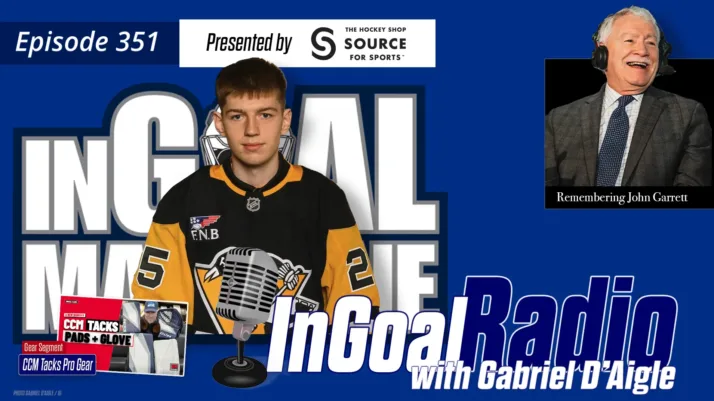
Episode 351: Tribute to John Garrett and an interview with Pittsburgh Penguins prospect Gabriel D’Aigle

Please subscribe and leave a rating — it helps us reach more goalies!


Pittsburgh Penguins prospect Gabriel D'Aigle trained with hometown hero Marc-Andre Fleury before bouncing back with Victoriaville in the QMJHL, earning a pro contract and making his ECHL debut. D'Aigle credits long-time Quebec coach Marco Raimondo for his foundation and Penguins development coach Karel Popper for his early adjustments to professional hockey.
- Gabriel D'Aigle trained with Marc-Andre Fleury while developing in his native Quebec, a formative experience he shares in detail.
- A bounce-back season with Victoriaville in the QMJHL directly led to D'Aigle signing with the Pittsburgh Penguins and making his pro debut in the ECHL.
- Long-time coach Marco Raimondo built D'Aigle's technical foundation, while Penguins development coach Karel Popper is guiding his early pro adjustments.
- The Parent Playbook segment warns that 'pro level' goalie gear can be financially wasteful and physically harmful for young goalies who aren't ready for it.
- Frederik Andersen of the Carolina Hurricanes breaks down a 2-on-0 rush scenario in the Pro Reads segment.
Episode 351 of the InGoal Radio Podcast, presented by The Hockey Shop Source for Sports, starts with an emotional tribute to goalie, broadcaster and friend John Garrett, who passed away suddenly, and concludes with an interview with Pittsburgh Penguins prospect Gabriel D’Aigle.
Feature Interview
presented by NHL Sense Arena
In the feature interview presented by NHL Sense Arena, D’Aigle shares stories and lessons from a somewhat unique path to pro hockey, including time spent training with hometown hero Marc-Andre Fleury, and insights into a bounce back season with Victoriaville in the QMJHL that led to signing with the Penguins and making his pro debut in the ECHL this season. We also get into some of the foundation he’s built with long-time coach Marco Raimondo in his native Quebec and some of the early adjustments to pro hockey with Penguins development coach Karel Popper. In the Parent Playbook, presented by Stop it Goaltending U the App, we present an offseason reality check for equipment shopping and the importance of knowing when “pro level” gear might not just be overkill financially, but could also do more harm than good to a young goalie.
Parent Segment
presented by Stop It Goaltending U
In the Parent Segment, presented by Stop it Goaltending U the App, we present an offseason reality check for equipment shopping and the importance of knowing when “pro level” gear might not just be overkill financially, but could also do more harm than good to a young goalie.
Pro Reads
presented by Vizual EdgeWe also review this week’s Pro Reads, presented by Vizual Edge, featuring Frederik Andersen of the Carolina Hurricanes breaking down a situation every beer leaguer can relate to: a 2-on-0! And in
Weekly Gear Segment
presented by The Hockey Shop Source for Sportsour weekly gear segment, we head to The Hockey Shop Source for Sports, for a look at the new CCM Pro Tacks pads, gloves and blocker to dig into some of the big changes in the new line.
Episode Transcript
Intro
I love it the way David Hutchison plays us in on the keyboards every time on InGoal Radio Podcast presented by The Hockey Shop. Source for Sports Langley, thehockeyshop.com, Daren Millard along with the cofounders of InGoal, Hutch and Kevin Woodley. How long have you been playing the keyboard? Like, was that that that childhood thing for you, Hutch?
Yeah. I was a heck of a keyboard player as a youngster growing up, and then at about age eight, they made me go to a recital and that was the end of my keyboarding career.
Really? But you you've stuck with it obviously because the theme music on InGoal Radio Podcast is dynamic.
Oh, yeah. Yeah. If anybody in Nashville is looking for a keyboard artist, just, give me a shout. I'm I'm coming down.
Just like, you're man of many talents. What do you mean just keyboards? I'm looking over your left shoulder in the office space there, and I'm pretty sure that's an electric guitar. Like, I'm expecting you on the stage with Sean Burke at Tootsies one of these years. Don't hold your breath, buddy.
Don't hold your breath. I'm a bit of a yeah. Never mind. That's just for show. It's just like my goaltending. It's all about show.
You you can make jokes and self deprecate yourself from a musical talent standpoint. But I'm willing to bet that I am the only one in this group that actually had his grade seven teacher create, invent an art class that didn't previously exist just to get me out of the music room, my trumpet playing was so terrible. Literally invented a class like, okay. Everybody has to do music in grade grade seven at this school I was at, but they've created an art class so they could get me out of the music room. That's how I'm gonna blame braces. Tough to play a trumpet with braces on, but that's how bad I was. It was
There wasn't any other instrument?
I should've given you the triangle, Woody.
Yeah. No. I can't even do that, guys.
How about this this
Which is why my wife plays piano, like, grade levels and whatever. I don't even know how it works. My kid my one daughter sings and plays piano, and I know none of it came from me. Literally created a new classroom to get me out of the music room. That's how
that drums as as a kid, and my parents said, okay. But you gotta learn how to to to do the music thing a little bit. So if you can get through a year of accordion, we'll let you get a drum set. Accordion? I did six months with missus Lang over on Fredericksburg.
Welcome to Brandon Manitoba.
Yeah. Yeah. Full on practicing the accordion.
That's hilarious. I love that. My wife every once in a while will ask me if I can match the beat on a song, like, just to see how ridiculous it is that I can't even, like, tap or, like, find the beat or match. Like, I am I am it's bad boys. It's bad. We make jokes. I know self deprecating. Illiterate. Yes. A 100%. Like, I make jokes about my goaltending and all that kind of stuff, and but this is this is, like, even more legitimate than that. I am musically illiterate. Well said, Daren.
We're going to pay tribute to good friend, John Garrett, in just a little bit, go down the the path from his conversation with Woody, that happened, just less than a year ago that he was on InGoal Radio, the podcast. We'll also catch up with a a guy in the Pittsburgh Penguin system. Gabriel Daigle is going to join us on our feature interview, and we've got the Stop It Goaltending U at the app parent segment with Hutch ProReads, Gear Segment with the CCM Pro Tacks. It's gonna be a a great episode as we get through the first round of the Stanley Cup playoffs. We got a lot of, like, new stories, but we got a the carryover of some some old themes. I'm thinking Edmonton right now.
Yeah. A lot of questions about goaltending, and I think, you know what? Let's I would just throw it to Connor McDavid. Average team with high expectations.
What a great quote.
Yeah. And, watch them obviously all year in the division. They had moments where it looked like they're gonna get it back on the rails and and become more than an average team. But ultimately, I I don't know that they were. And listen, I I'm not gonna blame goaltending on this one.
It wasn't great in the playoffs. Like, Connor Ingram gave them really good goaltending through most of the season. Like, that was not the issue. It took a it took a bit of a dip in the playoffs, but, I just think there's more there. The big thing to me is there are probably more questions about what you do moving forward than there are, in my mind, fair criticisms of what happened this season in terms of the actual goaltending performance.
I mean, Jarry ends up on the bench, and you've added two years by acquiring him for Skinner who's up at the end of the year and and questions about what his future will be after he lost the playoff starting job to Arturs Silovs in Pittsburgh. It just feels like a lot of cutting off your nose to spite your face in Edmonton, to be honest with you.
In Colorado, Scott Wedgewood gets through via a sweep at taking over the number one job there.
He was. You know, I think a lot of people, myself included, it felt like they Wedgewood kept playing so well, but it felt like there's this maybe it was just the media around that team. But for whatever reason, it felt like they wanted the job to be Mackenzie Blackwood's, and Wedgewood didn't give him a choice. Like, he was so good. Like, we've got an article up at ingoalmag.com right now looking at did the NHL general managers get the Vizual Edge trophy finalists right?
Andre Vasilevskiy, Jeremy Swayman, Ilya Sorokin. We went through the clear side analytics numbers. We went through the public numbers. We we tore that thing apart. And we had some conclusions.
I'll let you go read them. But, obviously, Logan Thompson was one of the guys that we felt should have been on that finalist list. But I gotta be honest with you, Wedgewood's right there too. You know who else too that got through the first round? Dan Vladar.
Like, their seasons, I think, got overlooked a little bit. No disrespect to what Swayman Vasilevskiy and Sorokin did, and we can talk about Sorokin in a bit, but, Scott Wedgewood was one of the best goalies in the NHL this year. And the only reason that I can see that he wasn't on that Vizual Edge list and, yes, he plays on a good team, but so did Vasilevskiy. It's gotta be the starts. Only 43 starts.
And I think the fewest to ever win the award was Linus Ullmark with 48 in 2023. So, Wedgewood has essentially, what he's doing in the playoffs is just picking up where he left off in the regular season. What a what a great story and kinda makes me smile because what a great guy. Like, we've had him on the podcast. He's done ProReads with us.
Like, he's he's a he's a goalie geek, and I say that with so much affection. He loves talking the position. He's well educated.
TNT postgame with, Henrik Lundqvist?
I'm talking about his pads and his his his LD, his measuring distance, and the way that yeah. I I I love that. And that's Scott Wedgewood. And those two probably could have gone on for half an hour, and I would have been there for it. Thank you very much.
Only thing better is when David Hutchison grabs the synthesizer, plugs it in, and and gives her a go.
True. Music to my tone deaf ears. Pass.
Pass? Vladar. Like, two years ago, would would we have seen him taking a team to the second round of the Stanley Cup playoffs? Would we have seen him getting the opportunity It's probably a a better question.
Been a great fit there. Listen. Like, there's also like, this is a Rick Tochet coach team, and I saw it firsthand here in Vancouver. They do a nice job of making the system somewhat. There is no such thing as a totally predictable, but you know where most of your dangerous chances are gonna come from.
They eliminate options. They, you know, Toc always talks about making his goalies only have to worry about playing half the net. They don't give up a lot of full East West. So part of that is that. But honestly, Vladar has outperformed that environment, again, by a margin where he should have been in the Vezina Trophy conversation.
He's been that good. And in the first round, you know, again, I I I just were they good defensively? Yes. Did the Penguins generate much, especially in those first three games? No.
But every time they did, every time they got a good look, like, Vladar was there. There are very few sort of statistical things in his game that jump out as there's no extremes in his game where he where he's targetable. I'll be interested to see what's gonna happen in the second round against a much more dynamic offensive team in Carolina in a series that starts today, but, yeah, like, just a lot of great stories. He had stints in Calgary. I do radio every week in Calgary.
And he would give you these stretches where you thought he was capable of being a number one. I don't know if it was him or just the situation, obviously, with Wolf coming up, but he never really got that chance. Now that he's gotten it, I you have to tip your hat absolutely to the way he's embraced it and taken off with it and, you know, not just played like a true number one in his first opportunity to actually be that, but played like an elite number one for almost an entire season and through the first round of a playoff series that I don't know a lot of people had them pegged to win.
Hutch, are are you loving this idea of of such a a fluid crease in the 2026 playoffs? Or does it make you long for the days of have one guy no matter what happens?
Yeah. I root I root for the underdog, so I love when when we see stories like Scott Wedgewood, not to suggest he's an underdog by any stretch, but just the I love the unexpected. I love when stories take a different turn. I love when teams give another guy an opportunity or or when he gets the opportunity and he he runs with it. Yeah.
I I I feel for the guys who don't get the opportunity so maybe the day of one guy just running with it, especially no matter what happens, I I find that very frustrating. So no, I'm really enjoying it. At the same time, you have to tip your hat to a guy like Andre Vasilevskiy who's played so incredibly well. And when the studs step up and do their thing, that's a sight to behold too, isn't it?
That's more of a rarity than the idea of a team bouncing back and forth. No.
Yeah. No. It it is for sure. And I I think it just also suggests that as the game gets more and more challenging from an offensive perspective in terms of us facing tougher and tougher chances, more selective offenses, it's much harder for a goaltender to dominate than it was if we go back to, you know, our good friend John Garrett's time. It was a very different game then, and a guy could dominate through separating himself from the from the others around him.
It's a it's a different game.
21 goalies in the first round got into a game, guys, and only two of them were mop up duty. Joonas Korpisalo in relief in Boston and Ville Husso in relief of Lukas Dostal in a game that got out of hand early between Anaheim and Edmonton. All the other guys are starters. Like, to see 21 guys get in and only two of them be mop up duty in the first round, I I think it's indicative of, you you know, this idea that unless you've got a Vasilevskiy, you're you're gonna need to. I there's a list of guys.
Vasilevskiy, Swayman, Otttinger. Like, there's a handful of guys in that category for sure, and a lot of them are in the playoffs. But, you know, Alex Lyon taking over for Ukko-Pekka Luukkonen, who was so good down the stretch, but a little bit of a speed wobble early, and Lyon comes in and wins five. You know?
And I'm not sure we've seen the last of UPL.
No. There's hey. Listen. Minnesota. Jesper Wallstedt's been great, but I wouldn't be surprised if we see not and it's not because I expect him to falter, but never like, this many games in a row, this like, we'll see.
Yeah.
Carolina. Frederik Andersen is one of the best goalies in the first round of the playoffs. A 100%, much like he was last year. But I'm telling you, game two, when they got into double overtime, there were things in his game that started to look like, okay. I think if that series game three had gone back to Ottawa in two days instead of two days off and play three days later, there was a chance you might have seen Brandon Bussi in that series.
So, you know, again, especially if you've got older goaltenders, why not embrace that? Like like, if you've got two options and you know that playing up your second option one night gets your first option back to a hundred percent two days later, unless you're facing elimination, like, there are gonna be some hard decisions along those lines. As the playoffs go on and as guys start to maybe show signs of fatigue, it's like, okay. Do we keep going with this guy, or do we do we think a night off would get us get him back to a 100% and, you know, we trust our other guy. Edmonton did it.
They put in Jarry for one game and went right back to Connor Ingram.
And Jarry was good.
Yeah. He was good. Yeah. He was. He was.
Again, like, such a different goalie. Right? Like, it was amazing to see that series. Again, we talked about, you know, the criticism around the Oilers goaltending overall, like Anaheim created rebound opportunities on Ingram and screen, like that's how they dominated on Ingram through the first before they made the switch over to Jarry Rebounds and screens. Nine of 14 goals off rebounds and screens.
A lot of the rebounds were because of screens. And, you know, two areas where they were clearly going after something in Ingram's game switched to Jari. He manages all five screens. No problem. But now on second chances and plays around the net, we've got a little bit more of that.
He's not taking away the bottom of the ice the way Connor Ingram is. There's a little bit more open and close, a little bit more reaching, a few more holes, and two pucks go in. And so that was a fascinating one to watch because I thought Jarry in the game he played solved the issues they were having. And so when they went and and they ended up losing in overtime. So when they went away from him, I was admittedly a bit surprised, but Connor Ingram had a really good game in game five.
So, options, tough as a coach, though, because if you choose the wrong one, you wear it.
Lot in our play today, including, an emotional, acknowledgement, regarding the passing of John Garrett, and, we'll share our thoughts and experiences, with, with our goalie friend and our broadcaster buddy in. But first is the Gear Segment brought to us by InGoal Radio, the podcast by The Hockey Shop, a source for Sports Langley, thehockeyshop.com. This week, we're taking a look at the CCM TACKS Pro.
Yeah. We've got our we had our full overview of this with some voices from Stuart Skinner already online. We're gonna freshen that up, and we got another article coming with Ann-Renu00e9e Desbiens. I went down to Seattle to catch her on the final game or the or the final practice ahead of the final game of the PWHL regular season. By the way, folks, talking about NHL playoffs.
PWHL playoffs have just kicked off. Fantastic first round between Boston's Aerin Frankel and Ottawa's Gwyneth Philips has started, and we'll see the others one of the other series with, Montreal playing Minnesota starts after we record this today. So I had some great, great conversations with Ann-Renu00e9e Desbienss about this product, about the CCM Tacks Pro. We've got an overview online. We wanted to make sure that we had to give them a chance over at the Hockey Shop to weigh in and show they've got a ton of inventory, and we went over the new line with Cam.
You've seen it in the NHL. You've seen it in the PWHL. You saw it at the Olympics. You've seen it at ingoalmag.com with a complete overview slash review, and now it is in store here at The Hockey Shop Source for Sports. Welcome back.
Gear
I'm Kevin. He's Cam, and this is the all new CCM Tacks.
It is.
What's new? What's different? We've already talked about it. I wanna hear your take. What's new?
My take. This is our set, folks. If you see puck marks, no. Cam isn't selling secondhand stuff. Decided We to bring the InGoal set, show it off a little bit.
The fact that we've been out
testing it. Not as many puck marks as you might like because I wore it and let's be honest, pucks don't hit me. Don't know what's going on, but
That'll happen.
I need to work on that.
So let's talk about the shape of the pad first. That is a big difference. That profile. One fifty. 150 degrees. So we're now getting that nice arrowhead shape style of that butterfly. So what I've kind of found through fitting over time and stuff like that, guys that say, oh, I can't see my five hole. I know I'm not flexible enough and things like that. This is gonna help Always kind of gravitated to a softer pad to be able to get that kind of style of closure, but that's not necessarily the case here.
Stiffer pad, tighter knees together, but still that ability to get that five hole seal. And if you have that flare, that gives you that extended extra out of it. Great option. Not saying this is just for your inflexible guys. Your flexible guys are still gonna benefit from that too as well.
But again, great overall feature, great overall closure, really kind of giving you, you know, another option.
Part of that shifting shape is a boot that feels steeper as well.
Yeah. I'd say that five times fast.
I don't remember what I said, so I can't Shift in shape. Shift in shape. Thin boot, but you can see how much steeper that angle is. How is that affecting fit in your early going cam?
So far, I've noticed the pad is fitting a little bigger, but always the access pad did fit a little bit on the big side that this is replacing, obviously. Okay. So in terms of his comparison, think if you've had an Axis previously, like we're still in around the same size. If you have an EFlex pad, this
will will fit a little bit bigger Okay. In comparison. Some of the bigger differences, shape is a big one. Stuart Skinner told us one of the things he really likes about that boot shape as well as the over that that v shape that 150. What do they call it?
Fusion? FZN? Yes. 150 v core? Correct.
Active rebounds, first and foremost, really it's a stiffer pad from the boot up, but he
That has to do with the core of pad though. Right. Well, he hasn't got there yet.
Stu talked about the predictability of rebounds off the boot, off the shin, and how they're always headed to the same spot. He really likes that. So just wanted to throw that feedback in. Turning it over to the back as Cam has already, knee stack has become do we say industry standard? Like, it's one of the more stable, one of the most stable ones in the industry.
It's got a little bit of give. Yes. They've added this wedge. We've seen a wedge before from Warrior. They've added this little wedge.
I just feel, and we've had feedback from casters, like it's regulation size, but it just for whatever reason feels like they're taller. Which again, you feel taller on your knees, which makes it easier to get a wider flare and close that up at the top.
More supportive down to your butterfly, being able to sit tall, keep that pad up and out in front of you as opposed to sliding underneath. Part of
that stability is there is a bit of a calf wedge, a little bit of a pillow on the inside edge built in. We saw that for the first time in a CCM pad in the EFlex seven. It continues here. Tapered speed channel. There's CGT?
Yeah. CGT material, which is definitely an improved slide. Stiffer build of the pad. I think this slide's better.
Stiffer sidewall. That's what's going to give you again. Speed channel two.
Whereas an EFlex is one solid right across. This one's indented. So less of this material is not touching the ice and you just sort of make contact here. There's less sort of resistance. Correct.
Strap it. Adapt the fit. Adapt the fit. Three sixty. Cam or don't?
Because Don't. No.
Then Keep you in focus. Yes. Bit of a different Still get that adjustable wrap that you have seen. So similar to what we kind of saw introduced in EFlex pads in particular. This very easy to adjust and get a little bit wider, get a little bit more loose fit, if you will.
And then a second one at the bottom.
Secondary strap. So we saw this is on the outside of the EFlex. It's now on the inside of the calf for the Tacks pad in particular.
And the feedback really for us right up to junior levels is if you want that pad to sit high and stay higher, this really helps that. If you want the pad to sort of sit down lower, let it sort of just hang over the the boot of the skate, you can loosen this up. It's typically a stiffer pad is designed to be worn a little looser, move around the leg, but the way this strapping is done, we've had goalies say that they find they can do it up tighter, keep it up on the top of their calf more easily without restricting any of that rotation. That's been the early feedback we've gotten. So what else?
Boot of the pad. We'd already kind of I touched just on forgot. Lock and Lock
and push.
Lock and push.
We've seen Push.
One more time. Lock. Push. So we've seen a similar system from a different company.
But True. When they're I can't remember what it's called. It might be PCS. PCS. Right.
Yes. Much larger than this one. This one's Correct.
A little more subtle. But a different kind of way of approaching it for sure. Right. Like, you still got that kind of hinge, we'll call it. It is a hinge.
But it's not necessarily geared towards getting the front of that tow bridge in front of that post.
It's not geared towards
So because I can now pull it over. See how I get that? I've seen a lot of, like, videos when you're watching that guy integrating with a post and actually that tow bridge kind of coming out in front of that post in particular. You have? Yes.
As he comes into that post, you can see that wall.
Because, of course, the tension on the skate's gonna hold. Right? You got it. So the other part is it I mean, you could technically remove that. You could custom order it without.
Correct. We have had a little bit of tester feedback on this causing a little bit of interference with the skate, like it can catch on the skate and not allow the pad to rotate back to center when you get back up. So that's something
that has a lot to do with your length and your toe selection.
You can change that as well, but just something to keep in mind. Early feedback is younger goalies really like it. Older goalies that are set in their ways and established and are hitting their posts at high levels consistently without it, probably would love to continue just doing it with skate laces and a larger gap.
That's why you have that option of custom. Okay.
So tapered core. Right. Outside of the leg.
You can see how that's shaped down.
Gentle. This is just basically this is a lot of high density foam in here to create that shape, to have that shape hold, to create those power rebounds that really rocket off the face of this pad. That's the
name of Speer.
Those foams are heavier so to keep the weight down they found an area here where rather than have this stick out where it really does nothing, were able to taper some of that weight down.
That's correct.
Are you happy?
Yeah. Okay. Yeah, because we kept talking about foam, but it actually has a
name. Infinite Power Rebuild. Now folks, I will say we ordered a set of EFlex seven with sort of a core that was not this shape, but that infinite power rebound stiffness, and we did notice compared to a standard EFlex seven because we have both sets, this one slid better. So again I just think it's something about that you have that CGT material which is definitely an improvement by CCM combined with that skiffer core gives you a pad that you know early feedback is this thing slides like a hot damn. Yes.
Damn. I know you're having fun knocking on the but we gotta get gloves and blocker And real quick
this is one that we shouldn't necessarily gloss over either. Why always go?
Oh, the blocker first. If it ain't broke, don't fix it. Just a lot of carryover from the EFlex 11 blocker.
Still the X Core. Very, very, very hard. Active rebound. Yes. Very lightweight, very balanced blocker too as well.
Tighter. Open
up that
cuff. Cuff, super open. Tighter fit hand?
Yes. So not a lot of wasted material. It doesn't get sloppy. Exactly. A lot of control.
Little cutouts on the side may seem like a small thing, we had tester feedback saying this actually does significantly. I can feel Oh, the air goes right through there.
The air goes right through there. D three o in the index finger makes I'm its gonna
Well, it never left. Yes. Okay. On to the gloves. It's a hell of a blocker.
Hell of a blocker or something like
that. It's such a tight fit. Can't even get off.
There we go. Okay. Five ninety. Redone five ninety. Redone 590.
Close it. Closes. That's redone.
And it has finger stalls.
It has finger stalls all throughout. Like I had this one on last, has the finger stalls, everything cranked up pretty tight.
So overall feel fantastic right off the bat. Grip on the index or actually all of the fingertips. The materials in
it feel richer right right off the rack.
Correct. This glove, once fully broken in, it definitely has a money feel to it. Very, very deep pocket plus one inch stock. Not so bad for a feature right off the wall. Nice deep double tee.
You know what? Like, if when it comes to a five ninety, there's not a whole lot that you can do to kinda redo it. However, just an update in the materials of the glove, actually having those proper finger stalls where they need to be, and that same cross form strap makes its return on the back end of the glove as well. That creates a great in that wrist without limiting the mobility. Exactly.
Still being able to pitch that glove any way you want to. It's a great update for the five ninety itself. It's less clunky and chunky compared to some of the older five nineties for sure. I think it's a great update in the overall line.
Think it'll help my game be a little less clunky and chunky? Might have to mix it a salad for the chunky part.
You'll find out later, I guess.
Hey. Well, hey. Listen. You know, it's funny because they did reengineer the five ninety. That's a while ago.
Took out the finger stalls. That they've been more towards this the five ninety one this is more like it's still built different yes
but it closes the same it closes better it sort of gives you all the properties you wanted from the original five ninety index finger to the base of that pump yeah and it just closes back like I said everything they've done in this it took them a little bit to get back to this as a glove with all the additions that they made and the changes and how they build it cut the weight compared to the the original five ninety.
It's one thing you notice too
It's so much lighter than some of the other brands. Yeah. All right. That's it. Cam, if they got any questions, the customizers have been live for a while.
We talked recently about how to order custom. You've got it in store now. Lots of selection. I'm guessing sales on access as well. Where can they get you if they've got any questions about any of those things?
(604) 589-8299 or 1-800-567-7790 or check us out at the hockeyshop.com.
There it is. CCM Tacks, new name, and a lot of new features.
Things hopping over there at the hockey shop right now?
Oh, busy, Daren. You know, when we get new gear like that
Yeah. And I can't wait to sort of share some of the opinions that we got from Anne Renee Debian. She had some really good thoughts on it. Not just, we're a little like, there's so much new gear coming at the hockey shop that we can't keep up with a weekly podcast show. So last week, we talked about the Warrior Covert QR stick. This week, we've got the Tacks Pro pads and gloves.
But CCM also launched the Tacks stick, which they have in stock at the Hockey Shop Source for Sports. And I gotta tell you, the feel on that blade is definitely worth checking out. They've also got a new undershirt from CCM with d three o in the collarbone area and great padding on the ribs and the bicep as well, plus cut proof wrist guards. So make sure you check that out. All kinds of new inventory arriving almost daily at the hockeyshop.com, The Hockey Shop Source for Sports in Langley.
And as we always like to remind people, Daren, you're wearing the old CCM AXIS line. Now that this new tax pro has replaced the old AXIS AF and all previous generations, Massive savings on any inventory they have left of the CCM Axis line, so make sure you check it out. Like I said, Hockey Shop Source for Sports in Langley, you can get there in person, or the hockeyshop.com.
Got my attention with the new base layer.
Oh, it's good. You like it?
Maybe I'll wear it around, walk the dogs just a little bit. You might get a little
you might you know, whenever CCM has d three o in a product, they call it out. They make it they make it quite visible. So that bright orange, I don't know, you're in Vegas, that might work. It's not quite me off.
For sure.
It'll fit right in.
Maybe I'll wear it to the day club. Hutch, you in?
Totally in. I would look
so in front.
In about fifty pounds, I'm gonna look great in that undershirt.
Let's let's get it and make it happen.
It's happening.
Well, and if you go to the wrong if you go to the wrong club and you get into an altercation, you'll know that your wrists have skate cut cut resistant material. You can just, like, bob and weave and and protect yourself.
Wonder what
CCM access undergarments ready for a knife fight.
Ready for a knife fight.
Base layer.
CCM undergarment to a knife fight.
Feature Interview - John Garrett Tribute
Protected undershirts long way away from when when our pal, John Garrett, broke into professional hockey off the Peterborough Pete's and and then won a Memorial Cup with with Montreal as the the pickup goaltender there, was was added to the to the team during his junior career and then spent a large part of his career in the World Hockey Association before transitioning over from the New England Whalers over to the Hartford Whalers in the National Hockey League, and, just a shocking, loss. He was covering the Stanley Cup playoffs for Sports Net, working that Utah Vegas series, and, we we got to catch up and, and in the first two games, and we're gonna see him in in game five. And and we we lost him in between there. And just to Woody, you've been able to spend some time with him. Hutch, I don't know how much he crossed paths with Cheech, but just an unbelievable personality.
Not forget about the the goaltending side or the broadcasting side. Just a just a wonderful dude.
It's that's the what you're hearing from and and, Daren, for you. I know you guys are close. I know this is has been a difficult time. The stories that come out, yes, there are great hockey stories, and we're gonna share some from when we had them on on the podcast just just about six, seven months ago. But it's who he was as a person.
It's a fellow journalist friend of mine. You know, we talked about music. John was a very accomplished pianist And a friend of mine whose kids were starting to play piano talked about the conversations that he used to have with John about learning piano, about playing piano, as he was preparing his kids to take piano lessons and and and reengaged himself in piano lessons as as an adult with young children. So, those are the stories that stand out, the personality, the person he was, in the press box. You know, I remember my first time, you know, trying to become this quote, unquote, goalie guy.
And here's a guy who played in the league and had all this experience, and he was always so gracious with his advice. He wasn't afraid to tell you like it was. No. And in a way that was encouraging. Right?
So I saw a game technically. There's so much more to it than just a technique. And he, know, he wasn't afraid to tell you that. Like, hey. Don't forget about this.
Don't forget about that. And he had so much experience, and yet he was also at the same time not stuck in the way he played. He talked to the goalie coaches. He learned the game. He took genuine interest in everyone's again, whether it was within the game in the role of the broadcaster or off the ice, he just he such a good person.
He took genuine interest in everyone's lives. He was always there to encourage new journalists in the press box, in the press room. Just it's the person he was as much as it was the life he lived. Both were remarkable, but I think the stories that come up more that you hear are are just a great reminder to everybody else that maybe didn't get the chance to meet that person, just how wonderful he was.
He loved his two Coors Lights or two at a time, and he loved his chicken wings or his hotdogs. The cutlery was was an option that that he he passed on most times. Just there there's elements of of John Garrett that are just so layered. But but what you'll hear in in reminiscing with John Garrett and playing back some of the the clips from the the earlier episode is just the the inflection, that that unique inflection that he had when he spoke, and the laughter. Just outstanding.
And we'll start with just advice for goaltenders in this conversation that took place between Woody and Cheech and and how he looks at at at playing the game today.
Again, the more things change, the more they stay the same. Like, you can't try harder. No. As a goalie. Like, you can't you can't like, and I've
had Convince yourself convince yourself that you can't try hard. Convince yourself that you can't be that just, oh, I'll just be that much better. Right? I'm the Vizual Edge trophy winner every year, but I can be that much better in our team no matter what they do. I can make the difference.
(g)oaltending is the only position on the team where you can make a difference every night.
And as you know, the goaltending is the only position on the team where you can make a difference every night. You can okay, you might be a zero zero tie, but you're the guy, you can make the difference every night. And that's what I used to tell the kids at hockey schools and that, you take the goalies aside and you say, okay. You know? You are the only guy on the team that can make a difference every night.
Sure. Goes up and scores five. Okay. He he's gonna make a difference, but the other team might get seven. But if you don't let any in, you can make the difference every night.
And and when he when he talked about today's goaltenders, you're right. Like, the he he had an educated background on how goaltenders are playing today. He didn't look at it through the eyes of the the nineties or the eighties or how he played.
No. He was always looking to learn new things, like I said, but also not just willing to hand over that any new idea was by default a good idea. Like he would challenge you if if there were times when it wasn't working. Right? Like he he had his beliefs, but wasn't so stubborn in them that he wasn't willing to think about things differently, and at the same time forcing you to sort of also think about things differently.
It was just a wonderful balance.
One of the great clips that I saw upon John's passing was one night when he talked about Roberto Luongo having a shutout and and at the final seconds. And and he and shorty worked their way through it. Like, oh, yeah. You you might have mushed the shutout. And so he's like, no. No. We should be good, but I'll I'll feel I don't I don't like saying it, but we'll we'll get through it. And then, like, final seconds.
Seven seconds left. I think he said it with 35 left.
Yeah. And and the the fun that he and Shorty had with that and how how Cheech owned that, that he was superstitious, how he absolutely leaned into it.
And I think those are the people that you think of the most are obviously first and foremost his family at such a tragic time. But then, you know, they had it on hockey night with, shorty, John Short House, the play by play broadcaster in Vancouver and Dan Murphy, the who's the host with that broadcast. They had so much fun. And I we know they're hurting right now just like you are, Daren, because I know you you you knew him well, worked with him for so many years. That that side of it, that that balance side of it is, I'm glad that we got to see that everybody else got to see some of that, you know, as he was remembered because it was it just the way they interacted and the fun they had on that broadcast, we've been blessed as Canucks, coverage for me, but fans in this marketplace to have some incredible broadcasters.
You think of Robson and Shorthouse coming through the ranks here in Vancouver, but the interplay between shorty and Cheech was just something that's I don't know that'll ever be replicated.
Chemistry. Right?
Yes.
You you see it, great line mates or deep pairings, whether it's a hockey or a quarterback receiver in in in football, when they when it's there, it's there. Your conversation with Cheech was was fantastic on InGoal Radio, the podcast, and he could tell a story, man. And you hear that right here discussing the goalie brotherhood, which is great at times and can be a challenge on other occasions. Here's Cheech with Woody.
I grew up trying to pattern myself after Roger Vachon, A little goalie, and back in the stand up era, cut down the angles, that sort of game. And I thought, well, okay. I'm his size. Exactly. And I can play like that.
You'd watch him, and then you'd watch a guy like Roger Crozier and Bauer and Jacques Plante and those guys, and you'd watch them and try and pick up the best that they had, and how they handled themselves around the net, and in the net, and angles, and rebounds, and Johnny Bower, the poke check, and you pick up the best qualities of each goaltender, but you had to do it on yourself. You're right, there was no, absolutely no instruction or advice. I remember going to Chicago. They called me up for the playoffs after I played in Richmond, designated target for the playoffs when Tony and Gary would take the practices up. And Gary Smith and I ended up being roommates.
I'm sure you've met Gary a few times, and what a great guy he is. And I remember Tony taking me aside and he goes, What are you and Smitty doing? You know? How come you're hanging around him? He's taking your job.
It's kind of a mutual admiration society, and nobody else knows what you're going through except the other goalie.
And that was Tony's attitude was and if you were the other goalie, it wasn't a team. I always looked on it as if the other goalie does well, then you won't nobody will bug you. And if you do well, then nobody's gonna bug him. It's kind of a mutual admiration society, and nobody else knows what you're going through except the other goalie. And Tony, it was, he's taking your job.
You can't hang around him and don't talk to him. I was like, oh man. And Tony was different anyway, but I thought, what an attitude to have, and what an attitude if you were his partner. It an was eye opener for me to think that, and Tony was such a great bowler and such a fierce competitor, I get where he's coming from, but that's a tough road to hoe. And you know, goaltending is really a tough position.
It's an individual position on a team sport. And now they have the psychologists and performance guys and how many goalie coaches? Each team has two or three goalie coaches, one for the NHL, an organization goalie coach, and then another goalie coach, usually a goalie scouter or something. And, back then, we didn't there was nobody except the other goalie. And
You you could hear the, like, the disappointment even today in his voice. Like, what do you mean? Why why aren't we supposed to be friends?
And that's but that isn't like what we talked about earlier. Right? Like, he's not sugarcoating it. Like, he's not gonna tell you like, he told you, like, this is how it was with Esposito. Right?
Like, that that was just the way it was. And like you said, just such a great storyteller, and there he mixes in self deprecation to everything, but, it's an art and the way he did it was, you know, like, Picasso esque.
Hutch, he just had that, unique voice. Right? That distinctive, delivery.
There are people who live with you forever because of that voice. There are people that change the game for you because of that voice. I think back to the Dick Irvins and the Danny Gallivans from when I was growing up and they will always be on my mind every time I watch a hockey game. And John left his own legacy that will be left in the minds of so many fans of, of the position and of the game. And, and then not just that distinctive voice, but just the way he brought his own personality to everything he did.
Certainly a privilege to have gotten to listen to him over the years, and I'm just sorry I didn't have the privilege of getting to know him as you two did.
We would tape a weekly segment back in the early days of Sports Net, on Sports Net News or Sports Net Central. There had a few names. Every Wednesday, we'd outside the crease. And John and I would have a subject, and he would say, okay. Which which way do you want me to go?
Basically, which way do you want me to go? And and he would argue it to the extreme, like, his absolute reputation depended on it. And then he'd end it. I'm like, you can't be serious about that. He's like, no.
It's TV.
Do it. But we like, the editors loved it. You hear laughing all night as they put that thing together after we recorded it. And but the producers really yeah. Well, like, we drove them nuts because it was supposed to be a three minute segment, and we go six or seven minutes. And they they had to find a way to fit it in the show or or cut it down. And it was always the same every time, but just the the fun that he would have and talking about different experiences that he had. And part of those experiences was when he transitioned from the World Hockey Association, some of the players that he got to play with in the WHA and then into the National Hockey League and ends up assisting on a milestone goal for Gordie Howe. More of the conversation between Woody and Cheech.
Off your whole roster. I mean, it was ridiculous. Was ludicrous to think. And, the the NHL wanted to make sure that they kept the WHA inferior because, hey, we're the NHL, and why don't they look at some of the stats of the guys' WHA careers? That's the NHL, we made the playoffs that year, and I got to play with Gordie Howe in his last year, and I got an assist on his last goal in
the I I have it on my list to ask because it took a few years for you to get credit at. But I remember hearing that story many times sitting around over in the press box in Vancouver.
Yeah. Greg Shannon kept trumpeting it and putting it online and give it to Cheech. That was a hashtag, give it to Cheech, and I it it finally came through. But Gordy was such a great guy, 52 years old. And we talked about no goalie coaches, and Gordy was just naturally so strong and so prepared, and the Saskatchewan farmer, such a nice guy, and yet an edge, and he could be just vicious if he wanted to be.
And it was a thrill to play with he and Dave Keon. I got to play five years with Dave Keon with Minnesota, and then with Hartford, and towards the end of their careers, but it was just such a thrill. And then Bobby Hull came to the Hartford WHA at the end of his career too. Bobby Hull. So there was Bobby Hull, Gordie Howe, Dave Keon, and John Garrett.
It's like Sesame Street.
Legend.
One of these things.
They they did a couple of montages on hockey night and different things from Cheech's experiences. And in one of them, it was Cheech and I on a a double decker bus in Chicago during one of the Stanley Cup finals, and I completely forgot about it. But we're just both sitting there in shades on in suits, like two losers on a double decker bus riding around Chicago and doing this content during during the senate cup final. And I don't know what we were doing, but we were laughing and having fun. It was just man oh man, the the the different things.
Driving back and forth between the senate cup final between the Red Wings and the Blackhawks, and different element. He was my voice of reason in in a lot of ways, which people will that know John will go, he was your voice of reason? Like, what kind of situation were you in? Because he could he could really stir things up. And one of the last times that I saw him, John Tortorella came into the room at a media briefing in Vegas.
And John Garrett knows John Tortorella through their time with the Vancouver Canucks, of course. But what you may not know is Cheech's daughter, Sarah, worked for the Tampa Bay Lightning when John Tortorella was there. And Cheech was always so appreciative of Tortz and how well he treated Sarah and how respectful he was of Sarah. And they got to to reconnect, and after Torts left the room, Cheech went and told me the story again, how amazing Torts was during that time. And and so I I I shared that with with Torts after we learned the news, and and it was emotional Torts night getting in the hallway of a National Hockey League first round series.
Players walking around and and were emotional, but just how as a father, forget all the the hockey stuff and the broadcasting stuff, but how appreciative it was of torts treating his daughter so perfectly wonderfully as a parent. So that that's that's the side that you you didn't get to know or weren't privy to on the tort side and and the cheat side. And the other side is a little more familiar in his ability to tell a story. Right? Like, just yes.
Yes. I know. What do you think that that that's gonna be like, he had that delivery. And one of the most famous ones was a night that he was backing up in Quebec with the Nordics. And, here is, Woody, going, down a path of one of my favorite John Garrett stories.
Daren Millard, our host of this podcast is gonna kill me. I know you've told it many times, but maybe there's some people that haven't heard it. He said I had to ask you about Quebec and the Coliseum, Dan Bouchard, and getting thrown in there one night and maybe a Coliseum being tucked in. You gotta share that one
with us. Well, not many people have seen the Se because they have a new building, Videotron or whatever it's called in Quebec City. It's a beautiful building. But the Cali Se was an old building where you came out of the dressing room and you took a right and you didn't go right to the bench. It was a hallway sort of thing, and then the bench was to the right.
So the spare of only sat behind the bench in the hallway, close enough to the bench, but behind the bench. Nobody could see it and you were down underneath. So the game's going along and it's like two-one. I'm pretty safe. Dan is playing pretty well and I think this is great.
Renu00e9 Lacasse, who was a trainer at the time, and he, every now and then, loved the hot dogs, best hot dogs in the league in Quebec, and he was, You want a hot dog? Then he was, Yeah, sure. So he gets me a hot dog, and got my pads, and every now and then I'll turn around, pretend that I'm doing something and have a bite of the hot dog. Then Dan all of a sudden decides that they score a goal on him, and he didn't like the way the defense played it. He just comes up, just skates off, blows by me and goes to the dressing room.
So I put my pads, tightening my pads up and everything, and I can't take the hot dog out because now everybody's looking at me. So I leave the hot dog in my pads and I go out and finish the game and sit in the dressing room and wait till the guys go and, you know, oh, but we lost again. So sad. Just so I can take the hot dog out of my pads and get the mustard and ketchup off the sock. At least the trainer knew what was going.
Yeah. He he described it one time. Like, it it looked like when he took his pad off, it looked like he got cut, Like, there the with all the ketchup in there on his sock and under his pad. And and by the way, ketchup was, like, one of his food groups. Oh, yeah.
Absolutely one of his food groups.
On everything.
Just one one more thing. Lady Scarlet was his his cat when we first worked together for the first number of years. And during the playoffs, Lady Scarlet would have to go to the cat hotel because he was on the road, and Sharon was away. But they had a one of the early days of webcams. So he he would he would fire up the computer, and we would check-in on Lady Scarlet and the cat hotel.
And I just thought that was just so unique that that this this famous hockey broadcaster is checking in on his little cat in in the in the cat hotel.
Another sign of, like, the torch story that just, again, the the stories, his ability to tell them, the personality, all those things. But at the end of the day, it was the person. How much he cared for the people around him, and took the time out of his day to check-in and stay in touch with, whether it's a cat or people, just spoke to the quality. And how much how much he valued the way Torts treated his daughter is reflective of how he treated everyone. Right?
He understood the importance of those things. They mattered to him.
But if if he could find a little bit of a a crack, he would poke and prod, like, in fun way. But he would he would find that that that that side of it. And the so the the the final series that he was working, he took great pride in the fact that he was the most expensive part of that broadcast because everybody else was, like, under contract or was working for for Sports Net. So I Like, Harna Ryan or Dan Murphy, like, they they weren't getting any extra money for for that because they were they were already being paid. But Cheech is like, I get paid per game.
I'm the most expensive part of of this series. And he took great pride in the fact that that he was the he was the premier guy when it came to raking in the money on that particular series. It's now I'm looking at it going, who leans into that? But but he did. And and he was wasn't doing it in a in a mean way.
He was like, look at me. Look at me. I'm the the this I'm the star of this show.
Even John Garrett in his prime couldn't have stopped that. It's a quote that he delivered during a Canucks broadcast, and I don't remember when. And it was with tongue in cheek and with all the self deprecation in the world, but it's posted on the law outside the locker room at Rogers Arena on the hallway still, amongst a number of other famous quotes from from players of past generations. And honestly, I I have a new mask coming, a wrap from our friends, Basil over at Custom Cages. It'll be my first one that's not just plain white in about four or five years.
And it's a Woody from Toy Story theme, but we had to change out the back plate. It was supposed to be the quote that's not falling that or that's not goaltending, that's falling with style. It it's now that quote from John Garrett. Even John Garrett in his prime couldn't have stopped that with a picture of Woody wearing that same mask you've got on the wall behind you, Daren. John Garrett's famous Canucks mask.
Yeah. I have the replica John Garrett mask, which was made by sports. What's what's Tony Priolo made it.
Sportmask. Mask. Yeah. Was no longer no longer Tony's.
So Tony made it, and but John gave me his mask to give to Tony to to make this replica off of. Like like, it wasn't just taking it wasn't just making a mask and painting it as John Garret. Like, Tony took John's actual mask and and and made the the replica of it. So always appreciative of of John. And and he was he was nervous about it.
He's like, you you better not screw this up. Like like, it's one of the the few times where he was, like, stern with me. This better not go awry. And I also have a a picture, a signed picture from him just to my left of John standing up Victoriaville stick Vic stick. He's got the DNR pads and and the black v sweater in the Vancouver Canucks, and just the the all star game was classic when he when he lost the car.
My favorite moment, though, before we wrap this portion up before I start crying, was Mario Lemieux's second game in the National Hockey League. And Mario gets into a a mix up in the corner to John's left. Gary Lupul. Gary Lupul. Yes.
And Gary Lupal is is taking a couple of punches from from Mario Lemieux, and in comes off camera, John Garrett flying in, and I don't know how he got that much air, but he jumps on top of of of Mario. This is Mario's second NHL game. And he starts screaming at Mario, you're never gonna make it in this league. You're a goon. Anybody can score points in the QMJHL.
And John loved telling that story. He he he owned that he did that knowing what Mario did, what not only what he was then, but what what Mario ended up doing. And and she just didn't go, oh, that was that was embarrassing. Like, he he doubled down on it all the time and and and lean into it. And that that might be the the the hot dog story is is uniquely John.
Like, actually playing a game with hot dogs in in his in his pads. But the fact that he told Mario Lemieux, you'll never make in this league. You're just a goon. Like, none of it was even ever going to be true. And anybody well, maybe anybody can score points in the QMJHL.
That was that was closer to
truth than
but but calling the only person that ever called Mario Lemieux a goon was John Garrett.
Oh, so good. So good. He he will be missed.
Just the social media outpouring, I loved him. I still love him. And I I count him as as as a great friend and a and a wonderful colleague, a huge supporter of my time at Sports Night. But you listen to everybody, and you go, I I wasn't even close to being, like, unique. He he had that impact on everybody, which is so cool.
And there there's very few people where everybody loved. Not just everybody most people liked and the rest tolerated. Everybody liked them.
Absolutely. No one had a bad word to say.
No. I loved him when he used to get his hair dipped back in the day, and he'd he'd come he'd go from a slightly grayish to a little reddish. He's like, yeah. I got my head dipped. I can do the the hair dye and all the different stories that that we had from watching a lot of hockey together.
John, we'll miss you. We'll see you soon. I hope everything's great up there, and you're truly outside the crease, but we'll we won't be the same without you. Alright. Stop It Goaltending U the app parent segment, Hutch.
Parent Playbook
Let's turn our attention towards what parents are looking at, from a gear perspective going into this offseason.
Yeah. Lots of thoughts on that, but I think Woody wants to have a word first.
Well, you know, they do gear over at the, stop the goal telling you the app. They talk a little bit about equipment from time to time, all part of getting twenty five years of NHL goalie coaching experience at your fingertips, including experience around equipment. Wanna tap into the goalie parenting expertise that helped Joey Daccord reach the NHL? That's what you get with the subscription to Stop It Goaltending U the app. All the knowledge from Brian Daccord who's been an NHL goalie coach, scout, and director, as well as the insights and expertise from his staff at Stop It, which includes a long list of veteran NCAA coaches, all delivered in easy to digest chunks, including five short daily primers, weekly style analysis, and breakdown videos, as well as drills that you can take on the ice with your team and coach.
Plus, you get included a subscription to InGoal Magazine, all with a subscription to the Stop It Goaltending U, the app. So make sure you check it out now on the App Store or Google Play and get the best of both worlds when it comes to stopping pucks. Hutch.
Gentlemen, gear season reality check time. This one's timely because we're right in the window where things as a goalie parent get a little bit dangerous. Your season's done or just about it. There's a fresh spring feel in the air. Hockey spinning up again for some people playing spring hockey.
Summer camps are on the calendar, and the equipment bag's been sitting open in the garage long enough that, you started noticing not just the smell, but what doesn't fit anymore. Your kid grew again. And somewhere in the middle of all of that, the conversation starts. What are we doing for a new gear? I get it.
I've been there. You watch your kid mature, you see them working hard. You want to give them every advantage that you possibly can. And when they're younger and a shot stings, it stings them. But honestly, it stings us, the parents too, sitting in the stands.
So we dig deep and often we overbuy. I got an email from a parent, in the last couple of weeks that really struck me. They wanted my opinion on True's top of the line pro pads for a kid whose head barely cleared the crossbar. Listen, I'm not picking on her because that instinct comes from love. I was that parent once.
Here's the truth I had to share and I'll share it with everybody today. Those pads won't fit. Even if they did height wise and frankly, in this case, they wouldn't have, they're going to be too heavy. And the kid wearing them won't be able to be an athlete in the crease. Not just too heavy, in fact, wide as well.
I don't know if every parent out there knows that the width of intermediate and junior pads is a little bit less than that of the pro pads. They're not going be able to learn the basics. They're not going be able to learn the skills of the position and, their way of stopping pucks will just be to fall on the ice and hope that things hit them. Pro gear is not an investment that you grow into. It's, it's built for growing bodies, playing a growing game.
Here's the part most parents don't realize. The gear available today at less than half the cost of pro stuff is incredible. I'd say we're in a golden era for intermediate and junior equipment. I would have gladly worn junior gear that's made today back when I was playing in university and I mean that very sincerely. And here's the bonus.
If you're spending less, you might be in a position to actually keep them in gear that fits as they grow. Do you want two years in that same not quite fitting pro gear or maybe one year in a lower price point model that fits and then next year you get something that fits again. That means they can move, they can play, they can learn the position, they can develop, they can have fun. All the things that disappear the second you strap them into something built for a 25 year old pro. So whatever you do this off season, talk to an expert.
You know we love Cam and his team, but whatever shop you trust, get your kid in there, get them fitted, not just for the right size but for the right level of gear. Kevin's told the story many times of seeing Cam and his team direct people to a lower price point piece of gear because it's the one that was right for that kid. That's a conversation that protects your kid, protects your wallet, and gives them the best shot at actually loving the position.
Interesting. The the the idea of being talked out of more high level gear is something that that that I think it makes sense, right, that that you would want the the best possible equipment, but you don't that you don't need it in in any sport. Right?
Well, it's just not the best for that age. Right?
It's not the best for that age, but it is such a natural parent instinct that just hurt my kid. I gotta buy something a little bit better. And I honestly don't think in most cases that parents think that if they spend $2.3000 on a set of pads, their kid will be a better goaltender, at least when they're quite young. I think most of them are just thinking about safety. I have the only, the only time I have quote unquote overbought and and felt like it was the right thing to do was a mask.
And I guess it happened to be like lucky that my kid at age six pretty much fit an adult sized helmet. Not saying that putting a six year old in a in a pro mask is the right thing either cause they're not going to be strong enough to hold it up. But Just as long
as their heads the size of a watermelon, Exactly.
Exactly. So, but yeah, it's definitely all about the kid being able to look, sometimes pucks hit you and they hurt And I don't want to say that's okay, but it kind of is. We have to accept that. That doesn't mean we run out and buy the next size up or buy the next level of of protection because your kid has to be able to move to play and they're not going to have fun otherwise.
Well, and the other part there too is, like, you're talking about pads too. Like, you're probably not feeling pucks through pads. Like, you shouldn't. Right. And then the the other part of going up to a higher end, you know, pro level gear is the glove's gonna be stiffer and bigger and harder to close.
Like, that's it. Like, if you can't close a glove and catch pucks, forget the forget, like, the the performance aspect. It's not fun.
Yeah. No. You're quite right. I focused on the pads, and I really shouldn't have. You couldn't hold those gloves up if they're too big.
You couldn't fit your little tiny hand in. Like, the intermediate gloves are made to fit smaller hands like mine and like You knew I
was coming with the had
to get it in early. And chest protectors, pants, know, we also as parents get obsessed with our kids being successful so we go and over buy size to fill the net. It applies at all levels. Don't run out and get a 27 inch paddle for your four foot tall kid. Go get fitted properly so that you're not just for the right size but for the right
piece of foot.
Pardon
me? It's why they make that stuff to for that age group.
Oh, no. I'm saying they don't. I'm saying is so many parents go out and buy stuff made
for other age groups. I know. But but parents parents looking at it going and trying to overbuy. Right. Or oversize, like look at what what is manufactured for that age group.
Yeah. And and it's also just a natural thing of thinking you're gonna save money too. Right? Let's let's buy something a little bit bigger. May maybe finally Johnny's ready to get into that senior gear and it'll last me a little bit longer.
It is an expensive sport, but that second price point gear, as Kevin has pointed out so many times on gear segments, is incredibly well made now.
We've got a goalie right now who did CCM EFlex 7.9, their second price point on the EFlex seven line, as a test through us. Went through the entire season. No problem with one set. It looks like it might have another season in it playing at high level prep school hockey. So, they were on the ice five times a week.
No problem getting through the year in the second price point gear. And this like I said, this is, you know, one of his teammates is probably gonna be the first player picked in the NHL draft in a couple of years. Like, these are this is a pretty high level of hockey and no problem getting through a season in the second price point gear. So if you can do it at that level, folks, certainly when you're talking about much younger, much smaller kids, like never mind that it'll get through the year, but to Hutch's point, it'll save you money, maybe allow you to properly size it for two years in a row with different sets of gear. And it's gonna perform better because it's gonna be less stiff.
Yeah. You go the the highest level, the the the what's the the top of the line. You're paying a premium for that because of that product. But if you go but you're you're you have to buy it a little bit bigger to grow into it. If that's the plan, that's the idea.
Or you go second price point, and you can buy what fits you. And if the kid grows, your child grows, you you can buy a a set to keep up with the growth spurt and you're still probably in in line with the the top of the line gear from a cost output.
Yeah. For sure. And I think Woody just brought something up that was really important that that 7.9 set might be good for another season. I think we're all we're not all a little guilty. I think we're very guilty these days of creating this environment where parents and goaltenders think to play the position every near year, you need to go out and buy new gear for next season.
That 7.9 set will be perfectly good for somebody else if the goaltender you're talking about has grown or needs a new set for whatever reason. It is okay to buy used equipment for your kid as well. I know you might not get Cam's expertise in sizing it, but you know what? Cam's an honest guy who wants your business forever. You could probably ask him, Hey Cam, should I be getting something used?
Is that okay to do? Could you maybe help me decide what piece I spend my money on and what piece I have to go and get used? He understands as does, I hope the person that you work with in your local store, the realities of the position. It is okay to use gear for more than one year in a row. It is okay to get it from another goalie in the neighborhood who's outgrown their gear.
We want kids out there having fun and there is the gear today lasts so much longer than it used to. Sometimes you see people online nitpicking because they got a skate cut on something or a seam came. Like the gear does age but it doesn't mean you can't play in it.
And you can get it repaired.
And you can get it repaired. You and I used to do it ourselves.
Remember that
Hutch? It was the best. I used to fix up my gear, add some padding here and there and dream that maybe one day I'd be an equipment manufacturer. It was some of the best parts of it, so it's okay.
Let's go over to ProReads, brought to us by Vizual Edge.
Do you want the puck to look like a beach ball? Every goalie has that night here and there where the puck looks huge. You're ahead of every play. You feel calm. You feel patient in total control.
Then there are the nights where you're half step late. You see it, but you don't really see it. You're reaching. You're guessing. You're fighting it.
That's not your technique. It's your eyes and brain not processing the play fast enough. Vizual Edge fixes that. It measures how well your eyes track and process the game then gives you a custom plan to train improvement. Three fifteen minute sessions a week, that's all it takes.
It's what NHL goalies use to make the game slow down when it matters most. And, of course, if you're an InGoal member, you will get 20% off. If you're not, use the code I n g o a l, all caps, to save 10%. But if you're a member, log in to any ProReads at ingoalmag.com and get your special InGoal membership discount code to save double that amount on a subscription to Vizual Edge. If you're thinking about Vizual Edge and you're not a member of InGoal Magazine, you should probably subscribe to us because that double savings will more than cover the cost of your subscription.
So make sure you check it out today, Vizual Edge.
What's Freddie doing?
Well, Freddie's killing it in the playoffs as we already discussed, but this week on the ProReads, he's gonna talk about it's kind of a two on one, but it's almost a two on o. And believe it or not, it's right after a face off. So Freddie does a great job. What are your priorities on that, Daren? This is actually one of those few that even us old beer leaguers can relate to because let's be honest, we've all seen a two on o.
What are you thinking on a two on o as a beer leaguer? What do what's your what's your first priority when that play hits the blue line? What are you thinking for depth?
I'm less depth. Medium depth at most, because I'm expecting to pass.
But still coming out to play a little bit of flow?
Little yeah. Yeah. I I need flow to help me get across.
Yes. Little momentum. Hey. Listen. They need it in the pros, so it's okay for old farts like you and me. That's that's the way I'm thinking about it. I'm gonna need a little bit because I'm expecting it. I'm counting on a pass.
So less than you would take on a breakaway, though?
For sure. Yes.
K. About your angle? Is that player cuts in, say, into below the bottom of the dot? Are you staying square to him, or do you cheat a little bit?
I would like to be square to him, more square, but I'm definitely cheating if I'm going to admit it.
So a little a little Yes. Not cheating
not cheating on flatter.
Not cheating on your angle, but you flattened out.
I'm flattened out. Yeah.
Okay. So this is the discussion that Frederik Andersen has with us. I'm not gonna tell you if he agrees with Daren or not.
I I would like to be honestly, if it was if I could do it, I would like to be, square to the to the puck carrier, but I know that I'm going to be flatter as a way to anticipate that pass that I'm expecting.
Okay.
Me, I just dive out Johnny Bower, poke check style to see if I can struggle.
Bad way to do it.
Well, except for then, you know, at the Beard League level, if you miss or even if you get it, because it's a two on o, chances are everybody stops getting back towards you. Yeah. So the two guys can get the rebound and then pass it around a little bit more. Yeah. Fortunately, Frederik Andersen doesn't have to deal with but he walks us through those same decision making processes that we just talked about with you, Daren.
Surprises himself a little bit with his depth decision when he reviews it with us on video. So make sure you check it out this week. Some great advice. And like I said, one of the few times the National Hockey Leaguer is gonna actually break down video on an essential two one o. So something we live within the beer league world, it really applies at all levels.
All part of ProReads, all available at ingoalmag.com, and all presented by our friends over at Visual Edge. Make sure you check it out today.
I will add this. My if I'm going to face a two on o, if I if I could choose, I want the guy coming down on on the left side, left wing side to to my blocker side. Because I want them to pass it over, and I'm ex if they're gonna do the the Give and Go pass back, I can use my stick easier because that that pass coming back to my blocker. That that's what I'm I'm always wary. I'm expecting the first pass, and I'm wary of the second pass as I slide across.
And if they don't go back, you've got the windmill glove save to make the highlight reels with.
And if they just if the puck carrier just shoots it
Selfish.
That's what we yell at him. Yeah. Who shoots on a two on o in beer league?
You selfish. Yeah. I called you guys selfish today.
Yeah. Well, while fishing the puck well, I mean, as I'm fishing the puck out of my net, I'm definitely giving him an earful. Now listen. You know you know what we haven't covered here? We did and Freddie Anderson didn't even go to this.
So obviously, it's no longer a thought process because the rules have changed. Did any of us consider going full David Leggio on this?
Just knocking the net off?
Knocking the net off because
the penalty is a breakaway shot. I I don't think Freddie had room in that one. It was a little tight, but, yeah, that was
a great move when he did it, wasn't it? Yeah. No. I actually I mean, anytime you get a rule changed based on your brilliance, I I I'm and so, you know
They changed that to an automatic goal?
No. It Penalty shot is
No. That that's why he did it because the penalty shot was better than a two on-zero in his goal then. I think it is an automatic goal now. You're right.
Yeah. Otherwise, I keep doing it. Yeah. I was explaining that just, like, three weeks ago to somebody. They're like, why would you do that?
Because there was there was a, like, a a borderline three on o in a game that we were watching. Like, well, it goes one guy's easier than than three guys. And the person said, yeah. But you got, like, full you're fully excused if they score in the three on o. If they score in
the breakaway
if they if you knock the net off and you they score in the breakaway, everybody's looking at you going, what a dummy.
Well, I mean, given save percentages on penalty shots and stick tap to Scott Wedgewood for his penalty shot save on Quentin Byfield in the, first round series between the Avalanche and Kings. That was a looked like he had him, and he still gets across at the glove. I just love his compete. So, I still like his odds. I think David Leggio was onto something.
Wonder if those rules apply in beer league. You think we'd get away with it?
I think that ends up on an automatic goal.
Yeah. Those referees take it serious. They've probably studied the rules.
Yeah. Damn it. And they're just trying to get out of there, and they don't need that kind of stuff happening. Because imagine if a goalie did that every time there's a three and o in men's league, the net would be tipped over more than it would be upright.
It would. And what would the ref do? He wouldn't put the net back on. He'd look at look at you and say, you put it back on.
By the way, at my little morning skate, Baker boys skate on Saturday morning, I had to go put my own post in this morning. And then three guys waited for me because they wanted to shoot pucks and they're like and they had this tone about them where I was holding them up.
And You didn't give them the old, do you know who I am?
What no. It was like three minutes. I'd been out there for three minutes stretching and nobody went in and put the post in. And then they were mad that I was holding them up to to shoot pucks in the net as I'm down in my hands Like, you morons.
I'm actually I consider that a sign of respect because some of the skates that I used to go to, they just would kept shooting.
Shooting. Yes. I think they
As you're putting them in,
they probably Yes.
Exactly. Hitting in back of the legs. Yeah.
Yep. Seen that one.
Yeah. That's that's true. And I was like, you dummies, we could have been, like, up and running if one of you two would have put the post in.
I don't trust I don't trust forwards and defensemen are that smart. I don't trust them to
put the post. That's the other part. How many times have you gone after they've put the post in and you've looked down and it's like crooked?
Or it's or it's just Or not in the middle.
Or it's or it's just floating on top of the ice. It's not actually anchored into anything. It hasn't been actually chopped in.
I used I used to measure. I'd use my stick and make sure it was
I swear to you. And then my kid learned that from me and he started doing it in junior and then I saw a bunch of little kids who used to watch him play junior and they started doing it. Yeah. Like if it's not in the middle, if a puck goes off the side, off the bar and in, you have to ask yourself, did I have the net in the middle or not? Because maybe it would have been
But I always think, what if it goes the other way if the net's over a little bit and it helps
You're right. It's a fifty fifty shot.
You're right. Exactly.
Okay. So let's let's be honest here now. We're talking about left and rights and being center angle and all those kinds of things. Those are important because you've sort of trained your mind to be in the middle of the net. And if the net's not in the middle, then you might be off angle.
But when you're doing your own pegs, how many times have you just maybe a little north south, you know, a little put that put that drop that peg maybe at the top of the red line goal line, not in the middle of it. Just sort of bring it forward a little bit.
I've never thought that. But now now it's in my head, I'm I'm gonna do it. I just I don't why. That's good. That could also be fifty fifty.
If the if it's a little bit forward and the puck was was gonna go wide, it might go in now.
I don't know why in my mind somehow that helps me. I know it doesn't actually make any sense, but in my mind, do
it. Don't explain my
head now. Listen. Don't explain it to me because I do it.
I just got the gears moving, I can't figure out why you would do that. But
Ask chat GPT. Maybe he'll come up with a reason to validate.
That's the only way I get an answer these days. Fair enough.
We've been doing some chat GPT questions in the studio during games lately, like on on random hockey situations. It's it's kinda freaky, the answers that you get back. And the answers are closer to being believable on random hockey questions and plays than than I ever would have expected.
Yeah. We should have we should have asked. Chad, what would you do on a two as a goaltender on a two
one o? Do on a two one o? We've got our feature interview brought to us by NHL Sense Arena, Gabriel Daigle. What's happening over at NHL Sense Arena, Hutch?
Well, first, I'm looking up in chat GPT about what I should do on a, 3 on 0. So you need to give me a little while to answer that one.
Blame your blame your teammates. That's what it should say on a three on o.
That's good. Hey, listen to guys. I don't know if you knew, but May is goalie month. Our friends over at NHL Sense Arena are going all in this month celebrating the position that, we all love around here. And look, you know, being a goalie is the best job in hockey.
Last Line Difference Maker, the one who can steal a game and have a whole bench mobbing you with the horn. Let's not get Woody in here self deprecating now. You think the game at a different speed, you read plays before they happen, and you've got a craft that takes years to build in a lifetime to refine. Every shutout is a masterpiece. There is nothing like it in sports and NHL Sense Arena gets it so they are celebrating it.
They have built a platform for goalies by goalies all month long and now they're rolling out the red carpet for the position. They're not messing around on this one all this month. They are giving dozens of prizes away every week, including jerseys, NHL Sense Arena subscriptions, special goalie content, interviews, behind the scenes videos, and, yes, a few surprises that they haven't tipped their hand on yet. The grand prize is a custom painted goalie mask designed by former NHLer, a longtime pro and friend of the show as they say, Kasimir Kaskisuo. One mask, one winner painted by a guy who's lived in the crease.
They're asking everybody to get involved. You get the details about this by heading over to their socials. And if you could, please share your story with them. Send in a short one to two minute video sharing your goalie journey to goalie@sensearena.com. Let them know one or two things like why do you play goal?
What's your best story as a goalie? What's your favorite part about playing it? All the details will be on NHL Sense Arena Social, as I said. So get that headset on. Keep stopping pucks.
May is your month.
Feature Interview - Gabriel Daigle
What do you set up this conversation with, Gabriel?
Well, I mean, it was set up for us. We should thank Marco Raimondo who worked with him throughout his junior career, and and has obviously been a a friend of the show and a past guest here on the InGoal Radio Podcast. We also know his goalie coach after he turned pro, signed with the Penguins, entry level contract, full value entry level contract, and write down to the ECHL at the end of his junior season. Posted a nine twenty five in three games with the, ECHL wheeling nailers. Carl Popper working with him, who's also been a guest on the show in the past.
So, world's colliding here, Daren. Just 19 years old. Like I said, turning pro after a real nice bounce back season in junior. Penguins draft pick. We just wanted to pick his brain a little bit.
He's a gear guy. He's a tattoo guy. I forgot. He's got a he's got a Kenny Dryden mask tattoo on him, and I forgot to ask Yes. About And I screwed that one up because we're we're twinsies on that one.
But, yeah, just listen. English not his first language, bit of a shy young man, but I thought he did remarkably well in this interview, walking us through his path, some of the experiences along the way, his work with both Marco and, Carl over the last little while, some of the adjustments to pro, and just basically his path to get to this point, an exciting point for him as he embarks on his professional journey.
Get to know Gabriel Daigle on InGoal Radio, the podcast, the NHL Sense Arena feature interview.
Really excited to welcome to the InGoal Radio Podcast. First time guest, hopefully, first of many. Recently signed with the Pittsburgh Penguins after finishing his junior career in the QMJHL, Gabriel Daigle. How are you?
Good. And you?
I'm good. I'm good. We're excited to have you on here. What's it what it's been like? You're in Wheeling right now.
You've you've got in three games at the end of the season, with the Penguins ECHL affiliate. How's it been? That's a pretty whirlwind transition from playoffs right into pro hockey. How what's what's what's it been like?
It's very different than junior. You know? So, like, it's I play with men's. So now it's like the guys are better or smaller, like, or stronger. I mean, like, my first game was, like, a big adaptation for me.
Like, there was a big difference. But after that, my second game, I played in Raiding. Yeah. Raiding. And it went, like, really, really well.
I played, like, I guess, like, 39 save, one goal, we won in o in OT. And my last game, I got, like I got a lot of shots, so it was it was a good game. So also my three first game was, like, pretty good.
Excellent. Now you're used to a lot of shots from your time in the
Yeah. Yeah.
I saw, like, 37, 40 averages around that. What is what is being playing behind a busy team do for you as a goalie? How do you adapt to it?
I learned a lot. Like, I didn't really adapt to it because, like, the years I've before, like, my draft year, I got all, like, the same amount of shots. So I mean, like, it was, the same thing for me, but I like it. So it's fun when you got a lot of That's that's what the goalie job is. So yeah.
You like it. Okay. So I'm going to the ECHL and you you talked about it. Like, you're you're 19 years old. You're you're drafted last summer and now you're playing against men.
What is the biggest adjustment for you as a goaltender? What are some of the things you've had to change? You know, I I know it's only three games, but in your first couple of weeks of pro hockey and and getting on the ice at that level.
It's maybe, like, just to be a little bit more smart and on it. Like, in the crease, just the crease management is really important. Like, don't challenge too much on the angle and just cut the crease. Like, I mean, like, play a little bit more like, know?
A little deeper?
Yeah. A little bit deeper.
How how would you describe like, is that a big adjustment for you? Were you a little more aggressive in the queue?
I was really aggressive in the queue. Like, always, like, like, over my blue paint, and I I wanna challenge a player. I was like, no. I'm just trying to be, like, square and set on every shot.
So maybe a little a little less is more, so to speak.
Yeah. Exactly.
So now now we know your goalie coach down there. We know your goalie coach, back home, Marco Raimondo as well, and we know, Carl Popper down there in Wheeling. What are some of the lessons you've taken away? Let's start with the last couple of weeks working working with Carl.
I mean, it's like the same, like what I said, like, it's just to play a little deeper. I mean, and all it's like on tracking just but it was like the same with Marco I have the last three years. So it's the workload, like approximately on the same thing, so it was not a big difference.
Okay. What about rush depth and rush management? That's one thing we hear a lot in pro too. Like, you know, a lot of guys, like, to get out and flow. Is that something you've had to change?
Like, wait for it to come across the blue line even before you make a first move?
Yeah. Exactly. Like, I need to wait, like, exactly on the blue lane to, like, just go on top of my blue paint and wait to the player. And I need to be, like, way way more pre patient, like, in the pro. So it's it's like, it was a little, like, really hard for me, like, the first three days.
But now it's, like, it's, like, normal, so it's good.
What's wait. If you're out there, what how how was that lesson learned in those those first three days even in practice? Like, did you learn quickly that if you're out too far, they're just going to pass it around you?
Yeah. It's well, it's more like to don't be late. Like, because if they pass it, like, if I'm too I challenge too much, I will be late on the pass on the on the other side. But, like, I didn't really practice before my first pro game. So I did, like, I think, like, two goalie practice before.
So I was, like, in my first game, I was, like, so a little bit nervous because I didn't know like what it's going to look like. So, yeah, so it's like, it was like really, really like, I need to like learn really fast the first days.
How did you manage your nerves? Like that's that's what what advice have you learned over the years for managing that first time in a new thing, you know, that other kids might learn how you you go in there feeling a little bit not knowing what to expect. How'd you sort of find your game within that?
I I just tried to play the same, like, the same way in the queue. So try to have fun and stop the puck. And and yes. So I didn't change a lot of things for my first game.
Okay. So speaking of having fun, my understanding is that, a guy that we've we've gotten to know and has become synonymous with having fun in the crease. You've had a chance to train with Marc Andre Fleury over the years as well as I understand it, a penguins legend. Now you're in his organization. Can you walk us through that, and what are some of the lessons you you take away from that time?
I mean, like, I practiced with, Marc Andre, like, for the not the last summer, but the three before.
Okay.
And it was like, I don't know a about him. Like, he always smiling, always like having fun. But like, when he gets scored, like, he gets like, I'm not even saying mad, but, like, he wanna stop the next puck and he never, like, he never stopped until he stopped the the last puck. So, like, he's really, like, he's he's really, really good.
So you you have the fun. He has the smile, but he never loses that competitive edge either.
No. Never. Like, I remember, like, the for the last summer I practiced with him, like, the end, he got, like, the score a lot. Like, the last five of 10, like, shot was gold. So after the practice, he takes, like, one of shooter one shooter and said, like, just shoot on me until he saved, like, all the pucks.
And so I was like like so I was like, surprising me. A guy, like, nine thirty nine year old guy just wanna save the last fucking yeah.
Good lessons.
Yeah. Really good.
No no matter how long how long you've been in the game, there's always work to do. Yeah. So how did you get started? Walk me through Gabriel, how how you got started as a goalie? How'd you end up in this position, and what do you love about it?
How I started, I don't really remember. Like, I was like I think I was like six years old. Like, was like only players practice on goalie. K. And my father told me like, I want to direct in the net, try to stop puck.
So I never, I never played player. Like I think I played like one game. But after that, I always be a goalie. And that's, that's why I buy skating, like, for less I will say, like, my skating, like, three years ago was really bad because I never really skate as a player.
Okay.
But like, right now, I'm practicing it with with Mark on that. Like, I mean, like, what I love about it is just, you know, the feeling to stop a puck and make save. Just like the feeling to be important in the game.
Okay. So I I I wanna touch a little bit of on that skating. When you talk about maybe not being a great skater coming in, what are some of the things that you and Marco have worked on over the past couple of summers to get your skating, up to a higher level?
So, like, each Monday, like, there was, like, a figure skater guy, like, who just give, like, lesson of skating. And they were like, we were like a group of goalie. Like, every goalie of Marco, like, we're, like, skating for, like, one hour. It was like, it's all like inside the inside blade, outside blade or like, just really, really, like, we are it was was all at the beginning.
What so are you in your goalie gear as you're doing this or you're just in skates?
Yeah. Goalie gear.
Okay. So a lot of different edge work type of stuff.
Yeah.
What did you think the first time he Marco told you you were going on with a figure skating coach?
I was like, oh shit, I don't know how to skate. At the beginning, it was very hard. Like the first summer was like one of the worst of the group. Okay. But I think the the last summer, I think I, like, there was a big, like, I'll say, like, I was way better, like so right now, like, I I think I'm a pretty good skater right now.
Now you obviously I mean, you played in the queue at a really young age. You had success at a really so obviously, you could move in the crease. You could skate.
Yeah.
But what's the difference between you now and you then when you say I'm a bad skater and now I'm a good skater? Like, you could still move around the crease really, really well. So what what in your mind can you describe what the difference to you is between then and now in terms of how you move and how you access your edges?
I I mean, like, in the in the net, there was a big difference. It's more like outside of the net. Everything like c cuts or or I don't know, like just getting more legs. It's more like outside of the net. Because inside of the net, like the t push, shuffle power push, it's like, I was like I think I was good.
It's just like the outside of the net skating, was bad. So yeah.
Okay. So do you think that the outside outside of maybe going out to handle a rim and stop a puck on a puck handle, has the other the stuff outside of the net helped your game inside of the net? And in in what in what way?
I think just to be a good skater is, like, itself to, like, every movement, like, in the net, I mean, just to be a little bit faster or even when you stop a rim, just, like, to be there faster and be more in control.
Okay. What, as you so as you you fall in love with the game, you're playing it as a goalie, you love being in there stopping shots. When did it become something that you got serious about? When did you have your first goalie coach? When did you who were your heroes growing up?
Who did you look up to? I guess growing up where you did and having the same hometown as Flower, probably he's on that list.
Yeah, of course. But like, I mean, when it becomes serious, I will say like maybe at at 10 years old. Okay. Like when I got invited to the break tournament. Okay.
You know, in the mountains, so it started to be a little bit more serious. And, I mean, like, I was always watching Fury. And also, I really like Bobrovsky when I was younger and still still now is a really good goalie. I think it's my, like, true role model. Like
So you're you're 10 years old. You love watching Flower. You love watching Bob. Are you watching them just because you love watching them play? Or is there a step there, Gabriel, where you're like, okay.
He does this, so I'm gonna try it the same way.
I think, like, maybe Fleury is just like how we play. Like, it's like street hockey. And I mean, Bob Bobrovsky is like the technical, the skating, the tracking. Like, I really like how we move, like in the net, it looks so easy.
Did you were you were you trying to emulate that? Were there were you were you used like like Bob came over and he learned the reverse. Were you trying to do some of the same things as you grew up older watching how he did it?
Yeah. Exactly. Like like in my basement, have, like, 70 guys. You know?
Okay. Yeah. Synthetic guys are the basics. Say, there I now I need to know that. Yeah.
Yeah. So, like, when I was younger, my my father, like, coached me.
Okay.
Like, and he was looking Bobrovsky, me and him was looking Bobrovsky and tried to do, the same thing as him. So so that's why. Yeah.
Do you still go down in the basement with the synthetic guys?
Not really. I I coach now. I start coaching in my basement.
Oh, really? So you're coaching other kids. How old?
Like, maybe between eight and 12. Okay. I I coach, like, maybe, like, 10 kids during the summer.
How long have you been doing that?
Maybe the last I think since I'm I'm junior. Like, maybe, like, fifteen, 16, 15.
Okay. So as a goalie, and we've had this conversation with other guys, are you learning from them too? Like, can can you can you improve as a goalie teaching young kids? Does it help you understand your game?
Yeah. But a little bit. Like, I mean, there's a difference, like, if you have the game a little bit, like, when you coach Yeah. Just to see how they move and sometimes just think about, like, how I can move on this situation or something like that.
Do you does it force you to like, it's one thing to be able to do something. Yeah. It's another thing to be able to see it and coach it. Like, I can see things technically, I think. But I I could never coach it.
I would not know how to do it. So it requires a level of a deeper level of understanding. Has it helped you in that way?
Yeah. Like, it's tell me to, like, maybe analyze my game a little bit. Yeah.
Can you give me an example? Anything where, like, over the years where it's okay, I never thought of it this way and this little guy is doing it this way and this might work for me.
I know.
I put you on the spot. Yeah. I put you on
the spot.
Yeah. I don't I don't really know. Maybe I don't know.
That's that's okay. That's okay. But but just the idea of it, I love that you're doing this. The synthetic ice, when did you have that down? Like, what age did you start, you know, working in the basement with your dad on synthetic ice?
Was he a goalie as well, or was he learning with you?
Yeah. Like, I start at, maybe six when I start playing, like, be a goalie. Yeah. Like, my my father bought, like, bought the synthetic setup in my basement. Yeah.
And I start practicing, like, every day during the summer to be ready to be, like, is it the same novice? Like, it's like at eight years old, it's the same thing to be to play novice eight. And so I started there and I did like the the novice 18. I make it, made it. So that's that's that's why I made it.
And also, what was your other question with that?
Just just, how long you've been doing the synthetic ice and and whether your your dad was a goalie or was he learning with you?
Yeah. He was a goalie. He played, like, midget midget double A, like and he he learned the same, like, at the same time as me because, like, the game is what is different now.
Of course. Yeah. So he was learning the new stuff along with you?
Yeah.
When did you connect with Marco Raimondo? Like, was that just strictly through junior or or when did you sorta was there a point where you went from your dad being your coach to getting some other voices with him?
My dad was my coach, like, the like, since when I started, but I also, like, worked with Stephane Manor
Okay.
Who is a coach in my hometown, coach Fleer. That's how I I know Fleer.
Okay. And
after that, Marco, I think it was like, during the COVID, he was like one of the only one goalie coach who still like do practice. So so I start practicing with him like every every week during COVID. And that's why that's, that's what five years ago? Yeah. Maybe five years ago.
Okay. And then, so you what do you think of working in the the smaller three? I was gonna say the three on three rink, the smaller rink that he has, the original one that he was at when we met him. But if you're working in synthetic ice in your basement, that would have been big.
No. No. But I I like a small rink
Yeah.
At at Chat Sierckey because, like, the the the like, the player are very close and the shuttle, like, it's all like scoring chance.
So All the time.
I think it's yeah. So that I think it's helped me. Like, I think it's good to do, like, sometime low ice and sometime, like, normal size.
Yeah. What so it's funny because we heard the same thing. Have you connected with some of the other guys that he works with there? Get to know other pros through your opportunities to train there over the years?
Well, I mean, like, I trained with, like, Devon. Levi. Yeah. Yeah. I practiced with, like, a lot of junior goalie, like, work with Marco.
So yeah.
To get a chance to any guys stand out that you learned something from over the years? Like, oh, okay. This guy does it differently?
Yeah. Of course. Like, every goal are different, so it's it's good to, like, watch Devon and the other the other junior goalie or the other pro goalie. So, yeah, also practice with Kelly, you know?
Yeah. Yep. Zach?
Yeah. And it's the pro, like, it's it's, weird. Like, it's not weird to say, but, like, the pro are always like really calm, really patient. That's like something I need to bring a little bit more in my game. So it's always fun to look like a pro and say like, I have to do this to be at door level.
Right. So that calm and that patient, you've watched it for years. You're getting an introduction to it now. Any advice for other young goalies about how maybe they can try and adopt that earlier in their career rather than waiting until they turn pro?
I mean, when you're younger, I mean, the, like, the most important thing is to be, like, athletic. K. I mean, I think it's that's the the thing that worked for me. Like, to be, like, athletic and and, like, to be competitive. I think it's, like, the the most important thing.
And after that, like, work on patience, tracking, and and, like, be calm.
When you're working with your young kids, how do you teach or how do you work on patience? It's a tough question, but, you know, how do you it's one of those things where we all wanna be more patient. You're you're working on it right now against these incredibly, like, older shooters with more experience. How do you do it?
I mean, just to wait the puck.
Just wait?
Yeah. Just wait. It's stupid to say like that. It's just like to to wait a little bit longer see the poke to, like, to to read the release.
Do you you find being a little bit deeper has helped you? Like, just a little bit further back in your crease gives you a little more time to take that all in and and wait on it?
Yeah. Of course. Like, to, like, to steal the deep person. Like, it made, like, to just be more patient at halftime to read the release and rack into the puck.
Are you a gear guy all that time in the basement, or are you a bit like are you a gear I say this word with affection because we are here. Are you a gear geek? Do you do you get into all the details? Or are you just playing what you play in?
No. I'm a like, I I like my gear. Like, I like know what I'm wearing. So
Okay. Get walk us through your walk us through your setup if you don't mind. Like, what are you in today? Why do you choose certain things? How do you feel it performs with your game?
The athleticism you have in your game?
So right now, work with, like I'm, like, all Bauer.
Okay.
Like, skate to to mask. I really like it because, like, it's light and it's and also, like, example, my my pads. It's a lot of light. Like yeah. And, like, I really like it.
Just like it's like the perfect fit for me.
It's got some flexibility to it for your athleticism. It's still super active rebounds, those types of things.
Yeah. Exactly. Like, it's just I don't know. It's hard, like, to to to explain. But, like, I, like I I also don't like to change my gear often.
Okay. So you
So I I like when it's, like, really soft, like my pads are soft.
So you've worn them for a long, like you wear them for a long time?
Yeah.
Okay. So this is something you're going to have to get used to at pro as you move up the ranks, you get new gear all the time if you want it, but you'll have to leave it a little bit maybe.
Yeah. It was like a a change, like, to like, twice a year. So it's not like a change. Like, I don't wear the same pads all year, so it's not that bad.
But you're not gonna need 14 sets a year like some guys.
No. No.
That'll be music to the ears of your equipment staff. That's for sure.
Yeah.
Do you know what your glove break is?
Do you
like, do you know those details?
My my glove is a shadow.
Okay. So you are into the details.
Yeah. I know my glove is a shadow. It's a pro palm, like for the game and like because I don't know. It's I like when my glove is a little bit more stiff. Yeah.
And also my blocker is a old Hyperlite, like it's an old model.
Okay. Didn't switch to the new one?
No, because I don't like the shadow. I feel like the blocker is like not on my hands, but it's like, I don't know. I also, I don't really like it. I just like the old and I have like the same blocker for the last four years.
See, but that's, that's a good thing. That's a good because Bauer, you can still get the older models when they upgrade it. You're not forced to move to the latest and greatest or their version of it. You can keep your old one.
Yeah. With Bauer, you can, yeah, he can do whatever he wants. That's that's the nice part.
Do you talk to other guys about gear? Like do you guys like, have you found depend on which goalie? Some guys love it, some guys don't?
Not really. I don't really talk about gear with like the other guys. Maybe more a little bit more in the summer, like in the summer when I practice with a year ago with Marco was like, yeah.
Try the different things. What have you learned from Taylor Goece in your time there? Because there's a guy who's who's, you know, been around and and moved up the ranks over the years, got a chance to go to the NHL at the end of this season. Anything you've learned from him?
Like, it's like the I will yeah. I learned it. Like, he's, like, a really patient goalie. Like, he he really, like, trade the like, he's really good tracking the puck. And, like, he move very, like, he move very well in his crease.
Yeah, he's like he play, like he's a really good goalie, like
Awesome. Hey. Listen, Gabriel. This has been awesome. Is there anything I'm missing here?
Your experience let me ask you about your experience in junior because they were there for a long time and there were some ups and there were some downs.
Yeah.
What what what did you take away from that and learning lessons from, you know, tougher years at times then the success you had later on? What were some of the key steps for you?
I mean, like, yeah, like the first, like, the first year was, like, good. My, like, my 16 year old seems so good. And I started at my 17. I don't know. I wasn't, like, really good.
I was, like, trying to find my game. And, also, like, that's my biggest time I think in my career. Like, the seven my 17 year old because I wasn't really playing. But, like, I mean, like, I'm at 18 years old. Like, my draft year, I play a lot.
I played the 55 game during the years. And, like, I learned a lot during this year, like, how to manage, like, a lot of game, how to manage, like, like, pressure of the draft. And after after my draft, like, last year, I just tried to have fun and play the game.
Okay. So pressure of the draft. What did you learn what did you learn? What advice? Because there's other kids right now going through that right now, first time through it, second time through it.
What did you learn that you can give to advice to other kids approaching it right now?
I mean, just it's maybe, like, just don't think about it during the game, like, before the game or the game day.
Was it on your mind?
Not really. It's more like between the games, like, during the always and more after the season. Like, it was like, am I gonna get drafts? I wish team I'm gonna get drafts and and stuff like that. It's just like during these seasons, don't really think about that.
Sometimes it's hard because you have like a lot of interview. I didn't get a lot of interview, but like some guys are going to get it. So I mean, just don't put like all your, like, all your mind on this.
Right. No. That makes perfect sense. You've mentioned that seventeen year old season. What were some of the takeaways from that?
Did like, you have so much success early at 16. Was there any part of you that thought, hey. This was just gonna not easy, but it was gonna be straight path and get easier every year? Or
I mean, no. Because, like, I'd like, the end of my 16 years old was, like, wasn't really good. I mean, like, I I got a tough end of the season. And after that, like, I went to the u eighteen with Team Canada.
Yep.
I played a, I think I played a pretty good tournament. I've only played three games. Yep. Plus I played the bronze final and that was a good game, I think. And after that, went to the Linker Grensky and it was like, I played only one game.
Right. Yeah. And I I got I got scored, like, seven goals in 21 shots. Remember. It was, the worst.
Like, I was in Hungary Hungaria. And, like, it was like, I didn't know what to do. I was pulling on the bench after this and, like, was, like, just before the tournament, the Harry Canada, you know, the the plane, like Yep. Company I lost my gear for, like, the first week. So I didn't fully practice before the tournament.
So you didn't have gear?
Yeah. I didn't have gear for the first week. So and after that, during the exhibition game, like before the tournament, my skate broke. So I had to use like new skates for the first game of the tournament. So that's a that's a big story.
Like That's tough. Yeah. That was a tough, like, a tough two weeks.
Did you and, I mean, you got through it. Maybe Yeah. You know? Like, did what were some of the lessons from that? Like, that did you know?
I mean, not like you can plan on having an airline lose your gear, but learning to adapt in tough situations. Did you have some takeaways from that?
I mean, like, on this one, just learned to, like, to always be ready of, like, of everything. Yeah. Like I was thinking like I would be the first goalie because I played at the U18 like before and I wasn't ready for like for that. That's that's what Yeah. That's why I learned about it.
Right. I would stay in the moment. Expectations can be a dangerous thing.
Yeah.
Okay. Listen, this has been fantastic. I'm excited for you. I'm excited to watch your pro career develop here. I'm excited for your time down there in Wheeling.
I guess you're looking forward to another summer back up with Marco as well this summer. Maybe we will see you there. Gabriel, thank you so much for taking the time today.
Thank you.
Outro
So he he has another year of junior eligibility?
Signed a pro and goal yeah. He made the decision to go pro, so he'll be in their system.
Could go back.
Could go back. Oh, right. Of course. Yeah. You can.
You can.
It happens every year. Guys play part of the season in pro and then they send them back if they see that the junior thing is gonna be really good experience for them, maybe chasing a memorial cup or something.
Definitely happens. But I my hunch, and I did not ask anybody in in the Penguins organization, my hunch is this is the start of him going pro just because he started, a, like we know how the CHL treats 20 year old goaltenders, quite often like the plague. And, b, he started in the CHL at a very young age, so he's got a ton of experience there. I don't know that he that they view this as as a situation where he'd have much more to learn from that level. And the fact he posted a nine twenty five in his three games in the ECHL tells me, there's some tools there and they're eager to start working with them.
Hey. Do you think that the Canadian Hockey League would add more overage spots with the whole balancing act with the NCAA? Just throwing throwing that out there. Would that be an advantage, or would it matter with the way you guys are are flipping back, and going across to college?
I think it's a really good idea. I mean, really good thing to think about at least because they're gonna be losing more and more younger kids now with the NC double a bringing in this five and five eligibility rule as well, so, it's gonna force kids to make a decision a little bit sooner. If they wanna keep the level of their game high, they're probably gonna have to go with more overages much like, the second tier junior leagues like the BCHL, I think is up to something like eight 20 year And olds on that's I'm sure And as a result, you see almost no 16 year olds in the BCHL now, but or even 17 year olds. And so that's a way of staying competitive.
I've always had this idea, when it comes to the Canadian hockey, like, the three overage rule has been in place for forever. That goalie should be exempt from that. And you could you could carry three overages, but, you could have four if if one's your goaltender.
I I think that, like, the one thing it's like everything in goaltending. The decision to add 20 year olds, there's a sliding scale. There's good and there's negative. And I'm sure Hutch can speak to this more, even more so than me, but I agree. Like we've talked about how they prematurely narrow a goaltender's development window by basically tossing them as 20 year olds because it's so rare that you have a 20 year old goaltender because of that rule.
And yet at the same time, not having 20 year olds means that younger players get an opportunity perhaps a bit sooner. So I don't know what the answer is. There's probably a little bit of yin and yang involved, positives and negatives both ways.
Well, I know with 16 year olds, they have rules about how many games you have to play if they keep you on a CHL roster. And I think the fact that goaltenders especially tend to develop later than than players do. Asking them to come into the league a little bit later, it would push out some of those younger guys. Probably not such a bad thing for everybody. I I think that's a that's a good idea, Daren.
Something certainly worth exploring. I'm probably not considering all the options. I know when my kid had a chance to play some games in junior as a youngster, I probably would have been upset if that had been not possible because of another 20 year old being there. But the reality is it might extend the time for goaltenders to develop. Have to have options for them somewhere else, but, certainly worth thinking about.
What I wouldn't do is if you keep a 20 year old goaltender now, you keep three goaltenders on the roster because we're we're starting to see that in a lot of leagues, especially pay to play junior leagues where they'll carry three goaltenders, for a lot of different reasons, but it means that a kid ends up sitting in the stands and and not developing that way. I know some people will argue, but he gets practice time. But but we know that, for goaltenders, they need to play games.
Yeah.
And, and I've met a few youngsters who very courageously turned down third spots on junior teams to go back to to u eighteen or wherever they were because they knew they needed to play. That's a pretty mature decision when kids are able to do that, you know, at whatever level you make a decision that you should be with a team where you're gonna play.
Well, I'm gonna pursue it. I can't believe I've never thrown that by you guys, or I don't think I've ever thrown that by you guys, that that 20 year old goaltender should be exempt from the overage.
So you would do that?
I I would I would do that. Mhmm. Just to keep you keep you in the league more often, keep you your options open. And nobody says that you have to have a a 20 year old goalie, and there's no there's no benefit to it outside of keeping goaltenders. It's not like you you have an advantage elsewhere in your on your roster.
I think it's just a different way to approach a position that develops in a unique way compared to, skaters.
It's a slight advantage to a team that would have kept the 20 year old anyway. Yes. Because that lets them open up a skater spot.
But how often are twenty
year damn rare these tennis days.
Yeah. Was just
gonna say It's pretty rare. Yeah. Like, it's pretty rare. The example I go to all the time now is Tye Gunnarsson. Literally could not find a single WHL team willing to take him from Prince George, and and obviously they had
a Or or CHL team for that matter.
Yeah. Right across the loan waivers. Yeah. Nobody nobody wanted him. And as a first year pro, posted top 10 numbers in the ECHL and went eight three and o in the American Hockey League as a 20 year old, which we know how big a jump that is.
So the idea that he couldn't play somewhere and help a team in the CHL significantly, you know, to me, I agree. As a league, you'd want to you should want to extend their those development windows.
The other the other piece to that though is is a team looks at, you know, who the potential partner would be. And if you keep the 20 year old goaltender, you don't want to have that guy sitting on the bench. Because if he's sitting on the bench, that's a 20 year old roster spot that could have been used by a forward or defenseman. Yeah. And so so then you keep the 20 year old goaltender under the current system, and the guy who's number two plays significantly less.
No. No. That's what I mean. But that's the point of getting rid of the exemption would be that you you no longer have to yeah. And that's No.
No. I understand.
And I'm just flip side I was talking about. There's always a yin and a yang. Somebody else Yeah.
And and and getting rid of the exemption wouldn't change, I mean, would help in that sense. I'm just I'm just bringing that up. It's, it it was one of the it's still one of the considerations I know.
You mentioned your backlight, on your new bucket, that you're getting done, with, Woody, wearing John Garrett's mask, and the quote, even John Garrett in his prime wouldn't have stopped that one. And I I saying that in the third person is funny. What are you doing with the rest of the front part of the helmet?
It's just, you know, it's a woody theme. Yeah. Clearly a play on my nickname. I used to make the joke where I had nothing to do with the character from Cheers, but now everybody's too young to know what the character from Cheers was. I had the last painted mask I had, and and honestly, like, I I think it's been five years since I've actually worn had a painted mask.
And this is actually gonna be a wrap. Our friends over at Custom Cages, Basil does incredible work, has done stuff for NHL
You sent me some of their their Remarkable. Products. It's in it's on par with you wouldn't be able to tell the difference.
Yeah. And so we're just doing Little Woody on the chin, some InGoal color, theme colors. My last one that I love the most was Woody Woodpecker wearing vintage pads, and one one pose was Woody Woodpecker holding, sort of like that Jacques Plante pose when he holds the mask and his face is all bloody. And the other side was Woody Woodpecker with, like, an old school mask and and making saves in this vintage gear. Well, believe it or not, my two games a week that I play most regularly, the most common other goaltender at the other end of the ice, his last name is Wood.
What? And so he has Woody Woodpecker on his new mask, and I'm like, I can't we can't have two Woody Woodpeckers on the same skate. We're gonna get ridiculed even more. So I went with Woody the cowboy, and, we put the Cheech quote on the back with a picture of Woody in his mask. And then one side is just Woody, his cowboy hat, his, you know, his face.
Nothing not covered up. Vintage gear. InGoal jersey. Got the, red bandana. I didn't put it under the mask like Kelly Rudy.
We actually had the the bandana around the neck like Woody wears and then, the sheriff badge. And then on the other side, I've actually got him in a Gerry Cheevers' mask, in a similar set of vintage gear. So, just something fun. Be nice to to be out there with, you know, be a little sorta unique and individual like us goaltenders like to be. And as the guy one of the guys here at InGoal Magazine, it's a little embarrassing that I've been out there in a white mask for the last four or five years.
So does that make you buzz, Hutch?
Buzz kill, dad. Ouch. Dad jokes.
Pretty good.
That was good, man.
I'd take Buzz. I'd take Buzz. That'd be a
good and Buzz. That's the way you got we gotta introduce you guys on the next episode. To infinity and beyond. I
still I do still love that line, and there will be another mask. We had to do the cheats tribute on this one, but I had that quote all set for the backplate. That's not flying. That's falling with style.
Well, I I certainly appreciate that that you gave that that nod to our good friend, John Garrett. And I love that you were able to get to know him along the same level as so many of us and be able to lean on his expertise and his storytelling as well. Cheech, we'll talk to you soon. And to our audience, we can't wait to our next visit on InGoal Radio, the podcast presented by The Hockey Shop. Source for Sports Langley, thehockeyshop.com.
Comments
Comments are for InGoal members.