
InGoal Radio Episode 199 with Andrew Hammond

Please subscribe and leave a rating — it helps us reach more goalies!


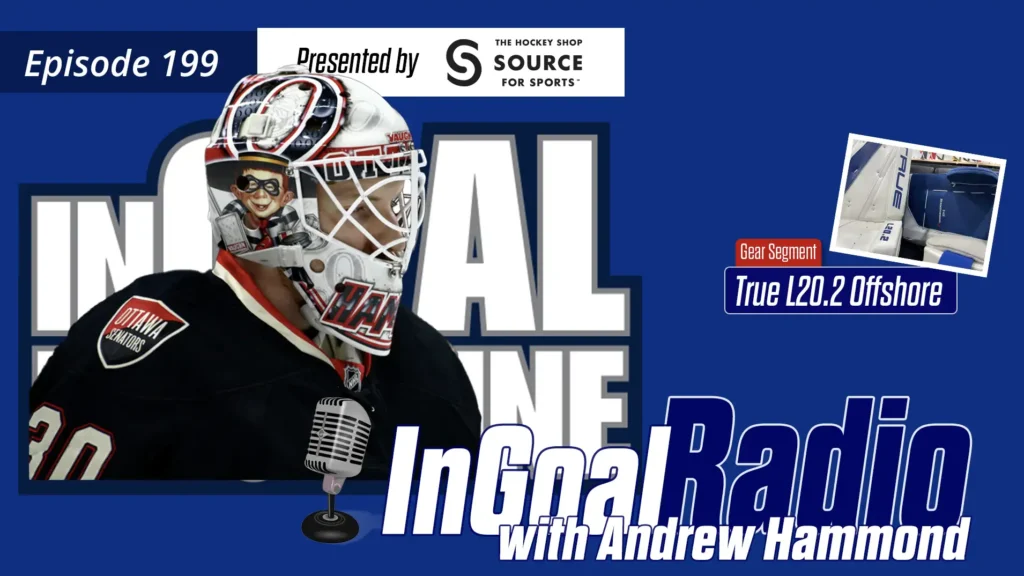
Episode 199 of the InGoal Radio Podcast, presented by The Hockey Shop Source for Sports, features a deep-dive conversation on the career of recently retired NHL goalie Andrew Hammond.
Feature Interview
presented by NHL Sense Arena
In the feature interview, presented by Sense Arena, Hammond takes you into — and well beyond — his historic 2015 run with Ottawa that saw him called up from the minors to go 20-1-2 with a .941 save percentage, backstopping the struggling Senators to a previously unimaginable playoff spot while fans threw McDonald’s hamburger on the ice to celebrate his “Hamburglar” nickname from college. While that run made Hammond famous, it’s far from the more fascinating part of his journey, which included uncertainty beyond his time playing tier-2 junior hockey in BC, then the same unsettled future towards the end of his NCAA career at Bowling Green. Hammond shares valuable lessons from each step, as well as from his time in the NHL before and after the Senators run, and the reason he felt he played better when he was at the highest level, including a .939 see percentage with the Colorado Avalanche in the 2018 playoffs, and a .920 with the Montreal Canadiens just last season, before suffering an ankle injury that ultimately forced him to announce his retirement last week.
Enjoyed the episode? Rate InGoal Radio
Ratings and follows are how other goalies find the show in Apple Podcasts and Spotify. It takes ten seconds.
Apple Podcasts
Open the show, scroll down to Ratings & Reviews, and tap the stars. A written review helps most.
Rate on Apple PodcastsSpotify
Open the show in the Spotify app and tap the star rating under the show name.
Rate on SpotifyWeekly Gear Segment
presented by The Hockey Shop Source for SportsAll that, plus a trip to the new location of The Hockey Shop Source for Sports (now in Langley) for a look at the recent arrival of the new True 20.2 offshore line “Designed by Lefevre.”
Episode Transcript
Intro
I wish you could see it right now. We are scattered all over the globe for InGoal Radio, the podcast presented by The Hockey Shop, thehockeyshop.com, Source for Sports Langley, Daren Millard in the Las Vegas Valley. David Hutchison in his vehicle in the Lower Mainland, and Kevin Woodley is about to go swimming with sharks as he comes to us for poolside in Hawaii. This is our most dramatic setting in a while. Hutch, you okay in that vehicle?
The holiday edition. I'm doing great. I'm in the mobile recording studio. It's fantastic. Spending a little time over in Vancouver on the holiday.
And, as it is all the time, our schedules aren't easy to coordinate, so I happen to be in the car. So let's do it. I've been wandering around Vancouver looking for the strongest Wi Fi signal I could find. I think I finally have a sweet one, so let's get it done, boys.
Woody, Poolside or Ocean? I know which one's safer. Be careful over there.
Well, I would have been Oceanside, but I needed to stay close enough to the hotel that the the Wi Fi sort of worked to get us through this session as the the owner of the, business Zoom account here at InGoal, the one who who logs in and can get more than forty minutes. So, but I am I am... If I lift my computer up, let's just say you can see the ocean. It is, boys. It's, it's beautiful down here.
Hang 10. That's that's my comeback. It's not not as fancy as yours, but I just, hang 10. Hey. You got to hang out with Thatcher Demko recently, for a ProReads.
Yeah. Hey. If you're not an InGoal premium member, no better time to join. We've talked a lot over the past couple of weeks about, the value of ProReads, the value whether you're a young kid or a beer leaguer or an aspiring junior goaltender or even another pro or another pro coach list... There's no better way.
They all tell us. There's no better way to learn to read the game than by watching video and listening in as NHLers do it. And so, the the the only downside here is the reason we got midseason time with Thatcher as much as we did is because he's rehabbing from a lower body injury, and he's gonna be a little while. But the bonus for goalies all over the world is they now get to sit in on a video session with him. So, first of many, we spent a good forty minutes with Thatcher.
And I gotta say, obviously, he's spent a lot of time with Thatcher over the past couple years since he's been with the Vancouver Canucks, just in that locker room on a daily basis, practices, games, morning skates, but it never really broken things down to this degree. And I came away very impressed at the way he reads the game. There are a lot of sorta elements in there that are very unique, that we haven't really necessarily heard before. There are times where he's not necessarily looking for the most dangerous player. He's looking for the most dangerous pockets on the ice.
I thought that was really interesting. It's something that he comes back to several times during his ProReads segment. So, if you've ever wanted to sit in on a video session with an NHL goaltender, there's no better place to do it than ingoalmag.com with an InGoal premium subscription. And we're really excited to bring you a whole bunch of ProReads videos with Thatcher Demko along with, you know, the dozens, plus other goalies that we've done sessions with. If you buy a membership now, you get almost three years of archives now, Hutch, like a 150 different ProReads with different goalies.
And Yep. And a full year coming in the neck... In... Over the next year. And, obviously, like I said, that's gonna include a lot of Thatcher Demko.
And we've got some other big names, amongst the sort of young up and coming crop that'll join us here in the next couple of months, and we'll add them to the repertoire as well.
Hutch sounds like a great gift, for the New Year.
It sounds like a great gift. I love the first Thatcher Demko ProRead that we got up. One of the things I I like is Woody often sort of brings his perspective and to try and pull more out of these guys. And and what... And this this week's play, he said, you know, are you trying to play it this way, which is a very conventional way that a lot of coaches talk about?
And he says, yeah. No. I actually don't believe in doing that, and here's why. And I think getting those new perspectives from guys is fantastic. So, yeah, great opportunity.
You can still send a gift. The gift subscriptions are still coming in. We've had a fantastic year. People wanting to share the gift of goaltending with loved ones, with students. Goalie coaches are buying them for some students as a thank you for working with them.
I've seen parents buy them for goalie coaches. And, if you do, you just, you're sending them a year subscription. As Woody said, you get the full archives of ingoalmag.com, which is over 650 articles and videos, published now. If you're interested, but you haven't really checked it out yet, if you head over there, there's multiple links that will take you to sort of why subscribe or the benefits of subscribing. And there's a great page that lays it all out there for you, including links to 10 or 12 unlocked articles so you can see a ProRead.
You can see a ProDrill. You can get a feel for what all those 650 articles look like. And then, I'm sure that you will see the $36-37 dollars American is a fantastic deal. And, and really, we've underpriced ourselves, but we wanna do our best to help out during these times. So grab your subscriptions now, guys, and and let's get talking about this great episode.
I just wanna start this statement by saying I have a great life, but I am incredibly envious of you two right now because one, what... No. Hutch, bear with me. You got to go to the Hockey Shop in person. And I did.
Woody, you got to, on our feature interview this week brought to you by Sense Arena, catch up with Andrew Hammond just to rub it in a little bit by explaining and give us, Cole's notes on both those things. Start with you, Woody, on on Hammond, and then I wanna know all about The Hockey Shop, Hutch.
Well, The Hamburglar, Andrew Hammond, it... You know, it's ironic. I knew the retirement had happened and that it was going to be announced, and it's for a a not very goalie friendly reason that I knew this. And we'd sort of arranged this interview for once he made it official. I actually reached out to Andrew as part of a a feature story on Ovechkin and his pursuit of
That was a great story.
Of of, you know, of sort of second place all time in chasing Gretzky. I was trying to talk to the milestone goalies, and Andrew gave up Ovechkin's five hundredth goal. And so I sent an email, to be honest, not expecting to hear back from Andrew. I'd heard back from other guys on the list. You know, James Reimer was 300.
Funny enough, James Reimer didn't remember that it was a milestone, but he remembered the goal exactly. It was the first time he'd faced Ovechkin. Anyway, so I reached out to all these guys. I thought Andrew was in Russia. I remember reading that he'd signed in Russia.
I didn't realize he'd only played a couple of games and come home. So, he catch... He caught me up sort of on that, that the retirement was coming. And then as soon as he made it official, reached out the next day, we had the interview set up. So Andrew's a guy that we talked about getting on the podcast several times before, you know, especially his last sort of season of pro, with the...
When he was with Montreal, he came through town. And that was when he just kinda had the ankle injury, his game looked really good. And and I thought things were... Every time... Let's let's get, like...
We get into this in the interview, and and I don't wanna give it all away, but every time that guy got a chance in the NHL, almost every time, he posted good numbers. So that's one of the conversations we had here, and he was doing that at the time of the ankle injury. And that... To me, that's sort of the what must be a little bittersweet, although he's he's fully accepted it, is the fact his game looks so good and then the injury, and he never fully recovered, and now he's retired. But, a great interview, obviously, about the the the amazing run he had with the Ottawa senators, one of the greatest of all time, the Hamburg...
Pretty much everything Andrew Hammond and his crew, but a lot of stuff that I don't think a lot of people know about as well, is packed into this interview. It was a really good run. He's really gracious with his time, and there are a lot of takeaways for goalies.
I can't wait for people to hear about it, and I'm looking forward to the lowdown on walking into that brand new space over at the Hockey Shop.
Oh, it's so exciting. Got over there two days ago. I've been in Vancouver for about a week and got a chance to stop by there on the way to the rink, and it was hopping, guys. It's... I think it was the twenty seventh, so we're into boxing week.
The big hockey shop sale is on, and the place is filled. I've never seen that many people in the hockey shop before in the old location, and the new one feels like it's about five times the size of the old location. It it feels like you've walked into this giant open concept space. Everything brand new. Everything beautifully designed.
It's sort of like a candy store for hockey. You just look around, and you wanna touch and grab and feel and play with everything that you see in the shop. And, and you can just see the energy, and you can feel the energy. And, of course, wandered around, saw all the great stuff in the different sections there, the new shooting lanes, and so on. But, of course, had to go spend time in Cam's Corner.
Oh, maybe that's the new name for it. Yeah. Check... Checked it... Checked out Cam's Corner.
Got to play with, some of the gear. Little Hutch tried on a bunch of chesties to see what might be next for him, and we got to talk to a few people around there about goaltending. And and Cam obviously spent a good good deal of time with him. Checked out those new Warrior sticks, the ones that we had. I think it was the last episode, wasn't it, with the the contoured shaft?
And, oh, those were exciting. Would love to try one of those. Just the the chance to get in there and talk goaltending with people and try everything new. So exciting. Check out the Hockey Shop in Langley, folks, if you get a chance.
If you're in the neighborhood, and if not, obviously, go online and you can find the Boxing Day sale on there. There's so many great savings, for you still at the Hockey Shop. Check it out.
Gear
The Gear Segment this week is dealing with the True 20.2 offshore line.
Yeah. There's, you know, kinda... A lot of people again will be like, hey. Haven't you guys done the True 20.2 line? And we have, but this is different.
There's a lot of inventory in. And that's the thing. I actually shouldn't say it's different. It's just that all of sudden, there's a whole bunch in there, and it's stock gear, but people wonder why, hey. Well, like, why are we all of a sudden got all this stock much like the 12.2?
And the reason is because true, which is not unexpected, has got manufacturing overseas now. And so there's gonna be differentiation between the lines. And so instead of built by Lefebvre, it's designed by Lefebvre. And this is something we've seen with other companies, and it's not a big deal, but it's just sorta Cam wanting to be upfront about why there's all this inventory. Let people know that there's all...
If you're... If you've been waiting for True 20.2, a line that was difficult to get, he's now got it in stock. And so we should also have the p... The new PX three line will be coming soon at the Hockey Shop and the hockeyshop.com, so look for that in the coming weeks. But in the meantime, he got this fresh shipment of 20.2, so we wanted to sort of go over the features of that line, what differentiates it from 12.2, and what we're expecting from PX three.
And really interesting, when PX three comes out, I'll tell you a story about Frederik Andersen's role behind developing it and the thinner thigh rise because when Freddie was here, this is this is, like, right down to taking video of pucks coming off his pads and sending it to them for running changes in the line. So we've got the True 20.2 offshore line available now at the hockey shop and thehockeyshop.com, and we joined Cam, sat down to talk about it. What's different? And I think for a lot of people, the key is what's not different with this new line available now. Welcome back to The Hockey Shop
Source for Sports. We're out at the new location in Langley. I guess pretty soon, don't have to, like, it's just gonna be the location.
I think we're getting pretty close
to it. Yeah. Yeah. About a month. Like, this is just it?
It's more than a month.
It's more than a month. Time flies when you're having fun as they stay, Cam. And in 34,000 square feet of hockey awesomeness, we are having fun. Here in the corner, we call Goalie utopia. I think I'm sticking with it, mainly because I can't remember any new words and it just rolls off the tongue after all these years.
We have... And some of you are gonna be looking at us right now going, boys, you already did the 20.2. What are you doing? Is... Would they get hit in the head with another puck?
Well, he did. He did, but that's beside the point. This is different. Yes. Much like we talked about with the 12.2.
You've got a... First of all, you have stock in. Yeah. We do. You have inventory.
We got colors. And one of the reasons that you're starting to see the inventory pop up is that True has has now has opened its offshore factory. They're producing gear offshore as well as domestically. Gotcha. And for everyone that screams, like, why and what, this is the reality.
In order to meet the demands, you needed to add offshore capacity. That's what they've done. And I'm telling you, when I look at these pads, 20.2, the 12.2 we did before, like, it really is hard to tell the difference between this, which says designed by Lafebvre and the ones that are actually made in Canada made by Lafbvre. So, Cam, walk me through for those that don't remember. We've done the 12.2 both domestic and offshore.
This is now the 20.2 domestic. Some of the highlights of this pad, and we'll get into the blocker and glove really quick, which is just some of the highlights and what they get in the offshore line designed by. I don't know if you're
gonna hear that, but they've included their fast glide material on the slide surface of the pad. So worth calling out right off the bat. In terms of... For an upgrade in terms for your overall sliding and feel wise, you know, very, very similar to Speedskin. It's not Speedskin.
It's different. However, you are gonna see it on all of their stock pads with the exception of... I think it was black, actually, because I don't think they have black blast glide. It only comes in white. So the black pad doesn't have it, but Just heads up.
Worked out. Flip it over. Let's see the back. Overall back I see that, like, you're flipping it over. The people up from the moon Well, I've got it, you
know, so you'd be able to do that.
Okay. There we go.
Open it up. Jump on the gun here a little bit. K. So we still see their FRS system. The exact same as what you would find on their domestic pad.
That's a
lot of Velcro. That is a lot of Velcro, but it
But with a lot of Velcro comes a lot of adjustability.
Exactly. Allows you to dial in your fit specifically to what you were looking for. Sure grip knee cradle, great for especially that sock knee pad combination. Make sure you're again, you're you're having that stable landing surface.
And, of course, you can run that knee strap down to the cap if you want. The outer flap on the knee is just sort of Laced in. Stitching. Laced is the word I'm looking for there. So easily removable.
Just undo the laces and you can take it off. If you prefer to wear it that way, little padding to help stabilize your butterfly down under the shin area. We see the flat
Open boot.
Open boot. Flat. Get that pad to sit up high. You see Matt Murray wearing his 20.2's in the NHL. See how high that sits on his skate.
Helps with that.
Stiff. Let's reiterate the whole stiffness profile though. So the soft, fantastic. The pad itself though, we are very, very, very stiff.
If you want flex, that's 12.2.
If you want stiff, that's 20.2. And, course, we've got PX three coming soon. We'll have that in store and sharing that story with you as well. But right now, it's the 20.2 made offshore. We've been through the pad.
I think we've got all the highlight. Oh, let's Yeah.
That get whipped in
the face by the ProLaces. And the ProLaces are worth calling out. I like that they have the one series. The hybrid series with the lead on it because to me, elastic all the
way to toe is problematic. We've talked about it before. All stock plus two sizing worth noting as well. So thirty three plus two fits.
How does it fit with that sitting high? So it's... It fits a little bigger just because it sits up high in the high in the boot. Correct. Yeah.
So if you were, say, a 34 in CCM, what might you be looking at a 33 here?
Correct. Again, depends on what pad you are in. But, again, if you're coming from saying, like, an EFlex pad or something like that, you probably wanna go down in size versus. If So you're 34 and you flex, you wanna be, like,
a 33 here, for example. Okay. Because they have a couple different models of the blocker. This is the five ninety five. The bindingless blocker comes stock with the 20.2.
Neutral hand position, if I remember correctly.
Yeah. I'm not gonna reiterate that a blocker's a blocker, but we've seen this blocker before because it's the exact same as all the other True blockers that are on the wall. Not too much of
a change here. Gloves. We saw the 12.2 offshore series came with a stock 600. This is a stock.
Game ready $5.90. Great close right out of the box. I mean, this is like a brand new glove. Kevin's closing it. No problem.
So And I have weak little hand.
Yeah. He's got weak little hand. So you're here to hear folks. So if you wanna check them out, you can give us a call at (604) 589-8299 or 1-800-567-7790. We got the colors in stock.
We got sizes in stock. Come check them out. True. Designed by LeFebvre twenty point two. Available now at The Hockey Shop Source for Sports.
I love that. What's not different is as important as as what's different because it's the same line. It's just made it a different spot. Well done. Give it to the Freddie Andersen tidbit.
Well, I was gonna save it for p x three, but, basically, Frederik for years has worn his pad shorter than sort of his max. Like, he hasn't had it all the way up to his max regulation NHL size. And that's because he likes when he drops into the butterfly, they close. Like, in a perfect butterfly, the tops of the pads, even when they're shorter, close, and he feels more mobile in the shorter pads. He feels like when he drops, in longer pads, the tops will hit each other and interfere with each other.
And so we went shorter. But, of course, in in the NHL world, we don't always drop into a perfect butterfly, or sometimes we drop a knee and move laterally, and so you're costing yourself coverage. So there was a a cognizant effort perhaps pushed by coaching... A goalie coaching staff to see if we can get back up and add those... Add that extra inch inch in a bit on each side of the pads for a little extra coverage.
Well, how do you do that without having the pads interfere? You need them to be thinner at the top of the thigh rise. And so when we see the p x three line, if you've seen it online, if you see it, you know, on social media, and we'll have it, like I said, at the Hockey Shop soon, you'll notice that there's that thinner upper thigh rise. But the first versions of it, thin meant floppy. And so he felt like pucks were hitting it, and it was like the trapdoor.
It was hitting the top of the thigh rise, and it was bending back and allowing pucks to get through. So we actually took a video camera out and had pucks shot off the pads, and he was filming to see that... You know, how much that top of the thigh rise was flexing. And so then the next iteration and the one that you'll see available, at launch, they reinforced the top of it, I believe, with a a layer or layers of carbon fiber to make it carbon fiber to make it that much stiffer. So Frederik Andersen very much playing an active role, it seems, at least from conversations with him and and when he came through with Carolina, in what we see as a finished product of the true p x three pad.
Bit of a lesson there, guys, for when people are out shopping. I think most of the companies and their new products have have dealt with this. But if you're shopping for something used, or even if you're looking new, if your desire is to have the lightest pad possible, One of the only ways you can go lighter is to go with a foam that is not as stiff and strong and is a little bit more flexible. So you grab the top of that pad. If you found something super, super light, it might be a little bit too flexible.
So especially in some of the older stuff, if you go and buy it, just understand that there is a trade off when you're going for the lightest pad, possible.
Freddie's got a little Ed Belfour, Ryan Miller, going on, with taking gear to a next level and researching it, Woody?
Yeah. I mean, a little bit. Yeah. He's definitely a guy who likes things to feel a certain way, and I like that. I like that he knows what he wants out of his equipment, and he's willing to make adjustments to it or have his manufacturers make adjustments to it to get it there.
I mean, we... When he was in the Bauer pads, you know, there were sets there. He wanted it to be a little shorter than than than what his max size was, and I think there was a set there that actually got shipped out, and sort of, for lack of a better term, cut down at the top of the thigh rise and then stitch back up so nobody could tell. So, I I love that he understands why his gear works and how it works for him. I think there are a lot of people that wonder why you'd ever reduce the height of your pads, but I'll never forget being in the Maple Leaf's dressing room and him doing carpet flies and showing me how, hey.
Like, it doesn't matter. Like, look at my butterfly. When I drop, the pad's sealed perfectly. I don't need the extra size, and he just felt that much more comfortable going to the ice, with a slightly shorter pad.
Carpet flies. I've not heard that before. Is that a language with the with the kids these days, Hutch?
I don't know. I've I've heard that one before. It's something you try over in the hockey shop when you're trying on your gear. So you just gotta
When he
Gotta go with it, Daren. Gotta be
a cool dude now. Cam to get some carpet in there. It's all beautiful hardwood now, so he needs he needs a section just for carpet flies. But, actually, believe me, there's
a Oh, now they're Woody flies.
There... There's some, oh, I like that. There's some really good stuff coming in terms of being able to see yourself dropping to the ice and what your profile is in in the net coming very soon to the Hockey Shop location out there in Langley. They're working on it. It's it's gonna be neat when it comes.
You'll be able to see yourself and take photos of yourself in your gear in a net to see how you look and how much of it you fill up. It's it's a pretty cool concept by Cam, but it's it's in the
That reminds me of something. That reminds me of something.
What?
You're not sure, Daren?
I thought you guys were coming here for the road trip. Now I might be coming up there.
Well, that would be nice. No. The chance to see how you fill the net and take up space. How else can you do that?
Go on Sense Arena.
Sense Arena. Absolutely. One of those great features of Sense Arena is that you can, take a look at yourself after plays and see exactly how you're filling the net, exactly how you, made a particular save. They've even got a feature that, allows you to mess around, and they tell you how well you're filling the space. They actually give you, a number to talk about how your box control is working.
Really cool. I don't know if you guys knew. There's a new Sense Arena out.
What?
There is a new release of Sense Arena out. Just came out. Just got the notice, maybe a week or ten days ago. And finally, the NHL and PHF shooters are in Sense Arena. So if you wanna get in there and face real NHL, real PHF pro guys, pro girls, you can do that now.
And, what an awesome feature that they've added in there. But... So, of course, everybody's super excited about that. Why wouldn't you? The other thing that's new, one, if you already have the Oculus headset, you can get on there and do a seven day trial with Sense Arena before you have to make any commitment to pay.
So there's a chance to get in there and give it a go. If you've been worried about making the commitment, now's your chance. They also have an intro version available. So if you wanna get in there, you're avail... You can get a subset of the drills.
You can get all the cognitive drills. You can get some training stuff for only $29 a month. So it's not the full full package. I don't think you get the video drills, but if you're not sure about making a full commitment and you already have the Oculus headset, maybe sent a left one under the tree. $29 a month.
Great chance to try out Sense Arena and see what it's really like before you make that full $49 a month commitment. For the full package, all the drills, the NHL shooters, the PHF shooters. You know, we think it's one of the best training tools out there, Daren. Now it's gotten even better, and that's one of the great things about Sense Arena. There's new releases coming all the time.
Oh, and I almost forgot. Now if you're in the big arena in Sense Arena doing your training, it's a full house filled with fans cheering for you. Pretty cool experience.
Do they, boo you if you let it in? Like, can you get, like, the full out Bronx cheer experience too? I haven't... I've been in Hawaii, so I haven't had a chance to test this out. I wasn't gonna risk my Oculus by bringing it down here.
They put them in some cool some cool background shots of people looking at me even Beach shots? Yeah. People would have been looking at me pretty weird if I was stopping pucks on the beach, but, will they boo you? And second, so you're telling me I can face NHL shooters without having to risk the loss of a tooth?
Exactly. Exactly. You can get you can get scored on in the comfort of your own home, Woody. That
happens anyways with the old version, but didn't take NHL shooters to do that.
Feature Interview - Andrew Hammond
Not many people get that opportunity. Andrew Hammond did. He has since just recently retired, but this is a player that will forever be linked to the Ottawa senators. And in fifteen years, they're going to have alumni back, and he is going to still receive the loudest cheer. And that'll be in comparison to some of the franchise all time greats because of that run that Andrew Hammond had.
Yeah. Absolutely. And the thing is... And we talk about it. We get into the the card from McDonald's.
We get into what it was like being in that zone. All kinds of great stuff from, you know, what is arguably one of the greatest runs in NHL history over this... Over that sample. Like, just incredible, the run he came on. But there's so much more to the Andrew Hammond story, and that's why we wanted to have him on as a guest.
Like, this is a guy who, you know, playing junior in the BCHL, wasn't even sure he would get a college scholarship. Forget pro hockey. And then when he did get to college, he chose a program on purpose, he'll tell you why, that when he when he got there, looked like it might be its last year because it gave him opportunity to play. And as college is winding down, the idea of pro hockey wasn't necessary. Like, he didn't know there'd be pro opportunities.
And then he goes on this run and... But as usual, it's it's not lucky. It's not a straight path. It's all about hard work. It's about perfecting your craft.
It's about finding, you know, different voices, different... Like, there's just so much to the Andrew Hammond story, beyond that incredible run. That's why we wanted to make sure we had him on the podcast so we could get into all those different elements, and he did not disappoint.
Another chapter in the Andrew Hammond story. Our feature interview brought to you by Sense Arena, the Sense Arena of VR.
Really excited to welcome to the InGoal Radio Podcast for the first time. I tried to make it happen a few times over the years, but the schedule's never aligned. I kinda wish that it was under different circumstances, but we talked a little bit last week, and it sounds like you're at peace with the decision. Andrew Hammond, fresh off the retirement announcement. Maybe just for starters, I wanted...
There's so many places I wanna take this. But for starters, just catch us up. We... Everybody saw the announcement on Twitter, talked about the ankle and the injury and trying it out this year. Just sort of give us the rundown on on, you know, where the body's at and and what ultimately led you to this decision at this point.
So I I think now being in this position, it's a lot different for me. I I just kinda had a... Maybe a little bit of a fear in the back of my head that whenever I was done, what what would the body look like if it was a bad knee injury or something. Just nothing's really guaranteed about how you're gonna kinda walk away from the game. And, obviously, for me, I had the injury in Montreal last year.
It happened in a game in Calgary where my ankle got twisted, kind of where they they drill the pegs in for the post. My escape blade, I went down into reverse, and the toe of my blade got stuck out of the post, so felt a pop. And ever since then, I've seen a number of doctors. I've gotten surgery. I've done rehab.
I've really, I guess, the the wits end of of options. But with that said, my day to day life and and quality of life is is great. It's really just unable to do a a butterfly, which in the in the modern day game is a little bit of an issue. But maybe if I was playing in the eighties or something, I could still get away with it. But, yeah, it's just something that I've been...
I've battled that up for a while, and the one thing I found... I mean, everyone plays through bumps and bruises and injuries and stuff. But I think it had just become too much where as much as I I was trying to will it to happen, the... I guess, what I was producing on the ice wasn't making it worth it anymore.
Frustrating to go through that process in terms of the ankle injury. And maybe is it more so because when I talked to you in Montreal, when you came through with Montreal, you were just starting to rehab. And we talked a little bit just informally in the hallway, like, really liked where your game was at, really liked where where things looked like they were headed for you, and it looked like you were really comfortable with your game. Does it does it make it more frustrating because you would, you know, you you were you were back in the NHL and and it looked like playing really well?
Yeah. To an extent. I mean, I felt like, for a long time, my my game was there's a variety of reasons, but I always felt like my game was a little bit more suited to the NHL. Maybe it's because I felt like I had a a good book on a lot of players, understand... Understood what they what they wanted to do.
And I think a lot of how I read the game and things like that maybe helped a little bit more where... And the American Hockey League gets players from all over, and a lot of people that maybe you haven't heard of before know what kind of player they are. And it... Basically, people might not have a... Might as well not have a name bar or number on the back because when you're in the middle of the game, you don't really know.
But when number eight on the Washington Capital is coming down, you know exactly who that is. So it was a little bit different. You understand tendencies maybe a little bit more, but I think also just how fast the game is is it's just so reactive, and you're not trying to look too far ahead, and you're just trying to, I guess, give yourself a chance.
Interesting you say that. And and certainly not the first time I've heard it over the years from goalies as much as people from the outside, it sounds absurd to them, especially for guys who read the game so well. The NHL in some ways... Maybe easier is the wrong term, just better suits their their style a little bit. It sounds like that was your experience.
The AHL can be a little more scrambly and unpredictable.
Well, I think what you have to remember too is everyone in the NHL, they're they're the best players in the world. If you think the game of hockey at at a fairly high level and understand what the right play is, you can usually bank on those players making the right play where the American Hockey League, there's a ton of great players, but there's lot of younger players who are still learning that. And I always felt like part part of my play in the NHL was based around, well, what would what would the smartest play be in this situation? And you can read it off players whether it's off two on one or three on two or whatever. You can kinda figure out where the puck will probably end up because they're nine times out of 10 gonna make the right play.
Well, I think what you have to remember too is everyone in the NHL, they're they're the best players in the world. If you think the game of hockey at at a fairly high level and understand what the right play is, you can usually bank on those players making the right play where the American Hockey League, there's a ton of great players, but there's lot of younger players who are still learning that. And I always felt like part part of my play in the NHL was based around, well, what would what would the smartest play be in this situation? And you can read it off players whether it's off two on one or three on two or whatever. You can kinda figure out where the puck will probably end up because they're nine times out of 10 gonna make the right play.
Yeah. And it's, it's interesting how that works. Reading the game as a skill set, because it's something we we talk a lot a lot at InGoal. We we have our ProReads that we try and sort of help kids with that process. Where does it come from for you?
Is it just experience and innate, or were there things you did to develop that, whether it was video or was there a way that you became so confident in the way you read the game at the highest level?
I'd say there's a couple turning points for me. When you look back at my game throughout college and junior, where I was, I was a lot more aggressive on those kind of state to point shot, and you're scrambling to find the rebound stuff. I was always finding myself going out towards the puck. And Rick Wamsley, my first year in Ottawa, really reinforced the the concept of protecting the net, and that's basically just, in some ways, it could be interpreted as angle before depth. For others, it's just trying to get to the middle of your net, whether that's on the goal line and being deep.
You're better off there than being three feet outside your crease and the guy passes it backdoor. You're not gonna give yourself a chance. So although you would like to be out taking down the angle at all times, there's certain instances where it's good to just kind of try and protect that net and get to the middle because especially at the higher levels, guys have virtually no time with the puck on their stick. They're just firing it. Are they better at putting it into corners?
Yes. But I would say, again, probably 80% of the time, they're just gonna shoot it towards the net and hope that it finds a corner or something, but there's a good chance that it might just hit you in the stomach or something as well.
That aggression that you you mentioned playing with in college, and, of course, Bowling Green University, four years there, after playing in the BCHL here in our backyard, the InGoal backyard, for a couple of, I guess, three seasons. Was that just a function of... Because I'm thinking, like, in... You know, it's not that long ago, and yet NCAA hockey was a little different back then. I think it's become a little more NHL like to a certain extent, but it was a little more of a one shot league at times.
You could be aggressive. We saw a lot of goalies have to make those adjustments coming over from college to pro.
I I think as much as it maybe doesn't have the speed that the pro game does, the way teams defend and forecheck, I mean, you basically have someone on you at all times there. And whether it's the atmospheres in some of the buildings where it feels like guys are all over you or the fans are all over you, it feels like the ice is a little bit smaller. And with with the college, I don't know if I would call it a a one save league, but it feels like guys truly defend as hard as they can, and it could be a product of you're playing 36 games, maybe 40 games a year. You have more energy, and you're younger and all that stuff. But it's definitely a different game, and you just don't have as much time and space as you do, especially in in the in the NHL where there's some guys on the half wall.
They want you to go right after them. And in college, every time you're taught to go right after the guy, whereas in the pro level, you're taught sometimes if it's Patrick Kane, just let him hang out there. He can't do anything from there. A guy behind the net, they can't score from back there. But in college, it's a lot more get on your guys quick as possible.
Let's rewind it a little bit. Because we started with... Obviously, I wanna catch up on the retirement announcement. And... But I I wanna go back to where it started for you.
Like, where did... How did Andrew Hammond be... How did how did you become a goaltender?
So like most Canadian kids, at least on the West Coast, the the driveway was kind of where it started. But my my first real memory was the ninety four cup run with the Canucks and Kirk McLean. I still remember the Geoff off Pavel Bure for the breakaway winning goal, and that's kinda my first memory. But after that, I was the youngest kid on the cul de sac and older brother, older kids in the neighborhood. And as the youngest, I got forced kinda between the pipes then.
And between those two things, it kinda created this desire to be a goalie. And like anyone, any young kid, you find an idol in different shapes and forms, some kids at Superman. For me, it was all the goalies coming through. And I think I went to one Canucks practice at the Old Britannia. I don't know even know if it's still called there, but it was the same thing where it just seemed like the coolest thing ever to me.
And the weird part is that I never really was a full time goalie until, I think, 12 or 13. I bounced around between the two, but the Semiahmoo minor hockey where I played, they they stopped providing gear for the goalies right around age 12, age 13, and that's why my parents said that they... That I had to make a decision one or the other. They weren't gonna buy both sets of gear. And I chose goalie, and that's kinda when I started playing rep hockey and all that stuff.
And everything else since then has kinda just happened in unique different ways than I guess what would be the conventional path for a lot of people.
Well, it usually starts. It's one of two things. Right? It's either the older brother and you gotta go in net or it's the gear. Like, an obsession with one of...
Like, those are the two most common origin stories we hear.
I I I was a I was a big gear head when I was younger. I I forget. There was a a forum and message boards that might have been in the old Miller Hockey website or something where they talked about all the new gear, and I was all over that as a kid. And my first set of pads, I still remember that I that I had owned was the Coho five seventies, and I slept in them that night. And I woke up, I think, two or three in the morning.
I couldn't feel my legs because they were just stiff as a brick, but that's all the the funny stuff. And I think that, like, the purchase from my parents' side of things, they realized how much that meant to me that I'm sleeping in them the first night I get them. So it was... I don't know if it was the gear or the the play, but something definitely chose me rather than me choosing goalie.
Well, I think... Yeah. I'm trying to think of the... I think it's the goalie store bulletin board was probably the the one you were on. And then ironically, I think...
I don't think it exists anymore, but it was, started by Paul Fricker, who was one of the local coaches here who now coaches the Vancouver Giants as a goalie coach.
Yep. No. I wore Miller growing up, so that would make sense. And they used to have the... I don't know if it was the store or factory or both out of...
It used to be called Great Pacific Forum, I think, back then, but I don't know right out of the Alex Fraser.
Yep. And that's where I still pair to
be now.
Play beer league. So it's it's it's still there. Now it's funny. You mentioned, playing out and, you know, 12 or 13 being a later age. And interestingly enough, it is.
And yet we've heard from a lot of guys that those early years maybe not being too goalie specific looking back on it can be a benefit. Do you do you feel that way a little bit? The fact that... Especially when we talk about reading the game that you you played as a forward. You played as...
You know, you were out and sort of the patterns that everyone tries to connect as a goaltender, you were part of them.
Yeah. I think that was a big part of it. And then also, I mean, one of the big hot topics these days are kids playing different sports. I played soccer. I played baseball.
And I think all of that's super important, and I would say more important than being goalie specific at a young age. But particularly being a defensive center forward in minor hockey and learning basic skating and how to think the game at some level, obviously, it's different and changes as you get out or get older. But I would always play roller hockey with my friends after school. Never in that, and it was always one of those things where you're kind of... I mean, the...
I would say the one drill that I have found most effective in my career, especially when things are going south and the net feels like it's a soccer net, is just putting dog leashes kind of on the corners of the net to to reinstill how small the net is. And for me, that's something that kind of dials back in. This job can seem really hard at times, but at the end of the day, there's not really much room where they can beat you. And as I talk about being a a forward or defense, then you kind of learn those situations where when you're certain places in the eye... On the ice, you know there's only certain spots where you could beat the goalie and that type of thing.
I would say the one drill that I have found most effective in my career, especially when things are going south and the net feels like it's a soccer net, is just putting dog leashes kind of on the corners of the net to to reinstill how small the net is. And for me, that's something that kind of dials back in. This job can seem really hard at times, but at the end of the day, there's not really much room where they can beat you. And as I talk about being a a forward or defense, then you kind of learn those situations where when you're certain places in the eye... On the ice, you know there's only certain spots where you could beat the goalie and that type of thing.
And all of that, you kinda learn without even really thinking about it. And then when you're on the flip side and you're in that, you kinda start processing that. Well, I've been in that position. I know you can't really shoot here or shoot there. It's gotta go here.
And that all kind of fits into that reading the game type of thing.
Oh, I love that. And I'm... And now I gotta ask because I'm curious. First time the dog leash just came out, like, where where did you have that initial exposure to that?
I'm trying to remember specifically. I I can't exactly, but I would... It it would have been... There had to been, I think, Pasco Vallana would have would have brought them out at some point, or we used to do a a pro goalie camp in Madison, Wisconsin.
With Mike Valley? Those guys. Mike Valley. Yeah. Yeah.
Mike Vaughn. Yep.
Lot of other guys. It it may have been there, but the the one year I was in Rochester, we got back into it a little bit. And it's honestly mind boggling. I think they're not as cheap as it should be, but I think they're probably $30 or so. And you get the retractable ones, you you basically pull them right to where the puck is, and you can see all the trajectory, everything as far as where you can be beat.
And if you're no deeper... No further out than just the top of the crease, you maybe have three inches on either side of your blocker or glove, and you just realize how small the net is. And I think that combined with one practice in the American League, Rick Wamsley told me just not to go down and watch how many pucks I stop. And between those two things, it kinda clicks in your head. You wanna make the the job so hard, but, really, it's not as difficult as you may think when you're just facing a shot square on.
And oftentimes, when either it's goalies dropping too early or something along those lines that you can actually make it much harder on yourself that needs to be.
Well, I was curious about the dog leashes just because obviously we talk now a lot about, like, the Swedes talk about it in terms of box control. And I've... And I've... But I've run into goalies over the years that learned it in different ways at different times and some of them quite early. I remember Connor Hellebuyck saying when he was a kid, they used to have, you know, the mini nets, USA Hockey's mini nets, and they would put those out in front of them.
But at the end of the day, however you learned it, whenever you learned it, I think you're right. Like, we tend to think of this giant six by four behind us. And the reality, in order to get into it, it has to beat us through a much smaller area out in front. And that concept can be tough for goalies to feel. It sounds like you found a way to feel it and remember it.
Yeah. And that goes back a little bit to... I mean, there's so many different ways it gets taught. I've heard belly button over puck or nose over puck and different things. And as long as you're centered on the puck or you're centered on your ankle and all that, it it it goes both ways.
Because if you've ever shot on a goalie, you think, oh, man. There's no room. But then when you're on your side of it and you're standing in front of net, you're like, this guy's got a lot of room to shoot at. So it kinda blends those two concepts where it makes you meet in a little... Meet in the middle a little bit.
But, yeah, I think I think box control is great for young goalies just to understand the concept and goes back to what I said with Bowling Green, how I used to chase out and think I had to go get stuff. But the more you do sit back, you realize there's really not that much room, when you're kinda just more protecting the net a little bit.
So we talked a little bit about bowling, Bowling Green, and and I wanna go back to the Vernon Viper's days. By the way, Curtis Lazar says hello. A teammate at... In Ottawa. We'll get to that in a bit, but he remembers you as a guy who grew up in the Okanagan.
He remembers watching you when you remember the Vernon Viper's. What was your experience like? We talked about goalie coaches and evolution, starting as a full time goalie at 12 or 13 here in semi ML minor hockey. Where did goalie coaching, where did that side of the thing enter the equation for you? Did you have one in Vernon at the time and into bowling green?
Did... Was that something where there were different voices helping you take these strides as a goaltender, or was until... Or was it maybe not until you turned pro? Because I know, you know, we're talking about an era where not every team had a goalie coach like they do today.
Yeah. No. It's... The the transition has been great to see. But, no, it always...
It wasn't always like this. And back back with Vernon, I'd I'd started with the Surrey Eagles, and that didn't really work out. And I'd kinda been at a crossroads in my hockey career before that, and I had kinda sat down with Pasco and Sean Murray and talked to them a little bit about what I wanted to do with my hockey career if this was it. And they were two people who they had kinda started... They'd run Semiahmoo minor hockey goalie schools back as young as when I was, I think, eight or nine, and I was borrowing the gear.
I remember Sean telling me... Well, he didn't tell me, but he basically inferred to my mom that it might not be worth my time almost because I was so bad. So it's funny because we we stuck together, and both of them I worked with all throughout minor hockey and junior and everything. And even when I was at Bowling Green, I'd go back and... Back home in the summers and see them and work with them.
But the the Vernon thing, where there's a goalie coach there, Sean Matile, who was an ex pro, and we worked on a lot of different things. He changed some things in my game. And that summer before my last year was kind of... I made a decision where if if I wasn't gonna get the scholarship, it wasn't because I wasn't prepared, and that's kind of been the, I guess, the one piece of advice or the thing I've leaned on the most throughout my whole career is just how important preparation is. But, yeah, I know there's been goalie coaches that have been going kinda all over the place right now, but there's been goalie coaches all over.
And at Bowling Green, we had guys helping out all the time. And my first year pro, though, Rick Wamsley was the only goalie coach in the whole Ottawa organization, and that's changed now where basically every team in the American League and NHL, as you know, they kinda have two guys. But back then, it was... You'd work with him maybe once once a month your first year. He'd come down for a week.
He got on with Ottawa for three weeks, and that's kinda how that worked the first year.
You mentioned preparation, and it sounds like there's a good lesson there.
Yeah.
Can you expand on a little bit? Because, I mean, the one thing with this podcast is we get a lot of, like, parents and kids listening. Often together, we hear a lot on the way to the rink. They listen to it together. So, you know, for that young kid that feels like they wanna make sure they're giving this their best at this point, what did preparation entail for you at that age and heading into junior and in the transition to college?
What did making sure you were prepared mean compared to maybe what you were doing before?
So for me, what the preparation meant was... Well well, a, that year, going in my last year at the BCHL, I... My only goal was really to get a a scholarship was... We had a good team. We wanted to win the Royal Bank Cup.
We wanted to the BCHL. We had lofty goals. I knew if I were showing up every day and I was thinking, oh, why don't I a scholarship? Why don't I have a scholarship on this? It it would wear on me.
It would take away from my play. So my only goal that year was to win the RBC Cup Cup and get into the playoffs and play really well. And I figured if I did that, the rest would kinda take care of itself. So for me, it was just work habits and practice, I guess, diet and fitness and all that stuff. It was something that I hadn't really taken in understanding of until that point.
And then even in the... Like, as we got closer and we did reach that goal of eventually winning and throughout that, the the other goal kinda took care of itself. But I'll fast forward a little bit in that where it was... When I was starting before the run-in Ottawa, I had every reason to not have confidence going in and all that. But for the previous month before I started, every day at practice, I'd be the first guy and last guy off.
I'd be in the gym at... I'd... In the gym, I'd be doing everything. So at that point when it actually became my turn or my opportunity, I had the confidence and self belief built in that, you know what? Whether this goes well, it goes bad, I've done everything I can to this point to get my...
To put myself in the best position going forward. And when you do that, you have the opportunity to give yourself all the confidence in the world. But no coach, no teammate can give you confidence. It's really just something a goalie has to find themself. And for me, that's how I find confidence and how I found confidence throughout my career was preparation and whether that's in between games or whatever.
Because there are certain times where you just know I've done everything since last game to get ready to play well or different things like that. But for me, that's what preparation was was putting myself in a good position to know that I could have success.
We hear that a lot in academics. Right? Like like, you're not nervous about a task if you know you're prepared
for it. Studied... If if you've studied, it's a lot different than if you show up and you haven't studied or something like that. It's it's the exact same concept. And, honestly, I think it's so overlooked sometimes.
It's just how much you could truly give yourself confidence by doing the right things.
Well, you you mentioned, that final season with Vernon in the Royal Bank Cup. You guys win it. Two nothing shut out in the in in the final, if I'm not mistaken.
Yep. No. You're correct.
And, like, have the scholarship been locked up at that point, or walk me through, like, was college... And you said it was a goal. Did you go into that tournament by the end knowing you had it locked up, or were you still waiting? Because that's a lot of pressure.
Yeah. It's kind of a funny story. So
Well, we like those?
Yeah. So I think it was maybe January ish. And at the time, one of the assistant coaches of the Bowling Green was Dennis Williams, who's now the head coach of the Canadian World Junior team this year. So he was on a scouting trip, and we we just happened to play the Swedish under seventeen or 18 team in an exhibition game on a Tuesday night. And I think his flight got delayed or something, so he came and watched the game.
I played half the game. And from that point on, I was kind of on the radar a little bit. I think maybe a month later, they'd offered me a scholarship, and I committed on a Sunday. And Monday afternoon, Bowling Green announced that they're getting rid of the program. So I had about eighteen, twelve hours where I was super happy that I got the scholarship, and then they said that they're getting rid of the program.
So little nerve racking. I had talked to some other schools, but ultimately, Bowling Green, I guess, upped their offer a little bit and gave me a little bit more of a scholarship. And the the silver lining for me was that I was gonna be given an opportunity in my freshman year to play. And I knew that if things did go south of the school, I could at least transfer to another school without losing a year eligibility or sitting out given the situation they were in. The great news is program got back on steady footing, and alumni rallied around, and it's in better shape than it ever was back then.
And now they're doing a lot better.
Now as you go through your four years at Bowling Green, and I know some of that... Was trying to think... Was trying to do my math in my head on whether some of the guys I know that that... Obviously, we had Kevin Bieksa here with the Canucks, a proud alumni.
Mhmm.
You know, I I think a Jordan Sigalet, and even the social media legend Kane Van Gate was once a third goaltender at Bowling Green, but I'm trying to... I I couldn't quite do the math in my head whether that whether that all coincided with with your time there. One thing I do know beyond your game and the evolution of it, I know then as much as... Like, the nickname started at Bowling Green. Can you walk me through the origins of that?
And, like, obviously, it became a huge, huge thing in Ottawa. Was it something you liked, minded, hated when it first started, or you... Because it... As obviously, it goes... The roots of it are stealing games and something you did a lot at Bowling Green.
Yeah. Well, not my first year. That's that's a different story, but, no. My first year, I think the team won four or five games. I won zero.
And they
But I'm I'm guessing if they'd announced they were canceling the program that there were probably quite a few departures, and maybe that first few team was not Yep. Quite Not up to stop. Accurate.
Yeah. Well, that... Dennis Williams, the the coach is... I think he was 28 at the time as the head coach, so I think that shows where we were at and great everything he's gone on and had a heck of a coaching career now. But, yeah, I think I was o twelve and two, and they still started me the first game of playoffs.
So I think that spoke to where the team was at and their chances. But, yeah, it's it's where the nickname started. My first year playing rebound, sure everyone knows that game, and one of the guys basically just started joking, like, the burglar kind of thing. And then some guy was like, the Hamburglar. And then the next year, we're coming up with a design throwing mask, and someone's like, you should put it on your helmet.
But the first year pro, had it on my helmet too, and no one noticed. So it wasn't until... Like, that that... That's not something I was ever really called in the locker room. It was more just a funny thing to put on the helmet.
And then, when the run-in Ottawa started, that's really the first and since then, I guess, the time that the Hamburglar was what became famous.
Okay. And so how the opportunity presents itself in Ottawa, sounds like late in your final season at Bowling Green. Like, was pro hockey... You talked about the final year of of junior a, you know, and and and make... Wanting NCAA to be a goal.
At what point does pro hockey become something that's serious for you and and a serious consideration?
My my second year, I had gotten shoulder surgery, but I was supposed to go to rookie camp with the Capitals. And then my junior year, my third year, I went to Blackhawk development camp. And that was kind of the first time that I had started thinking maybe. I remember I had a good camp at the Blackhawk, but I was older. I didn't finish school until 25.
So I didn't really think anything was realistic, but my junior year... Well, this is the story. In in hindsight, at the time, I didn't know any of this. And then I told my agent at the time, whatever happens, don't don't keep me in the loop. We'll just figure it out at the end.
Kinda like how I said with the the Royal Bank Cup and those other things. If if I'm doing the right things with the team, those other things will take care of itself. And we had played a game in the CCHA semifinals against Michigan, and we had a similar team to my first year, so we weren't great. But I think I had about 62 or 63 states or something, and Pierre Dorion was there watching and scouting, and he took note of me, and I didn't know anything about them having interest. And senior year, we're playing in Lake State, old hotel.
You gotta crack the windows open in the middle of winter because your room's a 100 degrees. And I hear this guy talking outside on the... On his cell phone outside on the street, and I can tell he's talking about some players and talking about an agent. He's mentioning, I think it was, like, Colin Greening and Jesse or Brad Winchester. I forget the two pre agent signings that Ottawa had, and they were talking about two Lake State players.
And I tell the the goalie partner on my team, we we shared rooms then. I told him about what was going on, and said, oh, that's interesting. He knew because his dad was at the game the previous weekend that Ottawa had basically their whole staff there watching me and all this stuff and that they were there watching me again. So I had no idea that they were actually talking
about me. Oblivious.
Yeah. I was just oblivious. And then we lose the next round in Notre Dame and kids program, so I won't go to the whole story. But we thought our careers were... Hockey careers could be over.
I know ECHL, AHL, Southern Pro League, NHL. I I truly had no idea. I had talked to, I think, one team in person that year. It wasn't Ottawa. And then, yeah, my agent called me the next day and basically said, here's the deal, and I I honestly couldn't believe it.
Is there a lesson there? You know, like, you talked about, you know, the fact... You're... The ability to sort of block everything out and not be having those conversations in a position that has enough pressure on it in... You know, just by the nature of the position.
Mhmm. To to allow you to focus on doing your job and and letting everything else take care of itself. If you were... If you knew they were there, if you knew they were all watching, if... Would that have just added unnecessary pressure?
It it could've. One thing I think might be good for young goaltenders that I always... I became OCD about it almost. Like, during a game, I'm basically repeating this phrase in my head at all times, and it's next shot, next save, next stop. So I'm I'm I'm...
It it was my way of staying in the moment and worrying about the next shot and not worrying about whether it was a bad goal I just led and a big save. And I think that kinda lends itself to becoming more of an even keel goalie. And then also if distractions were happening in the rink or you knew someone was there or anything like that, it allowed you to kind of move your focus from the one area back to where it should be, and that's on the the puck and the next shot, the next save, and hopefully the next stop.
Well, it's interesting because next shot, next save is a mentality that all goalies strive for. I always make the comparison to golf. Right? Like, that ability to stay in the moment is... As soon as we're in the past or the...
Or looking at the future, we're in trouble. And Yeah. It's it's the easiest thing to say and the hardest thing to do quite often. It sounds like maybe one way to do it is just not stop saying it.
Yeah. And you... Honestly, I... As I said, I became OCD about it. I I think, like, I love golf.
I think there's so many similarities between goaltending, and golf. And all of a sudden, one day, you're seemingly slicing it for no reason. It's the same thing. All of a sudden, you're not catching something clean. It feels like everything's the exact same, but for whatever reason, it's just a little bit different.
The more advantage you get in the game, you're able to figure out how to get back to, I guess, your base or the normal things. And I remember I was watching a game back on Hockey Night in Canada a while ago, and I think it was Dwayne Rollason who said, you know, for NHL goalies, it's not really a technical thing. You kinda know how to get back to your baseline. It's all about just feeling good. And I think that's the same thing with pro golfers too.
It's not not a whole lot different. And I think if you could build a base and a structure within your game as a young goalie, always being able to kinda go back to it when things aren't going well, it really helps.
What was yours? What were the things that you went back to? What was the foundational piece for you? If things started to drift, what did you come back to first? You talked about the dog leashes as one in certain drills.
What was the... You know, beyond next... Because some guys... You said next next shot, next save. Some guys also have mantras about posture or positioning that they try and...
And it'll change over time. But what was that foundation that you came back to?
Off the top of my head, I honestly... I I can't remember everything. I used to... As simple as having a a note thing on my on my phone that I would just look at, and it was kind of, I would say, half visual... Visualization and half just kind of keeping my mind dialed into the right things.
But, usually, it was toes on crease line, eyes first, feet second. One thing I I kinda got into later in my career that became, I think, helpful for me was trying to keep my my head on the same plane. And what I mean by that is if you picture the... Yeah. If you picture the crossbar, it's whatever relation your head is to the crossbar, it basically stays there whether you're dropping, moving laterally, or whatever.
The reason for that was that if you've ever played catch with a football or anything like that, it's pretty easy to catch the ball when you're standing still. But as soon as you start jumping, it becomes a little bit more difficult. It's the same thing with the first baseman. As I said, I've played other sports, and you get taught to kinda get set before the ball gets to you at first base. And part of that is because it's easier to track the ball.
And so the more tracking became something people talked about, I don't know if I was even necessarily caught it, but it was just something that I kind of put the two different ideas together and thought, okay. Well, this makes more sense. And the more I I focused on that, it felt like tracking pucks became a lot easier.
What was the first couple of years of pro? What was the biggest adjustment for you? You talked about, you know, working with WHL and some of the, you know, in terms of positioning and things like that. You know, you got a you got a stint in the first year. I think if I remember correctly, it was Craig Anderson second child, which this is obviously a
wild wild remember the... I don't remember what it was. I just remember Lehner was the guy who started and was against the wings. And as I... I've said a a few times this week talking to different people, but if that would have been the only time I played, it would have been great.
But, no, it was... My my first my first game pro, Norfolk in the American League, and they had three five on three goals in the first period. It was four nothing after the first, and I was out of there. So that was a warm welcome to the American League.
Hey. Welcome in, kid. Five on three galore.
Yeah. Yeah. Three five on three goals, so that was great. But... No, it was...
The first... It's actually very interesting to look back on, and I think if... I... I've spoken to different goalie partners throughout the years that have been rookies in the American League and stuff. If you were to divide my stats between the start of the season and Christmas and then from Christmas on, it was, like, an eight eighty save percentage the first half of the season, then, like, a nine thirty the second half.
And all that was was finding that adjustment. And, like, when I talked about a Bowling Green, how aggressive I would get, I finally started seeing those lessons that were being pushed on me as far as protecting that, being a little bit more patient, holding my feet. Once I started putting those lessons into action, that's when I started having success, and the game started seeming so much easier to me, and I had more time all of a sudden. And you're making saves that used to look hard, and now all of a sudden they look easy, and all that stuff just started to kinda come together to me and... Or for me, and I started playing more.
And all that was was finding that adjustment. And, like, when I talked about a Bowling Green, how aggressive I would get, I finally started seeing those lessons that were being pushed on me as far as protecting that, being a little bit more patient, holding my feet. Once I started putting those lessons into action, that's when I started having success, and the game started seeming so much easier to me, and I had more time all of a sudden. And you're making saves that used to look hard, and now all of a sudden they look easy, and all that stuff just started to kinda come together to me and... Or for me, and I started playing more.
I got in a rhythm, and, I played a lot of games down the stretch. And the the end of the second year, moved in into that summer feeling really good about my game and, wherever I could take things.
Interesting you say that because you talked about how well you read the game and first half, second half. Like, statistically around the league, for years, the first half of the season is looser defensively. It's why I keep seeing all this noise about save percentage being at a fifteen year low at the quarter point this year. And I'm like, well, it doesn't matter what it is at the quarter point because it always goes up as teams sorta... You know, it's not like just about the defense getting better, but it becomes more predictable.
Guys understand the system. They go where they're supposed to go. And I'm guessing as a goalie, especially one that relied or read the game so well, that might have maybe played a role in that.
No. I think that was a big part of it. And then also reading the game in college and reading the game in in the pro level are two different beasts. Although it's just an adjustment, and I think when you see you see a lot of fans sometimes get eager for the young goalie prospect to hurry up and play in the NHL and stuff. And I think there's so much value in developing at a slower rate.
And, ultimately, when when they're ready, they're ready. And, I mean, you've seen... You... There's so many examples now throughout the last ten, twenty years of guys that played three years in the American League or guys that played half a season right at the end of the NHL and all that stuff. And there's varying levels of success with both, and I think it really just kinda depends on the on the goalie itself.
Okay. So fast forward to the run, obviously, 14, 15, you get that call up. You... Did you know you were gonna stick? I mean, just because, like, it's a little more long term.
Like, when you get that call, I think it was early February or mid February, Lehner goes down. Did you know you were coming up for a long time? Like, did that help at all, or did you had no idea what you were coming up for?
Well, they they had wanted to sign me back in December of that year to basically the same contract I was on, which was the two way and all that stuff. And they weren't really happy with my play coming into Christmas in January, so I I wasn't confident that I would be up. I... It was uncertain on how long Craig would be out and all that stuff, but I didn't rule out them going and getting someone else or trading me somewhere else. So I really didn't know what was gonna happen, and I basically just put put my work boots on and my head down, and then, as I said, I tried being the the first one on the ice and and last one off.
And if anyone wanted to do anything, whether it was one timers from 10 feet away from me or whatever, I was the the dumb young goalie who was willing to do anything. So that's kinda, I guess, my mindset leading into there. And then after a couple weeks, it kinda... You start giving yourself confidence, and you're making more saves in practice. And then once you get your your first start, you feel like you're in a good spot.
The origins of that run, was that... It just starts there? You had a good game. You feel good, and then it snowballed from there. Were there things about your game at that point that you felt good about above others?
Like, were things that were clicking that hadn't in a way before? Because we're talking... Like, we're talking about... And I and, I mean, we are forty minutes in, and I... And I'm just getting to it.
I didn't wanna make this the focus, but we're talking about one of the greatest stretches for a goaltender in NHL history, like... And especially to start a career, like, chance to start and go on a run like that. That's... It's it's historic stuff. So I'm curious if you remember what, you know, what it was that was clicking, what it was that felt good that allowed you to stay one shot at a time for so long.
At least you look like
No. I I... And I think that was truly how it was for a while, and I think part of it was kinda things I've touched on before is having an idea of what my structure was. And a big part of that, I was not necessarily playing deeper, but just trying to give myself a chance on everything. And back then, my game wasn't the most technical and more acrobatic than anything, but which is funny too because when you're in the mall, you think you're the most technical guy ever, and then you look at the video now, you're like, oh my god.
But... No. It's... You you get the the base to your game and the structure. And the the first game, I felt really good.
I felt prepared. After that, I think the next two games were big for my confidence because I think we played Buffalo and then Florida the next two games, and I didn't feel great. I kinda felt a little nervous that I didn't have in my first game against Montreal, and I had pretty good results in those two games. So I'm think... I'm starting to think to myself, well, if if I'm playing this well and I don't feel good, if I can start feeling good, I could I could really do something now.
And that was kinda my mindset. And then once we got to California, I get back to back shutouts against Anaheim and LA, and that was really kind of the turning point for me where it was my my oh, wow moment. And that gave me the confidence going forward where... I mean, LA at the time, I think they had won the cup a year or two before, and they they were the... One of the top teams in the league.
And to to shut them out and and play as well as I did, that gave me a ton of confidence. And we kinda finished off the road trip that way. And next thing you know, we're we're back at home, and we're we're getting close to a playoff spot. And I'm feeling really good about my game and relying on that structure and the same stuff with the next shot, next save, next stop.
Was it hard to maintain that as the attention? I mean, you know, play... Player of the month in March, ten one and one. You said shutting out the state. We're the defending Stanley Cup champions.
The Kings would have been that year. Playing in a Canadian market, obviously, we know the hype that started around the nickname. That focus, like, that spotlight that's around you in this moment with all that attention and what some people might consider pressure, because you said now you're in the playoff picture. Yeah. How'd you manage to stay in the moment through that?
Because it couldn't have been easy, especially first first run, first chance.
Yeah. It it was it was difficult at times, but, honestly, like, it's it's it's weird. And I I think this is probably the same way for most guys playing in Canadian market. Like, your most comfortable times are when you're at the rink. Like, it's...
You're not worried about going to a restaurant and someone coming up to you or the restaurant. Like, when you're at the rink, you're just in your most comfortable kinda element with all guys that are just like you. And it felt like we're at the rink all the time then, which was great, but I was living in a hotel then, and that that part was a little bit harder because that meant going out to eat for dinner at restaurants all the time and all that stuff that I wasn't used to that I had to deal with. But as I said, when I got to the rink, it it was... That was my my place of comfort, and all the other stuff that came along with it was stuff I didn't have control over.
And I think once you start to accept that there's things in life that you have control over and other things that that truly you can't, I guess, change what happens, You get into a place of comfort in your life where it becomes easier to accept things that maybe you might feel pressure or just uncomfortable, and you just learn how to deal with it. And luckily, at that point, I was a bit older and had a little bit more maturity where it wasn't the the toughest thing for me.
The attention that came with it, and then it said the Hamburglar and the... As the nickname builds up steam and and gets more attention and there's hamburgers being chucked on the ice, You said uncomfortable. It it... You know, I got the sense talking to Curtis today. It wasn't a spot like you...
A spotlight that you wanted necessarily.
No. I mean, I I never grew up playing hockey to play in the NHL so that I could be the face of McDonald's in Canada or something. So I wasn't... Like, it it it just wasn't something that was ever on my radar. And, I mean, it's like anyone.
You ultimately wanna be remembered by, I guess, what what you do on the ice. I I think that ultimately is what happened, and I just happen to have a a very unique nickname that is synonymous with all that too now. But, yeah, it was uncomfortable at times. The one thing that sticks out to me that I think really kinda bothered me a little bit, like, I've always tried giving people the time of day if their fans or something was in Toronto, and you come off or out of the hotel. And I think there was honestly probably 40 or 50 people there, and they're all yelling my name for my autograph.
I didn't even know there'd be people out there, and I have to be on the bus in a minute. So I'm like, I can't sign anything, and you start getting booed and you suck and all that stuff. And it's a lot easier getting booed and told you suck when you're wearing gear in the middle of an arena than when you're walking on a bus.
Oh, man. Yeah. That's that's a little... That seems a little unfair, but, hey, Leafs fans. Right?
What are they gonna do? Yeah. Yeah. The other part was, you know, as you start that, you talk about preparation. You're slamming BioSteel right now to take care of your hydration while we do this interview.
But Yeah. It sound... It sounded like as those starts piled up, like... And the record was incredible, but I think people lose track of just how much you play in a very short period of time. And Yeah.
Like, how'd you manage that physically? Because it sounds like like, that would take a toll. That would take a toll playing as often as you did during that stretch without the pressure. But even with the pressure, how'd you manage the body, and how how did it feel by the end of that run?
To be honest, I mean, I had... I wasn't the best in shape person when I left college, and that was a rude awakening to me when I first met with the Ottawa Senators' representatives, and they had told me to lose x amount of weight and all this stuff. And I really dialed that stuff in, was in a really good spot, and I I was just in really good shape. And the only thing that really bothered me throughout that run was my my back had started hurting a little bit, and that's from the soft hotel bed I was sleeping in, and the team actually had paid for a brand new mattress to get delivered because at that point, I was the golden child, and nothing could could go wrong with me. And it was...
That was almost surreal too in itself that I was in a hotel, and they're getting a different mattress delivered. But for me, it was I I don't know. I had a different approach than a lot of goalies. I'm more... I lifted weights a lot more than other guys.
I did all that stuff. And even before the games, I would be swinging kettlebells and basically doing the mini workout, and that's just what made me feel good on the ice and changed over the years a little bit. But at that point, I think I still had that young man's body where it didn't really matter what I did. I could kinda just show up and crack my knuckles and hop on the ice.
And it probably took that mentality a little bit too.
Yeah. And, I mean, there's games where I felt awful. I was tired, and adrenaline takes over a little bit and all that stuff. And that's the other thing too. Like, I I would be lying completely if I said that adrenaline didn't play a big part in that run.
And as a as a kid who grew up a giant hockey fan and you see it often where guys start their careers really well, there... There's so much excitement when you're going into new buildings and places you haven't played before and whether it's playing Coffey for the first time or Ovechkin or all these other guys or new buildings or Hockey Night in Canada. You're you're... It's so much easier for you to find reasons or excuses to get up for these games, whereas the the longer you get into your career just seems more monotonous, almost kinda like the same game. Oh, we're in Chicago on a Tuesday night or whatever it might be.
Chicago on a Tuesday night's great, but I don't wanna get myself in hot water on any of the other cities that sometimes get mentioned.
When you remember the last game, I think it was in Philly. And if I remember correctly, you guys got in late. Like, it wasn't clinched or locked up. Or the last game heading into the playoffs, what do you remember? What do you remember of the plane ride home?
So that was, if memory serves me correct, if if we won, we were guaranteed to be in. If we lost, we needed help. It was more or less the same kind of game we had played throughout opportunistic offense. And when that horn sound... Sounded, it was surreal like a lot of other things during that period of time.
But the the the plane ride, and this is something that you hear so much around locker rooms, this guy... Older players always say, you don't realize how fast it goes by and how precious moments like that are. And at the time, I didn't understand it either. But you look back in position where I'm at now, and that's truly a a a top three moment. And we we landed in Ottawa, and, I mean, the the guys that are playing the league for ten, twelve years, they're saying this is one of the most fun seasons they've ever had.
And you're thinking, oh, wow. Like, I'm so lucky this is my second year pro, and all of a sudden, this is happening for me. But, yeah, they're probably, I don't know, 400 fans waiting at the airport. Like, it was truly surreal to get that, I guess, arrival home and all that stuff. And then you're starting to wrap your head around the fact that you're gonna be playing the playoffs and living out a a whole new dream.
I I heard that, they had a special item on the menu for that flight home too.
I don't remember that.
Okay. That was me. Le... Lazar told me there were hamburgers on the plane after. So Oh.
Yeah. So so it figures as as as the guy who's behind that and the guy who got so associated with it, you were the one that don't remember. So what was the weirdest part of that? You mentioned the McDonald's things, and there were lots of stories written at the time. I don't remember half of them, but, like, the lifetime card or something like that probably comes in more handy once you had kids than it would as a professional athlete, I'm thinking.
Yeah. Well, there's a little bit to that story. I I was given, I think, six gift cards by the local franchisees, McDonald's, and that would more or less be a Mc flurry on the way home from a game or something was the only real purpose for me. But I think I ended up... They were...
They only worked in Canada, and we were living in The States. And I'd given them to some friends that lived in the Ottawa area, and I still have the the gold McDonald's card in a frame that they'd given me, but I don't know if that works or not. So that's to be determined. And, honestly, it might never be determined if it works, but it looks nice on the wall, and it's a good talking piece at least when people are over.
Sign a contract after that year, stick with Ottawa for a couple years. When you have that type of high, like, we see we see it even today, the game evolves constantly. If you're not always evolving as a goaltender, you're falling behind. You get that contract. You've got some security there.
But walk me through, like, as things move forward, how did you continue to... What were some of the focal points as you continue to work on your game and continue to, you know, try and stick in the league and develop?
Yeah. Well, there's a couple parts that I I had I had, I felt pressure after the contract, and, obviously, I set... Lofty expectations for myself. And
It's kinda hard when you... When your first year... First full run is a nine forty one, That's a pretty high standard to live up to because I look your next season, you're nine fourteen, which is a hell of a mark in this league.
Yeah. That was... I mean, that was the... I think it was the exact same or point one off from what Craig had that year, and I remember it was treated as if I had basically the... One of the worst season ever.
So I I... It it was a combination of both where I I struggled with... I mean, we're a team that didn't make the playoffs that year. Was the goaltending part of that? Probably, yes.
There was... The wins and losses weren't there for me. As I said, save percentages and everything. I think a goalie should be ultimately judged by the wins and losses for the most part. But I thought I had a pretty good year, and it was disappointing for me because I'd kinda been dealing with some hip and groin stuff.
And the next year, I I came in, and it was fairly obvious from the start that I wasn't in the team's plans. And we had new coaches that following year, and it happens. And just the way that whole season unfolded where I was trying to kind of play through an injury, and then it just gets worse. I end up getting surgery and missed the whole year and then all of a sudden it's just a little bit awkward kind of being a part of the organization, but you're both trying to kind of move on and move past.
And when you finally move on and into other organizations, now you start getting different voices. Now you start getting different coaches. That's something I talk to a lot of guys about. There's positives and negatives. Positives is sometimes you can get new ideas you haven't been introduced to before.
The hard part is sometimes, you know, knowing what your foundation is and making sure it doesn't get lost. What were some of your experiences, you know, as you started to move on to other teams? And and, again, you know, like, HockeyDB doesn't say anything, but you get into a game with the avalanche, and you have a hell of a game. Like, every time you got a chance, it felt like to play at the NHL level, you played really, really well.
Yeah. And, I mean, that was disappointing to me too, and I I would agree with that. And I I think I was I was always surprised as the years that have gone on since then that I I just never got another chance. And there was times where I was called up with Buffalo for a number of times and never got in and various teams in Minnesota and stuff where it just never happened or the stars didn't align in that way. But I always felt that, like, when I when I played, I I played pretty well outside of the one season when I was basically playing hurt.
And I guess you could lump New Jersey last year into that as well. But
When I was... That was playing hurt that was playing hurt too.
Yeah. And and that's what I'm saying. So I I would say when when I was healthy, I I felt like I played pretty well, but it was eye opening when I got to Colorado. Juse Parkila, the goalie coach, he's still there. I I thought I worked hard.
It's a whole whole another thing with him, and he... He's great. He he knows what he's talking about. Awesome goalie coach. And at the time, I think I I had probably made a mistake in my career where after my first year, I I felt like I I just had to keep doing what I what I had done.
I felt like I had not figured it out, but what I was doing was working so well that first year that I would be silly to try and change things. And it's a fine line between changing things and evolving, and somewhere along the way, I probably lost my game a little bit there, but I learned a lot from him and just kinda little details that maybe I hadn't got along the way before then.
And then on to Iowa. And I'm guessing... Was trying to do the math on who was where at that point. Probably Freddie Chabot as a as a goaltending coach with the wild?
Yep. I had Freddie Chabot, my first year in Iowa, and then, later on, I did the full year taxi squad of Minnesota and all that. And then, I was there the first half last year, and and Richard Bachman was there with me last year.
What's that what's that like? Like like, some of the different voices, things that you were looking at, the games changing around you? Because like I said, like, by by the time I see you in Montreal, the games I had watched, I was like, everything looked really... You you talk about looking back at that that amazing run and seeing yourself as as playing more reactionary. By the time I see you in Montreal and had watched some of those games and the success you were having, like, there looked like there was a a a...
I wanna say more structure because that I don't want it to have negative connotations, but the... Your game just looked really clean, and it looked like it had a good feel and structure to it. So, obviously, there's a path along there where you made some adjustments.
Yep. No. Absolutely. I think I think Colorado is big for that. I I have never truly heard about the reverse VH or that whole thing until I got into Colorado.
And I was a guy who always went pat on post when he would teach it, and that was strictly out of that's where my foot would land. I I... It wasn't necessarily by design, but I felt like I could get more leverage coming off the post and everything. And we would work on it every day. We would be out there before practice probably thirty to forty minutes, all those goalies.
And Varle and Bernier and would be out there as well. It didn't matter if they had played the night before. I was kinda the third guy or backing up and kind of around, but not necessarily playing. And I got a lot of work with with Juse in there, and it... It's tough stuff, but that was kind of the start of me understanding that I needed a little bit more of a a technical base to my game and couldn't just rely on trying to make saves just because I got my body in the way.
Well, and I was gonna say probably, like, in terms of at least the post play and that type of modernizing of the post play, like, Jonathan Bernier revolutionized his post play in that same window. Like, I remember him going from Anaheim and watching him go into a post four different ways on four different plays. He really seemed to buy into... So you would have been learning it along with him under under UC's watch. And what's it like to...
Is it nice when another guy's trying to learn the same thing?
No. Absolutely. And it was it was... As I said before, it was it was eye opening and and how much work was involved to... I mean, you you hear stories of Ian Clark and other goalie coaches who aren't of the belief that the goalie needs to be the hardest working player on the team.
And UC would never talk about that, but it was kind of inferred with how much was expected of you each day. And sometimes it would feel crazy how much stuff we'd be doing, but I think the the results spoke for themselves. Team got in the playoffs, and it was nice having a guy like like Bernier and and and Varley too who... I mean, when you... When you're...
I don't wanna say going through hell, but you're going through a tough stretch. It's nice to have a guy who you can kind of talk to and and go through it together.
I forgot to ask while you were in while you were in Ottawa. We talked about reading the game, and I'm not sure anybody reads releases like Andy does. No. In the game today. Were there... Was there anything that he passed along that you...
Because we... I've talked to a lot of guys that were playing partners for him, and that's... You know, whether it was Mike Condon, or Robin Lehner sharing stories about how he read pucks off sticks. And in a lot of cases, it's like, hey. I can't do that.
I can't play like that. But for some of them, there were things you could take away from it. What was that experience like for you?
It it was... I mean, when you talk about making the game look easy, I don't know if there's a goaltender who the game's easier for him. Doesn't always make it look easy, but I truly find that I think the game is that easy for him. But there... There'd be times where...
I I can't say with complete conviction, but I'm fairly certain that he would do shootouts where he wouldn't even look at the the puck. He'd be looking at the guy's eyes and... Because he he would do that in practice all the time, and guys could figure it out. And he can just be standing there and make a glove save with his peripheral vision just because he was looking where the guy was shooting and would either give him something and take it away or anything like that. And I've tried it.
It doesn't work the same for me. So I I
It's a bit of a lost art.
The secret. Yeah. But it it was it was honestly incredible when you know this guy was going to the net to do a shootout, and he's not even looking at the puck, and he's still making the saves.
So that last year, Montreal, as these things start to come together, these these these, you know, different things post play. And it's funny. Like, we we talk so much about post plays goalies, I think non goalie people like, why are they always so focused on But as the game in that five year window has become so much about plays going across the middle of the ice into the corners or out of the corners, it feels like as goalies, like, the ability to move in and out of the post has never been more important.
No. Absolutely. And I think the more I learned how to use the post as leverage, I felt like it was... That was, like, my my position of comfort. And I say that in the sense that if I'm sliding on a backdoor play and I'm sliding in front of the post, if it goes back the other way, it's pretty hard to get back there.
But you're sliding to the post and the guy passes it back the same way it came from, it's a little bit easier to bump off that post, and you're gonna have more leverage, and you kinda use your momentum that you went into the post to push off, unless you're Matt Murray and you're knocking the net off. But it's it's... No. I I just find it it can it can be a tool if you learn how to use it and you learn how to, I guess, generate your momentum in and out of it. It can be a a great asset, and I think it's great evolution that you see now.
And I think it it helps a lot of the goaltenders.
Now as, like you said, if things started great in Montreal, then the ankle injury, skate gets caught under the post, something goes pop, and just weren't able to sort of play at this... With the same comfort from there on. As you kinda had to go through that stretch in New Jersey and and head overseas this year to test it and it doesn't work, like, what are some of the lasting memories for you? What are some of the... When you look back now at your career, what pops out first?
I would say, like, the the playoff game in in Montreal, the first one, and not even during the game necessarily, but skating out for warm up or not warm ups for the start of the game, and the towels are going crazy and all that stuff. And it's the stuff you see on TV that used to give you goosebumps watching on TV, and now you're living it out. And that was awesome. And then after kind of being out of the league for a little bit and getting the chance in in game five against Nashville, I think they're the present trophy winners and make 40 something saves and win game five. Like, those...
I think the playoffs are the the ultimate test in this league and to have success and get the opportunity, most importantly, to to play in those situations. Those are probably the most... The things I'm most grateful for, and then getting one last kick at the can to go back to Ottawa and and play with Montreal last year there was awesome too.
And in terms of what you're up to now, did you consider... Because you you see the game so well. Your your... You sort of walk through a spectrum there where the game was changing and you changed with it. You...
You've had all these different voices that you've worked with from from Pasco and Sean to, you know, to a little more old school guy like Whammer to some modern coaches. Did you consider coaching? Was that ever a thought... In the thought process? Like, was that something you thought about?
When when I was playing and you're always thinking, well, what am I gonna do after type of thing? That was always something I considered. I'm I'm in a unique position where I... I've I've I've kind of got to experience every thought that a a player in an organization might experience, whether it's being the guy for a little while, being the third or fourth guy in the American League, up on a call up, or not planning for a while, and all of sudden you get put in a weird position. I...
I've I've... I'll say lucky. I've been lucky to live live through that. I think I'm better for that, and I have a better appreciation for all the different roles throughout an organization. What I'm doing now, I'm I'm working for BioSteel, and I get to still be around the rink and work with a lot of the equipment and strength and medical staff.
And I get to deal with them on a day to day basis. And I still feel like I'm around the game, and it doesn't feel that much different yet. But I'll never rule anything out down the road, and it's it's been... I I joke about being a a a suitcase to an extent, but the way I look at it is I've just been lucky to learn from so many different people and had so many different coaches. And I I...
I'd be lying if I didn't say that I've I've kinda stolen a little bit from everyone, and that kinda helped shape my my view on on goaltending and hockey in general.
Well, I mean, whether it's on that side or the side you're in now, I think that it's... It... The game's better because Andrew Hammond stays in it. So it's it... I'm glad you found a way to sort of stay around the game and involved in the game.
You know, especially with all the different thing. Like you said, like, you've you've got that background where regardless of what a young goalie is going through, you can probably speak to it directly, and I think there's a lot of value in that. So if you ever do decide to switch to the other side, I'm sure people will be interested. Can't thank you enough for spending so much time with us today. As I look over at the clock, I realize it's over an hour, and I said I wouldn't be this long.
And so I'm sort of famous for this, but I apologize. Hopefully, all the Christmas cookies have been baked while we were talking, and and you don't have to worry about the cleanup or anything like that. Yeah. I can't I can't thank you enough, Andrew, for taking the time.
Yeah. No problem. Thank you.
And congratulations on a great career, and we look forward to the next chapter, whether it's BioSteel continued or whether we see you down the road or on the ice at a rink.
Yep. Thank you very much. I appreciate it.
That is a journey right there. Andrew Hammond, oh, winding through the hockey world. 2015, though, is the star on the map, Hutch.
Yeah. Isn't it? What a run. Just a little context for some of the people who maybe weren't following along as well back in 2015. The Ottawa senators in late January, I think they were about 13.
It might have been 14 points out of the Wild card spot in the playoffs. And you know that old adage, if you're not in the playoffs around US Thanksgiving in November, the odds of making the playoffs are very, very slim. Not many people have done it. So 14 points out in late January is, basically done and dusted. And Craig Anderson went down, I think it was with a hand injury.
Robin Lehner shortly after went down with a concussion due to a collision. And so they had to turn to Andrew Hammond, an undrafted free agent out of college. So this isn't the young superstar that you're expecting to take the net someday. And as numbers in the American League were not earth shattering by any stretch, and so, yeah, everybody sort of thought the season was over until Andrew Hammond went twenty one and two. So only one regulation loss in 23 games, a one seven nine goals against average, and a nine forty one to drag the Ottawa senators kicking and screaming into the playoffs.
As Woody said, one of the greatest runs in in NHL history to drag a team into the playoffs.
Do that over even a slightly larger sample size and, like, what? You probably get to... If you were able to do that over 45 games, we're talking about a Vezina trophy. Like, those are, like, historic numbers over a 23 game sample for a guy that no... Nobody really knew much about coming into it.
And I'm glad you had those numbers, Hutch, because you're right. I assume everybody knows the Andrew Hammond story. Probably should have teased that up before the interview, but it really was a remarkable run. And as he just explained, there was a... There was there were some ups and there were some downs beyond that.
But as I said, every time every time this guy got to the National Hockey League, they keep posted good numbers, like, really good numbers. So, you know, I was glad to see him get back towards the end. Disappointed for him in the ankle injury that ended it, but really appreciative of him spending the time to sort of walk us through that whole process. He's he's a pretty soft spoken guy. He's actually from my hometown, sort of out in White Rock, South Surrey area.
So, know, you just a chance to... We talked about it for a few years about getting on the podcast, getting on the podcast. And I wish it was under different circumstances, but I was really happy we were able to make it happen.
I gotta be honest. I was really interested in the McDonald's lifetime product card.
Were were you disappointed to know that it's not being used?
A little bit.
Yeah. Yeah. Yeah. I I I was really excited about knowing the update or the recent status of of that card. I I know about the 2015 thing, but the McDonald's thing, that that whets my appetite.
I can I can say that because I'm old? I'm not training.
It's... And, also, like, remember, like, some... Just the epic masks that he had back then
Yes.
From from... I think I think his painter was was Sylvie, if I remember correctly, Sila Brush. So, just... Yeah. Like, great mask.
Great play. He, like, he went with the theme. Right? The theme was the college nickname, and after it became famous and all the McDonald's stuff, he he leaned into it a little bit. So I love that, but he's not leaning into the McDonald's card, which may disappoint some people.
It's funny because before I did the interview, I asked for some details from none other than Curtis Lazar, who is a young center. I think it might have been his first year in the NHL. And, of course, he was the guy one... After one of the games, fans were throwing McDonald's hamburgers on the ice after games, and Curtis Lazar actually picked one up and ate one on his way or took a big bite out of one on his way off the ice to the locker room. And so, obviously, Lazar's now, he's a guy we know from shooting up in Kelowna over the years and now with the Vancouver Canucks.
So he shared some pretty good stories from his memories of that run as well.
Outro
I remember doing highlights, back, when that happened and spot shadowing Curtis Lazar after the the team had a leaving the ice and picking up the, the old hamburger and giving it a good chomp. What's, what's happening over at the, ingoalmag.com website as we get set to ring in 2023, Hutch?
I mean, pretty pretty quiet over the holidays, to be honest, keeping up with all the, gift subscriptions that are coming in, talking to people who, wanna know more about that in the process. So things have been just a little bit quiet over there, but I... As as we teased in the beginning, the biggest, and newest thing there is, the Thatcher Demko. The first ProRead is up. We will have the next one coming up at the beginning of the week.
So, if you wanna dig into some of the best content around, check out ingoalmag.com this week.
Woody, do you wear your Apple Watch when you go out surfing?
I do, actually. It actually has a it actually has a tracker for surfing... For calorie tracking when you're out there. But I'm gonna be perfectly honest, guys. Haven't surfed on this trip.
Most of the time in the water has been spent snorkeling, maybe a little bit of body surfing at one of the beaches, but the waves are way down on my side of the island. And the other side of the island is, you know, not for how least. Let's put it that way. Not for pale white beginner slash intermediate surfers. It's locals only.
So where the waves are big enough to be worth the time, I am not good enough to be granted that time.
And So tappin out.
And the the tour surface, like, it's only a couple feet here. So I might go out one day and just cruise on a long board, but for the most part, it's just been hanging with the kids. And, you know, I saw some octopus the other day once snorkeling. That was pretty cool. Always see sea turtles.
You know what I love about this place? And not to rub it into anybody who hasn't been here, I apologize. But if you ever do, make sure you snorkel. Make sure you find a good snorkeling spot. Like, ask somebody that knows because it is literally like going swimming in an aquarium.
It's unbelievable. So I... That's... I could do that all day every day. So, yeah, that's what I've been up to.
I more asked you about the Apple Watch because if you run into a Sharkey, I wanna be able to to pin, find my watch, and be able to locate you inside somebody's belly. I'm... I I'm... I have a phobia about sharks, and I worry about you every time you get over there.
Yeah. So thanks for, thanks for planting that image in my head, at least until I'm down to my last two days of vacation here. I'm glad you didn't do that at the beginning, Daren, because it's actually it's actually a pretty good... Yeah. Yeah.
We've seen them. Let's let's put it that way. They're out there.
I think those I... IWatches are incredible now, so they probably detect the shark bite and will actually phone emergency services for you, Woody. So it's a good thing you have it on.
Yeah. There is a... Let's just let's just say that... Yeah. Let's just let's just say that it's not something I like to think about.
Yeah. Because, yeah, you're you're planting seeds in my head. Let's just say I've had some close encounters out here and been close enough to be nervous. So may... Maybe we'll just stick to the shoreline the rest of this trip after this conversation.
Thanks, Derek.
Thank you. You. The pool's looking good. I I I I know that you're you're not happy with me right now, but I'm pretty pleased with myself that I'm protecting my buddy.
Let's just hope you're not the guy that that yelled shut out at the end of a game.
I've done that before too. Just to see the reaction on social media. I do it I do it. That's my other side of me. That's a poker, a picker, a prodder.
Thanks to Andrew Hammond. Thanks to Cam Matwiv. Thanks to you for listening. Awesome episode to end 2022 with and can't wait to go on this journey with our two hundredth episode that's coming up, and we have that great, great, big interview. I'm not gonna mention it just yet.
Am I allowed to mention it? No. No. I don't know. Should we I'm not I'm not gonna do it just yet.
We'll see you in 2023 on InGoal Radio, the podcast brought to you by The Hockey Shop, The Hockey Shop dot com, and Source for Sports Langley.
Comments
Comments are for InGoal members.