
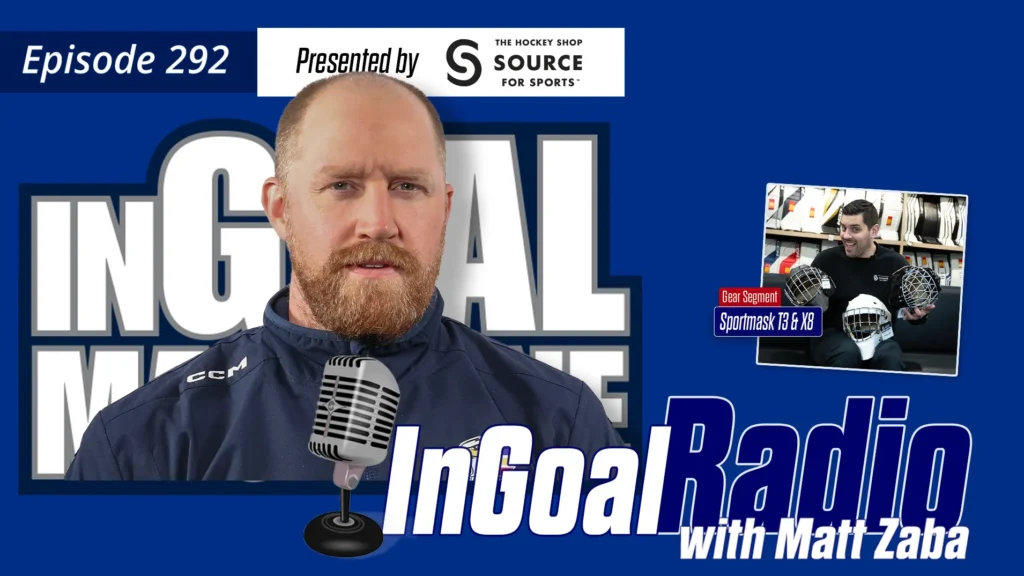
InGoal Radio Episode 292 with Matt Zaba, Colorado Avalanche AHL Goalie Coach

Please subscribe and leave a rating — it helps us reach more goalies!


Matt Zaba, goalie coach of the AHL Colorado Eagles, played alongside Henrik Lundqvist and worked under renowned goalie coach Benoit Allaire before transitioning to coaching through the USHL and NCAA levels. He now combines his role in the Colorado Avalanche organization with private development work through the Mountain High Hockey Goalie Club.
- Matt Zaba drew on his experience playing with Henrik Lundqvist and working under Benoit Allaire to shape his coaching philosophy.
- Transitioning from pro player (including one NHL game) to goalie coach required stops in the USHL and NCAA before landing with the Colorado Avalanche organization.
- Running the Mountain High Hockey Goalie Club alongside his AHL role shows how top development coaches balance organizational and private goaltending work.
- Goalie parents should understand how scouting works at each level and avoid the common mistake of chasing scouts rather than letting performance speak.
- Joey Daccord's net play breakdown offers a pro-level example of how modern goalies think about positioning away from the crease.
Episode 292 of the InGoal Radio Podcast, presented by The Hockey Shop Source for Sports, features a fun and informative conversation with Matt Zaba, goalie coach of AHL Colorado Eagles.
Feature Interview
presented by NHL Sense Arena
In the feature interview presented by NHL Sense Arena, Zaba shares insights from his playing days, which included time (and 1 NHL game) with Henrik Lundqvist and Benoit Allaire before finishing up in Europe, as well as lessons from the transition to coaching, which includes time in the USHL and NCAA before taking the job with the Colorado Avalanche franchise, and his work on the private side with the Mountain High Hockey Goalie Club (and their entertaining social media accounts). Loaded with advice from all aspects of Zaba’s many experiences, this is a can’t miss interview.
Parent Segment
presented by Stop It Goaltending U
In the Parent Segment, presented by Stop It Goaltending U the App, we talk about scouts, why it’s important for goalie parents to understand how it works at various levels, and not chase them.
Pro Reads
presented by Vizual EdgeWe also review this week’s Pro Reads, presented by Vizual Edge, which features Joey Daccord of the Seattle Kraken with another excellent video breakdown session, this time talking net play.
Weekly Gear Segment
presented by The Hockey Shop Source for SportsAnd in our weekly gear segment, we go to The Hockey Shop Source for Sports for a look at the Sportmask goalie mask lineup, from mid to high price points, and even an option for ringette.
Episode Transcript
Intro
What a magnificent time of the year. We are in that between stage. Looking back at the Four Nations face off and getting into the return of the National Hockey League season. Plenty of storylines to talk about in the goaltending world on InGoal Radio Podcast presented by The Hockey Shop Source for Sports Langley, thehockeyshop.com, Daren Millard, joined by the cofounders of InGoal Magazine, David Hutchison and Kevin Woodley. Let's start with the Four Nations face off reaction to the championship final, which served up the much long waited goaltending battle.
Was that any fun or what? Like like, just
Both guys.
And beyond the goaltending. Like, I know we're a goalie podcast, but just the whole thing. Like, gold stars for everyone. It shows you how long and how starved we've been for best on best competition. The intensity of a midseason tournament that I gotta be honest with you.
When people were asking me for goaltenders and who should play for who, part of my response, at least early this season before talking to players about how intense they thought it would be, was depends what kind of game it's gonna be. Is this gonna be, you know, like, back and forth, wide open, rush chances traded, or is this gonna be like the Olympics where the best players in the world absolutely grind defensively and finding a goalie to fit that, you know, my answer would have been different. Oh, man. Like, I was one of those people, I admit it, that wasn't sure we'd have this level of intensity, but it was full value for all those things and the goaltending, everything. I'm just it's just nice to have it back.
Hey? Like, as a guy who's got, like, the last three Olympic goalie, gold medal winning jerseys, NHLers on the wall behind him every time we sit down and chat, like, it's just nice to see best on best with the best. Am I excited or what?
But it wasn't long enough. I mean, I know they can't have any more than that, but it was so good. Don't you want more?
Yeah. You'll next year.
Sort of that Olympic experience of a cup yeah. You're right. It was just thrilling our appetite for what's coming.
Absolutely. It I mean, this is going to absolutely stoke the fires for what the Olympics can be next year in Italy. Although uh-oh. Uh-oh. Is this curmudgeon, Kevin?
I kinda hope like, they let him play last night, guys. And if it's IIHF refereeing, like, the physicality, the fighting, the stuff that made everybody tune in
The Olympics has NHL officials.
There we go. See? That's what I wasn't sure of. Will they call it an an NHL standard?
Still got international rules, though. Right?
Yeah.
But we should have a more traditional game. And you're right. The officials last night deserve all the the credit for letting them play. And there there wasn't a lot of infractions to begin with. Maybe some close too many men on the ice calls that that would have been there was a couple of shaky line changes, but it was a it was a fantastic performance by the officials as well.
The most talked about conversation among all the teams, the number one debated discussion was Team Canada goaltending. And Jordan Binnington told everybody that Team Canada got it right, Hutch.
Yeah. How fun was that last night? I mean, not only the huge game saving stops that we saw, but just done with style. He was out there having a blast and he was a ton of fun to watch. And I dare say, he can't just handle the pressure of what was literally game seven, game seven of the tournament.
Didn't he didn't just show that he can handle that pressure packed moment, but the layers of pressure from all around the country that were on him, every goal dissected by people, and I don't agree with most people's opinions on a lot of those goals. And he just stood tall and raised his game to a completely different level last night. It was incredible. Loved every minute of it. Toe up saves, come on, everything.
The level of pressure and the the window of pressure, that's a great point because he felt it or was exposed to it from September through the final seconds because it was debated from September through to the final seconds.
Sure hope the poor guy doesn't spend any time on social media. Like, people are brutal. People are brutal about all that stuff. And I have to say it here, I'll be my curmudgeon self. All those people out there on social media saying Canada's got a goaltending problem and Canada's got a goaltending development problem, You people are the problem because you create an atmosphere why why the heck would I ever want my kid to be a goaltender?
Because you're saying that's what I'm gonna expose him to and it filters right down to the youngest levels and everybody starts pointing fingers because this is the culture we have. Come on. Start standing behind these guys and just shut up and let them play.
Okay. So I'll give you that one on criticizing Binnington. I had this conversation with a goalie coach from another country last night. Like, why would any everybody complains about goaltending development. Why would anyone want their kid to be a goalie when they see how we treated Jordan Binnington? But
No. But as advocate, you're no. Because you didn't say attacking Jordan Binnington. You said attacking the the problems with the development of goaltending in this country, and that's a fair conversation. If you're gonna point to this and say, we haven't fallen behind all the other nations No. No. No. No. No.
No. Totally different conversation.
No. You misunderstood. You misunderstood. You misunderstood. What I'm trying to say there is if your worry is about goaltending development, you are part of the problem because it's hard to develop goalies if nobody wants to play the position.
So I agree with you, Kevin. It's a totally fair conversation. I'm just saying people are making it worse because they create an environment where somebody wouldn't wanna play or they make it way harder for anybody, even the youngest kids to play today.
What do you think the key was to Jordan Binnington's performance last night?
I think it was the fact that he went on the Vizual Edge trainer and did the game day ready routine.
True story.
Did he do that?
He he did. True story. Shameless plug for one of our new sponsors to ProReads. But, yeah, he did do. He went in went on yesterday onto the computer and did the the game day routine for Vizual Edge.
And, like, honestly, if you take a look at the overtime, like, his visual attachment was on point. You think of the deflection on the shot from the slot, like, not just going high glove from the slot, but off a teammate stick and still tracking into the glove. You think of that long recovery on the Brady Tkachuk sharp angle one where he got comes across and gets a glove on it. You think of the backdoor chance and and the good rotation and the good push and having the blocker building vertical coverage over the plat pad on the the backdoor play to Matthews in overtime, like he was dialed and attached. At the end of the day, though, we can get into technical.
We can get into tactical. It's the ability between the ears to manage all the pressures that come with a moment like that and not change your game. We could even be critical of technical and tactical. You could I mean, the reality of the second goal is he got up off the wrong leg. The kind of thing that you don't see from, you know, you they teach you at PWE.
Right? Like, proper leg recovery, and it delayed him getting across on a goal. That was might go in anyways. But, like, at the end of the day, the ability to not panic, to continue to go out and handle the puck behind the net as often and frequently and make plays when you're behind the net and the best in the world are trying to intercept passes and leave you stranded, to not change who he is in those moments, that's the true takeaway. Like, that's where you get all the cliches about big games and big moments and Jordan Binnington and all those things, but there's some truth in it because in those biggest moments, he still plays his game.
Whether you love it all the time or not, he still plays his game. Can you make an argument that as aggressive as it is, that leads to how much he has to cover off to make the Brady Tkachuk save? Fine. Sure. Fine.
Have that debate. But that's how he plays and he doesn't abandon it in the biggest games, in the biggest moments. He stays true to himself and doesn't panic.
Is it fair to say he might not have played his game in the preliminary round? Like, I think this was more Jordan Binnington in the final, and I it seemed like he was trying to be a little bit more conservative and careful in the other ones.
From a swagger perspective?
Also, just the way he played. He looked so much more aggressive last night, not just the depth that he was taking, but just attacking into plays that he was just he looked more like a goalie school goalie in those first couple of games and more like Jordan Binnington in last night's game to me.
Well, he was certainly busier in the final, which maybe gets you into the groove a little bit.
Yeah. But just chasing things and attacking things and and just playing with abandon in in a way that I don't think he did before.
His assertiveness with puck handling got better and better as
the team turned What a clinic he put on.
And you saw too, like, you like, when when the Americans scored their first goal on the low high play off of a dump in that was up on the glass originally, but settled behind the net by the time it got around. You could see his dis like, there was sort of a body language, like, ah, crap moment in And his body I think it it wasn't about the puck going in. It was that, ah, if I'd gone out and stopped that, they don't get that puck off the forecheck. And as much as you can point to that one as it's one of the few. Like, how much more effective is that American forecheck if it isn't for Jordan Binnington going back there and stopping pucks?
And a great lesson for goalies everywhere. It's not about I mean, he makes plays with the best of them. So don't get me wrong there. Like, he moves the puck smartly, efficiently, and he can pass it too. But so often, the key is just getting back there, and that's about his skating and his mobility.
He gets back to more pucks to stop rims than I think anyone in the tournament. And Lincoln is also really aggressive with that. We can get to him signing with the Canucks in a minute, but I I I think that was a difference maker in this tournament. And it didn't all it doesn't always that's a good lesson. It doesn't always have to be at the boat, the pass or the play you make.
It's about getting back there and stopping it and setting it up for your defenseman so they're not getting, like, plastered into the glass by a Brady Tkachuk. And once you get back there early, the earlier you get there and stop it, the more time you buy yourself to have a head up and make plays and make reads, and you'll get better. The key is first and foremost to be able to get back there.
How often do you see a goaltender, especially a young one, they almost time going behind the net to arrive at the same time as the puck. You can see them just letting off the gas because they think they need to get there. Get early and get your eyes up ice and evaluate what what's going on. Give yourself time.
What does Connor Hellebuyck take from this tournament?
I hope he takes a whole bunch of less crap from people around we talk about Binnington, but a lot of the narrative around Connor Hellebuyck has been about playoffs versus regular season. And as much as they lost the gold medal game, it's not his fault that the Americans left the best player in the world all alone in the slot with time and space. You know, Sam Bennett made a hell of a play on the short side, one off the rush. The first one off, McKinnon is you know, it's funny because it's I actually saw I'm not gonna name names, but I saw an American commentator go, oh, like shot from distance on the McKinnon goal. And I'm like, are you kidding me?
Like, I wanted to pipe in so badly. It's a layered screen. McKinnon goes against the grain and hits the top corner of the net. That play goes in more often than a breakaway in the National Hockey League. So it goes to show you the level you have to go to to attack Connor to have success.
So to me, even though he didn't win the gold medal, this should end any conversation about Hellebuyck, you know, not being able to rise to the occasion or that his playoffs are a result of some type of mental block, honestly. Should, but it won't. In this tournament.
It should, but it won't. You know what people are like. Just like we're
just like we're gonna have the same conversations about Jordan Binnington in the Olympics next year, especially if he has another down season statistically in Saint Louis. So you're right. The conversation and the narratives won't change, but I've always argued that the difference between Hellebuyck in the regular season and the playoffs is his team's inability actually, it's their ability in the regular season to defend the areas that are relative. Key is relative weaknesses in his game. There are no real weaknesses, but when you're so good at everything else, there are a couple things that can be attacked.
And they defend it very well in the regular season. And then in the playoffs, teams target it, and they don't react well defensively. I mean, some of the key metrics last season that they were top three in, they were dead last in amongst the 16 teams in the playoffs. So, and Colorado went to school on it. And I think the Canadians tried to take a page out of that book in terms of how they attacked him.
So, again, to me, this is not a Connor Hellebuyck not rising to any moment in any way, shape, or form. If anything else, I hope it goes the other way and people recognize that, you know, whatever doesn't doesn't happen in the playoffs. You know, as Hellebuyck himself said after the playoffs last year, I felt good about my game. I think he should have.
So people in Winnipeg are encouraged today, Hutch, because of what they saw out of Connor Hellebuyck going into this tournament? You you wanted a performance. You you wanted a certain level of play. They got it?
Yeah. They did. I mean, I I like to think people in Winnipeg know what they have and have known for a long time. It's it's everybody else who likes to find a reason to knock somebody down. And there's gonna be somebody out there who's gonna say, oh, yeah.
If he'd made one more save just like Binnington did. Look. If that puck goes over Binnington's glove on that, big coast to coast save, then we're talking a completely different story and Hellebuyck can win the big one. So the some of the conversations are absurd. The guy played an incredible tournament, and, he's one of the best in the world for a reason.
That that's what I mean. The the result doesn't necessarily matter when you evaluate Connor Hellebuyck's performance in this tournament.
It shouldn't. But, unfortunately, too many people out there just say it's about wins and losses. That's all that matters. And Hellebuyck did his part.
A year from now, Milan Cortina are the two goaltenders that faced off and the Four Nations face off opposite each other or standing in their respective creases to start the Olympic Winter Games?
That's a good question. It's about wins and losses. This is what a lot of people say. So Jordan Binnington sure gave himself a leg up for getting there. I I I'd be shocked if it's anybody but Hellebuyck, but things can change.
And Jordan Binnington sure gave himself a big leg up in that conversation.
I think maybe the goalies around like, Jordan Binnington's in the mix. He'll be at the Olympics based on this performance. The goalies around him might change. There are some goalies who are having incredible seasons that because of the timing of when you had to pick your team aren't on the team. And maybe the if they continue to have those types of season next year and build a bigger resume for results, they get that opportunity.
But to me, what Binnington showed and we talked about this, and it was the one thing when people kept questioning the decision to go to him, as much as I was one of the many who forgot about how game changing his puck handling can be going into the tournament, the reality is on the previous five seasons, no Canadian goaltender had better adjusted results relative to environment than Jordan Binnington. He was top 10 in the National Hockey League in those five seasons, and he was fully deserving of the opportunity. Wasn't ignoring that this year was a down year and has been a down year statistically. He has been the best Canadian goalie overall for the previous five years. He's got a history of being big game goaltender from his run to the Stanley Cup playoffs.
And when you add that into some of the style elements we talked about the puck handling, it it it's hard to argue with the decision to bring him even if he was well down the list statistically by the time the tournament started. And I think you saw as that paid off, it's all the reasons he's gonna be back in part of the mix next time.
The only thing that was sad to me about the tournament was how short it was because we had all these discussions right down to who's the third guy for each country. And despite Daren having an over under that I think you were correct on last week, Daren, we really saw so few guys get to play. And many so many guys have been part of the conversation only got to watch this and that to me, that's sad. It'd be great to see more guys in there. You know, in a long Olympic run, you very traditionally have, you know, the two guys split the first couple games and then they make a decision for a lot of countries.
Canada, for sure. I wish we'd been able to see that, but we definitely got the point.
Teams use multiple goalies.
No. You were right on it. I just wish we'd been able to see a little bit more.
Well, hey. Listen. I hear you. I agree with you. And I think there's a lot of owners and GMs that are like
Yes.
Yeah. No. Sorry. This was more than enough. I mean, how many of those guys like, I don't know if any of them are playing in their games this weekend.
How many teams there in Vegas, Daren? Obviously, Shae Theodore with the cast as he gets or at least like a like a sling type cast on his hand as he gets his gold medal last night. I mean, Brady Tkachuk, Matthew Tkachuk, there are key players or key teams that we now head back for the final third of the season that are not gonna be available in the short term and in some cases, perhaps for the long term, that as good as this was for the game, it will be at the expense of several teams.
Jordan Binnington celebrates a gold medal at the Four Nations face off, and Kevin Lankinen enjoys the spoils of a new contract. Can you give us the terms here?
Five years times 4 and a half million dollars is the extension that was announced literally fifteen minutes before we went on air. So that threw my morning for a bit of a a bit of an upheaval. But congratulations. There's a guy that bet on himself. Kevin Lankinen was making 2,000,000 last year in Nashville, was full value for it, one of the best goalies in a small sample.
Like, his adjusted numbers continued to be off the charts, which is why when it came to July and free agency, he was one of the guys I touted teams should be looking at. You know? To me, he should have been on the short list with Stolarz and in terms of guys that were ready to make a next step, much like Charlie Lindgren when Washington signed him. And for whatever reason, probably the 2,000,000 ask and the fact that backups were getting in the one to one and a half range outside of those first two I mentioned. He goes into almost training camp without a contract.
Sees an opportunity here where he thinks he can play with Demko not ready to return at the start of the season, takes full advantage of it, and now he gets paid. Now there are a lot of GMs, including including in Vancouver, they said we got him because he overplayed his hand in free agency financially. Well, that overplay, which was around $2,000,000 a year ask on term, maybe 2 and a half if you wanted multiple years, would be a bargain right now. So to me, that those are the bets you need to make, like, to just as an aside. You need to make those bets on goalies when they have that type of underlying profile so that you get the bargain.
Good for Kevin Lankinen. And he bet on himself, took way below what he was expecting for this season, and now he's gonna be in Vancouver for another five making, you know, really solid, like, sort of number almost almost as much as Joey Daccord's getting to be the number one in Seattle. So this may be a bit of a resetting of the market, but it couldn't happen to a better guy. You won't find a nicer person in the league than Kevin Lankinen. And, he brings a real he brings a smile at all times and appreciation for where he is and what he has and a real positive energy to the room here in Vancouver and to everyone around him.
So really happy to see him get this opportunity in this deal.
The follow-up is what does this mean for the future of the Vancouver goaltending situation?
Well, I mean, in the short term, Demko has one more year at $5,000,000. And the reality is there's a lot of questions about his health. Right? Like, he's out again now, sustained an injury in the Canucks final game before the four nations break. Lower body is what they say, will not even be reevaluated until they get back from a five game trip.
So that's March 1. So that's three weeks at that point. My understanding is it's soft tissue, and it isn't overly serious. And I think if we're being fair, as much as everyone's gonna look at the he's had back spasms. He's now had this lower body injury.
That is four different injuries, two to a knee in less than a calendar year, and everybody's gonna say, that's a lot of injuries. I can't help but look at them and say they're all related. I know the first knee injury played a role in the second knee injury and coming back quickly from it. And so then you miss seven months. You you miss all of your summer training.
You miss all of your summer work with your goalie coach. You miss your preseason, your training camp, and the first two months of the season, and you basically try and run and jump on a moving train. And that's a lot of stress on the body. The results weren't there early. He found his game in the last five.
Looked like the Vezina Trophy finalist that he was last season in the five games leading up to the injury. Now it's just a matter of how long he's gonna be out. I I I I feel for him. I think that it's going to take an entire offseason probably to reset physically and be able to start from scratch next year. And I think people need to understand, like, because the ceiling is so high on this guy, all it's gonna take is one healthy year.
Even if it's at 45 games or 41 games and a job share with Kevin Lankinen and kinda like Boston used to do with Ullmark and Swayman. And Thatcher Demko's right back to being an $8,250,000 goaltender. Now he's an unrestricted free agent. Is anybody signing him to an extension given the recent injury history? Probably not.
It's gonna be on him to have a good summer and come back next year and prove it, but then he'll be right back in that stratosphere. Whether Vancouver's willing to entertain that after committing this much to, I guess, with Demko healthy, you'd say one b. I don't have that answer. I do have a lot of people telling me that they think that market in the backups as the cap goes up is gonna be the one that maybe grows the most. Like, you're not gonna be able to lock in guys like a lot of teams did last year for a million, a million and a half.
Too many teams realize the importance of having a guy that can play in that role and play 25 plus games, and you're gonna start to see more resources committed to it. If so, this becomes a bargain. If not, and he remains a one b, this has the potential to become an overpay. But for now, just happy to see him get it. Because like I said, couldn't happen to a nicer guy.
I'll be watching free agency July 1 because that will be the time that Vancouver would be able to extend Thatcher Demko with a year out. Does he look at it and go, I'll sign now because I have been through the ringer injury wise and extend it at maybe 5,000,000 or maybe the same market? Or does he, which is a gamble on on your health, go through without a contract next year or with in the final year of his contract and play it out. It'll just be fun to to watch from from the outside.
Yeah. And honestly, I have no idea, you know, what he's thinking, what his representatives are thinking, what their approach is. You know, I honestly, I we saw it in his last five games at his best. He is one of the best in the world. Mhmm.
Like, Demko at peak powers is a guy who can challenge Connor Hellebuyck for starts at the Olympics next season. And so if I'm him, we just talked about how happy we we are to sort of see Kevin Lankinen and bet on himself. I would be tempted to bet on myself and have show what I can do again in a healthy season. Get through a season healthy. I mean, and in fairness, I mean, the truth is he hasn't gotten through a season as the number one healthy yet in four years.
So past the show, he can do that. But if he does, there's a payday waiting on the other side of it, and it'll be it'll be it'll be in that range of what the new standard is, you know, for for goalies at the level he's capable of getting to.
Similar story, Adin Hill, the other this year, trying to get through a season healthy. He's won a career high 20 games, trying to hit that 40 start mark, and, he's an unrestricted free agent at the end of the year. Lots to, keep an eye on as we move forward, but let's get into our gear segment brought to us by The Hockey Shop Source for Sports Langley, thehockeyshop.com. Things happening over there. I just got my email about ten minutes ago, from The Hockey Shop.
Well, I'm surprised you hopped on the chat, then I know when you get those emails, Daren, you go down that that sort of rabbit hole of checking out new gear, over at The Hockey Shop Source for Sports, and I would suggest everyone do that right now. It's a great time of the year to go to the hop hockeyshop.com and browse through the sales. We've got a lot of new gear on its way real soon. You've heard us here talk about the launch of Vaughn VX one. You've heard us talk about the launch of True and their PX5 gear.
And every time something new comes in, and we've got launches coming soon for CCM and EFlex 7, we've got the new Vapor line coming out from Bauer as well as a lot of accessories by the looks of it, and that always means that past models will be marked down. So whether you're waiting for that next new launch, whether you wanna check out the recent new launches we just mentioned, or whether you're shopping for the bargains that are always associated with this time of the year and all those new launches, make sure you check them out at the hockeyshop.com or in person at the Hockey Shop Source for Sports in Langley for all the best deals on goaltending equipment and experts selling it to you that'll make sure you get the gear that fits your game.
Did you just use the word accessories to get me excited?
I thought that, you know, I know you've got a busy morning, but mine has been turned upside down by the contract announcement right before we come on air. So I thought I would turn yours upside down because I know you're now gonna go look at accessories for the next hour and a half.
That's exactly where I go every time. I love my accessories. Little things that I can add or tweak with my gear. Dealing with the sport mask line this week.
Yeah. And we, you know, we we talked about a number of new lines coming out. What we've tried to do here in the past couple of weeks is it's like an errors and omission column. What are some of the things that we've overlooked as we went through all the new product of the past year? We did the CCM AXIS F9 mask last week, and that took us over to the mask section.
And I gotta say, like, it's a huge wall of masks. You always see the pad wall behind us when we record, which is a good reminder to watch all these on YouTube. But around the corner is a huge wall of masks. We talked last week about fitting masks for kids and how it's important to have multiple sizes. Over at the Hockey Shop Source for Sports, they don't just have all the sizes of every brand and every option.
They've got some other brands maybe outside of the CCMs, outside of the Bauer's and the big names to help make sure they have different options that will fit both your game, your head, and your budget, and that's where we went this week. We hadn't talked about the Sport Mask line, so we'll do it now.
Gear
Welcome back to The Hockey Shop Source for Sports. It's a sporty day here. Sport mask kind of day. Well done, Cameron. That was pretty whitty.
That was you don't have kids, do you? No. Well, you
got the dad jokes down, Pat, buddy.
I know. Attaboy. So, Cam Hi. Been a while since I've been in a sport mask. Yes.
This one's pretty comfortable. Yes. Walk me through the different models that we have here, the different options. Obviously, right away, I'm liking the matte. Yes. They got a matte white that you're gonna show us as well.
I know. It's like you're already talking about the colors before we even talk about the mattes. I well, let's talk about the mask then because I feel like I need to catch up a little bit on Sport Mask and their offerings. So I'll put this one down for now. Do I have on my head and what do I have in my hand? The Sport Mask X8.
X 8.
X 8. So they're opening price point for their mask comparable price point wise in terms of to a 950. A little bit of CCM F9. You're trying to peek at the tag there that says $699. There we go.
Okay. Yes. And that is Canuck dollars because the mask is made in Canada. Oh, no tariffs. Well, yeah.
Yeah. For now. So, yes, great call to start off with that. Okay. All the Sport Masks, we're talking about a hand assembled mask in Canada.
So more of a traditional foam? Correct. Their standard VN foam liner as you start to open up the mask itself a little bit more. So the shell itself, fiberglass mold, it is featuring some Kevlar to it too as well. So I'm guessing what?
Chin, forehead? Your standard suspects. Yes. So the X 8 is modeled after their T3 model, which we'll get into here in just another moment. But, again, showing off the mask itself, the more of that traditional mask when we see it, this shell and shape style has been around for a number of years.
Not too unlike what you're actually seeing on NHL goaltender, Jonathan Quick.
Alright.
That's right. Still wears a form of that T3 mask. Again, something specifically for him, which is a little bit of a different model, but Can I just do a little call out here? Go for it. I pick it up like this.
Yes. And, again, some of the traditional foams and things, it might feel a little heavier. And I think people sometimes grab a mask off the shelf this way and they judge it that way. And the reality is you gotta put your head in it
because I don't know that lighter is necessarily better. Now they've come up with remarkable technology that allows lighter masks to be protective. We've seen advancements in foams and all those things, but judging a mask based on heaviness never made sense to me. Like, it's too heavy. I'm like, ah, more material as long as it's balanced, I don't feel it as heavy on my head. I hope people pause and replay exactly what Kevin just said because that's extremely important.
I hope people pause and replay exactly what Kevin just said because that's extremely important. No matter how much we talk about a mask, I always say it comes down to fit, but how good it is, how bad it is, whatever you wanna call it. If the mask doesn't fit, it doesn't protect. And I think Kevin's statement there holds massively true for what's goes on the wall. Just because it's light doesn't necessarily mean it's better. Could be, but we don't know that until we get that on your head.
[crosstalk] Double check that size. That's why you call us and that's why you listen to this guy sometimes and me more so, especially when it comes down to fitting. So I don't know where to go from here because he's being nice to me and saying nice things. I'm a little bit at a loss. Let's talk about another option that's in I the think I'll save you.
Okay. So cool call out. It's kind of hard to find to be honest. Ringette cages on mounted, ready to go on these X8 masks. Something we carry, we do stock.
Again, little bit of a unicorn in terms of for finding these guys can be a little bit difficult. Unfortunately, with the way that Ringette happens, it sometimes gets held about the website or wayside. We are trying to make sure that that still stays front and center for you guys.
Okay. So basically that is the same shell just with a different mask or
is Exact there
same shell.
Okay. Just ring that style cage. There we go. Alright. Quick call out with this mask, and this holds true still for the T3.
So in terms of for sizing, extra small all the way up to XL. Note XL is an uncertified CSA product. That shell did not get certified. CSA certification is quite expensive. So hold on.
I got one quick question though. There's more to this. I know you've been nice to me, but does the XL fit your giant head? You know what? It's just not quite big enough.
Can kind of see that. Totally incorrect. The XL is massive. I interrupted. Keep going, Kevin.
Also, quick note. Same thing with the t three non HEC certified. So CCA certification. Canadian hockey, totally approved. HEC certification is an American certification for American minor hockey and whatnot.
Note, this mask does not have that. So if the league that you're playing in demands HEC certified mask, just keep that in mind when purchasing this mask. Okay? So Canada, you're good. Yes. United States
Maybe. Maybe, maybe not so much. Depends on the league that you're playing in.
It's kinda like a tariff.
Depends on the league you're playing in. Moving on. Next step up in their lineup. I like the
I like the matte white. That's
The good news As we like that in an automobile, I like it on a mask. That's a good look.
So he's a big fan of the matte. As you can see, he is wearing a matte black one. Gloss white, gloss black, matte white. Those are the three or four options that we have in terms of for color in stock at the shop in both the T-3 and the X-8.
Okay, so what's better about the T-3?
The price point gets up close to $1,009.49, so we're up by about 250, almost $300. Correct. So now we're gonna be using different materials. So let's open up the mat actual nope. We don't need that.
There we go. So you can actually see the difference in terms of the lay of the mask itself. Again, still at the same basis when we're talking about that fiberglass, still featuring Kevlar too as well, but also carbon fiber. The way that they lay their epoxy is very important too as well. So their process is basically trying to ensure that there's no air bubbles in the mask itself.
So it creates a very clean finish, no bubbling on the mask itself, very tight in the weave in the mask itself, very strong mask itself. So again, what we're saying here is in terms of that split. Okay. Why do I need this mask over, say, an X8, for example, that does come down to the level of shots you're playing. We're talking about that top end level for that T-3.
That X8 kind of more encompasses about that mid level of that market. I wouldn't necessarily say, hey. This is a junior level mask. I would now step you up to that T3.
When you say junior, like like major junior, junior a, stuff like that?
Correct. You should
be into a T3 as opposed to an X8 at that level.
Fit sizing?
The same. Same in this one. That's correct. Certification, same in this one. Correct.
Okay. Sport mask. Two different models. T 3. X 8.
X 8.
Sorry. I thinking about I was trying to lead you. I was thinking about how sporty you looked in that matte black. I do like the matte black. I'm big on the matte I'm gonna stop with the sporting jokes.
Forget it. Okay. Any questions? You
haven't told them where to call them. Gosh. (604) 589-8299 or 1-800-567-7790, or you can check out the masks at the hockeyshop.com. Do you have an extra large on the shelf? I on the shelf?
Yeah. I do.
You can come in and see if Cam's head will fit in an extra large mask.
It doesn't.
It's important to have those smaller competitors, but still developing technology just to just to give us some options along the way. We we love our CCM. We love our Bauer. We really do. But the the influence of some of these smaller companies is important.
And a little more traditional builds. Right? As we get into new foams and listen. Like, I love the three d printed mask liner, and I'm feeling really safe in it and I've taken some bombs and not had any ring. Like, I'm a fan of development.
We like innovation, but there's value in traditional masks, traditional builds, and traditional foams. And that's what you get in sport masks. A lot of sort of expertise from over the years of crafting those builds. And if you look at the National Hockey League level, there are a lot of guys that are in a more traditional mask build. So, important not to ignore those things.
I talked about it in the video. Sometimes the traditional builds, if you pick it up by the cage and hold it out in front of you, it's gonna feel a little heavier. Put it on your head, the way it's designed to fit and sit and feel the balance, you won't notice the weight. I do think that rack check, that sort of retail check where everybody just grabs it and picks it up and holds it in a way they would never actually use it, does a little disservice to some of the traditional companies. And so, again, with with the smaller ones like Sport Mask, would highly recommend making sure you put it on.
Again, there's different fit options. Maybe if the other ones don't have one that fits your head, give some of these alternatives a try to see if you can get that better fit seal and you're at better fit. And no better place to do it than at the hockey shop where their experts will make sure it's sealed in the right spots.
Quick question. And, Hutch, you would be the best for this eye line. Where where do you want your your eyes to be looking out through that that cage, through that hole in relation to the top?
Jeez. You know, I I don't think I am the guy to answer that.
Don't because I'm close, so I'm not.
I I I hope through some holes, not through some bars. No. Because I've actually had some people really get into it and say, no. Because your kid's looking through it this way, he can't possibly track the puck. And I'm like, and then you got the old photos of Marty Brodeur where the mask almost covered his eyes.
It was down so low. Yeah. You know? So I don't know. I still think a lot of those things I think are personal.
Through the middle of the bar, like or or the hole Yeah. Basically. And and then you're right, Brodeur was like, his his eyebrows were covered.
The only thing for me about that stuff Help you stay down. Yeah. The only thing about those things to me are are you seeing these odd fits because of a fit issue? So it kind of raises the question in a lot of cases for me, does it fit properly? I remember there used to be this line of Bauer's you'd see on guys and like it would cover their mouth completely and the cage would just sort of start at the top of the nose.
And then you also see, other kids, might know one pretty well, that wear it in such a way that the cage is basically touching their nose. Like you see these odd views and you have to raise the question, is this fitting properly? Is it fitting safely? But I still don't know that there's a perfect way to do it, Woody.
Well, I I don't know about perfect, but I will say this. There is obviously a set of bars and a window built into these things that your eyes are supposed to look through. If you are looking a level lower, like, say, at the lower section, like, with the bar that's supposed to be under your eye now above your eye and the whole mask sitting up, that might be a fit problem to your point. Like, if you're looking through the wrong windows, the mask probably doesn't fit properly. And, you know, we go back to the Corey Crawford example. He would have his teeth chipped on on an annual basis multiple times and have to go to the dentist by shots off the chin because the mask was sitting up so high and he wasn't looking through that right window. Still, it stopped a lot of pucks that way.
Didn't affect his performance because he was able to look through that second layer, but it's not where you're supposed to be. And that means you've got a fit issue that will affect you in other ways.
Although most of those fit things, let's be honest, are around like the average head. They're designed for an average head. And there are gonna be people who have a head that's just a little bit taller. So when you put the mask on, those bars are gonna sit slightly different. You can't adjust them so that they're perfectly aligned for where your eyes fit relative to the top of your head or or whatever.
So there are gonna be some extremes where it doesn't look right but it's still fitting properly. So I still think we got a grain of salt on all of it.
Parent Playbook
Oh, you found some traction there, buddy. I'm, proud of you. I have no better person to go to with the parent segment brought to us by Stop It Goaltending U the app than David Hutchison. And something you are going to talk about last week and Woodley sidetracked you, we're going to deal with this week.
There's a perfect segue here though. Oh, yes. Because last week's read for Stop It Goaltending U, the app, applies even more this week. So I dug into it a little bit. And in addition to all the things that you can get from Stop It Goaltending U, the app, we talk about the one minute videos, the daily affirmations that you get in one minute, the five minute videos, the twenty minute videos, the twenty five years of experience that goes into the coaching and all those videos that are available on the app.
You can also get counseling and advice from Stop It Goaltending U. They have specialists that can help you if you're looking for scholarships, if you're looking for places to play on a junior basis. There are options there to book meetings and talk with them about the process of scouting, of taking next steps, of getting seen, the path to junior, the path to college, the path even to pro. They've got expert counselors there that can help you navigate that, and you could book appointments with them right through the Stop It Goaltending U app. So one of many things we tend to look at the surface level, the base the base subscription.
When you get into the secondary subscription price point with Stop It Goaltending U, the app, the sort of higher version, you get some of these things included, but you can book these appointments and look into it. Make sure you check out the Stop It Goaltending U, the app. And, of course, in both versions, you get the best of both worlds, a subscription to InGoal Magazine premium so you can check out all the latest and greatest with NHL goalies breaking down film and footage and become a better goaltender overall. Hutch.
I think it might be my day to be the curmudgeonly one, boys. I already started off a little bit on fire earlier because I reviewed what I was gonna say last week in getting ready for this morning, and it got me going again. I'm sure you all saw that piece going around on social media last week. There was a program for kids as young as six that the number one thing on their list of what you get out of our program is exposure to scouts. Now look, to be fair, it might have just been a misstep in how it was promoted.
I like to think that the people behind this and every program has the kids' best interest at heart. Maybe they were using a template they had for older ages. Heck, maybe they got ChatGPT to write this thing for them. I don't know. But I couldn't believe that I saw something talking about exposure to scouts at age six, seven, and eight.
I was happy how many people were peed off about what they'd seen. And maybe I'm preaching to the choir here, but I still think, guys, that we need to talk about this a little bit because I guarantee there are parents every week in the stands at minor hockey games freaked out about what the next step is for their kid. Age eight, age 10, where'd little Johnny go to play? Who's gonna be on our team next year? Maybe I should be moving my kid here.
It is stressful being a parent. And look, I was that guy. I get it. I was involved in it. But in terms of exposure to scouts, here's the reality folks.
Age six, age eight, age 10 will not have any impact on your kid's hockey future. By all means, if you want to send them to one of these things for the right reasons, it's gonna be fun, because they're gonna enjoy the experience, because it will be a challenging development opportunity, go for it. But temper your expectations. These things will not define your kid's path to the National Hockey League. One of the ones that really gets me riled up guys, here we go.
It's the Brick tournament. We see highlights on National Hockey League games where people praise the wonderful Brick tournament because whatever player in the National Hockey League was in it. Good for them. Great for them. I'm sure it was a fun experience.
Here's the reality. The vast majority of players in the National Hockey League did not play in the BRICK tournament. The vast majority of players from the brick tournament do not play in the National Hockey League. It will not have an effect on your kid's future as a player. I was speaking guys to the head of a major hockey school, not a goalie school, And I told him when my kid was young that I was a little worried about this great brick tournament.
And, you know, he looked at me and he said, Hutch, do you know how many guys working for me for minimum wage played in the brick tournament? And the answer was a lot. Look. The players at a young age that turn into Connor McDavid and Connor Bedard, I saw Bedard at a tryout when he was a young kid, and it was electric, but he didn't make it because there was a scout in the building that day at age eight or 10. They're gonna get noticed anyway.
Couple personal stories. It was a year before my kid's draft year. His goalie partner, it was his draft year. So he's a year older than my son. And there was a scout from a Western League team talking to me because I was the goalie coach and he wanted to know about my my my son's partner, Joey, plays for Swift Current now.
And he said to me straight up, just so you know, I'm not even watching your kid. And I'm like, oh, okay. Why is that? Because it's not his draft year. I'll be watching him next year.
So do you think he was watching him at age eight? No. And I had the very same experience guys with an NHL scout at a game. Yes. They're aware of the kids in the league.
Yes. He knew what year might was my kid's draft year, but he was also very clear. I'm not watching him. I'll watch him in his draft year. That's when it really matters.
building a hockey career is not about getting discovered at a young age. What we need to be focusing on is building confidence in our kids, letting them have fun, let them grow as players, let them grow as people. If they're good enough when it matters, they'll find them.
So, guys, building a hockey career is not about getting discovered at a young age. It's not Pamela Anderson at a BC lions game who suddenly gets her life turned around overnight because she's discovered. You're not gonna discover a 10 year old kid who suddenly is gonna play in the National Hockey League because some scout sees something in him. What we need to be focusing on is building confidence in our kids, letting them have fun, let them grow as players, let them grow as people. If they're good enough when it matters, they'll find them.
Yes. You should play at the highest level that you can that's right for your family for all kinds of different reasons, but they'll be found. And if they're not ready then, that's okay too because there's a lot of different paths. Not every kid is ready at the same time. The first goalie taken in the National Hockey League draft this year from the Western Hockey League, most people seem to think it will be Josh Ravensbergen of the Prince George Cougars.
He was not drafted into the Western Hockey League. He had to fight his way past a kid who'd already played for Canada, the U17 level to even make that team. It's working out pretty well for him right now. And I guarantee guys, there's gonna be a a few goaltenders playing right now in the CHL, the NHL, the USHL, wherever, who will not be drafted this year, and they will go on to having great pro careers. And none of them were scouted at age eight.
So relax, have fun, and enjoy the ride.
Ladysmith's, Pamela Anderson.
Yes, indeed. Just
I down the believe the kids call that a good pull. I don't know. Didn't say one as a good, you know, good reference, a good pull.
Yeah. Yeah. I met her. She was
I just noticed that Woody was writing some stuff down, and he looked up.
Like, did I hear that? Right?
I mean, listen. I lived through that. Right? Like like, I was a kid in that era going to BC lions games with my parents when she was discovered as the Labatt's Blue girl on a, you know, at at a game for the BC lions. So CFL, a lot of our American listeners are like, what the hell is a BC lion?
What's a CFL? But they all know who Pamela Anderson is. So that reference definitely, that resonated with me. That's that's that's my era.
Glad I finally got your attention, Woody. Now I know how to do it.
So when do you worry about scouts?
You don't. You don't. Oh, oh, oh, oh, hold on. You do. Has to
be Tuesday time. Tuesday night at 10:30 in beer league. I know a whole bunch of guys that worry about the scouts then. That's when you worry about it.
No. But like, what are you gonna do to make this happen? I I under I'm sure there are some showcases out there that for a kid who wants to play some junior hockey somewhere, that's a way to find some teams, teams that don't have the budget to travel to see all these kids play and so on. But if your goal is the CHL or the USHL or a professional career, the scouts are there. They're out there.
They're finding you. You don't have to worry about it. You have to worry about playing the best hockey you can. It's like, do you worry about winning the game today? No.
You'd worry about the next shot. Do you worry about the guy at the other end? No. You don't worry about the guy at the other end. You worry about your game.
And, so I don't think you worry about all these scouting situations at all. I I do understand to a degree the worry about where should my kid play next year and how do I get them the best development opportunity and so on, and we can talk about that another time. But I don't think you chase the scouts.
K. So I got this is a little bit of a mea culpa too because this goes back to us talking about development of Canadian goaltending. And I've been critical of the lack of a national cohesive program relative to other countries here in Canada. But at the end of the day, much like chasing the scouts, the way the parents approach minor hockey is a big part of the problem in this country in terms of some of the things we've talked about with USA hockey, like, you know, no backup goalies at certain ages. Both kids play every game.
Some of those things. I was talking with, somebody who's done some writing for us, and his kid's team actually gave the parents the vote of whether starter backup. So a kid is sitting every game or whether they split games, and the parents voted to go NHL style starter backup. I think his kid's U9, U10, maybe U11. And so much like this conversation about chasing the scouts, it's the mindset and that has to shift from parents in terms of how we do things and looking at the bigger picture rather than trying to make everything professional, including worrying about who's watching your kid at a stupid young age.
And look, my point of all of this, Woody, is not to scold a parent because they're chasing a scout. It's not to say you're doing something wrong here. Parents, it's really for me to just help you give yourself permission to just relax and enjoy the ride.
But I wanted to scold somebody.
No. You you you scold away. I'm just making sure it's not the parents. I because honestly, this all began with me being upset about something I saw for a hockey program trying to rile up the programs. That's where where it happens.
We've we've privatized the game to such an extent, you know, and everybody's chasing a buck and it's fair to try and make money in this world. It's okay. But preying off people's fears is man, that's frustrating.
That's a lot of minor hockey and summers summer leagues and summer camps, summer schools.
Sure
is. Not goalie schools though.
No. Although I do have a funny scout story from a goalie school. I was on the ice, at a goalie camp. I don't know. There's 15 kids on the ice or whatever at the time and all of a sudden this chatter starts going around the ice.
And look, there's a ton of kids who've been drafted in the National Hockey League at this camp. And, the chatter starts around on the ice and everybody's looking up and pointing up. I come over to a kid like, what's everybody getting all excited about there? There's a scout here. Really?
Really?
Yes. There was a guy in a suit. It was the father of one of the other goalies. He was wearing a suit, so they all decided he was a scout. Not many scouts wear suits, by the way.
You can recognize them too.
Well, here's an interesting great tie in, because we've got Matt Zaba coming up on the NHL Sense Arena feature interview. He's from Yorkton. One of the great goaltending schools of my generation was the International Goaltending School in Yorkton, Saskatchewan. And Dennis would come on. He was the general manager and coach of the Yorkton terriers. He would come out and and scout the later years, like the 15 and up goaltenders all the time.
But not the eight year olds.
Not the eight year olds. No. No. Not the eight year old. 15 and up.
But
I was I was not really his cup of tea.
But you still got a chance, Daren. Tuesday night, 10:30, the scouts are definitely gonna be there because I got a guy playing like it's game seven against you. So a 100%, there must be somebody in the stands watching that Yeah. I played in try hard run the goalie.
I played in a beer league showcase for scouts, boys. Did you? I did. You probably Did you notice? Crazy.
Yeah. I did. True story. The the local there's a league around here that actually Are
telling the truth here or are No.
I'm actually I'm I'm I'm I'm stretching the truth, but I'm telling the truth. There's a league around here where, everybody gets rated. They get a rating number between
Oh, yeah.
Whatever whatever, and then they have a rating cap and you have to pick players for your teams based on this rating cap, which is a bit analogous to a a salary cap because you have to have a certain number of guys below a level, a certain number above a level, and so on. And so every team sends a representative
a way to run a league actually.
It's very cool. And if you want to come into the league, you have to go to this showcase where there's a quote unquote scout, a representative from every team in the league and they're in there and they're making their own notes. And those notes are combined to create the rankings for everybody. And, so yes, I did. And what was really cool is one of the guys from the team, I was new to town, came running down afterwards because he heard that it was Hutch from InGoal that was in the ice and we got to meet as a result and we've been friends ever since.
I thought you're gonna this is like, what was that show on CBC with Mike Keenan was the coach where Making the cut. Yes. Taking the cut. I play with a guy who was on making the cut. He plays every Monday and Friday with us.
He was on making the cut. He played a little pro overseas, played a little minor pro hockey here. I think ECHL, SPHL, a little NAHL. That's a tough league. Mhmm.
And he was on making the cut. So I I thought Hutch was gonna give us a making the cut story.
No. If I tried, I'd have been cut before making the cut. I wouldn't have made the cut.
I like that show. It there was something there with that show. Nobody's gonna make the NHL from that show, but there was there was still something there.
I'd like to see it again.
I would like to draw upon. Do you remember what your rating was, Hutch?
I don't, but I went first overall in the draft. Did you? Yeah. But they draft goalies first and there weren't many of us in it. So I I was the first goalie Yeah.
Of two or
Even the mock Andre Fleury of the Nanaimo senior hockey.
Yeah. It was pretty funny.
I had no idea we were with the first overall draft selection.
That's impressive.
Yeah. Well, that's yeah.
From now on, that's your intro.
First OV.
Co founder and first overall draft choice of the Nanaimo Rec League hockey. Yeah. What was the league?
It's called Casual League. Yeah.
Oh, from the casual.
NCHL, the Nanaimo Casual Hockey League. Great league. Had a lot of fun there.
Joey Daccord back with us with the Vizual Edge ProReads.
Yeah. Hey. We teased it off the top. When it comes to Vizual Edge and training your eyes, no better salesman than Jordan Binnington winning the Four Nations face off. Oh, I didn't know what to call it.
There was, like, tournament event? No. Face off. The four nations face off for Canada after going on Vizual Edge that day and doing their game day routine. We've talked about the edge test.
Do that when you start the program. And as you move on, we we talked a little bit about that, with Cam Talbot, but how you move on and you go back and take the test and see how you progressed. Identifies your strengths and your weaknesses in terms of six different sort of visual attributes, and then sets out on a program to train them. But there's also the game day one you can do to get your eyes warm and moving and tracking, diverging, converging in a proper manner like Binnington did heading into the four nations tournament. We've got a new monthly price plan at Vizual Edge, or I should say they have a new monthly price plan. Used to be you had to commit to multiple months. Now you can go month by month. It's a better option. Make sure you check that out at Vizual Edge, and, of course, there's discounts.
InGoalmag, if you're not a member of premium. And if you are a member of premium, log in to our ProReads to get the bigger discount using the code, which I can't say here because it's exclusive to our premium members, but you get a bigger discount with Vizual Edge. And the best way to go find that is to log in to ProReads, including this week's with Joey Daccord. Joey Daccord is facing the Detroit Red Wings. Little bit of behind the net play, little low high, little advice on when to use the stick to try and cut off passes, when to be careful of using that stick because it can take you out of your coverage in the net, how to read and process all those things, how Joey does it with the Seattle Kraken, one of the great sort of thinkers of the game in my opinion, the way Joey breaks down this video, and he's our guest again this week on ProReads presented by Vizual Edge.
So make sure you check that out at ingoalmag.com.
Talked about him. The American Hockey League goalie coach for the Colorado Eagles, the Colorado Avalanche parent club is the is the parent club of the Colorado Eagles. It's Matt Zaba, who's part of our show today with the NHL Sense Arena feature interview.
Well, it's interesting. I reached out to Matt because I thought maybe he'd be in town with Abbotsford, with Colorado coming up to play Abbotsford in the American Hockey League here. He wasn't, but it was a great reminder that we badly needed to get him on the show. And so this is a great opportunity to catch up with him. If you if you if you don't follow him and and the Mountain High Hockey Goalie Club on social media, I would highly suggest it.
They have some fun. They've got some good instructional stuff, but also they have some fun. They know how to manage social media and make it entertaining. But also having a really good first year in the American Hockey League. First year as a coach there, he's worked he's worked at the NCAA level, played at the NCAA level, coached there, coached in the USHL.
A lot of years coaching had some thoughts to him. Interestingly enough, from some of the topics we've discussed today about privatization and goalie schools and development and things like that. He's a guy that can really speak to it at all levels from youth right up to professional. And so great conversation with him. Also played a game with the rangers as you'll hear, so we get into that.
Playing alongside Henrik Lundqvist, what he learned from Benoit Allaire. Just a lot of different takeaways in this interview with Matt Zaba, who, like I said, long overdue to have him as a guest. And now that we've had him, I'm sure we'll have him back on soon because it was a really great listen.
But before we do that, one of the things we talked about last week, guys, was how tough it can be at the beer league level when you're not really sure the level of the player that you're reading the shot off of. Sometimes you get a muffin, sometimes you get a laser. One of the cool things about NHL Sense Arena, of course, was that you could train against National Hockey League players and see what it's really like to face those great shots and read those releases and so on. But I think one of the things they've added in which is really important recently is age appropriate competition. So now you can play against top U 14 and U 18 players, boys and girls in the drills, and it's a little bit more realistic for your level of play, and I think it's a really good idea.
They've also added some new drills. Again, NHL Sense Arena always updating, always improving, always giving you new things exactly as we should be doing as goaltenders. Three new drills I wanna mention, shot from the slot, which is working on those high danger slot shots. Really important. Off angle shots so you can practice your positioning against some tough releases off an angle.
And here's one that I think is super important in the game today is deflections. Learning to read deflections like a pro and some of those deflections if they're done right can be almost impossible to stop. But if you can practice them, it's going to make a big difference. You can get those drills through their updated drill page and where you can choose those shooters by age category and you can tailor your training and take your game to the next level with NHL Sense Arena. And of course, if you're a bit older like Woody and Daren, these kids are probably more appropriate to your speed well as well.
So head over to senserarena.com everybody. Use the code IGM 50 and check out NHL Sense Arena today.
There's a shot hidden in there a little bit.
Hey, listen. Wasn't hidden. He's not wrong. He's not wrong. I started I was I was struggling a little bit, so I started throwing on the headset before I went to my games and had some of my best games in recent memory in the last couple weeks.
So, I mean, the 14 year olds, they help.
Feature Interview - Matt Zaba
Fortunately, we're we're we're ready for it. Look at that. Woody stepping up. He's prepared. Here's the NHL Sense Arena feature interview on InGoal Magazine, with Matt Zaba, the American Hockey League goalie coach for the Colorado Eagles.
Really excited to welcome to the InGoal Radio Podcast. Long overdue. We've talked about doing this in the past, but we finally made it happen. Matt Zaba, currently of the Colorado Eagles and the American Hockey League, the Colorado Avalanche farm team, development club, goalie development coach, coaches at Mountain High Hockey Goalie Club in Colorado, a Yorkton, Saskatchewan boy via Colorado College playing. Play little New York rangers.
Got to ask you about the guy over my shoulder. Believe you believe Lundqvist was with you in the one NHL game you got into. Matt, thanks for joining us, man.
Yeah. Appreciate you guys having me.
I I feel like people probably know you, if not from your career and your coaching, then from your Instagram account because it might be one of the better ones out there. First year in the American Hockey League, though, how is the adjustment been to coaching at that? I know you were already coaching college level and USHL, but now in the American League.
Yeah. I would say the adjustments so far has been pretty good. Obviously, coming in, this is my first year in pro hockey coming in from predominantly the junior in the USHL. I was there for seven years, but the adjustment hasn't been too bad. A lot of that is just because I didn't have to move my family.
I have about an hour commute in the morning, but I get to be at home every night with my kids, my wife. So from that side, it's been great. The coaching staff's been been awesome. I've been really lucky with probably both coaches I've worked with previously in Tri City and now with the Eagles. They've been great.
They kinda let me do my thing. It's never been like a micromanaging thing. And then just the entire goalie department, with Craig Billington, Rick Wamsley, Pavel Francouz, everyone that's kind of been involved with that. It's just it's a really good group of people, that's made it really enjoyable in the my first year, transition into pro hockey.
I was gonna say, and and if I'm not mistaken, you've got some goalies in the management level with the Eagles as well. Like, Ryan Balk is involved still there, and he's got he's got the goalie background as a former goalie coach there. So you guys got, like, a nice little union going in Colorado.
It's been good. So and and Balk is someone that I've known. He went to Colorado College as well. So I would see him, around CC's rank or at some of the alumni stuff. So he's someone that I had a previous relationship with and he's been awesome.
But all that stuff has just made the transition for myself so much easier because there was a lot of familiar faces.
I hear a lot from NHL guys. Once they make the league, they talk about the bigger jump being from junior to pro than it is from the American League to the NHL. You've lived it. Yep. You're now coaching it.
Coaching it from the USHL to the AHL. What is it about that jump, and how cognizant are you of that and working I mean, your guys the guys you have right now, I know aren't making it right now, but is it accurate? Did you think that's the and and how would you help manage that?
Yeah. I think so. I think I think just being with the junior guys, there's obviously a lot of work, probably more so on their technical game as far as whatever it could be, right, their post play, handling, just their technical skills. They're not as much of a finished product. And, the AHL guys aren't either, but I would say they're a little more fine tuned.
Right? They're pros. It's probably a little bit more managing the person as far as the highs and lows of the season, the ups and downs, how they're feeling mentally. We obviously play a lot of games. We have a lot of travel.
So we have to be cognizant of that where probably in that junior side, you are spending a little more time, like, on some of the technical skills as opposed to maybe the video where here it's, like, the reads of the game and all that. So these guys from I found, it's like they know exactly what they're doing. Or when something goes in or something goes wrong, they they usually know, and then it's more of a of a conversation afterwards as far as, hey. Maybe we could try this, or what did you see? This is what I'm feeling.
So I feel like it's a lot of back and forth where the junior guys, it's maybe a little bit more teaching where it's like, hey. This is what we need to do. This is kinda how we need to see it type thing. So it's been good. It's been a fun contrast.
Well, I was gonna say a little more technical foundation at the younger ages. Yeah. You're not trying to reinvent the wheel with the American League guys, but the game changes. It evolves. Yep.
How do you find that balance? Again, first year at this level, but balance between a guy maybe doing things one way his whole career and seeing something that you think could change or be better, like cognizant of how to approach that and understanding that there might be some resistance at times. How do you how would you approach that?
Yeah. I think it just it kind of goes to the relationship building. And I know a lot of guys who have been on your guys' platform before have brought that up. And I think that's the biggest thing. I think it's being humble enough to know that these guys know what they're doing.
For instance, Trent Miner is one of our goalies here, he was probably the guy I met with first just because he has experience with the Eagles and he had a great year last year. One of the first things that we talked about was like, Hey, tell me what you were doing last year so we can continue on that same path. I don't want to necessarily come in here and change things. Had success last year. There's obviously things we want to grow and improve on, but, like, let's keep the train going.
So walk me through what you guys did, that made you have such a good year. And I think guys appreciate that where some coaches come in, maybe they wanna leave their stamp and be like, this is how I do things. This is the way we're doing it. And I think now things have to be more of a partnership more so than necessarily a dictatorship as far as like, hey, we're in this together. Let's talk through things a little bit.
Let me know what you're seeing and I can give you feedback. And then obviously, if things aren't working, then we need to address it and make some changes. But a lot of these guys are smart. I think one thing that I found is now a lot of these guys too, they've all grown up in that social media era. Right?
So they grew up as younger kids. They've been bombarded with the drills online and the coaching. There's not really any technical secrets anymore with that. They know. They know the overlap, the RVH, the VH.
They know every little detail about that stuff. So there's nothing really new for them. So I do think it is just more of a conversation of like how we're reading the game, certain situations and the feel of it. Which is very interesting, I find.
What? How do you go about that? Because that's one thing we talk about a lot. Right? Like it's a whole reason we all, you know, it's almost the whole reason we started having a subscription product was, you know, ProReads and the concept of, hey, let's show kids.
Yeah, maybe it's the highest level and it might you know, the nine year olds don't have to worry about an Alex Ovechkin 1T on the backdoor, so some of them may not apply. But the idea of showing them how pros think through the game, how at the pro level do you continue to work on building that?
Yeah. I think a lot of it is just, like, pattern recognition. Like, the more you watch the games, like, a lot of the teams are trying to do similar offensive zone concepts. Right? Whether it's a zone entry or certain power plays, something like that.
So it's just putting themselves in a situation to recognize kind of what's coming before them, like, and recognizing it quickly. Because the sooner they can understand what's coming or what the other team's trying to do, the chances are they're going put themselves in a better situation to make that save. So a lot of it's just watching it over and over and over and getting them to talk themselves through it. I think there's huge value in people kind of talking out loud about it themselves as opposed to me just being like, Hey, this is what I'm seeing. This is what we have to do.
It's like, No, I want to know what you're seeing. So now you can talk yourself through it. And kind of as you're talking yourself through it, you might click and be like, oh, well, I never thought of this in a certain way. And then it kind of clicks and now it it almost registers with them even more. So, yeah, I think watching the game is so critical, and I don't think a lot of kids actually watch the game anymore.
They watch
I was just gonna ask that.
They watch the highlights, but every system in hockey, I don't wanna say is identical, but for the most part, people are trying to do similar things. So the sooner you can understand that, the sooner you can be like, oh, this this situation shouldn't give me anxiety at all. Like, it's a three on two zone entry where they're gonna try to hit the delay guy or whatever it is. Right? You see it, you have your answer for it, and then you make your plays accordingly.
I was just it's funny. It like, studying for a test, if you're prepared, it doesn't cause you anxiety. I did I did have to you see it. You have your answer for it. Question answer, takes me back to obviously, I mentioned the game in the NHL.
Yeah. Drafted by the Kings, but ended up playing that game with with the New York rangers. The jersey over my shoulder was was was out there with you at night in Montreal. What what do you remember? Like, maybe take take me back to the career a little bit.
Like, who were some of the guys that had the impact? When I hear, you know, question answer, I think of Benoit Allaire. I don't know how much time or direct exposure you had with him before heading overseas for five years there, but walk me through some of the the memories of that and the lasting impression.
Yeah. I mean, I think anyone who's ever kind of been been around Benoit for whether it's a short amount of time or a long period of time. Like, he just had a way about himself that was always positive, and he just simplified everything. Like, I remember just growing up through it, everyone always said, like, you gotta get out. You gotta get out farther.
You gotta get out farther. And I remember, Benoit, the first training camp where I was with the rangers, he kinda brought me in and walked me through, like, how they play. He's like, hey. This is all East West now. You're gonna play a little bit deeper.
I just want you beating passes all over the ice. And that's really all he said. And I remember being like, Oh, okay. This is different. And I would say the first month of pro, I would say I struggled a little bit just because it it was different and you're trying to make these changes.
And then I remember it clicked, and I was like, where has this been? Like, my whole life, everything just felt like you were just way ahead of the play. Like, the puck was just coming to you. You were never, like, chasing it or scrambling or anything like that. And I was like, oh, yeah.
This is it. And I would say I was shot out. It should've shot me out of a cannon out of that after, like, my play just got so much better. I probably had a pro career because of that. But yeah, it was just so simple, so easy.
There was no overthinking. He never really brought up anything technical about, You need to be standing like this, or You need to be doing this. It was all just beat the pass, make your read, be patient on the release. That was pretty much it. And it was awesome.
I mean, I loved every second of it. It was probably the really the first time I had any, like, I would say tactical coaching as far as, like, how I was playing, and reading the play. And, yeah, it was just light bulb went off for me for sure.
Which is kind of, you know, nowadays feels impossible to us. Right? Like, that you could be that far along in your career and have had that much success and and not had that type of training. I mean, by the time you get to the rangers, you know, you've had four years at Colorado College. You played in the BCHL for a couple of years.
You know, first year, I think, was with with the king system in 07/00/2008, if I'm not mistaken, and then into Hartford in in 08/00/2009. So just your second year pro before you get exposed to it. And like you said, rocket ship all the way up to the rangers the next year, but you've been in high level hockey for a long time and and never had that. Kids these days would be stunned.
Yeah. Like, I think, so my goalie coach growing up was Craig Lombard, and and Lomby was awesome. And some of my good friends will talk about it all the time because he had he had numerous guys who went on to play pro or college hockey, like Taylor Nelson's at Augustana University. Had he signed, I think, with San Jose after. Nolan Schaefer rolled through there.
Scott Monroe rolled through there. There's multiple major junior guys. And Lundqvist, he never taught us really I don't want to say he didn't teach us anything technical like he did, but it was more just the competitiveness. And we just hated getting scored on. So we got so in tune with almost what we were doing that we were self taught.
One of my good friends is Curtis McElhinney, and Mac talks about it with myself all the time. It's like, okay, well, we didn't really have any goalie coaching in midget hockey, neither of us. We didn't have a goalie coach at Colorado College besides one year as my freshman year. So how did two guys that were pretty much self taught the whole way? Like, Mac had an outstanding career in the NHL, self taught till probably he gets to pro.
I was able to play pro and play in an NHL game without having any goalie coaching. And I think what we always come back to is we were so in tune with our game that we had to figure it out on our own. So if something wasn't working, we knew right away. So it's like, okay. Well, I need to change that, or that was a poor read, so I need to go back and do that so we could figure things out.
Where now I think kids are just given the answer to everything that they get scored on, they immediately look to their coach as far as like, hey, what happened? And it's like, as opposed to be like, oh, this is what happened. I made this bad read or I did this. They don't actually understand what they're doing. It's like, oh, my goalie coach just told me I should be in my reverse there or whatever.
Where now I think kids are just given the answer to everything that they get scored on, they immediately look to their coach as far as like, hey, what happened? And it's like, as opposed to be like, oh, this is what happened. I made this bad read or I did this. They don't actually understand what they're doing.
And it doesn't work where it's like, well, you need to figure that out in your own because you're the one who's playing it. Like, yes, your coach should be there to help you and guide you, but you shouldn't necessarily be immediately going for them for the answers. Like, I need you to know right away. So it's it's interesting.
Well and and I was gonna ask you, like, all these different voices, whether it's Benny simplifying the game for you, that sort of having to manage your own game and to compete. Like like, how do you now in both worlds? In the American Hockey League, obviously, guys are competitive to get there, but there's varying levels to compete. But also on the on the private side, you know, with Mountain High Hockey Goalie Club, how do you is that a big like, are all these influences there when you're private coaching as well? Like like, very cognizant of because because that
Yeah.
It's Looking for the answer from your goalie coach is in part part of the business, but you like you said, it's not necessarily a good thing.
Yeah. I think the youth side's like a it's a very difficult world right now. Just just in general, it's very hard to coach because there's that aspect of almost selling. Right? It's like the parents are there, they see it, they're expecting you to give them answers and give them feedback.
So I feel like as a coach, sometimes you probably want to over coach because that's the selling point to the parents. They leave, Wow, look at all that information that they got and they did this and they changed that. But there's a difference between kids actually learning, actually learning and just being told something.
Right.
So it's like, I need you to be, like, learning. I need you to be in tune with what's going on. And that's, I think, with the pro guys right now, not that they're learning, but they're so in tune with their game that there's times where we don't even have to say anything. It's like, hey. They know what they did wrong.
I know what they did wrong. And you can just almost make eye contact with them. Yep. I got it. It's like, alright.
No words have to be spoken. Or it's just like simple changes. But, yeah, that that's the biggest aspect that I find different is like the use side and the private side, you're almost trying to sell something, where the guys already here in pro, like, know. They know what's going on. You're just fine tuning and and you're tweaking things.
What about the compete side of things? Like, can you bring that out in certain drills? Is it, like you said, the interpersonal relationships, or can you add a little battle? Part of part of that, you know, on the use side too, but but part of it is, like, you know, question answer. But sometimes as goalie coaches, we give them the answers all the time because they know where every drill ends.
Right? Like, how do you find that balance?
Yeah. That's that's always the tricky part. Right? And I think it just depends on, like, the time of year. Like, sometimes during the season, like, right now, we're in the midst of it.
We have, like, two months left. I think sometimes your drills are just set up to get the guys feeling good. It's like, hey, we want them to have success. We're not telling them where we're shooting or anything like that, but we're doing drills just to make sure their footwork's tight and make sure they're tracking pucks and simplifying. And then when we get into the team practice, that's where it's like, hey, there's drills where you're doing, whether it's power play or whatever.
It's like, yeah, that's when you're bringing out kind of the compete side. Maybe if there's times we have a stretch where we're only playing two weekend games, you can go a little more, compete heavy on something like that, whether it's just like adding a play where you have to play out a rebound or something like that. I think on the youth side, to be honest, I think you can go as competitive as you want, and I think you wanna make it competitive for them. Because I think one of the biggest things with the youth side too is their the kids don't play other sports anymore. So it's like, if you play hockey, you just play hockey.
Like, I grew up, I played baseball, tennis, golf, badminton. So when I went to see my goalie coach, he didn't have to teach me to be an athlete. I already was. So when I I got the goalie drills, it all came together. Where now the kids are just goalies.
if kids aren't playing any other sports and they're not getting this athletic piece that's ultimately gonna be their ceiling as a goalie, you're not gonna have anything but just your typical technical goalie that has nothing beyond that.
So if you don't coach the athletic piece into them, you're missing out on an entire different ballgame. Right? So I do think that's probably the biggest missing link in the youth side is like, well, if kids aren't playing any other sports and they're not getting this athletic piece that's ultimately gonna be their ceiling as a goalie, you're not gonna have anything but just your typical technical goalie that has nothing beyond that.
Is that a you see that on a regular like, fairly regular basis in terms of I mean, we could preach it all the time. Yeah. Sports organizations do, know, play other sports, but I guess telling them and having them do it are two different things. It's probably more on the parents than it is on the kid.
Yeah. It's probably on the parents and the kids. And I I think when you look at, I would say a kid's improvement, what's the fastest improvement you can see on a kid if you're teaching them in a private lesson or something? For me, it's the technical side. It's like, okay.
I can get you getting up with the proper leg. I can get you moving in position faster. I can make you look like a little mini NHL goalie, which is awesome. Right? You're gonna see this instant improvement.
Everyone's And like, oh, wow. Like, their technical game is so good. It's like, okay. Great. But if you have nothing beyond a technical game, it's gonna be really hard to be successful long term and keep climbing the ladder, climbing the ladder, climbing the ladder.
Like, you have to have that other element to your game that separates you. Like, all the great ones have it now if you watch. And, yeah, the NHL guys, like, they all have that ability to break from that structure and be crazy athletic when they need to be.
They all have the ability, but also in terms of the pattern recognition that the elite have the ability to know when. Right? Like, that's that's the balance.
Yep. Exactly.
Your your history, you mentioned a little bit the goal you know, goalie coach in Yorkton Yep. And and the sort of helping you and others sort of get to the next levels. What do you like, when you compare now what you had compared to what kids have now, and and sort of maybe beyond just the youth coming up through into like, how'd you end up at Colorado College? What was that process like for you? If somebody's going through the recruiting process right now, what would be the advice that Matt Zaba might have?
Yeah. So, I mean, I never I always aged out. I never advanced levels. I would have been more of like a late bloomer. I didn't start playing goal full time till I was 12.
So I would have played my minor hockey in Yorkton my whole life, then juniors in the BCHL. I would say my last year in midget AAA, things kind of started coming together where I had a really good year. And there's a little bit of interest, but not a ton. And then it was just, yeah, going to juniors and playing well. I played two years there before CC offered me a scholarship.
I think the biggest thing with kids now, and it's just kind of the world we live in with, like, the social media stuff and your commitments and that is, like, everyone's in a rush to get to the next step.
I was gonna ask you, as you're as you're going through your, you know, minor hockey career, was like that was like that a career path or plan for you or it just happened at some point Now they all have it mapped out.
Yeah. It just kind of happened for me. Like my last year midget, like I had a really good year. I was MVP of the SAS Midget Hockey League. And that's for me where I was kind like, oh, like, maybe I can do something with this.
And I really started like training and taking it serious. That was kind of the eye opener for me where now kids, they want it before they even do it. A lot of the kids will ask the question, Well, how do I get to juniors? How do I get to college? It's like, well, you need to be dominant at the level you're at.
So it's like, are you one of the top goalies in your league right now? Like and the answer is usually like, well, no. It's like, alright. Well, you need to be that guy first before you can go and play in the USHL or the North American League or major junior or whatever it is. You have to be dominant at the level you're at to keep advancing.
Where I think people just think it's just going to automatically happen and happens. No, that pyramid gets tougher and tougher each step and each rung you go up.
Well, and I look at I look at your career at Colorado College, at least and I know that statistics are you know, goaltending is is never exist in a vacuum. Stats are not always the full story, but from a save percentage standpoint, it looked like it kept building the four years there, into the ECHL building, American Hockey League building. You get to the NHL. You get into the one game. What I I gotta ask what the memories are because it's in Montreal.
Yeah. I mean, it was a crazy experience. I wasn't really expecting it, and we got off to a slow start in that game. And I think it was two nothing after the first. So I was kinda like, okay.
Like, see what happens a little bit. You know? You never know. And then they scored right away again. I was like, oh, alright.
Now I'm kinda, like, perking up a little bit because it's, like, three nothing. I was like, they get another one. Maybe something happens. Right? And sure enough, they get that fourth one right away.
Just yeah. I was sitting in the tunnel because you're not even sitting on the bench, and, he is like the head coach at the time. He just like points over points at me and then points at the net. And I looked at our equipment manager who I had in Hartford the year before, we kind of looked at each other and he just like goes running in to the locker room to grab my stuff. And yeah, that was it.
And honestly, it was probably a pretty good way to have it happen because you're not even really thinking at that point. There's no pressure really on me. It's just like, Hey, go in, do your thing. I was probably the happiest person in a six nothing loss you could be, but, yeah, it's just it's just a combination of everything. Whether you're there for, like, a thousand games, one game, whatever it is, like, you work your whole life to get to that spot.
So, yeah, I have no regrets about how anything really played out.
Well, I was gonna ask you because you you get to that spot, you get that opportunity, and then the next year, by the looks of it, you make a decision to go overseas for the final five. What walk me through that process.
Yeah. So my last year, like, in all honestly, wasn't great. Like, I didn't have a good year. The year before that was outstanding, but just didn't have a good year last or my last year in Hartford. Got hurt early.
Just could never really find my game. And I think I knew probably three quarters of the way through that year. I was like, I just wasn't having fun. I wasn't in a good headspace. I was just like, I need to try something new.
I was pretty sure, like, I wasn't gonna get resigned. So that was
But you're you're, like, you're a year removed from a nine twenty in the American Hockey League. Like, you were having success.
So Yep. I would say it was just, a bad, bad time to have a bad year in a lot of ways and probably didn't handle it the right way in some some ways. But yeah, I just needed a change. And that's when I decided it was like, Hey, let's go to Europe. I loved my European experience, everything about it.
Got to travel, play in some amazing countries, lifelong friends. It's a life changing experience. And a lot of the guys will ask me just around our team, just what it was like or everything. And it's like, Hey, if you got a chance to do it kinda at the end of your your career or whatever it might be, like, 100% go. So, yeah, it was it was great.
I loved every second of it. I love Bolzano, Italy. A lot of my lifelong friends. Like, I still talk to my teammates there. I loved Vienna, Austria.
Wouldn't- Gorgeous city. Yeah. I wouldn't change those five years honestly for anything. It completely changes you as a person.
It's funny because I think the kid you talk about the kids and their focus and play junior in college and hopefully make the NHL. Europe to me would be a no brainer if that opportunity came up for a young kid. Like, I know as much as people wanna chase the other thing, and it sounds like you had the same experience. Like, because especially if you're somebody who chases life experience. It's like, what better way to get it?
Yeah. It was I I think for me, like, I wouldn't change really anything about the way it played out. I was disappointed probably having to go over my first year when I did, but I was really lucky to have the teammates I did and some of the other import guys that were with me. I think it is more of a mindset thing. Right?
Basically, you've been working your whole life. You're trying to make the NHL. Once you go to Europe, you're pretty much shutting the door on that. Not a lot of guys come back, which is okay, but then I think it just becomes, all right, what do I want to get out of this? Because what happens is a lot of the imports will go over and it's different.
How you're treated is different, the amenities, whatever you're used to, it's not the same. Where I was, no one really spoke English, so you have to learn to navigate that. But I think if you're just really okay with having an open mind about things and understanding and it's like, hey, this is going to be an awesome experience. I'm going to dive right in. All my good friends, I spend more time with locals in Italy than probably the import guys.
We had the best time there my last year. Myself and two other imports. We just jumped right in with all the local guys. Where are we going? What are we doing?
Jump into the culture completely. And I think if you're willing to do that, you're just going to have an amazing life experience that will literally change you as a person for the rest of your life.
Is there a lesson there from a goaltending perspective in terms of jumping into the I mean, off the ice is different, but jumping into the culture of a team when you're somewhere new?
Yeah. I think so. I think the biggest thing, like, when I got there is I wanted the guy the guys to know, like, I was very appreciative of the opportunity, and I wasn't just, like, some North American guy who was gonna come over and treat it as, like, glorified beer league or rec league. Like, I was gonna take it serious, and I was gonna be a good teammate, and and I was gonna care about winning. And I think the guys really appreciated that.
And for me, I always said, okay. Like, I'm not gonna be in the NHL anymore, but, like, if I'm gonna go Europe, I'm going to be the Henrik Lundqvist of the Italian Hockey League, or I'm going be the Henrik Lundqvist of the Austrian League. And, yeah, it was great. I mean, we won a championship in Italy my second year. We made it to two finals in Vienna.
Yeah. It was great. I loved it.
Awesome. And you mentioned Hank. I gotta ask because it was that one game. I don't know how much you were around him in the organization at training camps. But when we talk about mindsets and approaches, his was intense as and focused as I think anyone.
Guys that that have played with him, whether it's Alex, all different guys over the years we've had on the show talk about that intensity. Do you get to experience that firsthand many many times?
I've had to back him up. I think it was maybe eight games, but then at, like, at training camp and stuff like that. You could see it right away. It was like there was him, and then there was the rest of us. Like, he was the one guy that I probably played with or was around a little bit where I was like, oh, yeah.
Like, that that guy is completely different. You know? Then there was everybody else. Like, there's no way we're taking that guy's that guy's spot.
Were there things you could take away from his approach though that that you could pull in or maybe even still reference as
a It was just probably his mindset with it where he just, like, went about his business in such a professional manner and, like, he competed on every puck, and he was impossible to score on even in practice. You could just see, like, he hated getting scored on. And I think the biggest thing was the standard he held himself to was so high that no matter how he practiced or if he was hard on his teammates, he could be because he was bringing himself and he cared so much. Or you'll see other goalies where they give up a goal, they throw their hands up and like, well, it wasn't me. It's like, yeah.
But, like, that's not endearing to your teammates unless you're bringing it at a whole another level, and he was. Like, so, yeah, just the probably his approach and everything, how hard he practiced, just carried over to the games and how much he cared about his craft was was something to watch for sure.
Funny, you talked about, working with with the goalies now. It's more about the, you know, personalities and relationship building. What about those mental side and mental tips? I'm guessing everybody now has touched on a sports psychologist or has access to it, But, you know, the goalie coach's job still now as part time psychologist, like, how what are some of the advice that is there anything that resonates at all levels, whether it's kid or or up to the American Hockey
I I think for me, like, going through it, we never really had goalie coaches full time at the American Hockey League or the East Coast League when I was going through it. I wanna say you were left in the dark, but the communication wasn't great as far as, well, what am I playing? How does it stand? It it all had to come from the head coach. Like, I remember there were times where my coach and, like, head coach didn't talk to me for probably, like, three weeks.
So now you're like, alright. Like, am I playing? Am I gonna get into a game soon? Like, Where do I stand? You just wanna know kind of where you are.
And it's like, hey. If I'm not gonna be playing, that's fine, but just let me know how things are going a little bit as far as, hey. You're not playing, but keep going. This is kind of what we're thinking type stuff. So I feel like the communication side with the guys is so important, and you just have to be upfront with them, whether they're playing, not playing, the decision making of the head coach, whatever it is, there can't be any gray area.
And I think that's what they appreciate is like, hey, we're always going to talk to you. We're always going let you know what's going on, the decisions that are made. I'm going to give you as much information as I can to know where they stand. Ultimately, it just helps them get better so they can play with a clear mind and they're not thinking about, oh, it's my contract year. I'm not playing or whatever it might be.
Right? There's so many outside noises that they have to worry about. Like, I don't want myself or my communication or a coaching staff's communication, to be another one of those variables in what can already be a busy mind for them with everything else they got to worry about.
Think that's one of the things that's improved the most as we have coaches at multiple levels. Like, I I'm not saying that everyone does it, but I gotta think that there's more of that than there was when you went through. And like you said, like, we're we're not that far removed from an American Hockey League goalie coach being an anomaly rather than the standard.
I think so. And I think as you get a lot of guys who have played kinda get into some of these more, like, coaching roles and around, like, we all draw from our experiences. I know the things that I liked about my experience and I know the things that I didn't like about mine. Was like, oh, I wish I had someone that would have told me that, that never did, and I kind of had to figure it out on my own. I don't want that to be the case with any of the guys that ever come through here.
I want them to know we care. I want them to know we have their best interests at heart no matter what that might be. And I want them to only think about what they have to do on the ice as opposed to anything that might be distracting them off of it.
I love it. I love it. And the other part, I guess, is now we like, we've gone from not having coaches in the minor leagues to having access to more voices than ever before. What's the teamwork like? You mentioned the group, the goalie department, Billington, Wamsley, Francouz in his first year out of playing.
Having that access to resources, what's the communication like? What how's that how's that all come together? My biggest thing was always the ECHL is now a starting point for a lot of kids, and it's not like it's a legitimate development league because, you know, there's only so many spots at the other two levels and you need guys that can play. But for a lot of organizations, there's that's where the kids get left out their own devices. Maybe it's not a bad thing based on our earlier conversation, learning to manage your own game, but how does how does the goalie department manage all those things?
Yeah. The department's been good. Craig Billington's kind of the one who leads the charge a little bit. Like, I'm obviously in charge of the AHL guys. Husso is in charge of the NHL guys.
Wamsley, he does, he does a lot of scouting, but it's a great group. Like, we meet usually once a month formally just to kind of go over everything, but I'll talk to those guys whether it's daily or if I ever have any questions. And for me, I'm not scared to lean on any one of them. I'll call Wamsley or I'll text Wamsley about anything because he has a lot of coaching experience, even if it's just to pick his brain about, hey, this is what's going on. What are you seeing?
Am I missing something? Or he'll send me drills. I think that's the biggest thing is I know it's my first year too in this pro world and I know there's things I need to learn about that and just not even be scared to ask for help or get another set of eyes or ask for an opinion on something. I think it's huge because at the end of the day, we're all pulling for the same thing and we want the guys to get better and we want them to hopefully move up. So yeah, it's been a really good, I would say, working relationship with all of them.
I've enjoyed all of them so much in kind of my first year. They've been very helpful as far as bringing me along and giving me new ideas and collaborating. It's been good.
I love that it's a diverse group too. You've got you've got Husso with the Finnish background. You've got Francois. You've got got WHL up here in in Canada. You know, your home country.
Like, I love that there's different voices and that the organizations embrace. I was a big fan of the fact that they're the first ones to sort of hire a at least a Finnish goalie coach who'd never played. Like, we had a few guys that played in and got opportunities, but, you know, from that peer coaching standpoint,
I love that. Yeah. And he's he's been awesome. He's obviously been with the organization a long time, but, myself living in Denver, like, if I wanna go and, like, just spend a day with him, he's like, yep. Come spend a day with me.
We'll run practice. We'll do video. Come watch the games, whatever you need to do. So he's been great as far as my growth as a coach. It's just been a very, I would say outgoing group as far as like, Hey, you need help?
Let's help you out, or whatever it might be. It's been great.
Haven't been left on an island like maybe you were as a young goal yet sometimes.
Yeah. It's been a very good collaboration, I would say, with everyone. I think everyone's pulling for the same thing. The communication's been awesome. Everyone's been more than willing to help, which is the way I think it should be.
It shouldn't be anything other than that. So it's been very encouraging. Would say for me and how I like to do things, my personality, this has been a really good fit with everyone.
Okay. Last one. As we record this, we are a couple days out from the end of the four nation. So grew up in Yorkton, but you're pretty well established in America now. Where are the lines and the divides from a cheering standpoint as you head to into a Canada US Final?
And I'd be very curious, you know, to get your thoughts on on where both countries are from, there's a lot of focus on the development paths and and the different backgrounds there.
Well, I will say I'm kind of in a unique spot now. I am a dual citizen, so either way, I could go. But
You just gotta approach it as
you can't lose.
That's the way yeah.
Probably still rooting for Canada and more of this, just because, like, growing up in Canada and whatnot, it's just I mean, that's always going to be home, so I'll always be partial to that. I mean, it's going to be some great hockey as far as the goaltending goes. I mean, Canada's probably, just from the chatter, right, a little more of a question mark as far as what's gonna happen, who's gonna step up, and looks like Binnington is gonna be their guy. Hellebuyck, Hellebuyck. He's just solid back there, so you can't say much about him, but it should be an interesting last game.
What from a development standpoint, what have you seen? You know? Because we've done a lot on this. We you know, we've had, Steve Thompson on from their development program. I spent time in the POE Yeah.
Along you know, it jeez, it feels like it wasn't that long ago, but it was a while ago now with with Hockey Canada, and I've seen that program firsthand. Like, what do you see when you compare the two? I know most of your sort of coaching side has been stateside, but, you know, with all the focus on it and not necessarily fair, We were talking off beforehand, like, here we are in Canada, and Binnington's getting absolutely hammered despite coming off a win. And I'm like, how are you ever gonna get parents to want their kids to play goalie if they see that's the ultimate?
Yeah. I think I think it's a tough situation because I think a lot of parents, right, they like, hockey is expensive in general, and then you throw in the goalie position, which should be a little bit more expensive. But then there's also the stigma around the position. Like, it's a hard position to play. No doubt about it.
One of the approaches we always take with the parents is, okay, but there's no better position that's going to set you up for life after playing. The life skills you're gonna learn from being a goalie transfer in anything you're gonna do outside of the game. Like, the chances of you playing in the NHL are pretty slim, but you will be going out and doing other things after whatever job you get. So from goalies, you got this unique skill set where it's like you have to be a self starter. You have to be able to work from a team, but also take care of your own stuff because you are kind of on an island.
there's no better position that's going to set you up for life after playing. The life skills you're gonna learn from being a goalie transfer in anything you're gonna do outside of the game.
You have to be there for other people and make sure you're doing your job and prepared. So we try to take more of this bigger picture approach where it's like, yeah, we know it's going to be hard, but embrace that side of it because the skillset you're going to learn from doing this position, whether it's just learning about yourself, the highs and lows, it's going to directly translate to anything you're doing next. I know for me, I always view myself as an entrepreneur and everyone always is like, Well, weren't you scared starting your own business? I was like, No, absolutely not. Because every day I had to walk out of that tunnel knowing I didn't know what's going to happen.
I had no control over what my team was going to do, what was going to come at me. I just had to accept it and roll with the punches. So like, this was actually I don't want say it was easy, but like, I knew how to handle stuff like that. So when it became to take a chance on myself, I'd already been doing it for thirty some years.
I love that
you really think about it, you've been an entrepreneur your whole life when you play that position because you've been taking a chance on yourself. So it was really, I mean, everything was relatable back to everything I went through playing.
See, we need to start, like, a a second podcast for all the people that have success, you know, whether it's in business or, like, Hollywood. I think, you know, I think of, obviously, Keanu's the the the main one, but Steve Carell. There's so many guys that were goalies. Business, we keep running into them. Golf, LPGA tour, Brooke Henderson was a goalie growing up.
You're right. Like, for in terms of the mental sort of lessons that come with surviving in this position and thriving in this position, they do apply to a lot of different, you know, other areas of life.
It's it's really it's really crazy. Once you, like, take a step back from it and realize, like, all the things you went through to get wherever you needed to go, whether that's playing high school hockey, pro, whatever it is, the things you learn and you go through, the self doubt, the the highs of playing a great game only to be, like, knock down a peg the next one, but you still put on your stuff and go back out there when everyone's doubting you. It's, it's all transferable.
It's a position for life. I love it. Yeah. I love it.
And the approach we take with a lot of the parents. Like, hey. We know this is gonna be hard, but, like, if you would just embrace it and understand, like, how this is gonna help your child and benefit long term outside of the sports world, like it'll be the most rewarding thing you could do.
So well said. So well said. Matt, thank you so much for the time.
No problem.
I took took up more than I said, but that's my that's my habit as you as you know as a listener. It was a real pleasure having you on the show. Really appreciate your time. Some great lessons in there and, and some great takeaways that I think a lot of parents are gonna benefit from hearing and the goalies themselves. So can't thank you enough.
Yeah. Thanks, buddy.
Outro
I enjoyed listening to Matt. I didn't know Matt at all.
Like I said, overdue. Sometimes, you know, I'd I'd heard all these great things, just had a little bit of back and forth on social media, hadn't had a chance to really dig in with him at any other point. So it's not like I had a deep understanding of his philosophies or who it was or what he did, but I'd always been impressed by what I'd seen and heard from others. And so long overdue that we had him on the show. Thanks to Matt for making the time.
May have been Four Nations face off for the NHL, but it was a busy time for him with the American Hockey League continuing to run throughout it. And I was really pleased that, he was able to make the time for us on that one, and I hope everyone enjoyed it. I know I did.
How many years we've been doing this? Seven, six, seven? In and around there?
It's maybe six. Play
the Jeopardy music. I was told there'd be no math.
2020 early 2020, I think, might have been the first episode.
Isn't it amazing how we keep being introduced to new people who are having an impact on this goaltending world?
Yeah. It is, you know, and, yeah. It it is amazing. And and a good reminder, you know, obviously, we wanna bring NHL voices and we try to talk to NHL goalies as often as we can. But so many of our great conversations these last couple of weeks with Matt and Mackenzie Skapski, you know, and and into college.
I need to get into the college levels more and minor hockey. And there's so many great goalie coaches out there, that we will continue to strive to find more of them to have these conversations with there.
Do you know a great way to find goalie coaches? Well, it's not available yet. It won't be coming out until March 15, but InGoal Magazine will be featuring the most comprehensive list of goaltending coaches from around at least North America, although you're welcome if you're elsewhere. The InGoal Magazine directory will be coming out in both a very highly polished PDF format that will be a a flipbook on our site, just like a magazine, just like the old days of InGoal. And there's also a searchable online directory.
So maybe you'd like to go vacation in a beautiful spot like Colorado. So you type in Colorado to the directory and Matt Zaba's name will come up as working for a goalie school in Colorado. And you could learn a little bit more about how you could tailor your vacation around that. Or perhaps you'd like to go work with Steve Thompson up in Alaska this summer. What a spectacular place to go to a camp.
You'll find him in the directory as well. Just like to suggest that people look forward to that on March 15. And if you're a goalie coach and you haven't heard from us yet or you haven't gotten your listing in yet, give me a shout. Coaches@InGoalmag.com.
I can't wait for that. I'm printing it out.
Gonna be that guy, Yeah. You can you can print it out if you want.
Yeah. Totally. Might do it at the office though.
Yeah. It's gonna be a little bit of inkjet burned on that one because we've got a high end graphic designer making this thing look pretty. Really? Oh, yeah. We don't mess around with this stuff.
It's one of the great lines I've heard from you. We don't mess around with this stuff. Amazing. Can you can you believe we're we're now through the Four Nations face off and we get stretched drive here? The trade deadline's in a couple of weeks, and the Stanley Cup playoffs are right around the corner.
We have about 20% of the season left.
That's crazy.
New contracts being handed out.
That is crazy. Deadline. Any goalie's gonna move. So much that we have to talk about next week and the next couple of weeks and into the stretch drive. Looking forward to it.
Thanks to Matt Zaba. Thanks to everybody over at The Hockey Shop as well. And to Hutch, first overall draft choice, and Woody, along with you for being on this journey of goaltending with InGoal Radio Podcast.
Comments
Comments are for InGoal members.