
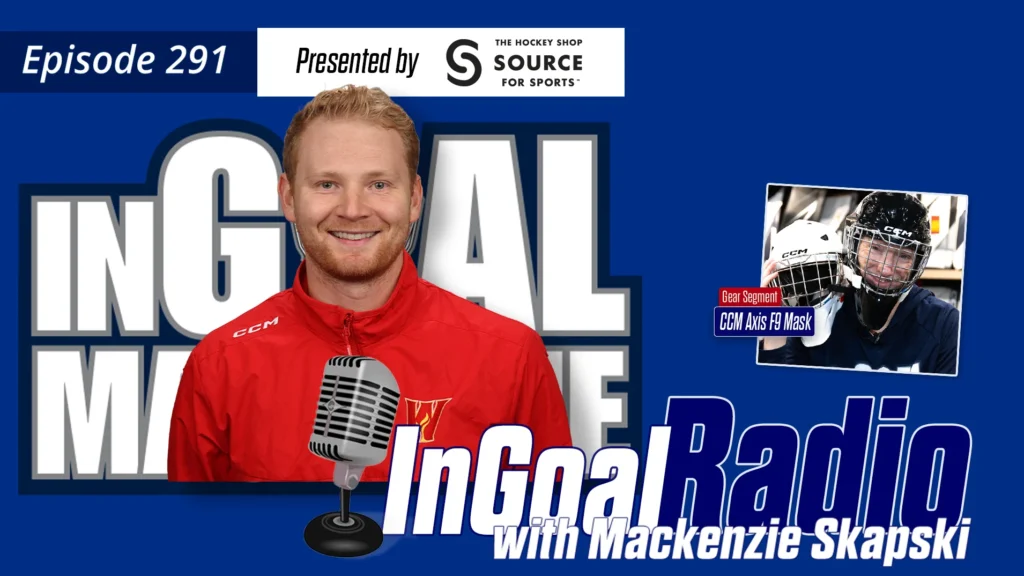
InGoal Radio Episode 291 with Calgary Flames AHL and Goalie Development Coach Mackenzie Skapski

Please subscribe and leave a rating — it helps us reach more goalies!


Calgary Flames AHL and goalie development coach Mackenzie Skapski explains how the Flames goalie department, led by director of goaltending Jordan Sigalet and coach Jason LaBarbera, has worked with goalies like Dustin Wolf and Devin Cooley to adapt their tactics to evolving offensive trends. Skapski also introduces a key concept in modern goalie development: thinking about depth management in east-west terms, not just north-south.
- Mackenzie Skapski details how the Flames developed Dustin Wolf and Devin Cooley by adapting their tactics to current high-level scoring trends.
- Skapski introduces the concept of east-west depth management as an essential and often overlooked dimension of modern goaltending positioning.
- The Calgary goalie department operates as a close collaborative unit between Skapski, director of goaltending Jordan Sigalet, and NHL goalie coach Jason LaBarbera.
- Skapski played two NHL games for the New York Rangers with a .978 save percentage before transitioning into a five-year pro career and eventual coaching role.
- The episode covers goalie mask fitting and how options have changed dramatically in the past decade, plus a review of the CCM AXIS F9 Mask featuring D3O smart foam.
Episode 291 of the InGoal Radio Podcast, presented by The Hockey Shop Source for Sports, features the return of Calgary Flames AHL and goalie development coach Mackenzie Skapski.
Feature Interview
presented by NHL Sense Arena
In the feature interview presented by NHL Sense Arena, Skapski shares insights from his first two and a half seasons with the Flames, which followed a five-year pro career that included playing two games (with a .978 save percentage) for the New York Rangers, some of the scoring trends he’s seeing at the highest levels and how the Flames goalie department has worked guys like Dustin Wolf and Devin Cooley to adapt their tactics to those evolving attacks. It’s a fascinating discussion that gets into everything from the special working relationship with Calgary director of goaltending Jordan Sigalet and Flames goalie coach Jason LaBarbera, to finer details of depth management and the need to start thinking of it in east-west terms as well as north-south.
Parent Segment
presented by Stop It Goaltending U
In the Parent Segment, presented by Stop It Goaltending U the App, we talk goalie masks, the importance of a good fit, and how those options have changed dramatically in the past decade.
Pro Reads
presented by Vizual EdgeWe also review this week’s Pro Reads, presented by Vizual Edge, which features Charlie Lindgren walking us through a power play and why important “scanning” habits should start at an early age.
Weekly Gear Segment
presented by The Hockey Shop Source for SportsAnd in our weekly gear segment, we go to The Hockey Shop Source for Sports for a look at the CCM AXIS F9 Mask, which includes impact-absorbing D3O smart foam in a second price point option.
Episode Transcript
Intro
As we get into this episode, I want to tell everybody the sound you may hear in the background is a jackhammer putting a pool in at my neighbor's house. There's rock here. They call it caliche. It's like the hardest rock going, and they're just pounding it out there. So I apologize if some of that bleeds through the microphone.
Daren Millard along with David Hutchison and Kevin Woodley, it's InGoal Radio, the podcast.
Elsewhere in our country, people need a jackhammer just to get down to their driveways.
That's a solid point
We have winter up here.
There's some weather going across Canada right now.
There is.
It's a wee bit chilly.
I wanna know if the hard rock like, speaking of hard rocks, is the Hard Rock still a thing in Vegas?
They're changing it, actually. They're going to build a new hotel shaped as a guitar. Oh. Yeah. It's really cool.
I've seen some of the the renderings as they call it. It's InGoal Radio Podcast presented by The Hockey Shop Source for Sports Langley, thehockeyshop.com. We're into the Four Nations face off. Got some exciting news coming up regarding goaltending and training during the course of the summer through InGoal. But I wanna give stick taps to Kevin Woodley, who wrote a wonderful article that I've seen several mainstream non goaltending specific mainstream media people pick up on.
And this idea that save percentages are lower because shots are lower and shot selection is more specific. And in the Four Nations face off, you had shot totals of 32, 21, twenty, and sixteen.
And a lot of goals.
And a lot of goals. So Woody, ahead of the curve, buddy.
Well, that article sort of gets credited to Clearsight Analytics for allowing me to dig into the numbers and put a theory to test. And I will say, I've had a couple cool experiences where I've been doing interviews with goalies where they've cited the article not realizing I was the one that wrote it to talk about why say percentage is going down. So those were kind of a couple cool moments. It's kinda inherent. Right?
As goalies, we know it. Like, there's less easy shots out there now because teams just don't waste them. There is no Right.
And this is the the Four Nations best players in the world, and shots are still low.
And I thought it was ironic because Sweden against Canada in the first game generated zip in the first period, but did just enough to help Jordan Binnington not feel ice cold back there by throwing a couple of unscreened shots his way that he was able easily able to glove one low along the ice and one. And I'm like, man, you've done nothing offensively, and yet you still managed to make him feel good about it because that's so tough. We know as goalies to be back there watching your team sort of storming the gates at the other end and not have a touch, you know, what that can do to you mentally. And to make those touches easy, to make them essentially I've watched games with NHL goalie coaches where those types of shots, they just say, that's a turnover. That's a turnover.
And I think that's that sort of mindset has bled into a lot of teams and a lot of shooters, like, not to waste shots like that. You're trading possession for essentially an easy save, a puck into the crowd off the stick, or or something they catch and control, and a fifty fifty chance to win it back at a in a on a face off. So, yeah, it's been an interesting shift to see that in the NHL. And as we see criticism of goaltending as save percentage comes down, sort of important to recognize that not all of it is goalie performance. Because we keep saying, goaltending's never been better, so why do the numbers say it's getting worse?
Is that an effective skill rising in the game too? I mean, if you look at the Four Nations, the very best players on the planet, I don't think Connor McDavid wants to skate across the blue line and waste a shot on net because he's just gotta get more pucks on net. When you've got that skill level, you wanna use it and you wanna be creative. So I think Woody's analysis is a 100% right, but maybe we could add to that that the skill level in the game has never been higher.
Yeah. No. There's I mean, the interesting thing here is that in an NHL game, obviously, that doesn't translate sure, Four Nations, but an NHL game that doesn't translate one through four lines to the degree of a Connor McDavid. But you're right. The skill's never been better.
There's no sort of there's nobody that can't score or shoot a puck on an NHL forward roster anymore. I I think the other part too is recognizing what traffic does to goaltending, and this is sort of the part b of it is the shots that do come from the point, there's usually multiple layers of traffic involved. And so it's not as easy as it used to be. I mean, you guys have heard me share the anecdote. You can hit the top corner of the net with a layered screen, it goes in more often than a breakaway.
Right? And so teams recognize that, and there's so much skill on the back end defensively to make those shots and walk the line and open those lanes. And so if your fourth liners aren't holding for better shots, they're going to the net to make sure that when the defenseman filters it, it's a better quality shot than it ever has been before. Because nine times out of 10, the goalie is having a tough time even finding it. So at the end of the day, this is just me over a series of now three different articles outlining how tough goaltending is.
How how difficult our lives are as goaltenders.
Just thought it was interesting. A low of 21, a high of 32 for shots through two games, and only one team breaks through the 30 shot barrier through two games, that teams are being ultra specific, and you don't get to 32 without overtime. Like, you needed you needed overtime to even get there.
And ten minutes of overtime, well, I guess they didn't get all the way to the end, but Do we like that? Electric.
Yes. I loved it.
Yeah. You okay. I'm gonna give a little time out on this, and I know Hutch is just gonna call me a curmudgeon because I've been in a kind of a mood this morning. Let's be honest. We loved it when it was the best on the best.
Oh, a 100% right. I know what you're saying, Woody.
This ain't gonna translate to the NHL. And it sure as hell isn't even going to be considered when you think of the amount of times I cover a team that's playing like four and six or five and seven second half of a back to back with travel in between. Like, we've teams five
and seven in the NHL.
We've had teams come here schedule. We've had teams come in here that coming off a schedule where they played eight games in eight different cities in a row, and you're gonna add a ten minute overtime to that. Like, it's just not happening. It's a nonstarter, not a conversation. Even the top players, I think McKinnon even said it afterwards.
Although, you know, the way he held on to the puck and tried
to score the time he had it I heard others.
Than anyone else.
I heard others like it. Other other players embraced it.
Yeah. Fourth liners that they they can they can get on the ice more on a three on three. Hey. Listen, Daren. It's not happening, the goalie union says so.
Three on three goals shouldn't even count against our resume.
Well, that's true.
Would you be more accepting of a loss in overtime, three on three, or the shootout? Because I'm thinking that three on three, I'd rather play more there. K. I haven't decided on that and the shootout.
We've got some recency bias here because we're watching the Four Nations Canada, Sweden. Have you watched overtime a lot of this year?
Yeah. I know there's a lot of resets and
If you don't if you don't change the regroup rule, what's the Gotta
have the over and back.
Like, you you have to do something about that. Otherwise, it's gonna become even more of a sludge fest. I don't wanna have to watch ten minutes of a lot of the overtimes that I've watched. I've watched Vancouver who sucks at overtime, by the way, so maybe I'm biased the other way. Like, think Yeah.
They threw up a lot of bonus points.
Yeah. I've watched them basically get no shots through entire over like entire overtime seasons, it feels like. They've only got a handful of shots in like 12 attempts at overtime this season. It's hard to watch.
I think the balance is really upset between the good teams and the mediocre teams or the middle of the pack teams, like that's the most advantage that anybody's going to have in our game. When you can trot out for ten minutes, a team like and players like Edmonton has
So I guess
compared to some of the others. So it it does it does and in a shootout, I think the odds are are much closer.
So a lot of and a lot of teams will just play to get to the shootout. So that's fair. Here's the bigger question for me. Did you like it enough on Wednesday that you're willing to live with it in the Olympics next year?
During preliminary round? Yeah.
What about beyond preliminary round?
No. No. But the Olympics
won't excitement, but we gotta have five on five to settle
I would rather I would rather it be 10
know, poke and the bear. They just wouldn't do that in the NHL. I'd be all four overtimes that go till three in the morning in the NHL in regular season, but they're not gonna
do would rather the Olympics extend it to avoid the shootout. Yep. Okay. Don't want shoot
Let's let's do it in the gold medal game. It's good for the goose. It's good for the gander. Let's do it for everything.
Yeah. You you think you're poking the bear, but you're not succeeding.
I just think that if it if it if it meant like, so but these games, these
It's better than a shootout doesn't need to be better than five on five. Like, that's they're different arguments.
But this is, like, three two one points. I guess you I guess you get punished by the point system. Mhmm. So we're gonna change that in the NHL too? Yes.
Because because
But, you know, Gary's never gonna do that because of because of parody.
Oh, no. I I think that's a fallacy. That's a fallacy, Hutch. Do you? Yep.
Because if if if if you're six points back of a playoff spot
who wins right now,
and you've got the potential to win in regulation and gain three points, you can make up ground quicker.
Wow. Interesting point. I thought you were gonna say him him wanting parody is the fallacy. No. But because I think extending
over think there's time an advantage to teams that that that are outside of where they wanna be, they can make up ground.
That that's an interesting argument on the point side. On the ten minute overtime side, that actually, based on your argument, would impact the parody situation. Because as you said, it's an advantage to the better team. So that's another reason I think they might But not do that's an interesting point about the points.
Interesting point. Everybody thinks that that having a three point for a regulation win will knock the the playoff races out of whack and you won't have these tight battles for a playoff spot? I'm running the numbers this afternoon to see how different the standings would look with three points for a regulation win compared to how we have it now. And I just got off the phone with or doing an interview with Scottie Bowman for the the other podcast, 100% hockey, and he he likes the idea that every game's worth three points. Now how does it affect playoff cases?
I've gotta dig into that, but I I truly believe we're we're the one of the only sports where there's different values on wins or games. One's worth three, one's worth two. I know
it that that's appealing. I I see your point about down by six points near the end of the season. You can make up ground. The question is, would you be down by six points at the end of the season, or would the better teams have put it out of reach by then? So Yeah.
You you will have to go through it game by game almost and see what happens.
I hate debating with smart people.
Run the numbers.
I'll it. Don't know.
Something else to do.
No. No. I'm gonna do it and I'll send you guys what I come up.
I would like to see how the points evolve over the season. So you look game by game in the league basically and
I'm not doing that.
You could do a graph. I I see, I've got a plan for it, but I just don't have the time.
There's no way I could do that. Because I have to do it manually.
Hutch has a friend that could probably do it for you.
Yeah. My friend, Chat, could do it for me probably. I might feed her all the information.
What do you guys got going on this goalie guide? I've heard rumblings. There's there's some Excited. There's some
We just spent thirteen minutes arguing about stupid stuff when we have the goalie guide ready to go?
Yeah. That's my fault.
My gosh.
I I you know what I thought, by the way, actually, I was in
a I tried to give you a compliment in that whole thing and it ended up being a debate about something else.
That's the mood I'm in this morning. My apologies. It's because we've had no sleep because we're doing the goalie, and I should say we, Hutchison. What
is the goalie guide?
It's the goalie futures. Back to the future, Woody?
Yeah. It is back to the future. We did one of these ten years ago, Daren. And it was so wildly successful that we waited ten years to do another one because because that's the type of business acumen we have over here at InGoal Magazine. We were too focused on building the product and forgot about a key part of the product and a key part of our audience.
Goalie parents, who as Hutch has discovered is a massive part of our audience, and goalie schools and kids trying to find goalie schools and parents trying to find goalie coaches when they're traveling. And so we decided that we were gonna bring back the goalie school guide, which is a once a year published magazine style on your computer, turn the page like you're reading a magazine, guide with articles and advertisements, and most importantly, listings for all the goalie schools. If you wanna look up a goalie school, find out, get information, it's all in there. But then we're actually gonna have and this seems like a no brainer. Again, a no brainer ten years in the making.
We're gonna have a directory, an online directory for goalie schools. InGoal Magazine has long been the go to place for goalies. It's the number one resource in the world for goalies and goalie coaching, and it's insane that we haven't made it the number one resource for goalie schools, goalie coaches, and that's about to change. So if you're a goalie coach, if you're a goalie school, and you haven't already gotten the email with the goalie school guide information, you should definitely reach out to us. We are in the process.
This is gonna be a quick turnaround. This thing's gonna be published in mid March. Deadlines to get your information in are just two weeks away, end of February, March 1. Remember, folks, it's a short month. So lots on the go.
We are basically creating the ultimate goalie school, goalie coaching reference list. And if you have a goalie school or coaching goalies, it would be a shame if you weren't on it.
Do you guys remember the old hockey news? When you get it in print, you go to the back and there was a place for hockey schools and then goalie schools, that was my bible, like looking up where where the goalie schools, what's what's being offered.
I've heard that anecdote from other people and they'd be like, which camp can I go to this summer? Like, looking up camps in Minnesota and stuff like that. And it's kinda like, yeah, why the hell aren't we doing this?
Yeah. And and now you're doing it. And I love the fact that it took ten years to really get it right.
You don't have to be you don't have to be a big school to get in there because there's options for anybody to get in for free. If you're a small goaltending coach just starting off your business and wherever and you don't really have a profile, this is a chance for people to meet you and and connect with you. So we wanna hear from everybody. The magic address is coaches@InGoalMag.com. And as Woody said, we do have a deadline of March 1 to get in there.
However, for those who would like to raise their profile even a little bit more, there's some affordable paid options, but there's a discount on those that expires on the February 19. So, some of you might even be listening to this just a couple of days before that. So reach out to us if you haven't heard from us and get your listing in because we want everybody to be seen by all the goalie parents and coaches.
So how does it work? You can submit your information and you're included. Yes. Then you can you can.
Yeah. You can you can buy higher profile. Higher profile. Yeah. And then Hockey was you
had to buy an ad.
No. No. And that's thing. But, like, you could like, as as depending on whether you want the guide or the directory or both, like, the that upsell is as low as a $150 Canadian, which again is like two cups of coffee in The States.
Yeah. Canadian dollars. That's right.
If you're using Canadian dollars. Yes.
Yeah. And don't think if you're that young goalie coach that the free option is is not a good thing for you because it really is. One of the things that inspired us to get going again was as I'm lurking around the parent groups in Facebook, I see all these people saying, oh, we're gonna be in Ottawa for a tournament this weekend. Does anybody know a good goalie coach there? Because I'd like to get my kid a little bit of time while we're on the road.
Sort of the the Thatcher Demko story of how it used to move around The States getting coaching from different people. Or we're just looking for a different experience this summer. We're willing to go anywhere in Canada. Just who's got good ideas on some good coaches? So now you can get in there, dive in, learn about people.
And, yeah, you can go to their websites. We'll even help you go to their websites to learn the the real details there. But actually finding who's out there, having gone through the process myself, a lot of you are more hidden than you realize even if you have a website and so on. It's not easy to dig in and meet every goalie coach everywhere. So we're trying to make that easier for people.
I have a rule. What's that? Free is better than cheap. So if you if if you can subscribe for free, if you can get involved for free, and you don't have the base right now to pay for the extra attention, it's still doing you some good.
Well, yeah, a 100% because the intention of the online directory is to make it searchable.
Yeah.
Right? Whether it's fully set, we're gonna increase the search functions over the course of the year. Like, we really want this to be a resource for goalies and goalie parents, the go to resource when they're looking for camps. And so that means we wanted to be as as inclusive as we possibly can. And so if somebody searches for, you know, private coaching in Minnesota or a goalie camp in Manitoba, you know, running in July, we wanna be able to sort of have them all pop up whether they're whether they've spent money to advertise or whether they're a free listing.
We wanna provide that resource for parents and for young goalies, and that's what this is all about, which is why there is no barrier to entry. You can get in for as low as $0.
Do you guys like the kits of the goalies at the Four Nations? The masks?
Are you there's some great masks. There's some great pad designs. I love it.
I really like Binnington's mask.
Yep. Have you seen Samuel Montembeault's mask too? Yes. It's Yeah. With the I like with the Simpsons where they tie the kid in that.
Right? They got that. I didn't see
that. I'm lucky.
There's some there's some great masks. There's some great masks. There's some great gear. Adin Hill's gear stands out. Are we at all surprised?
And listen, I'm applauding it. We love a little style. Are we at all surprised that so little of it is white? Like, I guess none of these goalies believe in the white looking bigger or, you know, shooters not being able to find where the gear ends and the puck like, it's all dark. Is there any I guess the Fins.
The Fins have white gear. I guess it didn't help Juuse Saros last night. So, but, like, so much dark gear. I like, I love Filip Gustavsson. I love his setup, but he looked he didn't look huge to me.
Oh, here comes the curmudgeon again. Used to have you said dark gear. Now you
I didn't think he looked big. I didn't think he looked very big in that the other day.
You you try to be curmudgeonly with a smile on your face now, Woody.
Darkier, smaller.
You're so funny. Dark gear. You're beautiful. Leave it at that.
I think that's an interpretation for each individual. I don't I don't think that goes across all a to b to c to zed. I mean, you know,
I go back to the Anders Nilsson conversation when he wore the all blue gear here in Vancouver. And then in that summer, he looked at pictures. He's like, I couldn't believe how small I looked in it.
Oh, that was beautiful, though. I loved it.
Such a good quote. He was a mountain of a man. He could never look small, but he felt like he did in the dark blue gear.
I like the Gustavsson mask. I loved Saros, his lid.
Yeah. There's some really great style. Some really, really, really great style.
Gear
But you gotta have a mask to do the artwork on and make sure it's a good mask, and that gets us into our Gear Segment brought to you by The Hockey Shop Source for Sports Langley, thehockeyshop.com, focusing on the Axis F9 bucket.
Yeah. We've been over at the Hockey Shop a lot of late. And interestingly enough, we've talked a lot about the new equipment coming in and the fact that we've just ran through the entire Vaughn VX one line. Like there is launches before the regular timing for launches. We did the true PX five line again, normally new launches are in the spring, but there's a couple new lines on the shelves already over at the Hockey Shop.
There's discounts on older generation stuff. We've also discovered a few things that we didn't get to reviewing. Things we just missed. We were so excited about the CCM Pro mask that we forgot all about this Axis F9 mask. So it was overdue.
Time for us to catch up with Cam and go over a product that they've had a lot of success with and a lot of positive feedback up on over at the Hockey Shop. But for us, this is the first time wearing it and going over it. So without further ado, it's Cam and the CCM Axis F9 mask. Welcome back to another episode of Kevin Dresses Up at the Hockey Shop with Cam.
Also known as the InGoal Gear Segment with Cam.
I like it when I get to put this stuff on and I happen to be a fan of CCM masks and this one is the Axis F9. We evidently get an f minus for forgetting to mention this while we were reviewing the top of the line mask earlier in the spring. And this is the beauty. It's interactive. Somebody reached out and asked and said actually, I hopefully they blame Cam.
We didn't do it. So now we're doing it. The Axis F9. Cam, this is the second price point mask That's correct. Compared to the Pro.
Yes. Walk me through the differences, preferably not by tapping on my head a lot.
Okay. So we're not gonna tap on his head. That said, if you look at the mask, okay, we have that exact same look.
So the profile?
Yeah. So we're getting, you know, again, that pro identification from the mask itself. Fitment wise, and we'll talk about that right off the bat here first, this mask goes from large, medium, small, extra small. That extra small mask almost encompasses a little bit of that kind of, like, what we'll call, like, junior category, that little bit of a crossover coming off. So there is an option there.
Don't be shy away from it just because it's a senior extra small. I'd consider it closer to like a junior fit. So again, another additional option that
we have I'd say it's one for the pinheads like yourself except we've been inflated the size of your head quite a bit over the years here on this.
Says the guy wearing a senior small.
This is a medium.
I didn't know we could fit that much brain in there.
Okay. So we've established the sizes. What's the difference? We've got the shell looks the same. Are the materials different?
Ah, let's see. XO Shell fiberglass.
You're reading off the side of the mask.
You know what? CCM is so great in terms of being able to add identification to their mask on the sides of their mask too, calling out some of their key features like we're just about to do, like that XO shell. It's a good segue.
And fit the fitment is very similar to how I feel in a medium pro. Yes. So that definitely is the same. The shape is the same. The fit is the same.
The shell is a little different.
Correct. So straight fiberglass shell. The cushioning
is very this the padding is what's the big difference, Yeah.
It's all about the foam.
We have the 3D printed inside of the pro level mask. This is very different and you can feel it because when you put on the 3D printed one, it actually feels quite cool against your face at the touch point sort of where it's against skin.
Which this mask still does have for sure but definitely not to that same degree.
Well, you can see some of the ventilation in the foam there, but again, a lot different than a three d printed sort of lattice like the other mask.
Exactly. But some really good callouts in terms of for the foam of the mask itself. D3O and the high impact areas.
So a little extra
absorb. You can even see it on the chin. It's down there with
all my chin.
On the mask as well. Add it on the chin cup as well.
It's down there with all my chin.
You know what that is? That's that same chin cup that used to be in the CCM XF Pro.
Will do. See if it's comfortable and familiar.
Yeah. Exactly. So nice, good call out there. Again, there's some really high quality materials being used in this mid price point with some good call outs in terms of that tech and spec too as well.
The IQ cushion in some areas?
Yes. Exactly. And that's not something that we usually find in what we'll call, like, that opening price point. Now, granted you, this is about a $100 more versus, say, the first price point from, say, Warrior or even Bauer for that matter.
But you're getting D30 impact protection.
Exactly. Exactly. So again, there's
And you're getting the new cage in the way they've sort of done it with the extra with the rip, the the bolts on the inside.
In setting that cage after much research about how that impact affects and feels on your face itself, how that cage mounts.
So a lot of the development that they've gone through over the years is present here. You're just not getting that three d print.
Exactly. Exactly. And I mean, you can kind of see some inspiration of that 3D print in the mask itself of the internal foams. So that secondary layer of foams, you can kind of get a little bit of that look that you get there.
Okay. You mentioned you compared the price point relative to other brands at sort of this lower level. How does it compare to the Pro with the three d printer? Like, how far down are we talking here? It was like half the price?
Two thirds?
About half the price. Yeah.
Okay.
Yeah.
Okay. So still from a safeness in beer league?
Yeah. Absolutely.
Safeness at what levels for kids?
I mean, like, this is a very solid mask for for what it is in terms of that price point. Like, I'd say this is more comparable to say, like, a 950 off the wall
Okay.
For example. So that, like, mask all the way up into, like, early stages of junior hockey for sure. Like, it's a very solid you can feel the mask on you. You feel protected. It doesn't feel like you're you're really cheaping out on something.
Okay. Awesome. Better late than never as they say, Cam. The CCM AXIS F9 mask. If you have any questions about it, how it compares to other models, both within the CCM family or in terms of other brands, where can they get you, Cam?
(604) 589-8299 or 1-800-567-7790. Is that too quick?
Little quick, but that's alright.
It's alright. Or thehockeyshop.com.
Anything else you wanna read off the side there that we haven't touched on?
Kevin's head is small. Why would they put that on the CCM mask? It's crazy.
Done with you. I wanna know the trick to getting Woody's audio through wearing a mask like that, Hutch. What do you have to do?
Hope and pray.
You know what? I never
whoever's recording us are not high-tech. We are not high-tech. There there's two microphones on them because inevitably we screw something up and we need to make sure that we're recording twice. But beyond that Oh, redundancy. That's good.
Yeah. Well, we learned that the hard way. But other than that, there's no hype.
I thinking about it as we were recording. They're down on my, like, down on my shirt line.
Yeah. They're not bad. The worst part is when we do chest protectors and he wears the chesty because the microphone's just under there and it's scrape scrape scrape scrape scrape and then Cam needs to show off that they're adjustable so on the Velcro. That's a Mhmm. Those were a bit of a nightmare probably for people to listen to in the audio only version.
So we probably need a little help from an audio tech who wants to stop by the Hockey Shop and hang out with us.
Can't be any worse than having to listen to my voice all this time.
What does the velcro sound like again? I think
that was the noise. It sounded like
I was caught in up a loogie. Maybe if I'm smart, I'll insert the sound there.
I liked I liked your your interpretation of it.
I pulled off the mic too so it wasn't too mic techy.
Yeah. You put put the full actions into it. When are we gonna put start putting this on YouTube so we can see all of your beautiful, wonderful, physical
contributions? Maybe soon as I get the guide finished, and then we've got time to do more editing. Yeah. Oh, you have to you have
to I'm up for it. Oh, yeah. We if we could do it all in one shot, that'd be good. So you can edit
There's not a lot of editing to this.
Face for radio over here. I don't think we wanna do the video.
So when you guys talk about the the F9, we're because it's a different price point. Lower price point. It's the same shell. Right?
Believe so.
Shape. Right.
Same shape. There might be some differences in terms of how much carb, like, yeah, composition, carbon layup, and how much Kevlar is in there. We'd have to check on that. The biggest difference is the liner.
Is the the padding. Right?
The liner the liner on the pro level is the one we talked about where it's the 3D printed one.
Yeah. The padding. Kevin's using big words like liner.
He is.
But it's padding.
Thank you, Hutch.
Padding. The padding. You're right. Paddington.
As if liner
is a small, big word. And I think we're starting to see that with with a couple of like, Bauer has some new padding that they've changed from 24 to 23, and there's a different price point there. But the 3D padding The print or liner. Yep. Like, that appears to be industry leading of what CCM has done there.
Yeah. I mean, we'll see where the industry goes. We'll see what the response is. I've had some good feedback from some well, I mean, we need you to ask Ilya Samsonov. He's wearing one down there in Vegas with the 3D printed liner.
And so is Aiden?
Oh, is Aiden got the I wasn't sure if he was still in the old pad or the
Oh, I know I never ever thought of.
Just assumed he had same Some guys really like the one with the fluid pods. I still have one of those. Like, a lot of guys love that mask. They felt really safe in it with the fluid pods as the principal point of contact and a little bit of wiggle room there in terms of absorbing some of the impact. At the end of the day, it's all about finding ways to sort of reduce how much of that side impact transfers to the head.
Obviously, puck impact first and foremost, but any any sort of side stopping. I mean, so far so good with the 3D printed. We've had good feedback on it. I'd actually have a say I'd have a tough time going away from it because I haven't tried anything else in a while, so I don't wanna overstate it. But I I love it.
It stays so much cooler too over the course of when you're out there for, a ninety minute skate. I just find it stays a lot cooler as well.
Does the F9 have the fluid pods?
No. No. The f nine is just more of a traditional padding or liner, but it does have sort of the the I think it's the x cushion that that Cam talked about during the during the segment there that you see on the back plate of some of their, some of their other ones, or you did in the past, or it's sort of taking some of, that foam and putting a seal on it, it's not going to absorb water. There's also it has D3O in the forehead of it, right? So at a time D3O was considered, you know, industry leading or, you know, next generation impact absorbing foam.
And now we've got to the point where they've tried new things and moved on and D30 still a very good product in terms of impact absorbing. Now there's something that never would have been a second price point mask is there to add a layer of protection to a second price point mask for CCM.
Another thing I like about the F9 and the Pro mask, which I didn't notice until I was doing some research last night, getting ready for this episode, was there's no buckles on top.
Oh yeah, they're built into the
They're built in. So if you're doing your paint job and your design, nothing's covered up on the top.
There's a little tiny, like, this
It's tiny little tiny tiny.
But it but it's flush. Yeah. It's flush. Especially if you so if you do a mask wrap, you don't even see it.
It's the only one I've seen like that.
Yeah. No. It's it's pretty neat how they and the backplate, the the way they integrate that into the backplate and through the back of the backplate really kinda I just find it you have you ever gotten into a game where you're, like, fiddling with the backplate and have it sitting on your head? I've I've I used to be that way all the time. And the way this just sort of pulls around the backplate from the top on the bottom rather than it just seems to
sort of pull it flat. It should feel, like, all along.
Yeah. I've I've I've never adjusted it. Let's put it that way. I've never I've never gotten into a game yet in that mask and being like, I just can't get it to sit on the back of my head right.
Can't believe Woody would be a fiddler.
Yeah. Yeah. I'm not one to have nervous tics at all. No. He said with just a hint of sarcasm in his voice.
By the third period, I can't get this back plate to sit properly.
I used to I used to be like a like that. If the chin cup was too tight tight, I'd be like one of those guys that was constantly sort of flexing it, pushing his chin down into it, like, just like nervous like a nervous tick.
Do you guys adjust the chin cups much? I do all the time. I'll have it too tight and then I'll have it too loose and I'm I can never seem to get that thing right.
I have gotten mine right now and I haven't touched it, but I can relate to having to get to a point. Because if you get it too tight, right, you feel like your sort of jaw's locked in there and you're not relaxed and you're not breathing. But if you have it too loose, you end up like me and you end up missing a tooth. Yeah. One word of advice in this chin cup discussion, never use an elastic based chin cup strap.
Woody learned that lesson the hard way when he replaced his stock CCM chin cup with an elastic based one because they were out of stock. I blame Cam. He didn't have a stock one for the CCM in the shop. I bought one from another brand he said would be just fine.
You're talking about the strap that goes through
the I'm not gonna say the brand, but there was an elasticity. It had elastic to it. Basically, to to allow you to flex your chin, which I would have thought was a good thing. But, of course, it goes the other way. If you get hit hard enough, that elasticity allows the the the mask itself to move relative to the chin cup.
And you get hit hard enough in the right spot, it will move the bottom face of that mask, the bottom opening of that mask right up into a tooth. And you'll end up with me $5,000 worth of dental work.
The chin sling used to be a thing. Canadian.
Yes. Well, you're right, Hutch. It was $5,000 Canadian worth of dental work, which is Big
deal. Yeah.
Three cups of coffee in The States. I can't believe guys wear chin slings. Like, honestly No.
Nobody wears that now, do they?
I think there are guys in the NHL for sure that are still in chin slings. A 100%. I've seen them. Like, I just can't believe, like, that they don't end up losing more chicklets or
Ben Bishop, I watched him lose a tooth one time.
Yeah. It's not a fun process. This is so I once wrote an article at nhl.com for my weekly column, my biweekly column now, the unmasked column. Unmasked. Yeah.
I lost my tooth, so I started asking guys about how frequent this was. And the amount of guys that are like crowns and chipped teeth and missing like, it was shocking. I was like, this is this is the thing. Nobody even realizes. We think of the hockey players as the big tough guys that lose teeth.
Goalies lose teeth too. A lot more than you think, Daren, have lost chipped and stuff like that from getting hit in the mask and having the bottom of the opening come up. Now, you won't find that article online @nhl.com. You probably it didn't last long at nhl.com because someone from player safety was, why the hell are we advertising this?
Really?
Yeah. It got pulled pretty quick.
I know some
It was an was an it was an oversight on on on my part. I I never thought of it
publish those it as a public service.
I think we probably did it equal.
I don't think we did.
I have to pull that one out then real.
I'll have to go looking.
NHL Sense Arena feature interview coming up with Mackenzie Skapski. We've got our ProReads brought to you by Vizual Edge dealing with Charlie Lindgren. I hope he's gonna talk about the dive. I I haven't listened to it yet.
Oh, I am apologizing in that our interview with Charlie and our ProReads session with Charlie preceded the dive. It was so good, though. I've that I saw that live. I that was a game I was covering that was in Vancouver and
I'm pretty sure. Kudos to the photographer who got the full on shortstop laying out and take the hit away out of the gap. That was an
unfulfilled discussion? I feel like we had this discussion because the shortstop reference is perfect except he's left handed. You can't have a left handed shortstop. That just doesn't work.
Boy, you're grouchy today. Like, you took up No.
I just always used to left handed shortstops. I hated left handed short stops because that was a short stop. I didn't want anyone to take him.
Oh, they all play first base.
That's right. It would have been a I don't care. It was just a hell of a save. Fun moment too. It's too bad.
I thought they were for sure after he made that, I thought they were coming back to tie that game.
It would have been Every goaltender who's played just enough has been in that position. Most times after you've given the puck away, but you you've had to dive back and you've dreamed about that moment where it goes into your glove.
It's like the Fleury save against Toronto that I think ultimately ended, like, it was the last game for Mike Babcock with the Maple Leafs.
Right?
Like, the I actually like, that was one of the best ones I've ever seen. I think Charlie's might even top it for style points. Like, he was fully laid out.
I'm sorry to beat that. He was horizontal.
Yeah. For those few people who haven't seen it, Daren mentioned it mostly happens after giving the puck away. It was not Charlie's giveaway that caused that lay out there.
No. No. He was on his way to the bench for a goalie pull for those that didn't see it. He was on his way to bench. He was being pulled for the extra attacker.
He got to about the maybe the top of the left face up circle close to the bench and realized that his team had given the puck away in the neutral zone. I wanna say he was probably at the left hash marks as it was shot through the neutral zone. And I feel like he started his dive at the left hash marks and caught it somewhere near the right hash marks inside of the right face off circle. Just just spectacular. Just spectacular.
They should they, like, they should make a poster of it. You're talking about getting posterized? That was post press.
We made a lot of great advancements in our game, both with equipment and strategy and rules. But pulling the goaltender for the extra attacker has never changed at all. There's no work that's put into it. There's zero strategy. You're making it up on the fly, and it's just three guys at the bench waving like crazy to for the goalie to come, and then there's a turnover and they put up their hands to stop, and the goalie's gotta figure it out.
It's it's probably one of the most basic place in our game's history.
Well, how about how about do you remember when, like, just to sort of reinforce the chaos and unpredictability of it, do you remember when I think it was poor Colin Delia in Winnipeg with the Canucks, and JT Miller was mad because he wouldn't go to the bench. He's like banging on the back of this Oh, yeah. Yeah. Net, go to the bench, go to the bench. And the coach hadn't motioned yet for him to go.
And it is a little bit it is you're right. It's kind of amazing. Have ever seen a
team have you ever seen a team practice it at any level?
Okay. So I'm sure I've seen a team practice, but mostly how did like, they talk about the so I will give you this. I'm not gonna name the team, but they left their six on five defensive zone coverage placard sheet. Like, it was like a sheet that was, like, covered like a placemat. It was so thick, like plastic.
Like, it's basically their six on five guideline sheet. They left it on the bench, and somehow it made its way to my hands. Somebody because there's somebody knew that I knew somebody in the coaching staff, and so can I get it back to them? And the amount of detail in that, maybe if they don't practice it, Daren, but the amount of detail that goes into planning for and whose responsibilities on a six and five and where the emphasis points are on defending and choking off rushes and things like that.
That, I guess. But the actual goalie going to the bench part.
Yeah. No.
That's The goalie going to the bench.
The one thing
That's fair.
Two pieces of practice involved in this one or at least discussion. I definitely know of goalie coaches who advise their goaltenders, when being taken out of the net, whether it's in this situation or a delayed penalty, in defensive Colin Delia to follow the play up the ice just in case something goes wrong. So JT Miller may have not wanted him to stay in the net at that point, but some people advise the goaltender to stay in the net and just follow the play up in case something goes crazy. Mhmm. So so I've heard that discussion happen and I've definitely seen goaltenders practice the pull in in two situations.
I actually saw a coach doing, some sort of skating drill with the team that involved, it was a bit of like a the hidden bag skate, but it involved things that related to the position of the players. So the forwards were skating a little forward then further than the defense. The defense had to sort of gap up and and do back skate backwards. And he wanted the goaltenders involved but not just hanging out in the crease because it was chaos around there. So we actually had them skating to the bench and back as if they were getting pulled.
That was amusing But I but hats off to the goaltenders in that situation because I watched one of them practice for style points diving over the boards to get on the bench. Don't need don't need the gate. I'm not walking over it. I'm going full Charlie Lindgren into the bench.
It happens multiple times a night and nobody practices when the goaltender should come out. And I I like to have this idea that there's a light attached on every bench in the National Hockey League. And if you flip it on and you put on the green light, the goalie has to come. It's not four guys waving their arms frantically. We need a light system.
They must talk about it. I'm not in the NHL locker rooms, but they must talk
about it. What are they gonna talk about? How many times do you see a coach going, no. No. Out here.
There. Don't. There.
Yeah. It's there. There. It's fair. They get made up on the fly.
podcast@ingoalmag.com. Let us know if you practiced it.
My question for you guys. Beer league. Delayed penalty. You really racing to the bench?
Oh, do because I wanna go talk to my guys.
Yeah. Yeah. I I love because
they they're never paying attention. Time I see them.
Yeah. For for me, it was just to have a little fun with them. So they're they're never paying attention. They don't know. So I'd kinda sneak up beside the last guy on the bench.
I'd be like, hey, how's it going? What are you doing here? Delay penalty. Get out Last
beer league I played in, we only had five skaters. So I I couldn't even go to the bench for the extra
See, in that case, you should be allowed to cross center ice with the puck.
Yeah. Yeah.
Make a play at the point, Daren. Make a play at the point. You know what? The other one is and I know you guys have ridiculed me because the league I was in before quitting beer league had stats, but you should drive me a little nuts. Again, yeah, you're right.
I shouldn't really care. Here we go. I'm gonna admit it. Now you guys are gonna mock me. You would goat for the extra attacker.
They would score into the empty net, and it would count again it would count as a goal against your stats. I'll be
like, That would drive me crazy too, Woody. Sorry. I'm with you.
That's fair.
That's fair. To drive me nuts. I'm like, guys would be like, oh, well, we tried. I'm like, no, you didn't. And that counted as a goal against for me, you jerks.
A league that I played back in in Markham, sometimes I would fudge whether I saw the guys waving to me because I knew we were gonna get scored on. So I didn't want the the goal
I got to the point where, like, inevitably, like, every time I got to the bench, I get there for five seconds and the puck could be in the net, and I'd be like, so, like, this doesn't work, and, I'm just getting tagged against here. Like, I'm
just not coming. Going back in. I just say it's been, you guys wanted me here?
But, Daren, you know that's gonna happen. Now you get your chance to have your Lindgren moment Just sort of
Halfway ahead.
Saunter to the bench not too quickly, hoping you get that chance. Somebody out there must have done that by now.
Well, it's it's a good point about saying hi to your guys though. Like, because there were forwards on my team that I would basically see in the locker room before and after the game and that was it. So an extra extra opportunity to visit.
The picture of me diving back would look a lot different than Charlie.
Yeah. All of us. All of us.
I think Hutch has some pictures of me laying on the ice. It's that line it's that line from Toy Story. Right? When when Buzz flies for the first time and Woody says, that's not flying. It's falling with style.
That's how I play golf. It's falling with style, but without the style.
Parent Playbook
Slide over to our parent segment brought to you by Stop It Goaltending U the app, and, we're chasing scouts today or advising you not to chase scouts, but, Stop It Goal Tending U the app, a great friend of ours.
Yes. And didn't real I'd like, this is the perfect moment for me. Did you know that they have advising? I'd stop at goaltending U the app. So as Hutch is gonna tell us not to chase scouts, there is a great place where you can chase advice and chase help in getting reference to finding whether it's schools or junior teams, and that's with the Stop It Goaltending U, the app, and their staff.
Twenty five years in business, they built connections all over the country and a reputation as straight shooters. They can help you as a goalie connect with the right places for the next step in your career, as well as helping you figure out how to take those steps. Are you ready? What steps should they be? What should they look like?
They'll make sure as much as we talk about every week, the Stop It Goaltending U the app, having the daily one minute tips, the five minute video, and the twenty minute video that'll help you become a better goaltender. They can also help you take the next step in your goaltending in terms of finding a place to play. Like I said, whether that's junior or up into college. So make sure you book an appointment, check-in with The Stop It Goaltending U, the app, and their personnel to get better advice on advising and the next step in your career. They've got it all in the app, all the experience that comes with it.
And, of course, as we say every week, you get a free subscription at InGoalMag premium, the best of both worlds. Stop It Goaltending U the app, and InGoal Magazine all rolled into one for one monthly price. Hutch.
I'm gonna call an audible. I may have to come back to this and re-edit and just fly in with what I planned out for today, but I'm gonna call an audible because there was so much discussion about masks around the CCM Axis F9 in the Gear Segment today that one of the things I see the most in the parent groups, probably the most asked question aside from playing time for goaltenders, which it's sad to hear that come up all the time, What mask should I buy for my kid? And then you immediately get a flood of comments from people, well, I just my kid wears the Warrior, whatever. My kid wears the Bauer, whatever. I've been in a CCM, whatever, and this is the mask you need to get for your kid.
And I think it's always the wrong advice. I mean, it might be the right advice, but we've got Woody in such a curmudgeonly sent time this morning that I think calling an audible here is a good idea. Because Woody.
Why? Because I just had the perfect segue from my Stop it Goaltending read to something about not chasing scouts and now you're you're not gonna curmudge in me.
You are gonna advise people today, Woody. You we're bringing in your gear adviser from ingoalmag.com. Woody, what should people be looking for in a mask?
Fit. Fit. Thank you.
Fit. Those are the top three points, aren't they? Fit. Fit. And I mean, you're not gonna go to Canadian Tire by
the What's fit?
What's fit?
Yeah. What what what is fit? Is is fit Your forehead?
Fit is temples around the forehead, no gaps in those areas, pressure points, how it sits on the head, how the backplate is the backplate sticking out? Is there a gap between the backplate and the side of the mask because your head's too big for it? There's a lot of different elements.
I just think sides. I just think on the If
you have a gap on the sides and it's rattling around, that's no good either.
So there's multiple fit points.
Yes.
But I'm gonna say this and correct me if I'm wrong, but I've worn a lot of masks. Nothing ever fits perfectly. Does it? Unless it's custom made or 3D printed?
I mean, I think we are getting to the point.
Yeah. I don't wanna say you can't I mean, CCM is gonna launch a custom molded 3D printed. You can order it fit to your head. They they they print it to your dimensions on your face. We've we've already talked about the scan process.
I think we've even had a Gear Segment on it, and it's it's I think you can order it right now. I love the fit in the I don't wanna overstate the 3D printed CCM mask for how perfectly it fits my head because the CCM shell already was a good fit for my head. Now do I love the fit even more with the 3D printing? Yes. But I I don't wanna overstate it as the end all be all, even though it has been for me.
You know what I mean? Like, it because again
Mhmm. But if your if your child is not not gonna go for the 3D printed mask, what what order do you put the places that have to fit the best? Is it forehead? Is it cheeks? Is it back plate?
Is it chin? He Hutch open now. Honestly don't know this.
No. It's a great question, and maybe we come back to this with an answer from from some experts. But I would even step back just a little bit and make this really clear to the parents who are new to the game and and don't know this. There are different dimensions of head that the different masks fit. So Bauer, for example, offers a couple of different lines of masks and they fit different heads.
the advice that I always give parents when I do chime in on there is, number one is fit and then spend what you can afford. My kid was scared of the puck as a young goaltender and I overinvested, some people would say, in a in a mask, and he never felt fear again and was fine.
And so just because little Johnny is wearing the Bauer 950 doesn't mean that your little Freddie is gonna be best in a Bauer 950 because maybe he needs the ENME line or maybe he needs a CCM mask. There are different fit sizes as well in the helmets. And just from a very basic perspective, just understand that that is the case. The advice that I always give parents when I do chime in on there is, number one is fit and then spend what you can afford. My kid was scared of the puck as a young goaltender and I overinvested, some people would say, in a in a mask, and he never felt fear again and was fine.
And it was a game changer for him. It made a difference to his comfort on the ice and the way he played far more than dropping $2,000 on a set of pads would ever do. So to me, it's the number one piece of gear that you're going to invest in. And, and I think that's the first part of all of that. Just understand there's some basic fits.
Daren, I think you've got a great point which one is the most important. I don't know how often people get down to these two masks fit, but this one is better in this area versus that. That's a good question. Maybe that's something we need to talk to Cam about in a in a future one, because we do like to do these ones that overall look at, you know, general concepts like the glove break that we've done before. Maybe we could talk about fitting a mask as as something.
I would say, just another piece of experience. I've only had a custom built mask once. I was so excited to get my face fitted with the with the plaster and so on and to ship it off to the manufacturer and then it arrived and it didn't fit the way I thought it was gonna fit. It was not the old, fiberglass, you know, complete mold to my face, it was just a current day mask where they they have some general fits and then they they sort of do their best to fit you to that.
I did the same thing and I lost some weight in between when I got fitted and it arrived and it didn't fit properly.
Yeah. It's like, it's sad, but
So one thing I think we should give kudos to here and parents should be aware of this is this has changed dramatically in the last ten years. In that the companies have expanded, as Hutch mentioned, different lines having different fits, but also the sizing that's available. Like, forever, the Bauer 960 was just the Bauer 960. And if you did didn't fit your head, kids still wore it in junior. Look at Corey Crawford wore it, and it used to sit halfway up his forehead, and he had to go to the dentist three times a year to have his crowns replaced because the bottom of the mask was rubbing against his teeth, and every shot off he took off practice off the chin would would chip a tooth.
So we've expanded the fit lines. There's more fit options. There's never been more alternatives to get a good fitting mask than there are right now. And that the key is to not go in saying, I want this brand and this model. The key is to go into a place and listen, I know I say this, not everyone has access to one, but like the Hockey Shop, because I know I've sat in on fittings.
And think some of our videos with Cam have talked about in the past about where the gaps need to be tight and where you'd need to be mindful of too much space. And I believe it's sort of around the temple and the side of the forehead into the front of the forehead. Because don't forget the front of the forehead. You've got a sweatband there as well, but more around sort of that side, around the outside of the eyes, around the temple area. And that is one of the key things that fit.
You asked about chin cup, Daren. Well, as you mentioned, chin cups are mostly adjustable, so you can alter that a little bit. The key is to not go in with a closed mind. I want this. The key is to go in understanding I need whatever fits best.
And we've seen I've seen Cam take parents going in saying, I want this thousand dollar model and say, listen, at this age, even in the small size, this just isn't fitting your kid properly. This yes. It's cheaper. Maybe it doesn't have the same foams. But at this age, the fit is the most important thing, and this is a better recommendation even though it's not you're not gonna spend as much money with me.
And that's the type of honesty and experience you want in that fitting process. It's not about buying the biggest and best and most expensive every time.
Two two points I don't know that everybody's aware of, that that are worth mentioning. Woody is correct about all the different fits that have now come in. I don't know that everybody realizes that that's a very significant investment on the part of the companies. It's not as simple as let's just make a different size because every different size with every different combination of cage and so on has to be tested to be certified. They don't just certify the Bauer 960 and then they get to make it in as many sizes as they want.
They actually have to invest in the whole testing process for each of those masks. So kudos to the the gear companies for actually making that investment to make that happen. The other piece I would just say is, I personally would be cautious about buying on the secondary market, about buying used with a mask above all other pieces. I don't I don't know that you're too worried about the integrity of the shell itself, although that is a consideration. But the foams with all the use and all the sweat do break down over time and that's a huge part of, obviously, of the padding and the mask.
So I would be a little cautious about purchasing secondary on the mask market.
Good stuff. We'll chase scouts next week?
Yeah. Let's chase them next week.
There's still gonna be there. There's lots of them out there. I am curious what your take is on that pursuing attention and exposure.
Okay. Well, we're gonna we're we'll talk about it next week, but if anybody wants to give me their opinions on this, leading into that, parents at ingoalmag.com, and I'm happy to chat to anybody anytime.
After our ProReads, brought to you by Vizual Edge, Charlie Lindgren.
Yeah. We don't have the diving head first shortstop glove save, but we've got another great breakdown with the Washington Capitals goaltender presented by Vizual Edge. Vizual Edge is the perfect sponsor for our ProRead segment. ProReads is all about letting you see how NHL goaltenders see the game, and Vizual Edge is all about helping goalies right up to the NHL see the game, see the puck better. We had Cam Talbot on the podcast and the ProReads last week.
A Vizual Edge user, talked about how it allows him he he believes firmly that it has enhanced his ability to find pucks coming around through and out of traffic. Just one of the many things that you can work on from a skill set standpoint using the Vizual Edge program. You get a pair of glasses, you can do it on a tablet, you can do it on a computer. It's relatively simple. You can be like Cam Talbot, you just do a short period every single day.
You can do an edge test to see what areas of vision. You've got convergence, divergence. You've got all these different aspects. Test where you're at in each one, and they will set up a program so that you can improve. And as Cam Talbot told us, he goes back every once in while and does the test and sees where his numbers are, and he can see the improvement in his test scores, and he believes he sees the improvement on the ice.
So this week, Charlie Lindgren, talking about seeing the game, it's all about knowing when to not look at the puck, when to look off the puck. And so he's got a power play breakdown that he does with us where he talks about the importance. And it's a great lesson because as he tells us, it's not only applicable to the NHL. Yeah. Sometimes we get into these things.
We talk about reverse VH, and that might not apply to a 12 year old the same way it does to the NHL. You know, a specific post play technique. Or 12 year olds probably don't have to worry about Alex Wojciech and onetimers and how they might play that differently than somebody else. But looking off the puck and developing that skill is something that Charlie Lindgren shows us and tells us can be done at any age and is a really important and maybe even more so at the lower levels and is a really important habit for young goalies to develop. So that's all in our latest ProReads.
Up at ingoalmag.com this week brought to you by Vizual Edge.
Looking off the puck, that's that's a skill, and you have to really work at it. It it's a conscious thing until it becomes natural. But if you don't
So it's also
a habit. Big trouble. Yeah. Yeah. And just knowing when a rebound comes, you know that that's your guy's stick there and not their guy's stick or vice versa when it when it comes into into play.
I look off the puck all the time, Daren, but it's usually when it's being shot and my eyes are just closing. Not a good habit to get into. Trust me.
I was at a I was at a camp and it was an Eli Wilson camp and they always start with a skating drill at the beginning. And he drilled into the kids that at every stop, you know, maybe you're going post to circle the top, that you would always take a look. It just became a habit that way. So every motion that happened. I remember my kid being on the ice with another coach at one point and he just looked, what's he doing?
Every single time he turns his head and I just explained, well, it was just a habit that was being put in by Eli. And all of a sudden that coach's goalie started doing it too. Building habits so you don't think about it when you're on the ice. It just happens.
We've seen this in the Pro Drills with Kristen Campbell and the Toronto PWHL team and Carly Jackson.
That's That's right. Right.
And their work with Brad Kirkwood where he talks a lot about, you know, they'll do crease movement patterns, not even in the crease, but imitating going post to post and into a post. And every time they go into the post, because of course, if you're going post to post on a puck behind the net, it's not in a dangerous area. Every time they go from one spot to the next, they have to look off and scan the middle of the ice, and that's part of their crease movement drill, and it becomes a habit that that that they believe leads to success in games.
It's also one of the top reasons why some goaltenders don't wear neck guards because they don't like the noise on their on their checks. It it the rattle on it. It's the one of the strangest reasons to me, but I've I've heard multiple guys tell me.
Don't know I don't know who you're Yeah. Talking about,
I don't like the noise. Is is that why you don't wear one? You don't like the noise?
That's one of many reasons. Yeah. I can't tie a knot.
Can't Tie knots, tie lots.
Good. I'm stealing that.
Thank you.
Can I borrow that?
Anytime, my friend.
How did it go?
I feel like my you can't
tie knots
knots, tie lots.
I I feel like that was my parents' philosophy when they bought a sailboat late in life.
I like that line.
Yeah. It just sucks when it comes time to undo the knots.
True. NHL Sense Arena feature interview coming up. NHL Sense Arena really gaining so much attention around the National Hockey League right now.
We hear a lot, Daren, about we've we've talked a lot about Joey Daccord and his use of NHL Sense Arena, and now he's an ambassador for it. Devon Levi, his use of NHL Sense Arena. I had a team, and again, I think this is the third time I've done this on this podcast, but it seemed to be hush-hush, so I'm gonna keep the identity of the team a little secret. But their goalie coach told me that their goalies both used NHL Sense Arena quietly because they have it as a resource with the team. They just don't like to they don't advertise it as much.
Both of them used it during injuries to stay sharp with tracking and hands and things like that. So, we only sort of hear about the ones that are public, but it was really interesting. This is a very, you know, prominent team with some prominent goalies that have both used it this season and nobody had heard boo about it. So sometimes, you know, teams keep things a little close to the vest. And I think this is one of those occasions where when we think of the use of NHL Sense Arena at the highest level, it's probably a lot more prevalent than even we realize.
That's amazing. It's a great resource if you can't get on the ice, whether it's for injury or whether you're a minor hockey player who just doesn't get as much ice time as you would like to have. NHL Sense Arena can step in and fill the gap. Woody's basically done everything we need to say about NHL Sense Arena this week, Daren. But I do know that they wanted to let people know that they've now added drills where you can face more age appropriate shooters.
They've added some U 14 shooters from the Little Caesars National Championship Team and some U18 female shooters into the, into the product as well. And one of the things I just love about it is that it's constantly updating it and, changing all the time. So much better every time we check-in with NHL Sense Arena. So now if you want, something a little bit more age appropriate or or Woody, maybe you want something more ability appropriate, you can face the U14 shooters or the U18 women. So really great that they're doing that, but you can also face NHL shooters too.
Well, the U18 women and they're all gonna light me up. So the question becomes, when are we gonna add the 55 year old beer leaguer who's clearly going top glove, but whiffs on it and drops it between your legs because you're reading everything. Can we add that one? Because that's the one that hurts the most.
But then every eighth guy used to play in the AHL. He weighs two hundred and sixty pounds, but he can still rifle it like he did when he was in the in the pros. That'd be awesome. Everybody who wants to check out Sense Arena, head over to sensearena.com and don't forget to use the code IGM 50 at checkout to save even more.
Yeah. Those those middle of the road players in rec league, they're the toughest ones because they don't know where it's going. So you have no chance of of being able to read a release.
Well, or or you you read it, you know, all the body language says one thing and they totally whiff and it goes in because you're trying to stay patient on and you're just like and then it's you're right.
It's not a picture of doing it on purpose.
No. No. It's not. And you're just like, wow, this level, just need to drop and fill the holes. But then at touches point, there'll be some guy that, you know, has put on a 100 pounds since he played, come down the wing and you're thinking, okay, another muffin.
And he just absolutely rips it by your ear.
All you do is smell the burning rubber as it glances off the side of your mask. Like, it's, all roads lead to beer league boys and it's a good time once you're there.
I'll end up playing at 09:00 on a Thursday night.
09:00. How'd you get the good time?
Feature Interview - Mackenzie Skapski
Yeah. No kidding. I know people. Know people. Mackenzie Skapski with us this week.
Speaking of knowing people, we've been really lucky to know and get to know Mackenzie Skapski and his rise up to from his time with the rangers, short lived NHL career with the rangers quickly into coaching. The work he's done sort of privately is when we first got to know him when he was first to guess, that was a couple years ago, now into the American Hockey League. I like, I'm telling you, this guy will be in the NHL sooner rather than later. The work he's done with Dustin Wolf, the work he's doing with Devin Cooley. And we've had some really deep discussions on sort of depth and depth management and some of the philosophies that, you know, he is using as a coach, that he learned as a goalie from, you know, guys like Benoit Allaire with the New York Rangers.
And so we kinda dug into a little bit. Like, we talk a lot about how the game has gotten so fast East West. So what adjustment have we made as goaltenders? He had some really interesting thoughts, some really interesting philosophy. We dug into Wolf's success this year.
We dug into Cooley's success this year. We dug into the way the Flames manage their goalie department, which I think is a model for all. The way all three are integrated with Jordan Sigalet and Jason LaBarbera and Mackenzie Skapski all on the same page and communicating regularly. There is a ton we dug into, Daren, and I'm happy to share this interview with the rest of the audience. Real excited to welcome back to the InGoal Radio Podcast.
Mackenzie Skapski of the Calgary Flames, Calgary Wranglers, American Hockey League Flames development coach. It's been a couple of years since we've caught up. So I wanted to catch up to you a little bit on everything that's changed for you. The development of the position, the development you've undergone as a coach working at this level, Bunch of things that we've talked about informally, I wanna formalize it a little bit. So I guess for starters, what are what are you what's been some of your biggest takeaways moving on to the coaching side at this level?
Oh, wow. Big picture. Yeah, big picture. I guess the first year was pretty much just going blind. I just started out as a coach.
So I had Dustin Wolf and Oscar Dansk my first year in Oscar walked in as a rookie with me when I was playing. So first and foremost, obviously, building the relationship with Oscar was important and having him gain my trust, then doing the same with Dustin. And a lot of the trust on what my ideas were came from our relationship. So we would often have goalie dinners together once a month where we picked a theme and that person would be responsible for that theme, appetizers, dinner, dessert.
Oh, so theme isn't goaltending, the theme is what you're eating.
Correct. Correct.
Just wanted to clarify.
Yeah. We're building a relationship here, right?
You're responsible for the reverse VH dinner.
Exactly. So yeah, we did that throughout the year every month. We would switch themes and we would everybody would be topping the next dinner and the next dinner just through presentation and whatnot. So we did a really good job at coming together that year. Just off of that, a lot of things that I was bringing to the table was a little bit different Dustin and Oscar.
And just through our relationship, I felt like they were able to have conversation with me and we were able to talk about it and we were able to ultimately establish a program where we could where we could work together.
Okay. So I wanna get into some of the differences of the program because, obviously, I saw some differences in Wolfie's game. You arrive after his first season. He's already the AHL goalie of the year. He adds another one, gets league MVP, and now, obviously, we see a year later.
I guess, two years after that, having success in the NHL. But before we get there, I'm curious, like, relationships. The importance of it, probably good advice for young goalie coaches to hear. You know, I think, a lot of the times we think about the technical, how can I change this guy, how can I fix him? You gotta get him on board with you as a person first.
Totally. And, yeah, that was a really difficult task coming in as a 30 year old kid in the American Hockey League and dealing with Dustin obviously is a talented goalie. So we went golfing and like I said, we had we had those dinners. We hadn't started those yet but we went for a few dinners and it's mainly just laying the groundwork on a relationship. And then from there, I just tagged a lot of his video from the prior year and and just showed him what I thought of his game.
Tried to connect with him on what he thought of his game. And from there, I sort of pitched my proposal to him and I think that we should be doing this and and he had some pushback on that and then he started to try it in practice and obviously you get you get lit up in practice a little bit and we just sort of stuck with it and then it showed up in his game and he started to make a lot more sense of it and now it's just become second nature for him throughout his time in the American Hockey League and now transitioning into the NHL.
Okay. So when I hear you say, the way you present it, it almost sounds like to me, it's almost like a business proposal. Here's what I see. Here's what I think we can do. Is that fair at all accurate?
Like when I hear that, am I hearing it the right way in a way?
That's exactly what it is. Know, like when I'm presenting to him, I'm trying to present it in an objective mind frame. Know, like leads to this and this leads to this and I think we can both agree on this. And it got to a point where you know, he it did make sense to him even considering the size aspects that he was concerned with initially. But yeah, I guess you could say it was somewhat of a business proposal.
I've never thought of it in those terms right now. I hadn't in our past conversations thought of but just the way you were describing it there. And that relationship building and then that type of like, the lines between the two, are they all blurred? Are they all one? Or are is the relationship with the person and the relationship with the athlete like, how do you blend that?
Because I think it's prob probably for a lot of guys, that's a little bit of a especially as a younger goalie coach. Like you said, Oscar Dansk played with him. How is there other people that you'd worked with in the past that were really good at it that you modeled it after? Or is this just something an approach that you had in mind?
I wouldn't say I necessarily saw it during my playing time. Obviously Benoit Allaire had been in New York and he was older than me, we wouldn't be having goalie dinners and whatnot. I just found that when I was playing, I found it really important to have somebody to talk to about everything all the time, whether it was goaltending questions within goaltending or just mindset. And that sort of tags along with what we teach in the business proposal. If things aren't going well in the business proposal, we have to put things in perspective.
And that comes down to mindset. But in order to reach that capacity, you need the relationship. So that was a big thing for us. And then just like athletes do when they're at the rink they're on and when they leave the rink, I expect them to be off and live their life. I think that that's where the relationship aspect happened is when we had goalie dinners, we would kind of turn the switch off from goal tending and dive into one another's lives.
The goalie the goalie dinners were goalies, but not goal tending, refocused. Correct.
Yes.
Wolfie is pretty young at this point. This is a few years ago now already. He's probably just starting out living on his own. I got to ask this, it's bit of a personal question. I feel like I'm prying here, is he any decent behind the grill or what's he cooking?
Limited. He's limited to themes.
Okay.
Specifically American. Okay. Outside of that, there's not too much creativity within his chef game.
Okay. So his culinary depth is a little thin. That's okay. The fact that he can cook for himself and other people is probably I mean, I think of where I was at his age, and I would pretty much have been calling somebody else to deliver. So I think he's probably ahead of most guys at that age.
We'll take it. Let's talk about his depth on the ice because that's one of the parts of this proposal. As much as you can, without giving away too much, what what was different and how has that been formed by your past? You mentioned Benoit there working with him and how much of it has been formed by your evolution of a coach as a coach since? What you've worked on the different voices.
I know you spent some time with Bill Rand for work with different guys. Been a real sort of student of the position, even as you're now a teacher of the position. What can you share? How much can you share about sort of that philosophy and how it works for Wolf in particular? And I guess now we can translate it to to, you know, we can move on to Devin Cooley this year as well.
Yeah. I mean, before jumping into Dustin, I think some acknowledgement is needed for mentors like Benoit and Billy for spending all their time and working with Lyle Mass and now with the Goalie crew that I'm with in Calgary. All of them are part of that. They've taught me to this point and sort of given me the business proposal as you call it to pitch these guys. But turning it over to Dustin here, the big thing that just jumps off the page when you started watching his video is just his ability to move in the net, his flexibility, his tracking ability just stands off the page.
But the thing with that is I didn't feel like he necessarily had access to all those tools all the time. So by bringing him back and adjusting his depth game, I felt like he had more access to get to spots with this movement, to have access to vision, to still maintain coverage and just hold his edges on pucks and things began to hit him.
It's interesting because I think there's two traditional thoughts that would run counter to that thinking. One is obviously his size and which is obviously a talking point fair or not, always has been. The idea that a smaller goalie needs to be out further. And b, we hear a lot, like, when you move as well as Dustin, like, I think some of the instinctual thing can be, man, like, he's so fast. He's so fast.
Well, if you're that fast, you can afford to take more ice because, yeah, okay, you gotta go further to get to the next one, but you're fast enough to do it. That's kinda the opposite of what we're talking about here.
Yeah. For sure.
To a degree. Like, obviously, there are extremes, but to a degree, yeah. It you know, it's last step.
The value of movement is established positioning. So if you're still caught moving, you don't have positioning. So I think that was a big trigger for him to be like, okay, like if I can have access to my reads, if I can have access to my tracking, I can have set feet, I'm going to have a lot of success.
For sure. And I think the big thing that we ask ourselves is what is the value of movement? The value of movement is established positioning. So if you're still caught moving, you don't have positioning. So I think that was a big trigger for him to be like, okay, like if I can have access to my reads, if I can have access to my tracking, I can have set feet, I'm going to have a lot of success.
So his ability to move got him to spots quick, allowed him to make reads, allowed him to have access to pucks with his hands and his vision, engage his body in the pucks. So I think at that point it really clicked for him that there's a lot more benefits than just challenging the first puck or playing high off of a rush, having to rely on his flexibility and movement to make some athletic save versus just being a little bit more controlled and allowing things to come to him.
We think of depth quite often as a North south thing, but this is East West as well?
Correct. A lot of it's North South. It is East West. We have rules in place just how far to go east west, how far to go north south, where we want to play off the rush, where we want to play in zone, how we wanna play lateral feeds low and high. And that would be, I guess, the the diagnosis of the depth game that we have.
The things you talk about positioning, tracking, all the things that he does really well. Give me an example of how changing the depth improves some. He kind of set it, you know, in a in an over overview, but, like, if you were to break down each one, you've used I've heard you use the word access before. How depth in a more controlled environment can give you access to more of these tools?
Well, I guess one instance would just be like if you're just taking a generic shot off the rush. If you're just taking a generic shot off the rush and a guy pushes or pulls a puck around you, prior to that year, he would have a lot of movement within his game where he would slide in a puck story, he caught like a couple shuffles and then make a save. So there wasn't necessarily set feet upon release. If you talk about odd man rushes, he does take the depth, he has a lot of drift. Oftentimes you get exposed on the shots just through too much drift or it would result into a lateral feed where now he's caught extending into splits and occasionally he would make those saves just off his ability.
But he would also go in and then he would just kind of chalk it up as a really nice goal. So those are the the plays off the rush and then in zone, he would he would like to be aggressive on on the first shot even in zone. So we just we have something within our rules talking about exterior lines and he believed that if he could keep a puck on one side of the ice as much as possible, he would do so. But that would result in two feet being outside of his exterior lines, which is one of our rules now. And it would expose him on any type of low lateral back post play.
Any type of rotation behind the net to get back to the post, he'd be exposed on that. And he was just really pot committed to that first shot. So that second year became a big adjustment for us because he went from six veteran defenseman the year before to now only having three. So it was a bit of a different environment as well.
Set feet, holding your feet, those things tie in. Like, that's kind of a principle that we've heard for years, right? And sort of how do we get to the position earlier? How do we get to set feet earlier? How do we get to patients And all the things that come with it, I guess depth makes sense as a way to do that.
Right? If taking less ice means shorter paths, shorter shorter routes, and even for a guy as quick as him, more time ahead of the play.
within the depth game, there's a lot more shorter routes but with that, now you're establishing more time for yourself. So then it becomes an importance of being able to hold your edges and wait on pucks and embracing the time that you do have because that's very foreign at that point is to play deeper, to understand the play, to be able to read the play, to be able to read the release.
Yeah, I think that's where it all starts. You and I can sit here and agree that the value of having set feet and if we can shorten our routes to have set feet, naturally it should come to more relevance. So yeah, within the depth game, there's a lot more shorter routes but with that, now you're establishing more time for yourself. So then it becomes an importance of being able to hold your edges and wait on pucks and embracing the time that you do have because that's very foreign at that point is to play deeper, to understand the play, to be able to read the play, to be able to read the release And these are all things that creep into your game that you haven't experienced before. So there's different obstacles that you have to work through when you change that.
Practice one of them.
Because we, I mean, practice, practice is practice. It's not designed for goaltenders, and and it shouldn't all be designed for goaltenders. The reality is there's 20 other guys out there trying to work on things too. Like, I think sometimes I was guilty of always saying, like, damn. Practice is no good for goal.
Like, that's just part of it. But it also means exposure to shots and chances that you don't get in a game. Changing some of these things can be hard. How do you did you have to hammer home things? And not just for for Dustin, but for Devin now too going through it.
Like we're going to give some stuff up in practice. Like, how do you get them comfortable with this concept?
They probably let in more goals in practice than they ever have. Like, it's That's not easy. No. It's not easy. So the the first day you give the video and it makes a lot of sense through video and they're immediately buying in and they hit the ice and in practice and they're like, Woah, like I'm just letting in so many goals, this doesn't make any sense.
But then, you you sort of have to talk them through it and just be like, trust it. And then it shows up in video and games and they're like, Woah, okay, I can see it now. So getting to that first game is a big deal. But like with that too, that's where like the relationship kind of comes into. I have to establish a trust.
You're say you're gonna build that trust if you're gonna ask them to come on this path with you.
Yeah. And they're gonna get beaten in practice and I'm more than willing to talk to the coaches on why. And they just have to continue to focus on it because when it comes around to Devin now, prior to this year, he's always been a workhorse, like he works in practice, he stayed extra in practice, he's trying to find ways to have success and he never found that in the past because there wasn't He just continued to stick to his natural skill set of being quicker and into his post and out of his post and trying to increase speed, speed, speed, speed, speed, and really speed wasn't the issue for him.
He's fast.
He's really fast.
From a man of his size, he moves well.
Yeah. And there's a lot of similar skill abilities to Dustin in that regard is move they very, very well, but then there's a lot of similarities within their depth game walking into their first year in Calgary. So that's been a big thing that we've been working on with Devin, trying to embrace patience when he's been very, very active in the past and that's his It's a huge skill set of his. Now he's able to utilize that skill set on broken plays, breakaways, those are the main two areas where he would actually have access and have free range to his, that kind of stuff. But it's funny, know, like he's now 27 years old and he's just, he's been working, working, working towards skills that are very, very important but the result hasn't necessarily translated into him having success.
How was that relationship building? Because I know for him,
he felt like when we had him on the podcast this summer, like, there are a bunch of new concepts that really struck home with him with Thomas Speer and his late exposure to San Jose. He really wanted to dig in on them. I think a lot of them are similar to some of the things you teach, but now you're also adding the other layer of this depth management. When I watched his game before, there was a lot of, like you said, there's a lot of moving parts, and it feels like it's quieter. But we're talking about two very different people, two very different goaltenders.
Was it hard to get him to sort of buy into sitting back a little more?
And we're not talking about sitting on the goal line. This isn't Henrik, you know, to the extremes of a Henrik Lundqvist inside out situation, but it certainly wasn't how he played before.
Yeah. Throughout camp, was talk of a three goalie battle with the Flames so we didn't get him down to the wranglers till later. We had about a week together before our first game. So we didn't really have the extra curricular time to go for dinners and do all that kind of stuff. So we spent a lot of time in the video theater the first couple days getting to know each other and it was more of a come to Jesus moment.
I was trying to make sense of it. I I said, you know, you played 50 games or 60 games in this league. You have a three two two goals against average and an eight eighty save percentage. Like, you're six five move move like the wind, you have flexibility, like, what's the deal here?
Right. And there were some great moments within there too where it did come together and you're like, wow, like, you saw the upside. Other teams saw it too. You guys clearly did as well.
Yeah. And we owe so much talent and like, he would stop 49 of 51 night, but then let him five on 10. So it was just, I was just trying to understand where he was coming from. And just a question that I ask all my goalies when they walk in the door is just give me three things you're really good at. Like, tell me about your game, I've never seen it before.
And he didn't have three things and that's pretty common. Like there's not a lot of guys that do, but then that kind of gives the trigger like, okay, let's go find out those three things and let's go, let's get to work and let's create measurables for yourself on how we can start to have success and measure our game day to day. Creating measurables. Yes. Can you give me an example?
It doesn't have You don't have to give me a name specific, but what that might be, there's probably a lot of goalies, young goalies and coaches that are really like, I I wanna find measurables for my goalies. And and like you said, they're not the same for everyone, but can you give an example of something that, you know, might not be as obvious as a save percentage, but things that you can have as a goal and then measure those performance things.
So for instance, like his three things that he said that he was really good at was, well, I'm really good with puck play. I'm really athletic and I have good post play. I'm like, okay, well, what does athleticism mean to you? And he couldn't really quantify it. So that would be an example of just generic skills where people have told him he's really quick, he's really athletic, which he is.
Right. Where he hasn't been able to quantify into progression, I guess.
Okay. So how do you create a measurable out of those? The way that
we basically come back to the conclusion, which we talked about earlier, where it's like, okay, what's the value of movement? And the value of movement is getting to position quicker. So how are we going to do that quicker? And where are we going to play? And how are we going to get there?
And are we in the process of doing so because it would be in a shorter manner. Are we still caught moving to plays? Are we set on plays? So that would be a natural measurable immediately, just a basic one. You could go through tape and say
how many times you're set on a play.
Correct. So just throughout practice like that would be his day one measurable was at the depth that I'm playing at now in practice, how quickly can I work towards this measurable throat practice where I can identify whether I'm caught moving or I'm in position? Now, obviously dominoes off of that. Like that's day one thinking and day two, day three, day four thinking is more so like, okay, how do we have access to coverage? Like it's one thing to play deep, but you still need coverage on pucks.
You can't be reaching towards pucks. So how are we going to be able to stay on pucks, hold our edges longer, engage into pucks, have access to vision, start implementing access to more reads which is obviously more important with east west low laterals happening within the game. And then our game sort of grows off of that. So now, his measurables are more in the ice awareness component of it, making sure that he's not locked on shots. But that's been built off of day one thinking where it's like, okay, I need to move, I need to arrive to be able to do all those things, that domino effect, that first block.
I love it. I love it. And you know, I know for him last year, biomechanic stance, comfortable being able to stay over pucks, not pulling off of pucks, the way he sets up on pucks, that all would probably fuel this as well.
Totally. 100%.
So he used to talk about we did ProReads. I love doing ProReads with him, by the way. I love he I mean, he's so energetic, but then, like, he explains what he's seeing. So he's clearly seeing things at a high level. Yep.
There's times where he would talk about, okay. Here, I'd sort of I was comfortable with the stance, but here, I hadn't figured it out yet. And you can see how that's delaying to the ice, that's delaying my recovery. My guess is all the those things that he felt and looked for when he was playing well would be easier to feel and find from a more neutral depth.
Yeah. Yeah. He for sure, like he just he feels like he's he's intercepting pucks without having to do anything really. And just relying on the skills of you know, obviously, you've talked about presentation and and not being locked on pucks and collapsing down with transition, with vision and consistency with vision. But if I go into it on day one and start overloading him with all this stuff, then he's gonna be in the same position he walked in the door with where he's just lost and he's focusing on skills and and these are all skills that we're we're focusing on, but there's no actual structure to his game that he can evaluate every day and then add those skills on top of that structure.
So but in day one, you give him a measurable that's gonna be easier to achieve with a more neutral positional approach.
Correct.
Yeah. Yeah. And and the benefit is he probably feel it probably fuels and feels all the other things that he's looking for too without necessarily thinking about.
Totally. Totally. 100.
I love that. You mentioned the goalie crew in Calgary. And then, obviously, I'm a huge fan of the way that Siggy has built an apartment. Jason's a guy I've known for years and I'm a huge fan of as well. The way you guys work together.
And I'm guessing from a depth perspective, because you you, you know, you threw it back to Benoit Laier and your experience with the Rangers, Jason would have had the same experience. I would love to be a fly on the wall in the conversations with you three guys when you're just talking about your guys and problem solving different things. How fun is that? How collaborative is that?
It's awesome. There's not many groups of people just in general in life, let alone a competitive environment like this where all three of us are in different roles. But number one, we talk every day. It's Every day. Day.
Those are three pretty
great goalie minds trying to problem solve. Yeah.
It's it's good. And and as much as Jason Jason has worked with Benny in the past, he's still got different theories than I do. And and we're very collaborative with it. Like, I'm willing to listen to him and he's willing to listen to me and there's no barking back to each other. And the same goes with Jordan too.
Like, he's involved in those conversations. And I think it's important that he's involved in those conversations because he has a better idea of what we're valuing as an organization to bring in. And he's got an unquestioned eye for talent. He finds guys. He has an unquestioned eye for talent.
He's very good at what he does and and not only is he very good at what he does just in terms of his skill base, but he's he's more than willing to include people on making decisions and asking about certain guys and he's always asking about guys. I mean, he he fills out a lot of reports every year and and he's cross referencing with me and and Jason all the time. So he does he sort of spearheads the whole thing.
That you talk about the different influences. Like, Barbs obviously had a bunch during his career. That collaborative effort, that willingness to sort of listen to different opinions. Like, is that I mean, the game's always changing. Like, as much as, like, we focused a lot on depth here.
Does it make sense? Like, this is yeah. I'm editorializing here a little bit. But I keep hearing about how the game's so fast, and everything is east West, and the numbers back it up. Everybody's trying to create off laterals or off screens.
Putting yourself in a position to handle laterals better, like, this makes a lot of sense to me in terms of as a direct answer, not just as a general goaltending philosophy, but the way the game is going, this seems to fit with the style of attacks. Is that are those conversations you got? Like, do you guys look bigger picture and look look ahead to some of these things? Is that part of these conversations?
For sure. For sure. And I I I think that I feel like that's contributed into our goalies and with the Wranglers, like their goal saved above average is is definitely the highest that it's been in their careers, both with Dustin and Devon. And Barb feels the same way. Like he feels like a lot of this is contributing to success Dustin's having with the flames now and Dan's having too.
But then, you know, I went to the flames game the other night and they're playing a team and I started to do a deep dive on just the analytics and the save percentage of the top 10 goalies because they hadn't done that for a while. I just get over consumed with what I'm doing in Right. The American
pulled back the Pulled a broader scale and looked at top 10 guys in the league. Yeah. So NHL, we should say too.
Yeah. See highlights of these guys and then you start to see the top 10 save percentage. And obviously it's different than the top 10 analytics. But what I found in both categories, both the analytics and both the save percentage is 70% of the goalies had good depth games in my opinion.
So seven out of 10 sort of fit the mold of what you're looking at.
All different skill sets, all different abilities to read the play, all different presentations, all different sizes. But that was sort of a common denominator that I did find within those guys.
Yeah. All different skill sets, all different abilities to read the play, all different presentations, all different sizes. But that was sort of a common denominator that I did find within those guys. Obviously, I'm not saying that depth is everything and because everybody plays differently, but it I I I feel like it's something that definitely contributes to the to the style of play currently in the NHL.
And I'm, you know, I don't know what that list looks like. I don't know which analytics you're looking at, but you know, we just had Logan Thompson on the podcast just a couple of weeks ago. And he talked about adjusting his depth based on sort of Sean Burke in Las Vegas or Vegas, and maybe a little late coming to it while he was in Vegas, but getting there towards the end and bringing that to Washington. Scott Murray talked about that. And he's having unprecedented success, like, you know, Vezina Candidate success.
So I'm guessing that's one of those names. Think of Hellebuyck and how good he is, how controlled he is, I think underrated is. So these are some of the names you're right when you think about it. Like, there is a my word, not yours, but there's a control element in terms of how they manage their depth.
Yeah. And I always tell my goalies like, we're walking a tightrope, like we're playing with fire, like playing so deep because if you get beat on that direct shot, everybody in the building knows and your entire coaching staff knows. So that's a really tough thing to embrace. I don't think necessarily everybody plays with a strong depth game. It's okay, my priority is take away that direct shot, make sure that it take care of my game
and because if the one goes in on the backdoor, it's not my fault. Exactly. There's there I mean, there's an element there. And with that in mind, we talk about the the goalie crew, you and Siggy and Barb's, Getting you guys on the same page is one thing. Do you have to work with your staff and your management team and make sure that every My guess is there's gonna be some you give up that others don't, but making sure that everybody else that's watching that's part of the team recognizes, Yeah, maybe, but look at all these ones that we're not that others are.
Yeah. I think as a staff in Calgary, we're aware of the threats of lateral plays and whatnot. And I'm very outspoken on how I think that we should play and counter those threats because a lot of those threats we're using offensively too. Right. So, you know, obviously there has been goals in the past that have come off direct shots and it does happen.
But then it's your job to talk to coaches, maybe not immediately, but Let them sit down first. At practice the following day or give it a couple of days and just explain to them why we're playing like this and how it contributes to success over time.
Love it.
Hey, listen, we've gone in deep on depth here. One one last one, the personalities, because Wolfie and Cools are very different people. Very, very different people, at least from an outgoing perspective in terms of what we see. Relationship building, you didn't have as much time with Devin, but, you know, how to manage different athletes from a personality standpoint. How important is that as a coach for young coaches listening right now not to treat them all the same?
Maybe even if the discussion about depth is the same, but not to treat everybody like they're the same person.
Yeah. I don't think you can pigeonhole somebody into thinking a certain way. Well, I shouldn't say that not to thinking, acting a certain way. I do believe that if you have comfort with somebody, you're able to have freedom and you're able to just go play and that's a big part of it. Obviously, there's expectations and rules that go along with it within structure and stuff like that.
But there's no authoritarian saying, you have to do this, you have to do this, you have to do this, and getting mad at somebody. It's huge. Are we seeing
from the personality side of things outside of the technical and the tactical an understanding? Because it used to be the goalie's gotta be the dead serious stoic, quiet guy. Like, Devin's not that guy. No. Right?
But is there more of an understanding within a locker room or within a coaching staff in general in hockey? I'm not trying to pigeonhole your guys, but that you need to let them be who they are, that it's okay if your goalie isn't doesn't look like he's trying to burn a hole through the wall before a game with his stare down. Because I've talked to guys now, we're starting to hear more of this, hey, I tried to be that guy and it wasn't who I am, and it actually negatively affected my performance. Do you think we're getting to that point of more awareness that, hey, like, let's let the personality out a bit even with our goaltenders because that's who they are, and that's how they'll be their best is if they are who they are rather than trying to pretend something they're not.
I I I'd like to think that we're moving in that direction. I don't think it's quite there yet. Right. I I do approach it with that mindset. I don't think there's a day that goes by where I don't hop on the ice without making fun of somebody or or joking around just just lightly just to break the tensions and then put a smile on somebody's face and then we get to work.
I think there's an extreme value in that for sure. So hopefully it continues and hopefully athletes can play with a little bit more freedom and joy. Love it.
Kenzie, thanks for the time.
Thank you.
Outro
That touched on a lot of areas more more than I was expecting going into it.
Yeah. You know what? It It can be a little force for the trees when Mackenzie and I get together because we talk a fair amount.
I think it's good. Like, lot of goalie coaches. It you did you wide range of topics.
Well, sometimes it's hard. Right? Because you when you have car and there's a lot of goalie coaches like this around the league that I talk to regularly. And then when you get together with them, because you know the answers to a lot of the questions because you've been having discussions, you don't know which questions to ask. Right?
And so there was a conscious effort there to probably make sure we touched on everything. Touch them all, Joe. You'll never hit a bigger home run-in your life. And I figured that that was we tried to get to a to to a lot of different elements. I think we did.
Look at you guys. Look at me. I'm happy now. It only took an hour and five minutes of talking to you. I've gone from curmudgeony to giggly.
It touches your smile if it does it.
Two seconds. I just thought
that was a fantastic interview because you do get into the trees. And and I just love the level of detail and the level of technical that is in this one. A little bit frustrating that I couldn't sit down with Mackenzie as you were doing this and have him pull out the whiteboard and really give me some of these details. But I know that, we do have to be careful about not giving away everything on these, on these interviews for guys. But just the the chance to dig into that mind a little bit and hear, the depth, if you'll pardon the pun, of the conversation was, a real privilege to listen to, Woody.
Well, hey. Like, we all like, what do we think of when we think of depth as goaltenders? Like like, this is one of the key points of this right now, especially as the game becomes east west, east west, east west. Like, depth is thought of in terms of north south. Like, when we talk about depth, when I say depth of a goaltender, how he manages depth, we think relative to the goal line.
Right? And it's a conversation that needs to be had relative to the posts, relative to East West. How much are you outside of those posts? At least, you know, the way Skapski is thinking of it, the way that Wolf is now thinking of it and the way that Cooley is now thinking of it. So, and when you see the success they're having, it's worth in my mind taking note of that and sort of marking those down and sort of trying to figure out how much of that success is related to it.
So a lot of
people will hear that, Woody, and I I can just imagine them right now. Well, I've been talking about that for years. We tell kids, don't go chasing the play out beyond your posts. But he's talking about something different than that, isn't he? It's not just chasing the play.
No. I I mean, he's talking about having a positional foundation. And you can call I mean, that chasing and look. The funny thing is that saying telling a goalie not to go chasing the play is like same as telling a goalie, look at the puck. Goalie coaches did it for years.
What we're trying to do is identify how to. So how do you look at the puck? How do you not chase the play? Well, you have positional anchors that you stick to. And those positional anchors aren't just about north south depth, they're about east west depth.
And you'll hear you've heard a lot and a lot of that was in that interview where he talked about sort of that positional element of east west.
Yeah. A lot of people are talking about chasing. It's sort of where you end up, but you're talking about where you start. And, I remember the first time I heard somebody talking about some landmarks for where they were. I think it was Alex all many years ago at an elite goalies camp.
And and I was fascinated by the landmarks that he used in his game, to set up proper positioning. So now you're I think you're talking a little bit about landmarking where you are on the ice just to begin things. And I think a lot of people worked a lot more instinctively in that area of things. Yes, definitely coaches didn't want you chasing the game too much. But in terms of where that sort of home base is for you, I think that's gonna be new to some people.
Yeah. And the idea of always sort of having one part of, you know, some part of your body inside the post for that home base is essentially what, you know, in a oversimplified terms is what we're talking about here.
Then you get into the overlap.
Well, I mean, you can still have your inside edge inside the post and an overlap or you can't. Like, that's the other thing. Like, we have a lot of people that want you to, as a play comes down the wing, you know, like good goal tending in their mind is rotate, rotate, rotate, but you could end up squared up if you don't sort of give back ice as you do it. You can end up squared up standing at the edge of your crease, which is well outside your post with all those backdoor threats the teams are looking for and nothing in the net.
So, I mean, this this is not a one size fits all. It's not as simple as the conversation we're right now.
It's lot more that yeah. It is. It is. And you know what? The Four Nations, it's even harder.
Yeah. All those good players going at you.
I know it's not fair. When they when the candidates
are top of to you got to overtime, and it was like everybody's shooting. Barrage.
Yeah. When they went Canada, like, I was on a radio show, and they're like, hey. Have you seen Canada's first unit power play? And they rattle out the names, and I'm like, great, guys. Like, I'm supposed to talk to you for the next twenty minutes, and now I'm in the fetal position.
Yeah. And it
took about eleven seconds. Ray Ferrero talked about The US Power play scoring its first goal last night, and he's like, that doesn't count. That was from the blue line. That doesn't count as a power play goal. Made me laugh on that.
Looking forward to being able to connect with you guys after the two rivalry games at the Four Nations face off, and I don't know whether it'll be done when we next connect, but we'll have a lot more to dig into when it comes to the performances of the goaltenders. How many teams went multi net miners in in this tournament and how they fare? We'll see.
How many do you think will?
I think Canada does. Oh, really? I think I think three of the four will.
Wow. I think we've got one that's already going to.
If the Americans win against Canada
Three of the four?
Yeah. If if the Americans beat Canada in game two, as we record this, they will punch their ticket to the championship game if it's a regulation win. They will they will change. So if if the Americans beat Canada, all four teams will use multiple goaltenders.
Oh, like the Americans will just give Helly a night off, you're saying? Yeah. Yeah. Against Sweden? Yeah.
Interesting. Never thought of that. Well, it looks like Finland's about to switch.
So Mhmm.
Kevin Lankinenen and then getting the starters net while Saros and UPL share a net at practice as we record this right now. So it looks like it could be Kevin Lankinen against the Swedes. And interesting to note too, there is a day between games for for Finland, but it's a morning start. Right? Like, it's an afternoon Yeah.
Back east, 1PM start. So might be an element of maybe there was part of the plan all I don't know. But interesting interesting times. It's gonna be fun to watch.
I think three of the
fans do. It's been a while since I set my alarm sort of must appointment viewing like I have for Saturday.
You Do guys not agree with me that that we're gonna see most teams use
multiple I multiple hadn't thought of your scenario, Daren, where maybe you rest somebody because you've already clinched a spot. I I had two in my head. I think just for fun, I'll put my parent hat on here. We should just treat this like spring hockey and you should have to rotate equally because everybody's paid the price to get there.
I kind of figured that, well, there's three goalies. That would be interesting.
There you go.
That would be awesome. Like, strategizing who you play
Yes. This
guy in the academy. Fascinating. Yes.
Well, we talk about goalies getting traded to different teams and how it takes, like, fifteen, twenty games to adjust. Like, these goalies are having to adjust to maybe the sys like, tendencies within the systems and at different pace.
With the d.
Like, it was and that's why I part of me wonders if it goes decently for a goalie in the first game, I I feel like subjecting the second guy to that adjustment. Like, hey. If a guy's comfortable in there, comfortable with the attention and the pressure and the pace and the different level of shooters and his new teammates, why would we change that? Why would we risk the other guy maybe being less comfortable for half a period when in this tournament, half a period could be the difference between playing in the championship game and and getting on an earlier flight back to your NHL team.
If the over under is three and a half, what are you taking? Under. Under. I'm going over. Oh. I think
the over under should be two and a half.
I'm still going under.
Now you're cranky. It was my game, my bet.
Wasn't cranky.
Was just changing it. I'm not cranky. I'm happy.
Woody used to be That sound like a happy guy? I'm not cranky. I'm happy.
Yeah. That's exactly how I said it to you.
Nobody can put words in other people's mouths like I can. Thanks to Woody. Thanks to Hutch. Thanks to Cam. Thanks to Mackenzie, and thanks to you for listening.
I will be with you next week on InGoal Radio, the podcast presented by The Hockey Shop Source for Sports Langley, thehockeyshop.com. Play well, everybody.
Comments
Comments are for InGoal members.