
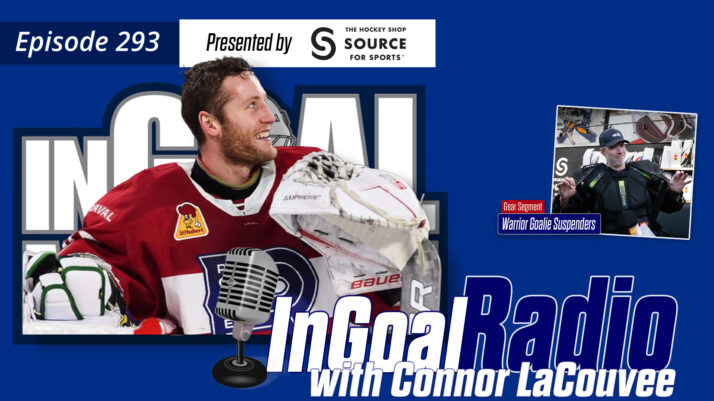
InGoal Radio Episode 293 with Connor LaCouvee

Please subscribe and leave a rating — it helps us reach more goalies!


Pro goalie and coach Connor LaCouvee explains that developing Goalie IQ requires understanding the gap between how players see goalies and how goalies see themselves. He advocates using a journal as a structured tool for self-guided improvement, and argues that coaching young goalies actively complements a goalie's own playing career rather than detracting from it.
- Goalie IQ development depends on understanding the difference between how opponents perceive goalies and how goalies perceive themselves.
- Use a goalie journal intentionally as a self-coaching tool to identify patterns and guide measurable improvement.
- 'Edge work' is a specific technical concept with a defined meaning in goaltending that goes beyond casual usage.
- Spring and summer hockey volume decisions for young goalies should be driven by development needs, not simply by the goalie's desire to participate.
- Playing professionally and coaching goalies simultaneously can be mutually reinforcing, with each role sharpening skills used in the other.
Episode 293 of the InGoal Radio Podcast, presented by The Hockey Shop Source for Sports, features a fantastic, information packed interview with pro goalie and coach Connor LaCouvee.
Feature Interview
presented by NHL Sense Arena
In the feature interview presented by NHL Sense Arena, LaCouvee returns three years after his InGoal debut to catch us up on life as a pro in Slovakia, as well as his ongoing transition to doing more goalie coaching, and how the two complement each other. From discussions on Goalie IQ and how to develop it, understanding the difference between how a player sees us as goalies and how we see ourselves, how to bets use a journal to guide your own improvement, what “edge work” really means, and how coaching can help young goalies get better, this thing is loaded.
If you want to reach Connor to learn more about his coaching find him on social here:
https://facebook.com/lacouveegoaltending/
https://instagram.com/lacouveegoaltending/
https://x.com/connorlacouvee
https://youtube.com/lacouveegoaltending
Parent Segment
presented by Stop It Goaltending U
In the Parent Segment, presented by Stop It Goaltending U the App, we talk about “how much is too much” when it comes to spring and summer plans for your young goalie, what factors should go into those decisions, and why “my goalie want to do it” isn’t always a good reason to let them.
Pro Reads
presented by Vizual EdgeWe also review this week’s Pro Reads, presented by Vizual Edge, which features a quick return of Cam Talbot, who has talked about his use of Vizual Edge, and a look at some of the important factors in skate-or-slide decisions on rush chances with lateral pass options.
Weekly Gear Segment
presented by The Hockey Shop Source for SportsAnd in our weekly gear segment, we go to The Hockey Shop Source for Sports to look at Warrior’s new suspenders, which include enough features to have non-suspender wearing Woody intrigued.
Episode Transcript
Intro
I finally saw it. I I've heard about the stories for years, and I finally got a look at Woody in in real time. Now it wasn't actually Woody doing things. It's InGoal Radio Podcast presented by the Hockey Shop Source for Sports Langley, the hockeyshop.com with Daren Millard, along with the cofounders of InGoal, David Hutchison, Kevin Woodley. Hutch, you love to talk about Woody like snapping.
And I saw it. I didn't have a camera at his rink. I wasn't keeping track of the shots in his in his men's league, but I saw Alex Nedeljkovic get removed from a game, and he wasn't happy. He snapped a stick. He talked to the bench.
He had some comments directed towards the coach. He slammed the gate, and I thought, that's Woody.
A lot of people out there would say that's going full Tuukka, but we would say that's going full Woody here around the shop. Woody? Yeah. Yes. Woody is entertained.
I have never seen Woody do that because thankfully, you can't get pulled in recreational hockey. But I think there's a good chance if you could, then Woody would snap like that. I used to. If I felt like I was having a bad game, I can't pull myself because as we've talked about before, thankfully, there's no backup in recreational hockey. I would simply go to the bench and change my stick.
That was all I could do to pull the goalie.
Well, two things. One, I also recognize the value of a stick, so they're too damn expensive these days to break them. Although when we
For used to sure.
When we used to have foam cores, I and and I knew one was getting a little soft. I I tossed a few off the crossbar back in the day. And, of course, let's be honest, back in the day isn't that long ago because I haven't been playing for that long. But the new ones are too expensive to do that. Have too much respect for my equipment.
Also, also, I have thought about just exiting games and pulling myself and just leaving my team with nobody in net many many time oh, thought
about it. I've come close.
Daren, you can't tell
me you've a lot of stupid things. I've never even thought of that.
Come on. Never even thought it? No. Like, I'm out of here. Like, it's like you guys Didn't
you do that once, Woody, when you got run?
Well, I mean, yeah, like drooling puddle of, you know, vomiting, concussed goalies probably should leave games.
But I feel like you might have been out of pure temper one time too, though. That that would be a
Oh, yeah. I got tossed I I I got tossed out of a league in pure temper
after getting him run. I've been kicked out. Yeah. And there's been no goalie there to replace me, but I was tossed out. I didn't just leave.
Yeah. I I I've been tossed, but I haven't I haven't left. I've thought about it.
I'm surprised you've never thought about it. Hutch and Miltsey's come on, Daren. Admit it. You must.
I'm counting in my head. What's the goal count that gets me to leave? What's the number that I'm done? Really?
Yeah. But You know, you've have you ever here have you ever walked in the
whole team stops and turns around to see how the breakaway is gonna go. That just
drives a then you make the save and the second third
rebound goes in.
Yeah. Yeah. And you're just like, hey, boys. I am out.
You're not here. I've never such an
odd person out of the the group by feeling more normal.
Well Yeah. But if they're only thoughts, we haven't followed through on them.
Hey. Listen. Listen. Listen. Two things here.
One, I assume when Daren said he saw me snapping, it was because when he joined our discussion late today, me and Hutch were already going because Hutch had stoked me on the fact there's not a bridge over the Fraser River and the Fraser Tunnel there, like
buddy. I didn't even start that one.
That was a little snap tastic. But back to Ned. And this actually goes to the conversation about Binnington coming out of Four Nations. I've done a whole bunch of media and radio where people are like, oh, I was so impressed that he didn't lose his cool because they were true clearly trying to get him. And, like, I I was too.
I but the narrative like, anytime he snapped, it's been with his team in an absolute hole trying to spark them.
And you said that on 100% hockey, the the podcast I did with John Shannon, and that was really enlightening. John Shannon really appreciated that that take. He he hadn't really processed it in those those areas.
Well, that's good. I I I thank you. I appreciate that. Thanks to John. I was flattered to be on the show.
The but but the that's the reality. Right? Like, we we attach this narrative to Binnington's personality, and certainly some of it's there. Like, he's a fiery competitive guy. But if you go back and look at when he's done it, it's almost always on his way out of a game where his team has just got nothing or they're not playing well.
Like, I I just think that's been a like, he's not doing it in a tight situation and in a must win game. You know what I mean? And so as much as you're right, the other teams did seem to try and get under his skin. It never looked like he was even close to sort of living up to a narrative that I think has maybe been a little a little overblown at least from a situational standpoint. And when I look at Ned last night, clearly, was emotion involved in there.
Clearly, that was sincere for a team and a guy who struggled. Like, I don't think his season has been a struggle, but of late, a lot of goalies are struggling coming out of this break, Daren, as you mentioned. But what happened after? They came back and won that game. Right.
Like like, that's that has to be part of the story. As much as the highlights will just focus on Ned breaking a stick, slamming a door, and absolutely screaming down the bench on his way out, they came back after that after leaving him hung out to dry and started to play better and won a hockey game.
So you think there's a link between the behavior upon exit to the team rallying?
I mean, I don't know that he had that planned or that was a pure emotional it looked like a pure emotional reaction to me. But that emotional reaction had an effect on his team. I find it hard to believe that Ned is not a very popular teammate. Just knowing a little bit about Ned and who he is and how he acts. And seeing him hung out to try like that and that upset would would create a more visceral, more emotional reaction than frankly that team had shown to any point in that game before it happened.
I think we've just experienced the most challenging week of goaltending in the National Hockey League season. More than the start of the season, more than around the holidays when people can be distracted, the the level of play has been clunkier or more inconsistent over the last seven days than in any other point coming out of the four nations face off.
And it's a combination of things that's leading to it. Right? Like, there are some guys that still still got their sea legs going after vacation. And there are other guys coming off
It's more between the ears. Got everybody checked out and, you know, when you when you take your your running and you stop for a second, it's hard to get that momentum back or you're on the bike or whatever. That that's what they've done.
What's running you speak of? What's what's what's running? Is there a bear? Is there a bear behind you? What is this running?
I'd stop and say You're you're right. You're right. You don't
have to be fastest. You just can't be the slowest.
The the a number of teams that have come back and just like their their their execution, their systems play, and and and to your point, it's the guys on vacation. It's also the guys that were at the four nations. Conor McDavid admitted it. It's been hard to find juice coming off something so emotional and so intense. And the product in the NHL probably hasn't suffered if all you care about is goals and a lot of fans just wanna see more of them.
I was watching Amazon's Thursday night surfing program. It's kinda like their version of red zone last night where they just basically have panelists and they're just surfing around the league. That's how I saw Ned's reaction. That's how I saw how the Penguins rallied. They're kinda just surfing to all the goals around the league, and the goal count was crazy.
So probably not great for the goalies in the league. And some of them have struggled too behind this, but there's a lot of goals being scored. There's a lot of really sloppy hockey, and that leads to a lot of wide open chances and a lot of high scoring games.
Vegas allowed four goals in the third period in LA and then scored five goals in the first period against Chicago. Like, period two separate games, but period to period was one of the craziest turnarounds. And then in the game against Chicago, there is 12 goals scored. It was seven five. I asked Darren Elliott.
I mean, are you okay? Because this is a little close to PTSD from the eighties.
Flashback, baby. Flashback. Junior hockey to Beer League.
Junior hockey scores today.
Yeah. But all the questions after the game, and this is the part that that bothered me, was about defending and allowing the goals. And Vegas won seven five, and I'll speak to that game because I was involved in it. Like, what about the fact that the Golden Knights scored seven goals? Where where were the questions and the the the compliments and the exploration there instead of was, oh, they came back, they made it close,
That interestingly enough, that reminds me of a lot of the call calls and and questions that I'm getting from some of the people and places that I work with or do regular radio hits with. I've got multiple markets up here in Canada where I'm I'm a regular guest and I'm not getting you don't get the questions about, hey, was that just a great shot? You get the questions about, hey, was that a bad goal? Like, we're seeing a lot of time and space and open looks and guys executing and goalies perhaps not. And I actually have struggled a little bit.
It's like, hey, like, that's a low danger shot by the numbers, but even and and they account for time and space to bump it up. If you have time and space to pick a spot, the the the the quality in terms of what's expected goes from low to mid or mid to high quite often. But there's some shots here where it's like, okay. Technically, that's a low danger scoring chance, but that's a that's a hell of a shot. Sometimes you just gotta tip your cap, and sometimes I don't even know where to do it because none of what I'm watching over the last week looks like what we're used to seeing in the national hockey league to your point, Daren.
Wanna get into the goalie school guide that you guys have, going on. Let let's do that now, and then I wanna circle back to this because I I I do wanna highlight the project that you guys have underway. Hutch.
Yeah. Well, in in terms of most of our listeners, it's, gonna be a couple of weeks away. We will be producing what we think is the most comprehensive guide to goaltending schools and goaltending coaches available in two formats. It will be online on the website where you can get in there and search for a goalie coach whether it's in your local town or if you're looking for a place to go on vacation this summer and wanna drag the pads along. This is just great chance to learn about all the different options out there.
Have to say, even after comprehensively searching, trying to put this list together, all these people who listen to the podcast are coming to the fore saying, hey, I'd like to be in the guide as well and I'm sorry I hadn't actually found you online. It tells you that there's a place for this. In terms of the goalie coaches though, we're down to the last few moments to get in. So, if you're a goalie coach and you haven't sent in your listing, please don't be left out. People will be using this.
We're gonna put the full efforts of the InGoal marketing team behind this to make sure that it gets in the hands of as many families, as many goalies as possible. The the online one particularly will be a living document. The other side of this is a PDF guide that looks like a standard magazine that we used to produce a decade ago. You can get in there. You can flip the pages.
There'll be fancy ads. There'll be some great articles from Woody. Lots of good content to dig your teeth into and and just enjoy the whole goaltending experience. Harkening back to the days when we were younger guys and we used to love to flip through to the back of the magazine and and see a listing and imagine that school we might like to go to. There's gonna be a lot of kids looking at this thinking, yeah, this is a guy I'd love to train with and and, and you'll be able when you go in there by the way, just one click and you can send a note to your favorite goalie coach and and ask for a little bit more information about what they're doing this summer.
So really excited about it. Been burning the midnight oil, the whole team, but, it's it's a labor of love and it's gonna be a great project when it comes out soon. So around March 15, most people will see it, but, the deadline is technically tomorrow to get get your listing in. But, especially if you're on that free side, there'll be a little bit of leeway for coaches to get in because that's the last part of the guide that gets laid out. So no problem.
And like Hutch said, we plan on making this the most comprehensive guide. And and the idea is really to make it like those old days when we used to go looking for a goalie school. We don't have those magazines anymore. You don't have those back page listings. So where do kids and more importantly, frankly, probably the parents, which have as we have discovered here at InGoal Magazine, we have a crap ton of parents that listen to the podcast that check out the magazine, and we wanted to develop a resource for them to find coaches and schools.
Maybe they're traveling during the season for a tournament. Like Hutch said, maybe they're planning a vacation. They wanna plan it around a goalie camp. They wanna look at new options. So if you're a goalie coach or you're a goalie school and you haven't filled out the information already, there's opportunities to buy ads.
But at the very least, out your free listing. It takes three to five minutes. It allows you we may have you in there anyways, but this allows you to make sure all the contacts, all the emails, all the phone numbers are up to date. It allows you to list remote camps if you have multiple locations, not something we'll do for you. We don't know that information, but you can so that when people are searching geographically, but it's not sort of your home base that they're looking, but you have a camp there that summer, it will populate and they will find you.
It also allows you to add a write up to your individual listing for your camp or your school or your private coaching on the online directory. Again, we're not gonna pull that off your website and put it up ourselves. That's up to you to do it. It takes three to five minutes. As I was actually meeting with an NHL goalie coach this week for a little lunch, and he could see the exasperation on my face because a whole bunch of goalie schools haven't filled out even their baseline free listing.
And I explained it to him and he just looked at me and he goes, why in the world, if you are running a school or a business, would you not take the time to fill this out? That might be the stupidest thing I've ever heard. And that's not me saying that folks. So make sure you fill it out. And we don't Hey, listen, we hear from a lot of camps.
I'm full. I'm always full. Guess what? If four or five other camps in your city are part of this guide and you're not, I don't know how much longer you're gonna be full. Even if you're a great coach, the reality is there's tons of competition.
We are gonna make this a go to resource. So if you wanna stay full and you wanna stay ahead of the curve, three to five minutes, fill out the free listing.
I can't believe you just stole how I approach things with my kids. If I don't really wanna be the bad guy, I'm like, you disappointed your mom, or why can't you do that for your mom? I I I presented in her line. That's what you just did with the NHL goalie
I really wish I
had his words.
Yeah. You said something funny.
That you wanted to say,
but you Well, put it in his
the the funny thing is is Hutch knows it because I told him this story before we went on air, but that literally was his reaction. And I was like, yeah. Like, really well said. Yeah. His was a little more colorful.
As my dad used to say, you can't fix stupid.
Talked to Sean Burke this week about, the summer, and Brandenburg has the goalie school. And we're just
You should get listed.
Putting together some of the different elements and staffing, and we were coordinating schedules. And that would that reminded me about the goalie school guide that that that we have going on. So plans are are firmly in place, and this the the goalie school in in Vegas will be here for the third time.
Nice. I'll wait for my invitation.
Well, you you guys have a standard invitation and you both know it, you just refuse to take advantage of it.
That's because I'm easily corrupted and Vegas scares me.
Refuse is a strong word, Daren.
Well, why haven't you guys shown up? A lot of little birdies going, tweet tweet. Silence. Edit that. No response.
Too busy, but but we'll make that happen.
Oh, no. No. You won't. I've given up on you guys. I I absolutely have.
Okay. Here's here's my question about goaltending because you were talking about a perfect shot off the post and the coach taking or standing up for the goaltender. My name was Stuart Skinner. How much space is the goaltender actually responsible for? And that sounds like a dumb question because the goaltender
Great question.
Goal, the net is six by four. When I play, if the puck goes off the post and in or off the post and out, although that was just a great shot. And if it goes post and out, I I I had it and it stayed out. If it goes in, it's like perfect shot. Am I responsible for four and a half by six and a half?
I've never asked this question before and I don't and I don't know the answer.
Very, very rarely is it that large.
I don't have the answer either. Angles. No. It's angles where it goes.
Should should I be covering an extra three inches beyond the No. Actual area.
No. I think No. Because inevitably, if you're you're covering three inches one way, you're giving up three inches the other way, and the three inches outside and then it matter a lot less than three inches on the other side that are gonna be inside the
this is a question that could go in circles, Woody, though, because it's also possible to cover three inches on both sides of the post just depending on the angle the shot is coming from, obviously. But would you prefer the precision of just getting to the post which maybe allows you to do some other things, in terms of your positioning? So for example, I know there's some depth conversations in today's feature interview. You might have to come a little further out of the net to cover three inches past the post, Daren. Whereas if you were precise enough, and it's a little crazy to think somebody could be this precise, but if you were precise enough, then you could take a less aggressive depth and only cover to the post, and now that gives you options for moving laterally.
So I think the precision of only covering to the post would be the ideal if you could. I am one of those people that goes crazy when I hear the announcers say, he beat he beat Millard, but he didn't beat the post. No. He didn't. Millard had his space covered.
How do we know it wouldn't have ticked his glove had it been one centimeter to
the left? So fine. I understand what you're saying, but that is so fine. Is the post the goaltender's responsibility?
I don't think so.
I don't know. I think it
I don't know. The more
I think about it,
I think it should Like, you say it's so fine, but, like like, that's the level of precision that a lot of these guys are operating at in real time at the National Hockey League level. No?
The the only thing I'd say to that, Daren, is a puck off the post is an uncontrolled rebound. How's that? Because you don't know where it's going.
Fair.
Yeah. So maybe that. But
if if it But I still hate
saying that like who who was I've heard it attributed to about three different National Hockey League goaltenders when somebody asked him in the locker room how he felt about the post getting that puck. And his response was, what am I supposed to get everyone that goes wide now? It's only I mean, where is your line? It's not a shot on goal if it hits the post.
But to to be honest, if we're gonna be honest, if if it hits the post, I should be stopping that. Like, that
You're saying you're saying you've left it to chance a little bit, whether it's post and in versus post and out, and so have two more inches of coverage. And, I mean, I guess I guess it depends how you feel as a goaltender, whether you feel like, man, I really had that angle and there was nothing there or whether you feel like, oh, man, I just got beat and I got lucky to hit the post. And and we all have that conversation in our own heads, and I think the answer to that probably determines whether you were in the right spot or not.
And I actually thought you were coming at this from a different angle, if you'll pardon the pun, Daren. Yeah. Which which was, were you asking how much space outside your own frame should you be able to cover? I mean, there is a point. Yeah.
That's different than am I required to cover for the post because, you know, I should I with no. Not necessarily. Not necessarily because because this one could be well outside the post. Like, I guess in my head, was asking, what is it physically possible to cover outside your frame? And of course, that depends on the speed of the shot Where
you are. Yeah.
Where it's coming from and a whole lot of things. But I think that is an interesting question because sometimes people will look at it and say, oh, I should have had that one. It went straight in the net. Well, there's a difference between the one that happens to hit you in the glove versus the one you only have to move an inch versus should you be able to go five inches to get a puck? I mean, there's there are limits to the physical ability to do these things beyond reading the game like like some of the best.
But, yeah, I was sort of thinking it from that direction. And sometimes you look at and you think you should have had the one that went straight in and maybe it's not even physically possible to get there.
Like, is it posting in a perfect shot that beats the goaltender or should the goaltender be
It really depends.
Thinking of stopping everything two inches outside of the post and there's no perfect shot.
I I think like everything, it's situational. If it's posting in from the blue line unscreened, goalie's taking responsibility for that. Right? If it's post posting in from the hash marks over his shoulder or past his glove just over the pad, you're tipping your hat. Right?
Like like everything, it's situational.
And was there a backdoor option so I had to play a little bit deeper, in which case there was more space to cover? Is it a guy yeah. Is it a an undefended shot from the point where I can come three feet above the top of the crease? I mean, we're gonna have to get into a little calculus here and then Woody's brain would hurt.
Yeah. My brain hurts already. I told them being no math. We saw one Vladar gave one up the other night, played a great game, beat Washington in Washington, which doesn't happen very often this year. But the one goal he gave up was Ovechkin.
And you're like, ah, it's Ovechkin, it's on a power play, so tip your hat. But if you break down the goal, it was a quick shot from outside the the the outside edge of the circle, quick release, no screen, net front presence, and Vladar didn't square on him. So he was flat probably anticipating like, there's a lot of reasons he wasn't square on him. But if you look at just the actual shot situation, you're probably thinking, yeah, he probably should have had that. Right?
Like, shot from there. Like,
there's He was thinking pass. He looked like he he was expecting a best in the past. And not And I was laughing. The guy's chasing the all time goals record.
Yeah. Who expects that?
And and and Vladar almost looked like he talked himself into it. Like, this is the one time he's gonna go with a pass across. He he's almost 900 goals, but this is the one time he's gonna pass. There was
And that and that's and the point is sequence. Even with one of the greatest shooters in the history of the game, soon to be the greatest goal scorer in the history of game or the highest at least, like, there's still there's still wiggle room. Right? Everything gets there's still gray area to evaluate everything. So it's a it's a geometry equation and that one, he wasn't in the right space, but there's so many factors that go into when and where we can fill the optimum space optimally.
It's too hard to answer it absolutely in any one situation.
Gear
A lot coming up. Connor LaCouvee is going to join us with the NHL Censorina feature interview. We have our parent segment brought to you by Stop It Goaltending U the app. ProReads presented by Vizual Edge, and our Gear Segment brought to us by The Hockey Shop Source for Sports Langley, thehockeyshop.com focusing on the Warrior suspenders. I don't think in the 922,000 episodes we've done, we've dealt with suspenders.
Have we?
Oh, we must have at some point.
No. Probably suspensions, but I don't think suspenders.
Man, I don't
I don't remember suspenders.
This one is right up your alley, Daren, because these are found in the accessories page.
Because I gotta pull stuff up. Shop. I gotta pullup.com. Pants?
Well, yeah. There's that too. Get it together. Pull pull your pants up,
Daren. Love accessories.
Yeah. Us us three old guys, you know, we're walking around with our pants around our, you know, droopy drawers as the kids have these days. Pull your pants up, get some suspenders. No. Accessories at the Hockey Shop.
Another example of new stuff coming in all the time. This isn't just one that we've skipped. This is a relatively new product. Now having me review it would be foolish because I don't wear suspenders. But Cam has got all the answers on what make these special, and you can get that expertise only at The Hockey Shop Source for Sports.
So make sure you check them out. Make sure you ask any questions. Give them a call. Check them out online. Do as Daren does.
Spend an hour in the accessory section where you will find new items all the time, including these suspenders from Warrior. Welcome back to the Hockey Shop Source for Sports. We're over
in Goalie, utopia. Hold on. I'm gonna suspend that intro.
Oh,
for cryin. Because we're gonna talk about the Warrior suspenders. Man, nailed it today. Are
you sure you don't have
kids? No. Dad jokes everywhere. I well
Okay. We're back. The suspense is killing me now.
Alright. What's so good about the suspender? So, goalie specific suspenders. Okay. That Kevin has been so kind to model,
So, goalie specific suspenders. Okay. That Kevin has been so kind to model, which we're gonna show off here in a little bit. But Warrior is a bit of a first to market here
[crosstalk] from our major brands. I I don't wear suspenders, Cam, so you're gonna have to fill me in
on the appeal. Those that do, including myself, a, Never really had a couple of specific features that can benefit us as goalies specifically for suspenders. Well, normally, just have, you know, say the regular lari ones with the plastic in the front and whatnot and things like that. Whereas here, as you can see, it's a good point in starting out. It's not just Warrior's logo here for starters that you tuck in your chest and you run your suspenders over top of your shoulder floaters.
Maybe those shoulder floaters don't have that little Velcro tie down. Warrior gives you one with the suspenders itself so that will go around that shoulder floater and anchor that suspender on top of that shoulder floater so you don't have it sliding off. Yeah.
How about that, I don't wear suspenders, but that would seem to make a little sense,
young I'm wearing some right now. Now some Warrior specific quirks and notes to these things themselves.
Why are there skate laces on my suspenders? I'm getting to that.
Goodness. Okay. Warrior pants specifically, they have nylon loops on the side and the back of the pant itself. That's what this piece is here that comes stock with the suspenders themselves. Say you don't have Warrior pants, those just pop off as normal.
So our model, Kevin, will stand up for us now. So as we can see
This is like how this is I wear my pants.
Oh goodness.
Not my hockey pants, just my pants.
Without those nylon loops, we can see that that those regular standard suspender buttons, they just slide right in. Okay. What's the point of this?
Yeah. Yeah. What is the point of that?
So now say again, Warrior specifically or some of the other pants that just have that nylon there. So instead of actually butting it through and struggling to put those buttons through, you can untie that and just tie that onto here. So you don't have to worry about this little button. I was confused. I know it's very easy.
We'll show off a little bit of a demo here, but we're just gonna talk about a little bit more of the spinner. Turn around. One of the big notes with what does separate say this suspender from say a lower suspender itself, that bigger back patch. So that will help to anchor the suspenders on the back of your chest in particular, whether or not it's over top or underneath. It creates a bit of more of a solid point, less of a chance of slipping, riding, easier to get behind that back plate as opposed to having it catch and grab, which is always a little bit of a gripe when it comes to those suspenders itself.
Nice thick elastic nylon strap. Good quality. Good overall fit. Again, an option for a goalie specifically that are looking for a goalie specific suspender.
How would you like me to stand now, Cam?
You can turn around and face the the rest of the audience so they can see your pretty face. Our phone number, (604) 589-8299 or 1-800-567-7790. You can give us a call. We got these bad boys in stock. Whether or not you tuck, untuck, half tuck, hybrid tuck.
How do you untuck with the suspender? There's no place for it to go. Check them out at the hockeyshop.com.
How do you how do you get on top of it? Like, my my my chest would be, like, down here.
Yeah. Even you would just be wearing suspenders on me. Chest would be over top.
Blocker gets some some bad press where every blocker is the same. I now have suspenders right up there as the most benign piece of equipment that a hockey player can play. Like, it's just there. You never even think of it. And now we've got developments or advancements in suspenders.
Didn't see that coming.
I love that people want to express who they are through even the smallest, most innocuous piece of equipment, which probably is the suspenders. And yet that's one of the reasons that we become goaltenders is that we love equipment. You of all people, Daren, loving to get into the accessories page. I think the fact that you can tinker with every little bit of equipment, is one of the things that's really cool about it. So I congratulate Warrior and, I'm sure there's gonna be a lot of people out there who wanna give them a go.
Upper body shoulder floaters, I think, should be, like, customizable where you could add them on aftermarket or replace them aftermarket with your your own flare on them.
Six by four?
Well, no. Like, the same same size, but, like, with graphics or your name or
Well, hey. Something like that. Bauer can do that for sure.
Bauer has custom like Brian's has a custom program too for the shoulder floaters and the custom designs. Know Bauer does for sure. I thought you remain I I was with Hutch. I thought you were going like full KHL, old days, yoga blocks, stuff underneath the shoulder floaters.
He's not crazy though. You could get some some like you could actually strap your own right on and nobody would even know. Just just the way those suspenders go around the shoulder floaters, you could Mhmm. You could create your own extra double wide strap onto your shoulder floaters. You'd be cheating even worse than Woody in his inner belt.
If somebody showed up playing men's league or rec league
Not legal Woody. Woody looked confused by my comment.
And they they showed up with one of those extra large shoulder floaters or add ons on. What do you think Woody's reaction would be if he's standing at the other end?
Oh, he'd call for a measurement. He'd call the ref over
sure would. Guaranteed. I'm with you, Hutch.
Are you guys kidding me? If you don't think I am the biggest looking goaltender on the ice myself every single time, if you don't think I wear the largest possible chest protector, that I can still move in. Like, if you ain't cheating, you ain't trying, boys. I'm not playing in the show here. I need every inch of coverage I can get.
So if you think I'm not Hutchison making his little shots about inner belt, man, why would you not wear an inner belt unless you're in the NHL and it's illegal? You can
lose the overdrives blades on his skates too, buddy? You got the overdrive blades?
No. But I do play against a guy who has overdrive blades, and I watch him move around the crease, and I'm like, damn, that's tempting. Like, he he he moves on his knees way better than he should for his age, and I couldn't figure out at first time. He had cowlings on. I'm like, how is he getting an edge and pushing from his knees?
He's got freaking cowlings on these super old skates. And then I saw it, overdrive blades. It worked for him.
Wow. Probably a lot of people listening who don't know what those are.
I I had them. Did you guys have them?
I I actually tried them once.
No. This is this is a pure expression of who I am. I bought them and I didn't get around to installing them. True story. So a lot of people out there listening, they don't know what we're talking about.
Small blades about like if you were to make a c with your forefinger and thumb about that size that strap under the bottom of your skate 90 degrees to the regular blade so that when you're down
your knees Right under your
Yeah. Yeah. On the bottom of the boot with that edge just sticking out past the edge. Yeah. On the cowling.
And then when you're down on your knees, it's easy to barely lift your knee and get a little push because again, if you're not as familiar with the sport or new to it as a family, just having to push around the crease requires you to lift your knee and immediately creates a hole for a for a goal to go in and a scramble.
Well, and back in the day when we had cowlings and really low profile skates, the blades weren't very tall, the holders weren't very tall, you really had to lift your knee to get an edge to push out of your butterfly. Like, you had to lift it sort of up to your waist to grab an edge a lot of the time. Like, we didn't nowadays, kids have got, like, no cowling on the skates so that clearance, they can get an edge from a really, you know, wide angle with the skate. Like, these skates barely off the ice and they've got an edge, but back then you couldn't. And so overdrive blades were essentially a cheat to get you an edge without having to lift your knee.
And like I said, I still know some guys at least one guy that uses it. It's pretty funny to watch.
That's fun. To be fair though, you might not have to lift your knee as much, but the puck is only about that thick. So if you lift your knee at all, the puck goes under it. Woody had a great article up over at InGoal about, dealing with crease chaos. You could go check it out.
Sometimes the best thing to do is just hold that butterfly and let the puck hit you.
That was a fun one.
You're talking my language.
Daren has a nice Daren has a nice butterfly too.
I I still have cowlings on on my skates. I'm probably at the last pair that was of that of that ilk. I don't mind them, and I've sort of held off going to the modern boot. How much clearance do you think I'd get off a modern skate like a present day skate over the RVZs that I is that
Oh, easy. Used to do the measurements.
Yeah. We used to we yeah. We used to have, like, somewhere in InGoal where I have to dig this up is the actual attack angle, like, measured. Like, we put the skate on its edge and measure how basically, how long until you lose basically, how long until the inside of your foot, the boot or the cowling in your case, Daren, hits the ice and you lose your edge. And it was pretty significant with the new skates.
If you're in a Reebok, you're you're not just do you have the cowling, which sticks out further inside of your sort of underneath your big toe, which which causes you to hit the plastic sooner, but you're also in a really low profile skate. So you don't have the clearance. And like today's with the the tall holders, I bet you I would bet you it's 15 to 20 degrees difference in in attack angle where you can grab an edge.
We commonly CCM RBZ. Not that that means anything, but I I do know.
Okay. You it's not you're not as bad. That's a taller holder. You're not like I thought you were, like, old you said RVZ. I thought you meant, like, old RBK.
Like, remember, like, John Gibson wore them forever, Devin Dubnyk, Roberto Luongo. Those things had the cowling,
and they were super cool. Time he sees my skates. Like, time for new skates. Like, my feet are comfortable. Then I'll get the text, time for new skates.
I showed up at some sort of skate with big cowlings on mine years ago, and another goalie coach just looked at me and said, what are those bobsleds on your feet? That was a good line. That was a good line. I don't
think That actually is pretty good.
Yeah. I have a pair of those. Couple pairs sitting in the garage right now.
That that's that's a flex right there. I've got a couple of theirs. I don't use them. They're outdated.
Feel like I'm gonna send a set out to you? I can't throw anything out. Look at the new vibe. I can't throw anything out.
You guys make jokes, but for the longest time, there were equipment managers looking for some of this old stuff for the guys that did not wanna switch. I know Dubnyk.
Oh, yeah.
Because, know, Duby had like and in Luongo size thirteens, like, you know, until he switched into true two piece late in his career. You know, this it was getting hard to find. It's kind of like the old Chris Osgood finding the the SK two thousands and and looking for shells that he could wear. Like, that's where we are at with, you know, equipment managers in the National Hockey League trying to keep these goalies in these skates for as long as they could. I think Gibson switched last year finally.
I almost bought an SK two thousand two weeks ago.
Really?
I saw one come up. It was in my feed. It was one of those sites, and I almost bought it with an HM 30 mask.
I was just gonna say 30. That's the old cat eye.
Just to go out and see what the sightlines were like.
Yes. Well, you could you could almost probably get better, but, oh, boy, I wouldn't wanna take That's flush. I
don't wanna take one up up top. Hey. Do you think Gibbies moved in the next week? John Gibson?
Don't know. Don't know. He's having a hell of a season.
It's the annual question.
Yeah. I kinda feel like he's having a really good year, and I kinda feel like I know there's a lot of pushback on a lot of this stuff, but I've always felt like I just wanna see him on a good team and see what happens. Now listen, the Ducks aren't as bad as that like, the Ducks are not a bad team anymore. Like, they've started to make some strides in terms of how they play. They're giving their goalies a little bit of a better chance too.
They're not they're not relying on them. Like, they still rely on them to bail them out a lot. Who am I kidding? But not maybe to the extent from a high danger perspective that they were before as often as they were before. They score a little bit more.
Like but I've I've really always been of the belief that Gibson on a really good team still has a a chan would have a chance to shut a lot of people up. Let's put it that way.
Do you think the Mackenzie Blackwood transaction helps this? Because there was the same questions about how would Mackenzie transition into a good environment.
That's a that's a really good point, Daren. I don't know because I think the one part of the Mackenzie Blackwood transaction that it's already too late to replicate, and Blackwood himself told me this for an article, is the fact they did it early allowed him to adjust. Like, so if you're making this move now, you have basically one month to get comfortable behind all the tendencies of new teammates. We talk about systems. Systems are easy to figure out for goalies.
It's the individual tendencies within that system, and that's not a snap at your fingers thing. And when we look at the checklist that I would and have built over the years in terms of whether it's likely to go smoothly or require more time. Gibson doesn't check off a lot of those boxes. Has he ever been traded before and had to switch teams? No.
So he doesn't have that experience. Is he does he play with a little more flow, a little more read and react, a style that relies on being able to read off the guys in front of you? Or is he just a technician spot a to spot b? No. He's more of a read and react, a little bit of flow, a little bit of backwards momentum in his game.
Again So
that should help him. Right?
No. That's tougher because you gotta read off new guys. Everything's different in front of you. This is kinda this is a checklist I built starting with the run.
Because he was good at reading. He's then it might be easier.
No. He I mean, he is excellent at it. But, again, what are you reading off of? You're reading off of tendencies. And if you've never switched teams before and now you've got new tendencies in front of you for the first time, like, it's just there are it doesn't mean that these are not absolutes, but there are sort of signs of if you look at past history of the guys that have had success and the guys that haven't in a quick, you know, sort of turnaround trade deadline environment, those are some of the boxes or some of the things that you look for, and he doesn't necessarily check them all.
And that's why I think for him, if I was a team making that move, I would have done it before now. Now that said, to your point, Daren, he does. He's like, he's a really bright goaltender. I haven't had a ton of conversations with him, but I've talked to other people when they do video sessions and stuff. Like, he's a really articulate, thinks the game well guy.
And so maybe because of that, he would be able to flip a switch and figure it out really quick. But I just I just think history says the more time you have, the more likely it is to succeed. And and Blackwood talked about it as well. There's a pressure element. Talk about going to a good team.
Well, if you've got time and you're not worried about figuring it out, it's a little easier between the ears than, hey, we're a cup contender. You're the goalie we've chosen to lead us to a cup. You've got a month to figure out how to play behind this team. Oh, and by the way, in that month, we're probably gonna have to start the backup a bunch of times because you can't play every game. So 15 games.
It's it's not a lot.
Parent Playbook
Parent segment brought to us by the Stop It Goaltending U, the app.
Yeah. Stop It Goaltending U, the app. We've talked about it the last couple of weeks. The fact that it is more than just all the highlights, the videos, the daily affirmations, you can do one minute videos every day. Every week, there's new ones.
Pick a topic. They walk through it one minute at a time. Five minute breakdowns. They've got drills. They've got tips.
They've got breakdowns of NHL goalies. They've got all these video, new ones every week to keep you not just I I'd say entertained too. Some of them are really educational, but also entertaining. They got some pep music videos, little power pep drills, but also they have the services that Stop It offers in terms of helping you moving into junior hockey. They've got private consulting.
All of those things are available through the app. You can schedule those appointments depending on the level you buy into. And regardless of whether you just buy a base subscription to Stop It Goaltending U the app or a premium subscription, it all comes with InGoal Magazine built in. Well, not built into the app, but built into your price. You get a subscription to us and all of our content at the same time.
So best of both worlds. Stop It Goaltending U, the app. Check it out, and InGoal Magazine premium included. Hutch.
Daren, normally, you ask the questions. Today, I'm gonna ask a couple of questions. I want you guys to give me a little feedback. I saw a question online, and I immediately copied it down because I thought, oh, this is a juicy one. I'm gonna go off here and get really grumpy.
And then as I was preparing, I read a little bit more carefully and my reaction isn't quite so strong anymore. But it's still an interesting topic to discuss. So I'm gonna throw this question out there, guys, and I need your I need your responses. Here is a parent who has said, my child's season is over and won't be skating with their team again until April. They would like to do on ice specific goalie training with their regular coach two or three times a week with occasional shot taking with different hockey coaches and their students.
Is there such a thing as too much goalie training? There's an edit to this I'm gonna add in a second, but let's just get your answers. Woody Woody Woody.
There is. My first
answer would be to ask more In this case.
My first answer would actually be to ask more questions.
Okay.
Once they're back with their team on April, is that for the rest of the summer? Is there an opportunity to do like, that's not that's not a like, that's a we're talking about a month, basically. Right? It's not like you're signing up for another sport. Yep.
I'd actually defer a little bit to this interview we're about to hear with Connor LaCouvee, who is from your neck of the woods, originally from Vancouver Island. Yep. Played signed with NHL teams, played in the American Hockey League, is now over in Europe. And he gets into in his discussion some of the differences that he sees with European goaltenders and how they treat their off season. And some of it is, and he talks about it, playing other sports.
So if there's opportunities there, I mean, a month isn't enough to sign up for a team and play a full season, but there are other things you can do. Tennis is one of the ones he gets into. And he really stresses the importance of doing other things that will still also help you become a better goaltender. I would ask the parent how busy and how many reps that kid has had throughout the season because there is a wear and tear element to this in terms of the physical toll it takes on the body, playing too much through. And if if all those like, so there's more questions to ask, but my temptation and and the age of the goaltender matters here as well in the skill level.
But there's a temptation, I gotta be honest, for me to say, find some other things to do for that month. Maybe back off a little bit. It did sound like a lot to me coming at the end of a season, especially if once they're back with their team in April, it's for the entire summer.
Mhmm. I'll answer that part in a second. Daren, what do you think?
I don't think that you need to be all in all the time. Mhmm. Even if you've got a little bit of space and the the the window is there, I just I take advantage of of the the time away and to to freshen things up slightly. Even if it's just a month, I think a little bit of a window's good.
Yeah. My my reaction was probably even stronger than that, and I was gonna get all grumpy in it probably because I read this the first time when I was a little bit tired. But I'll come back now with the edit for you guys to be very fair to this parent. The edit was they're taking June and July off.
Okay. That's I still have a bit of a
problem with this plan.
Yeah. I still have a bit of a problem with the plan but but what do you think?
That's one
these things for me.
Yeah. So you're good with it? Yeah.
Unless you're seeing signs of repetitive use injury or wear and tear. Like you can still do stuff in that month in terms of physically training and stuff like that without necessarily being on the ice if you're seeing any of those signs. But, yeah, I mean, completely taking the summer off. Again, hopefully doing some other things athletically in those two months, organized or not, does change my answer a little bit. But but, you know, I again, I'd still be a little wary depending on the did you give us an age?
I apologize for that if you did.
No, I didn't. It's it's it's either 12 or 13.
Like, if we're talking like a 10 yeah. Was gonna say, like, we're talking like a 10 or 11 year old. Yeah. It's a lot. It's too much.
Yeah. It sounds like a pretty sounds like a pretty high performance kid too. So there's just a couple things I'd pick out. Yeah. When I when I then came back and saw June and July, I was a little bit better with it.
I was kind of alarmed when I first read it. But here's the piece I would like to just throw in here for you guys. I love that Woody brought up the wear and tear. Even if you think your kid feels fine, you don't like, wear and tear takes years and you don't really know and they're still developing. So be careful.
And here's and I think that comes to the piece that actually bothers me about this a little bit. I'm okay with the specific goalie coach work a couple, maybe three times a week. It's the jumping in with other coaches and just wanting to go out and be a target. If there's a social aspect to that, then maybe that's important. But going out there and just being a drill goalie with a hockey coach who needs somebody to stand in the net can actually be quite detrimental, not just from the wear and tear aspect, which is at sometimes extreme because they're just waves of drills coming at kids, but they're actually imparting some negative habits as well because these are not situations that your child faces in the game.
And the most important thing for them is to learn how to read the game. And in this case, they're learning how to read a completely different book. So I'm not as excited about going out there and just being a drill goalie unless there's something very specific about that opportunity that is helping them. And in terms of the rest of the summer, absolutely get out there and and get involved in in something else. I would just say focus on quality more than quantity.
I maybe the two to three sessions isn't so bad, but I'm not sure about the rest of it. Having some variety in your life. If I was throwing in something different at this time of year, like if that other coach is just running small area games, little scrimmage, go out and have some fun, then go out and have some fun. What does your goalie want? And you don't always have to do what they want.
They might be begging you to do it, but as one coach said to me once, parents, if you ask your kid if they want another ice cream, they're going to say yes. It doesn't mean it's a good idea. It's okay to say no to some of these things as well. Keep them excited. Keep them wanting to be back on the ice, and that's okay.
There's nothing wrong with taking time off. I do congratulate this parent for taking June and July off because a lot of parents don't do that in that fear of having to keep up with everybody else. And, and then I guess the other question I would just ask is what off ice work are you doing? Another thing that Connor brings up in the interview today, are you doing some good specific off ice work that is gonna help that body be stronger and more resilient and be able to handle the sport a little bit better. But, yeah, fun fun to riff on that one a little bit, guys.
I love it. I love that. And and I and, like, I know this wasn't planned, but I do think that my advice to that parent would be to really listen to a lot of the things that Connor's talking about in our feature interview that's coming up presented by Sense Arena because we kinda got into this a little bit. Like, he's transitioning and starting to do some more coaching, when he comes back from playing in Europe in in the summers and some of the lessons that he learned over the years. You know, you maybe could become a better goaltender without going on the ice.
Depend not that I'm saying 12 year olds should study video, but talking about the way we look at our game, talking about even watching more hockey and recognizing patterns. Like, you're right in that window at 12 where we are seeing a lot of the goalies that just go and work with goalie coaches and do station to station work where everything is contained and don't necessarily build a lot of the anticipation. So just because you're not on the ice doesn't mean you can't be getting better, and you don't necessarily and again, Connor gets into this, need to be at the pro level to sort of start to look at the game and try and connect those patterns in different ways. As much as we don't wanna be the parents in the middle of a school year that say stay up late and watch hockey, this is sort of me saying find a way to watch more hockey a little bit because I think that is a big part of this. And so maybe that's part of the equation too.
There's so many things that Connor gets into that I think just perfectly suit this question. Maybe not directly, but might have you think about what that month looks like differently than if you didn't listen to this interview.
I think kids should should have to watch two periods of NHL or some type of high level hockey a week. Two periods. May maybe not have to stay up late or whatever, but you you just gain so much from a hockey sense aspect that that goes beyond making a safe selection or technique. Just learning the game is so important.
See, I would suggest those two periods be Vegas Golden Knights broadcast, just because Daren is on them, but because they like to use the replay from behind the net. I think if we could have a channel, like, it used to be if you had the NHL app, you could pit pick which camera view you watched the game from that doesn't or at least replays that doesn't exist anymore. If they would launch one where you could just watch every game from behind the net, sort of the goalies views from from behind the glass, I
think director, Joel Myers. He loves that. Especially on a on a power play.
Right.
He will it's called a Fletcher cam. It sits right on top of the glass. He will just sit on that camera for the entire time the puck's in the zone and I love it.
In Formula one, you can subscribe to whatever yeah. Formula one now you can subscribe to whatever drivers camera you want to watch this thing. The NHL is falling behind when they were already in a good place with this, so it'd be great to have it. It's funny that you said that, Woody. I absolutely agree with you because I was about to say you could watch hockey on TV or you could go to a local junior rink and stand behind the net.
I always tried to get in with Maddie, to be sure that we were there for the warm up, and we would stand behind the net and just track pucks. I would say, don't feel like this this barrage of pucks coming at you. Just focus on one guy, focus on one puck, track it in. It slows the game down for you, and then enjoy watching the game from there and see what it looks like. Feel the speed.
Watch the plays develop. You feel speed and you see things differently in a live game than you do on TV. Absolutely.
That's great advice.
Yeah. So and junior hockey is a great way to do it. It's everywhere. It's affordable and and it's a good chance to to learn.
I love that, Hutch. I love Darren, do you ever do this? And actually, this probably doesn't apply to Daren because he actually gets to be in the net facing the shots. But I find myself being in NHL rinks all the time. Quite often, I'll just go stand behind the net, behind the goalie, and watch the shots he's facing and try and see how, you know, just how visually it I've got a glass in front of me, I'm not worried about reacting or getting hit.
I'm not standing there imitating the goalie like the kids do sometimes and they end up on YouTube. But just trying to watch and track pucks from NHL releases standing right behind the net is really fun, and you quickly realize just how hard these guys shoot. But it's
And how fast they skate.
Yeah. I love doing that.
We just organically got to a really cool place there.
Yeah. Hutch's Hutch's that was great. I love that. I'd I'd never I'd never thought of that. I think that should almost be a parent segment all on its own, but you need to highlight that one when we post this online.
Absolutely. ProReads brought to us by Vizual Edge.
Yeah. And we've got we're gonna we're gonna roll him back earlier than he was scheduled to be in the rotation just because we enjoyed it so much. We've got Cam Talbot this week at the ProReads presented by Vizual Edge and probably fitting because Cam Talbot will tell you, has told us that his use of Vizual Edge is a big part of a late career search. Two all star games, both in the last several years, having another good year with Detroit right now, 37 years old, has talked to us as he did in the feature interview with us a few weeks back about how it's helped his ability to find pucks through traffic, to quickly find pucks in scrambles, to find pucks around screens. Hutch mentioned that article we had online about, how to sort of play behind the chaos when it builds up in front of the crease, and that was one of the thing that Cam mentioned that he he finds his ability to find pucks within the chaos or coming out of the chaos on a quick shot off to the side has improved since he started using Vizual Edge.
It is a online tool. You get some glasses. You sign up. You do an edge test. You get your scores, and then they help to improve on the areas that need improvement and continue to build on the areas you're good at visually.
There's multiple different portions of vision when it comes to sports, and they attack each and every one, whether it's convergence, divergence, whether you see the zone well or not, whether you see pucks coming at you well or not, they'll identify your strengths and weaknesses and help you get better at them as they have for Cam Talbot. As for this ProReads with Cam, we've got a a rush play against Toronto and some great advice on when and where and why to hold your edges, skate on lateral plays off the rush versus sliding, and why it's important in certain situations, how to identify where in the zone you have time to do that. And in this case, it gives cam a chance to make a really tough save coming back the other way. But the discussion is largely we get into the mechanics of the save itself, but it starts with making a good read off the rush and then understanding when you have time and why you have time and where on the ice you have time to beat a lateral pass off the rush on your skates versus having to slide. So that's all part of the great discussion again this week with Cam Talbot of the Detroit Red Wings in our ProReads segment presented by Vizual Edge.
Wish somebody would invent a technology where I I know my hips won't work the way they used to, but I would love to be able to play like I had good hips. You know, like, you you use Sense Arena and Visual Edge as a combination to go, that's what that's like. That would be amazing for us older older people.
Where's your guys' threshold? Say say we got a two on say we got a lateral pass off the rush where there's two on one or a three on two and it goes across the middle of the ice. Where's that point on the ice for you as individuals where you're skating versus sliding? And again, it depends, of course, can Cam gets into this, the factors like, is it has the guy got a one t shot on the other side? Like, is he is he on the side handed wise of having a one t or does he have to catch it across his body before he can shoot?
Is there a spot on the ice that and do you pre identify it even loosely where, hey, anything below this, I'm sliding anything above this, I'm trying to beat it on my feet?
Yeah. Above the hash marks, I'm trying to beat it on my feet or in and around the hash marks. But this happened to me this week in in practice. I was able to to skate in full practices a few times and a pass went across on top of the hash marks, and it it was a one team. I didn't expect the one timer.
I thought it would be dusted off for. And it beat me so clean that because I was still on my feet, I wasn't anticipating at all. And the next time, I did slide over even though I wasn't anticipating one timer and it happened again and I and I was there. So I'm I'm leaning towards sliding a little bit more.
It's funny. I've started sliding a little bit more recently too because I was trying to beat everything on my feet and a couple of the guys at my skates, You know, a couple like some there are some guys that played and you learn who who's got a wicked one timer and you learn who's more likely to use it versus to try and make a play off of that first pass, make a second play. And so that goes into it. But, yeah, I find myself sliding a little more than I was before, Daren. And it's it's interesting because it may not even be the right play, but you're not.
You're taking away the bad goal off that wall. Yes. You know, to go back to Alex Lyon's ProReads about sort of managing expectations. The one that goes through goes underneath you as you're still skating is worse. And so sliding across, you've got that covered.
Interesting. I what I will say, just to give it a slightly different perspective, is as a goaltender in practice, I always encourage the goalies I've worked with to whatever your threshold is in practice today, let's change that distance a little bit and challenge yourself to skate. You've got to understand that when you're out there in practice, it's okay if the puck goes in. Okay? Unless you have one of those crazy head coaches who gets upset about it, in which case, I hope you have a goalie coach who can back you up.
But find that threshold where you would normally skate, and let's just challenge yourself a little bit today. Let's let's try and have to go a little bit quicker. Let's try and pick challenge ourselves to see if we can be a little bit better. Because if you always have the same one, you're never gonna improve that skill. You have to be willing to take a risk in practice and so on.
And then the other one little situation, we talked about the scrambly situations. And, and I think Connor today brings up the the lateral release. In in those tighter situations, sometimes it's almost better to skate than to slide because if you have to control that slide, the last motion you make is to lift a leg and stop yourself. Whereas if you skate, the last motion you make is to actually close the door. I there are some very situationally dependent.
But young goalies in practice, challenge yourselves.
Well, I that that's let's put the disclaimer. Hey, Daren?
Don't practice.
We are not saying to do it how we did it. We just wanted to follow-up the discussion on why we, like, the last thing anybody needs to be doing, at least for me, perhaps maybe less so for Daren, is be taking advice on how to play the game.
No. But I I there's such a trend to staying on your feet because we were slide, slide, slide, and now it's feet, feet, feet. But it's interesting. We we didn't plan this discussion, but Woody and I from different sides are are using the same sort of fluidity in our game now where where we're
Well, and and maybe it's It just watching could be age dependent. We may be a little slower than we used to be. The the other one too is, like, I used to like, my default used to be skates. And a lot of guys listen. Like, they've got guys in these pro reads telling us, like, Joey Daccord, look at the season he's having again this year and and the rise he's made over and his default is skates every time.
Right? And we've heard that from him in the ProReads. That is his default. If he can beat it on his skates, he does. Interestingly enough, he also had a ProReads recently where he talked about the sliding up.
Like, slide across and up as a purposeful plan because he lost it through traffic. And that's the other thing for me. If a if a pass is going across the middle now, maybe low to high, and I haven't got eyes because I haven't done a good scan. This is me, again, taking the safe route because I haven't done the work and I don't know what the option is on the other end of that pass, I may slide across just because at least I've got a chance if he won t's. I've got I've got the ice in the middle of the net with my body taken away.
I like staying on my feet as much as I can because then I don't have to get up.
I was just gonna say, falling it's I've fallen and I can't get up. There's that.
So there is that, but I've I've enjoyed challenging myself a little bit to to try to slide over and make sure that I've got the bottom of the deck covered.
I like sliding. Been fun. Plus I have I
have new gear. My I just can say I you've got stiffer gear. You've got new gear, which we've gotta show off on our social channels that looks sick. I went to new skate blades that are a little taller and are putting me a little wider in the ice. And what happens when you get a little lower and a little wider?
Just I'm trying to adjust to these new taller blades. You tend to slide more. And, again, these are all things funny enough. This is an organic discussion, but these are all things we get into with Connor LaCouvee, including how he changed his sharpening based on some of the edge work drills he started doing later in his career and teaches now.
Feature Interview - Connor LaCouvee
Let's set it up. The NHL Sense Arena feature interview with Connor LaCouvee. NHL Sense Arena working on a few different things right now that are having some fun. They can't quite give me new hips, but it's still an advancement.
No. But it lets you do what we were talking about. We were talking about stand behind the net and watch some NHL junior shots and learn how to track the puck and so on. You can absolutely do that in Sense Arena without the wear and tear on your hips. You can do it as much as you want, whenever you want.
You know, guys, as the season's winding down here, as much as we're saying take some time off, the work is not gonna completely stop. And and we were mentioning before about playing some other sports and having some changes in your routine. Whether your goalie wants to, you know, just stay sharp during the off season or maybe you're looking for a head start on upcoming tryouts because it is tryout season in a lot of places right now. NHL Sense Arena is the perfect tool to keep them engaged and improving And like we said all the time, all from the convenience of home without having to spend all that money on ice. With real NHL scenarios, there's game speed drills, expertly designed training programs you can follow.
Sense Arena helps your goalie sharpen their reaction time, their puck tracking, decision making, again, all without needing expensive ice time. It's also a game changer for those tryouts. Preparation, you know, many teams are already holding their evaluations, and you gotta stay mentally and physically ready for when those come around for you. And that can make all the difference when you're you're fighting for that roster spot. You're looking to play on a different team, a different level, whatever it might be.
So give your goalie the edge that they deserve with NHL Sense Arena. It's trusted by NHL goalies, as you know, and NHL coaches. Visit sensearena.com, and as always, use that code IGM 50. Save even more.
Little bit of a heads up on Connor LaCouvee.
Honestly, we have done so much of it already. We've talked about this interview so much because this it touches on so many different things. I would suggest, and we'll put it in the show notes. We mentioned this in the intro. We've had him on as a guest before.
So if you're looking for his background, his rise through hockey, check it out. I think it was episode one forty five. But this time, we get into a little more of the evolution of his game over in Europe. It's been in Slovakia for the last three years and sort of the coaching that he started to do. He's doing a lot more of it in the summers.
He's always been a guy who's been a real no stones unturned, look for ways to get better on and off the ice. And so now bringing that mentality into coaching, and we we got into a little bit of, like, how he's learned to manage his game and understand his game and how that impacts him now that he's doing some, like I said, a little more coaching. There are lessons here for young goalies about coaching, and he suggests doing it. There's just are a ton of takeaways in this one. I feel like we could probably play back this interview and write 10 different articles.
So let's get into it. The NHL Sense Arena feature interview on InGoal Radio, the podcast with Connor LaCouvee.
Really excited to welcome back to the InGoal Radio Podcast. It's been a few years since we caught up with him. Connor LaCouvee is currently over playing in Slovakia from the island. So near and dear to our heart, close to me right in the backyard for Hutch. It's been three years, buddy, since we've caught up.
I see you all over social media. I watch highlight clips of you practicing, of you coaching, of you working, and I love because I feel like there's just sort of a knowledge sharing point here. All the clips you're sharing of other goalies when you see stuff and then posting it on social. So we'll put it in the show notes where they can find you on social media, but just catch us up. All the last three years have been in Slovakia, first two in Trencin, where you're at now, and that sort of continued evolution of Connor as a goalie and some of this other stuff you're getting into.
Yeah. Yeah. Great to be on, we thank you. So last time I was playing in Finland in Kalpa, and then the past two years, like you said, I played in in Tipos Extraliga in Trencin, Slovakia. Some, big name players from that that town, Hossa, Gabora, Chara.
Heard of them.
And then this year yeah. Heard of them. Exactly. And then this year, I'm playing for the in Zilina Miltzi, Slovakia. So one of the bigger cities here, and, we've got a great team this year.
Really enjoying it. It's been a lot of fun.
Okay. So you notice how I didn't name the team? I said, because I can handle that, but I didn't know how to pronounce it, so I left it to you. See, that's like that's that's expert stuff on my part. I let you because it starts it's a zed.
Right? So I I would've got that wrong. The transition to Slovakia, I know you've done some coaching while you're over there as well, but any difference in game style play that you've had to sort of translate into your goal thing in terms of managing what's coming at you from a an attack perspective? Any trends that you might just be seeing all over the place or specific to the Selection League?
Good question. Good question. So I think the biggest thing between European hockey and North American hockey for me, obviously, the rink size plays a big difference, but I found people or players will try and attack more off the rush, trying to seemingly beat a defender one on one. I think that's, you know, has to do a little bit with the width of the rank trying to get around them. And kind of more, I would say, maybe more skilled plays with this bigger ice, some cross scenes, things like that, where in North America, lot off the rush is that POP pass off pad as well as crowding the net with a lot of traffic.
I think being someone who I mean, I'm six one, I would say a smaller goalie, smaller goalie and pro standards. I would say it's been beneficial in some ways. When I was playing in higher leagues like the American leagues, some of the players are huge. They're big players, especially in the NHL, and it's tough to obviously look through that traffic. So I would say more tax off the rush and more east to west plays in the zone as opposed to American style.
Okay. That's it's interesting. And and just quick note for those of us, it'll be in the show notes too. We'll have a link back to your first appearance on the InGoal Radio Podcast. For those who are maybe catching us for the first time, highly recommend you go back and check that one out.
We're not gonna we're not gonna walk through Connor's career to date, but as he mentioned, time in the American League, signed by NHL franchises. Like, there's a whole history there that you can go back and check out in that first podcast. We're trying to catch up a little more with what's recent, so make sure you go check that out, folks. Interesting to hear you say it's off the rush because we always hear about Europe when we think of, you know, that sort of pass, pass, pass, hold it, pass again, wide open. No.
I'll pass again. Like, that sort of patience required.
Yeah.
And it sounds like maybe a little bit different there in terms of the attacking off the rush. Is that an evolution you you've seen around Europe as you sort of look at other leagues, or do you think it's specific to Slovakia?
I think Slovakia, it's it's very prevalent in Slovakia. Finland is a lot more defensive. Like, Finland, if if you ever want to get a laugh, look at some of the shots in Finland. Like, sometimes it'll be 15 to 15. It's an incredibly defensive league over there.
But, with Slovakia, there is a lot of offense. Slovakia, Austria, Germany, Czech's a little bit more defensive. But but I think players are more or coach more on puck possession, where in North America, you see a lot of smart chips, smart dumps, getting the puck to a good area and trying to forecheck hard with that smaller rink size.
As a goalie, it's funny to hear you talk about this and talk about offensive systems. How important is that for a goaltender? Like, you're starting to do some coaching. You've done it over there. You've done it over here.
We're gonna get into some of the different opportunities. But to understand systems, to understand what's coming at you, way you spoke about that, I'm not sure we hear a lot from goalie coaches about young goalies not watching hockey. The importance in your mind of being able to sort of understand and process what's coming at you, it's systems or tendencies?
Mhmm. Oh, it's incredible. And it's something that I didn't really know a lot of until I first came to Europe. My goalie coach, Peter Kossa, he was huge on tactics, pattern recognition, goalie IQ, understanding the game. And I didn't really have a great mind for it leading up through my whole career.
Really? And I think I started to, yeah, I think I've started to get a little bit of a hang on it right now. But one of the things that I've been trying to ingrain on every goalie I work with is the tactical element of the game. So thinking like a player, pattern recognition, you know, goalie IQ as you call it. And it's so important to understand your systems, what your team is trying to do, especially, you know, you play at higher leagues with how a PK's how a PK is set up, how your defensive system looks, what the opposing team, how they forecheck.
Is it two one two? Is it one two two? Are you trying to kind of soft rim that puck, or are you just trying to leave it for your d to wheel around the net? And with the importance of tactics, with the importance of understanding systems, both offensive and defensive, you start to realize percentages. Right?
I kind of call it like an A threat. When a player comes down in the shooting position, that's the shot. That's the a threat where a b threat might be the pass and the c threat might be a subsequent pass option that's less likely. But being able to understand your own defensive system, you can start to prioritize prioritize that a threat more. You can start to realize, well, how likely is the player to make that pass across six different sticks, three different players of each team.
Right? Maybe not very likely. Okay. So I should have a pretty big emphasis on this shot. And, you know, this is subjective to each team, each league, each system.
Okay. So I'm curious. You came to this late because it's funny when you talked about it. I figured this was just something that had been ingrained in you a long time. Learning it that late.
Like, already, you know, you're seven years as a pro, that would have been five years into your pro career after a couple different different organizations in the American Hockey League before you went over there, while you were over here. How? How'd you learn it? Because that's the question we we ask a lot. It's one we try and create with ProReads.
How do you learn to be better at that pattern recognition that we all know is or I think most people know is so important to goaltending. What's that process like?
Yeah. For sure. So I think for the average goalie, for someone I shouldn't say the average goalie, but for younger goalies, and this is something we spoke about earlier, just watching hockey at the highest level, Going to watch hockey at the highest level and going to watch the goalies. And, you know, when I say watch the goalies, I mean study the goalies. Not watching it from you know, Pete Fry uses the term fan mindset.
Yeah. For sure. So I think for the average goalie, for someone I shouldn't say the average goalie, but for younger goalies, and this is something we spoke about earlier, just watching hockey at the highest level, Going to watch hockey at the highest level and going to watch the goalies. And, you know, when I say watch the goalies, I mean study the goalies. Not watching it from you know, Pete Fry uses the term fan mindset.
Right? Not just watching it. Oh, that's a great save. Wow. He made a huge diving desperation save, but but analyzing it.
You know? Where was his depth? Why was his depth that way? What hand was the player coming down the left flank? What player was the what hand was the player coming down the right flank?
Why was he in this position? Why was the save made? Why was the goal scored? So I think watching hockey at any level, but at high levels is very important. I think if you can watch it live and watch it, you know, at a high viewing angle, that's really important.
I would also say various various resources like yourself, like the ProReads, watching those. Like, for me as a as a a 30 year old man, professional goal, I still love watching those. I was watching the blind plug by Joey Daccord today, that episode, and just the amount of knowledge you guys have. And if you wanna be good at something, whatever it is in life, you really need to study it. You really need to become obsessed about it.
I would also say various various resources like yourself, like the ProReads, watching those. Like, for me as a as a a 30 year old man, professional goal, I still love watching those. I was watching the blind plug by Joey Daccord today, that episode, and just the amount of knowledge you guys have. And if you wanna be good at something, whatever it is in life, you really need to study it. You really need to become obsessed about it.
You need to actually focus on the things that elite performers are doing. Right? So I think for the you know? Yeah. Go on.
I I was just gonna say checks in the mail for that one. We're gonna clip it clip it as they say. We'll we'll clip that one and put it in the put it on the put it on the socials for sure. Well, I've noticed it in your I've noticed it on your like, on your social feeds as well. Right? There was one the other day. I think it was Joseph Woll, like asking people to count how many times he looks off the puck.
And it's funny because that's such a big part of ProReads. We might focus on the play and some execution and and even the blind plug with Joey. But how many times during that blind plug sequence does he look off the puck? And so things like that. Is that kind of what you're trying to bring to the social media, like that awareness for kids?
And I'm guessing probably part of some of your work that you're you're doing now that you're transitioning into some more coaching in the summer.
Exactly. For sure. And I think being able to see these elite goalies, being able to a big thing for me throughout my career has always been video review, whether that's video of myself in the net, whether that's video taken, you know, of me or just from the Instat clips. Being able to see what I'm doing in the crease has really, really helped elevate my game because we have such a different perception from when we're playing in the net to as opposed to the player's view. So I think that's a very big component.
But going back to what you said about the goalies, being able to showcase younger goalies, what elite goalies are doing on a consistent basis, I think it's just so integral for them growing up. Because for me, I see I see so many good goalies coming up right now, and their technical prowess, their technical skill is a thousand times better than I had at their level. But you start to ask them, okay. Who was, what hand was the player over here? And why did you why did you have to slide as opposed to, you know, beating it on their feet beating it on your feet?
And I think some of the the tactical components is maybe lacking. Right? And I see that as a big, big area for for growth for so many young goalies.
I love that. How do you bring it to young goalies in the summer? Like I said, I know you've started doing some coaching. I know you did some coaching over there as well. I wanna ask you about goalies in in in Slovakia.
But, like, how do you I guess that's the question that we keep asking. Like, how do you teach it, say, in a camp environment? Is it classroom sessions? Is it just the awareness reminding these kids that it's not enough to watch YouTube clips? You really gotta watch the game.
Yeah. I think that's definitely a component of it. So for for the camps, I'm trying to get had the iPads last year. I had the video. Use my phone, but we had some iPads too.
And trying to have that live feedback as well. I remember I first did that Stop It Goal Tending where they had the the iPads with live video circulating. You could go back after the drill and watch yourself. And so I wanted to bring that in because I think that you can see so much in that. Right?
And that might be a little bit more of a technical component. But for me, the classroom, right, the classroom, I've got a whole bunch of videos, game breakdowns that I've done of, like, NHL goalies, as well as just kind of training clips that I've highlighted, showcasing tactical elements, showcasing pattern recognition, showcasing, you know, various depths and why goalies are successful.
Studying it at that level like, obviously, you started it as a goalie. Now you're bringing it to your coaching. Does it also make you a like, the more time you spend on this in a coaching mind, is it do you find it helping you in an athlete mind as well or or in your in your play on the ice? I'm guessing it translates, but even more so, like because it's different to teach. Right?
A different sort of mindset. It's a different skill. Does it help when you're playing?
Definitely. For sure. For sure. And, you know, for me, I kind of have the the three pillars of goaltending for myself, technical, tactical, and mental. Right?
So I try and highlight these three when I'm teaching my goalies, when I'm teaching my clients. Right? But it's it's funny because you catch yourself saying something to a goalie, as in, you know, know, lean over the pot, have good weight over your shoulders right here, catch the puck in front of you. And then I'm in a practice, and I'm, like, trying to catch the puck behind me here. I'm like, wait a minute.
I just, come on. Let's get back to it. Let's get back to catching that puck in front of you. You know? Or these tactical components or these mental components.
Right? And I think it definitely helps for sure. And one of the one of the best things that I would recommend for, you know, goalies that are 14, 15, 16, 17, start coaching. Start helping out at a goalie school. You're gonna see the game through a whole different light.
You're gonna see why goalies are getting beat. And there are so and how do I put this? There are archetypical ways to get scored on. Right? You know, you're off angle, you're not square, you're not setting your feet quick enough, you're sliding.
And you start to kind of characterize goals against. And you start to realize that you can really minimize these goals against by doing certain things, having certain habits, checking certain boxes.
Do you study your own like, I mean, you've got a goaltending coach now because you're at a professional level,
But do you look for those trends in your own film? Like you say, you watch your own stuff and I don't know how much we want young goalies, you know, breaking down and looking for statistical trends. But if you look for those specific things and you realize, hey, like 15 of the last 20 goals that went in on me, I hadn't squared or I wasn't set, I was drifting. Like, are those kind of can you find trends to self improvement through that self analysis if you break it down to that level of detail? Have you?
Oh, a 110%. I mean, something that I've done pretty much every day for the past four three, four seasons now is journal. Keep a post practice, post game journal, and just write how how the practice went, how the game went. Couple things, three things I said I did well. One thing I would like to improve on, action item for next practice, kind of like an action after action report.
Oh, a 110%. I mean, something that I've done pretty much every day for the past four three, four seasons now is journal. Keep a post practice, post game journal, and just write how how the practice went, how the game went. Couple things, three things I said I did well. One thing I would like to improve on, action item for next practice, kind of like an action after action report.
Right? And you really start to realize and hold yourself accountable on various things in your own game. And ultimately, I believe, you know, for goalies that are maturing, goalies that are in the the junior ranks, college ranks, pro ranks, you yourself should be your best goalie coach. You yourself should be, you know, your best supporter, your biggest your biggest critic, but you're also your biggest cheerleader too at the same time, your biggest supporter. And you yourself need to realize what's going well.
What are what are some things that maybe aren't going so well that you can improve on.
Can you give me an exact We kind of touched on a few, but give me an example of something where you might have recognized something in the games over the weekend, and then you go into the next practice focal point, and then how you would record that in a journal. Like, just walk me through sort of a little almost an example, just so sort of kids hear it and it makes sense to them. Yeah. This it makes sense that I should focus on one thing and then write how it went. But is there one example of something maybe recently that you've sort of focused on, found, and then how you approach that in a practice?
Because practice can be tough for goalies too in a team environment.
For sure. For sure. And we can talk about I got something for that as well too. Yeah. For sure.
So I think from I would maybe classify this as a tactical point. I would classify depth as a tactical thing. You know, it was we had in Europe, it's nice. You have breaks. You have national breaks in November, December, and February.
And February, I had some time just to kinda reflect on my game, my game, and look at it a little bit. And one of the things I kinda realized intuitively when I was playing the game and when I look back on it, I didn't like my depth. I thought I thought I was too aggressive on some zone entries, and it led for me to be for having to be rushed to a lot of my points laterally, a lot of my pushes laterally. And I found that just by being, you know, toes on the crease instead of heels, I was able to get to these points, you know, working through the midline and then out a lot more efficiently and a lot more consistently. When that puck is outside the dots, trying to be a lot, you know, a lot deeper in and work my way inside out as opposed to outside in.
I know it's a a fairly basic concept, but you start to you know, sometimes you can feel it intuitively, right, in the game, but a big thing is just putting it pen to paper. And this is what I really encourage all my goal is to do. Record your practices. Record your games. I wish I had done this in junior.
I wish I had done this in college because you just start to identify trends. And you start to realize that, okay. You know what? I felt awesome doing this warm up going into the game. I felt awesome, you know, having my pregame nap at this time, having my pregame meal at this time.
Oh, I really like that ball drill I did for warm up. That made me feel good. How was my mindset in the game? Oh, I was I was I was confident. I was loose.
I was having fun with my teammates. I was chatting a little bit, and I had such a great game. Well, when I struggled, when I got pulled, I was uptight. I was anxious. I was headphones in.
I didn't talk to anyone. Could this be a causation? You know, you have to start analyzing this. Right? And I think that has really helped me to kind of have consistent performances or help my goal is towards more consistent performances.
So you identified so I'll go back to the depth one. So something as simple as heels out, toes in, which is, you know, something we've heard for years. You identify that as one of your key points, and then you take it in do you take it into practice the next day as a focal point? Like, even and and can that be hard in practice? Because sometimes that little bit of depth on open looks is a difference between one hitting your shoulder or going over your shoulder even if we know the looks they're getting in practice are nothing to do with what the opponents are gonna get during a game?
How do you fight that battle?
For sure. That's a great question. That's a great question. So I I think, ultimately that has a that's the mental component. That's the mental mental pillar, because that has a lot to do with mindset.
And I think the the depth component was big for me over the break, but more so the mindset of just trying to have fun and be in the moment. And stop looking at things as objective, as black and white. And as a goalie, we get so many goalies I work with myself, we get caught up in this. Wins are good. Losses are bad.
Saves are good. Goals are bad. Right? And this is just the absolute worst way to analyze your game. This is the absolute worst way to analyze your game because you can do so many good things and still get scored on.
You can scan. You can beat the pass on your feet. You can be set and still get beat, you know, with an awesome shot. Is that a fail? Is that a loss?
No. On, you know, hopefully, 95 of those shots, ninety ninety plus of those shots, you're making that save. But one good shot could beat you, and it's maybe out of our control in that instance. Right? And so I think working with goalies to stop thinking so black and white, To go to go back to the the the depth component, though, how you would record that, yeah, just in in my journal, you know, today, we played so and so team.
I felt good going into the game, stuck with the pregame warm up. Some things I liked about my game. My skating was good. My rebound control was great. I was scanning well.
Something that I noticed I didn't do well, my depth. I found I was out of position on a couple zone entries off the rush. Tomorrow, my action item is focusing on depth. What can I do? How can I do this?
How can I check on this? Right? And for some younger goalies, like you've seen it probably, taping a little taping a little piece of white tape to their stick, to their blocker, and writing depth. That's what I have some of the goalies do. And then looking, analyzing, you know, maybe after a shot, look where you are in the net.
Is my depth good? Is it bad? Okay. Bad. Okay.
Well, look at my blocker depth. This is what I need to work on today. Or glove hand, you know, for some younger goalie, just trying to catch the puck cleanly. Right? If their glove hand wasn't good, well, hey, can you spend five?
Can you spend ten minutes before practice just throwing a ball and catching it? Things like that.
You mentioned player's view versus own perception using iPads, watching your own practices. And just when you said record practicing games, you mean, like, in terms of a journal, or you do you actually video your practices as well?
Yeah, I love, well, mainly this is a journal, but I also have been trying to get as much of my practices recorded too. I speak with our goalie coach, Dominic Antalya, great guy. For me, just the importance of seeing myself in the net. I think it is you know, at at my age, at a mature goalie's age and level, ultimately, you know, I'm the one playing. I need to see where I am at in the net, what I'm doing well, what I'm doing wrong.
Because oftentimes, my perception is so different from what is actually going on. And I've played this game now professionally for seven years. So, you know, you can imagine a a 15 year old goal, like, trying to trying to analyze what they're doing.
I was gonna say you said earlier that sometimes what you think is happening and then how it looks on video are two different things. Because I gotta tell you, I don't wanna see myself on video because what I think and what it looks like are are, like, really, I know they're worlds apart, and I don't wanna see that. But for goalies, there there's a lesson there. There's a positive there. Give me an example of something where where you watch video yourself and your perception of how it should have looked or what you were doing didn't match what, say, a shooter was seeing when you looked at the video and and how you and how you were able to maybe correct it.
If you can think of one off the top of your head. I'm putting you on the spot here.
No. For sure. So earlier in the year, we we spoke about, especially on my especially on my glove side off the post pushing to the top of the crease, I would be coming up a little bit with my stick as opposed to just kind of keeping that stick on the ice for kind of a medium length pass and staying over the puck. And because I kind of had my stick back, my shoulder would be back, my head would be up. What that would end up doing is having me kind of not fully set, not over the puck, and not having kind of active hands in front.
And my conception of it as I'm playing is what the heck's going on? I'm just being beat. I don't really understand what's going on. Maybe I'm not getting there quick. Maybe I'm not tracking it enough.
But then you watch in the clip, my boy coach pointed it out too, but you can, you know, you can see it. Oh, wow. My whole right side of my body is back, is up. It's not nice and square. It's not in front of me.
I'm not able to make that safe.
Right? And so many things trying to get there faster and change a whole bunch of different things, you're able to actually recognize the problem, which is you're you're coming off it as you move and not getting back on it. Like, well, off it on it, like, top of it.
Yeah. Yeah. Yeah.
If you didn't know that, you just try and change everything else.
Exactly. Exactly. And that's why for me, the video is just integral. It's so important because I think it really stops the guessing game. If you're able to see what you're doing well, what you're doing not so well, you can really hone in on both, hopefully.
Hopefully, you're celebrating your wins too, but you can hone in on the things that you're not doing well, and you can say, okay. This is an area this is a focal point of improvement.
I love it. I love it. Is that something and and as you said, you're doing a lot more coaching now. What was it like in Slovakia? What was your exposure to young goals there, especially when you were in Trenton?
Sounds like you did a, you know, a little more coaching there. Is this where sorta is this where the bug started in terms of we're seeing more and more when you come home in the summers now wanting to work with kids?
Yeah. Yeah. It was, it was awesome. It was it was super fun. I I loved it.
I have kind of I've kind of been coaching on and off maybe since I was, I don't know, 15. Maybe do help out at a camp, help out at a clinic here and there. And I remember Pete Samarov was the first goalie coach I worked for. Pete, he works for Dubuque Fighting Zanes, USHL. I remember he was the first goalie coach I worked for when I was doing one of his drills.
And I started to see these archetypical patterns for goalies, getting a little bit ahead of themselves, pulling off the puck, not, you know, not tracking well. And it was very eye opening to me because I could clearly see these things as a as a coach, as a shooter's perspective. But I'm sure if I was in the net, it would have been a lot tougher for me to pick pick up on this.
And and over there, what what did you see in the young goaltenders over that? I'd be I'd be curious because now you've worked with a bunch of young goalies in North America. Yeah. We hear a lot about coaching in Europe. We hear a lot sometimes about not coaching in Europe as a positive from a goalie perspective, not overcoaching at a young age.
Your Yeah. Your taste of that, your sort of exposure to that in young goalies over there. What what did you see? What was different? What was the same?
What'd you like? What you'd not like?
So the biggest difference I see and something that I think is a big problem in North America is the over specialization or early specialization in hockey and goalie in North America. Right? We have goalies that are learning all the technical elements, D push, RVH, VH, all these all these components without actually being an athlete. And in Europe, I feel like the athletic, general athleticism is really stressed. Juggling, throwing the balls, somersaults, cartwheels, working on your edges, working on your edges.
Like for me growing up, I did a lot of key pushes, shuffles, slides, power pushes, whatever you want to call it, but I didn't do very much do very many C cuts or actual edge work. And this is a huge component in Europe. I feel like the goalies there are very good with their edges, very good with their c cuts, very good with being able to move around efficiently and effectively and almost effortlessly. I mean, each goalie has their own style. But when I look at my game, it's so it's so abrupt.
It's it's a I'm a powerful skater, but I wouldn't say I'm a smooth skater. And you kinda see some of these goalies in Europe float around the crease very efficiently and very nicely with a lot of edge work, a lot of edge control. And I think with the younger goalies there in Finland, in Slovakia, they have a very good general athleticism base. They play other sports. They can their coordination or agility.
It's not just how's your technique? How's your butterfly? How's your g push?
What what are the what does the skating like, what does that skating work look like in comparison to here? Because you're right. Like, is it a lot more out of the crease? Is it a lot more free flowing, like, edge skating, single leg stuff versus and we've seen some of that over here. We've seen it maybe finally a trend towards it.
But do you think it's the difference between that versus everything in the crease? You know? And, hey. We're guilty of it at InGoal. We used to stress crease movement patterns, the importance of skating.
Maybe as important as those can be, maybe it needs to be more edge work stuff outside the crease as well. Like, skating's still important, but doesn't have to all be inside a crease. Is that like, how do you see it?
Yeah. I think it's I think it's going to be a little bit to each goalie's style, individuality, obviously. But just to kind of highlight a cool clip I remember seeing a while back was, with doing those pirouettes on the the blue line. I think you guys posted it. Correct?
Pro probably because we know he's got a little he's got a did a little college college ballet class. Right? So that agility and that edge work.
For sure. So seeing I think that has a time and place. I once I I still believe the crease move movements are integral. Those are the most important. But being uncomfortable like, two summers ago, I worked with Marco Raimondo, and he hired a Russian power skating coach, and we were doing some crazy outside edge work.
And I've never done this stuff, and it was awesome. It was so good. And and stuff that I still still use today and try and incorporate with my goalies now, it's there's some awesome stuff.
Uncomfortable. You prob probably when you're doing that, you're not it's not feeling natural. Where is the like, where did you feel the payoff for that type of work? Because we see it and we hear people say, Hey, this helped me, but how?
For me, edge control and balance. Balance, such an integral point, right? And being good on your edges. I think something that I'm guilty of and a lot of younger boys is just getting way too much on our inside edge, not having that neutral edge. Right?
You see so many goalies lock in and what what what's the result of this? All they can do is drop. There's no lateral ability. Maybe you can slide, but you want to save slides for those closer plays. We can beat on our feet, that's awesome.
But I think just having that balance, that agility, and that edge efficiency to be able to make those lateral plays move around the net. As well as so much of the game now is with the butterfly position, with RVH, with edge with edge work, being able to grab your edges quickly and transition either from a sliding to standing movement or just sliding to, you know, power pushing down.
I I'm curious, and you've spent some time in Finland as well. As the edge work, focus changes, do you find yourself doing more like, as you get more comfortable off both edges, do you find yourself naturally doing more shuffles as opposed to t pushes, which is is also a tactical and teaching point that trend that we've seen as well. Like, did do you get more comfortable with those types of transitions and those types of differences the more you get comfortable on different you know, like you said, different skating, different edge work?
For sure. And it's a it's an interesting question because at the end of the day, at the professional level, at my level, you're paid to play. You're paid for underperformance. So you don't want to have too much, I guess, focus on worry too much about incorporating new techniques simultaneously during a season. Sure.
You wanna bring a level of you always wanna be open to new things, receptive to new things, but you also, I believe, have to stick with what you know. And if it comes naturally, if it comes intuitively and and you're having success with it, then for sure, continue to do it. But sometimes maybe at the pro level, I don't wanna try I wanna be automatic when I'm playing. You know what I mean? In the in the moment, not having to to think or rewire.
I think for maybe some goalies I'm working with at at younger levels and being able to highlight when it's better to, you know, do a lateral release here, shuffle, and teach them, actively develop them, then I think there's a huge, huge potential.
I gotta ask, have you and I'm just as care like, did it probably runs counter to that answer a little bit. But as you've changed your focus of your skating, even if if it's not specifically in games, but as you've added different things, have you changed your sharpening at all? Have you changed your approach on how you look at your skates?
Yeah. Great call. Yeah. Great call. For sure, dollar.
Dollar.
Yeah. Really? Okay.
Yeah. Five eight one half to five eights. That's kind of the sweet spot depending on who's sharpening them, but usually half inch, and where it used to have, you know, three eights and kinda anywhere between that. That So that's a funny statement because I feel like I'm able to get more control over my edges with that. I feel I feel a lot I feel better.
Well, I was gonna say,
I mean, I and I was just curious because you talked about getting wide and digging in that inside edge. And as you get more comfortable over your edges and inside, outside, and I think the inherent thing is to go away from a deeper hollow. But I was just curious if that had applied to you because sometimes we think of that deeper hollow as that big push. Right? But with agility and speed comes less need for that one big push.
Definitely. And I found also too, it's easier on your joints. It's easier on your joints. Easier on your muscles. When you have that sharp, sharp, sharp skate and you're doing those hard T pushes, and that puts a lot of torque on your ankle, on your knee, on your hip.
And it's something that I don't think people really realize, but if you do a couple 100 t pushes of practice with sharp skates, as opposed to maybe a little c cut, a couple shuffles, maybe a lateral release, you know, I would argue that's a lot better for longevity.
You take really good care of yourself. We see that on the Instagram as well. How is and you've worked with a ton of different people. How is this all tied into that as well? You you feel less wear and tear with the skating.
How has the focus shifted, if at all, in terms of the things you're doing off the ice? And just out of curiosity, do you incorporate that into some of the summer work you're doing and some of the camps you're gonna be running this summer?
Definitely. Definitely. I think I think there's been different phases of my career. Right? When I was in college, you're very it's very about it's a lot about getting stronger, about developing.
Right? They really want you in the weight room, lifting heavy, you know, pushing yourself. And it's gonna depend on, obviously, the level of the athlete, the age of the athlete, but how I am now, a lot more, I would say, maintenance, making sure I'm good to play, making sure I feel healthy, making sure I feel still feel strong, but prepared. Right? Where as a younger athlete, when I was in high school, when I was at Notre Dame, we were still lifting heavy.
We're trying to increase our strength in college, trying to increase our strength. For sure, you're trying to increase your strength in pro, but, you know, in the NHL, you're playing 82 games. Like, this is not this is not a league to improve your strength. It's very tough to do, playing that many games. And still in in pro hockey playing a lot of games, it's tough to do very intense strengthening workouts and play that many games still feeling fresh.
Do you and and I guess recognizing that as you're working with kids a different age, you'll recognize where they're at in in that stage. Do the mobility and and some of those focuses apply regardless, though?
Yeah. So getting back to that, I think more of an emphasis these past maybe, I don't know, pretty much the entire time we've been playing pro, seven years now has been more of an emphasis on this mobility. And I think being able to show goalies some stretches, some exercises that I wish I knew in high school, that I wish I knew in college. A lot of that P and F, FRC stretching, for me, that is just the absolute best. If you concentrate on that, is insane at how flexible and mobile you can get.
And having an emphasis on things like that as opposed to just general strength. Right? You know, sometimes you see with, oh, I'm I'm working out with a trainer now. You know? Some of my clients and my goalies will say, I work out with a trainer doing this.
I'm like, hey. Well, what are you doing? You know? Bench press squats and chin ups. And those are great exercises.
Those are great exercises for general athleticism, general strength, but also to adding in some goalie movements. Right? Adding in that FRC, adding in that mobility. And with the younger kids, being an athlete, playing games, kicking a soccer ball, throwing a football, hitting a tennis ball. Like, for me, being a being an athlete, since I've been pro, trying to play as much like tennis and golf in the off season and have that be a component of my training, not just in the gym.
Tennis is a big, like, it's funny. We used to that used to be a Henrik Lundqvist staple. Right? You're moving your feet. You're going side to side.
You're you're maintaining a lot of sort of the lateral and the mobility stuff that we need, and you've got an eye hand component.
It's phenomenal. I I really like, the racket sports are phenomenal for for hand eye coordination. Hand eye coordination, agility, change of directions, all of these things. And I would way rather have my athletes playing tennis than just doing a standardized workout.
I like it. I like it. Hey. What let's get some information. So because there's a lot of great advice in here.
This thing is loaded, by way. I think I got about 10 different articles out of your interview that I've got noted here. So, you've more than paid us. And the plug, like, chat like I said, check's in the mail.
Yeah. I would do. Good.
Great stuff, man. But, like so for anybody who's looking to to do some work with you, we'll include the links in the Instagram and the, definitely check out Connor's Instagram. There's tons of great stuff there, including some of that video clip you mentioned of yourself, but then also video clips of other guys and talking about tactics and asking questions. I love that. Not just telling people how to do it.
Where can they find more information? What what's the plans for summer camps this summer coming back to North America after
playoffs, of course? After playoffs. Exactly. Yeah. So we have we have two camps, 70 about 70% full right now.
We have Montreal, July 14 due to July 18, and Vancouver, July 28 to August 1. And I was hoping we're still kinda working on the ice to add three day camp Calgary that week of July 21 to week weekend to maybe the twenty sixth there.
Okay. And you're still and you're also doing like you
said, you probably worked with about a 110
kids. So doing private privates one on ones as well while you're back for the summer. Gonna bring some of that slow back knowledge over here?
Exactly. We did some small group sessions last year, some privates as well that. I mean, for me, it's it's unfortunate way. Right? Because the ice is so expensive, and it's so tough to try and give affordable training to young goalies.
And that's something that I really want to promote. I really wanna pass down because just how expensive it is right now. So for me, I feel the small groups, the camps, this is where, you know, as a parent, this is where you get your best bang for a buck your buck. You know? I'm I'm looking at some ice some ice sheets in Vancouver. It's like 300, $350, you know, an hour on on some of these some of these rinks. Right?
So I have to I have to charge a little bit on top of that. So if it's a private lesson, it just doesn't make any sense feasibly. So, yeah, going back to kind of the small groups, I feel that's just a better better option.
No. That's totally fair. I I love how you broke it down. So LaCouvee Goaltending, like I said, we'll have links in the Yeah. The show notes.
Make sure you check him out on Instagram as well. Heading into the playoffs. Dude, thank you so much for the time. This is more than hey. What do you know?
Woody took more time than he said he would. Kel Saprese.
Shocking. Thank you, Woody. He was incredible, man. I really appreciate you guys having me on again.
It's great. It's great to catch up. So much great information there. I know everybody's like like me. I got, like, two pages of notes here just listening to you talk.
Everything Everything. Great stuff, man. Really appreciate it.
Thank you so much. Thank you.
Outro
How many things did you write down there in listening back to it?
Have a long list. Long list? I have a long list. I liked the advice, and we teased it coming at the beginning. I like the advice for young goalies, and maybe this applies to our little 12 year old goalie Hutch and what he should do for the month.
But going out and working at a goalie school, maybe the goalie coach he was gonna do all those privates with would let him come out and work with younger goalies and see it from a different lens because Connor suggested that as something that goalie should do. Maybe twelve's a little young for it. Maybe I'm jumping the gun there. But he talked about how that work. He mentioned Pete Samerica, who I believe is down in Minnesota, gonna be in our goalie school guy because I just heard from him the other day.
You know, maybe maybe, you know, there's some advice there. Because that article was full of it, but that or that interview was full of it. And that that one was one that jumped out to me like, hey, like, you're looking to get better this summer. It's not just about getting reps on the ice. There are other things you can do.
You do not truly know anything until you've had to teach it. It's great advice for young students learning in school. I can tell you as a teacher that when I first had to teach the things that I had learned, it, makes you wrap your head around them in a completely different way and you have to learn how to communicate that to other people so you see it from other perspectives, getting out on there there on the ice. And look, as a coach, it's not as simple as you go out there and tell these kids what to do because young kids today wanna have a discussion and they end up picking your brain and making you challenge yourself and your beliefs and what you're telling them to do. It's an incredible exercise, for you and for them.
And, I think, yeah, that might be some of the best advice coming out of this. Maybe. Maybe. If you live in Montreal or Calgary or possibly Vancouver, you can hang out with Connor on the ice this summer and learn a few things.
Helps your shot and your puck handling too a little bit. I know you're not out there necessarily with a goalie stick and goalie gloves, but if you're shooting pucks and you're you're having to put it somewhere specifically, at least you're handling them.
Hey. And it's just a chance to be on your blades and going out there and yeah. Why not? It's great.
Wait. We we got to a lot of different places today.
Kinda feels like it's it reflects the interview itself. Right? We went to so many different things. The whole show has been like that.
We do we do kinda meet as we go, and what I mean by that is we don't sit down and go, okay, we let's talk about a b c d or e. We just do it in real time.
Yeah. There's no planning.
But we get there.
That's a really nice way of saying there is no planning in this show there.
There there isn't, which is one of the things that I enjoy. Like, we without letting too many of the behind the scenes stuff get out in front of the the the camera and the audience, We could do this podcast in a in a lot less time, like the recording part of it. Yes. But it's so much fun to to work through it and and talk about it and pick each other's brains more.
It's a whole lot of fun.
Does that make sense?
It does, except I was just worried there's not much left in my brain to pick, but I'm happy to be picked at.
And picked on.
And picked on. Yes. Deservedly so, especially snap tastic.
No.
No. No. He is snap tastic. Don't don't try to make him feel better just at the end.
No. No. Is. I'm just saying he doesn't necessarily deserve it. That's all.
He oh, he's snap tastic. Yeah. But, you know, he picks on Cam so somebody's gotta get back for poor Cam since we don't bring him on the show.
Yeah. Poor Cam. I would like to see a game like a candy fest. I would like for there to be a sort of not celebrity game, but some kind of pickup game where we get to see Woody and Cam oppose each other for thirty minutes.
I I I have actually played against Cam in a in a alumni skate with the Surrey Eagles once or twice. He got invited out to it and was at the opposite end. I don't remember who won those games, but in my head, it was me.
What do you mean you don't remember who won those games? Do you know exactly who won those games?
I actually don't. It was a while ago. It was a while ago.
I remember if you purged the memory cam might have come out on top.
I was gonna I was just gonna say, I think I probably would have would have remembered. And now the more I think about it, I'm wondering if he was actually testing gear for us and I was actually there with the camera. So maybe that's my excuse. I didn't actually lose because I didn't play. We'll go with that one.
Again, you know, there's not much left of this brain to pick at.
You just made it a win win. He wins, you win.
It's my job to sit on the fence, I thought.
Yeah. You are good at it. You have great balance. Incredible. Thanks to, Connor and thanks to Cam.
Thanks to you for listening. This has been a lot of fun. Different areas. I I've got stuff written down that I've taken a list of. I'll have to go back and listen to the episode too.
Fun stuff. We'll talk to you next week on InGoal Radio, the podcast presented by The Hockey Shop Source for Sports Langley, thehockeyshop.com.
Comments
Comments are for InGoal members.