
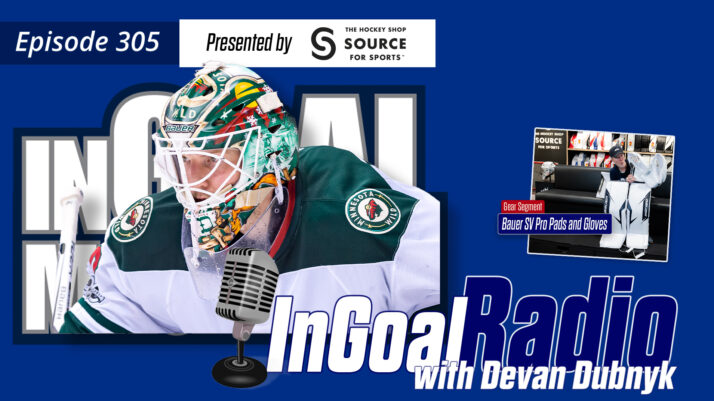
InGoal Radio Episode 305 with Devan Dubnyk

Please subscribe and leave a rating — it helps us reach more goalies!


Devan Dubnyk has launched Dubnyk Development, an in-season video coaching program serving goalies across North America. The 15-year NHL veteran credits the coaches and mentors who shaped his development for inspiring the venture, which he began after transitioning into media work and experiencing goalie parenting firsthand.
- Devan Dubnyk launched Dubnyk Development, an in-season video coaching program for goalies across North America, inspired by his experience as a goalie parent.
- Dubnyk credits specific NHL coaches and mentoring relationships as key to his development, and aims to bring that same guidance to the next generation.
- Joey Daccord, fresh off a World Championship gold medal, shares advice on managing a quick regroup rush attack in the Pro Reads segment.
- Goalies benefit from a true offseason break, with Carey Price's approach used as a model for rest and alternate activities.
- The new Bauer SV Pro line merges features from the Supreme and Vapor lines, offering a second price-point option with several top-level technologies.
Episode 305 of the InGoal Radio Podcast, presented by The Hockey Shop Source for Sports, features a fun and advice filled interview with 15-year NHL veteran Devan Dubnyk.
Feature Interview
presented by NHL Sense Arena
In the feature interview presented by NHL Sense Arena, Dubnyk catches us up on his post playing days transition to media work, including sharing some fantastic breakdowns from the Stanley Cup Playoffs, as well as life as a goalie parent and how it’s fuelled a new venture coaching goalies called Dubnyk Development. Dubnyk shares insights into his own development path in the NHL, and the coaches and philosophies that shaped it, as well as the importance of good mentors, and explains how he plans to being that to goalies all over North America with this new in-season video coaching program.
Parent Segment
presented by Stop It Goaltending U
In the Parent Segment, presented by Stop It Goaltending U the App, we dig into the importance of goalies taking a break in the offseason, borrowing advice from Carey Price, and sharing alternate activities.
Pro Reads
presented by Vizual EdgeWe also review this week’s Pro Reads, presented by Vizual Edge, which features new World Championship gold medal winner Joey Daccord with excellent advice on managing a quick regroup rush attack.
Weekly Gear Segment
presented by The Hockey Shop Source for SportsAnd in our weekly gear segment, we go to The Hockey Shop Source for Sports to for a deep dive on the updated features in the new Bauer SV Pro line, a second price point option that combines the best of the Supreme and Vapor lines and includes several top-level features.
Episode Transcript
Intro
It's amazing. It's amazing. Hutch isn't happy, but I started the three two one on the recording. And just like two weeks ago and like five weeks before that when I mentioned it, Hutch has to get the last word in, and I expect that from Woody, but not from our dad. It's InGoal Radio Podcast presented by The Hockey Shop Source for Sports Langley, thehockeyshop.com.
Hutch, what would you like to talk about? Is there anything he's wrapping a towel on it. And and Woody's now picked up on it. That that Hutch gets this little last word in. Isn't it great, Woody, that somebody else is getting heat?
I'm normally the one that always puts my well, my foot in my mouth. Basically, I never take my foot out of my mouth and never stop talking at the worst times, but this is yeah. It's hey, listen. It's just nice to have somebody else take the heat for a change.
Yeah. I think I think it's great. And Hutch blamed me today. He's like, you jump the gun with your countdown. Like, the countdown starts when the countdown starts.
That that's what happens.
And then We he has a good time here on the InGoal Radio Podcast.
We do. And and he's gonna have to listen to it like 16 times when he edits this thing together. We've got a Stanley Cup final set, and the matchup in goal is the exact same as we had a year ago. Just like Chris Osgood and Marc Andre Fleury, the last time two teams went toe to toe, Stuart Skinner's gonna try and reverse the script from a a season ago. And what a what a wild ride.
He he's topped what he went through last year on his way to the Stanley Cup final, Woody.
Yeah. And you know what? Funny because Dubnyk gets into this in our feature interview, Devin Dubnyk, because he's been doing some breakdown work with the Edmonton Oilers and Oilers Nation. So he's on breaking down video and doing some stuff postgame with them and and pregame as well. And at the end of the day, Stuart Skinner lost his net because the Edmonton Oilers were playing a brand of hockey that had no chance, no chance of winning in the playoffs.
It didn't look like the brand of hockey they played defensively to get to the cup final. Last year, they were giving up way too much, especially off the rush. And so he loses his job. He gets that spotlight. But in the meantime, they rediscovered their game.
And I could make an argument. We've talked about it here before that, like, there's something about Calvin Pickard and the way this team battles for him, and it's probably because of how much he battles for them where they rediscovered that game. They got back to it in that series. And then Pickard gets hurt and Skinner comes in. And for the most part, there's been some blips, but for the most part, they've kept that game intact.
And if they can on a nightly basis, they absolutely have a chance of winning the Stanley Cup. Now when I talk about that game, like, that is not at all to dismiss Stuart Skinner's performance. Since coming back in against Vegas, he leads the National Hockey League in goal saved above expected in the playoffs. He is on a heater. But what they've done defensively is not give up the types of chances that traditionally have plagued him statistics, and that's rush.
High danger off the rush since game four against Vegas, and we talked about this, Daren, after your series ended. Games four and five, they gave up nothing. They have given up going into last night's elimination game, I didn't pull the numbers up this morning from last night, but going into that game, there was you had a had a six game sample. They had given up 10 high danger chances off the rush in six games, and six of them came in game one against Dallas, and we saw what happened with that score. So they've got a formula.
The other team plays a role in this, but Vegas and Dallas were two elite rush teams. Florida is as well. Quick transition. But if they can continue that formula defensively and keep it in zone where Skinner's at his best. In other words, hey, novel concept.
Let's play to the strengths of our goaltender let rather than giving up a bunch of chances that target his relative weaknesses. I absolutely could see this going the other way. So it's gonna be a fascinating series. And Stuart Skinner, we can me, technically, tactically, we can break down all this stuff and all the scoring chances and everything. At the end of the day, the mental strength, the focus, the spotlight that he was under, having lost the net, and to come back and play the way he did to get back to his foundation, the work that Dustin Tokarski must have put in to get him back over his knees and in control the way he's been for the most part since coming back, not chasing nearly as much as he was early in the playoffs.
Like, everybody deserves a ton of credit. It's a really great story, and it's gonna make a really great storyline in the cup final.
Is the overall defensive environment better, not just off the rush?
Overall, yes. But they're still giving up high like, every game team gives up high danger because the other team's really good by this point too. All the high danger stuff in zone, he is handling, like, master class stuff. So it's not always pretty. Like, there's times he's gotta go outside of the technique.
There's physical limitations that'll leave him, you know, sprawled and splayed, but he's really doing a nice job of sort of picking his spots on those. There was a play against Dallas that I was asked to break down on video for a segment I do. It was a backdoor pass from the bottom of the right circle to Colin Blackwell, and he squared up on the guy at the bottom of the right circle who was on his forehand in a strong shooting position. And he squared up to the point where both skates were outside the lines, outside the lanes of his post. So that backdoor tap in is a one timer, I don't think he can get there.
There's a middle guy too. He's got a defenseman and two threats, but he squares up. And the pass goes through, but the defenseman gets a piece of it with his stick, so Blackwell has to catch it on his backhand and pull it to his forehand before he shoots. There's no panic. Skinner doesn't dive across head first, he doesn't sprawl or splay, he rotates, he pushes, he goes right into his post, he seals, and he makes a blocker save on a tough chance.
So that is understanding to me. And we've done this in ProReads all the time, guys. A goalie being like, hey. I know, and I'm sure Skinner's aware there's a backdoor opportunities there, and that he's kinda sold out on the shooter a little bit positioning wise, but that's the one he can't give up. If he cheats backdoor and that guy short sides him high or shoots it under his blocker arm because he's not square on him, that's the one that gets the media talking, that gets the bench deflated, that has the coaches rolling their eyes.
That's the one I can't give up. I'm gonna trust my guy to take care of his job. He did just enough by getting a stick on it to force Blackwell, and I'm not gonna dive across. Like, to me, it was a really like, I'm putting this is why we do ProReads. I shouldn't be putting thoughts in Stuart Skinner's brain or or telling you how he broke it down, but that's what I saw.
And to me, shows a lot of trust in the environment around him that and and then once that high danger chas chance materializes, he sticks with his structure. He didn't abandon it prematurely and dive because if he does dive across, Blackwall's got enough time to easily roof it over top of him if he's just down there with, like, a paddle or a pad.
Hutch, is is splay a new term or am I just noticing it in the last couple of weeks?
Oh, gosh. I don't know. I've heard it from Woody so many times.
It's how Woody does goaltending.
Maybe it's my grumpy hat, but I but I completely agree with everything that Woody just said in that analysis of that. And yet I think it's a great illustration of how ridiculous some people other people can be in an analysis of a situation. Because if that had been caught cleanly and had gone in with Skinner going across with such precision and control, the rest of the world would have said, well, you can't be a goalie school goalie. You gotta find a way. And if he had dove across and it had gone in, everybody would have said, well, look at him.
He's doing everything he can to battle. He had no chance. And so if you try and play with good technique and you make the save, you're praised. And if you don't, there's a problem. And I hate that so many things get broken down that way.
Again, I agree completely with what you said, Woody, but it just highlights for me a whole bunch of stuff in the analysis world that drives me nuts.
This is this we're we're setting up our feature interview so well because we spend a a bunch of time at the beginning talking to Devin Dubnyk about this because he's doing this breakdown role, and it was really informative. Daren, the go game against Vegas, the goal was zero point four seconds left. Dubnyk does a great breakdown of it. You're gonna it's it's good stuff. It's, you know, really, it's not just the goalie union putting on the goalie union hat and defending the goalies.
It's complete analysis of everything that goes into a play like that, and it's not just about the guys wearing the big pads.
Hutch, are your socks up to your knees? Did you just come off spraying the driveway? Did you just tell somebody to get off your lawn? You are grumpy today.
Yeah. But he agreed with He agreed with me, Daren. So let's take it.
I'm grumpy with the rest of the world. I'm the old man.
Yeah. I'm Bob. Like, I think Bob's a Hall of Famer anyway. Yes. Yes.
But three straight Stanley Cup finals and the potential of back to backs, we're talking about next level elite. So his his first Vezina was in 2013. And Wow. He's in the Stanley Cup final in 2025. That is a pretty extensive career and a great run.
And think about the different elements in the different stages and the different phases. Think about the durability. Think about the fact that like, I'm gonna don't wanna jinx it knocking on wood here, but like there have not been a lot of injuries here as he gets into his mid thirties. And earlier in his career, there was and we've got a great story actually, this is a good reminder, maybe we'll put it in the show, no touch. Maybe I'll I'll put it up on social as sort of how he rebuilt the way he trains using with a Finnish coach who also, like, has a martial arts background.
And so the longevity to me is one of the remarkable part. You're right. His ability to raise his game in these moments, you know, I mean, statistically, he's been outplayed by backups for, I think, two of the past three years, you know, and Stolarz and even Driedger for a while. Like, there, you know, there were these times where but he was the workhorse, and he was putting in all the minutes, he stayed healthy, and his ability to sort of make these incredible momentum changing saves, like the one on Stankoven. The backdoor fully extended splits, but has the blocker up and gets it with the corner of the blocker.
Like, I looked at that and that's the one thing that's this
is that five times.
It was so good. It was so good. I didn't I watched it live. I was at a a team gathering for the my daughter's volleyball final weekend at Nationals, and so I couldn't tell. I'm like, there's no way he got that.
There's no it wasn't till we got back to the hotel and sort of watched the replays. I'm like, oh my god, he got that.
I thought I hit his pad. And then when I saw his blocking, I'm like
that's like, so he has that ability. Right? Like, again, the underlying numbers on his playoff run, kinda like Skinner's. Like, it didn't start great, but now he's right up there with Stu in the last like, you know, he in as the moments get bigger, but you have to have a team in front of you that allows you to sort of play with that confidence. And when they do break down, that's where he's at his best.
They don't do it often. They can dominate for long periods of time, but when they have a breakdown, he makes these spectacular saves. And to me, one of the things that you have to be very cognizant of, and I think last year's playoffs will make them cognizant of it, you better be attent paying attention to your pre scout. You better, when you get those opportunities, execute and bury the way you're being told to. Edmonton didn't do it.
Bob was out of this world the first three games of last year's playoff run. Part of it was when the Oilers got one on one chances, they tried to beat him along the ice. I know that frustrated the people that wrote their pre scout because it's like, you're not beating this guy. Maybe every once in a while, get him to open up and and tuck it back in and it might rattle around and go through the legs, but you're not beating this guy along the ice. Like, so many people talk about the, when you look at his goal chart, the you know, there's more goals in the top corner, so shoot at the top corners.
Like, not on open looks. He's as patient as anyone. The reason all those goals are in the top corner is because you can have lateral back door tap ins. And if you don't get it in the top corner, it's not going in. Hello, Logan Stankoven.
Like, that had to be in the pre scout. That backdoor chance cannot be in the bottom half of the net. Most goalies is just get it above the pad. Bob, it can't be just above the pad. It's gotta be in the top half because he's always gonna build coverage with his gloves, whether it's dropping a blocker as he did there or having the glove over top the other way.
He is a he is he is a physical specimen. The way he takes care of himself, the work he does, there's been a lot of attention on that, doing the Olympic lifting on game days and all that stuff. He is just he's remarkable, and he's fun to watch, and it's gonna be a great Stanley Cup final.
I love the fact that he won a Vezina at 24, and he might be enjoying the most impressive run for a goaltender in his thirties with a presence trophy at 33 and then Stanley Cup final appearances at 34, 35, and 36. That's crazy good at the the stage of his career at that age.
It is do not pass go, do not collect $200, go straight to the Hockey Hall of Fame as soon as you retire. It just might be that we have to wait a while. Not because he's not a first ballot hall of famer, but because he looks like he's having fun. He looks like he could play forever.
He's huge too. Like, just he he's a big dude out there, and I don't know how he covers or seems to cover that much space. He's he's six two. He's one eighty. I I went back and checked that because he looks massive out there.
And I don't know what makes somebody look bigger than than they are because everything's checked. No. Everything's checked and it's all within the rules. So it just Sure. Some people present themselves looking bigger, and I don't know whether that's There's
a great hey. There's a great story there too.
Lots of tricks.
Wrote it I wrote it years ago when he was in Columbus because they came through town in Vancouver. I have to dig this one up. I wrote it for InGoal. And they came through Vancouver, and I was like, the one in the locker room, and I'm like, where the hell is the rest of him? Because he wasn't always this lean and skinny, Daren.
Like, he was a big muscle like, there was a there was a point where he changed his training and got really kind of, for lack of a better term, jacked. Like, he was jacked and he was ripped through the shoulders and, like, he he looked like a weight lifter. And it wasn't until he sort of changed. I think he lost I remember writing this story. This is top of my head.
I don't have it in front of me. Something like eighteen pounds?
Yeah. He was two hundred.
But it was 18 pounds of muscle.
Feel like it's more.
Yeah. It was all muscle. Like, he lost all muscle on purpose. Like I said, changed the way he trained. I think that's part of the story.
Cat Silverman, Catherine Silverman wrote it for us a couple of years ago, and we we sort of bring it back to the spotlight because it really was. She did a great job. It was the definitive sort of version of this, you know, rebuilding of Bob's training and and and body with the the with the Finnish coaches. We're gonna have to put that in the spotlight again now again because it is it is remarkable.
And remember where he was drafted? Remember the which round he was drafted in?
Was it a round that doesn't exist anymore by the Philadelphia Flyers?
No. No. It it's a round that still exists. Zero.
Oh, right. Undrafted. Wasn't drafted. Right.
That's very Undrafted. Love it. And all of this happening.
Well, and so and that's the thing, like, he's also a great case study in the evolution. Right? Like, look at him in Philadelphia. Like, go back and look at him. We all saw this incredible explosive power.
Like, you know, he would just move with so much power, but and it was under control, but sometimes it was too much. And look at I remember I remember when he got to Columbus and he changed his Who did they stance
keep in Philadelphia instead? Was it
did they sign Bryz? Or was that Yeah.
I think it was Bryz.
It might have been Briz. And so you go back and look at Bob's Philadelphia days, and his hands are up by his ears, up by his shoulders, his elbows are pinned back. Is locked in low and wide and loaded. I think Hutch Hutch might have even photographed him at one point while he was still with the Flyers at Rogers Arena.
Early. Yep.
And then I I walk into the Columbus Blue Jackets locker room the next year, I can see the changes in his game, and I wanna talk to him about it. And this Columbus, Todd Sharrock, the c longtime Columbus Blue Jackets public relations director, he's moved up up the chain in that role. I don't think he's he's necessarily still the day to day guy there, but he was at the time. And I remember him telling me, like, yeah. Absolutely.
Go for it, but good luck. Because, like, there wasn't a lot of English spoken at the time. And understanding the changes he was trying to make, seeing them walking into that locker room and spending ten to fifteen minutes. And it's me and Sergei Bobrovsky on our knees in the visiting room at Rogers Arena sort of using demonstrations to get through the language barrier on how he's changed his stance, his hand position, having them out in front of him instead of pulled back and his elbows pulled back. It's one of my favorite memories because afterwards, I remember Todd being like, oh, like, woah.
Okay. Like, you know, like, good luck. You're welcome to talk to him. He he's a great guy, but he's probably not gonna say much to, like, good ten, fifteen minutes of me and him basically doing goaltending on our knees, like two kids playing mini sticks to help me understand, in his words, as best we could, the evolution of his game from Philadelphia to Columbus. So here he is still evolving, still changing, and still succeeding at the highest levels.
It's it's such a good story.
His partner's rookie year? Brian Boucher.
That's what I thought.
Gear
Yep. That's and and then it was Bryzgalov of the next year, and Bryzgalov played the majority of the games. Let's get into our Gear Segment brought to you by The Hockey Shop Source for Sports Langley, thehockeyshop.com. They got a lot of stuff happening right now. This is a busy, busy month now that we're in
Yeah. There's a ton of new gear coming in. We're gonna get into another new product today, the Bauer SV Pro. What does that stand for? You saw the graphic on Logan Thompson.
Everyone was like, oh, look at that new Bauer graphic. It's actually a graphic for their second price point pad, the SV Pro, s being Supreme, v being Vapor. It's a combination of the best of two in a second price point, so can't wait to get in to that with Cam. He's got that in store. We did the Flylite last week.
There's a Flylite stick. Cam has a Source for Sports exclusive Flylite stick with a trigger grip, Daren, that you can buy just from the Hockey Shop. There's a Flylite chest protector, and there's even more coming. So a ton of new Bauer stuff. Next week and the week after, we're gonna start to see the launch of the CCM lines, the EFlex seven, and their new lines at the top level and down below it.
There's so much stuff coming in. And, of course, if you want to try it and you ever wanted to come say hi to Hutch and Woody in Vancouver, TendiFest, June 14, come on over and try all this new gear. Take it on the ice. See what you like best before you buy. It's the ultimate goalie day, demo day.
Try before you buy sample example, June 14. Make sure you check out all the social media for The Hockey Shop. If you wanna register, get some of the information about it, we'll be there. Make sure you come say hi to us. It's a great day and great savings as well at The Hockey Shop because as all this new gear comes in, as always, discounts on the previous generation.
Go over to Cam and Woodley over at the Hockey Shop with our Gear Segment talking about the new Bauer line with the SV Pro.
Woah. NHL graphics, Logan Thompson special debuted in the Stanley Cup playoffs, but the second price point, SV Pro, we have got all kinds of new options with Bauer's new second price point line in the vapor family, the SV Pro. You've seen the graphics on Logan Thompson. I may be teasing one of the options we'll get to as I close this glove. First time ever available in the second price point. Oh, Ken, we've got a lot to get into here.
Welcome back to The Hockey Shop Source for Sports. We're gonna go through this entire line. It might take a while because there are ton of new features beyond a graphic that got NHL approval and NHL support being worn by Logan Thompson.
Yes. He is currently wearing
He is.
Absolutely. This is this
is SV Pro. He's not wearing the second price point pad. No. But he is wearing the grab.
No. As as Bauer tends to do, you know, certain things get skinned as other things and, you know, mismatch. But But it may not be
in the NHL as a pad, as a product at the second price point, but this baby feels like it could play at some really high levels. This is not scaled down as much as we've seen in the past with other brands.
So considering the trend of, like, continuing to upgrade what we'll call, like, the mid level price point and also
adding I would say Bauer led the way on.
Yes. But adding the word pros to mid level price point. Don't give me a better yeah. Said our piece.
At least they put a new name in front
of it. Pro Oh, Here we go. Here start with. Can you tell me what SV Pro stands for? I don't.
I can't. Supreme Vapor Pro. So now it's the commingling of both the vapor and the supreme line together now, which is something because we don't see a mid level shadow pad anymore. They've just have their one line. However, some kind of new features that also apply to both goalies now.
Ability to obviously order this custom. This is nothing new. We saw this preview in the back. New custom options now.
But new custom options. So before custom, you were basically just picking your colors. You could add your name, choose your size, but no additional plus sizing. That was it. Now now no additional plus sizing, so you still are stuck in the small, medium, large.
Well, which is plus one and a half
as you informed us.
Yes.
Stiff core option.
So I can, in a second price point pad, order a stiffer core.
Correct. So if you did like, say, that M5 pro pad when it was around and you prefer preferring something a little bit on the stiffer side, the ability to get that stiffer core in the pad in this mid level price. So And
you can see, like, it is Stock. Stock. It's a flexible pad.
We're still following the vapor line in terms of flexibility. CoreX composite is still in that upper thigh, so that's still providing some of that long term rigidity. Traditional cut and sew graphics here, so we're not getting that same, like, rebound blue skin or anything like that. However, moving to the back of the pad, that's where now we get back to the similarities between this and say, like, a Fly Light pad, for example. Alright.
[crosstalk] Let's fly at it. Extended knee cradle. We saw this on the fly light. Same general premise here. You still got that grip knee as well.
Stability flex. So it's Stability flex. That's what you give to it. Gonna ask them to give to Return of the tabs for the control strap. So, again, something that was deleted off of last year's x five pro.
It's back. It's back. And you can stick a professor strap in. Correct. So something that I really, really do like, and that's a good adjustability feature in terms of for being able to dial in your pad.
Opening it up.
I already opened mine. It's TuneFit Plus.
Yeah. You see that? So if you saw that new slider that's available on the Flylight or you like tune fit 2.0, you've got options. Remember It's removable. Makes it removable so you do have the ability to switch it out to whatever you like.
But num fit plus is not. That's correct. Not as big of a tab here. However, that slider strap will still fit onto this tab.
Did you try it?
Yes. Wow. It will work. Good for you.
Again, much like the FlyLites, you've got the return also of stock bootstrap.
Being able to add the bootstrap doesn't with the bootstrap, but
you can easy you don't have to custom order the ability to add it in. Correct. You have what else do you have, Cam? I'm looking.
Yes. So some of the comboing again of Supreme and Vapor, Supreme style toe bridge. Right. That's that thicker HD Foam toe bridge as opposed to the flap that we'd find just on the Vapor. Again, a little bit more options in terms of for where you actually wanna place your laces and your bungees, being able to fully offset it completely if you like.
The bridge itself is already stock offset, but, again, if you wanna center it a little bit more, you do have that option stock. That flat vapor style boot, very flat. Let me see and have seen, very flexible too. And your bungee toe ties with that guy. Alright.
What other custom options do I have here? So if I order custom on this, I can choose the core. I can stiffen it up, which probably give you
a little more durability. Potentially. I mean, that depends on exactly what kind of style of pad you're looking for. That's more of a softer stiff conversation than it
is durability. I can custom order color. Yes. You can. This graphic.
And you can custom order. I can get my name on it. Yes. Those are my options.
And also choose if you would like the stock SV Pro Glove, which is like a 590 or oh, I teased this earlier. We're into it. SV 90, a 580 in a min level price point.
First time ever for Bauer, they're bringing the 580. They're what do they call it? Vapor 90? Vapor 90. Into the second price point.
That's correct. So did segue into
Well, I'd I'd like to talk about the gloves, but I kinda feel like I missed the the what I don't know what it is. It sorta looks like it's quilted. I feel like it's the Bounty quicker, thicker, picker upper here.
That textured slide surface? Textured slide surface. Well, it's not that much. Even the slide surface. That's just more because really, have slide contact.
You should be sliding on here.
And you're gonna be lining on the cap plate and the near
plate, which is Offset for that exact reason. This is just a little less friction, I'm guessing, a little less contact point with the ice.
So if anything, you know, depending on how you're sliding too with having that little bit more texture there, it could add potentially as a little bit of a stopper too as well. Like, I don't know. Let's throw out some ideas. You know what? You in the comment section tell you what.
We're gonna add some overall feedback. What do you think of this? Do you think it's gonna make much of a difference? Do you think it will help with your slide? Do you think it will help you a bit of a stopper?
Let us know below. Because, of course, you do have a calf pillow here. And so the weight of your calf, and they've offset this, so the pressure is on there, which is a hard surface. Pressure is on here, which is a harder surface, and that's where your sliding comes from.
But we we just found this interesting, and Cam didn't have a call out for it, so we're just calling it the benefit because they're thicker picker upper.
There we go. Gloves. Oh, you're already holding the SV 90. So We already talked about it.
Yes. 580 break.
Correct. Available stock. Same matching graphics and color patterns that you'd find off the wall. So if I cast
them where I choose between the two, you've actually got this in stock as a
stock option as well. Correct. Yeah. Similar story, if you like your X5 Pro in terms of for your catcher, you're gonna like the SV pro stock. Same five ninety style break, same double t, same overall feel.
Single t in the Vapor 90, the s v 90. You can see the difference in the way the pocket sort of forms there similar to what we saw in the Fly Light. That's correct. Yeah. So, basically, your major differences, you're not gonna see their catch light material.
You're not gonna see their same pour on material in the glove itself. That's starting to negate a couple price points in terms of difference between that and what would be the fly light and the top price point. Feels a
little thicker too in the pole.
Yeah. That said, even though we are, like, reducing, you know, technical foams, I think it feels thicker than last year for sure. Okay. Anecdotally. Blocker.
If you like your X5 pro blocker, you're gonna love the brand new SV Pro blocker that's pretty much the exact same thing. Okay. Simple. Yes. Updated back end materials a little bit more open cuff that we noticed in the actual fly light as well.
We've talked about that. Great overall balance, that same tighter feel. Yeah. TTC foam in the fingers. So you get a little bit of an upgrade?
Oh, there's foam on the back of the fingers. Yeah. You that. Hey. Look at you.
You forgot the callouts earlier.
I don't know. They're calling it on now. You know? That's a job is.
But that's not all, folks.
Oh, yeah? We have more options for you. So brand new. We'll start with the glove first. This is intermediate.
This is SV 90. So Intermediate Vapor 980 style. Again, never before up. Never before offered. We now have this available.
Stock off the wall. You can order custom as well in the SV We got little hands. Yes. Yes. SV intermediate available to order custom.
Can get that glove as well. Okay. What else do we got back? Oh, one more. One more surprise.
Brand new for this year.
This might fit you, Cam. SV Pro junior.
So if you're looking for more of an upgraded pad as opposed to say the Bauer GSX, if you're something a little bit different, not available custom, but what you are getting, you are getting that curve x composite in the core and that upper fiber portion of the pads. A bit of a stiffer pad, change up of the actual strapping system itself, so it's still following that intermediate and senior level pad as well. They're getting a bit of upgrade in overall performance. No vapor 90 option here. Keep that in mind.
So you're still gonna have the stock SP Pro glove in that junior sizing. However,
nice little can fit into an intermediate.
Yes. A nice little upgrade in terms of for juniors if they're looking for a more of a performance based pad. Alright. Okay. So there are a ton
of options we just threw at you with the new SV Pro line, Supreme Vapor Pro, second price point with lots of pro features. If they have any questions about the changes in the line or anything like that, where do they get you, Cab?
(604) 589-8299 or 1-800-567-7790 or check us out at thehockeyshop.com.
Different colors, different sizes, everything in stock, the ability to like we said, he's gonna have the s v 90 glove in stock on the rack. You can mix and match. Just give him and his crew a shout here at The Hockey Shop if you got any more questions or to order.
Different name, SV pro. I like the the combination of of the s and v, and looking forward to more happening at Tandy Fest. It just it gives me goosebumps knowing that that's just around the corner. Let's get into our Stop It Goaltending U, the app parent segment. Hutch, now I give you the floor.
Not quite.
Oh, I knew I knew that you do the read, but I was trying to set him up to to do something. And once again, when I want him to talk, he doesn't talk. When he when he talks and I need him to be quiet, he's chatting up a storm.
Well, before we get to the Parent segment, which has quickly become one of our most popular segments here on the InGoal Radio Podcast, thanks to the great work of David Hutchison. Let me talk to you about the people that bring it to you. Another great goalie parent, Brian Daccord of Stop It Goaltending. More than twenty five years of experience. He has goalie coach, Boston Bruins, goalie scout, Toronto Maple Leaf, director of goaltending with the Arizona Coyotes.
He's done it all, currently coaching at Boston University. So what do you get when you purchase, buy into the Stop It Goaltending U, the app? You get all of that experience rolled into easily digestible clips that are delivered to your phone or mobile device on a daily basis. Each week, you get five new primers. This week, the primer, so quick one minute videos are on mental toughness.
There'll be a a breakdown. Crease management this week is the goalie one zero one session. A b c and d, what do those stand for? Aggressive, base, conservative, and defensive. Those are four different positioning elements that you can choose, and they break it all down in terms of how to manage your depth in the crease.
They've got a video. Jake Oettinger, Stuart Skinner, Goalie IQ, looking how they play different situations differently. It's kinda like their version of ProReads with them and their coaches that stop at analyzing instead of the goalies themselves. And last but certainly not least, they've really stepped up their game by adding weekly drills to the app. This week, it's a hard rim to pass out.
So a simple drill that you can take into your practices this summer to get better. All of that at the Stop It Goaltending U, the app this week, plus, I'm a little biased here, but maybe the best part, you get a subscription to InGoal Magazine when you buy a subscription to Stop It Goaltending U, the app. You get all our great content with our weekly ProReads, drills, articles. We've got one up this week on Calvin Pickard. Five things that will help you play better when you're not playing much.
Great advice from Pickard, all part of our content and all included when you get a subscription to Stop It Goaltending U, the app.
Parent Playbook
Hutch, how are you gonna help out mom and dads this week?
Well, I might have been grumpy earlier, Daren, but I'm not grumpy when I'm doing the parent segment, especially today because it's actually a question from a young goaltender. And there's nothing more that I enjoy than teaching and coaching and hanging out with young people who want to learn. And so we got this question from a young goaltender, young listener, young reader. Is it okay to take time off in the summer? And it might be a parent segment, but answering a young goaltender's question, I think, is great for parents as well.
I actually sensed in this question reading between the lines that there might have been a little conflict between mom, dad, and son over this question. I don't actually even know what direction. Maybe he wanted to play more and mom and dad didn't want him to or maybe the other way around, but I felt like there was a discord between son and parents. And the question was, is it okay to take time off in the summer? And I think we've touched on this before.
Maybe we haven't answered it exactly, guys. But, again, since it's from a young listener, I thought I would answer it directly. Yes. We could probably end it right there. I was tempted to end it right there because Daren doesn't want me talking too much.
But, of course,
I'll do when you talk. It's just when I when I'm
Daren, like just stop interrupting, please. Three two one's already happened.
Yeah. Yeah. Apologize.
Yes. It is okay to take time off. In fact, it is essential. No matter how much you love hockey, you need a break. No matter how much you feel you might fall behind others, you won't.
You need a break. It's a mental break because even if you love every minute of hockey, you need that time to reset, to refresh, and to get even more excited about getting back on the ice. And if you're tired and need a break, that's okay too. The longer you play in the game of hockey, the longer the seasons get, the higher the pressure gets, and you need to find a way and a time to release that pressure. By the way, guys, it's completely normal to feel a little bit burnt out or stale wondering if you even want to keep playing at this time of year.
Don't worry. It's okay. Goaltenders, if you're feeling stale, it's okay. Mom and dad, if your kid doesn't seem excited about going on the ice, it's okay. If little Johnny doesn't wanna sign up for that summer skate, that's okay.
Our goal is raising happy, confident kids. So let them skip out on that stuff and do something else. Maybe even something that isn't competitive and is just fun. It's a mental break. It's also a physical break.
The game is hard on your body. And while you're young and growing, it's hard in one way. And when you're older and you've gone through all those repetitions of butterflies and RVHs, it's taking its toll in another way. But we all need a break to let our body heal. Elite athletes in all sports at all levels take breaks.
The fancy speak is to periodize your training. Of course, it means a heck of a lot more than taking breaks, but it does acknowledge that you need recovery time. And that recovery time, by the way, does not mean sitting on the couch and watching TV or flipping through your phone. By all means, take a week or two of complete downtime. It's not gonna harm you.
But even when you take a break, it's good to be active. Ride your bike. Go for a hike. We're not scheduling a different workout here that's gonna feel like work, but do some active things that are fun, refreshing, relaxing, still moving. Put the phone down and get outside.
How long should you take off is the question that I actually got in response when I gave my answer via email to this listener. Honestly, however long you need and maybe even a little bit longer. Woody's told the story before, of course, of Carey Price telling us that he puts the gear away until August. That for a professional goaltender who plays deep into the playoffs is still taking a good two months away from the ice. And even if you love goaltending and think you can play all summer long, please don't.
I can't tell you how long that you should be taking off, but I can promise you that if you go twelve months a year hard, you will eventually go backwards in your development. Your body will feel it, your mind will feel it. And again, as Olympic athletes from all different sports can attest, you will develop more quickly if you give your mind and your body some time to rest. So take some time off. Okay, Daren.
You can speak now.
I'm just gonna say, this person hasn't listened for the entire time of this podcast because we've we've mentioned it several times. You you you do need breaks. You need a you need a chance to miss the game. Right?
That's what Carey used to talk about. That's funny. I was looking trying to see if I could find the quote as soon as Hutch wanted his answers, and I'm glad he mentioned it. Like, one of the greatest goaltenders of his generation, if not the, and did not touch the ice. The gear went into the back of the garage until August 1, and that is late by today's standards at the National Hockey League level.
And he always talked about not just resting the body because Hutch is right. Like, your body, if you do this twelve months a year, the human body was not designed. It was not designed to for the hips to internally rotate into a butterfly. And if you do it nonstop, you will develop repetition patterns that that lead to injury. There's a better chance of it at least, even if you're doing all the work you should be doing, the James Wenland five damn things every time before you get on the ice.
You're still gonna run into problems if you never give your body a chance to rest. But also the passion and the drive, like, wanting to put the pads back on. Carey really felt that that fueled him not not being in them until August 1. So and last time I checked, I had a pretty damn good career. So it's important to try other things.
It's important to get away from the game. It's something we talk about a lot, and I I I appreciate Hutch responding to this young goaltender because I think it's a message that both goalies and parents need to hear, you know, more than on an annual basis. Every time we get to this time of year and there's pressure to compete with and keep up with all the other kids that aren't taking a break, I agree. You'll be better off in the long run if you take a well timed break.
I just wanna underline that I made the point that it's okay if you're not enjoying it right now. Because when we say what what Daren said is quite right, you need some time to miss the game. But I think for a lot of people that sort of implies that you want to play all the time, take some time off so you're really driven to get back on the ice and you're just chomping at the bit. But it's also normal to come off a season and say, I'm done for a while. Mom and dad, if your kid doesn't wanna get on the ice, don't look at them and think, oh, what's wrong?
What have I done wrong? What should I be doing differently? Let them have the break. It's okay. There's all sorts of different levels of loving hockey and it doesn't have to be twelve months a year and you don't all have to be driven like an elite Olympic athlete.
Just take some time and and if they come back, they come back.
You should have a first skate of the year every year, which means you've taken a little bit of a break, and then you sort of start over. Vizual Edge brings us ProReads.
Yeah. This
believe this is you that sets this up. Is it not?
Not exactly usually.
Really? Ain't that wrong?
Yeah. Yeah. Okay. I
feel like I'm didn't wanna get
a new license price too.
I feel like I've been set up to be the bad guy here, but speaking of guys who have embraced bad guy roles but are really great goaltenders, Vizual Edge sent us a little note this week. Jordan Binnington, remember him? Four nations won the championship. Do you know what he was doing to get ready for those games for Canada? He was on I don't know if it was a computer or an iPod, but he was on the Vizual Edge system as part of his preparation, and he sent a nice little note along that we wanted to pass along.
Vizual Edge, said Binnington, has added a quality element to my preparation as a goaltender. I use the game day drills every game before heading to the rink. It's a combination of recognition, reaction, and focus that activates my brain and eyes to feel ready for what's to come. That is a hell of an endorsement by a hell of a goalie in Jordan Binnington, and the fact that he was using it on a stage as bright and big as the four nations heading into that gold medal game or championship game against The USA and seeing him, you know, seeing the scores on the knowing that he was on that using it, just another goaltender at the highest level talking about how Vizual Edge helps them see the game. Well, guess what?
Over at the ProReads every week, we wanna help you read the game better. Take all that vision that you're improving with Vizual Edge and apply it to processing. And this week's guest is Joey Daccord, who does a great job in these formats, not just because of how he sees and reads the game, but with his honesty. And so, guys, what's what's your if your team turns the puck over at the blue line and you have a really quick regroup, and we see it in the NHL, it is all about regroups fast, and bam, the other team's coming in with an odd net numbers and your defenseman are down near the face off circles as they come in with speed, What's your initial thought as the goaltender from a depth management position? Are you thinking shot as that guy backs your isn't that the worst thing when you're when a guy's got your defenseman flat footed and he's backing up onto your lap?
I'm thinking shot every time. Well, so was Joey. So he took a little extra ice. Well, guess what? It wasn't a shot.
So he walked us through that decision and he was honest. Like, hey, I probably should have been deeper here on the past, but here's what I read. Here's what I saw. Here's why I was out past the edge of the blue eyes. And then he had a middle lane and a far side option for a one timer.
And so you gotta honor the middle lane because it could go right to him for a quick shot, both one t options. Another thing that Joey identifies, making sure you check what hand they are. It goes across to the far side, and this is where we get into depth or angle over depth. And so Joey breaks down why his second push isn't out towards the shooting threat, but back towards his post, and he walks us through the video of why that decision to pursue angle ahead of depth gave him a chance to make a very difficult save. Probably still looked really good, but even easier.
It looked looked even easier than it was, and Joey gets into all the minutiae. I'm just giving you the surface level breakdown in this week's ProReads presented by Vizual Edge. You can check it out, of course, if you're a subscriber to InGoal Magazine, ingoalmag.com. You can check out Joey's ProReads as well as 275 plus other video breakdowns with NHL goalies walking through footage, explaining their decision making process. There is no better way to learn how to read the game than the InGoal ProReads proudly presented by our friends at Vizual Edge.
We're all very excited about this week's, feature interview brought to us by NHL Sense Arena. And, before we get to Devin Dubnyk and, setting that up, Hutch, just a word on NHL Sense Arena.
Oh, you didn't want Woody to set this one up?
I've been in the I've been in Sense Arena a lot lately, so I can speak to it.
Hey. After your young goaltender has taken a break, after they've taken some time to go outside and have some fun, part of their summer preparation could be NHL Sense Arena. It's a great way to work on your goaltending skills when you don't have access to the ice, when you just wanna get involved a little bit, work on your development, but maybe you don't have a coach to guide you. If you don't have a coach to guide you, you don't have ice, you do have NHL Sense Arena's new goalie advancement program, which is a fully guided training program for goalies of all ages and skill levels. Yes, including Kevin Woodley.
It is designed to help you in three key areas. That's angles, traffic, and reading the release. Maybe you even get a chance to splay across the crease like Kevin Woodley. Each course features three difficult levels. Excuse me.
Each course features three difficulty levels tailored to age and shot speed. There's three training days per level with six to eight drills per session guided by expert insights from Brian Daccord. So this summer let NHL Sense Arena and their new goalie advancement program guide your off ice development with structured expert led training. Visit sensearena.com and use the code I g m 50 at checkout to get started today.
I am loving the shot release mastery course. So it's basically learning how to read a release. And it it is a great point about not having ice. Even if you did have a coach in ice and we know how expensive that is, are you actually gonna head out there and just watch shots go by you while you're looking at the hands or the knees or the hips? Craig Anderson
told you he did that in the National Hockey League. Right. Speaking of things we should link to.
And Craig Anderson gets at the NHL level, he can say to a coach, hey, by the way, coach, I'm not really gonna try and stop this one. I'm not gonna watch the puck. I'm gonna I'm trying to work on my reads today. Really tough to do. But within this shot
mastery yeah.
Shot mastery co program shot release mastery program, they have it the one of the segments is called ghosting. And I went through the whole thing to try and learn to be better at reading a release. And I don't know if I'm any better because I'm still me, but, like, some of the anticipation stuff, I started to pick up on the cues. And, you know, Devon Levi sits on his couch and watches these shooters all the time to sort of, again, work on tracking releases and learning how to read a release. It's been really fun.
I've really enjoyed it. I would highly recommend.
Feature Interview - Devan Dubnyk
So Devin Dubnyk. Doobie. Doobie.
This is all encompassing. We haven't caught up with Dubnyk for a while. I know he's been working on a training program called Dubnyk development. We'll have links in the show notes. And just a chance for us to catch up with him.
There's a little bit of talk about the Stanley Cup playoffs. There's a lot of talk about his career and sort of some of the different themes and stages he went through and some of the foundations that he's developed as a as a goalie at the National Hockey League level for fifteen years, ultimately where he ended up and what he thought was most important. And now his son is 11. He's coaching him. He's a goalie, and he's enjoying it so much that he decided to build out a program for other goaltenders.
So this is a chance not to we're not here to shill his program, but to talk about his philosophies and how he's planning on applying it in a way where you don't have to be in Minnesota to work with him. There's a lot of video element to this. So something exciting, something new from a guy who we've always had a great relationship with. I learned a bunch in this interview, and I think our listeners will too. Really excited to welcome back to the InGoal Radio Podcast.
Third time appearance for the man who wears the double d logo, Devin Dubnyk. It's got a new meaning now. He's been retired for a few years. We're gonna talk about Dubnyk development, a new project he's got started up. But first off, been doing a bunch of media. How are things? Catch us up in your world.
Yeah. It's been great. Didn't do didn't do in person NHL network this year. I kinda missed it. Spoke with them, and so I started to do some remote shows for them, which is fun because I can just do it from from right where I'm sitting right here.
That's NHL tonight first take. Obviously, Canadian viewers don't get that although they might during playoffs. That's the earlier show. So that's been kind of fun to get back into that and then hopefully do some live stuff again next year. And I've been working on Oilers Nation, which has been a lot of fun, and it kinda happened out of nowhere.
I started doing once a week hits on their Oilers Nation everyday show, and we were having fun with it. And I asked if I wanted to do more, and I said, absolutely. It was it was easy and it kept me in the game, and it was a lot of fun. And, so they created a new show for me called Ask Doobie, which, goes out every Wednesday if you wanna check it out on YouTube. It's been a lot of fun.
It's basically just a short question and answer. So people write in their questions, and, I record the show and give my answers to the questions. We pick the pick the good ones and the entertaining ones, and and, it's been that's been great. And then, more complete and post game, on the or there's playoff games, with the Oilers nation as well. So that's been a lot of fun too because it's, you know, it's been a long time since I've been able to really care about, you know, you care about watching and and how the players are doing stuff, but really, like, cheer for a team essentially.
So it's been fun to to kinda become a little bit of an Oilers fan while watching these games combined with the fact that that it's been a heck of a roller coaster in these playoffs for for the Oilers to to be able to follow that and have every single game have you sitting on the edge of your seat and getting the breakdown pre and post has just been a blast.
What what's the challenge from an analyst side? Because, you know, you have to be fair. You have to be honest. You have to be blunt, but you're also in the union. Right?
We don't want anybody taking away the goalie union card. How do you how do you walk that line, walk that balance when you're when you're wearing that hat? And I guess not to try and answer the question, is a lot of it just explaining to people, like, how difficult some of this stuff is and and what exactly makes it difficult? And maybe you got an example from recent days.
Well, that's exactly it. Right? It's it's it's you you have to be honest and but you're always, like, as an x player, you're always going to bat for the player first. And at some point, you do have to to be honest. If if it's not going well consistently over and over, if it's one game, you know, you gotta tee off on a guy over one game.
But but I think you nailed it where the most important thing is that it's explaining what's going on around it. Like, talking about Skinner in the first two OA games, yeah, he wasn't good. He was frantic moving around. He didn't look comfortable. Goals were going in.
Look what was happening in front of him. And even even you go to go through the games, you know, he gives up five and six goals, and it's like, okay. Let's walk through the goals here. And look what look at what happened in front of him. Which one do you want him to stop?
Of course, you want him to stop all of them. But if you're gonna if you're gonna pick one, it's like, okay. Maybe he needs to step out and square up to to Quinn Byfield walking in by himself going off the bar. Like, if now you're starting to pick at goals that that if they were goal one you know, one or two goals in a game and those goals happen, you'd never even think about, then, you know, yes, you still he still needs to find a save here and there and be a difference maker in the game. But the way the Oilers were playing at the start of the playoffs, nobody's winning.
Nobody's winning games when they're playing like that. It was it was just and watch the the evolution of the way they've played from that until, you know, really second half of that series. They've just been incredible to watch. And and then it shows. Right?
It's like, I always I don't care. There's no goalie in the world that's good enough to make a bad team good. There's just not. You can make a good team great. You cannot you can't stick anybody on a bad hockey team, especially with the creativity and the skill level of the game today.
They're gonna get scored on. It's just it's just the way it is. And so that's that's the thing. It's just being breaking it down for people. And you know what?
Even explaining what he should have done differently if that opportunity is there, but not, you know, not saying he sucks and he should be out of the net and get the other guy in and all this stuff. And it just it's it's it's the human side of it and understanding what what is the goalie seeing from their eyes in in the net and not from the TV where you can see everything around them. What you what you're actually seeing if a guy crosses in front of your eyes right as the puck comes off the stick, you don't see that puck leave the stick blade. You're behind a split second. Well, guess what?
You only got a split second. So it's probably going in the net unless you somehow made a great guess on where it was going. So all these little details, and it's fun to break down. It's fun to get talking about how he's, you know, call it goalie nerding out, but you get get you start getting rambling on it. I'm like, I don't even know if anybody wants to hear this because I I'm just going on and on about it, but people seem to enjoy it.
And and I think it's important because, you know, how many people played hockey that are hockey fans that are watching? They played hockey. How many people played goalie at any sort of high level? I mean, the number shrinks so much. So if you're able to provide this insight to people who wouldn't otherwise understand, you know, it helps everybody.
In some ways, it feels like it's it's a pro you've done ProReads with us in the past where you break down your own saves. In some ways, it feels like that. Like, all the little details that go into analyzing a play and all the things you have to worry about to be able to get to the point of seeing and reading a release broken down for other people to understand.
Yeah. So you try to dumb it down a little bit because if you and I are talking, obviously, we're gonna get into a whole lot more vocabulary and and words that that some people aren't gonna understand. So you just simplify it. But it's it's not hard when you, you know, when you break it down and you show people in slow motion and different replays, they can see it. Anybody that that you don't even need to be a hockey expert when and that's that's my job, and that's what I take pride in is is getting people to be able to see what I'm talking about on these replays and kinda go, oh, okay.
I never saw that. Never thought of that because it can run all the way back from two passes prior to to to what happened or maybe a little bump that spun somebody sideways that really kind of, like, spiraled the whole situation that ended up the puck entering the net. And that's just the fun little things. You try to find the things that that the average watcher isn't gonna have any clue about. And then you walk him through the play and say, no.
This is what happened. And at the end of the day, it's like, you don't need to be like, he should have stopped it or he shouldn't have stopped it. You're just explaining why the puck went in the net and maybe what he what he saw and maybe what he would have liked to do differently next time. But that you don't really need to have the, oh, he you know, he's gotta save that one. He's gotta have that or or whatever.
You're just explaining what happened. And, you know, I I I was on him a little bit on the, after the, when he came back in, after Pickard was hurt, when they got scored on with point four seconds left. And it wasn't really about his play. It was just kinda like, okay. At some point here and I hate I hate the way when they when you talk about goalies, he's steal one.
Well, goalie can't go steal one if he only gets 10 shots. But I said at some point here, the narrative's gotta change. And I don't know what that is because, again, you don't know what is gonna be presented to you in the game. You can't control that. So I don't know what that looks like.
But at some point, he's gotta do something to change the narrative because it's six and oh for Pickard, oh and three for Skinner, all this you know, four goals, five goals, six goals against last minute goal. Everybody's up in arms about this last minute goal, which I don't I didn't even dislike the way he played it. He's, you know, always in shootout mode, but at some point, you gotta find a way. And I I was going through stuff like that in my career where you're frustrated with a stretch, and you can keep coming up with reasons as to why it's happening. Things are going on in front of you.
But at some point, when it goes on for a certain period of time, it's like, alright. Well, you gotta change it. I don't you can come up with all the excuses and everything that's going on, but something has to change. And that was really the only time I got after Skinner a little bit. Must have listened because he just started rattling off shutouts like it was easy.
But, you know, that's that's really it's gotta take a lot for me to to say anything truly negative about a goalie.
And a play so I'll play like that because I think everybody can probably picture it. I think everybody's seen that replay. I can look at that, and I was asked to do the same thing. I go like, okay. Like, technically, do you wanna get a little rotation and back to your post?
Or you're just trying to check you know? Like, the guy's walking in after making a great fake, like, hat tip. Yep. Two defenders and the goalie bid on it, and he's walking in with his head up in this and, you know, like, how do you what do you do different there?
Well right. And and and I again, that was kinda one where you're just you just explain it. It's like, okay. So for let's let's start let's start first of all. William Karlsson skates up the ice.
This is not Connor McDavid skating up the ice. So you got seven seconds left or something. This guy skates from his own end, self chips it to himself, and his first guy to the puck. Problem number one that has nothing to do with Stuart Skinner is that William Karlsson just skated through down the entire ice and got the puck below the goal line on his own. Problem number two, you have one job with three seconds on the clock when the puck is below your goal line.
Don't let him center it. That's the guy behind the net. Don't let him center the puck.
Yeah. You're gonna get stick on the puck there.
Job failed. Lay down. I don't care if slide stack pad into the boards. Like, you're just three seconds left. Do this isn't conventional hockey.
You're just do whatever you can do. K? Job failed. Now the guy's back checking. I mean, and the clock comes into everything here because everybody thinks the game's over.
Now you got two guys coming back with I think it was McDavid and and Nurse. They're on tunnel vision because they think the play is dead. They haven't looked behind them. Problem number three, now that now you get two guys standing beside each other with Smith coming in with a full head of steam. Leon's late coming back.
He's probably gas because he's been on the ice for four minutes, which they needed to to have a chance in this game. And and then when Skinner comes out, you stop it. He's he's in sellout mode. Same thing. He knows what time it is on the clock.
He gets his feet way outside of his body when he gets in a stance. So from that point, when you talk about rotation, it's impossible. His feet are are well outside of shoulder width. So when that shot comes, he's stuck. So his only option at that point is to go for a chase, is to take off.
He he can't gain angle. He can only go flat sideways. So his only option, knowing there's the time on the clock, is to chase him to the corner like he did. And he actually did his job because he forced him to a spot that he couldn't hit the net with the puck. He didn't.
He, it was, it wasn't going in. So Skinner actually did his job there and forced him to an angle that he couldn't shoot the puck in the net. And obviously we know what happened. Unfortunately, Nurse is back checking and it's a bad bounce off of his stick and everyone wants to rip on him for that. He's just trying to get back.
But, you know, breaking stuff down like that and just kind kind of showing it clip to clip, why didn't he gain angle? This is why he didn't gain gain angle. It started from here. He got stuck with his feet wide, and he has no option but to just go sideways at that point.
It feels like when you break this down, and you know I'm a goalie nerd, so I'm loving all of it. But it it feels like this might echo a video session. Like, the kind of thing you might do with a coach if you're a Skinner after that game. Like, okay, what happened here? Is that somewhat reflective, not to a t because coaches are gonna have different ways of different teaching things, but like, does that echo sort of how you prefer to go through video during your fifteen year NHL career?
Yeah. And I would I would get into a routine. You know, it's not it's not right after the game. Obviously, you never wanna look at something right after a game because emotions are high. That's for everybody, I think, players and coaches.
Emotions are high. You gotta let yourself relax a little bit and and come down from the excitement of the game so you can think a little more clearly. So, Bob Mason and I would always do video the next day, and we would just go just basically go through all the touches, every clip, every goal. We walked through and and it it you know, I was older and obviously played a lot. And so it was it was more of a conversation with Bobby and I.
You know, I was a I was big a big self teacher as well when I was playing. Was constantly trying to of ways that I can get better and, you know, I could watch a video and and go through obviously what I'm talking about with you right now. I could go through that myself in my head and and be critical of myself and and try to figure out how to do it better. So with Bobby, it was it was great because it was just a conversation between me and him. I'm telling him what I saw, what I felt, what I was thinking.
He's telling me what he's seeing from above. Obviously, you got two different perspectives, so it's great to get both. And then you just talk it through. And it's like at the at the end of it, alright. All you gotta do is good, bad, indifferent.
However, the goal what did you do? What could you have done differently? Would you have done it differently? And move on. And that's and that's just how you learn because it's done.
It's over. Game game's done. So it's like there's some goals. You know? I I I used to like to treat it like I wanna I wanna think about the fact that I could have stopped every puck in every single game and treat it that way so that if I'm looking at a goal, it's like, yeah, okay, but I could have done something differently.
What would that be? Even if it's not realistic, think about what that could be. If it's out of my skill set, it's out of my ability, it's still fun to think about. That's how you grow. Okay.
It wasn't it wasn't in my ability today. Let's make it in my ability next week. Let's work on it. And, you know, there are some goals that hit off of a chest going five feet wide that, like, you literally can't do anything about. But it's pretty rare if you can't find something in a play, even if you gotta run it back a little bit and say, alright.
Well, what about when it entered the zone? You're deep, your feet weren't set, that caused you to get flat here. You can run it all the way back and just say, you know, I would have started differently before before the goal even happened. So it's just all things. Again, it's it's growing.
And and I don't think you have to have a negative outlook, when you're watching replays and you're watching goals. You just watch it for what it is. Like I said, it's what happened? What would you do differently? Could you do it differently?
And put it in your toolbox and and try to keep it there.
That's I mean, it basically sounds like a how to manual of how to learn how to read and process the game.
Yes. Exactly. And and being able to see it. That's why video is video is so important, and you never wanna overuse video, but just video review. Like, video review, I don't I would never wanna watch or have somebody, like, watch a team to, like, pre scout them because you because you have to react as a goalie.
Now forwards, yes, of course. You have pre scout teams because you're you're playing a system against them. And you wanna know as a goalie, you definitely wanna know, if there's certain plays or tendencies of a couple players, but I like I I'm I'm more looking at review because you're you're just going over what happened. And, goalie is purely reactive to what happens in front of you. Every game is completely different, it's better to look at what happened than trying to guess what happened, essentially.
I hated when a coach would try to tell me to, like, watch the shootout players before the game in case we got to a shootout. We can talk about the players who's probably gonna shoot. That's what Bobby and I would do is we just we go through three or four guys who are gonna shoot if it's the shootout. So I know who's coming. Not like I mean, you pretty much know who's coming anyway on every team, but, I think it was in Nashville.
We would literally watch the shoot the shooters, and then it, like, gets in your head because you're the guy comes in always coming from this saying, he's gonna do this. And, like, the second he goes to do something, you just bite because you're you're, like, instead of reacting, you're trying to guess that he's gonna do that move. And then more often than not, you do something else and you look like an idiot.
I'm used to looking like an idiot, so maybe I could watch more video.
Like, play goalie. You don't guess.
I love that. And, actually, this kinda brings me Dubnyk development. Like, so in the four years since you since you stopped playing, you've done a lot of media work, but now you're gonna transition into coaching. And how much of what you're trying to do with Dubnyk develop development, easy for me to say, Dubnyk development, is sort of about these lessons about because we see a lot what I see at the youth level a lot is summer camps and summer technique and things like that, but then you get into a season, which where these lessons are learned at the highest levels, the video, the interaction, and a lot of kids don't have a lot of coaching or instruction. Is that kind of part of what you're trying to build here?
That's exactly what it is. And and I would say the vast majority of kids don't don't get this. There's obviously lack of goaltending coaching on teams, which is understandable. There's a lot of youth hockey teams, lot of youth hockey players. They can't necessarily have a dedicated goalie coach, you know, for squirt, peewee, BAM teams even.
Like, it's a lot of work. First, you gotta find someone who's capable of doing it and then have the time. So it's understandable. And and I think you're right. They get all this stuff in the off season, and then they don't have it during the season.
And I was fortunate enough to work with Lyle Mast for the last six years of my career. Essentially, what kind of gave me this idea for the program because I I kind of did it with him in a different way. Obviously, I'm, you know, I'm older and established NHL player. I'm not gonna need to to have weekly conversations with Lyle about life and and how everything's going. Although you can if you if you want, but, it kinda got me thinking about this and and something that I wanted to do because I love coaching kids and and I've always enjoyed doing it.
I I have three kids of my own. So I'm out there with them and their buddies and their teams all the time. And and, you know, you learn different ways and how to connect with different kids and and all these things. And I love doing it, I don't I don't want to do full time goalie coaching. So I'm like, how can I how can I help, a younger generation of goalies with all of these things that they're never gonna get?
And that's the video review breakdowns. That's just the the communication and the talking. This is why I I refer to it as a mentorship program because it's it's the whole thing. It's goalie is hard. Nobody understands what it's like to be a goalie.
And we can say, well, it's minor hockey. You know, it's a PWHL game. Well, guess what? That PWHL game to that kid is the whole world. And so we can say maybe it's not a big deal or if they're struggling a little bit throughout the season, oh, it's just PWHL hockey.
It's what well, no. It's not whatever to these kids, and they're they're learning how to deal with this stuff. This is probably what they're going to sleep thinking about every night is like, I'm struggling, and and nobody's nobody I can't talk to anybody. Knows nobody knows what I'm struggling with. I don't know what I'm struggling with.
And so bringing that communication side as well where I'm available, email, text, phone, you know, obviously, don't wanna be on the phone twenty four seven with a bunch of kids. But if it's if it's necessary, right, you know, it's there if it's necessary to to talk through and and go through all these different things. You know, being how how do you be a good teammate as a goalie? How are you how are you a good teammate in the dressing room? How are your practice habits to be a good teammate to, one, get better yourself, but also be a good teammate to your players.
Don't you know, with effort level, with attitude, all of these things that that are such huge parts to being a goalie, being a good person, but also advancing and going up to different teams. Hey. You think Calvin Pickard is the best goalie? Is one of the best 64 goalies in the planet? Skill wise?
Probably not. Is he a great teammate who's been a great teammate who works his ass off harder than anybody and has a great mental mindset? Yes. And look what he's done. Look where he is.
And so that gets you to higher levels. That's gonna get you on a better team and playing at a higher level to learn, not just going on the ice, pushing and stopping, going down and being in some weirdo that no one wants to be around. That's not hockey. We all know that that hockey is such a team sport and the culture in the dressing room and all of these things are such a huge part of being on a successful team that these are just as important as the on ice things. And this is kind of what I want to bring to a select number of kids.
I mean, I obviously only have time for, for a smaller group of kids. So, you know, I'm I I want to be able to give my full time to the group that I that I end up working with so I can provide all of these things.
It's funny because I thought of it mostly in terms of the video stuff as being unique, but it really is like all the life experiences that you've been through junior, pro, and and been through as many ups and downs as anyone. It came out at the other on the other side of it with a lot of ups. It's a full mentorship. It's not just the video stuff.
Yeah. And that's and that's what I can explain to people as well as I've been like you said, I've been pretty much as high as you can be other than a Stanley Cup and about as low as you can be. And that's all the way from junior. I mean, I I have a full first round draft pick. So I moved away at 15, played major junior, first round draft pick.
I don't wanna tell the whole story right now, but everything's going up and up and up, fall off a cliff, come back, got Vezina, three all star games. Like, I've seen it all, and I've been through it all. I know what it feels like to do all of these things, how to perform at the highest pressure situations, how to figure it out when you've completely forgotten how to stop the puck and don't and think that your career is ending. You know, I've I've seen and dealt with all of these things, and these are just things that I wanna be able to provide other people with that that care and and honestly wanna want to get better and have this be a part of their lives because, yes, at the end of the day, everybody wants to play pro. Everybody wants to play college, all of these things, and that's obviously the goal.
But youth hockey is is it's like the best time of your life. And you think back in all of these memories, whether you make it or not, the goal is to get you to the highest level that you could possibly play at, whatever that is. And the memories and, you know, being the good teammate and having all these experience, that is gonna be a core of your entire life because it's just it's one of the best times that you're ever gonna go through in a in, you know, eight to ten year stretch. And so I wanna I wanna take kids, you know, all the way through. Obviously, listen, I'm very interested in working with with professionals as well and college kids, and and I got I I could do that as well.
But youth hockey is is it's like the best time of your life. And you think back in all of these memories, whether you make it or not, the goal is to get you to the highest level that you could possibly play at, whatever that is. And the memories and, you know, being the good teammate and having all these experience, that is gonna be a core of your entire life because it's just it's one of the best times that you're ever gonna go through in a in, you know, eight to ten year stretch. And so I wanna I wanna take kids, you know, all the way through. Obviously, listen, I'm very interested in working with with professionals as well and college kids, and and I got I I could do that as well.
But it's a combination of all of that, of just building them to be the best hockey goalie, hockey teammate, hockey person they can be. Because it's gonna it's gonna be so huge for them in life in general as well.
It's funny. I mean, we'll take it back to the Edmonton Oilers example and and Pickard. But you talked about how bad Edmonton was in those first two games for Stu. And then Calvin comes in, and the game kinda their defensive game picked up. And I look at some of the underlying numbers throughout the season, and I'm like, man, like, they play so hard for this guy.
Like, they defend really well. And to me, one of the biggest changes in the postseason was they found that game again. Maybe they would have regardless, but to your point, doesn't matter how good a team you are. If you don't defend, like, at a better level than they did in the first two, you're going nowhere. I don't maybe it's a coincidence they found it for for Pickard, but it just feels like the things he does, the way he battles for them, they reciprocate it.
So me asking you now, pulling back from that, what are those things? Like, what does that look like for, say, a young Pee Wee or, say, a 15 year old goaltender? Like, what are the things that you need to make sure you think about to be a good teammate at that level?
Well, I can't give away all my secrets on here right away. No.
Obviously We're gonna have a few.
We're have a I'm just kidding. So it starts you know, it's it's it's every day. So it start it starts in practice. Alright? You gotta be the hardest working guy in practice.
And I know that's cliche, whatever. And and listen. Everybody works hard differently, but you gotta be out there in practice, and you gotta be trying on shots. You gotta be trying on rebounds. You gotta be having fun with the guys, not yelling at them.
And I know things get frustrating sometimes. Every day is not gonna be perfect. There's gonna be some f u's here and there and and whatever. But for the most part, you're out there working your butt off, getting them better, getting you better, laughing and having fun. That comes with working hard because working hard and stopping pucks is having fun.
Little competitions in practice, all these things, it starts there. You create this bond with your teammates where, you know, they're out there. They're working their butt off trying to get better, and they're not seeing a goalie standing in there complaining or not trying in practice. It starts there. And then in in games, in the dressing room, and all these things, how how do you talk to the players?
Are you getting are you getting upset with them every time you get scored on or every time a mistake happens? That doesn't work either. You you're all you're all there for each other. Like, again, going to the picker thing, those guys are gonna go to war for him because they know he's going to war for them. And and you can you can see it.
It's it doesn't seem to make sense, and that doesn't mean they're not gonna do it for Skinner, but they just needed that change where, like, they just I don't know. They completely changed the way they were playing, and they got a couple they got a couple saves and and, you know, picks looks like some saves are harder than they are, but maybe that's what they needed. Right? They needed to look like, oh, he's making these big saves back here and and we're going. But the way that you that you go through, it's a it's a journey and it's a battle for everybody throughout a hockey season.
So you can't be pointing fingers. You can't be yelling at guys for mistakes. It is so much more productive to pick somebody up if they made a mistake. You can be frustrated in the moment. Take a breath.
Go give him a tap on the shin pads. Don't worry about it. He knows he messed up. You don't gotta tell him. You don't gotta repeat what he's gonna hear six more times from the coach.
Pick them up. And then you grow this bond on and it feels good. And you realize, oh, this is this is so much more fun, and you grow as a group. And it just and then again, you're you're gonna enjoy your time. You're gonna play better.
You're gonna be on better on better teams. All of these things are gonna come together if you learn how to be a great teammate. And guess what? That's gonna take you a long way in life too if you start treating people like you treat your teammates.
So one quick question because we we know and we've harp we in the past, we harped on this maybe a little too much.
At InGoal, remember writing articles about it at nhl.com. Like, the reality is even at the NHL level, there's a lot of practices and drills and reps that forget being not good for a goalie, can actually be detrimental. But we can't give into that as goalie No. And become bad teammates. There are times where you are a target of.
How do you how do you find like, is is it about finding ways to use them to your advantage? Is it about accepting there are times when you're just there with a target on your chest? Like, how do you how do you approach that balance between I'm trying to get better? These drills aren't helping me get better, but I know I need to be a good teammate.
Yeah. Well, so that's the thing is is and I tell my 11 year old, goalie, and I tell him this all the time. I said, listen, buddy, this is a tough drill. K? Shots are coming quick.
They're coming from close. So let's let's think about what we can get better here. Alright? You can't go down on every shot because they they come too quick and you're too tired. So let's think about a couple of things.
I want your chest lined up on the puck. I want your feet set, and I want you to watch every puck. If it goes by you, I don't care. I want you to watch it. I don't want you to just let it go by you.
Okay? There's three things that we can get better at in that drill without and it doesn't matter if pucks go in or not. Chest line up, watch the puck, have your feet set. It doesn't matter if it's 400 shots coming your way. You don't have to go down on one of them, and you can work on those three things.
Then that's gonna put you in a better mood than if you're just constantly thinking about, oh, this drill's stupid. Oh, this is is too tiring. Oh, they're shooting from too close. Listen. I I keep telling guys to edit.
That doesn't change all the way up. The boys love to shoot from the hash marks all the way to the top. They just the shots just get faster, so you might as well get used to it now. But just, again, finding ways to maximize your practice. So because we don't know one day some days, there's a great goalie practice, the way the drills are set up.
And every single drill, we feel great. Every single drill, you got a little bit of time in between. You got enough time to play a rebound. You can really focus on the first shot. Other times, they're doing skill drills, it's bang, bang, bang, bang, bang.
So find ways to maximize your time on the ice and get better at something every single drill that's gonna put you in a better mood to to deal with the with the with the guys that are shooting against you. You're not gonna get that frustration towards them if you feel like you're still getting something out of the drill. And that's that's a that's a constant growth for everybody. I mean, I was you I dealt with that my entire career. I think I only got really good at it at the end because I just you know, I knew my time was coming to an end, and I wasn't starting in San Jose and Colorado.
So find ways to maximize your time on the ice and get better at something every single drill that's gonna put you in a better mood to to deal with the with the with the guys that are shooting against you. You're not gonna get that frustration towards them if you feel like you're still getting something out of the drill. And that's that's a that's a constant growth for everybody. I mean, I was you I dealt with that my entire career. I think I only got really good at it at the end because I just you know, I knew my time was coming to an end, and I wasn't starting in San Jose and Colorado.
And, you know, life sucked for everybody at that time with COVID. And it's just like, go have fun and laugh with the guys. And it's it's it's so much better and you just you feel better about yourself. And and, again, it makes you closer to your teammates. But I think just maximizing that that time that you get out of practice and not throwing a practice away or throwing two drills away because they don't perfectly align with what you're trying to do at that time.
So back to the Daccord development program, the mentorship program, will you you know, if if people are applying to be a part of it to work with you from distances, will it be you know, again, there's the mentorship element, but is it a lot of video? Is it game only? Will you look at some practice video? How do you and I'm assuming they provide that to you. Like, how do you I know Steve Valiquette does something similar, we've, you know, we've talked about that.
The value of this and how you make sure kids kids make sure they get a lot out of it.
Yeah. So I'm I'm excited about this. The the video does need to be provided by by the player and the parents of the player. Obviously, there's I can't do that. I'm excited about the program options.
So I'm offering two two programs. One is a local program. If you're in the Twin Cities area, that's where I am. It's the same program as the other one, but there's an on ice component to it. So again, it's during the season.
So there's not a ton of on ice, but there's some preseason. And then just some here and there throughout the season for some touch ups because you don't need they're already on the ice a ton. You don't need a whole bunch of one on one sessions. You just need quality sessions where because where they can grab, you know, just maybe maybe a quick light switch to grab on to what what you've been talking about through these videos. So, I've been working with with Huddl camera.
If if you're unaware of it, can check out the website. It's h u d l. And so they're providing me with cameras. So each one of my clients is gonna get a Hudl TrueFocus camera that can be set up on an on a tripod, play and stop, it gets sent directly to me. And and I can clip it and go through it game to game.
More the more, the better. More video, the better. So if a goalie coach, if the player is able to go on and put a tripod on the ice on practice and record with an iPhone, that could still be uploaded to me immediately. Obviously, that's great video because you're getting you're getting a lot closer to the net. So I for me, it's it's providing as much video as you can provide.
I can decide if I'm gonna use it or not, but the more the better. And then I'll go through it and clip it and talk to them once a week. One week will be a a video that I'll send out. That'll just be me going through game clips or practice clips or whatever I've been provided, talking over. Next week will be a voice call, whether that's if it's a local program, if we can meet in person, great.
If not, it'll be a call like you and I are doing right now and we'll screen share and we'll go over it and we'll talk about it, together in person. And that'll just alternate weeks throughout the entire season. And that's the the remote program is exciting to me because it allows me to to to have an opportunity to do this with anybody in North America. You know, from from Canada to obviously, it thins out in the in The States as you get more south. But, you know, like and and it's gonna be it's gonna be tricky to pick kids who I wanna work with because, again, I only have a certain number of hours that I can do it.
And I want to I want to work with kids who want to who want to work, not just want to sign up. I want the kid to really be invested because a lot of the time without the on eye stuff, I'm not there for. So I can't control what they're going to go do. They need to be invested in what I'm and what I'm teaching them and ready to go put it on the ice when I'm not there. And so it's it's, it takes the right person.
I think there's thousands and thousands of kids out there that have this attitude, And I just want to to help them get better and and, again, grow grow as an entire person, and that is gonna help you grow. And then and because I can provide all the technical stuff as well.
Where does the for you, you you had so many influences over the years. I mean, Burke with Arizona, we've talked in the past about depth management, all the lessons learned there. Freddie Chabot in Edmonton, and then again in Minnesota. You mentioned Lyle and your work privately with him. If I were to ask you, like, what is the foundation of your teaching approach?
It's probably differs based on the kid and and the goalie and the attributes they bring, but is there a foundation you see right now as the game continues to evolve that sort of maybe anchors your philosophy?
Yeah. And that's what I worked with Lyle with, and we've talked about it. It's the the head tracking. It's the it's the head position and the eyes is really what starts everything. And and and it's like, you know, people get all squirrelly about it, but it's it's just the way it is.
If you watch, it it puts your body in the position to do what it wants to do. Your eyes are getting information that it's sending to your brain that's gonna tell your body what to do. So the more information, the more access that you have, the more information your body is gonna get, and it's gonna move naturally and powerfully. So, that is that's the foundation. And then so getting kids to understand that that that's their stance, you know, and it's not telling them where to hold their hands.
Everybody is completely different. Everybody can do whatever they want. It's getting their upper body in their head looking at the puck properly. Then as you move, looking at the puck first is gonna then send the information to the body to get there. So you start with this foundation, and then I wanna work with I wanna work with their strengths more.
There's it's it I don't wanna go and and look at somebody and be like, you're not good at this. You're not good at this. We're gonna hammer on this. Because when I worked with Freddie in Edmonton, and and that's the other I've seen every single different technique you could imagine because I was doing skate saves when I started playing hockey. I was watching I was watching VHS tapes, making skate saves on the ice.
It was a drill that we did when I was, like, 14 years old. So I've I've seen it all and done it all, but working with Freddie in Edmonton was great because how he would approach it is we we would watch other goalies all the time and what they're doing. And the VH was was really big at this time and coming in. And then toward the end, it was the RVH that was just coming in. And so we watched these other goalies, and he'd be like, hey.
Check this out. Like, let's let's go run some drills and practice, and let's work on this. And I learned so many different techniques doing this, but sometimes we would do something and I'd be like, Freddie, I, like, I can't do that. And and I know for a fact that I'm not gonna, like, mentally be able to do this because my body can't do this. My hips aren't flexible enough in that way or my knee or, you know, and I I was good through my hips and knees, but it's just like my strength.
Whatever it was, it's like, I can't do that, and I'm not gonna be able to do that. I can tell you that right now. It's not gonna work. And Freddie would be like, great. Throw it away.
Let's figure out what we're gonna use that's gonna work for you, and then let's get really good at it. And that's what I wanna take with these kids is, listen. Of course, there's things that you have to add and incorporate, and and there's weaknesses that you that you wanna get stronger. But let's not you can't create a bunch of robots, which which is where it's gone these days. It's just creating every single kid to play the same way.
Well, every single kid's body is completely different. I didn't play the same way. I can't do what Vasilevskiy does. Nobody can, but you you get where I'm going. Yeah.
Or Bob or whatever. Like, I can't move like that, but I still have to go play at their level. I still have to go and try to compete with them and and be a top five goalie in the NHL, but I can't do what they do. So how am I gonna do it? All my game reads, I'm going to stand deeper in my net.
I'm going to I'm I'm not going to get running around. I'm I'm going to do the things that work for me to let me be as good as them in a different way. And that's what I want to discover every single one of these person's best attributes that because naturally, that's why they're there in the first place and why they do what they do is because that's what their brain and their body is telling them to do. That's what they're strong at. So let's work with that stuff.
Let them be the athlete. Let them be great. Let them let's incorporate all these things in and allow these strengths to be great, and then build up the bottom end as well as we go. But don't just focus on you can't do this. This is what everybody's doing.
This is the fad. This is the trend right now. We gotta get good at that or you can't play goalie anymore. I just don't think that's how you create robots that don't know how to act play actual hockey games.
I was just gonna say you couldn't do the VH anyways because you never wore knee pads. One off the bare knee, and you would have been done.
Yeah. I had the
I had never wore them.
I had the really thin little thigh boards, the old Vaughn ones that wrapped around around my leg that that really hurt if you got it, but it didn't didn't put you out. Just a nice big old bruise on there.
Yeah. I remember I remember the first time seeing that you weren't wearing much under there and being like, dude, seriously?
The looks I get from kids when I when I say VH are like like, I don't even think they know how to do it. Like, they they're like I just I I've told some kids just out out of curiosity, like, hey. Like, put your put your leg on the post up and put your knee down, and they're like, what? What do want me to do? I'm like, yeah.
Put your knee up. Put your knee down. And they're like, it is such a foreign concept because it's just so much RVH RVH. And, I mean, it's for a reason. It's a much it's a much better technique.
But it's just funny these kids, like, they they're, like, look at me like I got three heads. Like, what are you what are you telling me to do? I'm like, no. I'm not telling you to do it. Just try to do it just for my humor.
I
love the approach because you're gonna be teaching them through the video how to read the game, but not how to react to it the way you would. Like Exactly. You'll allow them to see, hey. Like, you're good at this. So, like, what do you see here?
Can we maybe try with this x? You know, like, you're gonna work their game into learning how to process the game and how to process it through their eyes and their skill set.
Exactly. And that's, you know, not quite the same, but, like, with Burke, you know, everyone's what did Sean Burke do? Like, what did he work with? Burke, he just got me to to figure out where I needed to play in my net and have my feet set. Burke, he didn't tell me how to stop the puck or or what how I should be making a save or or what specific things I should be doing.
Burke, he was like, I I don't care where you play in your net, but you gotta beat the puck on your feet, and gotta have your feet set. So wherever that is for you and your skating ability, great. Mike Smith, that's why you played so deep because everybody looks at the goalies, and they're like, well, they play so deep. Well, that's why Smitty was excelled because Smitty couldn't play out. He wasn't comfortable playing out.
That's not what that didn't work for him. That's not it wasn't his game. Yet, you know, until he gets to Berkey, he's got, I'm sure, telling him, no. This is where you gotta play. You gotta be at the top of your crease.
You gotta be six inches outside your crease. You gotta cut down the angle, all these things. And it was probably it was hard in for Smitty. And, you know, he's got some of the best hands I've ever seen in my life. So you bring him back in the crease.
Now he's comfortable with his movements. Now he's got the fastest hands in the league, and look what happens. And so Burke was the same thing for me. He wasn't like, no. For you, the way you gotta play this way, that I want you to beat the passes on your feet.
So wherever that is, the closer is, the further back you gotta be. You gotta beat it on your feet, you gotta have your feet set when the plays come. And that changed my whole game because all of a sudden, I I was playing in a spot that if a guy was walking down and I was set on him, that I knew whoever was over here, I knew I could get there if I needed to. So I knew I was in the proper depth in my crease. I didn't have to think about that.
I knew that if that pass went, boom, I could get over there on my feet, and then everything became comfortable with where I was playing the game in my net. And then, you know, obviously, I obviously, I could play goalie. I didn't, like, forget how to play goalie. So that just freed me up to being able to not think about anything because I knew I could get from a to b to c on my feet and feet set. And that was a big thing for me was was having my feet set because I wasn't a guy that like a Ryan Miller, who's incredible with with his forward and backward motion, and he could make all these incredible saves while moving.
I couldn't do that because when I started moving forward and backward, my hands got sucked into my body when I go down, I and I go chase and stuff. And so for me, that doesn't work. I'm not gonna tell Ryan Miller to play a foot inside his crease and push and stop on everything because that's not Ryan Miller. He was unbelievable. His his flow and his game, like, it was a it was a talent, and that's what's fun about it's like everybody's so different.
So make them the greatest version of themselves.
I love, you know, that and I've heard it from you before, so it's not new. The like this like, Berkey just not not telling you how to play, just giving you a piece that allowed you to play your game set and square from a depth management perspective, which is a lot of the game. Right? Yeah. You mentioned tracking.
I'm curious because I think there are a lot of people that do get up in arms over it, and they do think that it is telling you one way to play.
No. Because it's really the it's not at all. It's telling you it's telling you to look at the puck. It's access to the puck. So, again, it's with there there's scientific evidence showing that it that it works.
And so there's a difference between you know, why I always tells me if you you know, looking at a puck. So if a puck's down and you're looking down at it, okay. Well, if you look up and you're looking down through your eyes at it, if you put your hands down by your stomach and and wiggle your fingers, you can't see them. So you're gonna lose sight of the puck. You're you're losing, you know, this much time to actually look at the puck, and you're not seeing it come at you.
You're seeing it come away from you. And so just that head position, having your eyes directly on access to the puck now, the your vision and your and your information that your brain is getting is now the puck looks like it's coming at you and not away from you. And so you'll realize everything is just here and here and not needing to go chasing it. And that's just one small little part. But even, you know, the the, getting recoveries for me with with kids is just going through it slowly.
It's like little things. If you look up, the rotation starts to come. If you start with your shoulders or if you start moving your body before getting access to the puck, the rotation comes because every you start here first, then you need to rotate back to get your foot up.
Yeah. The counter rotation.
It's one extra movement every time. So you're eliminating one movement, and it's fun if you get, you know, a good slippery pair of or, you know, I've I did a couple times where I actually put my leg pads on on the ice, which I felt for a few days after that. But just to try to show them, if you get nice fresh ice too, you can go down and literally, if you look properly, you'll, like, just turn without actually turning anything. Like, your body will gain angle just because that again, it's the information in your brain. It's it's telling you where you wanna go.
So if I go like this, I don't have the information that, you know, all the rotation starts to come in. If I'm down and I look down at it, my everything is just gonna naturally go. I literally just need to pick my foot up. There's no, like, rotate, swivel, get your angle. If I look down at it, my shoulders are gonna naturally turn.
My brain's telling me that's where I wanna go. By the time I pick my foot up and set it down, I've gained my angle. I have my angle. If I if I pick my foot up as I'm turning my head or before I turn my head, my foot is planted flat. And so the only way for me to gain my angle is now use my edge to change the angle, which guess what?
That's one extra movement. You're you're behind now. So like Lyle always says, you're gaining speed. How do you gain speed? Right?
You get stronger, you get faster, you train all this. How do you you can gain speed without hitting the gym just by eliminating these these movements, and that's what Lyle's been that's his whole thing, and that's what he's been teaching me, still continues to teach me. I still lean on him for for lots of stuff, a great relationship, and I'll be leaning on with this stuff. I'm sure there's gonna be it's gonna be great opportunity where I'm gonna be working with kids. I'm gonna send something to aisle and say, hey.
You know, this is what I'm thinking, but I can't maybe get this, and and he's gonna help me out. And it's just, again, it's if people take the time to truly understand it, it is it's a fascinating thing, and there is scientific evidence to show that it works. And I think I think what to begin with, what the problem was is that it was a it was a new concept, and everyone's like, wow. My goal is my goal is track. That's, you know, that's something else.
We don't need to do that. My goal is to do in this. It's like, my goalie looks at the puck. It's like, they look at the puck. Do they access the puck, though?
Like, just turning your head isn't tracking. It's like, oh, look. He turns his head before he moves. Well, that's not tracking. If it's because where is he looking?
And so it's this this whole other concept of and I think people just got kinda up in arms and scared about it. Well, everybody tracks. Well, guess what? All the NHL goalies, the the really high end ones, they do head track when they're on. And a lot of times when they're off, they're not.
And the difference is is understanding when it's on and when it's off and then being able to use that so that when you start to get off of it, you get back on and maybe you jump, maybe you catch bad games before they happen. Or if they start because a lot of times bad games, you know, you'll get a few wins, you'll kind of get away with it, but your game starts to go in the wrong direction. You can get it before it happens. Or if you have one one bad game, two bad games, it ends there because you understand what it is that's that's going wrong with accessing the puck and how you're moving around the crease. So you stop it at two before it gets to three, four, and five.
And that to me was a huge part of my career in working with Lyle was getting to be able to stop those slips and the trends. And he and I wasn't the best at getting back to him, so he used to give me crap all the time because he could see it coming. And he would call me, and I'd be like, dude, I won six in a row. Like, get off my back. I don't wanna I'm good.
But he could see it developing in these last few games where it was going in the wrong direction. And then surprise, surprise, bad game, bad game. And then we get back on it, and it was two, you know, two, maybe three games in a row, but it was never five, six, seven. And that was what allowed me to to play 65 plus games and be consistent, on a playoff team all the time.
It was my fault.
It was your fault.
It was my fault. It was the article. It was and it was being the biggest thing since the butterfly. That was the only reaction.
Well, Vally so so shout out to Steve Valliquette. He's the first one that actually introduced me to the concept before I ever talked to Lyle, Valli's a good friend of mine. He's he's fantastic and, huge hockey brain. But he was the first one before I went to Arizona. That summer, I went to a camp in Vail.
Daniel O'Brien, Sidney Crosby's trainer and and awesome camp, super high end guys. And and I rode from the airport to Vail with Val, or with Vally. And he's he was just discovering this, and he was super excited about it. So I talked to him for two straight hours about this, and he's kind of explaining it to me, but he doesn't really, like, truly understand what it is. And but he's like, he's kinda getting it and he's showing it to me, and I was kinda looking at him like, well, this sounds crazy.
Like, this is not how I, like, played before. I was pretty up and back. And and we did it for five days in a row, and I took what I could grab from that from Valley, which was, you know, just kind of basic, basic concept of it. And that was a year that I took off. And again, I I'm not gonna tell you that that's the reason why because I had such a small understanding of it, but I can certainly tell you it was a part of it.
Yeah. And I just told the world and maybe use some big lines from Vally about biggest things since the butterfly and everybody kicked us both in the nuts for the next year.
And I had to I had to do it was middle of Minnesota. I had to do, like, an nhl.com or, you know, it was a radio interview or something about this head tracking thing. And I think it was because your article came out.
My fault.
And Lyle and Lyle was in the article. And I started getting talking like, asked about Lyle. I didn't even know Lyle. I'd never met him before. I'd never talked to him.
Didn't know what he looked like. And they're like, yeah, this Lyle guy. And and so now they're they're asking me to speak on this, and I barely have a grasp in my head what I'm even doing. Like, I I can feel it when I'm out there sort of, but to
articulate it. Discussed with me for the article. Like, it was yeah. Yes.
But if it's articulated to someone, I'm like, don't even know what I'm trying to tell you. I just know I, like, I grabbed a few things from Vally, and this is what I'm doing. But it was like See? It was such an uncomfortable, like, trying to and, you know, I was front and center because this is right in the middle of, like, when things were really, really blowing up, and everyone's everyone's thinking, oh, he's got, like, the the key to success in his head. I'm like, I don't even know what I'm doing.
It was my fault. Like I said, see?
My fault. Hey. Last one. Because you this is so much of what you talked about, and I and I didn't realize you and Freddie spent a lot of time watching other goalies and trying other things. Got a young son.
I know you loved watching hockey, Doobie. Like, you watched other goalies, other teams all the time. Is this part of gonna be part of the lessons? Like, we hear it from a lot of guys. Just we had we had a Dan Stewart from the Blues on last week.
Like, just don't think kids watch enough hockey. Too much short clip.
100%. Watch. Watch. And and the the this is the video editing stuff is they're doing such a good job now, and Hudl cam's really cool. That's why I wanted to work with them and and their Midwest guys out here.
But, like, you it's it's so much more accessible now with with the technologies they have and what they can do where they're clipping it so that kids kids can watch this stuff and they're not they don't lose interest. They're not getting bored. It's not like, go go review this game that there's no markers in. And, you know, if you're forward, it's like you don't know when your shifts are. So, like, have fun scrolling through this game and trying to, like, find when you're on the ice and good luck if the camera even followed you.
Like, all these things in it. You know, they'll watch it for five minutes and it's an hour long video. It's like, no thanks. But you get all if you get these clips and a kid can probably watch his entire game in ten minutes. And and it and it's just they're just watching their stuff because things you know, we we see things and we think we know what happened.
And then one, you see what you are actually doing in there, not what it felt like you were doing, but also what's happening in front of you. Because there's so many times that you think, you know, you think you saw what you thought you saw, and then you watch video and you're like, oh, that's not actually what I saw. And then that's also how you grow your, your reads in the game as well as, is understanding looking at, oh, like seeing how things were moving around you, what you thought you saw as, as opposed to what was actually happening. And then you start to to feel more about that you know what's happening around you. The more you watch, the more you know what's happening around you.
And then also, like, sit down with mom and dad and watch watch NHL games. It's they're wildly entertaining. The goalies are are as good as they ever have been. And, like, I I still I just watch goalies. Like, when the pucks when they're moving the puck around the zone, I'll just stare at the goalie because I'm very interested in how they move around the crease and where they are in the crease and all these goalie nerd things.
But you got a young goalie, just sit down and watch the games with them. Tell them to watch the goalie all the time, not just when he gets shot. Just watch them all the time. And they'll learn all of these different things and these subtleties and and all that. So it's, I mean, again, you gotta this program, I'm so excited for it, but it's, it's like, this is for any sport, for any kid, like you have to be invested in it and want to do it because you love it.
But you got a young goalie, just sit down and watch the games with them. Tell them to watch the goalie all the time, not just when he gets shot. Just watch them all the time. And they'll learn all of these different things and these subtleties and and all that. So it's, I mean, again, you gotta this program, I'm so excited for it, but it's, it's like, this is for any sport, for any kid, like you have to be invested in it and want to do it because you love it.
Nobody can make you do something. I don't want like, there's no, you can't, you know, parents can't buy, pay for a kid to get all of this stuff. If the kid doesn't want to do it, you have to love it. And I had that growing up. Nobody ever had to tell me to go play hockey.
Nobody ever had to tell me to watch, to watch, you know, highlights, Rock em Sock em videos and watch Curtis Joseph and and really pay attention to to what he's doing. Like, was what I wanted to do. It's what I loved. And and you need that if you're gonna if this is what you wanna do. And if you don't have that, that's okay too.
But it can't be, it can't be forced. It has to be a love. And then we have to, we have to put kids in environments and situations where they love hockey and not put them in situations where hockey becomes a job at youth. And it's not something they look forward to, whether that's too much time on the ice, too much coaching, whatever it is, put them in an environment that they can love this great game.
All said. We'll have it in the show notes below for people to click on, but quick shout out to for the website address where people can find out more information.
Yes. It's gonna be dubnykdevelopment.com. It is going live. It will be live whenever whenever this comes out. It's pretty much just just finished up like yesterday.
So I'm super excited about it. It was a this has all been such a process as you have this vision of what you wanna do, and then all a sudden you start piecing it together and there's a whole lot more to it. But, you know, I've been working hard at this for for months now, putting everything together and I'm super excited for for now. I mean, it's it's gonna go out there. And, again, I'm I'm excited to see where where the applications come from and excited that I can work with with anybody because I I grew up in Calgary.
I lived in Vancouver. I played in Edmonton. I grew up in Canada. I'm in Minnesota now. But I wanna have opportunities to work with with anybody from from anywhere in North North America that that wants what I'm what I'm talking about and providing here?
Well, I I I would sign up myself, Doobie, but the video reviews, I have a rule. I know it doesn't look like how it actually looks like in my mind, and I never wanna see what it actually looks like. So I'll let the young kids who actually have something to gain learn from this one, buddy, and and and and avoid having to watch myself.
Sounds good.
Alright, Devin. Thanks for the time, man.
This has been great. Really enjoyed it. Folks, check it out. Devin or just dubnykdevelopment.com. We'll have it in the show notes.
The beauty for him is he always had that Devin Dubnyk logo when he was playing. It was on the chin of a lot of his masks. It transfers right over to Dubnyk Development. It's awesome.
Yes. Works perfectly.
Outro
I like it when Woody admits going into it. I learned a lot here because it's hard to teach Woody. Woody's brain is full.
Woody Woody's brain is is has has a limited capacity. That's why it's full. Not because he knows a lot.
No. Yeah.
I'm like one of those when you buy the base mobile MacBooks with a 128 gigs of memory. Yeah.
Gotta plug in a whole bunch of hard drives to
make short on that. I I think you're incredibly educated in on this position. And if you're talking about expanding your knowledge, then it's really worth it. And I hope everybody enjoyed that and go back and revisit it from time to time.
That was nice.
Hutch? He's getting up early. He's he's like a dog with the zoomies, and then then he settles down.
Just Probably not a bad description, actually. He's just
goes lies in the corner and sleeps for fourteen hours.
He's verklempt because you said nice things. I'm gonna add verklempt to the splayed.
I just wrote it down. Splayed? It's our part of our our goalie dictionary. Yep.
Yep. Shared the document with you guys, but nobody's added anything to it, I don't think.
Well, Splayed
I got a couple of things. I'll send them to you. Alright? Got I got three or four good ones that need to be included in it. Skate save.
Doobie Doobie talked about he grew up with skate saves. He know he's seen it all, man. Started with skate
that stretch any anytime in the last few years, like where you sit and you turn the skate out. It's hard. It used to be second nature, and and it's hard to do.
I would I've never done it and I'm pretty sure that I would need another surgery on my knee if I tried.
And watching Bernie Parent from back in the day make skate saves, like, how did he do that?
I have no idea. It never worked for me. I could do that stretch with style, precision, technique, get a puck involved and forget it.
No chance. Forget it. No chance. We've got a Stanley Cup final, so that's gonna be fun to watch Stuart Skinner and Sergei Bobrovsky start it out, and who knows where it takes us throughout the Stanley Cup championship series. Back to back for Florida or a split and a Canadian team winning for the first time since the Montreal Canadiens back in 1993.
We got some drama. Thanks, boys.
That was fun. Thank you.
I mean, it doesn't sound like Hutch is really into it.
I'm so into it. I'm so into it. You're gonna turn this off and I'm gonna spend the next four hours editing this thing.
Well done. Well played. We'll talk to you next week on InGoal Radio, the podcast presented by the Hockey Shop Source for Sports Langley, the hockeyshop.com. Tendy Fest is coming up.
Comments
Comments are for InGoal members.