
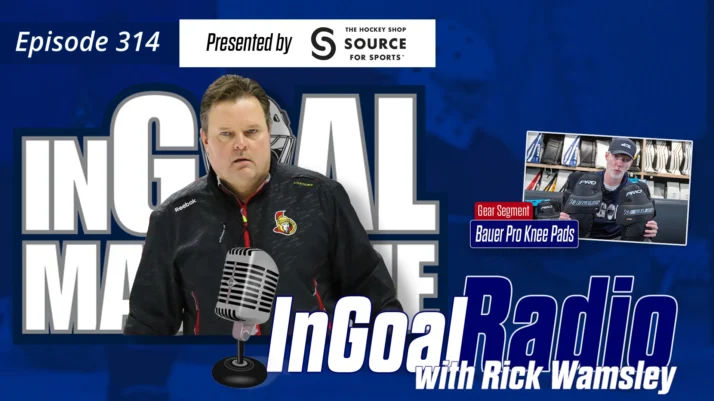
InGoal Radio Episode 314 with Rick Wamsley

Please subscribe and leave a rating — it helps us reach more goalies!


Rick Wamsley went from NHL goaltender to goalie coach overnight, transitioning from playing to coaching Felix Potvin with the Toronto Maple Leafs in the early 1990s. Over 28 years in the league as a player and coach, Wamsley learned from legends like Jacques Plante and coached goalies including Craig Anderson. He now runs GoalieU, an online platform using video work to help goalies develop.
- Rick Wamsley transitioned from 'goalie on Tuesday to goalie coach on Wednesday' with Felix Potvin and the Toronto Maple Leafs in the early 1990s, highlighting how abrupt the shift to coaching can be.
- Having Jacques Plante as a goalie coach gave Wamsley foundational lessons that he says still apply to the position 45 years later.
- Wamsley launched GoalieU, an online platform designed to help goalies improve through video analysis, growing out of his work as an OHL goaltending consultant.
- Charlie Lindgren demonstrates how depth and post integration differ significantly when facing breakaway attempts off the wing versus straight-line 1-on-1 situations.
- The new Bauer Pro kneepads are generating significant attention in the goalie gear market, covered in detail in this episode's gear segment.
Episode 314 of the InGoal Radio Podcast, presented by The Hockey Shop Source for Sports, features a fantastic interview with longtime NHL goalie and coach Rick Wamsley.
Feature Interview
presented by NHL Sense Arena
In the feature interview presented by NHL Sense Arena, Wamsley touches on everything from 13 seasons playing in the NHL over three decades, to coaching goalies in the League for another 15 years, including going from “goalie on Tuesday to goalie coach on Wednesday” with Felix Potvin and the Toronto Maple Leafs in the early 1990s. There are great stories on every aspect of the game and position, from his start as a Montreal Canadiens draft pick and fellow goalies sewing Tupperware on their gear, to having Jacques Plante as a coach, learning from watching John Davidson in the AHL, and coaching Craig Anderson, as well as some really interesting lessons that applied to goaltending when he started, and still hold true today, 45 years later.
We also talk about Wamsley’s work as an OHL consultant and how it led to a new online venture, GoalieU designed to help goalies improve through video work. Check it out because we’ve got an exciting new partnership coming that will benefit InGoal Members too!
Parent Segment
presented by Stop It Goaltending U
In the Parent Segment, presented by Stop It Goaltending U the App, we respond to a few common questions for listeners including travelling with goalie gear, breaking in new gear and the smallest goalies being forced by team rule to carry their own bags.
Pro Reads
presented by Vizual EdgeWe also review this week’s Pro Reads, presented by Vizual Edge, which features Charlie Lindgren of the Washington Capitals with great advice on managing depth and post integration when facing breakaways off the wing, and how both differ compared to a straight line 1-on-1.
Weekly Gear Segment
presented by The Hockey Shop Source for SportsAnd in our weekly gear segment, we go to The Hockey Shop Source for Sports for a closer look at the all new Bauer Pro kneepads and why they have been generating so much buzz this summer.
Episode Transcript
Intro
Welcome back to InGoal Radio Podcast. We got something a little different this week. We've got Woody at controls, which means there will well, it means probably there'll be less talking because if I don't get to weigh in on anything and I gotta drive the bus in radio parlance I gotta say, I have co hosted on radio programs in years past here locally in Vancouver. I have also driven the bus as the host. That's what they call this.
It's a lot more difficult to drive the bus than it is to be the guy that just bounces the other ideas. So I'm gonna give this a shot. We've got a great feature guest lined up this week. We've got all of our regular segments, the parent segment with Hutch. We've got the ProReads presented by Vizual Edge coming up.
We also obviously have our feature guest with Rick Wamsley. Five generations playing the position. Five generations. Five decades playing the position and coaching the position in the National Hockey League. More stories than we could get to in the hour, but let as a teaser, Hutch, our feature interview presented by Sense Arena, I will just say that there is a story about a playing partner
Oh, yes.
Attaching his mom's Tupperware to his gear to protect himself. That's how good this interview is. There are so many different aspects as well as some lessons that applied to Rick Wamsley forty five years ago learning to play the position at the National Hockey League level that still apply today. So can't get can't wait to get to WAMR as our featured guest this week. Why don't we start things off with our equipment segment, our gear segment, brought to you by The Hockey Shop Source for Sports.
Folks, it is early August. It is back to hockey, and that means the back to hockey sale is on at The Hockey Shop Source for Sports. So as much as we talk about the latest and greatest new gear, including this week's segment on the new Bauer Pro Knee Pads, There are massive discounts for every goalie on now at the hockey shop and thehockeyshop.com. Make sure you check it out. They're back to sale sale.
Back to school. Back to sale. Back to hockey sale is now on at The Hockey Shop. Don't miss it. Every brand is gonna have discounts available.
It is the perfect way to gear up before you hit the ice for your tryout camps in August and back to hockey in September. Make sure you check them out. But first, something a lot of people have been checking out recently, Hutch, the Bauer Pro Knee Pads. There's been a lot of buzz on these. Let's go over to Cam so he can explain why.
Gear
Oh, you've heard about this one before. Bauer's new pro knee pad. Maybe you saw it on a certain two time Stanley Cup winning goaltender named Sergei Bobrovsky. So what's got everybody so excited about this? There's neoprene.
There's new padding. It's completely redesigned. Let's get into it with Cam at the Hockey Shop Source for Sports, The Goalie, Utopia department. You have it in stock? There's been a lot of buzz over this knee pad this summer.
Explain
to Well, me I mean, look at it. It's been a while.
I actually think from the front, I don't wanna say underwhelming, but, like, it's hard to see the main differences from the front except for the maybe under here a little bit.
So let's
walk us through it.
That's well, let's go straight to the back then. There we go. Actual neoprene sleeve that you do slide on over top and through. It's definitely something a little bit different here.
You definitely can't put your skates on before your knee pads anymore.
Exactly.
Not that I think many people would, but just so you know.
You get that wraparound overall feel connectivity. I think that's a good word. That ability to get that anchored fit, think is the best And way to describe
a padded anchored fit. We see the padding around here, like healthy padding inside that neoprene. I think, you know, we talked about this with the Warrior one. We see it with the CCM Pro. They make you a little taller than the butterfly when you're on this on your knees.
Exactly. So beyond that, taller than the butterfly, again, impact reduction turns when you are dropping down into your butterfly as well.
You see the segmentation here and we see how it's angled. So to sort of just make sure it wraps around properly, you've got a big protector here and then the curve composite on the main plate.
So basically, we see from that lower portion up, this part of that pro knee pad remains very, very similar to what we've noticed in the past from Bauer, for example. So that hard curve x cop all the way through up into that thigh, you get that great supreme level of protection, Bauer Supreme. Overall feel wise, again, similar, but you have this whole neoprene sleeve at the bottom, which does change that fit of that knee pad and gives you that upgrade.
So it's a lot of comfort and there is a lot of we see in here, there's a lot of padding all around the side, segmented on the side, there's extra padding, extra cushion, as Cam said, extra landing area. And I guess just with that neoprene, just a real connection. Now you have thighs for calves? How does it fit?
Thighs calves for thighs? No. Other way around. Yeah. How does it fit?
It's snug, but, like, good snug. I get I don't have a feeling that it's gonna slip on me. I get it very anchored. Even when I feel like I'm moving and flexing my knee, it's wanting to move with me. So I imagine, you know, my pads over top, a set of socks over top as well.
Still recommended. I think it would get a great fit.
One size senior. You have intermediate as well?
We do have intermediate as well. So you only get two sizes, intermediate or senior based off of size of leg.
And you brought this out for me. So what the heck is this?
Because this is new for this season and it does go hand in hand.
So is this new for this season?
Yes. So is that. Exactly. Bauer's accessorize your knee pads. So if you wish to have a garter belt as well, which these do have the attachments for, Bauer's come up with a new garter belt that will clip into those front tabs to hold up your knee pads.
But I've really don't think they'll need it depending on the size of your
Yeah. It it really does kinda lock in around the knee. So feel fit, tons of protection, good enough for Sergei Bobrovsky to win a second Stanley Cup this year. I think you'll see a lot of pro adoption. We've already seen a lot of pro adoption, a lot of talk about pro adoption.
Bauer Pro knee pads in stock, in store, here at The Hockey Shop Source for Sports. Cam, can I ask? We've seen sort of price points go up as the quality and build of knee pads has gone up. What are we looking at here?
Yes. We are no stranger to a bit of a price increase, unfortunately, but $179.00-$180, gentlemen.
So that's in the ballpark of a lot of the pro knee pads we're seeing these days.
Correct. So it's now more line price with some of
these folks. We're talking Canadian here. Alright. So if you got any questions, fit, feel, performance, do you really need the garter belt or not, give Cam and his crew a call.
(604) 589-8299 or 1-800-567-790 or check us out at the hockeyshop.com.
Neoprene liner wrapped around your knee, tons of more protection. Bauer Pro knee pad. Good enough for Bob. Good enough for you. Okay.
Kinda easy to understand the buzz. I like the idea of the way you slide into a neoprene. Now not everybody's gonna like that. Some people wanna but the way to sort of have that that that sort of neoprene attachment around your knee, all the segmentation. I I I can see it.
I understand the hype. I understand the buzz. And, of course, you can get that at The Hockey Shop Source for Sports in Langley or at thehockeyshop.com. And if you have any questions, you can hit up their staff. What'd you like most about those?
The neoprene sleeve, I think was most appealing to them, Woody. Obviously, for everybody, the issue of knee pads moving around on your leg is is a big issue. Might even touch on it in the parent segment today. And, so that seemed like a really comfortable way of solving that problem.
It's interesting to me. Like, the more I get into knee pads, the more I realize that they might be one of the more personal items. Like, I never thought of. I always thought about, like, what are the most personalized items? The most sort of, you know, this is what I like and I can't have it any other way items.
Increasingly, I'm starting to recognize that knees and what's on your knees and knee pads are a big one.
You know, I remember you being super attached to a particular set for the first many years we were working together. So I can absolutely see that. And then I've also put knee pads that some people rave about on other goalies and they just say, no, it just doesn't work for me for whatever reason. There's something integration of the unit with your with your pants, with your pads, and, yeah, it's a it can get pretty personal.
How it feels. Like, how it feels attached to your knee. Like, that is other than our skates, like, that's our principal point of contact with the ice. So a comfort level is an important part of that. So, hey, listen.
We've got another option, thanks to Bauer, another new option, something different, something unique. Love it when we have innovation. So there's another new one on there for goalies that are looking to switch things up or wanna try something different, something new for them to try.
One of the toughest things I find when people send questions in Woody, is they'll say, I'm looking at this and I'm looking at this. Which one do you guys recommend for me? And you know, like like you said, this is just an option and there's a lot of great stuff out there and they're all very personal in their choices. So it's really hard for us to say that's the best anything. And, course, that's how you created a lot of what we did with that vision that we can't be saying who's got the best pad, who's got the best skate, whatever, because they're so personal and they are all really good.
So the idea behind all our reviews is we tell you how it feels so you can decide whether that's the type of feeling, the type of attachment connection or disconnection to your leg, body part, whatever, whether we're talking about a helmet, a chest, gloves, or knee pads in this case, try and convey how it's gonna feel and how it's gonna move. So you can maybe hear that and say, hey, I like my knee pad to move like that, or I don't wanna feel it that much. That's the whole goal here. That's what we try and do with both the Gear Segment and our full reviews online. Hutch, that answer you just gave me there, in terms of not being able to tell everyone, this is how to do it.
We like this. You you know what that reminded me of? It reminded me of all your parent segments because you never tell them how to do it. You just give them suggestions on ways they can think about it. So I think now is a perfect time to get to the parent segment brought to you
Alright.
By Stop It Goaltending U. Stop It Goaltending U, the app, which has a partnership with InGoal Magazine that if you buy a subscription to Stop It Goaltending U, the app, you get a subscription to InGoal Magazine. Remember, we tell you this every week. There's lots of great features over on the Stop It Goaltending U the app, starting primarily in my mind with Brian DeCord's daily primer. So every day, he gives you a one minute quick hit video that'll help you become better as a goaltender.
It can be off ice. It can be lifestyle. It can be mindset. It can be something technical. He's always got something new.
Each week, there's a new theme. You work through them in as little as one minute a day watching those videos, you will get better. They've also got a lot broader deep dive videos that come out each week and a drill of the week. So make sure you check it out. There are exciting things ahead, some broadening of the partnership within Goal Magazine coming up where you'll be able to access more of our content through their app.
A lot of great things coming in the next month. Maybe some things that Stop It Goalie U customers in the past who have maybe gone on and tried different things might wanna come back for. Lots of excitement coming on the Stop It Goaltending U app. Just like there's a lot of excitement every week to listen to Hutch break down the parent segment. What have you got on tap for us this week?
Parent Playbook
This week, instead of having one specific topic to jump in on, Woody, it's sort of a few quick questions that have been fired our way over the last little while, and I'm gonna dip my toe into each of those. If you wanna jump in a little bit and and share your feelings as well, we'd love to hear from you. And there it's a it's a diverse range, not around a theme at all. The first one, must be a lot of people traveling this time of year for hockey. Seems a little late for me, but there's a lot of questions coming up about how do you travel with goalie gear.
This is not a full segment on how to travel with goalie gear except to say it's a lot easier than you think. It feels a little bit overwhelming. All that gear, all that weight, we're all worried about baggage and so on even without goalie gear. It's pretty simple. Probably easier in Canada frankly.
I think they understand. Some of our big airlines here just see hockey equipment as another piece of luggage. And even though it's oversized, if it's under 50 pounds, they just treat it as a piece of luggage. Your sticks are part of the package. I recommend you tape at least two sticks together.
It gives them a little bit more strength when you're traveling. And, you might choose to use a stick bag. You might choose to use a plastic ski bag that sometimes they'll provide to you at an airline. And, and from there, it's really as easy as checking it in. Do do obviously check with the individual airline because it does vary how they do that.
I would recommend having a bag that you can fit your pads in. They'll be better protected in there. In one bag, at the highest levels of the game, goaltenders travel with their pads in the bags. It keeps them better on the bus, on the airplane, whatever. And then I would say put an air tag in it.
We made that suggestion on a segment years ago coming out of COVID and Daren did it with his golf equipment and it saved him on a trip when the airline lost his golf equipment. So put an air tag in. Usually, they don't charge you extra for the gear. I'll give you one little story of my son charming people. Arrived at the airport with his goalie bag recently.
Way overweight, north of seventy five pounds because he chose to travel with two sets of gloves, two pairs of skates for some reason, and, sorted other things. So he just looked at the lady and smiled, and he said, no. Come on. We're not gonna penalize goalies just because they have extra equipment, are we? It's gonna be easier for you.
It's gonna be easier for me. And she said, yeah. You're right. Go through. And so it was nice that we have people who get hockey, get goaltending.
So that's my tips on travel. Woody, how's that sound? You haven't traveled with goalie year really, have you?
I was gonna say I'm I'm I'm at a loss to be helpful here, which is I think a lot of people that listen to our podcast every week would would kind of agree that that's a that's a regular thing. But, yeah, I I don't I don't have a ton to add there because I have maybe this this may be a shameful admission given where we are in the game and and and how active a voice we have in the position, but I have never, never traveled with goalie gear. The most I've ever traveled with is what some people would call a coaching kit. Right? So skates, knee pads, a sweats, you know, a track suit or whatever, like a a coaching suit.
And and clearly, I'm not a coach, folks, just I'm not pretending to be, but going out on the ice with video cameras, you you bring those things. That's all I've ever traveled with. So my biggest thing is and funny enough, we are old enough to know there was a time where you would bring your skates on the plane because you didn't want them to get lost because you absolutely couldn't be without them. But sharp objects and planes don't go together anymore. You gotta make sure you check that bag.
That's the extent of my goalie knowledge is you need to make sure you check your skates.
Interestingly, I've seen some parents comment that they take the skates on the plane. I don't know how you pull that off if we can't bring a pair of nail clippers on here. But clearly some people have pulled it off.
Do know some people the blades out?
That could be it. Yeah. That could be it. That's good thought. But some people do strategically to keep it under that 50 pound limit, which a lot of airlines have.
Will pull skates out if they can, a helmet, just pick a few things that are extra heavy and bring that with a carry on if you need to be careful about the weight. Okay. Speaking of bags, there was also a question about a coach forcing a seven year old to carry their bag into the rink. If you can't bring your own bag into the rink, you can't play. I'm not gonna rant about that anymore.
You've heard me say it before. I hate it. A coach forcing all the kids at a very young age to carry their bags in because we want them to have fun. I would just say, don't be shy about using a a wheeled bag. I know it's not cool at a certain age, but if you've got a seven year old who has to bring their gear in and it's gonna help them, don't be, shy about that.
A lot of parents in the groups love those giant sumo bags, Woody. You see it all the time. They rave about it. In this situation, I can understand why you would do that. I will say to the parents of the young goalies, as you get higher up in the game, they expect you to hang all your gear in the room and then put your bag under the bench so that the rest of the room is clear.
It's easier for people to move around. It is safer for people to move around. And when the room is stuffed full of 10 or 15 of these giant sumo bags, not ideal at all and tends to be when you're at the youngest ages, they give you the smallest dressing room. So if you can get to the point where you're working with a regular bag, great. But if I had a seven year old and the coach was forcing them to bring their own gear in, a big bag that you can strap the pads on and strap the stick sticks to, I would not be ashamed about that at all.
So that was point two. Woody, you probably don't wheel your gear in, do you?
I'm gonna be You have
a different reason. You have a different reason. And it's vanity and it has nothing to do with being seen.
It's vanity? It is, but it has nothing to do with being seen
It is, but it has nothing to do with being seen
Okay. Wheeling So it is is it vanity? This has changed over the years. It it wasn't Utility? My I basically had a trunk that the wheel bag was destroying.
And so couldn't fit it in. Obviously, a a wheel bag has hard plastic, liners on it, sort of like a like ribs on the bottom of the bag to give it its integrity in the bottom so that you can sort of grab the handle on one end and there's a solid line to the wheels. It doesn't sag and drag along the ground. And that absolutely murdered the trunk of a coupe. And you're right, Hutch.
There was a point in my life not that long ago where I had a vanity coupe, a very nice car, the nicest car I've ever owned, And there was no way in hell that I was wrecking the car. By the way, it was a lease at first before I bought it out, so that was part two with one of those wheel bags. So I went to a soft, you know, that Warrior soft, big goalie bag, really durable two years that yeah. I've I've still got it. Team gave us one in beer league.
We had beer league bags and it would you know, no wheels on those. So it's not because if I had a truck with a bed that I could throw a wheel bag in and not care about, a 100%. I would be wheel bag guy. Because let's not forget, the only this is the secret to beer league. If you don't want your team to get rid of you, be the manager.
Be the manager.
Yes. And but unfortunately, the manager also so the manager of
my You gotta bring the guy at Coke with you, don't
you? Had had to bring the pops. Yeah. How how whatever type of pops those may have been and the cooler. So imagine this, I'm getting out of the car.
I'm pulling my non wheel bag out of the trunk. The cooler out of the back seat carefully lined. I did love this car. Carefully lined the back seat with a bunch of towels so nothing could ugly could get on my beautiful leather interior. So I would be going into the rink with the bag over the shoulder, the pads and the sticks in one hand, and the other hand towing the cooler, which had the team bag with the spare jerseys and all the other spare supplies on top of it.
People would look at me, are you a lunatic? Why is the goalie bringing all that stuff? To which I would reply quite flatly.
So he doesn't get cut.
This is my way of making sure they can't get rid of me no matter how bad I suck.
That's funny. Years ago, this seeing these questions reminded me years ago, we talked about doing a segment for the old PDF magazine where we would review cars and we would talk about what size bag could fit into each car. And I actually saw a parent on one of these online forums say, I want to use the large Sumo Grit Goalie Bag. I need an SUV. Which one should I buy?
So they were putting the goalie bag ahead of the vehicle, reminded me of our article, and this is apparent clearly has their priorities straight. Goal tending comes first.
I love that. Listen, I gotta go shameless plug here because the reason I don't have that car anymore is I I'm gonna I'm gonna cross worlds here is, I am now sponsored in the Vancouver market by a Hyundai dealership. And let me just tell you parents that are out there listening, as a guy who has driven a Santa Fe, an IONIQ an IONIQ5, a Kona electric right now, as well as a Tucson, you can fit a goalie bag into the back of all of those and probably shock some people to hear that you can fit the full size, everything in it goalie bag into the back of a Kona electric. So that's my shameless plug for my friends at Hyundai. Thank you very much for taking care of me and my goalie equipment.
Oh, jeez. You get one all year long. Does that since it's on this podcast, does that get me a vehicle for a week or what?
I will talk to my friends at White Rock Hyundai and see what we can do.
Okay. I've got a few more of these. Woody, stop me when it's time and we can use the the rest for next week. We could turn this into q and a next week as well. We did have another question about breaking in gear and a parent said, bought my kid a new chesty.
Should I make them wear that wear it at the next camp that they're going to and it's not a goalie camp? And my first reaction was, why are you even asking this question? The only way you're gonna break that chest protector in is to use it. It's not a goalie camp. You're just a target.
Put that chest protector on and use it. But it did just remind me of a couple of things. One, you need to use it. Two, remember the Mike Vaughn story when we were visiting him in Michigan? He actually told us that a great way to break a chest protector in would be to put it in a pillowcase, and I think you probably have to be a junior goalie to fit your chest protector into a pillowcase, but this one is.
And then put it into your dryer on low heat or on no heat and just let it tumble. Just beat it up for a little while. So something you could try with caution. We do not guarantee it works. I am not paying for your chesty if it doesn't.
The lawyers have asked me to say that. But but, yeah, you gotta get out there and use that thing, and the summer is the best time. Don't wait to go see Cam with the latest sale at the end of August as you're heading into to playing your next game.
Can I can I give a little piece of advice here?
Please, please.
Because you're I I understand you're worried or maybe the goalie is worried about how they perform at that camp. Mhmm. Obviously, should be out there not worrying about the finish. It's a like, view it as process when you're at a camp in the summer as opposed to, you know, puck stop, process over puck stop. Now understand, maybe that camp is being run by a goalie school that is also taking part in your evaluations and maybe you're worried about that.
So if I could share one piece of advice from InGoal testing and we test equipment. If it's a chest protector, great. But if you have a new chest protector and new pants and maybe a new glove, maybe on each day limit it to one thing. There's an adjustment process, especially if it's a new brand, not just a new size. If they're changing brands, if they're changing fit, if they're going up from a, you know, maybe an intermediate to a senior or to a senior pro and there's a difference that's gonna force them to adjust, try not to ask them to adjust to too much at once.
Maybe the first three days of camp, they're in the chest protector till they're comfortable, and then they add the pants, or maybe they add the pants, and the old chesty until they feel comfortable in both. We do this with testers as much as we can, and we went through this recently because we're doing a whole bunch of testing now for Warrior this week. Yeah. We had we're doing a whole bunch for Warrior. They're back on board with InGoal Magazine.
We're gonna be if you saw it on social media, we're gonna be doing a whole bunch of review work with them like we do for other companies, CCM in particular. But you can't take a goalie and be like, here is everything at once head to toe because they won't know what part feels the most different. So we had a case this week where, you know, it's like we're we're working with an integration of one piece to the other and they thought, oh, like, this is pre this is limiting my vision. And then we put them back in their regular chest protectors. Okay.
Now how do you feel about the way the mask looks? And it's like, oh, this mask is incredible for down vision. But because they were changing two different things at the same time, they couldn't tell which one was the issue. So really important to not to as much as I say get them in the summer and try it, I think it is important to not ask them to change everything at once because it's just too many aspects of their game that it can affect, and and you won't feel comfortable at all out there.
That's awesome that you actually jumped into this, Woody, because one of the other questions was about a parent who had bought all new gear for the kid for the first time ever, head to toe. They'd quite young, been borrowing gear from the association till now, time for their first set, and they went out and they were miserable and what am I supposed to do? And I think you've outlined it all there beautifully. I I would make the point that just because changing that chest protector then made the mask feel great, doesn't mean that there was a problem with the chest protector either. Because what we find every time we bring a new set of gear on the ice, whatever piece it is, there's an adjustment period while you tweak this strap and that strap and how I tie it up and how I wear it and so on.
And and so we might have been able to dial that chesty in to work great with that mask, but we just didn't have time to work with everything. We had a an hour and a half of ice, and we had a whole lot of things we had to accomplish. So that's why you need all those different skates with all those different pieces, so you've got time to adjust and tweak and and wear it the way it needs to be worn for you.
And listen, man. If Connor Hellebuyck and Eric Comrie can go to public skates to work on their skating Amen. And and maybe not every young goalie is they're gonna be too self conscious to be out there in gear to do with crease movement patterns while everybody's circling wraps laps around them. Okay. I get that.
There is no reason you can't go out there in a new pair of pants or a new pair of knee pads or a new pair of pads or skates and just get that break in process again without the results portion of having to stop pucks.
Yeah. Absolutely. I think I think we've probably done enough here, Woody. We've gone through three fairly long questions. Used more time than I typically do.
I think I've got three more pieces, so all that means is really good news. Parent segment's already written for next week.
There we go. Part two. Just like we're upcoming in our Sense Arena feature interview with Rick Wamsley, there are so many great stories. There's definitely a part two coming down the road. We've left the part two of this week's parent segment.
Great job, Hutch. We're gonna switch now gears before we get to Rick Wamsley. I'm I'm leaving a little tease there, leaving people I think that's you know, I'm not as good as come back. Yeah. I'm not as good as Darren at this, but I'm trying my best.
Time to get to this week's ProReads brought to you by Vizual Edge. Now this week's ProReads features Charlie Lindgren. Breakaways off the wing. Great breakdown from Charlie, and the beauty is for our InGoal members that understand how ProReads work, we've got a link in there. You can go back to his last ProReads, which was about a month ago, and it was straight line breakaways.
And this week, it's a guy who's cutting in. He's got around the defenseman. The defenseman forces him wide out towards the wall, but he's got a step. So now he's coming in from sort of the outside hash marks, maybe through the face off dot. In other words, it's a mano a mano one on one, but it's not in a straight line.
It's not like you've seen this coming from the blue line and he's coming right between the hash marks. How does it affect our depth? How does it affect do post integration? Do we work in and off our post because it's coming off the wing versus coming straight line? How we target or push outside our post?
Charlie Lindgren gets into all of that in this week's ProReads brought to you by Vizual Edge because ProReads are all about being able to read and see and anticipate the game better. That's why we have goalies like Charlie Lindgren, like Connor Hellebuyck, the best in the game, breaking down video to help young goalies learn how to anticipate the cues that they look for and how they react differently to it. Well, if that's the best way to learn how to read the game, the best way to see the game better is through Vizual Edge. And our partnership with Vizual Edge, which is an online cognitive and vision training tool, guys like Jordan Binnington use it every game day camp. Talbot talks about how it's helped him become a better goaltender late in his career.
His ability to find pucks through traffic have all improved by using the Vizual Edge training tool system. And, of course, we have a discount using the code InGoal, gets you a certain percentage off. But if you're a member and you go to our ProReads, you'll get the special members discount, which gives you an even bigger percentage off. So Vizual Edge, great training tool. We'll help you see the game better, which there in turn helps you read the game better like ProReads, and we're making sure we're giving you a discount.
Again, I would argue that the price of an InGoal membership is $50 a year. You're gonna save more than that through your membership to Vizual Edge based on that discount. So just go ahead, get the subscription, get the full access to the ProReads, and get a bigger discount. Thanks to our friends over at Vizual Edge.
Wise advice from you as always, Woody.
I said there'd be less talking to me, but I'm not going to you as much here because we're we're we're cramming through because we said we would get to our sensor. Yeah. Rick Wamsley, featured guest before we get to Rick and stories. Like, I know everybody's sitting there right now going, I I gotta hear the Tupperware story. Like, are you kidding me?
Folks, this is this is a goalie who Jacques Plante was his first goalie coach. Like, we are talking legendary stories, and then he went on to work with Craig Anderson. He's got an Andrew Hammond story. Some fantastic stuff in this interview. But before we get there, I need Hutch to tell us what's new, what's the latest, what's going on with our friends over at Sense Arena.
NHL Sense Arena. You know, what's what's the latest for me is I got a note from a listener who wanted to purchase NHL Sense Arena, wanted to check-in on whether the code was still there. It is folks, IGM 50, save even more, but he wanted to know which headset he could use because the Meta Quest headsets, they've got three now I think, and, and, you know, we couldn't really answer. And the reason I couldn't really answer was because we're still using the original Oculus Quest two and we're seeing everything in there that you can see. So don't worry about the headset unless you're into VR and you really want the latest and greatest to play a bunch of other stuff because NHL Sense Arena will run on anything at least from the the old Oculus Quest two and and up.
Woody, you were mentioning part twos earlier. And there is a part two up on our website and that's part two of your review of
The goalie advancement program.
Yes. Exactly. And working on angles. I think you've learned a little bit more about angles thanks to the NHL Sense Arena update.
Yeah. And it's funny because, my next game out after going through that. We tweeted we talked I think we talked about this last week. Like, hey. Have I been out on the ice? We did. Yep.
Boy, did I find myself prior prioritizing angle over depth a lot more, just making sure I was set in square early. And it is incredible. I was playing in a skate that was a little faster, a little over my head. Let's be honest. They're all over my head.
This one more so than usual. And the number of times where I felt like I might have been behind a play, but I was in position, I was set, and I was square even if I was a little deeper, and that gave me access to pucks and the ability to see it and sort of, not to not get hit by it, but just be in position to make a save all the time. I found I was crisper with it. It it was sort of an subconscious priority. I didn't go in there thinking, use everything you learned at NHL Sense Arena to stop pucks this week.
It just and that's the beauty of the Goal Tender
event. Program.
Yeah. This program, whether it is the first part we went over, which is about seeing the release, the second part, which is about mastering your angles, or the third part that we will review in the coming weeks on managing traffic, it's a progressive training tool. So it is not you're not going out there thinking about it because they've walked you through the progression. You've gone through the process of thinking about it when you're doing it in the headset. By the end, you're just out there making it innate.
And I found I took it onto the ice, made it innate, and in reflecting back after the skate, I'm like, there were a few moments in there where I'm like, I made that save because I was that much better at mastering my angle. So make sure you check out the goalie advancement program. There's lots of great stuff there.
Yeah. And just the last point I'll make is ice is expensive. Practice time, few and far between, and so and do you are you gonna go out there and wait for just the right situation to happen to figure out something with your angles? Or are you gonna spend fifteen, twenty, thirty minutes in the basement at home going over all of these things in preparation for that that next ice session? And these things are tailored for you in exactly the right way so that then you can integrate them in your game on the ice just like Woody.
Thank you to NHL Sense Arena for sponsoring all our feature interviews. Check them out. Sensearena.com. Use the code I g m 50.
Funny we talk about angles and prioritizing angles. That's a big part of Rick Wamsley.
Angle on this interview.
Why? They're oh, good dad joke there, Hutch. But honestly, like, the what you're gonna love this because there was a lesson learned early in his career that, like, as soon as he starts talking about it now it's applied differently in the early eighties than it is in 2025, but it is a lesson that absolutely should resonate with today's goaltenders just like being on angle like I just talked about with the Sense Arena program. As a matter of fact, I think it might be one of the biggest common denominators amongst the best goalies in the league today in terms of managing depth and
managing position. Shocked he've I was shocked he figured it out that early in his career. I mean, we're talking the eighties here. He was going over a concept that we're still working on today. I might even say discovering to an extent today.
I mean, I know it's been around a Rediscovering. But rediscovering. Yeah. But I did not think it was part of the game then or maybe that's why I didn't progress as far as Rick Wamsley. Because I never learned it.
It's all relative. Right? Like, where like, how you manage it is all relative, but the principle remains the same. And so just one of many fascinating parts of our interview with Rick Wamsley, rather than having me talk anymore, let's go straight to my conversation with Wammer, which starts with me introducing him. Incredibly excited to welcome to the InGoal Radio Podcast.
Feature Interview - Rick Wamsley
First time guest, someone I've had the the absolute pleasure of getting to talk to over the years about the position, a position that he played in the National Hockey League for twelve years, coached for close to two decades. Three decades playing, two coaching. He has seen every part of this game change, including the position. Rick Wamsley, now pro scout with the Colorado Avalanche. Wammer, how are you?
It's been a while.
I'm really good, Kevin. I really, really appreciate the invite, and I'm looking forward to the conversation because when you get two goalies talking goaltending, it it gets real intelligent in a hurry.
I love it. I love it. Will there at least be intelligence from one end of this conversation, and it's not mine. Hopefully, I can come up with the odd good question. Let's get catch us up on what you're doing because, you know, obviously, last time we saw you in the National Hockey League from a coaching perspective was with Ottawa, for for six years there.
But I know you've been doing some stuff with the OHL. You're now doing a pro scouting role with the Colorado Avalanche, and you've got some stuff on the side with a program you built to help, help young goaltenders. So just catch us up a little bit on how things are going.
Yeah. From, from the hockey, hockey side, I was I was let go in in Ottawa a number of years ago and kind of, you know, tried to get back in at different times and and I had a little bit of a gig with the OHL where I was the lead goalie consultant. So I tried to mentor their coaches and through video and clips and whatnot. And from doing that, trying to use their their goalies as examples of of maybe what I would do or what I would talk about or or tell me what you're thinking led led to the formation of Goalie U, where I I use OHL goalies, junior goalies to illustrate what kind of IQ or or high end thinking goalies, what it looks like. I think I can detail and explain what a scout might look like, what a former player might do, what he might look for and kind of get into a neat little package called Goal U.
And I'm really excited about the possibilities of just of kind of mentoring is not the right word, but but spreading my knowledge to to 13, 14, 15 year old goalies, and I would have died for this information when I was their age.
So a chance to take so you got the video clip. So a chance to you're not just telling them, you're showing them. It's a show me, don't tell me. Right? Here's all the information, and you can see it happening on the ice, and you're walking them through it a little bit.
Help help help with their goalie IQ.
Yeah. A 100%. I I can take it. I can take a five second clip and turn it into four minutes. And and I can go back and forth, and there's there's footwork, there's read, there's eyes, there's what lead, there's what the shooters see, there's what your defensive team has taken away, and all happens in four or five seconds.
So it's it's fun for me. There's a little bit of disguise scouting on the amateur side with Colorado. So that's kind of fun, too. And I mean, I I I love talking goaltendees. I love helping people.
So it's it's right up my alley.
Well, so much has changed in the position, and yet I'm willing to bet there are still some things that remain the same. Rick, what are some of the things that when you watch these kids who are playing at the highest level for their age group and you're breaking down video of, like, top OHL goalies, are there things that you see that the best do that it may not look the same as how you did it growing up, but that harken back to it?
No, but it's I think the philosophy is the same, right? Like how you play situations is the same. I was lucky enough to be involved in a Hockey Canada trip to Finland maybe twelve years ago, and it really defined how I coach and how I see the game and and how I view how goalies get better. Right. The at that time, the Finns really believed there were 10 ways to score.
So if there's 10 ways to score, then there must be 10 ways to defend. And that's how they taught their goalies. And Finland is one of the top producing per capita hockey nations. They produce more good goalies than any other nation in the world. So we tapped into what they were doing.
They were willing to share. And it was it was a really, really good experience. But the philosophy is the same. How you get there, how you get across is radically different. And that's that's due to due to a little bit of equipment change, better skates, no leather toe straps, all that kind of stuff.
No more leather and deer hair. But the philosophy is like really neat and it's relatable from an old school guy to to kind of a new school technique, if you will.
When you when you talk about that trip to Finland, I mean, not to not to digress right away, but pull on that thread a little bit. Like, what do you remember of that, and what were some of the things that again, there were there were probably things that just resonated as as things you understood all along playing and starting to coach the game. But what were some of the things that you you mentioned sort of shift and help form the foundation?
It it was neat because I was I mean, I was fifteen years into my coaching when we went and I'm sitting there and I'm looking at this guy and when he says there's 10 ways to score, I'm thinking backhand, forehand tips, you know, stuff like that. And then he was talking all situations. So when he defined and described the situations, I immediately said, I get what he's talking about. So I understand now what he's saying, like versus an east west pass or versus a low high pass. I had no idea how to describe it or articulate it or how to explain to someone how to defend.
And and once once he they walked us through it, it was it was brilliant. To me, it was brilliant. It was the it seemed easy and simple. And like I said before, I I I haven't watched a game the same way since coming home from Finland twelve years ago.
Is there other examples without giving it all away that you mentioned low high east west is more the the the tactics to manage these different scoring situations? Is that how you you sort of reverse engineer it to the goalie side?
Yeah, there's there. I think there's basic funnel. Where do you stand? How do you stand? Where do you look?
What are you looking for? Where where do you got to go? How do you get there? Like, it's really it's really good stuff. Like what foot you push, what foot you stop, what's preferred, what's really neat in the Goal U program.
I can show you nine different top end junior goalies who basically approach the situation the same way with minor differences based on size and skill and ability and quickness and all that kind of stuff. But a big believer in success leaves clues. If I think of a young goaltender can watch nine top end guys that are slightly older than them, maybe five, six years older than them, then they're going to get the idea. Rather than watching one guy do it once, you're going to watch nine different guys do it, face the same situation and basically approach it the same way and hopefully get the same results. It's been a lot of fun.
Really cool. Really cool stuff.
I like that from a learning perspective too. Now, do you do a lot of voiceover on it?
Tons, like tons. So I have an ability to go back and forth and I can talk through the whole thing while the video is is going back and forth. So the talking wise is fluid. The clip gets gets forward and backwards and and I can draw circles and lines and spot shadows and stuff. So it's I can get a little creative.
It's kind of fun. But but it's it's it's it's been it's been really good.
It sounds like a deeper dive than you would have done most likely in a video session with one of your NHL goalies during all the time you're coaching NHL goals. But does it does it hearken back to that a little bit?
Oh, 100%. So so it's, and and what's really neat about it, once I got home from Finland, I was still working with the senators. I I put it into how I talked to Craig Anderson and Robin Lehner and Andrew Hammond at the time. It just started, it just made more sense because the 10 situations happen 90% of the time. There's some funny stuff that happens that really you can't coach through or plan for.
But the 10 situations happen all the time. So we really started concentrating on those and got some really good results and everything just became smoother. So as soon as I say, well, that's a low high out. How do you play low high out and boom like that? Well, yeah, you start like this, you end up like this, you push like this.
This is what we're looking for. And it just simplified the process at a pro level. And I think it's adaptable, right, to amateur teaching as well.
What have you seen change the most? And and I this is because you've been in the game so long. This is a big question. But, like, maybe even in the last five, ten years as you've started looking at it through a different lens, working with the OHL at the young ages, but also from a pro scouting standpoint. Like, how have you seen things change in terms of the types of attacks and how goalies manage it skill wise?
Well, there's well, it it's interesting. I remember you're talking to an old school dinosaur type guy who who like most of us older guys, we question today's skill level. By skill, I mean, I love guys with hands, right? If you can catch and if you can direct, if you can trap, I mean, I'm your guy. To me, if goalie can take a hard slap shot from, say, twenty, twenty two, 25 feet.
That's going to hit him in the right shoulder block your side. If he can get if he can get up like this and catch it, I'm all over that guy. Everything that goes into this save is like, wow, that takes skill, that takes experience, that shows patience, that shows a lot. So I don't see a lot of that in today's game, today's goalies. And I think if you look at the really top guys, especially the National Hockey League, we all can kind of do that a little bit.
And the guys are trying to get there not so much. So that's one.
Is that way more Does that give us sorry. I gonna say, does that give us the element of control? It was so when what that ability to not just stop pucks, but to control pucks and and control.
Oh, 100%. Let it come to you. Like, guys that let it come to you. Like, let the play come to you. Let let the puck come to you.
Let the play come to you. And what you're really what you're really what I didn't have and what I learned in pro from my coaches and in playing experience, you finally understand less is more. Right. Less is more. And once you once you get it, it's like, boy, it gets it gets the game gets way easier than trying to go to the game or go to the puck or always be moving forward or just over moving in general.
Once I understood less is more my own game, and I learned that from watching John Davidson in a minor league game when he got sent down, that's another story. But it turned it turned my it turned my career around and ended up having a career. Let's let's put it that way.
So Okay. Well, let's let's rewind there. Let's let's pull on that one a little bit because, you you know, it's funny. We hear less is more a lot now still. Right?
Like, still trying to get kids to, you know, don't chase as much. Let it come to you. What did that look like to you back in those days at a time when goal tending was totally different with John Davidson?
This is this is this is 1980, 81. Okay. This this is 1980, 81. Could have been 1980. That's how long ago is.
I might have forgot. So it's either my first or second year of pro in the American League, and I'm not doing well. I'm I'm not I'm not doing well. And John Davidson got sent down by the New York Rangers to the New Haven Nighthawks for conditioning stims just coming off back surgery. So so maybe he couldn't move.
I don't know. I didn't know. I didn't I didn't know. So I'm I'm playing. I'm 21 years old.
I'm playing against John Davidson. I go, Oh my God, this is like it's like playing against an idol. Right? So and we we shot them forty five twenty right away. We are all over.
He didn't move. He didn't move. He just stood there. He just stood there. Let the puck come to him.
Let the play come to him. Only only move when he had to. And we barely win three two. And he was outstanding and he didn't move, didn't break that to me. He didn't look like he breaks my spine.
Here's a young kid at the other end going, wow, wow, wow. Maybe I'll try that. So I tried that in practice and just kind of stand in there, let it come to me more, stay on my feet longer. And it it turned my career around, turned how I thought around and applied it. And for me, it worked.
So it a really, really good neat experience.
Okay. So we've we've seen that happen. We've we've had conversations like that recently as well. It's still a a philosophy that applies. Yeah.
But for those that there'll be some people listening that will know it will resonate exactly when you say, like, late seventies, early eighties. There'll be a younger crew that's like, okay. Are we talking Henrik Lundqvist? Like, so where were you playing comparatively? When we talk about less is more, there's an overarching theme, but, like, describe to me how aggressive your game might have been back then compared to after watching John.
Yeah. So I was I was after. So I was kind of I was a kind of a sit back goalie and read a little bit and then go go to the play. I would go into it. I'd be moving forward on way too many saves.
So tougher to control the rebound and the read better happen exactly as you think it's going to or you're or you're going the wrong way. Right. Where where I watch John, he was out a little bit, not much, but he was just out more holding more, reading more from there and moving back. Right. So there was there was less going to it and there's a lot more let it come to you and actually retreating.
And like I said earlier, it just it was a whole different way to think. And, boy, they I just started getting hit. Like, I was in the right spot more often, right, just by just by how that philosophy went. And and like I said, just turn my it just made the game way easier than what I was doing.
Oh, I mean and it's it's incredible to hear that now, Rick, because I think it applies still now. And you're talking about, you know, you're a you're a third round draft pick of the Montreal Canadiens, your first pro season in 1979, and that lesson applies now in 2025.
So so the philosophy is the same. Right? Now the equipment's change allows you to do different things. You can play a little wider. You can hold your edges wider than than than we could.
Right? There was a point when when we got too wide the with the deer with the leather and deer hair and leather toe straps that the pad would push your blades off the ice and down you go. So kids and goalies today can play wider because the pad kind of gets out of the way. So there's that, but the philosophy is the same. And once guys get it, noticeable.
The other part of that is that you had to learn it by watching another goalie, no goalie coaches.
No goalie coaches. No goalie coaches. So I didn't, I didn't have a goal. I had Jacques Plante as a goalie coach in Montreal. He's my first coach.
Right? So I bought Jacques Plante's book, Goaltending when I was 10 or 11. So I've kind of been in this goalie you mindset from a young age, one to learn, never thought I'd have a pro career, but I just like playing goal. To have him as my coach was was it was it was eerie. Like, jeez, I bought your book when I was a kid.
Now you're my coach. But he Jaques was really different. Jacques was a go to the game guy like he. So so what what got me to the NHL where I kind of got out and held or backed up a little bit, Jacques Jacques was a leaner. He was he was a leaner.
He wanted to move forward. He he was he was that was his way. So Jacques was a type of coach that wanted you to play the way he did. Right. And I and in the end, I'm not sure when when you go back, but over your career, I'm not sure that was the best approach for me at the time.
And maybe that's why I got traded in St. Louis. Who knows? Good
lesson there though. Yeah. Oh, yeah. You transition to coaching after your playing career is done. And that's probably in the back of your mind that I need to work with the goalies as they are as opposed to how I used to be.
Yeah. My philosophy at Warrior is I have to understand when you're playing well, why? What are you doing? Why? And so when you're not playing well, then I got to understand what the differences are between, okay, you did this when you're playing well, it's not going so well now.
So what aren't we doing? So that's kind of the way I approached it, especially early in my career. Then, like I said, after the Finland trip, it kind of changed a little bit. But yes, so you to allow the guys to play because you end up being a position coach. Right?
You can't you can't really tell them how to skate or tell them how to catch, but you you just kind of emphasize we'd like you to catch a few more pucks than you are and let's try this type of thing.
Started '94, '95 with the Leafs, in on the coaching side. Walk me through sort of what that's like when you you're trying to figure out what it looks like when a guy's playing well. How much of that is them in a conversation, what they're feeling, and how much of it is you watching video and seeing tendencies?
Yeah. I I think I think like a player, you you evolve over time, but I was actually a player on Tuesday and the goalie coach on Wednesday. So that was during the 1993 I retired in February '93 and that spring, that's when Toronto went on the good run. Right? And then they went on another good run-in '94.
Felix Potvin was a goalie. So I was basically Felix's teammate on Tuesday and I was his coach on Wednesday. So it wasn't a lot of coaching going on, to tell you the truth, because there's more, you know, more shooting pucks. What do you need? You're Okay, that kind of stuff.
And then and then you just kind of develop. I just kind of develop how can I help him? So how can I help him? So I tried to I tried to watch like power plays, for instance. I think there's triggers.
I think there's guys never shoot and always pass. We tried to we tried to not overplay that guy. There are certain tendencies that every power play does. They're looking for the same guy a different way. So just just be aware of them.
Different stuff like that's a little bit of a different meeting than the PK players, Right. They're all about angles and what they're taking away. And I just want the goalie to be aware of what they're trying to do and then let's be ready for it. So that that was one. And then as as I moved along and it really took hold when I was coaching in Columbus and Ron Tugnutt hurt his hand and he could skate for a month, but he couldn't do anything.
So now what do you do? So then then I really got into footwork like like goalie skating, goalie specific footwork, goalie skating, like rather than skating wrong blue lineback, red lineback, I go, this isn't going to help him. So let's do some goalie motions. So let's let's shuffle blue lineback, red lineback, which is really long. Right.
Or or we'll see cut or we'll backward skate or we'll slide. And and after a month and a half of that to watch Ron Tugnutt play the last three months, it was my eyes were like, Oh my God, this is so good. He he actually said, Wommer, my feet feel so good after doing this. And so that was my first introduction to goalie power skating, whatever you want to call it. But it was goalie specific skating, right?
To condition the tenders at the time.
And it's funny because that's early 2000s or somewhere around there. And there's probably young goalies listening now that are like, what what are you talking about? Like, we like, this is the first thing we do every time we get on the ice. But the reality is not everybody was doing this stuff on a regular basis back then. It's twenty five years ago.
No, I did zero. I did zero before Tugnutt hurt his hand. I mean, I didn't and trust me, I watched everybody practice in the National Hockey League. I'm an R and D guy. It's not research and develop for me.
It's Robin do. Right. So I'm a Robin do guy. So if I see something I like, I'm doing it right. So said and nobody either nobody was showing me anything or nobody was doing nobody was doing it with their goals.
And that's another thing about Finland, like how much they skated their goalies and and the different type of the stuff you see now. Right. The stuff you see now, the one hundred eighty one hundred eighty turns, right? And push and backwards, forwards on your feet, on your knees, all that kind of They were doing that eighteen years ago. So it's really
It's funny because there's probably a lot of young goalies listening right now that are like, what what is he talking about? But, yeah, trust me, folks. It wasn't that long ago. All the things that you see on Instagram every day and you do every day as a skater Yeah. National hockey leaguers weren't doing it just twenty some odd years ago.
We were we get on the ice, five minutes before practice, warm up with the rest of the guys, take some shots, away you go, and that was it. And then and the assistant coach, if he wanted to work you out, it wasn't for you. It was because he wanted somebody to shoot at with the course players and wasn't goalie specific. You were forced to learn on your own to survive, which which we did. And but it it I think it made it kind of formed a foundation of of how to play and how to talk about the game for for me, for sure.
Part of that is you you had to learn, your own game. You're like you said, you're learning by watching other people. Are there lessons there that you applied as a coach that you would recommend to other coaches, to other young goalies now about about the need that as much as we do have more support than ever before to understand and be your own goalie coach, to be able to manage your own game to a degree.
Yeah. When I talked to my pros, I said my goal my goal is to have you coach yourself at the end here. So when I come in and I say, hey, what happened here? If I hear the right answer, we're done. You're coaching yourself.
Good, we're done. I don't need to hit you over the head with it. So I think the goal of any goalie coach is a leave him alone a little bit during the game. If you're a goalie coach that has can touch or talk to the player during the game, it has to be something drastic to talk to them. Just just just leave him alone.
Let them go. Let them learn by themselves. Have the conversation later. But adjustments during the game are really hard. You don't want to get too much inside here because as you and I know, sometimes two and two equal five when things aren't going well.
So just leave them alone. But the goal should be, for me anyway, to be their own best coach at some point.
You talked about reading Plante's book at 10 or 11. Obviously, a lifelong learner in the position. You've always had this passion for it. Every time I've talked to you, it comes through so so clean and and pure. Where where did it start for you, Wimer?
Where did where did this love for goaltending?
So I'm I'm seven years old in Port Dover, Ontario, town of 3,000 people. Right? I'm a huge Bruin fan. I have no idea why I'm a Bruin fan, but, I mean, love Gerry Cheevers. So maybe it was his mask.
Not probably was. But I I I mean, I I want to play goal so bad the next year in Port Dover, they started a tight program. So oddly enough, I was I was on the odd fellow Canadians. I fell. Lodge was a sponsor and I was on the Canadians.
And Mr. Barker was our coach. Right. And I knew Mr. Barker, small town.
Everybody knows everybody. So I sat right by the door. I sat right by the door. And as soon as Mr. Barker walked in, I begged him to let me be the goalie that day.
Can I play goal? Can I please can I play goal? I don't know why. I don't know why I just want to play goal. So he let me play goal that day.
And then after the game, he says, I was I was Richard back then. He said, Richard Richard's our goalie for the rest of the year. I've been in that ever since.
Were there other guys? You mentioned Plante's book, John Davidson watching him. Who were who was who was I'm guessing for you, there might've been more than one achievers with the mask.
Yep. So I had Jacques Plante. I had once once he moved on from Montreal, I had Ken Dryden, who was really cerebral and not much on the ice. So not a lot of contact there over a couple of years. Then I had Glenn Hall in Calgary.
So then Glen, and this is, I'm 28 years old and Glen Hall is my coach. And he comes up to me one day and he says, so I really like the way you play. I said I said, thanks, Glenn. That's great. I go, what do you like?
What do you like? He says, he says, you you don't play a big net. I go, great. I go, Glenn, can can I ask you another question? He goes, yeah.
I go, what's what's a big net? What what are you what are you talking about? Like the nets, four by six. He goes, No, no, no, no, no. You don't understand what I'm saying.
I didn't. He says, You don't make the net bigger than it is. So then once you understand what he's saying, so what he was saying was in an East West situation, I wasn't so far out overplaying the puck, but now I've actually made the net 12 feet wide instead of six. I stayed back enough to cover the angle of the shot, but also close enough to, if he passed it, I have a shorter distance to go to get to the middle. I was basically protecting the net.
So once we talked about, you don't play a big net, and I understood what he meant by what a big net means, I was to protect the net guy. So I really believe in my career. I look back and I watch highlights, I was to protect the net guy. I believe the goalie's job is to protect the net first. If they shoot it, we would like you to get in front of it.
As opposed to a puck stopper mentality that tries to stop everything. And when you play, when you want to stop everything, sometimes they don't shoot it when you think they should and it gets you in trouble. This is where less is more. This is where you learn the value of less is more. The puck stoppers are more, more and more where the protect the net guy is less is more and they understand it.
I was going to say big net sounds to me a lot like less is more. If And hear it. Yeah. No. You're in the net.
And we again, we talk about things that have, you know, old is new. I mean, we start talking about box control and, you know, some of these different different philosophies, and they're all great because they bring a different perspective or spotlight to something that's important. But if you're not in the net positionally, you're not filling any of the box.
No. You know, you have no chance. Like, you you you're you have no chance. So and it was the other thing about Glenn. The biggest thing I learned was another thing was I said, okay, Glenn.
So I said, I got I'm 28 years old in the National Hockey League on a on an entry two on one entry East West pass. I can't get there on my feet. You could never get there on me. So I'm I either stack the pads. Right?
Or I did the floppy seal. Right? So where the pass beat you bad and you just do this stuff. I said, Glenn, I I can't. How do you get across?
I've been in the league for seven years now. How do you get across? He says, Well, that's easy. I go, Well, it's not so easy. So he says, You just come out and stop on your inside foot.
Right? So stop on your in. So if the pass is going, if the play is coming down my right and the pass is to my left, he wanted me to come out, stop on my left foot, back on left foot, which shift the weight, shifted the weight to the outside, my right foot. He says, they shoot it, you just stop it. You have momentum back.
They pass it. Your weight's already where it should be. Just push and go. Sounds simple. I practice it.
So first game. First game shortly thereafter, we're in Minnesota. Verney's not very good. Guess the hook. They throw me in there in the third period.
We're down five-one. First place a two on one. Same side. It's the first play. So it didn't really matter if they scored like six-one or five-one.
We're not winning the game. So I said, okay, let's try it. So sure enough, comes in right out, stop him left, back on left, shift the weight to the right. He passed it just like Glenn said, right? Weight's already there.
I got across so good. The puck hit me right here, right here. I went, Oh my God, this is so good. I'm 28 years old. Right?
So you're not too old to learn if you're willing to listen. And that was kind of my first lesson in really how to shift your weight and routes and all that kind of good stuff. It was real good.
So up to that point, you're just out there skating?
I'm just skating. I have no thought process to what foot I'm going to stop on. So I could have stopped on left. Probably I'm right footed. So I probably stopped on my right foot no matter whether I went out to my right or out to my left.
Right. So I just played right. No thought to transferring weight, get it on the outside, leave it there and zip across. Then after that conversation with Glenn, it starts to make sense, right? So to the point where you can work on it and feel it, right?
If you can feel it and you can repeat it, then you got a chance.
You mentioned Vernie, Mike Vernon, Hall of Famer and and 89 Stanley Cup champion. What what what are your memories of of the cup run?
How good he was. How how how good he was and how close we were to not winning the seven game series against Vancouver. Right. And how how the team that the team that was there before that lost to Winnipeg and had lost to Edmonton, dealt with the demons of losing. Right.
And got past them, got past them against Vancouver. We had the scare. We didn't win till overtime game seven. I don't think odds kicked it in either for you people up in Vancouver. But anyway, we'll take it.
So and once we got past them, how good we were, how good we became and good enough to win it. So that was but he was awesome. Five foot nine, turn the toe over, end up on the rear and hands. I mean, he could catch it with his ear. He was so good.
He was so good.
For the record, 15 year old Kevin Woodley thought Joel Otto kicked it in, but I was young and easily impressionable back then, Rick. I didn't know.
So anyway, the three's the two the the Stan Smyl breakaway, right, with the glove save in overtime. The better save for me was the one timer by where I was I had the best seat in the house for two months. Pass come to left hand shot, right wing hit it. And it was if the pad is is 12 inches wide, this thing was 13 inches off the ice and it hit Vernie's toe cap coming across, come right off his toe. It was the best save I've ever seen.
It was it was awesome. Awesome. So he was great.
Had times as a starter, had times where you were in that support role. Advice for young goalies now when they're you know, we all wanna be the starter, but there are moments in your career where you end up going back and forth. How do you be a good teammate? How do you be a good playing partner?
Well, you you be a teammate first. Right? So you under everybody understands you wanna play. You don't you don't you don't have to go in and tell the coach. You don't have to be a bad person.
Right? Right? Be a good teammate. Be a good person. And if you wanna play, then you got to play better than that guy.
It's really simple. It's really simple. So I would tell my kids, I learned this lesson. So you got to plant the seed that you can play, and you have to allow the team time to weed the garden. Right?
So by weed the garden, NHL wiser's trades don't get re signed. So I'm a young guy in Montreal, third round pick, come to camp, have no idea, end up in Nova Scotia. You got to plant the seed that you can play. So when when the Canadians have the the mishap against the Oilers and the two out of three, Andy Mo comes in and shuts them down. Right.
So they're they're very upset. So they're going to change some things. We're in the playoffs in Nova Scotia. So plant the seed that you can play when management's in the house watching. Right.
Have a good game. That'd be a good start. So I had a great game. We shut out New Brunswick three nothing. And then later on your career, you hear about conversations and you ask, well, how did I make it?
He says, well, when you had that game in New Brunswick, the head coach turned to me and said, There's our goalie for next year. So I planned to see that I could play. So I made the team next year right there with that performance, continued in training camp the next year, allowed them to weed the garden. In that case, they traded my friend Dennis Herron back to Pittsburgh. But that's how it works.
And then when you get to be the old guy, the process keeps repeating itself now. Now I become Dennis Herron, right? And a new young guy is Steve Penny. So now Steve Penny takes my job. So I move on to St.
Louis and the cycle just continues. So be a good teammate, be a good person. If you want to play ahead of the guy, play better than me. It's easy.
From the coaching side, after you move to that side, I I remember I've written a lot about this about how, like, you know, like, there's lot of part of practices that are just not good for goalies. Not fun. But the one thing I may be missed in all of that is that that's part of the job. And so how you manage, especially when you're in the backup role, how you battle, like, those things matter. Advice for young guys in terms of how do
you Actually How do you manage those times in practice? Either battle either battle or have fun. Like make a game up. Talk to the guy. Have fun.
Well, that was a good shot. I got you there. You can have fun with it. It does become a little overwhelming. But understand in your own head that you know, on the fifty seventh shot in two and a half minutes, it's not really important.
Like, yeah, you want to battle, but but, you know, pick out the parts that are that are that are going to relate to you and get you better. And then there is the element of you're the number two guy, you got to take some crap and realize you're just taking crap and and make the best out of it. And don't don't be won't be a wet blanket or get upset or that kind of stuff. Just kind of stick with it. They understand too.
But have fun with it. You can have fun with your teammates and work hard at the same time. You can accomplish being a good person, good teammate and get better in tough situations.
From a playing perspective, before we jump to to coaching, what in your eyes was the biggest or were were through sort of, like you said, playing on Tuesday, coaching on Wednesday with the Maple Leafs at the end there. Up until '93, what in your eyes are the biggest changes in equipment and have the biggest and maybe the question is have the biggest changes come since?
Well, everything everything is is bigger. Right? I can show you pictures when I was first in the league where the blocker is so much bigger than my arm and my arm pad, like just so much wider. And then later, it's almost the same width. So everything's getting everything's getting bigger and lighter pads wise.
I got excited when I got a pair of pads early in my career that weighed seven pounds each. Go, Oh my God, these are so nice. She goes to seven pounds each. Right. And so the lightness of the patent, by the way, I was the guinea pig for Cooper's lightweight pad that they brought out and this would be $88.89.
Right. The GP pro, whatever they call it. I'm on a poster somewhere. My only poster in my career, but that's Okay. So I was there guinea pig for their light, their stab at their first lightweight pad.
It was awesome. But the pad, the way the pads float. Right. So right now it looks like everybody in the world's got the best flexibility and butterfly. But so as the pad turns and floats and they got that nice little knee pad to land on that we never had.
Right? That my MCLs would have been a little better shape than they are now. So it looks like everybody has great flexibility. And you can get that good low seal of the ice where guys in my era where your knee actually had to hit the ice and the leather got a little worn. I don't know how many goals you let in were zipped along the ice and you put your pad down, just keeps your weight going to whatever rate underneath you then.
You couldn't seal it. And so that's the biggest change for me is the the way the the pads are attached to the skate, the way they float in the in the meat the landing pad and on the inside part.
Was the fear factor still a part of the position by the time you changed or we had the chest protectors evolve to the point where it left a mark, but it probably wasn't going to leave you on IR?
I don't I don't know. I don't think the only fear factor you might have is is is in practice maybe, but most of the old school guys, you quickly learn at a young age, like if he if he caught it, it didn't hurt. Right. So rather than take it in shoulder or in the elbow or whatnot, we would we we would try to catch everything. And I think that was skill development, even it was survival.
But at some point it was skill development. So I had good hands and most of the goalies in my era all had good hands. And because I think you had to you had to have good hands to survive because it because it was thin stuff like like especially the era of the separate arm arm and a separate belly pad and an arm and chest. I mean, that those are a joke. So it's really changed a lot, which which leads me to another story.
My second camp, I'm I'm in camp with Greg Millen. And he has he has a belly pad and and a separate arm and arm and chest. Right. So separate arm pads. I look over while he's getting dressed.
And I said, Milly, I go, what? What is that? There's little little pieces plastic on his arm pads. I said, What is that? He says, Well, that used to be my mother's Tupperware.
And he sold him. He sold him on his arm pad where he was getting hit. I go, mom, you gotta get a better armband. You're gonna get hurt. These guys could shoot the puck.
Oh my god. I look at his mother's Tupperware sewn onto his. And
now now the irony is we've got carbon fiber. We've got plastic. Right? Like, hard hard surfaces to deflect. Is that the other big change, like you said?
Like, I think Oh, yeah. Had to catch a puck. Now now you you it can't go through your chest, but it used to be you wouldn't wanna put your chest in the way.
Not a chance. Not not not a chance. Like blocking. There's no way we we could we we need a thoughtful blocking, like in a blocking situation from the dead angle or just a line or below that. We never thought of a blocking because it's gonna hurt me.
Tried to we tried to direct catch, push on, pushing everything.
Characters you probably played with a few over the years. Any stories that jump out to you in terms of because we we we got this reputation as different goalies. Right? Yeah. I think it's changed a little bit, but we had that reputation.
Did you play with a few that deserved it?
But no no real, no off the wall, like like, this guy's out out there. The only weird the weirdest thing I ever saw, Montreal Canadiens, Dennis Herron struggling. So his his his idea of this game was to wear all new stuff in the game, like right out of the box, like, oh, So he wore all new stuff right on the box. He played pretty good, but I could never do that. That's as far as it went for me.
Well, that's another thing that's changed, right? Like nowadays the gear arrives and it's so similar. You had a break in process back in.
You had to, like had to. When I was in Montreal, Canadian were trying to get me to wear their goal pads. So I said, okay, make them and then we'll see, because I use a Canadian stick. So they made me a pair of pads. I wore them in practice.
I could barely move. They were so stiff and I couldn't I couldn't stop anything. So Bob Berry is up to me. He goes, what is wrong with you today? I go, Bob, I got new pads on.
I can't move. Don't ever wear them again, he said. There went my deal.
Oh, times have changed. What about from the coaching side? Like, you switch over to the coaching side, not for from a character standpoint, but, man, you were around some great stories and some great runs over the years.
Yeah. Started with Felix Potvin in '93 and '94 led by Doug Gilmour, Dave and Chuck. I mean, it was and it was the most it was fun. Like, it was we we had a legitimate chance. We were a good team.
Well coached by Pat Burns. Lose out to LA in '93. And then next year, I think we lost six to bank, if I remember correctly. Might even been five, but real good. And then after that ended up in Columbus in the expansion years, they were lean, weren't a lot of playoff.
They were in zero playoff performances and a a lot of nice rear end thumped. And you got to you know, you got to develop some kind of a mixed game is not the right word, but you got to really be careful how much you criticize or how much you kind of critique a goalie on a bad team. Like, let's go to, you know, we're going to face 40 tonight and 27. I'm going to be really good. So so that's, you know, that helped form me.
And then went to St. Louis as assistant coach and goalie coached there. And then was around when Steve or not Steve Mason, but Chris Mason got us in the playoffs one year and we were swept by Vancouver and Ford. But to get the playoffs, we were so far out of it was was a really good ride. And we had to make a conscious decision to switch goalies midstream, which is a story for another time.
And then in Ottawa, you know, being around Craig Anderson, who was so good and I scouted to him when I was with Columbus when he's playing junior in Guelph. And when Bryan Murray came to me and said, I said, we can get Craig Anderson in a deal. I said, you cannot. He told me, I said, you can't do that. He says, yes, I can.
I go, give me the phone. Call him right back. Tell him we'll take him before they change your mind. And he and he comes in, he plays ten years, eleven years for the senators. So it was he he was so good, so talented, so good and really glad to be around.
But everyone's Andrew Hammond because it almost didn't happen. So to make a long story short, Andrew got called up during the NHL All Star break. He wasn't in let's say it's fair to say he wasn't really in athletic shape when he got there and he was struggling a bit on the ice. Ottawa's out of the playoffs, not even close. We'd fired our coach.
Paul MacLean got let go. Dave Cameron's the head coach. So I went to him one day and I said, Hey, why don't we play Hammy against Carolina? He goes, Why would we do that? Well, Hammy's a good kid, good guys.
End of his contract. This might be his only NHL start. We're not going anywhere. Listen. So Danny puts his head down, picks it back up and says, I just got this job.
I can't do that. So I started laughing. So that game is when Robin Lehner got hurt, got concussed, and Andrew Ham was the only goalie we had to put in the net. And he goes on a magical run that was the most fun, unexpected length of play. So he went 21.
He went twenty, twenty one, and four, something like that. And we get in the playoffs, and it was awesome. Just awesome. So
We've seen the, you know, the Hamburglar and all that stuff. We've had Andrew on the podcast before. From your perspective as a coach, was there anything there that like like, are you how do you manage that? And did you do you see it coming at all? What do you think was
the key? See it coming. No. Because he was he was going yeah. He was having a tough year in the American League.
It wasn't working out as planned. The team in the American League wasn't that good. We weren't good. He wasn't getting an opportunity to play, but it really shows you what's inside of Andrew Hammond. Right?
Because because it it it wasn't going good. And when he got his opportunity, you talk about playing a seed that I can play and weed in the garden. Well, after that run, he gets a three year contract, decent dollars. We trade lot Robin Lehner, weed in the garden. It was awesome to be around.
What you didn't see on the periphery was how much of a competitor he was and how much of a leader he was once you really got to know him. And the team rallied around him and he embraced it. He played so well, so well. Numerous big saves. He he was really, really, really good.
Let me ask you one last one here. But when you say leader because I think we we sometimes, you know, we had Luongo was a captain here in Vancouver. We think of leadership in different terms. What does it mean to be a leader as a goaltender behind the scenes? What do you see that allows a guy to be that?
The the goalie that's a leader for me can can accept the responsibility of of an unfair share of the responsibility for losing. They take it upon themselves. They say, more save, we win. One more save, we tie. That's on me.
They don't take a lot of the credit when they win. It's the, boy, the defense was really good, denied the forwards or back checking. It's all good. Or they have that tiny little ability to say something that's negative, but doesn't sound negative. You can just get it in there somehow and the message gets out and gets received by his teammates.
But it's not like you're hitting them over the head. It's just a subtle little jab that, we just tighten up and boy can't take that many penalties and expect to win. But, you know, but but we got to be better killing penalties, you know, stuff like that. Right. So but it just it just happens over time.
You just start noticing little little tidbits of what he's saying and how he's acting and how his teammates are reacting to them and him and how much they when you get a goalie that that takes that is like he genuinely he accepts too much the responsibility for a loss and he puts it on him. Well, I think guys play harder for that guy.
I love it. I love it. We've we've close to an hour here, Rick. I said it wouldn't be this long. I took too much time. That's what I do. Just means we've got there's probably more stories from the career we can
get into. We spend another three hours here.
Okay. So that means we got you on the hook for a part two one of these days. But in the meantime, we've got some exciting stuff coming at ingoalmag.com. We'll have it in the show notes. We're gonna that goalie you that Rick talked about off the top and the project he's been working on with the, Ontario Hockey League video.
We've got a special offer for our InGoal readers that's coming along with that. So can't wait to have that featured at InGoal as well as a discount if you wanna get in on it. Whammer, it is always a pleasure to catch up with you. It's been far too long.
It has has.
We will make sure it's not this long between the next one. I really enjoyed this.
Alright, Kevin. That's good. It's it's a blast. Right? Anytime you talk about old stories and goaltending in the same conversation, it can't get any better.
Thanks, pal.
Outro
Okay. Like, there are a lot of different threads we can pull on out of that interview. I pulled on a few that I didn't expect to pull on from him, and it was hard to because he there are so many great things I kept wandering away from sort of a timeline. Hopefully, everybody enjoyed that interview. Believe me, there is room for a part two.
And as we talked about the beginning, he talked about Goalie U. Folks, it is not finalized, the structure, the framework, and the links, but within this next week, it will be an opportunity for you to check out Goalie U and the work he's doing with that film from the Ontario Hockey League, taking all the expertise he just shared, applying it to video with daily clips that you can watch, kinda like ProReads, just with a different level of goaltender without the goaltender themselves explaining their decision making. Rick walking you through video. You can check it out at Goalie U, and we will have offers within the next week for our InGoal membership that will allow them to access it at a discount. So we're and we're gonna be bringing it to them samples starting the next week so you can check out exactly what it is, get a taste of everything he's doing over at Goalie U.
Excited about this partnership. Rick's a guy who's been around the game a long time, but as you heard in that interview, still continuing to learn a guy who played the game a different way than they do now, but understands both and understands principles from both eras that still work today.
It was fantastic interview. I don't think there's much else you can say to it, Woody. I I really loved every minute of it.
Good stuff. Hey, listen. We're gonna wrap it up.
Yep.
We've got there everything. We survived Woody's maiden Kevin Woodley drove the bus on the podcast and
And it didn't go off the road.
No vehicles were sideswiped as he wandered down the road with his brain hopping all over the place. That's not a bad that's that's that's not a bad record for my first time.
No wheel bag scratched the vehicle either.
Oh, I like it. I like it. Well, that's enough of me. On behalf of Hutch, on behalf of Daren Millard, is traveling, but but will be back with us for next week's interview. Thank you for tuning in to the InGoal Radio Podcast. Make sure you check out everything we talked about today over at ingoalmag.com.
There are tons of things there that will help you become a better goaltender. Until next week, this is Woody for Hutch signing off. Don't know how to do this other than to say goodbye.
Comments
Comments are for InGoal members.