
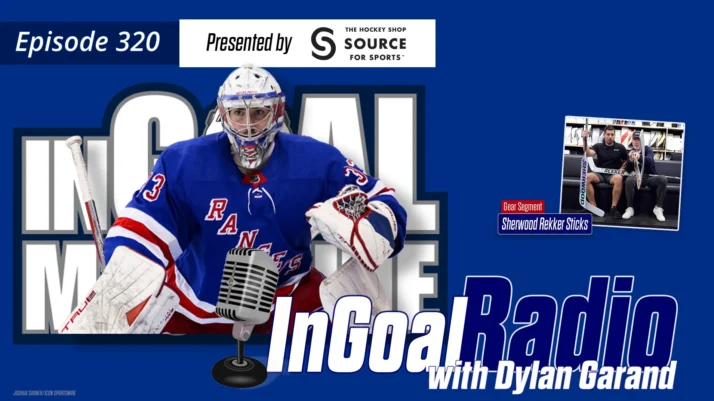
InGoal Radio Episode 320 with Dylan Garand

Please subscribe and leave a rating — it helps us reach more goalies!


Rangers prospect Dylan Garand, at just 23, credits a deliberate goal-setting strategy for earning AHL All-Star recognition and cites mentorship from Benoit Allaire and Igor Shesterkin as central to his development. He also trained with Dustin Wolf, who shared positional and patience keys for handling long lateral plays in zone — advice Garand applied to his evolving on-ice game.
- Dylan Garand used a structured goal-setting strategy during his first three AHL seasons that contributed to earning AHL All-Star recognition.
- Garand credits Rangers goaltending coach Benoit Allaire and starter Igor Shesterkin as key influences on his professional development.
- Time working with Dustin Wolf helped Garand refine his off-season focus, including positional patience on lateral zone plays.
- Garand discussed how his mental approach off the ice has evolved alongside his technical game, offering a model for developing goaltenders.
- The episode's parent segment covers best practices for communicating starting goalie decisions to young goalies and how parents should respond when those practices fall short.
Episode 320 of the InGoal Radio Podcast, presented by The Hockey Shop Source for Sports, features a great in-depth interview with top New York Rangers goalie prospect Dylan Garand.
Feature Interview
presented by NHL Sense Arena
In the feature interview presented by NHL Sense Arena, Garand shares stories and insights from his first three seasons of pro hockey, including the goal setting strategy that was part of being named an AHL All Star least season, and lessons from Rangers greats like Benoit Allaire and Igor Shesterkin. Still just 23, Garand also talks about his experiences at the World Championships and some great advice on how his game has evolved, both off the ice with his approach mentally, and on the ice with his off-season focus, including time with and tips from Dustin Wolf.
Parent Segment
presented by Stop It Goaltending U
In this week’s Parent Segment, presented by Stop It Goaltending U the App, we dig into some advice on how and when to tell a goalie who is starting each game, and how to handle things as a parent when those strategies appear to be falling short of best practices.
Pro Reads
presented by Vizual EdgeWe also review this week’s Pro Reads, presented by Vizual Edge, which features Wolf sharing some of his positional and patience keys when facing a long lateral play in zone.
Weekly Gear Segment
presented by The Hockey Shop Source for SportsAnd in our weekly gear segment, we go to The Hockey Shop Source for Sports for a closer look at the new Sherwood Rekker stick.
Episode Transcript
Intro
Paying our respects to the great Ken Dryden on InGoal Radio, the podcast, Daren Millard, David Hutchison, and Kevin Woodley. I don't think anybody, has as much of an influence on them as Kevin Woodley when it comes to number 29 with the Montreal Canadiens and Ken Dryden. The artwork, the tattoo that, you have on you, and just, some thoughts, guys, before we get into the discussion on this week's episode of InGoal Radio Podcast presented by The Hockey Shop Source for Sports Langley, thehockeyshop.com. Just, your memories of Ken Dryden and maybe what he meant to you as an influence and if there's a game or a year or a part of his style that stands out to you. Start with Hutch because you would have certainly been familiar with Ken right in your wheelhouse as a guy coming up through the ranks.
He just called you old.
Yes. He did, and I am. I admit it. Yeah. Right from the beginning.
It was, honestly hit me kinda hard this week, guys. When I started playing goal back in 1971 was a big year because Ken Dryden came up to the National Hockey League. And I still have a scrapbook in the back room somewhere with all the newspaper cuttings from the Stanley Cup final against the Chicago Blackhawks. He was, you know, he meant the world to me because my parents raised me as a a Canadiens fan at that time, and then they held him up as my my hero, so to speak. I think he was a a wonderful example for for parents to hold up to their children as a hero, not only because he was this incredible dynamic athlete who who redefined the game in many ways, but everything that he did outside the game.
And to be able to hold up the academic, Ken Dryden to me as as a young boy, I think, meant meant a great deal. So, yeah, he's he is my absolute first impression of hockey. He is my he is my first memory of hockey. I remember my mother stitching 29 onto the back of my team jersey because it wasn't available, to our team back then. And I I am one of the regrets I have of this podcast is that we were never never able to have him join us for for an interview.
I I was fortunate enough to meet him only once. I met his wife, Linda, many times, because I was an assistant coach with a team that his son played on in high school, and, just consider that a privilege to have, been able to have a short conversation once. And the impact that he left on me will will not soon be forgotten. And, you know, I've been, speaking to many, many goalie coaches over the last week here, and the impression that he left on so many people of our generation at at very least, is is remarkable. So, will be missed.
Woody, you've got the tattoo on your arm.
Well, that's see, the the interesting thing here is Hutch talked about 1971, and I wasn't born till 1973. And so we've actually I'm still old too. Don't worry. But we've actually we talked about this once in the past, how, like, he wasn't part of my formative years in hockey. Also, let's not forget I didn't play the game growing up.
Like, I didn't fall in love with the position at a young age, so I didn't have the same experience. So you're right, though. I have a half sleeve tattoo, including, a quote from the game tattooed on the inside of my arm and an image of him in that infamous pose, you know, leaning on the stick under his chin as as part of the design, as as the main part of the design. So but his impact on me, I read the book more than once. And obviously, like, the numbers jump off the page, and I've I've seen some of the videos, and I've heard the stories.
It it was the impact he had outside of hockey, and it's been well documented. The work he's done to you know, on concussions, all the different books he's written, Canadian politics. But the real thing for me was reading The Game during the pandemic and my daughter noticing. And I don't read a lot, and that's shameful as a writer. You should always be reading because that's how you get better as a writer, but I consume so many stories during the day that I don't feel like picking up a book at night.
It's it's kinda lazy. So when she saw me during the pandemic reading a book and then found out that I'd read it before and I was rereading it, she was curious about why. And so when I explained it, it clearly and what it meant to me and the way he wrote and and, you know, his thoughts on the position and the life, the sort of everything about it. It clearly resonated with her. And so she did a painting for me that Christmas, and it was remarkable.
It's it's it's right over my right shoulder here. I put that on social media at Christmas with a picture of her holding it up, and somehow it made its way to Ken Dryden, this image. And it must have resonated somehow with him because he had someone reach out. It was actually it was Roy MacGregor who, like, just having him reach out to me was an honor, frankly, because there's another guy who I hold in very high esteem as an author. Just incredible.
If it would be okay for Ken to reach out to my daughter and just talk to her about art. And I with the caveat that she wasn't a hockey fan, I'm like, you know, like, she's not gonna she doesn't know a lot about about Ken Dryden other than what I've told her. And absolutely. Well, a couple days, he later, he called, and they talked for close to an hour about art, about life, about what it was like to be a teenager in the pandemic doing online schooling and all the things that came with it. And there was a sincerity when she got off the phone.
It was clear there was a sincerity in that conversation despite the multiple generations that separated them that really resonated. And one of the things that I'll never forget is she said that there was an artist he really wanted to tell her about, but for some reason couldn't remember the name. They talked about all kinds of things, but he really wanted to make sure that she checked out this artist because he thought this artist would resonate with her the way she had done her painting, which was kinda unique. And I can't remember it was the next day or a couple days later, he emailed her the name of the artist and a kind note. And it just you know, Hutch talks about heroes.
And even though he wasn't necessarily somebody I grew up with, was just somebody I looked up to. And when they turn out to be that kind of person as well, like, think there's been a lot of stories like this since. But when it when you when you've experienced it personally, even through a loved one and not directly, because believe me, I asked my daughter if she would please share the email address so we could have Mr. Dryden on our show. And she didn't.
She should have written for you then.
Yeah. It was it just it it left a real it left an impression with me. Obviously, enough of impression to have an impression of him carved into my body in ink and blood. So, yeah, that it's a really it's a different way of looking at it. I know, like, that's not like I didn't grow up.
Like I said, I did not grow up with Ken Dryden, But the impact he had on, society, on the world, on the hockey world, on goaltending, and then to sort of see that he would take this time, you know, to speak to this young person who's, like you said, caught in the middle of a pandemic and all that that that whole generation went through. It was it was really special. It was really something. And so, when I shared the news of her of his passing with her, she was set she was touched. She was sad, and she gave me permission because I've never shared this story before.
Because to me, that was that was their moment. That was that wasn't my story to share. It was between the two of them. But once he passed, she said it would be okay if I shared that as well, and so I'm sharing it here today. It was, he had a pretty profound impact in that hour that he spoke with her.
It's amazing. That to have that conversation with him and not necessarily at the foundation of goaltending, which is a bit of Ken's MO was to expand be way beyond hockey and goaltending and athletics and to be be more bigger picture.
Yeah. And like I like I said, like like the caveat I gave, to to, Mr. McGregor when he reached out was that, hey, like, she's not a hockey fan. I wasn't sure if he would like. There's a little part of me that's like, you know, you just think like, oh, like, I don't know what they're going to talk about. I don't know if he'll even call.
But of course, like how silly that is because of what we know of the man. And like I said, it was close to an hour, and I'm sitting there. I remember what had happened when she got the call. And I've I I was I was very jealous. I was very jealous that she was having that conversation instead of me.
And and yet in some ways, it it meant a lot more. You know what I mean? Like, to just like you do imagine. Like, you imagine, like Oh, yeah. His position in politics, his position in life, his position in the world.
And just based on seeing this this art that she had done that was quite unique and the way she had captured him with with this painting, to have it resonate enough to reach out like that just just said a whole lot about the person that he was. Yes.
Similar, one degree of separation. My interaction with Ken, he worked for the Toronto Maple Leafs and he was my wife's boss for a number of years. So I met him through Jen, and remember the first time, was on a road trip to to Montreal, of all places, imagine that, and shaking his hand and being in awe, that's Ken Dryden, and then subsequently met him a few more times, and never got in-depth about goaltending, but will always remember that. But as an athlete, when you look back and go through the numbers, he played seven full years in the National Hockey League, and had single digits in losses in five of them. And the other two were 10 losses.
Now there's ties back then, but just the incredible, I don't expect to be another career like it where you leave on your own terms.
0.922 save percentage, which, you know, we we always have arguments about the goats of, you know, like in and and what like, I believe that tops them all. I think it's one point ahead of ahead of Hasek, not that we can compare errors. Like, there was just everything about him was remarkable. And we've seen remarkable athletes before, but they always they don't always end up being remarkable people, and he was both.
I think it's inspiration for for kids and families too because we hear so much how hard it is to transition from the game. And, you know, for an elite athlete who has risen to the National Hockey League or to the Olympic Games and other sports or or whatever the the top of your sport might be, it is so hard for so many of those athletes who define themselves as a goaltender, a basketball player, a sprinter, whatever it might be. And I think Dryden I mean, putting putting his education before everything else in the middle of his career, I know it was around a contract dispute as well, but but he made himself more than just a goaltender from a really early age. And I think that's a a great example for helping everybody as they transition. And you know what happens to it happens to NHL, players, but it also happens to young kids sooner than you expect as their their dream ends when they they don't make that triple a team at u eighteen with their last shot or they don't get the shot at junior hockey that they they dreamt of.
I think we have to prepare our kids for for life beyond hockey, and and he was a fantastic example. I've got a book on my shelf here, guys, that I haven't even seen mentioned in all the talk of what Dryden's done. It's called InSchool, and it's, about our our education system. He went in and joined a high school classroom in in Toronto and and wrote about the experience of being a student in a classroom, at the time. And that was inspiring in my journey in becoming a teacher as well.
And I think it was actually an underrated piece that that he wrote. Yeah. Just just inspiring, and I hope, I hope it touches some some other people as well and helps us help our kids.
Do we talk about the hockey side enough? Because he was so multidimensional. Like, there was the political career. There was the managerial career. There's being an author.
There is so much to Ken Dryden. I feel like it washes out some of the accomplishments from the Summit Series. He was in goal in game eight. The six championships in seven full years
Mhmm.
In the National Hockey League.
You won that first one, as a late season call up. But there's Trophy before he'd ever lost a regular season game in the National Hockey League. Hadn't lost a regular season game, and he won the Conn Smythe trophy. Mhmm. Then he won the Calder trophy after the Conn Smyth.
Remarkable. Yeah. Remarkable. You're absolutely right, Daren. I mean, look, there was a lot of debate at the time.
I remember, even though I was young, everybody saying, well, he's just a product of of the Montreal defense, which was so vaunted. Much as we've heard some people say, about Martin Brodeur, and yet we haven't let that tarnish his image. We we recognize him for the greatness that he had. I think Dryden deserved to be recognized more at the time. I don't know that he did get recognized as well as he deserved at the time despite all those honors and despite all those performances.
And, and certainly does deserve all those accolades.
Hey, listen. Like, for sure, the Habs were in modern day parlance away. Mhmm. But his record at Cornell was 76-4-1. 76-4-1.
And I don't know anything about college hockey, but I'm guessing that that they they were not as vaunted as the Montreal Canadiens. Clearly, that conversation about goats as much as it's hard to compare air as he belongs to, you know, in that conversation and being a big part of it.
One of my favorite trivia notes, when it comes to Ken Dryden was he was drafted in 1964. Yes. Third round. Now, not many teams, but third round, and drafted by Boston.
That's right. That's right. And
then becomes all world, and from a goaltending family with his deceased brother, Dave.
Yeah. And I actually have the book, is it Playing the Ice at Both Ends? I forget the name. It's it's here somewhere about the two of them growing up written by his father, I believe it was Murray. And it's funny because I think I've seen Ken interviewed and he sort of downplays the moment between him and his brother, but I can still picture the two of them meeting at center ice and shaking hands after the game.
What a what an incredible thing for brothers to start games against each other in the National Hockey League.
I don't know that as much as we're talking about Ken today, I don't know that Dave Dryden gets enough
Amen.
Enough sort of not respect is the wrong word, but enough credit for every goaltender in the world should be grateful Yeah. To Dave Dryden. He is essentially the guy who brought us the combo cage. Mhmm. It was him who put together a rudimentary design and and one of what he wanted it to be and and took us to great position.
Had the the bars on top
of fiberglass. Over a fiberglass, but it was Dave Dryden who created one and then took it to Greg Harrison who made a final finished product that I believe Dave was then the first to wear with the Oilers in around 80/81 or '81, '82, and ultimately took us away from either the fiberglass or the in your your like you said, with with Tony Esposito with the wire cage over the fiberglass, or the other option was the the original combo, which was the player helmet with a full full bird cage. So, you know, it's, again, remarkable family, remarkable brothers, and Ken Dryden, just a remarkable, as we've said, not just goaltender, but remarkable person and and will be missed for his impact, both on on the ice, on the game, and, on a lot of lives outside of it as well.
What kind of stick would he have used? Canadian? Was it Sherwood?
The one Canadian.
He was a Canadian.
Yeah. Definitely one of the
most Was it Canadian? Yeah. The one that the famous I think one of the most famous poses or at least the one tattooed on my arm, he was wearing a Canadien.
Gear
Oh, he was Sherwood. Over the course of his career, which leads us into this week's, gear segment. It's almost, leaning on this, but the Sherwood Rekker, line of goalie sticks, which I use personally. And, that is our Gear Segment presented by the Hockey Shop Source for Sports Langley, the hockeyshop.com. And I'm sure that there is a lot of conversation about Number 29 around the hockey shop.
I'm sure there was. Although us old guys may have to go in and educate some of the youth at the Hockey Shop because it's a younger generation. And I don't know how much time they had to talk about anything these past couple of weeks. They have been just jammed up. So busy in there with people coming in and getting gear.
And why wouldn't you get your gear from them as it's time to head back on the ice and get back into hockey? They have such a big selection. And it's funny because we talk about all the new stuff that comes in, and we'll have the Sherwood Rekker stick this week. CCM Vizion stick is coming out. Like, we're into September, and and the days of all the gear launching in April are clearly behind us.
There's new stuff coming out all the time, and they're on top of it. All the new all the stuff that came out in the spring, inventory for all, and the experts to make sure you find the one that fits your game plus previous generations on sale. There is no better place to get outfitted for your back to goalie back to hockey season than the Hockey Shop Source for Sports, thehockeyshop.com.
The Rekker from Sherwood on InGoal Radio, the podcast.
Oh. Something new. Sherwood, get wrecked, Cam, with a Rekker Sherwood, this is sure Shirley.
Shirley, you could have thought of something better than that,
Don't call me Shirley. Sherwood, in the goalie stick, like, when's the last time we saw a Sherwood goalie stick? They've been around.
It's just still it's been a minute since we've we've had one in the area
of the shop. Well, this is a nice Welcome back to the Hockey Shop Source for Sports. We have the new Sherwood Rekker Morph Pro goalie stick available. And, Cam, I'm gonna leave it to you to walk me through all the specs on this one because it is the first time I've seen it.
Yes. When it comes to composite sticks now, I mean, we have a market flooded with different options and things like that, but it's always nice to see an additional option, especially when it's a legacy brand too that's kinda gone away for a little bit and now kinda had much more of a resurgence as of late.
This isn't your dad's Sherwood. This isn't the old 7700 wood stick.
5030 wood stick.
Fifty thirty. I got a buddy in Bear Lake that still has one of those.
Well, those weigh a ton and this doesn't. Let's start off with the weight
of this. Under 600 grams, I understand.
Feels like. 95. Nice. So
so so not the lightest stick we've had on the show, but definitely on the light scale, like, towards the the lower end of the weight scale.
Yeah. As soon as we hit that under 600 grams territory, like, we're gonna consider that a light top line. Stick. Yeah. Exactly.
And I think part of the thing that we can't stress enough too as well is that because it's super light doesn't necessarily mean it's better. So having a little bit of weight, not necessarily being the lightest.
Durability, things like that. Can't
aid in that. Exactly. Okay. So start with the basics. Curve. They call it a G92. What is a G92?
It's not a G92. That's that's the blade technology that
helps G92. See, I'm learning. Vibration dampening. Okay. Inside the actual blade
of the stick itself. G nine I see it's got a little like, that means Your means little WiFi signal? That little WiFi signal means dampening.
Dampening. Vibration dampening. K. Curve itself. Start with that.
Yeah. Let's start with that. So what Sherwood definitely refers to as their PP31, which is a lot like a P31, which is a lot like a P4, which is a lot like a twist, which all means that it's a very similar curve to your standard curve off the wall to many of your other favorite brands in terms of for goal sticks.
You know Round. Do you know how G92 works in terms of vibration dampening?
You know, it's got that little so that
it So that makes it so there's technology in
there. There's technology.
So the other thing that's in there that's quite obvious when you grab it, I don't know how well it shows up on the camera, but really flat blade on the front which should aid on the on the front of your paddle. And on the back, it's it's it's sort of rounded. Like, it's the geometry is unique. There you go. This is designed in this uniframe construction to do what?
So a, that's gonna give you a very consistent rebound. It's also maximizing the coverage of the stick too as well. I'm not shrinking that paddle by rounding it. I'm expanding it basically by flattening it to a better degree. So more consistency in terms of that rebound pop, you know exactly where it's gonna go.
Grip. Little grippiness on there. Kinda goes down right over the I like that they included the grip down over the finger. So if you're holding it down there, you still have a little bit of grip. Sometimes we see it sort of just on the handle, but they've got it down over the finger like slide your finger up
the shaft a little bit you can feel how you get more of that texture about midway up. That's going help you grab the stick with your glove on that kind of overhand kind of style tee up grip.
It's the Go Zone.
Exactly. In terms of flexing and loading that stick.
Yeah. You can feel that grip for for like turco grip in here, but then you're right. You easily slide your hand up there. The shaft itself rounded edges which will help with breakage as opposed to really sharp corners, but Correct. You know, pretty standard rectangular shape on that, not some of the more unique variations that we've seen some other brands. So just mean, at the end of the day, we gotta get out there and feel it, see how it flexes. Do you know what the kick point is?
I know off the top of my head. I'll be honest. It'll be on
the website or if you have any questions about the Sherwood Rekker Morph Pro stick Mhmm. Which is retailing for $2.99 Canadian. So, again, higher end stick, but not the highest price point you have here. So a deal to be had.
Correct. In terms of for especially, you know, versus some other things on the wall here. So a great option, good overall feel, b similar sizing to now what we consider standard. So we'll use the, you know, Bauer example. This is going to line up like one to one.
So if you have any questions, give me a call (604) 589-8299. Depends on what sizes are available, what's gonna work best for you. We can talk about it. We can check it out, and it's good to see another option and cheer with back. We're gonna
make Cam go play with it so he can tell us how it flexes. He thinks he can shoot the puck folks. We'll see if he can with the Sherwood Rekker.
They're good sticks and and the just ability to withstand the the pounding from two years ago to last year, really improved product, and, I enjoy it. 25. I use the 25 inch paddle.
So, Daren, you if you're standing up for its durability given that you see NHL shots in your skates, that's a pretty you're the only one amongst us that's actually used this. So that's a pretty that's a pretty good statement.
Now when I get down to about two left in the year, I start using a warm up stick and let it take the brunt of it so I have it for my games. I will say that. And here's here's the thing. A couple years ago, up in the shaft, it would get nicked, and it would break apart, like, and day. They I don't and I didn't give them that feedback.
You mentioned it, but not that it changed it for me. But it amazing how the shaft of the the wrecker was so much more resilient than it was the year before, so credit to everybody over at Sherwood.
Hold on. Did you just say you use warm up sticks?
Yeah. I I'll I'll use the odd stick from somebody else that doesn't have the
The Daren Millard special.
Yeah. It doesn't have so the when Sherwood sent it to me, they put a Wheat King on it for theBrandon Wheat Kings.
Oh, nice.
So so they they know they know it's so everybody knows it's fine. But so when I get down low on my supply, I wanna be able to use it for actual my my men's league stuff, so I I will go out and use somebody else's twig for the wear and tear of a of an NHL practice. So, yes. Well
Welcome to the dark side.
Without even thinking about it, I give you credit for the warm up stick. And and
Welcome to my world. It's really bright and sunny here.
It didn't even jump out at me until I was telling you guys a story before we hit record. And you said, warm up stick? I'm like, yes. Yes. I do.
Honestly, if there's Slow. If there's anything we've ever accomplished on this show, it might be giving parents permission to have a warm up stick for their children and make the game a little bit more affordable.
Like, hammer away on that one stick in drills and practice and use your good stick for the games. Makes sense. Was just slow to it and it took me a while to get around to it because I just love the sticks, but I'm like, I've only got two left, I gotta save them. So I'll lean on somebody else's in the room. Can you go grab me somebody else's stick?
They they will. It's always good. And it happened by accident because Jack broke one in her shot, Jack Eichel, broke one in her shot, and I only had one stick out there. And so somebody just grabbed another one and gave it to me, so I I took that one and used it for the rest of the season.
Just that little subtle Jack broke one.
Yeah. You You didn't say or something like that, but
I I do not call them Ikes. I don't know what other nickname Jack has, but I I call him Jack.
Oh, I think you might be deferential and say, Mr. Eichel broke my stick.
Would you mind? And and nobody hits the shaft of the stick when I'm skating more than Jack. I get it's ridiculous how accurate he is, and it bugs him so much because because it's like, are you putting that there on purpose? I'm like, no. No. You're just Of
course you are.
Miss I'm missing it.
It's an extension of the hand. You're right. Take all the credit.
You're right. But but he he hammers it all the time, and he's the one that that I noticed was breaking the the handles of it. But last year was great.
You need to see what I what I've done, we've got a guy who played in the NHL, definitely not at Eichel's level, but on our Monday night skates, Anthony Paluso. And if you've played in the NHL, you can shoot. And Anthony likes high blocker and warm ups, and I can't quite catch up to it with the blocker hand sometimes. And so, inevitably, it goes off the shaft. And I like, I just almost need to start whispering in his ear, you know, low blocker is a better place to score because I can't afford this. Because you
can't I I do chirp the guys all the time when they hit it.
I'm
like, good goaltending. Touch that.
Heck yes.
Probably probably probably $1,200 worth of sticks in warm ups alone. Thanks to Mr. Paluso over the
last painful.
Over the last year. He's he's high blocker king. So that's why I too have switched to the warm up stick because he even goes through those.
Dylan Garand coming up in our NHL Sense Arena feature interview. We've got our Stop It Goal Tending U the app parent segment with David Hutchison. But I wanna mention and, oh, don't forget the Vizual Edge ProReads. We got a big contract extension signed to the Calgary Flames, Dustin Wolf. Seven years, 7 and a half million dollars.
Sounds like a lot for a guy with a full year NHL under his belt from a season ago, but when you look at the track record and what he did from junior to the American Hockey League and the awards and the trophy case and the accolades, that he was able to rack up, seven and a half could be one of the great moves by Craig Conroy and the Calgary Flames.
Yeah. Especially with the cap going up. Right? Like, it's seven and a half next year. At that point, it will be the tenth highest goalie salary in the league.
If we're talking about this year, he's not he's not on the extension yet, but if you were compared to this year's, it'd be the eleventh. Out of the 10 guys ahead of him on that chart this past season, his adjusted save percentage was better than eight. Only Connor Hellebuyck and only barely had a better adjusted save percentage than Dustin Wolf in his first full season in the NHL. You can talk about the progression, talk about the fact he's been in American Hockey League Goal of the Year twice, an MVP. You can talk about durability and games played, how consistent he's been in terms of staying healthy, and there might be something to quote, unquote smaller goalies there.
Big goalies have long hinges, and long hinges create a lot more pressure on the joints. His ability to keep his his edges underneath him and not get extended. There's just there's so much to like about his game, and statistically, it's translated at an elite level so far in the NHL. Does that mean that it's gonna be a straight line progression or even consistent? That's the challenge.
Right? Like, this is a position filled with volatility, and anytime you sign someone to term, it comes with risk. The game changes. What makes a good goaltender has changed over the course of the past seven years. Maybe we're seeing a trend towards smaller goalies as if he kick game becomes incredibly east west.
So a guy that signed a contract seven years ago might not fit today's game as well. So that risk, that's all there because things change fast. But, if I'm placing a bet, do I like placing a bet on Dustin Wolf? And not just because you mentioned ProReads. He happens to be this week's ProReads guest.
I just like everything about his approach. I like the fact that he is locked in on a foundation without being so locked in that he's not willing to change. Like, it's evolved in the four years that he's been there. He's identified things that he needs to get better at and gotten better at them. He's changed positionally how he plays.
Like, he's just got such a great combination.
Changed positionally?
He is less aggressive. As a matter of fact, it'll come out in next week's ProReads. We've got a great one there where he talks about how much less ice he takes now compared to even a couple of years ago. And this is the great irony. If you ever see a announcer in the National Hockey League talk about Dustin Wolf being a small goalie and having to be more aggressive.
You have permission to punch your TV because he may be a smaller goalie, but he is not. He is almost never not connected with the crease. Rare to even have him heels out, and he talks about that with us. And so it's ironic to see these guys who are six foot four playing, like, two skate lengths out of their crease when you've got him able to hold his edges and be patient and almost always contained within the crease. And that's an adjustment he's made after winning American Hockey League goalie of the year.
The first year, he started to make it the next season with Mackenzie Skapski coming in a little more Benoit Allaire style philosophy, Daren, which you'd be familiar with, you know, with Sean Burke there in Vegas. And so, again, a willingness to adapt. You'll see it in our ProReads coming up later on. We did a full hour with him, and some of the stuff later on, like the the last few clips that I had were low high place. And here I am admiring his patience, and he's like, I'm not sure I need to be in reverse here.
And sort of so I wouldn't be surprised to see that shift and continue to evolve in his game where he's so good at holding his edges. Maybe you see him on his feet more even on post play opportunities. So, again, just a student of the game. I do think it'll also come through in his ProReads how much of what he does is based on his belief in how he plays. And as much as he's reading handedness and all those things, he's just going where the puck is and trusting his abilities.
There is very little it's a fine line between reading the game, anticipation, and guessing. And I don't think on that sliding scale that he tips over to the guessing point at all.
He got paid after one year, but the Calgary flames were also very patient with them coming up from being drafted and with high expectations, with time in the American Hockey League.
You could argue he was patient with them too because given how he how well it went the first couple of years, there are some guys that would have been like, hey. I should be up Mhmm. In my third. Thank you very much. Yeah.
I listen. Like and I think it's a great point to talk about. A lot of people have said, I can't believe you're paying him after, you know, 71 games in the NHL. Think it's his total. They had some early call ups in the earlier years, little stints here and there, actually, that were really important to him because they helped him inform the changes he needed to make or buy into that he could succeed in the NHL playing the same way he did in the AHL.
Because I think early on in some of those call ups, he did become more aggressive thinking, okay. This is the NHL. I need to take more ice. And, you know, I just think that the way the way he plays, I like let's just say, I like this bet. I like this bet.
Far be it from me to be a petty person, and I don't blame him for taking the 7.5. But I've been I would have been so tempted to ask for 7.3. Because if I'm right, he was drafted with the thirtieth pick in the seventh round. And it would be a nice way of saying that a whole lot of teams could have had him.
That that will be looked at on draft retrospectives.
Well, I mean, it already has been. Right? I mean, there are some smaller kids who've been picked much sooner like, Jack Ivankovic this year. Right? Taken by Nashville, much higher than Dustin Wolf, who was almost passed over completely despite being a two time CHL goalie of the year.
So I think things are shifting. They're still picking big goalies. The giant guys are still gonna get more chances. But I think some smaller guys, thanks to Dustin Wolf and and some others, are are getting opportunities.
Yeah. Yeah.
Juuse Saros. Like, we're starting to see that. And, Daren, to your point, I didn't answer that question very well, but you you did a great job of talking about the previous accolades and Hutch just mentioned the two, you know, CHL goalie of the years. But but I think anybody that looks at it and says it's just 71 games, it you really do need to pay attention to what he did in the American Hockey League. Like, they're not as much as it's about what you can do in the NHL, they know this goalie.
They've seen the body of work. They've seen that evolution. They've seen the willingness to work and change and evolve and do all those things for four years now. So I think his body of work goes so much bore more beyond the 71 games in the NHL. And I think that there's always risk, but I think it's mitigated somewhat by the fact that they know him so well.
It's it's if I'm making that bet, it's on the devil I know, and there's a lot to like about about the goalie they've got.
Opportunity to hear from him on the Vizual Edge ProReads, Vizual Edge giving you an opportunity to improve your goaltending through the art of, visualization.
Visual Edge? Well, let's just let's ask Jordan Binnington what it's done for his game. Visual Edge has added a quality element to my preparation as a goaltender. I use the game day drills every game before heading to the rink. It's a combination of recognition, reaction, and focus that activates my brain and eyes to feel ready for what's to come.
Now remember, folks, Vizual Edge sponsors ProReads over at InGoal, and it is the perfect marriage between the two things because ProReads and this week with Dustin Wolf are all about helping you see the game better so you can read the game better, What to look for anticipation. What kind of cues should you have an eye on? Vizual Edge gives you the tools to see those things better. It's an online vision and cognition training tool that will help you improve your visual skill skills, improve your cognitive function. Those are all things that Visual Edge does.
InGoal, I n g o a l, all caps to get 10% off Visual Edge monthly and annual subscriptions. InGoal members receive 20% off. How do you get that code? You log in to your membership at InGoal premium and you go check out each week's ProReads. The 20% off code is there for members when they log in, including to this week's ProReads, which is Dustin Wolf breaking down the keys on a lateral feed cross ice to a guy wide open and the decision, again, we're talking about depth there and why he doesn't step out further on this guy, the keys to his patient off patients off reading the release, and why sometimes it's okay to stay a little flat when there's a backdoor pass option.
So a great video breakdown by Dustin Wolf, up right now at InGoalMag.com. And if you're a subscriber and you get to check that out, it means you can also check out the code to get 20% off Vizual Edge.
It's my favorite goalie to watch. Right now in the national hockey league, like, that Just the way that he can read the release and is skating. Those two things just jump out at me.
And we talked about our future guest this week, Dylan Garand, skated with Dustin Wolf this summer. A lot of the I see a lot of similarities in how they escape, and a lot of the drills that we talk with Garand about are things that he's doing based off those. He's added things to his repertoire in the off season and in his warm ups based on learning them from Dustin Wolf.
Parent Playbook
Get more on that, with Dylan on the NHL Sense Arena feature interview in just a little bit, but first Stop It Goaltending U the app parent segment with Hutch as we pay tribute and appreciate the partnership with Stop It Goaltending.
Well, the Stop It Goaltending U app has a lot of great features every week. This week, it's loaded. So there's new material every week to help you become a better goaltender. What they do a really nice job of is breaking it down into quick, easily digestible items, but then also giving you things you can dig into that are a little longer. They've got their weekly primer.
So Monday, Tuesday, Wednesday, Thursday, Friday, you get a quick one minute video. This week, it's about process versus product goals. They also give you NHL video. They've got Kevin Lankinen with an off center tip where they break down the video and watch how he handles it. Jacob Markstrom, a little bit of a deeper dive into how he manages a low versus a high stance, and a drill that you can take out on the ice yourself.
Two shot net drive pass drill. All available this week on the Stop It Goaltending U app. There's new content every week. They bring twenty five years of goaltending experience led by Brian Daccord, former Boston Bruins goalie coach, Toronto Maple Leafs goalie scout, Arizona Coyote's director of goaltending, and now the Detroit Red Wings director of goaltending. All the knowledge from his twenty five years in the game wrapped into an app.
And, of course, as a bonus, when you subscribe to the Stop It Goaltending U app, you get a membership to InGoal Magazine premium and InGoalMag.com, the best of both worlds. So, make sure you check them out today on the App Store or the Google Play Store. Stop It Goaltending U, the app, and get your free subscription to InGoal Magazine included when you subscribe.
It's one of the most popular parts of InGoal Radio, the podcast, the parent segment brought to you by Stop It Goal Tending U the app, Hutch.
Thank you, Daren. I'd actually this segment that we're we're about to do, I'd I'd actually prerecorded this in case I'm not able to join you guys for one of the shows. And I was gonna write something separate for today. I've actually got a couple of things that that I'm working on. And then today got away from me because I have been on the phone since 07:00 this morning, pretty much nonstop with goalie coaches all over North America.
Fabulous conversations. I am learning a ton from all of them and, talking to them about a program that we have for hockey associations. And so if you are a coach, if you are a parent who is an executive on a on an association, anybody who's got an interest in goalie development, I would love to have a conversation with you. And, very easy. Just find me david at ingoalmag dot com.
And because I haven't left this desk in the last twelve hours pretty much, I didn't get a chance to finish off what I had hoped to do this week. So I will I will come back with a couple of these other things next week, and we're just gonna dip into what I recorded and, but do it do it live here, of course. I got a question from a parent. I think it was probably a somewhat loaded question, but was wondering what is common in deciding when a goalie should be told if they are starting a game. I I don't know the exact situation.
I'm not using the parent's name because I both didn't get permission and because I sensed it was a an uncomfortable, drive back from a hockey tournament where this had been sent from. Shout out to him though because he did say that he was listening to the InGoal Radio Podcast for the entire drive home from this tournament, so that was awesome. And, and just wanted to know what is common. And I must say that virtually every goalie parent goes through this and most goalies wondering how should this be done. I'm I'm not we are never here at InGoal to tell you how you must do things.
We're just gonna share some of the stuff that we know. Daren and Kevin, if you have experience with this, I would love to hear what you'd like to throw in. I will just tell you what I told this parent. The day before a game is very common, probably more common than it should be. I know goaltenders would like more notice.
In minor hockey, I have to say, if I could stand on a soapbox where goalie should be splitting their games evenly, coaches, if you're listening, it makes sense to let the goalies know at the beginning of the week who's gonna be playing in the games on the weekend. It's not just so that your goaltender can be prepared, but there are practicalities like not wanting to be that parent who has to drive your kid four and a half hours to a game to watch him sit on the bench when they maybe could hop in with another family. Or grandparents wanting to come out and see their kid. This is minor hockey. This is for fun.
Coaches, let's tell the kids what the rotation is as early as we can. In junior hockey, it gets a little bit different because it's all about winning and they make decisions often quite late. I don't know that they need to. I think there should be a plan, but I know that decisions can often be made based on the previous game's results. Sometimes, late at night, sometimes even the morning of the game.
That's kind of the reality of what guys end up stepping into. National Hockey League level, I think most teams are a little bit better than this. I know of one team specifically that actually plans it a month ahead. And both goalies know
which team they're doing.
A lot perfect. Thank you. That's that's great.
More common than than not.
Remind me at the end of this to tell you about the one time the goalie coach was pissed because the head coach got the final call. And on Friday night, he still hadn't informed either goaltender who was starting a Saturday afternoon game.
There you go. So back to minor hockey for some of these guys in the National Hockey League. It look, it's a little bit easier in the NHL where often you're riding a guy and you're planning out his rest based around what the schedule looks like. However, we can definitely do better with the young kids. Here's the advice though that I did give.
As frustrating as it is, there's probably close to zero you can do to change it as a parent. It's great to learn what's normal, but really honestly, I think it's probably only helping you feel justified. And in practice, like I said, it's not going to make much difference. Maybe if you're a coach listening and you hear what other people do, that's useful. But as a frustrated parent, I don't know how much it helps.
I would say if you feel compelled to speak to a coach about this, frame it very gently. You can share why it would be helpful. You can explain about the logistics for families and grandparents and friends. You might find that the coach hadn't thought of those things, honestly, but be ready for them not to care. I wouldn't lean too hard on the I need to be ready aspect of it because most coaches, even though it's not completely fair, are gonna expect their goalies to be ready no matter what happens.
They're gonna give you the old, well, what if he has to go in because of an injury? Needs to be ready. This is why I would recommend something that I talked about in a previous week's show, which is to use the uncontrollable stuff to your advantage. Make the decision consciously that you're gonna thrive even in situations that other people find frustrating. Don't buy into the frustration.
Decide that you're the kind of person that doesn't care. If your goalie partner and their family are upset, you're gonna be the one that doesn't care because you can deal with it. You are ready whenever you're called, whether it's the morning of a game, halfway through a game, whenever. I promise you that that kind of a mindset, which does take practice, builds into a real mental strength over time, that knowledge that you can thrive in other situations where other goalies are rattled. I also think as a parent, need to think long term.
Even if you could change things this season, next year, your kid's gonna have a different coach and they're gonna have different challenges. And developing that ability to thrive under any circumstance prepares your goalie for whatever comes later. And at the highest level, you're gonna have zero control. So why don't you help your kid get ready for that now? For what it's worth, I have not said anything more than hello to any of my son's junior hockey coaches in the last four seasons.
You're not gonna have any control. One caveat I am gonna say though, I do let my kid express frustration. Bottling up that frustration with situations, be it this one or another one is not a good thing. I think it's important that we let our children acknowledge their frustration, acknowledge their upset, but don't add to it yourself as a parent by carrying on with the venting. Instead, listen and then pivot and say, yes, I know it's tough but I know you're strong enough to handle it.
You're stronger than others even. So what's frustrating to some is actually to your advantage. So that balance between allowing them to feel frustrated while reminding them that they can still thrive despite it is gonna build resilience and help them when they move forward in the game and in life. That's just my 2 cents, but I hope it helps somebody this week.
It depends on what level you're at when the goaltender when we believe the goaltender should be told that they're starting. A minor hockey, more advanced notice and taking some life particulars into play. And junior hockey, probably the day before is the norm, and NHL, a little more planning.
Yeah. I I think there's a lot of junior teams that do it a little further out too because you're in a situation where you can plan. But, yeah, for me, I think that the message is if you're a minor hockey coach, there really isn't that much to think about. Please don't tell me that you need to mull this over right up to the day before the game to decide what's best for the team based on what you saw in practice. Like, this is not the most important thing on the planet this week.
Tell the kids when they're gonna play, get on with the games. Like, really, they should probably be rotating at almost every level of minor hockey anyway, it should be a fairly simple thing is how I believe. But I know that doesn't happen out there everywhere.
Let them both play. Mhmm. Split the periods. Yeah. Let's get let's let's make this a civilized game again.
Okay. So what what will come up in a future week, and it's one of the ones that I started to write on was a parent talking about a team, of what I believe is eight year olds where the coach wants to rotate in period much like Alex Auld told us about. And the comments were, shall we say very strong against the team's head coach. So I kinda like what the coach was doing, and I'm gonna hop in on that topic next week or the week after.
You should talk to Paul Campbell. Our own Paul Campbell used to do a lot of writing for us. His young goaltender, they went through this. He's helping out with the team. And despite a little bit of pushback, got agreement from the coach, and they're switching every, I believe, every period.
So every kid plays every game. Love it. So they'll one will get two and and one, and then the next game, the other will get two and then one. I love that. Me for me, the biggest key here is that all roads lead to beer league.
And as much as we wanna know when we're starting, if you think it's bad not finding out, you know, that you're not starting the night before, try showing up at the rink and having your team be like, yeah, we don't really need you tonight. We found, like, some guy passed out in the corner and he's better. So we're gonna put him in that. So it's when they don't start you, that becomes the real problem.
If you if you split in game, do you you mentioned swapping the guys in period. So halfway through the period, you would switch?
Yeah. Look mean, look, like there's there's different models. Let's not not go too too deep since we're gonna talk about it another time. But in this case, I think it was halfway through the period. I think Alex Auld might have had a certain number of shifts they were going.
But there's a lot to that. A lot of ways you could do it. But
Embrace the chaos. Change on the fly. I
love that. And you will find a lot of young goalies if they're doing a tryout where there's multiple kids trying to get ice time. I've many times had them switch on the fly and the kids absolutely love it.
You're right. You don't have to wait for that stoppage.
Yeah.
Which could drag on.
Oh yeah. Or the play starts coming your way and you're in the middle of a change and yeah, embrace the chaos. It's fun.
Had a coach that used to do that in AAA midget, would change the goalies on the fly.
Love it.
Just to keep everybody involved. The players loved it. The goalies loved it. And, it was fun to watch. As as far as when to know that you're starting, there was coaches back in the day that would base it on a warm up.
I've heard that.
Yep. And and that was just mind blowing.
Which is hilarious because we're gonna hear from Dylan in in the feature interview talking about how some of his best performances in game have come after his worst warm ups and the idea of being able to get past needing everything to go perfect leaning up to a game to feel confident about your game.
There's there's something there about a bad warm up and great game. Always has been, over the years. The NHL Sense Arena feature interview hooking up with New York Ranger and Hartford Wolf Pack goaltender Dylan Garand, who's going into his fourth full year in the American Hockey League. Played as a 20 year old and has played a ton of games in the American Hockey League as we, give credit to NHL Sense Arena.
NHL Sense Arena. It's definitely you know, this time of year, we're heading into a whole new seasons, establishing whole new routines. And if you have not tried NHL Sense Arena, I would like to suggest that you give it a try for this season. It is the ever evolving virtual reality platform that is built for goaltenders and now players because there is a players module. And just last week, in fact sorry, not just last week, just last month, they added NCAA shooters to the NHL and PWHL lineup that is already in the system.
And they roll out new training plans from NHL goalies and professional coaches and they host regular competitions. And, of course, there is the NHL Sense Arena goalie advancement program, which Kevin Woodley has reviewed two pieces of already over at InGoalMag.com. If you're wondering what it's like, go read Kevin's fantastic reviews. The GAP program is a structured three part program that guides you through your development in three crucial areas of the game. One is reading the release.
So important. Just talking about that with Dustin Wolf a minute ago. Mastering your angles and dealing with traffic. And while we can't share all the details yet, I've already mentioned that there is a big new feature coming soon that I know you're going to love. So with NHL Sense Arena, you get realistic training year round wherever you are, including in season, including in the dressing room, including in the National Hockey League where we know Joey Daccord has used it between periods of games.
Yep. It is an incredible training experience, folks. So head over to sensearena.com and use the code I g m 50 to save even more.
Dylan Garand, the guy that, when he gets an opportunity to sink his teeth into a league, he takes a chunk out of it. Remember the Western Hockey League, 16 year old, he played a ton and got his team into the playoffs when Ferguson, Dylan Ferguson got hurt. And then now in the American Hockey League, he's playing behind Igor Shesterkin and Jonathan Quick in the NHL with the big club, and he's getting an opportunity to play a ton of games in the AHL.
Yeah. And he's he's developing. He's gonna talk about that process, the things he's learned. American Hockey League All Star last year, definitely ready for the NHL. I've talked to a lot of people who believe that.
Probably would have got a taste of the NHL last season, but just the worst of luck when an injury opened the door for a call up, Dylan sustained an injury on the same day, so he wasn't able to be the goalie called up. And then when just Daren needed some time off, the four nations break was coming. So hopefully that opportunity comes this season. Not that we wish ill health on anyone because everyone I've talked to thinks that Dylan Garand is ready for it. And he fills us in in this interview at the about the process to get there, the lessons learned along the way, from Igor Shesterkin, from Jonathan Quick, from Dustin Wolf, who also spent three full years in the American Hockey League before getting his shot in the NHL full time, and from his time at Hockey Canada at the World Championships playing with Marc-Andre Fleury, Sidney Crosby, Nathan MacKinnon, and Jordan Binnington.
There are a lot of great anecdotes and takeaways in this interview. Really enjoyed it. Dylan was gracious enough to have us on the ice, and we can't wait to share some of the drills at InGoal mag dot com. The way he embraces skating as a foundation, movement as a foundation, a lot of similarities when I watch him to how Dustin Wolf moves around on the ice, and his willingness to sit down and spend so much time with us after. We spent the full morning with him, and I think we're better for it, and I think our audience will be too with this interview.
Enjoy the NHL Sense Arena feature interview on InGoal Radio, the podcast.
Feature Interview - Dylan Garand
Really excited to welcome back to the InGoal Radio Podcast. It's been three years, and I didn't lead the last interview. So this is the first time I've had a chance to really sit down and pick his brain. Just got off the ice, spent an hour working on skating and positioning. It was really fun to watch Dylan Garand of the New York Rangers.
Thank you for for welcoming us into the rink, for welcoming us onto the ice and spending all that time and for sitting down with us today.
Yeah. Absolutely. Thanks for making the trip. I really appreciate it.
Alright. So not a never bad thing to come to the Interior. The only regret is I didn't bring my golf clubs because you guys have some beautiful courses up there.
We do.
How's it going? We're winding down summer. This is probably the latest preseason interview we've ever done before, like, really right down to brass tacks, you're leaving in a couple days. Walk me through the focus of Dylan Garand's summer and how it's evolved over the last three years since you've become a pro.
Yeah. It's, it's been a really good summer. I think, longer than, longer than usual. We didn't make the playoffs this year. Obviously, I got to go to world championships, so after the end of our season.
So that, added a month on, which was nice. Otherwise, I probably would have, been going a little crazy with all that time off. But, yeah, it's been good. Really, enjoy my time. I think summer's, it's all about having a good balance of, you know, work work and, you know, enjoying your summer.
Enjoying like for me, I played a decent amount of golf this summer. Been on the lake a couple times, you know, stuff like that on top of training has has been really good. So it's, it's flown by, but I'm definitely ready to get back to work this season.
World Championship experience. What was that like for you? You've obviously been a part of the World Juniors, but being back in the Hockey Canada colors and different voices, different people around, what was the experience like overall for you?
It was awesome. It was, it was something that I wasn't really expecting at all. Like, it kind of just happened all of a sudden one day, like, got a phone call like, hey, like, they want you to play. And like, and for me, like, I consider like an NHL tournament, like, it's pretty rare. I was the only American League guy on the team, you know, so I wasn't didn't even know I was on the radar or nothing like that.
So that was, pretty special to get invited to play for that team. It was a great experience. I learned so much there. Like, for me, I haven't been given much opportunity to be in the NHL and and get that experience. So for for me, it felt like I played in the NHL for a month and, you know, I'd learned a lot.
Obviously, play with some special players like Crosby and MacKinnon and just getting to be around those guys on and off the ice, learning about, you know, how they go about their business and about their day and stuff like that. And just getting acclimated to the NHL life, like being around those guys and being one of those guys, like really good experience for me and definitely learned a lot from that for moving forward.
We always hear that, like, learning to be a pro, being a process, your third year pro, but like you said, haven't had as many opportunities up at the NHL yet. It's coming. We know that. What does that mean? Like, for young kids that always hear that, oh, be a pro or this guy's a really good pro.
I mean, Crosby is the it's the ultimate example of, like, what a pro is. What are there little takeaways that you can share?
Yeah. I mean, just taking care of business, really. Like, show up to the rink, like, earlier on time and putting in your work, putting in extra work, whether that's on the ice, skills before or after practice, taking care of your body, going to bed on time, whatever. Like, even if you're maybe staying up later or whatever, like obviously that tournament is a different tournament compared to in season. Like guys have a little bit more fun, but they still show up the next day and they put in their work and they do their job.
And, you know, that's a big thing that you learn. Like, obviously you don't want to have fun every day. Like you gotta like dial it in and a lot of them do. But if you are like, you gotta make sure you're doing the right things. Like nothing can jeopardize a team and it's all about winning.
And that's exactly what they do. Every every decision they make is about winning. So whatever they need to do to be ready to go and and give their best effort in the games and stuff like that, they're gonna do it. So, yeah, it's just about taking care of business and and doing your job.
What any any goalie specific lessons that you learned from that one? Like you said, it's like being in the NHL for a month. We're always looking for little takeaways. What were some of the some of that experience? Because I I was trying to remember.
Don't don't know if Hockey cannot even sends a goalie coach to that tournament anymore.
Yeah. He was there. His name's Dave Alexander. He's the St. Louis goalie coach. So once once, St. Louis lost him and Binnington, they came together.
Right. So he was there kinda right
And they were a pair also at the Four Nations.
Yep. Exactly.
And I didn't realize Dave had gone, so my apologies.
Going again to the Olympics. Yep. You know what? Not gonna speculate, but I would assume Binnington will be there as well. Yeah.
Yeah. Yeah. There will be a team there again too. But, yeah, he was he was there. But, I mean, yeah, I learned a lot from a goalie perspective.
Obviously, being on the ice with those guys in practice, like, it's a different step from the American League. Not that it's that much faster, but they shoot differently. Like, they shoot harder, more accurately. Like, the releases are a little bit more deceptive. The traffic's a little different.
Like, obviously, big bodies and, you know, they're a lot smarter about being in lanes and stuff like that. And and yeah. I mean, just getting to spend a month there, it's just it's just adjustments you get used to. Like, it's different. Like, for me, the American League is different than the Western League when I made that transition.
And it's the same thing. NHL is different than the American League when I make that transition. So just to be around there for for a month, you know, I learned a lot through practice. And then, obviously, I played with, you know, Fleer and Binnington there, and and they were awesome. And especially Binnington too, like, I wasn't really sure how he was gonna be coming in.
Like, obviously, you know, from what you see on on the Internet and stuff, he's a bit of an intense guy and and stuff like that. But he was amazing. Like, he had a lot to share with me and we had a lot of, like, meaningful conversations, which which meant a lot. And, you know, even after right after we lost, obviously, it was a really disappointing loss, but he was just kinda explaining his thought process and stuff like that, like, on the ice and, sharing, like, how it feels, like, to him emotionally and and on top of the loss that they just had in the first round against Winnipeg too. So he shared a lot with me and and he was he was really special for sure.
He gets a bad rep, doesn't he? Because of the you know? And it's funny because the stuff that some would call antics, but, like, it's almost always calculated. It's at a time in the game when the team needs a boost and everybody sort of piles on, but he's not that like, he's a different person than the persona from the highlight packages.
Exactly. Yeah. And I understand it too. Like, as a competitive guy, like sometimes you need to do that stuff to fire yourself up and and, you know, kinda prove yourself that you're not scared or whatever back down. I don't know if that's his reason.
I would just assume that it is watching. But, yeah, off the ice, like, unbelievable human being. He's he's a special guy for sure.
And Flower, I mean, you're you're basically got to be a part of his last professional hockey tournament.
I know. I was one of his last goalie partners, which is pretty special. Yeah. He's he's an awesome guy. He was he was fun to watch in practice.
Like, especially when him and Sid would go against each other, like, just competes. Like, Fleury competes so hard on every puck, especially on Sid too. And and Sid's the same way. Like, he he wants to score on Flowers. So, like, even, like, you come down shoot and, like, it's a flow drill, so other guys are going.
Like, Fleury makes a save, goes in the corner, like, Sid will go get it and come back and try to score. And Fleury's playing it. Like, he's doesn't care about the next shot. Like, he's not letting Sid score and stuff like that. So it was, it was fun and, yeah, great dude as well.
So We
we we've we've had stories about him in the past. Think, well, but the fun. Right? Like, he's the last he was the last goalie that I know of in the NHL to play last puck even if he was starting. Right?
Like Yeah. You don't see that anymore. Yeah. But it's always balanced with the intensity. It's not a I don't care fun.
He's super intense. So you got to see firsthand that balance.
Yeah. Exactly. Especially, like, watching his pregame warm ups. Like, I mean, I I backed him up. He backed me up the first game, and then I backed him up the second game, and then I was scratched for the rest of the games.
So but even watching his warm ups on ice and from the press box, like, literally takes every shot, like, pretty much. Even, like, the butterfly where, like, in between drills and the guys come out, he stays in and he takes shots. Everyone's like, oh, what the heck? Like, they're, like, surprised by it because they've never seen it. And and I've never seen any goalie do that.
But yeah. And I asked him about it too. I was like I was like, why do you do that? Like, that's that's kinda weird. And he's like, oh, I like to get a sweat going and then feel good.
I was like, oh, like I just found it funny. But, yeah, he's he was great.
Did you see the goggles? Did he have the was he using the synaptic? He he uses strobe glasses sometimes
for warm ups. I mean yeah, that's inch I don't think I saw it. But I
He may not even be doing it anymore.
I'm also trying to stay out of his way as well. So I'm not trying to be in his way or I don't want him to see me.
You're trying to learn from these guys, but without being like
Yeah.
Like I am when you were on the ice today asking all kinds of annoying questions.
I'm not gonna be yeah. I'm not gonna be on his hip, like, before the game.
Why do you do this? Why do
you do that? Exactly.
Yeah. The Kevin Woodley special. My apologies. But the good news, folks, is we have some great clips that we're gonna share in InGoalMag.com. Thanks to Dylan letting us come out today.
Dave too. Like, there's a goalie coach who's had a lot of experience. You've had you've got Dan DiPalma here. You have Benoit Allaire in New York. You have Jeff Malcom.
You've got, Brandon Burke now. You've had a lot of different voices. In a one month environment, do you learn and and Dave would have come in later, as you said. Do you do you pick his brain at all? Like, different voices, but you know your game.
How do you Right. Assimilate those?
Yeah. Definitely a little bit. I think, yeah, like you said, like, I've worked with a ton of goalie coaches. For me, I know what works for for myself. So I'm not gonna throw that away if if someone says something else or whatnot.
But, yeah, Dave was great. He would sit down with me and we'd watch, like, Binnington's video or Fleury's video, like, after the game. And, like, he would, like, talk about what they're trying to work on and, like, what works for them in their game and then, like, how they applied in each scenario and stuff like that. We didn't get too much practice time together. Like, the way the practices there were like thirty minutes and then they boot you off the ice for the tournament and like, yeah, we would never get any time to work together.
But he did, like, I did learn some
included in the video.
Exactly. Yeah.
And Heat handling, binner is a big that's Yeah. That's a big part of your game. We watched you work on some rims and some of the drills you work on here today.
Yeah.
There's a guy that, you know, probably one of the reasons, at the Four Nations, he made such a difference was he he disrupts fortunes.
Right. Yeah. No. He was great. I I mean, there's a couple drills that Binner did, especially this one.
It was just like straight shots kinda right above the hash marks on the circle. Yep. And then he explained it to me like Dave did, you know, why and the purpose and how in the NHL pretty much all the goals or the most important part of the ice is this little box, which is like obviously the house, but like this tight little part. And so like, Binnington works on just these straight shots, like, right from those spots. And even I remember we did this one drill in practice.
It was like, you start on your post, like, push up. The other goalie was a screen. And he would instead of, like, usually that drill is, like, dot line, he would be, like, inside a little bit more because that's a important area that he believes, like, is is a really important to work on and, like, shots from there. So, yeah, just learning that from him, like, it was it was good.
You know your game. It sounds like you found a balance between wanting to pick things from other people and knowing what your foundation is. For those of our listeners that maybe don't aren't as familiar with your game, if I were to ask you that question, what is the foundation of your game at this point three years into pro, and how has it evolved? How much of it is still what you learned in junior with Dan, and how much of it has changed over three years? What would what would you say?
Yeah. That's a question. Yeah. Definitely a loaded question. But I mean, a lot of it's instinct, body, muscle memory, I guess.
Just working on things over the years, obviously, like you saw my skating and stuff like that, that's built over the years, like the tightness and crispness and pushing with my backside leg, stuff like that. Obviously, that's like a foundational thing. I think, you know, there's a difference between technical foundation and also like mental foundation, like the two combined with that. Obviously, you know, for me technically, think my skating and my tracking are my two strong suits. I mean, there's a whole pile of things I can dive into.
Like, I like to keep my feet on a bunch of plays and stuff like that. I like to beat passes on my feet, you know, work hard to see through traffic, stuff like that. And, like, being ready to receive on pucks, you know, that's something I learned through Dan Owens. Yeah. Mean, mentally, there's a lot of
Ready to receive. I'm gonna I'm gonna skip this quick. I'm gonna let you go to But the mental what what does ready to receive mean to you?
Like, not sleeping. Like, if that's like, being ready to shoot even if he's not gonna shoot, like, being ready, like or being ready for a pass and stuff like that. Like, not being up and down with your head. Like, not that you have to be in a full stance, but, like, being ready for, you know, whatever's gonna happen in the situation.
So not getting caught flat, like sort of Exactly. Engaged.
Yeah. Exactly.
Yeah. On
post. It doesn't mean you have to be a 100% engaged, but not like not ready. Like, so you're late on the pass or, you know, you're late on the shot and then you make a save and you give a bad rebound because you weren't quite ready for it, stuff like that.
Ready to receive. I like that one.
Yeah. That's a Daniel special. So I love it. Yeah.
Okay. So you were about to tell me about the mental side.
Yeah. I mean, there's a bunch of stuff like, obviously, the mental is arguably the most important part. Obviously, the technical stuff on ice is is huge. But if you can't play mentally or or believe in yourself, stuff like that, like, it's not gonna work. So, I mean, there's mental cues that I like to follow.
You know, I like to keep those to myself. Probably won't share those. But
I was just gonna ask because everybody's different. Somebody just write stuff on sticks that you can read from the side. Right.
Even like I will say for example, like, and this happened my second year pro, like I was the last two months a year, I didn't win a game. Was I was in our team was struggling and I was getting so mad, like so frustrated. So like, especially in practice. So I just drew this little smiley face on my stick just to remind myself of positive thoughts and breathing when I was getting mad. And I I still have the smiley face on my stick.
Like just stuff like that, little cues, like, visually and then, you know, also, like, just competing. Like, I love to compete. I love especially in practice. Like, I think practice habits is what you build in games, obviously, technically, but also mentally as well. Like, if you're kinda there's a lot of drills we kinda talked about this before that aren't quite goalie friendly and
Right.
You can manage that. Exactly. You can let your ego take over that and not really try and then, like, you know, kinda accept being scored on stuff like that. And you are gonna get scored on. It's just the nature of the position.
But for me, I like to compete. Like, because if I can stop these grade a point blank chances in practice, it's gonna be way easier in a game. So, I mean and also just that habit of of not getting scored on and and competing and working on every single puck, every single shot, that really translates for me, and that's something that I learned this year. So there's a whole bunch of mental stuff, like, that is really important, and I think you build that through practice and also knowing yourself and knowing your game.
Is that one of the harder not maybe harder is not the right word. More I I I don't know what the right word is. More important, maybe harder is the right word. Like, we talk about technical. It's easy from the outside to focus on how good your skating is and ask that question in terms of foundation.
But that's a big jump. You know, you talked about the dub to the American Hockey League. Most guys, twenty years into their career, will tell me that's the biggest jump they ever had to make.
Right.
It's not an easy thing. Being ready to handle those ups and downs and having tools to do so, is that the bigger part of
this? Yeah. Absolutely. I think the most important thing that I've kind of learned through pro is is to be comfortable being uncomfortable. Like there's I remember Benoit Allaire when I first got to New York, he told me that, like, Hank will tell him out of every 10 games, he maybe feels good in two or three of them.
And there's seven or eight that he doesn't feel good in. And you just gotta find a way. Like, it's all it's all about finding a way. Like, there's so many games this year where I was uncomfortable whether we're on the road or I'm not feeling good or or whatever. I'm not feeling sharp.
It doesn't matter. You gotta find a way. And and knowing that you can and believing in yourself is huge. And
In the past, would you have thought of would your mind have gone to, oh, like, to the uncut like, oh, my my I don't this my skates don't feel good today or why this doesn't feel good today or this isn't sharp and dwell on it as opposed to find a way to
Absolutely. I could tell, like, even my pregame warm up off the ice, I'm like, oh, I don't feel good today. Or like my eyes feel tired or something. And then I'm like, okay, I'm not gonna play good. Stuff like that.
Like, the game hasn't even happened yet. Like, just overthinking it and stuff like that. Now it's more about like, just warm up. It's kind of just a process. Like, I don't even care if I have a good like, I've played like, even on ice warm ups, like, sometimes if I was bad, I'm like, man, I'm gonna play terrible today.
Like, I remember at U 17, this goalie coach, Maxime Villacourt, I think he's with Syracuse Crunch now. He told me he's like, you know, pregame warm up is just an opportunity to see as many pucks as can. Like, it doesn't matter. So that's kind of the mindset I have. And I've had some of the best games of my life and I've had a terrible warm up.
Like, I've been I got scored on so much and I was terrible. And then like, boom, the game happens and it just clicks. So it really doesn't matter. And but in the past, yes, if I had a bad warm up or something, I'd be super in my head and I'd be super nervous and
Is it just the experience of having a bad warm up and then playing well, or are there things that, again, without giving away any secrets, are the things that helped you get past that? Or or did somebody have to again, a tool. Did somebody give you a tool to to or was it just your mindset? I gotta think about this. Right.
Yeah. No. I think it's experience in developing. Obviously, I mean, not specifically experience having bad warm ups and then playing good, especially like
If have enough bad warm ups, I'm
gonna get Exactly. Through
Yeah. And would be my philosophy.
You don't wanna force a bad warm up either because it's like, oh, if I have a bad warm up, I'm gonna play well. Well, it's like well, if you do it on purpose, then like, I think it just the best performances happen naturally. Like, you just get in that zone and and stuff like that. But, yeah, I mean, it's it's all about developing. Like, obviously, I haven't played in the NHL yet, so I am still developing.
And I just, like, every year I just keep, like, learning more and more and more and, like, finding out what works for me and and most importantly, like, believing in myself. Like, I can have a bad warm up or not feel good today, but I believe in myself that I'm still gonna find a way to perform. And even if it's not perfect and I don't need to be perfect, still gonna give the guys a chance to win.
Love that. And it's an important lesson. On the ice, technically, we talk about the skating. We see how you trained in the summers. Does that change over the past two years?
You had American Hockey League all star this year. Like, you've had good seasons. Mhmm. It felt like a step this year from the outside. Yep.
But I also know that I don't watch enough games. And as we know, goaltending never exists in a vacuum. It's a function of what goes on behind you. So but from the outside, it looked like a big step. Was there anything you did differently that you then brought back into this summer?
Yeah. Definitely a big big season for me for sure. Like, definitely, like you said, took a step. I mean, for me, I think my second year, I took a step as well, but my numbers don't really reflect that. Like I told you, I lost every game for the last two months of the season going into playoffs.
Team struggles or they like, that can be you know what I mean? Like, it's
Yeah.
It's not always the goal. No. It's it's hard from the outside if you're not watching every day to know.
Right. Yeah. And then ended up having really good playoff performances my first two years. And I really, like, I've really wanted to carry that into a regular season and prove I could do it. And and I think I did.
Obviously, we didn't make the playoffs, so kind of a tough year for our team. But, yeah, I mean, last summer, I really started doing it. I think can't remember if it was just last summer or the summer before where I really just just skate. Like, I don't take too many shots. Like, when I do, I go take shots in in Vernon with Lyle.
I obviously live in Kamloops. So I'd skate, like, three or four times a week and I just skate no pucks, no shots, nothing, and just work on my skating. And I found that really helped me last year, just a lot more comfortable on my edges, my feet. Like, felt like I could get to every spot. Like, just really helped me play my game.
So then, yeah, I mean, I've kind of been doing that every summer, at least the whole summer this summer and probably moving forward as well.
Is that is the beauty is one of the beauties of that? Like, you've got when you're home in Kamloops, you've got Dan DiPalma, your goalie coach from the Blazers days and and just an incredible person and goalie coach. You've got him around, but you can do this stuff on your own. Like, you this is a routine that you don't need to find three shooters or you can just go if somebody were so inclined, they could probably go do parts of this routine, not the whole thing. Right.
But parts of it at a at an open skate.
Yeah. Absolutely. I mean, there's times where I mean, you know Dan works. He's got a job. So sometimes he can't come to my ice times.
I just go out there by myself. Yeah. I mean, there's ways you can do it. Obviously, like, even in season, you can get on the ice early, hop on and and do some stuff before or after as well. Take advantage of that time.
Obviously, it depends on your situation, how much time you have. I'm really lucky that I can get ice, you know, to skate by myself. Yeah. I mean, just those little skills. Like, you see players in the NHL, like Crosby and stuff like that, they work on these little skills, whether it's like wall pickups or or rims or or their shot, whatever, like, after and before practice.
It's the same thing for goalies, like, skating. I mean, I would encourage people to spend as much time getting better at skating as they can.
So yeah. Yeah. I was gonna say, like, because it's kind of the found the foundation of your game. We say I think we say it. I can't remember if we've said it in this interview, but you said it earlier on the ice to me.
Like, if position stops pucks, skating gets you to position.
Mhmm. Exactly.
And so you don't need it's a good lesson for parents and kids. Not every time you're on the ice needs to be dynamic drills with 10 shooters rotating all over the place. Yeah.
For sure.
Looks sexy, but it might not be the foundation.
Right. Yeah. Especially in the summer, like, I was telling you before, like, I get a a billion shots during the season. Like, I want to take the summer to work on the skills and something that I don't need a billion shots at because I'm gonna get that during the season. So if I can take that extra time, it's huge.
Some of the other guys that you've had a chance to be around in New York, you mentioned on the ice a couple times, Louis Domingue. Like, as much as we'll focus on the Lundqvist and the Allairs and the Shesterkin because they're all incredible, and Jonathan Quick now too. Yeah. I mean, the background that he brings of success. You talked a lot about Louis and some of the things you've learned from him.
Share some examples with with the podcast audience of of lessons you got from Louie outside of maybe cooking.
Yeah. No. It's it's definitely I mean, our relationship over the last two years has has evolved so much. And, I mean, we kinda my first year, we maybe didn't get along too well. And and, like, last year, we were, like, pretty good friends.
Like, if we just did a full one eighty and yeah. I mean, you play with someone for three years, you know, I'd hope you'd learn a little something from him, especially a guy who's played in the NHL for a long time. I think he I don't even know how many games he's played. I think he played, like, seven years in NHL. Like, ten years older than me, you know, had a good career.
Like, I mean, how could you not learn from him? And yeah. I mean, he was great. Like, obviously, like I mentioned you before, one of the best puck handlers of all time in my opinion. So to get to watch him, obviously, in games do that, but also in practice.
And then also him giving me pointers that helped a lot and just little simple things like situational or whatever. Like, he was big on, like, toe or foot inside the post. He was like, yeah, anytime it's like hash marks are below on the half wall, like, your foot should be in the post, stuff like that. Those little push offs that I was telling you about earlier, just little little things like that. And I think for me that I really improved that with him is, like, you know, he's gonna do what he wants to do.
It's his game, and I'm gonna do the same. I'm gonna do whatever I need to do. If he's doing something one way, that doesn't mean I have to do it. Like, I know what works for me, and I'm gonna stick to that. But, yeah, you can learn from some from him for sure.
And, like, I'm I'm pretty lucky that I got to play with
him. I know Benoit was mostly focused at the top level when you were there. But, I mean, there's a guy that, you know, in my opinion, should be in the Hockey Hall of Fame. Mhmm. Kinda lessons as you came up even when you were still in junior, you would have had some exposure through development camps and and and training camps. What can you tell me about the way he approaches things and the success he's had in the career he's had through the the the chances you've had a chance to see. Like, why is it so effective?
Yeah. I mean, obviously, well established in the goaltending world. One of I think him and his brother are kinda like the godfathers of goaltending, stuff like that. So I didn't get a ton of time working with him. Obviously, in development camp and training camp was about all the time.
And we just watch video and stuff like that, and he would explain what he likes and and what he sees and and stuff like that and how that could maybe work for my game. And especially, like, for example, like, Hank, like, depth, like, never wanted him top rectangle. He calls it, like, you know, depth wise and, you know, likes him being a little deep and and standing up taller, things like that. So, yeah, I mean, like I said, I didn't play there with him, so I don't know, you know, how he kind of approaches a full season and and how he would have worked with Hank and Igor and stuff like that. But Use
some glimpses.
Exactly. Yeah. For him to sit down and kinda tell me about his keys and and stuff like that. He's obviously a really smart guy. Like, every time I was around him, like, I got called up for a couple games, he would, like, tell me a little something that I'd learned, like a little key and then stuff like that.
So, yeah, he's really smart and and cool to get to work with him a little bit.
Beat the pass question and answer.
Exactly. That's exactly what it is. Yeah.
It's a simple game.
Yeah. Exactly.
Hank, Igor, like like I said, you're like, we're gonna be asking the next generation what they learned from Dylan Garand. But right now, as you come up and see these guys that are having experiences in the NHL, are you trying to take pieces? Like, we talked about Igor Skating, how good it is. Yeah. You've incorporated some of the drills he does into your drills.
How do you approach that? Like, you're still you're still only 23. It's still only your third year pro, so there's still these guys that have been around a little longer that you're trying to learn from, but also have your own foundation. Foundation.
Right.
Finding that comfort in being willing to ask and have those conversations and still be confident that what you do is also good enough at that level For sure. Know what I mean?
Yeah, absolutely. I think that's a big part of it is just understanding and believing that you are at that level too. Like, you're right there playing with these guys. Like, they're obviously like, even to take a guy like Jonathan Quick, for example, like the guys won three cups, like, hall of famer for sure. Like Yep.
I'm right there with him. You know what I mean? So, obviously, you know, he's got so much experience and and played a ton. Like, you can learn from him. And the thing about, like, Quick and and Igor, they're both really good guys.
Like, I try not to get in their way and stuff like that when I'm around them, but there are guys that like, there's some guys where you don't wanna approach them because you, you know, they might get mad at you or whatever. Like, those two guys are so approachable, especially Quick. Like, Igor's English is not that good, but I I have asked him a couple questions and stuff like that. But Quick's great. Like, even he'll come over and talk to me and and just, like, make conversations, stuff like that.
So he's a great guy. And, obviously, I mean, I've only been up there a little bit, so I haven't got to spend as much time picking their brains as as maybe I'd like to. But hopefully in the future, I can, you know, be around them a little more and and pick his brain. Obviously, he's won three Stanley Cups and and Igor's arguably the best goalie in the NHL. Like, those are, two pretty good guys to learn from.
So Not
not not bad guys to reflect on. Jeff Malcom who moved up this year, you had some time with him, and now Brandon Burke is down there with you.
Mhmm.
Again, different voices. Yeah. What what can you tell me about maybe advice to young kids? Let's put it this way. Advice to young kids on having the voices change and working with somebody new and maybe new ideas and how you approach that going into a season when it is a new voice.
Right. Yeah. I think it's it's different as you get older. Obviously, I'm old enough that I'm playing professionally and almost at the NHL level. Like, I I would hope I know what works for me and my game and stuff like that.
So the voice
is But sometimes when the voice influences like, sometimes you go to a situation where that you know that guy can also impact whether you play or not. Maybe he has a different idea how to like, hey, I feel like I'm better playing this way, but you want me to try this and you decide who starts tomorrow night.
Right. Yeah. Yeah. No. For sure.
That is definitely the case for for some people and some teams. Like, for me, I'm lucky that those two guys are great guys. Like, that's that's never a factor or a worry. But, I mean, if that is is your situation, stuff like that, like, I think, you know, it's important to, you know, agree with them even if you don't internally, like, agree with them. Like, agree with them, talk it out, talk it through.
And then at the end of the day, you're the one in the net that stops the pucks, not not those guys. So you gotta do what you know is gonna work for you and then and that stuff. But, mean, Malcs, Malcs and Berkey and and even Benoit, like, it's all like a chain. Like, they all kinda talk the same language and, you know, they like to go always play the same way. Think, you know, for me, I'm lucky that especially Berkey, like, really understands my game and what works for me.
And, you know, they see something's like, oh, like, that's not really your game. Like, stuff like that, like, when we're watching videos. So yeah. I mean, that's obviously lucky that I can have those guys to really support me within my game. They're not trying to change me or telling me that I'm not doing something good enough or or things like that.
So that's that's huge for my game because all I see them as is, like, obviously, like, they're great friends of mine, but, like, they're helping me. I'm not worried about them changing my game or or not thinking I'm good enough. I know that they're there to, you know, give me the best opportunity to succeed.
See, you had Dan DiPalma here, and then you went right into there. So I asked you a question that really wasn't relevant to you. Some people do have to
fix that. I got lucky.
It's but the the importance of that, like, Benoit moves on, moves up, is in a develop or in a director role, and the continuity, the importance that like, I don't think it's a coincidence that Brandon comes in who would have learned from a systematic standpoint a lot of not that this was the only thing he did, but he would have learned a lot of Benoit things from his dad, Sean
Mhmm.
Whose philosophy is very much rooted in Benoit's philosophy. Yeah. Having that consistency throughout an organization. Again, you've never been in another organization, but I've seen it
Right.
Where the top guy's telling you one thing and the guy below him is telling you something else. It must be nice to know that everybody's on the same page.
Exactly. Yeah. And I know that, like, every game that I play in the American League, like, Berkey cuts it and he sends it to Malcs and and Benoit and they all watch it. Like, even if they don't say anything, like, they're all watching and and stuff like that, like, with the notes in it too, like, what we're talking about when we're doing our video sessions. So, yeah, I mean, it's it's all on the same page and they'll send messages too sometimes, like, Malcs will see something or whatever and he'll tell Berkey and then, you know, maybe Berkey mentioned something to me kind of thing like down the chain.
So yeah, it's nice that they're all on the same page and, you know, they're all trying to help me.
Love it. I love it. Summer, I I'd be remiss. You had the goggles on today, the TrakOptic goggles, which we've had we've heard a little bit of buzz on. We've seen them.
We've seen guys wear them. I get questions now all the time from coaches about, hey, when are these becoming available? Your work with Lyle and the goggles and how you feel that's affected your game.
Yeah, I mean, I've been using them for a long time. Like obviously these
You're like a guinea pig. You're like beta testing.
That's what they call it. Exactly. Yeah. Remember years ago, probably five or six years ago, like, Lal was telling me because at the time the swivel vision goggles were the only one goggles that were out. He's like, yeah, put a piece of tape on the bottom, whatever.
And like, you could feel it as soon as you put them on, hey, this is right. Like, it feels good. So yeah. I mean, I've been using them for a long time. I've taken shots with them before.
I think for me, I personally, I don't really like taking shots with it. That's just me. Like, because I skated with Wolfie there three weeks ago and he was taking his warm up shots with them. He likes to. So it's all about preference.
I love it for skating. Like like we talked about before, like the head angle being down on pucks. And for me, there's just a lot of trust and belief that my head's on the, like, in the right spot. And you could feel it too. Like when those goggles are on, like, you don't need to worry about, like, your chin up and down or stuff.
Like, where like, as long as you're seeing the puck, that's proper. And then it just becomes muscle memory. You feel it when the goggles are off, especially, like, as soon as you take them off, it's just boom. Like, your head's just down on it. So I I really enjoy using them.
It takes the philosophy and makes it something you don't have to think about.
Exactly. If
you can see it with those goggles on, you're doing it.
Exactly. I'm not even I'm not even thinking about it at all. I'm just trying to see the the pucks or whatever target I'm using, and then that's it. I don't think about goggles when they're on or off. Like, it's just a habit now.
Like, that's always how it is.
You watched you skate, obviously, was so impressed with the control and the precision and the edge work and your skating on those drills. And we had we had we talked to Dustin recently for for doing some ProReads and a lot of the same focuses. So what was your experience like? You've skated with him in the past or is this summer the first time?
We skated against each other in the summer. We played this charity game, whatever. Oh, yeah. This is our first time actually skating together for a full week. It was awesome.
Again, picking brains and learning from different people. What'd you learn from Dustin Wolf and vice versa?
Yeah. I mean, it was really cool. He's obviously a really good goalie. Like, I look up to him a lot. I watch him him and Igor are probably the two goalies I watch the most, if not
Just because it's me.
Yeah. I love the way he plays. Like, it was really cool to watch. It was it was nice for me to see that I'm not that far off. Like, he's one of the best goalies in the NHL.
Obviously, you know, shout out to him. He just signed a new contract today. Congrats. But, you know, it was nice for me to see that I'm not far off and, you know, there's a lot of similarities in our game, I think. And, yeah, it's just really fun to skate with him.
And and he works hard and he's a good guy. And I remember we drove to this workout together and I asked him wanted to ask him a question because, you know, him and I are not the tallest guys. So I was like and for me, especially through world championships, like I mentioned earlier, like, the traffic's a little harder and or not harder. It's different. Yep.
And, you know, so I asked him about that, like, because I was wondering how he dealt with it. Because it's different in the American League than it is in the NHL.
It's crazy. Every guy is telling me in the NHL now that is the one of the biggest parts of that jump.
Yeah. It's hard. It's it's really hard. So I asked him. He was like, yeah.
It's it's not that I needed to get better at it. It's just that you need to adjust to it. Like and it that's that's one of those things that you get at the next level. Like, when you first go, you just adjust to it. It's different.
It's not fast that much faster or different or it's just different. So you just gotta let your body adjust to it. One thing he said, was like, yeah, I've I've gotten really good at, like, switching sides before the guy even comes in the lane, like, so I'm early on it, like, stuff like that. So that was that was cool for him to share. Yeah, I mean, it was a really fun week.
We both it was funny. The first day we were good. Second day, we're both really, really bad. And then the third and fourth day, we were both really, really good. So it was it was really fun to skate with them and just get to watch them up close and in person.
So what's, from here, you are off to New York for training camp. What is the mindset going into a new season? Like, do you do you set goals? Like, this is this is good advice for kids because a lot of kids are about to start their season, whether it's, you know, triple a, house, junior, first junior season. Do you set goals?
Do you how do you approach the start of a new season like that clean slate going to your going to training camp and starting a year?
Yeah. I mean, it's exciting for sure. I think for me, I do I set goals and I actually, like, write them down and I look at them every morning when I eat breakfast. Like, I won't share them because I I don't share them with any of my parents don't even know. Like, it's just me.
Like, that way I hold true to myself and I know that if I really want it, like, it's on me to work for it.
Are they big I won't I I trying to find the line with not asking, but are they like bigger picture goals or are they like process goals? Or do you have do you have do you separate the two?
I've tried I've tried for me, like
Like, you talked about competing on pucks. Like, I Yeah. Is that one of I'm gonna compete on pucks every day? Or these are more like
No. I've tried those process goals before and they don't really, like, motivate me as much as but some people are way different. Some people like only the process goals. Like, I'm a big process guy and
Yeah.
The way I approach every day is is all about the process. But for me, I commit to that process because I know it's gonna get me to success in these goals that I want. Like, for example, last year, one of my goals, I wanted to make the all star game. That was one of my goal. I only have four.
I don't want too many goals. I only have four. And that was one of my goals. So like that's something that, you know, gets me out of bed in the morning and
So congratulations on both the all star game and meeting a goal.
Yeah. Thanks. But yeah, I mean, I look at that every morning and that's kinda, you know, my motivation, what I worked for. And it's season long too. So, you know, I know that every game is an opportunity to get closer to those goals and, you know, performing games and have success through practice.
So it's just an everyday thing and
So the process is all a part of making.
Yeah. Exactly. Yeah. But, no, it's an exciting year for me for sure. I think, you know, hopefully I get some opportunity in the NHL this year.
I'm definitely, I'm waiting for my turn and, you know, it's and, yeah, I mean, I'm just gonna play as much I can in the American League and, know, keep developing because I know that I am gonna get to the NHL soon and, you know, I wanna be ready for that, opportunity when it does come. And, you know, I've spent three full years in the American League now and, you know, I think that's that's for me, yes, I haven't got an opportunity and I'm and I'm waiting for it. But I know that I'm I'm developing and and I'm getting better. And it's gonna make me the more time I spend in the American League is gonna make me even more ready for the NHL. Like, you see a lot of guys who get rushed or rush and get there and and, you know, maybe they have success some success at the start and then, you know, kind of hurts their career maybe a little bit in the long run.
So for me, obviously, want to get there as fast as I can. Like, everyone does. Everyone wants to play in the NHL, but I know that, you know, the path that I'm on is is, you know, I believe it's gonna be best for me in the long run. So, yeah, it's an exciting year for sure and, you know, hopefully some opportunity comes up and I'm excited to get back with the guys and, you know, play for for some wins.
I was just gonna say, listen, you've only been three years. Yeah. You know, like, it's only three years. Right? I know it's hard to be paid.
Like, Wolfie spent three years Yep. Right, in the American Hot So I guess he's got got little taste here and there.
He had to win and we're injured. It's hard. And look at him. He spent that time in the American League and now he's a obviously, he's he's pretty good. He's one of the best goalies in the league.
So it's it did him well.
Dylan, this has been fantastic. Thank you very much for your time, for inviting us up here, for for welcoming us on the ice. I can't wait to share the videos with everyone at InGoalMag.com, your approach, your mindset, everything. There's so many things that young goalies and parents are gonna take away from this. Thank you so much.
Absolutely. Thank you.
Outro
It's a it's a name that people that follow hockey in the Canadian Hockey League, Hockey Canada, like, they know Dylan Garand. They're just waiting for him to break through.
I think that opportunity is coming. He just hasn't gotten the opportunity. And when it comes, I I think based based on everything I've seen and he's ready for it. I'm excited for him when it does come because I think, I think he'll push right through.
Be fun to watch the influences that, he's subjected to. Brandon Burke, Sean Burke's son is his goalie coach in Hartford. So there's, the Allaires there, and then you've got and Quick and. There's there's a lot feeding into him.
Yeah. And we didn't you know, one one name that we didn't talk about who was quite tight with through his time with the World Juniors was Devon Levi as well. I know they did maybe not this past couple summers, but in previous summers, they spent time together in Kamloops and Devon would come in and they did some skating together. Honestly, for me, and it comes through a little bit in that interview, and I think it will come through even more when folks get a chance to see the drill work, is, like, this guy skates on an almost daily basis, and it is not always what you and I would think. It is not there's no shooters.
He talks about, I get tons of shots during the season. Like, he is just it is all skating. Edge work, skating, his control over his edges, way he keeps his feet under him. It is it's a lot of goalies will probably look at it, young goalies, and be like, well, you know, I want, like, rush drills and shooters and dynamic and saves. This is the good stuff.
This is the stuff that gets you better. And I I watched it, and it was like, oh, like, I was I was excited. I was like, this is I loved it. And I can't wait to share it, because it's a lot of people will it's it's a bit of a unique approach, but it's like it's like the epitome of sort of that that pro grind and and the focus and the way he's embraced it, it's unique. And like I said, I'm I'm I'm betting it pays off.
I'm betting it pays off soon, and I can't wait till it does.
Part of the reason that, some guys are great at handling the puck and some guys struggle, just that skating ability, getting out, being able to have a little bit of a cushion to be able to get there, on a rim or be able to get to a rim at all, is is a real advantage.
And he can
And interestingly enough, I was just gonna say, Daren hasn't seen the video, but the last five minutes of the hour long was handling rims and getting head up ice and some great tips from him on the work he does with that. Also, whenever he's got somebody out there with him to dump the pucks in using that. The other best part about his stuff, and and he talked about this a bit, Everything he does is the kind of stuff well, I mean, not everything because you gotta lay some pucks down for visual targets, but most of it, it's the kind of thing you can do at a drop in public skate. You you don't this reminds me of Cam Marie and Hellebuck and going out and just getting ice and skating. And the stuff that Dylan's doing are the kinds of things that you could go go do at a stick and puck or go do at a public skate.
It's it's foundational. It's fundamental, and it'll make you a better goaltender, and and we're seeing that in his game and his rise up in the American Hockey League to all star status last year.
K. Before we go, remember last week, I talked about coming out and playing the puck, and we've all done it. We've all tried to make a play, given the puck away, ends up right in the back of your net.
What'd you do this week?
Sixty five minutes after we recorded that episode. Ice time, scrimmage. I totally did it.
Oh, no.
Tried to I tried the last second to make a play. Didn't work. It was off. I have enough trouble stopping pucks. I don't need to be giving away freebies.
And the first thing I thought of was I jinxed myself with you guys.
Did you did you tape the tape to mister Eichel and give him a goal?
No. I put it right off somebody's shin pad. They weren't even trying to score. They were actually just going through the motions that I just ripped it right off the shin pad and then
Well, that's the flirt. That's the nFleury, isn't it?
Yeah. Me for me, that would be a victory. It means they got it off the ice. It wasn't That's the beauty of playing shuffleboard. You can't hit a shin.
What was I doing? Anyway, I just thought I'd talk a lot of stuff here. I'll admit my foot pop, and I'm terrible at it too. I don't even know. Would've had a better luck just giving up the breakaway instead of come out and trying to make a play.
Better shot at keeping the puck in.
See? You know? But you need to you need to embrace it. You need to embrace it. Get right back out there and try again.
That's what Sean said. Sean Burke said, do not take that home. And he was mocking me. Do not take that home. Look forward to the next shot.
Yeah. See, I the skate I take part in, unfortunately, it's it's up to five, and they take it pretty seriously before you switch ends and switch goalies like you're trying to get to five. And so the whole philosophy of going out there and trying it, every time I make a mistake, like, you can just see the whole bench be like, oh, man. We gotta we gotta pick them up again. Stay in the net, like, mill house.
Just tie them to the post.
And Darren Elliott, my buddy with the Vegas Golden Knights broadcast, the Olympian and former goaltender with Buffalo and Detroit and LA Kings. He has a philosophy on men's league, beer league skates, that goalies don't switch ends. The players do. The goalie never does the skate of shame, and it's the players that have to switch ends every time.
My Monday night skate, they do that.
Yeah. I don't think that's great
idea. Never I never switched. And then Friday night with Friday afternoon with largely the same group for some reason makes us switch ends and it drives me crazy. I always yell like, I'm up here working my butt off. I don't wanna skate down to the other end.
You guys can do the long change for a game.
Because that's why. They don't want the long change.
I don't know why they can't figure it out.
Just extra skating, man.
Although, if you do the skate, it may reinforces that you're going to a different team. Because that first couple of minutes after you switch ends or change teams, you're like, am I in dark or am I in the light team? Oh, I hate that. What what's going on right now?
Yeah. Yeah. I yeah. For me, it's skating by and seeing the looks on their faces like, oh, crap. We gotta play in front of this guy now.
I just go to the other side. I make it my routine to go to the other side just so I don't have to deal with that.
So okay. So here's one for you.
I know what they're So
so if you've had a tough one and or the other guy's had a tough one, like, where are you on the tap on the pads? Does he skate by the other guy or the, you know, the the blocker tap? Near me. At any time or even just because you've, like, so do you not go near the other guy? Like, do you wanna support?
Like, that's a tough moment because some guys are
I don't go near
the end
of the skate, but not not if I win, he doesn't need me tapping them after he lost. He doesn't need my sympathy or pick me up and I certainly don't want his.
Oh, I like it, Daren. I like it. See, this is how I feel, but not necessarily how I act.
So you go over and like give him the big, it's gonna be better
than that. Would suck it up. He's so magnanimous despite everything he says and all the bitterness he pretends. Woody could never not do it.
And when I when I get filled in, I don't want him going, hey, pick up your lip. It's gonna be okay.
Yeah. Or yeah. I know defense Yeah. Wasn't good Yeah.
Yeah. Yeah. We all all do it. Like, I know we all do it, but it's just like Stay away from end. Yeah.
Yeah. And sometimes, like, the guy will, like, you know, like, you go to give it and the guy just, like, have his head down and you can he just skates by and doesn't do anything and you don't know how to I'd put
my head down. I just don't want anything to do with it.
I'd be like, man, Daren's, like, he's like the antisocial social type.
I'm social before and I'm social after. Not not not not during. I'm I'm mad at myself because I just but
So shall we wrap it up? Yeah. So shall? Oh, yeah.
Sorry, Hutch. For all of us, thanks for, being with us on this journey. Our thoughts and our prayers out to the, Dryden's. What an influence on our world, of goaltending on InGoal Radio, the podcast.
Comments
Comments are for InGoal members.