

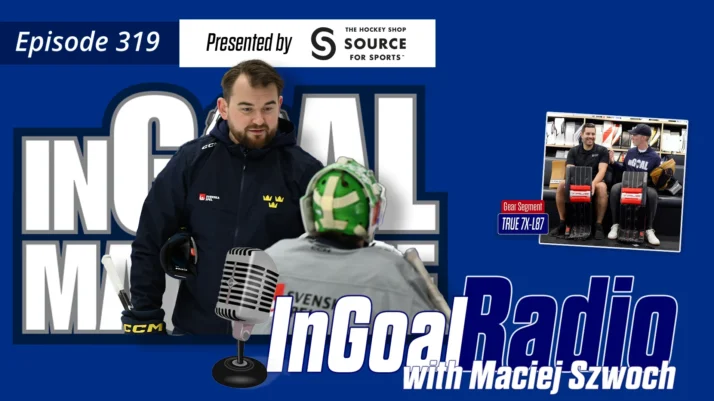
InGoal Radio Episode 319 with Swedish goalie coach Maciej Szwoch

Please subscribe and leave a rating — it helps us reach more goalies!


Swedish goalie coach Maciej Szwoch conducted a study analyzing 322 goalies affiliated with NHL organizations between 2015 and 2025, evaluating draft success by comparing invested value with actual return measured in games played and trade value. His research also examined geographic and organizational trends in how NHL teams select and develop goaltenders, offering one of the most data-driven looks at goalie drafting yet published.
- Maciej Szwoch studied 322 NHL-affiliated goalies from 2015–2025, measuring draft success by comparing invested value against return in games played and trade value.
- Geographic and organizational trends in goalie selection and development vary significantly across NHL teams, according to Szwoch's research findings.
- Hutch's top-10 tips for goalie parents concludes with numbers 6 through 10, offering actionable advice for supporting young goaltenders this season.
- Pro Reads segment features Devin Cooley analyzing stance against a rush and skate-or-slide decisions on a lateral pass.
- The True L87 7X offers pro-level features at a lower price point with a vintage aesthetic, reviewed this week at The Hockey Shop Source for Sports.
Episode 319 of the InGoal Radio Podcast, presented by The Hockey Shop Source for Sports, features the return of Swedish goalie coach Maciej Szwoch and a deep dive into his research attempting to measure success when it comes to drafting and developing goalies into the NHL.
Feature Interview
presented by NHL Sense Arena
In the feature interview presented by NHL Sense Arena, who last joined us after helping Farjestad win the Swedish Hockey League championship, walks us through his study exploring the drafting and development of goaltenders into the NHL between 2015 and 2025. He explains how he used data from 322 goalies affiliated with NHL organizations to evaluate draft success by comparing invested value with actual return, measured in games played and trade value, while also investigating geographic and organizational trends in selection and development.
Parent Segment
presented by Stop It Goaltending U
In this week’s Parent Segment, presented by Stop It Goaltending U the App, we wrap up Hutch’s top-10 ways to ensure this is your best season as a goalie parent with #s 6 through 10.
Pro Reads
presented by Vizual EdgeWe also review this week’s Pro Reads, presented by Vizual Edge, which features Devin Cooley breaking down stance against a rush, as well as a skate-or-slide decisions on a lateral pass.
Weekly Gear Segment
presented by The Hockey Shop Source for SportsAnd in our weekly gear segment, we go to The Hockey Shop Source for Sports for a closer look at the True L87 7X, a lower price point option with pro features and sweet vintage style.
Episode Transcript
Intro
Got a little bit of news coming out in the goaltending world, plus we're inching our way towards the rookie camps are right around the corner. It's InGoal Radio, the podcast presented by The Hockey Shop. Source for Sports Langley, thehockeyshop.com. There's David Hutchison right over there. Look to your right, everybody.
And on your left is Kevin Woodley. Woodley, he usually likes the right side, but he got beat to the punch today. Don't hold it against Hutch.
I'm right.
You know what? It's true, Daren. Like, I'm such a poor puck handler that I pretty much only have one way to go. So if anybody ever pre-scouted me, they would know which side I go to every time and just sit there and wait for it.
Rim it forehand. Rim it forehand. Rim it forehand.
Actually, I do. I kinda like the backhand.
Rim it forehand.
I don't trust my forehand.
So I I I That takes skill, buddy. Good job.
Well, no. It's not much skill. It's not like it's it's not a hard rimmed hutch. It's just the
If you're using a left handed stick. You
know, we've we've always been there. Every everyone has played the position at some point. The pucks is drifting into your zone, you come out to about the hash marks and you got that easy play up the left side or you can like do a little fake and try to slide it hard to your right to a defender or to a to a teammate. And the guy that's bearing down on you is right there and you try to go to the right and it ends up on their stick and ends up at the back of that. Woody, have you have you been in that situation lately?
I've not lately, but because I pretty much just anchor like, they pretty much it's like the Simpsons cartoon where they tie the kid into the net. They don't want me going out and playing the puck very often. I once towed I once got out to close to the blue line for one and tow dragged the guy.
What?
Yeah. And then and felt really good at my about myself at that point. And then I can't remember what happened later in the game, but it was I was, like, the most embarrassed. I don't remember the specifics, but I sure enough had like, gave up the most embarrassing worst goal ever. And I was like, that's karma for for for pretending you can actually handle the puck and toe dragging a guy.
But, yeah, I had him I had him fully bit into the middle and pulled it back to the right and he went right around. I was like, hoop around a barrel. And then I I promptly had, like, the worst experience later on. So karma. Karma will get you.
I was once losing a game one to nothing without a shot on net. What? Well, in my mind. So what what constitutes a shot on goal?
It it's
It's a puck that would have gone in the net had the goaltender not been there.
Yeah.
Well, had I not been there, it wouldn't have gone in the net. I backhanded a puck that was going wide of my net. First shot of the game, it went off the stick and into the back of the net. So I figure had I not been there, it doesn't go in the net, so it can't be a shot on goal. But I was down one nothing.
It's one of those weird rules or or stats because you cannot have a goal without a shot. Yeah. But you can have a goal without a legitimate shot or a try at the net.
Definitely not a scoring chance.
Good good point. It's like if if the pass comes behind the net and it banks in or off you
Off you.
Or a a foot, is that is that a shot?
Of course, it is by the rules of hockey, but it's kinda funny, isn't it?
But it's not. Right?
Yeah. Well, had I not been there. Yep.
We got some good stuff coming your way today on InGoal Radio, the podcast, including our Gear Segment talking about the True L877X line. I was with with all the numbers, I like, I'm not as fluid and up to date with it. I always feel awkward. Like a feeling I'm I'm reading a tractor line or something.
Yeah. We get into the lots of numbers and lots of skews and lots of confusion. Companies have tried to streamline it somewhat in recent years. You know, you've heard my rants. I won't go on another one about all the companies that put the word pro on their second price point.
It's it's tough to keep up with sometimes, but that's the beauty. Every time we do a gear segment, we have it on our YouTube channel. And Hutch, because he is meticulous in detail, goes and make sure he gets the proper name for the gear and puts it on the YouTube channel. So you can But here's
the thing.
Search. Yeah. But the proper name for the gear changes depending on what store you look it up at?
No. No. Here's the thing. So so I I I wasn't on-site for the recording of this one or or the last one. And I heard them say was it the L977 x was what I heard in the video?
So I thought, okay. That's what I have to write down, but I better just go check True's Site. So I go to True's Site, and it's 7X-L97. I'm like, okay. I got this one, so I changed it up.
Sure. Sorry. There you go. But then I was then I'm editing the video last night and stitched into the back of the pad for the 85, it's $85.07 x. So on their website, it's one way, and on the pad, it's the other way.
So I actually don't know which is which, but it's the second price point, and it looks really sharp.
I have l eighty seven seven x written down.
Yeah. I think on the website it's seven x l 87.
Big question as we turn this into a new segment is will it be changing as True has been sold or is in the process of being sold?
Oh, the Mckinney seven x.
Right. I somehow I think the true brand will be the one that survives this.
I I think that's the one that'll survive. I think we caught Daren by surprise too.
Graham Rustin We did. And his company purchasing that.
Well done.
Thank you. I I try to to keep up to date. Rustin's an interesting guy. He's had his hands in a lot of different things in the hockey world from Owen Bauer was part of that group that that at one point, Owen Bauer purchased The Hockey News, now into to the Troop purchase. I'll be curious to see where this and McKinney.
You guys mentioned McKinney, which it it is it active? Like, does McKinney still making gear? Yep. Yep. I think there was a
I think there be honest, it it sounded like there was a belief that the marketing power of the Hockey News would be enough to relaunch that McKinney brand. And so it will be interesting to see what lessons were learned because it it didn't get back into the mainstream the way they wanted. But they've certainly got gear that has, you know, a little more presence at the highest levels, obviously has some of the most presence at the highest levels in the NHL and certainly has more brand recognition for its quality than this isn't disparaging McKinney in any way, but obviously it was more mainstream with goalies and true. What'd be really interesting though is, you know, business background and I don't pretend to know what the all the details are, or what the plans are, but, you know, True is a brand that has spent a lot of money on paying goaltenders at the National Hockey League. And so that's usually one of the and whenever we see hockey companies switch over to investment owned companies.
And there's a bit of both here. He obviously has, you know, his fingers. Like you said, he's a hockey guy. But one of the things we typically see is some of those player personal service, you know, where our gear contracts change up dramatically. And right now, they, at least anecdotally, from a goaltending perspective, are are up there with, you know, in terms of their spends with with with anyone probably at the highest.
And True's an interesting company because the skates were based off the Scott Van Horn. Right?
Right. Which they now own, factory in
Oklahoma too. Acquired that, and the goalie gear is Lefeuve, which they brought in there.
So they own that factory.
True's sort of pieced that together a little bit to to come under the True umbrella.
Yeah. And I guess you can look at this a couple different and and to go to the business side of it, True wasn't in this game very long. True came in with deep pockets based on true temper sports and their ownership and and and the obviously golf shafts are the biggest one, but a lot of different things under that hat. And they came in with really deep pockets and weren't in for long and now want out. And I don't know what that tells you about the health of the business or the health of the business model under True that they wanted out profit.
They wanted out of hockey so fast. Or it's not making a profit and they were tired of losing money. That's the other way I look at it.
True. Yeah. Yeah. Definitely.
No pun intended.
Aaron Dell has announced his retirement from professional hockey, and Dell was a guy that was consistently in the National Hockey League, but but finishes last couple of years playing in the American Hockey League, ECHL a little bit, I believe. I I like the fact that he stayed in the game even though he wasn't in the NHL.
Yeah. Obviously, there's a the it's funny. Aaron was a guy that loved to talk to, didn't get to it wasn't long con we've never had him on as a guest on the podcast. Really soft spoken, really quiet guy. Like, I would use the word shy, but I don't know him well enough to use that word.
You know what I mean? Like, never got to know him at that. Always enjoyed the conversations, but just just kind of a quiet guy, like to do his thing. Loved guitars, had a real passion for music, and his gear was sick. Like, so yeah.
Like, we're gonna miss seeing the designs that Brian's would come up with for him. And, it just he he was always just like this really, really nice had time made time for you, but they weren't the longest conversations. Right? So, yeah, it's too bad we never had him on the pod, but career's done. Good career.
A career that I think probably, you know, what was he the okayest goalie in the world? Was that the t shirt that he had made up at one point?
What a line. Yeah. What a
great so good. And he he made he made a run of it of a career that I don't think a lot of people would have said was going to happen.
Is there a guy who owns a greater body of work when it comes to gear setups?
I it's a short list. That's for sure.
I don't think so. Yep. Just some beautiful setups.
Only play a 130 games in the NHL. And they say only a 130, but, had a had a good run with the San Jose Sharks. That was his main level in National Hockey League. But but I just from a out of UND, by the way, give them give them stick props.
Another one.
Yep. Just a guy that that loved to play the game.
And didn't and under undersized at a time when everybody was looking for size.
I find it interesting that he's got the passion to stick it out in the American League for a while. I mean, obviously, never been in the shoes of someone like that. He even though he's only played a 130 more games in the NHL than I have. But I could imagine wanting to finish my career taking a tour tour of Europe or something. Like, why not go see the world when you're still young and capable?
You mean to play in Europe, not just tour in Europe?
Yeah. Okay. Of course. Of course. Yeah.
Yeah. Yeah. But I mean, there aren't a lot of places you can play and then, you know, when you get a little bit of time off, go visit another country and a short drive or train right away.
He's 36.
Still a very young man.
I can't even remember 36.
Very, very young man. I know you're close to 36, Daren, but I'm long past.
If if you round it down in a strange working of mathematics, I I could do it. We've got our great NHL Sense Arena feature interview coming up. Is going to join us in just a little bit. Give us the four one one on.
Well, he is we've had him on before. Podcast guest on before. Coached Färjestad to a is the goalie coach for Färjestad. Was the goalie coach for Färjestad when they won an SHL championship. We had him on shortly after that.
Had done some work with the Red wings in the scouting side. He had some time this summer, and he's put together basically a look at drafting and development in the National Hockey League for goalies over the last ten years. Who's doing it right? Like, actually went out, did the math, tried to figure out a formula that allows you to measure success. Because I think to this point, a lot of it is anecdotal.
We see, you know, our our some teams having lots of success with lots of guys, but maybe not enough at the elite level. Some teams get an elite guy that sticks and that's considered success, but never draft anything to come up behind him. So who's really doing it right? And what are they doing? And what are the trends?
Whether it's where they're picking from nationality, what teams produce the most NHL goalies, what size is being drafted and what where are the successful windows there? And how many games played before you get a chance to try the NHL? Like, what's the magic number there? He crunched the numbers on all of it. He came up with a report and we're gonna publish that at ingoalmag.com, a version of that, a simplified version of that because obviously some NHL teams have already been reaching out about getting some of the information from the the deep dive, all the data that he's collected.
And we just thought we'd have him on. He shared it with us, was gracious enough to allow us to share it with our audience, and we figured we'd have him on to talk about it. So he'd be able to see that in ingoalmag.com and and listen to the interview and sort of gleam what you can or what you will out of all the work he's done looking into the draft history. And, obviously, he was a guy that was doing some scouting, and, it's it's it's fascinating. He's a guy who's produced some NHL goaltenders from his time coaching over in Sweden.
From Linus Ullmark with Moto, Dennis Hildeby was one of the latest ones. Like, he's had a lot of guys come through there and have success over here.
Hildeby. I I can't get over how big that guy is. Success. Every time I see him, it's like, wow.
Yeah. He's yeah. And he just signed a three year contract right with Toronto.
So Yeah. Six foot seven. You know who has a new contract? Johan Hedberg. Not new new, but you know, he's head coach in Lexan in Sweden.
Yes. It's kinda cool that we don't hear goalies becoming head coaches very often. It just jumped out at me. A friend of mine's son is playing for him in Lexington. I said, who's coaching?
He said, remember remember the Hetburg, the goalie?
Yeah. Yeah. He's been doing that for a while.
Yeah. Joining Lexan this year, he was far east as assistant last year, but then before that was a head coach for a number of years in Sweden. So good on. We need more goalies behind the bench running things. Right?
I've been having conversations with goalie coaches all over North America the last two weeks, and I'm actually amazed the number that are head coaching. And I I just tell them, soon as I leave the blue ice, I get completely confused, so I don't know how they can do it. Shows up in my puck handling how I get confused when I leave the blue ice. But yeah. No.
It's, there's actually a surprising number of goalies, I think, that are behind the bench. Really? Probably because of that perspective we have. Yeah. Yeah. Yeah. And and I I kind of wonder, and I'm I'm just speculating here whether it's just easier to follow a career as a coach if you take the head coaching reins, because as we know, goalie coaches aren't very well compensated, in some leagues, not at all. So maybe that's some of the motivation. I certainly know one goalie coach that that was the motivation for him, and I've spoken to several others that have stepped behind the bench recently.
It it does make sense from a financial side of it and Mhmm. Being able to see the game. But on the on the flip side, if you're a goalie and you're the head coach, that whole idea of you had to have done it to be able to coach it. It's it's a bit of a tougher sell. Now there are guys that have never played in the National Hockey League.
There's there's a guy who wouldn't have heard that criticism because he's got a Stanley Cup ring stuck in his ear. Yeah.
Yeah. Derek well, Derek Lalonde was a goalie as well. Obviously, not coaching right now, but with the Red Wings for a couple of years and and and won Cups as an assistant with the Tampa Bay Lightning coaching position players, and he was he was a goalie.
So you think we'll see more or is it just one of those cyclical trends?
Well, if it's more than 10%, then it's really telling us something. So is it 10%? I don't know. Probably not. No.
Maybe it is an outlier. No.
It's just the ones that Hutch is talking to. So but hey, the more
But it is a shame but it is a shame that I'm sure lots of guys do it simply because they want that leadership position and the challenge of leadership and the challenge of taking the reins of a team. Good on them for that, but it is a shame that some feel they have to do it for financial reasons.
That's why I joked. It's it's NHL NHL network, network, NHL, NHL, nhl nhl.com, NHL social media. It's goalie week this week. Right? Right. But it's a short week. Right? Because it's Labor Day. So it's only Oh. It's only a four day week.
And I I was joking on one of my radio hits the other day. I'm like, they should have called it goalie coach week because and but we they would have had goalie coach week, but they couldn't find a week that only had three days or two and a half days because they only get paid about half of what the other coaches get paid, and they get treated like absolute garbage in comparison in terms of being disposable. So, yeah, we the the NHL won't have a goalie coach week because they can't find one short enough to stiff them. I love
chip in the shoulder of Woody.
I listen. Like like, honestly, and I we joke and but it's it's really like some of the anecdotal stuff that I'm hearing. We've heard for years. Right? Like, right down in the minor leagues, like assistant coaches in junior making, you know, more than enough money for for a healthy living and and goalie coaches, just basically getting track suits and borderline
Gas money.
Yeah. And and, you know, borderline just doing it for the track suit and and a stiff end and yet being expected to be a part of video, power play, penalty kill. Like they touch everything and right up to the National Hockey League, most of them are paid less than half than than top assist or than most assistant coaches. And it's increasingly becoming a disposable position as well.
Why is that? Because we've seen the value of it and more more teams have goalie coaches and organizations expanding their goalie departments. Why is the compensation not falling? I don't know. I honestly don't know.
Like, it makes like, I get I get a lot of assistants played. Right? So most assistant coaches play and not all goalie coaches, like half the league's goalie coaches didn't play in the NHL. But I don't know why that should be having made more money during your playing career shouldn't be a precursor for getting more money in your coaching career at the expense of somebody who had to grind it out without making all that money. It actually you know, I mean, I could tie it right back to the hall of fame.
Right? And the fact that they haven't put a goalie coach in there despite the fact that guys like Francois Allaire, like, literally changed the freaking game. And they won't even for the most part up until a few years ago when we started making this push about this, haven't even considered or voted on it. Like, they're just they're just like, I think part of it, Daren, is that they don't understand it. And so the people in charge, rather than try to understand it, they're wary of things they don't completely understand.
Write down a hiring, right? Like, this is why you often see management hire people they know or friends, because at least they feel they can trust that person to give them the goods. There are some people, there are a lot of people in management in the NHL that feel when a goalie coach tells them something and it sounds really good, they don't know whether they can believe it or not. Like they genuine because they just don't understand it. It could be magic beans.
So it's that's about the only thing I can I can think of? Because otherwise it makes no sense. We all keep like the absurdity of the importance of the position juxtaposed to how little some organizations poorly financially, little they spend on the position is it's kind of staggering.
I there's a lot point where we can we can accurately look at teams that put money into it, get that out of it, and those that don't put money into it, don't get value out of it?
The you know what? Project for Mate Schwo, right? Our featured guest this week, like, hit like, like, you do see that a little bit in this. There the numbers here, like, I can draw a line between some of the guys that are having success and and whether they have a goalie scout, whether they have a goalie department. And actually, I haven't filtered his numbers or or taken a look at it and be like, okay.
Who's having the success and how many of them have had because the whole idea of a goalie department is relatively new. Right? So
Well, Florida has one big one, and they've won back to back cups.
Yeah. They but they've also won back to back cups. The irony of that one is they won back to back cups with a goalie who in some ways was the reason for starting a department. They started a department so they wouldn't have to be the team that pays the unrestricted free agent $10,000,000 a year, that they would constantly have guys coming up. And yet you could argue that their development and their drafting, do they win the cup if they don't trade Spencer Knight and get another you know, get get Seth Jones?
Like, there's there's they've taken goalies and turned them into assets, you can also look at it that way. At the end of the day, it's hard to quantify the misses, but, like, there are organizations I'm not gonna name names, but there are organizations that put very little into it and are constantly sort of looking for goaltending. They can't figure it out. And they have nothing coming out of the minors. And you're like, you can't draw a straight line between this and the fact you won't spend any money on the position beside beyond having a coach at the American League in the NHL level?
Like, you you can't see that? And this is gonna get increasing. This is good timing for matches. You know, his his outline and his research and and the paper he's produced on this because as we saw, there was no giant game of musical chairs for goaltenders this summer. It was a summer unlike any other.
So you better have something coming in your own to you know, up from under your own ranks. You better be producing your own because the ability to just go buy it appears to be nearing an end.
Great commentary, not an area that I expected to go to, but it's fascinating and love to get to the point where we start seeing the real feedback on what you put into it, do you get out of it? Or is it a little more nuanced than that? We'll continue to follow it. Our Gear Segment brought to you by The Hockey Shop Source for Sports Langley, the hockeyshop.com. What's happening over at the boys?
Gear
They are so busy over at The Hockey Shop. It is that time of year and actually ties nicely into our gear segment today with the true how are we saying it? We're going l eighty seven seven x or seven x l 87, either way, a lower price point gear line that you can walk into the store, buy off the rack, retro graphics gonna pop, but is it the right one for you? Or would the CCM eFlex 7.9 be a better option as a second price point? Something you can go buy in the store or maybe as Daren suggested last week, you're at a level where I might need a little more padding in the glove.
Do I need to buy the pro level glove and the lower price point pads? Can I get away with that? These are the types of questions that the folks over at the Hockey Shop Source for Sports can answer for you. Everybody in that goaltending department plays the position, has played it at a high level. Well, Cam likes to think he's played it at a high level, but they understand the position.
They understand your game or they will learn about your game and find the gear that works best for you and your child. I can't tell you how many times I've been in there after a film session and watched as somebody comes in to get fit and the the young goalie, wants the highest level, the parent is willing to pay for the highest level, and the crew at the Hockey Shop are like, you know what? You might not need the highest level. So they'll save you money. They'll get you the gear that you want.
They'll get you the gear that fits your game, and they're going to have enough options in store or in the warehouse that you walk out the door with the gear you need that day. Make sure you check them out. The Hockey Shop Source for Sports, thehockeyshop.com. They will get you ready for hockey season.
And they have so much stock. Like, if you're not looking for custom, you can walk in there and basically walk out with with what you need.
Yeah. Pretty much. And that's the beauty of these graphics. Like, it's one thing to be like, oh, look. We got we got the l 85 and the or the l 95 and the l 87 true graphics, but not have any colors.
It's not just a 30,000 square foot store. There are two separate warehouses where they keep the extra gear. They have a ton of it. There is no better place. There's no place you are more likely to find what you need than the Hockey Shop Source for Sports.
L 87 7X from True, the subject of our Gear Segment brought to you by the Hockey Shop Source for Sports Langley, the hockeyshop.com.
What's this? Another true retro graphic? Didn't we just do retro graphics? Another true pad and glove roughly half the price of a pro level option? Cam.
It's Oh, look at that. Puns and dad jokes. Stylus retro graphics. Last week, we did the L 95. Yes.
Now we've got the L 87. Walk me through how I have a true, look at that, Doctor. Seuss of me this morning, pad at a lower price point that looks so damn good.
Okay. So we're gonna run a similar playbook to what we did last week. However, we are gonna base it off of now the Catalyst series. So 7x three base pad, L 87 graphic, that nice vintage look available in some spoofy colors too. Do say, you know, even that, the tan and the white looks pretty awesome.
[crosstalk] So some differences in the pads for sure. So again, based off of that catalyst design, we have a Okay. So let's just rewind for those who didn't watch it. Make sure you go back and rewatch last week's l 95 graphic is the hazardous line, the lower price point option of the hazardous line made overseas. Mhmm.
[crosstalk] L 87 is the lower price point of the catalyst line. So just refresh us on what a what a catalyst pad is compared to a hazardous for those that are now looking at this. For sure. And just to clarify, obviously, these graphics still exist at that highest level in the PX series, but we are now looking at that offshore lower point series. So Stock off the wall available in store.
If you need it for the start of the season, you can come in or go online and get it at the hockey shop and have this ready to go with this great look before the puck drops on your season. That's kind of the point. Exactly. Okay. Catalyst pad.
So start off, much flexier boot. Yeah. Definitely more flexible. In the boot the entire time. To the hazardous.
For sure. Flatter boot construction too as well. So that will come into play in terms of for your sizing as well. So keep that in mind that this So this one's gonna fit a little lower than the L Money. Exactly.
Exactly. So flexible boot. You do have that outer roll break. It's still a very stiff paddle. Yeah.
[crosstalk] Even with that break, it's So Well, it's got a little flex at the This will break a little bit more, so you will get a little bit more bend to that butterfly. So a bit more like full arrowhead kind of shape. You can kind of shape it a little bit more, but you're still from the knee up, still a nice stiff construction. It's not gonna get floppy on you.
[crosstalk] So this part doesn't change now between the two pads. So that upper thigh portion, we have the same level of thickness, same level of stiffness to the that taper thickness to thin it out at the top as well. Correct. And then we move on to the back of the pad. Similar knee stack?
Yes. Similar backing? Yes. FRS straps? Yes.
[crosstalk] Kind of the same on that? Yes. Is the opening the same in terms of width compared So to pretty much. I just wanted to make you open the pad cam. The exact same.
Okay. So again, familiar characteristics. You've known the 7x series of pads before, 7x three. This is gonna be the exact same feel on your leg. Just get that slick vintage graphic.
And with the l 95, we talked about the removable knee flap. Know what we didn't talk about?
What's that?
Comes with pro laces. It does. Both do. Elastic. Fungies.
If you don't like it, unscrew it out, attach your laces, attach whatever else you like. You got options there. Okay. Glove. Still a five ninety break.
Still a five ninety. You're holding You're holding an intermediate. So intermediate is going come with single offset tee. Senior is going to be standard double tee. You had a senior one.
There is it. There is a senior one standard double tee. Put that on your hand cam. So again, five ninety break. Great closure off the wall.
Exact same story. It does. The closure is really nice. Yes. Again, that consistency level has definitely kind of hit their stride for the gloves in terms of overall feel wise and, you know, fresh feel up off the wall.
So great option. Again, looking at that mid level price point, you know, you're three, four, five times a week sort of thing, five times probably starting to push it a little bit. Blocker? Also bindingless like the l 95, so similar. Six fifteen.
[crosstalk] Same. Just demographic. Same. Same. But different.
Same same but different.
So do you have any questions about that? Questions about how it's same same, but different. How it's four, how it fits. Anything you wanna know about the l 87 or l 95 gear. Yep.
Cam and his crew are available to help you. Sizing, how it differs between the two, who it's for, all those questions, where they get you. (604) 589-8299 or 1-800-567-7790 or check us
out at the hockeyshop.com. Roughly half the price of
the pro level pad available in store. Good looking graphic. Great option as you get ready to go back to hot.
That's a seven x l 87 from True. I I said l eighty seven seven x going into it
because You're covering all the bases.
That's I'm I'm I'm checking every box right
wise man. A wise man.
Yeah. I'm not gonna lie to you. L eighty seven seven x feels better, better than l eight seven seven x and better than 7 x l 87.
So It's
with L877 x.
You know what I just appreciate? What? None of it says pro.
Yeah. I'm with you on that. When it when it's pro, is that not top I think top top of the line.
Care careful, Daren. We've already had one Woody rant today.
I know. I know. I'm with you on this side. I just want you to know, I'm totally with you. If I'm shopping for gear and I see pro, I think this this is the NHL.
A little bit like all those spring hockey teams for eight year olds that name themselves triple a, elite, quad, whatever. Yeah. We're just getting overexcited with titles. Let's stop people. Rain it in for Woody.
We don't want them to have an aneurysm.
That's right.
Do we have titles on this on this podcast?
Three Dummies with Mike's?
No. We need something better.
What? Like, Dummy one? Dummy two.
You guys are cofounders. You guys are cofounders of InGoal. And are you No. You're a
co founder of the podcast.
Are you co co hosts or are you analysts on this thing?
I don't feel worthy of either. I'm just Hutch.
Well, that's boring.
Daren's dead with titles. All we know is Daren's driving the bus. He is the he
I'll go host You guys are cofounders, and and we'll work our way from from that.
Just so you know, you are the host because I typically when I send I I we get a lot of these interviews off to the side through relationships we have. But when I do have to go through a team and I need to hit up a PR staff and make sure or check-in to see see if it's okay somebody that we've landed on our own is is on the show. It is always the InGoal Radio Podcast hosted by Daren Millard. You are our brand recognition, my friend.
Seriously?
A 100%. Every time. Absolutely. Every time I deal with a PR staff, is the InGoal Radio Podcast hosted by Daren Millard.
Your title should be Leverage. Yes. Director of Leverage.
Yeah. I like that.
Parent Playbook
Parent segment brought to you by Stop It Goaltending U, the app. We're gonna flip back a couple of weeks, but first, what's happening with our friends with Brian and company over at Stop It Goal Tending U?
Well, the fact that they spent the time to be featured guests on last week's podcast has not prevented Brian Daccord and his team from continuing to update the Stop It Goaltending U app. They've got primers as they do every day, not not just every week, but every day, five new quick one to two minute videos that'll help you become a better goaltender. This week's primers appropriate with the season starting are on goal setting for your upcoming year. They've also got a great new video featuring Joey Daccord. It's a quick hit drill video called goalie one zero one.
It's like a like a instruction and drill to help you get on angles. It's an angle warm up using a cone or pylon and Joey Daccord walking you through it. That's their Quick Hit Goalie one zero one video. And Goalie Playbook, they walk through a session with Frederik Andersen, a game with Frederik Andersen, and break down the way he handles certainly certain things in certain situations. It's all part of the Stop It Goaltending U app.
It's the type of content you get weekly there. And, of course, when you get a subscription to the Stop It Goaltending U app, you also get a subscription to InGoal Magazine, ingoalmag.com, and our premium content so you get the best of both worlds.
Hutch, Brian and Joey took over the spotlight last week and that pushed back something that we had a two parter from a few weeks ago.
We did. Couple weeks ago, we started on 10 ways to have your best season ever as a goalie parent, something we talk about every year, deservedly so. Brian and Joey took over the show last week because it was such a great parent segment. And I first want to say that have received a number of emails over the past week. I've shared them with you guys.
Haven't really had a chance to address them because it's it's been a week, boys. It's been a week working really hard, talking to goalie coaches, probably ten plus hours a day. If you haven't heard from me, hit me up, davidingoalmag dot com. Would love to have a conversation. We will get to those other emails.
The best comment, though, from any coach that I've spoken to this week, Daren, was I usually listen to this show on 1.5 times just so I can get through Woody in a reasonable amount of time. True story. True story.
So why do they allow it so slow? It only hurts.
Yes. That's right. I actually, I actually This is also a true story. I listen to some podcasts and I have to slow it down because the host speaks so quickly. So maybe that's just my processing.
Anyway, let's get to the parents. And my next five, I remind you, none of these are in any particular order. They're just how they came off the top of my head when I was originally writing them, and I've tied them up a little bit since. So the sixth thing you could be doing this year as a goalie parent, please make a resolution to do this. Praise effort and not results.
Of course, it's fun to win. Of course, it's hard to lose, but we can make a lot of mistakes and still win. We can even get a shout out with mistakes. We we can play a great game and lose, but we're trying to raise kids who work hard. It's a skill that's going to serve them very well after hockey.
So I should say, I've even told our son many times, I'm going to be fine if you choose not to play hockey next year, but I do want you to have something in your life that you love and work hard at. So if they skate hard in practice this year, let them know afterwards that you noticed. Goalies are almost destined to be the last guy if a coach is running them through a traditional skate between the lines, but you can still work hard and praise your child for that. If they battled hard in a game or if they held their head high after a goal, let them know. Let them know that they're doing the right things out there.
And if they do some extra training during the week on their own, give them a high five. Tell them how much you love seeing them work hard. Number seven, praise having fun as well. Effort matters, but it's not all about hard work. We do play the sport because we want to enjoy it.
So praise them when you see them having fun and showing it. I frankly am not one of those coaches or parents who wants to see their kid hyper focused and over serious putting on a show for everybody out there, making them look like a great pro. I want them to go out there and focus, but also to have fun. I get that they have to work with a team and a coach who might have his own feelings about this, but to the extent that you can, help them be themselves out there. Maybe you've heard of Marc-Andre Fleury.
Not only does he have fun, he battles like nobody else out there while making the game more enjoyable for everybody around him. He can also focus in the moment and take the game as seriously as anybody. So I like to think other young goalies can do the same. Number eight, help them to become independent. Our goal in life is to raise happy, confident, independent kids.
And if their goal is to play high level hockey, junior, NCAA, even pro, At some point, they're gonna be on their own, possibly younger than you imagine right now. Now's the time to help them get ready. So can they pack their gear and go through the mental checklist with you to make sure everything's in there? Can they pack their own snack for the trip? Can they remember what time the game is even for the younger ones?
Can you teach them to decide what time it is to leave the house? After practice, can they wash their own things? Even the youngest kids can help with some of this. And at some point, I would suggest you should transition to saying, I'm your driver. I'll be your biggest fan, but you're in charge.
Tell me what time you want to leave the house and I'll be ready for you. They can probably pull this off a lot younger than you think. Support their mindset at home. That's number nine. What can you do to help them out with their mindset at home?
And I'd say a ton. We want them to focus on having fun and becoming the best goalie they can control. The controllables is the old cliche, but I often take it a step further and say with a strong mindset, even the uncontrollables can work to your advantage because the other players and other goalies around you won't be as strong in a tough moment. So welcome them. You know, one key, I am quite upfront about this and I let them know I believe they have a strong mindset.
Tell them you believe in them. One thing that it is one thing that's a real separator in the game, and I'm just trying to help them build on that. So I don't want them thinking I'm just tossing out a throwaway phrase to cool them down in a tough time. I'm serious. Turn the negatives into positives.
If they come home and they say practice suck, nothing but two on o's and three on o's. Try something like, okay, I get it's frustrating, but you have no control over the practice plans. So what can we do? Learn to love the drills. Guess what?
They're supposed to score every time. If you make a save, it's huge. So live for those moments, battle and get better. Turn the negatives to your advantage with a good mindset. Or if they complain that I had 70 shots on goal today and my D were no help, you might try responding okay.
It's tough, but it's 60 more shots than the guy at the other end got to have to get better. And our job's to help when other players make mistakes. So there's going to be, some goals with 70 shots and that's not easy, but you can build the strength to push through it. Don't be the person at home that's complaining right along with them and letting them get focused on that. There's a million examples.
Just ask yourself, what do you think a mature world class goalie would do in that situation? And then help them focus on that. We're here to help them grow as people and those skills will help everything they do away from the game. And then finally on my list for today, model how you want them to grow up as goalies. You can demonstrate the best mindset as a parent.
If you show stress, they're going to feel stressed. On the other hand, if they see that you don't overreact in tough times, they're not going to either. You can help your son or daughter develop a great mindset through how you respond to things at home. If you want them to treat every game the same as we often hear the pros talk about it, make it just another game, then don't talk about tomorrow being a big game and send them to bed extra early to get ready for it. You just need to treat it like every other night.
Of course, you should have good habits at home. I'm not saying stay up till midnight before those big games. Let's have some good long term habits this year. If you smile after a tough game, eventually they're going to feel better. But if you act angry after a tough loss or if you blame their teammates for goals, you get the idea how that's going to rub off on your kids.
So set the example this year. That wraps up my 10 thoughts for having your best season as a goalie parent. I hope everybody out there has a fantastic season. If you have any thoughts, questions, or you just need another goalie parent event to, I am here. David at InGoalmag.com.
If you want the front half of that, go two weeks ago, two episodes ago, and, you'll hear the, opening part of, how to be a better goalie parent, how to how to have your best season as a goalie parent this year. I love the praise the effort, not the result. That that's something I think it's hard to do sometimes.
It is. It is definitely hard to do sometimes, but I think the line I've used on here before is you gotta catch them being good. If you're out there just finding things that people do wrong, then you're going to have a negative relationship. But you might have to work hard at it, but you can find something to praise. And then once you do that, the kids, I promise, will follow along.
So don't accept that you're going to lose every skate. Just, hey, you were closer to that guy than ever before. Oh, you gave one of the players a run for his money. You beat your goalie partner there. Just what can you do to to get them working really hard and understanding that hard work is a good thing and it's fun.
I always wait for Woody to come in with some kind of self deprecating line.
I don't need to I I That's right. I just I'm I'm worried about the people that have to play this fast. So let's go.
The laugh sound really good on on two times speed too.
You know, if I had more time to edit this show this week, I would grab each of Woody's clips and speed them up 1.5.
Well done, Hutch. Thanks for that, outstanding advice. The, Visual Edge ProReads, brought to us by Visual Edge, allows professional goaltenders to sit down and walk us through safe selection and situations with just the insight that you're not gonna find anywhere, and it's all thanks to Vizual Edge.
Yeah. And let me tease next week's ProReads to get everyone excited for that. We spent an hour with Dustin Wolf this week breaking down video, and we will bring you the first of those ProReads next week. This week, we dig back into a session we did with his likely playing partner this season, Devin Cooley. Now Devin was with the San Jose Sharks at the time when we did the video, but his insights were so good, and we spent so much time together that day that we still haven't run out of ProReads.
We've got one more left to go. So we wanted to make sure before Devin steps into likely his first season as a full time Calgary Flame goaltender at the NHL level, he was in the American League last year, that we had all these used up. We didn't wanna waste any. And this week's was another good one. The end is is basically a focus on a skater slide decision on a backdoor play off an odd man rush, but there's a lot of good details when he talks about his stance as the rush materializes.
Pay special attention to at what point on the ice does he get into more of a ready stance versus a more narrow upright stance that allows him to move, but maybe not be worried about a shot as much. So lot of great information, a lot of great breakdowns in this week's ProReads featuring Devin Cooley. And as I said, a little tease there, folks. We've got his likely playing partner this year, Dustin Wolf, Calder Trophy finalist coming up for next week's ProReads. Of course, ProReads are brought to you by Vizual Edge.
It makes sense. ProReads are all about helping you read and anticipate the game better, and Vizual Edge is all about helping you see the game better. Those two things go hand in hand. Vizual Edge is a vision and cognition training tool. You just do it on your computer with a set of glasses.
If you're Jordan Binnington at the highest level of the game, including the four nations gold medal and throughout that tournament, he uses it every game day as to add a quality element to my preparation as a goaltender. Binnington said, I use the game day drills every game before heading to the rink. It's a combination of recognition, reaction, and focus that activates my brain and eyes to feel ready for what's to come. So if you'd like to learn more about Vizual Edge, make sure you check them out and of course get a discount using the code InGoal for 10% off their monthly and annual subscriptions. And if you're an InGoal member, you can save 20%.
If you need the code to save 20%, make sure you check out ProReads. Members, when they log in and watch a ProReads, that special code is in there for you to save 20% on Vizual Edge.
Can you ask Dustin Wolf to walk us through his pre opening face off to a period routine?
We have. It's up on ingoalmag.com. We've got the full jump. Everything is in there. Really?
Yeah. It's yeah. We did a story in a couple years ago and and Wolfie was really good about explaining just the thought process.
Let's make sure we link it in next week's ProReads near the front.
Thank the archives, Daren. We're in there. Thank you.
See this this there's so much that I don't even realize is is there. That's a big jump though.
I would probably turn an ankle Literally. Landed. Well, first of I'd never get that high.
I'm gonna try today. I'm gonna go out before anybody is on the ice because I don't wanna do it with anybody watching. And I'm gonna I'm gonna try jumping like that.
Next step, I wanna see you do the Kari Lehtonen.
What was that one?
Jump up and sit on the back of the net.
He did that? Mhmm.
Oh, yeah. There's that famous picture of him just sitting on top of the crossbar.
I've I've seen that, but I didn't know he jumped up there.
Well, I mean
Well, how else you get there? They didn't bring a ladder.
I would have crawled up pretty ugly if he's like, a little less graceful.
I I I would've crawled up. That that that'd be the only way.
Hang a leg, roll over. You're like lying on the back of it as you swing your legs back over the bar. Yeah.
Rec league goaltenders will get this. Men, women, doesn't matter. The times that you're you're going to the bench for the extra attacker and they forget to open the door for you and you have to climb over the boards. I've You get you get to a certain age where that effort to get onto the bench becomes a bit of a challenge if the gate's not open.
I'm at the age where the effort to get to the bench becomes a bit of a challenge.
There's the Woody I know.
There's the Woody we know and love.
He couldn't stay hidden forever. Attaboy.
I'm sorry. Welcome back, Woody. Now he's got quiet. You know, when that happens with the podcast and I'm listening to one, I always check to see if has it stopped? Don't know.
It's just just Woody playing
What's along with this silence? Woody can't be quiet for more than a minute.
Feature Interview - Maciej Szwoch
NHL Sense Arena feature interview. Maceij Szwoch, back with us this week.
Before we do that, I have mentioned in previous episodes that you need to have a new season's resolution. There's one thing that I think you should add to that new season's resolution, and that's working with NHL Sense Arena with you, your son, your daughter. Heck, parents, you can join in and enjoy it as well. It is the ever evolving virtual reality platform that's built for goaltenders and now players, by the way. Recently, they added NCAA shooters to the NHL and PWHL lineup that's already in the system.
They roll out new training plans all the time. They host regular competitions. And, of course, there's the NHL Sense Arena goalie advancement program. It's a structured three part program that will guide you through development in three crucial areas of the game, reading the release, mastering your angles, and dealing with traffic. And while we can't share all the details, as we've told you, there is a big, big new feature coming soon that we know you're gonna love.
So that's gonna take up a lot of your time when it arrives. You better get in there and grab NHL Sense Arena now while you can and start working through the training programs. I should say, guys, I've actually spoken to a number of people this week that would love to try NHL Sense Arena, and they're worried about the cost of the Oculus headset or the Meta headset now. Can I just let you know that Woody and I are still using that original Oculus Quest two? And I've seen them on Facebook marketplace for a $100 Canadian.
So it's not a steep cost to get in there anymore. Go give NHL Sensorina a try this season. It's the most realistic year round training you're gonna have wherever you might be. Check it out at sensearena.com and use the code IGM 50 to save even more.
Let's get to our NHL Sense Arena feature interview, Maciej Szwoch on InGoal Radio Podcast.
Real excited to welcome back to the InGoal Radio Podcast. It's been it's been almost three years. It's been far too long. And now and and again, I'm probably gonna get this wrong, but I'm gonna do my best. I still didn't get it.
I know I still didn't get it.
Well, that's the best pronunciation I've heard you say. So, you know what, congratulations. Great job.
Goal tending coaching is all about progressions and you teaching me how to say your name properly. We're getting there, my friend. How are you? Good.
Thank you. How are you? Very nice to see you. It's been a while.
It has been a while. It has been a while, but you've got an exciting new I was gonna say study. It's like a compilation. You have been digging into stats on goaltending draft and development over the last decade in the NHL. You sent it to us over at InGoal to have a look at, and I was like, instantly, we gotta get them on the podcast to discuss it, because it's fascinating.
Spent the last ten years at Farjestad coaching in in Sweden's top professional hockey league. Spent some time with team Sweden at the World Championships this spring, and now you're working on this or you've worked on this. You've dug into it. So for just walk me through the genesis of this project before we dig into some really exciting numbers and some of the things that, you know, you uncovered on a topic that I think for the most part is just nebulous to this point. People feel like some teams are doing a good job and others might not, but but nobody's really cranked out the numbers like this.
Well, I'll I'll bring you back to Nashville actually to the to to the symposium that I went to there and I met a gentleman named Chris Boyle, who's very skilled when it comes to analytics and we were discussing who's actually doing a very good job in the NHL drafting and developing goalies. So ever since then, and I can't even remember which year it was, I believe it was 2017 or '18, and I've been thinking about this for quite a while. And this summer, I always do a summer project. Last year was about shootouts, this year I decided to actually sit down and have a look at, okay, who is really doing a good job of drafting and what's the value? Where did these goalies come from?
Are there organizations in Europe that are doing a very good job, or in North America for that matter? And what's their path to the NHL? So I spent a lot of time crunching numbers. It took a while, and then started building my reports, and and I wrote a study. Maybe it's not gonna be qualified for university, but I hope I hope people enjoy reading it.
The University of Goal Tending. The Goalie Union will definitely dig in. So you picked for for a time window, you've picked ten years, your 2015 to 2025. Some of the methodology, like getting to the point where you how to quantify this would have been, I I imagine, a big part of the process because there's again, whether a guy plays in the NHL, there's only 64 jobs, only 32 starting jobs. Sometimes that value can be assessed in terms of if a goalie is drafted and then later traded, that's considered a value.
How'd you go about trying to figure out how to quantify this and where'd you come out on some of those things?
Well, that was actually the first part I had to do to have a some type of rule book for myself to understand, okay, how do we actually measure this? So the first thing I did was outline some rules, who qualifies for it. So I went back ten years, and I also included everybody that's on a depth chart today. And a gentleman like Marc Andre Fleury just retired, so he wouldn't qualify for it. Carey Price, a unbelievable goal setting here.
I see I see his jersey in the background and as we're talking, did not qualify for it because he retired a couple of years back. And then I had to figure out some type of value for each pick because when you're picked picked in the first round, the expectations are higher, and it's more likely that you're going to succeed. So what happens if you're gonna get picked in the seventh round to do a good job or in the mid round. So I had to figure all that mathematics out, and thank God I have a a mother that's a math teacher who can help me out. So thank you mom for staying staying patient with me with all the questions I had.
And after I had all of those rules rules kind of mapped out, I was able to start doing formulas and start crunching the numbers and having Excel actually spitting out all these things automatically for me.
So now you're an Excel expert too. This is the one this is my biggest weakness in my my game is the Excel spreadsheets. My wife who is an accountant tries to help me. Hutch puts a lot of things in Excel and tries to help me, but it's that's that would be a tough hill for me to climb. I'm glad you got over it.
Well, thank god we have YouTube. How to Excel. So as you go through this, did you go in looking for certain things? Did you find were in terms of obviously, you wanna quantify who's doing it well, but were there other avenues or other little things that came out as a result that you didn't expect that you learned about?
For starters, I really wanted to know what happens when a goalie get gets scouted sorry, drafted, and he enters system of an organization, what happens with him afterwards in those years? Where did he come from? And actually looking at where goalies were coming from was one of the things that really caught my mind or my eye. I wasn't aware that certain organizations repeatedly did a very, very, very good job. US national development team program has is by far the best in this ten year range with nine goalie scouted, But I had no idea that the Soo Greyhounds were as good as they were or that that in Russia was very good.
And I actually found in this study as well, which was nice to see. So it came from all across the world. Some teams, I had no clue they even existed, but it was nice to see that, okay, there are certain hotspots out there in the world that we could have a look at and see, okay, what's going on here?
Okay. So one of the things that you mentioned there was quantifying where they were drafted and assessing a value, and you you kinda just you you quickly mentioned that if you're drafted higher, you have a better chance of succeeding. That part of this part of the findings generally true?
It was true. It was true. Because logically thinking, I mean, if you're drafted early, you're considered a high draft pick and you get more chances and you have more exposure and that you certainly have a lot more patience with these picks. And usually, they're very talented as well. So it it did actually work together with with my hypothesis.
Well, and and I guess the other thing too is there aren't that many of them. Right? Like, the first round picks, for example, whereas we tend to hear about the late round picks that hit, but the reality is they're one of maybe six or seven in the fifth or sixth round that year as opposed to every couple of years we get a first rounder?
Well, I mean, Henrik Lundqvist was drafted in the seventh round. Jacob Markstrom was drafted in the fifth. Connor Hellebuyck was drafted in the fifth as well. They're all excellent goalies. They're just they just have a different path than weren't as ready at that point point in time.
But one thing that really, really, really caught my eye was looking at where from which country goalies came from. And Russia has 20 goalies drafted in the last three years, which surprised me. It was that many. And at the same time, USA had only six.
That one surprised me.
That one did surprise me as well. So the the interesting part with building it within Excel was I could start to build different reports. And as I was I was sitting and clicking and trying to understand what's going on, I had a couple of, oh, wow moments, and this was one of them.
Some of the where there well, let's go let's go through let's go through sort of some of the how you broke down the numbers. You know, you mentioned your hypothesis, but some of the results, like draft and return, for example, just sort of looking through the spreadsheet. Basically, how many how many how much a team is invested and how much games played per draft pick value they're obtaining. Some of the some of the teams at the really high end there, I see Columbus, Washington, Anaheim, Pittsburgh, you know, sorta how you quantify that where you see some of those successes. And and and I guess the biggest thing would be, you know, when you see Anaheim up there, when you think of Gibson, maybe don't think of Freddie Anderson being a big part of that, but he's played a ton of NHL games, and he's one of the goalies they drafted.
That was the most interesting part of all. And that was actually not where I started this this study, but that that's where I I spent the most of the time because it was so interesting watching, okay, what's going on after they they drafted? You mentioned Anaheim, is a great example of drafting Frederik Andersen. He actually reentered the draft and got drafted from Frölunda and that he was originally drafted by Carolina. He gets drafted.
He plays a bunch of games, and he gets traded away. Now he gets traded away for first and a second and a player to Toronto. Well, that's a very good return for for draft pick. And at that time, Anaheim already had John Gibson through the pipelines, going through the systems, getting adjusted, and building his his experience and understanding of what he needs to do. And now he's an NHL goalie that's ready to go.
He plays 500 plus games for Anaheim. And this summer, he gets traded for a second and a third. And as this is going on, Anaheim drafted a young gentleman named Lukas Dostal, which had a great breakout year this year. And so now they're doing it again. So you know what?
All credit to that organization. They're doing a great job of identifying prospects and turning those prospects into new ones.
How much did you how much are you able like, it's just looking at the numbers, but I guess it's drafting is one thing, identifying talent. But the other part is the development curve. Is there a way to sort of quantify who's doing a quote unquote good job of that? And is it, like, by the numbers, just a matter of how patient they are in terms of giving them opportunities to learn the game maybe before they reach the NHL, like the number of years in the minors? How do you go about when we're comparing success drafting versus success developing, I guess they're intertwined to a degree, but were you able to see different patterns amongst different teams there?
Like, who's having success creating goalies out of the ones they picked?
Well, teams like Columbus Blue Jackets did a a very good job. The Washington Capitals did a very good job, and it's no surprise with Mitch Korn and the director of goaltending at that point in time. The Saint Louis Blues are doing a great job where they had Jake Allen and then replaced it with Jordan Binnington, and now Joel Hofer is making that that step. So there were certainly teams that were doing a very, very, very good job. But what really caught my eye as I was going through the crunching all the numbers was the amount of years spent as an amateur goalie.
So again, I had to separate numbers to kind of understand what does a amateur mean, meaning junior, it could have been playing in college or playing lower league level games in Europe or even pro in Europe. And the amount of years spent as a number one goalie, it was very interesting to see just watching the profile of a player, seeing it, okay, he only played ten years that 10 games that year, he played 30 games, 30 games, and all of a sudden, he's blooming a little bit later at a North American level. So understanding and watching the amount of games they played before they signed the the they ended North American pro contract was extremely interesting because as you were seeing, games not being played on a on a amateur level, they didn't pan out.
Was there a magic number? Like, a range where you're like, hey. Like, need to get this many games before you're probably gonna have success. And, again, it's such a I mean, the position is so unique. No set ways to do it, but we look for trends.
Is there is there a range where you're like, hey. Like, if if you can get to this many numbers by this age, you have a games played at other levels, you have a better chance of succeeding.
That is extremely hard to quantify given the fact that when you're playing juniors, you can play 60 plus k 60 plus games a year, and in college, you can't. Right. And every league was and this was hard to figure out how many games actually each league play. So I had to quantify by years, and how many years as a starting goaltending were you? So the cutoff was 55% of the games or in that range of 55%.
Now the average goalie that gets drafted and signs an NHL deal has three years until they make a they they make the jump. So, you know, in that time span, at least you wanna have spent spent two years as a as a starting goalie to actually build that experience.
So when you say make the jump, is is a jump to pro contract in the American Hockey League as the starting point? Is that that's that's where it starts in terms of having made that jump, or does that American League time still count as amateur sort of that pre NHL?
No. I I measured it once they signed the North American pro contract, meaning they could end up in AHL, East Coast, or in the NHL, depending on who they were. Okay. What's what was really interesting to see was examples of Karel Vejmelka, for instance. I actually tried to sign Karel to to Färjestad as our starting goaltending goaltender back in the day.
I went down to Prague, I met him and, you know, scouted him heavily and tried to sugarcoat him to come to come to Sweden. He decided he wanted wanted to stay another year in Czech because because of the family situation. He loved his family, he wanted to stay at home. He spent six years in Europe before transitioning in, and then all of a sudden, he's right into the NHL. So what I actually found was teams generally are a little bit too quick to sign goaltenders and bring them into their system.
A lot of the times, they could have just waited another year and let them grow and let them develop into goal to mature goalies before stepping into the jungle of the AHL or the NHL.
Well, I like that as an observation. I wonder how many did you identify teams that you know, we talk about draft. Were there teams that did a better job in terms of finding the undrafted free agents? You you mentioned Karel Vejmelka. I think of Arvid Soderblom as another one for the Chicago Blackhawks.
Chicago Blackhawks has two. You have the Kevin and Arvid. Both of them have the same type of process. And Kevin is, again, another guy I tried to snag to, but Chicago went went first. So there was definitely a lot of teams that that was trying to do so, but I also I also noticed that a lot of the teams were trying to fix their own draft by signing undrafted goaltenders to plug their holes in the system.
When we talk about just playing versus, you know, some as we move through the study, different ways of assessing value once you add in draft picks or takeaway, like, who you mentioned some of the teams. How much of it is just finding one guy over a ten year span? Like, some of the workhorses, they're obviously gonna have success because they're playing the majority of the games with the teams that drafted them. Obviously, Saint Louis, you mentioned Jake Allen, Jordan Binnington, now Joel Hofer, all homegrown. Anaheim with the three goalies that we've already talked about.
The Kings, Tampa Bay with Vasilevskiy, Winnipeg with Hellebuyck. It's gonna skew to them because they've found number ones. Is there yeah. How do how do you sort of manage that and and accounting for that?
Well, again, this was so much fun doing. Now you're completely right with a lot of the teams that by the numbers look great because they have a lot of games played are tied to their elite starters. Like Jonathan Quick is a great example. Andrei Vasilevskiyy is another great example.
And and teams should be recognized for finding and developing those guys into elite long term starters. That's that's the goal.
Hey. These some of these guys are gonna be a hall of famers at the end at the end of their careers. So that is great. But what what really intrigued me was, are there any teams that are be able to actually transition these these picks into new picks or find value into these? And this is where Columbus Blue Jack is is a very good example, having drafted really well and then sending goalies away like Anton Forsberg or Joonas Korpisalo.
Now you find in Elvis to replace these guys, and you turn around and have new picks that you can have, new players or better better picks in the next draft or so so the it was it was almost a detective job just to understand who actually went where. And it there was a couple of cases where there was three or four different trades in one trade, which was a mess to understand. But I had a lot of fun and a lot of time to sit down and and watch this.
So when you when you get a guy in a malt, like, they're not the core part of the trade, but they are a part of the trade. So how do you is it hard to sort of assess value? Like, they were traded as part of a package that got all this value back, but they might not have been how do you quantify who was the key part of that package?
Yeah. And and this is where I thank my mom for helping me out, actually finding a way to quantify this because the the general idea was one player counts as one plus the value of the pick. And if there was a player involved in the trade, that was also counted as one player for player. So I was able to find some sort of math math solution to this, and there is an example of a trade that involved the goaltender, and it was this massive block block cost to trade that San Jose did with New Jersey Devils. And I might mispronounce the name, Zachary Fucale was a part of it, but is no longer playing that much or in in an elite position.
He was a part of the trade, but it wasn't really about him. As to Joonas Korpisalo leaving Columbus, he was a big part of it and the reason why that trade happened.
Right. So quantifying them differently. Yep. This is this comes at an important time. Do you like, I'm I'm guessing obviously, we you've you're paying attention to the trends.
And what we saw in the National Hockey League this summer, not just with goaltenders, but with all positions, including goaltenders, is a tendency to just keep your own. And so very few high end guys making it to that UFA status where you can just go fix your problem with money. I would think the ability to create you mentioned Columbus where one guy move you know, in their case, Bob moves on, and then there's a funnel of guys coming up behind them, that's gonna become increasingly important and understanding who's doing that well and maybe what they're doing well to achieve that seems to me to be a big part of this.
It is. And as I started to look at different organizations, you could actually see some type of of model of which type of goalie they were drafting, size, where they came from, and so on. And I think this is where the the director of goal tending is kind of had to be credited for for creating a plan, presenting a plan for management, and getting the leverage to actually execute this plan. Because finding good goalies is hard. It is hard.
And it's even harder to develop them, because there's so many things that can happen during the course of the years as they're developing. There's injuries, and there's so many different things that can happen before you actually enter an NHL locker room that can't go wrong. So you have to continuously always have guys in the pipeline getting ready getting ready for the next steps and and drafting and looking at these guys. And I had some time spent now at the Hlinka Gretzky tournament sitting down with some of these gentlemen that that actually do this, and it was a lot of fun just watching and listening to the conversations of how they identify these prospects, and what their plan is for the prospects, and getting an understanding for, okay, this is this organization's plan, and this might be the different type of plan from from from this organization.
What, you know, again, without betraying any of those conversations or tying any, you know, organization specifically or names to them, when you saw through the numbers some of the types, the goalie types, the models that some of them seem to be following, what were some of the things that stuck out? Obviously, size was a part of this study.
The one thing that comes back in every type of conversation is too many goalies are too technical. And even at this level, which is a u eighteen tournament, it's basically summer hockey because season hasn't really started yet, it's but a fun tournament to watch. So if you ever have the opportunity to go, I I think you should because it was it's really good hockey. But too many goalies are too technical. So what they're kinda looking for is that sweet spot between an athletic goaltender, which is very fast on his feet, that has some type of structure to his game, but not too technical.
Because too many goalies tie tend to find a technical solution to an untechnical problem. And you end up not doing those great saves, which we see as a Sergei Bobrovsky or Andrei Vasilevski or Jonathan Quick do, because they are athletic and they read the game so well.
Quantifying how somebody reads the game. That's that's a tough one too. Right? Like like like, we know it's important, but how do you do that? You you okay.
Now I gotta I'm gonna I'm gonna delve a little bit away from the study because you've been doing this. Right? You mentioned, you know, the fact that you were pursuing Vejmelka. You were pursuing Lankinen to come play at Färjestad that you know, I look at the names of the guys that you've worked with over the years and, like, top of my head, I'm thinking there's five or six that have gone to the NHL. And, you know, and some not all of them have come as just through the Swedish pipeline and through you.
I think like a Matt Tomkins who went over there and came back. You know, obviously, the the success with Hildeby. You mentioned Ulmark back to your time with Moto. So how do you how do you find like, without giving away the secret sauce, like, found a lot of these guys over the years. How?
What what are you looking for?
Well, number one is I've had some great great help teaching me these things. I've I've come across some of the smartest hockey minds in hockey and had the the opportunity to sit down, and I'm so grateful for those opportunities and for them actually sharing. So meeting people that I that want to share their knowledge and their experiences is is is very important, and I try to do that as much as I can when I meet people. It all comes down to, you know, how are goals being scored. And we know it's predominantly in four ways.
It's off it's in screens and tips, rebounds and scrambles. It's in the in the around the net at play systems, and it's off the rush. So if you can teach goalies to have a system in each of these categories, you're gonna have a very, very, very strong goalie. Now if you find goalies that are already doing a very good job within these four elements, and now you hit the jackpot. And now you can work around and fix small problems.
And it and lastly, it really comes down to character. Every one of those names that you mentioned are great athletes, but even greater human beings. So having conversations, sitting down with these people, eye to eye, and getting a feel for what type of person it is, is equally as important as crunching numbers, as watching video, seeing practices, or seeing games from from a rink.
It's funny you talked about the having some structure to their game, but not being overly reliant on it or or so committed to it that they can't solve problems outside of structure. Those four categories, it would probably be possible to look good in all of them, but maybe not have results. Like, so if somebody has all that technical package, but the results are sort of up at a plateau versus somebody who has some rough edges, you think you might be able to like, as a scout, are you looking for more of the rough like, hey. He's having success with these rough edges. I think if we change this, we can get him to another level, but he's still got this instinct.
Like, is that part of the what you're trying to weigh in balance?
Absolutely. And the beauty of actually scouting and being in a rink watching somebody play is you're not really connected to team success or not. Whether or not the team you're playing for wins or loses, doesn't really matter if you're scouting a game. What matters is how do you manage certain situations. Because you can have a great start to the game and then not do anything for a period and a half, maybe there's a shot or two, you're not really doing much, and then all of a sudden, late third period, you're up two to one, what happens?
How do you respond to that? Do you crumble under pressure or do you rise to the occasion? Or you let in a soft goal in the in the beginning of the first period, how do you respond to that? So these are the types of things I I tend to think about, okay, what do you do next with this? What is your response to this?
And sitting in the rink watching somebody do that and getting a feel for their body language, and are they shell shocked from the situation? Do they thrive? Do they actually just shake it off? Or how do they manage that situation is equally as important as anything else.
Good lesson for kids there on body language. It's not just about results. It's about how you react when the results aren't going your way.
And that's actually, and I did not mention to you because we had a conversation before we started recording this. I did not factor in wins, losses, and those types of things because simply there wasn't data on each and every single goalie, so the the study would be skewed. So I just left it out. I would have loved to see how that actually how that works together with all these things, but I I had to put it out and just looked at the actual games played.
Well, the assumption would be that wins and losses would be higher for those that are making the NHL. But to your point, depending on what team you're at, you can actually be a good goaltender and not get the wins.
I'll give you a great example. Dennis Hildeby. When I watched and scouted him, I that was actually a two part job since I was I was with Detroit at that at the same time working for Firestone. And I would see Dennis lose games seven to three, eight to two, ten to one. He wasn't on a very good team at that point in time in his junior team in Timro, and they were struggling.
But since I I saw so many of those games, they should have lost instead of seven to three, it should have been 13 to three. It should have been 15 to zero or whatever. He he would just compete and keep his team within a game for as long as he possibly could, but then they would just break down because he couldn't keep it together. Because at the end of the day, there's you can only take so much. So his competitive and and athletic ability in those games really caught my eye, and that's Junior.
And now he's one step away from the NHL in Toronto.
When going back to the study a little bit, I wanted to get into sort of some of the teams, some of the leagues where we're we're seeing these goaltenders come from. You have the 10 most drafted leagues in the world. You talked a little bit already about about Russia, obviously, about the US national team development program. Are there any because you've as a as a scout working with Vafaristat and looking to bring goalies in, you're evaluating the goaltenders, but in that process, I'm guessing having conversations with the people who are behind the goaltenders, the trends that lead to this. As you see that increase in in Russian goalies, which has been a popular topic over here in North America for a while, do you does anything about the study and the numbers surprise you?
Specifically, why do you think we see this trend? Is there anything that was sort of backed it up when you started looking at these?
Usually, and this is just me making my own assumption. There's no there's no number to back this up. But usually, when somebody has success, a lot of people tend to want to follow that. We have Henrik Lundqvist, for example. Everybody in Sweden wanna play like Henrik Lundqvist.
Everyone wanted wanted to be Henrik Lundqvist. I mean, gosh, I wanna be as good looking as Henrik Lundqvist, but I'm not.
Don't we all?
Exactly. And now you see the emerge of Sergei Bobrovsky, and Vasilevsky, and and some other great Russian goaltenders. Obviously, a lot of young kids want to play in that. But the NHL, which which stands for the the MHL, if I managed to to transition Russian into Swedish and then back to English, stands for 39 of the goalies drafted. That's the most drafted league in the world in this in this study.
The second one was the Western Hockey League. The USHL followed in third, the OHL in fourth, and the Swedish junior program in fifth. Now, what's the difference between the WHL and the OHL? I can't tell you that because I don't know. I can only tell you that a lot of the talent is coming from the Western Hockey League, and a lot of talent is coming from the the MHL in Russia.
But what was interesting was the second most drafted team in in the world, in this span, was Karpat in Finland. And Karpat, I don't know if you're familiar with with that town, it is way high up in in Finland. It is North of the Arctic Circle. It's dark. Nothing really goes on up top, but they sure produce a lot of great goalies.
You have the Justus Annunen, you have Nikke Kokko and so on. So there's there's a lot of great goalies. Joel Blomqvist came from that organization as well. So, I mean, they consecutively are are creating great goalies, and I would love to go there and sit down with the goalie coaches and see what are you guys doing because clearly, you're doing a great job.
I think that has to be a summer trip though.
Yeah. It has to be a summer trip, but you're not gonna see any darkness because it's gonna be light all all day long.
Okay. So it's either all dark in the winter or also all light in the summer. Yep. Well, so you mentioned the MHL and that that was maybe the part of where I where I wondered. Like, without being able to dig into it, do they is there a tendency to leave them there longer in terms of before because we've heard that, you know, like, promotion to the KHL.
Like, it's a feeder system for the KHL, and sometimes younger like, opportunities aren't always there for younger players in Russia. So do goalies get left there a little bit longer whereas and and I guess I I should probably have looked this up. Like, I'm not sure if there's an age limit. Like, at the in the WHL and the OHL, they're capped out at a certain age. But is there an age limit in the MHL that allows them to stay there a little longer?
I can't tell you, because I don't know. A lot for me. Yeah. Homework. That that's for sure.
But I do know that Russian goalies tend to play a little bit longer in in Europe before they transition over. You have Pyotr Kochetkov, who just got drafted in the first round by by Columbus Blue Jackets. He resigned with his Russian team for a long term. I believe, if I'm not mistaken, it was four years. So it's gonna take a little bit longer time.
Ilya Sorokin is a great example. He spent a lot of time in the KHL before he even came to the NHL. But as he came to the NHL, he was ready to be a starter. So now the the system that they have in Russia with the younger hockey league, the higher hockey league, which would be the equivalent equivalent of the AHL, allows them to play competitive hockey at their where they are mature enough to play, and play against great players, and then transition up to the next level, and then finally playing at the top level, which is the KHL before coming to, to North America.
So, again, the conclusion would be that more time as a number one, of where it happens or at what level it happens, is probably the most important factor?
The it seems like that. Yes.
You talked about Russia and and surprising at the low number of Americans given their rise overall. And yet despite that overall in the last three years, only only six drafted, USDP, now obviously part of that is they're drawing from the entire country to to to bring in the best. You mentioned Karpat, Brynäs in Sweden, the Soo Greyhounds, Färjestad, yourself over there. See, like when you looked at these, was there anything that jumped out off this list?
The only thing that jumped out was more questions. Right. So what are they doing in Soo Greyhounds that is allowing them to have such success? What is Tolpar doing in Russia that allows them to have this success? I knew for a fact that the IFK in in Finland are doing a great job.
I knew that was doing a great job. In fact, as as working as a scout, that was one of the things I would look at first to kind of identify prospects. Is an organization I've known for a lot of times, and I spent ten years with, so that was that was easy. But I have no clue what Omaha Lancers are doing, but clearly, they're doing a very, very, very good job. So it was interesting to see certain organizations pop up constantly, but I would love to have conversations with these people and kind of understand, okay, what are you guys doing?
What is your system?
We talked about some of the different leagues mentioned, WHL, OHL, the QMJHL a little bit behind that. Canadians over the last ten years, despite a lot of criticism about what's happened here in our country with goaltending and that focus will be back once again if they do anything other than win a gold medal, it might be there even if they do have the most draft picks over the over this pair. That did that surprise you at all given some of the conversations around it? That they end up with a 103 total. Even though the Russians have more first round picks, Canada overall has more goalies drafted.
Is then maybe that's just a familiarity thing more with with with the Canadian Hockey League and more eyes on it?
Obviously, there's more eyes on it. Yes. I still do believe that Canadian Hockey has a an excellent program in place. And I listened to the conversations where you there's arguments for both sides, and and you can have a lot of different discussions surrounding Canadian hockey. The fact of the matter is, Canada's producing great goaltending and has been for years.
The only interesting part was when I was growing up, all of the goalies came from the QMJHL from the QMJHL. Now they're not. They're ranked third from these types of of leagues. So you can make all sorts of different arguments for like, Canadian hockey is either getting better or worse at goaltending. The fact of the matter is, 21 goalies got drafted in the in the last three years, and this it was, you know, first overall for amongst any goalie that any nation that got drafted goalies.
And second was Russia. So clearly, there's a lot of talent coming out from Canada.
The other thing we talked a little bit about it, but I wanna dig into the hype, the trend there. I mean, obviously, we're skewing bigger. We have been for years. We hear a lot of stories and get different levels of pushback about how many of them are true, but there are organizations that won't look at a guy be, you know, below a certain height, six two. You know?
Jet Greaves isn't on their list. Dustin Wolf doesn't even get a look, things like that. And that trend seems to be continuing. The average goaltender drafted you had at six foot three over this ten year period. Thoughts on that and the way that's gone and what you're seeing in the numbers?
What was very interesting to see was some organizations tend to go higher goalies, and there are actually a lot of goalies that teams teams that are going the different way. And talking about Canada, the trend of goalies that actually get drafted, they are starting to get a little bit smaller. And now you have a great example of Jack Ivankovic, who to me is just an elite goalie, and I I absolutely love his game. He is, if I'm not mistaken, five ten or five eleven, still a
great
goalie. You have the Juuse Saros, you have the Devon Levi, you have Dustin Wolf. Just because you get drafted at a certain height, that is not the measurement for success. This skill is still it it has to be there.
Dude, is there is there an opportunity being missed here? Like, and and not I'm not gonna single out anybody, but those that are chasing height, like, is there value to be found amongst the guys who are like Calgary did with Wolf with one of the last picks of the twenty nineteen draft. Is there value to be mined by keeping an open eye towards guys who are under six foot two, whereas some organizations won't even have that look?
Definitely. And I think the argument that can can be made there, which is getting increasingly more important in NHL hockey today, is your ability to skate. Smaller goaltenders are faster goaltenders. And the way the league is going right now with a little bit more East West, the pace of the game is just extremely high. Getting to your spots, sets sets stable and square is so important to actually executing those saves.
So for me, one of the greatest traits, if you're you're an elite skater, you're definitely going to be on my list. And one of the guys that I have the opportunity to to scout, which I absolutely love, and I'm so happy for his success, is Joel Blomqvist, who's six foot one. And he was just a great skater his draft year. A little bit undersized depending on what where your measurement is, but his skating was just elite, and now he finds himself in the NHL.
Yeah. And and there's a guy that, you know, I think the outsiders will look at the raw numbers, but the adjusted numbers that I have on Joel Blomqvist last year were a lot more flattering than again, that was just a really tough environment. He outperformed it, by a lot more significant level than the raw save percentage would would would suggest. And so I think there's bright things in his future as well. What have you been up to from the private coaching side?
Let's let's make sure we plot we've taken up all your time. We're learning all this stuff on your study. All these hours you put into this. Is there anything I've missed in terms of this discussion, all the different takeaways that you had from this? I tend to miss things.
Well, you know what, we could have sat here for hours and hours and hours and talked and I know from experience and listening to your excellent podcast that you have a thousand and one questions. But I think we covered most of the so far. But right now, I'm I'm in the mix in the in the midst of developing my own my own company. You can actually find that on Instagram, m s p underscore goaltending. Right now, it's it's it's in the process of being built and shortly I hope to send out dates for camps and and clinics.
So but outside of that, I'm just trying to enjoy some time off and actually being a father for once, and it's been a long while before I had the chance to sit down and just spend time with my kids.
Did this doing this exercise chain change your thoughts on anything? Was there anything that, like, it would inform them? But you've had a lot of success finding guys. Did it change the way you looked at anything?
That is a great question. Yes. In terms of there were guys that I wouldn't I scouted these guys, had a clear idea where I thought there's no chance. Luukkonen is one of those. I had to apologize to him.
He proved me wrong. I was a little bit concerned about Arvid Soderblom. I actually had the opportunity to apologize to him working with him on team Sweden. I thought it was a little bit too early for him to to go to North America. I was wrong.
And I love the fact that I was wrong. But it was it was also nice to see that some of the guys that that I liked during those years drafting that it panned out and worked out. So it's a great lesson, and it was a great opportunity to to really map out everything and get a broader of the understanding of which organizations are actually doing a good job.
Having the numbers on especially the the one that really one of the ones that jumped up for me is the at least anecdotally, I think we knew it, but being able to quantify it, would you maybe suggest or have the numbers now to suggest to a certain team at some point? Like, okay. I know we really wanna get him here, but here's how much more likely he is to succeed if we leave him there and let him play as a number one for this period of time?
Well, it seems like I have those numbers right now. Right. And from the experience of working in Färjestad, I would see these young gentlemen develop, and there's actually one case where I had the opportunity to convince an organization to leave them him for another year, and that was Linus Ullmark. He was just simply not ready for the transition to the to North America. He spent one more year in Sweden, and as he came in, was so much more comfortable and so much more mature because these are young kids.
And both you and I were young at one point, and there's a lot of things going on in a young young person's mind. And trying to figure out who you are and your life is equally as important as actually playing well on the ice. Because if you don't have everything in order off the ice, you're probably not gonna succeed on the ice.
One so that I mean, it sounds to me like as much as the numbers would inform that more time is a good thing, at the end of the day, like goaltending itself, it's an individual thing as well. And knowing the person matters as significantly to that decision.
And, unfortunately, that's one of the things we can't quantify.
Right. Which is why you need a scout to talk to them. Exactly. Alright. Mate, I really appreciate this.
It's been great. We're gonna we're gonna try and twist your arm here a little bit and get and and have have at least some of these snippets, over at InGoalmag, so that people can refer to them a little bit. I don't know if we wanna give away everything, but it's a fascinating study. I think it's gonna educate a lot of people on on sort of the development process. And like you said, quantify who's doing a good job or not, and we really appreciate you sort of walking us through what led you to this and what is a pretty exciting study in terms of, as I said, sort of putting some numbers to what a lot of us have just thought about anecdotally.
Who who's who's getting it right when it comes to drafting and developing goalies?
Well, thank you so much. It's been a pleasure, and it's always a pleasure being on the podcast with you. And keep posting great content because I'm in there every single day reading articles and and listening to the pods. So you guys are doing a great job.
Thank you, sir. Appreciate that. Cheque's in the mail for that plug.
Outro
Matt Jay does what I wish I could do, go down these rabbit holes of of different parts of the the position and the journey of goaltending.
Well, he's got he's got the perfect background for this. Right? Because he's he's been in the on the draft side and the scouting side. He's been in the development side as a co and he's been a coach at the highest levels in Sweden. A lot of the names it was interesting to hear him talk about, like, a lot of the names that are considered successes as being sort of found money by NHL teams over here.
You think of Vejmelka, you think of Soderblom are guys that he was interested in also for Färjestad because obviously in in overseas in Europe, they're looking for imports as well. So, the qualities he looks for, the way he assesses it, but then when he did this study, just purely down to the numbers. And so I think the real value, and like I said, the numbers that we've published at InGoal, this is there's a lot of value there. There's a lot of interesting trends in there, but they're surface level. He's got a database with everything in there where he can filter and make requests and really dig into the minutiae of it.
And I wouldn't be surprised if there's some NHL teams that are reaching out asking for some glimpses into that. Because like you said, like, maybe the problem, maybe the half of the league that still hasn't invested in a director of goaltending, maybe they're not they don't they don't know how to quantify who's doing it well and and what works. And and this is a glimpse into some of those trends. And through that, you can find out what's working so far. And I think when you add that to his background as a teacher, a developer, coach, and scout, it's a pretty nice mix.
Yeah. There's gotta be some feedback there from the data that is reflective of the positioning of your organization.
There is. Absolutely. I think there is. And I think there's some organizations in there that maybe don't come out as favorably that I know for a fact have actually invested more in the position in the last couple of years Mhmm. And added people to spots.
So maybe they've already recognized the shortcomings because I know they've added people to take a deeper look in both development and in drafting.
I think it's important to recognize that those investments you make into the position will take a number of years to pay off. You can't hire a goalie department and suddenly expect to have a full pipeline of prospects and ready to go. It takes how many years to develop a goalie?
How many years? Three, four,
four, five?
I'd say four, five. Yeah, exactly.
From 18 to most guys are like, you break in and have success like Wolf did this year at 23, that's considered success. That's five years after the draft.
So that's the rub of it is an organization saying, we gotta do this, but we're not gonna see the results of it for five years.
Okay. Maybe at the draft level, but when you look at the organ like, it is not a coincidence
Free agents.
That there are some teams that seem to consistently find guys who on the free agent market from Europe that have success. I mean, I look at what Calgary's done. Right? Like, David Rittich has bounced around quite a bit since, but he was found money for them department. You look at, Utah now with Carl Vejmelka, found money.
And interestingly enough, Brian Daccord was a big part of that process in finding. And again, it really was a process. It wasn't just one or two guys. He like, that was the ultimate example of a department working because it was a scout noticing something and then the department going to work figuring out if if what he saw was the right thing. And ultimately being able to bring over a guy who is now, like, had a sensational year last year and didn't cost them a draft pick.
And so you've got development as a part of that. And interestingly enough, now Brian hired Detroit now adds to the list of guys that have a department or teams that have a full department. So I think there are examples out there of it working where you can maybe shortcut it, Daren. I would also I would also think that honestly, that there's probably analytics, like making sure that your goalie department is tied into your analytics department in a way that's positive so that you can find the sleepers. Right?
Like, be the team that's that that signs one. This is actually a two sided example. There's a there's double edge to this sword. You you wanna be the team that recognizes that Kevin Lankinen absolutely should not have been an unrestricted free agent in September last year. Like, he he's a really good NHL goalie.
And the Canucks got him for $8.75 last year as a result of that. But you don't wanna be the team that signs him for $8.75 and then has to pay him 4 and a half for 5. You wanna be the team that's that's confident enough in what you've seen that you signed him for three years at two and a half, and now you've got a bargain for two more. And so having a department and having the processes in place and the checks and balances and having consistency that what you're looking for in your goaltenders, whether it's draft or undrafted free agents or even pro free agents, play a system and a style that fits both your team, strengths and weaknesses, and how your goalie coach operates. Like having that all on the same page.
And what better way to do that than to actually have a director or people in place where there is a complete top to bottom approach to it rather than willy nilly. We do one thing in the American League. We do one thing in the NHL. And we just hope that if we draft talent, it'll all it'll all rise to the surface.
To be continued on that, because there's no finish line when it comes to how you formulate a plan. It's going to be ever evolving. And I don't I don't know whether like, if you told me I had to pick between I have to draft goalies or I have to sign goalies through free agency, I don't know which way I would go. If if I had to pick one or the other. Probably free agency.
Yeah. But given how yeah. But you you say that, but, like, nobody hit the free agent market this year. Yeah. Like, nobody hit like, none of the big names hit it.
None of them made it. Do we expect Filip Gustavsson to make it to free agency next year? Do you expect Anthony Stolarz or Jacob Markstrom to make it to free agency next year? Right. And if you do with Markstrom, given the injury history and the age, how much are you willing to invest?
Like, to me, you wanna be the team, and Columbus is a perfect example, that always has somebody coming up and pushing to be the next guy. So that, you know, okay, it's hard to move off of, know, let's get Elvis back to playing the way he was when he came up. That's a priority as well. But we know we've got Jet Greaves coming. Right?
Like, there's there's you wanna be the team that at least has an option. And there are too many right now in the NHL that weren't able to go and solve their goaltending issues in free agency that don't have an option coming up this year, and there are questions surrounding them. And then meanwhile, James Reimer, whose adjusted save percentage was second only to Jake Allen amongst the potential free agents this summer, is sitting here unsigned on September 5. Can't figure that one out either because I think he's frankly, statistically, he's better than a lot of guys who are in backup spots right now.
You brought up Jet Greaves. That's gonna be a wonderful story to watch based on the way he finished last year. See how he can pick up on that coming into this campaign.
And I would say that it was not just how he finished last year, that if you have access to the right numbers and you're willing to look at them, maybe not to the degree it happened because he performed today. Like, if you play how he played down the stretch for an entire season, you get the heart trophy. That's how good he was. But the numbers were always on the right side of the ledger every time he came up. Like, this was coming if at least by the numbers.
It looked like this was coming. And I think you could make an argument that if they brought him up sooner, they might have had playoff hockey last season.
Lots of stuff. Rookie camps on the horizon. We'll get into that a little bit next week and some of the other discussions about number one goaltenders for organizations from one year to the next. How many changes from last year to this year? We'll explore that next week on InGoal Radio, the podcast presented by the Hockey Shop Source for Sports Langley, the hockeyshop.com.
Share, get us your feedback, and let us know what you think all over at ingoalmag.com.
Comments
Comments are for InGoal members.