
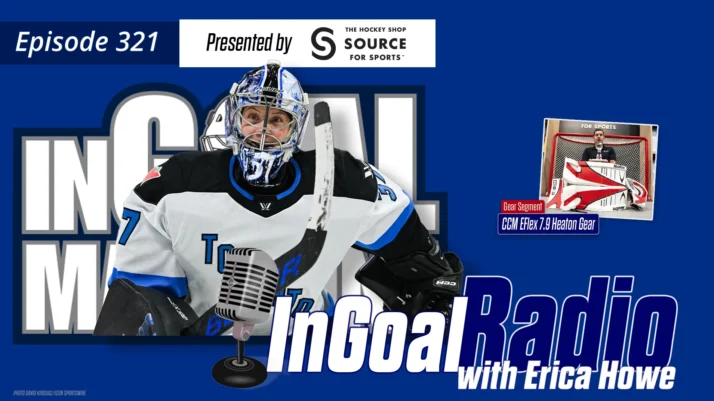
InGoal Radio Episode 321 with retired PWHL goalie and breast cancer survivor Erica Howe
Please subscribe and leave a rating — it helps us reach more goalies!


Retired PWHL goalie Erica Howe, who won an NCAA national championship with Clarkson University and a gold medal with Canada at the under-18 world championships, describes her cancer diagnosis as the 'toughest year of her life.' She credits lessons and relationships built during her goaltending career with helping her navigate treatment and isolation, and has partnered with October Saves and the Canadian Cancer Society to support others facing cancer.
- Erica Howe credits goaltending's mental discipline and team relationships with helping her survive and recover from breast cancer treatment.
- Howe has partnered with October Saves and the Canadian Cancer Society to support other cancer patients using her platform as a former PWHL goalie.
- Mental skills developed in hockey are directly transferable to life transitions — Howe is now applying those lessons as she moves into coaching.
- Dustin Wolf explains his positional target preferences and the decision-making behind whether to target the back post on long laterals.
- Sports psychologist John Stevenson's research suggests cell phone use can negatively affect a young goalie's on-ice performance and mental readiness.
Episode 321 of the InGoal Radio Podcast, presented by The Hockey Shop Source for Sports, features an inspiring interview with retired PWHL goalie and breast cancer survivor Erica Howe.
Feature Interview
presented by NHL Sense Arena
In the feature interview presented by NHL Sense Arena, Howe takes us through the “toughest year of her life” after being diagnosed, how the lessons and relationships from a successful puck-stopping career helped her through the ups and downs navigating cancer treatment and the isolation that came with it, and how she’s teamed up with October Saves and the Canadian Cancer Society to help others in their battle. Howe also shares some great lessons from an impressive career that included winning the NCAA national championship with Clarkson University, a gold medal with Canada at the under-18 world championships, and two CWHL All Star appearances before her final season with Toronto in the inaugural PWHL season in 2023-24, and some of the most important mental lessons she’s now applying in the transitions to coaching.
To support her work with October Saves and the Canadian Cancer Society, click here.
Parent Segment
presented by Stop It Goaltending U
In this week’s Parent Segment, presented by Stop It Goaltending U the App, we dig into advice on how top help your young goalie manage cell phone use, including some important lessons on how it can negatively affect your game. It was a great reminder for parents to look back on an article penned by sports psychologist John Stevenson for InGoal titled “Is Your Phone Costing You Saves?” and we’d highly recommend revisiting those lessons after you listen to this.
Pro Reads
presented by Vizual EdgeWe also review this week’s Pro Reads, presented by Vizual Edge, with Calgary Flames standout Dustin Wolf explaining his positional target preferences and whether or not — and perhaps more importantly why or why not — to target the back post on long laterals.
Weekly Gear Segment
presented by The Hockey Shop Source for SportsIn our weekly gear segment, we go to The Hockey Shop Source for Sports for a closer look at the gorgeous Heaton 10 tribute from CCM that combines fantastic retro graphics with pro level features at half the price, all available in store without the need for custom orders.
Episode Transcript
Intro
Welcome to the InGoal Radio Podcast, episode three twenty one presented by our friends over at The Hockey Shop, Hockey Shop Source for Sports. I am Kevin Woodley, and I've probably already got you confused because it usually takes me a good thirty seconds before I try and get a word in edgewise on our host, Daren Millard, who is not here today. Special assignment and that special assignment involves travel with the Vegas Golden Knights, Training camps, Hutch, David Hutchison, cofounder of InGoal Magazine, as Daren Millard always likes to say, I believe actually founder of InGoal Magazine would be the proper way of saying it, is here with me. Training camps are on our way, which means Mr. Millard is just jam packed right now this weekend. Could not join us.
It's an exciting time for NHL teams, for NHL prospects, for NHL goaltenders, but also for junior kids. The show is underway. The WHL started last night. How's she going? That means hockey dad mode is fully activated for you.
I hit my stress mode again. I stand here every week, and I deliver soliloquies for parents to tell you how to remain sane and enjoy the game, and I'm not very good at it myself. It's a struggle for all of us, and, and I get a little bit stressed watching my kid play just because you want him to be happy and you want him to do well. Thank you for calling me the founder, but I think the truth is I started InGoal before you, but I was lost and you found me and we figured it all out together.
So Oh, is that why we're cofounders? So That's right. I I'm like, I was I took part as a in a Founders to Fairways golf docuseries with your nephew, David Stark, and played a round of golf. And he asked me about that because Daren always introduces us as cofounders, and I explained this is interestingly enough, was at Bear Mountain Golf Course. K.
36 hole course designed by Jack Nicklaus. For those that don't know on beautiful Vancouver Island, it is it is a gorgeous spot. This is where this event was going on. They they were recording us and doing interviews as we're playing golf, and I play golf a little worse than I actually play golf. So you can imagine how bad that would be.
And we had we had a great day, but there were a lot of tie ins. As I explained the story of founder, cofounder to him, I had to also explain that we met for the first time at Bear Mountain Golf Course That's coffee shop owned by at the time by former NHL goaltender Trevor Kidd, and that my background was actually pre goaltending was as a golf writer. In addition to covering the NHL, I did some PGA tour writing and a lot of magazine and travel golf writing, and that included touring the Bear Mountain Golf Course in an SUV while they were still routing and cutting the first of the two Jack Nicklaus designed courses. And in that SUV with me were the original founder of Bear Mountain, Len Barry, and his partner, one of, I think, I believe over a dozen NHLers to be involved in the project, Now hall of famer, Mike Vernon. So it was a full day of goaltending and golf colliding on the Bear Mountain Golf Course this week, and it all started with a conversation about whether you were the founder, and now we we know why Daren reverses us.
So so I this in typical Kevin fashion, I just spent three minutes, and I haven't even introduced our guest. I just rambled. This is a special episode. We've got Erica Howe, longtime women's pro, two time CWHL all star, played her final season a couple years ago in the inaugural PWHL season for the Toronto Sceptres. National champion at Clarkson University, won a gold medal at the U18s with Canada, has since retiring last year been in a cancer battle that she went public with back in October, rang the bell late spring this year, and is now involved with our friends October saves and raising awareness and raising funds.
So we have a fantastic conversation coming up with her, an emotional at times conversation as she shares both her cancer journey and her journey in the game of goaltending and those worlds colliding lessons from both that are invaluable for everyone. So make sure you stay tuned for our feature interview this week featuring Erica Howe. But first, Hutch, we go to I wanna start the I'm gonna I'm throw see, curveball. Curveball. We're gonna throw you the parent segment right away. We're gonna switch
like, we're gonna catch the curve.
We're gonna switch things up here, buddy. We're switching it up mostly because I'm stalling before I can get to The Hockey Shop Source for Sports, our presenting sponsor. And The Hockey Shop's Gear Segment this week is the CCM Vizion stick. But I wanted I wanted to throw it to you because we've already had far too much of me. The parent segment this week, of course, is brought to you by our friends over at Stop It Goaltending, Stop It Goaltending, and the Stop It Goaltending U app.
Daily primers this week habits including on and off the ice, a goalie systems breakdown on high slot line plat passes, sixteen minutes of video featuring NHL goalies, how best to manage it, and a behind the net wrap drill. All part of this week's content at the Stop It Goaltending U, the app. And, of course, when you get Stop It Goaltending U, the app, from the Stop It Goaltending crew, you also get full access to InGoal Magazine, ingoalmag.com, and all the content that we have coming out there. You know what you do, Hutch, to access the Stop It Goal Tending U app?
You pick up your cell phone.
Parent Playbook
You pick up your cell phone. As I understand it, that is the topic of conversation for this week's parent segment. Take it away, my friend.
That's the second curveball you throw on me. And if you don't warn your catcher, you're throwing a curveball. You end up with a wild pitch or a pass ball, and it's not a good thing. Let's hope I can figure out how to block this one. Here we go.
Listen. Did I say that I've throw I pitched even worse than a goal tended and golfed, so my apologies.
Good. So it's a wild pitch and not a pass ball at
your fault.
At least we know that. Alright. Here we go. We are gonna talk about cell phones today, and I will at some point figure out how to deal with your curveball because sometimes they're good things, but sometimes we need to be careful about them. Cell phones have been on my mind for a while, Woody, since I I got a note from InGoal listener, Ted Penzition.
Ted, I think I got your name pronunciation correct there because I actually asked, Woody. And he sent in this story, and, here's what Ted wrote to me. He said, last year, I had an 11 year old first full year goalie, and, we noticed that he was struggling with long shots. And shortly after one of your podcast discussions about eye training, I had an idea. For weeks, he would get dressed and play games on his phone before the coaches started their chalk talk.
I deducted that perhaps his eyes were trained to focus at 18 inches. So one day he walked in with his dad and I asked him to hand his phone to his father. He mumbled a bit, but then we did some eye exercises prior to taking the ice and he pitched his first ever shutout. Literally, word pitched, it fits in with our little discussion there earlier. And, and now this young goalie is playing up a level, and he still gives his dad the phone whenever they enter the rink.
So I'm glad that some of our content here on the pod inspired Ted, and I'm glad that he had the creativity to apply it to his particular situation. He's helped the young goalie, and and it stuck with him. So that's really cool. Now a couple of nights ago, I was at a junior game, not my kid, not his league, and I spoke to a coach after the game. Then we saw one of the players go into the coach's room to collect his phone.
You see the team makes all the kids hand theirs in when they get to the rink. They tried to give the kids some freedom, but during exhibition season, they walked into the room between periods only to see most of these kids aged 16 to 20 sitting on their phones. The problem, it isn't just about young goalies, everybody. So Ted described for everybody a consequence that not everybody might imagine, and that's the effect on your vision. I think we can imagine the distraction and and so on.
But that tangible thing about vision, I think, was really cool for for Ted to figure out. I wonder about attention span as well in a world where few of us can sit for more than a couple of minutes without our phones. I should tell everybody that, we published a lengthy article from sports psychologist and goaltending coach, John Stevenson, over at InGoalmag on the effect of phones. It's titled, is your phone costing you saves? Examining the effects of screen time on the eyes, brain, and stopping pucks.
Go check it out over at ingoalmag.com. If you're one of our subscribers, we will have it linked in the show notes for this week's podcast. So as we embark on a new season, it's a much easier time as a family to set new standards and routines, so I'm raising this merely as a way to provoke some thought. I'm not here to tell you what to do. What you choose to do as a family and how you manage it on your own is, of course, your decision.
I will say that many teams at the junior level either take the phones away or at least provide a place where they expect the players to leave their phones when they arrive at the rink, whether it's for games or practices. Now younger teams may not wish to do this, but they choose to give the parents guidelines about phone use. I will say it is important to be present when you're at the rink. Practice time and game time, it's limited. Creating a good team culture is really important, and mentally preparing for every ice session is important.
Being withdrawn on your phone is really not the way to achieve any of that. The list of negative effects of screen time are too lengthy to mention here, but, John Stevenson does detail them in his article. He believes excessive screen time affects both your visual system and your ability to mentally process and read the game. So while I'm not here to suggest that you have to take your child's phone away as they enter the rink, that's your decision, I am here to encourage you to have a discussion with them. Of course, they want their phone with them, but what's the plan going to be for it?
Because there's little question in my mind that before hitting the ice, they their use is detrimental. The eyes really are the key to everything in goaltending and treating them as an afterthought or even mindlessly engaging in an activity that at very least detracts from preparing the eyes for what is to come. It's a mistake when we do so much more to give ourselves and our kids every advantage. Expensive equipment, expensive lessons, proper physical warm ups, proper nutrition, and more. So why ignore the potential detrimental effect of your phone?
So I'm asking this week, what will your family phone policy be? What will you ask of your child? Will you be like Ted and his goalie who saw the link between the phone and performance and made a change for the better? Let me know. Parents at ingoalmag.com.
I feel like this is one that's gonna be a lot easier for the parents that are already goaltenders. You know, like the the father son, father daughter, mother daughter, mother son relationship because the adult in this discussion will be able to get fully dressed in goaltending gear before trying to pry the phone away from their young son or daughter. And I feel like in past moments where I've needed to do that, I've wanted all the protection I can have.
Oh, I see I see where you're going.
Okay. There's a fear fear factor of goaltending. Trust me. There's a fear factor in taking a phone away from a teenager, which I mean, listen, jokes aside.
And that's why I
said discussion. As anyone.
That's why I said discussion. Right? Like, again, not not telling anybody how to parent, but, walking up to your child at the rink for the first time and saying, hand me your phone. I just heard on InGoal. It's a good thing to do is setting yourself up for failure.
A discussion two or three days before the next practice or game, maybe share some of the stuff from the article, maybe share Ted's story.
Never a bad thing to break the dependency. You talked about the junior kid running back to get his phone as soon as the game ended. It is I mean, I'm living
in right Full kit. Like, most of the kids had gone into the dressing room, and he literally still had his helmet on when he went in to get it. And and, I mean, maybe he had something urgent he had to but I doubt it.
Yeah. Absolutely. Hey. Listen. Like and this is not a this is not us judging the younger generation.
Have a massive problem with the amount
of time I spend on my phone right now. Yep. Yeah. That's it's an important lesson and I love the way you framed it in terms of having a discussion about this rather than trying to dictate it like anything when it comes to that parent child sporting relationship, whether it's hockey or for me with my young daughter with volleyball, all you can do is lead them, and hope that maybe when you you get to the water, they have a sip.
Well, just imagine how well you would do if you went to your spouse and said, hand over your phone. It's, you're on it too much. It's probably how the probably the discussion that would ensue with your child as well. So not easy.
Been on the other side of that one. I can tell you that recently as well. And, you're right. Like, instantly, you know you know it's right, you know they're correct, and yet you the the instinct is for your your back to get up for sure. Yeah.
Right away.
Yeah. Of course. Okay. Of course.
We've got so much to get to in this episode. Always, packed with tons of stuff, but we did have we did have some sad news this week, which I probably should have led with and forgot. Passing of Hall of Famer, Ed Giacomin, famous of the New York Rangers. And before our time a little bit, Hutch, like, terms of having watched him play?
Just. Yeah. I watched a little bit of him. He kind of crossed over with Ken Dryden's era. People who watch this stuff carefully will probably tell me I'm right or wrong, and maybe I was just used to reading about him in books.
I What I loved about, Ed was I mean, it was masks that got me into my love of the game. It's masks what, in many ways, got us rolling here at InGoal. And in a time when people were just starting to apply paint to their masks, I remember Ed and his partner in New York, Gilles Villemure, had two incredibly distinctive yet unpainted masks and, two very different goaltenders if I recall correctly. But, but other than that, I'm I'm sorry to say that I don't have a a great memory to share, but I do understand you got a note from one of our listeners.
Yeah. Longtime listener and great supporter of InGoal Magazine, Chris Mattola. And this is not an age shot like I delivered to Hutch with Dryden recently.
[crosstalk] He's just a little older than me. Just a little
older than us, and he and he sent a really nice note saying that he'd seen Ed Giacomin, play a lot in person. Probably the best stick handler I've ever seen, and I didn't that was not something that I was familiar with. In the words of Chris, better than even Brodeur, especially when you consider the lumber that he had to use. So maybe a part of the game that we're not all intimately aware of because it was from a previous generation, but sounds like puck handling was a big part of what Ed Giacomin did so well.
And, there was another little anecdote he shared there, I thought you said, which I had never heard of before.
Yeah. He said in warm ups, he used to and, of course, Chris is as passionate as they come about the position, so he didn't just go to games to watch them play. He would have been a guy that watched warm ups. And he said in warm ups, he used to regularly catch pucks between his legs. It was something to behold.
That is amazing. And just picture the stand up goaltender trying to squeeze the wickets just perfectly. I can think there's probably gonna be a few young goalies listening to this today that might try and pull that off in practice.
Think a bunch my first instinct was like, hold on. What? Like, he reached back between his legs and caught the puck? Because but now I know what we're talking about here. So Yeah.
Yeah. You're right.
I actually I've I've done that with a number of goalies. My son who, you know, is a goofball mostly, but but others just challenged them to play like an older generation goaltender, somebody they've watched as a as a way of, in a goofy sort of way, increasing athleticism. So let's see if there's some young goalies out there that wanna try catching catching pucks between their legs this this week.
Okay. Send us your videos if you do. We'd like to highlight that. We'd also like to see the failed videos. Maybe I'll try and do it.
Actually, enough pucks go between my legs already. That's probably not a good idea to encourage more. At least I would have an excuse. Guys, I was trying something. Like, every time I go into the rink with new gear, it's just like a built in excuse.
One guy who didn't need any excuses, we may not have all immediately had a picture of Ed Giacomin, but we did when I mentioned Marty Brodeur. I think everybody has, you know, that distinct memory. Maybe some of the kids don't because, hey, we're getting to a point now where some these kids aren't quite sure who Carey Price. But I think most of us in our generation obviously have a distinct image of Marty Brodeur. And, boy, was it fresh in my mind when we got to see this week's Gear Segment from our friends at The Hockey Shop Source for Sports.
We're gonna get into the new offering from CCM, which is a Heaton 10 Tribute Graphic stock available off the rack in stores. Before we get to Cam and before we get to that breakdown, I gotta tell you, it is remarkable to be in there in late September as everybody at the Hockey Shop Source for Sports is catching their breath after the madness of August and early September. Everybody coming in and grabbing their gear, skates, fitting, sharpenings, new pads, everything. But to be in there and see the walls completely restocked and to see how much new stuff continues to come in. The CCM Vision stick, we did a segment on that that we'll have coming.
There's a wicked new retro graphic swagger stick from Warrior that we've got coming up in coming weeks. That's new. This heat and set that launched this weekend that we're gonna talk about. So it doesn't matter what you need. Even in September, it's like Christmas every week I go in there.
They've always got the latest and greatest available and a staff that is well educated on the features of all that equipment. And as always, we've talked about it before when the new stuff comes in and there's more coming from Brian's, new launch coming out in November. When the new stuff comes in, the old stuff is on sale. They have so much inventory there even after the biggest sort of in store sale period of the year. There's still plenty available, plenty of discounts.
Hutch, how about some of that pro return stuff that we saw? We've got a segment that'll come out soon on the True sticks.
But spectacular,
but CCM.
Holy cow.
Gear
Incredible deal. CCM sticks, True Sticks. Make sure you check them out at the hockeyshop.com. As a matter of fact, I'm a little worried about this. I'm telling everybody to go check it out.
They might sell some of this stuff. There was so much new stuff we recorded six segments during our recent visit. I'm worried about them selling out of some of the gear before we actually get to feature it on the show. That's how much new equipment, whether it's pro stock return or or pro returns or new launches or just things we're still catching up from the summer are in store and available at the hockey shop source for sports, thehockeyshop.com. Make sure you go check it out, including, and we'll hear it from Cam now, this week's Gear Segment, the all new CCM 7.9, and you'll hear in a minute why I highlight that, Keaton 10 graphic.
Kicking it old school.
That is. Like, I'm like if we had a little cardboard down here, I'd get down there and breakdance.
Welcome back to The Hockey Shop Source for Sports.
You wanna see that, don't you?
I'm Cam. They were breaking in and not dancing. Heaton. CCM. Heaton 10's.
Heaton 10's. Can you
see a little graphic on the back there? Probably not. It's a long ways away, but heating tens.
So That's a good look. It is a good look.
Now I like I feel like I can make some skate saves in these. Bonus points Yes?
In the comments below if you can comment exactly what year this came out. Yeah. We'll leave we'll leave that one blank for us.
Do we need to ask them who wore it most prominently? Like, especially in these Is that obvious? It could
be, but, go ahead and
ask him. He's on the Mount Rushmore. That's
fine. He's on the Mount Rushmore of Goaltending.
Absolutely. One of the GOATs.
See, you know what's funny? I thought of our our, you know, good old local boy, Dan Cloutier.
Yeah. I'm pretty sure everyone's going to Marty Brodeur on this one, buddy, but good for you. Good for you for, you know, keeping it connected. As we unveil very devil
Miikka Kiprusoff. Welcome back to
The Hockey Shop Source for Sports where we are talking about the CCM EFlex 7 Heaton custom graphics
[crosstalk] 7.9. Now available at retail. You know what? Hold on. Okay.
You didn't hear that a lot when Marty was in net. Nothing went in. If that sounded like a goal horn to you. I apologize for the PTSD if it did. Continue.
Are you telling me these are 7.9?
This is a 7.9. Honest to God, did
not know, did not plan, asked you coming in, I'm like, oh, this is an EFlex seven, which is another testament to the fact of how little difference there is between the seven and the 7.9. So there we go. That little aside, unplanned aside. I didn't even realize this was 7.9.
There you go. You also let the viewers in on the little secret is that we just do this live. We do not write a script here.
Well, I mean, there's absolutely no planning. I learn as I go. Wow. Okay. So there we go.
So So
there you go. Are far and away.
The price point's very reasonable on this as well.
So this is giving you that option to get that kind of vintage style look. So this does fall in lines with some of the other things that we have seen, you know, resurgence of the reactor graphic, things like that.
Yep.
However, a, this graphic looks super sick. One one color for now.
So it's just in the devil's murder colors. The Cam cannot relive his Dan Cloutier fantasies.
I wish. But if you did want to, you could go up to the EFlex seven and order their all out custom print, which is an option. Right. And change your colors. But anyway, that's neither here nor there because we are talking about the 7.9 equipment specifically.
So you have the pads and we have covered the 7.9 in the past, but we can do a quick overview of the pad just to make sure everyone's up to speed. So first of all, looking into the back again, same as that 7.9. There are no fundamental spec changes to the pad itself. You still have our QMSS three
overall calf wrap. Includes a new
slide. CGT slide technology. Yes. Which really does feel great
on the ice. Can't even notice that. Look at the Heaton on
the side. More importantly now, again, I'm talking about some of the actual graphic features of the pad itself. So yes, you do get that old school Heaton logo.
Honestly, can just send them back to the 7.9 overview and the seven overview. You can folks, can find we don't need to go into all the details. That's what you're getting here. You're getting in a Heaton look. You can get it in what sizes?
So intermediate and senior. So that same sizing curve that you see in that 7.9, for example, all the way through. So stock, same blocker, no changes there, but still you get slick old Heaton graphic and then you still get their new five eighty builds in the glove. Single t, skate lace pocket, and great overall closure right out of the box.
And look. Heaton. I like that. Okay. So lower price point, great gear, and a stylish retro look.
All available off the rack. No need to custom order. They have it in stock here at The Hockey Shop Source for Sports at thehockeyshop.com. If you have questions about some of the specs, some of the sizing, anything to do with this gear or any gear, call Cam and his crew.
(624) 589-8299 or 1-800-567-7790 or check us out at thehockeyshop.com.
Cam's so excited that he couldn't slow down.
Marty Turco, there's another one that wore that Heaton and graphic.
there's another
wear it in this color?
No. But I'm just you know, the other names that come to mind. I'm just reminiscing on the golden years.
Marty, don't worry. He's also a fan of you. We'll have him send a personal apology. Okay. So a couple couple things I gotta clarify here.
First, I think earlier in the show, I was so excited about all the new equipment that I teased the Vizion, the CCM v I zed I o n stick as our gear segment this week and then dropped the heat and 10 line on you. We'll have the vision stick within the next couple of weeks, folks. I promise it is definitely going to be worth the wait. And like I said, it's available right now if you have questions. Yeah.
No pun intended on the worth the wait thing.
Oh, yes. If you could envision that stick, it is beautiful.
Okay. This is a dangerous road we're going down here, Mr. Hutchison, the king of the dad jokes. I can't keep up to you when it comes to those, so I'm not even gonna try. So if I tease you and you got all excited, go check it out online at the hockeyshop.com because they've got it in store, available online now, and they've got a staff that can answer any of your questions. So what was the first thing that jumped out to you when you saw those heating pads?
It's time to get my gear on again.
Oh, wait. Did I this is something I like to hear.
Yeah. Like, seriously, they're absolutely gorgeous. And, I mean, now you get I would love to wear those pads because it's such an iconic name, such an iconic look. In my mind, I can puck handle like Brodeur, although there is no chance I come even close. Just try and envision that.
But, yeah, they are so beautiful. If you play on a team that is red and black or you can have any excuse to wear red and black, I think you're gonna want these. But then afterwards, it was the fact that they're so affordable.
Yeah. I I you heard it there in the segment folks. And just a reminder to go check it out because if you thought I was putting you on when you heard it and that I was acting that I was shocked by it, go to the YouTube channel. You'll see how genuine it is. And actually, interestingly enough, on the back of the leg panel or the leg channel on the inner, it it has that sort of, like, embossed.
It just says EFlex seven, not 7.9. And I had the pads in front of me, and I genuinely thought this was an EFlex seven product, which it speaks to two things. One, how small the margins are between seven and seven point nine. What a value 7.9 is their second price point product with CCM this year. It's it's easily the nicest that they've had.
It's the best iteration of that version that they've had at CCM, and and just how close it is and how much money you can save. And in this case, get an extra look. Now the one thing that did jump out at me, especially after Cam, after the fact, realized that he had a Brodeur figurine in his office hoisting this Stanley Cup. Would have been nice, Cam, to know that we could have had it over our shoulders, little Marty whispering in our ears as we talked about his new gear. But seeing the Brodeur statue and noticing and and, of course, there wasn't.
But his Heaton's had, like, no thigh rise whatsoever. It basically ended at the top of the knees. And then seeing that pattern on the modern pass, I'm like, oh, thank God for thigh rises.
Yeah. Oh, yes. I'm not gonna order them in the size that I used to wear gear.
Can I get a thirty four minus three?
Yeah. No. I'd be the thirty minus three because the the pads behind me, those brown pads, my kid and Adam was wearing pads that size. So things have changed a lot, haven't they? I think this is also a good time to remind people, maybe you can get it up on the socials this week that we did a somewhat goofy quick segment where you had to blindfolded guess whether it was an EFlex seven or a seven point nine pad.
And I handed you both while you were blindfolded and you had to figure out which was which. I won't tell anybody how that how that went. It was genuine though. He was legit blindfolded and, and it was something we just thought would be fun fun to try.
Now I'm gonna be honest with you. That video when we first launched it, I got a lot of responses from teammates, guys that I played with over the years, and they're like, how is this any different than the way you play goal? Eyes closed, eyes covered. What's the difference? You can't see anything.
One of these weeks, we're gonna have a moratorium on self deprecation. I'll give up the dad jokes if you can give up the Woody jokes.
I don't have any other material, my friend. All I've got is self deprecation.
Well, in short,
and I make myself an easy target. What can I say? So there we go. The CCM EFlex 7.9, Heaton 10 line. The other part that I I wanted to highlight there, I don't know.
You can see it again in the YouTube video, but just for those who are listening to the podcast only, Cam mentioned you could get it in different colors by just going CCM seven, EFlex seven all out and ordering the graphic. But of course, that would mean the graphic is printed on. Part of the beauty of this 7.9 design in the devil's red colors is the fact that it is stitched on. And so there's a little bit of that old school stitch and sew feel to this pad. They would look the same because what they do with the all out graphics I mean, you've seen our set.
It's remarkable, but a little bit different when it's cut and sew and sew. They they bring that to you with this 7.9.
Our our set, which made its debut in the Western Hockey League last night.
Let me tell you.
Very nice to see.
Considering it's previously been worn primarily by me in summer beer league skates, that's the best it's ever looked.
It was fun. So there's one detail missing from the Brodeur pads that I mean, it's probably good that it's missing.
Now you've got me
make them authentic?
Well, they'd have to Buckles be
on the toes. Buckles on the toes. Okay. That feel I mean, it's not missed
because take the knee stack right off this thing?
Well, no. I said there was something missing. But you're right. There was also something added. Yes.
There there was no I remember watching Marty play later in his career and covering the league and looking at his pads, and it was just up until the final years, like, was just a stub. Like, there really wasn't what we would consider a full landing gear area for him. I mean, again, one of those things that just makes what he did and the way he played so much more remarkable. So, yeah, hats off obviously to CCM for coming up with the tribute. I think it looks great.
I love the the 10, the logo, the graphic. I love that Heaton is stitched onto the side of the pad as well. Mhmm. Just the way they've incorporated the two, is is fantastic stuff. Alright.
We've done parent segment. We've done the Gear Segment. It is time to talk a little ProReads brought to you by Vizual Edge. Vizual Edge, as you've heard us talk about for several weeks, is a cognitive and vision training tool online on your computer, on your tablet, using their glasses, which you get when you buy the program. It is used by goalies right up to the top end of the game, including Jordan Binnington of the Saint Louis Blues and team Canada, not just at the upcoming Olympics, but the gold medal winner or championship winner at the four nations.
Jordan Binnington was on Vizual Edge every game day as part of his four nation preparations and shared these thoughts about why he likes it. Visual Edge has added a quality element to my preparation as a goaltender. I use the game day drills every game before heading to the rink. It's a combination of recognition, reaction, and focus that activates my brain and eyes to feel ready for what's to come.
I was just gonna say, because now you're pulling out another tool where looking at a screen is helpful for a goaltender. And I forgot to bring that up when we were talking about Stop It U, the app, as well. And if you dig into John Stevenson's article, which I would highly suggest that everybody do because he put a lot of effort into that and a lot of great detail, he mentions there is a difference because one is very purposeful use of technology for your benefit and one is not. And the way it engages your brain is very different, and you also pair it with some purposeful time away from the screen. So he's actually got a a recommendation in the article for the amount of time you should spend away from the screen compared to the time with the screen and even a ratio of time of looking and focusing on objects at a distance while using technology.
So didn't want to suggest that you can't be on a phone. There are some great uses including Visual Edge, Stop It You The App, and maybe even in goalmag.com.
Well, I was gonna say too, I don't I'm not sure you can use Vizual Edge on a phone. I think it is pretty much, I think tablet might be the smallest you can do it on. We're gonna have to look that up. The smallest I've
ever done. I thought I tried it on the phone, but, we we will have to look that up.
My eyes are not good.
I could certainly imagine that you would prefer to use it on a larger screen. I mean, it's still screen time, but I think you would want to use it on a larger one just to fill your field of view as well.
Yeah. Absolutely. Regardless, this is a tool that can be used and is used by the best in the game, and you can get a discount on Visual Edge by using the discount code InGoal, all one word, all caps, I n g o a l, and get 10% off all monthly and annual subscriptions to Vizual Edge mental, cognitive, and vision training tool. And, of course, InGoal members, 20% off. I can't read the code out, folks.
You gotta be a member to receive it, which means you have to log in to our ProReads, and each week, it will feature the code you can use to get 20% off visual edge training. This week's ProReads, when you log in, features for second week in a row to celebrate his contract extension with the Calgary Flames, Dustin Wolf. And it was really interesting, and a great example is Dustin Wolf broke down a rush chance started by Connor Bedard of the Chicago Blackhawks. So Bedard with the puck, skating down the wing, and a backdoor option going to the net. There were multiple elements to this ProReads.
And the first one that caught my eye, because I think Bedard is one of these young up and coming players that, I think, fair to say can score from anywhere, has a wicked release, and has beaten goaltenders from distance. And yet in this case, Wolfe was actually critical of the depth he chose off the rush with his heels on the edge of the crease and Bedard near the top of the circle. Because in his mind, after watching Bedard in the replay, there was no way he was shooting, and he wasn't dangerous from there. So there was no reason to be that far out. So what I love about Wolf in this ProRead and throughout his ProReads is he's willing to look at his own video with a critical eye and share that with us.
Like, hey. I don't need to be out that far. The threat is on my right on the backdoor driving the net. So that was one part of the ProReads, and you'll be able to, when you log in, see that, see the video, see what that looks like, see what it is visually that he's seeing in Connor Bedard that tells him the shot is not a threat from here. And then watch as he comes across because this is different situationally.
It's different from goalie to goalie. Some guys with that backdoor net drive want to stay outside of their posts, above their posts because hitting the post itself can delay the top of your body, your upper body coming across into that save lane completely. It can kinda sorta spring you off it a little bit. But in this case, Wolf talks about targeting the post purposely and that that is where he's going to with his rotation and his push breaks it all down in the video, gives you a taste not just of, hey. This is this is how I do it, but why he does it that way.
And for one of the best in the game last season, rookie of the year finalist, adjusted numbers that were barely behind Connor Hellebuyck on a per se basis when you factor in the quality of shots faced, Wolf breaks it down completely in terms of why he does it that way. That's all in our latest ProReads online now at ingoalmag.com, and, of course, brought to you by our friends at Vizual Edge. Hutch, anything stand out to you in that ProReads this week?
Just the fact that it's a it's a great piece of content for people to watch and consider what they are teaching, what they are being taught, what they have learned growing up. That depth piece is especially coming from one of the smallest goalies in the National Hockey League. I think is so important for people to see, and it's a very clear situation to help you understand why that is so important. I mean, it's easy enough to say, you should stand here. Here's the reason, but but it's an absolute wonderful example of of why depth matters and how it helps him make a save even if he is critical and says that perhaps he doesn't need to be as far out as he is.
And the fact that here's a guy facing, as you said, one of the top shooters in the game, and he can manage it at a conservative depth. The game is trending this way, both managing your depth and moving on your feet, being able to move on your feet as a result. And I I just think it's a fabulous example. It's not we don't look at ProReads always as this is how to make a save. It's it goes into so much more depth than that, and it gives you an understanding of the game and the thought process.
I remember, I was telling somebody this earlier today, Woody, that, the brilliance of when you started ProReads, the fact that it puts a positive spin on what people so often on the Internet love to jump in on, and that's criticizing a goaltender when a puck goes in the net and all the things they could have should have done. And I remember you saying, we don't understand what it is that they see. We don't understand all the thought that is going into the saves that they're making, and we need to hear it from them. And I think this is a great example.
And I think it's another example of, like, listen, we are not about telling you what to do because there are as as as yeah. There are 64 goalies in the National Hockey League on any given day, and I'm not sure there are two that play the game the exact same way. And so how goalies play, how they met, it's unique. And so learn from them. Learn and I will say this because we are two Dustin Wolf back to back ProReads Inn, and we have many more to come.
We spent more than an hour with the Calgary Flames goalie heading into this season breaking down video. Pay attention. I don't wanna give it all away when we discuss this week's ProReads. I want people to actually have to log in and and watch it, but pay attention. Pay close attention to each of the first two.
When he talks, there's tactics. We've we've discussed the tactics. That's your depth. That's the decision to target the post on this backdoor push. But the mechanics, his triggers and his keys that allow him to move the way he does, to keep his feet under him as not just as well as any goal in the league, but arguably better than any goal in the league.
UC Saros pointed that out to me last year. I asked him the stereotypical question about smaller goalies watching other smaller goalies. And Saros said, like, not only it's not just that he's a small goalie, but I'm paraphrasing a little bit. But, essentially, there were things that he thought Wolf did better than anyone else in the game, and that's why he watched him. Not because he was another under, quote, unquote, undersized goalie.
Mhmm.
And Wolf really does get into, again, his foundation, his keys, his mechanics that'll he believes allows him to play like that even in moments where they're not perfect. And if you pay attention in these ProReads, he talks about them. It'll become a repetitive theme as we continue to go through. There's already one repetitive theme in the first two that you will hear him talk about in both in terms of what leads his movement. And so pay attention to those things because there are no absolutes in goaltending.
But when you see somebody who's playing it at a level like he is and he's basically handing you his keys to doing it the way he does, Not saying you have to do it, but you bet I would suggest paying attention and maybe giving it a call.
I would suggest paying attention to the best in the business and maybe maybe try again. And I mean, all the NHL goalies being the best in the business. And even then, it is still so hard. Let's, like, let's not discount his ability to read what was happening there because you could tactically approach it exactly the same way as Dustin Wolf, and perhaps you could even skate as well as him and move as quickly as him. But if you can't read that situation the same way, you're in trouble.
Because how many goaltenders would be frozen for just a tenth of a second on that pass worried that Connor Bedard's gonna put one past them? And that tenth of a second makes all the difference.
How many goal tenders would admit in retrospect that they had too much ice, that they didn't need to be that far out and would feel like they were that far out and they had to hit the gas and go into emergency mode and make a big desperate move. The control with which he manages the situation is such a key to it. So he gets into all of it in this week's ProReads. Folks, I mean, obviously, we're patting ourselves on the back here, but I can't tell you enough how much ProReads is invaluable, is a tool to learn how to read, understand, and manage the game at any level. Highly recommend it.
Obviously, you have to be a member to get it, but we try and pay it forward with things like, hey. If you're a member, you get 20% off visual edge. So make sure you check out the latest episode of ProReads with Dustin Wolf. We've got lots more coming. There's an archive in there that you get access to with over 300 of these videos featuring some of the best in the game, Connor Hellebuyck, Thatcher Demko.
We've got them all in there, so make sure you check it out. Okay. We have we're taking too long. We have a fantastic feature interview with Erica Howe coming up. But first but first, before we get to that interview, we need to talk about the presenting sponsor.
And you talk about learning how to read the game, learning how to process the game. We've gone through NHL Sense Arena and they're great three part system. And I gotta say, working my way through the screen portion of that, how to manage screens, learning how to manage screens right now, there is so much in game application to that that I think it's a very valuable in season tool as much as it was presented as an off season development tool. I think it's an invaluable in season tool for just getting used to what we face once the season starts and traffic matters, but they've taken in another step. They've got a whole another way to get you through a season by getting you through a game, Hutch.
Fill us in.
Sure do. It's here. Just announced today. Goalie training uninterrupted. You get to test your endurance and your focus now in NHL Sense Arena's new game flow module.
It's found in goalie drills, and it provides nonstop action to challenge your mental and physical stamina. So we're not just doing a drill where we face some shots. We now have continuous action, a flow drill happening in front of you that goes on shot after shot. The drill continues uninterrupted. You make a save.
Say the puck goes in the corner. They've got an AI controlled puck retriever, another player in the corner who grabs that puck, fires it up to the blue line, and things keep on going. And they've got brand new shooters and looks to keep that practice fresh even for the most experienced goaltenders. So you stay focused by tracking that puck's movement from the save to the corner, back to the blue line, through multiple passes, and always through a screen standing in front of you. The video flow is so realistic, so impressive.
You can simulate maybe just a a period if you'd like or you can get right up to a full game to build your endurance and prepare for game day any day. We talked earlier about it being a great summer development tool, NHL Sense Arena. Now that you've done that, now let's start building your endurance. Young goaltenders, I was just talking with another goalie coach this morning, Woody, about the fact that getting the ability to stay focused through an entire game is a real challenge. As you get older, the games get longer, you're out there on the ice for a long time.
And then he brought up that even at the beer league level, you've got to break your game down into shorter segments so that you can manage to stay focused and get through that full game. Well, now, NHL Sense Arena gives you a tool to start working on that. So you have to stay focused for longer and longer. It's a really, really cool new feature, really feels like game flow. And when you put that screen and puck retrieval, controlling rebounds, so on together, the the action just keeps going and it's fantastic.
So check it out today. Sensearena.com. As always, use the code I g m 50 and you'll save even more.
I gotta say, like, we we've been having discussions here at the InGoal Radio Podcast and outside, you know, with with friends and peers in the hockey world about playing time, about starting goalies, about backup goalies, about how absurd it is at at at what young age we get into that about how maybe every goalie should play. We've got some stories that have come in sharing about Just this week. Kids kids at 14 u where they've been declared the backup and don't actually get to play. They're not even alternating. That should not be allowed.
No. That's crazy to me. We'll get to that maybe next week. But if your son or daughter is in one of those spots or, hey. They played last week's game, and this week, it's their turn to sit on the bench as much as I disagree with that being the best way to handle it.
Here's a chance to get a game worth of reps, like, to to get that feel. Come home, throw on the headset. Know, you haven't stopped any pucks during the game, you've gone through your game day warm up and everything. Throw a headset on and at least live through it from that standpoint. So just another way.
We've said this from the beginning. The amount that Sense Arena has or NHL Sense Arena has developed and continued to build is a big part of the program. When you purchase it, you aren't just getting what it is now. You're getting what it's gonna be for the next twelve months, and it's constantly growing and improving. We've seen a lot of that in this past twelve months.
Looking forward to seeing what's next because they never stop growing.
I have a feeling if they had backups in beer league, you'd be down in the tunnel on NHL Sense Arena just trying to stay ready, coach. Maybe not even on the tunnel, even on the bench, but then you're taking a bit of a risk.
I would a 100% be using my warm up stick in either regard though. Dangerous situations there in the tunnel when you can't see what's coming at you.
Oh, yeah.
Because you have the Sense Arena headset on. Do you feature
interview this week?
I don't know how to segue to this because we're going from
Just did.
Feature Interview - Erica Howe
Funds and giggles to this week's feature interview, which is there's a little emotion here. This is this is a serious topic, but one that our guest handles so well, and you're gonna hear throughout this interview. You're gonna hear Erica Howe talk about what she's been through, not just in her career. We'd we'd get to the hockey, but in the past year in her cancer journey and share her story in a way that is going to impact you and hopefully inspire you to get involved. Hopefully inspire you if you ever have doubts about your own health to make sure you get it checked out, inspire you in many different ways.
But this is not somebody, again, it will shock you to hear this after listening to her, but who naturally is comfortable in the spotlight, even though she was in it during her playing career a fair bit. And so the way she's gotten through this, the way she's managed that, the impact of her teammates, the world of hockey, the impact that her life as a goaltender and how it prepared her for this journey, we get into all of it. I'm gonna stop talking now so that we can get to this feature interview. It's a can't miss one loaded with some really inspiring stories that we hope helps others and inspires others. As I said, check the show notes for your opportunity to pitch in and be a part of her October saves initiative.
Without further ado, I've said too much. Erica Howe. Really excited to welcome to the InGoal Radio Podcast for the first time. Erica Howe retired one year from an incredible career as a goaltender. She got a National Championship in the NCAA.
She's got a gold medal with team Canada at the under eighteen world championships. CWHL all star times two. And in the inaugural season of the PWHL, probably one of the sickest sets of custom pads I've ever seen. She is a firefighter by day and was well playing hockey and has spent the past year plus fighting cancer. Now an ambassador for October saves.
Erica Howe, welcome to the InGoal Radio Podcast.
Thanks for having me. I'm super excited to be here.
I wasn't sure where to start this because you've had this great career that I really wanna dig into. But, obviously, the last year has been a challenge, and you've come out it of it on the other side embracing a spokesperson's role as well as now with October save. So let's start there. You retire from hockey. You're headed into a massive change in your life as you walk away from the game and into other things, and you get diagnosed with cancer.
What is it seems so silly to say, what has the last year been like? Like, that's such a small question for such a big moment in life, but what has this been like to go through?
Yeah. I think, like you said, retired from hockey. One of the things I have been most thankful for is that I got the opportunity to retire from hockey. Right? Like, cancer didn't take that away from me.
I had already decided, like, I'm walking away from the game. You know? I I wanna move on to different things. What's that gonna look like? And then boom.
Kinda not too many months after cancer hit. And I think the last year has been the hardest of my life. You know, we talk about hockey, and there's all the ups and downs, especially as a goaltender. You go through so much emotionally. There's high highs and low lows.
And I think I always thought that was gonna be the hardest times for me, and then cancer comes along. And when it becomes kind of life or death, am I gonna survive this? What's this gonna look like? It's a whole another level of hard and going through chemo, radiation, endocrine therapy. It just it took it to a whole new level.
And I think as I go through, I was just really thankful to have the hockey community and the firefighting community. I am a firefighter kind of at my back in a whole another way than I ever thought possible.
That process as as you what actually, and and from a the importance of getting checked out, the importance of, you know, staying on top of your health, of not ignoring, you know, walk us through what you know, how you discovered it and some of the lessons there. Because there are as hard as it must be in the moment now that you've come out and become more of a voice talking about your journey, there are lessons there. What are some of the, you know, right right down to diagnosis and and the early days of it, the messages for other people.
I actually found up, like, a palpable lump in my left breast. And, you know, I was joking around about it. There is like, it is pretty common for women in their thirties to have lumps. And I went to a charity ball hockey tournament with a bunch of my teammates and friends, and I had them kind of feel it. You know?
Like, what do you guys think this is? What does it look like? And, they were all like, go get this checked out, Howie. Like, it's it's funny, but go get it checked out. Just make sure it's nothing that I don't know if I would have taken the step without them kinda pushing me.
So I do kinda credit like, my teammates saved my life on that one just being like, go get it checked out, whatever it could be. So I went through the whole process of biopsy. And then one morning, I'm at work, and I just got a call from my family doctor. And I'm like, I had my biopsy on Friday. If this is my family doctor calling me at 8AM on a Monday morning, like, things probably are not good.
I pick up, and sure enough, he says it's cancer. The surgeon is gonna follow-up for with you, but you don't know. Once you get that call diagnosing him with cancer, there's kind of a lag period where it's like you don't have any answers. And I think that beginning period is the hardest to struggle through where it's like, have cancer. I don't know where this is gonna go.
Am I gonna live at the end of this? Like, I have no clue. And that first kind of bit of period was the hardest part, honestly. I think as an athlete, once I got diagnosis, this is the end. It's stage two.
This is gonna be your plan. That part kind of was easier to me almost. Like, chemo and radiation come with their own battles, but having no idea of where it was gonna go is and that's when I really leaned on people. I didn't tell the whole world at that point. I kinda kept it to myself, told my firefighter colleagues who I consider family.
I told a couple teammates, but I really just needed time to kind of come to terms with it myself and understand what it was I was up against. And I didn't want a bunch of people asking me questions when I didn't have the answers. You know? But my wife and I kinda stuck together. We told our close group of friends, and I think the one thing that came from that was just one foot in front of the other.
Like, you can only go one foot at a time. You have to continue going through your your day to day. Like, we'd be in tears, and then we'd be like, okay. We have to go to work, and we have to do something that makes us feel normal because it's so turbulent right now. We just don't know anything.
So that's kind of what I tell people in the beginning. A lot of people reach out now and be like, just one foot in front of the other. And now that I'm on the other side of it, I think the most important thing to me that I've learned is just about values. And I don't know if you can really understand it unless you've gone through that period where you literally don't know if you're gonna live, but just understanding who you are as a human and what's important to you. I think on the other side of it, that's where I am, where it's just like my family's most important.
You know? I love going to work and being with my colleagues. I think making a difference for the next generation is huge, and we're like that in hockey, and I've taken that into my cancer journey. But I think just knowing who you are and what you love as a human is super important.
We always hear things about people finding perspective, but there's probably, like, no greater sense of that than going through what you go through. It seems it doesn't I was gonna ask you to when you're talking about one one step at a time, I mean, it reminds me of one of the mantras we hear in hot in goaltending all the time. Right? Like like, you you can't stop the thirty second shot if you don't stop the first run. That that mindset that is in goaltending so easy to say and so hard to do.
Yeah. To just take it one step at a time where the I mean, did any of the lessons from your great career you know, as as much as this is real life and death and not just the perceived of a game, did were there any that helped you? Like, the experiences it's a tough position mentally. Yep. Did it help you?
Yeah. A 100%. People always ask me, like, did could you draw on your hockey experiences? I'm like, a 100%. Like, even, like, pushing through the hard times, like, as a goalie, you don't decide when the game is happening.
Like, maybe you didn't get a good night of sleep of sleep the night before. Maybe you're not feeling your most confident, but you still have to go out there and perform. I think cancer journey is the same thing. Like, you don't feel good, but you still have to be able to put one foot in front of the other and just focus on the now. I think, in the whole of hockey, like, we talk about leaving that better than how we found it.
I think cancer is the same for me. I kind of alluded to that where it's like, just wanna do some good and leave it better. And I appreciate everyone who's come before me, who's been in trials or scientists who, you know, find the newest and greatest technologies so that I can have a better outcome. I think that's the same in the cancer journey. Also, yeah, you have to be present.
I think as a goalie, that's I'm a I've been doing some coaching lately, and that's what I try and teach them. Right? It's like one save at a time, one shot at a time. You're not you get too far ahead of yourself. You're worrying about the other goalie.
You're worrying about all that. Let's bring it back to you and what you can do. Like, focus here and now, just one foot in front of the other. And that's it. I think I definitely took that into my journey this past year as well.
As you said, from diagnosis to going public, I think it was about three months, a lot to process in that time and a lot to go through. You know, we've talked to other people about, you know, what chemo and what radiation is like. It separates you being immune compromised from all the people that help you get through things. How did you find that bad? Like, you've been a part of a team your whole life.
You still have a team. You still have your teammates there for you, supporting you along the way, all your teammates for all your your years. You got your firefighters. You have your family, but the contact with them can become kinda tough during those stages. How did you how did you manage that part of it?
Yeah. When you're going through chemo, your immune system or the type of chemo I went through, your immune system is kind of up and down. So there's parts where it's very low and then parts where it's not so low. So during those times where it was not so low, I'd try to just have touch points with people, and it had to be small group. So I might go to the fire hall for lunch, let's say, or, like, have a friend over to talk.
The other thing I did during the year, like you said, I retired right before. But when I retired, I kind of wanted to step away from hockey and find who I was. So I was like, do I wanna coach and leave and pass the knowledge on? Do I wanna be a ref who was in the mix? Do I wanna just focus on firefighting right now?
But when I was diagnosed with cancer, I was reaching for anything that made me feel normal, anything that made me feel like myself. So I actually, this past year, reached out to the Sceptres, and they had me on in kind of, like, equipment manager role, we called it. I'm a lot of the time, I ended up just going to the rink and hanging out with the girls or mentoring the other goalies that were there because I obviously, Carly Jackson and Kristen Campbell were there when I was there, so we still had those kind of touch points. But I would go to the rink. And I would wear an n 95 if it was my low time or stay away from people or if people were sick.
But they were so awesome with me just having me in when I could and giving me tasks to do and making me feel like I had my some normalcy in my life while I was going through this very challenging thing on the other side of it. And I always said, like, those were my best days. Like, we joked about it being, like, my make a wish to be a part of the team, but my wife and I call it, like, my make a wish that saved my life because it made me feel normal and made me, re like, just do the things that I love to do.
So goaltending, which I would argue is the hardest position in sports. Firefighting, which, you know, requires a level of bravery and commitment that is up there with has to be one of the hardest jobs in the world. And then you pick going back as an equipment manager, one of the most underappreciated. You know? Like, that's that's the grind right there.
The one of the the the did you get to sharpen any skates? Probably probably no?
Yeah. They let me sharpen skates. So they have a the one of those machines that I think it's a Blade Master or whatever. I got to do the sharpening on skates. The only ones I wasn't allowed to touch were Kristen Campbell.
She's very particular about her skate sharpening. Those were the only ones.
That's very goalie of her.
Yes. Exactly. It fits the she fits the mold. But, yeah, I know. They gave me short hours.
So I do a I would call it, like, a quarter of a shift. They'd be there from 8AM till 1AM. I would only go in for a few hours. I was lucky. They they let me loose.
Okay. So goalies are very particular about their equipment. Yeah. You learn anything about player quirks?
There's a few, like, just more about, like, switching out gloves or, like, taking insoles out of skates and stuff. Like, I didn't realize players were so picky. You know, we had Hannah Miller in there every day looking at sticks, changing her specs, and all that. I'm like, guys, I this is for goalies. I didn't know players had so many, like, quirks about them too.
We get the bad knocks, but they
they
they do the weird stuff too.
Yeah. Yeah. There's certain players. Right? You pick them out, you're like, you could be a goalie for sure.
You had yeah. I think it was December 21, against Montreal, where you had a night there with the Scepters where speech at the end. And and it sounds like the comfort you have right now talking to me about this journey that's come with time, not somebody who would normally have sought out the spotlight. Walk us walk us through that night and what it's been like embracing this role outside of your comfort zone and why it's important to you.
Yeah. Those first two months when I or three months when I didn't tell anyone, that was part of it. Right? I knew I was gonna get so much support. Like, this is almost like a get real problems.
Like, I have the support of the hockey community and the firefighting community. Like, those are two incredible people. So, yeah, being able to come to terms with it on my own and accept help was definitely a huge part of it. And when I was ready to tell people I had accepted it more, I threw it out in a group chat being like, guys, I would love to, like, find some good from this. If anyone has any ideas, like, please let me know.
And then the December 21 game is what came from that little text, which is my friends and family kind of throwing it together. There was people who worked for the league in that group chat who were my close friends. And, yeah, they threw together that game, which I almost wish I could put that feeling in a bottle and carry it around with me of just, like, the love and support that I felt on that day when the firefighter guys were there selling toques and raising money. You know, the women put on a show. They walked in wearing T shirts and buttons and stuff like that.
And then just to have the crowd acknowledge and cheer me on, it kinda just gave me strength to go through the next phases. Right? Because that was mid chemo, and I was not feeling great. But then having that energy come down on me just gave me enough to push through. And on the other side, just having purpose.
Like, let's, you know, do something to do some good out of this. And the bra toss obviously made me laugh there that Bravado donated a bunch of bras that, people tossed on the ice, and then they donated to local shelters for women. And then the speech after the game, they're like, would you like to say something? I'm like, I would love to be able to thank these people, but I'm not very comfortable. And they're like, just say thank you, whatever.
They gave me the mic. And, you know, so many people have reached out since then being like that moment was so impactful. And I was, you know, just trying to get through and say a little thank you to all these people who had I don't even think they've realized how much they did for me to push me forward and keep me going throughout the journey.
I wanna talk about October saves and make sure that we we put a good spotlight on there. Folks, like, if you're listening to this and wondering where you get involved, we'll have some links in the show notes for sure to October saves and and how Eric has gotten involved there. But but but also, you know, I I look on your Instagram page and we see ring the bell and we know what that means in a cancer journey. But but I didn't ask and let people know like that stage, that process, what life is like once you get there. Is it a finish line?
Like, just update people on where you're at from a health perspective right now. We've we've kinda left them hanging a little bit here.
Yeah. I would say the ringing of the bell is not a finish line. There is, like, an expression that I've seen thrown around where it's like, when your house is on fire, you're grabbing your stuff and getting out, and you're not kind of reflecting and crying until you're on the front lawn. So you ring that bell, you made it out of the house, but then there's that part where you're on the front lawn and you're kinda looking at what just happened and you're trying to put your pieces back together. So I think I rang the bell in April.
And post ringing the bell, I had to go through some endocrine therapy just because my cancer was hormone influenced. So there's a whole side of that where your hormones are like this and you're just trying to balance out and, you know, you're starting a new chapter of your life because I I'm not the same person I was. So part of the mental side of that is finding who I am now. Like, what's my new normal? What does that look like?
And while you're going through therapy, you're feeling like this. But I would say in the past four weeks, like, I've hit my stride of, okay. I can now work out and feel stronger. You know, I I've gone back to work as a firefighter and not as a firefighter, but on light duties. But I go to work.
I I, will attend a big call if there is a big call and I'm on a specialty truck that goes there. So in the past four weeks, I'd say, like, I'm I'm hitting some normal. My doctor actually has said I can try playing hockey again. One of the first questions out of my mouth when I went to the oncologist was, can I play hockey? And she was like, no.
You cannot play hockey. So this past week, was like, okay, doc. One year later, same question. Can I play hockey? And she's approved me to play a little bit of hockey only as a player. And I was like
Okay. So but would that have been the choice anyways? Because so okay. That's what I wonder because so few when when when a pro goalie retires, like, that's the last time they put on the pads. I wasn't sure if you were in the role.
Exactly. I was I was thinking you might get that, and this podcast might get it where it's like, the oncologist says I can only play player, guys. I was like, can I get a a doctor's note to bring to the guys at work and to everywhere else and saying, I can only play player, guys? Like, I think that might be a cancer perk here is that I have to retire from goalie.
Oh, so you're gonna betray us. Just don't give away all the secrets. Okay? Like, if you're allowed to tuck a few, you know you know, are the goalies moving and how they move? You're allowed to take advantage of that, but just don't be sharing it with everybody else.
Okay?
Yeah. It's true. It's true. I do, like, I coach with a team, and I do try and be like forwards. If you need anything, you know who to ask.
Like, ask the goalies how to score.
I wanna go back to that a little bit. Actually, first, you know, before we talk about next steps and that discovery process you set out on before having all your attention pulled to the cancer journey, October saves. Yeah. You know, like I said, we'll have a link in the show notes so that people can get there themselves. We had the founder on a couple of years
ago. Where that where your voice, where your role, why that made so much sense to you to get involved as we perfect timing. We're we're ten days away as we record this from October and a chance for other people to get involved.
Yeah. I think, the can I'm through the Canadian Cancer Society, and they helped a lot with, the December 21 game, like, getting everything set up with the Scepters and that. And they reached out being like, we do this awesome initiative. Like, we'd love to have you on board kind of as a voice. And I was like, like, hockey and cancer combined, goaltending, like, that is my MO.
Like, I love all these things. I love being a part of something bigger than myself. Like, absolutely. So any goalies out there, if you want to sign up, I know cancer has touched so many lives. And, me, myself, my dad passed away from incurable cancer, glioblastoma when I was 16.
So it's it's touched so many lives. And I think having breast cancer, I'm almost lucky because it's so well researched. You know? There are so many cures, but there's so many cancers out there that are also don't have cures or don't have amazing treatment. Think just October saves fundraisers for all cancers in general, I think.
Any goalies out there, if they wanna get involved, sign up online, October saves. They have an Instagram. I have a team. How amazing if anyone wants to join, but, it's a good way to have an impact and combines kind of some of our biggest passions as goalies and for me now as a cancer survivor.
Okay. The passion that you have for the position, the passion that you had for the game, you weren't sure where that fit into the next step. As you start to, as you said, get back to a more normal, what you what you consider normal in the past month, where where where are you at with the game? What are you thinking?
Yeah. I I've always done a little bit of coaching.
Okay.
Just I just like to stay involved and do things. But since, diagnosis and that, like, I've got more involved with coaching. I did a camp this summer, with one of my friends, EJ, who's also a coach in the GTA. And I think that's where I'm headed, like, passing down kind of the the wise words of the game to the next generation. And when I'm coaching, like, I I really try and focus on navigating the emotions of the game.
Because it's like every kid now does skills. Like, they're all going to goalie sessions. They're all working on their skills. Where I think I like to focus my energy is kind of away from the ice almost. Like, we'll do the on ice skills for sure.
That's fun. But, also, like, how do you handle your emotions? How do you handle when your goalie partner's playing amazing and you're not playing amazing? Because that's one of the most challenging things. Like, you still have to be respectful and a good goalie partner, but I know it kills you inside.
Right? Kind of that kind of thing. So I've started doing that with, a team. I have a few kids I work with just one on one, like, focusing on that sort of stuff. Like, pregame routines, postgame routines, visualization, that kind of thing.
Like, what can you do away from the ice to kinda help you get to that next level?
Okay. I'm gonna put you on the spot here, and we're gonna we're gonna K. We're gonna
this is gonna be, like, a sample of the coaching and the advice on the mental side because you did go through that. Like, you didn't get to play much in that final season before you retired. But when you did, you were really good.
Mhmm.
How how how how do you manage that? I mean and you had Soupy there who, you know, I think I believe was goalie of the year
in her first the first ever p d PW. So she's succeeding. You know you're capable of good things, but the net the opportunity isn't there. What kind of advice do you give to kids that are in that spot? Because that's not easy.
No. It's not easy, especially when you're a kid and you just wanna play. Right? Like, I think for me, when I was PWHL, like, I had already gone and worked as a firefighter. Like, I had perspective.
I wanted to come back and be a part of it any way I could. But then you've got CJ there that first year who was the third goalie who didn't even dress, who also just had an amazing attitude. I feel like I learned a ton from CJ in that year. And what we always kind of would say together, CJ and I, is like, okay. You know yourself.
Right? I know I'm a great goalie because x y z. Like, for me, it's like, I'm calm, I'm present, and I'm consistent. Like, these are my bread and butter. I go to practice every day, and I work on my game and try and be as as good as I can be.
Like, I'll I'll do everything I can to be amazing. I'll do I'll warm up well. I'll get on the ice. I'll perform well. I'll stay out late to work on the skills I wanna work on.
And then from there, it's the coach's decision. Right? Like, it's the coach decides who's playing. And then you either you have a choice from there about your attitude. Are you gonna be sulky because that actually only really takes you down?
Or are you gonna say, okay. The coach picked that. That doesn't mean I change anything about my game. Like, I keep moving forward. I keep trying to get better, and I support the other goalie because that's what's gonna help the team be successful.
Is that does that include embracing some moments that are not necessarily goalie friendly in prac like, that's the thing. When you're not necessarily playing all the time, somebody has to be, and I hate this word, but somebody has to be the target in those drills that just absolutely suck for us. And for the longest time, I we used to talk about, like, people didn't realize the outside world didn't realize how crappy those drills could be and Yeah. How they could actually form bad habits if you got stuck in enough of them, right, and and didn't treat them the right way. And I think we we we went about it the wrong way sort of talking about that too much as opposed to being like and maybe at sometimes giving kids an excuse to be like, what are we doing here?
As opposed to this is my moment to be here as a teammate, and maybe what can I can I pick something to get out of this? So how did you get through some of those tougher drills?
Yeah. That's that's also something I focus on with coaching too. It's like, yeah. This drill sucks. It's like so what?
Like, sometimes in games, games are not perfect. Like, things happen that you can't control at all. This drill is a perfect opportunity for you to practice something. I think I think Devon Levi said, like like, goalie practice is programming, right, where it's like, you're just doing it like, you're doing things perfectly. You're getting the reps in so that you can feel it and kind of form the habit.
And then once you get to practice, like, it's not gonna be perfect. Like, now we're practicing for a game. Right? I think when you have, like, the three on o drill that they're just doing tap ins, like, that's my opportunity to work on my mental side of I'm probably gonna get scored on 10 times. Okay?
I'm gonna pick one thing I'm gonna focus on. For me, it would be, like, being light on my feet where it's like I'm not locked into anything. Like, I can move gently. And now I'm gonna focus on reframing this to be like, I'm gonna do the best I can in this drill. Not this drill sucks.
I'm gonna get whatever I can out of it. I might get scored on, so I'm gonna practice my reset routine, of being scored on in a game. And then I'm just gonna go as hard as I can and have fun with it, where I know I'm not gonna get my x's and o's and perfect glove save out of it. That's for goalie practice. I'm just gonna go hard because it's gonna make the team better.
That's it.
Payoff? Like, did you find you get in into games? Like, may like, I know the final year, there were only a handful of games, but, like, in at other points in your career, obviously, you had a great career. Like you said, two time CWHL all star, four years at Clarkson at the same percentages, by the way, video game numbers, those are so absurd, and the national championship. Did you find moments along that path where, like, that attitude absolutely paid off for you?
A 100%. Like, I think when you have the attitude of, like, oh, this drill sucks, and I hate this. Like, you walk away from the ice, and you take that with you, and it and it takes away your mental energy. Like, if you're if you're have a gas tank of energy, like, the moment you focus on it and you give it any life, like, it takes away your mental energy. Whereas if you just go into the drill, reframe it, do it, and then you walk away, now you have the mental energy to do something else, to do a proper cool down and relax and decompress from the game and move on to the next thing.
But the value of approaching it that way, of competing, of having fun and the right mindset, teammates see that. They also they also see the goalie that goes, oh, this sucks and stops trying. Do you feel like if you can like, do you get more out of them? Because when you get to a game, right, you might need somebody to lay out on a backdoor that you didn't quite get to or, you know, get in a lane that that's gonna be a tough lane to be in an. Can that battle that you show in moments in practice be paid back?
Do you have you had examples of your career where you whether it's one way or the other or for somebody else where you recognize the value of being that teammate in practice coming back in games?
Yeah. It it's always the case. Right? Like, if you are willing to lay it out in practice and give everything you can, like, the girls will or the guys will pay it for it to you in a game, I think. When I think of one of the games I played in my first in the p first PW year there, it was Boston.
And we were on a 10 and o run, and Troy was like, yeah. You're gonna go. And I'm like, I really don't wanna ruin this run, Troy. And the girls did not fairly show up for me that game. Like, I think about it and laugh because they were, like, exhausted.
We had just gotten back, and they didn't show up for me that well. And they were kind of like, show up for how you guys like, she's playing a game, but makes me laugh. But then I think about CJ this year. CJ will stay on the ice and take 300 shootouts at the end of practice. You wanna practice your shootouts?
CJ's out there doing 300. And then this year, CJ got the nod for a game, and the girls showed up for them. And it went to a shootout, and Siege stood on their head and didn't let in a single goal. And I think that's, like, my most recent example. The team just, like, laid it all on the line for Siege.
And after the game, we're so excited to celebrate them in the locker room, and they the Scepters let me hand siege the game pop for their first PWHL win, and it's just like we I talked about the shootouts and staying out on the ice, and everyone was just so excited for them to get that win.
They are incredible. We've had we've had CJ on as a guest before. Okay. The support you you got from them, like, I saw them all at and the and the and the shit stuff like that. Like, it's it's kinda hard to put into words, I guess.
Like, I've only been able to be around CJ through the podcast and the and this I'm so happy. Like, she's now just down the road. We've got a team here in Vancouver.
We've seen this growth. Like, it was one of the hardest things at InGoal is we recognize we wanna be around we want PWHL ProReads at InGoal Magazine. We wanna build those things. But we didn't we've we were kinda small. We haven't had the budget to travel.
So we kinda always had to wait for the PWHL to come through town on on more of a barnstorming type tour. Now it's gonna be in our backyard, and we're so excited, including the chance to work with CJ and and and see them more often. Can you put into words how special Carly Jackson is? It's kind kind of a tough spot here.
That's what I talk about CJ being that third goalie the first year, and not a single minute did CJ pout or get grumpy. Like, they just work their tail off and try to get better and look at and then this year, they start in a playoff game, in a do or die playoff game, and we're unbelievable. Like, I think CJ is one of those people that's just a a little ray of sunshine that you wanna carry around with you because their energy and their just perspective on life is so beyond their years. Like, I'm like, you're five years younger than me. You're so much wiser.
Like, I learned so much from them just that not only as a goalie, but just like a human being and understanding that you put in the work and then things just happen. And if you just keep putting in the work, you get to start a playoff game eventually. Like, you work hard to earn it. And, yeah, CJ with the whole mullet thing, it was actually me, CJ, soup went out for our year end goalie dinner. But when they came back to town for the second year, we, like, waited to do it.
And I was like, CJ, like, I might have to shave my head here. Do you think you would come make me feel more comfortable because they are just such a nice human being and give me a mullet? And Siege was like, for sure, buddy. I'd be honored. Like, good.
Good. And it and it did. It had it made such a difference, like, having them there with me to do that.
Make sure you check out Erica's Instagram page because there's a lot of these moments have been captured, and you you just at the end of the day, I'm supposed to be a wordsmith, but I can't put into words some of the emotions that come through in those videos and in those moments and in those messages. I gotta ask, how'd you get started in Goal?
Yeah.
You know you know this is one of our favorites. We gotta rewind a little bit.
Yeah. I so my parents are from England. They immigrated here, so they know not they knew nothing about hockey. Okay. Then when I was four, like, I was just like, yeah.
I wanna play hockey. And they were like, how about soccer? I'm like, no. Hockey. They're like, okay.
Canadian dream. Let's do it. And then I saw the Mighty Ducks, the first movie where they go to the store and they get all their new gear and the the goalies. Like, Goldberg, the goalie, gets the chest protector on that. And I was just like, I wanna be a goalie.
That this is a classic goalie tale. Like, put
this whole the net?
Yeah. They had to tie him into the net. I was like, look. It doesn't hurt. And my parents were like, now we're playing hockey.
Now you're a goalie. And, they've they were against it for so long, and I just kept beating them down. Anytime that bag would go around and be like, me, I wanna be the goalie. And then one day, my dad took me to the store, and I got, like, these really massive secondhand pair of goalie skates. And that's when I knew I was like, oh, my parents are gonna let me play goalie.
And my dad actually we I lived in Ottawa, so we went to the canal, and we skated on the canal in my fresh new massive goalie skates. And I was eating it because, you know, the toe pick on there. But I was just like, I was so happy to get my goalie skates and know that my I was finally gonna be allowed to be a goalie.
Oh, that's that's one of the best origin stories we've had. It's usually you've you've heard them. If you've listened to the
like, it's quite often it's a sibling. But the gear, we've had a few gear ones. I'm not sure I've ever had Goldberg getting his gear as as part of the origin story. That's amazing. The passion for it as it grew, at what point did you get to, you know, like, hey.
Like, this is something I can do at a collegiate level, at a national team level, and who were some of the guiding influences along that path? I think I feel like from the outside, it feels like you talk about goalie coaching and how everybody has one now. I feel like on the women's side, sometimes that was later. The the number of times I've talked to female goaltenders who like, oh, my first coach was in college at a time where on on the guy's side, they'd be like, I had a coach at nine, which not necessarily a good thing, by the way. Yeah. Where where was it for you?
Yeah. It was definitely later later in life. I played boys hockey growing up, like, just locally. We didn't really have I remember them getting triple a in Ottawa in, like, when I was in, like, grade 10 or 11 or something like that. So I just played locally with the guys, so I didn't really think about it.
Right? Like, I just love playing hockey with my teammates. And, in guys hockey, like, you're only one year, so I played with the same guys all the way through. And then around grade eight or grade nine, like, someone on the girls' side reached out and was like, just so you know, in Ontario, to play for team Ontario, you have to play girls' hockey. I was like, I don't even know what you're talking about.
Like, I have no clue.
Just out there playing.
Yeah. And then I did end up going and playing on, like, a girls spring team, and I think someone took my parents under their wing and tried to explain to them how it worked, and that was my intro. And then in grade 11, I I made the switch to girls hockey to the junior league here in Ontario, and that's when I kinda started understanding, like, oh, there's scouts at these games. Like, oh, there's there's a team Canada, UAT, and, like, I had no clue, but I knew I wanted to try and play for team Ontario. So kind of around then, but I would say, like, I didn't start taking it super seriously until almost after college.
So you were just out there competing and everything on instinct?
Yeah. Like like, we had, one of our coaches at university was a goalie, so we would do video and have a couple goalie sessions, but nothing not like it is today. It was mostly, like, work on one thing. And then, after college, I kinda got invited to the big girl camp, like the senior national team camp. And throughout college, I had been invited to the development team, and I never made it.
Like, I I went I I call myself, like, most invites without making the team, like, most consecutive cuts. I think I had, like, six or seven times I was cut from this development team. And I went to the senior at the big girls camp, and throughout the summer leading up to that, I trained with, Genevieve Lacasse in Ottawa. Yeah. Yeah.
And, yes, a senior national team goalie. And she was like, you have to have the dog in you. Like, you have to have the lion in you. You have to want it and go get it. You can't just be passive and let this happen.
And that was kind of the moment that twisted for me. And I think back then, the women's hockey landscape, like, there was only one team to play for. Like, we had the CW, which was kind of, like, glorified minor league hockey. You had, like, everyone had a job. You had two practices and two games a week.
So there was only one team. And to have this senior goalie come and be like, I want this for you, buddy. Like, you have it. Like, you just have to change how you think and how you train, and you have to actually go for it. You have to be a little bit vulnerable here because I think I was just, happy, go lucky, and I'll just do whatever, but I'm not gonna put myself out there.
I'm just gonna play. And she was like, you have to kinda admit that you want it and go after it. And she kinda dragged me along, and it was like, if this is successful, Lacasse, I might be coming for your spot, but I think that's when you have true you know you've made it is when you're comfortable in yourself, comfortable in your game so that you're willing to help other goalies because that doesn't really impact how your game goes.
That's great advice there. Right? At the end of the day too, like, that that that competitive level admitting that you want it, like, that can be scary too. Right? Like, you're you're killing it.
Like, at that stage, if I've got the timeline correct, like, you're like I said, like, like, September, September, like, just, like, numbers I'm not familiar with in the NCAA, national championship. Like, you're dominating at that stage, but you went into those camps not I don't know what, not chasing, not feeling it, not
I'd say some of it's not there. Not, yeah, not preparing enough. I'd say, like, I was always, like, a very skilled goalie. I think that, obviously, I didn't chase that much, but I didn't work enough on the mental side of it.
Okay.
Of you know, I'd go there. It's in the summer. I once I got reps in, I was great. In October, I was maybe the worst goalie you could be. But then once I got reps in, like, by March, like, I I could win a championship.
Right? Because you have the reps under you, but most of the Hockey Canada camps are in August.
Right.
And it's like if you don't prepare properly, if you don't mentally get your game right and have all your tools ready to go to help you fight through things, you, don't have that longevity to adjust things on the go like you would in a season. I think that's where I definitely, was challenged. That's where I didn't have my skill set or I wasn't dialed in as was on that side.
These are lessons you can convey now to to
Exactly. That's think that's why I'm passionate about coaching too. It's like, let's learn these lessons. Like, we have all the on ice. You guys have all that, but let's find what works for you off the ice so that when things do go awry, you already have it in place.
And I think that was kinda where I lacked, and Lacasse helped drag me through that as well, just, like, focusing in on it and really being vulnerable to the process and opening up and being like, I do want it, so I'm gonna go after it.
Lacasse, CJ in her way, Some of the other influences along the way for you, in your career.
Big one is Liz Knox. She was the CW goalie when I got there, and it was the same thing as Lacass. They're kind of the same age, Lacasse and Noxie. Vizual is the same way. Like, just love hockey.
Let's do it together. You know, the coach makes the decisions. Let's just go. And I will say, like so Lacasse and Noxie were kind of the ones that dragged me along. And then when you circle back, like, to that first PW season, like, I I put Lacasse and Noxy on my helmet just, like, as a reminder of, like, those are the women who laid the path for me to get there.
And then I think about my role in that first season, and I felt like I was a knock here, Lacasse, you know, trying to path it down to soupy and CJ of, you know, this is what I was taught, and this is how we work together so that the team can be successful.
You were a part of the transition from, as you said, the CWHL and, you know, professional league, but not at a level that allowed the athletes to really focus on their games. They had to focus on other jobs. There wasn't the training, the practice facilities. All those things were just not at the at the highest level. You're a part of the PWH PA trying to lead the game to where it ultimately got or where it is now at least with the PWHL.
Where are we now? When you look at the success? We talked about the expansion, Seattle, Vancouver. Where where do you think the game's at now, and what needs to happen to make sure it it continues to grow?
Yeah. They I mean, what I see now is just amazing. Like, I think that first season, we played in the Bell Centre and sold it out, and I was in tears. And some of the kids some of the young kids were looking down the bench being like, you good, bro? I was like, I don't know if you guys truly understand what we went through to get here.
And I think that's one of the coolest parts about that first year is that we had some of the players left over who went through the grind, right, where we worked so hard to get this league where, like, you guys we have equipment. We have practices. We have full time staff. Like, we had to work so hard to get here, but then you see the next generation come in, and they want more. And it's like, yeah.
We, you know, we should have more. Where it's like, we're kinda satisfied with just the league and how it was and it's set up, and we played in that in Mattamy, which was tiny, but the next generation coming in demanding more. Like, I think both generations are super important. Like, let's be humble and thankful for all we have, but, also, let's push for more. Like, let's, you know, hopefully, we get charter flights or better meals, better accommodations, stuff like that.
And even from the first year to the second year, you could see it a bit more, but it's like, we want everything taken care of so that we can go on the ice and perform to the best of our abilities. I think the next gen is really good at pushing that.
Wait. Because yeah. You're right. Like, they're more like an NHL schedule, but no charter flights. Like, you're you're flying commercial.
That's a grind. It's a grind. Grind. Because I can sort of relate, not personally, but in my industry, having peers that try and keep up with an NHL team flying commercial and how much of a mental and physical drain and demand that is almost impossible. So to do it and then actually not just have to sit there in front of a computer when the puck drops, but actually stop the damn thing against some of the best players in the world, that's tough.
So there's still steps to go, but incredible steps that you that that the league and and the game has gotten to.
Yeah. And I think you see the the fan engagement too. It's just amazing. Like, the fans are everything. Right?
Like, especially people who have been there since day one. So it's just so cool to see, and I can't wait to see where it gets to in, like, ten years. Because right now, you know, that will be, like, the u 15 age. Right? And they they see the PW.
They will strive for the PW. It's kind of like what we see in the WNBA right now where it's been around thirty years now. It's the women coming up have had the WNBA their whole lives. It's like
It's a goal.
Yeah. They they see it. So I think in ten years from now, it'd just be incredible to see, like, what it where it will go and what it will it will look like.
Are we gonna see Erica Howe goaltending coach for some expansion team that we hadn't even imagined ten
years ago? Yeah. Yeah. Hawaii. Right?
Hawaii Orcas. I think that's the running joke.
I I I like I like the way you think. I there's a road trip I could get on board with. Yeah. Okay. Hey.
Listen. This has been fantastic. Thank you for taking the time to speak with us. Thank you for as someone who wasn't comfortable in the spotlight early for being willing to embrace it and share your message, important messages, and now continuing with October saves. Like we said, it'll be in the show notes, folks.
Make sure you check it out. Look forward to future conversations down the road. Erica, thank you so much for your time today.
Thanks for having me. I really appreciate it.
Outro
The one thing that I will say coming out of that, and I said it to her, we talked about it afterwards. We spent a lot of time obviously on the past year and what she's been through, but there's there's more to the journey too that got her up until that point and through her career. She is a you could you could tell. Right? Like, just a passionate goalie.
Mhmm. And with with some different roots in the game, not a lot of technical instruction at a young age, did a lot of it on instinct. Just starting to transition into coaching. Seems like that's a passion that she's found through this journey. And I can't wait to keep in touch with her because I believe that there is a very there's a very good part two waiting here for more of those lessons that we heard a bit of that she learned about the mental game, about the on ice game, about the approach during her career, and how she transitions to coaching and teaching others those lessons.
So, you we've got it we've got it already set up down the Rhine down the road. We will have Erica Howe back on the InGoal Radio Podcast. Also, somebody I loved when she talked about the next generation that's coming right into the PWHL and being a part of the previous generation that being being so excited to see that the next generation isn't satisfied with the status quo, but not wanting them to realize how far they've come to get to where they are right now. And I think she didn't say it, and maybe this will be part of our topic down the road. But when you look at at all those years, I mean, almost four seasons where she was in the PWHPA, where there wasn't a formal league and there was more just barnstorming exhibitions and how few spots there were in that organization to to be a regular goaltender.
Just there was a lot of sacrifices made by a generation of players that she was at the forefront of to sort of get to where they are in the PWHL right now. And so it's nice to see, obviously, you probably heard the excitement in my voice. Like, we're really excited that we've got Seattle and Vancouver and the PWHL basically coming through our backyard now in the upcoming season. It's gonna be so much easier to access it. We have so many things we wanna do there.
And and pioneers like Erica Howe and and the and the players and the goalies that, you know, went through the CWHL when it was basically, as she said, you know, just like glorified minor pro hockey where you had to have a side job and, you know, practices were at weird hours and there was no athletic staff and nobody to take care of you to where we are now and the growth. They deserve major credit for that. And so glad to see it's growing. Glad she got that final year in the PWHL. And as she said, .921 save percentage, by the way, folks.
So she didn't get to play a lot, but when she did, she was good as she was throughout her So, yeah, looking forward to to spending more time with her as she gets into the coaching side of the game.
Game has come such a long way and, I'm super excited that we're gonna be able to have so much more content from the PWHL as we
need to. And including including Carly Jackson, who CJ, as you heard her talk about, down the road now in Seattle, just such a just another another person. They absolutely love this position and this game, and it comes out in every conversation. And you can learn so much about the way they play the game and the way they approach the game. We got a lot of those lessons from Erica today.
Just looking forward to so many more of them. So it's it's we still got it. We still got, like, you know, like, in a month and a half before the PWHL season starts. We're right at WHL, as you said, it's kicked off for you. You got another game to watch tonight.
NHL season is around the corner. We'll have Daren back next week. Like we said, out on assignment with the Vegas golden knights. I'm not sure.
Exhibition games this week.
Yeah. We got exhibition Darren's at an exhibition game tomorrow. There you go. There you go. I'll be covering exhibition games this week.
So a lot of news around the league that we didn't get into today, including Connor Ingram basically agreeing to part ways with the Utah Mammoth. There is a big part of me that feels like it's a little dirty anytime somebody comes out of the out of the program and is immediately sort of had to cut ties with his team, but we don't have his side of it. It may be a mutual thing. I honestly don't care about the behind the scenes stuff. Hopefully, it was all handled properly.
All I care about is that Connor Ingram, the person is feeling better. And I can tell you that if Connor Ingram, the person is feeling good, Connor Ingram the goaltender in the right situation and situation he's comfortable with will absolutely benefit whatever team either claims him or trades for him or acquires him. He's an exceptional goaltender. But first and foremost, what we worry about the most is just that Connor Ingram, the person is in a good spot. And if that's the case, then we'll worry about the hockey later.
So we'll leave that there for now. Unless you had anything you wanted to add, Hutch, I kinda threw another curveball at you, another pitch in the dirt.
Nope. Pass ball. I missed that one.
You're not gonna rake. Just gonna leave me with another error on the pitching side. Okay. Attaboy.
No. No. No. No. I said that one's a pass ball.
Oh, you're taking the catcher's taking that one.
I I could I should have been able to handle that one a little bit better, but
it's okay. Alright. Well, hopefully, we'll have some answers on that and hopefully some direction. I mean, we can't How how about all the training camp stories? Like, there's all the but, at the at the end of the day, twenty six years into covering the NHL, I had the number of times I've seen people get excited about early preseason, early training camp, and it's like, let's just all take a breath and see how this all plays out.
Give it a chance to play out. I was just gonna say, speaking of the Utah Mammoth, how about Karel Vejmelka's pads might be the most beautiful set I've seen in the National Hockey League. The new Bauer set.
Yeah. That is gorgeous. And our friends over at Brian's outdone themselves again. Did you you see Igor Shesterkin's hundredth anniversary pads?
I like them. I like them a lot.
How about the Vaughn's that Jonathan Quick has on for the Rangers hundredth anniversary?
Seen those. I've not seen those.
Folks, go find that one. I've been dropping the ball at the, InGoal social media channels if that hasn't been out there for Hutch to see because it is they're they're gorgeous. Nice job by Vaughn. Nice job by Brian's with Igor's set. Vejmelka.
There's a lot more coming. There's a bunch more coming. Some gear changes for some guys. Guys getting first opportunities at the number one spot, new tandems, battles for backup jobs. And as much as we didn't wanna get overexcited this week, by the time we reconvene next week, I think we'll be far enough along in the preseason that we can dig into some, there'll be enough meat on these bones that we could dig into a little bit.
So looking forward to getting back to talking a little more about the National Hockey League at the start of next week, and and tandems around the league. But for now, I think we've had about enough of me. Let's let's get Daren back so we can have less Woody, more Darren, more Hutch. Thank you for putting up with me in charge of this week's InGoal Radio Podcast.
Comments
Comments are for InGoal members.