
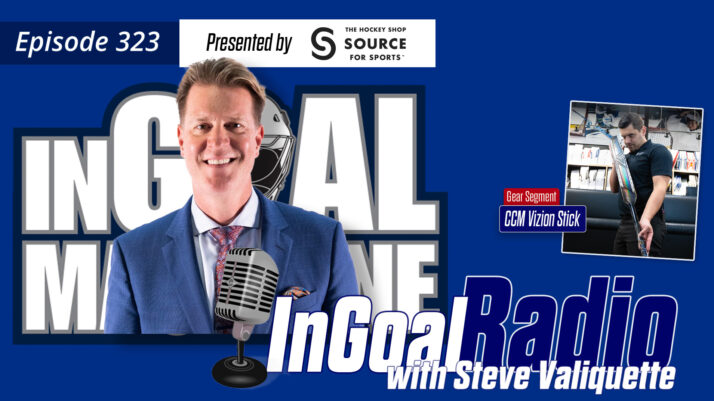
InGoal Radio Episode 323 with ex-NHL goalie turned analyst and coach Steve Valiquette
Please subscribe and leave a rating — it helps us reach more goalies!


Former NHL goalie Steve Valiquette explains how his data company, Clear Sight Analytics, translates scoring chance insights into practical on-ice goaltending drills during the offseason. He also shares lessons learned from New York Rangers goalie coach Benoit Allaire and legendary goaltender Henrik Lundqvist, offering a rare behind-the-scenes look at how analytics and elite mentorship combine in modern goalie development.
- Steve Valiquette uses Clear Sight Analytics scoring chance data to design specific on-ice goaltending drills, bridging the gap between analytics and practical skill development.
- Lessons from Rangers goalie coach Benoit Allaire and Henrik Lundqvist shaped Valiquette's approach to both playing and teaching the position.
- Calgary Flames goalie Devin Cooley shares specific techniques for managing a tall stance and using visual leads effectively.
- Developing a personal game-day routine is critical for young goalies — parents should enable kids to build and own that routine themselves.
- Dustin Wolf refused to return his CCM Vision stick demo after one season, signaling it as one of the most notable new goalie sticks of the year.
Episode 323 of the InGoal Radio Podcast, presented by The Hockey Shop Source for Sports, features another fantastic interview with ex-NHL goalie turned analyst and coach Steve Valiquette.
Feature Interview
presented by NHL Sense Arena
In the feature interview presented by NHL Sense Arena, Valiquette takes us behind the scenes of a summer spent coaching goalies (and inevitably shooters too), walking us through how he translates the scoring chance insights from his data company, Clear Sight Analytics, into on-ice drills over the course of an offseason. Mix those specifics in with stories and anecdotes from his playing days and lessons from New York Rangers goalie Benoit Allaire and legend Henrik Lundqvist, who is also now a sometimes broadcast partner on MSG, and it truly is a can’t miss interview.
Parent Segment
presented by Stop It Goaltending U
In this week’s Parent Segment, presented by Stop It Goaltending U the App, we talk about why the importance of having a game-day routine and enabling your kids to develop — and stick to — it themselves.
Pro Reads
presented by Vizual EdgeWe also review this week’s Pro Reads, presented by Vizual Edge, with Devin Cooley of the Calgary Flames explaining some of his keys to managing a tall stance and the importance of visual leads.
Weekly Gear Segment
presented by The Hockey Shop Source for SportsAnd in our weekly gear segment, we go to The Hockey Shop Source for Sports for a closer look at a new CCM Vision stick that was so good Dustin Wolf wouldn’t give back his demo last season.
Episode Transcript
Intro
Presented by The Hockey Shop Source for Sports Langley, thehockeyshop.com. This is InGoal Radio. We are excited about this. We are in the cusp as we record this of the National Hockey League season. It is opening week for the NHL.
Daren Millard along with David Hutchison and Kevin Woodley. Who's most excited out of the three of us? Oh, it's me. It's me. I I'm pumped for this season.
This this is gonna be awesome. The Olympics in the middle of it. We got a jam schedule. We got all kinds of storylines from from goaltending this year. Players pushing to to make their mark and others to establish themselves new homes, new places for a couple of guys.
There's there's a lot going on.
Keep going, Daren. Like, because I I I haven't I'm not I'm not at the same level of enthusiasm as you are for the I he's Really? It it's been it's it's been we'll we'll just leave it alone. But so, yeah, I need this. This is contagious.
You're starting to get me pumped up. I'm liking this. This good. Let's go. Let's keep going.
Hutch, why is he so grouchy?
He's just Woody. It's a day ending in y.
Are you are you pumped up? Like, what's got your interest for this year?
I'm absolutely pumped up because because you just don't know what's about to happen. What's the storyline that's gonna unfold that we're not prepared for?
We have a goalie who's starting the year as the Hart Trophy winner.
That's pretty exciting.
That's cool.
That's pretty exciting. And who's gonna take the big trophy this year? What's gonna be unexpected? Who's gonna rise to stardom that we haven't met before? I I like the unexpected, and I'm I'm really excited
Jordan Binnington, a year ago at this time was being questioned nine ways to Thursday. And now he's the like, he's got the step ahead of everybody else for Team Canada's Olympic spot.
Absolutely. Can't wait to watch it. See, there's where my excitement is. Jordan Binnington will be in town here one week from today with the Saint Louis Blues. Maybe a chance to talk to him.
So there you now I'm getting excited. See, now now you got me on board, Daren. Other goalies coming to town. That's what gets me excited.
I'm excited about Steve Valiquette joining us today on the Sense Arena feature interview, and he is always fabulous. There's no better guy when it comes to deliver.
Yeah. And he delivered on this one. And, you know, what better way to start the season than by talking to a guy who's basically created a company in Clear Sight Analytics that allows us to understand goaltending and success and environment and what makes it tough and who's succeeding against the toughs and what leads to playoff success versus the than Steve Valiquette. Like, he's got all this information. And the beauty of today's interview, not to give too much away, we'll just set it up a little bit, is that he takes it all and the trends we see in terms of goals and how teams are attacking goalies, and he breaks it down more from a teaching component.
He spent more time on the ice this summer than in any other summer he has, coached all summer long, mostly goalies, but also working with shooters. And so he takes all that knowledge that he's gained from the NHL, his ability to break down the game like no other, and he and he gives us some lessons on coaching goalies with it. It's a it's a fascinating interview. I think I think this is gonna be one of those ones where two things will happen. One, I've gotta create a lot of content out of it because he's like, I'm gonna send you a picture and we'll do a a story on this.
And I'm like, yeah, we should. And last time we didn't, but this time I will. I promise folks. And two, I guarantee you there are NHL goalie coaches that take stuff out of this, and they either apply it directly or they're reaching out to ask about it, which kinda happens pretty much every time he's on the podcast. There'll be teams and goalies that are like and goalie coaches that are like, okay.
I need to know exactly what we're talking about here so I can apply it to my team and my guys.
Look at the CCM Vizion stick in our hockey shop Source for Sports Langley, the hockeyshop.com, gear segment. But, some news as we embark on the season, some signings, and let's start with what what happened in Minnesota and and Filip Gustavsson. They got both Kirill Kaprizov and their goaltending taken care of.
Yeah. And I I think the goaltending is gonna be a bargain. Was it five years thirty four? 6.8 cap hit?
I was surprised.
Yeah. Filip Gustavsson, when this contract kicks in next season, will have the eleventh highest salary cap hit amongst goaltenders. And let's be honest, if there's other extensions around the league, although most guys are locked in, but say a guy like Markstrom resigns, it'll probably drop to twelfth. The eleventh highest cap do you know what Filip Gustavsson's performance ranks over the past three seasons since arriving in Minnesota? Sixth in the NHL in goals saved above expected, 42, just under 42 over three seasons, and top 10 in adjusted save percentage.
Now here's here's the interesting part. He has been an every-other year guy by the numbers. His bad years are just right around or slightly below league average. His good years are exceptional. If that's a blip so in Minnesota, first year, exceptional.
Second year, down year. Third year, last year, exceptional. Last year in Ottawa, didn't play that much, but he was slightly below expected. So if that trend continues, you're getting the sixth best goalie over the last three years for the eleventh highest cap hit. But if that middle year is a blip as he was learning to play more and with the new system and all the things that come with the expectations of being a number one for the first time after such a great first season.
And you get the guy you've gotten last year and three seasons ago, number one in the entire National Hockey League in adjusted save percentage and goal saved above expected in those two seasons. So at his best, if he can deliver that somewhat consistently or more consistently year over year than he has, you are getting incredible value. Even if he is a got a little Craig Anderson in him and there used to be, like, one year would be Vizna numbers, the next year would be league average, and that was a trend in his career, you're still getting a bargain. So really interested to see the way this plays out. At the end of the day, it's a great deal.
I can't believe they got him at 6.8 cap hit.
Anthony Stolarz will stay in Toronto.
That might be the greatest bargain in goaltending overall. I mean, he leads the NHL over the past three seasons in adjusted save percentage, not in goals saved above expected because that's a cumulative stat. And, obviously, he hasn't played that much, especially when he was stuck behind Sergei Bobrovsky in Florida. Although that year, his numbers were off the charts and better than Bob in a smaller sample. So the only question on Stolarz is games played both because of health, but also because there were years where he wasn't the number one.
Like, if he stays healthy, this absolutely will be the best deal in goaltending. $3,750,000 for a guy who leads the league in adjusted save percentage by a lot. Like, I think people forget. He missed six weeks last year and still had the best save percentage in the NHL. The only guy better than Hellebuyck in a much smaller sample.
The only reason this isn't an $8,000,000 contract is because, I guess, age, and he's never played more than half a season. I think 37 is his is his career high. So as long as they don't push him outside of that comfort zone, if they can find a way to keep him healthy, again, just an a fantastic deal for the Toronto Maple Leafs.
There are number two goalies in the league earning more than he is.
Yeah. Clear cut number twos, whereas he's he's he's a one a. There are one b's that are making more than him. Absolutely, Hutch. It's it again, availability counts.
Right? Availability is a key ability, and so staying healthy will be on him. But I think a lot of what we forget is that the reason the games played were so low in some of those years is because he wasn't a number one. Right? And and and he kept producing in these great numbers.
So I'm curious to see where it goes. I love everything he does, and and we'll see if this becomes, like I said, potential to be one of the best values in all of goaltending.
Can't discount his comfort being in Toronto. I wonder if an agent in if the only question is games played, could an agent not negotiate some significant bonuses for games played?
That becomes a There's performance bonuses that Yep. That you could, but team team teams are leery about it because it takes away the certainty of a cap, and then that goes against the
next year.
So so that that's where where teams get a little bit
Well, of course they do. Of course they do. But I'm just just saying, like, in instead of having to settle at such a low number for a guy with this ability.
You know where I see the slippery slope on that one? Like, what if you get to the end of the season and he's and there's three games left and you know you wanna rest him for the playoffs and he's two games away from a massive bonus. Like Good. Like, to me for goaltenders, like, that has the potential to create a lot of bad feelings between a team and a player for a goalie goalie, especially in the age of sort of, you know, you know, load management to use that phrase. Right?
Like so I do think that's that's a bit of a tough one.
They wouldn't do it? But a wise manager in that situation would say, we're sitting you and you're getting your bonus anyway.
Yeah. I don't even know if they can buy the CBA, but that's a good point. Yeah.
I don't know. But Hutch, it's a hell
of an attempt. I love the creativity.
Always. Connor Ingram moved to Edmonton.
See, look at me. Ray of positive sunshine, Daren. Like like, you know, I was I was you you've converted me here. All I've got is great things to say about all these guys. That's because they're in the goalie unit.
Listen. First and foremost, all we want for Connor Ingram is to be in a happy place when where everything is, you know, in his life is good and he feels good about everything around him. And I would say if you're the Edmonton Oilers, you want the same because when he's in that space mentally, the performance on the ice has been very, very good. And I would point to the two years with the Arizona Coyotes. It took him half a season.
Remember his appearance on the InGoal Radio Podcast? He talked about how that first half season in Arizona, he wasn't playing that much. He hadn't been a backup for a long time. He'd been playing a ton in the American League, and he struggled to adjust to it. But he had a conversation with Schwab.
They figured out a way to sort of get through it, and then he took off. From 01/01/2023, so halfway through that first year in Arizona to the end of the following season. So we're talking about a year and a half. A season and a half of hockey. Not a tiny sample, not huge, but not tiny.
Connor Ingram was ninth in the NHL in adjusted save percentage. He was performing like a legitimate number one. I remember Andru00e9 Tourigny, head coach of Arizona at the time now with Utah, talking about he was performing like an elite high end number one for them. That's what they were getting on him. And that's the potential that Edmonton gets at a ridiculously low price with Utah eating salary so that it wouldn't cost him anything to keep him in the minors.
Now the question I can't answer and only I'm assuming Edmonton and Connor can talk about is, you know, where he's at and how he's feeling about everything. I would suggest that Bakersfield, as much as I understand, starting him in the American League, not a great environment. Not the favorite city of a lot of American hockey leaguers and might be a tough place to be comfortable. But if he can find that comfort level, I know a lot of people in Edmonton are talking about him being an insurance policy. The reality is when he's at his best, his best has been slightly better.
And this is not a dig on on Stuart Skinner because it's only slightly, but his best has been slightly better than Stuart Skinner's, you know, best stretch of of a season or even three quarters of a season. So, you know, they've they've given themselves some real upside here. And and first and foremost, the best chance of seeing that upside is Connor Ingram being in a good place, and we hope that that's where, you know, that's where he's at and where how he's feeling.
Impacting the National Hockey League and the Edmonton Oilers crease, Is that too early to to start going down
that path? I guess you just increase expectations on him, but I mean, it's pro sports. Right? Listen. That's the upside that I just out laid out.
Like, that like, could it? Yes. Absolutely. He's capable of that. We've seen it.
We've seen it for long stretches. I saw it before he got to Arizona. There were times in Nashville where you could see it. It's why I remember, you know, in Arizona, Craig Morgan, the he was the great beat writer there in Arizona reaching out ahead of the waiver claim looking for names, and and InGoal was at the top of my list. Like, he's a guy that year that when Nashville put him sent him down, he was the one I identified that I thought Arizona should go after based on some underlying numbers from clear side analytics.
They were pretty clear that there was upside there. And after getting comfortable in Arizona, we saw that. Like, he he's capable like like, I don't mean, like, just good. Like, I'm talking ninth in the NHL for a year and a half, like, up there with names like Demko and Vasilevskiy and Hellebuyck. Like, those adjusted numbers were significant.
They were they were they jumped off the page. They were really good. He's got a really good reactive game. You know, the only thing that statistically he struggled with was East West plays, and guess what? Edmonton's really good at limiting those.
So it's, you know, the potential there, Daren. I don't wanna say it'll happen, but the potential was absolutely there for him to have a significant impact.
Yes. It does depend on what happens with Stuart Skinner and Calvin Pickard. If if they play great, there's there's no need Right. To go
down. Then you have then you have an insurance policy as well. If if one of them were to get hurt, like and that's the thing. I, like, I actually think Stuart Skinner's gonna have a really good year. So when I pump the tires on Connor Ingram, it's not it's not to slight Pickard or Skinner in any way.
It's just that, like, the reality is this guy's had this guy's had really great stretches in the NHL. And so if he gets on that role again, he's perfectly capable of pushing somebody out.
And the reality is most teams end up using three guys at some point anyway.
Yeah. Now they here's
So he's gonna get a chance.
Now here's the tough part. It's gonna be hard to see it in the American Hockey League or harder to see it in the American Hockey League because it's a game, especially early in a season, when teams are there's so much rotation of personnel and systems are getting like, it's not like the NHL where they start the season and everybody's on the same page. It's a game of mistakes down there early on. And one of the things that Connor does exceptionally well is read and anticipate the game. And I'm not sure that that strength there, and you guys live this in Vegas with with with the big sweetest Akira Schmid where the numbers weren't great in the American League and then they brought him up late last year and the numbers were fantastic in the NHL.
Like, there's a chance Connor Ingram is better in the NHL than he is in the American League, so you're gonna have to have patience, especially early on with some of those numbers in Bakersfield.
Yeah. And Schmid was great in camp this year again with the National Hockey League personnel. Let's, get to working towards Steve Valiquette, starting with our Gear Segment, brought to you by The Hockey Shop Source for Sports Langley, thehockeyshop.com.
Gear
Well, the new gear keeps showing up. We we've got the we we talked about, the Warrior twentieth anniversary. We got the Swagger stick next, like a let retro look stick next week in the gear segment. The Vizion stick from CCM with a a layer of aluminum, basically, to increase durability. They call it Aluply.
We just got ours over the weekend. Did not get a chance to take that CCM Vizion out on the ice myself. Well, I did. Here's the thing. It's so pretty that I couldn't put tape over it.
So I was like, oh, it's so pretty. I was taking pictures in the locker room, and then I got on the ice and I just couldn't put tape over it. So I took a few shots with no tape, and then I'm like, oh, I I can't. So I went back to the practice stick, the warm up stick, Daren. But we will get it on the ice.
We'll get feedback. I guess the only feedback you need on the CCM Vizion stick is Dustin Wolf liked it so much he refused to give it back and started using it last year before it was supposed to debut in the NHL. That's pretty good feedback. So we'll let Cam break down the rest. Reminder, though, that all your needs, including all the new equipment that continues to arrive even into the fall, can be found at the hockey shop source for sports, thehockeyshop.com.
35,000 square foot building loaded plus containers in other warehouses full of extra equipment. Like, they've just got it all. If you need it, they've got it, and they've got the expert to help make sure that what you get is right for you and your game. Check them out. The Hockey Shop Source for Sports, thehockeyshop.com.
You know, back in the day, there was an aluminum goalie stick.
Was there?
It was heavy. Yeah.
Really?
Yeah. Really? There was an actual aluminum goalie stick.
I have an aluminum player stick with a wood blade stuck into it. I took it out to a shoot with a with a bunch of junior kids earlier this year where I had to push pucks around and I wasn't coaching. I was supervising, basically, because the the real coach couldn't be there and just basically helping them run his drills. So I took this old stick out there, and the the the junior age shooters couldn't believe it. Like, you could still see the glue from shoving the wooden blade into the aluminum stick, and it was so heavy compared.
But remember when that was exciting? The, you know, the Gretzky aluminum stick with the wood blade, that was new, and these kids couldn't believe how heavy and clunky it felt.
I love collecting things, memorabilia from all sports, primarily hockey. If I could get my hands on a Gretzky Easton aluminum stick, I would be the happiest guy going.
See, and this is I very much regret being cheap at the time, but my aluminum stick is a Bauer Supreme, so I don't have a Gretzky Easton for you, Daren. I should have just bucked up at the if I bucked up at the time, I'd be getting paid back right now.
We got the CCM Vizion stick, with our Gear Segment over at the Hockey Shop. Here is Cam and Woody.
I've had a vision.
Actually, I finally have a vision. The CCM Vizion, the stick that you have been hearing so much about. A stick that Dustin Wolf got to try last year and refused to give back. Yeah. A lot of anecdotes at the pro level about that.
[crosstalk] This is the Hockey Shop Source for Sports. This is the Gear Segment at the InGoal Magazine, and we are gonna talk about what makes the CCM Vizion stick so special. So special that several pros that tried it refused to give it back last year, which is why you saw it a little earlier in the NHL that maybe was intended, but now it's in the store in Cam. Tell me why other than the, like, pop of this graphic and look. What makes it special?
So there's a few things. One, we're gonna continue along the lines that goalies can't spell properly, and we're gonna spell vizion with a zed, which is fantastic. I love it. And just every time, every time we talk about something, it always has to be spelled slightly wrong, which is okay. It's fine.
But anyway, I'll be the visionary here and we'll talk about the CCM Vizion. Ladies and gentlemen, this stick is light. Great feel. Overall balance is fantastic. Got some a little bit special in my hands.
We'll leave this one to the side. We're gonna focus on these two for now. Kevin, had talked about when we were discussing off camera, aluminum.
I think Ali Pro is that what they call it, right? Yes. So it's basically a layer of aluminum worked into their carbon weave that gives you increased durability.
Durability.
Which is another thing that we've heard from the pros that have used this. They can't believe how much longer it's lasting and these are guys that get new sticks whenever they want. So that's a positive.
So without adding too much weight at all, actually, anything,
anyway lighter.
Yes. Exactly. We've increased the overall, you know, longevity of the stick, we'll call it. I always shy away from the word durability because we've seen them all break. Sticks break.
Yeah. 100%. Yeah. I mean, I'm not pretending that it's, like, never gonna break, but it's going to be improved in durability. Correct.
Don't be scared of the work, Cam. I I am scared of the work.
So start with the shaft and work our way down. That v style geometry makes its return that we saw on the AXIS sticks in
the XF A Pro and little a little thinner and your finger is a little thicker as the top. Have you gripped that?
That tapered feeling, especially in your hand, a, gives a good nice control feel.
I like the feel. I like the feel.
But b, as you're as you're going in in terms of actual, like, flex profile and overall general feel of the stick, like, I really like it. I think having this a little bit more of a rounded edge can add to that, you know, durability potentially of Good the
you, Cam. Good for you. You got there.
It felt weird. It felt weird.
For a guy who talks about other people not being able to spell him, his inability to talk is remarkable.
Inability to talk, but I'm more durable. Speaking. Speaking.
Speaking of
Paddle and blade.
The steep paddle, this is kinda echoes what we saw in the
Steepest standard.
XF. Yes.
So I get that
sort that that bob feel or along the lines of being able to choke down on a little. Maybe not quite as extreme as bobs, but Definitely not as we're seeing in the National Hockey League.
Exactly. So another cool feature of the stick itself is that this is all one piece now too as well. So the blade and paddle are designed to be one. As opposed to, usually, we'll have a sandwich or conjoined motion of the paddle and blade together at some point. Sandwiched.
Sandwiched. This is all one piece all the way up until the conjoin of the shaft.
Wow. Okay. Now tell me why the paddle's got the different like, what's different here on the sorry, on the blade?
So when we're looking at the blade, we're looking at that textured carbon. Overall, stiff, thin. I I don't know what you were checking out there, but just in case.
Texture.
Texture. See texture.
You can oh, hold on. You can hear texture.
You can hear texture. I've always wanted to hear texture. Anyway, when we're looking at them, stock p four curve. So this is our old Crawford kind of design similar to a p 31 in a Bauer and twist in a Warrior, t 31 in a true. What else do we got here?
What am I missing? Don't know. Anyway, your standard, what is now overall mid style of a curve. Next, we have one other little gem mixed in between.
Hey, let's get to it.
Okay. You're slow
to plan this.
Finishing off. So not only do we have some nice colors in the stick, but actually have a couple pro returns in the Vizion itself. So remember when we said that they didn't wanna give them back, there was a few overruns from last year. A few still exist. I'm holding a Markstrom one in my hand right now.
Alright. So slightly different curve than what your standard Vizion stick would be, but that said, still same overall construction.
I was showing off the graphic on the back.
No. There is a graphic on the back too. Yeah. Is. Thank you.
Stay with the v. Okay. So it's in stock. You've seen it in the National Hockey League. It's in store here at The Hockey Shop, online at thehockeyshop.com.
If anybody has any questions about fit, like example, Pro Return, I see that that's not a steep I'm guessing the Pro Return does not include a warranty.
No, it does not. But all of
these do. Make sure you give Cam a call.
(624) 589-8299 or 1-800-567-7790 or check us out at the hockeyshop.com. That said, I had a vision of the Vizion stick.
K. Say that again. The the aluminum foil that's over top.
Aliply. Aliply. Aliply? I think it's a l I p l u. Alli aliply no.
I think it's aluply, a l u p l I. Yeah. See, I can't spell, boys. Too many pucks off the head. Not that bright.
Not many hockey brands can spell with the names they use.
That's true. Vizion is spelled with a zed, by the way, so maybe
I'm off the hook. Really?
Yeah. See that? When I start googling these things, that doesn't help me.
Well, see, now you know, Daren, we're here to educate you. You can you can type in VIZION. It's got a really cool on the back, the graphic. It's got a big z on the like, it it is jokes aside, and I did it for social media content, it's sexy. Like, it's a it's a it's beautiful.
Like, it is you look at it and you're just like, I don't wanna put tape over this. I don't blame you there, Woody. And and and honestly, I could only tape the smallest little knob at the top because I don't wanna cover up the alu ply word because I'm gonna need that to sort of show off for for for a review. I need people to see and be able to spell it later on, so I didn't wanna cover that up. It's up up near the top of the shaft.
So it makes it more durable both on the paddle and on the shaft?
Yes. Yeah. Yeah. Well, actually, I need to double check that. I think Cam in the segment explained it partway and I should be careful, but I know for sure on the shaft, it runs through the shaft.
I don't know if and then it's a one one piece sort of shaft through blade construction. The blade is noticeably stiffer for sure. It's a stiffer stick. I'm not sure we got into that in the review. We talked about the profile, but it is a a stiffer.
It's a mid flex, but it's a stiffer flex point than than, like, an EFlex model would be for CCM. The the the blade, though, like so if you're if you're playing at a really high level, NHL guys, obviously, probably why they love it, junior kids, that stiffness of the blade for stopping hard rims, once guys can really fire that puck along the boards, that matters. This has got it in spades.
Looking forward to it. Let's get into our Vizual Edge ProReads for this week.
Well, speaking of Dustin Wolf, we've got his tandem partner, Devin Cooley, who won the backup job with the Calgary Flames. He's our he's our he's our pro reads this week. Tall stance movement and visual attachment keys in our breakdown with him. So, this is our last from Devin Cooley from his time with the San Jose Sharks, and I know that's a little while ago. But Devin's such a he's he was so good at sort of explaining his process and the evolution of his process.
I can't wait to get him on the air for more ProReads again, once he gets some more games with the Flames. Preseason was tough on both backup goalies in Calgary, but I'm looking for big things from him this year. And so we wanted to make sure we didn't waste this breakdown he did with the Sharks. There's some great information in there, especially, and we've talked about this a lot before, managing your tall stance and not getting caught in it and the ability to transition down and out of it as plays get closer to you. He breaks into that, And then some visual attachment keys in terms of early eyes and stuff like that.
And then soon enough, we've got another one coming from Dustin Wolf himself, where he talks about post save recovery decisions. So, Vizual Edge brings you our ProReads, whether it's with Wolf or with Cooley, it's the best way to learn how to read the game. And the best way to see the game is through our friends or see it better over at Vizual Edge. And it's really interesting. We've talked a lot.
You know, I've I've used the Jordan Binnington quote in these promos, their sponsorship of the ProReads segment. In addition to guys like Binnington using it on a daily basis, and we're seeing this around the league, more and more guys are starting to adopt it. We're starting to see NHL teams adopt it and have all their goalies on it. I'm seeing an increased list, and it comes down to this isn't just a tool, but a lot of goalies at the highest level and up to the highest level are starting to realize that if you're not using it, you're falling behind in terms of making sure that your vision I remember Braden Holtby telling me, my eyes are my most important muscle. I gotta work on them.
So making sure as the game gets faster, if you are not keeping your eyes on top of it, you are going to fall behind in Vizual Edge through their cognitive and vision training program can help make sure that doesn't happen to you. Remember, Vizual Edge, you get an automatic 10% discount code using InGoal. But if you are InGoal Magazine subscriber, check out the ProReads. We've got a subscriber only discount that'll get you 20% off. It's not just goalies.
It's goalie coaches, guys like Mitch Korn that use it with their guys. NHL teams asking their young younger goalies to use it. So Vizual Edge increasingly increasingly being used by National Hockey League teams because they don't want their guys to get behind the play or fall behind in terms of how well they see and track the puck. Some guy named Aaron Judge also uses it if you're watching the baseball playoffs. So this is, this is a legit tool that if you're not using, you're falling behind.
Make sure you check out Vizual Edge through InGoal Magazine.
Parent Playbook
Another opportunity to make your game better without having to go on the ice. One of our most popular segments, since its inception. It's just the it brings parents and and the goaltenders together. You both have a reason to listen to the podcast, and we're very thankful that you do. Our parent segment brought to you by Stop It Goal Tending U, the app.
Hutch, I know you've got a a great angle for us today, but Stop It Goaltending U, the app, continues to make an impact.
Early in the season, goalies are busy. Right? Like, it's it's that time of year. School's back. Hockey's back.
Parents are running around trying to get everybody to ever time management and preparation are so important to getting through this type this time of year and having success. And that's why this week's primers on the Stop It Goaltending U app are all about time management and preparation. What can you do to make sure you're not wasting time? And one of the things you can do is just watch these quick one minute videos from the Stop It Goaltending U app. Every week, they call them their daily primers Minute, minute and a half, you don't need to invest a whole bunch of time.
Little things that will help you get better as a goalie, including this week's on time management. They've also got a longer video, so when you have time to sit down and digest a little more, Boston University goalie Brad Gilmore explains how to set goals and expectations for a season in a way that will ensure success. They've also got a load of high drill, so that's something you need to work on in your game whether you're a coach, a goalie coach, or a goalie. You're looking for ways to get better on that particular play, which we see increasingly in the at all levels, NHL and and all levels below. They've got a drill that will help you work on some of the keys, and they outline that all on the Stop It Goaltending U, the app.
And remember, anytime you get a subscription to Stop It Goaltending U, the app, you also get a script subscription to InGoal Magazine Premium and all those ProReads we just talked about earlier. Hutch.
This week, we're gonna talk about having a game day routine. Might fit in with what Stop It Goaltending is doing this week, talking about time management. So the question is, parents, does your goalie have a game day routine, or do they just show up at the rink and wing it? I'd like to talk about the importance today of having a routine. It's it's a way that you can work with your child to develop one, and I've even got something for the youngest goalies out there and those who already have a routine.
So stick around till the end. As Kevin has told us before, Ian Clark says that, tension is the enemy of goaltending. And while he was referring to physical tension and the need to play relaxed, I'm sure he'd agree that mental tension can be just as damaging. Having a routine allows you to step on the ice confident that you're prepared. Nothing's been forgotten.
You've done everything you can to be ready. It removes uncertainty. You know that no matter how you feel before the game, you're gonna play well because you've done the same things every time. You're prepared. A routine also reinforces that every game is the same.
None is more important than the other. I've said it before, when you hype up a particular game by changing your approach, you create pressure. Routine minimizes pressure. Plans can change, and that's okay, but it's much easier to adjust a plan than to wing it without one. Now I'm not talking about being rigid.
It's important for your child to understand that things will change. Traffic happens. Coaches make requests. Siblings have commitments. That's life, and that's okay.
I asked her son about this once, and I said, what if there's a snowstorm and your bus arrives just before game time? He said, that's okay. I pick one or two of the most important things for me, and I do them. So what can a routine include? A pregame nap perhaps.
When's it gonna happen? How long will it be? Some light physical activity after the nap, like a brisk walk. Nutrition, not just the pregame meal, but snacks at the rink or even between periods. If you're in one of those leagues where there's floods, when are you gonna pack your bag?
When are you gonna leave for the rink so that you arrive when you need to? Maybe an hour before, maybe more at higher levels. A dynamic warm up, foam rolling for Woody, ball work, eye work, visualization. What are your on ice habits in the warm up? Maybe a short skating routine.
What I don't mean is superstition, like the order you put your gear on. If you've got a little ritual, that's fine, but don't become dependent on it. If you can't do it one day, it shouldn't throw you off. Now for our younger goalies, like the u eights, for example, this might sound like a lot, and it is. At that age, hockey should still be about fun, being carefree.
So start simple, packing the bag. You may need to guide them, but don't do it for them. I know it's easier, but this is a great step towards independence. Help them build a routine so nothing's forgotten. For us, it was imagining putting your gear on in the order that you pack it.
Underwear first, then the cup, then the knee pads, and so on. They'll need some help at first, but you're building for the future. Now for older goalies, the routines can get more detailed. You might even have different versions, maybe a shorter one for weeknight games, a longer one on weekends, and I'd consider writing them down in your journal if you use one. Now parents, it's worth reviewing the plan together with your goalie, even if less frequently as they get older.
Maybe the night before or earlier on game day, it's a good reminder to them that plans can be flexible and that adjusting them is part of the process. And for those thinking, we already do most of this, I would ask you, do you have a practice day routine? It doesn't need to be as detailed, but it's worth having one. Too many goalies waste valuable practice time by showing up unprepared, rushing to get dressed, rushing onto the ice, and then just messing around until the first whistle. K.
So what did I miss? What would you include in your game day or your practice day routines? Let me know. parents@ingoalmag.com.
Great guidance as you shepherd all of the parents along, trying to make them better, more supportive, also allowing the goaltender to blossom and become more mature. And I think that's a that's a difficult thing at times.
Well, it is because we all lead incredibly busy lives, and isn't the easiest thing just to do it for them? Order them around, maybe do a few things and just have them off to the side because we are busy. But, we all try and do everything we can for our kids to help them become better goaltenders and to grow as people. And so I think maybe having a resolution this week that you're gonna consider a a game routine would be half an hour or an hour well spent.
It also ties into Valiquette's interview that's coming up. You're gonna hear some things of him with about his feelings about kids showing up unprepared to the rink. So from Stop It Goal Tending and they're, you know, making sure that Time management. Time management and preparation was part of that daily primers to you talking about the importance of a game day routine. Now we're we'll get to hear from a coach who will tell you how important it is to him that you show up ready to go.
Feature Interview - Steve Valiquette
Segue over to the NHL Sense Arena feature interview, with Steve Valiquette, and, we we love what we're seeing from NHL Sense Arena.
Sure are. And we know that NHL Sense Arena, in fact, is part of many goaltenders game day routine or a practice preparation routine. And now in NHL Sense Arena, they have goalie training uninterrupted. They've got a new game flow module. It's found under the goalie drills, providing nonstop action to challenge your mental and physical stamina.
The drills continue uninterrupted with shot after shot aided by an AI puck retriever sitting in the corner ready to grab your rebounds and send them back up to the point. They're brand new shooters. It keeps the looks fresh, keeps the practice fresh even for the most seasoned and experienced NHL Sense Arena goaltenders. So stay focused by tracking pucks, movement from save to the corner, back to the blue line, and it's all happening through screens. You can simulate a full period or a game to build your endurance and prepare for game day any day.
It's really cool new feature with continuous video shooters that really feels like game flow. Combined with those screens and the quick puck retrievals, it'll just keep the action going. So check it out today at sensearena.com, and as always, use the code I g m 50 to save even more.
Little dip for a different take with Steve Valiquette this week.
Yeah. I mean, I you know, there was a temptation when we first talked about having him on as a guest to be like, oh, yeah. Let's just preview the NHL season and talk about guys who, you know, maybe the numbers say one thing or another are gonna hit. And like you said, the excitement going into a season predicting, you know, breakout candidates. I got Jet Greaves.
But the real value was in how you take all those numbers and apply them as a coach. So this was a fantastic conversation. As Steve told me going in, we were chatting sort of off the air a couple weeks ago about how much he was on the ice this summer, more than he's ever been before doing a lot of coaching. And I wanted to know how he applies all of that knowledge he's gained at the NHL to the different level. So, this is one where I think his first answer gave us about 10 different threads for me to pull on, and we just went from there.
It's we jump all over the place, but it is loaded. I literally think there will be five or six different takeaway in takeaway articles that come out of this interview, which means there are a lot more than that for parents, for coaches, for goalies to learn from this interview with Steve Valiquette. Really excited to welcome back to the InGoal Radio Podcast. We're trying to figure out for how many time. We think Steve thinks it's four.
I think it's four. I think
he's right. By any means, it's been too long because we can't remember when the last time was. Was it last year or the year before Steve Valiquette, Clear Sight Analytics, former New York Rangers goaltender, former NHL goaltender, former former goalie coach, still doing goalie coaching. Man, the last time we had you on, we dug into the goalie coaching side of it and how your information informs the work you do. I wanna keep talking about that because, boy, did it get the audience excited?
And there's gonna be a few people that are gonna remind me that I didn't share drills. I promised I would. So I might be hitting you up for video, but welcome back. How are you? I understand it has been a summer full of ice times.
Yeah. It it got really busy quickly. Coming into this summer, I put a program together where I could get everybody on the ice five days a week. And the reason why I went there was because my greatest summer of growth was age 16. And I went to the Jim Park Goalie School in Toronto, and I was on the ice five hours a day.
And it was five days a week. My father would wake me up at 05:00 in the morning. We would take his cube van down to Toronto. And, you know, I live in Bolton. That's where I grew up, Bolton, Ontario, an hour north of the city.
I'd have a sleep for about forty five minutes to an hour on a cot in his office, and then he'd wake me up and I'd get to the rink for 08:00, and he'd pick me up at 05:00 or even later because he was probably off doing a side job somewhere. My dad owned an electrical company. But when I look back on that experience, it was the commitment that I made to hockey that made my belief stronger. And you get an element of you you believe that you deserve it more. And so what we did this summer with our goalies in Connecticut was we had two dedicated days of just training on the ice with skating and no pucks, and then we did three days with pucks.
I spoke to their trainers for off ice and just said, look. We're gonna be doing a little more cardio this year so don't have to hammer the guys, you know, on the treadmill or on the bike or out out running. And, you know, what we did was we set up basically a segment of time, which was nine weeks that then went to eleven weeks of 16 goalies that were skating five days a week. So I was on the ice a lot. And, man, one thing that I really learned was you've gotta learn how to tie your skates differently during the summer.
My my bunions were just, like, on fire. I got corns on top of corns. My feet look like Jaromir Jager's now. So that's that's one that was one drawback to it.
Okay. We're gonna have to see. This is where Kevin Woodley, the consultant comes in. We need to get you in a set of the Bauer Konekt's because it's like putting on ski boots and slippers, and all the coaches we talked to think it's just the greatest thing
since like, from a comfort standpoint. This may not be a popular opinion, but I stopped wearing goalie skates on the ice because I had to move enough to move pucks and just get things going. And and I I felt like I was clogging around out there, so I took my goalie skates off. Oh. I know.
I got the bad look. I know.
I know. I know. Listen. It's okay because you've meant so much to the goalie union. We're gonna let you slide on this.
Right. Right.
So I interesting that, like, one of the things I wanted to ask is you mentioned that. I I couldn't remember if the split was three days without and two days with, but no pucks. The difference between pucks and no pucks and why you split it up that way, from a teaching standpoint.
Well, I think that, you know, you realize as you're going through this that movement becomes everything. Here's what I can lean on from Clear Sight Analytics. It's a company we started, ten years ago. I know you referenced it on your podcast a lot, and I thank you for that, Woody, a lot. And I thank you for that.
I think I should be thanking you because it informs me so much better.
Well, it helps. Right? And, you know, that's why I started it. I wanted to do enough with hockey that was relevant to what was happening in the games and the practice. I I didn't want the games to feel foreign to the goalies that I was working with.
I wanted them to buy into the fact that it happens this often in a game. This is why we're working on it in practice. And what I know about the east to west movement is over the last five years, we've seen it increase by 42% in the NHL. So because of that, we have to bring that into our practice plan. And a lot of the shooting that we start the summer with, it is straight line shooting until everybody is really locked in on shot.
But by the time we get to midsummer and we're starting to move the puck more east to west and downhill seams, it's it's apparent that the guys that are skating at a high level and never skip, they always show up, and they're there early. Like, the guys are there early. They are the the guys that are serious are on the ice fifteen minutes before, they're required to start. You know? And that's you know that.
And, you know, I set the standards hard with these guys because I felt as a player that I craved structure from my coaches. If I came on the ice and the drills were all set up and my coach is out there, not with a cup of coffee in his hand, but, you know, prepared for my first appearance on the ice and we have a quick connection and then we get to work. You know, that's the way I was raised. I was raised by sudsy, you know, and that's he was organized. You know, we'd get out there And then after the practice, we'd be journaling.
You know? And and I said to the guys that I'm working with this summer again, I said, look. If you're not journaling, I'm not working with you. And and that means writing everything down. And it's not something that I'm looking at at the end of the summer to review what they have written down.
I told them that I want them to write it down in their own words. And pictures are powerful. I have moleskins. I have a an entire shoebox full of moleskins from my playing career. If it was the drill that had, you know, had me run through or if it was a Benoit Allaire drill, I had all of these catalog, but it also helped me with my own feedback on why I was doing it because your memory will betray you, and you must write it down because at some point during your hockey season, you're gonna hit a tough spot, and you can lean on what you've written down.
And and I mean it with the powerful, message that pictures can really help you with because if you're working with, let's just say, making a save low blocker in front of your pads down, well, you you can draw that. And you'll be pretty surprised how quickly you can become better at drawing that and then how powerful it is and how it actually shows up in your practice.
So you were you used to draw now I'm dying to see some pictures. We're gonna have to we're gonna
have to get you to pull
that pull that one up on these days. So we're on Zoom right now, but this is audio only.
That that ain't gonna work for the InGoal Podcast audience.
But a pic that you could post because, these are funny. You know, I have my breathing exercises. I wrote them down with my tunnel of my spine from the base of spine to crown of head. You know? I I wrote it all down.
And I think that when you're coaching right now and, you know, I think it's you set your standards, you expect the athletes to adhere to them, and you can cut them. I mean, there was a few times this summer where I cut kids out of the program or suspended them if they are tardy. And look, I think that, you know, one of the best things I kinda fell on was why do we play sports? Right? And I did this with my own kids.
I've got a 16 year old that's a pitcher, and I have a 13 year old that's a tennis player, but it applies to all sports. And it's why do we play sports? You could put a, you know, a little message on your dry erase board is what I did. And then I drew a line, and I put there punctuality. You know?
And let's talk let's talk about how important it is to be there on time and be actually before time because, you know, when you start the right way, you get the instructor or the coaches best. And that's the important thing. You get the best version of me if you're out there and you're coachable, you're working hard, and you're not getting frustrated when you're challenged. But all of these things, they really revolve around why we play sports and how you can apply them after. And that's the really unique thing about being an introspective developing young goalie.
And the journal helps you figure some of those things out.
Absolutely. Absolutely. Like and you know what else too, Woody? I mean, it gets into the on ice, of course, too. Right?
But it's it's the off ice behavior that lends itself to the doing it the right way on the ice. And, like, when we set this standard at the beginning of summer, everybody's dialed in to the point where, like, if they see a guy coming on late, they look at me like, what's he gonna do? You know? Like, I'm either kicking him off the ice because, you know, it's his second time. And if it's his first time, he's gonna he's gonna do walls or he's gonna do the mountain climber all the way down the ice.
But there's and I do it with the shooters too. Your on ice practice is only as good as your shooters. And what I found over the years is that, you know, I employ typically division three shooters for prep school hockey goalies. You know, there's a they get to play up to those guys, but they're not overwhelmed. And that's important too because when we're looking for the sweet spot of let's find game feel, well, sure, I lean on the analytics sometimes because, for instance, if I'm setting up a breakaway drill at the end of practice and I put 12 pucks at center ice, well, the shooters should score four because by NHL numbers, they go in one every three times.
So if you have a division three guy going against the goalie from Avon Old Farms prep school and the prep school goalie, you know, shuts them down and maybe allows one on 12. What I tend to see is if you're dominating division three shooters in our practice environment, you're gonna dominate at prep school.
So a level up from the for for shooters, but maybe careful not to be two or three levels up.
Yeah. I I d one against prep school is dangerous. Pros against prep school is dangerous. You you can lose guys because now they feel smaller in the net, and they don't feel that they can, you know, play their game. And that's really what you're looking for.
You're looking for the sweet spot. Right? You're always looking for the sweet spot. We've gotta have everybody dialed into game feel, focused, intense repetitions every day. That's that's what I refer to it as.
That's my acronym. Focused intense repetitions every day. FIRE.
Oh, I like it. Now hold on. We have gone from I asked a question about skating. We we took it to journaling, breathing exercises, the proper shooters, why we play sports, and a great acronym, fire. Can we go back to the skating?
Sure. Sure. Sure. Sure.
What does it look like? What is it like, this is when we hear this, and this happens a lot. It used to happen a lot more. I used to spend a lot more time on the ice in the summer with NHLers, and somebody would be at the rink who I knew, a parent, to to you know? And they would watch the us filming a session, and they would inevitably come up afterwards and say, oh, you that was that looked like that because you guys were filming.
Like, it looked slow and it looked, you know, detail driven because you guys were just, like, doing takes. Right? Not because that's how they train. Like, it was slow. It wasn't fast.
He was barely you know, how hard was he working? You know, there's not pucks flying everywhere. And the answer would always be like, no. Like, this is how these guys work. So walk me through the focal points for you on skating as you try and, you know, set these guys up for success against all these East West play?
Yeah. So this is this is where I knew it was necessary to, you know, I I brought two guys in this year to to run the skating. And I needed two because, you know, they've got different things going on in their lives too, and I don't I have to make sure that these kids are on the ice twice every week skating for an hour. And the warm up is slow. It's fifteen minutes of just edge work and just you know, we're not there to, quote, unquote, bag these guys.
I want them to be quality balanced skaters. Now one of my favorite drills that I do during practice is a drill that I call net play. And in net play, I'm up at the hash marks with a pile of pucks. I pass the puck down. The player has five different shooting options when he receives it.
Now the player receiving the puck has his ass against the wall behind the net, just to the left of the net or inside the trapezoid depending on the day. Because if it's inside trapezoid, I'd like to have the guys slide into a reverse and then work from there, and if it's into corner on their feet. So let's just say that it's into corner, the five options are step out to dead dead angle, take a shot. And during all of these five shots, there's a player net front for rebounds. And, typically, I will have two guys below the goal line, two guys in front for rebounds.
So it's very fast, very competitive. So first shot is dead angle. Second shot is climb above the hash where I am and get above dead angle so the goalie has to get off post and get on angle and then shoot for the far pad. We're just working on reps that just trying to create rebounds because it's really a perimeter shot. Shot number three is a wraparound.
Shot number four is a strong side, same side step out, and it's just pretty sharp angle. And then the fifth one is to the middle a little bit closer. Now what I'll see in these five different shots is goalies sometimes struggling with what save selection to use, how to track down on the save, how to move out of that save smoothly. And oftentimes, if they're not tracking down and striking the puck, well, then their weight is back and they're falling back to their backside or sometimes to their belly, both in cases where, you know, they're not tracking the puck well. I can identify that, and then we can take those drills over to the goalie coaches that are skating and say, hey.
Look. Here's my guy over here. You know, this is Dustin. He's having a hard time getting out of a reverse. And the rebounds that are going to the weak side of the ice that are so valuable, going in, like, 50% of the time now, I want these guys moving better out of that save.
So what we're gonna work on in skating is reversing the post, make a save, imaginary save, and then slide over. And if it's from the deep dead angle, I still like to use a VH. I strike it down and slide out of that. You can keep your head over your leading knee and get good rotation and slide smoothly. You're fast.
If you're striking it down hard, you're fast out of it and you're smooth and you're smooth. So every one of these sequences, including wraparounds, the shooters are so good. They know how to create a rebound off a wraparound that's gonna bounce to the weak side. You know, I just did a complete study on this, and those were going in. It was 36% of the time this year, wraparounds that would go to the weak side of the ice.
Those are very difficult saves for goalies to make, but we have specific skating technique required to be able to get into that post and have a paddle down and keep that rebound on the strong side of the ice. So what I like to do is take what I'm doing. And when I see a goalie that needs extra, time and and a little bit of curriculum on how they're gonna skate and move, it helps them when they come back to me in the next session because now they're skating in a way that allows them to be in the middle of the net sooner and slide out of every save.
Okay. So you've got your no puck skating work that's just more, you know, warm up getting ready, learning to be on your edges, and then you get into specifics based on what you're seeing in the practice performance.
Yeah. This is what I live by, and I sent you a text message before we got on of the silhouette of the goalie with all of the shot locations. And I just named that, points of contact. It was just something that I, you know, worked on once upon a time at a coffee shop, and I have the goalies now basically working off of that picture and imagining that they're making saves from dots down so close to you Yeah. Which would be a different save than if it was dots up.
Okay? So if you look at that page and you're saying to yourself, okay. Well, I've got 16 different shot locations. I like the goalies to spend at least ten minutes a day with just their knee pads on, their gloves, their goalie stick, and just practice low blocker. It's just just like, this is my thing.
If you can do it without a puck, you can do it with a puck. And I take that same training process, and I do that with the skating. If you can skate, move, make an imaginary save, and move out of that save without a puck, I know that you can do it with a puck. But if you can't do it without a puck, you cannot do it with a puck.
Okay. So this is, like, almost visual like, in the knee pads, they're
executing visualization. Yes. But you've got your knee pads on. And what I always do is I just take two pucks, and put those in front of me in my butterfly on the carpet, put them three and a half feet apart because that's the width of the opening of the net in front of you from the face off dot. So you can practice stick angles.
You can just strike down to the right. Imagine the puck's coming five hole. How would I rotate on that? Puck's coming five hole to my left side, a different rotation, far left. You can make all of those saves.
And now the more you wrap them out I I'm telling you, Woody, when I see a goalie that maybe I haven't seen for a couple weeks and they come out and they're all of a sudden striking the puck perfectly, they're making great contact everywhere. I'm like, you've been doing it. And, like, you could tell. And you can tell the kids that aren't. And I think that that's the most important thing is, you know, you're journaling and you're doing this off ice because if we're just trying to get back to right where we were in the last workout, we're not gonna make the progress that we can.
You know? And and it's really important to me that everybody comes out of the summer, and they're dialed in. But they're also getting ways to fix maybe possible future problems. And I'll give you an example for this. So when I'm warming up, two I do two goalies at a time.
That's what I that's just the way I like to do it. Private only privates. Not not camps, just privates. So one goalie during the first five to ten minutes, depending on the day of the warm up, will be at center ice. And because the net is on the red line, it's a very good guide for looking and checking in on your stance.
So there's times where I'll stand behind the dot, face off dot at center ice, and the shooters are ready to shoot. And they're shooting anywhere on this particular day, and I'm looking at the goalie stance. And sometimes you'll see the goalie's left skate is nine inches or so from the red line, and then the right skate is, like, 15 or 16 inches. You know? So we know they're off balance, but it allows me to coach them to coach themselves.
Like, hey. Check your feet out. If you're squared up to that puck that's on the face off dotted center ice right now and you're in your net and you look down at the red line and it's not a balanced perfect inches from left skate to middle as well as right skate to middle, you know you're off. Right? Or toe caps.
You can see guys getting, you know, sometimes off with their toe caps. They don't have squareness. You can find these ways to during a season when your hips are moving around a lot of bit because your team's flying or you're on a bus, you've got ways that you can check-in on your own mechanics because alignment is very important when we're talking about being able to have proper elevation and, you know, before you get to angle depths and squareness.
Okay. So the the 16 different shot locations and the the visualization, like, you know, obviously, you wanna see that they're working on it. Do you have and you want them to do it on their own. Mhmm. Yeah.
Recommendations for how often? Like like,
you know, and Every day.
Every day. Yeah.
This is an everyday thing. Fifteen minutes. Like, if you're you know what, Woody? At this stage in the game, if you're into it, you're a hockey junkie, you're you've gotta do more than everybody. You've got a 1% chance to play division one if you're an American.
You know? It's it's that hard. There's 18,000 kids that sign up every year to play hockey in The US. You know? 250 across all positions are gonna someday play division one.
Alright? It's it so I'm I'm again, I'm like, hey, guys. If you're gonna put in this commitment, you're gonna spend the money to get out here, your parents, and all of their commitment to get you here. You know, I'm here with you. Like, let's let's get this done the right way.
So I could tell when guys are into it and they're doing it. And, you know, the one thing I can explain a little further because you're gonna post that picture, I hope, is that when you look at those locations, right, and you imagine that, let's just say you're a six foot goaltender, and you can imagine that there's a there's a shot being taken from the face off dot, your left face off dot, take that distance halfway towards the net. So it's really a puck that's coming from below the below the face off dot, but in between the face off dot and the bottom of the circle off the angle. And you're looking at a shot about 15 feet away from the net, roughly. But I think that every goalie on angle should be protecting the upper part of the net with shoulders and elbows there rather than trying to, reach back and and get a catch.
Now if the shot is before the face off dot, further away from the net, 25, 30 feet, well, we want reactionary hands, and we wanna, you know, get our face towards the puck or nose towards the puck. So, yes, your glove save is different from above dot versus below dot, and everybody has a different range. Because I'm six six, my range could actually take me a little closer to the face off dot where I'd use my shoulders to protect up top. And I didn't really know this and understand this until my later years playing where I had a a few, like, runs of success where I was making and protecting up top a lot better because my timing was coming down to the ice and using shoulders and elbows rather than cranking back and trying to chase it with a with a glove that was really in a race that it couldn't win.
Right. Pulling off pucks.
Pulling off pucks.
Right? Yeah.
And that's why you gotta
that shoulder that sort of that old school windmill, and Steve's old enough to have a little windmill in him. Yeah.
That shoulder pulls right under his face. Fight it. I had to fight it off. But I think doing those exercises, it's something you can do without you know, it's ten minutes, and it's, it's not too taxing on your body. But it's so good visually for you.
Okay. So I got a couple things I wanna I mean, I've got about a note of 10 things already. But, the reason that you choose that sort of area to map out those trends? Like, I know I think you call it funnel Mhmm. Sort of from dot down in that lane.
Is it the reason you identify that as this is where our focal points? Is that because that's where a lot of this plays and shots are coming from as as we?
Yeah. You got it. Like, look. I've got, research on top of research here. And, you know, the one thing that I've noticed for the last ten years is that we get a bulk of our shots off the wings because that's where players are pushed to shoot.
And in games, you're gonna get those shots more frequently than a player just stepping unimpeded into the slot area unless, of course, it's a breakaway or a two on one. But in zone unsettled offense, it's extremely hard to get to the middle of the ice. So you're gonna face a lot of shots from there. Now what I believe is that when goalies can establish that they can stop the open shot, they get their team behind them, and they can actually hang back a little bit and protect the pass that could be across to the other side of the ice. So your goalie can then confidently be out there because the team counts on him being able to make that save.
You've established that earlier in in the season, and that allows you to have long term success. Now one thing that I think that when you're working with goalies, can establish is that, when you're walking directly off the wall above the hash marks towards the net, so so skating over the dot but taking a straight line, those saves should be relatively easy for your goalie because there's minimal movement. Right. The ones that are more difficult would be is if we have a pile of pucks at the blue line in the middle of the ice, and we're allowing players to cut to the right or left, but we'll just talk about the right side of the ice, and then come downhill and change your angle. And then even harder is coming from the middle of the ice and then getting to the middle and then cutting hard east to west.
Right? Changing angle. But, you know, I've done a bunch of research on this because it it really interested me that some of the goalies I was coaching, they weren't very good with righties, whereas other guys were struggling with lefties on the right side of the ice. And it was it was interesting because you could see different patterns on what was causing them difficulty. So with young goalies, if you take the pucks from the middle of the ice at the blue line and you're skating downhill on the right side coming let's just say, know, you're coming downhill, meaning a straight line down the ice, getting towards the face off dot on the right side.
What you could see is that when a right handed puck carrier is approaching the goalie, the goalie must allow them to get a little bit ahead. You know? Just get a little bit ahead. Little bit ahead. And then when they get ahead like that, there's still the time that goalies can recognize the puck has to get off their stick, the shooter's stick, and reach the goalie.
And that's patience. That's explaining patience to a 14 year old. You know? Let them get a little head. Be okay with that.
You know? We're talking about inches here, not feet, but, like, you know, three or four inches. And then when they're ready to dig in and, you know, I I call it the ceremony before the shot with the way they bring the puck in, you could see they're about to lock in and shoot, and that's when you shift clean into angle and you're as big as a house. Now whereas a lefty coming down the right side of the ice, the one thing I like to tell the goalies is let them dance. Because they're coming down the right side of the ice.
They have the puck. They danced their body around the puck. The puck hasn't moved, and you have to make sure that you're not moving on the influence that they're sending you that false information with their body moving because the puck hasn't. And when goalies understand that moving less there gives them the middle of the net, now they're making saves, and they're big, and they're just receiving pucks.
Love it. There's one I wanted to also go back to before we get too far along just, like, for a definition. Lot of striking down, strike it down, what that means to you, how others like, trying to put it in words that somebody that's heard it for the first time understands.
Sure. So, you know, let's talk about work from the ice up. And earlier, I said that from the points of contact, I have four spots on the on the ice. And if you are really good with stick angles, you'll find that the same head position is required for low blocker, low glove. And then you'll find that the pucks you're receiving at your hip that you're able to suck in is is really the same head position as well.
Everything from your from your chest down has the same head position. So knowing that, the stick angle is is really important. What I would say is that imagine that you have a fishing line on the cage of your helmet and attaches to the top of your goalie stick, the blade. And when the puck is coming to my right on the ice, we do not wanna ever snap that line. If the fishing line snaps, that means I'm tracking back.
But if the fishing line stays intact, it's because I'm striking down with the puck and I'm able to get over it now. If that puck that's coming to my right side is I'm striking it the right way. All of my weight now is on my right knee. Therefore, I have my left edge that can help me in that rotation, and then I can move. And I don't have to counter rotate, so I'm saving time.
So everything is you know, it's connected. And the more connected you are on first save, the better you are on rebounds, the better you are at moving out of that first save. If you find any disconnect there, if if, for instance, you don't strike down on those pucks that are you know, again, that fishing line, if it breaks, you're in trouble because your weight is all over the place. Low blocker, it's the same thing. Forget about the fishing line for low blocker, but, you know, again, it's there's, it's face to the puck.
There was a really good one that circulated with our guys this summer from YouTube. It was the, Baltimore Orioles first base coach. I'll send it to you after we get off. And he was teaching a rookie first baseman how to receive a ball at first base. And I loved it because I'm a baseball dad now, and it's there's so many commonalities between baseball and goaltending.
And the way this first baseman, you saw him improve in about four minutes from just being able to go. And he the coach was saying, I want your face to the ball. Face to the ball. You know? And that's the same thing we're saying.
Right? It could because the the closer you have in relationship from your low blocker to your nose, the better you're gonna be at making that pure contact and being able to move out of your save.
The progression that you go through over a summer with these guys, you said it was nine, eleven weeks.
Yeah.
Is there like, I got you guess you got different levels at prep school, different guys that are, you know, maybe come in familiar from one year to the next with strike it down and know what it means versus guys that are coming in for the first time. Like, do you focus your progressions at all on trends tied to the game, or is it more focused on the skills first to the goaltender and then take them to the trends of the game? How do you balance those two things? Because you see things through both lenses.
Well, what's really neat is we have 16 kids. So if I need a pro to skate with a prep school kid because the prep school guy is spraying pucks with his stick. His his stick angles are really awful right now, but I've got access to a pro. I'll have him skate with him. We'll do stick angles.
He'll get a really good look at it on video. He'll see what the pros move out of save like. And then sometimes it's just that. It just clicks. And sometimes it's about effort.
You know? Sometimes I might have a guy that doesn't compete hard enough, and I'll bring the most competitive goalie that I coach out, and he'll just rinse them the entire skate that, you know, we'll have a talk about that afterwards, you know, because that's a thing too. And you can teach compete, by the way. You can teach it.
Well, I I got that in my notes to get to, but I wanna touch on stick angle a little bit too because the importance of that. And and I think it probably ties into something you said earlier about, like, just how often I mean, you spill a weak side rebound. That puck goes in, I think it's, like, almost 50%. It's, like, 40 some odd percent of the time now at the National Hockey League level. So the importance of stick contact and and and what constitutes good stick angle for you, and I'm guessing the importance is being able to control play as opposed to a puck off a pad heading back into a dangerous area.
100%. So that drill that I, referred to earlier that we we call net play Right. You know, it really sets you up for success because even if you miss with your stick, you still have your weight going the right direction over your pads so that you can move out of save and be very competitive. And technique doesn't stop the puck. It doesn't.
It gives you access to the puck. It gives you a fighting chance. That's what technique does. Technique you can work on your technique all day long, but there are a lot of goalies that fail because they rely too much on technique and wanting to look good while allowing a goal. Right?
It's it's I call it the, like, the and one for the older people that would listen. Remember, and one basketball. Yeah. We're not out here playing and one hockey. You know?
I don't care how good you look as the puck's going by you. I'd rather you come out of that save because you can, because your first save was technically strong enough to give you a fighting chance for save number two or save number three and be athletic. You know, that's really important. So the, the net play drill, again, that's those are those are just shots on goal where players are shooting to create. So the goalies have oh, and I should I should add to this too.
I have a semicircle, around the net, and any puck behind the net or in front of the net that lands in that semicircle and the rebound, the players can deke. If the puck goes out to slot, it's a quick recover and then shoot it. But that rebound can be played out sometimes for thirty seconds if it's a live puck. So we're really teaching guys to compete, and we're really teaching goalies to move the right way and not really rely on being technical. I want guys to I want guys to go after it and compete.
Okay. But the when we get back to stick angle, I think, like, on glove side, it's inherent. So low on the glove side, if you strike down with your stick, you're you're inevitably gonna get your rotation. Like, it sort of pulls you in that direction. The tendency on blocker side, maybe it's just my old age speaking here, but that wanting to pull off and steer it,
You know, with
a walker like that? How do you, like
I'm gonna try and explain this. I know that I can't
There's a picture over your right shoulder of you basically pulling off the puck, by
the way. That was deflected.
Okay. Okay. We'll we'll we'll give you that one.
So you know what? That that game was in Vancouver too. So alright. When you when you're facing a puck that's coming five hole on the ice hard and it's it's it's either middle or right kneecap.
Okay.
Okay? Say
right middle blocker side with regular goalies.
Yeah. Right. Correct. That's by blocker side knee. So for me, my right knee.
Okay. I'm looking at the puck, and this is a very good exercise to do at home. You're looking at it. You're bringing your head down very slowly. You're seeing it come, and there's still a little bit of angle on your stick.
Not a lot. But at the moment that the shaft of your stick, the paddle, probably touches your pad. So there's a kiss there. And at that point of impact, when the puck hits it, you should have your head all the way over so you could see the full diameter of the puck hitting your stick. And then on that point, you can then cork it and put that puck hard into the glass to your right side, to your right corner.
And, again, I think with coaches, you come up with your own language so the kids understand you.
Right.
If I say to a kid, like, cork the puck. Let's go. Cork it. They know what I mean. And they're not moving before the puck gets to them, and they're not sitting in their butterfly and watching it go to the corner either.
Because that doesn't help anybody if the puck is coming from the left funnel and you're just sitting there on your butterfly watching it go to the weak side of the ice while you've got guys driving the back post. You need to cork that thing. And, I mean and it's the purity of sports, really. It's it's the same way it feels when I'm playing baseball with my son and I hit a home run. It it hits my hands don't rattle.
I hit the pure part of the bat. If I'm golfing and I hit a 300, which I don't, but it feels like I hit the sweet spot of the club. It's the same thing when you make this save. When you're corking a puck hard to the right side, it's because you tracked it all the way in on the point of impact. You just cork it, and you've got your rotation.
You've got your backside edge, you're gone. And it's all in one motion. In the timing is impeccable, and it's the purity of sports to me. That's when you know
a little more quick strike down and quick as opposed to that old school pull off.
That's right. There's none of that. It's it's it's still in the middle of your your stick is still in the middle of your butterfly when you get down on it. There's a little bit of angle so we can elevate it. Because you don't want pucks leaving you flat.
Because if they leave you flat, then the weak side is just banging in a rebound. Yeah. You know? But, no. I certainly have video on this.
I could send it to you. Like, I think that's And then teaching the other side of the ice is actually the harder. So not everything five hole, at least for me, I want every every shot five hole going to my right side. And then everything that's going to my left kneecap is gonna be going to the left corner, but that's, I think, a harder save. To be honest with you, I didn't learn that until I played with Lundqvist.
I I was watching him every day. I sprayed a few of those into my own glove. You know, that's when you know you're doing it wrong, when you've got too much angle on your stick and you just catch your own stick angle. You know, that's a problem. Right?
So
so you think it's a harder save to the like, rebound off
the the glove I think everyone I coach gets the, gets the five hole to the right side and the kneecap to the right side. And the right side, that's just an easier side for everybody. The harder side is the left side.
Interesting. Because I would have thought lot of guys move better, recover better, get more rotation to their glove side than their blocker.
Just the contact, the initial contact and corking it. Okay. We've really gotta what I stole from Lundqvist was that I noticed his right elbow was, like, kinda pointing up towards the rafters, and he'd really get over it. And he'd still create that angle and then just be able to move on it, and it was all in one. You know?
And when I was struggling with it so one of our drills with Allaire was five shots, five hole to start every practice among other shots. But, you know, that was one where I was like, oh my god. Hank is clean every day. Like, his five are clean. I'm spraying a couple.
And then I just watched a little closer, figured out exactly what he's doing. I paid attention to his right elbow, and I and then I was like, okay. He's got his right elbow going up towards the rafters. I gotta get my elbow higher. And I was just able to get over it and, you know, crack.
And, like, all of a sudden, I was like, okay. Got it. You know?
Importance of that control. Like, that's a great story. But, like like, also, we're like, you know, like, I see a lot of kids who are quite content to kick everything, like, to not activate that stick, to to use their pads on low shots. I can think of a very highly touted prospect that did a lot of that coming into the NHL, and that was one of the missions of the people was that were involved in his development was to make sure to activate the stick. When we talked about his hands, it wasn't catching pucks.
It was controlling play.
Well, you know what's interesting that any goalie could do? You know, if you understand what a funnel is. Okay. Now, again, challenges on a podcast, but it's from the far post. There's a line that goes all the way to under hash at the wall.
That's your dead angle line. And then if you take another imaginary line from the middle of the net all the way up to where the red line meets the boards, that's your funnel. Right? And when you're in the funnel when you're in the funnel, the interesting thing about that too is before I go there, I wanna explain the, the net play drill one more time because the shooters that work with me, I enjoy teaching them how to score too. It makes our practices better.
So what they know now about the net play drill that we do is where the rebounds come off the goalies. When they shoot from dead angle, you'll see two shooters go right to the slot because dead angle shots end up to slot. And if they're shooting out of a funnel, they know that if it's funnel in, it's funnel out. So you'll see both guys scurry over to the other side of the ice and get into the funnel because they wanna score. And if it's a net play drill, they're trying to get to the weak side of the ice.
You know? So it's there's a cat and mouse there, but it's making it competitive. Right? So I think that one thing that you can do, and I'll get back to what I was initially gonna say, is that if you don't wanna spread on saves, which you don't wanna do from shots from the funnel, k, we're just gonna talk about the funnel for a second. You can put your stick on top of the net, put a puck anywhere in the funnel.
K? And then ask a shooter to shoot on you and just stay in your butterfly and do not open your knees. Just keep them tight together because now you've got fundamentally, you've got really good form and elevation. You're you're sitting up nicely in your butterfly and you're athletic. You can't get scored on.
Your butterfly exceeds the opening to the net, which is why you should never reach for saves in the funnel because now you're throwing your body all over the place when you could be compact and athletic and be able to move again because your feet are under you rather than splitting at the knees. You should never split at the knees on any shot from the funnel. It's a massive mistake.
Basically and to simplify for folks, like, the funnel is basically it's wider, but it's basically from the middle of the net through the face off circle. And then it widens out from there.
Yeah. You know what we're gonna do? I'll send you a picture to put I think you should post a couple of these things because, hey. Look. If I was coaching a team right now, I would have this on my dry erase board with the team, you know, because it's a good way to coach.
Like, I was on the ice last Monday with the kids at Taft Prep School here in Connecticut, and I showed them about the funnel, like, where to stand, and that's the next shot. One kid shoots from the funnel, the other guy gets a rebound in the funnel, and their side scores like, oh my god. You know, it works. You know? And you get buy in from these guys, and and now they're working on the ice in tandems.
F three can still be high, but the offense is working in tandems because there's a way to create offense at every level of hockey without getting to the interior. You don't always have to get to the interior. You can't always get it to the interior.
K. So careful here. First first, you abandon the goalie skates. Now you're helping the shooters.
Well, hey. It's a big part of why you know what, Woody? It's a big part of why the reason these guys are coming out. The reason they come out is because they wanna learn how to score. And if I can make a practice for them, like Dallas Eakins once said, when I was listening to a podcast that he was on, that the puck in the offensive zone at five on five is on the wall for 80% of the time.
Right.
So a lot of the drills,
I just start off the wall too. So the guys are getting clean pickups off the wall, and they're able to get their own rotations. And I'm happy to do that. I want them to get a lot out of it because I want hockey out there. Nothing frustrates me more than when somebody lifts up at a posture and plays a rebound slow because you just robbed that goalie of an opportunity to make a rebound safe.
It has to be game like. Everybody has to be in posture. Everybody has to be performing and working at a high level.
And that that's one of the things that I think it's it's probably a common misconception. Jokes aside about helping the the the dark arts of scoring. But the reality of everything you do at Clear Sight Analytics, and I've said this to a few people because they always come to me asking goalie questions. I'm like, this can all be you it's all there. The numbers are all there.
If we know how goalies are handling certain situations, you can it's not even reverse engineering. It's all built into the numbers. Who's creating them and how and why?
You know, when I when we got on this call, I I told you my day today, you know, it's a Sunday, and I should be outside paddle boarding. And I'm not. I'm I'm working on hockey, and I don't know why because I'm a psycho. But, you know, I'm I'm doing a project on Auston Matthews because he had such a goal dip from two years ago at 69 to 33. And, you know, what happened?
Right? Like, what happened to his goal scoring? Well, how about this one? Two years ago when he had 69 his 69 goals, by the way, that was the most scored by any player in a single season since the o four, o five lockout. Right?
So modern day. He had 62 slot line passes. We haven't even talked about the slot line yet. So that's the east to west pass across the middle of the ice for the folks who don't know. And he only had 29 last year, Woody.
He went from 62 received to 29. So he had a 53% decrease in the game's most dangerous scoring chance type.
And if and close to but more than fifth basically, that matches his decrease in goals.
I know. His goals on slot lines went from 20 when he scored 69 to seven when he scored 33.
So I guess the question would be and it would you'd probably have to like, is it that he's not getting those chances in terms of passes across the middle? Or because there's two parts to a slot line play. There's the shooter recognizing the importance of on and off the stick versus hole.
That and being available for it or having your teammate get it through. And the one thing that he did really well when he scored his 69 goals was he created a lot of unsettled offense. So unsettled offense is chances that come off the forecheck, chances that come off a backcheck where you strip somebody, a giveaway, a takeaway, or a fifty fifty puck win because that's when the team's defense shifts for the first time. Everyone scrambles, lanes open, and that's the time you're looking for slot line. You're looking for a slot line immediately after any of those things happen.
Who led the league last year in unsettled offense? The Florida panthers. Who led it the year before? The Florida panthers. Right?
So I'm looking this past week at the difference between teams making the Stanley Cup playoffs and and not based on the differential between their slot line. And last year, it was 12 out of 16 teams. The year before that, 14 out of 16. The year before that, 13 out of 16. It's there's a trend here where if you don't give up the slot line defensively, it's better for your goalie.
We know that.
Right.
And the more you break it offensively, the more opportunity you have to score. And I think that anybody listening to this podcast has to know that the conversation and scoring has to shift from we've gotta get to the middle of the ice. No. It's that's not complete. You've gotta get to the middle of the ice and cross.
Whether you're carrying it or passing it, that's where true offense comes from, and it shows up with who's making the playoffs every year. The, New York rangers, a team I cover on television, they were the worst in the NHL last year with 243 slot line chances against. The year before they won the president's trophy, they only allowed a 186. Oh, that's massive. That's massive.
And and it it's less than one a game over 82. So we think of that as, oh, that's not but that's a that's a massive difference.
Mass they're they're they were minus 25 last year, the year before they led the league with a plus 75.
It reminds me of a conversation I had with Robin Lehner few years ago about going from Buffalo to the Islanders. Mhmm. And he was talking more odd man, which but let's be honest, where's the easiest way to create a slot line play as an odd man rush?
Odd man, you should be looking for him.
Yeah. And he and he said, like, if I give up if the team I used to play for gives up four and I'm playing great, one or two might still go in.
Yeah.
Just and if I play on a team that only gives up one a game and two go in, that's two every four games, not two every game. Like, it's just the reality. Those are the most dangerous plays on the ice. You gotta prevent them, and you gotta try and create them.
Robin was really good. He reached out to me. I think it was after one of our episodes. Maybe you gave him my number. Did you give him my
number? I didn't, but I would
Well, he helped me get the Vegas contract. I owe him a steak. Robin, if you're if you're listening. Thank you. So you know what?
There's a lot that certainly goes into this. I love doing it because player development happened to me, and and that's the root of everything that I did this summer. It's what I do on television. I'm always trying to talk, and the coaches speak to to the fans and the hockey people alike. And with Clear Sight, I'm just trying to prove it.
You know? I'm just trying to prove it because, it gets a little more backing that way, Woody, if you've got, the hammer at the end, the facts. And it all comes together. And and I it's funny. My life in hockey feeds itself.
You know? I'm on the ice in the morning. I could have an executive call or a presentation with an NHL team in the afternoon. I'm doing television at night. I have alumni purse appearances from my time with the rangers.
Like, I'm a bit of a rounder in hockey, but they all kind of feed the same conversation and theme, and it's it's a great lifestyle. It's it's doing something that I love doing, and it's it's it's everywhere.
To bring it back to the we're gonna take it right back to the first question to wrap this up because I've taken up close to an hour of your time. You and I could probably go for another two.
I I didn't think it was an hour. I thought that
was thirty minutes. Okay. All these different things, all the different parts that go into it, does it still come back to the ability to move for a goaltender? Is that you know, we take it back to the skating. Is that
That's a good question.
Is that the first piece?
So you know what, Woody? I'd rather teach somebody to stop the puck before they can skate. I I you know? Surprises me. Yeah.
Because, look, I know that if you can't skate, you can't play. But if you can skate and when you get there, you still can't stop the puck
That's fair.
That's that's the way I look at it.
Okay.
So the business, Clear Sight Analytics, is built around the goalie having half of a second of clear view on the puck, and he's gonna stop the puck 97 of the time. Now when the puck moves east to west, we are trying to build our goalies to be able to capture half of a second with set feet when it moves east to west, and that's when you become a master. And when you can do that at the level that you're playing at, it's time to move up a level. And that's the neat thing about this game. Do not try and move up a level before you've dominated the level that you're at because once you do it the right way, you never hit those points of confidence lost or indecision in your game or change that's not necessary.
Your game should be your game from the time you're 14 until the time you're 35. Play your game. Beat the pass. Set your feet. Have proper depth for your skating ability.
Hustle after every save so that you can have access to pucks and be able to compete. And these things don't change. Like, it's amazing when I go out and watch Henrik Lundqvist practice at the end of his career with O'Leary. He's doing the same drills we did in o four, o five, o six. Like and I'm like, hey.
Same drills. He's like, these are the fundamentals, Vally. They haven't changed. You know? They are the fundamentals.
One of his fundamentals was compete. I remember watching him come into Vancouver second end of a back to back. He didn't play the first end, but he was out there, and I was shocked. Or they maybe it wasn't back to back. Maybe it was practice after a game in Edmonton the night before.
Mhmm. And it wasn't just that he was out there. And this is this is in the last couple years of his career. But my god, he did not give up on a single puck. He battled on absolutely everything.
So I said last question, but in typical Woodley fashion, you you mentioned earlier you can teach compete. You talked about the the semi circle around the net. Yep. Any other examples? Like like because that was the one thing.
Like like, look at the look at Flower. I we had Dylan Garand on. He goes to the world championships, and he said, Sid and Flower in practice. Like, they never the drill the next rep of the drill could be coming down, and they're still playing up the rebound. The compete was off the charts.
Wow. The compete was off the charts. Luukkonen used to compete every second he was on. Like, the greats compete. How do you teach it other than telling them?
Yeah. So you know what? Here's what I believe now. I didn't know this when I started coaching twenty years ago. I thought it was innate.
I thought it was in you. And, now I believe it is in you. You just gotta pull it out. And you have to hold these kids accountable. Okay?
So when a goalie doesn't go for it, that might be my biggest pet peeve. And I'll say to them, you know, why didn't you go for that? Oh, I didn't have a chance. They were gonna get it before me. You know?
And they don't go for it. So when you don't go for it, that means that you don't get the opportunity to make a save. You don't put the pressure on the shooter to actually beat you because you're not there at all. They could miss the net with pressure that you're putting on them. They could hit the post, at which point we have a live puck.
Or let's be honest, a lot of them see an open net and shoot right into the middle of it. So just
And you can make a great you can make a great save.
Yeah.
So for those reasons, I would say to the goaltender, if I see you not going for it the next time, it's really a fifty fifty to me. It's a fifty fifty. It's a wide open net on a weak side rebound, but that's a fifty fifty. If I don't see you go for it, we're stopping the drill right there and it's down back. Right?
And and and that's the accountability piece. If you don't hold these guys accountable and they think they can get away with it, they're gonna keep behaving the same way. And I always promise these goalies. I promise them every summer. You're gonna have so much more fun when you compete because competing is your mindset.
It's it's a decision you make in your head, whereas working hard is physical. And those are two different things. Working hard is physical. Competing is mental. And competing to me and and how I hold these guys accountable is if there's a rebound that they should bring in and freeze, but they lose that battle because they're not really intense on that rebound, which is a massive skill too.
You'll save yourself four or five goals a year by bringing it in quick to freeze it. If they lose that battle, I'll just mark that in my head, and I'll keep that for the end of the drill, and I'll skate them. And if they don't follow on their rebounds hard or they don't compete on their rebounds as I discussed there, these are all grounds for as soon as the drill itself is over, it is down back multiplied by how many times you didn't compete. And I'm telling you, these guys don't wanna skate, so they will compete hard, and then they'll buy in. And I'm telling you, I've got guys that are in college right now where I'll say to them, man, you were soft when you were 14.
You remember that? And they'll laugh. Right? And I'm like, dude, you're so hard right now. You're absolutely hard to score against.
You're hard to play against, and that's the best compliment you can give a hockey player. And they're having more fun. You have more fun when you compete, but you must compete. And and a big part of every day is learning how to compete and holding the athlete accountable.
Well, we don't know anybody who competes more when it comes to understanding the game, both goaltending and how the other side that he wears the skates for scores.
Moleskine right there, Woody.
Focus, locate, beat the pass, be patient, trust my instinct. I love it.
Yep. Many of these around. And you know what? Let's leave it with that. Everybody needs to journal.
Write it down, guys. Your memory will betray you.
I love it. I love it. You know what? There's a couple more notes I made here. That means we have to have a part five someday.
Toe caps up by ice, alignment, all these things. Vally, it's been great, buddy. You know I'm gonna be hitting you up to take some of these great lessons and turn them into stories because a lot of them will there's some visual elements we can add to it and some great stuff. And for the listeners who are gonna be like, you said that last time, Woody. I promise.
This time, I will follow through. Well, it was
great being on with you, buddy. Anytime.
Outro
Is there a more interesting person in goaltending than Valiquette? Like, just the amount of knowledge that he brings and and different directions that you can truly go?
Well and we forget, and I probably should have talked about it in the intro. Like like, this is us talking about where he's at now. Like, this is his fourth time on the show. The first one was about his experience in junior, his time. Like, think of the guys he worked with, Benoit Allaire, with the New York rangers.
You heard him mention Sudarshan Maharaj with the now with the Anaheim Ducks as the director of goaltending and the importance of his work with him. So everything he's done since playing about wanting to sort of connect the dots, on why certain things worked and why certain things didn't when he was playing that have led to sort of the analytics and the coaching and all the expertise, but then all the experience he has on top of that. Like, it really is a pretty unique combination of been there, done that, and wanting to uncover and check new boxes and learn new things that like you said, I think you said it perfectly, Daren. Like, there are not many like Steve Valiquette, the goalie world is better for having him.
And we love catching up with him. Enjoy the season, you guys. Really looking forward to it. There's all kinds of different, story lines from goaltending, and, there's always a few that pop up that we didn't see coming, along the way. And we will see if Bob can do it again, whether Hellebuyck can stand on top of that goaltending podium for the National Hockey League to acknowledge or with the Olympic Winter Games, coming up, what that means for Jordan Binnington and company.
And our first year, our first NHL season in '22 without Marc-Andre Fleury.
I'm not I'm still not convinced he's gone.
Oh, more intrigue, Daren. I love it.
I I'm just just saying. I I'm not convinced he's gone for good. So I didn't go to the retirement party. I'm like, I think he's gonna come back. I'll go to the next one.
That's what a couple of guys said. If he comes back, he better have another big party again. Thanks for listening to InGoal Radio, the podcast presented by The Hockey Shop Source for Sports Langley, thehockeyshop.com.
Comments
Let's talk goaltending!
We welcome your contribution to the comments on this and all articles at InGoal. We ask that you keep it positive and appropriate for all — this is a community of goaltenders and we're here for each other! See our comment policy for more information.
You must be logged in to view and post comments.