
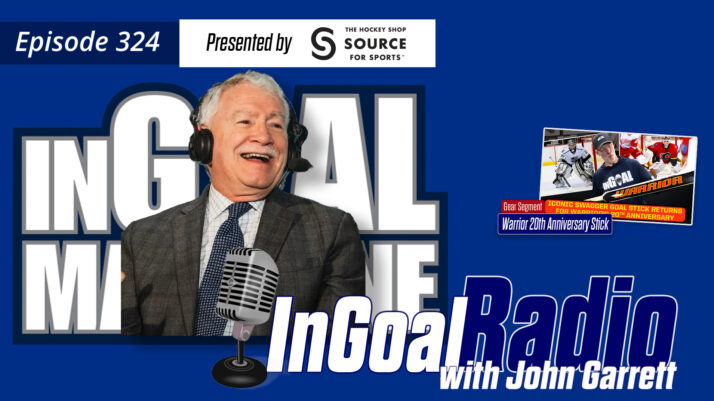
InGoal Radio Episode 324 withJohn Garrett

Please subscribe and leave a rating — it helps us reach more goalies!


Former NHL goalie and Hockey Night in Canada broadcaster John Garrett spent six seasons in the WHA and seven in the NHL, playing in an era before modern masks and protective equipment. On InGoal Radio Episode 324, Garrett recalls assisting on Gordie Howe's last goal decades after the fact, losing the All-Star Game MVP car to Wayne Gretzky, and getting caught hiding a hot dog in his pads during a relief appearance in Quebec.
- John Garrett played six WHA seasons and seven NHL seasons before becoming a broadcaster for the Vancouver Canucks and Hockey Night in Canada.
- Early goaltending equipment left players vulnerable — Garrett describes playing without a mask as a kid and wearing masks that still resulted in broken noses.
- Separating performance from results is a key mental skill for young goalies — this episode's parent segment offers practical strategies for having that conversation.
- The Warrior Swagger stick marks its 20th anniversary with a limited edition that blends retro graphics with current performance technology.
Episode 324 of the InGoal Radio Podcast, presented by The Hockey Shop Source for Sports, features a fun and enlightening interview with former NHL goalie turned broadcaster John Garrett.
Feature Interview
presented by NHL Sense Arena
In the feature interview presented by NHL Sense Arena, Garret shares stories, anecdotes and advice from six seasons in the WHA and 7 in the NHL, touching on everything from playing without a mask as a kid, to assisting on Gordie Howe’s last goal (decades after the fact), to losing the All Star Game MVP car to Wayne Gretzky, to getting caught with a hot dog stuffed into his pads after coming on in relief in Quebec. A student of the position while broadcasting for both the Canucks and national games on Hockey Night in Canada, Garrett also touches on the evolution of goaltending and equipment that used to leave you bruised and masks that still left goalies with broken noses.
Parent Segment
presented by Stop It Goaltending U
In this week’s Parent Segment, presented by Stop It Goaltending U the App, we talk about ways to help you and your young goalie separate performance from results.
Pro Reads
presented by Vizual EdgeWe also review this week’s Pro Reads, presented by Vizual Edge, with Dustin Wolf of the Calgary Flames explaining his key to rebound recoveries and how it fuels his game.
Weekly Gear Segment
presented by The Hockey Shop Source for SportsAnd in our weekly gear segment we go to The Hockey Shop Source for Sports for a closer look at the Warrior Swagger, a 20th anniversary celebration stick that mixes old-school graphics and modern tech.
Episode Transcript
Intro
We all took a moment. We sat back and said, it's happened to all of us. And Alex Nedeljkovic, we'll get into it a little bit. Just what he could have done differently and how it made us feel more a part of the union. We'll get into it.
It's InGoal Radio, the podcast presented by The Hockey Shop Source for Sports Langley. Thehockeyshop.com. Here is David Hutchison and Kevin Woodley joining Daren Millard. Gentlemen, how are you?
So well. Outstanding. Hockey's back.
Woody, you you must be just overjoyed with people now rolling through the Lower Mainland. You'll be able to hang out with all these visiting teams.
I I'm looking forward to hopefully doing that soon. Wasn't able to out of the gate do some do some medical reasons that kept me away from the rink. And now actually, to be honest with you, Daren, like, I thought I'd be getting the Saint Louis Blues today, but they canceled their practice and they don't have a morning skate. And as excited as I was to go see new guys coming through town, I have a bad feeling that this condensed season of ours is gonna prevent practices to the point where goalies don't talk on game days. It's gonna be a lot harder than it has been in the past to actually sit down and have conversations.
So I guess I just gotta book time with them when they're on the road in their hotel.
That's a bit of a trickle down effect with the jam packed National Hockey League schedule during this Olympic year and more teams taking practices off or making them optional.
I wonder if it has a positive effect or has the potential in a year where I think a lot of people would be looking at the schedule and thinking nobody's gonna play a ton of games as a goalie, the truth is practice is probably one of the more prohibitive things in terms of rest for goaltenders. I wonder if having all these practice days off is gonna allow guys to be fresher and play more games despite the schedule. Like, honestly, Connor Hellebuyck said it at the beginning of the season on the players tour, talked about how he thinks 70 games is absolutely doable if teams would just figure out how not to wear out the number one guys in practice. And guess what? Practice is off all the time.
Might be a way to do it.
You know, I knew practices were a wear and tear issue on goaltenders. But Hutch, having watched your son all the way through and into major junior, you can appreciate, this as much as anybody. I was talking to a goalie coach from the Eastern Conference the other day, and he said that they started a couple of years ago monitoring drills. How many times goaltenders go down during the course of a practice? So they'll put a check mark beside each drill in the practice plan and go, that's that's a a 50 up and down. That's a 30 up and down during the course of a practice. And when I thought of it that way, man, oh, man, goaltenders are going through a workout during the course of practice.
Think it was Brian Daccord who first opened our eyes to that with some research they were doing about a butterfly count. And and I know I've certainly heard through, Steve Thompson and USA Hockey discussions of having a butterfly count on goaltenders and maybe even at some point at the lower levels of hockey, limiting the number of butterflies a kid can do in practice, to try and extend their window, to try and keep them healthy, and so on. So I think it's fascinating that an NHL team is doing that. I'm actually really excited and encouraged to hear that an NHL team is doing that. I would add something to it if I was gonna take the research to another level myself.
I would suggest that there is a difference between a butterfly on a straight shot versus the number of open looks kids face in practice. Because a lot of coaches run a lot of no pressure, two on one, two on o, three on o. The counts of these odd man rushes that kids face in practice often, not just odd man, but but completely undefended rushes in practice, doesn't come anything close to what you actually face in a hockey game. And I would suggest that having to go full bore coast to coast to make a two on o save is a lot harder on the body than just dropping on a regular shot. So I actually think that it's magnified in practice beyond what you would ever see in a game, and it is something that we're gonna gonna need to keep an eye on.
And and also just ask the question, what's the return on investment on all those butterflies, so to speak? What is the kid getting out of going through that? He's doing a great job being a shooter tutor for the players and the two on o's and so on. But, I I I think back to Steve Valiquette's interview actually last week when he was talking about tying what he does in practice to the percentage of times that something happens in a game. And I would argue a lot, if not most, head coaches don't actually do that when they're constructing their practice plan to the detriment of the goaltender's health, but probably to the detriment to the players as well.
We have a pitch count in baseball as we get into October baseball, and Hutch and I are about to engage in a bitter rivalry between the Blue Jays and the Mariners. Why not have a pitch count? Don't get me started. Let why not have a why not have a butterfly count? Like, for sure, I and and I do think that practice trends have evolved in the National Hockey League.
I know maybe not at the lower levels where we see at least a a few less of those open ended useless. Frankly, I remember writing the article more than a decade ago at nhl.com for one of my unmasked columns and having getting DMs from goalies all over the place. Thank god somebody said it. Things we always assume to be true. Practice can actually be bad for you if you have too many of those.
Like, it can actually form bad habits. You're trying to impress a coach. You're trying to make saves, and there's drills where they're not realistic. And then when you pull back and flip the script, is it helping the shooters to take 20 shots in a row they won't get once all season time and space wise? So, I think we've evolved a lot in in in this argument, but clearly there's more room to grow.
And managing practices so you get the most out of your goaltenders is one of them. I'll go back to Devin Dubnik after the trade to Minnesota. Like, it's been so long now. Can't remember exactly. Was it like something like 50 games in a row or 35 starts in a row?
Like, by today's standard, it was absurd. Ask him why. Because they had Darcy Kuemper and Nicklas Backstrom. They had a three goalie system. Dube went on the ice early.
He did his goalie specific work. He stayed out every once in a while for a little bit to get some flow and rush drills and keep the boys happy. And then you had NHL shooters and NHL goalies, and he wasn't one of them, and he was able to maintain his game and his rest and play at a rate that nobody's played since. I I still can't believe we're all these years later and nobody sort of looked at that and thought, hey. There's something here.
Now one of the challenges is NHL shooters do not wanna shoot on Beer League goalies. So this will be an interesting thing next year with the practice goalies, and teams already use practice goalies often. Is there an evolution here where we can get a skill level at that practice goalie that's not gonna piss off the shooters that's truly gonna allow the number one to take the reps off that he needs to play like they used to play in the old days all of ten years ago.
That's a work in progress, but, let's, talk about, some of the different challenges that the goalies face in games, and that's what Alex Nedeljkovic went through the other day. He had a puck that was flipped in on him by Jack Eichel, and it just took one of those hard bounces. And if you've played the game for any length of time, you've dealt with one of those. Maybe it didn't go in, but it certainly scared the heck out of you. And then followed up. He I don't know whether he was trying to make up for it, but in overtime, was out to the blue line to play the puck, and that didn't go right. It went off a shin pad and ends up in the back of the net. That one, everybody's done giving the puck away. I just can't remember the last time a goalie was out to the blue line. Can you I
don't even skate that far when we got a delayed penalty.
[crosstalk] It's too much. And if and I was thinking, if it can happen to Ned, it can happen to anybody because he's really good at playing the puck.
Yeah. And that's I mean, I think when you look at that skip and that bounce, and we've all been there. Right? Like, it is a circular object with edges on a frozen surface. It takes weird hops.
It looked like maybe there was an attempt or he was in the process of trying to get out to corral that dump in to play it with a one goal lead in the final minute as opposed to just working about worrying about stopping it. And I haven't looked actually at the media afterwards to see what his comments were. It happens to the best of them. Obviously, the the overtime going out to play the pocket, it goes off a skating right to the other guy, like, just didn't get it through that first four checker. Personally, at the Beer League level, I absolutely would have, done a toe drag on that one.
You know, if you're gonna if you're gonna go if you're gonna go down, go down swinging. I think I've told the story on this podcast of me actually successfully pulling a toe drag off like that and then having the worst game ever afterwards. I believe it's karma. So listen. He's an exceptional puck handler on a team that is gonna need exceptional puck handling to help it transition out of its own end.
It's a big part of his game. I do know in Pittsburgh that they tried to mute it a little, not to take it away from him, but to recognize that there were moments where less can be more. And I wonder if that's a lesson here. But at the end of the day, it's a tough look. It's a tough ending.
It's a tough bounce, but you don't as Mike Smith always used to tell us, don't stop doing what you're doing completely. Maybe you adjust when you do it and how you do it in certain circumstances, but Ned's puck handling is another level. And, you know, listen. A lot of people have talked about San Jose and handed the crease to Askarov. Do not overlook Alex Nedeljkovic.
He was the best goalie by the numbers in Pittsburgh last year, and he won't give up that job without a fight.
And don't forget about risk reward. I mean, obviously, he made the wrong decision given how it turned out. But in overtime, if you can make that quick pass, the game can be over in a hurry. Especially, it looked like he was he was probably trying to pull something like that off. But I just have to say that, I don't know, I was of conflicted feelings when I watched it because I I love watching goaltenders who like to handle the puck.
It's one of my favorite parts of the game, and so I'm just excited to see him willing to take those chances. And frankly, it doesn't matter to me whether San Jose wins or loses, but I'm also the resident goalie dad and I just felt sad. I felt like I was heartbroken for the guy because I can imagine being in the shoes of his family watching this happen and you just don't want to see the microscope on your kid in that way. So I just felt really, really sad for him that it didn't work out.
What if there's a a formula where you can look at it, not not in real time, but beforehand and and when you go into these situations. What are the percentages of me stopping a breakaway, and what are the percentages of me winning a race for the puck and having it come out on the right side? Like, is it even if it's seventy thirty that you're gonna get to the puck, is it better to sit sit in the net and take the breakaway that you that you you've experienced a thousand times?
Yes. Yes. Because Woody and what did Steve Valiquette tell us last week, your percentage chances are in a breakaway. Five?
Like, they go in 35, so you got a sixty five percent chance of success. But but
bet you better have at least a seventy percent chance of getting
that get it. Right? Like, he just tried to pull it back through the guy. Like, if he if he if he if that goes another six inches, it's over the blue line and and Vegas is off side. If he chips it off the boards, which is a tougher play on the backhand, but if he chips it off the boards, it's out and he's got time to reset. He won the race. He won that. He he made the right calculation there.
He just didn't get it through the first
And the backhand's not a tough and the backhand's not a tough
No. Exactly.
Level. I mean, these guys can
do that.
I mean, hey. Listen. Is what it is. I I'm with Hutch actually. I applaud I applaud it.
Like like I said, like, we're biased. Ned's one of our favorites here. Guy chucks the puck like nobody else. He's already scored a goal in the National Hockey. He scored a goal in every level.
Who the hell are we to question his decisions coming out to stop pucks?
Toronto and Carolina both picking up, goaltenders to give themselves some depth.
Well, trickle down. Right? Like, yeah. Domino's better way of putting it. Joseph Woll, still not back with the Maple Leafs and whatever's going on there, we just wish him the best.
And they're one of our favorites here and and and a long time sort of supporter of InGoal. So whatever's going on there, just hope that everything works out for him. But in the meantime, Toronto decides to go waiver wire fishing rather than, you know, sign James Reimer, which I thought was interesting after bringing him in on a PTO. Cayden Primeau was exceptional in the American Hockey League after losing the NHL job early, was really good in a small sample in the NHL in a backup role last year. Like, I don't I don't mind taking that swing, taking that shot.
There's I I believe there's still a lot of upside for Cayden Primeau. Bad news for Carolina, they lose Primo and Pyotr Kochetkov isn't healthy to start the season, so they've gotta go make a claim and Brandon Bussi ends up there. Another guy who is just a couple years removed from a whole bunch of, you know, talk here. We had him on the podcast, upside and promise, and first year as a pro in the American Hockey League was incredible. Michael DiPietro sort of took that job over in in in the ensuing time, but he's with, well, I guess, another organization and now another organization.
So anytime the anytime the Panthers go and grab you, probably a pretty good sign of your upside. Carolina takes him from Florida and let's see if he gets an opportunity to get into some games because I would suggest that if there's one situation where you can't just be like, let's ride the number one, it's Carolina with Frederik Andersen. That guy, when he's in the net, has I I think people forget, like, has been one of the best goalies in the league statistically over the last couple of seasons. The problem is just keeping him healthy. And so, obviously, they need to be smart about how they handle his workload in, as we mentioned, a condensed season.
In our NHL Sense Arena feature interview, the great entertainer slash former goaltender, John Garrett, will join us in just a little bit. Give us a little tidbit on what we're going to see and hear from him.
Oh, a little bit of history, couple of shots at Daren Millard and his puck stopping ability, some great stories. But also the thing I loved about John was for all the character and the obvious character that came through in the broadcast and the experiences and the stories that he can tell and he tells many of them is he he also kept up with the game. Like, he didn't just compare everybody he was covering in the modern era to the way he played. Like, he stayed on top of it. He had conversations with goalie coaches.
He learned about modern goaltending, and he was able to sort of analyze that as well. So, we sort of touch them all with John Garrett, who is long overdue to be our featured guest. We finally make that happen this week.
Yes. Yes. I know that you think that you know everything about goaltending, but I can tell you There's that little John Garrett impersonation. We also have our Gear Segment brought to you by the Hockey Shop Source for Sports Langley, the hockeyshop.com. The Warrior line celebrating a twentieth anniversary.
Little swagger graphics on a Warrior V4? As soon as we saw it in store, Daren, we were just like, oh, oh, Kiprusoff vibes all over the place. So what's it all about? What are the actual features underneath that slick paint job? Let's go see Cam, and we'll find out.
Gear
Oh, we got some swagger here today, ladies and gentlemen. We're here checking out the Warrior Swagger vintage style, Goal Sticks
this week. That is like, I I literally wanna go stretch for three hours on a game day. This is giving me some serious Miikka Kiprusoff vibes. I mean Forty five minutes before morning skate, forty five minutes after morning skate, forty five minutes before the game, forty five minutes after the game it up. That's three hours every game day for Miikka Kiprusoff. But mostly, the man had style. Whether it was the He
had swagger.
Whether it was the masks or the swagger sticks. So so tell me, Cameron.
Well, there's definitely I
mean Clearly Yes. We've got the look.
Yes. We've got
a lot of swagger on this segment. Oh my god. I'm feeling it, but this is modern. Like, I got, like, Warrior's ASG grip up top, which I'm really loving. Just So what is this really?
What what what what do I have in my hands other than one, like, sexy stick?
Alright. So V6 are based off of the V series line. So this is the V4 stick. You have the V4 senior stick and then there's also the V4 Pro.
Okay.
In terms of availability, in terms of options.
Those are two of the three price points we would find in The the V4 only one we're missing is the Ritual.
The RTL.
Which is the highest price point.
That's correct.
Okay. So we've got the mid and the low price point options with retro graphics. That's essentially what we're looking at.
That is 100% what we were looking at. So, yeah, you already called it out, the ASG shot.
Feel like
I your glove in. Super nice, like, lightweight, but, man, we are just enthralled by the graphics. So you have three options. You've got your Calgary Flames esque
That's it. Like, don't even like, it's Kipper. This is Kipper.
You got your LA Kings esque design.
I'm, like, feeling Jonathan Quick hoisting cups of that thing.
So now here you go. Pop quiz with our Montreal design. Who was using?
I was actually trying to think of this, and I'm I'm I'm trying to think of air. I'm trying to think of timeline.
So community engagement, comment below.
Help out the old guy, folks.
Yes. Exactly.
So he struggles to remember what he had for
breakfast. That's fine. So watch some dates. Three different designs, two different price points, junior, intermediate, senior available, intrinsic for sizing curve. So, again, wide swath as options.
So for those of you that are wanting to relive some of your glory days with those Swagger woods. I had Like like like 10 of these that I would cycle through.
The the sort of the wood like Oh, it just looks great. Around the edges like that that look, that feel. Now, I mean, the one interesting part is like there's paint added on here. Correct. And so it does feel at times like it might feel a little heavier.
We haven't weighed it, but that's just the one caveat, folks. The one caveat, it's still an incredibly light stick.
So without scratching that rabbit hole surface down too too much, yes, I mean, this is extra paint added to a stick in theory.
Well, and they're so light these days that if you add layers of paint, you're adding weight.
However, Warrior's v series sticks were already painted anyway. They didn't have exposed carbon, so this still does actually come out to the same weight as your standard v series.
Really?
[crosstalk] That's correct. Even in the blade.
Even in the blade.
I'm gonna have to go check, Cameron. I don't trust you.
So only one curve, twist, standard, same as p 31 in about
Who would trust a guy that describes this stick as Calgary flames and not Miikka Kiprusoff? Oh, Miikka Kiprusoff. All credibility lost. Oh, okay. Give them your number just in case you are actually pretty good at answering questions.
604-589-8299 or 1-800-567-7790 or check us out at the hockeyshop.com.
And remember, hit up the comments and let us know which Montreal goaltender made this look famous.
I bet it's cool being around the hockey shop when something like that comes out and then Cam and company get to tell all the newbies, back in the day, this was the greatest thing in the world. This is this reminds me of Miikka Kiprusoff. You wouldn't remember him, but he was outstanding. You get to be a little bit of a a a dad moment.
I think I I can't remember who was Cam or Jono. One of them was like, the only thing missing on this stick is the made in Finland. Right? Because remember those Warrior swaggers with the with the famous for the Finnish wood and and and how Warrior was having them still made. Now what was that?
Wasn't that it's a former defenseman that owned the company. Now I'm brain cramping, Daren. I've taken too many pucks to the head. Those old goalie sticks in the swagger line was was Warrior purchased that from a former NHL defenseman's company. And what what was it?
Much like the question we asked in the video about which Montreal Canadian used the stick, and by the way, the the the colors on that one would also work for the New York rangers. Now I'm now I'm starting to wonder. I don't trust my own memory. It's terrible, terrible, but it's a great stick. And you know what they've got at the Hockey Shop Source for Sports right now?
A whole bunch of them. We did the CCM Vision last week. They've got a rack full of pro returns from multiple companies. All the greatest from Bauer, the new sticks from Warrior, whether it's the v four line right up to Ritual or these new Swagger looks, they've got it all at the Hockey Shop Source for Sports, and they've got new stuff coming in pretty much every week it seems. So even though the normal launch season is in the spring, there's still new stuff coming in the fall.
Make sure you check out the hockeyshop.com on an almost daily basis like Daren does to see what's new. And for our American friends, it's Thanksgiving in Canada right now, which means Thanksgiving sale from our Canadian friends at the hockeyshop.com up to 50% off. Make sure you check it out today.
Accessories. That's where I go to first, and then I bounce around everywhere else. I love my accessories. Just just looking at different things because I can I can pop in, grab something, pop out? I'm I'm I don't have the cash like you guys to be looking at pads every week, but the accessories make me feel rich and into it.
Oh, that got Hutch's attention. ProReads brought to us by Vizual Edge, one of the great aspects of InGoalmag and ingoalmag.com. It offers you a little insight into what's happening from an NHL goaltender point of view. It's it's a video session with a professional goaltender.
It is. And we've got one of the hottest young professional goaltenders up in this week's ProReads presented by Vizual Edge. That would be one Dustin Wolf. And after watching his season debut against the Edmonton Oilers, I regret only that I did not go to the shootout breakaway portion of our video session with Dustin Wolf because watching him hold edges from a low wide stance and basically make Deeks irrelevant was quite enjoyable. But we've got a great session with Wolf where he walks through thought process on rebound recovery, And there's sort of one staple for him every time.
And it's interesting because we talk about reads and situations and playing different things depending on what those different situations look like both in terms of where where the offensive players are positioned, what hand they are, and what your defense is doing. But for Dustin Wolf, it really gets back to his system and his belief in it. And so it's a great video example of just how deeply rooted that is and why it works for him. So make sure you check that out at ingoalmag.com. And while you're there, if you're a subscriber to InGoal premium, did you know you get 20% off on Vizual Edge, our sponsor for ProReads?
Vizual Edge is a perfect sponsor for the ProReads segment because ProReads is all about helping you see the game better, and Vizual Edge will help you see everything better. Just ask Jordan Binnington. He said that Vizual Edge has added a quality element in his preparation as a goaltender. I I use the game day drills every game before heading to the rink. It's a combination of recognition, reaction, and focus that activates my brain and eyes to feel ready for what's to come.
Speaking of eyes, I was having a little trouble reading that, boys. So it's a perfect partnership. Use the code InGoal. You get 10% off on Vizual Edge. It really is a game changing tool.
It's not even a tool. It's sort of a must have. If you're not improving your eyes, you're probably falling behind And you can do that at a discount, 10% Vizual Edge using the code InGoal. Or if you're an InGoal subscriber, check out the ProReads at ingoalmag.com, and you will see the 20% discount code if you're a member. Vizual Edge and ProReads know better way to see and read the game better.
K. The the low wide stance on the shootouts, it I would feel vulnerable five hole there. Why does he be able to just push that aside?
Because his because his knees are like two inches from the ice with his feet, like, two feet outside his hips and he's still holding his edges. Like, at the end of the day, he's actually so close to the ice in that stance that that along the ice is not exposed much at all. And his ability to hold it's it's all about his ability to hold edges from that wide stance. It really is unreal. His goalie coach, longtime junior goalie coach, James Jensen, actually sent us a text after that, that shootout talking about, yeah, he believes it's it's largely tied to the true skates he wears and the way he's got them set up to to sort of be able to hold his edges like that.
And which kind of surprised me a little bit because it's such a stiff boot. You wouldn't think you'd have that ankle flexion in it. But Wolfie's got it dialed in and hey, like at six foot, he's got shorter hinges, shorter levers than than a lot of the a lot of the long goalies with longer legs that maybe have sometimes run into knee, ankle, and hip issues using those skates. But for Wolf, it's not a problem. So it it's really remarkable to watch.
It's a little bit of a tough one for ProReads because you're like, k. Do this. Like, emulate that. And, like, you'd probably have to take you'd probably have to take me off the ice in a wheelbarrow if I tried to do that. Like, my whole lower body would just shatter into a million pieces.
So, yeah, it's it's the degree to which he does it is remarkable in an era where we talk about narrow stance and managing depths. And obviously on a breakaway, you've got to widen out at some point. His ability to do it to the nth degree without giving up an edge. Even in that, if you guys watch that shootout was eight rounds, Like, the Leon Draisaitl goal that beats him was a deke. It was like a double move both ways, and it was an insane move.
And most goalies, heck, I would have been in the corner with the first push. Most goalies, there's no way they're holding on to that second edge. He actually drops that leg and still manages to recapture it and push back just not quite enough to beat dry side of the post. It's it's it's insane.
Watch it five times to see how he got the second edge on it to be able to get that leg back.
Yeah. I actually think my knee started hurting just watching that.
The other thing that's interesting about this is is, you know, just raising discussion. Daren, you brought up the question of being vulnerable five hole. And I think it's worth saying that what you choose to do out there is a is give and take. And he's decided that being a little bit wider is help is helpful. I love what he talking about saying making dekes irrelevant.
Wow. What a marketing line that would be on the Dustin Wolf way of playing goal. But but there's give and take. So he's he's creating an advantage for himself in one situation. And and maybe okay.
I agree, Kevin. He's a lot closer to the ice, but maybe you do give up a little something in the middle as a result. And and I think it's worth people acknowledging that that's something we're doing all the time. You know? There's a lot of people in the game of hockey that still say any goal that beats you five hole is a bad goal automatically.
Well well, is it? Is it? Because there's some give and take. He's he's created a situation where he's less likely to give up a goal somewhere else. Okay.
So one goes in the five hole. If you insist that you can't give up a goal five hole, you're gonna have every kid just sitting in a butterfly getting walked around. And, and I think that's what makes the position interesting if we can get away from absolutes and talk about different ways of doing things.
I thought it was interesting that Daren talked about five hole because to me when you get that wide and as a six footer, I think the most common knee jerk reaction would be, what are you giving up upstairs? But the way he times his retreats and doesn't get that wide until it's in tight is also part of this process. And as I said, you know what? Based on this discussion, we might have to go back to Dustin Wolf for another ProReads. I might need to dig out the actual, shootout ProReads that I did with him.
We've had a lot of Dustin Wolf on the site lately, but this might be worth revisiting this week just because he walks us through that process. And and again, there's a balance to it. Everything balanced. It can't just be one or the other.
Hutch, have a one simple reaction when somebody scores a me between the legs. Who shoots there? More and more guys.
How you see a lot of shootout goals.
Them all the time. I I say them all the time. Like, who shoots there? Like, pick a corner, you
guys. Daren sounds like me when the guy comes in on, a two on o and he shoots and you're like, and he's Selfish. And he's, like, totally, like, riding the stick down the ice celebrating. You're just like, who shoots on that? Who shoots on that?
I I that's my other reaction. Selfish. They they love skating with me. Did you see the Dustin Wolf play where it went off the net up in the air off his body?
Oh, yeah.
Let's talk about heartbreaking.
Like like That was preseason. Doesn't count.
I know. I know. But it just it shows you the total unpredictability of the game.
There is randomness in everything.
Hard rubber object frozen with edges on a on a icy surface. It's gonna bounce.
Our friends at Stop It Goaltending U the app, presenting the parent segment.
Lots of good stuff before we get to the segment, which is also good stuff. Over from our friends at Stop It Goaltending U the app, the daily primers this week, talk about effective communication. We hear a lot about communication. Right? The importance of it.
But how do you do it effectively? Talking for the sake of talking, you might as well have a podcast and be named Woody. They walk you through ways to be effective in your communication. They've also got a quick video where Harvard goalie coach Brian Robinson goes over RVH integrations and technique. Their full video analyze what makes Darcy Kuemper's game so successful.
I'm taking a look at some of the saves he made and their drill of the week transition from a backdoor play to a slot shot, which is increasingly, as we heard from last week, the type of thing that teams are looking to do at all levels, get you moving in and out of your post and then exploit you with low high, keep you trapped down on the goal line. How do you battle that? There's a great drill to Stop It Goaltending U app. When we take a look at Stop It Goaltending U, the app, we think of Brian Daccord, we think of Joey Daccord, who by the way is off to a hell of a start with the Seattle Kraken once again. And we think about all that experience rolled into your phone or your tablet and the ability to access it at any time, you get all of it.
All of these things that I just described are delivered new ones each week as well as a subscription to InGoal Magazine premium. InGoal mag and Stop It Goaltending U the app, no better combination in the world of goaltending to help you get better. Make sure you check it out on the App Store, Google Drive, wherever you download apps, and get Stop It Goaltending U the app today.
We should have a little counter when he pokes fun on himself. Ding. Self that's self deprecating.
It's not good mindset,
Woody. It's not. And it'd be a lot of it. A lot of dings going on.
All roads lead to beer league, boys. It's the mindset I need for the job I have.
I think we're gonna bring Pete Fry in one day as a guest, and he can just do a counseling session with Woody.
We should do that on a on an episode. And I and I'm not even joking. It would be cool to hear
Just Pete. Just interject every time I rip myself?
Jump in and and and talk about it.
Well, Woody Woody often uses the phrase, show me, don't tell me. So let's go get Pete in to show us how it's done.
I'm in. Take it away, Hutch.
Parent Playbook
Gentlemen, we often hear that we should focus on the process and not on the results. And any parent who's had a child playing for a team that loses a lot of games, I mean, the kind where it doesn't matter whether it's their kid in net or Connor Hellebuyck, they're probably still losing, has probably figured this out. But what does this really mean for you as a goalie parent? We've we've talked here before about praising hard work, about catching kids being good, about noticing when they apply something they've learned from their goalie coach. Yet often, that all goes out the window after a loss.
Kids inevitably tie their losses to their performance, and they can't find a way to separate the two. And sadly, many take it even further and start tying that performance to their self worth. We've all heard kids say, another loss. I suck. For a parent, that can be heartbreaking.
So today, I wanna share a practical example of how you can try talking to your goaltender after a tough loss. The kind that leaves them questioning themselves. It's just one approach, but it can help build a framework for separating performance from outcome. So here's a real conversation. I spoke with a goaltender, who had had similar results in the box score in a couple of recent games.
One was four goals against in a loss. One was four goals against in a win. After the win, they were really happy because, let's face it, winning feels good. After the loss, they were devastated, saying something along the lines of, if I'd only stop that one in the second period, we'd have won. Technically, it's true and perfectly understandable.
There's nothing wrong with being competitive. But it's important that we don't let the scoreboard dictate how we judge our performance. As parents, we often try to comfort them, of course. Well, you didn't have that much support. The other team was really strong.
If your team had scored a couple more goals and you'd won, would you feel differently about your performance?
They had lots of grade A chances. But when they're upset, those words rarely help. So comfort them, give them a hug, but give it some time before trying to reason. And then try this question. If your team had scored a couple more goals and you'd won, would you feel differently about your performance?
The answer is something like, well, of course, when we win, everybody's happy. And, yeah, as a parent, you'd probably feel better too because when they're happy, we're happy. But this is where reflection matters. Ask them to think about their performance again, imagining their team had scored those extra goals and they'd gotten the win. How do they feel about how they played regardless of the score?
And you might hear something along the lines of, well, I did a lot well today. My positioning was good. I controlled my rebounds. I've been working in practice on battling for loose pucks, and I thought that went well. That second period goal still stings, but the other three were deflections or tough screens.
Yeah. Tough game, but I'm only really unhappy with one of them. So I guess it was pretty solid overall. Now at that point, you can acknowledge that losing isn't fun, but it's not all on them. In fact, that game sounds like progress.
A mistake or two, sure, but also clear steps forward on the things they've been working on with their coach. That's development. That's growth. You can help them see that they're a better goalie today than they were a week ago despite the loss. Now I'm not saying every post loss conversation will go this smoothly.
Competitive kids don't like losing no matter how you frame it. And there's still gonna be some tough games where they're unhappy and they really didn't play as well as they might have expected. But even then, this conversation reinforces the point. It's a team game and their performance is only one part of it. If their team had scored a few more, it's a win.
Same performance, different outcome. And, yeah, sure. It works both ways. The sharp eyed parent in the crowd might realize that you could say something like, well, what if your team hadn't scored six goals? But don't.
Let them be happy. Let them build confidence. They already know where they made mistakes, and this win reminds them that their teammates have their back. When they reach junior, they're gonna have coaches who break down every detail, but until then, let them enjoy the game. Try a few of these what if conversations.
Try your own version of a what if conversation after a loss, and over time, they might start to understand that their performance and the result of the game are not always the same thing. And that's a lesson that lasts well beyond the rink. If you've tried something along these lines or if you have thoughts about this, let me know. parents@ingoalmag.com.
Do you guys judge your performances on saves made, good chances stopped, or goals allowed, and whether they were good goals or not? In the sense of you can make four great saves, but if you let it stinker, do you feel crappy about your game?
I think there's some ratio there and it's probably different for everybody. It's not one to one. It's not one good save make makes up for a tough goal and it is absolutely only natural to focus on the mistakes. But I still don't think we we should tie them to the results. Heck, in in beer league, that probably goes double.
Well, you know what? It's funny, like not beer league because I don't play that anymore, but like, the my Monday night hockey skate, which has a bunch of guys that are way over my head. A lot of them are younger too. So they're under my age and over my head. But I've I'm with you, Daren.
Like, I you can make a couple of good ones. And then if you let a couple in that you you think you should have, but what's interesting is the conversations afterwards in the room, like these are great guys and they talk about it and they can see if you're little upset and it's like, they're quite honest. Like, they'll tell me when I'm on or when I'm off and there's nights where I'm off and they're like, it. Like, what are you talking about? It was like 10 bell saves all over the place.
And and all that I'm thinking about my mind is the the winning goal because we do play to five and they it keeps it competitive. Because frankly, if there wasn't a back check with this skill level, I'd be screwed. And the open look from the top of you know, from around the dots that I think I should have patience on that goes over the shoulder. I'm mad about that. And they're like, so to put it's the what if, like, sometimes the perspective of the other people shows you it's not as bad as you think.
Now interestingly enough, my last game, I left there. I said to the other goalie, I'm like, man, just felt like I couldn't see it tonight. And then the next morning I found out, yeah, no, your eyes don't work anymore. You couldn't see it. So yeah, that was kind of a reassuring visit to the doctor even if the other part of it wasn't so good.
Just to explain But
you are getting better.
Right? Just to explain to the listeners, Kevin Woodley does have a problem with that, his eyes right now. He is recording this podcast in the dark wearing sunglasses, which makes for a really interesting view for all of us. I wish this was on YouTube.
It's we have to start putting it on YouTube. It's called the corneal ulcer and it's a lot less scary than than it sounds. And so it should get better with some time. But yeah, it was it was so funny because I was like, and that's why I missed the home opener for the Canucks because this is not a look I would recommend going to an NHL game with. But it was funny because I literally said to the guy, I'm just not seeing it well tonight.
And I thought my tracking habits were off or that maybe I was pulling off the puck. I wasn't watching it. And he's like, I'm like the next morning, it's like, no. No. Yeah.
No. Your eyes don't work anymore. You're done.
To Hutch's point of view, it loss is too stink, though.
Ugh. It's
it's hard to define the positive.
Well and maybe that's what I was trying to say is there's been nights at that skate as irrelevant as it is. It's just about a sweat and a and a good time. And, yeah, there's a competitive element where you lose the final game and you feel like you just sucked and you get perspective of the guys who've been trying to score on you all night. And they're like, no, that was one of your better ones. That might be saying something too, but you know what I mean?
Like, it's that same thing. It's I was trying to point out that perspective is quite different. And sometimes it's hard in within that loss to find that perspective.
And what I didn't say that that maybe I should have is this isn't just about consoling your child and making them feel better if they've had a good performance in a loss. I this is a really important developmental step for any athlete to be able to assess your performance independent of the results so that you can then take steps forward. It's otherwise, if if you and and I'll take the other side of this where your team scores a few goals, maybe they shouldn't, and you get a win that maybe you didn't quote unquote deserve. If if you just walk away feeling like everything's great and you've had a had a wonderful night, you've lost an opportunity to learn something. And, so in in either case, you need to take the opportunity to learn something.
I still wanna underline parents, don't be sitting your kid down and tell them you gotta win, but you stunk. Like, that's that's not our approach to anything around here. But but do take the opportunity to learn when when things happen. Because sometimes that loss and the and the disappointment afterwards, not sometimes, often can can overshadow the experience you've had in the game and the opportunity to take something away. Like like I talked about in in this sort of hypothetical example.
Here's a goaltender that's been working on something in practice. They brought it into the game. They did really well. It's important to acknowledge that that work was was well done and that they've taken a step forward, and they're they're now a better goalie than they were the week before.
Well said.
If you are gonna sit down your kid and tell them they stink, can you record it for us?
So that we can use it with the woody self deprecation?
Yes. Is there way to put an asterisk on what Daren says? There's I don't know how you put an asterisk in the radio.
Once again, we need to get on YouTube.
Do.
Daren Millard's opinions do not necessarily reflect the policy or opinions of InGoal Magazine.
We just have Pete pop
up in the corner every time.
That would actually be really funny.
That would be outstanding.
Here's how I would handle what Daren just said.
Record scratch.
NHL Sense Arena brings us our feature interview every week. John Garrett standing by as we bring you a message from NHL Sense Arena.
Yeah. Well, we just talked about, process over results, and NHL Sense Arena is a great place where you can do just that. Sure. There are results. There's metrics on how well you track to pack your reaction time and so forth.
In fact, there's metrics that you'll never get on the ice. So what a great tool it is. But those results are independent of how the team is playing in front of you and they're just for you. But more importantly, you can follow a process that leads to improvement, a process that's guided by experts. Decide that you will do fifteen minutes of training with Sense Arena every day, and at the end of the year, you will have done more than ninety hours of training that other goalies are not doing.
You can spend that time going through their guided goalie advancement program and you're following a process step by step towards becoming a better goalie. Or follow one of the many training plans included where professional goalies and coaches guide you through your training to help you each day on the road to becoming a better goalie. If you haven't seen it for yourself yet, have head over to ingoalmag.com and check out Kevin Woodley's very thorough reviews. You'll see NHL Sense Arena isn't a toy. It's a serious training tool that will help you become a better goaltender.
How serious? Well, Joey Daccord of the Seattle Kraken uses it as part of his training and has even used it in between periods in NHL games. Head over to sensearena.com today and use the code I g m 50 to save even more as you try NHL Sense Arena.
I will add. Sorry, Hutch. Not trying to be that guy.
You just have to.
I have to. Well, this time this time it's important. This time it's important. We've only got a couple more days. October 15 is when that 50% off sale will be ending.
So for only a couple more days, 50% off on NHL Sense Arena. Check out the website for more details and still get your IGM 50 for an additional $50 on top of the 50 percent.
Woody, take us over to Cheech.
Feature Interview - John Garrett
What more can I say? Like this they're legend, entertaining broadcaster, passionate broadcaster, student of the position, came up in an era that many of us won't understand. Playing a game where shots off the mask when he eventually got one could leave you with a broken nose, where shots off the body would leave you with a bruise. We talk about the evolution of position, the evolution of the equipment. We talk about hot dogs being stuffed into that equipment while backing up other goalies and ending up with hot dogs in your gear after getting put into the game surprisingly.
We talk about everything with John Garrett, the man they know as Cheech. We did not get into ketchup on pizza. I'll leave that for another episode, but I'm sure regardless, everybody will enjoy this one. I had a great time doing the interview, and make sure you stick around to the end for a couple of digs at Daren. Really excited to welcome to the InGoal Radio Podcast, someone I've had the absolute pleasure to get to know a little bit on the media side.
I played seven years in the in the WHA.
Six years six years in the WHA. Then another years.
Seven in the NHL. So
it's
There like you go.
Too many pucks off the head. He's already correcting me. I'm the young guy. I didn't wear the masks that would break your nose, and I still can't keep it straight. I've got everything upside down.
Oh, I know.
John Garrett, great to have you on the show. I enjoyed many of our conversations over the years around the press box, and now I get to bring some of those to our audience. Just fantastic to have you. Thanks. And and still doing broadcasting, working with Hockey Night in Canada and the Sports Net crew.
Maybe catch us up a little bit on on sort of how that schedule's changed over the past couple of years for you.
Well, it got to the point where, I kept looking at my birth certificate and said 1951. The Canuck schedule was really busy. The last couple of years, was doing over 80 games and then playoffs too, and it's it got to be a grind. It wasn't as much fun as it was. It's still fun.
And I'm I'm doing maybe ten year 10 games a year now, and just enough, just weekends and Saturday nights, and usually the second games are the doubleheader. So it keeps me involved, it makes me pay attention to the league and what's going on. It's just evolved that it was time. And unfortunately, that I left and the Canucks went right in the tank the next year. So
It's your fault.
Yeah. That's it. It's my fault.
The there's so I mean, your career starts in the seventies, spans through the eighties playing, and now as an announcer, like, you've seen this evolution of the game, had a front row seat, the position in particular. So I wanna I wanna get into all of that, but let's start with where it started for you. Growing up in in Trenton, Ontario.
Yes.
How did John Garrett become a goalie? This is a different era back then.
It was. It was. And, I don't think people realize, you know, it's even then, it was kind of a rich kid's sport, especially for goalie. We used to go I played in Trenton, Ontario, grew up there. And you'd go down on Saturday mornings, and there'd be a bin with the goalie equipment in it, and they had padlock on it, and the guy would be there and open it up for, it depended what group you were in, tikes, and they were called squirts when I was there, and peewees and bantam, and you'd go and you'd get there early enough so that you got pads that weren't the same legs and gloves that were on the right hands and things like that.
And you played just one goalie, that was it. Wants to be the goalie today? And you were the goalie. And if you played on the rep team, a lot of times it was only one goalie. And you played all the games, and so that was good, and bad.
You no matter how the game was going, you had to stay in. And then as I progressed in, I'm that old that I started with no face masks. I was gonna say Different
game different game back then too.
Yeah. We had the little leather helmets that just, you know, covered your temple, and then I got into the clear shield that was always fogging up, then the form fitting masks that weren't so form fitting, and I remember the team doctor in Peterborough was the first form fitting mask that I had made. All the rest were where you bought a Canadian tire and they were just plastic and just fit on your face. The form fitting mask in Peterborough, the team doctor made it, but it fit right to your face. It was great for visuals.
Could see, no matter where the puck was, you could see it, down, no blind spots at all. But every time you got hit, it was like getting punched. It fit so tight to your face and wham, and you think of how many concussions, back then it was, who cares? Smelling salts, you know where you are. Yeah, I'm in a rink.
Keep playing and away you go. And broke my nose in junior just because the mask was fitted right tight to my nose, and the guy hits you from the side and your nose shifts. And I remember the doctor coming in, puts his two thumbs up against my nose, and he goes, Oh, yeah, it's broken. No kidding. No kidding.
But then I played junior in Peterborough, got drafted by St. Louis. St. Louis just had finished Glen Hall, and Jacques Plante, and Ernie Wakely was still there. And so I went to St.
Louis, 13 goalies in training camp. And you watch watch now there's five or six in training. We had our own dressing room. 13. But it was a six week training camp.
And guys would come in, the guys who had contracts. And I remember my first training camp, a guy named Noel Picard was there in St. Louis, a defenseman, great big defenseman. He had played the year before, played very well. And so he had the contract.
He comes in, he's forty pounds overweight, but he had six weeks to get ready. And they knew, I've got a contract and I'm going to be on the team. And he was ready by the time the season started. Played in the Central League, St. Louis At the time, there was a Central League and the Western League.
The Central League was the younger players, the Western League was the older players, and St. Louis had their farm team in Kansas City, and I was in Kansas City with the Kansas City Blues in the Central League. The next year during training camp with the Blues, I got traded to Chicago, and Chicago had Tony Esposito and Gary Smith. And here I am, my second year pro. What are your chances?
Well, not very good. And they had a team in Dallas, and they had goalies that were there already, Michelle and a couple other guys. And so they sent me to the Western League to Portland, because they had a working agreement with them. Went to Portland, played in the Western League. So this is where I get to play in every league in the world.
And about Christmas time, just before Christmas, I'm in Portland, and because they're a privately owned team, there was only two players from Chicago there, myself and Bill Orban, forward and played in the NHL for a while. Real nice guy, but they decided they were gonna use their own goalie three games in a row. And that Chicago didn't like that one little bit. I get a call and Tommy Ivan phones and says, Well, we're not going to tolerate that. We're going to bring you back.
So they brought me back, but to Trenton, they said, Well, why don't you go home? It's great at Christmastime. Why don't you go home and we'll find a place for you to play? And then I was thinking, Oh man, Portland back to Ontario. Driving and we moved all our stuff.
First year we were married, my wife and I, who've been married fifty three years now, it was surprise, surprise. And we get the call, and it's, I think it's December 20 or something. And so we got to pack up, and I drive and she flies, and I remember her taking the Christmas tree, takes the decorations off, we lived on the 2nd Floor of this apartment building, she threw the Christmas tree off the deck, trying to get, you know, welcome to professional hockey. And then she got stuck in Chicago, and I almost made it home before she did, and I was But anyway, they found a place. I played in Richmond in the American League, so now I'm three leagues already.
And Ronnie Wilson's dad is the coach, Larry Wilson. Just a great guy, another one of those guys that had a heart attack while he was out running, just a proof that you don't have to be in great shape all the time here. Real nice guy, great coach. He played me all the time. And so I'm in Richmond, I get called up to Chicago for the playoffs.
And they're talking to me about contract for the next year, but they still got Tony Esposito and Gary Smith. And they're offering me 16,000 to play in the NHL, 18 for the second year playing in the NHL. And the WHA had had one year under its belt, Bobby Hull, and it was starting to get established as the rebel league and all this kind of stuff. And I'd been drafted by Minnesota. They came along and offered me a $20,000 signing bonus, 35 for the first year and 45 for the second year.
No brand.
Yeah, exactly. And that's, I think, what happened to a lot of the players who signed in the WHA, was the NHL was so arrogant that, well, you're not going play in that league. That league will never last. And some of the teams I played on, Minnesota Fighting Saints, and the Toronto Toros moved to Birmingham, and all these stories from the WHA. But it was a no brainer at the time.
And you look at the four teams that made it, merged with the NHL, And you look at all those great players that had the opportunity to play in the WHA, Gretzky and Messier and Mike Gartner and Michel Goulet and Rick five and Gaston Jingre, all the young 18 year old Ken Linseman, Rod Langway, that had a chance to play, and could have played in the NHL, but because they weren't drafting until you were 20, they were stuck. And so the WHA afforded them the opportunity of a real competitive league, and high quality, especially towards the end. And then look at how long it took the Oilers to be a dynasty, within what? 'seventy nine, 'eighty was the first year, and what was their first cup? 'eighty four, 'eighty five?
Somewhere in there. And then Colorado wins, and Carolina wins, and all the teams that merged have won Stanley Cups. And I think that's a testament to how good the WHA was evolved towards the end.
Now, throughout all that, like some of the names you mentioned, I mean, obviously legends like Esposito and stuff, what were like, you walk into a training camp with 13 goalies. Is there any opportunity to build relationships to learn from these guys? Is there goalie I know I know we're in an era now where every eight year old's got a private goalie coach, and it was far from that. No. Back then.
But is there any advice, or are you just out there on your own figuring it out?
No. No. There wasn't. You're out there on your own figuring it out, and, you've watched the guys play. And and, like, I grew up trying to pattern myself after Rogie Vachon.
A little goalie [Vachon], and back in the stand up era, cut down the angles, that sort of game. And I thought, well, okay, I'm his size. Exactly. And I can play like that. And you'd watch him, and then you'd watch a guy like Roger Crozier and Bower and Jacques Plante and those guys, and you'd watch them and try and pick up the best that they had, and how they handled themselves around the net, and in the net, and angles and rebounds, and Johnny Bower, the poke check.
A little goalie, and back in the stand up era, cut down the angles, that sort of game. And I thought, well, okay, I'm his size. Exactly. And I can play like that. And you'd watch him, and then you'd watch a guy like Roger Crozier and Bower and Jacques Plante and those guys, and you'd watch them and try and pick up the best that they had, and how they handled themselves around the net, and in the net, and angles and rebounds, and Johnny Bower, the poke check.
You pick up the best qualities of each goaltender, but you had to do it on yourself. You're right, there was no, absolutely no instruction or advice. I remember going to Chicago, They called me up for the playoffs after I played in Richmond, designated target for the playoffs when Tony and Gary would take the practices up. And Gary Smith and I ended up being roommates, and I'm sure you've met Gary a few times, and what a great guy he is. And I remember Tony taking me aside, and he goes, What are you and Smitty doing?
You know, how come you're hanging around him? He's taking your job. And that was Tony's attitude was and if you were the other goalie, it wasn't a team. I always looked on it as if the other goalie does well, then you won't nobody will bug you. And if you do well, then nobody's going to bug him.
So it's kind of a mutual admiration society, and nobody else knows what you're going through except the other goalie.
So it's kind of a mutual admiration society, and nobody else knows what you're going through except the other goalie. And Tony, it was, he's taking your job. Don't, you can't hang around him, and don't talk to him. And I was like, oh man. And Tony was different anyway, but I thought, what an attitude to have, and what an attitude if you were his partner.
It was just, it was an eye opener for me to think that, and Tony was such a great bowling and such a fierce competitor, I get where he's coming from, but that's a tough road to hoe. As you know, goaltending is really a tough position. It's an individual position on a team sport. And now they have the psychologists and performance guys, and how many goalie coaches? Each team has two or three goalie coaches, one for the NHL, an organization goalie coach, and then another goalie coach, usually a goalie scouter or something.
And back then we didn't, there was nobody except the other goalie. And you think now mental health and, well, you have to be crazy to be a goalie. It's kind of a legit statement because it is such a pressure packed position to play, and you have to have thick skin for sure, because you're either great or it's your fault. You don't talk about the ones you stop, it's the ones that go in. You can have, I remember Stuart Skinner, first year the Oilers were in the finals and and lost, and he let in a wrist shot from and they lose two one or whatever it was in game seven.
It was one of those games that and it wasn't a great goal, but that ended up being the game winner. And what did everybody talk about? They talked about that wrist shot that beat him from the face off dots. And I thought, well, isn't that just typical of the position? Is you're great and Skinner still is people question and he's been to the Stanley Cup finals quite.
And well, all the Oilers need a goalie.
And it's funny because so the more things change, like all the support that's there for the goalies, the more they stay the same. We still wear the goat horns and sometimes fairly, sometimes unfairly. The understanding around the position in many ways hasn't evolved all that much. It has amongst the inner circle and the people studying it, but, like, in the general like, right up to general managers will admit, like, oh, I like, how many times do we hear general GMs and coaches? Well, the goalie coach will handle that.
I don't fully understand that. Like, that level of ignorance towards it, I love that you always kept studying it and stayed on top of it when you switched over to announcing. Like, when you look at the and we'll get back to the WHA and then transition back to the NHL in a bit. But as you've seen it evolve, like, where where do you think it's at now? Are there things you watch and still shake your head at a little bit without having to call anyone out?
Well, I like the fact that Dustin Wolf had such a great year last year. Juuse Saros has established himself as one of the elite guys. They don't have to be six foot five, six foot six, and cover three quarters of the net and wear oversized equipment and just block. You can be an athlete and you can be a reactionary goaltender and not just be a guy that goes side to side and just blocks. And I think that's one of the things now that I'm hoping, and I still think that the league is going to have to clamp down on the equipment again.
And it's nice that now none of the goalies get hurt with shots. Nobody, know, a mask or arm pads, or you might get hit in the top of the knee maybe once or twice a year, but it's not like it used to be where the guys were flinching or pulling up because you get hurt with shots. Now the equipment is so good, so light, and the goalies are so conditioned. Everybody's in great shape. So it it bothers me, but here's again, as you were saying, it's why can't goalies play 65, 70 games again?
Like, Grant Fuhr did them one year, 72 games or whatever, and then got hurt in the playoffs. Why can't they play back to back nights? If you're in playing the Rangers one night and you're playing the doubles the next night, you look at 20 shots against the Rangers and you're playing, why can't you play the next thing? You know, okay, it's the mental part of the game, and it's not the physical part. The coaches think, okay, I can't use them, I can't burn them out, well, And that's to me is like you say, the general managers and the coaches and you go to the goalie coaches and Andy Moog is one of my favorites.
Bill Ranford is one of my favorites. The guys who have been there themselves, who know the pressure and what the goalie's thinking. And Ian Clark is one of the best goalie coaches there is, but I remember Ian telling me one time that I can get Dan Clouthier so conditioned that in the playoffs, it won't matter, that he will, it'll just be all muscle reaction and muscle memory, and he won't have to think about it. Well, you think about it. And that's where a guy like Ian, who is a master at the craft, but that's one of the I'm sure that you look at Winnipeg and how Connor Hellebuyck picks, and their goalie coach is one of my favorites too, and great guy, and he's played the game.
I talked to him about it, and he said, Connor is so wound up, and he wants to succeed so much in every game. You know, the regular season, he just absolutely lights up. But then you get to the playoffs, and he wants to do more. And it's hard to convince the goalie, and even, you know, guys that have played before, how do you get inside their head and say, hey, Connor, just be yourself. You don't have to be that much better.
You're the best there is. And you watch him in the playoffs, and I think, man. Know, Connor, settle down. You remember Rick Tabaracci. Rick Tabaracci is another guy that was in Winnipeg and played really well.
Come playoff time, and he was just a basket case. And then Cloutier was another guy that just, he gets so wound up for the playoffs and shot from the red line goes in, come on.
You can't, it's funny because like, again, the more things change, the more they stay the same. Like, you can't try harder. No. As a goalie. Like, you
can't you can't, like and I've had Convince yourself convince yourself that you can't try hard. Convince yourself that you can't be that just, oh, I'll just be that much better. Right? I'm the Vizual Edge trophy winner every year, but I can be that much better in our team no matter what they do. I can make the difference.
Goaltending is the only position on the team where you can make a difference every night.
And as you know, goaltending is the only position on the team where you can make a difference every night. You can okay. You might be a zero zero tie, but you're the guy, you can make the difference every night. And that's what I used to tell the kids at hockey schools and that, you you take the goalies aside and you say, okay, you know, you are the only guy on the team that can make a difference every night. Sure.
Gretzky goes up and scores five. Okay. He he's gonna make a difference, but the other team might get seven. But if you don't let any in, you can make the difference every night.
Do you think we have to embrace that? Like, do you think that's part of what goes into it? Like, embracing that from an early age, that wanting that as opposed to being scared of it?
Yeah. Oh yeah. And you look at the guys who have been successful and, you know, the Murray Murderers and Patrick Roy, all the guys who have been Vasilevskiy gets to the playoffs, and you can count on one hand. When's the last time Vasilevskiy or Bobrovsky lets in a bad goal in the playoffs? And they play four rounds, And every year it's the same thing.
That's why, you know, Sorokin and Shesterkin and those guys, you think, well, okay, they're not quite there. They're not at that level. And I think it's just, they don't have that belief that they're gonna make the difference every night.
Is that just purely innate or just comes with experience, comes with time? Like, we talked about coaching and psychology and all that. Can that be learned? Can that be taught? Is that, there's, is there just something that some guys have?
Maybe it's different for every guy. I don't know.
Well, I think there I think it's different for every guy. I really do. But I I think there are guys. Jim Bedard was a coach in Detroit, the goalie coach in Detroit, and he did a great job convincing his goaltenders that they could be the best, even if they weren't. He would convince them, that in the playoffs, they could be the best.
And and Detroit Mike Vernon comes from Calgary, and and he wins, and Dominik Hasek, but, you know, they they had some guys win Stanley Cups that weren't in that category.
Yeah. You think of like, I mean, not not to not negative, but, like, Osgood and the career he had. He actually had a remarkable career, but, like, multiple Stanley Cups. Like, in the playoffs, he was he hit another level.
Yeah. That's it. That's it. And I I think Jim Bedard should get credit for a lot of that. And then there's the other like, you can win the Stanley Cup with ordinary goaltending if the other team Antti Niemi is a Stanley Cup winner.
Antti Niemi. And who'd he be? Was it Boucher or one of those guys in Philly that
was in Philly. Yeah. Well, there's I there might have been three different guys at the time. Was it was Brian Boucher, Mike Michael Leighton. Remember they went through
a blast? Well, yeah. We covered that one. I'm thinking, worst goalie is gonna lose this one. And it was, that was the one Patrick Kane scored from the goal line and nobody knew it was in and it was an Antti Niemi, you want to stand with that?
And, well, I know that was before the reverse VH was born. Otherwise, you know, maybe maybe that goalie would have had that Patrick Kane shot. Although you probably have some thoughts on that that technique as well. It's been a little overused over the years. So I wanna transition back.
Let's go back to you know, you talked about the WHA and Birmingham and and the New England Whalers and then boom, back into the NHL with with with from New England, Hartford. As much as the WHA was a no brainer, what did it mean to be back in the National League?
Well, for me, by then, was what, almost 30 years old. And it was, the transition was pretty easy, just because the last four or five years in the WHA, the competition was really good.
Right, you were ready for it.
Yeah. And once we got to the NHL, there was, I guess myself and Al Smith, were the goalies in Hartford. And it got to the I played the first 15 games or something for the Wailers, and nobody thought we'd make the playoffs. And I don't think anybody thought any of the WHA teams would make the playoffs. And we did.
And we got off to, after 24 games, we were eight, eight, and eight, and nobody thought, you know, the WHA teams. It wasn't like expansion now, where you get to pick players off other teams. It was, oh, you get to protect one goalie and then two players off your whole roster. I mean, was ridiculous. It was ludicrous to think.
I got to play with Gordie Howe in his last year, and I got an assist on his last goal in the NHL!
And the NHL wanted to make sure that they kept the WHA inferior because, hey, we're the NHL, and why don't they look at some of the stats of the guys' WHA careers? Well, that's the NHL. But we made the playoffs that year, and I got to play with Gordie Howe in his last year, and I got an assist on his last goal in the NHL!
I I have that on my list to ask because it took a few years for you to get credit at, but I remember hearing that story many times sitting around over in the press box in Vancouver.
Yeah, Greg Shannon kept trumpeting it and putting it online and give it to Cheech. It was a hashtag give it to Cheech. And it finally came through. But Gordy was such a great guy, and 52 years old. And we talked about no goalie coaches, and Gordy was just naturally so strong and so prepared, and the Saskatchewan farmer, such a nice guy, and yet an edge, and he could be just vicious if he wanted to be.
And it was a thrill to play with he and Dave Keon. I got to play five years with Dave Keon with Minnesota and then with Hartford towards the end of their careers, but it was just such a thrill. And then Bobby Hall came to the Hartford WHA at the end of his career too. Bobby Hall. So there was Bobby Hull, Gordie Howe, Dave Keon, and John Garrett.
It's like Sesame Street.
Legend.
One of these things.
Legends of the game, all of them, John Garret. Yes.
Toughest shot in practice because we're talking about an era where and I don't mean toughest shot in terms of stopping, but well, maybe a little bit of both, but in terms of how you felt it because we're talking about an era where, as you said, it's not like today where I can I could go out to an NHL practice and not get hurt? None I wouldn't stop anything, but I wouldn't get hurt.
Well, that's it. And back then, you know, you could pick the guys that could really shoot. There'd be three or four, and you'd watch the other teams play, and you'd catch up. Then, WHA, unlimited curves. Oh.
The sticks had the boomerang sticks, and you're playing in the Chicago Amphitheater, little weedy band box, and the guys would come over the red line and it'd be like they five feet inside the blue line and shoot the boomerang and it would dip about three feet. And he just and Bobby Hull. Bobby Hull with an unlimited curve on the stick. You go into Winnipeg and it was a nightmare and and that sort of thing. And then everybody got to shoot really well, the new sticks and all that kind of stuff.
And everybody could shoot really well, but half the guys didn't know where it was going. And that's like you were saying, the guys you had to worry about in practice were the guys that and and players like that who could big strong guys that could shoot a rocket, but have no idea where it was going. Give it to Jerry Cheevist, you stand over by the post and get up three quarters of the net here, hit it, they still hit you. They weren't trying to, but they'd still hit you. Come on.
Was that was the nightmares of practice.
That's what I say in beer league. If they don't know where it's going, how the hell am
I supposed Yeah. Exactly. You can't read it off the stick because they have no idea where it's going.
Exactly. How much you know, I'm not to like, the fear factor isn't there anymore. Right? Like like, wait No. I mean, it really isn't or it shouldn't be.
How much was that a part of the position for you? Like, oh, being able to overcome the fact that, like you said, pucks off the mask with those old masks, they broke your nose.
Well, was it. And St. Louis, one night I'm playing in St. Louis and Guy Lafleur takes a shot. Lars Lindgren was a defenseman, goes down to block and goes over his pad, catches me just above the eye, foreign fitting mask, my connect mask, the pressure cut, twenty eight stitches.
You know, you just That was the thing. You'd work with the kids in hockey school and the little kids in particular, especially the ten twelve year olds, you could tell, and back then you could tell they because the equipment wasn't as good. And they pull up on every shot. And well, you don't really want to be a goalie, you should maybe do some skating drills and you could tell the kids that had their chin on the ice and were down and in the crouch and ready shot after shot after shot, then they've got a chance. And that was the thing was you had to keep telling yourself, even myself as I got older and in the NHL, keep your keep your chin on the ice.
Guys would come in and just bury their head and pound it and and you say, okay, I can't be pulling up on this. I gotta stick Stay in your crouch and keep your chin on the ice.
Okay. So explain that to me because like from a protection standpoint, pulling up on it pulls your head away from it. But when you talk about staying like that just kept you connected and on the puck so you had a chance to react to it?
Exactly. Exactly. You start to pull up and you lose your traction, you lose your feet. And so you can't react and your hands too, because all of a sudden your hands aren't even, you can't react with your hands. And you start to pull up and your whole body, you lose that intense prowess that, you know, where you can't pounce one way or the other.
See, love that. That ties to a lot of the modern tracking stuff that we're talking about today as well. Like, again, the more things change, the more they stay the same. It's funny because the way saves were made back then, like, nowadays, it's, hey, the puck can't go through my chest. So if I can get my chest in the way as much as we don't wanna be blocking, like, you can react into pucks in a way where trap it off the guy.
You guys didn't wanna take a puck off the chest. That you wanted to gloves, blockers, active hands, skates, and stick because it hurt.
Yeah. And angle things because your stick blockers, angle things to the corners, whereas now the equipment's designed to absorb it.
Right.
It's softer, it's And how many times you say, Oh, he swallowed that one up? Well, hits them and it sticks to them. And I think that's the thing, you know, and Henrik Lundqvist had those pads that could kick the puck by the traffic in front and things like that. But the position has evolved to the point, the equipment's evolved to the point where the armpits, like we used to have bruises from October to May, and now the armpits and it hits and it drops, it doesn't bounce off, doesn't go to the corners or anything. It hits the arm pads and it drops.
How many times you see it hit and drop into the blocker even just because everything's so soft that you absorb it.
Right. Greg Harrison, relationship there.
Were, you mean- Greg Harrison.
Pioneers of the game from the mask. You talk about that Canucks mask is an iconic one. Yeah. What was that relationship? What and and you you were you were kinda one of the leading edge guys with the
I was.
Some of the designs and some of I
was one of Greg's first clients, and he worked at the Orvaltin sports camp with me when I was playing junior in Peterborough.
You and Jim Rutherford?
Jeff and Tim Rutherford was there too. Naturally Shaky and Bobby and the Dale Talon there, and there was a whole bunch of those, that era, that all worked at the sports camp, and Greg was there as an instructor, I guess. He was a goaltender for a while, And he made a mask for me, a Minnesota Fighting Saint one was the first one that he made for me. And it weighed a ton. Oh, was, don't tell anybody about that one.
Was thick at the top and it kind of wrapped around. Then, but it got soft, you know, it ground down. And it's not like now where, and Greg would charge, you know, $500, and that was a lot at the time. And so teams, oh yeah, we'll get one mask. That better last you all year, baby.
There's no ceremonial nights. We're not gonna have a special mask for, you know, the night of St. Patrick's Day. You're not going have a St. Patrick's Day mask.
Your mask is your mask for the rest of the year. And he was an artist. He was a craftsman, and I mean, he does many things, refurbishes Studebakers, and he does a lot of very artistic things, and he did masks for me all along. I got traded, I remember I got traded from Quebec to Vancouver on a Thursday, and the Canucks were playing in Toronto on a Saturday, and Greg goes, Oh, I've got an idea for your Canuck mask. Can you get it to me on a Friday?
And I said, Yeah, yeah. And so I met him on the Friday, and sure enough, my Kanak mask was ready for the game Saturday night. And Richard got hurt that night, and he got hit in the ear, and the All Star game back then wasn't such a big deal. They played the All Star game on a Tuesday night. And so Richard got hurt on the Saturday night, and we played in Pittsburgh on the next night.
So I played, finished three minutes or something on a Saturday night, and then I played a game for the Canucks in Pittsburgh on the Sunday, and then Richard couldn't play, had broken eardrum. He was the only guy on the Canucks that was on the all star team, and they wanted to have one guy from every team. And there was nobody else in the West that was really lighting it up as a goaltender. So, oh yeah, we'll let teach go. And so I get to the NHL All Star game with no votes in either division, had played one game for the Canucks.
And I'm representing the Canucks in the nineteen eighty three All Star game in New York. And I'm playing with all the oiler guys who, you know, went were really good the year before. And then the Islanders were on the other division, and so I got to play in the all star game and cruising along in the all star game, and nobody's really it's intense compared to all star games now because
Especially with that islanders.
Yeah.
Oilers rivalry kicking off.
That was that was it. And, so we get to the third period, and, the reporters have to pick the MVP. And so they have the ballots, and it's ten minute mark. They fill out the ballots. And nobody else, I'm the guy, I'm going to win the car.
And I'm driving a Nissan Micra at the time. And there's a Firebird, you know, with the Eagle back in the 'eighty Yeah. Three, And so, Brecky comes out and scores goal. That makes it four-two. And then goes on, next shift comes out, gets another one, five-two.
Now he ends up four shifts in a row, scores four goals, and they rip up the ballots. Everybody's ready to the ballots. Gretzky stole my car. That was it.
Gretzky stole you you should have and we have John Garrett, NHL all star. It should have been John Garrett, NHL all star MVP.
Not for
Gretzky. And whoever let in those goals at the other end. We need
Kelly Lambert.
We see we gotta blame Kelly on that one too.
Yeah. You're gonna blame the dead you're gonna blame the dead guy. Aren't you just so sensitive? Oh, that's not nice.
No. No. No.
I think I think Gretzky in an all star game format probably probably had an advantage there. Yeah. Those years, Vancouver, Quebec, I you know, Daren Millard, our host of this podcast is gonna kill me. I know you've told it many times, but maybe there's some people that haven't heard it. He said, I had to ask you about Quebec and the Coliseum and Dan Bouchard and getting thrown in there one night and maybe a Coliseum being tucked in. You gotta share that one with us.
Well, not many people have seen the Coliseum because they have a new building, Videotron or whatever it's called in Quebec City, it's a beautiful building. But the Colisei was an old building where you came out of the dressing room, and you took a right, and you didn't go right to the bench. It was a hallway sort of thing. And then the bench was to the right.
And so the spare goalie sat behind the bench in the hallway, close enough to the bench, but behind the bench. So nobody could see it. You were down underneath. So game's going along and it's like two-one. And I'm pretty safe.
Dan is playing pretty well. And I think this is great. Rene Lacass, who was a trainer at the time, he, every now and then, he loved the hot dogs, best hot dogs in the league in Quebec, and he was, You want a hot dog? He was, Yeah, sure. So he gets me a hot dog, and got my pads, and every now and then I'll turn around, pretend that I'm doing something, and have a bite of the hot dog.
Dan all of a sudden decides that they score a goal on him, and he didn't like the way the defense played it. So he just comes up, just skates off, blows by me and goes to the dressing room. So I put my pads, tightening my pads up and everything, and I can't take the hot dog out because now everybody's looking at me. So I leave the hot dog in my pads and I go out and finish the game.
And then Dan all of a sudden decides that they score a goal on him, and he didn't like the way the defense played it. So he just comes up, just skates off, blows by me and goes to the dressing room. So I put my pads, tightening my pads up and everything, and I can't take the hot dog out because now everybody's looking at me. So I leave the hot dog in my pads and I go out and finish the game and sit in the dressing room and and wait till the guys go and you know, oh, but lost again. So sad, Just so I can take the hot dog out of my pads and get the mustard and ketchup off the sock. At least the trainer knew what was going.
Oh, I bet you they were having a chuckle.
Oh, yeah.
So we have the we have in the KHL, somebody's cell phone fell out of their gear. Think, last point of one season. You were just lucky the hot dog didn't come
out the gate. Yeah. Well, you look at some of it, like San Jose, where the guys in Montreal, guys on the other side of the rink and San Jose, the guys in the corner, you know, but everybody's got a camera now and so you can't have popcorn or anything like that. That's what the guys used to used to do, have popcorn.
Any advice on being a good teammate? Because because like you said, at various points in your career, were the number one. At other points, you were, you know, where you were a backup. Is that important? Like, the important like, I think it gets lost for kids.
Like you said, the Esposito and the competition, but we see it with Calvin Pickard in in Edmonton. Like, those guys battle for him because he's such a good teammate. I I at least I any lessons along the way?
Eric Comrie in in Winnipeg is another guy that I think that and, you know, it's a double edged sword because they feel for you as the underdog, but you always want to play. Every goalie, you know, you want And to yet you have to accept the fact that, okay, this is my role. Glenn Healy was one of the best backups because he accepted the role and yet compete in practice and the backup goalie, you have to stay out with the guys who aren't playing and every optional practice, you should, if you're a good teammate, and I think most of the guys do, is if you're the backup goalie and they're on the road and it's an optional practice and there's going to be four or five guys out there, they want to target. So get your ass out of bed and go and and you're there. And I I they appreciate that.
And you stay till the last guy leaves, and that's part of your job. I think the players really appreciate that. You're on the bench and you're involved. I think that's one of the things that you lose now with some of the rinks with the goalies are so big that they can't sit on the bench. We used to have to sit on the bench and open the door or close the door, and you're always chirping.
You were chirping along with the other guys at the other team because you're right there. But now they're back, they're with the five coaches and eight trainers that are there. And so you can't really get involved in all the goings on on the ice, whereas you used to be able to do that. Don't step on my hands. Watch the door.
But you can sneak a hot dog.
Yes. Yes. In certain rinks, you can get the hot dog.
John Garrett, this has been fantastic. Thank you. I've taken up more time than I said I would, but I really appreciate you. I'm kinda famous for that, so my apologies. But really, so many great stories, so many great insights, some things that, you know, still hold true today for the parents and young goalies that listen to this podcast all the time, some lessons as well.
Thank you so much. You said
My pleasure, Kevin. Few games. We're catching
this year. Yeah.
Daren still plays barely goalie. And and Daren had way better mass than I ever had. He he used to he he parlay his presence at SportsNet to, get a free mask every now and then, and he'd he'd have the best mask, but his technical side of the goal, like if you don't see the guy shooting, but you know which way he shoots, what way do you cheat? You always cheat to the way the guy shoots, right? Left hand shot, you cheat to your right because chances are it's gonna go it's harder to shoot across the body.
You know, little things like that. I I used to tell Daren, oh, I didn't know that. Oh, I didn't know. That's why you're still playing beer league and you never played above Jr. B, Daren.
That's why.
Well, okay. So your first game this year is down in Vegas. Yes. I hate to tell you this, but he's parlayed his relationship with InGoal into some pretty sweet masks and gear for his for his Vegas practice goalie duties that he still fulfills down
the road. Oh, man. He always drags me whenever I'm in Vegas. I'm on his pregame show, and it's always in the corner over by the canteen. So I can grab a hot dog there before I go on right there.
I love it. I love it. Well, we look forward to seeing you on Hockey Night in Canada again this year. I'm glad to see that you like, glad that you're staying connected with the game and still still doing the broadcasting. You're missed here in Vancouver, and and I look forward to hopefully catching you at a at a rink this season as well, John.
Thank you so much for the time today.
Well, thank Kevin, and I'm sure we'll running running into each other some.
I look forward to it.
Okay. Thank you.
Outro
John's never even seen me play, but he's made a career. Well, small part of his career, making fun of me. He's We we we spent a lot of time together, and we were we used each other during the chaos of working at Sportsnet during the early years where things were crazy and fun and goofy, but a little unscripted. We we were each other's voice of reason, which is kinda scary on both sides.
Like it, but I love it. Well, he's gonna be you know what, Daren? I think you need to schedule a practice session with the Vegas Golden Knights to make sure you're in there because John's gonna be there coming up, I think, this week for the second end of a hockey night in Canada broadcast back to back. He is doing the late games, several times this year, and I think Vegas is on that tab sometime here in October. So make sure he gets out.
I'll maybe InGoal will provide him with a video camera to record it, and he could do a critique after.
Doesn't use forks a lot, I can tell you. How about the how about the hot dogs in the in the in the pad?
Such a good story. Such a good story.
Amazing. He also had that great period where he wore his sweater super long, and it covered up his five hole. Little outside the box thinking, totally illegal, but not illegal because there wasn't a rule against it. But he just he wore such a long sweater, and it was wide, and it it would catch pucks back when pants were a little thinner, little narrower.
How about how about Gretzky screwing him out of the all star game car? I've heard that story before, but hearing it again still broke my heart. Especially the way he described the car. It just I I could I he paints this picture, and that's what he does so well in the broadcast. He paints a picture. Like, I saw that car as he was describing it, and I can envision the disappointment as Gretzky took it over.
He wasn't even supposed to be there to begin with. That's And then he's that close to having the keys.
How far have we how far have we come in terms of the NHL where basically the all star game was, we need somebody from this team and the goalie that we picked can't make it, so let's take you. And you just got to this team. You're an all star. Hey now. Yeah.
You're an all star. But he played well.
I've got one of his masks, the Vancouver Canucks version, in my office into my studio. And and I've got a special signed picture from Cheech doing a great one foot stance while he's stopping a puck. Not not great positioning, but it's a it's a great inscription from my from my buddy, John Garrett. Good times today. And he would he would have enjoyed watching Ned or that puck bounce off the post on Dustin Wolf, just something a little more interesting, something out of the box.
Quirky. It would have fit perfectly with John Garrett. What do you guys have planned for the week? What what's going on with you, Hutch?
I think it's back to the office this week, Daren, because I've been on the road for the last two weeks enjoying time in Quebec, Ontario, and on the Prairies. Hanging out in Moose Jaw for a week. So it has been a wonderful, time talking to lots of coaches, lots of parents, and, and getting to watch my kid play as well. And now I'm back in the office playing catch up. So that's my week.
See, there's your catch up reference, Woody.
I had to have a catch up reference. Yeah. And my week is basically gonna be spent, cheering for the Mariners, perhaps in person at perhaps in person at one point, hint hint. It will also be hopefully, I can see well enough to to go. And, I guess, basically, trying to work off all the turkey and pumpkin pie that I'll be eating tonight because it is also, of course oh, Hutch is holding up a Blue Jays World Series thing.
See, we need one of those in Seattle. Listen. It's gonna be a week of trying to work off the turkey and pumpkin pie because it is thanksgiving up here in addition to the great savings at the Hockey Shop Source for Sports. It is time to binge eat to the point where your pants don't fit.
1992, 1993, 2025. Let's put it together. K, Hutch? Let's do this.
Touch them all, Vladdy.
Touch them all, Vladdy. Touch them all. Yankees lose.
That was so good.
I'll talk to you guys next week on InGoal Radio, the podcast. Go Jays.
Comments
Comments are for InGoal members.