
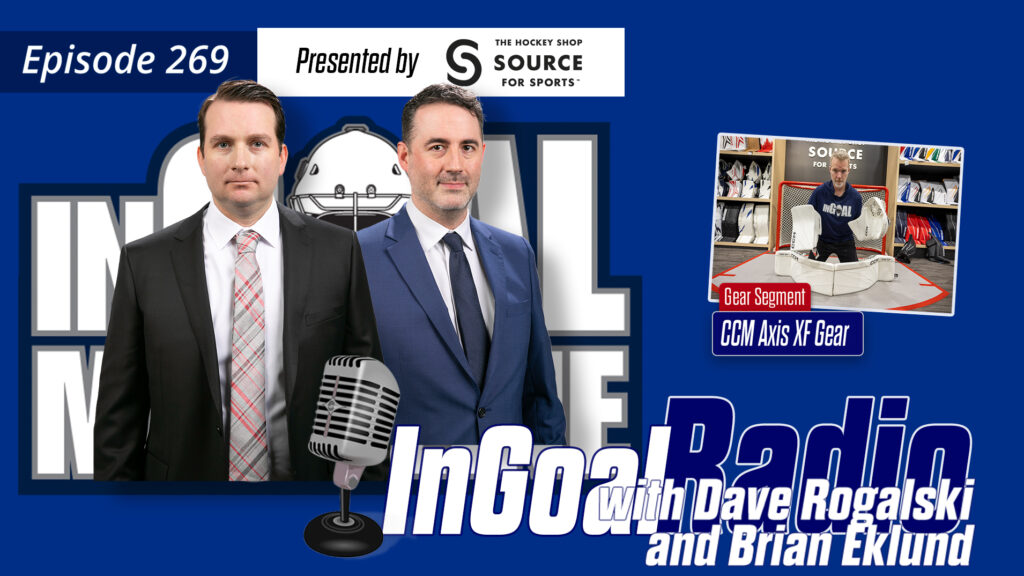
InGoal Radio Episode 269 with New Jersey Devils goalie coaches Dave Rogalski and Brian Eklund.

Please subscribe and leave a rating — it helps us reach more goalies!


New Jersey Devils goalie coaches Dave Rogalski and Brian Eklund, speaking at the USA Hockey National Goaltending Symposium, advocate for keeping young goalies in the position longer before specializing, while emphasizing game-reading skills as central to development at every level. Eklund, who oversees AHL and development goalies for the Devils, works alongside Rogalski to build structured practices that serve goalies from youth hockey through the professional ranks.
- Dave Rogalski and Brian Eklund recommend delaying early specialization to attract and retain more kids in the goalie position.
- Teaching goalies to read the game — not just react to shots — is a priority the Devils coaching staff emphasizes at every development level.
- Eklund's dual role as AHL and development goalie coach for New Jersey creates a connected pipeline from prospects to NHL-ready goalies.
- Structuring goalie-specific practice time effectively is a key focus for Rogalski and Eklund when developing both young and professional netminders.
- The CCM AXIS XF gear line earned strong reviews from goalies who used it through the summer, with specific features highlighted in the episode's gear segment.
Episode 269 of the InGoal Radio Podcast, presented by The Hockey Shop Source for Sports, features an interview with New Jersey Devils goalie coaches Dave Rogalski and Brian Eklund.
Feature Interview
presented by NHL Sense Arena
In the feature interview presented by NHL Sense Arena, we sat down with Rogalski and Eklund at the USA Hockey National Goaltending Symposium in Minnesota to discuss the state and evolution of the position from youth levels right up to the NHL. Rogalski, who works as the Devils goalie coach, and Eklund, who works with him as their AHL and development goalie coach, discuss everything from how to get more kids playing the position and when they should specialize, to helping them learn to read the game, how to build practices and their work with goalies at the highest level.
Parent Segment
presented by Stop It Goaltending U
In our Parents Segment, presented by the Stop It Goaltending U app, we answer a question about whether to wax a goalie stick — and more important, who should be the one doing it.
Weekly Gear Segment
presented by The Hockey Shop Source for SportsAnd in our weekly gear segment, we go to The Hockey Shop Source for Sports for a look at the CCM AXIS XF line, diving a little deeper into what features goalies love after using it all summer.
Episode Transcript
Intro
Along with the cofounders of InGoal Magazine, it's David Hutchison, Kevin Woodley, along with Daren Millard. We are ready to go. I love it when Woody looks at me with a side angle, and Hutch is so excited. We've got all this happening on InGoal Radio, the podcast presented by The Hockey Shop Source for Sports Langley, thehockeyshop.com. A whole bunch in line today. We got some news out of the league. We've got our regular segments and a big shout out, Hutch, to the Oakville Rangers.
Off the top, Daren, I just wanted to let everybody know that we had a great meeting with the Oakville Rangers Association this week. Last year, we piloted a program, and we're renewing it again this year where every goaltender in the Rangers Association is going to be an InGoal member. And on top of that, we added in so one coach from every team would have InGoal as well because we really believe in development for coaches. We really believe that every team needs to have a coach who's ready to, help goaltenders. And did wanna add that moms and dads can read InGoal through those, memberships as well.
So we really wanna see more associations make InGoal a part of their development because it's just a great way to have everybody on board. You know, the coaches can assign things to read on InGoal, check out the latest ProRead, for example, and just have chat about it. They can have some drills that they can work on because so many of the drills that we share, maybe they've got NHL goalies doing them, but there are things that kids of all ages can do. So, just wanna thank Oakville for reaching out when they did last year and for being a part of InGoal team again this year. And, if anybody has is a coach or a parent working with an association that, needs to work on their goalie development and maybe InGoal could be a part of it, let us know.
Info at InGoal mag dot com because we'd love to have a chat about how we can help.
And I gotta, like, give Hutch props here because this is his pilot project, and he's led it the whole way. And that includes emails throughout the season. So if there are coaches that have access to the subscription and maybe they haven't been using it, he tries to package, different articles and themes each month and send them out. So, like, at a certain point of the year, you're worried about sort of how to get ready to get on the ice, off ice training, stretches, things you can do. He'll do an email about that at different points of the year, different sort of themes that can sort of pull those coaches in and make sure they're on top of, know, you some of the different things they can be doing with their goaltenders on the ice.
A lot of these associations have you know, the players will pay for things that the goalies don't get, And so the goalies pay into that as part of the registration. So I know a lot of associations end up with little bits of cash for goalie development. Sometimes they'll use it to hire a local goalie coach to come in very sporadically. I know once, locally, a parent asked me what they should do with their goalie development money, and I suggested NHL Sense Arena. If you're gonna like, do I get a I can afford a goalie coach three times a year.
I can have NHL Sense Arena all year. So that was my recommendation to them. And now we wanna make this an option. So if an association rather than letting each team in some cases or each goalie or goalie parent decide how they wanna spend their goalie development money, why not have the entire association get better, including your coaches when it comes to goalie development by giving them access to the number one goaltending tool in the world, which would be a subscription to InGoal Magazine premium.
You're part of an association? Work your way up. Put put push it up, if you're interested in this.
And obviously not to suggest that InGoal is the reason, but congratulations to the Oakville Rangers Association for a fantastic season last year. I'm sure the highlight being the U 16 AAA team capturing the OHL cup as the top team in Ontario. Fantastic one nothing victory in the championship game. Congratulations, goaltender Jacob Saranic on the shutout. Jacob, I do hope I got your name right there.
InGoal is thrilled to be a small part of the development program for goaltenders that they've put together there. A number of different facets as they try and support their goaltenders and their coaches in the best way they can because we know just how valuable goaltender development is for all organizations.
So this is a big picture approach. We're looking at it from a wide lens. And I guess it's similar. Can you can you draw a connection to what USA Hockey did earlier this summer?
What do you It's funny because I was listening back. Obviously, our featured guest on this week at the InGoal Radio Podcast is Dave Rogalski of the New Jersey Devils and Brian Ecklund of the New Jersey Devils, their American Hockey League team and goalie development coach. And a lot of the stuff we talked about was goalie development at young ages, and you'll hear in the future interview where Rogalski sort of references a couple of things we do at InGoal as being a big part of that. So, we've been very careful here, Daren, I think, not to be the people that tell you how to do it. Right?
Like, don't it's not do this or just do that. The whole idea has been to open more goalies' eyes and more goalie coaches and goalie parents' eyes to the possibilities. Here are options. Here are tools in the toolbox as we like to say. We don't tell you which tools to use.
We just share the tools that the best in the business are using. And so I think that taking that to coaches as part of these association programs, so it's not just the kid, but the coaches that are getting a chance to sort of see the way that others do it at the highest level and see how they can replicate that is in some ways, in a small way, reminiscent of what USA Hockey is doing by having 2,200 bronze level, you know, certified goalie coaches across The States. Right? More knowledge in the hands of your volunteer grassroots or minor hockey league parent. I think Dave Rogalski even says in the interview, like, you can have your private coaches, but they can't be at every PWB practice as the kid comes off the ice at intermission.
After a bad period, what do you tell him? We wanna give the volunteer that's on the bench or the assistant coach or head coach is on the bench the tools to help that kid reset. The tools to, you know, take a bad game and make sure and practice the next day if you see something, there there there's a particular drill that'll help him get better. And so, in that way, yeah, I think that's a fair comparison.
Rogalski and Ecklund coming up in the NHL Sense Arena feature interview, the parent segment brought to you by Stop It Goaltending U will wax poetic, with ideas on whether or not you have to copy things that skaters are doing. A little bit of how far should I go with that? Give us a tidbit on what's coming up, Hutch.
Think you've teased it really nicely, Daren. I'm not sure what I can add, but, we had a a parent asking the question about waxing a goal stick. And, I wanted to talk a little bit about the waxing itself, but then also how we're supporting our kids with all of that. So I'll just leave it at that. We're gonna go a little deeper into things as we always do.
The Hockey Shop Gear Segment focusing on the AXIS XF pads and gloves. I'm looking forward to this, Woody.
Yeah. Well, we teased it. We did the the customizer and walked through all the features. Now Cam's been selling it for a while. We've had it on for a while, a little more feedback, a little more sort of what this pad does, what these gloves do, what they do well, and why they may or may not be for you as you're making decisions about gear heading back into your season.
Happening around the world of goaltending, department changes have taken place. A high profile one in Vancouver. One of a couple of different tweaks that have occurred in the last week.
Well, interesting that we have basically you know, I was gonna say two thirds, but it's actually more like two fifths or even two sixth of the goaltending department of the New Jersey devils on this week. I think right up there with Florida in terms of the teams that have invested the most into have making sure they have as many experts as possible in to touch every aspect of goal tending, including a hire of Manny Legace this summer to expand it further. And in the same week, we have a couple of really prominent names in the news for changes in other departments, the New York Rangers. Benoit Allaire becomes the director of goaltending, transitions off the ice and into a director role. And I think this was coming for a little while.
I think some of it is physical. Benny hadn't traveled for a couple of years on all the road trips, especially out west. I hadn't seen him in a couple of years, which is really sad for me because I always enjoyed both watching him work and the brief conversations we we would have. One of the best. I know this is an argument I make all the time, but when we talk about the Hockey Hall of Fame, like, that's a name that should be in there.
So he's moved into a director role. Jeff Malcolm moves up from the American League to the NHL. And friend of the program, Brendan Burke, Sean Burke's son, moves from the Portland Winterhawks over to work in Hartford as the American Hockey League and development coach for the New York Rangers. So they go from two people in the department to three with Benny on top. And then here in Vancouver, someone in Ian Clark who I would put in that same category in terms of what they've done in the game as a goaltending coach, Vezina Trophy wins, the amount of guys he's developed.
I don't know that anybody's ever written more about the position than Ian Clark. He had a title of goaltending coach and Director asked to transition off the ice. Again, much like a lair physical, knees and a shoulder, just becoming problematic. I don't know that we talk enough about how physical a toll goalie coaching takes. You know, we've we've you've heard us talk about Stephane Waite, double shoulder surgery when he was with the Montreal Canadiens.
Like, most coaches don't have to rip pucks like these guys do. Most coaches aren't on their knees. I know Benny Benny Allaire, the hips, were an issue by the end there. I know Francois Allaire can't even get his foot in a skate. Right?
Like, it takes a toll. So Ian Clark asked to transition off the ice. They transitioned him into a scouting and development role. I believe the preference would have been to a Director role, which was a title he held previously, but they've taken that away. So he's no longer involved on the day to day, at least in the all night stuff here in Vancouver, which is that's a bit of an eye opener.
So at a time when others are adding directors and that's the trend around the league, the Canucks remove a Director, but still do add a body because as Ian moves to scouting, they'll have Marco Terranius move into the NHL role. So we've got now our third finish goaltending coach in the National Hockey League, only the second who didn't play in the NHL, and they have to hire in Abbotsford. So the department expands, but I don't think in a way that many expected. But news around the league for sure, I think everybody saw the Benoit Allaire one coming. At least I knew about it, and I think a lot of people did in the goalie coaching world.
The the Clark News was more shocking to more people, I believe.
I don't know how many years you'd have to go back. Not a ton that this would have been under the radar stuff, but it's significant news, I know for the New York Rangers and the Vancouver Canucks these changes to the goalie departments.
Well, I mean, when you think about the amount of success those two guys have had. Right? Like, take a look at take a look at the New York Rangers. Right? Like, since Benny Allaire and and you know what's funny?
We can go back, and here's here's this is six degrees of separation. I wrote when Benoit Allaire was hired. Now this is around the lockout time, o four, o five, was hired away from the Arizona coyotes by the New York rangers to be their goaltending coach. I wrote that it would be the most significant move of the off season. Like, forget free agent signings.
I wrote that that was the biggest move in the goaltending world in the off season, and we would look back at it with that much significance. The irony is I wrote that in a little publication called Goalie News, which was being run by Ian Clark at the time. So, yeah, I can take a look at it ever since he arrived. Right? Henrik Lundqvist straight into Igor Shesterkin.
Never had to worry about your goaltending in the New York with the New York Rangers. And I would argue the same thing in Vancouver here. Ian Clark's first stint around, Roberto Luongo leaves away from the NHL for a couple of years working in Sweden, comes back, Sergei Bobrovsky in Columbus. Take a look at the draft record in Columbus. Seven goalies drafted under his watch.
Six of them played in the NHL. Here in Vancouver, the first goalie they drafted under his watch and was sort of one of his projects and one of his guys, Arturs Silovs. Made the made the organization about $40,000,000 last year by coming out of the American League, getting them to the second round, and getting them four home dates. So, these guys have had significant track records. Goal tending hasn't been a problem here in Vancouver since Ian Clark came back, whether it's Jacob Markstrom transitioning to Thatcher Demko, and when Demko goes down, having somebody ready to come up in the playoffs.
So there's value to these guys because they are so good at what they've done, and part of that is because they've done it for so long. Doesn't mean the guys coming up behind them can't have a similar impact, but there is value in the experience that they brought to the position. In the Rangers case, they'll make sure that experience sticks around in a more hands on role. In Vancouver's case, management decided they didn't need it in that director role.
You tweak something in my head there when you're running through the six degrees of separation. And follow me on this because I'm not I'm not one upping you, but I'm adding to the story.
Are we going are we going Alaire Burke Burke? Yes. Thank you. Saw that one coming.
Because Benoit Alaire goes from Arizona, Phoenix to the New York Rangers where in Phoenix, he was working with Sean Burke, and then he moves on in upwards, transitions in the New York Rangers. And Brendan Burke fills the role in Hartford, which is where Brendan Burke was born when his dad played for the Hartford Whalers.
See, I didn't have that last degree of separation there, Daren. That's the brilliance that you bring. But I don't think it's coincidence when they the Rangers announced it as I, whatever, quote tweeted it or x it or whatever the hell they call that platform these days, that that essentially coming up underneath him were two disciples of his philosophy. And, obviously, Jeff Malcolm would have been because he would have worked hand in hand with Benny during his years in the Rangers organization. But people were like, well, well, how's Brendan Burke, a disciple of of Benny Allaire already?
And, of course, that's from the teaching that would have come from Sean, his dad, and the philosophies that I mean, he changed his game under Benny. He rebirthed his career under Benny in Arizona. And not that that's all he does or all he brings as a coach, but I do think there are similarities in terms of philosophy that that sort of remain rooted in both those guys, and and Brendan would have a lot of that ingrained in the way he teaches and the way he understands the game.
And, Sean, let me know. Like, that was something this opportunity for Brendan that that he acquired on his own. It wasn't Sean out there campaigning. Sean stood back and and really let it happen. And Brendan Burke goes from the Portland Winterhawks over to the New York Rangers and will work with the Hartford Wolf Pack.
So fun stuff coming up on that front. The other big news, out of the week was the acquisition by the San Jose Sharks of a high profile prospect. Where are we on our evaluation of the trade that happened within Nashville predators?
We are watching observantly and noting the discrepancy in others' evaluation. Let's put it that way. Because I think on the public side, and the analysts that work on the media portion of things, there seems to be a gap in how high they are on Askarov compared to some of the established NHL guys that I've talked to about it. And this doesn't mean that that gap I think part of the gap is where he is now. Maybe the the the potential and the upside remains, but the belief is not as strong in the industry as it is amongst those being paid to write about it as prospect analysts.
So whether he's ready now to be a star or whether there's
A little bit
about is continuing.
Yeah. Yeah. I I do think one of it is ready to be ready to be in the NHL would be one of those discrepancies. But then there are some that that that don't see the same upside that others do. But that's gonna be the case of every prospect.
Right? Like, you know, like, every team has different evaluations of a guy. But I leaned into a couple of guys who have a pretty strong track record in this department just to get opinions and, you know, they weren't as universally positive as some of the stuff that comes from the analysts. So I'm I'm I'm curious. Because here's the reality, Daren.
I don't know. I don't watch the American Hockey League every day. I haven't watched Jaroslav Askarov play a ton. I like the spunk and the character that he brings. I think there are things he does that are elite.
I think there are things he does dating back to the draft that I questioned at the time how they would translate to the pro game in North America. But I haven't watched him develop on a daily basis in the American Hockey League, even on a monthly basis, to be able to say whether those things have come along. So that's why I lean on other people's opinions. You'll hear me a lot on a lot of the radio work that I do quite often. You know, if I get a question that I don't know the answer to is my answer is I don't wanna blow smoke.
So let me do some digging, and I'll get back to you. And when I did some digging on this, I found that there was a discrepancy in opinions. And I'm really curious now to see ultimately over the long haul who's gonna be right and to what degree.
So where is San Jose on their goaltending going into this year?
Well, a lot of people like, well, he's he's in another situation where there's three guys. Right? Because they have Blackwood and Vanecek. My understanding is maybe Vanecek's recovery from off season surgery hasn't gone as smoothly as as everyone would hope. And so there's at least a window at the start of the season, if not longer, where he's gonna have an opportunity to show he can play.
And I think we all know that Mackenzie Blackwood, the biggest question surrounding him has been an ability to stay healthy. The kids I mean, he's built like a linebacker, and he's got the athleticism of a kid who's five foot ten. Like like, Mackenzie Blackwood has all the talent in the world. It's just a matter of sort of being able to control it and stay healthy. So if you're Askarov, you've got an opportunity there.
You've got two guys who have traditionally, you know, not gotten through seasons. And it sounds like at the start, he'll be in the National Hockey League in part because of the questions about where Vanecik is in his recovery for I and I should have looked this up, but I believe it was hip surgery in the off season. So, yeah, there's there's, there's an opportunity there. They're obviously a team that is not in win now mode. So there's an opportunity to develop, make mistakes, and get better, and probably more of an opportunity to do it in the National Hockey League level than there would have been with the National Predators.
And frankly, this became a problem when Askarov or his agent put it out there that he wasn't willing to go back to the American Hockey League this season because a lot of the teams and the better teams that were interested in him, everybody's got their two right now. Well, no questions about the health of Demko in Vancouver, but, know, and at least going into training camp. But most teams have their two set, and so they're not looking to disrupt that. And so, that statement, I think, narrowed the field somewhat, and it certainly lowered the bargaining position of the national predators, when it came to finding a partner in this trade. And I think the reason San Jose was such a fit is be in part because they're developing in a scare off as a future plan.
They don't need to win right now, but also the fact that they are gonna have there is room at the end thanks to Vanecek's recovery.
I thought Nashville did really well in the trade, Barry Trotsky with with the return. I also think it's a win for Yaroslav because he gets a two year deal out of it.
Yeah. He's got his window. I mean, as high as he was drafted, he was always gonna have a longer window. Right? Like, when when you're that high a draft pick, you're gonna get chances.
So but certainly having this upcoming year on his entry level and two years beyond that locked in, like, you're pretty much and if I'm not mistaken, those are those are one way deals in the following two years. So and at money where you've gotta be in the NHL. So he's got himself, again, development is rarely linear. Maybe this kid hits the ground running and and some of the questions in the American Hockey League don't exist in the NHL. We've seen guys before where their ability to read the game, pays off more in the NHL than the American League because the game is more readable.
As much as the skill is better and the dynamic attacks go up and what they're trying to do gets harder and the shots are better, guys are where they're supposed to be defensively, and you can read off your own team better. So we'll see. At the very least, having those extra two years gives him a much longer runway to sort of get his feet under him, which interestingly enough is one of the question marks. How how how well does he keep his feet under him and for how long?
So he doesn't stay upright enough?
He's so incredible from his knees and moving from his knees, but there are some people that question whether he goes to it too early in a game where we continually hear narrow, mobile. He's hypermobile. Like, he's so fast along the ice, and he also moves really well once he's down on the ice. But at the end of the day, you're never as fast from your knees as you are from your feet, and that's a trend we've seen in the league. Right?
There's also a tendency, I think, to use the pads, on low saves rather than activate the stick and steer and control. Like, controlling play is a question mark that some of the analysts had. Again, I I can't wait. The talent is undeniable. Let's see how he applies it.
Let's see how it works out. Judging this kid now at this stage of his career, frankly, isn't fair even though I asked a whole bunch of people to do so when I called around, but, there's enough talent there that I'm excited to see where it goes. And there's a personality, and that's not a bad thing. Yeah. I I wanna see this kid. I wanna talk to this kid. I want InGoal to have this kid on because I love the enthusiasm, the passion that he brings to the game.
Let's have more of it.
Hutch, that got you going a little bit.
Oh, the the game needs more personality. I I think to an extent, we're allowing a bit of it in. But compared to the other major sports, I think we do a pretty poor job of marketing the personalities of our athletes, and Askarov has a personality. I mean, one of the best giveaways I've ever seen at a game, right, was that figurine of him bench pressing the net. If I I would have bought one if there was a way I could have got one.
Just a a fantastic and then a great puck handler. Like, don't we all love a goaltender who handles the puck? I, I know there was some chatter of him maybe going to Chicago at some point, and I thought about him and Guyan one day being a a partnership, and the puck handling they would have had in their city would have been a whole lot of fun to watch, but maybe they will against each other one day.
Does he have the biggest personality of a goaltender in the league right now if if we graduate him in the National Hockey League?
Maybe the biggest he's willing to share. Right? Because isn't that the problem? I I mean, I don't I I can't think of anybody who's a big showman in the game. That's one of the problems that we have is that there there might be some great personalities there, but they're just not allowed to really share them because whether it's the teams that don't want their their athletes to be too spoken or quite frankly, the media who jumps all over anybody who makes, the wrong statement or portrays themselves in the wrong way.
Damn media. Damn media.
Media, Woody. You're you're never like that.
Linus. I think Linus has got a great personality, and he shows up in it.
We'll see if that those two together, maybe the fact it was both of them allowed them to both show it a little bit. Speaking of Swayman, still not under contract, guys. Still an RFA unsigned a few weeks, away from training camp. Trying to think around the league, guys that have similar personalities. It's you're right.
There's there's not a ton. There's not a ton.
Says something, doesn't it?
Well, hey, and one of the things in the in the NHL Sense Arena feature interview this week is talking about goalie development and what can we do so that kids want to try things and want to be in the net and to stop the stigma about being a goaltender. Well, one way would be to encourage some great goalie personalities so kids have something to look up to because we want them to look at it and say, hey. That's fun.
I'll compare it to a cornerback in football. Like, the jawing that happens there against a receiver, I would love to see more of that goaltender to a to a forward. Does that translate to you?
Let's have Deon Sanders pick up his third sport.
Patrick Roy, I can't hear Jeremy because I have my Stanely cup rings in my ears. Right? Like
And winking at guys on the ice and and those kinds of approaches.
I I wink at guys in Beer League, Daren, but it's actually just a nervous twitch.
That'd be a 16 shot in the last 15.
Light is the light is that light behind me still on? Can you guys can you guys tell? I can't turn around and and look. I I got this I got this thing going. I I listen. I'm I'm in Vancouver where they literally traded away a very popular and who was having a ton of success backup goalie Mhmm. Because they felt their backup goalie should be seen and not heard. And they didn't like the fact that the personality of the backup goalie was such that he had a car deal.
He voiced restaurant commercials on the local. They hated that. They want their especially a backup, seen not heard. And he's still popular, and he hasn't been in
this different for goalies than skaters?
Well, backup goalies too. I think the league suppresses everyone, but I think backup I think goalies in general.
I don't think the league suppresses
Shut up and stop the puck. I'm not saying the league. I don't mean that I work for the league. I mean more the the just sort of the the way everyone in hockey. The culture of hockey.
That there you go. Thank you, Hutch.
I I think that's a great way to to to phrase it. The the culture we're we're boring. We're humble, and and that doesn't translate into big personalities.
Well, it's all about we, not me.
It's also why people say people say hockey players are the greatest guys.
And it's not just that we don't have enough goaltenders, but we don't have enough hockey players. The game is not growing compared to other games. And, maybe you'd like to give some kids something to look up to and let them have some fun for heaven's sakes. There's more of it. There's more of it now than there was, to be fair, but, but still.
We're we're gonna hear it in the Sense Arena, NHL Sense Arena feature interview. They talk about their kids watching trick shot artists on YouTube. Mhmm. Well, the NHLers can do those things, but why do we never see it showed off? Right?
Like like, not I'm not talking about, like, in game, but they're all capable of doing a lot of these tricks, and yet we rarely ever see that stuff.
If you need to work on your personality, you can go to an improv class and develop that side of it. If you wanna work in your goaltending foundation, you can go to a goalie clinic. But what happens if you age out? I asked you guys last week about adult goalie clinics or adult goalie coaches. Is there an avenue for it?
Why don't we pursue it? And it just happened that I was on the ice this week, and, Rob Cotoria, who is a big fan of, the two of you guys, he's the goalie coach for Kansas City, the Mavericks of the ECHL. He was working with Isaiah Seville, a part of the Vegas Golden Knights organization. And it was the summer skate. I just happened to be on there, and I asked if I could look over their shoulders and just watch.
And it got me thinking again about like, I'm interested. I'm middle aged. I'm still trying to learn more. I would love to learn more. I'd love Rob to tell me what I'm doing wrong.
But do we is there a place for the 30 year old Wednesday night a league goaltender to get help or, the b division 45 year old goaltender to get help?
Yes. There is. It's called ingoalmag.com, and I would suggest that by that age in your life, you should be able to afford a subscription. So hit us up. We'll help you get better.
That's the first step.
Shameless plug.
Shameless plug. I'm all about the shameless plug. But, honestly, like like, not to digress too far here, but, like, think about what five damn things for your hips has done for so many goaltenders our age that we've talked to. And I know NHL guys are like, man, where was this? Like, I wish I'd known this.
There's a lot of that on our website, so make sure you check it out. We did get a lot of feedback from guys saying, like, hey. Like, this this coach has a one week camp, or there's actually one here in Vancouver, Ron Veet, that is talking about now running us every Sunday, sort of an open ice for for adults that wanna go in and do goalie lessons, and there's some of us that are thinking of signing up. I got a note, from Sean Kelly in in Montreal, and he works with, he he does some stuff with Paramount hockey. And Olivier Gervais, Paramount Hockey does a goalie camp every summer in Vegas, and they usually have adults joining in, not specific to adults.
So we got these notes from all over the place. We also got some notes from from some guys that are like, yes. Please start one. Let's go. Let's have a goalie camp.
So maybe it's on us to make a big a big goalie camp. But, yeah, I it seems I think a lot of them, though, and I haven't asked this, and I'm not being particular to any of those names, would probably spend a lot more on a goalie camp for their kids. Are they gonna spend it as an adult? Because the reality is ice is not cheap and goalie coaches are not cheap. We will drop hundreds of dollars to get our kids in to see the, you know, the the really good goalie coaches.
Would we do that for ourselves knowing we'd be winded twenty minutes into the drills? I'm not so sure, but it seems like there's an interest out there.
Yeah. You'd have to structure a camp differently. Mhmm. Maybe it's one ice time a day for three days. It's not eight to five or anything like that because you've got things to do, but we we take golf lessons.
We take pickleball lessons. So all the different avenues of of trying to improve our other aspects of our hobbies.
You're throwing weed around here, Daren. Yeah. Yeah. You've never seen you've never seen my golf swing, buddy. That's not a let that's not a that's not a lesson to golf swing. No.
It's like tennis coaches, adult tennis lessons are is a massive industry.
Yeah. It's a it's a good example for what people are willing to invest. Triathlon as well as a sport that has a ton of adult involvement. Running, although certainly not at the same sort of expense. But I think one of the things that happens there is that you're also building community.
People love to be part of the local running circuit, tri circuit, golf club because there's a social aspect to it and there's a social aspect to all training and trying to get better together. As a goaltender, we're just a little bit more isolated in what we do. So if we were going to do a camp like that, I think it would be important to have components that are, as you said, Daren, a little bit nontraditional, not like a kid's camp. What can we do to make it a little bit more sociable? Can we bring guys to yes.
Can we bring guys together, from a local league so that, you know, the the experience they have in the camp gets sort of carried over because during the season, they can have a chitchat at center ice before a game or whatever? Or what can we do during the season to continue that community of all the goaltenders that came together for the adult camp? But, I do think community and and social aspects are really important. But people, as much as I do agree with Woody, I would spend far more on my son than I would on myself. People do invest in their own sport.
We've seen that from other sports.
Is there a need? Yeah. Is there a desire? I think there's more of one than we necessarily at first blush, accept.
Hey. You know what? You know who I'm bringing in for this for sure? Maria Mountain. Oh, yes.
Like, a 100% as much as we talked about five damn things, and she actually has like, I'm gonna go shameless plug on something that's not even ours to plug, but she actually has a beer league program, one for the off season and one for the in season. So even if you're like, oh, well, I mean, in my season like, lot of us are my, like, beer league starts next week. My my weekly skates start next week, and it'd be like, oh, man. It's too late to start the summer program. But Maria has an in season program specifically for adult goaltenders.
So if you haven't checked that out, make sure you check out, Maria Mountain, goalie training pro. I know she was promoting sort of an updated version of that program recently. I would highly, highly recommend it, because big part, we make the jokes about structuring it differently. I think you'd have to have more goalies per station, because we you know, I mean, I'm 50. I've I've I've done I've done a one hour goalie skate and hardly been able to move at the end of it with just me and one other guy alternating in and out.
Maria is the person that'll help you get through that season healthy and through one of our weeks healthy, and you'd probably learn a ton about the things. That's the other thing. Like, as we get older, like, making it through a year, much like NHL goaltenders, that's the closest thing I'll be to an NHL goaltender. Guys are getting hurt all the time now. So Maria will help you get through the season healthy, and that will allow you to work on the things that you'd be learning at a camp like this.
So shameless plug to Maria Mountain who is does more for more goalies than anyone.
I've worked with Maria extensively over the years. I've been part of her camps, and it it's really educational. And I've been part of day camps where I was the only adult in it, and it is a little cheaper. It's like the parents I'm the same age as the parents. They're over there watching, and I'm with the with the kids.
But so, like, the education is so cool with with Maria.
And And Maria plays, so she'd wanna be a part of our beer league camp.
Good point. It's it's it's all coming together.
I wonder how many father son or mother son, father daughter, whatever combinations we have where a parent and a child are both goaltenders.
Well, you haven't?
Yeah. I do. Yeah. And, but I wonder how many there are out there that would be interested in doing a camp together because I'd I'd love to go and skate with my son and enjoy that experience even though obviously he'd put me to shame. Maybe that would just be another way of doing it.
Well, I just think when the RVH comes out and you're trying to figure out if that works into your game as a 35 year old c division goalie, if you can go to a camp or the the resources are there that you can be taught it properly instead of trying to figure it out on your Tuesday skate
No. For sure.
Your game on Thursday.
Well, and who gets to practice when you play recreational hockey as an adult? I Mean
I fall in it.
I can't get up.
Mhmm. Sean walked by, and I got scored on a couple of times top glove. He was yelling at me. Burke was walking by off to a meeting the other day. So I thought, well, help me out here, buddy.
Let's let's do that. And, I told him, please send me some notes, with what what you see because I I would love any type of, like, keep your stick on the ace more or, track the puck more. Any like, I would love that stuff, and, I'm glad that we got some great, feedback on it.
Get your wife to stand on the glass like a good goalie parent with the iPhone. Get some tape, and Woody will break it down for you.
She's not coming to a a rink ever again unless it's to watch the the Golden Knights. That's the only time.
Well, you're
She did that when we dated.
You're a Golden Knight.
And then she stopped when we got married. I'm just, why? She goes, we're married.
I think I I think my favorite my favorite memory of somebody recording was a three on three league, which my teammates stupidly signed us up for the highest division. This is quite a few years ago. Not realizing that that's where all the college and American Hockey League guys came for skates. And so we're getting pumped, like, just pumped. It's the first time I've ever asked a referee for a little extra time, and he's like, are you okay?
And I my just, right away, no hesitation. I'm like, I think so. But do you know where the defibrillator is? I was just gonna say. Please confirm where it is.
And he's like he starts laughing, and I looked up, and I'm like, no, man. This is the closest I've ever felt like my heart's like, they were just rope a doping us. And then at the end of the game, as we're shaking hands, the kid comes down on the other end. I mean, the score is just, like, sideways. And he's like, good job.
How'd you think I played? And I'm like, dude, I could barely lift my head by the end. I wasn't watching you. I didn't I wasn't mean and say, like, yeah, you saw, like, five shots. But, like, he's like, that's okay.
That's okay. Don't worry. My dad was upstairs in the because there's a bar that looks over this three on three ring. So my dad was upstairs filming. I'll review the tape later.
And I thought to myself, yeah, first sign that maybe this is a league you shouldn't be in, old man. That's me.
Good point. Even if you record yourself, you don't know what you're doing as a 35 year old rec league goaltender. I'm telling you, there's something here, you guys. Let's get into our regular, foundation of the podcast, the Hockey Shop Gear Segment, brought to you by The Hockey Shop Source for Sports Langley, thehockeyshop.com. Dealing with the AXIS XF.
Gear
I've been waiting for this. Waiting on pins and needles for this review with you and Cam.
Yeah. There's lots to get into here. But before we do, just a reminder, the back to hockey sale is on now at the Hockey Shop savings in some brands as high as 50%. So whether you need new gear like the new CCM AXIS XF and AXIS XF Pro, you wanna get the latest and greatest, they've got a whack ton of it. You can walk in, don't have time to order custom because the season's coming.
They have an unbelievable selection. You've seen it behind us when we do our videos. If you haven't, make sure you watch YouTube. Just, walls and walls. And if you've ever like, we're we get to go in the back just like it's a 30,000 square foot building, and it is a warehouse stacked to the roof with gear.
So if you need it off the rack for your season, there's a good chance they have it, and there's a good chance they have it in the size option and maybe even some colorway options that you need coming up without the ability to order custom. So whether it's the latest and greatest or something that's on sale from past generations in the back to hockey sale, they'll have it for you at the hockey shop and the hockeyshop.com. Make sure you check it out. As for the Axis XF, well, we reviewed it, overviewed it once. We dig a little more deeper into the details now, sort of refresh people's memory as they head back to hockey, and see if this is a a line of equipment that would suit the way they play.
Cam explains. Welcome back to The Hockey Shop Source for Sports. We're InGoal Utopia with Cam Matwiv, and you may be wondering why oh why. Do we have the AXIS XF pads and gloves? Have we not talked about this before?
We did.
We did.
But we talked about it purely from a customizer standpoint what you could order and we highlighted the new features quickly, but now we've had a chance to wear it, a chance to try it, and we realized we hadn't really done a full review. So we're going back to walk you through what's new, what's better, what's improved in the CCM AXIS XF pad, glove, and a blocker that is not just a blocker, is Cam's favorite block. Bounce. We'll we'll leave that one because you're a little too excited about your favorite blocker, my friend. We'll put that back here.
Okay.
And you can tell us about the pads first.
Alright. Let's talk about the speed channel. The
speed channel. The speed channel The speed channel that does not feature speed skin. No, no speed skin. Speed skin gone, speed channel in.
There's speed skin on this pad. No speed skin on this pad, but again, gen pro surface. Why? So, a little bit of a change up, a little bit of a scientific research project, a little bit of interesting data found out. We may just have footage of some of that scientific research being done with one Devon Levi sliding around in their lab and reading the different results. It was kind of cool actually
We may just have footage of some of that scientific research being done with one Devon Levi sliding around in their lab and reading the different results. It was kind of cool actually to be there. So, yeah. So, see. So this is no more anecdotal like, oh, it might slide better or
anything like that. Oh, no. That's legit. Their lab has got some Gen Pro flat
Slide's the best. Better than Weave. Better than Weave. Better than
Speed Skin. Speed Skin. With this setup, now obviously speed channel, what is a speed channel? It's subtle but if you, for those that are actually here and can feel it, there's you can maybe see that on the camera. It's tough to see.
There's a ridge. Yep. And basically, it creates a gap between that inner edge and where your weight is on the back of this plate. That'll that what's a gap do? Less friction, slides better, the data backs it up.
What else is different? Extremely reinforced hard slide surface. There's no softness here. Softer that is too as well, the more it's gonna collapse on the ice, the more it's gonna drag. Stiffer, more maintained, better stability, better
sliding.
There we go. Speed channel. Cover that. Why it's important. Big difference.
I noticed it especially from an axis two pad to this. Quite a bit easier pushing around the crease, a little bit more stability when the axis two was already a very stable pad, especially when you drop. Made that nice classic thud sort of thing. You still get that nice wonderful thud sound when you drop down here but that stability for sure definitely can't be ignored when you're moving around on ice in the crease.
And I gotta say if Cam had better sliding in this pad, that's something because this guy's butterfly is like Jay a Giguere level narrow.
You want a Stanley Cup?
Done. There you go.
Next. Okay. So moving on to the back of the pad a little bit more. We see some familiar features from previous models. So we still have their knee drive system.
So it's their direct rotation strap. That's their knee strap comes across. Their knee thick, thick knee stack, their version of an integrated knee stack. So that comes from the actual side paint being felt One piece of the inside of the side. One piece on
the inside of the thigh. And for those that haven't experienced, it's basically I mean, CCM was the first one to show us that that connection with the knee can actually get the pad to the ice faster and so not having a knee stack that is floppy will actually get you sealed and on the ice faster. There's a little bit of give here because obviously you want a little bit of sort of mobility, but for the most part, when you drive down into that knee stack, it's gonna drive the pad to the ice and actually, if you drive down enough, you will create separation from your knee and the pad will get there ahead of your knees. We have, again, science and research to prove it.
The science and a feature that I really, really like because I've always had trouble finding the exact fit.
If you're, if you really, really like it, you should probably let people see it.
Well, getting over it. So they're quick motion strap. Now adjustable on the inside here. So this is set up by, once again, Velcro as we can see right there. So we can actually pull this in or out a little bit more to get that adjustability in terms of for those bigger casts or something that's wanting something a little bit tighter.
Again,
because Cam has thighs for calves, so he needs a little extra room.
Calves for thighs, thighs for calves, whatever way you wanna put it. I got big legs. I need the extra space inside or the pad doesn't rotate properly.
And I do the adjust ability because that was something in the previous iterations where one was a little snug, then it went a little long or vice versa. I can't remember. Now they've given you adjustability so it works.
Either way, we can adjust that quickly on the fly and get that set up. So continuing to move down. We get to one of the more interesting features of the pad stock, their new toe tie.
A little bit of elastic down here. So the best part is,
is that this can come undone and then you can switch it out to any sort of system that you would like, whether it be just skate lace and or a regular bungee lace, or if you really wish to keep this on, it kind of gives you a little bit of the best of both worlds. You can create that knot up at the front so you can get wrapped around the post in reverse VH situation. Not, not stretchy here. Nice fixed, but you still have the elastics on the top. I think you sort of place and change it to anything else.
I like that because this is the connection that matters and then from there on having a little elastic at the end doesn't that's fine. Okay, little bit flatter, a little bit of a channel but this is just gonna sit a little taller. It's a stiffer pad. A lot of flex in the boot. We've seen the flex in the boot, but through the shin and up through the thigh, this is a stiffer pad for sure than an E Flex.
Correct. Combination of that bit flatter boot with that, is this gonna fit a little taller?
It will sit still similarly to what you found in like an Axis 2. Which was a
little taller than an EFlex line?
Correct. Okay. So one of the things that we also haven't talked about is a rebound foam.
Oh, right. I forgot.
Yes. We almost did. Infinite power.
Infinite power rebound. If you wonder about the legitimacy of infinite power rebound, I would suggest you go look back at game seven in the Stanley Cup final. Yes, the Edmonton Oilers may have lost that game, but there was a point midway through the third period shot from the point through traffic, you can literally hear it. I don't think he saw it in a butterfly. You can literally hear it off the face of Stuart Skinner's pad.
There's like four or five guys parked around the top of the crease looking for the rebound. It shoots past them into the high slot out of the most dangerous area, buys him time to recover. Did it shoot out with an infinite power? Infinite power rebound. Look at you.
And we talked to Skinner because during the season, he went back to his EFlex at one point early in the year, was experimenting with it and the reason he couldn't switch back completely is because he loved that rebound he got out of the AXIS XF pad. It's why he stuck with it, obviously, for other reasons too, like he liked the pad, but that rebound was a big difference for him and it was noticeable. As soon as he went to one or two practices in the other one, he noticed that those rebounds were being left in more dangerous areas for the way he plays. You've heard it here. Infinite Power Rebound.
It's a different foam. It's made everything stiffer. Yep. And you get a more active rebound off this pad.
And remember, custom's always available. If you need to find yourself, you need a break as opposed to stock and whatnot, there's options there. So you can kind of go over that or we did go over that already in a previous video, but we've talked enough about the pad. Talk about the glove. Okay.
CCM AXIS XF five ninety one. Now you say, I've seen a five ninety one before from CCM. You have, but it's changed. So in the inside of the glove, I have a thumb loop. Should probably actually let people see it.
An index finger loop and a pinky loop, all on the inside of the glove. So we've kind of gone back to some more it's still open hand position, especially with the like the other two fingers.
Yeah. You don't have like four finger stalls.
Correct. But it's giving more control over the glove and that ability to close it right off the shelf.
They've also improved that how well it closes, how quickly it breaks in. They've taken some steps on on sort of that closure. Again, we've gotten away from that sort of two popsicle stick design from previous CCM palms. It's a nice even seam that closes along a line. It's consistent but they've improved how it closes.
Some of that is the back end as well, a little more flexibility in the strapping.
We do see that cross form strap come back as well.
Love the cross form Again,
lots of mobility in terms of being able to present your glove. You're not feeling like you're cranking on that wrist strap and then really locking it into basically your entire like forearm for example. Again, have a lot of play here. It You can really help present that glove forward and nice. And again, that ability to kinda close it off the shelf.
And for those that are like, what's the difference between a 591 and a 590? It's just those internals and sort of the construction, but the actual break angle is the same. And a little
bit of original 590. Yeah. Break is still the same, that index finger to palm closure, but the actual shape of the glove does change a little bit in our stock 590 glove. Yes, obviously available custom. You can still order, you know, your 600, your five ninety, five eighty, all still available But again,
a nicer option and advanced forward inside the glove. Last one, but certainly not least because Cam loves this, the AXIS XF blocker. Since they've redesigned their blockers, they're noticeably lighter. That same rigidity off the board, like just we talk about the rebounds off the pad, we hear a lot of feedback from goalies right up to pro about how actively they can steer pucks and how
So do it, do it, do Do it, do do it again. What I really like is that wrist mobility. See how you're able to get out and really punch that blocker forward? That ability to get your palm that center basically of that backhand right on that puck, the ability to deflect pucks wherever you want them to go consistently every single time. I felt that off this blocker right away.
Popped it on my hand. I was like, oh, okay. It feels like a blocker. Started taking shots with it. I was like, wow, we're you know, this is this is something.
It's worth checking out. It does make a difference. This is still part of your game. A blocker is not just a blocker. It's old adage.
Forget it. Know what? This makes a big difference.
Look, the D 3.0 on the finger to protect you in case you get one that rides up the stick, they've expanded how much is there, so a little extra protection goes further down your finger and around it. So a little extra protection on the inside of the stick if you get
a puck that rides up and finds that narrow gap. Stock, they're straight style finger protection. We've seen that curved one in the past. It can cause a little bit of interference, especially with holding sticks. This is that straight one.
The stick slots in quite nicely. You don't find it slips out or messes up its presentation. Again, a really nice blocker. You know, it's not something we talk about too often.
Cam's favorite blocker. If we'll get closer
Totally. To Yeah.
So if you have any questions, give me a call. (604) 589-8299 or 1-800-567-7790. Me and or anyone from my team will be more than happy to help you out with any questions you might have above gear. Got questions about custom, you want to do a custom order, give us a call, send us
an email, or just go back to the custom video that we already did. And then still come
back and contact us because you'll still need our help.
Alright. Just a question about walking into the Hockey Shop. You're talking about behind the scenes and everything stacked up. If I see pad that, like there's nothing wrong with saying, hey. Do you have that in a different color or something?
Because they they they might. Right?
They might. They might for sure. Yeah. They have a lot of different colorways there. It is a little more diff obviously, you know, what they what you'll see is a lot of colorways for associations.
Right? And so Uh-huh. Local associations of which there are many, it'll have a lot of those. And a lot of those are common colorways that match sort of your general, like, NHL theme teams and stuff like that. So they'll have a lot of that.
You'll have a lot of white, right, in popular lines where you can you can go add a little bit of color yourself if you wanna add a little splash of color, you know, buy some of the pad skins and just put a little bit on there. So, yeah, chances are they've they've got options for you. Whether they're the exact options, I don't know. You gotta go over to the Hockey Shop in person or hockeyshop.com to check it out. But I guarantee you, if you've got questions and you're uncertain, Cam and his staff will be able to answer them pretty quick.
Parent Playbook
Stop It Goaltending U presenting our parent segment as we get into taking things that the players do and using them yourself. Do you have to do that? We'll get into the, nuts and bolts of it with, Hutch in just a little bit, but, Stop It Goaltending U continues to, really educate us.
Well, I mean, the app, we've talked about it. You've heard us talk about Stop It Goaltending U, the app. And, of course, we like to think that it's not the best part of it, but it's a pretty darn good part is that when you buy a subscription to the app, you also get a subscription to InGoalmag premium. So the best of both worlds, regular articles every week, new material on how to become a better goaltender. And I loved what they had up recently.
The daily primers, which are just our short one minute, maybe a little longer videos, so you don't have to be in there for hours at a time. Just little tips to help you along the way, and they try and make them sort of themes that fit the season. And, of course, we were talking a lot last week about tryouts and, you know, how to be a good teammate. And sure enough, all of the daily primers were five different tips, one each day last week on how to be a good teammate. There was also some great old school saves they went over and a complete twenty minute breakdown, which is a great sort of style in the juxtaposition or study in the juxtaposition of styles between Sergei Bobrovsky and Stuart Skinner from game seven of the Stanley Cup final.
Just a complete video breakdown. It's a great thing. Just one of the many tools that they have at Stop It Goaltending U, the app. And like I said, when you buy a subscription at Stop It Goaltending U, the app, you also get full access to InGoal Magazine premium to get all their great content, whether it's daily quick hits or the big deep dives, and you get all of our content as well. There's no better way to get better as a goaltender than the combination of Stop It Goaltending U, the app, and InGoalmag.
Like riding a freshly treated surfboard, we slide over to Hutch.
Alright, boys. I noticed, a question pop up this week where a parent said, quote, I noticed a lot of kids are waxing their sticks. Do I need to wax my u eleven goalie stick now? So that was what prompted me to think about this week's session, guys. And we're gonna be fairly quick, but I wanted to address both the question of waxing a stick, but I also wanted to go a little bit deeper than that as I like to do.
First on the waxing of a stick. Look, it's a it's a personal thing. I remember at the youngest ages in the game, it was actually particularly popular in my son's teams that there would be kids with all sorts of different scents of wax in the room And they're all putting layer after layer after layer, collecting these things. You know, I used to think that every teenage hockey player smells like axe body spray, guys. I think every kid before they become teenagers has the scent of stick wax on them.
I don't know if it's still the same, but it sure was when my son was there. Now the reasoning for why to do it, some people think it's the way that the wax grips the puck on your stick. It's probably of little consequence to a nine or 10 year old goaltender. I know some definitely do it because it prevents the buildup of snow on the blade of your stick, which, can definitely affect your puck handling at any age. I I I do think it's a little bit less, at the higher levels of the game.
Woody and I were chatting about that and I can't think of a lot of NHL goalies that do it. Not many have mentioned it when they're doing stick taping sessions for us for example. But of course, at the higher levels of the game, you've got the ice getting scraped frequently and you've got the extra floods and all sorts of things happening. So so maybe, but probably also depends on the building you're in, the climate and so on. Have had some parents say that they feel if you wax the stick, the tape job will last a little bit longer and although tape isn't particularly expensive, it just saves the trouble.
So that's a short explanation for why some people do it because I know we have some parents who are actually new to being goalie parents this season are listening to us and reading InGoal now. So for those folks, that was a bit of an explanation to that. But as with everything, look, it's up to you, feel free to experiment. Stick wax is pretty cheap and if you need a small gift for a goalie for whatever reason, it's a it's a nice easy way to go. But I did wanna, as I always do guys, touch on one little other part to this And that was the the way the question was phrased.
Do I have to wax my U11 goalie stick now? Now look, not to attach too much to the phrasing, but I think my answer is you don't need to do anything. We've spoken about this before, but we're trying to prepare our kids for both higher levels in the game and for life beyond the game. And while it might not be as convenient to do it this way for mom and dad, do try and have your kids doing as much as they can in their preparation to play, taping their sticks, which they can
do a lot younger than age nine. And yes, it will probably cost you a few rolls of tape along the way, but kids can learn the skill quite young. They can take pride in it. They can experiment. And without doubt, a nine year old can rub wax on their tape if that's what they're choosing to do.
Even though it'll take a little teaching time, it's one less thing for a busy parent to worry about. It's hard enough being a hockey parent without adding chores to your list. And if your kid doesn't wanna wax their stick or even tape it or whatever, they're gonna be fine. Let them just go out and play. It's all good.
Beyond teaching independence, taping the stick is an important ritual guys for players at a lot of levels of the game. You know, as you get higher up, you'll see those kids standing on the bench all retaping their stick as preparation for going on the ice. And, as much as I cringe when I see a perfectly good tape job being pulled off so a kid can re retape it before a game, Not really needed from a technical perspective, I don't think. But it can sort of be like a meditative ritual for a lot of players just to help them relax and focus on the game. And why not, if your kid is ready for that, let them learn to do that.
Now, I'm not saying that a nine year old needs to retape their stick before every game, far from it. But you also don't want to be that mom or dad standing outside the dressing room taping your kid's stick. Let them have a little bit of space, give them a chance to experiment and learn and I promise far more important than just having the perfect job for the next game is the personal growth for your young goalie. Even all psychologists there. Well, I tend to do that.
I tend to think of things a little bit deeper. These are the things that jump out at me. I mean, I I can still remember at age 11 seeing a mother standing outside, the dressing room taping her son's stick because he was a little too scatterbrained to do that and hadn't done it yet. And I'm just thinking, why are you doing this? Just if he has to go out and play without one for a game, without a tape job, he can do that.
Or if he really wants it, he can do it himself too. I know, you know, we're all so focused on making sure our kids have the best experience that day and the best game that day and it all feels like every game is the most important thing ever. But I think if we step back and use a little perspective, I think we're gonna help our kids learn some things that, are better in the long run.
I like the personality part of it too.
Oh, yeah.
You can put a little bit of yourself as as a encourage your son or daughter to make this stick taping approach theirs. 100%.
You know, there's we weren't we just talking about not being able to have much personality? You can sort of quietly have your own personality on the stick. It's sad that that's where we wanna express our personality, but maybe it's true.
Well, hey. Listen. We get to express our personality more than anyone with the masks True. In some way. But I do think of, as you say that, Linus Ullmark.
Right? Like, researching, coming up his stick. We've got it on ingoalmag.com. We've got articles about this where Linus explains, like, he has he takes a puck, and he shades certain areas of the white tape. In part, there's a performance benefit to part of it.
Part of it was just to make sure he had something that was his, that he owned. I he told me he was looking at old, you know, like, tape jobs of, like, Belfour and Roy and Hasek and trying to make sure that nobody had ever done it before. Right? So there is an opportunity to both become, someone who takes responsibility for preparing your equipment, which matters, but also show a little bit of that personality, develop a little bit of that personality. And if I did not realize that they made like, I think back in the day, they used to use surf wax, which I
have plenty of here. But I didn't know there were different you know, like, for surf wax, they all smell different, but you're basically choosing wax based on the hardness and and the temperature of the water and things like that. It sounds like like flavors. Like, I think I might be and I might be trying this. So guys, like, come into the crease and aren't like, what what's that smell?
It'd be like, oh, what's that smell? Little more positive experience than just the stinky gear. And I wanna know, what's the benefit besides you you hinted earlier before we started talking. Did I hear something? Like, if you put enough of this on there, can I Michigan this thing?
Yeah. You totally can. I've seen kids put so much wax on their on their stick. Like, we're talking, you know, a noticeable increase in volume of the stick that the puck will actually defy gravity and you can hold it upside down and it's not gonna fall. That's not how a Michigan is done.
And if you know how to use your stick properly, you can pick it up without the crazy wax on it. But, yes, I've seen lots of young kids enjoy doing that too.
So Woody This maybe you This is gonna be a party trick.
Yeah. Woody will do the auto Michigan in the middle of a game. It's just like, I I don't care. It's against me, but it's a great highlight, so I'm doing it.
Well, I'll just like Woody. I'll just go behind the net and, like, some guys charging down. It'll be kind I'll just, like, pop it like I'm gonna do a Michigan. I'm like, what the hell is this guy doing? Just lift the stick up above the air and fling it.
Lacrosse style.
Like a fly fishing rod out of the zone and everybody be like, woah.
Was a little worried though, Woody, hearing you talk about surfing and the different conditions and temperatures and so on because I can now imagine you taking a barometer to the hockey rink and trying to figure out the exact humidity in which wax you need to apply your stick for that day because because you would do that. Which
which box of mister Zogg sex wax does Woody break out at the rink?
Got the feature interview coming up, but how do you guys tape your stick? What's your strategy? Do you tape the heel? Do you just do the middle of the stick? Do you go all the way to the toe and there's no blade showing?
So I I used to always do it based on our experience when we were younger, Daren and if you didn't protect that stick properly, a little water would get into the heel, then the heel would start Split it up. So I would have extra strips covering the bottom there. That's not really an issue anymore. But for that reason I was always taping all the way around the heel and all the way up to the toe to try and protect and make that stick last forever. My parents weren't buying me half a dozen or a dozen sticks a year like we we need to these days for a lot of kids.
I'm I go from heel to toe just because that's how Carey taught us. And if you haven't already, Carey Price has a great video up at InGoal where we walk through how he taped his stick. We've got that with a bunch of different guys. Don't go all the way to the back of the heel. Probably start, like, a third of the way down the stick, but then do overlap at the toe and then cut it with scissors just because it looks nice and pretty.
I'm a little OCD, and I gotta say I've gone Devon Levi. It was a little bit of urgency. I had not had an opportunity to tape my newest stick before I went to the rink, but I went full Devon Levi on the, handle at the end of the shaft the last time I played, and it is a it is a lifesaver in terms of being able to put on a nice knob at the end of the stick in a very short order.
That was cool. Check that out over at InGoal. The feature interview brought to you by NHL Sense Arena. The latest on our friends and the whole universe. I don't know how else you explain that, but you put on to the Sense Arena.
Think it's called the metaverse.
Different metaverse.
There you go.
But I wasn't sure meta still worked or what because but there's changes all the time there. I'm trying
to We're the old. We're the old. It's okay. We can say things.
What's happening at NHL Sense Arena?
Well, all I can think of, Daren, is that hockey season is basically here. By the time the next show comes out, it's gonna be September. We've got minor hockey players on the ice already. Lots of things going on. And I don't know.
This probably could be a topic beyond talking about Sense Arena guys, but what's your New Year's resolution? It's a new hockey season. Do you have a resolution for the hockey season? For a lot of people, I think you might want to make your New Year's resolution that you're gonna make NHL Sense Arena a part of your season this year. Because whether you're a young goalie who's new to the game or you're a seasoned veteran like Woody, there is something in the best off ice training system for goaltenders.
And in fact, there's a version for players as well if you happen to have one of those in the house as well. So there's something for everybody in NHL Sense Arena to help you become an any a better goaltender. And I was thinking today especially about young goalies heading into the season who might not get to practice more than once or twice a week or recreational goalies like Woody who never get to practice. You can add fifteen or twenty minutes of Sense Arena to your day every day. Can you imagine trying to learn the piano or the guitar only practicing once a week?
Some parents get a chance to add in a session with a goalie coach each week, which is great but that's still only one more day and it's it's not cheap. NHL Sense Arena is an investment, but it's less than another ice session each month and let your kids have fun every day if they want to. So whether you want to go through all those cool features that they've got like walking into your favorite NHL locker room, playing on an outdoor rink, competing with somebody else, or whether you want to be a little more formal and go through a guided training program or just build your own training program. NHL Sense Arena is fun and it's so good that NHL goalies use it to warm up for games or when they want a few more quality reps. So head over to sensearena.com or go to the Meta Quest store in your headset to learn more and try it today.
Feature Interview - Dave Rogalski and Brian Eklund
The NHL Sense Arena feature interview is Woody hanging out with Dave Rogalski and Brian Ecklund. Woody?
Yeah. Really, this is goes back to the USA hockey, symposium, first ever in Minnesota. So this is one that we've had for a little while, been saving for our fans to to roll out, and it's loaded. It really is. Like, we really you know, we we probably could have multiple parent segments just based on this conversation.
They've got some great advice that apply to coaches, parents. And then when I say coaches, not just goalie coaches. Obviously, there's a lot there for goalie coaches, but even, like, coaches that are, you know, working with minor hockey. I mean, development. What are we doing with development?
Some advice on kids and getting them to actually watch the game. Brian's, Brian's young son is now just now becoming a goaltender and talking about the importance of watching and learning those patterns and how kids tend to only watch YouTube highlights and how important it is to maybe watch more hockey. They just they touch on everything here. We get into some of the specifics, you know, themes and and theories that they apply at the AHL and NHL level. It's just a it's a long ranging discussion that touches on a lot of different things that I think puts it in the can't miss category, so enjoy.
The NHL Sense Arena feature interview, Dave Rogalski and Brian Eklund from the New Jersey Devils on InGoal Radio, the podcast.
Really excited to welcome to the InGoal Radio Podcast. First time guests, plural. Brian Ecklund works with the New Jersey Devils, American Hockey League affiliate. I almost I almost said Binghamton, but in Utica now. Dave Rogalski, the NHL goalie coach for the New Jersey Devils.
Also, a gentleman that we've gotten to know in the past through his roots in Minnesota hockey. I seem to recall doing stories on Dave when he was following some of his pupils here in Minnesota to see their first NHL starts. We've got them here at the USA National Goal Tending USA Hockey National Goal Tending Symposium, so we get to get them both. First off, guys, big picture, what is an event like you guys have been working in goaltending for a long time. What does an event like this mean for the future?
And what how big is something like this for goaltending in in The United States, which is already on an upwards trajectory? What can something like this mean?
It's great. I mean, it's it's building a community of goaltenders and showing the support that we that that is out there. I mean, InGoal Magazine, you look at it, True Vision, all these other vendors that are here. It's all these different resources that these parents and goaltenders and that are out there and they can kind of start learning how to grab onto these different for these different things. In the talks that are going on right now, you're having former Olympians talking about their experiences and about the differences in goaltending and styles and things like that.
It's like it's really cool to hear all different walks of goaltending all in one area, and it's it's great being able to see how well supported American goaltending is becoming.
And the other part of that too is the, the sort of, like, this is the expo side, but the side we've been at sort of the symposium side of things, all the goalie coaches. I heard 2,200 bronze level goalie coaches in The United States. You know, I was talking to Phyllisera about that. Like, what does that mean as well for for, you know, like, the just the fact that there's more goalie coaches out there with some level of understanding when they're on the ice, whether it's a volunteer parent or whatever. Like, what how big an impact can that have?
Well, I think it's a, huge impact, and I and I love what USA Hockey is doing and I think other countries are doing the same, but I don't follow them as much as obviously USA Hockey. But even teaching the everyday forward or defenseman who played and now they're volunteering as a goalie coach, trying to explain to them, can still teach goalies. You can still help them read plays. You can still make sure that they're competing. You can still make sure that they're staying with the play.
There's still little minor details that a parent, a a forward, former forward, a former defenseman can help a goalie. And to have 2,200 bronze goalie coaches registered is gonna go a long way as hopefully to keep, continuing to build what we wanted, you know, 50% of the goalies to be in the National Hockey League.
Now both of you guys have worked on the private side of coaching as well. Do you welcome that? Like, on the private side, like, We got more volunteer goalie coaches out there. Is that still a positive? Because, you know, I know my side of the border, like, there's such a pushback.
I I feel like sometimes from the private to have more of the sort of, like, nationally trained ones. Like so is that a positive for you guys?
I I I'll let Brian speak as well, but for me, I think it's awesome. At the end of the day, there's more passion for the position, and the more passion for the position, the more goalies there are. On the other hand, there's can be specialists, and there can be people that do it for a living for sure. But the people that are doing it for a living can't be there at a Peewee B1 tournament on the bench in between intermission and help the goalie along because he's having a tough period. And that's what we're trying to build is make sure there's always some sort of support system.
And when whenever you build that culture and you're starting to build that love and passion for the game, we're going to get more compete and more compete. We're going get back to USA goalies and USA goalies, I believe, like ten, fifteen years ago. And you look at Quick and Gibson. Those guys, they're workhorses, they're competitors, and they're making it. Mike Richter is a battler.
These guys and that's what I think a big, framework for our goalies are.
No, I mean, I can't echo that enough. I completely agree. You look at goaltending and on the private side, you get such an opportunity to work with these goaltenders but you get it once a week, maybe once every other week. You get to sit down and actually work with these goalies and there's so many other opportunities when they're out there during practice that they could have that opportunity to be worked with And that's where there was that deficit for years where there wasn't enough opportunity for us to be able to make an impact. And this is just adding another layer to that impact where we have coaches that are trained.
Maybe they were a center, maybe they were a defenseman at one point, or maybe they were a goalie parent that never played. And now they're able to feel like that they can impart a little bit more knowledge and be able to help them that little step. And it's all these little micro steps that we can make that's gonna make a big impact long term.
Okay. So another one of the themes to throughout this weekend on sort of and actually hasn't I haven't seen a presentation on it. Just sort of one of those things that gets talked about at the tables. Early specialization. You guys have both coached at the highest levels, but you've also worked with younger kids.
Just thoughts on when we should be introducing what, or is that maybe the conversation? Like, is it unique to every individual? You know? Like, are we doing too much for the seven, eight year olds? I I'm always curious too.
I'm not a goalie parent, but we get that question a lot from goalie parents.
Yeah. I mean, I recently became a goalie parent. So like my son, he's eight years old and he's came to me and he was like, want to be a goalie.
Okay. So quick time out. Yep. Congratulations. Because I think even us, the stigma has always been, oh, we make jokes about it, but we shouldn't anymore.
We should celebrate.
Yeah. It's one of those exciting moments like that you when you have your kids, they start get passionate about something. And his thing was always, he wants to be a goalie now. And it's it was a cool moment and he's now sitting up and he's like what hockey games on tonight? Like what game are we gonna be able to watch?
And it's like, hey bud, it's 08:30, eastern time. The puck's gonna drop. I don't know how much more bedtime you were gonna be able to push this here. But no, I mean, it was a it's a cool moment. But when it comes to specialization, go back to your original question was I think that the goalies are gonna dictate it.
I don't think it's something that we can go and pigeonhole a kid and say, hey, you know what, like you can't specialize or you can specialize. I think the kids are going to tell you when they want to do it. I think that we can impart as parents onto our kids that you can or can't do something. Let them make the decisions themselves. And if the kid wants to play one year, he wants to be a goalie and he's a gol gun ho about it.
And the next year he wants to be a defenseman, that's fine. I mean, like, as a parent, that's how I look at it. I just want them to be happy and love the sport. And if he wants to be a goalie, I'm there to support him through it.
How do we go ahead, Dave, actually.
Yeah. No. This is something I've thought about for a long time and and I I believe in is is you just gotta be careful on that early specialization when it comes down to the word no. If a kid wants to poke check, let them poke check. Let them play hockey.
They can't just be a goalie. You're a hockey player as well. Learn the game. Play the puck. Stop the puck behind the net for the defenseman.
Make mistakes, but that's the key to success there. It's not always T push here, shuffle here, go down here, stay on your feet, do do this, do that. Teach them hockey, teach them the position and how to better help themselves grow so they become, you know, their their IQ for the position grows, but their IQ for the game grows. And now if you're a natural athlete, those are the ones that you see take off. If you look at the National Hockey League and the American League, they're all a little bit different.
Make mistakes, but that's the key to success there. It's not always T push here, shuffle here, go down here, stay on your feet, do do this, do that. Teach them hockey, teach them the position and how to better help themselves grow so they become, you know, their their IQ for the position grows, but their IQ for the game grows. And now if you're a natural athlete, those are the ones that you see take off. If you look at the National Hockey League and the American League, they're all a little bit different.
And they're and they all play maybe the same foundation, but at the end of the day, they all have their own little quirks to their game. They all read the game a little bit different. And a lot of them that don't make it there, they all play the same. So let's make sure we don't limit a kid's ability at a young age. Let's let them play hockey, and that will help them grow and and build IQ and have fun and compete for pucks and stay on the puck.
Stay connected to the game. Stay connected is a big part of what we talk about, and and that's a key focus for me, especially at the young age.
Well, it's so funny because I guess the kids will tell you this as well in terms of where they're at in their development, what they're ready for, the size of them, the shooters they're facing. But when you introduce certain things and when not to, I mean, it sounds like maybe just, like, someone keeping it skill based, like, skating and and at an early age, not getting into too much technical stuff until they're ready for it. Can can there be too much technique at too young an age? Again, it's not a blanket statement for every kid, but do we find a little bit of
that too much? I don't know how many times I've seen, like, the best 10 year old, and you're like, wow. That kid's amazing. All of sudden make it. But you see the best athletes ascend.
So there is something where if you can just slowly build a little bit of both, like I'm talking about, play hockey, but also learn to be a goalie, a little bit of both and that's going to help those true athletes kind of take off from there.
No, I mean, it's something that I definitely believe at a young age that you don't want to over drill them at the end of the day. With the way that I run my summer stuff, don't go and pigeonhole kids by age, we go by ability and where they're at in their own development. We might have older kids working with younger kids or younger kids working with older and we let them kind of dictate when they're ready to kind of move along in that process. But when they're first starting out, we do all games. We play soccer, we play tag and we're doing like a lot of mimicking drills and we do things like that on the ice for them to have fun, work on core skills like recovery and movement and stuff like that.
But without that being like a stigma of I'm doing a drill. We let them have fun with what they're doing and the longer that they have fun, the more they're gonna wanna come back to the sport and the position.
K. The one thing you said, your son wants to watch hockey and you gotta watch bedtime. Yep. Have we lost that a little bit? Kids wanting to watch hockey?
Mean, we talked about play reading and and developing that. I wanna ask you about, you know, ways you can help kids learn to read the game, but it feels to me like we're not watch kids don't I'm not I don't wanna be the one that every parent is gonna be like, you just told my kid to watch more TV. But Yep. If it's hockey, I feel like we've lost that a little bit.
No. I mean, there's definitely a lot to being able to watch the game and learn through mannerisms. I mean, growing up myself, I mean, I watched Andy Moog and Rejean Lemelin and you're watching Felix Potvin on TV and you're like, you wanna emulate these people like Marty Brodeur. You wanna be those, your heroes. And you're sitting there watching them play and you stop and you think like, hey, like is there being a little disconnect?
I mean, there's this advent now of being able to watch hockey and snippets. So you're watching like kids, you'll see a lot of them will watch the goals from last night and that's great, but there's there's a lot of nuances to the game that is being lost. For sure.
Right. Like, even if we see the saves, it's quite often or or the goals, it's what happened three or four touches earlier that led to it. And that isn't necessarily in the highlight package.
Yeah. I I what's funny in my my two boys, they'll watch, you know, skill guys that do trick shots in their backyard on YouTube, you know, and that's the one thing that InGoal has done. It has a platform for videos and teaching. Now it's now can we expand that platform to YouTube with fun things for goalies to do on ice to to because kids gravitate to YouTube because it's there's so many different videos. They swipe left, swipe right, that's their first access to social media.
But they don't watch as many games. And if they do, they're in and out, which is fine. But now how do we just kinda let that kind of naturally progress to the passion about the position and the fun parts of the position? The top 10 saves. We need more top 10 save videos out there.
We need sometimes maybe more tutorials out there. The more we grow and, you know, platforms like InGoal platforms like this symposium and other ones around the world, I think more children are going to be exposed to the position and growth. We just need to make sure that we keep up with the times on the social media side.
We need sometimes maybe more tutorials out there. The more we grow and, you know, platforms like InGoal platforms like this symposium and other ones around the world, I think more children are going to be exposed to the position and growth. We just need to make sure that we keep up with the times on the social media side.
Yeah. I will say I I was at the other number that jumped out at me from this weekend. Unfortunately, not in a positive way. I couldn't believe there were 2,200 plus bronze coaches. That's amazing.
But then when I heard there were only little over 20,000 goalies and it was 4% of registered players, like, what what like, we gotta we gotta change that. Right? Like, which is why, the stereotypes and the jokes about, oh, you don't want your kids to be a goalie. Like, we like, we got at InGoal, we gotta stop making those jokes because people take them too seriously, I think.
I mean, is there there there is a big disconnect with this position. I mean, it's a it's a different it's almost a sport within the sport. Right. Right? It's it's so different that I think some people get turned off by and they get nervous about it.
So as parents, there's that pushback of if I don't understand it, why do I want my kids to be a part of it? There's a stigma of how much it costs in order to be a goaltender. And I mean, the reality is, yes, it's not a cheap position by any stretch. But at the same time, there's so many resources out there that these kids can go and gravitate towards that they can work at their game. And there's so many opportunities for kids to play this position on teams that are starving for goaltenders.
So like there is if there was ever a time right now, there is a great time to be a goalie. Alright? With the amount of support that's out there and the amount of resources that are coming online and the fact that there's so many different places that these kids can play on a daily basis. Like, I do think that this is a great time.
Dave, I wanna ask you, like, both of We'll start with Dave. But outside of watching hockey, I mean, you guys get them at the highest level. How do you teach maybe when you get some of your prospects or somebody Brian, some of your young kids at your camps, you're younger. How do you teach play reading?
Well, Play reading such a
big part of the game.
Yeah. And and and you can do a lot of it from video, and it comes back to the point of watching it. Then how do we find that fun? Especially at our level, it's it's gonna be video. But a lot of them, you know, guys like, you know, we had Jake Allen.
We added at the end. Very good play reader. And but these guys are they've educated themselves. They put it in their a lot of their own time and through good details and practice habits. And our young goalies are doing the same thing, and it's just part of the growth.
But it's working with them in those conversations and listening to them. I don't think I think it I I won't say I don't think. I'm gonna say it's very important that as coaches, whether if it's a 10 year old to a 25 year old, to have those conversations about the scenarios that you're in, but it also comes back to my main conversation earlier, my pain point about even a forward coach or d coach can teach a young goalie play reading on the other side. Okay, I can't get that pass across and you're playing a little deeper, I'm going to take a shot, or you're really aggressive and I can get that pass across, I'm going to pass. So as a young goalie, you can read off your defenseman a little bit, how wide is he, and those type of conversations with, positional coaches can really help the goalie, and I think having the D coaches involved in the goalies and the situations whether it's a penalty kill, it can go a long way.
Having the D coach and the goalie coach and all positional players involved on two on ones, three on twos kind of help build play reading mentality and build it to to understand the scenarios when we're shifting, when we're not shifting, all that type of stuff that goes on in a hockey game. But it comes down to one thing. It's just good communication. Biggest part of communication is listening to the goalie because you have to have an understanding of what they're seeing and why they're seeing it and then communicate and talk it out from there.
Is that a big part of your video sessions? Like, without giving too much away, just like as much as we get into the technical minutiae, sometimes a little too much even at InGoal. Is it about just the understanding of why they're doing it a certain way?
Just very important that you listen to what they're doing and why they're doing it. And then you work on it from there. Yeah, you're going to have conversations. There was just a do this, do that, do this. It's it's not a working relationship.
And as a goalie coach, you don't always you get who you get, whether if you're a squirt, PWHL, high school, college. And the most important piece is just to work with what who they are as people and how they read it. And then you take their abilities and then you have that working relationship to maximize their potential. And that's the key is maximize their game. Try to do that.
And some of them might not be able to do it and some can. But at the end of the day, work together. It has to it's a it's a business. And you know, it's a handshake agreement. You go into this, you say, what do we see?
What do you think? What's your game plan? What are your thoughts? And then let's hash this out.
Yep. I mean, it's like we always started off as a conversation. We're gonna have conversation about goal tending here and what you see. I'm not gonna tell you how you need to play it. It's gonna be us working collaboratively to come about this.
It's seeing what you see and how do you feel in this situation and why did you make this decision, what else could we have done And kind of work through those. And then you go down the ice and you try to recreate situations. Alright, how did you feel? How could we have looked at this differently? But there's some great conversations you end up having also with skills coaches.
Alright, and you start talking to them about different ways that they're looking at the game and how they're trying to attack us. Alright, or how trying to make our lives difficult. And you start talking about how that affects us as goaltenders and what can we do to combat that. So there's just so many nuances to to this collaboration. I mean, it really is when you get inside of an organization.
It's it's everybody working together from the goalies to the the coaches to the skills coaches to the players coaches that can really make a difference. And it's the same thing going all the way down to the youth level that these coaches that are there, they can bring something to the table that can be very beneficial to these youth goaltenders.
One that I was gonna say, is that how we sell? Like, even something as simple as more effective practice drills for the goalie by selling the skills coaches, the head coaches, the other coaches on the fact it's also gonna be more beneficial for the shooter?
No doubt. I mean, you look at how we build practices at times, we're still a little bit behind the time on how the game is played and how we're approaching it. And I do think that there's there's still more collaboration that can happen, but it's going in the right direction. I mean, you're starting to see drills that are more designed towards zone entries and how defensively are we gonna handle this? And then off of that, how do we play as goaltenders to be able to combat like different types of plays?
So it's there's no doubt. I mean, there is definitely a lot that's growing within this.
Okay. I'm gonna go back to rogue for one last one.
Hang on real quick. I just gotta add on to this real quick. Like, it's it's a fun such a fun, conversation is come down to the penalty kill. You're 15 years old, and you're the goalie. You're usually not involved in the PK, those conversations.
Get involved. Power play and penalty kill coach can say, this is a there's a chance. This is gonna be open more than the other. So now that young goalie is building his his reading ability on playmaking and then what could be there. So now they're more prepared for certain scenarios.
And now you're gonna get more saves. Now you're gonna be growing goaltender IQ. Now you're gonna get more saves, and the team's gonna get more wins.
And the players penalty killing in front of you are gonna have a better understanding of how what they do affects you and vice versa.
And that's what we're talking about. It's we have to be more can't just be, oh, you're the goalie. You do your own thing. You're you know, let's work together as a team. And the more we work together as a team, the better off we're gonna be.
I love that. I love to hear that that's what's happening. I wanna ask you one more before we let you go, Roe, because you gotta go you you gotta get out of here a little early. We're gonna make poor Brian stick around with me, suffer a little bit longer. But the relationship you guys have built as a group, I heard you on the stage with with Scott Clemmensen talk about you guys talk daily.
How important is that? How how nice is that to be a part of? Because even in some organizations with directors, that's not always the way it is.
Yeah. Well, whether if it's Marty, Clem, or Brian, we have a tight group, and we communicate with each other. And we've got a lot of, you know, young goaltenders in the organization, and being collaborative goes a long ways in in growing goaltender depth. And, you know, with Akira Schmid and Nico Daws and and Mackenzie Blackwood and Tyler and and Jeremy, making sure the young guys are going in the right direction. I mean, that's our job.
Then obviously, the guys up top, but you can't just I don't believe in individual attack. We need to work together. Having Marty and Clem and Brian and these guys in Anders overseas, If you have a question or if you're you're trying to figure a piece out, you have so many people you can fall back on. Well, have to use those tools as much as you possibly can. And when you're using those tools, you're getting better as a coach and you're helping the goalies.
So communication is key. Just communication with the goalie is important, but communication within a department goes a long ways.
Love it. Okay. We're gonna let you go.
Thank you for having me. This has been awesome.
Yeah. It's my pleasure. Okay. So we let Rogue go catch up with family. You're my prisoner for a little while longer, Brian.
Love it
it. Just continuing on that theme of the collaboration for you at the American Hockey League level to be in contact regularly. And and I I almost forgot about Anders as well on the scouting side of things. Just how like, goalie can be a lonely position
No doubt.
As it when you were goalie, we all know that. Yep. But I know goalie coaches that can feel like they're on an island sometimes.
Yep.
And so they don't even get to go to events like this and network and learn from other people. So to have that in house, how special is that?
It's it's been fantastic. I mean, it was one of the major reasons why I took this job was the opportunity to be able to have that support system around you. I mean like anything, when you try something new and you get out of your comfort zone, there is that little bit of angst that's inside like, alright, like what is this gonna be like? Knowing Clem for years, knowing Rogue for years and and going through all of that and obviously looking up to Marty, when I was young. It's like an opportunity to be able to go and do this in a group and an environment that was as collaborative as it is.
It's like, this is a no brainer. This is where I have to start my cutting my teeth essentially.
I wanted to ask you a little bit about that that transition too, like, I mean, college hockey is a weekend weekend games. Yep. Right? There can be a little bit of that in the American League, at least out for us on the West Coast. But I think for you on the East Coast, there's a lot more midweek games.
The schedule's a lot different. Well, how does that change things from a development standpoint? Not having that time between games.
It's there's no doubt. There there is a big difference. I mean, you start looking at the amount of time that you have to work with the athlete. And I would say the biggest change that you saw from college to pro and especially out east because we do have the Wednesday games and you might be traveling to Laval like we did this year. Three weeks in a row, we're on a Wednesday in Laval playing one game.
Right.
And it's a six and a half hour drive to get up there, play the game, turn around, you come back down and it's just like, that's a lot. It's daunting. So you're losing Thursday because of it. You're getting into 04:00 in the morning. So you've lost that day on top of it.
So you look at development and you're turning around playing Friday, Saturday. These kids, they have to be able to learn how to develop at times through video. They have to be able to see themselves in video and make corrections and changes to their game and they might not be able to get out there and have a lot of reps of being able to work at it before they have to start implementing things and that was a massive change. I mean, in college, you have so much opportunity to work with the athlete and then you have twenty, thirty minutes that you get to work with them because it's pretty much unlimited time. Right.
So you look at development and you're turning around playing Friday, Saturday. These kids, they have to be able to learn how to develop at times through video. They have to be able to see themselves in video and make corrections and changes to their game and they might not be able to get out there and have a lot of reps of being able to work at it before they have to start implementing things and that was a massive change. I mean, in college, you have so much opportunity to work with the athlete and then you have twenty, thirty minutes that you get to work with them because it's pretty much unlimited time. Right.
And when you get to the pro level, you're managing their workloads, you're managing the amount of butterflies that they're doing and you're in all of their time and you don't want to waste a moment of their time. So you have to be efficient. And one of the big ways is through video where you can monitor a little bit of their workload.
Can you give me an example without giving too much of it? Like how you would use video to not only monitor, like, so you're teaching through video?
Yep.
When you say monitoring their workload, practice or just looking back at game sessions, reviews?
It's both. I mean, we we utilize GoPros on the ice during practice and we use them during games. We'll hang them behind the nets. So we were able to get the the goalies view, alright, of the net. And we can sit there and watch it from either direction, like watch it from a coach's eye essentially from the bench.
And you can watch it from back from from behind the net and see what the goalie sees. When you're able to look back and forth at, alright, this one here was tipped. How could we have got got underneath that play better? Alright. Did we lose it through a screen?
Oh, now from behind the net, I can see you the layered screen that you had to deal with. Alright. Now, how could we maybe arrive early in order to be able to do these things? So you're able to utilize that as much as you can. You can recreate when you get out there for pregame skate and do a little bit of that.
But I mean, you start tracking shots. You start looking at like on a game by game basis. You start seeing, hey, is there a trend in how we're giving up goals? Because like every goalie coach that's out there that's doing my job, we pre scout opponents. We look at how what their tendencies are and what their goalies are doing.
We try to give our players a little bit of feedback on that. And so on the converse side, you start looking at trends or how are they trying to shoot at us? I mean, they going blocker side more often now, on us? Maybe what are we giving up? What are they seeing that we maybe need to?
Can we make these adjustments through video and through analytics?
Working with goalies, is he you have to be careful on how much information you give him? Like, that's always a tough line. Right? Like, the one thing I always say, like, I think I've learned enough about the position that I can see things that are happening
Yep.
Good and bad.
Yep.
But I would never be able to coach because coaching requires knowing when to say things about those things you see. And that's an art, it's teaching. It's not just coaching, it's teaching. How'd you come to that? So
I very rarely would come to a goalie and tell them, hey, all right, this is how teams look like they're trying to attack. They're coming down the off wing, they're firing it towards your blocker, they're trying to go high glove on you. All right, I'm not gonna talk to them about it because I don't want that to be in their head. I don't want them to all of a sudden start overcompensating for something. But you can go and start building drills that you're gonna overemphasize that type of a pattern.
Coming down the wing, tell the shooters, I want you to go high short side on this play. And you can try to get them to start understanding it and work with them in that without actually having them load their head with that information. So as a coach, you gotta kinda almost have that insulation point. Like how much information do they need? Do I need to give them that information?
Or can we kinda create, situations for them that's we're gonna work on it without them having to overthink it.
So you're informing your practices with by what's happening in the game. Correct. Goalie doesn't necessarily need to know, you're just building him towards those habits.
Right. I mean, there might be some days that they think I'm crazy and I'm only shooting at their head. Alright? Like, no. But it's always for a reason.
Like, we're we're trying to use the information that we have in front of us in order to better prepare our goaltenders. I mean, we're looking at analytics reports and seeing how we stack up and how we're handling the rush. And then, hey, all of a sudden we've had them this month, we've dipped on the rush. What's happening that's different? Look at all our rush chances against that we've tagged over that month and see, hey, maybe is there a trend?
How can we start working towards a correction on these things? But it's again, a lot of it's collaborative. I mean, at times you start asking them like, how do you feel? Like, are you noticing that there's a change, that there's something different that's happening? Like, what are you feeling in this game?
What are you noticing? And you put that collaboration points. I mean, it comes back. But at the same time, go back to what Rogalski was talking about a minute ago. I mean, he was talking about the collaboration within the organization.
It's great being able just to reach out to Rogalski or to Clem, to Marty and ask them, hey, what have you been noticing at your level? Because we're aspiring to move the goaltenders from the American League to the National Hockey League. What trends are you seeing that maybe I can start working on down here so that they're better prepared when they get up there?
I guess the other thing too is you gotta be careful not to chase change for the sake of change. Maybe there is a trend, but it's a short time blip, but and maybe your goalie is going through something that, you know, whatever it is, a minor like, you can't just always change everything towards one because that's when we get in trouble. We lose our foundation within
They need to have a foundation of what they are as a goaltender. I mean, like, there's no doubt. And within that foundation, there are little things that you can have on the outside of that foundation, but we always have wanna have that foundation. And internally, we we try to create our three to four points for each one of our goalies and prospects.
Are they unique to you? Like, do you have a foundation where, hey, as an organization, this is our foundation for all our goalies? Or do you have to recognize that each of them, like you said, the the three or four points you mentioned different for every guy.
Yep. They're they're different for each individual. I mean, you might have a goalie that's six foot five, you might have a goalie that's five foot eleven and they're gonna have different foundation keys that make them effective and it's knowing your goaltenders well enough that you can be able to put them in that right position. So you talk about like these are your keys, these are the things that you want to make sure you're honing in on a game by game basis. Can you check those boxes at the end of the game?
Did you hit your points? Are these the four things that you felt that you dominated? Were you true to your foundation? And you wanna see them be able to understand their game and buy in on it. But on the outside of that, there's always parts of the game that they are constantly evolving.
Right.
And from one year to the next year, foundations might change just a little bit because the game is evolving.
But making sure they're part of that process.
Yes. And so they have
no doubts about what it is.
I mean, you sit with them. When you first, like, like, we're about to go through the draft and if we draft a goaltender, we've done extensive research and video work and getting to know this person. And then you wanna sit down with them and hear what their feelings are on their game. Cause you don't wanna force anything on any athlete. Cause at the end of the day, they have to own their own game.
Like they have to feel like this is a big part of it and they need to buy in on it. And if you're just telling them how they need to play, are they ever gonna truly buy in?
Well, I was gonna ask that then. So how do you find that line between wanting to give them the right information? You have to be a filter, obviously, as you said, but also wanting them to take ownership. Are there times where maybe not necessarily don't go on the ice, or even are there times where it's just like, hey, like, I need to watch this kid figure this out himself today. A
bit. I mean, like, there's there's no doubt. I mean, as a goalie coach, they they hear from us a lot and at times we become a crutch for them and they need to be able to learn through mistakes and like because at the end of the day, I mean you've heard it, I've heard it mentioned a few times at the symposium is it's okay, like we're not gonna be there in your ear during the course of the game and to be able to, hey, you needed to on this play, you needed to have more depth or a little bit more flow or whatever it may be. They're gonna have to be able to problem solve a little bit on their own if they start noticing things are changing. Like on the power play, hey, they went half wall goal line seam twice on you in this.
What are you gonna do that's gonna change? I can't get down there to explain this. I wanna see how are you gonna do it. And at times, you're gonna have to step back and let them kinda learn on those in those situations.
Outside of tactical and technical work ethic, any advice like, you know, like as you're working with, you also work with and actually, you know, we haven't had a chance. Plug plug plug this the private stuff too.
Oh, no. No. No. That's not me at the end of the day. I I I don't wanna plug it.
I I there's a thousand great goalie coaches that are out there. At the end of the day, I want every one of them to be successful and have a lot of fun with it. I love what I get to do. I've been able to do it now very luckily for fourteen, fifteen years. I've got amazing coaches that work with me that run the show down there.
When I'm the absentee dad and I'm off working and having fun with Utica. But no, I mean, it's something that I've been very, very fortunate to be able to work with a lot of great goaltenders that are great kids that wanna get better and that are working really hard for it.
Okay. So they're working hard, but how like, work ethic stuff. How do you instill that? Like, is there ways to instill that in young boys? Sure.
I mean, some of them come to it naturally. Yes. Some of them come to success naturally, but not maybe get away with not working as hard as they need to which they will eventually but how do you impart that?
I mean, it's and it's one of those things that they're gonna have to learn through failure. Alright? Like, you can't tell a kid that you're not working hard because they're gonna look at you like you're crazy because they are working hard But there's levels to that. Alright? I'm sweating.
So am I working hard? Yeah. Of course, you're working hard. I get that. But can you work harder?
And how do you do it? Sometimes they're gonna have to you ramp up a drill, make it go a little bit faster than what they're really ready for and be able to show there is another level to this. Just because we're good today doesn't mean we're always gonna be good tomorrow. We're gonna have to force ourselves to continue to evolve and get better. And a lot of that's to do with pace.
I mean, you see it at the transitional stage going from college to the American League, American League to the National Hockey League. The game gets faster. And just because you were great and you worked hard at college doesn't mean that that's gonna be enough at the next level. You're gonna have to work even harder to be able to do that and you're competing against other guys that are working hard. How are you gonna separate yourself from that point?
So a lot of it's a conversation and sometimes that's all you need to do and other times you gotta force it. Whether it be through drill recognition, through video or hitting them in the head with club a little bit. Like they've got to understand like how hard that they need to work and it's internally, it's a non negotiable for us, right? Hard work, everybody can work hard. It's a non talent thing.
You don't need to have talent to work hard. So across the board, we expect you to give everything you have on a daily basis. Now it's naive to think that that everyone's gonna do that every single moment, but we can try to drive that as much as we possibly can.
I usually ask this a lot earlier, but we sort of hopped right in with the sort of The USA hockey stuff. Where did this passion you don't get to this stage and do this for this long without a passion for it.
Yeah. Where did
it start?
Where did it come from? You know what? Honestly, it came from when I was told that I'm not gonna play anymore. Like to be honest, like I look back and hockey was taken from me before I was ready for it to be gone.
Is the story there you're comfortable sharing?
Oh sure, of course. I was playing minor league hockey. I was drafted by the Lightning and I was playing in the minors in Pensacola in my second year. I had a great year in Pensacola. I was luckily enough to get a second contract and was able to start playing and working my cutting my teeth, get up to the American Hockey League.
We went through all of that. And in my last year that I got to actually play, I had a lot swirling in my life and I let things get away from me. And I look back and when I got into coaching, I wanted to help kids not make the same mistakes that I made. I got angry because I wasn't playing enough and I let the game get away from me. And so when I finally realized that it was over, when I was told by Providence that they weren't gonna resign me and that it was time for me to kind of look and I started looking around and my agents started looking around for other opportunities and they were like, well, you can go to Europe.
But I was like, that's not really what I wanted to do. So I stopped and I was like, all right, well, what do I wanna do? I wanna get into coaching. And my younger brother was at the time playing high school hockey. So I went back down there and I hopped on the ice.
I wore full equipment, got on the ice and I had never coached before. I mean, I had played but never coached. So I got on the ice and I was like, hey, do you mind if I try to work with your goalies? And I got in the net and I set up a drill and I did the drill and moved around in the net. The next goalie from the high school kid hopped into the net and he was like, Hey, you know what?
That's not exactly how I did it. So I'm like, Hey, out of the way, get back in and do it like I did it. I'd get in there. I didn't know how to coach. I was just like, do what I do.
Alright? And that'll be fine. And so I slowly started getting on the ice and working with kids. I remember when I first started out, I was down at Pilgrim Arena. I'd open up the door and I just get on the ice at a youth practice and I was like, do your goalies need any help?
And I'm wearing full equipment. I'm the six foot five guy skating out there asking if their goalies need help. And I was just, I just wanted to work with kids. I just felt like I lost out on something. And as I started working with these kids and you start seeing these kids get on the ice and you're helping them.
I mean, I still remember when I worked with Drew Commesso for the first time and he got on the ice and his father put him out on the ice and he had the pads on the wrong legs and I had to pull him off to the side and walk over to dad and be like, this is how you put on goalie pads. And you start seeing these kids grow and he's the exception to the rule. There's so many of these kids that make those little successes. Like they won their first game, they get their first shutout and you see the smile on their face and you can't It's probably
not just a smile on your face, but you clearly get something out of that.
Some joy. You start getting like a passion for the game again. And that was the thing that I all of a sudden found again was like, now I want to be around this. I want to do it. And so I started a goalie school and we started working with kids and I told myself and I told my wife that we just want to work with kids that are mites, squirts and peewees.
Just get them started. There's great goalie coaches like Joey Daccord that are out there and Mike Buckley and all these guys that can work with the high end guys. Let me just work with the kids. Well, eventually those kids get older and they get better and
they still wanna
come back. And then now all of a sudden I've got this little goalie factory that's happening, and it was organic. And I was just because I loved it.
Who are some of your influences that that, you know, like, whether it was as a as a minor pro or coming up through the ranks or even as a kid that this sort of informed some of the foundations of your coaching.
I mean, it's it's crazy to say, like, I I never had a goalie coach till I got to college.
Wow. Never did. How much things have changed. Right?
You're a 100% right. Like, you you sit there and you look at what goalie coaching back then was, was just a bunch of kids on the ice with a puck shooting machine and they fired pucks at you. I went to my clinics during the summer and my mother would sign me up for Vladislav Tretiak's goalie school and stuff like that. Would go to it, but I never really had that one person that really like latched on and helped until I hit college. And I had a guy named Tony Saros, played at UPenn, was my goalie coach at Brown.
And he was just an awesome person to talk to. He was a psychologist that wore goalie skates is the way that I always put it. And it was just that you made you laugh and being around it. So I got a lot influence from him for just the passion, the love of what you do and the wanna have fun with it. Because if I'm having fun, you're having fun, you're having fun, I'm having fun.
It's just, it needs to be a part of that whole process. And then when I turned pro with Tampa, I had a person that's still very influential in coaching career is Jeff Reese. Reese down in Dallas is he was my first goalie coach that really started adding technique to what I did and wanting to find little niches. And I mean, I laugh to this day. I mean, I was probably his little Frankenstein project.
I was this big lanky kid coming out of Brown University, that really didn't have a lot of technique. I was just athletic and threw my body around and he started trying to build a goalie. And I owe a lot because he took the time to really stop and get to know me as a person, as a goalie and wanted to work within my confines of what I wanted to be. And he made me believe in myself. Alright.
And just the passion that he had and the way that he went about doing it, it was awesome. And being able to reconnect and going through the draft process years later when I was at BU And I'm I had this young goaltender that was 17 years old that was going through the draft. And all of a sudden, he's we're getting teams that are calling about him. And I end up talking to Jeff Reese again, and it'd been probably ten years. And I'm like, holy crap, Reese.
I haven't talked to you in forever. And we're talking. They end up drafting him and obviously revision his history. Everything's been fantastic.
Yeah. Some kid named Jake Oettinger.
Yeah. He he just it was just great being able to talk to Reese again. And still to this day, I probably talk to him a couple times a year about goaltending, about about what what he's got going on in life, about how Jake's doing. So I get clued in on how all that stuff's going. And he he's just a great resource and a great friend.
One of the great people in the game as well for sure.
Really is.
Hasn't done the podcast yet. Don't know if he listens, but if you are, Jeff, please change your mind and come on. The way Reese got to know you as a person, is that an important lesson for other young goalie coaches? I do think that, you know, we I mean, we're guilty of InGoal. We focus on the technique.
We focus on the tactics. Do we need to focus on the person as well as the athlete?
Then there's there's so much, of that investment piece that really becomes important in the development. When when the goalie feels that you're invested in them and, knowing who they are and how they tick and knowing that side of them, how they're doing in school. How are you today? Like, hey, we joke about it all the time and one of my coaches, is great with it. He's, what did you have for breakfast today?
And starting off with like the conversation, getting like what makes you tick and how are you getting to this point? It was a huge part of it. And I just remember having conversations about life and just like things that are going on with research that just made me like truly believe he was a friend that was also a coach. And I mean, from that perspective, there is always that line that needs to be there. But at the same time, I wanted to go through a wall for him.
I would do anything for him. And it gutted me when I was traded from Tampa to Boston because I lost that. And that was something that I look back and that was a big part of where I went astray in my career was when I lost that mentor that was there with me. So it's something that I always was impassioned to say that you know what, how important I want to know my goalies. I wanna get to know about them, about their brothers and sisters.
Like what what makes them tick? Like, why did you choose to be this this goaltender? And at that point, you can really dig into them as as goalies and be able to help them and push them.
Love it. I love it. Last one. I promise. I'm actually just gonna do one last one.
I'm famous for sort of having three or four last ones, but Marty Brodeur. Yep. I mean, we've had the pleasure of having him on the podcast. Like, I've been doing this twenty four years. I've interviewed, you know, covered Olympics and interviewed guys coming off the ice at Olympics after winning gold medals, Stanley Cup winners, Stanley Cup losers.
So I'm a little detached. And yet when we had Marty on the podcast, I was like a little kid again. Right? Like, when you get to talk to your hero, like, so what's that like now? Wow.
Him being one of the guys that you're having those regular conversations with and do you have to, like, take a step back sometimes?
It's it's kind of funny. Like, I got a couple stories for it, but I'll I'll start with this. He's very humble, very down to earth. He helps in a lot of different ways. He talks about things that he saw.
I mean, he's the creme de la creme when it comes to goaltending and the way he played the game and the way he saw the game. So anytime you can have a resource like that and he starts imparting things that he sees and how he read plays and did things, it's like it's it's a breath of knowledge that you're never gonna be able to recreate at the end of the day. He saw the game differently, played the game differently and he's a mentor to all of us as coaches because he is there for us. We talk to him and it's kind of funny, at times you forget that it is Marty. So we, during my summer camps, one of the things that we do is we do goalie trivia.
So we want kids to fall in love with, like the history of goaltending. All right.
I like that.
Not just like the technique, but all right. Know what came before. So it's one of those funny things. I'm sitting there and I'm running the trivia and this is a trivia that I've probably had built for six, seven, eight years. So it's been a while even before I took this job.
And we're going through the hockey record books. All right. And I'm sitting there and I pull it up and I'm sitting there with all the guys. All right. It's like jeopardy style for $100 who has the most wins, career wins?
And then it goes and it's Marty Brodeur. And all right, and we go to the next one and it's like, and like it ends up being Marty Brodeur has this record, this one here, Tom Barrasso. And then the third one, Marty Brodeur. And then like we get to the end of it and I'm laughing and I put up for $500 and all the kids are yelling out, it's Marty Brodeur. And it's like, I hit the button and just skip the question, it goes to him and it's like it is.
And you forget at times how much history he has in this sport in this position and how great of a resource he is but he's just one of the guys. He shows up to the rink, he sits down in the coach's room, we start talking hockey, we shoot the excuse me and we end up having a beer and you're just talking to another guy. But the one other good story that I have is when I was getting this job, it was during COVID. So I'm getting interviewed through Zoom and I'm going through the process with Scott Clemmensen and I get through that part and it's now I get to talk to Marty Brodeur and I'm down in my basement and I hear my kids clamoring around the corner and Marty offers me the position and I'm all giddy. I'm excited about getting this opportunity And I like my kids come running around the corner and I'm on Zoom at Marty and they jump on the couch beside me.
And I don't know if you remember the enterprise rental car commercial that was being played during the playoffs. And is that your cup that you forgot your cup in the car and they jumped behind me and they're like, Marty, did you ever get your cup? And it was like, it was just a funny like moment that ended up happening that I was like, yeah, that's right. This is Marty. This is is really Yeah, this is the guy that every once in a while calls me and I've gotta he's now my boss and I've gotta make sure that I have good answers for him or why our goalies aren't playing better.
But I mean, it's he's just an awesome human being to be able to have as a resource.
Brian, speaking of good answers, this has been fantastic.
Thank you.
It's been way too long to have we've had you on like, not having you on was clearly an oversight in the past. As I get to meet more people, I wish I wish I'd met you sooner so I could have you on the podcast sooner. No. But I'm gonna hold you to coming back because the answers are great. The information was great. Everybody that listened is gonna be better for having listened. Thank you so much for the time.
Thank you for having me. Has been great. It was great having you and great conversations.
Outro
That USA hockey weekend was very, very nice to us.
Still paying off. Hey? And we still got Mike Richter. Mike, if you're listening. We we weren't we we missed each other on the sched week we had set aside, so we're gonna try again with that one.
You know? And I think there were a lot of that interview itself spoke to a lot of the efforts that are going on at USA Hockey to sort of continue to grow the game to make sure there's support there for young goaltenders, to make sure that they're getting more young players playing the position, and then keeping them interested in having support for them. So, I'm glad we were able to spread it out and continue to reflect back on their efforts, as this summer has gone on. And I appreciate the time from Dave Rogalski and Brian Eklund. Also grateful to New Jersey Devils for giving us permission to have both Dave and Brian on the podcast just as we were with the Detroit Red Wings and Phil O'Sare.
Not all the organizations grant us access. Sometimes they see that as a secrecy thing, and they don't want their guys talking. But I think both of those organization recognizes the value in development at a national level and with youth sports and and with young goalies. And so thanks for to them for making this possible. It really was a great interview, and we look forward to bringing you more of these.
I'm already looking forward to next year and, that great gathering of goaltenders. Hutch, good luck this year. I know you said, goodbye to junior
Mhmm.
This weekend, and, the journey in the Western Hockey League, continues with the Vancouver Giants for young Maddie.
Well, more importantly, good luck to all those parents out there who have had to say goodbye to their children as they head off to, hockey teams near and far. It's, it's a long season and it's tough for all of us as much as we love seeing our kids go off and chase their dreams and love to see them have a great time doing it. It's always hard to say goodbye.
Good luck to all you beer leaguers that start next week too. Let's not forget us.
It's so hard.
So hard. Thank goodness.
Well, I I guess it should be to to all the beer league widows out there that are about to lose their husbands. There you go.
There you go. Make sure there's ice in that cooler.
Yes. And unfortunately, for the knees as well as the drinks.
Good point. Fun show. Dave Rogalski, Brian Eklund. The parent segment was really cool as we evolved into different topics, and, the Gear Segment was fun. Everything, brought to you by Stop It Goaltending U, the app.
We've got NHL, Sense Arena, our title sponsor, our, main presenter, The Hockey Shop, thehockeyshop.com, Source for Sports Langley. We'll talk to you next week on InGoal Radio, the podcast.
Comments
Comments are for InGoal members.