
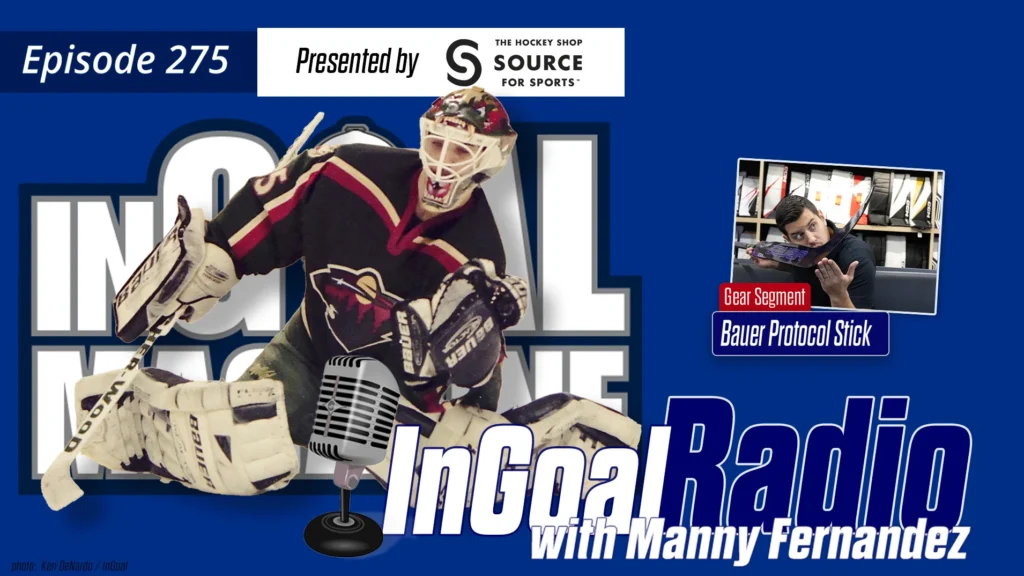
InGoal Radio Episode 275 with Manny Fernandez

Please subscribe and leave a rating — it helps us reach more goalies!


Manny Fernandez, who won the Jennings Trophy during his 13-year NHL career, explains how he found a balance for his reactive game as goaltending evolved rapidly in the league with limited technical coaching available at the time. Fernandez also shares a behind-the-scenes story from working with renowned goalie coach Francois Allaire at his offseason camps, and discusses his recent move into player development after co-opening a new training centre in Montreal with Marco Raimondo.
- Fernandez developed a reactive, instinct-based game during an era when dedicated goalie coaching was scarce, offering a model for goalies who learn best outside structured systems.
- Working with Francois Allaire during offseason camps helped Fernandez find technical balance without overhauling his natural game — a lesson relevant to any goalie navigating competing coaching philosophies.
- Fernandez recently co-opened a goaltending training centre in Montreal with Marco Raimondo, expanding his role from NHL veteran to full-time goalie development coach.
- As a goalie parent with a son in the QMJHL, Fernandez offers a dual perspective on how to support young goalies without projecting professional expectations onto their experience.
- The Parents Segment continues a three-part series on youth goalie statistics — covering both their value and their downside, plus advice on how to talk to your goalie constructively after a game.
Episode 275 of the InGoal Radio Podcast, presented by The Hockey Shop Source for Sports, features a fun and informative interview with former NHL goalie Manny Fernandez.
Feature Interview
presented by NHL Sense Arena
In the feature interview presented by NHL Sense Arena, Fernandez shares insights into his 13-year NHL career career that included winning the Jennings Trophy, as well as life as a goalie parent with a child playing in the QMJHL. There are plenty of great lessons on both sides as Fernandez, who recently joined former guest Marco Raimondo to open a new training centre in Montreal, talks about how he improved in an ear without much technical goalie coaching, and how he found a balance for his reactive game as the position began to evolve rapidly in the NHL, including a funny story from working with Francois Allaire during his offseason camps.
Parent Segment
presented by Stop It Goaltending U
In our Parents Segment, presented by the Stop It Goaltending U app, we continue our three-part series about the value and downside of keeping statistics for your young goalie, and advice on different ways you can talk to them about their game after it ends.
Weekly Gear Segment
presented by The Hockey Shop Source for SportsAnd in our weekly gear segment, we go to The Hockey Shop Source for Sports to learn more about Bauer’s all new, limited edition Protocol stick with a 77 flex, a big P28 curve, and the first off-the-rack combination of both the with saving Ergo Spine with their PentaGrip.
Episode Transcript
Intro
We're ready to go. The National Hockey League season has arrived. Welcome to InGoal Radio Podcast. Daren Millard with the cofounders of InGoal. Kevin Woodley, David Hutchison.
There's a special feeling around the opening week, the National Hockey League season as now everybody's underway.
Well, it sort of started already. Like, we're back, baby. I'm all excited, ready to go, like, fired up, but it kinda already started. Like, how many did you guys tune in? Did you watch the overseas games between New Jersey and Buffalo?
Yeah. I gotta be honest. I've struggled with this a little bit in my various broadcasts on radio here here in Vegas. I just call it opening week in North America. I I should have added the North America because the the staggered start is one.
It is. And, like, opening your season, we were actually at the Hockey Shop recording on the was it the Friday?
That's right.
It the Friday as the opening game was going on, and we both kinda looked at each other like, Hockey season started. It's the middle of the day and the kids are in school. I'm not sure that makes a ton of sense on a Friday morning back back here. So, I get it though. Good for growing the game and all those things.
Listen. Jacob Markstrom was fantastic in his first game for the devils. Jake Allen follows it up with a nice effort. And, you know, Devon Levi, like, are we gonna are are we doing Vezina picks this year? Not that I'm calling Devin Levi for the are we doing breakout and Vezina picks?
Just drop that in there. Like, we had our schedule, and then I just threw in the Woody bomb. Like, screw the whole rotation up for the morning. Are we doing it?
I'm fine with Vezina.
I haven't thought about it. I just threw it out there. I have no idea who I'm picking.
Give me three guys. Let's go with three people.
Jumping in, Marky. New situation. He Better
looks so good in that game.
I'm going for the easy one.
You can pick three guys each. Alright? Because it we're we're doing this off the top of our heads. Oh. I'm gonna go Shesterkin.
Shesterkin, I was about to say. Yeah.
I'll go Shesterkin, Swayman,
Hellebuyck. So and I've taken Marky, so, like, we've just creamed the top right there.
That's what we're gonna do.
That's really fair to Woody, so I better jump in.
Oh, you don't you can take the same guys. I don't mind if you take yeah.
I don't don't mind if you double dip.
Because I definitely had Shesterkin on my list. Contract year, he's gonna be a money guy. I think he's gonna have a great season. And
you're overthinking this.
I'm overthinking it. Okay. I'm definitely overthinking it, Daren, because I'm not capable. This is why I struggle as a goaltender. I'm not capable of underthinking anything.
Okay. I'm gonna give you I'm gonna give you a couple off the wall ones.
No no pun intended. And and I don't actually think it's that off the wall. I'm giving give me give me Joseph Woll. K.
Oh, love it.
Give me give me Joseph Woll. Give me Linus Ullmarck. And then I got Jake and Jacob Markstrom is my sort of security blanket. And I had questions about Jacob in in New Jersey because I thought he was a perfect fit last year when they were porous defensively and they needed him they needed a goalie that would stop bullets in their teeth, and they're a lot better now. And I think they're gonna keep getting better under Sheldon Keefe.
And that's not necessarily like, he's he's at his best when he's busy, but he sure looked good in that first game. So I'm all about the tiny sample size. And I'm gonna give you a breakout candidate because I have to do this lit.
Hold on. Hold on. Hold on. Hold on. Hutch, you need one more before we start lobbying and breakout candidates.
I don't want you to be influenced by Woody. By the way, the podcast is still going. It's just Woody thinking or Hutch thinking.
Hutch Well,
I I mean, it's not that off the wall, but given that he won't be starting the season on the active roster, I'll just go for Thatcher Demko because, obviously, Vancouver, solid team. Obviously, we've always thought Thatcher's one of the best goaltenders in the league, and it would be just an awesome story if he could come back in a few weeks and start playing at Vezina level.
Here are the
I like a good story.
Vizna picks on the podcast totally out of left field.
Demko, Shesterkin.
Shesterkin gets two votes.
Markstrom.
gets two votes. And then we've got Hellebuyck, Swayman, Woll, Ullmark, and Demko.
I like it. Now I'm giving you a breakout. And this isn't just because I because I liked his first game. He
Did you do three
more? He lost his this guy lost his first game, but if you were watching, you saw the signs that we sort of saw this summer. And frankly, the underlying numbers saw it last year, and people haven't really clued into it. Devon Levi's gonna have a big season. I don't this may like, the hedge here is I'm not sure how good Buffalo's gonna be, and they have a tendency to leave their goaltenders in some tough spots.
But I think Devin Levi's
Oh, there's full panic in Buffalo.
Devon Levi's gonna have a monster season. I have I have some questions about the coaching hiring decisions and things like that given how the defensive play of past teams under staff, but Devon Levi was ready to pop last year. Maybe this is just me pushing back on some of the narratives about, oh, send him to the AHL and he's not ready. And then by the end of the season, his his adjusted save percentage was almost identical to Ukko-Pekka Luukkonen's for the year. Like, he's
But but the problem is, you know you know the GMs aren't gonna look at adjusted save percentage, and that's why I think
you're stretching a little bit with Ullmark. That I don't Devon's gonna win a Vezina. I just think he's gonna have a breakout. Like, I think he's gonna be the guy that we all look back at. Saw him as a as a backup coming into the season, and I think he's capable of pushing for a lot more than that.
And that's pushing against the guy who had an incredible breakout season of his own last year. UPL was really good last year. So
Is it fair if you're calling Joseph Woll for the Vezina that that's a breakout as well since he's not played a ton of games in past?
Maybe I'm biased again because of the underlying numbers. There's nothing about Joseph Woll's history that says this will be a breakout. Like, when he's healthy, he's elite. That's the only question. Every time he's been in the NHL unhealthy, he's posted elite underlying numbers.
Did you wanna break out, Hutch? You don't have to. You can pass.
I think we're gonna have to pause the podcast here. Hutch will think about this for half an hour and then hit him.
Are we are we at like this is like a Woody bomb. Just like we had this whole, like, show planned out what we're gonna talk about and I just tossed it like grenade right into the middle of it.
Who's who's young and new beside those two guys?
Be different than Woody? Yeah.
I don't I love Dustin
Wolf, Tough but to break out on that team.
Calgary. That's gonna be really hard.
I think I think if you're not consistently considered a Vezina Trophy candidate, that would be a breakout. You can be older but come from outside that group. There you go. They can be a breakout.
How about Kevin Lankinen in early in the season in Vancouver? Although, Arturs Silovs has played really well in the pre Yeah. Preseason and and could have something to do with it. But again, you talk about a guy whose underlying numbers the past two seasons in Nashville say he's ready to pop. I think they end up job sharing through the first month of the season while they wait for Thatcher, and so there's an opportunity.
There's gonna be an email to info@InGoalmag.com saying that somebody's sitting at their keyboard right now screaming they can't believe we're missing goaltender x.
Y or zed.
So you're passing on the breakout?
I I you you know, by all the by all the criteria that I've used so far, this isn't even a a reasonable pick because it's not a great team, but I'd just like to see James Reimer who got claimed by Anaheim have a really good start to the year.
I second that. How's that?
Yeah. Didn't take long for our waiver question to be answered. Remember we were discussing, like, who would be the first and how many goalies would be picked up on waivers, and would we have a goalie picked up on waivers by the middle of October?
Did we set it over under?
I think it was one and a half.
So when we crossed it, we had two and here's the second question. If it had been two and a half, would we have crossed it? We had Yes. Two Yes. Goalies, but three waiver claims.
Yeah. They they they Yeah.
It's predictable that the one went back the other way, so I'm not sure that that's probably a half right there.
Did you talk to Patera
at all? Jiri Patera going back to Vancouver, I think people could have predicted that was gonna happen as soon as Swayman signed.
Woody, did you talk to Jiri?
I have not. No. He's not back yet.
I wanna know if he if he left his stuff.
Oh, there you go. There's the question I will ask.
It's interesting. I I was watching a sports cast last night and the commentator said, well, the one thing that Jiri Patera will have gotten out of this whole deal is at least he gets a Boston jersey with his name on it. And that made me say, no, I'm sure he didn't because I do remember, I think it was Mike McKenna came on one time and told us that most of the teams he went to, he didn't even get a jersey unless he went and asked for it.
Well, you didn't have to ask.
And yet you do have to ask, but he did for the most part. And then one team he did ask had already sold it at some type of fan auction at the end of the season. And, of course, that would be none other than my Vancouver Canucks. Maybe it's in that pile of goalie equipment in the back closet.
Probably in the backroom still.
The bathroom.
Find it for him, you'd a hero.
Behind the bathroom that's now our press box.
We're not surprised that Anaheim picked up a goaltender to give them some stability in the absence of John Gibson?
Well, we predicted it last week, didn't we? We said that if Gibson's down for a while, that's probably the place the claim would happen.
Yeah. And the appendectomy, even though, like, at the end of the day, it was three to six, Sounds like it's gonna be closer to the end of October, and you wanna give him some runway to come back. Like like, I don't know how severe it was for him. I know when I had it, like, it was a full week of eating nothing but ice chips after losing mine, and I lost about 10 pounds of material during the surgery and probably another 10 plus eating the ice chips for a week. So there's there's a refer and I I am far from a professional athlete, so I would imagine that, you know, he's gonna need some time to sort of rebuild his strength and James Reimer gives him that time.
Reimer just continues to battle and stay in it.
I tell you, like Solid goaltender. It's His numbers in Detroit were bad last year. His adjusted numbers were just fine.
Like
Like, he wasn't supposed to be the guy in Toronto when he broke in. He is a man made goaltender.
100%. I we had this conversation on the podcast with him. Right? Going back to the like, first meeting him while he was with the Marlies in Toronto when he I think he was supposed to be in the ECHL at the time, up to the Marlies, up to the National. He's just continued to grind.
And I think when you see the work he puts into his craft in the summers to sort of stay somewhat modern and ahead of the curve, you understand it. Like, he's just managed to keep himself relevant. And like I said, the underlying numbers last year were kind to him. They were he was right around expected on a team that struggled to defend. I thought the Red Wings, as I'm a huge Alex Lyon fan, I gave them a ton of good games.
But as they overplayed him and you started to see some of the fractures, I thought they probably could have got some more wins by putting James in. Because when they did, he succeeded, but also giving Lyon a little more time off by using James more often. So that was, sometimes some curious decisions, there. And, you know, let's see. Let's see how many starts he gets alongside Luukkonen in Anaheim, but I'm with Hutch hoping that they go well.
And even if he ends up back on waivers once Gibson is back, opens the eyes of another team that maybe has a need by that time.
It's InGoal Radio, the podcast presented by The Hockey Shop Source for Sports Langley, thehockeyshop.com. Correct me and say I'm totally out of the the left field here, but is there some similarities between James Reimer's journey and and Manny Fernandez, who's going to be our Sense Arena feature interview today? The way they just they battle to stay in it. Different styles, but they created something and kept going, probably against some odds.
Well, I I mean, Manny Manny had some help. Like like, look at the look at the Hockey DB, like, before we did the interview. Like, Manny's got a career .912 at a time when save percentage was, you know, like, was not in that range. And he had some really great years in Minnesota, like and style wise, a totally different goaltender. But I I think maybe the similarities are, like, somewhat overlooked despite having an exceptional career.
And I think there's times when when when we can say the same of James.
Yeah. We you look back on Reimer's career and, you know, there's some great years in there, but he had a battle for those years. And Fernandez with the tandem and the the system probably didn't get credit for for what he did at times, and then you look back at the numbers and go, they're spectacular. Jeremy Swayman, it was settled and that's good. I I think he got a great deal.
I think the Boston Bruins had to bend a little bit, but $8.25, what does that do with the goaltender market?
Well, I think it has the potential to reset it a little bit because Jeremy's kind of in the boat that Demko was. That that's the comparison I've been making when he came into his current contract and the standard at that time and it became a standard was five times five. Right? Like Demko and it places if this becomes a new standard, it puts the onus on the team and the managers to make sure they're giving it to the right guys. Because it just became a default.
It was Demko and then Merzlikens and Cal Peterson was in that mix. And if you if you see your guy as being the future and you get it wrong, that's a big ticket. I think in a couple of years, we won't view it the same way as the cap continues to go up significantly. But in the short in the short term, I I do think it has a potential to reset the market. The question will be if Swayman continues to play at that elite goaltender level, how far down that market list does this rise affect guys?
Like, how many guys end up being seen a if Swayman goes out and proves he can be the number one guy this year and continue to do what he did in Boston, a team that leans more heavily on its goaltenders last year and could do so again this year and gets fully sort of inducted into that, quote, unquote, elite category that I've already got him in, the only thing missing is the games played, then maybe it doesn't change the market because of the teams are like, sorry. Like, we believe in you in the future, but he's at that tier that only a few guys are. And so you're gonna have to be really careful what guys get that get that number.
Does it affect just Shesterkin's target? No. Swimming gets $8.25, I want
His target was quite a bit higher already, wasn't it?
So it stays it stays at 12. The number that I've heard is 12.
So, I mean, it could, but at the same time, he's an unrestricted free agent. Like, is and has been consistently in that elite class, And he could walk right up the door to anywhere else. Now there's two two parts to this, and it kinda, you know, came to light in in is Swayman's contract got a little or the negotiations, I should say, got a little sort of public and heated and emotional, at least from the appearances on the outside. At the end of the day, by all accounting, he sat down and decided, did he want to still be a Boston Bruin? And if you look at the other teams that could you know, if you had gone the other way and demanded a trade, like, if you're and you believe you're worth $12,000,000, there might be other teams that believe that too.
Are any of them the New York rangers from a competitive standpoint, from a market standpoint, and in terms of where the team is at in their evolution standpoint? Like, you willing to just be like, okay, well, you won't pay me, somebody else will, but I'm gonna go to a team where I might not make the playoffs for the next three or four years?
Well, and those teams also have to be financially structured to be able to take on the contract. Right? Total. Obviously, I don't know, Edmonton Oilers with so many top end guys Toronto Maple Leafs. They just don't have room for a 12 or $14,000,000 goaltender.
How many teams do?
Well, that's what I mean. Like, there's not that many. The list for even taking sway minute at eight and a half was really short. And so how how much shorter is it at twelve? And is it is it something you want as an athlete to be going to a team and or maybe he craves that.
I'm gonna be the guy that that that takes this team over the top and gets them back on the back. You never know where the individual motivation is, but the grass isn't always greener, and that may ultimately become part of the decision. I just think Shesterkin's sort of like, Shesterkin's been around that what what we saw what we're saying about Vasilevskiy after winning the cups. Like, that's the level he's played at after year in New York with less defensive support arguably than Vasileski had in Tampa those years. And so I'm very curious to see where this goes, but the difference is and it's both sides.
Like, if you're the rangers and you've gotten great minutes out of Jonathan Quick as a backup and you believe in Dylan Garand coming up behind him, that's great. But are either
That's a big roll of the dice.
Neither one of those guys is Igor Shesterkin at his best. Right? So it's a tough one and there's both sides to this. We'll see who blinks first. Maybe maybe the balance comes out around 10 and like at the end of the day, we've moved the market regardless.
And frankly, Hellebuyck moved the market and maybe even more so Ilya Sorokin moved the market. Because for the longest time, we were stuck where number one guys were 5 to $6,000,000 outside of Vasilevskiy in price. Like, think about Jacob Markstrom.
Yeah. We went up and then we went back.
Yeah. The premier free agent on the market in Jacob Markstrom was $6,000,000 contract. Very reasonable $6,000,000 contract now.
But how different is the salary cap next year compared to when Jacob Markstrom signed that deal?
Well, and we know it's going up now, and there was uncertainty.
But that's a that's a huge difference in all of this. I and I don't know what those numbers were as a percentage of the cap, but it's certainly not a comparison of 8,000,000 to 6,000,000.
Okay. So here's another because I just wanna turn this into the six hour podcast and Daren's gonna be late to get and get to practice for Vegas. The argument and I made it myself because we're talking about what deflates goaltending salaries in the National Hockey League. And one of the things one of the pushbacks from a GM standpoint is, do you wanna commit, like, you know, that sort of Leon Draisaitl $12,000,000? I know he's he's higher at 14, but that elite player money to a goaltender when they spend one third of the season on the bench.
And the pushback I've from other
every minute of the playoffs.
Right. And and the pushback I've heard on the other side, and and will that continue? But the pushback on the other side is, well, McDavid only plays, he's on the bench for
At most half the game.
Yeah. At least. So, you know, I I I've used that argument. I've heard that argument. I've entertained that argument and sort of some people have pushed back, like, on us saying and fair enough, saying, like, hey.
The star players don't play every minute of every game when a goaltender's in there.
Can go in circles. The puck's at the other end of the ice half the game too. So it's it's it's it's silly to get into that argument, isn't it?
I don't know. I don't know. Other people are so that's why I was I wanted to fun. Throw it
It's fun. I'm just saying it's almost an impossible one to come to a resolution.
I can tell you this, my team, my men's league team feels like the pucks in our end, 99% of the time based on my influence.
Well, you feel that?
No. Based on my influence on the game and how many face offs we get at center ice. They feel like it's always in our end
because it's always going to center ice. Well, yeah, you're just taking it out of the zone every time. Yeah. It's very quickly.
Nobody has a better breakouts than I do.
Have you ever turned to your defenseman after the like, just getting dis disgustingly bombarded for like a two minute sequence and then the puck finally ends in the net and you just turn around and be like, I had to let it in. We had to clear the zone somehow.
I wish I had an opportunity to say that after two minutes.
I'm usually just sucking wind so bad by that point that it's a get it out. Where's the defib?
Most of my conversations with the d start with this. We look up at each other and they say to me, what happened there? That's how it all starts. And then we then we move on from there.
Most of my conversations with my forwards are in the locker room before and after the game because it's like a reintroduction. I haven't seen them when the game's been on. Hey, did you come back in the zone today?
Are you are you guys allowed to go to the the master bedroom after a late night beer league game or do you have to sleep on the couch so you don't wake everybody up?
I I I'll go first because I have a late night skate every Monday night that takes me to at least midnight usually by the time I get home, sometimes after. I very much am sleeping in the basement. There is we've got a don't wake me policy Yep. That I I try to adhere to. And the reality is I struggle to fall asleep for a while anyway.
So I'd rather come down, have a stretch, put some ice on the bad knee and watch a little TV for half an hour. But I very much and you know what? I'll tell you what the hardest part was, was before my oldest daughter, who's now in third year university, before she moved out, her bedroom when she was in high school was above the garage. So not only did I get the instructions to sleep in Oh, the basement yeah.
You're you're done.
But I was not supposed to open their garage. Yeah. Yeah. Because it would wake her, you know, the the I mean, it's not a fancy expensive garage. It's pretty loud going up and she's sleeping right above it.
It would wake her and screw up her sleep, and she had high school the next morning, which prevent presented a very difficult dilemma because I didn't wanna leave my gear in the car. And my garage doesn't have a door, so the for the gear to come in, it would have to go through the front door because I don't have a side door into my garage. So there you go. There's my challenges, my first world problems as a beer league goaltender, but very much I've set up on the couch in the basement.
Yeah. I'm with you. I'm on the same.
I I would do I had the same situation as Woody with respect to a daughter, so I would often go in that side door of the garage, which is a pain because a goalie bag does not fit through a normal door very easily.
Especially with your wheels.
Certainly would do that. My wife had no issue with me coming to bed late. My situation now, boys, is a little bit different because I'm not playing this year, but my wife is a goaltender as well and is playing. So last night, I dutifully tried to stay awake to get the game report when she got home. It was a late game.
I was, lying in bed watching YouTube videos on the computer, and I heard the garage door open. The dog left the room to go down and greet her. And that's the last thing I remember. Apparently, she came in and I was sound asleep and YouTube was still running. I couldn't manage from the time the garage door opened for her to come up the stairs to get the game report because I was too tired.
So she didn't disturb me at all.
That's a win for everybody. Good for you.
I Well, she she only let one goal in last night.
So You wanted to tell it?
For him to give me that game
Made made a twenty three second left save to, preserve the tie.
Now in your defense, however, as much as you should have stayed awake to listen to that blow by blow description of a great performance, at least you didn't tell her she had to sleep in the basement.
No. She again, she is the person that told me I should make InGoal a full time thing. She's the person who told me to take that jump so she can forever do whatever she would like now.
Good on her. Lucky guy. Stop It Goaltending U App parent segment is the continuation of a three part series with Hutch. We've got that coming up in just a little bit.
Our Sense Arena feature interview will connect with Manny Fernandez, and he had a great career. Dallas, Minnesota finished up with Boston. He played long enough ago that he had 35 ties on his record. He had ties. Wow.
Wow. Not too many guys know what that is anymore or had that on their resume. And we've got the Hockey Shop Gear Segment, hockeyshop.com Source for Sports Langley discussing the Bauer stick that's going to make you a men's league hex doll.
The Bauer Protocol, proto for short.
Proto. Gotta hook. But it's gonna it's gonna make you a men's league Hextal in a good way. Like not not the
It's a Snapshow? Stuff.
Yeah. Yeah. Yeah. It's it's for sure that last minute stick. If you're one of those people when the goaltender gets pulled at the other end, you wanna go to the bench and change sticks for the goalie goal, this is
it. Yeah. This is a this is definitely a if you if you can if you can shoot it, you can snipe it with this thing. If you decide to join the rush, hop in, you know, maybe work yourself down low on the power play, you'll be able to tuck from top shelf from in tight with this thing. It's got a hook on it.
Yeah. You will not be able to keep it keep it on the ice. What's going on over at the hockey shop?
Well, they continue to bring in new gear. Got a Brian's launch coming soon. You've got the new Bauer Proto stick, which is in stock and available right now at the hockey shop. But we're also gonna start to get into you got sales going on. We're also gonna start to get into some of the services that they offer and some of the things that the hockey shop, like from men's league sweaters, your beer league team needs a new look, they do that.
You wanna get your skates custom profiled as the season goes on, they do that. You got questions for the crew about maybe your kids outgrown, had a growth spurt here in the early part of the season late in the summer, and they've outgrown last year's equipment, and you need something quick. They've got the inventory to make sure that not only do they do that, but they've got something that'll probably match your team. Whatever you need as a goaltender, the Hockey Shop and the hockeyshop.com has not only the inventory to make sure you get what you need, but the staff to make sure it's gonna fit your goalies or your game perfectly. So make sure you check them out, whether it's new gear still coming in right through November, old gear on sale, or expertise and advice that will help you stop more puck, check them out at The Hockey Shop Source for Sports Langley in person or the hockeyshop.com.
Gear
And that new gear this week, Daren, includes the Bauer Protocol stick. Rather than me rambling about the giant hook on the end of it, let's get to camp for some of the other details about what's gonna how this is gonna help you snipe, whether it's beer league or whatever league. Welcome back to the Hockey Shop Source for Sports. We're in Goal Utopia where it is the start of the season, but more like Christmas because look at the curve on the new Bauer Proto stick.
I'm sorry. I had the mini version. Protocol, brand new.
Limited edition. Limited edition. Limited run. Very pretty. Wicked curve.
590 grams. So those are the highlights. Yeah. Walk me through why we have this stick.
Like, what is this stick designed to do other than take someone's eye out with that curve?
Shall we? So Bauer has always talked about their innovation line of sticks. It's something you've seen on the player side of things. Been translated over into the goalie.
The Agents stick. There we go.
So you can kind of almost consider this a little bit of for the agent to a better degree as a new innovation, not the same style of stick, but there's some tech and spec being sandwiched into the stick as well as some nice cool features that we see as a common common request as well as that brand new p 28 g. For those of you Curve.
Old enough to have watched Slapshot, that is Doctor Hook McCracken's.
Curve. You dated yourself again, Kevin. So we look out on the back of that stick. We see that Ergo spine. So this stick is based off of the Shadow goal stick.
Again, that same spine in the back. Construction, very, very similar to what you are gonna find in that Shadow from here down. So what starts to change a little bit? Once again, we already talked about the curve, but the flex of the stick itself. So this is listed at a 77 flex.
Your standard Bauer goal stick is listed at an 87. What's this all translate to?
A whippy stick for ripping one-timers.
You found it. You found it.
Oh, but I'm not a player. So what does it actually translate to for a goalie handling the puck?
More torque behind your shot. So you can put your weight down on it and really start to feel that flex. Once you can find that kick point and what it does help you to do too as well, it even gives you a call out called the launch pad where you should be positioning your glove on that stick to be able to get maximum torque behind your shot.
Kick point is mid? Correct. And you can really feel it on this.
You can really feel it. So far, general feedback even for us just messing around with shooter has been fantastic. Getting bar down, going over the net if you really want to. It's crazy what this stick can possibly do for those that are, like, you know, at that high end of the puck handling.
Okay. So you can go bar down. But last time I checked, that wasn't my job. How do we need to start thinking about stopping backhand rims if we're playing at a really high level with that curve? Is that a bit of something to consider if you're a higher angle, maybe playing junior, you gotta be comfortable with that?
I would consider it. Would it be worth trying to make sure? Yeah. A 100%. But there's only so many ways that you can kind of simulate a backhand store.
So overall feel, weight we've covered, comes in full right as well, all the way from 26 down to 24 in senior. Twenty four, twenty five is available in full right. Oh, I haven't forgot about you guys. Overall, great feeling. Awesome.
It's pretty. And it's shiny.
Yes. By way, definitely pops.
Again, this is a one off. So these specs are what you get. You can't come in and order it with different curves. This is how it comes. A lot of really nice features.
We almost forgot about that.
Well, Pentagrip is included, but that yeah. Okay. See that. You say we almost forgot.
We almost forgot. We're a team. So Pentagrip also comes from the Vapor stick line itself. Again, a lot of requests for the Pentagrip on custom goal sticks.
A little bit of a matte finish up top for a little more grip?
Correct. Especially as you're throwing your poke check and whatnot, it can actually help you control that slide so you're not chucking the stick right out of your hand. Again, great overall feel. Definitely worth a check out. You can give us a call here at
(604) 589-8299 or 1-800-567-7790 to chat more about the Goal Stick. I already hear this burning question in the back of my head. Well, how much is it?
77 flex. It's actually written on a stick. I don't think I've ever seen that on a goal stick. I don't think you were looking at that. I think
you were looking at the price point.
I was actually okay. Go ahead. $400.
So it's not cheap. However, when you're gonna be paying for this style of innovation, stuff like that, remember, you're paying for a performance level stick itself. So, again, any questions?
The stick's so nice that we need to actually keep it clean, And we would have wiped it down and gotten rid of Cam's greasy fingerprints, except they're still so greasy that pucks go right through his glove just like that towel did. Cam, good try. Good effort, kid. Make sure if you've got questions for The Hockey Shop, you check them out at thehockeyshop.com or contact Cam. New Bauer Protocol stick.
Whippy. Whippy. Good shooter. Pretty. They've got it in stock.
I'm grabbing one of those. I am. Just for warm up, just to be able to ring it around the glass and everybody go, woah, or or throw it over the glass. You know, you're you're coming in and warm up to your top of the circles and you rip one and you're going, I'll throw it off the crossbar if I can. I wanna throw it over the net, over the glass, into the netting, and just have the boys go, oh.
And then I'm switching back to my other stick for the game, and then I'm gonna score with Protocol stick.
Now listen. There's a little more flex there. So you gotta be able to snap you gotta be able to lean into this thing a little bit. You gotta be able to snap it. The more flex, like, it's it's like the kids with their super whippy sticks.
Like, if you don't got the juice on it, it's gonna like, it's got the hook, but that flex point has to be activated for you to snap it or it's just gonna flutter about halfway up the net.
I I sense a doubter.
Don't tell you, Daren.
Oh, no. You you you're you're doubting me.
Well, we're getting you a proto stick just so you can show us. I wanna see actually, we need to get you a Bauer Proto stick just so you can take it into the room, like, at practice later today with the Vegas Golden Knights, and ask the NHL guys what they think of that hook and what they could do with it. That's the video I want.
Be able to now it's a legal curve. Right? There's no so early.
Hutch, You know this?
Oh, right. There is there are no illegal curves anymore, Daren.
Right. For goalies.
Players. What? When was the last time you saw a stick measurement, Daren? Yeah.
But you you still can't have a stick that can be
There's no rule on it.
Didn't if I'm wrong, but I am I did not know for players. Yep.
Yep. There isn't There
isn't for stick measurement.
Isn't for goalies. So p 28 it is for Daren.
People don't work their own sticks like they used to with the torch out and Can't.
I don't know if you can with these. Can you?
If really I don't think so.
Nobody's gonna order a bunch of illegal sticks.
Really?
I don't think so. Equipment managers would get into serious trouble if that happens.
Okay. They only get in
There's no illegal equipment in the NHL, Daren. You're right.
I'm looking at this through rose colored glasses. The logical point of view. I can't believe you're the one that's pushing this, the dad of our podcast, and you're floating this tomfoolery out there.
I am not saying to do it. I'm just saying it happens.
Okay. I'm looking up after this podcast episode because I don't wanna ruin it right now and we can go back next next week. You think that there's no more illegal sticks?
I think that.
Like that rule doesn't exist. Correct.
And I just think I would have heard about that.
That sound you yeah. Sound you hear in the background, folks, is all of us tapping away at our phones to see if we can
No.
I'm I'm not looking up.
I'm not gonna look it up right now.
Download the rule book fast enough.
Everybody else,
you can Oh, now now I see one that says there is a rule, so I don't know.
Maybe not for goalies, but
Apparently, can't exceed half an inch, but I'm pretty sure that anyway.
There's no way they got rid of that rule.
Why not get rid of the rule? Because if your stick's like this, you can't take a backhand and you can't handle the puck. So
I don't know. You've got a a three part series.
Wrong. I'm I've never been wrong before, but maybe I am now.
Parent Playbook
Stop It Goaltending U, the app. I'm trying to save you here. Brings us our parent segment. This is the carry on from our conversation last week, Hutch. Stop It Goaltending U, the app, a great resource for all goaltenders.
Well, it's a great resource for all goaltenders. It's also as as Hutch gets into, you know, how to help your kid with stats and managing that part of the game, there's also a resource you can tap into at Stop It Goaltending U, the app, under the services section to get game reports and game video reviews. So if you wanna get somebody else taking a look at your kid's game, you can do that through Stop It Goaltending U, the app. You would record and then upload your game film into your own dedicated Google Drive folder. A Stop It coach will watch the film and create a game report using the Stop It Goaltending game day app tracking software.
You can see how you perform relative to you hear me talk about expected goals and expected save percentage all the time. How many grade a's did you face? How truly hard was that game environment? And then that coach will do a voice over of your footage, breaking it down clip by clip with advice and tips, things you did well, things you could maybe do differently, steps you can take to become a better goaltender. That's all available under the services section of the app at Stop It Goaltending U, the app.
There is a fee. It's not included in the app. You can do try it for one game, eight game, 24, have your whole season reviewed, but you can try it on a short term basis to see whether you like it. Make sure you check it out at Stop It Goaltending U, the app. And, of course, as we have for several months now, every time you get a subscription, everyone who subscribes to the Stop It Goaltending U app gets a subscription to InGoal Magazine, the premium product at ingoalmag.com, and all the NHL content that we bring you on a weekly basis, including game reviews with NHL goalies.
That's pretty cool. Be able to get reports like that.
I actually I actually have to pay people not to watch my footage.
What do you think? I've submitted my video, what do you think of this? Tennis. Pickle ball. Hutch, what do we got what what do we got on the heels of last week?
Well, I think our friends at Stop It must have been listening last week because we talked about how save percentage is just not really a great metric to be working with. So many parents out there talking about counting shots and finding save percentages for the kids. Last week, we talked about why I don't think that's a great measure. And more importantly, what I talked about was that what are you even going to do with that number? If you're an eight fifty or a nine fifty, that doesn't instruct how you're gonna practice next week and how you're gonna become a better goaltender.
I think our friends at Stop It were listening because they sent us in this information about the video coaching program and the game day app. We're gonna talk a little bit more about game day, and we're gonna talk a little bit more about maybe some alternatives for stats if you really do wanna take them. We're gonna do that next week. This week, I wanted to get in on the heels of save percentage and say, what do I talk to a kid about after a game if I don't tell them what their save percentage was? What do I talk to my own kid about?
The answer today is nothing because he's got a great goaltending coach over in Vancouver. But when he was younger, what do I talk to, the goalies that I coach after a game? How do I address things? I think we want to first say, as I've done many times before, you know your goalie better than I do. And it actually is really important to understand your goaltender to have a relationship with them because the conversation will be directed a little bit based on what they need as a goaltender.
Are they a kid who's struggling with confidence? Are they feeling discouraged? Are they overconfident? Are they one who tends to blame others when things aren't going very well? Having that context of who they are and even how they respond to feedback is is really, really important before you carry on with one of these conversations.
It's not there's no sort of checklist of here's how you talk to a goaltender about a game. So understand them. Have a relationship and you can direct that conversation based on it. That said, the first thing I'll just say is let's put the the goals aside, whether it was a good game or a great game. I know those things matter to you, but let's put those aside for a little while and just say, what did you think?
How did it go? Was it a tough game for you? Was it an easier game for you? How do you think you played? Some general thoughts.
And any parent out there will tell you as they're listening to me, I ask my kid how school went today and they said, I don't know. It was okay. And they'll have nothing to say. And as you first have these conversations with your child, asking them how the game went, you'll probably get similar responses. But if you press on, if you go through some of these other things that I'm gonna talk about here, eventually, I think those initial conversations will become more engaged.
And I do think because your kid loves goaltending, they're passionate about it, it's gonna be a little bit easier than getting an answer about what they did in history class today because they love what they're talking about. That said, I think getting that framework for it is really important because we've said before, we want them to be their own best goalie coach. So just get a feel for that. And it it also takes away that context of the score. Let's just talk about the game in general.
And that idea of was it a tough game or an easy game? I think framing it is is important as well. So that again, getting away from the stats. Let's just evaluate what were you facing tonight and then how did you respond to it? And then I try and push a little deeper and get in a little bit more specific.
What went well for you tonight? Tell me some things that you think you did really well. And I'm hoping over time that general question can lead to some good feedback from them. But you might need to dig a little bit deeper. And one question I often ask is, what are you proud of tonight?
Again, focusing on the positive, tell me something you're really proud of that happened in the game. And at first, even later, you're probably gonna get the kind of answers that you might expect. Oh, that glove save was awesome. When I stopped that breakaway, it was great. The paddle save.
They'll come up with some highlight saves that their team might be cheering about, their coach might be cheering about, we at home would cheer about and absolutely celebrate those things. Those are why we play the game. We love those highlights. And it's it is all about having fun, but then push a little further. What are you proud of that happened today that anybody else in the rink might have missed except a goalie coach?
What happened on the ice that other people might not notice you'd like them to notice? And some examples of those things could be going back to what happened in practice this week. Were you working with your coach on containing saves with your body, those gut trap saves? And maybe you noticed one during a game and you can say to your kid, hey, I noticed on that power play, there was a screenshot and you contained the puck with your body really well. I saw you'd been doing it in practice.
Good job. That's fantastic. And maybe you noticed that they were shifting slightly into pucks instead of full on sliding out of control and getting out of their out of their crease. Maybe you noticed that their depth selection was really good. Perhaps in one situation, they knew there were no options and they took a little bit more depth.
Perhaps on a power play where there were many options, they played a little bit deeper because they've been working on that in practice this week. And I know some of you are probably thinking as I say that, I'm not a goalie coach. I can't find these things. But that leads some of the conversation you have during the week. If you know nothing about goaltending, when your kid comes home from practice, say, what did you learn today?
Teach me. Help me learn how to be a goaltender. And that will help them process what they've been doing. And I think even reinforce what they were doing on the ice in practice that week. I think some of these conversations are a little bit like doing homework.
You get the lesson in school, but then when you go home and you review it, that's when the lesson really takes hold for you. So having your kid teach you what they're learning, just in a small way, will help you notice things in their game and it will help them reinforce what it is that they're learning. So sometimes you noticing these things for them helps them start to find these subtle things in in their game. But I think it really is important that we're celebrating the things that they're doing really well. Then you can ask, is there anything you'd like to work on next game?
What came out of the game today that you think you'd like to work on? And again, you hope maybe this comes from some of the things they've been doing in practice, some of the things they've been learning from a goalie coach. But maybe they'll say, I struggled handling the puck today. Or I gave out a few too many rebounds or I wasn't catching pucks cleanly. Some of the things that maybe they'd like to do, this gives them some guidance in practice.
And again, even if they don't have a goalie coach guys in their practices regularly, by reflecting on the game, some of the things that were tough for them, that gives them at least a mindset when they go into practice on their own for some of these drills so they know that they can improve on things a little bit. I struggled a little bit with screenshots today. I was struggling to find the puck. Well, maybe they can think about that a little bit more during practice. All of those things, I think, give some structure to the game, some structure to what they're doing, and puts all the goals aside.
Because look, goals go in sometimes for no fault of your kid. They hit two bums and a stick and then they go in the net behind them. Those don't mean you had a good game or a bad game and they give you nothing to work on in practice next week. And then finally, the goals themselves. Brian Daccord did a great article for us where he talked about coaching your kid in the car afterwards.
It's a bit of a controversial topic in hockey. Too many parents telling their kids how to play when they have a coach. But but Brian said to us, a goalie can go. They can play their game. They can come off the ice, they can get changed, they can leave the rink, hop into your car, and nobody, not even a coach, may have said a word to them that day.
And as a parent, you might be the only chance they have to process that game. And so Brian himself believes that actually going over the goals is important as sort of a cleanse. You can get through them and put them aside and then say that they're done. I know we talk in games about you wanna forget them and put them in the past and you do during the game, but but a lot of guys still wanna go over the goals. I never really brought them up with my kid, but if he brought them up with me, we would have a conversation about them.
And it's just a quick check. I I think it was, Mitch Korn who would talk to his goaltenders and have checklist, didn't he, Kevin, about here's one you should have had, here's one you could have had, and here's one you had no chance of getting. And I I think with your kids, that's not a bad framework to go through. There's almost always a way we could imagine that we might have made a save, But, I think putting some aside is, look, you just had no chance and that's okay. That happens.
Here's one. Maybe you could have done something and worked on a little bit. But processing them and then leaving them in the past, I think is is really important. And then just the last thing I'll say, and I agreed completely with Brian in his article on this one, was once the conversation about the game is over, it's over. Put it away.
We're not going to revisit it at dinner. We're not going to bring it up again tomorrow. I think again about teaching that right mindset, We're just saying the conversation has happened. We've processed the game. We've diagnosed what we're going to do in practice this week.
And then we just put it away. And then let's move on and and have some good family time and let's just enjoy each other for everything else that we do. So that's my general process when I'm talking to, to my son or to a goaltender that I work with. I think it's important that we get lessons out of our games so that we can become better. If they have a goalie coach who does this all with them, by all means, leave it to that goalie coach.
But if you're the only one as a parent, that can talk to them or you're a goalie coach looking for things to say to your goalies, those are a few ideas. I think what, what Stop It is doing guys with their video reports on games and going through the stats with goalies, Awesome program. If you want to bring in that reinforcement to support you as a as a parent, getting them to help your goalie, great program to have. But if you're on your own and you want to help help them out, those are a few thoughts. By all means, people, let me know what you think.
Do you agree with me? Do you disagree? Do you have some other things that you say to your goaltender? Parents at ingoalmag.com.
Couple of things, just wanna play off of, there's options there, Hutch, and that's great to have for the parent to have flexibility in dealing with your child. And the other one is just be conscious of reading the room and and where things are that particular day. It doesn't doesn't have to be tried and true that you've you stick to the same formula every day and being able to just play off of your child's mood or situation.
100%. I think that's sort of what I was saying in the beginning when I said you need to know your kid the best. You need to have that relationship. But I think, Daren, you made a really good point there. Read the room because it may have changed one day to the next.
Do you need to be a little bit more positive? Do you need to really focus on a few things that went well? If they did have a tough game, there's gonna be some days they just don't even wanna talk about it and maybe they'll wanna come back to it later. Understand your child and let them process it the best way that you and they know. Woody?
It's well said. I'll go to the Mitch Korn thing. I think it was evaluating goals. Could have stopped, should have stopped. And then I can't remember if it's no chance, but basically analyzing them in those three categories.
And and again, I do think though there is value in being able to look at what those attributes, you know, what attributes go into a would've and a could've or or should've.
Sounds like somebody needs to interview Mitch and do an article soon, Kevin.
Yeah. Because it because it, like, it changes. Right? Like, that's the thing. Like, he's got all those years of knowing what that looks like, and we don't as goalie parents, and that changes obviously you know, we we understand analytics now if a puck goes across the crease, and it's a one timer.
I think intuitively as goaltenders, we know that that's a harder save to make, but, you know, that's where the Stop It app and the work they does sort of helps quantify that a little bit. Right? Because what we have as parents for example, what I have is a guy who watches the NHL all the time watching kids hockey. My evaluation process is much different in terms of what I think a should have looks like at the different levels. So there's there's value in sort of bringing in that outside voice if you're unsure.
And like I said, the beauty of it, not to turn this into a pitch is you can just try it. You don't have to go all in and buy it for a full season. You can just try a one game. And that'll actually give you a sense a little bit of how your evaluation might differ from an independent third party as well. It might provide a little perspective as a parent when we get into those conversations about how you perceive something and how what reality looks like for that age group.
Yeah. Teaching tool for the parent and the and the education side of it.
It's huge. I found, again, not to get too far ahead into next week where we're talking about it a little bit more, but I found the first few games I actually use Stop It's GameDay app incredibly educational for me. Even though I can watch a game and I understand intuitively a lot of this stuff, as soon as you start categorizing every single shot, things really jump out at you. And they also make you think, okay, Stop It says this one was really, really hard. I'm not sure it necessarily was in this case.
You you you end up evaluating the individual selection as well on your own. It's it's a fascinating process.
Look forward to the completion of the three part series on our parent segment brought to you by Stop It Goaltending U the app next week. Slide over to the feature interview presented by Sense Arena. And this is a cool one because this guy was a National Hockey League player, and he is a parent, and it's kinda neat on the goaltending front. So he he has that experience. Manny Fernandez, in the feature interview brought to us by Sense Arena.
Sense Arena is excited that we're into a new NHL season just like we are guys. They've got a whole new system in place this year. They've added to their system and they're starting the year with 32 regular season games you can jump into in your headset. Specific challenging drills that you can work on, that work on a specific skill. You can compete against yourself.
Go through the process to unlock games and eventually tracking your progress. You can earn a trophy that you can throw in that all new trophy room that they've set up for you to check out in the headset as you're tracking now this season experience points that let you see how you're doing as you progress through this. So they're building so many things in now to really excite you about your training, make it interactive, make it exciting, relate it to the National Hockey League, your favorite team. It's really just become such a cool tool on top of the fact that it's just a great tool for helping you learn to become a better goaltender. As we know, as we've heard from so many goaltenders like Joey Daccord, Devon Levi, and others that use Sense Arena, including in the dressing room before and during an NHL game to warm up.
I think one of the things that jumped out for us was when we heard, was it Joey talking about that it's a warm up for his warm up so he can step on the ice and be ready to go as soon as the warm up starts. Sense Arena, NHL Sense Arena, incredible tool for helping you become a better goaltender. Go to sensearena.com. Give it a try. Use the code I g m 50, and you will save even more.
I think Manny Fernandez would have liked Sense Arena. Because as you're about to hear in our feature interview, a lot of what he did was on feel. And so the ability to get that feel without having to get on the ice every time is a big part of what NHL Sense Arena does. And the feel that he talks about in this interview, like, I don't wanna ruin it, but it's a fun one because this is a goaltender that had a really good NHL career at a time when the position was changing rapidly, and he was in the midst of it. So lots of great advice.
He may not have played the way the game is played now or the position is played now, but lots of great advice whether it's from the parent perspective with a young goaltender now playing in in the queue or from that, how do I add new things? How do I get better on my own? There's just so much in here. It's a really unique conversation, one that I think our our audience is really gonna enjoy.
He was one of the coolest guys to sit down and just watch for a night. Whatever team he was playing for, if he was in that night, I would pay attention to what Manny Fernandez was doing on the ice. I wanted to play like him, couldn't play like him. I don't think anybody could really necessarily play like Manny Fernandez did with the safe selections. Fun interview.
Great conversation. Enjoy it. Brought to you by Sense Arena, NHL Sens Arena VR.
Feature Interview - Manny Fernandez
Really excited to welcome to the InGoal Radio Podcast. It's been a long time since I had the opportunity to chat with Manny Fernandez. And if I understand this correctly, Manny, is this is this the first interview you've done since retiring more than a decade ago or just the first one in English?
No. It is actually is the first one. Yeah. I stood away, from the spotlight after I, and you did a good break, and this is actually the first one. You're lucky. Lucky.
I I we're we're honored. We're really honored. Well, I wanna get into your career a little bit, but first, maybe catch us up on what sort of got our paths crossing. We were in Quebec, not this summer, but last summer, and and we're lucky enough to spend some time, with Marco Raimondo and his facility there. And you guys have teamed up.
You have a new facility. I'm gonna get you to say it. Yeah. In Saint Louis, I'm gonna call you to say the name of it because you're better at it than I like, just walk me through, like, you're back in the sport. You're back in the position.
You're working with goalies, the new opportunity with Marco in the new facility. What do you guys got going?
Well, to be hon to be honest with you, I, I coached my son. Now my son plays in the Q, so he's he's 19 years old. But it got to a point where I didn't wanna jeopardize our relationship with me and my son. It wasn't going into that direction, but I want him to have a different feel, maybe somebody else to give him different advice. We've been working for so long on the same stuff.
He got to a point where I think he needed somebody else, a new voice in his life. And I started shopping around, and Marco came along. They got along great, which the vibe was amazing between those two, and that's how we got started. And I I I sort of stayed close enough to to see how Marco worked and and just, you know, do got talking, and I just said, you know, Marco, eventually, if if you got anything else, if you wanna move on another rink, you wanna expand or anything else, just let me know. I might be interested.
Since my son is going away and he doesn't need me anymore in his life, it'd probably be something I'd be interested in. And funny enough, he called me about, what, two, three months ago. Then Manny, are you ready when you're sitting down? I might just have the the new adventure you've been looking for. So here we are.
We just bought this new complex, and we have a bunch of ideas where we wanna work together. And he's amazing on the ice. He's amazing relating his his his thoughts with the new guys. And I think with my expertise, my, you know, my career, I think that I can help him on a different level, maybe mentally or, you know, at least looking at videos and stuff like that. So we have a bunch of new ideas.
We were gonna take care of those, those young bullies here in the Quebec region.
I'm so excited to watch where you guys take this. You know, as I said, we're big fans of Marco and the work he does, and I know his podcast hit with us last summer, got just an absolute ton. You talked about the way he coaches and his approach. So much good feedback. We had we had we were getting notes from as far away from, you know, as Sweden, from goalie coaches there about how about just how impressive he was with the way he works with his goalies.
What, you talk about approach. I I'm curious too. We have a lot of parents that listen to this. That line for you, just take it back to working with your son and when you knew maybe it was time to let somebody else have a voice in there, that can be a tough thing for for parents, especially for a guy who played at the highest level.
It is. It is. Well, we we we we've never had any problems. Any, there was never one day where I stepped on the ice, and I felt like my son was just out of it, nor I just it would you know, I wanted him to work. He wasn't doing the reps.
It was always smooth, but even in my career in my career, I just felt like you need a bunch of of information. You just if you just need that if you just only have that one guy, sometimes it's the same thing that repeats all the time. So I wanted even in my career, I wanted to have a lot of ideas, and I just took, like, everything that I needed out of every person that I met. And I think you make that puzzle whatever fits into your game. So I was never a black and white type of guy.
You know? I just there's a lot of goalies where it doesn't it's it doesn't fit for a 100%. And my son, I felt like he had a different style. He was going in different direction, and I it wasn't mine. So I felt like Marco might be a good fit for him.
It's it's it's just the idea. Maybe sometimes it's, you know, you can take a goalie to a certain level, and then for some reason, it just you need something else to to to to go on. Then that's what I felt. So it just we have got this great relationship, me and my son. I I don't wanna say that we have bad relationship at all.
But, I just felt it, and I think it was it it was the right time, and Marco was just the right the right fit for him.
Diversity. Right? Like, different voices at different times we see quite often. I I always hear the cliche about how goalies take longer to develop. And then when you actually talk to the goalies that maybe, you know, maybe they hit a few years later than players, you find out there's a new voice somewhere along the way or a new idea that's just clicked with them and resonated with them.
And if they hadn't made that change, maybe it doesn't happen.
It clicks it clicks quicker. I I don't know if that's where you're going, but I think you need something to to you need a voice. You need something that's gonna your mind's gonna boom. It's gonna turn on. And sometimes the the fact that you say sometimes it takes longer.
With all the information that's that's running around, I I wish I had that when I was young. It's like we're chasing information. Today, you got stuff everywhere for the young goalies. I mean, if they're curious, you get on the web, you see videos, you you you kinda see what everybody does. It's amazing for them, and I think you're gonna see guys get to a different level younger than than our in our careers when when we didn't have all these media stuff around the sport.
We basically just looked at each other and said, wow. This guy, I I he does this well. And then you'd look at InGoal, he does this well. Where today, you just have all this information. You just at your fingertips, it's it's it's amazing for these young guys.
So, I mean, those are the positives of the where we are today and all the information they have. Do you see any negatives?
Well, it's more pressure, obviously. Where back in the day, while I played in Dallas, you'd be lucky to get in the sports section. It's just nobody would talk, you know, less pressure, less spotlight. The people would be in the ring, see the obviously, they would see the the scorer whose fault it was, but outside world wouldn't wouldn't see anything else. Now today, you'd be playing a game in Sweden, and I think the guy in in China would read about it.
It's it's everywhere to see for people to see. So it's a lot of pressure, and it's a lot of a lot of people give out their thoughts and stuff like that. So it's heavy on those young kids. I see my son just got traded from, and he had a tough time there. And because he kept reading all the all these people that he went on a website, and he saw all these these people giving their idea and stuff like that.
It's it's harder for the young kids. Like, I mean, you have to be careful on on all of the all the things you read. But, if it's just for information, I think it's super.
How now what are some of the things that you see? Any trends you see around the game where where you feel like, hey. I can lend a voice here. Obviously, it'll be different for every goalie. Are there are there things you like seeing in young goaltenders or anything you don't like seeing in young goaltenders when you watch today?
The young goalies?
Or even even even you right through the ages, just like, you know, whether it's young young or or sort of into junior, the kids you're seeing. What do you what do you like? What do you think could be different?
Like, personally, for my son, I made him play with small equipment. It's that was just one thing that hit me. I just I want him to to be able to move his feet and be be more agile and and really, you know, from a young age, like, learn to move, where sometimes you see, like, parents just go overboard with pads up to to the elbows. The kid doesn't move. But I I wanted my son to be mobile, and I wanted my son to to explore and maybe have piece a little bit smaller.
But you know what? At least he'd be able to move. Now it's all about size. It's it's it's really tough out there. It's it's really now they're big boys, six foot two and up.
They're a big kid. My son's six foot, so he needs to be really, really quick. He needs to be he makes he needs to make those big saves. So those get around, and he needs to come out more. So he's got more, more space to to cover than maybe a six foot four guy.
You know?
Right.
So I think I did I did good on that part. I I knew he was he was never gonna be six foot seven. I knew he was gonna be right around six foot, so he needed to to to be quick, to be agile, to to to know his edges, to to to be able to move around. I don't think I would have helped him to to just be really big at a young age. So maybe that's one of one of the things that I see.
That's that's great advice. If you can't skate, you can't play, and I don't think you know, that's something we hear a lot right up to the NHL. Now you gotta be able to skate. And if you put a goalie in pads that restrict his ability to skate at a young age, you're hindering him.
Exactly. That's my feeling.
No. I like it. I really like it. Well, I mean, you mentioned, you know, when you grew up and how you learned was just watching this guy and seeing what he did well. So who were the guys for you growing up?
Who was who were the ones that inspired you to become a goaltender and helped you on that path? Like, who did you emulate when you were on the ice?
Well, for me, when I was young, Pelle Lindbergh was my guy.
Okay. Yeah. And I'm I also watch, you know, Steve Penney and all those guys that that that came through Montreal, obviously, because I was in Montreal. I was a big Habs fan. But
Of course.
No. Just when I said that, this is a lot of a lot of the guys that I've watched, like, regularly were the guys that were playing with me in practice. I was the I was the type of guy to really look at the other guy when he's in doing his reps. And there was always one thing that he did right that I I could feel through him, and and I could take for it kinda snatch that off his game and put it in mine. And I did that all along my career where I just took little bits of every goalie I played with or against, you know, guys that I knew well that I could see, like, over a span of time, I could really have okay.
This guy puts his glove at the right place. I can really feel how he feels, and it covers a lot. I in our back in our days, that's how you did it. Right? Today, in practice, we basically with Marco Marco is gonna film you.
We go out upstairs, and we'll watch the tape. You'll see what you look like. You'll see what you have to change. We didn't have that back in our day. So you sorta had to go through feelings, you know.
And when I saw somebody, that was one of my four sides. I just I felt what he felt at that time. Don't know if it makes any sense.
It it does. It just
an English French thing. But I I I could impersonate myself into him, and I would take, like, the things that I know would fit in my game. That's how I grew up. I grew my game to the next level. And I got lucky enough to play with amazing goalies throughout my career, so I just it made that job way easier, but that that's basically how I get better.
Well, I I gotta ask because, you know, there's a long list of of really good goalies you played with and some incredible seasons that you had alongside them. Is there any is there an example that jumps out that you can recall of a guy you played with and one little thing that you just took away from him after watching him in practice?
Well, I think the best example is when I I I got close to the NHL, Obviously, you get to that level, you get really excited but really nervous at the same time, and you're kinda hoping that you you watch the guys that have played this game for a long time. How do you do it to survive? So I took I was like a sponge, and that goes back to Andy Moog when I showed up in Dallas. Darcy was there too, and then I got the chance to play with Eddie Belfour. All of those guys, I took small bit time out of you know, I'd go in and practice, and I was just not doing just my rep. I was also watching the other guy how he did his.
And he was amazing to watch because I that was the tiniest goalie you've ever seen in your life, and you were wondering how he stopped all the pucks when you felt like you're in a soccer net out there. You just he basically didn't move, and he was he was all over the place. So it was it was good for me because it showed me that even a smaller guy could do that, then it has to be possible for me to do it too. So that kinda got over the first herd, and then on to to Eddie. Eddie just Eddie was the same probably the same size as me.
He he was just everything that Eddie did was really close to my style too, so it it really helped to those were the two first big goalies that that really helped me get over the go from the IHL to the NHL, I think.
Well, and you had you had couple of quick tastes and success in Dallas, and then the the first year you get, Europe for for most of the season in ninety nine two thousand, nine twenty save percentage. So, obviously, you were learning quickly, my friend. You kinda came up in through an era where the position was changing rapidly. Like, goalie coaching, you know, was starting to become more common. When did you get your first goalie coach where you were maybe had another voice other than looking at your your practice partners, your playing partners, and and trying to learn from them?
When did you get a was the first time you really had that voice to, you you know, a third party trying to add things to your game or work with you on your game? What do you remember of that?
Well, I got a first goalie coach in Laval when I played in the Q Okay. With which was more of a mental aspect. He helped me tons, but, basically, he helped me out mentally. When I felt scared, I felt nervous, I felt anything. I he was the voice.
He was the person I could talk to. Everything I told him stayed between me and him. It was a great way relationship. On the ice, we were lacking a little bit, but off the ice, he was a 100%, then we moved. Let's move up.
We we had a goalie coach in Dallas, but he was sorta up and down. So it was tough. Some of those, those years, I was pretty much by myself. I you you just had that and then finally made it to to to Dallas. Some of the older guys didn't need a goalie coach.
Like, Eddie didn't need a goalie coach. I don't wanna go too deep into that, but but, you know, it just and then in Minnesota, we there was a lot of ex players, you know, just guys that that have been through, that have done the job, that that know, like, the mental aspect of it. Yep. And where today, I think it's more like a guy like Marco. Marco would tell you, you know, this is what you wanna you wanna watch for.
You know? And that he's gonna give you your your cue where it's really precise. Where back in my day, was just more the the mental aspect. You know? You would relate information to the coaching staff and say, well, he might be a little bit nervous.
He might wanna know, he's shook up. He doesn't feel a 100% or, wow. He sees his, Like, right now, he's he's always he's your guy. You know? He he would make that those decisions.
Where today, he there it's more like a one on one with the goalie. I think that it's moving towards the NHL, like, where guys are gonna be, like they're gonna be amazing. They'll be like Marco. It's more of a a guy that's gonna help you with your style.
Right. It's back then, it was more been there, done that experience. And now it's very there's a lot more technical and tactical that goes into it. A lot more teaching.
I think so.
Yeah. Now did you get to a point? Like, I know in Minnesota, I remember, you know, there was a there was I think there was a summer where you and then correct me if I'm wrong, but you started going to Francois Allaire's schools. And as a lot of goalies did back in in that era, in that time, in Quebec especially, was there a transformation or new things you added to your game at that point, or was that, like, what was that process like?
You know, a lot of people ask me because I was in we're on, I'm right on the borderline of the butterfly, and, that was Right. Dipping in a little bit. But Yeah. Still had those Dominic Hasek where where it's just, like, really, like, a freestyle of of it was just how you felt. You know?
And Yep. It's a the goalie business is it's changed so much. It's it's amazing. From when I was back in my day to to what it is today, even the equipment, I remember because they came out when I was playing in the NHL, they came out with the new rules, the the maximum length and all that stuff. When they did, it was me.
I was still falling on my pad when I went down to a butterfly.
Right.
And then they came up with this new thing where you cannot be on your pad, and we're all wondering where we're fall, you know, not directly on the ice. It didn't make sense to us, but sorta, you know, got over that a little bit, but it was different, but it's it was better. Now it is today what it is. It's just a different world. But, no.
I'll give you the same shot about 10 times, you have a 100 different ways of stopping the puck. He goes, that blows my mind, and it shouldn't be like that.
The butterfly, I I put it in my game a little bit, but not that much. I still look at tapes today, and I'm I it's horrible to watch. I I don't know if every goalie feels like that, but it's compared to what it is today, you know, and I asked Francois, know, tell me tell me and it resonates into my mind because there was one summer I worked with him, and he goes, I can't believe it, Manny. He goes, for every shot, and I'll give you the same shot about 10 times, you have a 100 different ways of stopping the puck. He goes, that blows my mind, and it shouldn't be like that.
And I was like, what is he talking about? And it's true because I was it was a question of feeling. It was a question of you would react, but 10 different ways, where today, guys are just they're taught to just do the same thing over and over again, and it it you know, maybe we'd have, gotten rid of three goals, four goals, every 20 shot, maybe. I don't know. It's just it's a better way, I think, today to to to play the game.
It's really precise. It's, but it wasn't a 100% many for them as I can tell you that.
No. I I mean, I loved watching you play in part because of that as the league was transitioning to goalies looking very similar, you still had that flare, that read and react style to you. Do you think as much as I think, you know, when when guys do it the same way, like, on every shot, it looks the same. There's a consistency to it for sure. Do you think we've lost a little bit of the art, the flare, the unpredictability as shooters sort of figure out what that consistency looks like?
Is there a place for a little bit of, you know, different save selections every once in a while?
Well, there there's still. There's gonna have to be in in in a hockey game, you can't control a 100% of the time. There's they leave out maybe that five or 10%.
Right.
But also you're you're saving so much energy where I was you know, you got to a point where there's there's plays where I look, like, for a span of two minutes, and I was flopping all over the place. You know how much energy I lost to just get back into just the right place? It's it's unreal. The guys today, they move one foot to the left, one foot to the right, and everything is compact. You know?
It's where us, it was would you come out for a breakaway 20 feet out? I'd have to back that up. You know what I mean? There's a lot of energy that goes into doing all of that stuff. Where I I think today, guys are they can play well over 50 games and and be okay with it.
Where back in my day, if you played over 40, you'd lose 10 pounds a game. It's just that was the reality of it. But, no, overall, I think, yeah, you're you're cutting down on on mistakes. Right. You you're up to just feelings and stuff like that.
Sometimes you have a bad night, and that's when everything goes wrong. Where today, you have, like, a base where it just even if you have an off night, it you can still produce what you have to do to produce.
Right. It gives you you're in the way. Right? You're putting yourself in a position sometimes if you're not feeling the reactive side, you're at least in a position to get hit.
Exactly.
What tab I mean, you talked about, you know, sort of how many games you played. You had a lot of great tandems. We've seen that trend come back. You played with with Dwayne Roloson and Niklas Backstrom, I think, Minnesota as well, towards the end with Tim Thomas in Boston. A lot of great goaltenders, but a lot of job shares.
It was different back then because a lot of the league was like, you know, they had guys playing 70 games, and you guys were kind of in a way ahead of the curve. What was it like managing that though in Minnesota?
I was never going to share share the net with Steve, from pulling up, even in Laval, I wanted to have the whole the whole load.
Right.
Right. When we got to to Minnesota, we started splitting splitting time, first with Jamie McLennan, my first year. And that was okay because we're we're young. We're you know, we just just pick up basically, pickup team. You know?
And I think you needed to dial it down a little bit. Maybe just half of the games was was good. As we got better, Dwayne showed up, and Dwayne was just amazing. The years that I played with him, he was just on fire. Stood at the very top of the NHL every year, I think.
So now it became like a competition between me and him. So it's one thing. When you go into the net and you know you're just gonna be playing every game, you go in with this calmness, you know, a little bit where our mindset was just to go in and empty out the tank every night because you knew pretty much for sure that you're going back on the bench and and Dwayne was gonna come in or whoever it was. You didn't have to play games. So that gave us a chance to to go out, harder than probably a number one would, and that became my mindset.
I was always afraid, though, can I come out of that mindset? Because it's it's something to get into it and and learn how to play with that, but that what's the other side of it? Can can I go back to being the number one and just play long term, you know, get in there for 20 some games in a row and and have that, you know, the ball rolling? I I did it one season where I played fifty fifty three, I think. Never got the chance to do it again, but, you know, it's it's a I think, overall, it's a mindset.
I think it's a different feeling than having the net yourself and having the confidence behind the bench to say, well, you're gonna go in there. You're gonna play most of the games or 90% of the games.
I was gonna say 58 games in o five, o six, and a nine nineteen save percentage. So clearly, you could still do it when you needed to play more that year. The the relationship with with guys like Dwayne. So you're competitive. You're a competitor.
You want the net every night. You both understand that that maybe just isn't the situation at the time there. You guys are splitting more. How do you manage those relationships? Any advice?
Because you're gonna be helping young goalies, whether it's mindset or on the ice, in in in at the new facility. What kind of advice would you give?
Well, you see, we we always had that one thing. It was respect. Always. Did we see eye to eye on everything? Probably not.
Were we best friends off the ice? Probably not either. But there was that mutual respect. When the other guy played, we we respected that, and we just didn't do anything to to to kinda play around with that. So for that, I mean, that was the best thing that could that we could ask for.
And he he was same way as I was. You know, he was really strict on that. So he would, you know, leave me alone on game days when he knew he wasn't playing, he was out. It was my team. And then when he played, I did the same.
You know? So there was never that with any of the guys that I played with, there was never that that one thing where you're trying to bug the other guy on game day. Yeah. That was never that. So whether you're gonna get along with all of them, I can't I can't say that you will, just like if you don't get along a 100% with everybody on your team, but the the main thing is to keep that respect between each other to to say, well, I'm gonna give you your space.
You go out there and do your job. May the best man win at the end of the day.
I love it. I love that approach. Finished off in Boston, won a Jennings trophy alongside Tim Thomas. What was that relation not so much the relationship, but what was it like playing with Tim? A guy who, I think, like yourself, there as he as he evolved, he added technique and some elements, but he was also still largely a guy who battled and competed and, you know, would make saves maybe differently than what a lot of the league was doing at the time.
Yeah. Tim was was amazing in that regard. I I you know, I saw him play during the games, and I was like, there's no way that I can go on for a whole season. But to see that guy practice and do it in practice and in games constantly, like, not missing out is just like, he would be the kind of guy who just wouldn't move and just stop the puck with a stick. He would do that over and over again, not just once or twice.
So it wasn't a question of luck. It was really the guy who had a skill, something like Dominic had. You know? You could see him play and also and feel his confidence and feel like it's not like it's not gonna get by him. Whether he turns on his back or hits it with his head, you just had that feeling well, like, the puck wasn't gonna go in.
And those guys did it for a long span of time, so they knew something we didn't I would have tried that maybe once in my career. The puck was for sure in my net, for sure. I didn't have that. They just I needed to keep some composure. But no.
Tim, when I got there, like, he was doing it. He I think the year before I got there, he had a tough tough year. The minute I made it to Boston, you could feel the switch. He was just, he was really on. Those years, he was amazing.
So, obviously, all those practice habits that you saw and the way he worked exuded that confidence, that feeling like nothing's going in on him. Do you have any advice for young goalies that, you know I mean, it's not gonna be Tim be like Tim Thomas, obviously, but, like, how do we instill confidence? What are the things a goalie can do to instill confidence in his group? Obviously, stop the puck is a big one, but are there other things, whether it's practice habits or or or advice that you would give to be like, this is how you make the guys feel good about playing in front of you?
I always believe it was started in practice, and I think all NHL guys are gonna tell you the same thing. Because when we left the game, that was the most important thing was to practice hard, to practice to that level where you're gonna demand that in the game. Because your body and your mind, if you use them to just go easy and practice, but when kind of game comes, listen, I'm gonna ask you for 10 more gears, it's not gonna happen. You you sort of have to start in practice. I always practice harder than I almost it's funny to say, but I always practice harder than I played.
I always believe it was started in practice, and I think all NHL guys are gonna tell you the same thing. Because when we left the game, that was the most important thing was to practice hard, to practice to that level where you're gonna demand that in the game. Because your body and your mind, if you use them to just go easy and practice, but when kind of game comes, listen, I'm gonna ask you for 10 more gears, it's not gonna happen. You you sort of have to start in practice. I always practice harder than I almost it's funny to say, but I always practice harder than I played.
And just because, I don't know, I think when you get you get the reps in practice and your head is kinda making those saves and you're doing it perfectly in practice, you get into a game, and that's where your confidence comes from. For me, personally, I don't know if you all feel the same. I I can only speak for myself. But if I practice well and I did everything I needed to do in practice, I just felt like this calmness in my game where I showed up a game, and I I knew it was gonna go right. And when you start the game with I know it's gonna go right, usually, start with 90% confidence, which is where you wanna be.
You know? You're never gonna be hit that 100%, but you don't wanna start at 60 either. If you had a bad practice, you come in the game and you're doubting yourself because it's like, wow. It didn't go well. How is your how am I gonna come out?
Am I still gonna be good? Where I just for me, my reps were that's what is gonna tell me if I was gonna feel good, confident, or I was gonna feel like, woah. I need to be on my my toes a little bit.
I kinda like if when we were students, right, they used to always used to tell you, right, like if you're prepared for a test, you're not nervous. If you if you do the work going in, you're you're prepared.
Exactly. Well, that's that's how I treated it every time. Maybe you go into a marathon, you're not gonna if go you into a marathon for five kilometers, you're not gonna you wanna train at ten to be able to do the five really hard. It just I felt the same way in practice. If if my my games were 60 where I needed to be concentrated and really focused while all my practices, I treat them the same way, where I would just I train myself even if I had a off day.
Like I said, it was a travel day. I didn't feel like practicing. I used those days that were harder to be like, to kinda really, really concentrate and and and try to get a a good practice even though it was a tough day. So I would get into games. It'd be much easier.
Sounds like that's great advice. I'm I'm so excited now for you to be in this new role and sharing that advice with all these young goaltenders. When you look back at at at thirteen years in the NHL and an incredible nine twelve save percentage throughout, like, really impressive, the Jennings I mentioned. Is there one memory that jumps out to you? Like, when you look back at your career, is there anything that stands out above the rest?
The o three season probably.
Okay. Playoffs? That was
the one we, playoffs. Yeah. Going into with with Wayne. Actually, he started the series against the Avalanche. We were down three one, and then I got called in.
Just to win that series for the upset and for what it meant back then because we're just like I said, we're a bunch of young kids, trying to prove prove ourselves, just, again, going against, a team that's been, you know, with all the big names, everybody was there. Just to be able to defeat them in seven, that was probably my my biggest moment, I I would say.
And then you got to come see me in Vancouver.
And I got to go see you in Vancouver. Didn't do so I didn't do so well in Vancouver. I no. We won in seven that one too, but I was on the bench. But that's strange.
We can laugh, right, now Yeah. In a years, so we can we can make jokes about it.
Absolutely. Absolutely. It was at least, hopefully, it wasn't my questions.
No. It wasn't. No. Might have been the the beef jerky in the dressing room. No.
Oh, Johnny still brings that for the visiting for the visiting. It's still very cherished around the league from the locker room attendant Johnny who is still a beauty.
After all these years, I still think about that. That was amazing. He would brought it bring it in the dressing room was the best thing I've ever seen.
I think we're gonna have to place an order and have it shipped to you, my friend. I still see Johnny's he's still there. One of the greatest people around the visiting room locker attendant in Vancouver for those people listening and don't know what we're talking about. He's an absolute gem of a human being. And so I will put in that request because I still see him at the rink.
Oh, man. Manny, this is this has been so much fun.
Yes. It has. For the first interview, it's been really, really pleasant.
Oh, there we go. See, I'm trying to make it easier. Like, try and make it fun. Right? So we really appreciate your time.
We really look forward to sort of following, the evolution of Cartier Desport in the new location, and and hopefully getting out there as we were able to two summers ago with Marco to get out there and see you guys at work. I know you've got really exciting plans for it and some camps and things like that that we hope to be involved in, and and I'm really excited about it. So congratulations on that. Congratulations on a great career, and congratulations on your first interview since it ended fifteen years ago.
Thanks, Ken. Thanks for being so nice.
Outro
The Francois Allaire story is outstanding, and it's it's so true.
Yeah. Just such a different style. And and again but I know, like, he didn't play it up that much, but I know there were elements that he took when he started going to those camps in the summer, like leg recovery stuff. So he was evolving as much as he did rely on field. There was an evolution there as well.
But at the end of the day, it was battle and finding ways and reads and anticipation and different save selections. And I'm with you, Daren. I always loved watching Manny Fernandez. Play as you talked about there. Like, that was such a big moment.
You remember in 2003, him and Roloson, and he was the guy that Yeah. Was was that the end for Patrick?
When they beat him?
In came back three one in playoffs. That was was was the final game for Patrick Roy. So a remarkable series. A big part of, you know, we think of Minnesota and the Minnesota wild and how ingrained they are in the hockey community there and the state of hockey and all that stuff. That he was a big part of that early wild team that, you know, built that success as, you know, expansion teams back then were not did not get the rosters that they do today out of the gate.
And so they were they were underdogs, and to have that upset three years into their existence in the playoffs was a big deal and really sort of cemented that franchise and that community even more so.
Fun stuff, and two totally different goaltenders in that tandem, and they made it work. And you don't always see that type of change beyond a right handed catching goaltender and a left handed catching goaltender, but they they they were very different.
Very much so. And and like I said, loved watching them both. Got a front row seat for it because that was the old Northwest Division that the Vancouver Canucks did. So I got to watch Minnesota and Vancouver a lot and got to watch a lot of Manny Fernandez in the in those years. And like I said, like, it was a different style, but it was always fun to watch.
The Northwest Division. There's a jog into the memory banks from the past. Looking forward to it. We got our our Vezina trophy picks. Again, gets two votes.
We've got Markstrom with a couple of votes, and then Demko and Ullmark and WHL and Swayman and Hellebuyck also gaining consideration. And I don't know whether there's a wildcard at dark horse from David Hutchison yet. We've we've given him an hour.
From Daren Millard?
Pardon me?
Have we had one from Daren Millard?
I'm sorry. It's must be my Internet is sketchy because I'm having trouble hearing you right now, but but I'll I'll I'll get you a wild card pick.
I gave you a half of one. I said, if you call it a wild card, I just said, I hope James Reimer got off to a great start. But you didn't give us anything as you were calling me a chicken. Okay.
Jordan Binnington because of the Four Nations face off and the competition to gain the starting role with team Canada. I will put Jordan Binnington out there.
Okay. So I'm I'm gonna back there. I like this one for Daren because Binnington's underlying numbers for the past numbers have been exceptional. The myth in Saint Louis is that they were they won the cup, but after that, that they were a great defensive team. No.
They were a team that relied heavily on goaltending, and Binnington's been a big part of that. And so was our guy, Joel Hofer, backing him up. They both had exceptional adjusted numbers last year. And now not to take Daren's side too much and push back on Hutch, but I did manage to dig up because working for nhl.com, I have it bookmarked, the rule book. There isn't I know.
I know. Indeed still rules around players. Three quarters of an inch in terms of the curve with the toe and the heel lying flat is the maximum it can be sort of rounded and off the ice. So I
We're gonna come back to that next week because I still think there's something I'm I've got in my head that's doing this.
Okay. So I will give you one, however The explanation.
That that that that from the goaltending side that I didn't realize. Did you know? We know the rules about no, you have you're supposed to have white tape on the knob of your stick. Yeah. Do you know there's a minimum knob in the rules?
Yeah. Quarter inch, think.
It's a half inch.
Half inch.
And so my I'm curious whether that's a half inch from the thickness of the stick or whether the thickness of the stick counts. Because I am seeing a lot of goaltenders around the league that aren't putting any knot, like like, two or three pieces of tape now as their knob. Like, it really isn't much of a knob.
Why is that? I well, I have a theory.
I'll ask a few. I'm gonna have to ask a few now, but I'm actually starting to wonder if they've opened themselves up to, like, could you just how we saw illegal sticks, could you and we've seen goaltenders it's not a penalty, I don't believe, but we've seen goaltenders be asked to add white tape to their stick, and they get annoyed by it because they didn't know the rule, they've got a colored tape on there. Could you imagine if a goaltender in the middle of the game had to go Devon Levi on it and grab a roll of white tape and lay it on the ice and put a bunch of rolls around to get to the minimum half inch? Like, I think there are guys out there depending on how you interpret this rule that would have to change sticks if they were called on it. So did we just open up Pandora's box?
I apologize to the goalie union and the guys that don't have a half inch.
No kidding Oh my gosh.
I think Hasek started this because he would make the knob of a stick off balance. It was wider
I tried that.
Near the top and and smaller at the bottom, so the puck didn't slip through under the shaft if you went paddle down. So it put the handle of the stick closer to the ice. So I think that's why people are going with smaller knobs of the stick.
So inter I mean, it's interesting, but now I need to know how half an inch is interpreted because I think the thickness of the stick itself is close the stick.
So if it's a half inch past that, if it's gotta be that means a quarter inch on each side. There are absolutely guys that don't have that right now and are technically playing by the rule book with an illegal stick.
So Woody asks Kay Whitmore at the NHL office and suddenly every NHL goalie is getting checked on this. And Woody's not welcome in the locker room anymore. That's a solid move there, buddy.
That Woody's not gonna say anything.
We'll just we'll just ask the goalies themselves.
Yeah. We'll do that.
That's what we'll do. We'll do that.
Don't tell anybody. It's only goalies listening to
this anyway. I'm not happy you were wrong on the curve thing.
I'm not. I still don't think I'm completely wrong. There's no such thing.
I'm happy that I didn't that I didn't miss an entire rule change. That's what I'm thankful There's
to the story, boys. It's coming. You're gonna find it.
I will.
Until actually texting it up for you right salvation. We'll talk to you next week on InGoal Radio, the podcast presented by The Hockey Shop Source for Sports Langley, TheHockeyShop.com.
Comments
Comments are for InGoal members.