
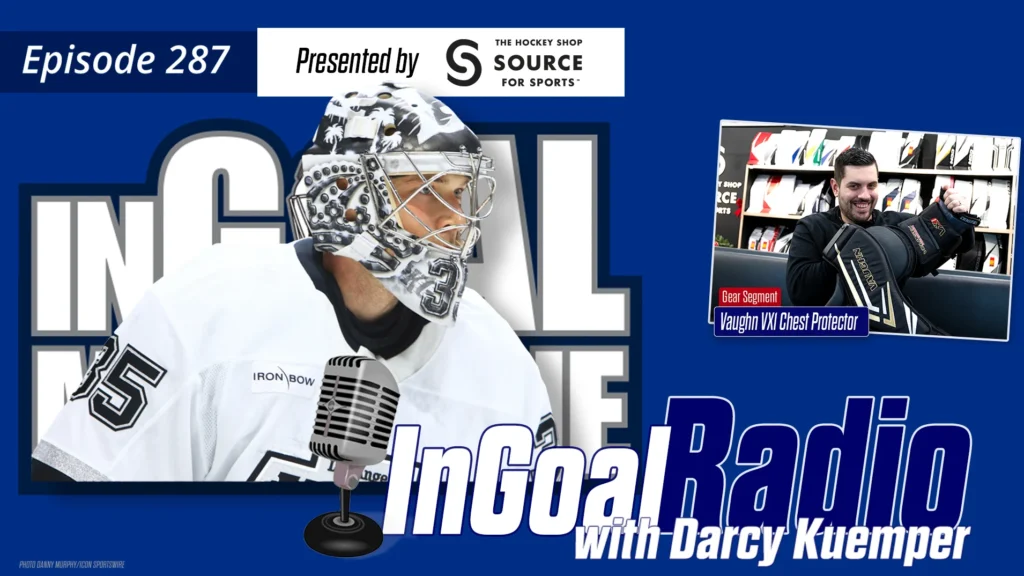
InGoal Radio Episode 287 with Stanley Cup-winning goalie Darcy Kuemper of the Los Angeles Kings

Please subscribe and leave a rating — it helps us reach more goalies!


Stanley Cup-winning goalie Darcy Kuemper explains that adding 'motion' to his pre-shot movement was a key technical change that helped launch a resurgent season with the Los Angeles Kings. Kuemper also reflects on the most important shifts across his 13-year NHL career, emphasizing continuous technical and tactical growth as the foundation of his longevity.
- Darcy Kuemper credits incorporating 'motion' into his game as a pivotal technical adjustment that fueled his resurgent season with the Los Angeles Kings.
- Kuemper outlines how consistent technical and tactical evolution — not natural talent alone — has sustained his growth across a 13-year NHL career.
- AHL All-Star Devin Cooley of the Calgary Flames offers specific advice on reading and managing 2-on-1 situations.
- Dylan Garand of the Rangers' AHL affiliate uses an unconventional warmup drill — deliberately requesting head-height shots — to sharpen reaction and protection habits.
- The new Vaughn VX1 chest protector addresses a long-standing goalie fitting problem while improving overall upper-body protection.
Episode 287 of the InGoal Radio Podcast, presented by The Hockey Shop Source for Sports, features Stanley Cup-winning goalie Darcy Kuemper of the Los Angeles Kings
Feature Interview
presented by NHL Sense Arena
In the feature interview presented by NHL Sense Arena, we get quick but information-packed insights into the evolution of a Stanley Cup champion. From technical to tactical, including the benefits of adding “motion” to start a resurgent season with the Kings, Kuemper shares insights into the approach that has allowed him to continue growing as a goalie throughout a 13-year career, as well as what some of the most important changes have been.
Parent Segment
presented by Stop It Goaltending U
In our Parents Segment, presented by the Stop It Goaltending U app, we talk about a great off ice training tool that will make you a better goaltender – and just might prevent the odd head shot. In the segment we refer to this article with New York Ranger’s AHL Goaltneder Dylan Garand and an unusual warmup that features purposefully asking for shots aimed at his head.
Pro Reads
presented by Vizual EdgeWe also review this week’s Pro Reads, which is presented by Vizual Edge, featuring freshly minted AHL All Star Devin Cooley of the Calgary Flames with some great advice for managing a 2-on-1.
Weekly Gear Segment
presented by The Hockey Shop Source for SportsAnd in our weekly gear segment, we go to The Hockey Shop Source for Sports for a look at the new Vaughn VX1 Chest protector, which improves protection and solves an old fitting problem.
Episode Transcript
Intro
Inching ever closer to the Four Nations face off, we're gonna get into who the starting goaltenders will be for the respective clubs. It's InGoal Radio, the podcast with Daren Millard, David Hutchison, and Kevin Woodley. Gentlemen, how are you doing today?
So well.
A little groggy, a little tired. We're good.
We're not used to these morning recording sessions. Yeah.
So the the energy level might be down a little bit. I forgot my coffee up in the kitchen.
Oh, do wanna run up and get it? Hutch and I can fill for how long does it take you to to get a coffee?
Let's start the timer.
Alright. Go. Hutch, we were on with USA Hockey taking the goaltending course.
You were?
The bronze level goaltending And we were fortunate enough to be included in the Alaskan region. And it was a two night course, three to four hours on on both It was extensive. What was your your first takeaway from that? And then we'll get into some of the the other details of what USA Hockey is trying to do here.
My first takeaway was that it was fantastic. And as I mentioned last week, somewhat rooted maybe in philosophy, how we want things approached correctly. Last week, we mentioned the concept of it being about creating more goaltenders and more kids who are happy being goaltenders and that right sport environment. You wanted to bring up a video that we saw this week. You you teased last week that you wanted to talk a little bit about sport culture in Norway.
Right? Norway. And, that fantastic video that was just all about the culture of sport in Norway and it's a it's a bill of rights, I think, for young athletes that they have in the country. Very progressive. I I hope there's some way we can we can share that video at some point, but I'm I'm not sure that we'll be able to.
But that sort of underpinned it because I felt, Daren, I don't know about you, when we got into the more technical side of goaltending, technical light on the on the second day, even that felt like it was very rooted in philosophy and doing things the right way. What makes a good practice? How can we alter a practice as a head coach so that we're creating a better environment for our goaltenders and our players? Themes that we've talked about here before, but I think they've wrapped up into a fantastic package that is going to benefit all of their goaltenders and their players going forward. It was it was really well put together and and great to be part of such a good experience with nearly a 100 people sitting in on this.
Woody is back.
Things like drill design.
Mhmm.
Right? Like, they didn't just say, okay. Here's here's a drill you can use to work on skating, or here's a drill you can use to work on that. Rather than telling everyone or giving them the tools, they wanted them to think about how they build those tools. As a matter of fact, with the assignment that comes at the end of it is to build your own drill.
And it was amazing because the foundations of of a good drill, and these are based on things like learning. You know, they've looked at learning models, different elements are not necessarily what we see on a day to day basis, even me in the National Hockey League. Like, I joked with the group that if you wanted to cheat your drill design, we've got a couple 100 of them at InGoal premium. But the reality is a bunch of them, even right up to the NHL, wouldn't sort of fit the foundations of good drill design. Right?
Quite often, we've got pucks that aren't related to each other, where one shot comes from one area and then the drill continues from another area without finishing on that first puck, where they're not integrated, things that never happen in a game. And so, you know, the way they walked us through really thinking about how you would design a drill, as you said, Hutch, how you would design a practice, how to keep goalies engaged, how how many reps of a drill to work on, what to look for in terms of learning and and skill acquisition, in terms of ramping a drill up with progressions or even pulling it back with regressions depending on how it's going with goalies of different ages. Like, it was really rooted in those type of foundational things as opposed to here's what we wanna work on. Here's a drill to do it. Go out and do it.
And they had examples, like I mentioned, the NHL stuff. They had examples of them working with Olympic athletes in USA camps that they're like, okay, what's wrong with this drill design? Here's what we were doing seven, eight years ago.
Hey, here's a question. If you guys were gonna talk to a another coach after sitting through this, what's one thing as a takeaway that you would tell them to try and do in their next session? You can't wouldify it and turn it into 14 things in one sentence. It's gotta be just one thing you would tell another coach if you sat down with them.
What if I
Yeah. Is that pretty good?
I like that.
I like it too.
Okay. One thing you would say to either a head coach or a goalie coach as a takeaway from that that they could implement tomorrow.
Include your goaltender in the drills, in in the in the practice a lot more. Have have some goalie, not specific drills, but some some drills aimed at bettering your goaltender.
K.
That would that was
That was good takeaway.
That jumped
out to me. Woody? One thing.
I know I'm struggling to come up with one thing because I think it depends on the age. I think it really does. My biggest thing would be for a coach that's working with young goalies is is my whole takeaway from the whole thing is how how silly it is that we do starter backup at such a young age or dedicated goalies. I I would have them making sure that every kid is trying the equipment.
So I really liked one that's, perhaps for older goaltenders, but but not necessarily, where the shooter knew what the options were in the drill, but the goaltender did not. And then if the shooter scored, they had to keep repeating that until the goaltender made a save.
So the goaltender was Can you give us some example
of that? Well, there was the the drill that was walking out of the corner. It was one of the the U. Olympic women's goaltenders. Did not know that the shooter had the option, going net front wrapping, and so on.
And then when when the shooter beat her on the first rep to the far post and and managed to score, he had to make the very same move the next time. So without telling her how to fix it, she could problem solve the scenario because she faced it a few times in a row. But it was one that But she didn't know.
She was gonna
She also didn't know it was coming multiple times in a row. So she didn't know what it would be initially and she didn't know it was coming multiple times in a row. And she didn't have a coach step in and say, here's how you fix it because the learning comes in the problem solving that you're undergoing on your own.
And when we talk about recognizing patterns and a big focus of this was play reading and the importance of reviewing it, especially once you get to certain ages fit perfectly with InGoal's ProReads, interestingly enough. But figuring that out, right, like being able to read it and figure it out on your own problem solve, connecting the patterns of the game on your own as opposed to a coach telling you what's coming and telling you what to do. You have to figure out, hey. They keep shooting blocker. They keep shooting blocker.
I can't stop it. Oh, now I've stopped it. Oh, and the next one's going glove. Like, changing things up, but only after you're stopped was you're right. That's a that was a very interesting one.
But again, method behind the madness, not just randomly, hey, we found this works, but hey, we found this works and it's based in some, you know, some learning methodology or background or philosophy. I'm not sure the proper word to put on that, but that but it's rooted in some type of thought process beyond just randomness.
The first session really was focused on the associations and helping guide you to create more goaltenders, create a path towards giving players the option to become goaltenders and and expose that position to to everybody on the team.
And wanna stay goaltenders.
And stay goaltenders. Yeah. And and that's that was a great add to not just get the man, but inspire them to continue on with position. I love the idea of splitting time that there's not full games to a certain age, and we can all debate that that might be a little bit too late where where you're still splitting time, but at least it it had the emphasis on it at a seven, eight, nine, ten level where I I think that full games are are certainly in in our net three neck of the woods. It's it's certainly more full games.
And then in the second half, you did get into more some drills, but but not a lot of save selection or how to play a certain situation. There there wasn't a lot of that. And I left thinking that was that was different than how I expected coming in. I thought there'd be more of that.
They don't tell you how to do it. Right. Get you to think about why you're doing it.
Yes. And I, going into it, would have been shocked that there wasn't more save selection and maybe disappointed that there wasn't because I look forward to that kind of thing with with ProReads on on InGoal and the different situations that that Woody is able to talk about with his Sense Arena feature interviews. But I wasn't I wasn't sad that it wasn't in there at the end because there were so much so many other layers to it.
Well, and like I said, I I I think they got you to think about why and that's what they want. They don't wanna be telling you here's exactly how to do it. Now there was some elements, hey, at this age, here's where our focal point is. Mhmm. At this next stage, here's where the focal point is.
They walked through the the different phases of save selection, the different phases of being a goaltender, you know, and I'd I'd have to pull it up sorta, you know, put it
structured, very structured on age and and how you implement the the save selection process.
But it never told you how to do it. And I think that's kind of the point. Right? Start get people start thinking about why and, you know, why we design drills and how that relates to that process in a game for goaltenders and tie those things together and think about why and how we're tying it together as opposed to here's how to do it. Go do it.
And I to me, I'm with you. It wasn't necessarily what I was expecting, but I I think all of those are good things. Like, they still got into the fundamentals of goaltending, this is what I think in the wheel. You know, play reading being the hub, but like stance, skating, position, save selection, rebound control, recovery. Right?
Like but not telling you how to do each one. They talked a little bit about stances and and different ages and things like that. But again, they didn't hammer you over the head with there's only one way to do it. This is how we do it. We want you to go out and create a bunch of
I think what they're doing is they're sort of blending the best of both worlds in a debate that we've had here before. How many times has Woody brought up the, the so called Russian school of goaltending where kids are not overly instructed at a young age? They just go out there and play. And that idea of layering the technique on later as you get older and you've already got this sense for how to play the game a little freer.
And I think they're sort of blending the best of both worlds because they're creating some structure to that early learning environment so that it's a little bit more purposeful without telling the kids exactly how to do it. I think it's a it's a great blend, and it's gonna pay dividends for kids down the road if coaches are able to implement it.
Because and that is an if. Because I know it's funny. I was talking to somebody who's who's who's young goalie is in a net that's far too big for them. And this this person, I don't wanna I didn't say I'd relay this conversation on the podcast, so I won't name names, without without permission. But, like, his his little guy is in a net that is way too big for him in The United States because their association hasn't adopted these philosophies unilaterally that that USA Hockey's talked about.
And that philosophy is just At the
what ages you're using intermediate nets too.
So he's
got a little guy who's who's using a full size net far before these recommendations would have him using a full size net. And the kids are literally just shooting over his head and dad's having to tell him, like, don't worry. There's nothing you can do about that because you can't reach it. Like, you're just physically not big enough to reach it. And they did a great job, I think, in the presentation of showing you why that's wrong and why that's bad, not just for the goalie, but for the shooters.
Because it just creates a bunch of kids that put their head down and lift the puck and shoot into the top of the net all the time as opposed to learning how to actually play the game. But to Hutch's point about not over telling you what to do, as they said to us, right, like like play reading is the hub of all the different things, all the different fundamentals of goaltending. They wanna create a generation of problem solvers. And so if they give the bronze level volunteer coaches all the answers and the how to's, then how are they going out there and creating a generation of problem solvers in terms of the young goalies trying to as Hutch's example of that drill and how they how they set it up so that she had to solve the problem. They're getting young goalies with the way they teach us.
They're hopefully getting goalie coaches that are working with them, these volunteer goalie coaches to instill that in how they work with them so that this next generation, like, they figure it out on their own as being all as opposed to being always told, here's the answer.
Get And let's face it. It actually makes it better for that system of volunteer goalie coaches. Because how many people are intimidated about the thought of coaching a goaltender who don't have experience? Heck, even when I had experience, I was intimidated by the the thought of all the forums on the internet telling me how you have to hold your glove and don't do it this way, don't do it that way, nitpicking all the technique. Now we're saying you just have to create an environment that enables learning for kids.
You don't have to be the expert in order to design great drills and have a great experience for young goaltenders. You just have to be able to put it together and those kids are gonna learn. So anybody can do it.
It's funny you say that. It remind you know, you're talking about, like, being an expert and and the Internet Warriors. You know what just popped into my head? Connor Hellebuyck's stance and his stick off the ice. Oh.
The first time he shared a drill from Net 360, and Connor's got his stick off the ice as he skates around, as he as he's doing his crease movement patterns. And people are lighting us up in the comments on social media, including some some goalie coaches that worked at very high levels, you know, talking about the the absurdity of this and get a stick on the ice. And this is before Connor sort of popped, so to speak. And
It's worked out okay.
Don't don't hear anybody tell Connor Hellebuyck how to play the game right now.
It was unusual, though.
A 100%.
Seen that before.
It was unusual, but I would argue
A little.
Argue that you saw it more and more as sticks became, again, a little bit smaller. It's I'm actually amazed that way back in the day when we had these tiny sticks that people weren't doing it. But we created these absurd stances in order to keep our little tiny sticks on
Because the everybody said you had to
keep your stick many stick saves do you make standing? I mean, that's really the answer to it all for me.
And and and it's a and so to me, it's a great example of what we're talking about here. Because if the Internet Warriors had won or if USA Hockey had said in their bronze level presentation that one of our fundamentals
Stick on the ice.
The fundamental fundamental is stance and the fundamental is skating. The fundamental is not stick on the ice. Does Connor Hellebuyck ever get his stick off of it? Right? So it just to me, it's funny it popped into my head that way.
You think you know better, you can design a drill that will teach him better by firing lots of pucks on the ice at him. And guess what? He's probably gonna problem solve it and make the save without having to put his stick on the ice and prove his own point.
And to that point, there was at a within this a balance to be had for Connor Hellebuyck. Because admittedly, in some of those drills, he had it like it's one thing to have it off the ice. There were some where he used
to parallel the ice.
Where we'd almost and point it out at the shooter. And Wade Flaherty told me once during those drills that when it got too extreme, he would just whisper in a shooter's ear, rocket a few into his feet. Get it yeah. Get the get the worm burner, the ice burner out there, and that will force him to make sure he's conscious of how high he's holding it. So a great example in real life with a guy who's turned into the best goalie in the NHL right now on his way to a third best and a second straight, because that kinda ties into what they're trying to do.
Like, don't don't tell him how to do it. Let him problem solve.
Put a bow on it. The more than 100 people that were involved in this bronze level, NA USA hockey goaltending, coaching seminar, there was keeners. There there was the goalie coaches certainly involved in it, but a whole bunch of volunteers, a whole bunch of parents of of goaltending coaches or goaltenders who aren't coaches. There there is a a much wider spectrum of people than I was expecting.
Well, because the philosophy is to get as many people armed with this knowledge out there at every level so that an age appropriate knowledge so that hopefully more kids have somebody advocating for them, whether it's as simple as making sure they're not standing there for half the practice, not seeing any shots, and getting overwhelmed with shots they don't have time to reset on for the second half. Like, that's gonna lead to more kids having good experiences when they're in goal and wanting to continue playing the goal because they have a bit of a shortage down there. Right? We talked about that as well. And I'm starting to hear anecdotally of of situations, not everywhere, but in some cities in Canada where they're struggling to get two for certain teams and all the negative stuff we've created around goaltending, how expensive it is, and all those things.
So, you know, I I I really I think there's a lot of different levels to this, and having more people out there to work with goalies right down to the volunteer level is a great approach in my mind. And, you know, not to bring this back to Canada, but the juxtaposition is is pretty telling where the beginner level goalie coaching programs here in a lot of areas, and I've had somebody from those programs tell me this, are gate kept. Right? So, you know, to try and limit the numbers because we don't want too many people moving through those ranks. And to me, that's when you juxtapose that with how they're doing in The States, it it it's absurd.
They probably have their reasons, but but it makes very little sense in terms of wanting to avoid the situations we see far too often and hear about it InGoal here far too often, man, on my team, my kid gets no help.
I would love to go through the Canadian equivalent just to see how different or they similar they are because that would be that would be interesting too. And my hopes is that there's probably my hope would be that there would be some differences just because this you don't want the same way everywhere, but I'd be curious to see what those differences would be.
Well, as I said, if one of them is one's designed to get more people that are able to help goalies on the ice, and one, even if it is more technical and Hutch can speak to it because he's taken it, if it's if it's limiting how many people have this knowledge, I question the point. I
Yeah. I suspect having been in the education world that the people behind both programs would argue that they have designed them for the same purposes. And everybody has, of course, all the best of intentions. So I think they are all trying to accomplish the same things, But of course, there are differences between the two programs. So I can't stand here and pronounce, you know, the Canadian program is different because of x, y, and zed because I expect that if I were to do that, there would be some people involved in creating it that would say, well, no, that's not what we're trying to do.
It's we're actually trying to accomplish exactly the same thing. It's it's presented in a in in a slightly different way. The intention is the same in both places. And, yeah, just leave it at that. If you get the opportunity to take either or both, I would certainly encourage people to do it.
Still to come. We have our, Vizual Edge ProReads. We have the Stop It Goaltending U, the app parent segment with Hutch. NHL Sense Arena, a feature interview is a marvelous conversation between Kevin Woodley and Darcy Kuemper that just happened in the last couple of days and really interesting walking as him through walking us through his journey. And just a little update on on what's going on with Darcy and the return to the Los Angeles Kings.
We also have our Gear Segment, but we would be remiss not to discuss Tristan Jarry and the journey that he has, endured this year with the Pittsburgh Penguins, waived and, assigned back to the Wilkes Barre Scranton Penguins. Woody.
Yeah. I've been not his first trip down there. Right? I thought they scapegoated him a little bit at the beginning of the season, if I'm perfectly honest. I remember we talked about this at the time.
Just an absurdly low expected save percentage, like, an absurdly tough environment. I think as expected, when they sent him down the first time this year was, like, in the .838 range. You know, stuck in net for some of the most woeful defensive performances at the start of the year that we've seen all season. Like, their first game of the year with Tristan Jarry in net, I think they gave up 16 high danger chances and something like seven expected goals. You know, you get enough of those and that ain't on the goaltender statistically.
But, you know, then again, I've seen some numbers where, you know, his early goals, can't tell you for whatever reason, but the number of times he was beat on the first shot, the number of times he was beat on the first two shots, the number of times he was beat multiple times on the first six shots of a game. Starts matter. Defensive confidence matters. You know, it's I still feel like he's being sort of paying a price for the contract that the general manager gave him when he first got there. Like, he's not there are other guys let me just put it this way.
Let me put it this way, guys. Adjusted save percentage right now in the National Hockey League. Yes. He is below expected. Yes.
Out of the 75 goalies that have seen a 100 chances this year, he is 56 per clear side analytics, minus 0.6%. Would you like me to lead off read off some of the names that are right around him with the same number in in easier environments for the most part? I'll give you a Sergei Bobrovsky, a Jeremy Swayman, and a Thatcher Demko. Those are the three names that surround Tristan Jarry above and below. Two of them below in terms of performance relative to environment.
Only one of them has been called out so publicly and sent to the minor leagues. I know it hasn't gone well. I'm not ignoring the early goals and what that can do for the confidence of a team in their goaltender, But they it does feel a little bit like he's being singled out for a team that has a lot of other problems.
Even those early goals, I'd love to see some numbers on those. Like, were those high danger chances? Did the Penguins just open the barn door off the opening face off? Probably.
Yeah. I can think of a few defensemen on that team that might. So
But it's we've said it here before, haven't we? You can't you can't change the whole team and I guess you're not going to change the head coach. So you just find a goalie who can make those saves. It's crazy.
The the numbers for all three goaltenders that have played for Penguin the Penguins this year are are pretty similar too.
Well, I I'll give you this though. I will say this. Alex Nedeljkovic has actually played behind a worse environment. Like, his expected save percentage is even lower than Jarry's, and he's on the right side of the expected like, his results are positive. He's thirty fifth out of those 75 goalies.
Oh, good.
So that might make it harder, like the juxtaposition between what Alex is doing in a tougher even tougher environment and what Tristan was doing. And then I think part of this equation too is if they I don't know. Do they really do they think they can get back in the hunt? I haven't looked in the at the standings lately. When he was up there, Joel
Blom Yes. Yes. I think they do. They do think they can get
back When when he was up there, Joel Blomqvist, like, it's been a while. But again, in an environment where his expected save percentage was 10 points below the league average. And and like at at the end of the day, you know, you have to consider how porous this team is defensively. I know they played better of late. Lundqvist early in the season, like his numbers ranked top 20 in the league.
So there's an element of maybe wanting to get him in here. But but again, even with all of that, like, there's no question. Jarry of the three has had the worst performance, but it does feel a little bit like like he's he's kind of being singled out here. And, hey, I get it. Like, it's a big it's it's it's a big boy league.
It's professional sports. But it's it is interesting how the gloves seem to be off with him, but not anyone else.
Here's a philosophical question, and, Hutch, I'll really be really curious to hear your answer. Is there a difference between early goals allowed and bad goals allowed? So you can allow a bad goal at any point in the game or an early goal. Is one worse than the other or are they the same? Because I've talked to a couple of coaches who have gone through this and they said, this guy, he he just puts us behind all the time, or we can't get through the first period.
And they they're not bad goals, but they're they're allowing two goals in the first period. And I know for a fact that there's bad goals allowed, but they're they never mentioned those. And it got me the conversation got me
It makes sense. I mean, if you're up by four goals and you allow a, quote, unquote, bad goal, it really doesn't affect your team. They can move on and keep playing. If you, we know how difficult it is to chase a game. So if you're down by a goal or two and chasing the game, you play differently as a team than you do if you're if you're tied or up.
So for sure, I think a coach would hate an early goal more than they would hate a bad goal, situation dependent. But that's awfully that's awfully hard on a young goaltender. It's an awfully hard on an older goaltender in the National Hockey League because as I said, it's not necessarily on him. It may be. But I guess the question is as a coach, especially if you're a coach of a young goaltender, it's not okay to just tell him you can't let in early goals.
You you're you've got a responsibility to help him figure out what's going on so that that doesn't happen. And I would suggest piling the pressure on them is certainly not going to make it any better or any easier for them. I I struggle with this culture where and and I get it at that the professional level it is different. But I struggle with this culture where we just point fingers and say that's not good enough, without necessarily giving the kids the solution or helping them problem solve it to go back to what we were talking about before.
Not to sit on the fence here.
That's my job.
Because there there is there is both here. Like, I've been critical of how they've handled Jarry, but there's there's certainly some responsibility to be to be born on his end. We talked about the early goals. When I look at sort of quality starts percentage, like like how many of his starts overall would would we be considered what you giving your team a chance to win. Ned's 74%, Blomquist is 88%, and Jarry's at 50.
Sure. But what's the definition of that?
It's how you perform relative to expected based on the shot quality. Is it? So are you are you under yeah.
Well, it's important for
you to I'm looking at the Clearsight numbers. So we're looking at we're looking at how the goaltender performs relative to what he's
Well, that's important for you to define that, Woody, because there's a I don't know if I want to say traditional, but there's a wider held metric of what a quality start is, which
We come on. We know that I don't look at No.
But I think you need say that because somebody's driving right now, listening in their car and they're hearing quality start. And in their mind they're gonna go to the metric that's more widely available and I will have this wrong but it's something like three or fewer goals or a save percentage within x of the league average. That's, you know, and that is just an yeah. It really is.
It's arbitrary. So let me give you the flip side of the coin, and this is hammering on the team. I pulled up Pittsburgh's numbers defensively for the year. Five on five, high danger expected goals against. Thirty second in the league.
High danger expected goals against off the rush, and these are the most dangerous chances. Off the rush high danger, thirty second in the league. Five on five defensive zone, expected goals against off high danger chances, thirty first in the league. The only statistic where they are in the top half of the league and it's barely at sixteenth is their penalty kill expected high danger against. This is a team that doesn't and has not defended.
It's reflected in the expected numbers for all three goalies. Jarry has admittedly performed the worst of all three. And last, this is a homework assignment for me for next week. I know Valiquette has numbers in here in Clearsight as I look these all up that can actually do, like, first five minutes of a period and see where you're ranked relative to the rest of the league. I will say this.
When the game is tied, when they're up a goal or up a couple, Jarry's numbers, that's where they fall off a cliff. When they're down and trailing by even just by one, which this should be a good number, he's in the positives. But when they're tied or up a goal, he's he's almost like negative eight goals this season relative to the environment in front of him. So the starts with obviously, it's zero zero at the start of the game when when the first shot goes in, that's gonna hurt you. So there's something to figure out there.
But outside of that, again, it hasn't been great, but this is not fall off a cliff numbers for Tristan Jarry. This is not called out publicly send you to the minor leagues numbers for Tristan Jarry. Couple of big names that aren't far behind him on this list.
Tied for the lead in National Hockey League shut outs a year ago.
It goes to show show you what how much we've talked about the shut out discussion before.
Yeah. We'll continue to watch and see where the Pittsburgh Penguins go from here. The InGoal Radio Podcast presented by The Hockey Shop Source for Sports Langley, thehockeyshop.com. Let's get into the Gear Segment, but first, an update on Cam and Company over at The Hockey Shop.
Well, we've been rolling out some Vaughn VX 1. We had the pads and gloves last week. He's got it all in stock. So it may be January 16, but it's Christmas every day at the hockey shop Source for Sports where they have new equipment coming in continuously. We're gonna roll out that in a cup I think soon ish.
We've already done the review because they have it in store, the True PX 5. There's a new stick from True. There's always new stuff coming in, but it's also that time of the year where you may need to make sure you check out the website, the hockeyshop.com, on a semi regular basis because there are sales like crazy. For all the new stuff that's coming in early than it used to, there is room on the shelf that needs to be created for it, and that means offering old stuff or older stuff, previous models at discounts. So make sure you check out the hockeyshop.com, not just for the discounts we typically find at this time of year, but new gear coming in on the regular.
You remember guys that we talked about this last week, it used to be you didn't get the new gear till April. Well, now with lines being launched in January, it's early and earlier for some of these companies. Some of them spreading out all over the year. So there's always new stuff and that means there's always previous models on sale and that Vaughn VX1, when we talked about the flex profile, there may be people out there that hear that and like, man, I better go get the V 10 because that's the flex profile I wanted. Chances are you'll be able to find it on sale at thehockeyshop.com.
It is it is just incredible to see the shelves there and what's available.
I like to pull stuff off and make Cam put it back.
Are you there when he does that, Hutch?
Actually, you should see us filming the gear segments because because I have to travel over there to do it. We're doing three, four, five segments at a time And it really is chaos by the time we're done because do one segment, gear gets sort of tossed aside, the next set comes in, and by the end, there will be enough gear for five segments all over around them stuffed in behind things so they don't show up on camera. Man, the the week we did the one on glove breaks where there were three models from every manufacturer out there as well. It's it's, it's heaven though.
Gear
What are we talking about this week?
We're gonna carry on with the Vaughn VX 1 line, and we're gonna look at their chest protector.
Looking forward to it. Let's get into it today. Cam and Woody over at the hockey shop, the hockeyshop.com, Source for Sports Langley.
Welcome back to the Hockey Shop Source for Sports, Goal Utopia. I'm me. He's Cam Matwiv. This is the new Vaughn Velocity VX 1. It'd be 11 if you wanna do it that way.
This is the third different element of the new line that we've unveiled. We started with pads and glove and blocker. Then we went to the pants. Very popular in the National Hockey League, and now we're into the chest protector, pro spec.
Awesome. Quite popular in the National Hockey league. It's there.
It's there, but the pants are more commonly there. Let's put it that way.
Okay. So chest, what's new? Gee, let's start by what's similar. You like the v 10. You're gonna like the V 11.
Why? K. What did what did the what did the what does the goalie like about the v 10? So what what kind of goal? Who is it for?
So first of all, the fit and the cut changed from older Velocity series. We saw a departure again from some of their older models when we went to the V 10 and into now the VX1. So what we're getting is a little bit more of a tapered chest, a little bit boxier on the shoulder floaters, how can still create some good size to the goalie themselves, but not too wide overall. So still allowing the goalie to really get over top of themselves quite easily and get their hands forward without having a restriction of those shoulder floaters being too wide or too big.
Okay. So again, departure from Velocity, but that Coravon mobility remains.
Out of the box mobility, 100%. Still some of our refinements too is to increase the overall out of box protection, which has always been a little bit of a hot topic with Velocity series chest protection.
There was always a trade off. It was sort of the the Aerial type was more mobile, but you might feel a few more.
Correct. Correct. And that's where one that I like to call it the arms right off the bat. Feel thicker, more rigid, feels more protective right out of that box. That's always been a bit of a velocity staple. Again, very mobile arm, but, you know, expect to see, you know, a few bruises here and there sort of thing. Right?
That said, again, initial feel with this chest, it feels like it's thicker. It feels like it's more protective, but we haven't lost that flexibility right out of the box.
So you used a custom order and bring in models that were quote unquote pro beef arms. So beefed up arms. You don't feel the need to give to me, that's an example of the improvements they've made in the protection is you don't even feel the need to order pro beef models anymore. This does the job.
There's a reason why we don't do that, and that's exactly it right there. K. So good call out. So continuing on through the arm itself, they are laced in arms, elastic lace for the laced skin in particular as well. So there is a little bit of adjustability in terms of macroing this in for yourself.
I wouldn't say we could drop it by, like, a full inch by any means. That'd be a little bit too much. But that said, it still gives you a little bit more of that playroom to be able to find out, you know, your exact fit.
So adjustability, you would just loosen it and it would hang a little lower. Is that what you're Okay.
That makes sense. So it's already, I would say, at its highest point. But here, again, we can loosen that up a little bit to add a little bit more space. So moving down, continuing with the side of the chest itself, Vaughn's created a little bit more wrap to the actual ribs. So before in Velocity Chest, this used to cut off quite a bit more.
Now we're getting a lot more wrap, especially with those reverse VH situations, things like that. It's like your ribs are a little bit more exposed. We need that more wraparound protection, which is this chest is not providing.
Some of us got a little extra built in layers. We don't need that.
Exactly. But it's
Little extra, especially after the holidays.
It still stings when you get hit. So another cause and effect of that as well, they've actually hidden that chest buckle I saw that. In behind the actual protection itself.
So you don't have to worry about buckles getting broken.
Ideally, yes. Could could it still happen? 100%. Anything can happen. But that said, you definitely have a lesser chance of that being exposed to a shot.
Okay. Good. I like it.
Moving on to the back.
What's this? New
feature. Again, speaking of velocity chest from the past, we used to have, especially in some of those older models, when you would tighten them up and set them up properly in the shoulders, you'd have this little spike kind of come up right at the back of your spine. It used to sit up like this. You can always tell when a guy was wearing a velocity chest. Gone are those days, and one of the reasons of that too is this additional feature and how they've set up the shoulders now.
So the shoulders themselves on the inside of the chest as we look into it, the way the flap sits now that wraps around your shoulder blades nice and easy, you have a nice elastic piece at the back so that kinda sits on the back of your neck as well. The reason of this now connects that all together. I will now keep it down on the back of your neck as opposed to having it ride up and shoot up kind of like behind your mask. Again, see if we can get, you know, Hutch to do a little bit of magic and see if we can find an old picture of some of those old velocity chests.
I didn't know that. See, I'm learning something today, Cam. You're the expert.
Oh, man. That's what I'm here for.
Continue like when you have a really poor tailored suit and that gathers in the back and
Exactly. And that helps prevent against that. And I think it's a nice call out and a nice nice feature of the chest as well. Like Couple more things to finish off with. The shoulder floater.
What about the adjustability here?
Exactly. So looking into it a little bit further, that's to be able to bring that unit up on you a little bit more.
Oh, we can adjust this for you Yes.
Macro adjusts actual floaters in terms of how they're sitting on you as well. So that's pulling on the inside of that shoulder floater where that's attached to
you. Well, that is a ton of adjustability.
Exactly. Exactly. So it really allows you to dial in that fit, make sure that it fits you specifically. Last call out, suspender buttons. Spinners up and over top of the shoulder floaters.
Tuck them down so they don't slide around. Great for those that are tucking in. I personally, I like to slide them in between my shoulder floaters so that way I don't lose a little bit of that size from the shoulders themselves. But, hey, preference, tweets your own.
Designed to be tucked, untucked, goes either way. How does it fit with the Vaughn Velocity VX 1 pant that we did recently?
Both and great.
Both and great. So tuck it in, untuck it, you're covered, you're protected, you're mobile, the new Vaughn VX 1 velocity chest protector, pro step the spec protection from Cam if you have any questions about fit especially. That's important here. Where can they get you?
(604) 589-8299 or 1-800-567-7790.
Or check them out at the hockeyshop.com. You can always reach them through the website and you'll get questions answered there as well.
I was interested in you guys talking about the advancements in in in the Vaughn chest to be more protective.
It's definitely like, it's always been different brands are known for different things. Right? Mhmm. And Vaughn chest protectors for the longest time were known for being more mobile, but you were gonna feel more pucks. I I'll I'll go back to Henrik Lundqvist.
I remember being in the room, he had an older model. Vaughn had just brought out its its sort of carbon, I think, V6 model. And I remember Henrik taking off his gear, and his arms had bruises, and he had all this stuff wrapped underneath it. And we had actually gotten the Vaughn the the newer model. And, of course, he wasn't a Vaughn guy at the time, and so we had gotten it to for testing ahead of him having ever seen it.
He was wearing a, like, three generations old model, and it this one is really well worn, and it was clear he was feeling pucks. And so I actually brought it into the locker room, and he went and tested it in the equipment room while I was talking to their head coach at the time as part of my NHL job, Alain Vigneault. And him and I remember getting a message the next morning that him and the equipment guy ordered three of them. So this is right up to the NHL. That was it was it was give and take.
Right? More mobile, one of the most mobile units out of the box, but you're gonna feel more pucks. They have definitely started to tip that scales, and we've reflected that in our reviews over the years, and it continues with this one. Because at the Hockey Shop, they used to order for their higher end goalies, their junior goalies that because a lot of junior goalies come into the shop to buy their gear there. They used to order what they called pro beef.
So they would they would always customize it and they would customize it by beefing up the arms. And in the last couple of generations, including this new Vaughn VX 1, Cam no longer feels the need to have that as a standard option at the Hockey Shop because Vaughn has already increased the protection on the arms to the point where guys like me should probably stop talking about that as the stereotype that applies to Vaughn. They've done a good job of making sure they still got the mobility. And on that scale, they're still gonna be one of the more mobile, you know, versus, like, you don't feel a thing chest protectors. You might feel some pucks, but they've done a good enough job of beefing up the protection in the arms in particular.
Oh, wow. I've been talking to Cam too much. I used in particular. They've done a good job of beefing that up to the point where he doesn't feel he has to custom order more protection for his goaltenders. And I think that's an important message because, you know, here at InGoal, can we can fall into stereotypes continuing from one year to the other, and that one is only partially relevant on the mobility to protection side.
Parent Playbook
Slide over to the Stop It Goaltending U, the app parent segment with David Hutchison, the latest from Stop It Goaltending U.
Well, the best from Stop It Goaltending U, in my opinion, and I'm biased here, is the fact that when you get to the app, you also get a subscription to InGoal Magazine. So you put together all the power of the new material that we deliver on a weekly basis, the ProReads, the chance to sit down and watch videos with NHL goalies with over twenty five years of expertise from the Stop It Goaltending U people. Brian Daccord with daily primers, five every week one minute lessons to help you become a better goaltender. Nice quick hits. This week, I really this is a good one.
How we carry ourselves as goaltenders. How we present ourselves. How we carry ourselves in the crease. There's some important lessons here. Frankly, there's some lessons here that there's some NHL goalies that need to learn in terms of how they carry themselves and how it impacts how their teammates think of them.
I've heard some stories about that lately, some really valuable lessons there. There's a five minute goalie clip and then a twenty minute each week breakdown. This week, it's Goalie IQ. They break down video of Askarov, Yaroslav Askarov, we hope to have a as a featured guest here in the near future, and Thatcher Demko at the other end of the ice. So they broke down a game between those two of late and sort of watched how they handled different situations.
It's a great learning tool where at ProReads At InGoal, we have the goalies talk about their save selections. They watch it from a coach's eye above and make notes and compare so you can sort of learn how these goalies manage the game and and sort of compare notes and maybe try some of those things themselves. So between us at InGoal and the folks over at Stop It Goaltending and their twenty five years of expertise, there is no shortage of great tips and advice that you get out of a subscription from Stop It Goaltending U, the app.
Hutch? The floor is yours.
Thank you. Before I get going with this week's parent segment, guys, I do want to thank everybody who reached out this week via parents at ingoalmag.com. It was probably the busiest week on there. After I shared my experience last week as a goalie parent about our son being traded, a lot of people reached out. The concern and support from the InGoal community for us as a family and for Maddie in particular really was heartwarming. Let me let everybody know that he's doing great. He's loving the incredible hockey culture in Saskatchewan, where he's found a fantastic team in the Moose Jaw Warriors. He's got supportive coaches and a billet family that, already makes it feel like home for him.
In fact, I think I told you guys earlier this week he had a day off and he achieved his lifelong dream. He went and spent over two hours in minus 21 degree weather on the backyard rink. So couldn't be happier for him. Thanks to everybody who was worried. This week, I'm working on a new segment, but we're not ready to unveil it yet.
Not a new segment, a new new edition of the parent segment. Tentatively, I have it titled the top five annoyances for goalie parents. You know, things like the referee not blowing the whistle fast enough or threatening young goalies with a penalty if they cover the puck at the wrong time. Those sort of things that annoy you as a goalie parent. If any of you have ideas of things that annoy you want me to add into that list, please send them to me.
Again, parents@InGoalmag.com, and we'll get them in, next week or when we come up with that final list. One annoyance that I'm sure is gonna make everybody's list is headshots. And, of course, we all hate them, but you know me, looking for the bright side, I also figured they find they can give us a bit of a teaching opportunity. So that got me thinking this week and it reminded me of something that we have seen New York Rangers American League goaltender Dylan Garand do. He used to finish every warm up guys by asking the shooters to fire pucks directly at his head.
You may have seen it in the article that we published on InGoal quite some time ago when Dylan had played in the world juniors, and we'll put a link in the show notes so people can see the video and I might even put it up on social this week. Every time Dylan's on the ice, he finishes his warm ups pointing at his own head to tell the shooter what to do. And it is so funny when there's a new shooter on the ice who looks around in confusion, wondering if Dylan is really asking what he seems to be. Spoiler alert, he absolutely is. And he wants that shooter to rip the pocket his head.
And that's to create the certain amount of control with his hands, a little bit of hand speed. No. It's not really because he wants to stop himself from getting hit in the head, but maybe it's a bit of a help. Now, like many parents, when our kid was younger, we invested in the best helmet that we could afford when he started taking those high headshots. That often said, I would joke with my son, guys, and I'd say, why didn't you just catch it?
Of course, as long as he wasn't hurt. So how can a young goalie learn a skill to make that catch even if it's not all about saving ourselves from headshots? And the answer, learn to catch with a baseball glove. Woody, I might need your help on this one this week. Baseball players are incredible athletes just like Kevin Woodley.
And, their catching skills do translate directly to being on the ice. And they don't start at shortstop in a goalie stance, although I'd love to see Woody play shortstop in case he actually does. When they're catching a ball, they focus and they bring it into the middle of their body. Woody, this like I said, this is your area of expertise, but playing catch, a lot of balls come straight at your head, do they not?
They do. Yeah. Yes. You're you're you're digging into the the deep recesses in my brain because it's been a long time since I've had a catch. But, yes, certainly, you're they're aiming at your chest and they might miss a few a few There
you go. Chances are that's where Woody's concussions all began was actually as a baseball player and not as a hockey player. I don't remember. Playing catch with a ball glove, of course, is not about stopping headshots. I don't think we're gonna solve that problem for you here.
But it it did The thinking about it did give me the idea that using a baseball glove is something we should reinforce, for people because it helps you become a better athlete, helps you control the play on the ice. The more pucks you can stop with your glove, the more rebounds you control, the more play you've, controlled. In our podcast with LA Kings, goaltending director, Bill Ranford, you might remember, he mentioned that not enough kids know how to catch pucks well. And he even said that with their NHL goaltenders, they'll bring in baseball gloves in development camp and help them learn how to catch. So don't just have your goaltender bouncing a ball off the walls by themselves.
Grab a pair of ball gloves, head outside, unless you're in Moose Jaw this week, and play catch with them. Not only are you gonna have fun and help them become a better goalie, but you're actually gonna be spending some quality time with your kid out there having fun. On so many hockey road trips over the years, guys, we brought ball gloves with us. It's a it's a great way to pass the time and when life throws you a curveball, like having to wait hours for the next available ferry home, your kid learns to take it all in stride and rather than being frustrated, they enjoy the time hanging out with you and playing catch. So that's all for this week.
Get some ball gloves, start working with them. Don't forget to send in your top annoyances as a goalie parent so that I can add them into that segment when we get to it.
Okay. So two things. One, was it Billy Ranford or was it Sudarshan Maharaj of the ducks with the baseball
was Billy. Member, Sudsy, actually said that they started to use lacrosse sticks and they were working on lacrosse and train in dev camp.
Sudsy definitely used to use baseball too. They would actually have his goalies play five remember 500
up? You did
mention Playing 500 up? Oh, yeah. Yeah. Yeah. Yeah.
They used to play 500 up. So I just wanted to make sure. I thought it was Billy too, so I just wanted to make sure we clarified. Good job, Hutch. I shouldn't shouldn't have questioned. But, yeah, Sudeze bringing up the lacrosse stick.
So there you're you're right. You're right. I definitely didn't take any in the head. I will say that all these years later, my ability to catch a baseball hasn't helped my ability to catch a puck, but that might be because of the twenty twenty years or so in between doing the same. It makes a ton of sense, and we see guys at the highest level, as you said, work on this skill using other sports, whether it's lacrosse or baseball.
Let's turn it around. When my kid was, I don't know, five or six years old, I I threw a couple of fly balls to him in the backyard and he quickly ran away terrified that he was gonna get drilled in the face catching a fly ball for the first time. So we made the opposite switch. I went and grabbed a goalie mask, put it on him, and he immediately learned how to catch the fly balls and because he wasn't afraid of getting hit and then, on he went.
I'm sure his junior buddies are gonna appreciate you telling the story of him running away from fly balls at
this I hope they're listening.
What what would be your first pet peeve? What do you if if you were gonna put your body inside of a a goalie parent?
Well, first off, I've never had to do that.
Oh, your uncle Woody is Well, pretty okay. So Woody gets more annoyed than me.
I don't know that I I don't know that I can answer this because of what did you call them, Hutch? Woody isms? Like 14 answers.
Oh, that you've created a whole new term. I said don't woodify it, but they are woodyisms.
Woodify. I would woodify this. Yeah. And they they'll be careful here, but, like, my frustration in watching right up at the highest levels has been the sometimes the lack what's going on in front of them drives me a little nuts. And that's because I watch everything through the lens of the National Hockey League.
And so watching goalies, watching a crowd and audience and even coaches pin something on a goaltender when in real time I'm identifying six crucial breakdowns in front of them, that drives me nuts. And that's probably not fair because you don't expect everyone to watch through the lens of having watched twenty five years of National Hockey League games on an almost nightly basis and and doing it for a living. But the amount of times I see these mistakes in front of them that never get corrected, but they're supposed to be the ones correcting everything. So that's a big picture one, and I'll just leave it at that because we don't have time for me to wouldify this.
I'll get into players that dig at the puck and the whistle not there
There you go.
In time. And the referee not dealing with those players. They just blow the whistle and go, that's good. Well, that's my lot.
Once had once had those players.
Once had a finger broken by a guy who dug so hard, he slashed me on top of the glove. I won't name the brand. They didn't have great protection back there. This is quite a few years back. And actually broke my finger digging at a puck, and they didn't penalize him in a freaking beer league game.
And we get into another one of our pet phrases around here, Daren. Everything happens to Woody.
Everything happens to Woody.
This one's crooked, boys. This one's crooked. That's not the middle one. It's not the middle one, but you can see how it doesn't go straight anymore.
ProReads. I I still wanna do a ProReads with Woody, but like, with Woody as the guy that's breaking down the table.
Yeah. Except that. Yeah. When you do it in the NHL, you say, can you tell us what you were thinking here? With Woody, it'd be, what the hell were you thinking there?
Yeah. Exactly.
Well, I didn't mean to fall down on this play. My plan wasn't to end up on my ass, but I am actually trying to swing my stick at this guy. Yes. That was purposeful.
We are gonna do that at some point. ProReads with Woody breaking down his own game, but, not not this week.
We're we're gonna we're gonna have to wait on that one. We may have missed our window, boys. I see the knee surgeon on Friday for a potential replacement appointment. So we may we may have to get that one in soon. ProReads this week, we've got a competent goaltender.
Matter of fact, we've got one of hottest goaltenders in the American Hockey League featured in ProReads this week, Devin Cooley. We've still got him in San Jose gear. I've been meaning to talk to you about this one, Hutch. Even though the video San Jose, we might need to change it to Calgary so people recognize it. Image of Calgary, logo of Calgary.
I don't know how it works. It'll confuse people, but Devin Cooley right now in Calgary is killing it in the American League. First time American Hockey League all star, and he was our guest on this week's ProReads. Simple stuff, two on one, but not so We simple how we approach talk a lot about sort of reads and instincts, and what I love about these ProReads, and Devin Cooley does a great job of it, is he he just breaks them down. You know?
Not just what what are we looking for is is this two on one gets over the blue line. In this case, it's handedness of the pass option, but explaining why the handedness of the pass option affects your depth specifically. Is it a one timer? Is it not a one timer? If it's not a one timer, I can take more ice on the original guy because I've got more time to get across potentially.
What to happen when the guy if the guy pulls up? So many of us just continue drifting and retreating. What what to recognize when you start to stop and hold your edges. There was so much in this one. And Devin Cooley, it's been great to watch him have all the success he's having with the Calgary Flames now in the American League.
And and I think inevitably, as a late bloomer headed for the National Hockey League, I think he's gonna be a National Hockey League regular. When and where, we'll see, but you can see it all coming together for him, and it's fun to watch. And you're not surprised if you've been paying attention to his ProReads, if you listen to his podcast featured guest appearance in the summer. Just love the way this kid approaches the game, has fun, love the way he thinks the game is always trying to learn. And so it feels really good to sort of have gotten that glimpse and then watch him have the success, and he provides another glimpse in this week's ProReads brought to you by Vizual Edge.
Because the way they read the game, Vizual Edge will help give you the eyes to see the game to allow you to read the game. Online training tool that improves both cognitive and visual functions. Vizual Edge, make sure you check them out at visualedge.com. You can check them out on all our ProReads over the past, I guess, two and a half months now. There's links in there.
There's discounts in there through InGoal. You don't have to be a subscriber. You can still get 15% off. Hutch, what's the code for 15% off? InGoal.
And then if you're a subscriber, you can go to the ProReads, log in, and you will get your members only discount of 30% off. Vizual Edge walks you through. We talk about divergence. That's your ability to sort of pull your eyes back and see in a broader spectrum. Convergence, when that two on one gets closer and closer and need to lock in on the puck, your ability to see the puck coming at you and track it through, that's convergence.
Just two of six visual traits that they identify, sort of rate your skill at using the online tool on their glasses, and then build a program to help you improve on. Visual Edge will help you see the game better. ProReads will help you read the game better. Put those two things together as we have at ingoalmag.com, and you've got a recipe for more saves.
Such a tool. An ability
That's what people say about me. That's why he's the perfect spokesman.
A method to be able to work on on that tool of your of your game. I'll rephrase that from from now on. Sorry to put you in a bad spot, Woody. That that was all my fault.
That's okay. I know who I am and what I am.
We have to get T shirts made.
I am self aware, Daren.
It's already happened to Woody. Speaking
of t shirts, not to, like, just derail this and go right back to our original, but boy, am I regretting because a lot of USA hockey, the program we talked about at beginning is about creating goalies for life, like people that love the position and wanna be goalies forever. And what a massive miss on my part, not wearing my all roads lead to beer league t shirt in the second for the second, second part of that seminar.
I think you did okay.
All of please, can be a leak.
You guys got some good shout outs on that.
ProReads got some good shout outs. Sure did. Not asking about ProReads.
Sense Arena, NHL Sense Arena brings us our feature interview on InGoal Radio, the podcast. This week, you catch up with Darcy Kuemper.
Yeah. And well, but first of all, speaking of great tools, Hutch.
Speaking of great tools, NHL Sense Arena. I talked before about using a baseball glove, and it being an important skill that you can develop off the ice. But I have a feeling if you were to list the best off ice training tools, NHL Sense Arena would show up right at the top. Ice time, as we all know, costs a small fortune and kids are rarely getting enough goalie specific training time as it is. But NHL Sense Arena is here to fill that void because once you have it, you can practice with it as much as you want every day, fifteen minutes, an hour, however much time you or your kid wants to spend on NHL Sense Arena, it's there.
It's easier on the body. You're not taking those headshots. Although I have told the story of how we did get a headshot that actually rattled us one time just because it was that real. You can train all you want in virtual reality with a system that is so good that NHL goalies use it to prepare on game day. In fact, one of the many training plans that's included with NHL Sense Arena is Seattle's Joey Daccord's game day warm up.
Yeah. The same one he actually uses in the National Hockey League you can use on NHL Sense Arena. And let me be clear. I am not saying that Sense Arena has duplicated what Joey is able to do on the ice because he has access to more ice than you. Joey uses NHL Sense Arena as part of his warm up.
NHL Sense Arena then is not a toy, but it is a lot of fun. It's a serious training tool with programs designed by pros to help you become a better goaltender. Face all the shots you want. Try all the programs. Try the neurocognitive drills.
And if you want, yep, you can even face NHL shooters. NHL Sense Arena. Grab it today. SenseArena.com and don't forget the code, IGM 50 and you'll save even more.
Wonderful stuff. And, we've all been able to be exposed to NHL Sense Arena, and it's so much fun. It's you don't even know that you're training, really, because you're just on the ice. It's it's really cool. Woody.
Guys remember speed dating? Probably not. Probably happened after we were all settled in. You guys know the concept of speed date
and then she dumped me right away at somebody else.
Exact I'm right with you. Hutch and I did the same thing.
The date ended quick. That's your version of speed dating from your youth? Yes. Well, you know how it is. You know, you get to know somebody really quick.
Feature Interview - Darcy Kuemper
We sort of have this week's feature interview as a version of speed dating. Due to unforeseen circumstances with the LA Kings schedule, our time with Darcy Kuemper was a little shorter than we originally planned, but we had him locked in as our featured guest. So we made the best of it, and I gotta say, he delivered. This is the shorter than our usual feature guest interviews, but it is loaded. You might wanna listen to this one twice because once we get into, say, from the second question on, we are getting into details about his game, details about his evolution, details that you can apply to your game or not.
But we get into details, and we get into them fast and furious in our feature interview with Darcy Kuemper presented by NHL Sense Arena. It is short, but not short on information, advice, and insights from this Stanley Cup champion. A guy who in his second time with the Kings, which is also very rare, is top 10 in the National Hockey League right now in adjusted save percentage and climbing the charts quickly in the as the second half of the season starts, you know, into the fringes of a Vezina Trophy conversation. I'm really excited to this is the first time on the podcast for Darcy Kuemper. We've talked so many times over the years.
It's kinda hard to believe you are where you're at in your like, it feels like yesterday, my friends. We were just kinda chatting, and you were new to all this. Looking back, what's the memory that jumps out the most right now?
I mean, winning the cup, obviously, is a tough one to to replicate, but there's there's been several other moments that that stick with you. Like, first game here in this building and, you know, playing in skies that that I grew up watching and idolizing. That pretty surreal. But, yeah, winning the cup is a tough one to beat. That's a childhood dream that not many get to to really live out.
So I just really grateful that I was able to to be on such a good team and and live that experience.
Okay. So I I remember that first game. I got to cover that first game. So we've both been around for a while. Coming back to LA this year, we don't see that often.
Like, not just goalies, but even players going sort of back to a team you played before. Benefits. Like, are there benefits? Has the transition been easier because you've been a part of this organization in the past?
Yeah. Night and day easier. Just, a, knowing some of the you know, a lot of the staff's the same, but just the the area, you know, you're you're not moving to a new city and trying to find your way around. You you know the city, you know the facilities, and and obviously some former teammates. So the transition's been super easy and very thankful that I was given the opportunity to to come back to such a great organization.
So just it's funny. I was talking with Linus Ullmark recently about trade deadline and how hard that can be for guys to change teams. Simple things like knowing how long it takes to get to the practice rink so that your routines aren't disrupted. Does that those things matter?
Oh, they mattered big time. And I think getting traded in the off season, you know, makes transitions a lot easier because, know, you're going through a full training camp and kind of learning your way. But, you know, you get traded in the middle of a season at a deadline. I've only had to experience it once, but all of sudden meeting times are different and, you know, PKs in the morning instead of at night and little things like that. And then you have to readjust your your whole routine on the fly.
So, I mean, you gotta deal with the the circumstances and adjust as quickly as you can. But in the off season, makes it a lot easier to to just kind of go through a training camp, learn the learn the ropes as as everyone else is getting back into it as well.
Players have changed. Coaches have changed. But is there familiarity in terms of on the ice from even the handful of guys that are still here or systems?
Yeah. I mean, a lot of it a lot of it's different, but I think, you know, having Kopi still here, you know, such a great leader.
Not a bad guy to anchor that with,
Yeah. So he he's, you know, kind of the the benchmark that everyone follows up to. And when everyone tries to play like him as a goalie, it's pretty nice. So it's special to play with guys like that. Like, I've had a opportunity to play with a lot of, you know, future hall of famers and, you know, he's he's one of them and you just kinda cherish those opportunities.
Go back to that first game you talked about mentors. You talked about guys that impacted you growing up. Like, how's your game evolved from there to here? And there's probably a lot of different voices that have been involved in that process because of the different stops along the way.
Yeah. I I mean, coming in, I feel like I was just going out there and competing. Back then, you know, I think the position was just starting to get a little bit more technical, but it it was still a lot of different variations and styles that you would see across the league. So you just go out there and and stop the puck really. And and now I think since then, I've had a lot of chance to to work on my technical side of the game.
Well, different voices with different goalie coaches being on different teams. So kinda pick up tidbits here and there and and build your game as a whole. I think you just wanna never stop learning. Always have the mindset that you wanna get better, and then you can keep improving your game as as you go along.
Do you maintain it? Like, I I would imagine you've because had a couple different voices in the last couple of years. Mike Buckley now here with the Los Angeles Kings, Scott Murray with the Washington Capitals. Do you get to a point where you know what your foundation is and then you're willing to work around the edges, or do you have to be careful not to abandon the foundation? Does that you must be at a point in your career where you you know what that foundation is.
In your mind, what would it be? How would you explain it to others?
Yeah. I think, I mean, for me, I'm a I'm a bigger guy. My foundation's always gonna be my positioning, my my depth. I I feel like if I'm playing a good depth, you know, I I take up a lot of that and and that's when I'm at my best. So like you said, there you you wanna be learning, but you do have to be a little bit careful that you don't get away from what makes you you.
Cause if you start changing things too much and then then you're not gonna feel comfortable out there. I mean, end of the day when the puck drops, you wanna feel comfortable about your game so you're not thinking out there. And that's where you have to be a little bit careful. But with that, you you know you can work on things without without changing who you are as a goalie as well.
Can you give me an example? Like, is there one thing that maybe you've added? Like, I know it's only been half a season with Mike, but for I know he talks about motion. Is that something you've put into your game differently than maybe it was at your previous stop or previous stop?
Yeah. We, I mean, right from our first time on ice together, we we started working on on motion and having some fluidity to your game. And that's something that I hadn't really You know, you kind of do a little bit naturally, but hadn't really talked about it or focused on a whole lot. And I feel like it's just really helped my game with my movement. Like, I feel like I'm able to get to places quicker and then use the foundation of my size and my depth to my advantage.
And so that's a perfect example of adding a little something to your game without getting away from what makes you you.
What's the hardest part of that? Because that's we've seen this, you know, again, Linus in Boston, they called it, I can't match you now, recoil. Right? Like, and it sorta, you know, became something that was talked about a little more. What's the toughest part of that in that?
Like, obviously, we've all played with flow against the rush, but in zone's different. How do you get used to that?
I I think the the challenge with it is if you if you start doing it too soon or or too much, you're gonna start playing really deep.
End up on your goal line.
End up on your goal line. So it's a it's a real feel thing. It's a a timing thing. So you I mean, it's reading the play, but also, like, you can't you can't start your recoil, if you wanna call it that, you know, when a guy's on a shooting threat, then all of a sudden, you're going back and forth, back and forth, or you're you're stuck on your goal line. So it's just a a timing thing, a feel thing to to how the game's evolving in front of you.
And I think once you get that down, it it puts you in a really good spot to to handle anything really that comes your way.
Some guys are talking about just sort of releasing the edges. Like, it's not like an active reverse C cut. It's it's subtle, is it not?
Yeah. It's not if you start c cutting, it's gonna be too big of a movement. So I think releasing the edge is a perfect term for it. And it just it's almost like a little weight shift just to get you a little bit of momentum going backwards.
Okay. So, Scotty, what are some things that you maybe took away from your time with him? I know there's a lot of focus on tracking and I noticed how tall you are in your stance, like through the thighs and stuff looks really good right now. Again, we talk about adding all these pieces. What were some of the takeaways from your time with him?
Yeah. We worked a lot on on tracking, and we also did a lot of reverse work, edge work, which I feel like it really helped me just handle different post plays, allow me to play with a little bit more of a hinge, and then be able to to recoil from that position from the RVH. So that was a big focus of ours.
So inside leg, like being able to hinge around with
it? Yeah. Like using your your inside leg, the edge work, just Almost like a rudder. Yeah. Almost like a rudder and really anchoring on that post.
That was a big focus of ours and something that I'm using my game now. I I feel like it's really helping me.
I noticed that you also and maybe this is a just practice thing. I haven't studied film or anything like that, Darcy. I don't know, Becca. I just I'm just not that in-depth. But, like, hold your edges in, like, you sort of set up for a reverse, but you don't default into it too prematurely.
Hold that inside edge. Is that part of the patience process as this game becomes so bloody dynamic?
Yeah. I feel like if I if I mean, goalie is different, but if I get in my reverse too early, you can get a little stagnant. So I feel like if you just are sitting there waiting for the game to come to you, which you you do wanna do, but it keeps you a little bit more more engaged, a little bit more active to just hold it a little bit and and then rely more on timing rather than just, sitting there too early.
The way the game's changed. What's the biggest change to you? Like like the way the attacks, the dynamic offense. As a goalie, we hear a lot about it. What to you is the biggest change in terms of what you face on a night in, night out basis out there?
Well, I I think the speed of the game has really opened up, and I think that comes with how skilled the guys are nowadays. But, you know, it used to be when I first came in the league, a lot of repetitive, you know, pucks in, cycle them up to low to high, pound the puck at traffic, which is its own challenge in a way. But now the game's so east west lateral. As a goalie, I think that's why, like, having some motion to your game is really important because it allows you to free you up to to make those East West pushes and and be able to get into position on those on those backdoor plays, even plays low to high to the slot. The passes are so quick and so good that that you need to try to stay one step ahead of it.
Well, I I think the speed of the game has really opened up, and I think that comes with how skilled the guys are nowadays. But, you know, it used to be when I first came in the league, a lot of repetitive, you know, pucks in, cycle them up to low to high, pound the puck at traffic, which is its own challenge in a way. But now the game's so east west lateral. As a goalie, I think that's why, like, having some motion to your game is really important because it allows you to free you up to to make those East West pushes and and be able to get into position on those on those backdoor plays, even plays low to high to the slot. The passes are so quick and so good that that you need to try to stay one step ahead of it.
And as we wrap this up, depth. You talked about depth and using your size. Have you had to change how you manage that because of all that dynamic movement? Like, the understanding that I think people think of aggressive depth as like, you know, heels out and like white ice behind your skates. I'm guessing it's not that for you.
Yeah. It's pretty rare that you're not touching your paint at least. But you do you do want to be touching the top, whether it's your toes, heels, depends on the situation. But I feel like if you start backing up too much, especially, you know, you see traffic back up a lot of guys, know, it might feel might feel a little bit better there, but also, like, you wanna be in a position where, you know, the puck might just hit you. If it's coming through traffic, you wanna be as big as possible.
And I think that's why you you definitely still wanna be touching the top of your paint. But if you start getting too far out, I I think you'll be chasing the game pretty fast.
Last one. Darcy Kuemper, Stanley Cup champion could go back to Darcy Kuemper first game. What would be the one piece of advice you would give that young man that I watched play his first game here?
Just enjoy the ride. Think I mean, being a goalie at any level, there there's a lot of pressure, and there's some stress that can come with it. But, you know, just have fun with it. Enjoy it. And, you know, everything happens for a reason.
There's gonna be highs and lows, but just keep a smile on your face and and keep enjoying it.
Thanks, Darcy.
Thank you very much.
I've enjoyed watching him this year. I like I like his kit too, his setup.
Oh, there's so you had you just is that they're trying to nail me on my regret that I couldn't slip in one more question because I wanted to ask him about the switch to True?
No. I just I I like I like the the mask. I like the the color scheme. I like it all.
It's a good looking setup, and he's got a good looking game. It's interesting to watch. He talked about using his body and his size. I was there, and we we kinda hinted at it. I watched his NHL debut with the Minnesota Wild against the Vancouver Canucks.
And the one thing I remember as sort of part of my, you know, quote unquote scouting report, because that's not what I was doing, but just watching the game. I was so impressed when he first came up with what I called at the time, I think I labeled it soft seams. His ability to sort of close-up holes and present big, but absorb pucks. Nothing goes through the body, but it's not the pucks aren't rocketing off him back into dangerous areas. He just seemed to sorta ease his way into shots and hold them in the seams between his arm and his body, almost like a reactive block and sort of moved into puck so well, and that was a long time ago.
You watch his game now and he talks about utilizing his size. He is playing. Know, we talked about recoil. We wrote the article with Linus Ullmark in LA under Mike Buckley. They use what they call motion, which is a similar concept, and Darcy got into that.
Allows him to use his size, present really big, and then just make sure he's not stuck as he do does it. So I I really enjoyed the conversation. I really enjoyed watching him play. Watch his setup. Watch his stance.
Watch him. He just looks he looks like a goalie. I know that's just crazy. I can't believe I just said that out loud, but, like, there are elements of Darcy's game that you'd watch and you'd be like, yeah. Like, I wanna take a picture of this.
Like, if somebody asks me, this is the snapshot I give them. And it's absurd because Connor Hellebuyck, we talked about how different he is and everything, but Darcy just, like, he's the guy you take a photo of almost and do a silhouette and put him on a t shirt. Does that make sense? Yeah. I don't know how much going with that.
There is no stereotype. We there's no one way to screen it out. Could
have just just leave out the looks like a goalie and he belongs on a T shirt. There you go.
Can we can we can we edit that out, Hutch? Because I hate I hate who looks like a goalie.
I don't mind that.
You Well, there's too many too many scouting reports that are like, looks like a goalie.
That's where you guys are too close to the forest to see the trees. Looks like a goalie we can relate to.
There's trees?
I think we only see the trees, maybe not the forest. That's the problem, isn't it? Whatever.
There's a forest?
What's a tree?
Chances are Woody ran into one of those trees and he's now trying to wonder what he's he's looking up at them. All he sees is all he sees is
the forest. Where I play golf.
Just go for a go for a walk. You you'll find it eventually.
Touch some grass, Woody.
Outro
Have a good week, you guys. Anything on the agenda?
That's a really good question. You know what? Let's let's let's tease this. We do have something on the agenda that I think goalie coaches and goalie schools are gonna wanna pay attention to in the coming weeks. So we'll leave it at this.
It's a bit of a blind tease. It's still a work in progress. We haven't done it in nearly a decade, which is absurd given our position and the amount of people that read us and look to us. It's time for a goalie school guide and sort of allowing goalie coaches around North America, and I guess the world, to share information on their upcoming goalie schools, becoming a resource where young goalies can look and find out who's offering what camps when and plan out their summers. We've got some help coming on board to work with us on this.
So look for that in the coming weeks. If you're a goalie coach and you've listened to the very end, you run a goaltending school, you can you can send us a note info at InGoalMag dot com because once we're ready to roll this out in full, we'll make sure you're the first to get it. I've probably blindsided Hutch here by putting it out there into the world while we're still in the planning stages. We don't we know we don't have much time. We're trying to turn this around really quickly.
So, yeah, goalie coaches, if you're already a part of the goaltending school partnership program, you'll be included in this. If you're looking for more information on this or the goalie School partnership program because they sync quite nicely, make sure you reach out info@InGoalMag.com. And pretty soon, we'll have a new name on there to to send you an email to, because we realize we're overwhelmed and we're gonna get some help running this.
I think that's a good idea.
You sync it?
I don't know. Woody Woody just said sync, and I had to never mind.
I no. I like it.
I always like that. Is a little this is a little inside baseball. Every time we record a pod or sorry, a Gear Segment, we run two microphones and one set of microphones is on my phone. That's how it records. Like, it's run remotely off my phone.
And there it there's Cam's mic and there's Kevin's mic. And every time before each one, I have to resync them. And I'm like, hold on a sec. I've just got a sync. And Cam inevitably, every single time I'm gonna beat him over the head with a blocker if he does it anymore says, oh, what are you syncing?
You think I'm bad, but poor Cam's children are gonna face a lifetime of the worst dad jokes ever.
Yeah. He's gonna be he's gonna be begging us.
Think it's
awesome. Gonna beg us to delete those videos at some point,
isn't I think it's awesome.
Have a great week, guys. I love this idea of the Goalie School Guide. Look forward to seeing it, and enjoy the journey of goaltending by InGoal Radio, the podcast.
Comments
Comments are for InGoal members.