
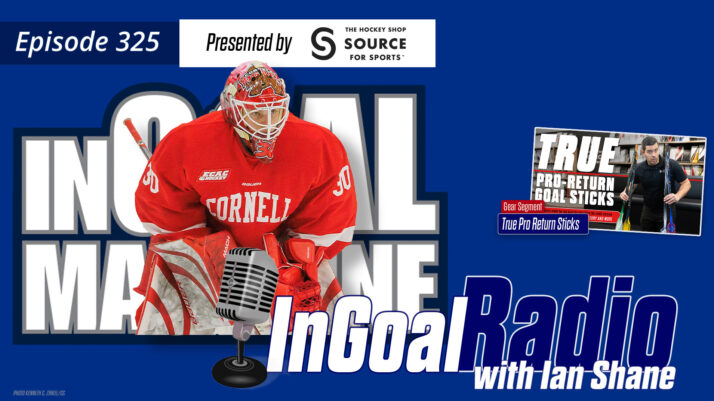
InGoal Radio Episode 325 with Ian Shane

Please subscribe and leave a rating — it helps us reach more goalies!


Cornell University standout Ian Shane credits skating with Calgary Flames goalie Dustin Wolf and working with personal goalie coach James Jensen as key factors shaping his technical development and trajectory toward professional hockey. Shane, a 6-foot goalie entering his first pro season, emphasizes disciplined time management as one of the most transferable skills any goalie, coach, or hockey parent can apply to development.
- Training alongside Dustin Wolf and working with goalie coach James Jensen significantly shaped Ian Shane's technical foundation and professional mindset.
- At 6 feet tall, Shane offers specific insight into how smaller-statured goalies can thrive at the professional level through technique and positioning.
- Dustin Wolf identifies reading shooter tendencies as the key to his elite performance on breakaways and shootouts for the Calgary Flames.
- Parents can support young goalies most effectively by staying involved in development in a positive, relationship-building way rather than a pressure-driven approach.
- Shane uses NHL Sense Arena virtual reality training regularly, highlighting its role in modern goalie development at the collegiate and professional level.
Episode 325 of the InGoal Radio Podcast, presented by The Hockey Shop Source for Sports, features an informative interview with Ian Shane, a Cornell University standout embarking on his first pro season.
Feature Interview
presented by NHL Sense Arena
In the feature interview appropriately presented by NHL Sense Arena, because Shane is an avid user, we get into his path from California to Cornell, how a chance to skate with Dustin Wolf and his personal goalie coach James Jensen shaped his trajectory and technical focus, keys to thriving as a 6-foot goalie, key advice on time management that will benefit any goalie (or coach or parent) and so much more.
Parent Segment
presented by Stop It Goaltending U
In this week’s Parent Segment, presented by Stop It Goaltending U the App,we talk about getting involved in your young goalie’s development, and how to do it in a positive, relationship building manner.
Pro Reads
presented by Vizual EdgeWe also review this week’s Pro Reads, presented by Vizual Edge, with Dustin Wolf of the Calgary Flames explaining the keys to his incredible success on breakaways and shootouts.
Weekly Gear Segment
presented by The Hockey Shop Source for SportsIn our weekly gear segment we go to The Hockey Shop Source for Sports to show off some of their latest Pro Return sticks from True, including one from a three-time Vezina winner, another from a two-time Cup Winner, and a unique shoulder grip from a soon to be first ballot Hall of Fame goalie.
Episode Transcript
Intro
Another stacked lineup on InGoal Radio Podcast presented by thehockeyshop.com, The Hockey Shop Source for Sports Langley. Over at The Hockey Shop, they are getting things going, really turning things over. Stuff comes in, stuff goes out. It's, very quickly. We've got our Gear Segment, brought to by the Hockey Shop.
The Vizual Edge ProReads stop goaltending parent segment, with David Hutchison. And Sense Arena feature interview, we are highlighting a newly turned professional, Millard along with Kevin Woodley. How are you, buddy?
I'm good, Darren. I'm good, my friend. Yeah. We got Ian Shane on the podcast today. And while that may not be a household name to many, I expect we'll hear it more and more as he turned pro this year.
He's starting with Kansas City in the ECHL, a MVP of the ECAC, a Ken Dryden Goalie of the Year Award winner at Cornell. So and a fascinating guy who leaves no stone unturned. So lots of good stuff in this conversation.
Hey. Did you hear Anthony Stolarz's postgame the other night? It it got a lot of traction around the hockey world outside the the goalie crease.
Yeah. Probably because somebody in the crease actually spoke up for a change. Right? Right. And and and that's the man, I don't know where that line is because I've never been in an NHL room outside of being an impartial journalist observer.
Well, I guess part of that career is covering Roberto Luongo as captain and putting the C not on his chest because you can't, but having him painted on his mask and calling him the captain, that was the biggest issue. I can tell you for sure. Ian Clark was the goalie coach at the time here. He told them not to do it. Because as much as Luongo was the leader of that team, it puts him in the position to do exactly what Stolarz did, which is judge the guys in front of him.
And if you judge the guys in front of you honestly, I like, I'm not sure that goes over well coming from the goaltender because they can make a bunch of mistakes that don't end up in the net because you pick them up. You make one mistake and it's in it. Like, I just feel like the spotlight is bright enough already. And being put in a position to answer as candidly as Anthony did postgame, just brightens it that much more. So, hopefully, he's up for it because, you know, there'll be a lot of well, there's the potential for a lot of side eye if the next time he's between the pipes, it doesn't go so well on him versus on the team.
It's a no win when you answer questions like that. But I also feel
Great way of putting it.
It's it's hypocritical as heck to be to be judging a goaltender for saying what Anthony Stolarz offered and not judging a forward or defenseman for evaluating their team. What's the difference? They're both they're both playing for the same club.
Yeah. Absolutely. And you're right. Like, it's it it's not fair. It's just kind of the way it is.
Right? Like, candidness just inevitably like I said, it just inevitably brightens the spotlight. And it's not like Anthony Stolarz can't handle a bright spotlight. He's the number one goaltender with the Toronto Maple Leafs. Right?
And probably some frustration there on his part because, hey, guess what? He got run again. And as much as he I don't think he was critiquing the team for allowing that to happen, certainly, when he got run by a charging forward was different than the one I hate is the when your defenseman deposits a guy on your lap, and it's just like an MCL waiting to pop. And there was one of those incidents as well in that game. So, like, I understand the frustration.
I don't think goalies shouldn't be allowed to do it, and yet I've lived long enough to know it usually doesn't go the way we hoped.
Have we seen a bit of a turn in officials calling goalie interference on plays that are aggressively attacking the net? I feel like I've seen more penalties lately.
Yeah. Maybe that's because everybody's attacking the net. Like, you know and so good. I'm glad that they're calling that penalty because there is nothing worse. I think it's one of the the league's biggest failures when it comes to protecting goaltenders is when referees and I think video review made this even more prominent.
Referees always used to say to the goalie, well, if the puck had gone in, I I I would have disallowed it rather than, hey. That's a goalie interference penalty. You you're not dissuading the action. Right? So, yeah.
And I think video video replays made that to the nth degree. Like, oh, like, don't even have to call goalie interference. If the puck goes in, we get to review it and see if there was contact. There's been it feels like way more contact. We've already seen goalies go down, not necessarily because of that contact, but it's only a matter of time.
The crease crashing, I mean, it's taught every day in practice. Stolarz got running and said we need to do more of the same at the other end. Right? Like, so this is the nature of the game. Traffic around the crease has never been more difficult.
It's the high speed off the rush that always looks scarier, and I think where we could see more injuries, and it sure feels like we have a lot more of that. Guys just putting their head down and cutting through.
Well, they're
told there's Get to the net. 100%. Right.
Get to the net.
And Right. And I
and hardly even fault them even though it would drive me absolutely out of my mind if if you were standing there. But they're they're being instructed to get to that front of the net.
Yeah. And and some and sometimes they get rewarded. I think it was a game you had. It might have been against Dustin Wolf. Jack Eichel cutting through the crease breakaway puts the puck and Dustin Wolf's left pad into the net.
I would've challenged that. Even with the puck, you can't push you can't push the pad over the line. Like, I think that
would have helped you challenge that. And and I said, if it was a rebound play or a scramble in front of the net, I don't think that play would have counted. But because he was in the act of shooting and touched the pad and pushed the the puck in the pad across the ice line, I thought it was okay.
By the rules, it's actually the opposite. We saw it in the Vancouver game against Charlie Charlie Lindgren covers a puck in the crease, but Evander Kane's stick is already there as, hey. Guess what? Part of a crease collision. And he literally with his stick with the puck under Charlie's glove, lifts the glove with his stick and pries the puck out.
And in the ensuing scramble, the puck ends up going in the net. And the definition shared by the NHL was that you can move the goalie's equipment in a scramble to create a loose puck. And and if the puck goes in as as a result of that later, it counts. You just can't move the goalie's equipment over the goal line. And so by the letter of the law, as much as Eichel has the puck, he also pushes the puck and the pad into the net.
And Wolf has the pad there. Like, he's in position to make the save. He's he's the pad's got enough levers to stop the puck. I so it's been it's been really interesting. There's been a it's not just that one.
There's been a couple there's been a couple that have gone the goaltenders way that I don't think should have. Loose puck at the side of the net. Vancouver against Chicago. I you know, somebody's gonna knock on the door and take away my goal of the Union card, but I think it's Tyler Bertuzzi whacking away at a loose puck. And Lankinen loses his cover.
Like, he he's not able to hold the puck on against the post. The puck goes in. They say that that whacking at the puck was goalie interference. But if you actually look at the play, he didn't have his inside edge, and so he was off balance anyways. And I don't know that he would have been able to hold it.
So if that's not a goal, then certainly pushing the pad over the goal line, in my opinion. And by the way, I'm reading the rules would have got called back too. But it's again, we leave so much gray area as a league in this. And and with coaches wanting guys to go there, part of that gray area is allowing more collisions than I think goalies are comfortable with, and we'll probably see more guys get injured in a year where we're already seeing teams dig deep down the depth chart, and we're, what, three weeks, two weeks in?
I can't remember which game it was, but, I did see a player called for goalie interference for making contact with the net minder on a breakaway. I hadn't seen that before. That was
I've been so I've been concussed playing three on three doing that.
On a breakaway.
Guy came in so hard, cut through the crease, and he was so in tight that his elbow went right across the side of the head.
Wow. Hey. Is is a goalie with puck battles, is that considered a skill? Is is that an area that you can train that you can get better at? Because reaching for those pucks, battling for those loose pucks in in front of the net, like, you can you can cut down on chances significantly if you're able to retrieve those.
But if you're not able to or willing to just roll up your sleeves and get after that puck, it can make life difficult for you.
I think it's a fine line between chasing them at at the expense of coverage. I remember Michael DiPietro. We've got a a drill up at ingoalmag.com with Michael DiPietro when he was with the Canucks, and it's just him by himself working on a little sorta down low crease movement with a puck out in front of him and, you know, slide it back and forth on the knees, stop, and then being able to reach out, grab that puck, and pull it in without breaking the seal along the ice.
I love that.
That's the risk. The risk is as soon as you sprawl out, like, Lindgren and, like, to me, again, I didn't love that call, and then I saw how the rule was written and realized it was it was the right call even if I still hated it. Like, he extends forward to cover that puck in a scramble with this glove. He gets his glove on it, gets pried out. But because he extended himself like that, he's got no net coverage.
Like, he's prone. He's he's fully, you know, belly flop forward to cover a puck. So it's a real fine line. You have to pick your moments. When do you sort of give up your coverage to swallow up that puck?
And when do you just stay home because, yeah, okay. It's crazy. It's a battle, but at least I can it's not going through me if I build a
wall It's like a race for the buck.
Behind you. Yeah.
Are you better off to sit back?
You better make sure you win it. Let's put it that way. And in that case, actually, like, as I've as I discovered in that one and, like, again, like, you're Charlie InGoal, you're fuming because I I hated the call in real time until I saw the explanation and realized that maybe by the letter of the lot was okay. Like, there's nothing worse than feeling like you have your glove on a puck and somebody knocks it out from under you and it and it's allowed to continue. So he actually won that race.
I thought Ty should go to the goalie. Like, Ty goes to the runner in baseball, but I don't think it does.
And it feels like every time that there's one of those fifty fifty plays, the pucks ends up in the back of the net.
Yeah. Why?
I mean You know it right away. As soon as soon as you're in that, like, oh, this is going the wrong wrong direction.
Well and then, I mean, that's the again, that's the reality. As soon as you pitch forward to cover it, like, you've lost your ability to move. Like, you're prone. And so that's that's the balance. Can you but in some of those battles, like, just reaching out a stick and trying to pull it towards you, you know that's not gonna be enough.
And the desperation, you just wanna we talk about controlling play, like, not not allowing loose pucks around your crease. It's tough. It's part of the decision making process. I would encourage people to go find that DPietro drill. It's a good one.
Gear
And before we get to the, pro returns, On Tap in this week's, gear segment, what's happening over at the Hockey Shop?
Well, they've got a ton of pro returns is if you follow their social media, and if you don't, I would highly advise you do because they also go over as much as we do here with our gear segment, New Gear, they highlight stuff that's coming in. And and I gotta say, it's been remarkable to watch the transformation of the industry. How much new equipment is coming in even in September, October. We've got a new launch from Brian's coming up soon. We've got a new stick sort of holiday season stick from Bauer coming in.
There's always new product coming in. This time of year added bonus pro returns. We get into it on true, but they've also got a a a great selection of CCM pro returns. You get a unique chance at times to try out different styles, different shaped shoulders, trigger grips are quite often part of the equation. And as we find out this week with the true pro returns, you might even be able to grab one that belongs to a future first ballot hall of famer.
Oh, There is a large variety of shoulder shapes on our laps right now, and some of the biggest names I see a three time Vezina trophy winner. Might have a heart trophy now. Kind of a dead giveaway there. One of the goats, like, he's he's flirting with he's flirting with that what do they call that with the, you know, the the four statues and the faces and the Goalie Mount Rushmore? Mount Rushmore.
Thank you, Cameron. It's been a long morning. There's a two time cup winner. Man, there's a lot of talent on my lap right now. It's true.
Oh, nicely done. Welcome back to The Hockey Shop Source for Sports where we have the Pro returns from True, including one that I'm sure InGoal Magazine readers are gonna recognize the very unique shoulder shape on the top of the paddle of one recently retired Marc Andre Fleury. And, of course, if you're an InGoal Magazine subscriber, ingoalmag.com, you've seen Fleury demonstrate on video to InGoal why he switched to this and how it helps him get his blocker sealed in a butterfly. That's the biggest reason. So you've got that video on ingoalmag.com.
We've got some unique ones here from
I do.
Yes.
Connor Hellebuck. I talked about three time best trophy winner and a heart trophy. Yes. You see Saros and this one. This one will be popular because even though he never actually used true or that I'm aware of in a game, he switched from CCM to Bauer this season.
This is the Bobrovsky paddle shape that everyone wants, and that is Bobrovsky's name on the shaft. Cam, where'd you get all these great Pro returns from True? I'm guessing from True. Good question. Is why I'm the journalist, buddy.
This is why I'm the journalist. Hard hitting questions.
Did you get these from True? Yes. It's True. I got them from True.
Good job, Kev. So walk me through outside some of the unique, like, like, great chance to try some different shapes. We hear a lot about Bob
Yes.
And his. We hear a lot about people shaving theirs down to try and be like him. Don't shave anything down. Just get one of his sticks. So So there are
multiple lines that are crossed, like, in terms of for, like, versions of the stick. Mean, we have a nine x three. We have a As
it is nine x four.
It it is what you see what
you get because quite often at the pro level, they get skinned as the latest, but they have old style preferences.
There's there's some wacky things going on here, and I think So
you may not know what you're getting.
To a little bit of a degree, and I think the best highlight of that would actually be what I'm holding right here in Connor. Hello. Connor stick. I mean, a guy to Heard him. Use things that aren't necessarily what they look like right a 100% off the bat, sighting his pads in particular.
This would go for the stick as well. This feels like a sandwich of their old, like, hair trigger six point o sticks. Like, there's a lot going on in here. I mean, takes a little bit of a deeper dive and that might be something that you would you know, between him and his actual stick manufacturer itself. But that said, it's definitely different.
I I can't compare this to anything else that's on the wall as of currently right now.
So lots of different colors, lots of Oh different my goodness. Look at that. That's pretty clean. I like that. And
a little bit of that shorter shaft too as well. 24 inch paddle for those that are actually super, super curious. There are some various different paddle heights in here, and that is gonna be player to player dependent. There's not a lot of consistency here in that sense. In terms of overall feel wise, in general, again, as what they are listed as as a starting point, that can give you a bit of a generalization.
But being the inherent nature of Pro Returns, yes, there are gonna be some different materials and different feels than you would find off a standard stick off the wall in the comparable. Mine.
Now Pro returns. We've been down this path before, but let's remind our audience, you're saving money. It's cheaper than buying a nine x four Hzrdus off the rack new, but does not come with a warranty. That's correct. Just
like the NHL guys. You break it,
you bought it. Well, you've already bought it, and then you break it. But that's you need you know what? It doesn't matter. That's okay.
So if you have some more questions about them, you can give me a call. (604) 589-8299 or 1805677790. There or check them out at the hockeyshop.com. However, there are some various different curves here. We can try our best to kinda compare it to, you know, what else is stock on the wall.
There are some custom curves here for sure. So, yeah, you wanna chat more about it?
This this is one of the ones that are like, Cam will help you out to find one that you like. Man, if you had a chance to come in here, I could spend all day just going through the stick rack with the Pro returns they have. There is a there's some fun stuff in here.
He's already made a mess of the stick rack.
We gotta ask Kevin Lankinen about this unique. Kinda reminds me a little bit of, like, Philipp Grubauer has one of these that we've also got at ingoalmag.com about sort of the staggered inner paddle. So just some great stuff here and your chance to own the same stick the pros use at the Hockey Shop Source for Sports.
That's pretty good. You could almost be a collector. Like, somebody that's that's just, loves their hockey gear with, like, jerseys or pictures if you get a a Fleury stick.
I I mean and and especially that one. Right? Because, again, refer to ingoalmag.com. Like, we have video of Marc Andre Fleury explaining the unique shoulder shape that he adopted in the final year, year and a half of his career that's on that true pro return at The Hockey Shop Source for Sports and how he got the idea from Carey Price. And so another good video at InGoal Magazine.
If you watch that one and you're like, I think that would help me, you could go stock up on Marc-Andre Fleury pro return true sticks. Now, also, I'm with you, Daren. Like, if you think you're gonna see Marc Andre Fleury at any point, like, to have one of his twigs actual made for him twigs and get a little scribble on there, like, that's the kind of stuff that ends up on the wall in the office for sure. I mean, one of the all time greats.
I've been, working on my sticks with a saw.
Oh, really? Yeah. A little home repair.
Cutting down the shoulders, putting in trigger grips where I could. It's harder now with the sticks than it was with the foam core and even the way back when with some of the wood ones, but it's it's unique. It's fun. I'm not an expert yet, but I've become more adventurous with it.
Okay. So what are the what are the guys in the room think when they see us or any of the other goalies seeing your your in your inventions?
Oh, I I have a I have a buddy who who we we wrote the rec league, and he thinks he calls me Frankenstein.
Okay. See, think that's not a bad nickname to have. There's a lot of guys that wear that with pride in our industry.
Frankenstein sticks. And every time one breaks, he's like, that's because you're saw I'm like, it wasn't even where it broke. So But but I'm trying everything. I've tried the Bobrovsky, really, slanted shoulder.
They've got those at the Hockey Shop.
Oh, nice. Yes. And I've done a couple of trigger grips. So yeah.
Just so know, the word is steep, not slanted. Steep shoulders. Now I have a couple questions here. Having broken more sticks than I care to admit, even though I use my warm up stick. That's right, folks.
Carbon there is nothing worse than carbon fiber slivers.
Yes.
How how do you do you wear gloves when you handle these things or when you're using power tools? And and I ask this as someone who's not allowed to use power tools for fear of trips to the emergency room due to my own incompetence. Does it cut clean, or do you have to worry about the the slivers and then get some tape on there quick?
Oh, I I I have to worry about slivers, but I try and keep my hands clear, and then I'm taping it immediately. And if I don't cut all the way, I've got a pair of pliers there that I just snap it and then file it down.
Alright. We're gonna be doing, like, you're gonna be like Tim the tool mantel. I love it. Tool gonna time with Daren how to how to grind down your sticks.
It's one of my favorite things. I've sewn up my upper body gear so far this year. I patched my pants this year with
You heard the
patches and glues.
You are the Ryan Miller of the InGoal Radio Podcast.
I love it. I enjoy getting deep into it. Our equipment staff is amazing because I'll say, I need I need a needle, and they'll give me a needle and thread.
Oh, do you get the big, like, the big Yeah. The big, like it's like a c curve knee yeah. Like a hook needle, but it's like it's like I feel like it's it's not a half a centimeter thick, but it sure I remember the first time one of the equipment guys shared one of those with me to repair something, and I was like, this looks like something out of a horror movie. You sew things with this?
And you realize really quickly, it's great. I fixed my blocker because it was coming separated just from glowing paddle down. Sewed that up. It's not pretty, but it's fun.
It's Frankenstein, baby. Daren Frankenstein Millard. New nickname.
I I enjoy doing it. That's our Gear Segment this week. Let's get over to Vizual Edge ProReads. Talking to Dustin Wolf, but before we get to that, a message from Vizual Edge.
Yeah. Well, ProReads is all about seeing the game better, and Vizual Edge is all about seeing the game and the puck better. It is a great tool to do just that. It's a cognitive tool. It's a vision tool.
That's why goalie coaching greats like Mitch Korn asked his goalies to use Vizual Edge both to assess where their vision is at when they first come to him and then to go out improving it. Jeff Glass of the Anaheim Ducks, Justin Peters of the Ottawa Senators. Coaches know it helps their goalie see the puck better. As Kasimir Kaskisuo said, if you're not training your eyes, you are falling behind, and there is no better tool to do it with than Vizual Edge. Just ask Jordan Binnington.
Uses the game day drills every game before heading to the rink. It's a combination of recognition, reaction, and focus that activates my brain and eyes to feel ready for what's to come. And, of course, because they sponsor the Visual Edge ProReads, Vizual Edge will give you 10% off all monthly and annual subscriptions using the code I n g o a l, all caps, InGoal, all caps, to save 10% on Vizual Edge monthly and annual subscriptions. And even better, if you're an InGoal premium member. And why wouldn't you be?
Because you get to see ProReads like the one we're gonna discuss with Dustin Wolf on breakaways. You get 20% off. I can't give the code over the air. You need to be a member. Log in to AnyProReads, and you'll see the code to receive 20% off Visual Edge cognitive and vision training tool used by the best on the ice, used by the best in the goalie coaching room.
Why isn't it used by you? It will improve your ability to see pucks, and it is so crucial. So make sure you check out Visual Edge at our ProReads this week featuring Dustin Wolf.
How bad for Wolf? Dropped a 2-1 decision at Winnipeg. Their team just can't score, and it's hard enough playing in the league. If you've played at any level for any length of time and you end up on a team that can't score, you know that little angst, anxiety that's that's around you if you if you let in two that the chances of you being successful are are very limited, and it's even more heightened, in the National Hockey League and with the challenge of the Calgary Flames right now.
Oh, it's a very real thing. We've we've talked about this with the Anaheim Ducks. John Gibson went through it for years in Anaheim. Ryan Miller, you know, shared thoughts on that. What it's like, it is so hard as a goaltender to go into a game knowing that one or two is one or two too many.
Like, that you almost feel like you have to be perfect. And listen. Like, Dustin hasn't been to start the season for sure. They're giving up, you know, they're giving up a fair amount of great a's. They're not the worst team in the league defensively, but they're certainly asking him to basically play Superman.
And the reality is he did last year. Like, his numbers we've talked about were right up there with Connor Hellebuyck on a per shot basis in terms of how he performed relative to his environment. You couldn't see it because the environment wasn't as friendly as what Hellebuck and company had in Winnipeg and other goalies around the league, but that's how damn good he was. So I'll I'll tell you, it may not be the start that he wants, but knowing Dustin Wolf, he will, and I thought last night was the start of it, turn this around. Whether it's enough for the Calgary flames, he will figure out a way to deal with all these pressures.
That's just the type of kid he is, and we all know how good a goaltender he is. And while it may not be going his way overall to start the season, it sure does anytime you get him on a breakaway or a shootout, and that's the focus of this week's ProReads. We we promised you this one. We've had a lot of Dustin Wolf lately in part because he's so damn good and so damn popular. The people's goalie, everybody loves a six footer.
We will have one in the feature interview this week as well in in Shane. But the way he holds his edges, we saw it in that opening win against Edmonton, the way he manages shootouts, the way he manages breakaways, it's so impressive. So when after we discussed that last week and what allows him to succeed, we had to go back to him because that was part of our ProReads when we connected before the season. And he walks us through sort of some of his keys, why he's able to hold edges, why he's able to stay so patient and not bite on moves in this week's ProReads. Make sure you check it out.
There's a little bit on depth management, matching speed, but mostly about sort of managing that ability to widen out without becoming prone to early commitment down to the ice.
I was on the ice with a couple of guys in the weekend, and I had it in my head, the dusting wolf, like, wide and on his edges. So I just started screwing around with it for a couple of minutes. You can't replicate it. You you can you can look at That's not for us mortals there. But it's it's like it felt so vulnerable while doing it.
And I don't know how he does it. It was it it was impressive to see. It's more impressive when you try and do it.
Yeah. It's I mean, it is truly remarkable. He does it to the end. That's why we wanted to focus on it in this week's pro. It's he does it to the nth degree.
Right? Like, this is it's a little bit of a tough one for ProReads because it's not like, hey. Look at this. Look what he does. Go do that.
Because because most people can't. Right? Like, his ability to sort of have his edges on the ice when his knee is barely off it, you know, it's a small list of guys. It's him. It's just there can but then to be able to still generate power from that width is it's incredible.
And the patience that comes with it, it's, you know, it's gonna be but but, again, part of it too is, like, anytime you're that good on something, I think I said last week, he's where Deeks go to die. I I I teams are gonna be like, well, if we can't beat them this way, let's just walk in and shoot. Right? So that's where that managing your depth and making sure you're not retreating too quickly, that you're at the top of your crease when the play hits the hash mark on a shootout or on a breakaway. That's gonna be key to this because as good as he is down low and tight, if you try and go east west on him, unless you push the puck and the pad over the goal line, cough, cough, You know, you're gonna have a tough time beating him, and teams will be like, well, if we can't score this way, let's score the other way and start shooting.
Yeah. His ability to maintain his explosiveness while he's so steep and wide out is is mind blowing. Hutch is standing by with the Stop It Goaltending U parent segment, getting involved with your child's goaltending and goaltending development. But first, Stop It Goaltending U, the app.
Well, we've talked about it every week, and I would remind you folks that if you get a subscription to Stop Stop It Goaltending U, the app, you also get a subscription to InGoal Magazine, InGoal Premium, all the great articles that we have up there, the complete archives, those ProReads we just talked about with Dustin Wolf, you get all of them. You get over 300 video sessions of us sitting down with NHL goaltenders breaking down tape. You also get the Stop It Goal Tending U app, which includes similar type breakdowns at times from the coaches that Stop It Goaltending U and their twenty five years of experience. But this week, they break down clips with Arizona State University goaltender, Sam Urban. So they're mixing that in.
You get the daily primers where Brian Daccord gives you quick one minute videos to help you become a better goaltender. Little lessons that'll stick with you, but don't take long to digest. This week, they focus on decision making under duress. Goalie systems, they break down speaking of Dustin Wolf, they break down the success of small goaltenders and what is key to it in their goalie systems video. And in the drills this week, they've got a variable net drive drill with behind the net and pass out options.
It's actually one that I'm thinking of breaking out with a a team with a couple young goaltenders that I've started working with because the team gives up tons of behind the net pop passes into the middle. So this is a drill I think we might incorporate in practice next week. So you could find all those things every week on the Stop It Goaltending U app. And a reminder, you get a full subscription to InGoal Magazine premium.
So the parent segment this week, Hutch is going to dabble into getting involved with your child's goaltending. I know that you have an angle on how to go about that or experience, with that, and will lean into your path after Hutch offers his tip.
Parent Playbook
I've alluded to parts of what I'm sharing this week in the past, but I want to collect and emphasize a few of them together today. Get involved in your child's development as a goaltender and a young athlete. Of course, you are already involved in so many areas of their life, but I wanted to share a few thoughts on how you can be actively involved in their development on and off the ice. I know you already work hard to provide them these great opportunities from earning the funds to support this expensive position and driving them to to rinks near and far and so much more. And in the busyness of life and already doing so much, we often forget the impact we can have by doing just a little bit more and more importantly, doing it together.
They love that you come to watch their games and practices, I'm sure, but that's not really a shared experience. Your kids won't remember the car rides much, and they certainly have no clue how many times you reach for that checkbook. But if you take ten minutes here and there during the week to do something as simple as toss a ball together or even learn a new skill like juggling alongside them or even have them teach you, those moments will be remembered forever. It's really that simple. If you hope your child will do some extra training at home and lead a more active life, why not do it with them?
Maybe you can't do every exercise or sport, but you can do some, and the act of modeling as a personal dedication to training will instill the same dedication in them. This isn't about pushing or nagging or requiring. It's showing them a shared love for something, and it can't be forced. People often ask how they can get their child more engaged, how they can get their kid to work harder, and my answer is always the same. Model it.
Set the example. Many will say it has to come from within, that they have to be born with the drive and so on, but I simply don't believe that. You can't force your child to love training or to be competitive on the ice, but you can model it right alongside them. Show them that the best way to spend free time is being active from a backyard game of badminton to a hike on a local trail to maybe even playing goal yourself. I've met several goalies who started after their kids did and even asked their young goalie to help them learn.
Now how powerful is that? Okay. I know some kids will still not be competitive. We aren't all wired that way. I get it.
But I think this is the best way to find out. Look. You can even learn alongside them in other ways, maybe sitting down and going through our weekly ProRead together or, frankly, any other type of goalie education. You show them how helpful and fun it can be. If you have the experience, you can discuss the ProReads together.
And if you don't, you can ask them to explain what things mean. Nothing helps you or them learn more than having to teach. And especially when they're just getting started or quite young, I've said it before, volunteer as a coach if you're able. And as long as you can lace on a pair of skates and have the time, you can do it. Take the Hockey Canada or USA hockey first level of training.
They are designed for people just like you who've never coached goalies. And if your child is miles ahead of you in both ability and experience, you can still help. Simply being an advocate for goalies on a team and being available to support them if the coach will give you any amount of time to work with them can help. If you're not feeling confident, simply ask the goalies themselves. What do you need?
How can I help? Whether it's ten minutes here or there doing something like tossing a ball or investing in the time by committing to coaching or anything in between, it's the moment spent together that you will cherish forever. So go out there and make some time together this week.
I teased just your journey with, with your daughters. What did what did you learn during their path? It wasn't hockey. It wasn't goaltending, but, but we could all kind of relate and, and saddle up our own experiences alongside this this sport of hockey.
Well, I think and and Hutch touched on it. There's great pieces of advice. And I think when you hear something like get involved in your kid's development, like, you might be like, oh, really? Like, we don't want like, do they want us to be involved? Do we wanna be too involved?
But Hutch had so many great takeaways in there. They're gonna help you build the relationship. It's an experience, a positive experience when you get involved like that. But, also, how many times and this is mine. Like, how many times do we want them to work harder?
We want them to train harder. We're adults. We've seen what it takes to make the next level. Sometimes they're not aware of it. Telling them, let's be honest, it's not always the best way because they don't always listen.
Showing them. It's an old journalism rule. Show me, don't tell me. And so for me, it started last summer with my daughter who's now playing, div two college volleyball in The States, about the sort of the the habits required off the court. She loves practice.
Didn't always love training. And so me nagging her to train, not necessarily the best way to do it. Me committing to getting in much better shape myself and doing a similar level of workload and her seeing me doing that on a day to day basis, it sets the example. It's show me, don't tell me. Don't just tell your kids to do something you're not willing to do.
I put the work in myself to feel better physically. She followed that lead. My wife went to the gym with her so they would do. She can't do the same training. My wife can't, but she was there with her helping, you know, spot her on certain sets.
And so just again, seeing other people who used to tell you to do things doing it themselves, seeing them put in the work, it absolutely inspires kids to wanna do a little more. And and as Hutch said, I thought so eloquently, at the end of the day, it's the moment spent together that you get out of this, but there's ways to do it. You know, don't just get mad at them for not working hard. Show them what it looks like.
Great stuff, from parents for parents. Flip over to our Sense Arena feature interview. Ian Shane, going to be with us this week. Cool journey, Cornell guy, and now playing professional, all under the umbrella of Sense Arena and NHL Sense Arena.
Feature Interview - Ian Shane
Yeah. And, I mean, this is a perfect tie in. We we don't even need to do a read on NHL Sense Arena because Ian Shane uses NHL Sense Arena, and he'll tell you exactly how and why during our interview. But one of the things that we've really gotten into, and Hutch has talked about it the past couple of weeks, is game flow for goalies. This is a new feature.
One of the things that we talk about all the time, and and we've been doing this for a few years now with Sense Arena, is that it you don't just buy it as it exists right now. It is constantly evolving and constantly developing. And the latest release includes this game flow for goalies, continuous place simulation. So it's kinda uninterrupted. It's not just one drill, take a break, do the next drill.
It's kinda like gameplay, mirroring the pace and unpredictability of a real hockey game. You get high speed shots, live traffic, active screens, really challenges goalies to maintain focus over a longer period of time and adaptability as you get these realistic game conditions. Challenges continued focus and mental stamina, train through short or extended periods of in zone action, building on the mental and physical endurance essential for game situations. Rebound control, situational awareness, practice controlling your rebounds and reading the play under pressure, enhancing that decision making and reaction times off the rush with continued in zone play. So it's just it's a great new feature.
They're always looking for new features. We talked about the goalie advancement program and the last part that we I haven't finished the review on in part because I can't get into the headset right now with my eyes, But the the, traffic management portion of that, and that's something that Ian Shane discusses here, that's what one of the things that he really thinks he's gonna use it for even more in the ECHL as he's discovering in the program, traffic is even harder. You can go to practice and say, I wanna work on traffic, but nobody wants to get in the way. Your teammates don't wanna stand in front of the net and potentially get clipped by hammers from the point. So you never get the realistic.
You're probably most realistic practice version of managing traffic available is actually in virtual reality through NHL Sense Arena. So Ian Shane uses it. We'll hear about that from him coming up in a couple minutes, and we think you'll be a better goalie if you use it too. Game flow new from NHL Sense Arena.
Here's the feature interview on InGoal Radio, the podcast.
Really excited to welcome to the InGoal Radio Podcast. As I understand, a listener, so that's always good. And we have people that actually listen to the show. Ian Shane, first year professional after three years at Cornell, three outstanding seasons at Cornell. Wanna get into your experiences there, transitioning to life as a pro, which you're just starting, opening openings weekend right now in the ECHL.
First off, just welcome to the show. Thanks for taking the time.
Yeah. Thank you for having me. This is awesome.
California guy too. Mhmm. Which we're seeing increasingly in the National Hockey League. We we had a game recently where it was, Demko, Wolf, and Cooley were three of the four goaltenders. So Yeah.
The rise of California goalies. So let's just rewind. Like, how'd you get started, and who were your guys growing up?
Yeah. I think it was obviously not as big out there in Los Angeles where where I was when I was growing up. I my dad played college hockey at Hobart, and then he played a little bit professionally in Germany. So I grew up he was long retired by then, but I grew up going to his beer league games on Fridays and hanging around the rink and absolutely loved it. Hockey had always been a part of our family.
And when I got my opportunity to throw on the skates, it was incredible. And then I believe my second game of in house, we didn't have a goalie. So coach raises his air asset. Who wants to play goalie? I was the first one to raise my hand and just kinda never looked back since.
What I know I gotta ask is, was dad a goalie too or just just hockey?
No. He was not a goalie. He was a, he was a forward.
So So how do you feel about that?
He wasn't too excited. He I think he was hoping that I'd get in there, get shelved, and it'd just be a quick little phase and get on with, you know, teach me about being a forward and a defenseman. But, unfortunately and now fortunately, obviously, stuck with it.
Now were were there guys you you sort of you start playing just for love of the game. What did you love about the position? Were there guys you looked up to early? Who were some of the early win influences growing up in California?
Yeah. I think the guy I looked up to most is Jonathan Quick. You look back at his his resume from 2012, 2014, and getting to grow up in that LA Kings that you're watching those teams compete. You just want I think every goalie falls in love with sort of the pads like I I love throwing on the helmet, having the bigger stick and the setups and sort of the creativity you could have behind it. And then watching Jonathan Quick, his compete level, and how significant important part of a team he was for the Kings in that time.
It was something that motivates you as an athlete and a competitor to be like, okay, that's that's really cool to be on the spot and sort of be the guy, and that's something you wanna strive for.
It was there was there a point where at what point did you go from just watching and and sort of appreciating that to maybe emulating? Like, were there times where you're are you you hit a point where you're looking at how Jonathan Quick plays the game or how he handles a certain situation and trying to maybe bring that into your game. Although Quick is so unique. I don't know. As you talk about pads, like, I don't know if you've ever had a chance to sort of grab a set of his pads, but, you know, you could, like, they're so soft.
They're it's incredible. I don't think anybody else has pads like that anymore.
No. And I think he's still using I could be wrong, but the V4, V5's from god. It'd be close to twenty years ago now. He went when you go
There might be a little v two in there too as part of that.
I I I would imagine, but I'd say, honestly, it happens a little subconsciously earlier on in those years. Like, I was playing my first game as a goalie probably around nine or 10 years old. So I think when you're watching guys, like, Quick, you're not really overanalyzing at that age because you don't really know what should I be looking out for. How's he reading situations? What is he doing with his puck touches?
You're just kinda watching. You're like, wow. He's aggressive. He stepped out of the net. He's in a big squat.
He's pushing over into the splits. And so I think a little bit of that you start to emulate in your own game as a little kid. And then once you start working with goalie coaches out there and really start trying to get an understanding of the game and sort of thinking your way through it during practices, think that's when you start paying more attention to, okay, what is he doing on these situations? What does his edge work look like in the crease? Where houses What's his high stance?
His mid stance? His low stance? Things like that. What does he do with the puck when he's behind the net? So I think it kinda does take a little bit of an external influence of these people to come to you and start pushing the, the idea that you need to start being a student of the game as well.
What age was that for you? And who were some of those influences from the goalie coaching side that were like, hey, like, like, take a look. I I mean, I'm instantly loving what I'm hearing in terms of just how in-depth you're talking about multiple stances and things like that. When did that start, and how has that evolved for you over the years in terms of how you look at your game, how you watch others?
For me, my I started with Jamie Storr, was sort of the goalie coach of the Junior Kings in Southern California. And then I actually met Dustin Wolf and his mother through a couple of skates and started talking to him about his goalie coach, and my dad was talking about him. And I ended up working with James Jensen down in California who's also works with Lyle Mass. So that was probably around 11 to 12 years old and sort of really getting into the philosophy of hedge trajectory in the modern game, I think, was huge. So probably about 12, 13 years old was when I I decided, alright.
I'm I'm a head trajectory guy, head first on everything, is sort of the philosophy.
And that's interesting because I had no idea that, like, James Jensen and obviously Lyle are two people that I know and I didn't realize that those influences. So what does it mean to you? Caught me off guard there. I didn't do my homework here in well enough. Obviously I should have sent Jenner a note and then I would have had the whole, you know, when you say that, because a lot of people have heard that and that phrase means different things to different people.
I think there's a lot of misunderstandings around it too. What does it mean to you?
To me, and I've, I've also worked with PJ Musico, who's also another student from James Jensen and Lyle, but so many of the mechanics in your body, it comes from one, mentally getting the information first. What are your eyes seeing? What are your eyes taking in? What handedness is he? Is a one timer?
Is he a threat? Is he not a threat? And then also understanding that sort of the head and the neck and that downward motion drives the rest of your body to to kind of come around. And obviously, I think for every athlete, the legs feed the wolf, but the head obviously kinda, you know, sends the information and sends the angles and everything that the legs need to do sort of prior to the actual movement. So to me, it would it would just be head first gives you the most information cognitively and physically.
Okay. Was gonna say, and, like, and and, like, eyes first is something we hear a lot, and I think that's a pretty common thing. Right? Like, in terms of, you know, visual attachment, getting that information early, leading with the eyes, Is when you add the head to that or you say head instead of eyes, is it about the way you move your head as opposed to just look at the puck faster?
Yeah. Because I I think sometimes every goalie gets caught. You're sort of looking with your eyes first a little bit instead of bringing that head around. And your eyes go first, and you kind of start extending yourself and reaching out a little bit as opposed to bringing that head down and trying to keep your eyes perfectly in the center of their sockets. That's where you're gonna be the most stable.
It's where they're gonna take in the most information. That's obviously if you're facing the puck. If you're on angle, you'll have the most access to the puck. So getting early eyes is important, but getting that head around is, I think, just as equally important.
Builds rotation too. So obviously. Absolutely. Yeah. Okay.
So, I'm curious now too, like, the relationship with Wolf, was it just at that point? Obviously, a guy that we know pretty well and and I mean, his edge work and his, describe your game for me because you guys have one thing in common from a height perspective. You're- Absolutely. You're thriving at six feet. What, what have been the challenges other than perception that you've had to overcome at that and how, you know, like, maybe walk us through your game and how you've succeeded at this level?
I mean, all the success in the NCAA now transitioning to pro and and how you what you think the keys to that are.
Yeah. I think perception is obviously the biggest obstacle is everybody. I mean, I I had my my exit meeting in Coachella Valley after the American League camp, and it was very positive meeting. It was same thing was brought up. Was, hey.
You're, yeah, you're an undersized goalie, so just go prove that you can do it. And it's like, alright. Well, even still here after having a college resume, junior resume, stuff like that still comes up, but it's not as important. I think what's really more important is, you know, kind of the process every single day, proving to yourself, proving to your teammates that you can be a good goaltender. And it was honestly a blessing for myself to get to work with a guy like Dustin from ages probably 11 through 14.
He was he was kind of the other guy on the ice with me and James Jensen. I took two years to be homeschooled actually in middle school so that I could kind of get some of that time in the mornings, whatnot, to really be able to hone in with Jenner. And I think that paid huge dividends for me down the road. But just getting to watch his game sort of his compete level and his approach every single day. I mean, he's he's a guy that we were 13 years old, he's doing a full dynamic warm up and high trajectory stuff and having a protein shake after skates and a full cool down.
And, you know, I really I just didn't appreciate the nutrition aspect of it yet. I mean, I'm 12, 13 years old. It's it's hard to at that age. Looking back, you wish you did. But Well,
I'd say, hey. At 13, you're asking dad to take you for Slurpees on the way home. Let's be honest. I mean, at least most of us were.
Yeah. Or asking for a Chipotle stop or something like that. And, I mean, that's why Wolfie is obviously having the success that he has. It's just he he pays such great attention to those details, and that's something that I I try to bring to my game, especially nowadays is really honing in on the nutrition, the sleep aspect. I use the the whoop band to kind of track my sleep and my strain throughout the day.
So that's the stuff that obviously he's been a pro. He's been at this. He's been treating himself as a professional for long since before he even went to junior hockey, and, like, that's something that I tried to emulate a little bit. Once I went to junior hockey and college hockey, you're just you're learning the game at a higher and higher level, and I'll try to just take all those lessons I learned into, into my first year of actual professional hockey.
Well, I guess the benefits too, like, junior and and and now in the ECHL, especially, like, like, NCAA, it's weekends and the track like, it's a probably a little easier to maintain some of those things. But junior, the bus rides, and the, you know, what you're about to embrace in terms of bus rides and that lifestyle, it can be hard to stay on top of some of those things. So coming in and not having to learn the importance of nutrition, I don't know how many guys do these days, but I still hear from some that are, you know, this is a first time thing. That's gotta have a benefit. Do you do you see the payoff?
Like, you know, let's go through junior, like, two seasons in junior, USHL with Chicago, NAHL with Bismarck. Do you see that you compared to other guys who maybe hadn't figured that out yet, the benefits?
Yeah. I think it really paid off my freshman year of college when, we had a few younger guys who were kinda struggling with the academic piece just because going from junior hockey to college hockey and taking those years off, it's it's hard to sort of get that schedule back on track. You're managing the fatigue from we had early morning lifts, then I have to go to class, and then I have to go to practice after class, and I got to do homework. So that time management and that kind of prioritizing sleep and nutrition as my fuel to make sure that I could maintain a good level of energy throughout all those things was huge for me. I think that was something that will hopefully make, I think, professional hockey easier when you take the academic piece out of it.
And it's just okay. We got practice in the morning. I have the rest of the day to refuel, rehydrate, recover.
Obviously, somebody did a really good job in the homeschooling because you went to Cornell. So not a lot of people even getting into Cornell is a challenge. Maybe some advice for young goalies on how you went about you know, time management is something that I'm into. I'm 52 years old, and I struggle with time management. One of my one of my biggest challenges right now.
So maybe for me, for all those young goalies out that are trying to figure this out, like, how did you how'd you go about it? Like, because because some guys have different systems, different plans, different tips along the way that help them sort of, you know, get a handle on taking better care of their time so they can take better care of themselves and be better prepared to play.
Yeah, I think looking back on it, I have such an appreciation for my parents and the way that they approached my whole development, my upbringing. It wasn't, Hey, we're going to homeschool you so you can become an NHL hockey player. And that's what you're doing. And they're pushing me. Was, Hey, you're in California.
It's tough. You're you're on a triple a team. I was playing for the California Wildcats, so I'm practicing down in Riverside. I live in Manhattan Beach. I'm going to school.
I went to Loyola High School, which was an hour north, and then I'm driving two hours south for practice. Like, I just didn't have a life outside of hockey, barely got to see my friends. I couldn't really be a part of the school culture very much because I'm leaving all the time for practices or for tournaments. So for the homeschooling aspect, I think it was my parents saying, let's we got to try and give him some time back also. So get these practices in, and then school is really two or three hours a day.
You cut out the recess, you cut out lunch breaks and arts and crafts, all this other stuff, and kind of just hone in on what are the things that is part of the education that is actually important. And I was in a program, it was called k 12, like a California Virtual Academy. So I did have a structure and a system. It wasn't just my parents kind of trying to shoot in the dark there. So that also helped.
But I think for a lot of people, especially at that age, your structure around you is so important. And it's hard for any kid to manage their time when you go to class for seven hours, then you have practice, and then you have homework, and you just you feel you burn out pretty easily. It's hard to find that time for yourself. It's hard to say, Okay, I have a few extra hours of my day. Is there something I can work on?
Is there something I can do to make myself a better hockey player? Or should I just, you know, relax? Should I take a little bit of a recovery day? What can I learn about myself in this time? So just trying to find ways to get that time back is really important.
And then for managing time when you're older, it's it's really about accountability. I mean, the not spend in in college, you'd see guys spend a little too much time at the dining hall, or they would sort of marinate a little bit too long after practice in the locker room. Those are just thirty minute periods that add up over the course of a week that you can get back. And that, like, the same goes for in high school. You know, not hanging around the rink too long or hanging around with your buddies too long or too late, like prioritizing your sleep.
Like, there there are ways to get fifteen, twenty, thirty minutes back throughout the day. And over the course of a week, that could be the difference in a few hours.
That's such a great piece of advice. Sometimes in the moment, it can be hard to recognize that. Did you have anything that other than just sort of like, was it all just self awareness, or did you do anything to map out that time and and sort of understand you could, you know, you'd be able to sort of quantify and see it. And then when you can, it probably helps you realize what you're getting back. Right?
If you save that 15 here, 15 there, 15 there, and then you do get a chance to take some time for yourself, however you choose to spend it.
Yep. That was something that I think my parents did a great job facilitating. Driving to the rink a couple hours there and back every day and going to high school that was about forty five minutes away. Lot of time in the car, obviously. And a lot of time, my parents like, you can't you can't waste this.
If we're going to be in the car, you want to keep playing hockey. You're going to have to get homework done on these drives or do something productive towards school. Like, you're just losing time. You're burning time sitting in the car. So I would do homework on the bus rides and the car rides and just kinda made me realize that, yeah.
Okay. I do have those those time periods. I I am able to get something done here. I don't wanna waste that time.
It's great. Great lesson. So you get to college, and as you said, that obviously pays off because student athlete is not an easy thing to do. My younger daughter's first year right now figuring that all out herself, and it's hard. There's a lot of demands, the amount of lifts, as you said, workouts, practices.
Like, it's a significant commitment and school for the first time. What was the biggest adjustment on the ice when you get to Cornell?
Biggest adjustment on the ice? I would say the the jump from high school to junior is a little bit bigger than it is from junior to college. You're playing with more mature guys, obviously, in junior hockey. So the biggest adjustment, just kinda making sure that you have all aspects of your life running to their best ability.
You just So kind of go to go back to the time management was about Yeah.
About being organized. Yeah. It's about being organized because if you're struggling in the classroom, if you're struggling in your social life, things like that, it'll sort of start to eat you up and it'll take effects to you on the ice. So making sure that you have all those other things taken care of, it makes it so much easier, so much less stressed out on the ice. And I think that's the biggest thing is guys sometimes just stay up too late.
They're doing work. They're trying to cram for exams, things like that. And you're not sleeping as well. You're not eating as well. You just you can't perform as well.
No one can, you know, make up for that lack of nutrition or recovery.
On the ice, you had a ton of success. MVP of the EC two time champion and MVP of ECAC championship, Ken Dryden Goalie of the Year. I gotta ask, like, when you go to Cornell, is that presence pretty like, do you feel that presence? Is it is it on the walls? Are there, like, just I mean, you end up winning the Ken Dryden Goalie of the Year, but obviously a school that I think we associate with Ken so much.
Mhmm. Yeah. We have a tribute to him, right, as soon as you walk into the rank that sort of explains his legacy. He's got his jersey up in the rafters, obviously, him with, him and Joe Nieuwendyk. So it is cool.
Just looking up every now and then glancing at that jersey and realizing like, wow, I'm playing in the same exact same building and same ice that Ken Dryden played on and it gives you it gives you a little bit of pride, especially as a goalie.
Also, two time on the Mike Richter watch list. What like, how'd your game evolve during the years in college, and, you know, what kind of things changed? How did it have to evolve, if it did at all?
Yeah. I think that I'm a very aggressive goaltender, and that's something that I was able to use to my advantage with the Cornell systems because I I think we played a very structured game in our d zone, so it allowed me the time and space and the opportunity to step out on on forwards really well. And that was something that Mike Schafer really preached for me in my game, being a smaller goalie, was you gotta you gotta compete. You gotta be aggressive. Every day in practice, that that's the emphasis all the time is competing.
I love that. I loved our blue collar approach to it. It just instilled the sort of work ethic in me that, okay, if things aren't going well, you can work your way out of it. If things are going well, how can you make yourself that much better? So never being complacent, never being happy with exactly where you're at.
And like you mentioned, the the watch list stuff for the Mike Richter. Obviously, it's cool to be mentioned and named amongst the goalies like that. But obviously, at the end of the day, that's that's not what you're competing for. You wanna have the chance for a frozen four in a national championship. And I think our team did a great job keeping our our focus solely on that and sort of just throwing the individual accolades by the wayside.
And so I think from freshman to senior year, it became so much easier to manage all that noise and manage sort of the expectations for ourselves. I mean, we had a very tough my my senior year, we we had a pretty tough season. We were struggling for the greater part of two or three months, I would say. I I had a pretty tough month of January. Things just weren't going well for me mentally.
And then by the time we started making the playoff push, I I just think our team was so mature and just really understood our goals and our own expectations in our own room that it was like, okay. We just need to throw everything else aside. It's playoffs. Nothing else matters. And, obviously, we were able to come out with another championship.
I was gonna say too. Like, I I know that wasn't the season maybe you wanted as a as a senior, statistically, all those things. But at the end of it, five goals in five games and an ECAC title, what lessons on refocusing, lessons on because we say it all the time. Right? Like, it's it's the easiest thing to say in, but the hardest thing to do.
Like, it's the next shot mentality. Mhmm. How were you able to you know, any advice you can share with other kids who maybe, you know, the season hasn't started the way they wanted? So hard sometimes to move past that as well as you were able to do down the stretch and and and the playoffs there.
Yeah. I I think that the big issue for us is we we did have a little bit of expectations coming back into the year and that that can be positive and negative. And I think it's negative when we started having injuries to a lot of our older guys and our top players and they weren't coming back. And we started struggling as a team and then started really fighting, okay, well, we expected to be here, and now we're here. And it just it became a bit of a grind.
And I think a lot of guys put stress on themselves to overperform or try and do too much, and we sort of hit rock bottom. I think we lost six to one to Dartmouth at home, and some of us upperclassmen had a talk. And we were like, it's just we're not we're not making it fun. We're not having a good time right now. Like, we're putting so much stress on ourselves.
It it's it's a game. It's a children's game as PD Melgoza here at Kansas City likes to say. It's a children's game. And I remember talking to our hockey operations guy, Corey Lieberman, who's now one of the associate coaches at Clarkson University. And he was like, you just you used to come into the rink in the fall, and you'd have a smile on your face.
You'd be laughing around with everybody. And now I see you coming to the rink, and you're stressed out. You're quiet. You're clearly trying to focus on, I I need to get better here. I need to feel better here because I just have fun with it.
Enjoy the process. Enjoy the ride. Like, the it's a game. At the end of the day, we're not saving lives. We're blessed to be able to play college hockey at the the air at the place that we're at and just kinda throw it away, do your best, forget the rest sort of mentality.
And I actually read a book at that time, The Subtle Art of Not Giving an F. Ex ex live, obviously, but kind of helped my mindset big time of just having fun with it, you know, not overemphasizing the details of, okay, my warm up, my recovery, and freaking out about this, this, and that. Just remembering it's a game and having fun with it and throwing the things that you can't control, away and just controlling what you can. And a lot of that is just your work ethic and your attitude.
Expectations are so tough to deal with. They tend to lead to, like you said, trying too hard. I I feel like this is a this is a position, especially, I mean, for everybody to a certain degree, but I always make the analogy between golf and goaltending, like the two sports or the two things where you just trying harder rarely works. But Yeah. It's, again, easy easy to say in my office here, but a lot harder to do in the moment. Yeah. So those lessons, once learned, are they are they sort of ingrained, do you have to remind yourself of some of those things as you as you move now into professional hockey?
I think you always gotta always gotta remind yourself. I had my first couple practices here in Kansas City a few weeks ago. I was stressing out. You come I felt like I had a great camp over at Coachella. Come down here, and then first day didn't go so well and had to go back at my journals and whatnot and kinda look at, okay, how was I feeling there?
What am I doing differently here? Okay. I'm just I'm just stressing myself out. It's it's kind of in my head a little bit. Just loosen up, relax a little bit like you said.
And then things started going well again. So just it's little reminders like that, but keeping track of how you feel, I think, is so important. Keeping a journal or some kind of log of what am I doing, how am I doing mentally, physically. Like, obviously, when things are going poorly, it's it's easy to remember why. And sometimes you were you write those down more than why are things going well.
So I I think keeping track of both sort of aspects of when things are going well, why? And if things are going poorly, why is super important.
How long have you been doing that? Because it's another great piece of advice. We keep hearing this more and more from guys about the value of having a journal and almost to the point where it feels like, you know, over at InGoal, need to throw up another article reminding people this is almost non negotiable. Like this is such a valuable Yeah,
I've been doing that since my second year juniors. I started in Bismarck and then all. Yeah. Just kind of mostly I had more free time than when I was in Chicago. So I wanted to sort of put my thoughts on paper, and I thought it'd be interesting to be able to look back at a few years from now.
And I do love looking back at some of those entries and see where my head was at and seeing obviously some of the similarities and trends in seasons, whether it's my last year of juniors or my my junior year at college. Like, you see trends, you see similarities, you see how your your brain starts to work. And then over the course of a couple years and some time and some seasons, you start to notice these trends sort of right away and how you're feeling and you go, Oh, I could probably look back and I would realize that that's how I felt when a, b, a, b, and c was happening in my life. And okay, this is how I managed the last time. So it's just it's really good to kind of keep track of all that.
Yeah. It's funny we talked about not trying too hard, I talked about how you can't just try harder in this position. And yet you mentioned, you know, aggressive goalie, quote unquote, and and things like depth. So walk us through because a lot of people be like, oh, I think it's a stereotype sometimes that that smaller goalies and smaller, like, a lot of people give their right arm to be six feet tall, by the way. You know, that when we hear aggressive, like, I think some people think that it's, like, way out.
Walk me through what, you know, what depth management looks like for you and and, you know, if it you think it might have to change at this level too as the game becomes a little more scrambly perhaps
Mhmm.
In the ECHL this year?
Yeah. It's it's obviously understanding, your time and space, understanding your angles. It it doesn't need to be, okay. I'm six feet out in the white ice. I'm at the hash marks being a third defenseman here.
It's it's more just okay. I want a little bit of a flow in my game. I want be able to back up with the play, and it's not this intense crazy. I'm I'm charging out of you. It's more a matter of understanding, okay, because I'm six foot, if my toes are on the top of the crease, then I'll maybe have a few inches above my shoulder if I go down.
And if I have my heels at the top of the crease, then that that goes by the wayside. That's gone. So for me, I think it is gonna change a little bit in the ECHL. And as I saw last night, things can get a little bit scrambly in our own zone. You have to be a little more patient, and I think guys are really good at holding on to pucks in this league from what I've seen last spring and so far this fall.
They'll make extra plays. They'll take a little extra time. So I'm not being too aggressive and making sure that I can read the play and manage the play is gonna be, I think, something that's really important for my game. You obviously don't wanna be rushing out on a two on one. Now you kinda wanna be managing it.
And if the guy's gonna shoot, if that's your read, just holding your dice better and trusting your tracking, trusting your positioning. And if they're gonna pass the puck now I'm a little bit deeper or I have some flow in my game, I can try and beat beat the pass on my feet or, you know, make a down drive, but I'm I'm in a position where I can get there quickly because puck does move that much quicker than than in college, and these guys do make that much just better read sometimes.
Yeah. It's, it's an interesting I just and I wanna make sure I touch on it because it sounds like you're, for the most part, in contact with the crease. Like like, you know, heels out, toes in. I think when people hear somebody say aggressive, they think white ice. Like like, you know, white ice behind the heels kind of thing.
So, like, that's an important lesson for kids too that, you know, this isn't the eighties. We can't be out at the hash marks all that often unless we're unless, again, like, reads and specific situations. Right? You talked about taking a step out on a forward if there's nothing there. How have you learned?
Like, it feels like you're a student of the game. That ability to read and anticipate is so important. How have you gone about sort of enhancing that? Is it just experience or have you become a video guide? Does it depend on the level and what you have access to?
You know, are there things you think other kids could do to get better at reading the game?
I'm definitely a video guy. I I love rewatching all my games on InstaT because I I've I've gotten the luxury for a few years of having that account through junior hockey and then college and then now obviously in the in the ECHL. So going through that sort of analyzing situations and it doesn't have to be crazy of I'm I'm keeping track of every shot and every play and what exactly did I do. But it's it's these trends. It's pattern mapping.
That's it's a big part of the game is recognition and pattern mapping and seeing, k, where am I for these certain situations? And just sort of reading the play and rethinking it, talking about it with your goalie coach or something that you trust. And for me, it's it's kinda looking at where I can and can't use certain tactics. Like, I I do love to be an aggressive goaltender. And for the most part, everyone's been giving me the advice of you just you can't be as aggressive in ECHL.
Things break down. Guys are that much better with the puck on their stick. They'll they'll wait you out a little bit longer. So be aware
Find that balance. Yeah.
Find that balance and and take take advice from other people. Listen to other people. Obviously, play your own game, play your style, but we're always students of the game. You should always be trying to learn. And if I can get the advice from a couple of guys that I I really trust where they said, yeah.
Find that balance and and take take advice from other people. Listen to other people. Obviously, play your own game, play your style, but we're always students of the game. You should always be trying to learn. And if I can get the advice from a couple of guys that I I really trust where they said, yeah.
I when I went pro, I had to figure x, y, and z out, then that's that's gonna help me that much more.
Pattern mapping. Is that just watching and sort of paying attention? Like, not subconsciously, because you're clearly thinking about it, but is it sort of just thinking about it and then it becomes innate or like you would study for a course? Like, are you making notes as you're doing the video and trying to build in, you know, as Mitch Korn says, right? Like, goaltending is not a game of shots, it's a game of patterns.
Yeah. I would say for me, it's it's it has a lot to do with, repetition. So seeing these situations a lot, obviously, by playing tons and tons of games and a lot of hockey, you you're exposed to these situations plenty of times and getting to rewatch those videos and those clips of those games and sort of rethinking through those, obviously, and visualizing it. It gives you more repetition and more ways to kinda think through it in a controlled setting. Obviously, goalie sessions with a a goalie coach are great for this because you get to talk about the situation, and then let's do six reps of this stepping off the the the post to an overlap or just something, for example.
And then, okay. Now let's talk about it. What'd you feel? What were you thinking? Okay.
Let's do six more. Now let's do the other side. Like, getting to see that. And then when it happens in a game really quickly, it's it's not a thinking of, oh, okay. What did I what did he say here?
Should I step out? No. Maybe I should stay back. It's just it's it's automatic. It it you can't think and play goaltending at the same time.
So getting that repetition away from the games, I think, is the most important part.
Yeah. As I always say, although you're probably too young to watch it, although maybe the new movie helped. If you think out there, you're dead. That's the old Top Gun line. Mhmm.
You use Sense Arena as well. Like, it's funny time management. Are you still using it? Like, and and in what way? Because we've talked to a lot of guys.
I know you're at Coachella Coachella Valley Camp, and I'll ask you about that real quick. But in what way do you use Sense Arena now? How has that evolved over the years? Because you're so big on time management. I'm guessing it saves you some time.
Yeah, it definitely does. Instead of going for a whole hand eye warm up or things like that, it's it's great to just sort of get the feel of tracking down right away. So I love throwing it on for a few drills for practice. Like, a Joey Daccord obviously has a lot of training programs on there. There's the USA Hockey training programs on there that I love using just because you see a lot of different shots, a lot of different angle changes really quickly.
Right now, my goal, mostly because I I listened to that episode where you guys were talking to Joey Daccord about his his using it to try and make reads through traffic and whatnot. I think that's gonna be one of the biggest changes for me. I mean, unfortunately, I I let up two goals through traffic last night that I one of them I probably want back. So something I'm definitely gonna focus on this week and talk about with our goalie coach is just focusing on kind of watching through guys, sort of maintaining the puck because that's that's one of the biggest differences I've noticed is guys are really good at being in front in sort of that money spot. That that that traffic area is is pretty tough to look through.
Had maybe four or five guys in front of me when the that that first one went in. So it's tough, but I I'm gonna use that sort of that that's my goal with it right now. But usually, I don't have a sort of set goal. I love just trying to get a good feel and go in there and sort of turn my brain off a little bit and same thing, just get repetitions, get the feel down. Then when I come on the ice, it it it translates very smoothly.
So pre practice, like almost like a almost like a warm up instead of balls off the wall for half an hour kind of thing, like juggling. Yeah. That this has replaced some of those elements. You use it on game day too?
Yep. I'll use it on game day, especially if I'm not gonna do a morning skate. Saving the hips, saving the knees over the course of a long season. Obviously, we had 72 games this year in the ECHL. So way different than college where we played 34 last year.
I think it's gonna be huge to just sort of maintenance the body. So that that'll definitely continue to be my routine as hopping on there and doing a little morning skate routine.
You were catching you amidst a whirlwind. First year pro Coachella into Kansas City, moving, you have to, like, you have to figure out your whole life. You're changing everything, location, new places, Wi Fi, all those things. What what was the takeaway from the camp at Coachella? You said you thought you thought it went well.
What were the were there any things that jumped out at you in terms of, like, hey. That's new or lessons learned or advice that you got that was, hey. I hadn't heard that before.
Yeah. I was sort of just watching the guys go about their their routines. The other goalies there were Nicholas Coco and Victor Ostman, who Victor was actually my my partner in juniors as well. So we have a good relationship with him there. Watching them go about their day.
It's nothing crazy, but it's it's obviously they they pay a lot of attention to their own details. They hold their feet a little bit more in practice. They really emphasize their tracking. They're they're so good positionally. So getting to work on the ice with those guys and the goalie coach there is Vince The Letty, who's awesome.
He's he's very stoic demeanor and really holds himself like a professional, and you you just you you feel this great, like, energy coming from him. He's it's just it's always a productive conversation, and he's really into it. Yeah. Seeing how these guys approach their day to day routines was huge. I was only there for about six days, so I was just trying to take in as much as I could visually and just sort of trying to copy what they're doing on and off the ice.
It took in a lot of great information supplement recovery wise and practice or, like, practice preparation wise off ice. So, yeah, it was a great experience to sort of just see how those guys go about their their business and their day and try and bring that here to Kansas City and keep it going so that hopefully one day I'm also doing it at that level.
And in Kansas City, you've mentioned a couple times you got a goalie coach there, which is really nice to hear because that's not always the case. This is this is a big year. It's a tough transition. Know, there's a lot that's gonna be thrown at you. It always amazes me when organizations, whether it's at the NHL level trickling down or the individual teams, sometimes it's a combination, the NHL splitting the cost with the ECHL team.
Having that support in the first year, what's that been like? Again, just having that voice as you do things like learn that traffic in pro hockey is probably never been tougher than it is right now for goaltenders. I hear that all the time at all levels.
Yeah. It's it's good because I think if things weren't going well for someone in my position or someone in the East Coast trying it out for the first time, their first year pro, you can obviously get a little bit too wrapped up in your own head and the expectations you put on yourself as we were talking about earlier and get you results oriented and not as much focus on the process. And I think having a guy like PD here, having just the goalie coach in general really helps you focus on the process. You can come back on Monday after a weekend and sort of throw the throw the games behind you and just focus on, alright, this is what we've been working on. Let's continue to get better at this, and you are getting better.
And having someone who can kinda keep track of that growth and that development for you is is awesome. They they keep you kinda in reality because, obviously, you can get a little too ahead of yourself if things are going really well. You can get a little too low on yourself if things are going poorly in the game. So someone who can kinda keep you level headed, I think, is extremely important, especially for I mean, being thrown in your first year of professional hockey where a lot of times it can be a revolving door for some teams and guys are moving around a lot. There's so much change throughout the locker room and throughout the season that things can get absolutely just hectic for you.
Well, I was gonna say too, I mean, it's that game of patterns, it's so much of what we've learned at ProReads, which was really eye opening for me over the past few years is how often that's reading off your own guys, not just what the opponent's trying to do. And that revolving door as guys move up and around, it's not just, you know, it's, it's defenseman, it's forwards. It's being able to build the trust that, Hey, like this guy's gonna be where he's supposed to be within the system. That's, that's all added wrinkles to an already difficult transition.
Absolutely.
Ian, this has been awesome, man. I really appreciate the time. I appreciate you taking it in the midst of your first weekend as things have just gotten underway for you and first year pro. I look forward to more conversations along the road because I really enjoyed this one. I love your approach, the way you think the game, all the sort of no stone unturned, things that you've done over the years.
And I know a lot of young goalies are gonna listen to this and benefit from you having given us this time and sharing your lessons and stories along the past. So thank you very much.
Of course. Thank you guys for having me. This was awesome.
Outro
You know, you said something going into that, conversation, about players not wanting to stand in front of the net. Add in the fact that your defenseman, your your guy doesn't wanna stand there and get into a a battle with his own teammate and potentially take a shot or get bruised up during the course of that battle because that's part of traffic as well is dealing with all of that chaos.
Yeah. And so you see it. Like, you see it like the Seattle Kraken. You know, I remember Steve Brier had him in Toronto when he brought him to Seattle. He had the the the sort of shop locking dummies.
Right? And he'd have them set up on pulley systems so he could, like, have these, like, literally look like hockey players on on a on a wooden platform with, like, wooden slats so they'd be up ice like skates would be for deflections and tips and everything. And he would have a rope attached to them. We'd pull them across the crease as shots were coming because that's the closest they could get to simulating real NHL traffic. Because you're right.
Nobody wants to stand there. And frankly, teams don't want it. Teams don't want their defense. Imagine losing a franchise defenseman because he blocked a shot in a practice. NHL Sense Arena allows you to to sorta get that same type of simulation where it actually there are bodies battling in front of you.
So it's a great tool, and I think that goalie advancement program was really focused on sort of off season tools, but the traffic management one is is one that I think will have a ton of value. I think they all do, but that one in particular, a ton of value in season at a time where the game's never been harder at at all levels in terms of managing traffic as a goaltender.
Alright. Well, if we have practice goalies in the National Hockey League, why don't we get
some Shop blockers?
Let's get some traffic fillers.
I I well, two things. The practice goalie gets to wear equipment that where it doesn't hurt. So maybe those guys will want goalie gear to be shot. And and I think the liability might be a little higher for the, practice shot blockers. See?
You know, defensemen are actually soft, Daren. They're just soft. They don't wanna stand out there.
Yeah. I I actually don't know how they did it. I I work with Alec Martinez now, and he was a machine with when it came to eating pucks. And the amount of little add ons to his gear when he played was extensive because of all the the little areas that he would get hit. And I still don't know how he did it.
I I talked to him about it now, I'm like, why would why would you do that?
Because that's what it takes. Right? That's why he has cups. Yeah. I mean, I'm the same way.
I'm like, like, just get out of the way. I'm wearing all this equipment. You're wearing nothing. But the reality is they have to be there because they're trying to box out the other guy.
There is such a strategy to shot blocking. I I think the average goaltender that plays at a lower level would be shocked at how much communication and planning there is. A connection between the goaltender and his own defenseman on which side they always take, which allows you to cheat over and maximize your coverage. It's it's a science.
Well, but it's a science that I think everybody at that level is aware of, and we're seeing it in the NHL now where teams are trying to exploit that science. Understanding that, hey, like, we want our goalie in the short side lane and our defenseman in the flexing out into the middle lane. That's probably how everybody else plays it. Let's watch video. Oh, that is.
Okay. So now how as as screeners, as generating traffic, can we mess up their system, mess up the goalie's eyes, they use it to our advantage. There was a fantastic example. First goal of the season on Lukas Dostal. And if I mentioned this last week, I'm repeating it.
I apologize because it was just the perfect example of how hard it is. He's got short side vision. The screener is in the middle on the shooter, and there's, I believe, a defender tied up with the screener and a flexing forward heading out to the shooter. And as the shooter winds up for the shot, the forward in front of Lukas shifts to the short side. So in the lane where he had vision, forcing him to either stay where he is and lose sight or shift into the middle to regain sight and a little more middle net coverage.
Now as a goaltender, your thought is, okay. I'm safe to shift into the middle here because their guy's occupying the short side. Shooters shooters not shooting at his guy. But as soon as the shot was released, that guy did like he was like he was fighting a bull out there. He just did the old ole, and he twisted out of the way.
And, basically, the plan was for him to get the goalie to vacate the short side as my shooter is shooting at the short side and then move out of the way at the last second. He didn't have a chance. And that's the degree to which teams are trying to attack the traditional ways that goalies and their defensemen play in and out of lanes to help the goalie see and maximize their coverage. Teams are attacking it so purposely. It's just never been harder to manage.
The length of the strategy is incredible for a game that looks absolutely random at times.
A 100%. And and and and it becomes like that old game of, well, if I'm gonna do this and he knows I'm gonna do this and they know I'm gonna do this, then if I do that, he knows. It it's at the end of the day, it's also totally unpredictable, but they're trying to find these ways to attack the few tendencies they are aware of.
And you almost have to trust the system to stay, in that case, short side, but that's really hard to do when it it's a lot more advantageous if you can see the puck.
Well, okay. And not just trust the system, but you gotta trust not every defenseman, not every forward is Alec Martinez. They're not all willing to eat it. And so a lot of times, you'll have a guy, especially if it's a forward flexing out into the middle lane at the top towards that shooter, they'll be in the right lane. But are they actually there to block a puck, or are they just there?
And if it gets past them, you're trusting them to take away that lane, and they're giving it the old Ole, maybe not quite the maybe not quite a Flamingo, but they ain't putting their whole body in the way. That's when things get really difficult because you're trusting them to not just be there, but to actually take away that lane. And especially when we come to forwards, not all of them do.
It's hard. You're you're dealing with the human element. National League Championship Series. Right? You you you take one and you bring in a run, and instead they batter got out of the way and ended up striking out the next play.
And everybody's like, well, if you would have just leaned into it, if you would have just allowed him stuff to get hit, would've scored a run. What?
So I'm just quite happy. I'm just, yeah, I'm just happy that you didn't reference the ALCS because I'm still hurting on that one.
I wasn't going to.
Thank you.
Like, I was on the the victorious side of that. I wouldn't do that to you because I know how painful it would have felt if it hadn't worked out.
Well this side. To all my friends that didn't feel the same way and felt they had to send a text message to this lifelong Mariners fan last night, I would remind them that I was at game five when the grand slam was hit, and I didn't send them any text messages. So thanks for replying and kind, you jerks.
It's karma. Like, don't do it.
Yeah. Karma
Kick in the butt.
Kick karma might be wearing a Dodgers jersey this year.
No. You can't do that.
Hey. Listen. I'm not actually. Like, I would happily cheer for the Jays, but the the Dodgers are a wagon right now. It'll be it'll be good.
Hopefully, they make it a series. I hope it's a good series. I hope it's entertaining because I will say this. As much as my heart was broken in the seventh inning last night and, you know, that's forty people don't realize. That's forty eight years as a Mariners fan, not a single World Series appearance.
That is Lucy. The only shock to me, frankly, was Lucy didn't pull that football away in the ninth inning instead of the seventh, but I hope it's a good series because the because there was a few blowouts in the ALCS, but man, like, five and seven were just as good as the drama gets.
I I enjoyed watching that American League championship series and and looking going, I've only ever watched a hockey game in that, that stadium. With you.
I was just gonna say, I've I've obviously, I've been to Mariners games, but I was I reminded the people I went down with. Like, I've been here as a fan for the Mariners, but the only game I've ever well, I actually did work a Mariners game earlier in my career, but the only the only game in that stadium was absolutely the the Winter Classic. So I had good I have good memories there. That was a good game too. It didn't work out for the home team, but remember Joey Daccord, like, much good stuff there.
Yeah. Sort of a coming out party almost
for him. For Joey Daccord. Yeah. And he he started off a great start with Seattle this year. It's a it's a great ballpark.
It's a great ballpark. Well, one day we'll get a World Series game in there. Might not be in my lifetime, but one day.
It'll it'll happen for you. Plus, you're in good health.
That's a tough we'll have
we'll have, like, whatever, like, those those cryogenic chambers will keep me alive long enough to watch the Mariners. I'm not saying win one. Just playing one for crying out loud. Only franchise that hasn't.
Oh, okay. I'm trying to think of, when he came out of the, the chamber. Member, who's the movie? Mike Myers. Austin Powers.
Yeah. Austin Powers. He's getting all his stuff back. That'll be you. Oh, that wasn't mine.
No. No. Thanks for doing this, today. Fun stuff as always. Loved our ProReads.
The Gear Segment was fantastic, with all the Pro returns and, options there. And the, the Parent Segment, Parent Segment continues to to deliver, every week, with Hutch. Happy goaltending, everybody, and we'll talk to you next week on InGoal Radio, the podcast.
Comments
Comments are for InGoal members.