
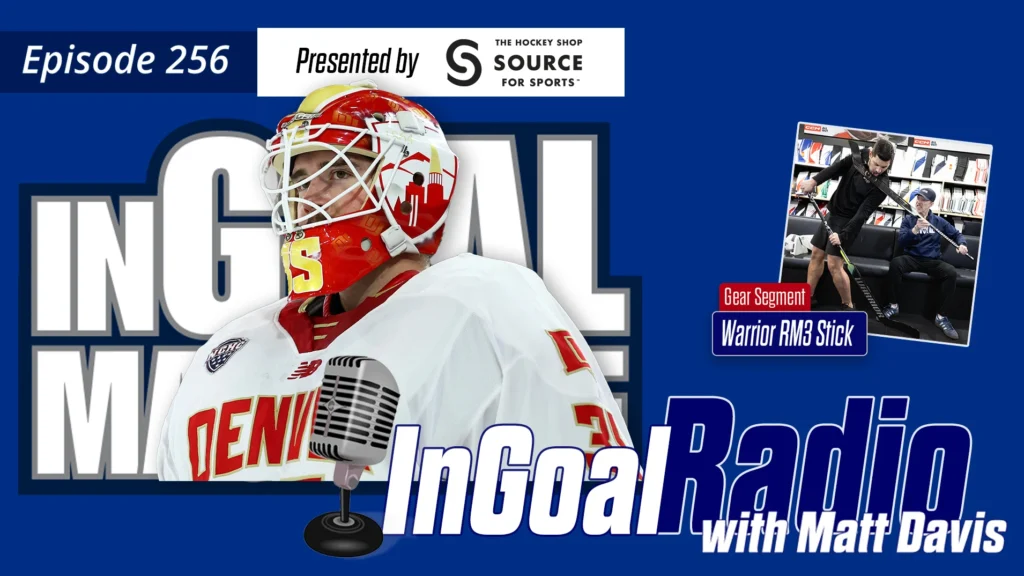
InGoal Radio Episode 256 with Matt Davis

Please subscribe and leave a rating — it helps us reach more goalies!


Two-time NCAA Champion Matt Davis of the University of Denver posted a .956 save percentage overall and an elite .979 save percentage in the Frozen Four during his championship run. Davis credits mental management tools and technical development with DU goalie coach Ryan Massa for his performance on college hockey's biggest stage, including a specific technique for controlling rebounds without using the hands.
- Matt Davis posted a .979 save percentage in the Frozen Four, reflecting elite performance under maximum pressure at the NCAA championship.
- Davis used specific mental management tools to handle the spotlight on college hockey's biggest stage — an approach applicable to goalies at any competitive level.
- DU goalie coach Ryan Massa taught Davis a technique for controlling rebounds without using the hands, a technical skill that reduces second-chance opportunities.
- Finding the balance between motivating young goalies and over-pushing them is a real challenge — the Parents Segment explores how to encourage harder work without damaging a player's relationship with the game.
- The new Warrior Ritual M3 stick line is reviewed, giving goalies and gear-focused fans an equipment update to consider.
Episode 256 of the InGoal Radio Podcast, presented by The Hockey Shop Source for Sports, features a in-depth interview with two-time NCAA Champion Matt Davis from the University of Denver.
Feature Interview
presented by NHL Sense Arena
In the feature interview presented by NHL Sense Arena, Davis takes us through the highlight — and one highlight reel save in particular — of a spectacular run up to and throughout the playoffs that included a .956 save percentage overall and a eye-popping .979 save percentage in the Frozen Four. Davis digs into the mental side of the game and tools he used to manage the spotlight on college hockey’s biggest stage, as well as his technical evolution with DU goalie coach Ryan Massa, including advice on controlling rebounds without using your hands.
Parent Segment
presented by Stop It Goaltending U
In our Parents Segment, presented by the Stop It Goaltending U app, we talk about wanting your kids work harder, and finding a balance between proper motivation and pushing the wrong way.
Weekly Gear Segment
presented by The Hockey Shop Source for SportsAll that, plus a trip to The Hockey Shop Source for Sports to look at the new Warrior Ritual M3 stick line.
Episode Transcript
Intro
Is it your off season, or are you still following the Stanley Cup playoffs with zeal and keeping track of the American Hockey League? We're winding things down on the professional front, but most of us are well into our summer and training season. Training already underway. It's InGoal Radio, the podcast presented by the Hockey Shop, thehockeyshop.com, Source for Sports Langley. Daren Millard, along with the cofounders of InGoal Magazine, Kevin Woodley, and David Hutchison.
Are you guys into your off season, or are you right now still clinging to the playoffs? Woody, where are you?
I'm definitely still clinging to the playoffs because I'm covering the Canucks and Oilers. So how much longer I cling to them? We shall see game seven tomorrow night. Been a long time since I've covered a day game seven, Daren. As a matter of fact, the last one was 2011 between the Vancouver Canucks and the Boston Bruins, which was, you know, people think that we in the media become cheerleaders for the team we cover.
And I always say that we don't cheer for teams, but you do cheer for good people and good stories. And 2011 covering game seven was tough because you're on deadline. I have to I was working for the Associated Press at the time. You have to file the story and get down to the room and do your interviews. And so while I'm down in the first room I'm into is Roberto Luongo, who I'd gotten to know quite well and I'm quite fond of as a person and and as a goaltender.
And to see that heartbreak was really tough. But then minutes later, I'm on the ice with Tim Thomas and the Stanley Cup. And another guy who I know the reputation around him since those days has changed, but a guy who was very good to us here at InGoal Magazine, did charity projects with us, mask giveaways, steered those mask giveaways and charity contests in a direction so that any fan could afford it as opposed to just the highest bidder buying it. And, you know, was quite fond of Tim as well. So I can be quite emotional to sort of see both sides of those emotions one after the other with people that you've gotten to know over the years, like the agony, the heartbreak, and then the joy on the other side.
This is only the second round, it won't be quite as as severe, but I I I I will be facing that tomorrow night.
Sounds like he's conflicted already. Hutch, where are you? Are you still involved or are you into the off season?
Betwixt and between. Spent this week up in Kelowna where my son was doing a little bit of off season training. And then on the way home, I don't know how many people realize I live on Vancouver Island, which is a roughly two hour ferry ride from Vancouver. And so on the way back, we're sitting in the car watching as much of the Canucks game as we could, and then we lost our cell signal, went upstairs where everybody else sits in the ferry, only to discover we're on one of the only boats that didn't have a television. So it was, an angst filled ride back to the island before we could find out what had happened in the game, but it was a game.
Little bit disappointing. We were cheering as Vancouver fans. We weren't just cheering for stories. Although, we like both the Edmonton goalies, so we're cheering for them as well. It's a bit of a toughie.
So, yeah, we're we're still, Daren's still being hockey fans to an extent, but also in full preparation mode for next season.
We wanna dive into the situation with the Edmonton crease. But, first, if you are still going, you can take advantage of NHL Sense Arena to fine tune your skills. And if you're into the off season and you're having trouble getting ice or there's no ice around, a real opportunity, exists with NHL Sense Arena to keep those skills sharp.
Doesn't it though? You know, Sense Arena sponsors our feature interview every week guys. But if you hang on a little while later, you're gonna find out a way that maybe it's useful in relation to our parent segment. Just a little teaser on that one. One of the coolest things about Sense Arena is that you can actually put other people in goal with you.
Mom, dad, grandma, grandpa even. We've taken it around and shown it to various goalie coaches who want to find out what it's like out there. And we've had NHL goalies tell us that they've done the same with their family, friends, teammates. So it's a really cool opportunity to share the game with people that you know. And it's so real that you're giving them the full experience of being a net.
More importantly, though, it's so real that you can get incredible training this summer even when you don't have access to the ice like, we know Woody did well on a surfing vacation we did up at Lake Louise in the Rockies. Sense Arena is there with you all summer long, whether you've got access to ice or not. You will be having fun and you'll still be able to tell everybody that you're working really hard at becoming a better goalie. So go grab NHL Sense Arena today and you can take your training this summer to the next level, boys.
The NHL Sense Arena feature interview, Matt Davis from DU as the 10 time NCAA champion, is well, he's not the NCAA champion for 10 times, but, he's a two time since, NCAA champion. The goaltender joins us, learned the ropes as a support role, and then has won it in a just a splendid spectacular performance this past year. And there's a lot to get to with Matt Davis in a fascinating interview with Kevin Woodley. A whole bunch of different areas that that he will take you down that path with, including how to smother the puck without using your hands. That conversation topic is still baffling, and I found myself you have to listen to it really to understand it, but I found myself sitting on the the couch with my hands trying to act it out as he was explaining it to you, Woody.
Yeah. You know? And, I mean, as as someone myself who coughs rebounds up even when they go in this glove, you know, I I the idea of not you know, because my hands suck. The idea of being able to smother his pucks without using them, it definitely appeals to me.
Denver University. Oh, what a great pipeline to the National Hockey League, and we're looking forward to see what the next steps are for Matt Davis. The TendyFest is coming up. The annual event. It's back and rolling, and, we're looking forward to that as InGoal Radio Podcast presented by The Hockey Shop, thehockeyshop.com, and Source for Sports Surrey.
Less than a month away, boys. Hard to believe, actually, that we're we're less than a month away from June 15, the sixth TendyFest. Gonna be at Fleetwood Arena in Surrey, not too far away from the Hockey Shop new location in Langley. Gonna start at 1PM. I believe they have three full sheets of ice going.
They're gonna have all the major brands there. We've already talked about the skate sharpening. You can actually test different custom profiles or radiuses on your blades on the ice, see if you like some of the different custom options because that that's a tough one. Right? Like, yeah, you test new gear, but how do you test different skates?
Because you don't wanna have them out there in a game, and all of sudden you suck because you can't you know, you don't feel like you're getting in your stance properly because you're on your heels or on your toes or whatever, toe picking like I would. Just every opportunity to try the latest and greatest and try some different things on your skate blades. There'll be prizes. There'll be everything. It's just chance to meet Hutch.
He's gonna be there. I might tag along. Maybe we'll bring a special guest or two, some Sense Arena head. There's so much going on. Make sure you don't miss any the the TendyFest six at Fleetwood Arena.
RSVP. Check out their socials. All the Hockey Shop Hockey Shop Goal, THS Goal on Instagram, on X, on Facebook. There is an RSVP so you can sign up to sort of get specific times or so they make sure they know you're coming. Make sure you check that out as well.
Gear
The RSVP works out perfectly into our RM three. Let's slide over to the Gear Segment right now, and then we'll come out with some news from the National Hockey League and what the Edmonton Oilers have done in flip flopping goaltenders and how surprised we are. But the Gear Segment presented by The Hockey Shop dealing with the new Warrior twig.
Yeah. And, you know, we've seen sort of some different iterations and some evolutions from Warrior sticks over the last couple of years. This is a bit of a blend, some new coming into a different line. And I'll be honest with you, there are different all the different names and, you know, m one two three ritual this that. I get a little confused.
So let's just go to Cam, and he'll break it all down for us.
Welcome back to The Hockey Shop Source for Sports. We're over here in Goalie Utopia where we're it's always little dangerous when we're waving around the new twigs, but we've got the new So shiny. Warrior RM 3. Yeah. Cam. I'm gonna need you we're gonna do this quick.
Okay. But because I
feel like I've seen this before. Have But there are differences. Now, Warriors, I mean, so many different sort of models and iterations and some have this the the new shaft geometry and some don't. 2024 stick lines, what's new, what's different, where are they going, and why? We we have some consolidation to help alleviate some of the issues. Oh, thank you because I is easily confused.
Yes. Yes. So starting off, a, these have a wonderful chromed out look, which is fantastic. I really, really like it. Oh, they like pimp my stick.
Oh, they like pimp my stick.
Weight wise, extremely lightweight. Flex profile wise, so the m three versus the v three low mid kick point. Very flexible.
Lower Okay. Kick
in the in the paddle? That's correct. So you can see on the back, you can see how there's that carve out. Yeah. You've got the it's thinned out there.
Exactly.
For our friends at home,
maybe. See, somebody's already calling to know about it more already. This is good. This is good. We like these things.
So what's now changed and which is huge for Warrior? Huge. Let's talk about sizing. No. So if you look on your stick right here, see how it says 25 inches?
No. This is now a true 25 inches goal stick. I don't have to do math to figure out which stick to buy?
Warrior, you are finally on it.
So you will see the elimination of the 27 and a half sizing. That is now the 26 inch stick, 25, 24 becomes an intermediate stick, which was the old 25 inch. So make sure you call us to double check, line up, make sure you find exactly where you're advertising. Because especially since how you have old inventory of the old side, folks keep blending. This is a good move long term.
Love it, Warrior. Great job. In the meantime, folks,
you have to be really careful when you place your orders.
Yes. Yes. But this is this is great. This is good. You can now line it up with other things on the wall.
We can create a little bit more consistency in terms of the shop. So Okay. What else is Back stick.
Back the stick. This is now this is the new standard?
This new that shaft we saw on their I sticks. So M2I was the first one. See, this is why it was confused. Then we saw the V3I and now standard on the m three sticks. You will see that new shaft geometry.
So asymmetrical shaft, able to slot your glove in. Wanna go actually to play the puck so you can get a little bit more torque that tapered all the way up into the top feel.
Still enough butt end to
give Cam a black eye. Added durability feature too as well with this being rounded on all sides here, not a flat edge. There's nice chance in terms of for the puck to hit it. Have a more We all know the
square edges are where they tend to break on those shot shots. Correct. We all like our flagpole saves too. Pretend they're on purpose, folks. That's the best one
to do. Coined a term right here. Oh, flagpole save. I don't I've never called it flagpole save.
Like shaved off the bat. Cam, you don't make saves. I got that one from Mike McKenna who played in the National Hockey league.
So we can give Mike McKenna the credit. We will give Mike McKenna the flagpole save. Yeah. Just because you've never heard of it doesn't mean to That's be fine
because they do it
all the time. So, we're back. Fly grip. That's the overall feel of that nice textured feel right at the actual Paddle Mate itself. Great overall shiny look, extremely lightweight stick.
Definitely worth a check out. Oh, I'm checking it out.
Excellent. It's hot. Can I ask you one question? Have they softened the edges around the top of the paddle a little bit too?
Just in terms of fur you're saying rounded, so it feels a little bit more comfortable in hand? Yeah. Warrior always always a step in the sticks. Because the other ones, there was a real sort of squared, almost sharp, didn't love it, had to
put tape over the edge. I I this feels much better in my hand than previous generation. You have it
here, folks. Kevin will I be
pay attention. He does. He's a nice looking twig. Alright. Quick other note, standard twist curve available on these guys.
So this matching up with your p 31. Nice overall chance for that shot. RTL being their top end stick, Pro being now that mid level, well, mid mid upper Pro, we'll call it. If you have any questions,
this is the guy.
Give me a call.
604-589-8299, 1-800-567-7790.
Check it out at the hockeyshop.com. We still have leftover models from last year. Check out our sale inventory. We have lots. And, yeah, that's it.
Let's do it. Where are we going now?
K, does does he just say the phone number because you make him say the phone number? Because I don't know anybody that could write down the phone number as fast as he says it.
No. But what's really funny is that if you went way back to when these segments began, Cam had to look it up almost every time when he asked him to say it. Yeah. So we gotta give Cam credit. It's only taken three or four years, but he has now memorized his phone number.
Yeah. I mean, the the it's a great chance to remind folks that if that was a little too fast for you on the podcast, that's why you should be checking out the Gear Segment on Instagram, on YouTube, because Hutch always puts the number, flashes it up there for longer than Cam says it. So if you ever need to get ahold of him, you can check it out there. Check out the numbers there. Like I said, whether it's Cam or one of his staff, like, that's that's the place to go if you've got any questions.
I know we've had a bunch of questions. Remember last week, guys, we did the CCM knee protection? Yeah. And the new CCM pro and the and the new CCM, the Axis line. And people have sort of commented that, hey, it's not on the website.
I can't buy it. Phone them. It's in stock. It's for sale. It's just not allowed to be listed on the website yet.
They have it, it's there, they'll sell it to you, just give them a call.
That's funny, I thought it was just me. I thought I was doing something wrong because I I went to look it up because I wanted to see the the new just the physical structure of it, and I wasn't able to see it. And I thought I thought it was just me being me.
I guess there are rules about when things can be online and when they can just be for sale in store. It makes zero sense to me, but they gotta follow them. So if you'd like those knee pads, mean, I it's a good sign for us because a lot of people are asking. That means a lot of people went and looked. And to those people, we apologize that we went and put you on a search for nothing, but just call them and they will they will take care of you.
Parent Playbook
Hutch coming up with the Stop It Goaltending U, the app, parent segment. How do you motivate your child? I'll get into that in just a little bit. From motivating to just managing, the expectations of your athlete. The Edmonton Oilers went through that this weekend.
I I called it the nuclear option in putting Stuart Skinner into a backup role for a couple of games for Calvin Pickard. Just initially, how surprised were you guys that they did that and now have subsequently come back to Stuart Skinner?
Well, it worked out for us because we had Cal Pickard on the podcast.
And I was talking on Vegas radio, by the way, I was singing your praise saying go over to InGoal Radio the Podcast because
Oh, thank you, dude.
Kevin Woodley has the Edmonton Oilers starting goaltender.
I I think conversation. When they they came back for game five, I went over to the locker room. I said to him, that's gotta be the biggest game goal bump we've ever had.
Absolutely.
So listen. Playoffs hadn't gone well for Stu. You've heard me talk about what he is as a goaltender. He's proven he's a number one for them all year. I think we forget.
It gets a lot to ask. Second year NHLer, here's a team with a cup or bust mandate. You're the starter. There were some moments within the games early against Vancouver, and I've been around this Oilers team for a little bit where, frankly, I think they think it was or thought it was going to be too easy. They didn't bring their best, and their goalie didn't bail them out.
Like, the the he'll tell you that. Right? There were some you know, I would I would argue giving 40 goal score Brock Boeser time and space in the slot twice in game three probably isn't a great way to handle your defensive duties. Time to pick a spot. But, you know, hey.
Goal has gotta make some of those saves too, and and Stu will be the first one to say that. I think what we saw there, and it's interesting because he's not the only one, a bit of a reset. And for him, it was more mental. We've seen other guys physically. We talk about the Carolina Hurricanes, giving Freddie Andersen some time off, right, during a series.
Like, the game's never been harder mentally or physically. And so I applaud the Oilers for having the bravery to switch, but then also go back and say, hey. We've given him the time. We feel like he's hit that reset button, he's gonna be good for us. And listen.
The Canucks didn't test him much in game six, but there are a couple of saves in there, a couple of key moments, especially in the five on three. Hughes had an absolutely labeled top blocker corner shot with a layered screen, which is a quality scoring chance. Stu looks around the screen to the left, so on his glove side, and as the shot's released, has to come cross body on the screen and get a blocker up at high on the glove. Like, that's a tough save. And so there were moments like that that were difference makers in the game.
So good for him. Kudos to the Oilers for having the bravery. I don't think a lot of coaches would have had the courage to switch and switch back. So good on them for recognizing, like, they could have just gone with the narrative. Oh, he's our guy.
We'll keep going with him. But and then when the other guy played well because listen. Calp gave them two really good games. You'd argue the best goaltending performance of the series was Cal Pickard in in game five, and they lost, and they go back to Stu. So I I just think it's nice that you're probably talking a lot to your goalie coach, Dustin Schwartz, and having trying to have an understanding of where each of his guys are at and trust them to deliver in those moments when they have.
How about a strong mindset on Skinner, though? Because So lot of pressure they put him under last night. And he was came out and said he wanted the net, and I'm sure he did want the net and felt confident. But if you weren't quite so strong, you could look at that as, jeez, he maybe didn't do as well as he expected. They lost, so they had to switch somebody else in.
Now they've put him back in with the series on the line. If he lost last night, where does that stand him for the future with the team, for the future anywhere? How is he feeling mentally about that? I mean, there was a lot at stake for Stuart Skinner last night, and he came through.
And even within the game. Like, they go up one nothing early. Mhmm. And then they give it back, and it's not on him. Mhmm.
Like, the defending on that play, Petterson down below the goal line to Elias Pettersson in the slot to allow him to find that seam, both players. Like, you know, and both teams are guilty of some pretty poor defending, like the Canucks too last night. But Pettersson gets first save. Stewie makes the first save, and he's wide open to get the rebound because there's nobody within a couple feet of him. Like and so all of sudden, it's one one, and there could have been a lot of doubts.
Even though it's not on you necessarily, there could have been a lot of doubts creeping in in that moment as well. So, I the one thing I've never worried about with Stewart Skinner is the mental strength component. I he's just always sort of has this growth mindset. And so it's yeah. Good good on him.
And we'll see what happens in game seven, but regardless, that was an important bounce back in game six.
Oilers won two of three after the change to Calvin Pickard, so it's worked so far. They they still have to complete it, but if there's a message there, and I wonder, did the rope on starting goaltenders in hockey get shorter because Edmonton Oilers went to this drastic measure?
I think that it depends on what your starting goal to who you're who he is and how long he's been at it. Right? Like
But overall, as a league, that gap between starter and backup has got shrunk. Right?
So But this, like It's just piece of puzzle. To be a possibility with with all due respect to Pickard. And it was a great story. Nobody was cheering for him harder than me. This was one of those, whether you wanna call it the the Vasilevskiy, the Hellebuyck, the Demko, where if you're healthy, you're staying in no matter what.
Yeah. I mean, I just think that you have to read the situation and the situation, like, made sense in this case. Right? Like, are you doing that to Vasilevskiy? No.
Are you doing that to Igor Shesterkin? Because you saw the wheels not come off against Carolina, but they certainly started to wobble. And again and I think you can make the case with Freddie Andersen too. I think Carolina waited a little too late late in the playoffs to get him a rest. You know?
That they could have done that sooner because once he got it, he came back strong again. But if he'd done it sooner, would he have gotten him stronger for longer? You know, Shesterkin, even Shesterkin is in the conference finals. As the games piled up and the stance widen, which is what happens when he gets a little fatigued, the goal started to go in. But you're not putting Jonathan Quick in there.
I I wonder with the three you know, they were up three nothing in that series. If they'd done it at some point with Quick, if they would have gotten just jerking back to how he played at the beginning. Right? So nobody's gonna do that. I think it does depend on the situation.
There are certain guys that are just staying there regardless. Jeremy Swayman was staying in there regardless. He was fantastic for the Boston Bruins in that series. Even with Linus Ullmark, a trophy winner who had posted exceptional numbers against again this season sitting on the bench.
I was doing some research for the Chirp Podcast and was talking to a National Hockey League head coach on the Eastern side. So not familiar as we are with with Edmonton. And he just said, given what happened last year, he was encouraged that they made the change in the sense of he supported it, but it was still a a bold move. I just felt that after last year, you you kinda had to shake something up, and he wasn't sure whether Skinner would get back in, but he he liked the move.
And I think I think the fact you were willing to put him back in was part of what makes it you know, you didn't just yank him. You yank him and said, okay. Let's let's get a reset here. I watched him do some work with Dustin Schwartz. The morning of game four here in Vancouver, they went out there and they worked hard on his games.
As matter of fact, actually, one point, thought he might have gotten injured. He was down for a little while. And, hey, you're gonna get back in here. You got the opportunity. Make sure you're ready.
And he was.
Yeah. If if Oilers are gonna go deep, they were gonna need him again. And that that's the reality of it. Awesome stuff from Stuart Skinner and Calvin Pickard being able to go in and, and just give, whether you wanna phrase it, Skinner the time or just give Edmonton the opportunity to stay in the series. Awesome stuff there.
And and a great story coming out of Arizona. Maybe the final note on the Arizona Coyote franchise for now in Connor Ingram winning the Masterton trophy.
Yeah. Well deserved. And and, you know, there were other good choice obviously, there always are when you talk about the Masterton and and perseverance and dedication. I mean, Freddie Andersen, who we just talked about, came back after missing all that time with blood clots and and was a, you know, a star for the Carolina Hurricanes down the stretch. But what I love about InGoal story is his willingness to tell it.
He's not a guy that likes the spotlight. We've had him on the podcast here before, but he's not necessarily a guy that likes that focus, that attention, that spotlight. And so his willingness to go into and talk about his battle with OCD and where he was at and the how much he needed to get that help and how it's allowed him to get to this level as a goaltender, which is, you know, a legit number one in the National Hockey League, has been for a year and a half now. There's a especially given his reluctance for the spotlight in other situations, like, that take requires a level of bravery. And I think because it benefits other people to see that these, you know, professional athletes who can be viewed as superhuman are in fact human and go through some of the same struggles that a lot of other people do and that it's okay to reach out for help.
You know, to me, that's just one more feather in his cap for what he's been able to do and well deserved that he gets the Masterton as part of that.
Connor Ingram, the Masterton Trophy Winner, and now he gets to Connor Ingram, the Masterton trophy winner, and now he gets to embark on a new chapter of his career in Salt Lake City with the Utah Hockey Club. Do you by the way, do you guys have a favorite of all the nicknames that have been tossed out?
That's it right there. Yeah? Utah think it sounds classy. It's I I just I don't know. I just like it.
Yeah. It's less artificial. It's it just kinda
It's old it's old school. Old school
in the in the soccer
Their barns outdated, so their their name might as well be too. Don't mind it too. They're they're I'm going Yetis.
Oh, yeah? I don't know whether Yetis has too much of a tie crossover with Colorado. That's how put it on the other shoulder.
Yeah. I agree.
Yeah. Maybe. Maybe. But I just I listen. I'm with actually, Hutch, I'm with you.
I like old school. Right? We're all old here.
And you can still have a nickname attached to it. Soccer teams or football clubs, they they they have soccer club or football club, and they still have the the Bournemouth AFC Bournemouth in the premiership, they're called the Cherries, but the Cherries aren't connected to the actual name. So you can still have you can still have that nickname somewhere.
I just see I'm with I'm with you guys. Like, that works for me too. But I just see the home run that is the Vegas Golden Knights as a new franchise and the marketing and the shield and the the helmet and all the pregame show. I see how the Kraken have embraced, you know, and I love the logo, the s with the glowing red eye and the fans, you know, rockets red glare when the when the anthem comes on, how they punch that for the eye and it lights up in the arena, and they've got the tentacle. I just I just think that this is an entertainment business.
And as much as old school works, I think you gotta entertain it in a new market. Hey. Let's be honest with you. It it ain't gonna be hockey club because the merch isn't gonna sell. They need they need to move merch, and that means getting a name that's infectious with young kids, and everybody wants to wear the jerseys so there'll be bright colors in Vegas, Seattle.
I don't know. I we'll see. Trust that they'll do a good job with it.
I think you're underselling what the marketing people could do because there's a chance to make it all about everybody being part of that club and bringing the whole community together. So we'll see.
Well, I I expect we are
too old and it won't be that. They want are gonna want something flashy, but I still think there's a cool opportunity there if they chose to embrace it.
Well, I just have covered the Vancouver Canucks for twenty four years. So it's, inherent that I underestimate a marketing staff.
Here's the thing. They're gonna get a good look at the Utah Hockey Club. And if it hits and it goes Mhmm. They have the option to stay with it.
Mhmm. And if it
doesn't, they can tweak it and add a nickname or they can do a full re reboot in year number two. So they they've actually positioned this pretty well.
Well, listen. If they're gonna go Utah Hockey Club, they got Connor Ingram, who's a Bauer guy, and they got Karel Vejmelka who's a Brian's guy. I need to see some vintage retro sets big time on both of them. And they both those companies are capable of knocking it out of the park with with with that type of design. So, hey, listen.
If it takes hockey club for us to get more vintage retro sets in the NHL, I'm all for it.
I I do think the tie in with Yeti and, and the Avalanche a little too close. In Denver, they've got some good things, going right now. A nice run by the Avalanche and another championship season out of DU. Matt Davis, the starting goaltender there. He will join us for the NHL center in a feature interview in just a little bit as the two time NCAA champion goaltender, first time as a starter, and boy, was he spectacular.
But first up, the Stop It Goaltending U, the app parent segment with Hutch who is motivating us or helping us with the motivation factor.
Well, before Hutch gets to explaining how to motivate your kid, I think I have a tool that will help them a little bit. Because one of the things about motivating kids is getting them to sort of watch hockey. We hear that from a lot of goalie coaches. Watch hockey, sorta embrace the game. And between the two products you now get when you sign up for the Stop It Goaltending U app, and that, of course, is the app itself, but also now a free subscription to InGoal Magazine, our premium product.
You will have access to the type of tools, and videos, and things that will entertain your young goalie while also educating them. And it doesn't have to be an all day, you know, five hour grind like it's a job for them. The Stop It Goaltending U app, they have every day of the week, five one minute primers. Just spend one minute on there, and then once a week, they have a one twenty minute full video. Over at ingoalmag.com, we have, know, with that InGoal premium subscription, we have ProReads every week where you basically sit down like you're in a video session with an NHL goaltender coach or an NHL goaltender.
Between the two of those, you will become unstoppable, and you don't have to grind eight, you know, eight, ten hour like, it's not a job. Just spend a few minutes a day on both of those products, especially the Stop It Goaltending U app. You will become a better goaltender. You will learn to enjoy the position more, and you will get better as a result.
Hutch, give me some help. I'm trying to get my child to be more active, more involved. How do I go there?
Well, every kid's different, so I'm just gonna give you some ideas that have come from my experience. It is as a parent, but it's also twenty years as a teacher and a coach. So I've I've dealt with a whole lot of kids over the years in in different sports. And so I've got a few ideas. Before that, I do just want to mention one thing related to the parent segment.
Our good friend, Pete Fry, the goalie mindset guy, is going to be coming on the show next week as part of our parent segment. So if anybody out there has any questions, around mindset, mental training, and so on for goaltenders, let us know. Parents at ingoalmag.com. And we are going to pick a couple of questions out and share them with Pete. One of the reasons we're bringing Pete on is is just to celebrate the fact that in July, July 20, in fact, in Vancouver, we're going to be hosting a full day seminar with Pete that will be available both in person and online.
We'll have lots more information available, at InGoal about that in the future. But Pete's also a great guy. I actually thought about asking Pete the question for today's segment, boys, because I'm sure you'd have some great things to say. But I thought I'd I'd share mine. Maybe it'll come up again next week.
I think this question has been coming up a lot in in the last couple of weeks, guys. And maybe it's just because it's summer, it's less structured for hockey. And when kids don't have practices to go to, I think people look around and they wonder why their kids aren't working harder. And there's a whole lot of reasons, but I think and I've been there too. A 100% have been there, guys.
It's sort of a grade A FOMO situation. It's a it's a real fear that maybe my kid's sitting down watching TV, playing a video game, doing something like that, not training. And you're imagining all those other kids their age out there working hard. The question comes from parents of kids who are as young as six or seven, honestly. Right up to I've had that question from a parent of a kid who's playing U 18 and wants to be in the NHL and doesn't really do anything beyond practice or even in practice.
So it comes at all different levels. Like I said, everybody, every kid is different. I can't promise that, what I'm going to share today guys will make your kid the next Crosby or MacKinnon in terms of work ethic. But, but I do have a few thoughts. What I often hear in response to it is people saying, well, it's gotta come from within.
Just let the kid be themselves and they need to learn to work hard on their own as if somehow built into our DNA. I don't know. Maybe it is to an extent, guys, but there has to be more to it because we teach our kids just about everything that they know. And you also can't be the taskmaster just standing over your kid with things for them to do all the time because that's not what the game is about. It's not going to teach them to have fun.
It's nothing I would ever endorse. But like I said, lots of experience. So I've got a few thoughts. One of the ones that I've said many times to to both of you on the show, guys, is that kids want to please, they want to be spending time with you. So the first one I'm going to say, and this relates back to Sense Arena, set the example.
It's no surprise that if you love golf, your kid's probably gonna love golf. If you love fishing, you're probably gonna raise a kid who loves fishing. Pick any other passion that you have. Your kids are probably gonna give it a go and probably grow up with similar interest to you. I know you've got lots to do in your life, mom and dad.
I know you got long days at work, you've got family to look after, far more obligations than your kids do. But if we come home after work and we sit and just watch TV, what do we think our kids are going to do when they're not at practice? If the only exercise example you're setting is sending them to practice, having them do what they're told to by their coach, and then they come home and nothing else is being done by you at home, where do you think they're suddenly going to get motivated to be an athlete? So I'm not saying you have to go and train like a goalie. Although if you want to put Sense Arena on and play with your kid, I'm pretty sure they'll have a good time challenging you and and doing the different drills with you and so on.
But something that shows your kids that you really believe in working hard and training, physically, I think is a really good example. I've I don't think I've told this story to either one of you before guys, but, my mother was not an athlete. My father was not an athlete. I remember at six years old standing in the kitchen with my mother and we're partner juggling oranges just to try something athletic. And she loved the fact that we were trying it too.
She didn't care if I dropped them on the floor and they got all squished and so on. It was just about doing something together. She'd bounce a ball for me to catch as a kid, as a young goalie, just anything to get involved in what I was doing, even though none of this was her kind of a thing. So you don't have to be training, you can just get involved in your kid's training. And my mom didn't have Sense Arena in 1972, but I guarantee she would have given it a go if, if we did have it guys.
But there's other ways beyond your own training that you can set an example. And here's a couple of thoughts. Do you only get excited about the big highlights when you're watching a hockey game on TV? Do you just call your kid in and say, look, Igor Shesterkin just made this unbelievable save. That's gonna stoke their dreams and that's really cool.
But what about encouraging what it takes to get there and be Shesterkin? I like to get excited about other things that the kids are doing. So you've heard me talking about catching athletes being good and then making, you know, like maybe making a good decision in a game. I'll talk to my goalies about having made a great decision to hold their edges in a particular play. We'll celebrate that.
It's not just about the save, it's about how they made that save that we're going to celebrate. About skating to another position instead of sliding. About making a desperation save and holding their balance so that they're there for the next save as well. Mom and dad, you can do that too. You can pick out those things that that are part of the process and celebrate them.
And it also applies to hard work. Look, it's not as easy to find, but you can do it. We used to travel to practices, one year where it took almost an hour each way to get to practice a couple times a week. We'd put on an audio book, maybe you listen to the podcast. We would listen to an audio book, for example, about Kobe Bryant, who is one of the legendary hard workers out there.
We would celebrate how hard he worked. And this isn't about programming your kid. I was just sharing something about an athlete that I genuinely admired. And guess what? My kid does now too.
Or I'll send along a clip I see on Instagram or Twitter or whatever of some athlete who just busts his butt and works really hard. It's about celebrating the process. But speaking of Stuart Skinner, I was at the Eli Wilson Goaltending School in Toronto, guys. Stuart Skinner was a student there at age 16, and I got one of my favorite photos, I've ever taken. It was at the end of an ice session.
All the goalies are filing off the ice. They'd been out there almost two hours. They had another two hour ice session to come that day. And these are all the guys and girls that have the aspirations to play at the highest level of the game, and they're filing off the ice. The Zamboni is coming along and there's Stuart Skinner at the side of the boards doing crease movement drills on his own.
I grabbed that photo. I sent it home via text as quick as I could. Not with the message, here's what you have to do if you wanna be good. That just brings up guilt and stress in your kids. But it was just celebrating something that I thought was really impressive.
And I just said, look how cool this is. And Stuart, I think, was about 16 years old at the time celebrating hard work, celebrating the process. We always talk about focusing on the process and not just the results. And I think we can do that as parents and celebrate that. Now, not everybody has those experiences, guys.
You can't all be on the ice with Stuart Skinner or at an NHL practice like Woody gets to be to pull out some cool things or you get to be Daren. But you still can focus on what your kids are doing well and working hard and just give them a little nudge. So was there a drill on the ice and your kid beat another kid in, say, a skating drill? Those awful skating drills at the end of practice, and your kid happened to dig deep and beat one of the players. Celebrate it afterwards.
Even if they were last, were they a little closer to their partner than they were last week? Celebrate that when they come off the ice. Tell them that you just loved what you saw about how hard they work. And when they come out after practice, give them a high five and say, man, it was so clear that you were just busting your butt today. I promise they're gonna wanna do that more next time.
Focus on the process, not what they need to be doing results wise. So those are just some examples of catching kids being good, of doing the things that, you want them to do, but also focus on the fact guys that it takes a long time. It takes years. Kids are gonna wanna please you. They're gonna wanna do the best.
They're gonna wanna work hard, but it's gonna take time and be patient. Your seven year old is not gonna grind like Nathan MacKinnon does. But, if you pick on a few of these things, I think over time, ten years later, you might find that your kid is being described by other people as a self motivated athlete who loves to push himself. So just a few thoughts, few things I've been through both with goalies that I know with athletes that I've coached, students I've taught, and I hope a couple of them maybe resonate with people, guys.
And just like that, little Hutch comes walking into the room. Perfect timing on on that behind you.
And we're gonna celebrate the fact that he's come into the room to get me another coffee. An awesome kid getting his dad.
Thumbs up. No arguing. Nothing.
he offered He texted halfway through the show, I'm making coffee. Do you want one? Love it.
And and motivating your child to do more doesn't involve like walking by as they are on their phone or their TV and say, let's get up and do something. It takes some planning, takes some effort, it takes some organization on on your part too.
Yeah. It takes takes but but I think it's just about building some of that stuff into your life and and into your routine. So maybe your kid doesn't have an off ice training routine, but maybe you've been on InGoal and you've seen a few things. Hey, Johnny, let's try this together. I would I'd love to work on this balance exercise.
I'd like to learn how to juggle. Whatever it might be, you can do it with them or just show them that you're working towards a goal. Like, maybe you are not a runner, but you've decided you want to take on your first five k. Make it real obvious that it's okay that you're walking first before you're running, but you're working hard and you're having fun. Just share something with them.
Why does Johnny get a bad rap?
I know little Johnny. Hey? Yeah. It's tough. It's tough.
Little Johnny is a hardworking kid at the end of the day. I love him.
Poor little Johnny. Listen, the Stu Skinner story reminded me of one of my own Program of Excellence Camp, Hockey Canada. I was there as a video coach, and it was actually the camp where Stuart Skinner met Dustin Schwartz, which I think played a strong role in the Oilers drafting him later that summer. And after one of the sessions, one of the main goalie coaches introduced me to the group and said, hey. If you've ever got any questions about things like equipment or whatever, this guy knows his stuff.
He can probably help you. And I was like, I don't know. I thought he was just pumping my tires because I'm basically just in the background there. I'm not really doing much doing video. Stuart Skinner was the only one that sought me out later to ask questions, introduce himself, and have a discussion about gear adjustment stuff that might be able to help his game.
And and listen, we've been there. We see that. I see guys in the NHL that are wearing equipment that's in a way that's prohibiting their game, but you nobody asks those questions. He's always had this growth mindset and this desire to sort of always be looking for opportunities to expand himself and get better. And so whether that's work ethic or asking questions, I just love I I I love that about the kid.
That that's why I don't think it's a coincidence that despite getting those two games off in this series, he came back and looked like himself in game six facing elimination.
He could be a gear coach. We might see that at some point.
He could. He could. Woody could get a job at the Hockey Shop.
I could. Then I'd have to put up with Cam all the time.
I think Cam would have to put up with you. Let's be honest.
Let's be that's that's a fair assessment.
I'm pretty sure only one of you is getting through the first week anyway. So it's it's fifty fifty who's gonna have to put up with who.
And he'd the boss. I'll have to out of
my Yeah. Would he be stocking shelves at midnight?
Feature Interview - Matt Davis
We got our NHL Sense Arena feature interview this week connecting with Matt Davis from DU, NCAA championship, DU winning their tenth NCAA title. And this has been a a one that we've been looking forward to bringing to you and an area where it just is a a goaltender, an athlete, a person that is is so gracious and open to the discussion, Woody.
Yeah. I know it was a fun one. We got into all kinds of different things. We talked obviously about the moment and the stage and the spotlight and how he handled all those things from a mental standpoint. We talked technique.
We we got into pretty much ironically, gear was one thing we didn't really get to, but we got to pretty much everything else. So one of those ones where this may not be a goaltender that everyone is familiar with yet, wasn't drafted. He'll be probably at some development camps this summer with NHL teams. He certainly opened some eyes with this performance. And I just I like, you know, sometimes when it's when no.
Not every week is it, you know, a guy who's been in the NHL for ten years or or twelve years, like Calvin Pickard last week. But, man, sometimes the takeaways from these guys are even more valuable, and that was the case with Matt Davis. He shared so many great insights. This really is a can't miss interview. Thanks to his openness and generosity with his time, and I think a lot of people are gonna enjoy this one.
So let's have at her.
It's the NHL Sense Arena feature interview on InGoal Radio, the podcast presented by the Hockey Shop Source for Sports Langley, the hockeyshop.com.
Really excited to welcome to the InGoal Radio Podcast. First time guest, hopefully, first of many, and a guy we're a little belated. Taking me a little while to get to this. Matt Davis, NCAA champ, two time NCAA national champion with the University of Denver. The star of the show in this most recent one.
I guess, first off, just the emotions that come with an evening like that, a win like that on that stage, and and how you've come down from that high since.
Yeah. I mean, it's definitely a whirlwind. You got a lot of emotions. I had my family there, so it was incredible. I mean, to bring the tenth national championship to a program like the University of Denver, it's just so special.
I'm not sure if it's still I'm not sure if it's really sunk in yet, but we're all done with kind of like the organized celebrations. So I'm sure it'll I'm sure that'll happen soon.
Now you're second, obviously, but different when you're playing the starting role. I'm curious, did the experience of going through the first one, even if it wasn't in the same role, did it help you prepare for the spotlight, the attention, all the things that come with a stage that bright and big?
Absolutely. I mean, there's a level of familiarity with with the Frozen four and just the tournament in general. I mean, like, you just kind of know what to expect going in. There's a couple more things for me this year such as media and stuff, but that was all easy to manage. And and, I mean, yeah, it was just it, it certainly helped being there before.
Okay. So when you're drawing that up, we all think of championship moments. We all dream of them as kids, whether we're playing road hockey or pond hockey or, you know, pickup games. I think for most of us, they include a goose egg and probably a highlight reel save or two. You got them all.
I I can't count how many times I've seen the save on Leonard. Walk us through it. Because I know I don't even have to tell people about it, but diving backdoor Superman glove save in a tight game, that moment and looking back on it, how it sort of played out and how you saw it.
Yeah. I mean, Puck went backdoor, and they were on the power play fairly early in the period. We knew going into the period they were going to have a push, so we just had to be ready for that. Yeah, so the puck went backdoor, ended up going backdoor again. And I was just In my mind, I was like, Uh-oh, I got to get over.
And I managed to just dive over. It's one of those saves where we as goalies know that it's not one you're going to expect to make every time, and you gotta get a little bit lucky. So it's it's I was just, super fortunate there and just feel super lucky.
Okay. So you say that, but at the same time, like, if you, for example, stay stuck in technique and aren't willing to abandon it and do whatever it takes, you don't get there. I've heard some guys, hey. If if a shooter's got a wide open cage, he's probably shooting in the middle of it. So rule of thumb, get something in the middle.
What, Like, do any of those is it just all instincts at that point, or are there any things that sort of from your past or experiences that, you know, in desperation moments, yes, it's a desperation save, but are there are there are things that go into it.
No. Yeah. 100%. Yeah. I was more so saying in practice, you're going to make that maybe nine or that's going to go in maybe nine times out of 10.
That's certainly a thing. Mean, you definitely You don't practice it, but you learn more with experience with those kind of saves. Yeah, I mean, good players are typically going to get that up and you just really try to dive over and get your hand over the puck as much as possible and just try to take away as much net as possible. So there certainly is some technique and and there's some there's definitely, like, some level of skill involved there. But, but, yeah, I mean, there's still that fortunate factor.
So
Yeah. No. And and so early eyes I guess, are another key. Like, it's not a blind dive. You're probably getting eyes on stick blade and get get an idea.
Oh, yeah. Yeah. I mean, everything comes down to early eyes.
Okay. So walk me through, like, for those people that maybe didn't outside of the save, didn't get to see a lot of your game throughout the season or throughout the playoff run, walk me through sort of how you would describe your game and where that blend of the technical components and that willingness and ability to go outside the box when you need to. Where where does that come from, and how's it evolved over the years?
I'd say that I am I've really tried to become a super calm and collected goalie in there. I mean, I think in juniors, I was pretty erratic, and I would always be in the splits and on my stomach just trying to make desperation saves more so. And with me and my goalie coach here, Ryan Massa, we really just focused on narrowing my feet and making every save repeatable. So that was just an area that really, really helped. And and rebound control was another thing we focused on big time this year.
So just trying to kill every play no matter what. If you're screened and you can't see it and it hits you in the stomach, you still got to kill it. So we worked on stuff like that a lot. One other aspect of my game is my puck handling ability. I think I'm a goalie that loves to get out there and handle pucks and I'm pretty confident with it.
I'm not afraid to really try some stuff. And yeah, I mean, I developed that throughout my life. I mean, I feel like my game here throughout two years of watching my goalie partner, Magnus Chrona, it really grew. I got bigger, stronger and faster. We were just able to really narrow in on so many details that ended up mattering big time down the stretch.
So the narrowing of the stance, that is a common theme we've heard from guys over the last couple of years, you know, at every level, right up to the National Hockey League. Guys who have been in the league for a long time as it becomes increasingly East West, the importance of sort of keeping your feet under you so you can beat those plays up and and have that patience you talked about. When you said you were a desperation maybe more often and earlier than you'd like in junior, is that a function sometimes of of being a little wider in your and sort of going into save execution a little prematurely?
Yeah. 100%. I mean, I found that when I was wide now I can see it clearly. I was wide, I would get stuck, my weight would get back, and then any kind of backdoor save, I had no option but to slide into the splits or dive. It was something that I really had to learn.
And, I mean, guys can really one time pucks here. Like, stuff happens quickly. So if you're not there and set and on your feet as much as possible, then you're, it's not gonna look good. It's not gonna be pretty.
Any any advice for other young goalies? Because there's probably a lot of goalies that are hearing this, that have heard it a lot on our podcast a lot. We've you know, like I said, up to every level, guys talking about narrowing feet and and sort of changing their setup and their stance. And sometimes I can I think sometimes I we assume it's easy? Oh, look.
Like, look at these guys do it. But I know how hard it is, especially, you know, like, the narrower you are, the taller you are, the further you are away from the ice. So it's hard to maintain that patient. Any advice or tips on how you went through that process to get comfortable playing from a narrower stance?
I think you find kind of a pocket there. It's an incredibly difficult thing to do Everyone knows how it is. Try to turn off your brain and make saves, especially in games. And I was fortunate enough to have two years of just practice time to do it. It was kind of like, I'd go to one extreme and then I'd be like, hey.
I gotta I gotta widen it a little bit here. Like, it's it's too narrow.
Yeah. You're like you're looking like the back half in the mid two thousands.
Yeah. Yeah. Exactly. And you're like, you gotta you gotta be okay with getting scored on in practice sometimes when you're trying to do that. Like because, I mean, you're not gonna stop every puck.
And when you're trying to make those kind of changes, like, it's it's gonna be uncomfortable and you're gonna get scored on, but you like, it's gonna save you in games in the long run. And it's it's a cognitive change that you really have to focus on so that it becomes subconscious.
Any drills you liked or things you went through with Ryan? And I guess it's important to have the support of a good goalie coach like Ryan because he's gotta let the coaching staff know that, hey. This might there might be a few more pucks going in for the next little while, but it's part of us coming out on the other side with with a better goalie.
Yeah. Yeah. I mean, no real drills come to mind that we did to narrow it. It was more so just he's he's there every day and it was more so just kind of watching. And he's like, If he saw me get scored on, he'd just yell at me, Narrow your feet.
And I was like, Yeah, I should do that. So And it just started just becoming if I would get scored on, it became something where I was like, Oh, my feet were way too wide there. And I can tell because I was off balance. I was more on my heels. I wasn't able to get my knee snapped back under me in my slide or I went to the splits.
You start to just see those kind of clear, clues that you were too wide. And it's, it's yeah. It it's tough, but, I mean, it it helps so much.
Speaking of Ryan, you know, I saw some of the praise you had him for the work because because you missed some time. Like, you you go on this incredible playoff run, and I think, you know, we talked about the national championship game and that incredible save. But, you know, at at the frozen four, what, three goals on a 145 shots in three games, that's incredible playoffs. Nine fifty six save percentage from start to finish, but you had missed a couple of months earlier in the season. Walk us through again that process of coming back from that, getting back to where you're comfortable with your game and the importance of your goalie coach and helping you along that way.
Yeah. I mean, like, it's it was it was tough. I mean, you know, groin injuries as a goalie, it's just kinda like it's like a quarterback with an Achilles injury. Like, it's it's it's extremely difficult, and that confidence factor is huge. But Massa was huge on just making sure we took it one step at a time, one small step at a time.
And it was a couple of weeks before I got back on the ice, and it was a couple of weeks before I was actually fully extending and really trying to push it a little bit. And I ended up getting to a spot where it just seemed like it wasn't getting any better. And it was one of those things where you just got to trust in your goalie coach, trust in your strength and conditioning coaches. I was also fortunate that that was going into our Christmas break. So I was able to go home and rehab it a bunch more.
And so after taking all those baby steps, was able to take some time off and I come back and just kind of got back out there and I wasn't noticing it. So it was a lot of just strengthening my groin and just increasing my confidence level. And yeah, I mean, he was a huge help for me there and yeah.
When you come off an injury, the importance of a progression back to sort of return to play, again, we we get a lot of parents and kids that listen to this on the way to the rink, on the way to summer camps, things like that. And so we're always looking for lessons, takeaways. And I do think especially with a groin injury, the tendency can be like as soon as you feel better to hop back out there on the ice, what types of progressions did you take to sort of make sure that when you did get back out there, you felt comfortable you weren't going to risk re injuring it?
Well, we started out like, as soon as I started skating, it was we were just doing c cuts, like, from board to board, and it was not fully extending. Was just kind of little baby C cuts. I was a quarter of a depth into my stance and you're just not extending it at all. Then we just kind of grew from there as I got more confident in it. And we got to a point where it was just kind of it became more T pushes and it's like little shuffles.
You go to shuffles, then you start increasing the distance. Then once you're super confident in those long shuffles, then you go to T pushes. And yeah, it was a long process, that's for sure. And it short little skates, ten minutes, ten, twenty minutes max. And we would just get out there and start testing it and seeing what it's like and how I felt after.
Then we go from there.
As much as in the moment, I'm sure you're just like, you wanted everything to be better and get back into playing goal. Is there any benefit to all that skating? Like, middle of a season, you know, we talk about edge work and patience and how the game's become so lateral. That's a lot of skating work, even though you'd much rather be doing full work. Was there any benefit?
Did you feel better on your edges at all?
Well, I would say so. Benefit I found was when I started practicing again, and it was like I was not fully confident in it yet. So I wouldn't move much. We found that I was making just as many saves as I would normally make. And he was like, See, I've always told you, you don't have to move nearly as much as you do.
I was like, yeah, you're right. If I just control my pucks and yeah. It was pretty crazy. It was kind of like a nice little eureka moment for us coming out of injury. It was sweet.
You're in the spot. Don't move out of the way. Move into the puck. These are subtle little small movements. You don't need to big make big exaggerated movements all the time, but it can be tough to sort of realize that at times.
Okay. So explain that a little more for us so just so we get a sense of it and the kids because because you we do hear that a lot from goalies and goalie coaches, and it can be a tough thing to understand that, like, hey. You're in the spot. Don't move out of the way. Move into the puck. These are subtle little small movements. You don't need to big make big exaggerated movements all the time, but it can be tough to sort of realize that at times. Did you guys use video when you're looking at that, or was it just that matter of you sort of feeling it while you're going through the rehab process and getting back on the ice?
Well, we'd always try to use video, but it never seemed to really click for me. And then as soon as I got out of the like going into the rehab process and I got out back on the ice and was practicing, and it was like, if I'm on angle, my hands are in a good spot, and I've got a good depth, doesn't mean I have to be out in the white paint. There's not much net. And if they drag it, it's just a small little of adjustment, even if it's just re squaring my toes. That's all it is.
You don't really have to move nearly as much as you do. I'm by no means a big goalie. So that was really huge for my game and it was kind of It was a little bit mental where you just got to tell yourself to calm down because when you get antsy and when you get high emotions, you'll start to busier feet, busier game, pucks will hop out of you. So that's just kind of like, it was cool because I mean, I saw the benefits of that throughout the end of the season. And yeah.
I mean, it's just crazy how it works.
So we're not definitely not going to recommend that anyone go out and rip up their groin in order to discover the importance of not reaching on pucks, but there's a good there's a good lesson there nonetheless. You talked about sort of when when you get amped up or when the moment gets big that that that that's inherently what I think a lot of goaltenders do. Right? Try and do too much. It's so easy to say play simple and yet so hard to do, but I'm wondering because you had all the success when the moment should have been the most nerve racking, when the stage was the biggest and the lights were the brightest.
I, you know, I saw that you referenced your work with a sports psychologist. How are there tips or things you can take away from your work there that will that another goalie might hear and resonate with them in terms of get them to play that quiet game in moments where everything else around you is quite loud?
Absolutely. I mean, the one thing that really helped me the most, I'd say, is just breathing. And you hear it a lot. You hear it all the time. But, like, I would either do breathing six seconds in, a hold, and then exhale for six seconds, or I do box breathing where it's four seconds in, hold for four, breathe out for four, then hold for four.
And it was kind of like the secret sauce that we found towards the end of the year. I mean, there was this one game in Duluth, I think it was in February, January. And I had a terrible weekend, terrible showing. And I got busy. I was focusing on all the details that we worked on and it just completely busied my game and it did not go well.
And then I sat down with my sports psychologist over FaceTime and Matt and I chatted a lot and we came up with this breathing and it was just, you just have to trust in it. You have to trust in it. And you get to the biggest stage, and I don't even feel nervous. I just feel like I'm in, like, a flow zone. Like, it's just kinda go with the flow.
Stuff's gonna happen. You just let it go. And it was just breathing before before the game, during TV timeouts, just whenever I had the chance, sometimes mid play if the puck went down and I felt my energy kinda get amped up a little bit. And it it it worked wonders for me. It was incredible.
So were both breathing techniques, both of the ones you described, things you use to bring yourself down a little bit? Because we have seen some athletes that will have different breathing techniques. Sometimes it'll be to sort of get them up, like, almost like you would use it if you're waking up after a a pregame nap and other techniques they use to sort of bring things down. Were both of those designed to sort of mellow you in the moment?
Oh, yeah. Oh, yeah. There was times where if I was too amped up before a game, I'd just sit down and do that for fifteen minutes or however long it took. And it just got me right back into the zone. And there was one there was one like, the game that I was probably the most amped up for was Cornell in in the second game of the regional.
And I I let in not the greatest goal pretty early on.
And It happens to all of that.
Yep. After that, I just kind of I really was just like, hey. Like, you gotta relax here. So I started breathing again. I mean, the TV timeout was, like, two and a half minutes, so that was super helpful for that.
So I just started breathing again and getting back down there. And then the rest of the game, I managed to shut the door. Love it. Yeah. It's I I think we really found a formula that works.
And, I mean, it's not gonna work the same for everybody, but once you find that, I I think you just gotta latch onto it.
Did you were there different things you were feeling that had you alternate between one and the other or, like, in terms of the two different like, the box breathing or the four on or or sorry, the the six and six. Did it depend, or were were there certain triggers to be, oh, I'm gonna do this one now or the other one?
Sometimes it was just kind of whatever I was feeling. And then also the box breathing, it's kind of hard sometimes when your heart rate gets so high because I think it's some with your CO2, your ability to handle CO2 or something like that. I don't I'm not too scientific there. So but, but, yeah, sometimes I just have to switch to the six and six, and then I try to get a couple of box press in first or after. So it was just kind of whichever I needed.
Okay. So I should ask this because you're at school. You're obviously not taking biology after that ad test.
Absolutely not.
What what's the major? What what where's the focus right now? I know the folk like, student athlete, having known a few, it always amazes me that they can handle school at all, the amount of work you guys put in. But what's what are what are you looking at?
I'm in finance.
Oh, so wow. There we go. So I'm gonna be hitting you up for some advice after you're done in your playing career. The you talk about the breathing. You talk about the stage.
I also saw something, and and I just, you know, was reading up before before we had you on. Use the phrase tire pump. And, you know, we do work with sports psychologists that talk about confidence being something you can create in yourself, not something you should rely on a moment for or the first save for that you can manufacture it and instill it in yourself. I'm wondering if this is the same thing when you talked about the tire pump game. When if you're okay with it, can you share sort of what you meant by that?
Yeah. So it's just kinda giving yourself compliments. Like, we're not it wasn't really compliments, but it was more so just like, you're the man. Like, you're the guy. Like, you're going to do this.
And I just remember telling myself, I will not be denied. I will not be denied. Just right before, especially third periods when you're going in and you're about to close down games. It's kinda like I would kinda think of it like like that that like in baseball when you got that closing pitcher coming in, his songs coming out, and then everyone's kinda like, alright. This game's over kinda thing.
So I was just kind of like I was playing around with it, and I found one that worked during the playoffs. And I just started telling myself, will not be denied. I will not be denied. And then there's also some that we worked in with a couple of my details. It was like it was fast eyes, quiet feet, I can't be beat.
Luke Oh, like that. I like that.
Yeah. So that was one that I would say to myself during games and it worked. I mean, masses masses, he's a he's a wizard with that kind of thing. He comes up with a bunch of those. He's pretty smart.
Okay. So we have seen guys in the past jot these down. Eric Comrie with the Buffalo Sabres this year had one that he'd put on the inside of his stick. Corey Schneider, Michael DiPietro in the past have shared messages they would have stitched inside the back of their blocker. The little reminders within a game, the the mantra that sort of gets us into the moment.
It makes us feel good. Obviously, you had these in your head. Did did you ever consider putting them on a piece of gear? Little reminders.
I don't think I think I would probably get a little bit
The distraction?
Work as well for me. Okay. Yeah. I think just me personally, I think it's better just to have it in my head because those I've I've never had one that works for that's worked for a couple years. I've had to really shuffle behind them.
I remember I used to use this one, and I'll still do it sometimes. It was Braden Holtby one. It was I have no future. I have no past. I'm here to make the moment last.
So I would use that one a bunch. And I mean, there just comes a time where I find that I it just stops working for me, and then I just have to find a new one. So I don't think it would work as well if I put it on my gear.
It's it would be like a it's like changing your stance. Right? You can you you work on narrow, narrow, narrow, all of sudden, you after a few weeks, you're like, oh, crap. I'm so narrow. I'm I need to widen out.
Right? Like, you you can't concentrate on the same thing all the time. Any any other little thing little tidbits? Like, I mean, you mentioned Holt's obviously famous for the water bottle and seen a bunch of guys copy that. Did you have anything else you used to sorta whether it was a game where the play was at the other end and the clock was maybe losing a little slow, tips, tricks to sorta stay in the moment?
We've covered a bunch of them already.
Yeah. There's I mean, there's some that I got I've gotten a bunch from my sports psychologist, Steven Gonzalez, and one was just I mean, we've that's another thing. Like, we've just had to shuffle through them, and I've never been able to find like a clear answer when I'm in a rut to get out of it. So we've always just had to work through a new thing and it's like, oh, did that one work? No.
We'll try this one. So it was there's been some just kind of like the flashlight. Like, what's your flashlight on? Is it on the noise and the fans and whatever the other team's saying to you, or is it just on the puck? And so, like, there's stuff like that.
It's just where's your focus, narrow it to the puck. Or even meditation techniques, like, say you're you're standing out there for the anthem and it's just kind of like you just feel your feet, you feel your hands, you hear the music, you see three things, you hear three things. It's just kind of meditation techniques to stay in the moment. And those those those have been super helpful for me too, and I also utilize those during my visualization. I I always try to feel it.
Feel the moment. Are you are you seeing yourself from sort of bird's eye view when you're visualizing, or are you seeing the play, like, through your own eyes?
I tend to be more, like, first person. Okay. So I'll just be like, when I'm visualizing at home, I'll I'll be in I'll be in my gear. I'll smell smell the sweat. I'll smell the ice.
I'll smell like, I'll feel my my hands. I'll I'll, like, I'll visualize plays happening, and I'll feel it hit me. Like, I'll feel a blocker save hit me right in the middle of the blocker or a glove save hit me right in the mesh, or, like, I'll feel the pants and just feel it stick to me. And, I feel like that kinda it's it's helped me kinda soften up when it comes to the game time so that when pucks do hit me, they don't pop out.
I love it. I love that. It's like you're you got, like, Sense Arena going on without the actual Sense Arena. You don't need the virtual reality. You got it going on between the ears.
Oh, yeah.
Love it.
That's actually probably one other thing that helped me, well, it definitely helped me not be as nervous come the final four. I mean, ever since January, I mean, it was Steve Steven Gonzalez and goalie coach Massa and my dad, I mean, we were all talking about just things that I can do to make sure I'm ready say that time comes. That visualization piece was a big thing. I would visualize probably a couple times a week just being in the frozen four and whether it's getting to St. Paul or just visualizing the entire kind of experience, visualizing the game.
Every time it just ends with the guys coming off the bench storming you.
You made it happen.
Yeah. Right?
Like, it's
if I can make that credit, but
That's but that's that's what the visualize like, we have some sports psychs that and a lot of the techniques you talked about, headlight and getting it on the puck. We heard that from John Stephens and webinars we've done with him, Braden Holtby. He's longtime, sports psychologist and and sort of mental coach. Some of the other techniques you use are are things we've heard and talked about in the past, and one guy that we work with talks about sort of that moment, like that that winning moment and having a clear picture of that, and it sounds like you did sort of manifesting that destiny in a way.
Yeah. I I think I actually heard about that first when I was in I I was in the Stop It Goaltending Camp, probably four or five years ago. And Corey Schneider spoke at it and he just kind of talked about his visualization and how specific it is. And then I get here and Masa talks about the same thing, about how he started just being able to visualize a score and it would just happen basically every time. Because he was quite the goalie himself.
He was unreal back in Omaha and he had a good little pro career. But like, it's, it's just crazy how it works, and you just wanna be as detailed as possible in your visualizations.
Okay. So you mentioned you mentioned Stop It. You're from Calgary. I'm gonna rewind here a little bit. We've gotten through all these great things that have happened this year and all the work you put in to get there.
How did it all start for you? Like like, you know, how did Matt Davis become a goaltender?
I think it was just, I always knew I wanted to play hockey and be an NHL player, and it was whenever I would dream of it, I was always in net. So I just remember hearing the thunder of a big pad save or just feeling a sweet glove save or something like that. I always remember my first glove save in the basement of our old house. It just I was just kind of standing there for my older brother. He just kind of ripping those little, road hockey balls, and one of them just happened to stick into my glove.
So it's kind of funny how how you go back and and, yeah, it's a pretty special moment.
Okay. So full right. We don't hold it against you. Just kidding. Left handed or that just was that just the way you got started?
Left handed. Okay. I actually played my first game with, we'll say, normal gloves. Okay. I didn't enjoy it too much.
And then
I can imagine.
I got a pair of yeah. We lost that game five-two, I remember. And I like, I don't really know if I want to do this. And then I got a pair of Southpaw mitts, and I think we won that game pretty handedly. So I was like, maybe I do wanna do this.
I just need I just need these special gloves.
You you weren't going full Vasilevskiy on it. He told us that he's actually left handed and would would have preferred and naturally would have caught full right. But growing up in Russia, even with a dad as a professional goalie co or professional goalie at the time, couldn't get the gear. That's how he ended up catching, as you said, normal.
That's crazy.
Yeah. I know. It is it is kinda nuts. Yeah.
And it's that actually like, the full right. I mean, as a player, I normally shoot right. So I've been pretty lucky with being left handed and shooting right. I mean, puck handling kinda just came a little bit more naturally than it does to some other some other goalies.
And it's that actually like, the full right. I mean, as a player, I normally shoot right. So I've been pretty lucky with being left handed and shooting right. I mean, puck handling kinda just came a little bit more naturally than it does to some other some other goalies.
Okay. You said that was a big part of your game, the ability to dish and get out there and obviously not just, you know, passing the puck, but making the right reads and the right sets are a big part of that. I saw you had three apples this year. Does anything else change? Like, as you get you're gifted with the puck.
Do you have to learn how and when to handle it in certain ways? Or sometimes even the system can change. Like, I didn't see a lot of helpers before and then all a sudden three apples this year. Was there anything that changed or was it just opportunity?
I mean, yeah, it was just opportunity. It just I mean, sometimes you make a stretch pass and they've got a good opportunity and it just doesn't go in the net. It's stuff like that. Then you'll also get some phantom apples where you just go stop a puck behind the net and get a D man like Zee Booyum go end to end and go score. Yeah, I mean, it's something that it definitely changes as you get older.
I mean, in junior, I'll definitely say I was a lot more experimental and a lot more kind of radical with the puck. Now it's more so about just making the right play, making sure my D man doesn't get hit. And I mean, like, don't be afraid to use some flash, like hit the middle sometimes, like when it's open. Teams typically do leave that wide open. You just have to have the confidence to hit it.
And don't be afraid to throw some sauce and also don't be afraid to just stick it in the corner if it's what you need to do. So it's just kind of making that read. I was happy this year. Managed to go all year without I mean, when you play it as much as I do, you kind of expect to maybe have one major hiccup every once in a while. And I was happy I didn't have one this year.
So knock on wood, hopefully, we'll keep that streak going.
So That's that's the Mike Smith rule. Right? Everybody wanted to rip on the mistakes, but the reality was he was out there stopping it so often. Were in in it's like the it's like the elite skilled defenseman, right, that's always skating the puck out of their zone. Right?
They've got the puck more. They're gonna have more mistakes. So, that I'm I'm glad to hear that it went perfect. Growing up, who was your guy? And does the Southpaw thing play a role?
Like, did did you have to like, were you looking at the Vokuns of the world or the Jose Theodors of the world, or did it matter? It was just more about any goalie.
Well, I saw Hiller a lot in Calgary. Mean, was like, Oh, no way. He's a southpaw too, but it was hard not to love Carey Price. That's for sure. And yeah, he was just incredible.
It was crazy fun to watch just constantly.
What? We talked about narrow stances and narrowing your stance, or was there anything was there a point where you started to try and sort of emulate some of those guys as you're watching? Like, at what point does that go from you're just out there playing to maybe some goalie coaching, maybe some technique, and thinking, hey. This is something I could do and win a national championship one day.
Like, just as in watching NHL guys?
Or just in terms of to go from a young kid watching NHL guys to that evolution of something where you're trying to imitate them and then maybe working with coaches and on the technical aspects and thinking this is something more than just minor hockey?
Yeah. I mean, I think it's it's huge to watch a lot of hockey. Like, I think that's a big thing. Just watch as much as you can, and then you get exposed to a lot of goalie coaches too, and you just kinda start to morph your own style. I mean, I think I realize now, like like, I'm I'm a shorter guy.
I can't play exactly like Juuse Saros. I can't play exactly like, a Shesterkin. It's just kind of I can take tidbits from their game, but there's there's a level where you just have to be Matty Davis, and you gotta you gotta play your own game and realize what your strengths are.
I can't play exactly like Juuse Saros. I can't play exactly like, a Shesterkin. It's just kind of I can take tidbits from their game, but there's there's a level where you just have to be Matty Davis, and you gotta you gotta play your own game and realize what your strengths are.
You mentioned watching a lot of hockey. Do you still do that? Do you do it growing up? Did you were you're obviously watching. Were you a note taking kind of guy or just sort of casual observations that I might try that in practice the next day?
Because we know, like, Demko, for example, told us once that when he was a kid, he used to actually keep a notebook when he watched hockey and make notes of some of the different things different guys would try.
I do a lot of stretching and juggling kind of thing.
While you're watching?
Yeah. So I started to I mean, as soon as I got good enough at juggling where I'd be able to just juggle and look up and watch stuff, So I'd I'd do that. Just kind of juggle and watch watch some hockey. Just kind of try to like, I think you can subconsciously pick up on a on a lot just watching a solid amount of hockey. And I still do watch a lot of hockey.
And, I mean, when you get older, you realize how hard it is and just how good you have to be. So it's it's somewhere if I can pick up any kind of little tidbit or read, then it's it's big.
Okay. So let me guess, you're probably a pretty good play reader.
I, I like to think I am.
Well, I I mean, I ask because we've got a lot of goalie coaches now, Matt, telling us that kids don't watch enough hockey and that they they they come to the camps and they go to the schools and they move like an NHLer. Right? They're just incredible. Skaters, you know, all the different techniques. But connecting the dots or as Mitch Korn would say, connecting the patterns on the ice, it isn't there.
It you know, a lot of them think it's because they they'll watch highlight clips on YouTube or Instagram, but not actually sit down and watch games and start to subconsciously, as you say, recognize the patterns. Oh, if it's in this corner and the guy's coming off this wall and he's a lefty or a righty, here's where it's most likely to funnel.
Yeah. And I mean, I think that's another thing where you'll see you'll see some of the young goalies just be too structured. Like, that's there's there's just too much coaching and not enough playing because that's where you really figure it out. And, that was one area where I had to battle with over the last two years. And it it was, since I was just practicing so much and working on so much stuff without getting game time.
And this year, there's definitely a lot of speed bumps where I'd get exposed in one area. And mean, you just learn how to handle it and you got to go with a growth mindset and just kinda work through it. And so I I I definitely would say I was too structured, and then I would be stiff, and I wouldn't be able to read plays as well. And then once you get a couple more games under your belt, more experience, you just kinda soften up. It becomes it becomes more habit overall.
And that's one thing that I mean, you can't really I don't think you can really teach in goalie skates unless you really just hammer just straight game like kind of scenarios without where shooters can shoot wherever they want, shoot to score in every shot, and you play out every rebound. And, yeah, you just kind of push yourself to the max without losing your technique, really.
I love it. And it's funny you said stiff. We there's a goalie coach here that always likes to say tension is the enemy of goaltending. Right? And so as soon as we're rigid, we can't react because we're not relaxed.
I'm guessing the breathing probably helps with that too, like in terms of finding that You said soft. When I hear soft, am I hearing right just in terms of sort of relaxed and loose?
Yeah. If I felt stiff, I'd kind of just give give it a little shoulder shimmy, like, in the tunnel before I'd go out. And another drill that we would do a lot this year, as soon as I started getting beat on screens or pucks were popping out, it was I would just kind of sit in my butterfly and Massa would wheel around and shoot pucks towards my body and my pants. I'd have to contain it without getting my hands involved. So that was just kind of one area where you just kind of you get used to just kind of dropping your butt a little bit and getting over the puck.
And was it helped me a lot. Like there's a lot of times where just big whistles come. Like, some big whistles are hard to find. And if you can do that on the power play or whatever, it it makes a big difference through screens.
Okay. So without using your hands, like, were you able to not, like, not catch pucks or steer pucks? Could you use them to smother on your body? No. Okay.
So now you're gonna have to help me out here. How the hell do you do that? And I and for the record pain. I'm a rebound machine, so I I'm looking for personal advice here, Matt. But, like like, in in order to sort of absorb pucks off the seams of your pants and off your chest and not put them back out into play, what that containment you talk about, how what's the key?
It was a lot of just, like, just being soft and con like, how do I explain this?
No. No. It's this
is great. Don't show.
Yeah. So Well, we're gonna put you on the ice and do some drills too.
So, like, if you get over it and say the pucks go in more glove kinda elbow pant area Yep. You get over it. Like, you just drop your pants, drop your butt a little bit, and get completely on top of it.
So like like soft seams, you're kinda like you're you're you're sinking and just kinda giving it a as it hits you, you're sort of like, yeah. Yeah. Just absorbing it. Making yourself a human shock absorber.
And, of course, it's like yeah. And there's there's some pucks where you're not gonna be able to do it. And, like, those those up high chest shots, like, have to get your heads up there if you wanna contain it. And, I mean, it was another good thing because through screens, I would be able to just leave my hands where they were, and pucks just started hitting my hands. If they weren't going to hit me in the chest, they're going to hit my hands.
And I'd be able to contain that and also just make the save on pucks I couldn't see. And that was a it was it actually it worked it worked wonders. It was it was big.
I love that. We're gonna have to turn that into a a Pro Drills tip. Do you use the front of the pads? Like, sort of we think of that butterfly and that little triangle it creates in front of us depending on the width and length of your pad, like the width of your butterfly flare and the length of your pads. You know, like, I know Thatcher's really good at adherence or pucks that do hit the pants or the chest that he can't quite control.
They end up between the knees and the back of the pads sorta maybe not your perfect contain. Like, it's not not on you, but it's behind the pads and control.
Yeah. I mean, it's certainly nice when that happens. I don't know if it's really a skill that I have mastered by any means.
Working on it.
Yeah. That's that's something I can definitely work on. That that'd be good. Just for those pucks that do squirt out.
Okay. I've kept you longer than I said I would. Just walk me through what the next like, you're you're in school. You're in class. Do you taking classes through the summer?
Are you? What what's what's the next step look like? Have you got some dev camps lined up? And I I asked that I I should have probably looked, and I apologize for not in advance whether even I I know, I think, correct. The rules say you gotta pay for your dev camp while you're still in college, things like that.
What's what's next for you?
Yeah. I'm I'm going to be in school until about mid early June. That's when our finals are. And then I'm going to stay here up until I'm actually heading to Colorado's dev camp, so pretty excited for that. Then I'll head home for a couple weeks, and and, yeah, and then I'll come back here.
And I'm also taking a class in the summer, but it's all all online. So, I can be wherever I want for that.
Anyone you worked with over the years in Calgary you wanna give a shout out to?
Yeah. I mean, I've worked with a I've worked with a lot of guys. I mean, Jeff Glass. Growing up, it was a lot of world pro goaltending with JF Martell, Derek Perfield, Mike Bergen.
All names I recognize.
Yep. Yep. Up in Edmonton, Jamie McKeag and Ian Gordon. Yeah. I mean, ATC up there was good.
Ian Gordon goaltending, of course.
Yeah.
And, yeah, I mean
So you've worked without like, you worked with a lot like, it sounds like you had a lot of different voices, you know, not to extend this, but tips on working with different guys. Like, do you go about adding tools to the toolbox without maybe getting carried away with change for the sake of change? Because sometimes you go to a camp and the goalie coach like, some and I don't I think those guys are are not the kind of coaches that would do this, but kids can go to camps. It's like, wow. You know, they paid for this camp.
I need to change something in his game so his parents think he learned something. Right? Like, that happened.
Yeah. I think it's just kind of whatever they tell you, you test it out and you give it the old college try. And if you don't like it, then that's fine. Then you don't have to do it. But if you do like it, then least you gave it at like, you gave it the shot.
Now it's be starting to become more habit, and you can easily implement it. So it's just kind of filtering through through just trial and error.
Love it. Okay. I'll let you go, but thank you. I really enjoyed this conversation. I know our audience is going to as well.
Best of luck this summer at Dev Camp with Colorado. I'm guessing you'll get a little dose of have you been to a Dev Camp before?
I have not.
This is first one.
Okay. I'm I'm pretty excited.
Okay. So a little dose of Jussi Parkila there with Colorado as well, the go the goaltending coach who we know from. So now you you talked about the hands in the hand position. Now you're gonna get a dose of finished coaching and finished hands.
Awesome. I can't wait.
Okay. Well, have a great summer. Like I said, really appreciate the time. Congratulations on the national championship, and most outstanding player award there. And just like I said, have a great summer, and thank you so much for spending the time with InGoal Magazine.
Thank you so much for having me. I had a great time.
Outro
How many people were sitting there sort of acting that out and not using your your hands, but absorbing the puck on on your pants or or chest protector? I I know I was.
So was Matt trying to explain it with the body language on the video because we were on a Zoom and I was trying to so both of us were too.
You could tell. Yeah. I texted Woody right away. It's it's, as I was saying to you guys, it's something that we actually learned from Eli Wilson. Funny enough, I was sitting in Eli's kitchen as I was editing that feature interview.
Eli not at home, but, was generously sharing his home with us while we were up in Kelowna. And, mentioned to Woody, it's something that we learned at Eli's camp where he actually began it as a drill, as an experiment to For a kid who was struggling with that, that that skill of trapping a puck against his body. He said, let's just try it without your hands at all. And if we can then get the body to do it, then maybe we can bring the hands in afterwards. And super successful to the point that it's become a regular drill at his camps.
It's a regular drill I use with the goalies I coach. And lo and behold, we then of course see a lot of goalies using it in games. Found a lot of highlights of Carey Price doing it. I've got highlights of my son in the Western League doing it. It's a very good skill when you are in a screen situation.
You're just trying to take up as much base as you can. So you just get in there, you find the puck hits you, and now you've got that built in ability, the non thinking ability to to just control that puck. And that doesn't mean you can't get your hands involved afterwards once it's hit you. But, having that ability to do it without them is, is a a great skill to have.
I was thinking about tying Woody's hands behind his back and letting him do it.
I might have more rebound control that way than I do with my hands. Like I said, I might have more warrantied blockers.
I'd like to know if Woody's able to do anything. If we put some duct tape over his mouth and he can't speak, I think then he might be apoplectic.
Woah. That
would throw him off.
That was kinda mean.
It was. I'm sorry, Woody. I shouldn't be so mean.
I will say absorbing the puck without your hands being involved sounds like a lot better idea than just using your head to direct the puck. We're we're seeing this a couple of times in the in the second round. And I'm not encouraged by this. I think it's getting too much attention.
Hey. Don't do it. Devin Cooley taught us how to seal that top corner in the RVH by putting your head over your shoulder like you're sleeping on a pillow. He does it on purpose now. These masks are good, Daren.
I saw I saw Henrik Lundqvist talking about it, showing the example of it was Georgiev, wasn't it, that did it the other And, it was interesting. I liked his insight that he could explain to people, well, if you take it here, it's not so bad. If you take it off the side of the head like he did in that example, that would really smart. You know, it was interesting that to see him talking about that. My my kid then did it in a game, last year, had a puck going high and I don't know why he literally jumped to head this puck.
It got knocked out of the air halfway to the net and went down underneath him and into the net and thank God it was a high stick. But, there are dangers.
Oh, wow.
Yeah. There are dangers to it.
Never reach, boys. Never reach.
It does show your control in the sense of you're not ducking. So that that's positive. Like, you're reacting to the puck. They're they're I look at it as a slight positive there, but just
The side of the side of the head is risky. The side of the head is risky. We know goalies that have had ruptured eardrums from taking pucks flush off the side of the mask into the ear hole and creates enough pressure to actually blow out an eardrum. Curtis Sanford, goalie coach for the Toronto Maple Leafs had it happen in a warm up. Somebody somebody shot from a side he wasn't looking at, got him in the ear hole and ruptured his eardrum.
So that that's no fun. We don't recommend that.
It was one of the one of the first net three sixties we went to up in Kelowna, Kevin. I don't know if you remember. They they do a few little sort of experimental things with the goalie sometimes just at the beginning of the skate, and a coach brought out a bunch of those orange foam pucks and started firing them at the goalie's heads to get them to control it. We didn't get a chance to talk to them about what the motivation behind that was. It sure looked like fun to be able to do that.
I wonder if, I wonder if the day will come when they start using pucks that are just a little bit safer in practice for the players to work on that skill with the goaltenders or I've even I've even mused about whether we're gonna see goaltenders in those rugby scrum caps just for a little extra protection in practice, the the kind of thing that NFL players are using now in practice as well.
Hey. So just real quick to tie up because I we we said we're gonna get out of here, and nobody wants to listen to me anymore. But you talked about Georgiev and you talked about Lundqvist. We just give a shout out to both of them. Mhmm.
Alexander Georgiev, after giving up seven in the first game of the playoffs and hearing how he was gonna be the problem and all the negative attention focused on the crease in Colorado was damn good from that point on for the Colorado Avalanche. I really liked his game. The underlying numbers supported it. And how good has Henrik Lundqvist been on that panel in the intermissions for TNT? Now we're gonna have to have a little education on proper reverse VH because Hank criticizes RVH, and yet most of the RVHs he's criticizing are not properly executed, and Hank never used RVH.
But I just love his breakdowns and analysis, and, he's so, so good at it. And I thought, know, went from being a major story in Colorado, probably not talked about enough for how good he was after that point.
Yeah. The dynamic of that panel with Hank is really, really good.
And He's educating the masses.
He's educating, but he's not just blatantly defending either. Like, he's he's admitting there's some fault along the way by the goaltenders and not just rolling over and falling on the card, The goaltending
Like I do.
Yeah. Well, like like all of us do to a certain extent. Hey. You guys have a great week. Looking forward to the next conversation, which will involve the final four, the two conference championship series in the National Hockey League as we continue down this path and also following the world championship, the American Hockey League.
So we'll bring you all the stories from the wide world goaltending on InGoal Radio, the podcast.
Comments
Comments are for InGoal members.