
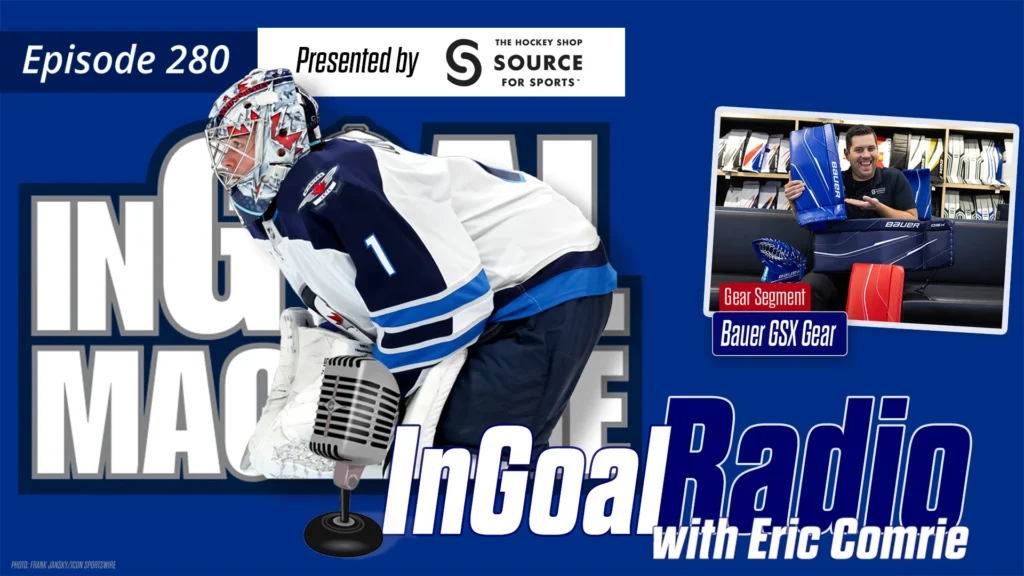
InGoal Radio Episode 280 with Eric Comrie

Please subscribe and leave a rating — it helps us reach more goalies!


In InGoal Radio Episode 280, Winnipeg Jets goalie Eric Comrie advises goalies to know themselves and avoid adding tension by trying to fit the stereotype of what a 'serious' goalie should look like. He credits goalie coach Wade Flaherty as a key factor in the success he and Connor Hellebuyck share in Winnipeg, and discusses how his game has evolved over the past three seasons.
- Eric Comrie warns goalies against mimicking a 'serious' goalie stereotype, arguing that forcing an unnatural identity creates harmful tension and hurts performance.
- Goalie coach Wade Flaherty plays a central role in the success Eric Comrie and Connor Hellebuyck share with the Winnipeg Jets.
- Joseph Woll of the Toronto Maple Leafs explains when goalies should look off the puck, offering a practical read for goaltenders at all levels.
- AHL standout Devin Cooley is highlighted for his strong season with the Calgary Wranglers, with key advice drawn from his approach.
- The Bauer GSX gear line is reviewed as a strong equipment option for young goalies, as part of an ongoing series for goalie families.
Episode 280 of the InGoal Radio Podcast, presented by The Hockey Shop Source for Sports, features and fascinating and advice-packed interview with Winnipeg Jets goalie Eric Comrie.
Feature Interview
presented by NHL Sense Arena
In the feature interview presented by NHL Sense Arena, Comrie shares advice on everything from mindset to skating drills as well as technical and tactical tips and the evolution of his game over the past three seasons since we last caught up with him. He talks about what works so well in Winnipeg for him and Hellebuyck, the role goalie coach Wade Flaherty plays in that success, and offers great advice on knowing yourself and not trying to be someone else just to fit into the stereotype of what a “serious” goalie should be and the expense of adding tension.
Parent Segment
presented by Stop It Goaltending U
In our Parents Segment, presented by the Stop It Goaltending U app, we dig into one of the common phrases we hear about “learning to be a pro” and what that can look like at younger ages.
Pro Reads
presented by Vizual EdgeWe also review this week’s Pro Reads, which features Joseph Woll of the Toronto Maple Leafs talking about when to look off the puck, and is presented by Vizual Edge, a tool used to enhance tracking, reaction speed, visual stamina, and focus, and talk about some of the advice shared by Devin Cooley, who is tearing it up with Calgary in the AHL this season.
Weekly Gear Segment
presented by The Hockey Shop Source for SportsAnd in our weekly gear segment, we go to The Hockey Shop Source for Sports to continue our look at the various options for young goalies, with a focus on the Bauer GSX line.
Episode Transcript
Intro
Personally, professionally, don't tell my other bosses. This is my favorite part of the week. I love to hang out with David Hutchison and Kevin Woodley, the cofounders of InGoal Magazine. This is InGoal Radio, the podcast presented by The Hockey Shop Source for Sports Langley, thehockeyshop.com. Can't wait for our Gear Segment with Cam.
Gonna deal with the Bauer GSX line. We also have a huge, fun, awesome, just educational interview with Eric Comrie coming up in our NHL Sense Arena feature interview. The Stop It Goaltending U, the app parent segment is learning how to be a pro, and our focus on pro reads presented by Vizual Edge is with Devin Cooley. We got a whole lot going on today, boys, and I just I just wanna hang out with you guys.
It's a busy time in the goaltending world, Daren. There's lots of good things. And and another busy time for a lot of our sponsors that you mentioned, whether it's The Hockey Shop Source for Sports, NHL Sense Arena, or our new sponsors at Vizual Edge of the ProReads are it's almost Black Friday. Second Thanksgiving. The real Thanksgiving happened up here in Canada already, but everybody celebrates yours on your side of the border because it comes with Black Friday.
Savings everywhere. Make sure you check out all our socials because we'll be sharing them with you soon.
Have you guys dipped in any Black Friday presales? No. At a point. No? I have.
No. At a point. No? I have.
I have.
Just just wanna I wanted to softly get into the buying season. Just dip my toe into it. We got conversation to come up as the rosters are going to be announced in the next inside the next three weeks. So the finalization and jockeying for position is happening there as Andrei Vasilevskiy makes some history by smashing the record to be the fastest of 300 wins. I was blown away by how much of a difference there is now between one and two.
Yeah, Daren. There's a there's a huge gap, both in terms of games played and years because, Vasilevskiy did it in 490 games. Number two on the list is Jacques Plant in 521 games. That's a 31 game difference. Plant obviously playing for some incredible teams in Montreal.
Still 31 games incredible, in this day and age. And number three on the list, Sergei Bobrovsky. So we've got two current NHL goaltenders at the top three, Vasilevsky and Bobrovsky. Russia's not in the four nations, but if they were, they'd have some interesting decisions to make, wouldn't they?
Good problem to have. Andrei Vasilevskiy is on an absolute tear at the start of this season. We know he had the back surgery last year, made some changes this year. We talked about it with Adam Francillia on the podcast when we had him on in the summer that Andre reached out and is now working with him. I talked about it early this season.
When I watched him play the Canucks, I felt like a little bit like I was watching some Connor Hellebuyck, little bit of the as Helly likes to call himself, the big boring. Just a little more sort of control, staying upright longer in some of Vassi's play, and he reads the game so well. It just he just made it look so easy, and maybe that was the way the Canucks were playing at the time. But he's actually, like, the top of all three of those Russian goalies in adjusted save percentage at this point at plus two and a quarter. Shesterkin's right behind him. Not far behind them is Sorokin. And then a little further down, not quite as as strong statistically, but the guy's coming off a Stanley Cup win and is one of the one of the best of all time, surefire first ballot hall of famer, Sergei Bobrovsky. So that, you know, obviously, they'd rather be there, but not being there, man, saves them making a really tough decision on which of those three you'd pick.
Oh, it only puts it off for a year, you guys. It's not like they're not going to have to get into this. The Olympics are are in 2026. So and Russia will will participate in that. Right now, Andre Vasilevsky. Data.
Oh, that's awful. You're you're really just gonna sit there.
Well, I mean, it wouldn't be fair to either of them for me to jump to any conclusions. Now would it?
That's a tough one, though, man. Like, him and him and Shesterkin speaking of data, are like neck and neck statistically, and Sorokin is not far behind. And then like I said, all Bob does is win. So I gotta say this though. Like, I'm just happy to see Vassy back at the level.
Obviously, with the back surgery last year, didn't have a season like we're used to seeing. I probably underestimated the role that back surgery would play, and good on him for despite having a career as decorated as it is, understanding that as he ages, he's not gonna be able to rely on his freak athleticism or shouldn't want to rely on it as often as he has in the past, and that that's a path towards injuries and making some changes in how he trains and moves. So that's a it's a heck of a bounce back so far. It's a great story. I'm not sure it's one that's been told a ton because it takes the advanced numbers to sort of recognize how good he's been behind a team that is looser than it's been in the past.
But, you know, this is a guy who's, you know, top five, six in the league right now among starters and having a hell of a year.
Super brave of me to pick Andrei Vasilevsky to be good. No. But if
you think about it, we kinda didn't we do that in the context of of breakout? Like, in the sense that he's coming off surgery and so on and and was gonna maybe rise to new heights again this year, you is is the way I interpreted what you were saying.
Okay. So so if I'm gonna pat if you're gonna help me pat myself on the back, let me take an l here. Happily take an l here because the numbers sort of looked not as flattering once you accounted for the system and how good they were structurally last season. So I worried a little bit about how it would translate with a new team, but Cam Talbot is absolutely killing it in Detroit right now. It is no longer a small sample amongst starters.
Cam Talbot is first in the National Hockey League in adjusted save percentage. He is giving them everything they ask for and more, and I could not be happier to see that come to fruition. I mean, you know, that's again, the numbers have limitations. Right? You have to remember, like, this is a veteran presence, a team that really needed that kind of stabilizing presence alongside Alex Lyon who is off to a good start as well, but Talbot is giving them exceptional goaltending in Detroit right now.
And one of those ones where the questions I had and asked in some spots publicly, really happy to take the l on that one because the numbers the numbers have gotten it wrong so far. Cam Talbot's having a having a, like, literally top of the league season right now.
At the end of the day, we're gonna ask, why doesn't he get a long term contract, and why does he play for so many teams? Because he he plays well for everybody.
Yeah. It's fair. And and the long term contract is probably just more to do with the age. Right? Because it's Yeah.
And and the volatility. And I think a lot of people looked at the Kings and just thought they're really good defensively. And, honestly, the numbers sort of bore that out a little bit. And, you know, tough last year, you end up backing up in the playoffs. David Rich takes the net.
I mean, I think at the end of the day, it doesn't matter who is in net. The Oilers just overwhelm the Kings, and maybe that has something to do with it. But good on
like, he goes to all star games.
100%.
And I've said it here before. I think sometimes management and hockey puts sort of narratives on guys, and it's really hard to break out of that narrative that that surrounds you. And even if we may see something different and the numbers might say something different, guys get pigeonholed in this game, and it's it's unfortunate. So it's great to see him having a big big year. And sometimes you have to really exceed that narrative for you to be able to break out of it, and it looks like he's starting to do that right now.
Well, well, you know what? I mean, one of the things he's talked about, shameless plug for one of our new sponsors, Vizual Edge, is his use of their product in the past couple of years has been a game changer that sort of led to a lot of those all star games and and the and all the success he's had in the last couple of years. So we're gonna get him on, and we're gonna talk about that and his work with Vizual Edge in the near future. But it brings me to another breakout candidate this year, just at the American Hockey League level. And a guy who I don't think will be there very long, our ProReads this week was with Devin Cooley.
We did the video while he was with the San Jose Sharks, but he is absolutely, again, much like Talbot. I'm throwing this phrase around a lot. Absolutely killing it with the Calgary flames affiliate, the Calgary wrangler so far this season. The same percentage when we did the ProReads. I haven't checked to see how it went on the weekend, but the same percentage was nine fifty four at that point, and we're well into the season for him.
So, the first goalie this year to be named the American Hockey League player of the week, coming off a two shutout week. Devin Cooley is is absolutely killing it, and he was our guy in ProReads this week, which, of course, is brought to you by Vizual Edge.
Should mention Devin's name has come up a couple of times in my conversations with people at the American Hockey League level, and it's, just organically surfaced as well as well as he's played. He's earned the the right to be a conversation topic. On the four nations conversation, three weeks until the rosters are announced, how much fluidity do you think there is in the discussions about the goaltenders?
I think there's still a little fluidity in the three spot.
For Team Canada?
I have a hunch country. Yeah.
Yeah. I guess it does. For let's with Canada, I mean, I would hope that Cam Talbot's opening some eyes with the start he's had. You know, we talk about narratives and respect, but I do think, you know, it's it's a little baked in in the one and two. I'm not sure, but I have a hunch it might be a little baked in in the one and two.
You know, I think you're gonna see a Binnington, Adin Hill combination for Canada. I think that's gonna be the top of their pecking order, and we'll see where they go with three. Is it a Talbot? Because he's the hot hand right now. Is it the experience and joy that a Marc-Andre Fleury brings to the rink?
Could we see that? Because he's having a good season. Or, you know, talk about guys that are earning it. You saw him last night, Daren. Logan Thompson's got some of the best numbers in the league right now, both raw numbers and adjusted.
Could we see a lefty thrown into the mix? So I'd I'd sort of wanna find a guy on a heater if I was Canada. And, you know, the two guys I think they have to have haven't necessarily been on heaters, but they've got a pedigree and they've done it for years. And so I think that's the way they're probably gonna go.
I don't think there's a path to Marc-Andre Fleury just based on retiring. And if you're gonna use that three spot, use it as somebody that you can expose to the situation for potentially an Olympic appearance. That's Fair. My impression from it.
That's fair. I know it's I know his name got thrown in there and got kicked around a little bit, and I I love the idea, but, obviously, you're right. Not everybody does. And you you you wanna build
It it would be awesome. What about the American side? It seems like there's
Tough decisions.
A less firmness based on the play than we had before.
Well, it's got 100.
Alright. Clear. One's not hard. Yeah. And then you've got Oettinger.
I'm sorry. Otengier's right behind Connor Hellebuyck statistically. And then the last one is, I would assume, a Jeremy Swayman, Thatcher Demko decision. Swayman hasn't had the start, but he has enough of a track record to know what he's capable
hasn't started.
And Demko hasn't been on the ice. So and if and if you're at Vancouver Canucks, you're probably happy if he's not on this list in a couple weeks because the last thing you wanna do is add to his workload as much as he deserves it based on his past play.
Do they name the goaltenders or do you think they name the goaltenders and tell somebody that they're number three?
Oh, that's a good question. I don't have that answer. I
Because it's so far out from the tournament that As management, I'd wanna They would love the option of leaving it more wide open.
That's wise decision.
If you have what's that old saying? What if you have time, use it? I don't think I'd be telling anyone.
Well, especially especially if you talk about the Talbot situation. Right? Like if if you look at those Binnington Hill is baked in if you want, Woody. Talbot being number three in that situation, dare I say, is is about narrative again. But if you give him a little bit more time, a little bit more runway, if he stays at the top of the league, how can he not break into the top two?
And he's like, his numbers right now are so exceptional that they inevitably like, nobody sustains that level over the course of a season. It would be a historically great year. Like, Shesterkin's Vezina year, where everybody was talking about the heart wasn't at the level that Talbot's at now. And so it will be hard to maintain it. But imagine if he did, like, you don't wanna close the door on that.
What about Sweden and Finland? Should we do a deeper dive on that
next We can save it if you want. I can give you the Finns right now. Let's save it, Daren. That's called a tease, I think.
Let's do it next week.
I would rather do it next week because I would like to be more prepared for names and and possible alternatives because I on on the Swedish side, I just I I need to do a little bit more digging, if that's fair
to Let's do
it. And it might get it might give Hutch an opportunity to to really, decide on on his fence sitting.
I'm not fence sitting for Four Nations. I was fence sitting for the Olympics.
That I know. But you it'll give you the week before 2026. Yeah. Oh, no. You found a fence.
Gear
Our Gear Segment brought to you by the Hockey Shop Source for Sports Langley, thehockeyshop.com. We're dealing with the Bauer GSX line.
We are. We're we're continuing to look at the kids lines. I was I almost did it, Hutch. I almost said youth, but but that's actually technically a line.
A line.
Yep. Bauer GSX, junior intermediate senior, hockeyshop,hockeyshop.com. They've got that and more. Before we get to the gear segment, a reminder, there is no better place to gear up for Christmas than The Hockey Shop or thehockeyshop.com, including their upcoming Black Friday sale. You'll be able to get discounts on the things that your goalie needs, whether it's stocking stuffers, a stick under the tree.
Isn't it always fun to come downstairs on Christmas morning and see that big long stick all wrapped? Maybe less fun to wrap for the parents, but the joy that goalies get out of that, or a full set of gear. Well, no matter what you need, the hockey shop has it and the staff and the expertise to make sure that it's the right thing for the goalie on your Christmas gifts gift list. So make sure you check them out whether it's in person in Langley at the Hockey Shop Source for Sports or thehockeyshop.com, and they will have something to help you for the goalie in your life this holiday season, including the Bauer GSX line, which Cam is gonna walk us through for the junior intermediate levels. They also come in senior, but can can't let's just shut up, Kevin.
Let's let Cam explain. Welcome back to The Hockey Shop. We're here in Goal Utopia with Cam Matwiv and the new Bauer well, not new. Bauer GSX. It's got new features on the Bauer GSX that weren't available in the past.
Junior intermediate colors, pro level features. We're gonna get into them in this segment with Cam. Why don't we start with the pro level features we teach?
Oh my goodness. The best part about this pad is they bring down the Stabiloflex knee. All the way to junior and intermediate.
Junior, intermediate and senior, which the GSX is all available in. But the best part is having this down in the junior pad because that's not something that, you know, wasn't available before. Again, this GSX has been around for a little bit now, but we're definitely wanna call out some of these highlights again.
It's that time of year where kids are deciding to be goalies full time, and this is the type pad if you're a parent that you wanna come in and look at if they're taking that step.
For sure. I I mean, that need just can't be ignored. That extra stability when you do drop down, why they call it Stabiloflex, in terms of being able to sit tall in the butterfly, get used to those mechanics, especially as that kid tearing through as well. Know, again, option. It really helps with the overall control of the pad and then that similar slide surface, not exactly core tech, but very, very close to it.
You're getting a very easy sliding pad, very stable pad. You know, can't say enough good things about that GSX available at that price point.
Colors are new? Colors are last time we did this, it was black and white. Yeah. Just simple. Like, were in the fifties.
Now?
We're in the fifties. Now we're bringing it to the twenty first century.
You had to think about that,
You know.
You know what century we're in. Right? Navy, blue, red.
All options that are available.
Gear in store, stock? Yes. Off the wall?
Yes. You can find them at thehockeyshop.com. Glove? Nice, snappy, easy closer.
So important for kids to be able to close their glove.
That junior style hand. Say the joke if you want it. It's fine. It's too late. It's on Kevin's hand, so clearly he has a junior hand.
It's fine. Easy. Nice snappy closure. Double tee. White.
Gonna have the skate lace. The colors don't. As we see here, but that's always something that can be released aftermarket if you please. Nice easy blocker. Flip it around.
The palm continues on with all of the Bauer style blockers. A little bit of a tighter hand fit. Again, great for having that extra control, especially, you know, learning those fundamentals and whatnot for that junior size kid. Overall, colors definitely really pop, help to add a nice refresh to the lineup.
Okay. So sizing. Kids, walk me through the different sizes we're talking about. Again, it goes all the way to senior, the GSX line, but this we're talking about There's an over sizing.
Yep. What what size range do we start at for this?
So junior small, which would be a twenty six inch, twenty six plus one. So as you've seen before in Bauer's sizing, the small, medium, large category still exists. Medium, twenty eight. Large, thirty. Thirty is also a crossover size and intermediate.
When why would I change? The intermediate pad, you will find more structure to it. The knee cradle is gonna be a little bit bigger. The same technical equivalent size, but the pad itself, harder packed density foam too as well on the inside. So you will start to feel that difference kind of between the two.
When do I make that transition? When your child's ready, which is also okay, when is he ready? You can tell by the extra size of the child, you know, if he's tall and super skinny, you know, potentially that junior pad is still correct. He's filled out a little bit more control of something that's gonna be a little bit more heavier. He's ready for a little bit more advanced pad, okay, that's when we make that next step up to that intermediate size.
One of the things that we didn't mention this time when we did the last time, it has a pillow on the inside as well. Cam talked about stability in the butterfly. So this is that pillow can give you a little extra, just making sure when you're landing that little bit of support to keep that pad flush and keep your goalie sort of balanced over top of his knees when he's on the ice, especially as Cam said, before he sort of gets that body control just to make it that much easier. And then as he gets it, if you want, you can take it out because it's removable by Velcro. So just one of the many features they thought about on these junior and intermediate pads to help young goalies be comfortable and able to play the position like they see goalies at the higher levels do.
Exactly.
Okay. So if you got any other questions, Cam went on about sort of the different levels, the different ages. That's the expertise you get when you come here to the Hockey Shop in person at the Hockey Shop or hockeyshop.com or if you wanna give them a call with questions about what size for your kid.
604-589-8299 or 1-800-567-7790.
That's the expertise you get. You'd these are questions that parents often have about, you know, what do I really need for my kid? Cam and his crew will make sure you get the answers that will help them get into the right gear.
Perfect. Thanks, Kevin.
I I've been waiting that that entire visit by Kevin and Cam to get back to how he intro ed the Gear Segment. And a great idea, Hutch.
New swag for InGoal. We're gonna get some
T shirts.
Gotta get T shirts.
Yeah. We're gonna get Shut
up, Kevin. My mother won't be impressed. I was never allowed to say shut up growing up, but I I'll put it on a T shirt and I'm gonna send one to each of Kevin's daughters.
Who who have, in no uncertain terms, used that phrase, perhaps with more colorful language.
This goes back to 1999. And that was the year the Dallas Stars won the Stanley Cup. And Brett Hull was on that team. And Mike Keane made hats that said, shut up, Hull, and handed them out to all of his teammates during the Stanley Cup final as a way to, like, lessen the pressure, have some fun, and enjoy themselves. And we're in Dallas at the practice rink covering that championship series, and out they all come with their shut up Hall hats.
And Keane walked over to me and said, pretty good,
Mike, Keenan, I had the pleasure of him later in his career here in Vancouver is just an absolute treasure. So that story does not surprise me that it was him at all. Just a treasure of a human being, and your perfect locker room guy, like, just ultimate leader. So, he was the one that was on the bench when Johan Hedberg broke his wrist and the emergency backup goalie was on the bench, Chris Levesque from UBC. And poor Chris, nobody knew that he'd broken his wrist, and he ultimately never came out of the game.
He went for a diving poke check at the blue line. Probably tops among the things you shouldn't do when the next guy up, was recently a third or fourth stringer at the local university, but he actually broke his wrist on the play. And Leveque, the camera flashes to him, and he's just chewing that gum like crazy, like, just as hard as you can chew gum. And Mike Kenean just looks down all casual and says, don't worry, kid. He'll get up.
Just a absolute beauty. I I it was only a year or maybe a little more than a year that he was here, and then he went to coaching back in in Winnipeg, which I believe is where he's from, but one of the all timers.
Yeah. Good, good Winnipeg guy. I'm gonna find out, I'm gonna get in touch with, Mike and see where he got those hats. I wonder if he still got the contact name. Shut up, Kevin.
Shut up, Kevin. Let's get into the focus on ProReads presented by Vizual Edge, and we're zeroing in on Devin Cooley who is turning the American hockey leg on its ear right now.
Yeah. Before we get to Devin, wanna talk to you a little bit about Vizual Edge. We teased it a little bit earlier with Cam Talbot and the way he's used the product. He's one of more than 50 NHL and American Hockey League goal goalies that use Vizual Edge, which is essentially weight training for the eyes and brain, a way to strengthen your visual and cognitive processing skills For peak performance, you take an edge test to start it off, sort of get your baselines on where you're at. I've done that myself, and I'm now in the process of trying to improve those baselines.
It's early for me. Only been doing it for a little over a week. Got a skate tonight that I'm really eager to sort of see how it's going to work, but I I feel like I'm seeing the puck better already and that makes sense based on the way they train and improve certain aspects of your visual system. Especially for me, it's divergence, ability to track objects sorry, convergence, ability to track objects coming to you. But it's one of just six skills that they train.
It's a really easy online program. They send you the glasses, and, of course, all listeners receive 15% off. Hutch, what's the code for 15% off?
Well, it's pretty tough. InGoal.
See? Super easy. So simple. Even even I can't remember it.
If you're an InGoal member and you go check out any ProRead, in the last few weeks, you will see the code for InGoal members, and then you get to save 30%.
And I would highly suggest checking out, as Daren said, the ProReads this week. Devin Cooley may be wearing San Jose Sharks gear because we caught up with him before he signed with the Calgary flames. But this is this is a young man who, if you remember his podcast appearance, is very much still learning new elements of the position. He was so good explaining sort of some of the things that are new to him, bit of a, quote unquote late bloomer, and he is blooming in the American League right now. This week, we talk about hey.
Kinda reminds me of the Joseph Woll one last week, speaking of another Vizual Edge user about looking off the puck. There's important elements in that where Devin talks about when to look off the puck and why and the importance of it. And then he gets into the importance of flattening out your reverse VH and when to do it. And this is something I see a lot. I've talked to you a lot about Hutch.
Like, guys coming into the reverse too steep with their inside leg too uphill towards the top of the crease and how that limits some of their lateral mobility instead of coming in a little flatter. And so Cooley walks it us through all that in this week's Gear Segment. I know Daren, us old guys, we're just lucky to get into the reverse. Actually, we can get in. It's getting out that hurts.
But at the higher levels, they actually have to learn how to steer and flatten themselves out. And Cooley does a great job of explaining why that's important in this week's video.
I'll give you a little homework too if you're watching this week's ProRead or maybe go back if you've already checked it out. There's another little element in there where Devin Cooley handles it his way. If you were to go back and look at the videos we did with Bill Ranford showing their system on the post, you'd see that as an LA King, he'd be asked to play that a little bit differently. So go see if you can find out what that is as your homework for this week.
Oh. At least there was no math. I didn't know there was gonna be homework, but I like that.
Oh, I don't know. You just did a bunch of angles, Woody. That's math.
Oh, that's funny. Woody on the steepness of the RVH and when to flatten out, when to be a little bit more aggressive. That's that's something that I certainly struggled with as far as the approach to it.
Well, it's it's interesting because there are some coaches. And, obviously, here in Vancouver, I've been around Ian Clark for a number of years, and his his goalies go inside out. They actually sort of loop as they go in, so they're always flatter. 30 angle 30 degrees relative to the goal line in terms of their alignment on the post is their ideal. And by being flatter, you sort of push that shoulder into the post.
There's just there's less like, most of the guys that get ripped short side quite often, it's because they're steep and it's harder to get that short side high coverage. It's easier to sort of push into the post along the goal line and up than it is to push downhill into the post and get your head against it.
I guess when I'm going in early, I'm still worried about the far side a little too much and trying to be a little more square to it.
Well, I And that's what that's
where I run out of trouble. Is too. And that's Depends on the threat too. Right?
And that's why we have ProReads. Right? So you can figure out what threats to do what with. And I'm gonna be honest with you, Daren. For me, when I go into reverse VH, my biggest worry is being able to get out of it.
It's
like You want me to go across and get up?
I've fall I've fallen down, and I can't get up.
And then if you're outside the crease a little bit and you're trying to slide back, there's all kinds of issues. So but I can't wait to dive into that with Devin Cooley, who is a name that you're going to hear a lot more of and one of those names that I'm proud really surfaced through InGoal Radio Podcast.
Well, hey. Here's a tease for you. For all you goalies that are listening to us talk about reverse VH, but you're my size and the reality of me in a reverse VH is I'm not covering anywhere near the crossbar, We have got another Calgary Flames guest coming up this week at ingoalmag.com. Talk about reasons to get an InGoal premium membership beyond the fact you're saving 30% on Vizual Edge. How about Dustin Wolf, who is off to an exceptional start himself in the National Hockey League is a listed at six foot.
Good luck if he's that tall goalie. On post separation, which is another word for that step out or overlap. We've got full video. We've got a breakdown from Flames goalie coach Jason LaBarbara and a whole bunch of videos of Wolf working on his post integration that I think probably actually translates for a lot more of us and a lot more younger goalies who aren't big enough to get into a reverse and seal up to the post. It's a great video, a great pro drill, and that'll be up later this week at ingoalmag.com where we bring you more bang for your goaltending buck.
Parent Playbook
Looking forward to it. The parent segment now brought to you by Stop It Goaltending U the app.
Another one of our sponsors.
Oh, jeez. It's a big day.
It's a big day for sponsors. Stop It Goaltending U the app. You get a free we there you go. If you don't wanna buy a membership just to InGoal, get a membership to Stop It Goaltending U the app, and you automatically get a membership to InGoal, which gives you all the ProReads, which gives you the 30% off the visual edge, which gives you the Dustin Wolf post separation drill and hundreds more like it, but that's not all you get. In addition to an InGoal mag, InGoal premium membership, when you buy a Stop It Goaltending U, the app membership, you get access to all their great content as well.
Their five part daily primer this week, and each week, there's five different one minute quick hits you can look at in one minute and get better every day. They look at a season assessment. We're a month, maybe two months in for some teams into your season. How do you assess the way it's going? They've got a five parter on that this week.
Five minute drill from Joe Kanata, former Canuck, former pro on reverse VH tips. Again, we talk about flattening out and when to. He's got reverse VH tips up there. And then twenty minute deep dive video this week on t push versus shuffle, what the differences and when to use which one. So tons of information over at Stop It Goaltending U, the app, proud sponsors of the InGoal Radio parent segment.
Let's be a better pro.
Let's be a better pro. First thing, a great parent segment is just listening to the Eric Comrie interview this week. I know we've teased it a few times, but there was a piece in there on trusting your process that I clipped out as I was editing it and I said it sent it to both of my kids, Maddie and I still claim our former billet Cooper Black as part of the family. So I sent it to Cooper as well. I just said, this is so good.
You guys have to listen to this. I will clip it and put it in with the parent segment this week. So moms and dads, you can send it to your kids if you want. Because I know some of the younger kids don't have the patience to listen to the whole thing, but they should. Anyway, I did have something else prepared for this week, guys.
And as I was growing up in the game, I kept hearing people on broadcast talking about all these guys coming into the league and needing to learn to be pros. And I wondered what that meant. And I thought when you're a little bit younger, you you actually can learn some of these things yourself. Now there's levels to it that you can't as a minor hockey player. That grind of an 82 game schedule, the long travel, balancing family life with hockey.
That's pretty tough to learn that as a young kid, But you can get a start as a young goaltender, and parents, you can support this. Now, the first thing I wanna say is I'm not suggesting we take all the fun out of the game. We don't want young kids to be all business all the time. They're playing hockey to have fun. I for one hate hearing of minor hockey coaches telling kids on those fun away tournaments that they have to stay out of the hotel pool.
And mini sticks belong in the hotel, of course, as well, guys. But while there's some things you can do to teach a young goalie to become more professional, and I'll I'll put that in air quotes. Because to me, being professional as a young goalie is learning to be responsible for your equipment, for your time, for your training, for your game, those sorts of things. And it will come over time, but there's no reason you can't start at a young age. When I see top major junior goaltenders, the ones you just know are headed for a career in the game and and somebody who comes to mind for me, Woody, is Dylan Garand who's playing in the American League in the Ranger system as somebody who was professional from a young age.
They do all these things just as a matter of habit at every goalie skate even. They don't have a coach telling them what to do. So what what could you what could you do? You've heard me talk before about helping your young goalie learn to be responsible for packing their gear and knowing when it's time to leave for the rink and so on. You can check out some of those articles and parent segments.
I'll have them linked. By the way, just a reminder, every parent segment is published separately at ingoalmag.com. It's unlocked. You don't have to be a member and you can go just listen to this segment. And in there, will have links to these different articles and things I'm referring to today.
Second thing you can do, teach your kid that when they get to the rink, often coaches want you to be there early, an hour early at a really young age, but there isn't a whole lot of direction after that. And you see kids not even sure what to do with themselves. So simple things you can do, like lay out your gear in the locker room like you would see a pro do it in an NHL stall. And I know some minor hockey dressing rooms, you don't have the room. But if you do, hang the chesty, hang the pants, get everything set out just so before you even start getting ready.
And then you take that bag and you roll it up and you stick it underneath the bench. That's the way the pros do things. And you can start learning to do that from a young age. On practice days, tip number two, when you hit the ice, there's often a whole lot of unstructured time to begin as players are skating around, shooting pucks into the net, and too many goalies either just go straight into the net, although I think most of us tend to avoid it, or they just sit by the boards out at center ice just doing that lazy groin stretch. And I even see this in game warm ups.
Mom and dad, go find a couple of InGoal warm up articles and again, we'll link them. But maybe the Dustin Wolf or Sergei Bobrovsky skating warm ups and help your young goalie learn them for that unstructured time. I'm not saying you stand on the bench and walk them through it, but maybe you show them just one little piece of it and say, hey, why don't you try this today before practice? And eventually, they can learn something that will become their own routine much as you see older goaltenders doing now as soon as they hit the ice. Do you think there's a coach telling Dustin Wolf to do his skating warm up every day when he hits the ice?
That's his. He's probably done it for years and he's gonna continue to do it. Even a few minutes spent on edge work as others are just messing around on the ice will yield literally hours of extra practice in your minor hockey career. And then the last little tip, have some good mindset practices at home. You could check out Pete Fry's articles, for example, over at ingoalmag.com.
Also, last week's parent segment where we talked about not blaming others. Just having a little bit of time to focus on a few of those mental skills will help you have the mental approach of a pro. And as I mentioned, listen to Eric Comrie's interview today to learn a little bit about that as well. Like I said, an eight or a nine year old does not need to learn to do all of this, although some of them might like it. And don't get frustrated if it takes time for your kid to develop some of these habits.
But if you can develop a few of them, you're gonna have your young goalie well on their way to being a pro.
I love the idea of unpacking the bag, hanging stuff up, and then throwing the bag underneath. One, it creates way more room in in the Yes. The locker. And the other one is if you forgot something, you you'd know right away. It could give you, like, a twenty minute point head start because we've all forgot stuff.
That's an excellent point, Daren, for sure.
That's actually one of the reasons one of the big questions you see in the parent groups amongst the really young goalie parents, new to the game, wanting to know which of those giant grit locker bags they should be buying for their kid. And you'll walk into the five, six year old dressing room and there's 20 of these giant locker things because we wanna buy the cool thing for our kids. I would suggest not going that route because as you get older, like we said, they wrap up that bag, they stick it underneath the bench. It's kind of an expectation of coaches, so there's room to walk around in the dressing room. And by the way, it's a lot safer there too because then you don't have skates tripping all over people.
With you on that, the great advice about listening to the Eric Comrie interview is fantastic. The NHL Sense Arena feature interview on InGoal Radio Podcast. Woody, this is fantastic. Hey. Before we get into it
I was just gonna say, one of the things you can do, Hutch, is fire up NHL Sense Arena to make sure you've got your eyes and hands warmed up so you don't have to stand in the net and let guys rip it bar down on you to get warm.
You sure can. And I had Sense Arena on this week and they got a great new feature, guys. I don't even know if you've seen this yet because it was just announced. They have something called the open skate. It's in beta.
It's still sort of being tested and developed. But, it's basically stick and puck drop in hockey. You go on there, they've got the ice divided up into different zones. You can set up nets with targets and cones and all sorts of cool things and just go out and play. And you do it in a drop in room.
I I think you can set up your own rooms with friends and so on. But I just jumped in and there were a couple of French Canadian kids out on the ice and I heard them talking to each other about the Michigan and a one timer and all these things. It was so cool to hear them just having fun out there. The one little drawback, but I think Eric Comrie would like this this week, guys, is that you can't do it as a goalie. You can only do it as a player, but we all love to go out there and be a player.
So you can actually take your controllers, grab a stick, you can grab pucks and fire them at targets, do whatever you want to do, learn to be, a player and just learn some of those skills and just go out and have some fun. NHL Sense Arena is an incredible tool for learning to be a better goaltender. As Woody says, you can use it like NHL goalies do to warm up before you go on the ice. But I think some of these cool new features like this new open skate, just a great way to have a good time as well. And it does remind me, by the way, hate to take too long here, but you can also have player accounts on NHL Sense Arena.
So, if you happen to be that young goaltender who older brothers, older sisters sort of forced into the net to take shots for them. Those older siblings can also have an account on Sense Arena and learn to be better players as well. They've got a Black Friday sale on right now. Head over to Sense Arena Dot Com. You can save 50% on an annual plan.
You get the sleeves to hook your controllers in for free. And if you use the code, IGM 50, you're gonna save even more.
I like that hangout room.
It's cool.
Did you throw
We should all do
it together. Did you did you throw that, like, on a goalie stick? Like, could you put your blocker and glove on, throw the paddles on the goalie stick and and stick handle?
I wish I wish you could. Maybe maybe since it's in beta, they could work on that, but it just sent me straight to players.
Because it reminds me of the you know, Carey Price would go out in our day with Carey Price in the first, like, five or six, maybe 10 laps around the rink just stick handling, playing around. Like, that's all the great puck handlers tell you to just grab a puck and go play with it. So as a goalie, if you can do that in that drop in version, there's real value there other than just having fun.
I'm just having fun. Woody's not gonna ruin my fun. Just gonna go out there and smile and giggle and try the Michigan.
Well, I mean, in addition to the Shut Up Woody t shirts, my kids would also like one that says, is a fun smuggler.
So Fun sponge.
There you
go. That's
a great term.
Feature Interview - Eric Comrie
Give me the background on the Eric Comrie conversation, where you wanted to go and where you ended up going.
Well, I'll be honest with you. Just any chance to catch up with Eric Comrie is a good day. Right? Like, his approach to the position, and it had been a few years. And obviously, a few tough years in Buffalo statistically at least.
Right? And I talked about just how tough the environment he played. I'd never seen a goalie with an expected, say, percentage of eight fifty eight like he had last year in Buffalo. And so to see him come out the other side, get back to familiar surroundings, I wanna talk to him about some of the things that were working with the Winnipeg Jets. One is first three starts, giving them a chance to give I mean, Helly never wants to come out of the net.
Right? But giving them a chance to give him a break with a really solid start for a goalie, you know, whose numbers looked crooked last year, but didn't tell the entire story. And he talked a little bit about the changes he's made, but also some of the things in his life that allowed him to stay grounded through the tougher times, including becoming a father and that ability to sort of separate the rink from home, you know, when he's going to the golf course. There's similarities between goaltending and golf, and he gets into those as well, but it's also when you're there, it's a reprieve. So a lot of different angles.
We get into technical, we get into mental, we get into a lot of different things. And as Hutch said, his mindset, his approach, his joy for the position all comes ringing through, and a lot of the advice that he gives, I think, will resonate with a lot of young goaltenders. Well, actually, it's gonna resonate with a lot of goaltenders. So this is one parents can listen to with their kids for sure. But I think a lot of us can come away with with takeaways that'll make us better no matter what level we play at.
Eric Comrie, the NHL Sense Arena feature interview on InGoal Radio, the podcast.
Really excited to welcome back to the InGoal Radio Podcast. One of our favorite guests, but it's been far too long since we caught up with him. Eric Comrie of the Winnipeg Jets. See, I guess that's what happens if I wait a couple years. I can just reintroduce you as Eric Comrie of the Winnipeg Jets.
I always seem to make my way back, and I think, I always like to make my way make my way back. I always have fun with Winnipeg.
Okay. So let let me ask you because you also always have success with Winnipeg. You're back with the jets, off to a great start this season. What is it obviously, the team, the people, flats, playing with Helly, like, is it just home for you, and and does that matter? Like, that comfort that you seem to have playing on this team and in that market.
It's it's everything really. I mean, Flats is unbelievable the way he does. I mean, don't get me wrong. I still have a lot of great goalie coaches everywhere I've been. I've been a big fan of all of my goalie coaches, but Flats and I have a really special relationship where he just he he knows my game very well.
And I think the way he breaks down video is one of the best in the the world the way he does, and he does a lot of skating drills, a lot of different footwork drills. I mean, if practice starts at eleven, him and I are there at 10:30 every single day, for at least half an hour doing a bunch of drills, then we're doing twenty minutes after. So that's fifteen minutes of goalie drills a day. We're just flats, and that's you can't get to other places, just because the amount of time we have is it's unbelievable. And I think just the the whole group in Winnipeg is just very welcoming.
It feels like a in fact, I get almost a little of a comfortability there, which helps me just to be play more a little bit more loose, a little bit more relaxed, which I've always played my best when I got.
Okay. So you mentioned skating and footwork and all that extra drills. How's that evolved over the years? Flats knows you, probably knows what you like, what you need to feel your best even when you're not playing a ton. But, I mean, I I it's funny because the game's never been more dynamic East West as the type of things you're doing skating wise when you mentioned footwork.
When you came up, we used to talk about open skates and going in, like like, your skating through crease patterns. Can you move is it more is it all still in the crease, or is there more outside of the crease these days? And when did that evolve? Not just for you, but maybe even around the league.
It's still a lot of crease work. I still think we do a lot a lot of crease work. We're we're mostly always in our crease doing skate drills. I mean, he sets up pucks, and I have to move from different puck to different puck. Almost like past different things like that.
I think he's we're a big believer in that. We're a big believer in skating in our creases and doing a lot of crease work. If we don't wanna mess with the crease, obviously, we do have brackets and you can't switch ice sheets, then we do some work outside the crease. But still, it's like a v drill where you just skate to a puck, skate to a puck, and it's very, very basic, just very basic, very simple things that you do hard times a game, but it's just it's about just making sure your movements are sharp, making sure you're quick, making sure you're changing directions really quick. And it's just little things like that that would just keeps you on your game, and it keeps you almost confident to stay on your feet a little longer because it builds a lot of confidence on your feet.
So it's funny you mentioned that. Like, you know, the more complicated the game gets around us, you know, you're talking about alphabet drills. Right? Like, the simple crease movement patterns back to base.
I mean and I really don't think there's a better example of making the game simple than Connor Hellebuyck. He makes the game as simple as any goal I've ever seen. The way he thinks the game is unbelievable. I think me being around him really helps because we we talk shop all the time. He's one of the most calm and loose cool boys I've ever met in my life, and I'm I'm really in between periods breaking down breaking down plays, breaking down scenarios, and we go and watch the video on it in between periods.
I mean and I really don't think there's a better example of making the game simple than Connor Hellebuyck. He makes the game as simple as any goal I've ever seen. The way he thinks the game is unbelievable. I think me being around him really helps because we we talk shop all the time. He's one of the most calm and loose cool boys I've ever met in my life, and I'm I'm really in between periods breaking down breaking down plays, breaking down scenarios, and we go and watch the video on it in between periods. Like, it's he's very really really relaxed, really chill, and we just we have a great, like, a great friendship and a great community together. And I think that all three of us working together collectively, it really helps to simplify our games.
Okay. So if a lot of the skating footwork done is is still done sort of in the crease or crease movement patterns, Have you added like, we see I think because it went to the cup final, lot of people got to see the Bobrowski ballet. You know, that that edge work stuff that's out of the crease and a little more flowy and, you know, a little more sort of body edge connection. Like, have you added that in recent years as well, or is it still just primarily crease stuff?
It's I do a little bit of that stuff in the summer, but still mostly just crease work. Just mostly I mean, you look at myself or Connor's game, we don't have a lot of that flow in our game, really. We're more just set to our spot, set to our spot, set to our spot, set to our spot. You look at Bob, I think he has a little bit more flow to his game, and he plays it really well. He's unbelievable.
Like, he's just that's he's so good at that, and that's I don't know if I could play that way. It's not really a way that I could play not a way that, like, Kelly could play. Kelly is Kelly is very much in in his in his spot in his spot in his spot. And I think for myself, I'm the same kind of way where it's all about hitting my marks and just making sure I'm set and all my all my edges the best I can be, but not not extra flow, if you know what I mean.
Is that part of the evolution of your career is understanding what your game is? I I guess for any goalie. Right? Like you like you said, like, knowing that I couldn't beat you that guy or that's not my strength to try and play that way. This is what I need.
This is what I do.
I I think so. I think the the I mean, the older I get, the more more I realize I'm not, oh, I can't change my game at this point in my career anymore. It's more I can learn little things to do or things like that, but I think it's, I think when I was younger, I tried to take like, I tried to do a lot of different stuff that a of people were doing and a lot of around the league. I like, okay. I wanna do this.
I wanna do that. I wanna do this. Okay. I gotta do this. But now I realize I gotta make sure I hone in to what my game is and really understand and appreciate where my game is and where it's at and really just go and build on my weaknesses, but also my strengths and make sure I understand, hey.
Make sure you don't neglect anything that's part of your game. But I understand, if it's not part of your game, I don't think you have to work for it. There's certain things I I just don't do as much as the guys that I try to I try and keep out my game.
We think of guys that and and I'm always drawn, we always have conversations about sort of finding the next thing and what's the next thing. And can you get caught chasing change watching other guys and and maybe changing things for the sake of change or trying to keep up as opposed to rooting down on your foundation? Could that be tempting to do, especially as a younger guy?
So I think it is good as a younger guy, though. I think it is good, especially when you're before before you make pro, before you do that stuff, I think it's good to learn and as much as you can and try different things out. I tried a bunch of different things out, and, it helped me a lot because I I learned a bunch of different things. I think it's really good to be as open as you can be. Like, I've had many different goalie coaches along the way, and never was I stubborn and said, no.
I don't wanna do this. I've always implemented or tried everything that everyone's ever told me to do because I think no one's ever trying to make you worse. They're only trying to make you better as a player. No one's gonna give you advice and say, I want you to do this because they want you to be worse. So everything they did, they told me to do with with the effect of making me better, and I believed it.
And I tried everything I did, not everything stuck with me. I I would try things and give it a really good chance, and if it didn't if I didn't like it and I'm practicing it, I wouldn't use it all the time. I think it's the old you like, look at the old Bryson DeChambeau thing. Like, he I I know it's a golf thing, but he said it in his video once. He goes, you wanna do is, like, is if you give him a new cue, you want it to be almost instantly working.
If it doesn't instantly work or feel good right away, it probably isn't gonna mesh with your game best, and that's that's what he said, and I I I believe that to be true in a lot of aspects.
I know you're a golfer. Do you find a lot of paying attention other like, we always talk about it's it's a similar mentality between goaltending and golf, one shot at a time, easiest thing to say, hardest thing to do. Are there other even body mechanics and how detailed we can get between the two, the way they break down video. Does one help the other? Do you find lessons from one that that, you know, help you as a goalteller?
100%. Not just golf, but every sport. I think you can learn from every sport. I think you you watch quarterbacks. You listen to what they say in their interviews.
You watch different pitchers. You listen to what they say in interviews. I think it's a very similar position, the fact that we had to be so mentally dialed in. You have to learn different things. Then I was watching actually a video on Instagram by Bob Rotella, I believe, the sports psychologist who just said, you gotta let it loose and play free and play loose.
And it's so true. It's the same thing in hockey. I think you can pick up different things from different sports, different athletes because and I watched a lot of different Tom Brady stuff here because I I love Tom Brady. I love the athlete he is or Peyton Manning. I watched him from the just because I think you learn so much from these guys, and they have so much knowledge in their field that you you you wanna absorb as much as you can from those people.
Do you do you like, do you read biographies? Do you read books from some of those guys? Like, for Bob Rotella, as you mentioned, famous, you know, sort of golf psychologist, or just mostly just watching shows on those guys?
It's just it's just like little videos here and there. I mean, I I had my own sports psychologist that I I work with as well that I'm a huge fan of, and I I really believe in him a lot. And I've worked with different ones along the way, and I think it's it's I think the mental game is one the most important aspects of hockey. And I think learning to, like, really play your process and not dive into the results as much is a really big thing. And I think for myself, it's about learning to and it's still a constant practice.
I mean, you're never perfection. This is a constant practice until the day you stop playing, till you the die early, is understanding results happen because you're good at the process, and really being great at the process is really the ultimate goal.
Okay. But we also play a position where there's an odd shaped frozen object bouncing around on ice and 10 guys flying all over, half of them trying to take away your eyes, the other half trying to put that thing behind you. Bounces happen, things happen, defensive environments are different. So process and results. Because I've had this conversation, it's early in the season.
Right? And a lot of guys how do you look how do you deal with numbers? Do you look at them? Do you not look at them? Can you do you find a way to not look at them?
How do you manage Anyone
who says they don't look at numbers is not telling you the truth. I'm telling you truth to tell you I look at numbers a 100% because at the end of day, numbers do matter, but it's it's still and and you still you still have to you can you can you can judge a little bit based on results afterwards. But when you're in the in the process, I think you really have to be fully engaged in it. You have to be fully engaged in the process, and what your process is is different for everybody. Like, my process is really focusing on my skating, making sure I look and then I move, that I'm feeling tall on my stance.
And just I'm repeating those mantras throughout the whole game and just making sure that, hey. I'm just sticking to it, sticking with it, sticking with it. And then if you because result based thoughts will pop up. Said, it's impossible. If you if you try to it's gonna happen.
You're a human being. Like, thoughts pop in your head randomly, but you have to the goal is to get back to your process as fast as you can away from results. That's the ultimate goal, is just to stay the best at your process and understand that that will take care of the results better than anything else will.
Okay. You mentioned mantras. Do you still have one written on your stick as well as a reminder, or have you changed
that? 100% I do. Yeah. I change it all the time. I have different ones.
It's it's still my mantra on the stick is still more of a reminder to what I wanna do is just, like, be breathe and be centered in my body and not get overly up or overly down and breathe. And I think for myself, it's it's it's little excuses that that help me along the way.
Different mantras that you've adopted over the years. I think we had one that we ran at InGoal one year and breathe was a part of it.
Yeah. Breathe.
Yeah. Breath work has been important to you?
I believe yeah. I believe it's very big. I believe it's a I do a lot of, like, I don't know if you've ever heard of, like, Neuro Peak or Heart Math. It's like HRV training. I do a lot of that stuff where I put like a, a band on or a little clip in it.
Like, it tells you when your, your heart rate is in sync. I think for myself, I I love the feedback. I love to know because then when I'm doing it, I can I can tell when I'm in a state, and I and then I can try and replicate that state when I'm on the ice or before I go on the ice, if I'm feeling a little bit nervous, if I'm feeling a little bit wound up? Or even a little bit tired, you can you can use different states and to modify how your body feels. I think for myself, I've done a lot of meditation stuff and breathing without that stuff, but I think having the feedback and knowing when I'm in that that space I want to be in and I can verify it with with the numbers I see in front of me, then I understand, okay.
This is what it feels like. This is how it feels to be in that zone you wanna be in. So I can kinda use that to try and get as close to that as I can around the ice.
So it's it's one thing to sort of practice it, but to actually know what the ideal is and then know what it feels like, that's where something like neuropsych helps you sort of connect those two feelings. 100%. The feeling to numbers, I guess.
100%. Because, I mean, at the end the day, it's all all all we're doing is feels, different feel based things. I think the the the more you get into the field where you know it's the closer feel gets to reality, I think it's when you're playing your best.
Okay. I see. You know me. I love to geek out on the tools, and now you got another one I'm gonna have to look up, buddy.
There you go.
The so so working with that and the breath work, it's interesting that you say when you're fatigued because I think we always think of sort of breath work to sort of bring us down, but we've had other people teach us things that, hey. Like, hey. Sometimes, like, you need to, you know, start up a period or whatever. You need to get raise your level. You've got breathing techniques that do that too.
100%. There's there's different there's many different breathing techniques, many different things. I'm I've been lucky in, like So for me, I'm more of the guy that has to calm myself down. Get a little bit nervous, I gotta calm myself down, get back to like a relaxed state. I play my best.
And you know what? People play best when they understand who they are as a person. Like me, who I am as a person, I'm a I'm a talking, outgoing, fun, like, I I like having fun and joking around. And I used to play before games where I would get really quiet and cheer myself because that's what goalies did. They stuck to themselves, they were quiet, they were all in the corner by themselves.
That's what the that was the old saying, that's what goalies do. And that's what I would do, but that would almost drain me because it's not who I am as a human being. It's not who I am as a person. So I I I learned the more outgoing, the more fun, the more joking around and kind of person being more to who I am as as a person I am before games allows me to express my true self. And that's all you're truly trying to do on the ice, express who you are on the ice.
That's what the that was the old saying, that's what goalies do. And that's what I would do, but that would almost drain me because it's not who I am as a human being. It's not who I am as a person. So I I I learned the more outgoing, the more fun, the more joking around and kind of person being more to who I am as as a person I am before games allows me to express my true self. And that's all you're truly trying to do on the ice, express who you are on the ice.
I think a lot of people have to understand it. Just because your goal doesn't mean you have to be super quiet and super like this. You have to get prepared for the way that your body is best to be playing.
So you do have an outgoing personality. You're a great talker. It's why we love talking with you, and you're passionate about a position that we love. Yeah. So, obviously, we're biased.
Right?
Yeah. Yeah.
That outgoing nature is not necessarily fit hand in glove all the time with every hockey environment. Is there a lesson here? Like, so did you suppress yourself a little bit and and get away from being who you are on the ice just to sort of fit in at times?
100% of it. I tried to be the goalie over there who was super focused, didn't talk all game day because he was so ready to play. And I think everyone like, oh, this guy's gonna be ready to play because he's been so focused and hasn't talked all day and was super, super dialed in. But realistically, I was I was draining myself of the energy and the focus and stuff that I needed to play. And I had goal day and said, I'm exhausted.
Like, first period comes right, I'm exhausted. I wore myself out from a whole day because my personality type, the more I get quiet, the more I get nervous, the more tired and more fatigued I get. Where if I was the more social, the more outgoing, the more fun I'm having, energy I build up, the more and more focus, the more and more relaxation I can have. And it's just it was it was a it was kind of a cycle that I didn't understand until I I I almost, like, figured out some of my personality traits, and and I really learned to chew into those.
I I I love that. And is it easier or like, I mean, again, you're back with Helly. Is the environment easier to do that when you've got a guy who, like you said, will talk to you between periods, will review video between periods who's open to those kind of things?
Think I always tell Helly before games, and, I mean, I'm just trying to have fun out there at the end of the day. Mean, before the game, I'm like, hey, man. Just, just keep talking to me as much as you can because I know who I am. I'm gonna get nervous before games. That's who I am.
I'm gonna get nervous. I'm gonna get a little quiet. Do I want him to keep me going, keep me active, keep talking to me? I'll even, like, have little fidget spinners to play around with just to keep my hands active. And just for myself, it just keeps it keeps my mind going, keeps my body going.
If I get a little bit quiet and still, that's when I get a little bit in my own head and I just get in my own way. So I'm trying to get active and have different little things like that and just be talking and be chatting and having fun.
I I guess, like, we we hear it. It's become a cliche. I use it so much on this podcast, but tension is the enemy of goaltending, and and quiet for you breeds tension.
100%. And that's that's that's a great way of putting it. I think quiet stillness breeds tension for me. When I when I'm relaxed and loose and having fun and joking around with Helly and we're we're having conversations about anything, anything in life. And it just we're just we're just chatting, and that's what that's who I am as a person.
I think that allows me to be who I wanna be.
Does becoming a new dad change any of this? Congratulations, by the way. I know it's been
a little
bit since since that happened and since we've had you on, but, like, does it change perspective on anything? Like, I think for all of us, it does.
Yeah. It it does change perspective, but I don't think it changed a lot of my I I was always very family oriented in my whole life, and I think it never really changed who I was as a person. Never really changed that kind of stuff. So I just she's the most important thing in the world to me, but family's always been the most important thing in the world to me. So it's it's not gonna change, and she's she's always gonna be number one.
Doesn't matter what what happens in life, my family will always be number one, and everything else is really replaceable. Other than that, my family is everything to me.
So so for you, it's more that you were always gonna be who you were around family and all that. It's a matter of now you're comfortable doing it at the rink, and that allows you to play free.
Yeah. 100%. I think I've learned that through trial and error that my best games, like, are the games where I'm just having fun and and loose. And and and once again, sports psychologist helped me dive into that. We did, like, this thing where we would, did, like, a a character assessment where you do, a thing online and and found out who I was, and Who I am is I'm a talkative, joking around person.
That's that's when I'm gonna be the best I can be.
That's funny because there is a goalie coach in the league, who actually does a personality test with all of his new goaltenders.
Yeah.
In part because he wants to know who they are, but also because he knows he's done the test himself, and so he wants to know if he has to adapt who he is and how he approaches things to fit their personality. Like, it matters. Who we are as people matters who we are as go to who we are as goaltenders.
100% does. I mean, who we are as people is it's huge. And I think people get brought into the trap of trying to be like everybody else, but you have to be your own self at the end of the day. You you're gonna be your best when you when you're just expressing your true self on the ice.
A lot of great lessons there for for young goalies, Eric. I appreciate you sharing that.
You know what?
You mentioned okay. You mentioned the videos and talking shop all the time. So what's that like? Is that in between you said in between periods, you guys will actually talk about saves. Come onto the bench.
You come to the bench on time outs. You're breaking down the game. Is that, like, unique to you and Helly? Maybe there's other guys who do it, but have you ever done that with anyone else?
Not to I mean, people will talk about it. We'll talk about it a little bit, but not to the extent of Helly does. Helly is How he's hockey mind is just better than anyone I think I've ever met, and I don't think people have realized that because he's kinda keeps it to himself. And I can't go and dive into a lot of it either because he probably wouldn't like me if I did that, but he's very, unique in the
You told us that he we absolutely had to have him as a ProReads guest because the way he sees the game is second to none.
And Yeah.
Some of the stuff he shared with us in terms of where he was the point in place where he had read what was going to happen and that's what happened was mind blowing.
He tells me things that I I would never have thought of in my life, and it's it's unbelievable, actually. It's it's the way he breaks down everything is incredible. The way he knows when to his positioning is so perfect. It's unbelievable. And for the scenario, it's it's I mean, him and Craig Anderson are two of the best play readers I've ever met in my life, and it's it's it's unbelievable.
And they both had unbelievable careers because of it.
So do you have to like, do just try and take little bits all the time? Do you have to be, again, be careful? Because he the way he processes it, like, can you add that to your processing, or do you have to be careful not to get too ahead of things? Because that fine line between reads and anticipation and I mean, it's never guessing, but a lot of times it's an educated guess. Yeah.
And it is a fine line between the two. He seems to have found that balance, like, unlike any like you said, man like, Andy used to, like, not even look at the puck on breakaways for crying out loud.
I know. No. I think it's it's a little bit of everything. Think it's also about trust. I think it's about learning to trust your instincts.
I think before sometimes I get caught into planes so much and just focus in the puck and not worried about what's around me. I think that was a big thing where I changed. I I focused on more, like, just allowing myself to trust my instincts and trust my reason, trust my ability to to know what's going on around me. And just kind of fully diving into, like, knowing like, not always having to know what's going on with the puck, but also know what's going around around me. I think Hellebuyck's the best of that because the way he talks about, oh, the screen was here, so I know he has to shoot here, and he just goes there.
It's it's unbelievable. He trusts himself so much and trust those instincts. And I think the trust component of it is a very big thing than just doing, hey. I'm gonna go out there and just play on my instincts and trust him.
Does that come with reps too? Right? Like, I mean, is that hard
when you don't a lot of reps. That's a lot of reps. It's a lot of reps of breaking down video too. Like, how he always talks about he gets a lot of his stuff by the way he breaks down his video. The way he breaks down his video is really, really good.
And just simplifying the game is the easiest. It's the best way I can and the only way I can describe it because I can't give away too much of what happened.
That that don't hate no. No. No. I don't that's the last thing I wanna do is put you in a bad spot there. But you did mention it's funny because I I had made a note, and I wanted to come back to it.
You mentioned that flats in video, you said he's the best. So the way you guys so let like, little leave hell out of this, but the way you two work together on video, because without those reps, and it's been tough to get them over the past couple of years at times for you. Yep. How do you stay sharp on those reads, on those things? Is video a way you can can do it?
We it's what we do with ProReads a lot of the time. Right? We want kids to sort of see how they how you guys look at the game, right, and share that. Can you get better at anticipating or reading the game with video, and how do you do it with flat?
I think he just so every time we break down the game, it's unbelievable because he just sees it so well and sees the game so so precisely. I mean, he is just so we every time we go to the video room, he just hard to describe because he sees everything so well. We're always trying to simplify everything. Get that to our post play better. Why are we using this?
Why are we doing this? And so I've seen a lot of guys who break down video in the sense that I think we just go over it. We talk about every save, we talk about everything. But we truly take everything that happens in that video session, and if we wanna work with someone, we create drills specifically for what we saw in that video. And I don't think a lot of guys are doing that as much as you think they are because I think you just go over the video, then you run your your normal drills that you do.
We will see a drill a a video session, and we'll go through it. Okay. This is the drill we have to do because this is the thing we wanna get better. Okay. This is the drill we're doing because this is what we wanna get better at.
I think he does such a good job of implementing what we see on the video onto the ice sheet, and it's it's it's amazing to see.
It's funny because, and I think it might have been back in even bubble time, but I do remember watching him. It was him and Helly and at the time do the same drill. And then the next day in a game against the Canucks, the exact play happened. I guess it had been happening in games. That's why they went to the drill, and Brossoit made a game changing save to to to win based on
Yeah.
The drill work they've done. So, fascinating to sort of see that in real time.
It's it's unbelievable. It's just the way, like, he I mean, I can't get dive into it too much, but the way he sees the the way he sees into, like, what how the movements before, the way he sees, like, okay. This is positioning here. This is How are doing this? And it's the way they go through it is very, very, very unique.
Is it focused on you guys, or are you looking at the other team? Like like, when we talk about reads and stuff, how much of it is sort of connecting the patterns of the game, or is it you guys are just mostly a 100% dialed into what you're doing in reaction to that?
We're mostly dialed into what we're doing, but we're seeing the play around us and seeing, like, how we're playing the player premise. And we're seeing, okay. This this play is happening this year. Okay. How are we gonna work on this?
Okay. This is okay. This is a play where I didn't like how you play this. We're gonna make sure we go on the ice and adjust it and make sure that we're playing. So we're kinda looking at both.
K. You guys said you said you talked shop all the time with hell. You mentioned between periods and stuff like that. When you get away from the rink, though, is that when it turns off? Because he he may be as passionate a goalie as I've met, but also seems to know when to k.
We're done with goaltending now. Is that important? Is that something you've learned too? Because you're very passionate about the
Oh, a 100%. I think I've gotten better at that. I've learned to leave my results and everything in the car and not bring him into my house. Like, I can't. I have a daughter who has to have the best dad in the world every single day, in my opinion.
I try and be the best possible father to the daughter as I can be every single day. And if I'm carrying the burden of what happened last night or what's going to happen from us, If you're if you're having a little bit of a downstretch, I can't bring that home to my my family because they she's learning constantly through these her eyes right now, and what she sees is what she's gonna know for the rest of her life. But I have to make sure that I I'm shaping and molding her mind the best of my to my possibilities, and I have to make sure that I am a 100% present and focused with her and having just the best time in making sure I can develop her life the best I can.
Damn, Eric. I need a time machine so I can go back twenty years to when my kids were that age
to do that
do a better job. That's really great advice.
And by the way but by the way, it's it's not easy. It's hard. It's hard. That's that is the it's the hardest work of all time is doing that, is leaving that at the rink. I I can go on the ice and skate for hours and do all that stuff and do all the stuff in the gym, that's the easy work.
It's the stuff it's not bringing it home and being the best dad I can possibly that's the stuff where I'm making sure that that's a 100% of my focus because I I I have to do that because it's hockey will come in and go. She'll always be there for me.
Okay. So we talked about numbers a little earlier.
Yeah.
How hard was that over the last couple of years when the numbers weren't where you wanted them to be? And how were you able to dissociate or or disconnect numbers and results? Because in fairness and I don't know, I don't think you guys even have access to this. I don't know if you'd want access to this. But the environment you played behind was the toughest defensive environment in the entire National Hockey League for any single goaltender.
But me saying that, I don't know if that helps or not. So how do you again, this goes back to the conversation I've been having with guys around the league early in a season. If it's going well, if it's not going well, how much do you pay attention to the numbers and and how do you disconnect from them when you need to?
So, yeah, that's it's always hard to disconnect. So you you have to do it. But I think for myself, I've learned just leave it at in the car and I I I mean, I'm very luck I get home. I have a great wife who's really happy to see me. Doesn't matter.
She love me. It doesn't matter what my numbers are. She might be a little bit more she might be a little bit worried about it too, but then I have my my dogs who they don't know anything about hockey. They don't really care about hockey.
They can't count.
They run up to me, and they're they're no matter what I did that day, I could have been the I could have let him a 100 goals that day in practice or anything like that, and they don't care. They're just happy to see me no matter what. So that puts a smile on my face. Then I have my daughter who now she can kind of waddle over to me, and she doesn't care how I did it at rink because she doesn't know what anything that's going on at the rink. And she puts a smile on my face too, so that kind of helps.
I mean, seeing the different things at the house definitely helps. I think having passions away from the rink also helps. I'm a big golfer, like you said, like I watch a ton of golf videos. I understand. I like learning about golf or just even if things are really bad, I'll throw in a funny movie, just have a good laugh.
I don't think there's any better medicine than just laughing and having fun and enjoying things. I think, like, who you are as a person isn't defined by what you do at the rank. I think you have to be at the end of the day, you're gonna get judged on who you are as a person more than who you are as a goal. And I think I try to be the best person I can be. And really, at the end of the day, I I can't control results.
I can't control what goes on out there. I can control my character. I control my work ethic. Control what I do in practice. And that's that's what you can control.
I can't things can go bad. I mean, I'm very fortunate to make it to the NHL level, but I got here because I I worked as hard as I could to get here. Like, I did it through hard work. And I think for myself, I I trust myself that if I put the process and I worry about what I do in practice and I work as hard as I can, I've done everything I possibly can to achieve the best success. And I gotta go out there and just enjoy it and just have fun.
And whatever's gonna happen is gonna happen. It's it's and they this game's gonna tell you at one point when you're you're done playing it. It'll tell you, you gotta go out there and do the best he can to make it as long as he can and enjoy it the best as he can.
Anything you've changed over the past couple I mean, there's a constant evolution. Like you said, we talked about rooting into foundations and things you don't wanna change, but is there anything that you've tweaked or adjusted that you found has made a difference for you in the last couple of years?
I've made I mean, I've made a lot of changes in my game all all the time. I'm always constantly changing, doing different things, but if the things don't work, then I'm not gonna keep them. But I think the biggest one for me is maybe getting a little bit taller in my stance, like feeling my hands a little bit more active and different things like that and kind of scanning around the ice a little bit more and just making sure I'm I'm using my body to the best of my ability standing. I mean, for me, standing a little taller makes the game feel a little bit slower and slows everything down a little bit. I think when I get a little bit low, everything feels a little bit fast, a little bit quick.
So I think the standing taller and that's a lot of things that I've noticed that the goalies around the league are doing. I mean, you look at Igor who played last night. I'm not sure if this is gonna air, but I played him last night. We played against him last night, and, he he's very good at staying as elevated for as long as possible, I think like that. It's it's unbelievable see.
Think you can get the good example of that is actually, went from we talked about it a lot last year when I played with him about the how he went from being very low all the time to also staying a little bit taller and up to getting a little bit bigger and just a little bit narrower. And I think that that it's kinda just slows the game down a little bit and allows you to read things. And I think it's the big thing that you see a lot of a lot of different goalies are moving towards that. I think that's a big one. It's just, like, getting a little bit taller, not feeling so rushed all the time.
Well, I was just gonna say too, like, I mean, the game's so east west. The narrower we are, the the more mobile we stay. Pekka Rinne used to describe it when he later in his career, ironically from watching UC Saros who played less aggressively than he did, which is, mean, figure that one out from a stereotype standpoint. But I love the way he's described to me. He got taller.
He got narrower. He stayed in it longer, and he kept his hands out. Like, he tried like, you talked about sort of keeping the hands a little relaxed and up front. He described it like looking at a steering wheel driving. Like, everything just sort of kept it in front of him.
Yeah. 100%. I think, I honestly think the first goalie that I really did a lot of that was Henrik Lundqvist. He stood very tall at the end of his he got really tall at the end of his career, hands really in front of him, and I think it just it helped him just kinda slow everything down. I remember when he first came to league, he was quite bent over, but as he got more and more used to NHL level, he got higher and taller and taller.
I think he used the elevation in that one. I think the evolution he had in his game really helped him simplify his game. I mean, he was always really good, but I think the older he got, you had to you had to simplify your game a little bit more and more because you can't quite be the athletic goal you always were. I think you have to it's a constant evolving evolving and getting better and doing things like that. And I think I think that's kinda where the game is headed to.
I think I mean, I remember Henrik being the first guy. Was like, how do please? He's so patient, so so calm, so relaxed. I think it's because of how tall he was and how calm he was.
It just feel like I just feel like you have more time up there sometimes? Or is it is it a matter of trusting it too? Because after like, the one thing about staying tall and narrow is you can feel like it's a long way down to the ice sometimes.
Yes. You definitely do. You spoke you spoke trusting and about working. I mean, I'm not perfect at it yet either. I'm it's still it's still a learning thing I have to get better at.
It's something I go over all the time in my videos, make sure, kid, that I play tall day. It's one of my things that I play tall day. Was I was I was I calm? Was I tall? And I think for myself, those kind of blend into each other.
And I think it's about working on every single day in practice, making sure that you're not getting overly amped up almost. Because I think when you get amped up a little bit, you get a little bit lower and you wanna explode at things. When you're tall and calm, things kinda just happen around you. Let things kinda work out.
Again, I go back to tension. Right? When we think about getting low and wide, we think about locking in and and, well, let's I don't know if he loves it when I use this, but as James Reimer would say, I'm getting too horny.
Yeah. Yeah. Reimer would definitely say that. I mean, yeah. He's and it's I I think Reimer and I are are a good example of that.
We got low, and we played sometimes with attention. I think the better we played, the I mean, I can't put words in Reimer's mouth. But for my for me, for sure, I the better I played I look at my video, and I think sometimes when I was amped up and I was playing and and the NHL oh, I I'm I'm playing in the NHL. I'd be so exposed to so quick. It got me a little bit amped up.
And even you look at my back, like, when I played the I was I was like, man, I'm always playing so good in American League. I'm playing at a level that I can't replicate in the NHL. And I'm like, I look at my games, wouldn't look at the same goalie because I get so I get tension, I get amped up, I get low. And then when I was playing in the American League, I was a little taller, a little bit more relaxed, a little more calm, but things happened, just trust it more. And my year in Winnipeg, I mean, is obviously a couple years ago, but my year in Winnipeg, was flats, I really just made sure I was like, okay.
Actually, it happened more first time I really noticed this was I was in Detroit. I mean, not Detroit, but I was in Detroit. I was playing a little bit, like, a lot of tension, a lot of amped up, and I went I got claimed back by Winnipeg. I'm like, you know what? I gotta be more calm and tall.
And I started to play more I started to play a little bit more loose and calm and tall in the American League, and the next year, got claimed by New Jersey, and that's I I said in my I played one game there, but I played a really good game. I played really calm, really tall, positional, and it just made the game feel a lot a lot easier. And I kinda built into the next season. I went to Winnipeg as the back one of the backup job in Winnipeg the next year, and I played that whole season that way, and I think it really helped me.
Does it you mentioned scanning the ice. Is that something you're still working on? Like, we talk about Reeds.
Yeah.
But I'll make this the last one because as usual, I've kept you for too long because the conversation's fascinating.
That's okay.
When? I think this is a really important lesson for young kids. I talk to goalie scouts all the time, and they're watching kids that they're scouting for the draft, like, right up to junior. And they're like, man, doesn't look off the puck enough. Yeah.
Is that a really important lesson, especially as the game gets so fast? And so do you as a guy I know that Yeah. Some of it's instinct, some of it's feel, and it just comes with time and reps. But as a guy that I know has a process, like, have you identified when are the times you can take a look? Is there a lesson that you can share on that?
The best thing I learned from it was watching Connor Hellebuyck, but also watching YouTube videos. I don't know if you guys ever seen goalies in action, like the in action videos and, like, watch Bobrovsky.
I haven't seen those ones, but certainly have not watched enough
of Bobrovsky. Clip of goal. Watch a Bobrovsky clip of goalie in action and watch how many times he looks off the puck. And I think that is why I was like, man, he really he's really scanning nice a lot. I think for myself, it helped me develop, like, an awareness of, wow, he's really looking.
I gotta make sure I look more. And I'm probably not as much as him, but I think he's one of the best at scanning the ice. And and and the way he plays, I think, hey. He's unbelievable. He's so good.
Skating is so good, and he's you said, his edge work is so good because he works on it a lot. But the way he does it is he's also scanning and knowing where things are going so he can play a little bit more off his read because he's he's so good at scanning the ice. It's unbelievable. I mean, I remember if you ever get a chance, you gotta watch those those goal in action, you need clean to video clips. And I think for myself, I I I really was eye opened by how much Bobrovsky was looking and looking off the puck.
And I know
Did you start to map out when? Like, when it's okay to like, when is when are the safe spots? Are there times on the ice where, hey. I better scan?
Yeah. I I think you if you there's guys that are shooting threat, you have time to scan. You have more time than you think. It's another thing of trusting and understanding. You have more time to scan than you think because you you if he's not an immediate shooting threat, he's not gonna you're gonna have more time.
I mean, now I hope this doesn't cost me a goal now. I'm gonna be scanning and looking off the puck. But you never know. It might. But at the end of day, it might for every goal it costs, it might save you for something for knowing what's going on around you.
And I think I mean, I know Wade I mean, a flats here has the, he used to have the three second rule for what some of his other goalies where, like, every three seconds, you should be taking a look at.
Wow. That's yeah. That's I like that. And that's I mean, a lot of people like, wow. Every three seconds.
And, hey. No. Not if the guy's standing at the dot with the puck in a shooting position.
Yeah.
But it's a it tells you how important it is.
I also don't think anyone has a stopwatch going one two three all the time to look one two three time to look. I don't think anyone's thinking about that. It's it's just a cue to make yourself look a little bit more.
And and you also don't always have to have a full 10 it can just be a quick No.
It could just it could just be a quick even just a quick eye movement. It's fine. Doesn't have to be the it just yeah. It doesn't have to be a full thing. Just you have to be aware counts.
No work guys are shooting, righties, lefties. No one's on the ice. What's their tendencies? And I think that's one of the biggest things that helps is learning guys around the league and learning, k, righties, lefties. Where are your one timers?
Where are your threats? What where can I when do I have to be more aggressive? When can I give a little bit of ice because this guy's not much of a shooter? Oh, this guy's a shooter. This guy's one of the best shots in the league.
I gotta make sure I take a little bit more. Well, that's a one timer on the side because he's playing his offside. I gotta make sure that I know that can get over there as fast as I can because that guy has a really good one timer. Little things like that that help.
Right. This guy's down low. I gotta slide across. This guy's up high. I can beat it up.
Exactly. All those little details. Does it help actually if you're thinking about those things, this part of it, does it take some of the tension out? Like, you're no longer thinking about
Yeah. I see
you're your I need to do that. You're just processing and playing the game.
You're in your process. And once again, that's part of the process. It's like you're taking results out of it. You're taking and all you're doing is playing your process. And that's I think at the end of the day, that's the most important thing a goal I can do is just understand that the goal is not to play a a result game.
The goal if the goal is not to win the game, the goal is not to have a shout out. The goal is not to have a nine two five. The goal is to play your process the best you can and just stick to it.
I love it.
That's and that's what I tell myself is to before every day is control what you can control, trust your process, play your process, and let results just happen. And I think that's it allows me to have fun on the ice, and I think and and people have to understand, not every game is gonna be great. You're not always gonna be your best. I I've gone through many games where I'm like, oh, man. I don't have it tonight.
That's and that's what I tell myself is to before every day is control what you can control, trust your process, play your process, and let results just happen. And I think that's it allows me to have fun on the ice, and I think and and people have to understand, not every game is gonna be great. You're not always gonna be your best. I I've gone through many games where I'm like, oh, man. I don't have it tonight. And it's it's it's it's a part of the way it is, and you just gotta keep battling through your process and doing the best you can. And sometimes, the goaltending's funny.
I love it. It's great way it's great advice, and it's a great way to end, Eric. As always, I can't thank you enough for all your time and your just your openness and willingness to share. There's some advice in there, that I know is gonna resonate with goalies and goalie parents as they sorta hopefully they all try to well, not all, but, you some of us are just stuck in beer league, but the ones that are trying to get to where you are today in the national hockey
I play I play men's league roller hockey this summer as a player. So I I always say I love it. My most I look forward to it more than because I love hockey. I love playing hockey. So I I I love that floor hockey.
Do you learn anything about processing the game when you're out as a forward, or is the level just not even comparable?
Level's not comparable, but I do learn that you don't have as much time to pick your corner as you think you do. You're more just shooting at it. You're more than shooting at a match.
And so knowing that as a goalie probably helps.
It definitely does help because you under understand that your job is to fill space sometimes.
I love it. I love it. Okay, Great to see that smile. Great to see you back in Winnipeg, where it feels just natural.
It's it's it's there. Yeah.
I look forward to catching up in the near future.
Awesome. Thank you so much. Have a great day.
Outro
Hutch, your favorite part of that discussion?
Well, like I said, it was just the mindset stuff and trusting the process that it's not about the the score, that it's not about the stats. In itself, that clip which comes later in the interview sort of sounds like the absolute ideal, and I'm sure people are going to listen to that and say, that's not even possible. You gotta be kidding. Reference back to the beginning of the interview where he says, you're a liar if you say you don't look at the stats. It's real.
So he's sort of acknowledging that this is a challenge, but this is what we're shooting for. I think in this day and age where we see so many influencers on the web acting like they have this perfect life and this perfect approach to everything, I think Eric mentioning that this is the ideal, but it's not perfect. I think that's a good way to go.
My favorite one, and this is interesting because we talked about being a pro, but Eric's advice to be yourself and how he was trying to be someone else by being that quiet serious goalie that everybody thought was dialed in rather than being talkative and chatty, which is who he is, obviously, from the interviews we've done. Right? And that he was actually suppressing a part of himself trying to play the role of, you know, that intense focused game day guy. So you can do all your work to make sure you're ready to play, but you don't have to be somebody you're not. And Eric's sort of discovering that at this point in his career as pain you know, I mean, we we hear it all the time.
Right? My favorite Ian Clark line, tension is the enemy of goaltending. What's gonna make you more tense than trying to bottle everything up and and and be intense when it's not necessarily your personality? And that Eric talking about that being a big part of what he's able to do in Winnipeg, just being himself now at this point in in his career, really resonated with me as well. And I think a lot of kids.
Yeah.
I I love that. There's there's so many people that that follow that prototype of being the serious goaltender and zoning and all the things that go with it.
I'm just gonna play devil's advocate though because because while I completely agree and while I believe the kids play better if they are themselves, you hit a level in the game when there are people making decisions about you as a goaltender that have their ideal stereotype of a goalie and they struggle to handle a kid that just likes to go out there and have fun. So you really do have to temper that and be careful. Find a way to be yourself sort of internally, where at the same time, you've sort of gotta read the room with your coach and your GM and so on. I know GMs who have moved on for goaltenders because they thought they weren't serious enough. And so it's it's unfortunate If you're a coach listening to this
right. But if you're one of those GMs listening to this, give your head a shake and see if it comes out of your paws out of your posterior. Because look at what it look at here's a kid who's having success and look at what that does to kids mentally when you're asking them to be someone they are not because you have a stereotype about a position that frankly 99% of you haven't got a freaking clue about anyway.
I couldn't
agree more. GM that's like that, tell.
Yeah. Yeah. And and, like, be clear. I'm not saying that's.
But Hutch is right.
Yeah. I'm just saying be careful. I'm not saying you need to be that way. I'm not saying it's the right thing. I'm just saying be careful.
Yep. Fair advice.
Couple of people taking away all my fun now.
No. I'm not taking it away. Those GMs are taking it away. I'm just Yeah. Maybe.
Just gonna get on my unicorn, ride over, and swim the dolphins. That's what I'm gonna do. Gonna have all fun in my perfect little world over here.
Fun smug.
In case can't ruin any part of my day.
Fun smuggler t shirts for all.
Shut up, Kevin. Fun smuggler for Hutch. I'm sad. I am sad because the episode's over. I'm, like, hanging out with you guys.
Go stop some pucks.
Go stop some pucks.
I'm gonna try. It's in
a saver too, man. Be a pro. Hutch, what do you well, I'm not about sure about the pro, but I'm gonna smile a lot, much to Hutch's chagrin. Thanks to Eric Comrie for stopping by today. Love that conversation.
The Hockey Shop Source for Sports Langley Cam. Keep up the great work. We got some fun stuff. Vizual Edge. That's a zed zed z zed in Vizual Edge.
Keep that in mind if you're googling it. And, of course, NHL Sense Arena. And the ProReads, the parent segment brought to you by Stop It Goaltending U, the app, everything's coming together, and it works together. So look at all those different ways to make the purchases with our sponsors work for you because they do have a connection along the way. Thanks for listening, and we'll talk to you next week on InGoal Radio Podcast.
Comments
Comments are for InGoal members.