
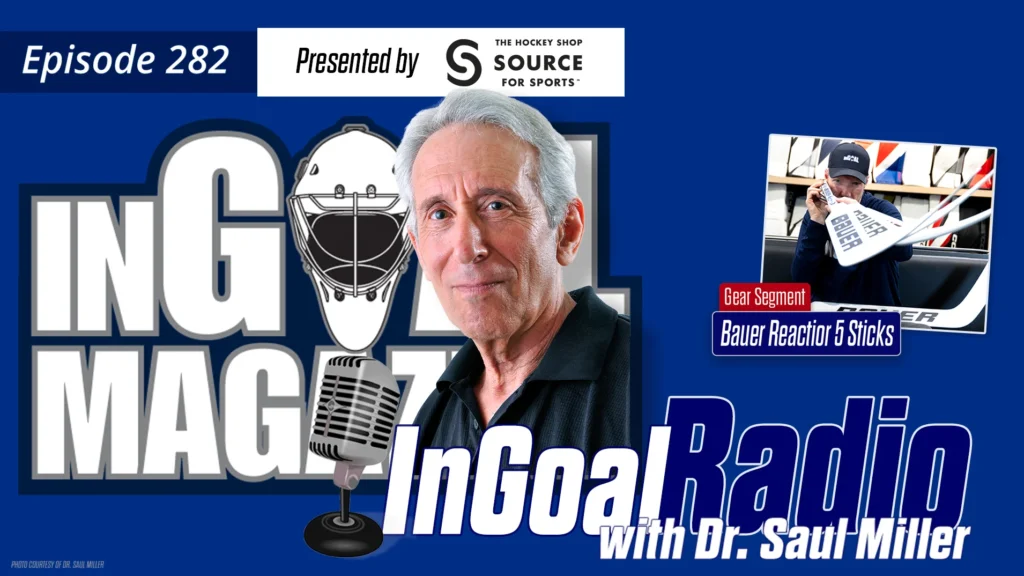
InGoal Radio Episode 282 with Dr. Saul Miller

Please subscribe and leave a rating — it helps us reach more goalies!


Sports psychologist Dr. Saul Miller, whose clients span the NFL, NBA, NHL, CFL, MLB, PGA Tour, and Olympic athletes across 12-plus sports, advises goaltenders to use visualization, positive affirmations, and constructive video review to strengthen mental performance. He also recommends specific strategies for goalies dealing with the mental grind of playing on a weak team.
- Use visualization and positive affirmations daily to build mental consistency between the pipes.
- Reframe video review as a positive learning tool rather than a source of criticism to reinforce confidence.
- Goalies on weaker teams can develop mental toughness using specific coping strategies that benefit all goaltenders regardless of team strength.
- Joseph Woll explains his RVH decision-making process, noting he would have preferred to stay on his feet but chose RVH as a desperation save option.
- The retro-styled Bauer Reactor 5 stick complements the popular Reactor 5 pad and glove set for goalies building a matched setup.
Episode 282 of the InGoal Radio Podcast, presented by The Hockey Shop Source for Sports, features a fantastic discussion with one of North America’s leading mental coaches, Dr. Saul Miller who counts several NHL Goaltenders amongst his many clients across multiple professional sports.
Feature Interview
presented by NHL Sense Arena
In the feature interview presented by NHL Sense Arena, presented by Sense Arena, Dr. Miller, whose clients have included sport teams in the NFL, NBA, NHL, CFL, Major League Baseball, in Europe, plus PGA Tour golfers, NCAA athletes, and Olympians in over a dozen different sports, touches on a number of topics specific to our position that will benefit coaches, goaltenders and goalie parents. We discuss visualization, affirmations, the power of positivity in video review and much more – all guaranteed to help your game.
Parent Segment
presented by Stop It Goaltending U
In our Parents Segment, presented by the Stop It Goaltending U app, we lfollow up from last week’s discussion on whether it might be better to play on a relatively stronger or weaker team for your development by giving parents and goalies tips for dealing with the mental grind of playing on a weak team – tips that indeed will help goalies regardless of where they play.
Pro Reads
presented by Vizual EdgeWe also review this week’s Pro Reads, which features Joseph Woll of the Toronto Maple Leaf, and is presented by Vizual Edge, a tool used to enhance tracking, reaction speed, visual stamina, and focus. Woll talks about his choice to use RVH in a specific situation, why he would have preferred to stay on his feet and the role those decisions play in a desperation save.
Weekly Gear Segment
presented by The Hockey Shop Source for SportsAnd in our weekly gear segment, we go to The Hockey Shop Source for Sports to look at the retro styled Bauer Reactor 5 Sticks – the perfect compliment to any setup, especially the popular Reactor 5 pads and gloves.
Episode Transcript
Intro
Two rules in podcasting. Mention the sponsor right off the bat. The Hockey Shop Source for Sports Langley, thehockeyshop.com, bringing you InGoal Radio, the podcast, Daren Millard along with David Hutchison and Kevin Woodley. Rule number two, make sure everybody's recording. Check.
Check. Check. Ready button has been pressed.
Check. Are we all looking at Hutch as we say this?
I've never forgotten that. I don't know what you're talking about.
Yeah. We may have lost one of the greatest interviews we've ever done. Really? I may have exaggerated the greatest, but it was really good stuff.
It was a great start.
It was a great start. Was so good that when we realized Hutch hadn't hit record, and I am blaming him even though I was there too, and then tried to restart it, the coach in question who has not been a guest since just tried so hard to be as good as he was the first time and remember the answers rather than just letting it flow that he just couldn't do it. We ended up having to quit because he it was just it was and we're running out of time. So, yeah, it's the interview that never aired.
We won't say who it was, but he was drafted twice on the same day.
Little little, trivia for folks out there.
Oh, now we've got people. We've got a project Do
do do.
To take care of during InGoal Radio, the podcast. You know, one time, I think it was 2014, I was on the ice, LA Kings celebrating the Championship, and I was with Jonathan Quick, and we were interviewing him. We've got, like, three questions in, and the cameraman said, well, we gotta start over. We gotta start over. I got a problem.
And looked at Quickie, and Quickie said, sorry. He laughed because you're right in the middle of family and everything, and I I didn't even blame him. I was I was I was almost happy. It was less awkward that he just he left right in the middle of it. And we we've only forgot to record a couple of times. Like, at my end, I forgot a couple of times and started halfway through the first segment and didn't mention anything until the end of the episode, and Hutch was very understanding. Let's just say that.
Hutch is Hutch is very understanding. That's why he's the parent of our group.
Glass houses. Glass houses, guys.
Four Nations face off. The rosters have been announced. We know all 12 goaltenders. Do you wanna go team by team or do you wanna go biggest surprise?
So I'm trying to recall, like, we made our own list, didn't we? Like, do we remember what each of us said and who got what right and what wrong?
I think we were pretty accurate outside of team Canada.
Okay.
Alright. Pretty close there, weren't we?
We just missed the third one in Canada. Right?
Yeah.
Right. Yeah. Exactly. Okay.
Yeah. It was it was just that was the big mystery. Finland, to be quite honest, was was pretty straightforward. Slam dunk. Once we got into the season and the performance of Kevin Lankinen, was a debate at the start of the season.
Heck, we didn't even know where he was gonna play at the start of training
camp. Which makes it all the more remarkable.
Yeah. It became pretty clear once we got into the campaign and the job that he did stopping pucks for the Vancouver Canucks. So in the absence of Thatcher Demko, Sweden was obvious. United States, maybe there could have been question mark just based on the performance by the Boston Bruins at the start of the year. But I don't know how far down any of us got.
It was it was the team Canada third position. Binnington and Hill were in front of the pack from the very start. Where we were on the third goaltender with team Canada was option a, b, c, d, maybe the f or g. Right. We had we we There's a lot of different looks.
We named what do we named? Cam Talbot, who would have waranted should I mean, part of the conversation, I hope, because he had a great start to the season before he got hurt just last week. Logan Thompson's killing it in Washington. Jake Allen's actually you know, we talk about this the Swedes taking Jacob Markstrom. Jake Allen statistically, least, is slightly outplaying him in New Jersey right now.
There were some options there for Canada to choose from. Joel Hoefer actually post
Mackenzie Blackwood. Yeah. It's another good one. Marc Andre Fleury. Very much so.
I know that his name was at least brought up in the discussions. There's, you know Joey Daccord. We go. If he could have got a passport. Eric Comrie has better adjusted stats than the guy that they ultimately ended up taking.
And that said, I think I found a really good reason or at least one why Samuel Montembeault was the guy when we get into some of the statistics regarding this team. But do we so should we go through the other ones, or we just we just covered Finland, Sweden, and America? The one let me let me give you this one. The American decision, was was any of you thinking Thatcher Demko, despite the fact he hasn't played this season, could, I think, likely play this week here in Vancouver? No.
Even with even with a higher like, his ceiling over the last couple years statistically has been higher than the other two guys. No thoughts at all.
Yeah. But it's not like there's an obvious weak spot in the tandem that they have. You were looking at somebody there and you're thinking they're just filling a role with a body, then sure, maybe you go to Demko. But there's already there's still so much uncertainty around even though they're talking about him maybe playing this weekend. I just don't know that you can make that jump.
Well, and probably presumptive of me to think Demko too, as much as he was a second place for finisher for the Vezina Trophy voting last season. In a year where Anthony Stolarz is among the top five in the NHL in adjusted save percentage. And very quickly since coming back and getting his feet under him, Joseph Woll is right there with him. So an embarrassment of riches for the Americans in net, and I don't wanna miss anybody else who, you know, equally would have warranted consideration.
It's almost like they're working hard at developing goalies in The States.
Yeah. It's almost like they got a plan. It's amazing what happens when you have a national development plan. Yeah. No talk.
Can't Do you guys wanna dive a little bit deeper into what you're alluding to there?
No. I think it's best if I keep my mouth shut.
I've I actually got a TV hit on SportsNet last week where I was actually Go Woody. I was on the I was on the post game show and a number of intermissions talking about this. As much as I do think there is an argument to be made that part of this is just cyclical, and I know, Hutch, you believe that that that's part of the conversation and that candidates may be just in a downswing relatively, I do think it would be naive to ignore the efforts that other nations are making to improve their goaltending from the grassroots up compared to Canada and the lack of a cohesive top down, bottom up, however you wanna do it, goaltending development plan for both the goalies and the coaches. We still remain very much a private coaching nation, where it is private companies and private schools, and there are excellent people doing it. But we are not doing a good enough job delivering a a plan that works for everyone and getting everyone on the same page right down to the youth level.
We have fallen way behind what other nations are doing, and I think it would be naive to ignore the role that's played in where we are now relative to those countries. And that includes hey. That's fully acknowledging that Russia is a part of this discussion in part because they don't they there's a lot of people that believe they don't overcoach young kids. That they just teach them how to skate and how to move, and they don't get too technical at too young an age. In in The United States, that's part of the conversation of their development plan.
We don't have anybody having that conversation, or at least if it is being had, the results of it are not being instituted down to the grassroots level. So there are excellent people involved at Hockey Canada. I think there's actually a concerted renewed effort, and I don't think the person that's been put in charge of that has had enough time to, you know, put things in place to catch up to the other countries. So I don't wanna throw the baby out with the bathwater because there is excellent people in place, and they are working on it. But the fact that they're doing it as one of, like, three or four jobs on their resume as opposed to a full time position dedicated to goaltending is a problem.
The fact that Canada has not hosted its program of excellence for goaltenders since the pandemic when other countries get their top young goaltenders together on an annual basis, work with them on the ice with a bunch of different coaches, different voices, and bring in national hockey leaguers to men mentor them, and we haven't done that in now, what, four three, four years? I think that's a problem. I think the Canadian Hockey League and our junior structure is a problem. Kids don't have enough time. They they spend key years sitting on the bench playing twelve, thirteen, 14 games, and then within a year and a half, if they're not a stud number one, there's no place for them.
Like, that window is too small. And I think that, you know, obviously, the NCAA rule will change that for a lot of guys, but that's part of the problem. The lack of a cohesive plan between top tier junior and the next level down so that kids that are on major junior teams that aren't playing don't have a place to go and get minutes. Like, there's the twenty year old problem. Like, there's a lot of different issues that go into this, and I don't pretend to have all the answers.
Let's make that clear. But I think we should have somebody full time looking at investigating what those answers should be and delivering it throughout the country in a cohesive everybody onboard manner. Hell, 24 of the 32 National Hockey League goalie coaches are Canadian. We don't have a coaching problem. We just have a everybody on the same page.
Let's come up with a really great plan and make sure we have more good goalie coaches at a volunteer level. I know goalie coaches that have taken the American bronze level certification program because they struggle to find the Canadian equivalent available in their area when it's convenient. It's easier to go take the American. Again, is it the only reason we're in this spot? No.
But to ignore all those factors I just listed off in a bit of a rant, I think would be equally naive.
We named seven players that were in the mix for team Canada's third goaltending position. Could it be that we're deeper than everybody wants to admit?
Yeah. That's fair. That's totally fair. You I don't know that you go seven deep when I look at it with the with Finland and Sweden.
So that's that's 10 deep when you consider the three guys that that are actually on team Canada.
Yeah. No. That and that's fair, Daren. What we don't have is the clear cut slam dunk. There was a time when much like the Americans, you're picking amongst, you know, Vezina Trophy candidates on an annual basis.
Like, we went through the American list, and all those guys aren't just good goalies that could play for your country. They're goalies that arguably let's put it this way. You can go probably four or five down the American depth chart and make an argument that any one of them should be starting ahead of the goalies that Canada selected. You could probably do the same with the Russians if they were involved in this tournament. Go four deep and say, all of those guys are better than the top option in Canada.
And that's not a shot at Jordan Binnington. You guys know full well, and I pointed to the numbers over the years, how good I believe he has been relative to the environment defensively in St Louis. I think he gets overlooked for that. I think that's one of the reasons he's here. This year is a down year statistically, but in the previous four, Jordan Binnington's cumulative adjusted save percentage over those four years is top 10 in the entire National Hockey League.
I'm ahead of a number of the names that I just threw out there. So it isn't a Jordan Binnington slide. It's a we went from having Patrick Roy and Martin Brodeur and Roberto Luongo and Carey Price and Marc Andre Fleury to still looking at Marc Andre Fleury. And that's where I think the argument is fair. There's a lot of depth.
Why aren't we producing the guys at the top of the list? And, again, there are some coming. It is cyclical. That argument all holds weight, but other countries are doing more to make sure it's smaller countries with fewer goaltenders, they have better options.
Wanna get to what happens in 2030 in a second, but when you look at the 12 goaltenders named to the Four Nations face off rosters, Do you know how many have won a Stanley Cup in goal? Just the Canadians? Just two and both on the Canadian team. So I
Not just goaltenders, by the way. Wasn't it something like 20 cups on the Canadian team overall versus three on the American team?
But I just I I I was getting a little bit rustled up about this, And I've I felt like the conversation got too loud. We Canada wasn't picking from nobody's, and they've got the only two guys that have won Stanley Cups in the tournament.
InGoal. Fair. And when Adin Hill won his Stanley Cup, the numbers he put up during that cup run and, frankly, for the start of the next season up until getting injured and everything kinda cratered on him were the type of numbers that win you a Vezina trophy. So he was full value for that. Now you listen.
You're talking to you're preaching to the choir on Jordan Bennington. So it's a fair argument. I think our expectations are higher, and I do think that when you look at us as a hockey playing nation and the number of registration things that we have, it's fair to expect that. And when you look at all the things I just pointed out compared to the efforts being made in other nations, there is no question that we have fallen behind. And so what becomes interesting, Daren, and I guess we'll have to let it play out, is what happens eight years from now or four years from now.
Well, the next Olympic cycle in in 2030 is there time to be in a much better place with a bonafide star, or is that too quick?
I mean, you're looking at six years from now. You think of the the Carter George's of the world
that have Basically five years. It's five years.
Been drafted. I don't know.
I think it's too quick. I think it
I think I agree with you, Daren.
Especially if we're talking about I mean, ultimately, we're talking about something that needs to happen at the grassroots level to increase the number of goaltenders in the system and then the performance and development of those goaltenders. And looking at the current crop of major junior kids aged 16 and up is really the only ones you can look at for five years from now, and we're not affecting their development and we're not going to affect their development. So maybe there's some great kids in there. Absolutely. But from a can we influence their development perspective in the next five years?
Doubtful.
Okay. Can you completely change things around in their development? Absolutely. You're right. Probably doubtful.
How many times have we heard over the years guys late bloomers, guys that get a different message from a different voice presented in a different way, and it clicks for them? Something that hadn't clicked before, it clicks for them. Sometimes in the National Hockey League, it's after changing teams, whether it's by trade or free agency. Sometimes they go to the minors.
A different coach, a different voice. For sure. Great point, Daren. So my point to you
guys Jordan Binnington.
There you go. My again, my point to you guys would be, okay. Maybe we can't affect their development significantly in the next five years. But out of that crop of junior goaltenders that might have a chance, you know, eighteen, nineteen now, they'll be 23, 24 for some of them heading into the next Olympic cycle. What if that voice that clicks and resonates with them and completely changes them from maybe a middling prospect or a high level prospect to the next slam dunk guy.
What if that voice is at the program of excellence camp that they don't have anymore? What if that voice Or
even gets a kid even gets a kid noticed and gets that chance that is gonna get bypassed right now.
Right. And so again, why would you leave that to chance? Why would why would you not want that next crop? And we're I mean, the POE, I've I've been blessed to be there a couple of times. Like, it's not just four or five kids that might be world junior candidates.
There's, like, fifteen, twenty goalies. They have the u 17 goalies out there. You're exposing them to new voices. You're exposing them. Again, 24 of 32 NHL goalie coaches are Canadian.
Some of the best in the business. Take a look at, like, who's gonna be Canada's goaltending coach at the at this Four Nations event? David Alexander. Look at the success that David Alexander has had as a goaltending coach. You don't want the next generation to come in for a camp over three or four days to hear from top nutritionists, to hear from the top off ice, you know, you know, trainers, to hear from the top goalie coaches in the world, and maybe something clicks and resonates and allows them to get to a level that they won't get to without it.
Like, to me, that's missed opportunity, and it's opportunity that's been missed for a number of years now. I understand finances are tough. Thing times are tight at Hockey Canada in terms of some of the incidences that have gone on and maybe tightened the belt on some sponsorship opportunities, but I'd sure love to be see money spent on a program of excellence rather than another celebration dinner for, you know, a team that's won a world championship. And I understand that comes with sponsorship and brings more money into, and there's there's more to it than that. But I just feel like you're you've thrown the baby out with the bathwater here by not having at least that program, like 30 of your top goalies coming together and having a chance to maybe take another step, and maybe that's the thing that clicks for them that allows them to succeed at a level they might not otherwise do.
I just wish you would have thought about this beforehand and been able to really express yourself.
This is the top of my head rant, Daren, too, so I'm not even I don't even have a list of notes in front of
anybody about this at any significant level?
I don't have somebody that's full time at Hockey Canada. And, I'm I've I you know, I probably should be careful here. I probably should've re I probably should've talked to somebody because I do know that there are excellent people involved. But I do know within the last several years, there was a point where it was a volunteer basis, where literally the person that was taking care of this thing was doing it on a volunteer basis. That that's gotta change.
The other countries have a full time person coordinating this. We don't. We've finally put somebody in place who I believe is excellent and get the job done, but they need way more resources than they have right now to pull it off.
You know what we need?
We just need to make it the InGoal Magazine development program. Buy every goalie in Canada subscription to InGoal Magazine, and I will fund the entire thing.
You're not far off there. Like, as a complimentary piece, the resources that people are exposed to through this podcast is extraordinary.
We have well and today's a prime example, our featured guest, doctor Saul Miller, right, who's worked with NHL, NBA, NFL, Major League Baseball teams, sharing his knowledge on mindset and mental strength and tips on that. But also, I would argue, you know, we have associations that are working with us to make sure their kids and their coaches have a subscription to InGoal Magazine because it offers development tools that for a lot of them would otherwise be lacking, and access to coaching tips and advice from NHLers and NHL goalie coaches that would otherwise be lacking at a association level. And so if it's good enough for some of the biggest associations in Canada as a development tool, then actually, you know, this shouldn't be a rant. It should actually be a proposal. Maybe I need to formalize it.
I encourage you to do that.
Get the I do. Get fired up.
No. Not not the fired up part, but Fired
up part's fine.
Put some put put some layers to it and put it in front of the right people. It's a good Not a rant. Nobody wants to hear a rant. It it to to the right people. We love we love the rant.
I I'm I'm enjoying this incredibly. But from the the people that that are going to make it happen, turn it around, they don't wanna hear another rant. They want, how can you help me? How can this be my idea? How can we make this seamless and in a transition?
So if you're able to to put that on the paper, don't write it down. Nobody writes stuff down anymore. You could you could type it, but don't write it.
I'm on it. I'm on it.
K. That's the right thing to do. I I I gotta scoop on you guys. Uh-oh. Hey.
Luke McKechnie, the Moose Jaw AAA U16 goaltender scored a goal the other day. I I I watched it firsthand, and I fired it off to you guys. I'm like, how how is that? Or U18 AAA
goaltender. You watched it firsthand? What are you doing watching U18 games?
I didn't watch it firsthand. I saw it on a on a post. But I
saw it first. I like it. I like it. Good for him. And and
you know what? He had a four checker right on him, and he was going for it no matter what.
Love it. Awesome.
It was it was one of the more aggressive goalie goals I've ever seen. So congratulations, Luke and the U 18 Moose Jaw Warriors. I think they're the Warriors. Yeah. Warriors.
Good job, Luke.
Luke, I I wanna do it one day. I just can't shoot it all the way down the ace. Let's get into our gear segment. What do we got going
Can I do a time out, Daren? Can I can I apologize? I need to go back to Four Nations one more time because we didn't get to this. With all the talk about Canadian goaltending, I pulled up some stats, and the one factor that all the Canadian goaltenders amongst the top in the league at, and this goes to sort of, hey. We just need our goalies not to cost us games when we have a best on best when when when you have that many good players that committed to defending.
Adin Hill, one low danger goal against all season as a starter. Samuel Montembeault, Jordan Binnington, three goals against low danger all season as starters. Those are three of the top 10 results. And interestingly enough, Jake Oettinger, Juuse Saros, Connor Hellebuyck are also in that mix. So when we look at at sort of what countries want out of their starting goaltenders at a tournament like this, we just can't have the bad ones.
You know? Like, it's you gotta make some big ones, but you can't have the costly ones, especially if we're gonna lock it down and defend as I'm sure the Finns will and as Canada has always prided itself in doing. For all the focus on Samuel Montembeault and questions about why he's there, I think that's a big part of it. Doesn't give up bad goals. And all three of the Canadian goaltenders led by the guy you watch on a regular basis in Vegas, Adin Hill, even before his recent heater, low danger goals are not not a problem for him.
He doesn't give them up. So just one thing I wanted to throw in there before we get to the Gear Segment.
So that's what just don't lose the game means?
I think don't don't give up bad goals.
Low danger chances.
Don't give up bad goals. We all know what they do to a team. And in a tournament like this where the margins are gonna be tight and and I believe as much as it's taking the place of the all star game that this will not be an all star game, that the fact it's been so long since we'd have best and best will have them batten down the hatches, grinding out tight defensive hockey, which, again, is what Canada is famous for at best on best for all the talent and skill it's defending. I I think that's an important part of the conversation.
I just really don't like the phrase don't lose the game. You don't have to win the game.
Oh, it's
Don't lose the game.
Listen. Doctor Saul Miller is gonna tell us that is not the mindset you wanna go in with if you're a goaltender.
No. But but even even when they're talking about goaltenders to play for these teams, hey. They may not be able to win the game for you, but they're not gonna lose
any assist. Those guys are absolutely capable of winning the game for them. Montembeault and a heater at the start of the season was as good as anyone in the league. So they're absolutely capable of it. But I find it interesting when I look through all the teams, very few of the goaltenders pick give up bad goals.
They're amongst the league's best when it comes to not doing that.
Gear
Gear Segment by The Hockey Shop Source for Sports Langley, thehockeyshop.com. What do we got?
Well, we've got leftover sales from Black Friday. It was crazy. Like, the prices, the sales, it was nuts, but there's still some leftovers there. So if you're still looking for bargains, if you're still looking for something under the tree, make sure you go to thehockeyshop.com or the Hockey Shop Source for Sports in Langley, especially on the Christmas side. Hockeyshop.com, they have a Christmas guide, a Christmas wish list for goaltenders that you can click on and check through, and they've got lots of great items.
Like I said, full price on sale, new merchandise coming. There's a new stick from True that we're gonna get to in the next couple of weeks ourselves that's in there. There's there's new gear still arriving despite the fact it's almost Christmas, so make sure you check it out. Thehockeyshop.com, including this week's subject, the Bauer reactor graphic stick. I wasn't sure what was underneath those pretty graphics.
Like, what was the base model? Because the price looked great. So we went to Cam to get all the detail. Welcome back to The Hockey Shop Source for Sports. We're over in Goal Utopia with Cam Matwiv.
And today, we're reacting. Oh, Bauer Reactor 5. We did the gear. We did the pads and the gloves with the reactor graphics. And we realized And then I spotted we we we forgot to do that.
You have reactor graphics sticks.
We didn't react in time.
You didn't. Kinda like you playing goal, Cam.
I I know. Did
not react in time. Welcome back, man. Thank you, folks. I'll be here all week. Tip your waiter.
A new waiter. Alright. So based off of the X 5 pro stick, we have the Bauer Reactor R5 stick, similar specs. You still get that pentagrip. You still get that nice lightweight shortened shaft that you're gonna find in those vapor sticks to be able to help you play the puck, pull it off of the boards.
Rounded toe as well, again, for that playability of grabbing that puck off the boards. Overall stick, lightweight, great option, great way to complete that set with those Feactor 5 X5 Pro graphic pads.
Okay. So hold on. Well, again, just slow for those of us who are a little slower witted. What is this stick based off of?
The X5 Pro.
Which is a second price point.
Second price point stick is the Hyperlite two.
Okay. So Hyperlite two family. Yes. Second price point with the Bauer Reactor five graphic essentially. And a little extra paint on it for the white?
Yes. Yes. That would be a difference as well?
Yes. Yes. X5 Pro, so
it's little more carbon fiber. That's correct. I'm just trying to hit all the points. No. No.
No. It's
good. This is what you're here for. We kinda you know, we bounce back
and forth. Right? And it comes with lots
of color. Yes. 23, 24, 25, 26, 27, regular hand only.
Is there intermediate or just senior?
23. That's an intermediate. Twenty four is becoming kind of a senior size, but we'll talk about that another time. Okay. So how many colors?
I count. Three. There is three different colors. You know what happens if you put them all together? I don't.
Oh, it's like the Infinity Stones. Yes. He's gone. Oh, crap. I forgot about the phone numbers.
I had to snap them back.
(604) 589-8299 or 1-800-567-7790. Give us a call. We can talk about your Reactor R5 goal stick.
Go away again.
It's getting annoying.
Collect them all.
Wonder what the collective exhale was after the Black Friday sales and subsequent shipping.
I'm gonna be honest with you. We are four days later as we record this. Like, we're past Cyber Monday by four or five days. Hutch was over to chill. He just wanted to see me chill out with me.
Nothing to do with watch his kid play hockey. So we were gonna do a segment. We hit up Cam. Like, hey. Can we we're over.
We got a time. We can bring the cameras. Kill another segment. He's like, can't do it. Boxes still everywhere.
Like, the aftermath of a sale that big at a store as big as the hockey shop is it lasts. It's got a lasting effect. So they're still getting through it. But like I said, that means there's also still deals to be had. We'll be back in there shortly to to, like I said, film a few more segments including that new True stick.
Spent a lot of time going through all the sale items and what was available from sticks to skates, accessories, I've said before, my favorite thing. So continue to do so, but I can't wait to they're gonna have to restock. So it's the after these sales, we're gonna get a whole bunch of new opportunities to get into some gear. Vizual Edge ProReads up next as we continue to dive down the rabbit hole of Visual Edge and its benefits to goaltending.
Well, its benefits are they help you see the puck better, and that makes them a natural fit as the sponsor of our ProReads segment because ProReads is all about seeing the game better. So I've been using Vizual Edge, took their Edge test. They give you results on six different components of sort of your visual your your visual skills, basically, and then you start training each one. I've seen improvements, not just in my subsequent edge test. So you can take that original test, and then you can take it over as you go through the drills and see if you're actually getting better with the various things like convergence and divergence and tracking and all the different elements that go into seeing a puck better.
I'm seeing improvements already, and you will too if you use Vizual Edge as a training tool. You know who else uses Vizual Edge as a training tool? This week's ProReads guest, Joseph Woll of the Toronto Maple Leafs. And this week's ProReads focuses on RVH or overlap decisions on two on ones down low in tight. And I thought it was it was fascinating to listen to Joseph Woll sort of walk us through the mindset and what happens when you maybe anticipate someone continuing downhill into a zone, but they don't get there and you've made a decision.
So the importance of patience, he walks us through all the video of this two on one down low and comes up with some interesting points, can be a little critical of his own play, and that's what we love about Joseph Woll. How he did it in that moment may not be how he'd wanna do it the next time he sees that chance. And what I love is both the honesty in explaining that, but also the degree to which Joseph goes through and explains why. So make sure you check out the latest ProReads featuring Joseph Woll, who is one of 50 NHL and American Hockey League goalies that use Vizual Edge, and see how he saw that play and how he'd like to do different differently maybe the next time he sees something similar.
One of the things I loved about this one, Daren, was that it sort of emphasizes what Woody visualized when he started ProReads was looking at all the negativity on the net and then bringing the goalie's voice to it to explain that there's more to what you're talking about when you're just somebody on on X or something saying, I don't like this particular goal. Spoiler on this one, Joseph Woll makes the save. But in the initial situation, there was a chance for the other team to score. And had they done that, I think a lot of people would have gone online and picked apart his use of the RVH there. And I love that he explains, a, that he would probably agree he shouldn't have, but why he made that decision.
I think it just emphasizes that point that there's reasoned professional decisions that go behind what we're seeing online that people are so quick to criticize. And if the shooter had done what he anticipated, it would have been the right play.
He just got a little ahead of Right? And that's that fine line that a lot of these get in guys get into with us. The fine line between needing to be ahead with your read, but not anticipating to the point where you leave yourself exposed if the guy doesn't do what you expect, that fine line between a read and I don't wanna use the word guessing, but anticipating prematurely.
Just thinking out loud, the overlap would be a challenging save selection on a two on one because it puts you even further away from the potential pass option.
Yes. You're not inside. You're not as much of you as inside your net for sure. Now I
should You gotta cover more ground going across.
Right. Because I know you haven't had a chance to see this one. It's just gone up, but it's sort of a down low, in tight two on one as opposed to a two on one with a lot of flow to it. Okay. But, yeah, 100 per 100%.
That's why having Joseph Wall explain because some of what he explains might be counterintuitive to some of the people watching the video and thinking it through themselves. So having him explain why and you can see it in the video, the extra sort of parts of his movement that result. And that's why it's important to have these voices. And how guys move is different. Not every goalie is gonna see that and think, well, I move better.
Like, some guys are gonna be like, well, I move better out of the RVH. I don't have that little extra movement. I would have been just fine. And that's the beauty of what we're trying to do here is not tell everybody how to play it, but show the thought process that goes into it so that everybody can figure out whether they see things the same way as Joseph, whether they have the same physical skill and tools and movement, or whether they might need to handle it differently. It's why it's why every time we do a ProReads, you can just go right to the video and hear the NHL goalie, but we try and give you a screen cap and ask you specific questions so you start thinking.
It feels a little bit like homework. It feels a little bit like school, but get the goalies thinking about that decision making process before the NHL explains to them why he did it a certain way.
It's my favorite part of InGoal is the ProReads.
I think most people. Moms and dads, if you're looking for a good Christmas present, you can order a gift subscription and your kids will instantly have access to 260 ProReads.
It's incredible. Mhmm.
That's Walk through safe selections by the goaltender watching their own video. No other place offers that.
No. And some of the best in the game for those that haven't seen it or are new to it, like Connor Hellebuyck, Thatcher Demko, a lot of the names that we just talked about for these Four Nations team have sat down and down and done video reviews for us with ProReads.
I wanna know what's the secret to covering the short side on an RVH? Why are some goaltenders better at it than others? And along the way, can you squeeze that out of the people that you're talking to?
I'm gonna give you a hint here, Daren. If you go through the archives, there's a couple with thatcher Demko that talks about alignment and entry. We've got a covered couple different drills and a couple different ProReads that I do think without necessarily picking apart other guys because that's not what we're about. I think that is a big part of the of the answer. How you align, what degree that inside edge is relative to the goal line, like, sort of how many degrees off the goal line is it.
And there is a formula there that I think makes it easier to cover the short side rather than coming in steep with a a much higher alignment leg that let that inside leg way up higher in the crease just makes it easier to short side seal for a lot of guys. And so I'm hinting at the answer. It's definitely in, check out you know, mean, Thatcher Demko gave us, like, I think, nine ProReads. He was forty five minutes of excellence, and the answer's in a few of those.
I'm on it. Let's get into the Stop It Goaltending U, the app parent segment, and Stop It Goaltending U. They that's another great added benefit to to being part of the InGoal family.
They have extended their Black Friday style, by the way, to the point where if you listen to this podcast right as it comes out, make sure you check it out because the sale is still on as this launches. Won't be throughout the podcast until we get the next one, but check it out early. You can get an annual subscription to Stop It Goaltending U, the app, for $20 off on the regular basic model and $40 off on the premium one. So rather than monthly, you can buy a one year plan. You'll save $20 on the basic, $40 on the premium, and in both cases, you get a free one year membership to InGoal Magazine premium edition and all those ProReads we just talked about.
So always lots of great content. They've got quick hit drills every day, five new ones a week, every weekday, five minute drills and twenty minute sessions, like, all kinds of different layers and elements you can get into with the the coaches and crew from Stop It Goaltending. Every week on the app, they have new material. And, of course, every week, you get access to new stuff from InGoal Magazine. All subscriptions to Stop It Goaltending U, the app, come with a free subscription to InGoal mag.
Make sure you check it out today.
Parent Playbook
Hutch, what do you have for us?
I have a follow-up, Daren, from last week. Last week, we were talking about, that idea. Should you if you had a choice, would you rather have your child playing on a strong team or on a weak team? And there were a lot of great opinions bandied about here. Really enjoyed the conversation with both of you.
Promised last week that we would follow-up with some tips for those kids who are on a weaker team and for those parents who want to know how to help them because it can be a grind, it can be a real mental challenge. So I promised I'd come back with some ideas as I was putting it all together for this week though, guys. I realized the things I'm going say would probably help every goaltender regardless of what team you're on. But obviously, a lot of the needs are highlighted when you're on a team that's struggling and facing those challenges. So I will say moms and dads out there, this is going to require some time and effort if you want to really be able to help your child.
But if you do, it's a real opportunity to grow as a person and as a goaltender. We've said before that goaltending is mentally a grind and it is doubly so when you're on a team that's struggling for wins. And really, honestly, aren't we asking young kids to deal with some challenges here that even us as adults find challenging? I know all the goalie parents in the group find it really challenging when our kids are in this situation. Now think about this as a 13, a 14, an 18 year old having to deal with these challenges.
It's tough. Personally, I've got a lot of experience with this, guys. My kid's been a goaltender since he was four or five years old, and I think he's played on a strong team only once in his life and it was a fun relaxing year for all of us. The reality is that if your kid is naturally competitive, it's going to be hard to take losses no matter how well they play. We also need to acknowledge that.
And, the people around them don't make it any easier. There are a lot of positive supportive people in the game, but at every level, no matter what they play, others are going to look at them and wonder or even openly ask if they couldn't have found a way to make one or two more saves. And players, we know can make multiple mistakes a game, but one or two by your goalie and they hear about it and they feel the pressure. We even do it to ourselves as goaltenders. So what advice do I have this week for kids?
First, acknowledge the situation. I think as parents, it's acknowledging the situation that they're facing in conversation with them really does help. This isn't making excuses, it's simply acknowledging that there's a lot of pressure in their lives and and what they're faced with. Goal tending can be very isolating as we all know. That acknowledgment just sort of lets them know that, they're not alone in what they're facing.
I would also suggest that you help your child acknowledge it and and say, look, I understand that my team is not a strong one, but I'm here to have fun and develop and I'm I'm not going to let these losses take that from me. I think being able to say that out loud really helps. And of course they want to win, but understanding the situation and what they're facing is okay. So any goalie with any hope of being good is going to still though give a 100 to try to win. It's okay just to acknowledge it.
You're not making excuses or lowering your effort. Second, and this is really the big part guys, set different expectations. You're not mailing it in and just assuming losses. Of course, you're going to try your best. And the reality is that a self motivated athlete is going to be competitive regardless.
But we're talking here about a way to channel that effort in a way that will help their performance in a healthier way. You're setting different expectations, not no expectations. I mean, it's a bit of a silly example, guys, but years ago I was invited to play in a beer league team. It was all young guys, sort of 18 to 20 years old in a league way above my level. And they were the worst team in the league.
And before we They were. And before we went out, I asked one of the guys, literally, this is my first game with them and I said, how's this usually go? What's this going to be like? And the guy looked at me and he said, keep it under 12 and you're doing well.
And they weren't joking.
They were not joking. It was clear. And honestly though, that changed everything for me because I was super nervous. I went out, I gave up fewer than 12 and and I really enjoyed myself and I played a lot of games with them and I don't think I ever gave up 12 and I had a good time. So, but those different expectations help.
And look, that's an extreme example, but I think it makes my point. But the best approach isn't about the number of goals really when I'm talking about different expectations. So here's what I would suggest you might want to do to help their development and their mental health. Set some other goals that they can try to achieve. Referring again to a book I've mentioned before in the past, the inner game of tennis.
You can set a goal like count the number of times you control a rebound or count the number of times your child plays the puck well or they choose a good depth or they beat a pass on their feet or even some emotional goals like not showing that you're visibly frustrated after a goal or making the plan to take two deep breaths and let them out slowly before every face off. Some sort of a goal related to their process on the ice. Not a lot, just one or two of them will really help them focus in a game and work on what they're doing. And then afterwards, can look at those personal goals that you've, set and you can decide, did I achieve them? How did I do?
How well can I do better? And you can even be proud and evaluate your performance based on that sort of personal system that you put together. The goals are related to process and not the scoreboard. I don't know if you guys noticed watching the Olympics this year, guys. I was amazed by the number of athletes who referred to their sports psychologist and making their process related goals.
It was like the number of I've heard it before, but it just seemed like athlete after athlete in the Olympics this year. It was amazing. Look, there's top gymnasts, figure skaters, snowboarders, whatever, who know they can't do the same skills as some of the people they're competing against, the ones who are likely to win the medals. But do you really think their only goal at the Olympics is to win? Do you really think they have a coach saying, you just need to find a way to do a triple axle today?
Of course they don't, but they still work just as hard as anybody else out there. Their development is just in a different place and that's okay and they don't need to be miserable. They just need to focus on their process and their development. And funny enough, the scoreboard tends to follow along over time as well when you do that. It's harder when your personal performance is tied to a team result like it is in hockey.
So, you know, you could be good enough to do the goalie version of a triple Axel and your team is terrible and it's, it's going to show up on the scoreboard still. But that doesn't change the fact that you need to focus on your personal performance and your personal goals. So I think this is a good plan for people even if your team never loses because that good result on the scoreboard doesn't mean you as a goaltender have played your best or developed in any way. So I think having this idea of focusing on some process is really good for goalies at all levels. And then I actually think guys it'd be great if we could follow that process that they do in tracker swimming where they focus on personal bests.
Like I wish there was a way we could do that as goalies because it's so healthy. It's okay you didn't win. You swam the fastest race you've ever swum before. Good for you. That's great development.
And, that's kind of what I'm aiming at here. Can we find a way to define our own personal best by looking at some of those process driven goals that moms and dads and goalies and coaches can put together? The third piece, focus on the fun. If you enjoy playing goal and you're out there not because of the wins, if you enjoy going to practice even though you give up lots of goals and practices, we all do focus on that. Focus on the fun and the saves you're making out there and and talk about it.
Talk about the saves that went well and don't focus so much on the goals that are going in. And then the last one is put the work in. It's easy to roll out there on a strong team and win every game. Having fun on developing a poor team or acknowledging is not easy, but it's gonna take some effort from the parents and from their goaltenders. Setting these goals, putting these plans in place, reviewing these plans together.
That same kind of effort though, like I said, is gonna help a goalie on any team even if they never lose. But you're gonna have to reinforce these ideas with your kids and stay relentlessly positive even if inside moms and dads it's tearing you apart as I know it does. You have to take a deliberate approach to this, and I know as a goalie parent who loves your kid and hates to see them suffer, you will invest the time to help them set some goals each week and evaluate them after games and at the end of the week. Help them see their development. Help them see their progress.
Help them focus on the fun. Now whether you look in the mirror every day or write it down or read it over and over, You need an affirmation of some sort. Hat tip here to our good friend Pete Fry, the goalie mindset guy. For example, stand in front of the mirror and say, I'm a great goalie. I belong here.
I've set my goals, and I'm going to go after them today. I'm allowed to make mistakes. Or even, last week, I met my goal, and this week, I'm gonna take it another step. Or nobody can take my love for this game away from me. Whatever it is that you need to say to reinforce your love for the game and that you're doing this for the right reasons.
Look, it's not gonna be easy. There will be hard days. There will be hard weeks. Even the strongest of us is upset when others blame us, and we all want to win. Simply acknowledging that it's okay to feel that way helps.
But then move on and focus on the process. And, of course, remind them, I love you. I love watching you play. I love seeing you have fun out there. I know it's a bit cliche, but if you can get through this, you will be a much better goalie, you will be a much stronger person, and that is going to pay dividends for the rest of your life.
I'm with you. I I think the adult league goaltender can take a lot from everything that you just said as much as the the parents and the children.
A 100%. I was thinking the same thing. I'm like, I should make notes on that. Now I'm not playing beer league anymore, but I hit the point where my expectations didn't match where my beer league team was at. They were frustrating.
They're terrible defensively, and I stopped having fun because I I wanted to win. And I let that get in the way of having fun, and it was just so miserable to the point where another concussion and not allowed to play anymore actually probably was a bit of a blessing for my mental health with that with that group. I was laughing a little bit, Hutch, there at the end because I know you haven't had a chance to listen to our feature interview today because that affirmation you talked about is exactly one of the things that doctor Saul Miller talks about with us in terms of I and looking in a mirror on a daily basis and saying, I am a great goalie was one of the things that he suggested. Now it's a little tough for me to do that with a straight face, look in the mirror and say, I am a great goalie, but it is something I'm gonna try.
I love the idea of affirmations.
I just think that hearing it well, I mean, we'll listen to doctor Miller, but but hearing it out loud or seeing it written down just puts it in a different place in your brain than sitting there at night lying in bed awake wondering to yourself, am I a great goalie? How where where do I stack up? Do I belong here? No. Yeah.
I do. I do. And and I'm gonna tell myself that.
Damn right I belong at div seven beer league forty plus.
And I wouldn't have done that ten years ago. Like, I wouldn't have bought into the affirmation. I would have found a way to make fun of it. And now I think that there's serious and significant benefit for the human being, never mind the goaltender.
It's where our brain goes, right, when we're under stress and stuff. So do we train it to go to a positive place or we train it to allow in a whole bunch of doubt? And how you go about that I mean, it's a perfect segue to our feature interview. But how you go about that, and how you go about practicing that will inherently become a how you think about things when you're playing in the moment, or as Hutch said, when you're laying in bed at night wondering big picture questions. How do we focus ourselves to make sure we get the most out of those moments?
Well, let's get into our NHL Sense Arena feature interview. What's happening at NHL Sense Arena?
One of the cool things about NHL Sense Arena we've talked about before is that they actually host competitions. So you can put your headset on and go and compete for prizes against other goaltenders. And now they actually have one that is live that is worth talking about. It goes until the fifteenth of this month. They have a thousand dollars in prizes up for grabs for both goaltenders and players.
Because for those goalies out there who've got players in the family, there's a Sense Arena version for them as well. They're calling it the Nasher Cup Challenge. If you're a Nasher fan, you can get out there and see what he does and compete in, in his Columbus Blue Jackets jersey even in Sense Arena right now. Top three goalies and top three players are going to win a $250 pure hockey gift card, a $100 gift card, and all three of them, all three places get the, signed Nasher Columbus Blue Jackets jersey. So for the goalies, they're calling it the brick wall challenge.
You got different drills that are going to test your angles, your puck trap, tracking, your shot stopping skills, and all sorts of different scenarios. And then they've got a leaderboard established. So, just a really cool thing that Sense Arena does. We know it's an unreal tool for training, as a goaltender for preparing to go on the ice as a goaltender used by goaltenders in the National Hockey League. But now you can go out and have a little fun and get a chance to win some prizes.
Are me and
Daren eligible? Daren, let's get in on this. I need my Nasher jersey.
I don't know. I think just I think we need to acknowledge, Woody, that, you're probably not gonna win, but you can still go out there and have fun and you can still work on some of those skills. And Daren and I are very proud of you.
Thank thank you for making my expectations realistic.
And and I deserve to be there.
Brick
wall. I deserve to be there even if I don't win.
Because you are a great goalie.
Yes. I have skills. Not sure.
You do.
How good they are, but I have some they're still skills. You're going down a different avenue today with our NHL Sense Arena feature interview.
I am, and you're gonna hear me talk about this at the beginning. This is a gentleman that I've seen around the rink for years. I've been doing this now covering the National Hockey League for twenty four years, not to date myself. And Doctor Saul Miller is somebody that I've seen around throughout at various times, coming to see clients, coming to see the teams he works with. You check his website.
We'll have it in the show notes. Like, the list of professional teams and and clients that he has is impressive. Major League Baseball, NBA, NFL, NHL for sure, teams overseas, Olympians. And so I ran into him recently. He was he was here to watch the islanders.
Had a couple of former clients or current clients on the islanders. He was here to watch them, and we just started talking in the stands. And I quickly realized that he's a goalie and that he comes up through the goaltending fraternity. He's a member of the union. He played, you know, back in the day when there were no masks.
And so to have somebody we started talking. He was he was made you know, I asked him if he'd be interested in coming on. He said yes. And to have somebody with as much sort of depth of knowledge and experience, on the performance psychological performance side of things, be willing to sort of sit down and and share some of those concepts with the rest of the goalie union, was a real honor. As soon as I realized that, it was just a matter of time.
Probably just two weeks before I got him on the show. So, I appreciate his time. I think everybody's gonna enjoy this. Hutch, there's there's write down a specific advice for how to handle those car rides home after a good game and after a tough game. Doctor Miller gets into all of it.
Like I said, folks, there's he's got a free YouTube channel. We'll put all that in the show notes below. As you're listening to this, we talk about that as well. Just there's a ton of good things here. We've had a lot of different sort of sports mindset goalie people on over the years, and add doctor doctor Saul Miller to that list.
He's got 10 different books published. We get into all of it and a lot of great takeaways for goalies and goalie parents at every level.
Feature Interview - Dr. Saul Miller
He's one of us. Doctor Saul Miller, the NHL Sense Arena feature interview on InGoal Radio, the podcast.
Really excited to welcome to the InGoal Radio Podcast. First time guest, someone that I have seen around the rink at Rogers Arena, probably actually dating back to when it was named GM Place for a number of years coming in to work with athletes and teams. Doctor Saul Miller, a performance psychologist, performance specialist. He has a PhD in clinical psychology. He's written 10 books, worked with teams in the NHL and clients in the NHL, PGA Tour, Major League Baseball, the NBA, as well as on the business side.
A lot of clients on the business side. So he is also, first and foremost, in the Goal Union, a former goaltender. Doctor Miller, thank you so much for for joining us today.
It's a pleasure to be with you, Kevin. Absolutely.
Okay. So before we get into sort of some some tips and things and advice for goalies and goalie parents, we have a lot of those that listen with their young goaltenders. Talk me through you played in an era where there weren't masks all the time or when you at least when you started, your love for the position growing up.
Absolutely. You know, it's just I don't know. I was always a goalie. As a matter of fact, I grew up in Montreal, and a bit of heresy. I was a Toronto Maple Leaf fan in Montreal at the time when, you know, obviously, six teams in the league, and Turk Broda was the goalie for the Leafs, and my nickname became Turk for a long time up until high school.
I mean, I was called Turk, after him. And we played, you know, outdoors, and the equipment was no, as you said, no mask. I had a little sort of cat baseball glove with a a thing protecting my wrist, a tiny little chest protector. But the thing was, Kevin, nobody could shoot. You know?
It was all wooden sticks with no curves, and it was, you know, just in the era of boom boom Jeffrey, who played for the Montreal Canadiens, who is accredited with the guy first inventing the slapshot. So you didn't have snappers and wrist shots and things like, like you have today. So, anyway, it was a lot of fun. Played outside and, you know, played a little bit of beer league, played some fraternity hockey, goaling in college. And, the last two times that I put the pads on were when I was working with once with Tri Cities in the Western Hockey League and once with Medicine Hat when our backup goalie was unable to attend practice, and I said, hey.
I'll put the pads on. And I remember with Medicine Hat, which was the last time, I remember one of the, players saying to me, hey, doctor Miller. That's Ken Dryden. That's stand up style. And I said, yeah.
Because, man, if I go down, I don't know if I can get back up. Yeah.
That's how I play goal. It's like the old commercials I've fallen and I can't get back up. So I can I can relate to that? What did you like I mean, the equipment, I'm guessing you didn't have your old, you know, horsehair pads when you went in with with those two WHL teams. Did you notice a massive difference?
Oh, it's unbelievable. The equipment today, I mean, you put on a a whole top that's, you know, well, really well padded. As you said, the pads, the goalie pads are bigger and way lighter. It's, you know, the masks and everything, the gloves. It's, you know, it's it's a challenging position for sure, in terms of, you know, taking pucks, but goalies are really well protected.
I'm curious. Before we get into sort of maybe some of the specifics of of goalies approach and and from a mental performance perspective, you've had an incredible career and a lot of success. We run into people in other fields that have succeeded and have roots in goaltending. And I'm just you know, I wonder if you see any crossover between the demands, whether it's mental strength or other of the position that inherently lead to success? Maybe not inherently, but can contribute to success in other fields.
Well, certainly, you know, I knew there were a lot of broadcasters who were goalies. And, I do think that one thing that from a a goalie's perspective is the whole game is in front of him. And, you know, you're out there for the whole game. It's not just a quick shift. And you have to really be understanding systems, how how the defense is gonna handle things.
So it really there's an intelligence factor and a way you see the game as a goalie that's quite different than I think anybody else. So I think it lends itself to being able certainly to see the game differently. As to whether it relates in other fields, I don't know. I I certainly think we'll get into talking about this, but the pressure that you have to deal with is far greater than in any other position and maybe even in any other sport. When I compare it to, say, a soccer goalie who might get seven or eight shots in a game to a hockey goalie who's, you know, gonna be engaged for, you know, thirty thirty shots is not unusual and maybe even 40.
So Jacques Plante once said it very well, you know, Jacques who invented the mask. He said, can you imagine a job where every time you make a mistake, a red light goes on and 15,000 people stand up and cheer? Well, now it's 18,000 people. And he said, that's pressure. You know, if I'm a forward, I always tell, you know, if I'm a forward and I'm not aggressive on the forecheck and I'm giving them an opportunity to break out easily, yeah, some people might notice it.
The coach will notice it. If I'm a defenseman and I don't gap upright and I'm giving them more space to more, you know, act movement to maybe even challenge and create a chance, Yeah. The coach notices that, maybe a couple of fans. If the goalie does anything that's not right, everybody has an opinion about it. It's a lot of pressure, and you have if you're gonna succeed in this, you have to learn how to deal with pressure, and that can transfer certainly to other things in life.
Okay. So, we talked about I I mentioned you've you've written over 10 books in your career. One of them is Hockey Tough, and you mentioned that there's there's a full chat or a section in there. I don't know if a chapter is the right word, but section in there that deals with goaltending. So when it comes to that pressure, how do we help young goalies build the tools to manage it?
Well, I certainly think there's a number of things you can do. You know, let me backtrack a little bit. I think if one wants to be a good goalie, in their preparation, there's three elements. There's the physical element where, you know, quite the goalie's role is quite different. Right?
So your endurance has to be a little different. You're out there on the ice. If you're playing at, say, an elite level for a twenty minute period, you're out there for thirty minutes. So those are long shifts. You have to have endurance.
You have to have the ability to manage your intensity, but also to be physically fit enough to do this. And then there's the unique requirements. You have to do special exercises. You have to have the protect your knees, protect your hips, protect your lower back, your groins. There's certainly specific physical training.
Then you have the skill development area where you're really working with, you know, elite goalie coaches on having good technical skill, good positioning, the way you present your body, and even some things about how you read the game, but, you know, your angles and your tracking and all of that stuff. And puck handling as well. That's the skill part. Then there's a purely mental part, and that's my area. Now there's overlap between these different things to some extent, but the mental part, I I like to look at it that there's right focus, right feeling, and right attitude.
And when I get to right focus, if I'm working with a goalie, we take a look at, well, I always tell them the mind is like this supercomputer. We think thousands of thoughts a day. It's your computer. You're the boss. If you don't like how you think or you don't like how you feel, you gotta change the program.
So when we talk about their mental programming, it's what they think, the thoughts that they have. It's the images, the movies that go through their mind, and it's their emotions. And that's what I'm working with them on, their thinking, their imagery, and their emotions. And when it comes to thinking, I give them homework. I wanna know five reasons why you're a good goalie or why you're becoming a good goalie.
And I was just looking at this before, us having this interview. And one of my clients who's in the NHL, when I asked him five reasons why you're a good goalie, he said, I'm athletic. I'm quick. I'm mobile. I move well.
I'm tech technically strong. I have good technique, and I'm big. You know? That was his thing. And I want him looking in the mirror every day.
If you're a developing goalie, you get up in the morning. You go to the bathroom to brush your teeth. You look in the mirror. You see that handsome face, and it's saying to yourself, I'm a good goalie. And know why.
I have the head. I read the game well. I I have the body. I compete. I'm athletic.
I move well. I have good technique. Talk to yourself in a positive way. Every year, I have three, four guys clients get invited to NHL camp for the first time. And some of these players, not I'm specifically goalies, just players, some of them walk into camp and they go, wow.
That guy's big or that guy's fast, or they worry what the scouts and the coaches are thinking. And I say as soon as you do that, you give your power away. Why were you invited? Because you're a good player. I want that's the thing you wanna be saying to yourself all the time.
I'm a good player. I have the skills. I have the body. I have the movements. I'm a good player.
And then I ask them usually to to give me half a dozen actions that if we were watching them watching them play, what would we see if they were playing great? You know, I'm square to pucks. I'm tracking pucks. I'm moving well post to post. I have rebound control.
I'm handling pucks well. I'm communicating with the d. Why it's important is we get more of what we think about. Before a game, before a practice, think about a couple of things you do well. Put the good thoughts in your mind.
If you if we get more of what we think about and you're thinking, don't mess up, you're gonna increase the probability of those things happening. I also ask them, all my clients, not just goalies, to pick an animal that would give you the feelings you'd wanna have if you were playing great. And it's really interesting because elite athletes and and goalies included, of course, 99% are picking predators. You know? They're picking lions.
They're picking bears. They're picking tigers and what have you. What's the difference between the goalie who's a predator and the goalie who's the prey? This is really important because the predator is on the hunt. They cross the red line or into the blue line.
They're moving into bear country, and you're tracking it. You know? You're you're stepping up. This is my my area. If you're the prey, you're like, don't make a mistake.
And the big difference is I think the two core human emotions are love and fear. When we have fear, we kinda contract a little. The goalie slips is a little smaller, and he moves back into the net. When we love it, we step up. We're bigger, and we're a little more challenging.
You know? It's a balance of patience and aggression, but we're, like, bigger, and we're hunting. When we're fearful, when we're the prey, we move back. We're a little smaller, a little more tentative. So it's creating this mindset.
This is the focus part. You know? I'm a good goalie. This is who I am. This is what I do.
I'm the hunter. I'm the predator. Then we move into the emotional management part. And when I ask players, if you're having a bit of anxiety, if you're having a bit of uncertainty, what can you do to increase your confidence? And, usually, what they say to me is positive self talk, saying good things to myself.
I can handle this. You know, a good mantra for a lot of goalies is I'm a good goalie. I can handle this. Just remind yourself. You know?
They score on a first shot. I was watching an interview last night with one of my NHL goalie clients. They scored on the first shot on him. He said, you know, it's not a good way to start a game, of course. But it's that's when you're saying, I'm a good goalie.
I can handle this. You know? And, you know, whatever. The the other key to managing that bit of angst is breathing. Breathing is probably the most effective tool.
I've had players tell me the thing that's helped them the most and especially goalies. And I have a specific routine that I work with where we work with rhythm. We work with the in breath, and we work with, sending energy through the body. But like I tell clients, I'm a smart guy. I know if I go to the gym and I lift, I get stronger.
But I don't go to the gym. So understanding what I'm telling them without doing the work isn't gonna change anything. They have to do the reps. So with most clients, I'll give them a a specific recording, usually about eight minutes long, seven, eight minutes long, and I want them listening to that all the time. I had a young client last night, and I checked with him.
Please let me know if you got the recording. And and he had a game. And I said, how did you play? And he said, I was trying to do some of the things you talked about, but it was really hard. Is there some something like, it's hard to remember this.
Is there something I can do to, you know, make it stronger? And I said, yes. You've gotta do the reps. You've gotta do the training. People tend to do under pressure what they've previously done under pressure unless they overtrain away from the pressure to build up enough habit strength that they can move back into the situation.
So goalies have to learn how to use their breathing to stay in this good performance area. When we when we get tense, we shorten our breath. We create more fatigue, and we're not feeling bigger. We're feeling smaller. So I think there's a really key way to work with breathing.
And another exercise I give players is what I call the release reflex, where if I'm having a thought or, well, I'm having a negative or anxious thought, how do I release the thought and use that awareness to breathe in energy and reset? It's a way to learn to reset. And I tell them I mean, we show them how to do this, but then I say, look. In practice, I think every goalie knows there's way too many shots in practice. Half the time, they don't let you set up properly.
You know, it's bang, bang. You know? And so you can't stop everything, but it's really good in practice to practice resetting. You know? Like, okay.
You take a breath the next three shots, you know, I've got or the next five shots I've got, and then take a breath and reset. Okay. The next so you're practicing how you would reset in a game situation if the play hasn't been maybe you've had a a lot of play. Maybe you've had not much play. Maybe your attention drifts in that twenty minute period.
And how do I draw that back? It's using your breath to draw the power back to you. Or if you have a coach who's highly critical, and it's really unfortunate, especially with young players, and you're worried about the coach and your attention goes up, and you notice that, draw the energy back to you. You learn to use your breathing to stay with the power. And as I say, there's three elements.
There's the rhythm. There's drawing the energy to you, and there's getting that energy flowing through you into your hands, your feet, and your eyes. So learning to do that to release the tension and to keep the flow going is something that takes practice, but it really gives you emotional control.
It helps. That breath sorry. And that breath work is something like we talk about it. It's it's funny. You talk about the physical and the skill development and, you know, how many goalies spend a lot of time in the gym, how many goalies spend a lot of time with the goalie coach.
But then the third one, how many are willing to do the work on things like breath work
Yeah.
So that it becomes innate when like like a reverse VH come becomes innate or the strength to push across the crease becomes innate. Right. The ability to reset that reflex. You have to work at it to get better at it.
Absolutely. Absolutely. I mean, you know, pressure brings out sometimes if we can't control it, it can bring out our worst, but it can't and we don't want you know, a lot of goalies are intelligent. I I'm a lot of goalies, as you were saying, are intelligent. Intelligent people often think too much, and it's really important that we bring it back down to, you know, I'm a good goalie, and this is, you know, this is what I do.
It's very interesting. One of the people in my book, Hockey Tough, that I interviewed was Devin Dubnyk. And I had worked with Devin when he was playing junior, and he was a superstar in junior. He was really good. He was a very high draft pick, and he went to a very poor Edmonton team, and he was getting blitzed.
And then he got traded to Montreal, and that didn't work out. And he ended up in in Arizona. And reconnected with him. He was suddenly, became a Vezina candidate. And I said to him, what happened?
I mean, what what helped you to transform this? And he said two things. One, he said, I had a goalie coach who believed in me. It's always great to have a coach who believes in you. And that was, Sean Burke.
Sean Burke. He's a real good guy. And then he said, I learn and this is key. I learn to keep the game small. And what he meant was, all I think about is push, stop, set.
Push, stop, set. I just keep the game small. I don't care if it's the first, third game of the season or the seventh game in the playoffs. I keep the game small. And when he said that, it gave me the idea of in the focusing part of my training with goalies to ask every goalie to come up with two, at the most three, but two anchors.
And these anchors are things that you bring to mind that will help you to stop the puck. You know? I mean, they could have just scored. Some guy could, you know, crash into you. Some guy spray you.
Some guy's talking at you. A lot of things can happen. You can worry that a shot wasn't put on the shot clock or what's somebody thinking. None of that helps to stop pucks. But what are one or two or three actions that will help you to stop the puck?
And overwhelmingly, he had come up with push stop set. Overwhelmingly, for most of my clients, it is be square track pucks. Be square track pucks. If they have good position and they're track good tracking, they're gonna be fine. If they're worried about some other nonsense, it's not gonna help them.
So it's a tool to bring them back into them. We talk it's so easy to say next golf, next shot mentality. You can't dwell on the past or the future. All you can control is the next shot. Easiest thing to say, hardest thing to do.
That sounds like a really good tool to help maintain it.
Absolutely. I would say easiest thing to do and quite possible. I wouldn't say hardest thing to do.
Okay. Maybe it's just for some of us who aren't that bright who play golf. We struggle a little bit.
It's like you got we gotta watch ourself talk.
Mine is three. Mine is posture. Uh-huh. Position position and puck. So track, watch the puck.
Yeah. Position is where I wanna be in the crease, and posture is sort of how I'm standing. Yeah. Probably one too many. I might need to simplify a little bit.
Something like three. The the third one that I found most popular is, hands up and in front, you know, instead of dropping them down. Hands up and in front, b square, track, pucks, you're in good position. You know? And it's keeping the game small.
I don't care what the score is. You know? And it's really funny. And then imagery is really important. And, you know, as I said, being the the bear, being the lion, you know, this powerful animal that can really move well in spring.
And what you had just said, if if a lion is chasing a zebra, and to get away, the zebra leaps over a cliff and is gone. What does the lion do? I ask clients and just goes for the next one. It's always next shot. It's always next shot.
You know, I had a conversation when I worked with Nashville years ago, and Mitch Korn was the goalie coach. It was a funny story. We're in the, in the dressing room, and we were talking about the use of video. And it's a great tool. I mean, it's a tremendous tool where you can actually see what your positioning was and how you reacted, and did you play it right?
Did you overplay it? How how did it work? It's a great tool. And Mitch was saying to me, I like my goalies to watch the goals that went in. They can learn from the goals.
And, I mean, I understood what he said. And, and then he left the room. And the backup goalie at the time was, Anders Lindback. And he was sitting there, and he said to me, I like to watch the saves. And they're both teaching lessons.
You know? But we don't wanna watch too many. We wanna watch some gold, but we wanna watch saves, in my opinion, at least two to one or three to one in ratio. You know? Focus on the positive.
Build up the positive stuff. You know? And
Well, I was gonna I was gonna ask on that one. Like, because I we have had goalie coaches talk about that. Like, sometimes you need to look at what you're doing and make corrections, but a lot of the time, the job right up to the NHL level is to make these guys feel good. And showing compilations of great saves and great moments, whether it's spectacular or just keeping the game simple and making easy saves look or hard saves look easy. Yeah.
A lot of guys use that to build up that. Sounds like they're on the right track in terms of making sure you're keeping that goalie in a positive imagery frame of mind.
Well, I'd even go I absolutely agree, and I go one step further, and I'd say, you wanna practice the things that you're good at, that make you good at. You know? You wanna I I remember years ago, I I think it was up in Prince George. I was working with the, cougars. And the Detroit, Red Wings, one of their skill coaches are, Fisher.
Yuri Fisher probably then. Yeah. Yep. Smart
guy. He had come up to watch one of their prospects. So we got into discussion, and he was saying, I like them to watch like, in in practice, I like them to work three to one on the things they're good at. Why? It because they're good at it.
I want them to reinforce what they're good at and only work at one thing you wanna improve upon at a time. Because if you're working on more things you wanna improve upon, it's it's almost, it undermines confidence a bit. Focus on your strengths that got you there and then add to your repertoire. And on the same note, after games, I always tell guys, no matter how you performed, first, find two things, one or two things you did well, and then one thing you could improve. You coulda stoned them.
You coulda had, you know, 30 shots and a shout out, two things I did well, and one thing I could do better. You coulda had a poor night where five goals went in, one thing I did well, and train yourself to focus on positive things.
That sounds like good advice for parents too. If they're they're having that you know? You know, how do you have that conversation in the car on the way home from a game? Focus on positives first.
Yeah. Yeah. Absolutely. I I mean, a good question for parents is simply to ask your kid your your son or daughter, what what did you do well tonight? You know?
Tell me one or two things you did well, and then one thing you can do better. Yeah.
I like it. I like it. Now you talked about imagery and the importance of it, using the animals. What about visualization? Absolutely.
There's three How important and how to do it?
Three kinds of visualization that I use. The first is, like, what's the end goal? What am I working towards? Because if somebody say say somebody's playing u 18 hockey, and, you know, what do they want? Their goal is to play junior.
Their goal is to play college. Maybe their goal is to play, professional. If they have goals like that, if you have that image of what you're working towards, you're gonna work harder. Some guys just like to play. It's just fun.
That's great, but you're not gonna work quite as hard as somebody who has a picture of what they're working toward. An end goal image is valuable into it's a driver. It can push you to do more. Another kind of image is mental rehearsal. It's just seeing yourself doing the things you wanna do.
And that's why I ask them, when you're playing your best, what does it look like? What are you doing? I want them to be able to create the images and just be able to imagine. And, frankly, some people do imagery, you know, sit there with their eyes closed. I like them to have their eyes open and to almost move.
I think it gets it more into the wiring. You know? I mean, you can create image things like I do with goalies where you imagine a guy crossing the blue line. You're square to him, takes the shot, you make the save. Coming in closer top of the circle, you move over, square to him, make the save.
Two on one, he comes across, passes across, you move across, square, make the save. So it's bringing them a little closer, you know, a little more dynamic movement and making saves. You know, that drill that all goalie coaches have where you're over here, you you come here, and you make the save there. And and looking at, you know, good positioning, watching where where's your hand? Where's you know?
So imagery and using video is part of that to to see that you are doing things well and what could be better. But I get the emphasis on the positive.
So the video shows you what it looks like when you're playing well, and then you take that into your mental rehearsal. Is that the kind of thing you do before a practice, before a game, or is it like the, you know, the mental gym, for lack of a better term, something you need to be working on consistently like the breath work?
Yeah. I mean, I would think I would think yeah. I think you could do this every day, I mean, during the season. You know? It's, yeah, it's integrating those things.
We get more of what we think about. We get more of what we picture. And we do wanna see the video of things that we could have done better, but we also wanna see, I think, more of what we're doing well, especially at a at an elite level, at a higher level. As we develop, we wanna see what what would be most helpful, and we wanna be encouraging in in sharing that message. There's another thought that I think is interesting when we talk about right attitude, and that relates to what is your goal.
If the goal is to be the best you can be, if that's your goal, to be the best goalie you can be, then whatever comes up, you have to use it. If you don't use it, it can use you. Let me give you an example. If you have this use it mindset, if you're playing well, you acknowledge it. Use it to build your confidence.
Yeah. You know? Between between periods yeah. That was a good period. Use it to build your confidence.
If it's not going well, use it to improve your process. If I keep getting beat because I'm not moving across quickly enough or I'm dropping my hand, you know, I'm giving them the top corner, and I see that, use that awareness to improve the training, rehabilitating that move. Winners find a way to use everything. Losers let it use them. I suck.
I'm no good, and so on. So in the course of the game, if one goes in, again, I tie this to breathing. I knock it out. I use it to breathe in power and reset because I practice that. After the game or, like, the next day or when I'm watching video, then I might use it to work on improving process.
But in the moment, when my attention drifts and I notice I'm, you know, I'm for a moment, I've just tuned out. I use that awareness to draw the power back to me. You know? I'm playing, and I see this gorgeous woman in the stands, and I draw the power back to you.
Is that and again, that reset Yeah. Yeah. Reflex. Yeah. I mean, the reality is, like, people humans to sit there and concentrate on the puck on the play for thirty straight minutes.
I don't even know if possible. Is it about recognizing Yeah. That the attention is inevitably gonna drift? And when it does, I have a tool to bring it back?
Absolutely. Absolutely. You know, when the when the play is right in front of you, it's like react, react. It's tracking. You know?
Right? It's like, you know, you're you're the wolf or you're the bear. You're the lion, and you're, you know, you're tracking it. They're in my territory. That's my puck.
I often ask players. You know? Giving away all my tools here, but I sometimes say to players, if I was to put let's say somebody says they're a lion, and I said, if I put a hamburger between you and a lion, who would get the hamburger? They say, the lion. Of course.
I said, but if you're the lion, and it's then it's your puck. So I want the goalies thinking that's my puck, and they're tracking like that. Well, then the play goes down there. I can take a couple of breaths and smooth things out. I'm still in the game, but I'm just breathing in a very consciously different way.
But sometimes, as we're saying, the attention just drifts. I I almost tune out for a split second. And when I notice that, bring the power back. Or I'm worried what the coach is thinking. Or some as I said, some guy sprayed me or bumped me or is chirping at me, and I'm sort of focused on him.
That doesn't help. Bring the power back to me. So that that it's all that use it stuff. I use everything to create the right focus and the right feeling, the right focus and the right feeling.
I got one more I wanted to ask, Saul. You've written about golf as well. You've written about a lot of different sports, including cycling. There's a solitary nature. I guess there's a probably a solitary nature to cycling too, but I was thinking about I'm always drawing parallels, golf and and goaltending.
You you're part of a team as a goalie, but you very much are on your own back there sometimes. Do you see some similarities, and and do they similarities in terms of how the mental approach should be between those types of sports?
Absolutely. And it's interesting in the golf book, which is called winning golf, the mental game. I one chapter at the end of the book, I talked to three of my former NHL clients and two of my NFL clients when I worked with the Los Angeles Rams. I asked them how the work we did to help their hockey or to help their football translated to the golf course. And it's interesting.
The NHL guys were were players I'd worked with for a couple of years, and Cliff Ronning said a funny thing. He said, it's much easier in hockey than golf. He said, because in hockey, if you get upset or you get pissed off, you can go crosscheck somebody. So, you know, in golf, you really have to moderate it. But you it's absolutely the same idea, right focus, right feeling, and using it, creating maybe even more so creating continuously the good feeling so that, you know, you see the shot you wanna make, create the good muscle memory, you get your breathing so there's smooth flow.
If the if the energy is flowing through you smoothly and the breathing helps to do that, the ball is more likely to go where you want it to go. So you have to manage yourself, and that parallel between golf and certainly goaltending. You really have to manage yourself with all this stuff going on around you. And it's interesting. I remember Garth Snow.
I worked a little bit with him when he was a player. He actually believed that fighting in a game helped him to play better.
I I was gonna say we can't go hit anybody. Like, we can't crosscheck anybody like Cliff Ronning can, but Garth Garth maybe did.
He absolutely he actually thought he played better. So but what it highlights is that there's a difference of personality factor. Some extroverts are more stimulus seeking. To get into their optimal performance zone Well, sometimes I have a graph. Would graphs work in this?
Well, not for the people listening, but we could certainly share them in the show notes just like we're gonna share with, you know, a lot of the other stuff.
Well, it's not a very good graph.
But It works.
It just shows that this is performance. So this is maximum performance across the top, and this is emotional intensity. And we see with no intensity, the person's asleep almost. Their performance is very low. And now they have an edge.
They're in a really good place. And now they're getting too intense, and performance drops off. And this is where most of my clients they're they're tense. They're up a little uptight. And they're so that's why the way they talk to themselves, working with their breathing, creating the right mindset helps them to be in that good zone.
But there are different levels of intensity so that the introvert maybe is a little more sensitive. They they're gonna do different ways to prepare to manage their sensitivity. The extrovert and the other extreme is much more stimulus seeking. So they might be chirping at people to keep keep them in the game. I've talked I remember Fred Brathwaite said to me, I talk a lot in the game to keep me in the game.
I mean, you know, you're talking to your d. You're talking to you know, if you're a good communicator, it it helps the guys know somebody's on you and this kind of stuff. But sometimes they're talking to keep them in the game. I need that stimulus input. So and you can be chirping at people, which I don't think most guys would think about doing.
But if it gets you in that zone, it gets you in that edge, you know, fine. I I did I can't imagine him fighting helps him to play better. But I was at the at in at the rink here when the Canucks played Boston years ago, and Donald Brashear got in a fight with Marty early in the game later in the and and really kinda handled him very effectively. And then Donald, I don't know why he did this, kinda skated by the Boston bench, you know, provoking further action. Late in the game, Canucks were winning.
I think it was four or five to one.
Five two. Five. That was Saul, that was my first ever game covering the Canucks for the Associated Press, so I know exactly where we're going.
Okay. So, you know, wanted, you know, to save his face, and he and Brashear, there was no need for him to do anything. Brashear skated away and McSorley. I think McSorley was trying to took him to turn him around. And he actually, you know, pulled him back, and Donald hit his head on the ice and and so on.
Who was it who skated and turned around and skated, but down to the Boston end? Garth Snow skated down to get McSorley, which is unbelievable.
Yep. I I I missed I forgot about that part.
Yeah. I think I'm I think I'm right about that. He didn't go Yeah.
No. You probably are. He was he was the goalie that night, so that would make sense. It's it's I guess the point the the the overarching point there is that, like, as you talk about tension, Ian Clark, the goalie coach here for years, used to always talks about tension being the enemy of goaltending. If we're too tense, we're not free in our movement, that flow state.
Everybody has a different point Yes. In terms of where where that that that optimum point is.
Yeah. But I think, you know, what we're talking about maybe maybe it's ill advised because it's way over the optimal point.
There's only we're not not most of us aren't Garth Snow is what you're saying.
And, I mean, goalie shouldn't be thinking or retaliating and doing any of that stuff. That's where you really have to learn to if, you know, you're getting sprayed or you're getting bumped, use it to breathe in energy, reset back to tracking, back to hunting, yeah, back into your good zone.
I love it. Saul, this is fantastic. I really appreciate you taking the time. For everybody listening, we'll have links in the show notes. Saul has a great free YouTube channel called sports psychology school with some videos that illustrate a lot of the points that we have.
So we'll make sure we put those links in the show notes for everyone listening. Freeze.
Freeze the that's our readers' that's our readers' favorite stuff. As well as the book, you can access it through his website, a hockey tough, or for those of us that need a little help with the golf, there's that. Cycling, our host, Daren Millard, will wanna check out the cycling book. We'll have all those links in the show notes for you folks so you can check those out, as well as to Saul's website if you wanna contact him. Saul, thank you so much.
Really appreciate this. I know a lot of parents and goalies are gonna benefit from it.
It's been a pleasure, Kevin. It really is. And I really admire what you do and what you've been doing for years. So take care.
Thank you. Thank you. That means a lot.
Okay, buddy. Bye bye.
Outro
That was fun. That was Yeah. Really cool. I love learning things.
So so one of the things there is is if you were an animal, what animal would you be? Wanna be a predator, not prey. What do got? Where are you guys going?
Oh, I'm a bear.
One of the good ones.
Yeah. Don't like I I'm a I'm scared of sharks or else I would go with the great white shark, but I'm I'm more more more bear. I wanna be on land.
I'm thinking bears on on I think a shark on the crease might might just flop. I maybe I am a shark on the crease because I just flop around all over them.
My my second answer would be a bald eagle.
Oh, it's like, yeah. The talons. Oh, I like that. Able
to fly. Just being able to fly with you.
Fly and you're you're you're a predator. Like, you got great eyes, visual edge, and in Sense Arena, that's good. I don't think they're flying around with the the headset on, but that those are my two. Bear, grizzly bear, and bald eagle.
I'm thinking the bald eagle would have the ultimate windmill Wednesday, with the wingspan.
Has nothing to do with where Woody is right now, but I'm going Orca. Highly intelligent, pretty fast, predators. They look like they can have a whole lot of fun out there as well. So Social. Monarcha.
Social.
I'm not socially
well, that might not might not fit me very well.
I'm I'm definitely not going that because of the social aspect.
Not just not just are they predators, but they tend to play with their food. So a little bit of baiting the shooter out there a little bit. You know?
Think if
ever seen those videos where they're sort of tormenting the seals on the ice by making waves until they fall off, they do tend to play. And, hey. Listen. Daren said shark or orcas can take down even great whites. So
Yeah. Exactly.
And they're I'm pretty sure they'd fill up the whole net. So I I like that. I'm going orca too.
Hey. You're not allowed to steal my
Okay. I'll I'll go Fair. I'll go wolf. It'd be nice. I'll go wolf because I happen to be a big fan of some some kid in Calgary with the same last name.
Oh, there you go.
I like his mask too. Yep. Like, when you see it from above, that that wolf face, it's it's a well done.
He's a predator.
Alright. Let's wrap things up. You guys have a great week. Been awesome being back with you. Outstanding work with Sal.
I love the parent segment this week. Some great advice that we can take and expand the borders there. I'm glad Cam is getting a little bit of recovery time over at The Hockey Shop Source for Sports Langley, the hockeyshop.com. And, can't wait to see what you guys have for us next week on InGoal Radio, the podcast.
Comments
Comments are for InGoal members.