

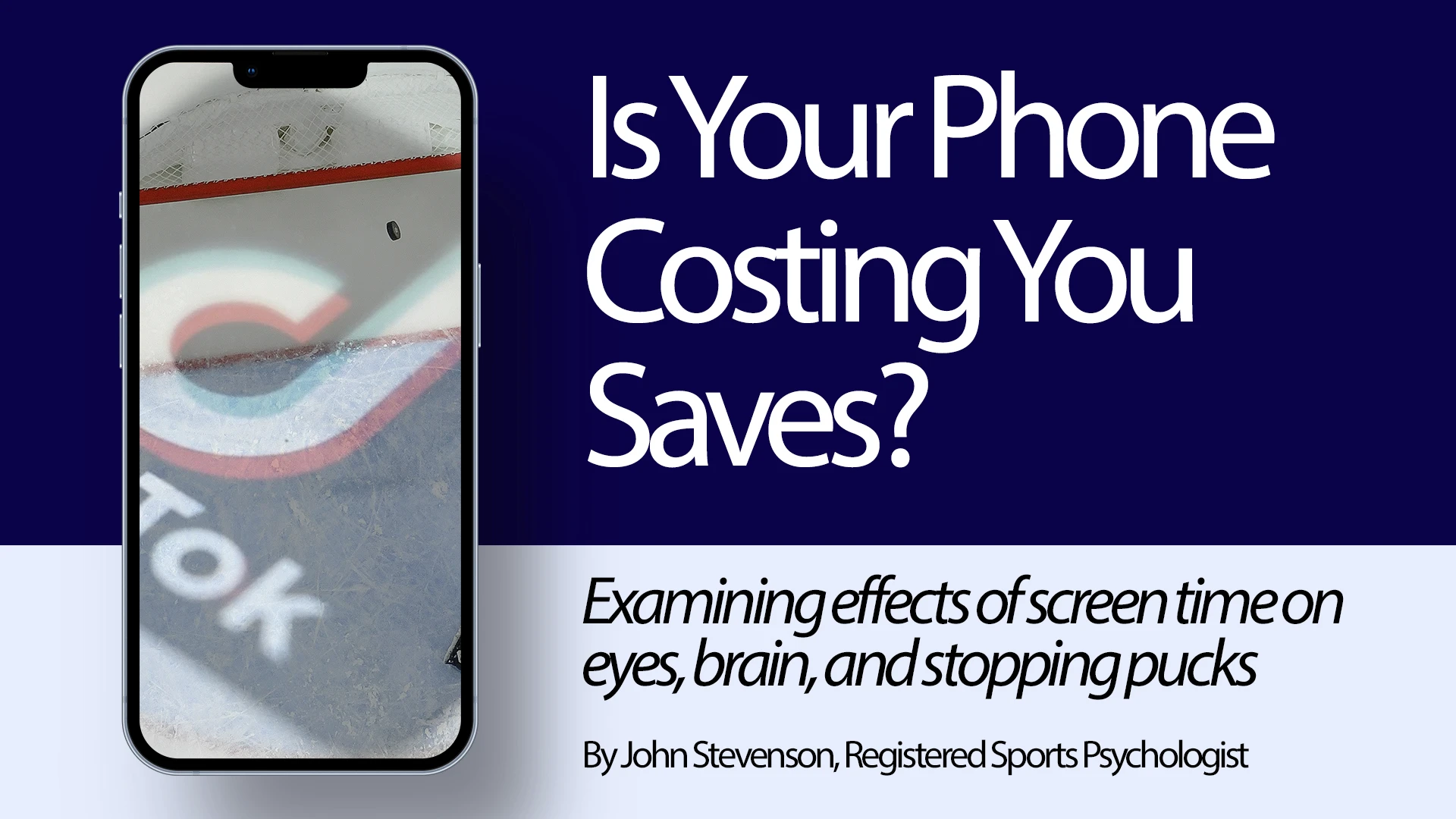
Is Your Phone Costing You Saves?
As a former NHL and WHL coach and scout, I believe what separates top goalies from the rest of the pack in any league is their Goalie IQ: their ability to anticipate what happens next.
According to my mentor and world-renowned goalie coach Mitch Korn, “Goaltending is not a game of shots, it’s a game of situations.” As Korn said, based on their ability to see, read, and respond to the wide variety of the situations they encounter each game, the best goalies in the world know:
- Where to Stand (Depth Management)
- What Save Selection to Execute
- What to do with the puck (Rebound Control)
- Know when and how to Recover
This skill is so critical in fact, that InGoal Magazine has devoted a whole section called Pro Reads that teaches and fosters the development of this vital tactical skill. Alongside this section, InGoal has published several articles on the importance of goalie eye-hand exercises, vision training, and perceptual-cognitive training (Neurotracker, Senaptec, Vizual Edge, Reflexion, Sense Arena, etc.) to improve a Goaltender’s Hockey IQ.
Unfortunately, I believe a critical factor has been overlooked and ignored, especially since the COVID-19 pandemic, and that is the impact of screen time on the goaltender’s ability to stop the puck. Screen time refers to the amount of time spent and the diverse activities performed online using digital devices (DataReportal, 2020). For instance, screen time encompasses both using digital devices for work purposes (regulated hours of work or educational purpose) as well as for leisure and entertainment (unregulated hours of gaming or social media use).
Since 2020, there are reports screen time tripled among children and teens. On average, both passive and active time spent using screens outside of online school-based requirements has increased for children and youth during the COVID-19 pandemic from 0.75 hours to as high as 6.5 hours per day in parent-report studies from the United States and elsewhere globally.
To contact or work with John Stevenson:
Champions Mindset Inc.
John@championsmindset.ca
780-504-9469
More from John Stevenson:
Still ahead in this article:
The two physical systems that screen time quietly degrades — and the documented conditions that follow — are listed in the next paragraph.
15+ years of goaltending film & coaching
Already a member? Log in
Think you're seeing this in error? Contact support
Keep reading
15+ years of goaltending film & coaching
Already a member? Log in
Think you're seeing this in error? Contact support