
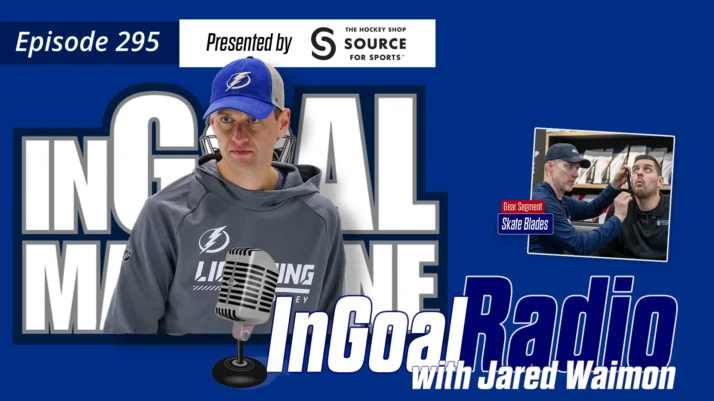
InGoal Radio Episode 295 Tampa Bay Lightning Goalie Scout Jared Waimon

Please subscribe and leave a rating — it helps us reach more goalies!


Jared Waimon, goalie scout for the Tampa Bay Lightning, began his career as an aspiring college goalie before transitioning into goalie coaching and eventually NHL scouting. He explains how each role informs the other, offering practical advice for goalies and coaches hoping to work at the professional level, and emphasizing that experience on the ice directly sharpens his eye as a scout.
- Jared Waimon followed a path from college goalie to goalie coach to NHL goalie scout with the Tampa Bay Lightning, demonstrating that on-ice experience is a viable route into professional scouting.
- Working as both a goalie coach and a goalie scout creates a feedback loop — each role improves performance in the other.
- Goalie parents should prioritize working with multiple coaches in the off-season and approach each session with an open mind to maximize development.
- Toronto Maple Leafs goalie Joseph Woll breaks down depth management and screen reads during a 5-on-3 penalty kill situation in this week's Pro Reads segment.
- The chest protector tuck-vs-untuck debate is explored in the gear segment, highlighting how personal preference and fit affect a goalie's setup.
Episode 295 of the InGoal Radio Podcast, presented by The Hockey Shop Source for Sports, features a loaded feature interview with Jared Waimon, goalie scout for the Tampa Bay Lightning.
Feature Interview
presented by NHL Sense Arena
In the feature interview presented by NHL Sense Arena, Waimon takes us on a journey through his path from aspiring college goalie to goalie coach to NHL goalie scout, sharing great advice for anyone aspiring to work at the top levels in either role, and how each job has impacted the way he does the other. This in-depth interview is loaded with great advice and take aways for goalies, goalie parents, goalie coaches and anyone working (or hoping to work) in the scouting world.
(to contact Jared, check out his page on the InGoal Directory of Goalie Schools and Coaches)
Parent Segment
presented by Stop It Goaltending U
In the Parent Segment, presented by Stop It Goaltending U the App, we dig into the benefits of working with different coaches in the off-season, and the importance of bringing an open mind to those sessions.
Pro Reads
presented by Vizual EdgeWe also review this week’s Pro Reads, presented by Vizual Edge, which features Joseph Woll of the Toronto Maple Leafs breaking down depth decisions and screen management tips against a 5-on-3.
Weekly Gear Segment
presented by The Hockey Shop Source for SportsAnd in our weekly gear segment, we go to The Hockey Shop Source for Sports to dig into the debate about whether to tuck or untuck your chest protector. Can Cam get Woody to switch?
Episode Transcript
Intro
Let's scrape it up. Get that crease ready. InGoal Radio, the podcast presented by The Hockey Shop Source for Sports Langley, thehockeyshop.com. We have a real special acknowledgment coming up on this episode. Plus, our Gear Segment will focus on some steel.
We've got the parent segment, talking about, being open to multiple goalie coaches. A lot on this, episode with Daren Millard, Kevin Woodley, and David Hutchison, the two cofounders of InGoal Mag. Hello, guys.
How are you now?
Good morning, Daren. How are you?
Good morning. Are you in Hawaii?
His You're right. I've been ups I've been up so so long. It's practically nighttime, but it's 01:00.
How is the goalie school guide coming along?
Oh, I think by the time anybody listens to this, they will have received an email with a link to the online version of the directory. Just to be clear to everybody, we've made it really confusing. There are two versions of this. There is one which is a magazine style PDF flipbook that you'll see on our site. There are multiple articles including, may I say, an exclusive interview with Marc Andre Fleury as the cover article.
Lots of great reasons to dive into the content and then you will see listings of goalie schools, about a 150 of them, ads from a whole bunch of them showing you what they do. Lots of great stuff in there. That's one version that probably will not be out when you are listening to this podcast for the first time. But what will come out in the next day or so is the online directory. So it complements the magazine style one because we can put more information online.
You can get in there and say, show me a goalie school in Toronto or Chicago or wherever you'd like to find one. You can compare different schools. You can just get a real good feel for what's out there and we'll talk a little bit more about that as we go on today. But, yeah, we're just about to put a wrap on it, but we're also gonna make sure that for the next long while, we're adding to this. So the online directory will be improving all the time and we've actually got a couple of giveaways that are gonna be coming out associated more with the magazine style one and those will change.
There'll be multiple ways to do this. Just all sorts of really cool stuff that we think is gonna be super valuable for, goalies and their families, Woody.
Yeah. And if you're wondering why Hutch doesn't know what time of day it is, it's because he's basically been working day and night to make this happen. Sleep deprivation has been the order of the day, but it's close. Mostly, I I gotta say, and and with all due respect to our partners and all the goalie schools that have gotten involved in this, herding cats to get content from the schools that are participating. Well past deadline, still looking for some of that material.
If you're one of those list guys that we're chasing, please get it to us. It's gonna be awesome.
Do have any muscle?
Am, man. No.
I mean, to go shake them down and get them on the on the go.
Oh. That's me.
That kinda like Vegas Vegas muscle.
Daren, we should have brought you in on this. We should have.
I wouldn't I'm not sure I would qualify for Vegas muscle,
but Oh, you must know somebody there.
I I know of Vegas muscle. I've heard stories of Vegas muscle.
Oh, I went to high school with a couple of guys that could probably help us up with the muscle side. Although, I think one of them is actually in jail right now, so we'll leave that story for another day. Oh, Woody. Really?
That's cool.
Not so much. I don't think jail's cool at all. Thank you. No. No.
Well, not. It's cool
that you kinda know. I don't know anybody that's ever been to jail. Congratulations to on Vegas, the UNLV Skating Rebels, a division one of the ACHA club hockey. They won the national championship yesterday. There's been a lot of discussion about UNLV progressing and getting, the next step, into division one NCAA hockey, but the ACHA is the top, level for club hockey.
And, after losing in the championship game a year ago, they won the final yesterday, and Jeremy Foreman was the star of the tournament for Vegas, the goaltender. And he played four years at UNH in division one hockey in two AA. Was not the starter, but gotten a few games over the years and transferred over as a fifth year grad transfer and was outstanding. That's pretty cool that he finishes off his career as a national champion and MVP.
Congratulations. That's super exciting.
That is
actually He was also in goal this year when UNLV during the Christmas break beat the University of Denver. First time ACHA team had beat division one school and the defending national champions.
That was a huge story. Yeah. Maybe it's my sleep deprivation. You may have already mentioned this, but didn't he play only about three games before this year?
Yeah. And then he gets to come in and win a national championship? Really cool.
Play every day.
Folks. Yep.
And, he's not, not the biggest guy. So that was that's also a cool story.
It's funny. Even as people want to talk about how the NHL only wants really large goaltenders, every time there's a story about somebody a little smaller, Dustin Wolf, I just love it because it shows there's an opportunity in our game for everybody.
Dustin Wolf. Have an I thought actually the, the game in Toronto at the start of the week that we're recording, I thought if he goes in there and he, like, dominates, he might have grabbed the Calder trophy for rookie of the year that night. Now it didn't go his way, but I thought being on that stage with a strong performance, he might have just locked it down. And now we'll we'll see where where the voting goes. I believe he's got a shot at it still.
It's not like that's gonna go the other way. But being in that massive hockey media hotbed that he might have been able to really secure.
Because probably not everybody realizes it's a media vote. Not all the awards are, but this one is. Right? So you need to be being in Calgary in Western part of Canada where the games are really late for friends in the Eastern media, it's tough to get seen as much as we'd like The Dustin Wolf to be
ability to get the the publicity from something like that.
Yeah. It matters. It matters. We've seen it in other votes for other awards. And I'll be honest, that was a tough night statistically for him.
Kinda knocked him off. He was chasing down Logan Thompson for the most goals saved above expected in the entire NHL this season. And as I had argued on a couple of my local and and radio hits in Calgary and and Edmonton, was putting himself in the Vezina trophy conversation. Forget the call there. Like, as a guy that should get votes, I think we all know Connor Hellebuyck's winning it, but as a guy who should get votes, as a matter of fact, even after the Toronto game, he his goal saved above expected is still ahead of where Connor Hellebuyck is, and that's just, you know, again, no discount at all to how incredible Hellebuck's been.
It's just the reality of their environments. Wolves asked to sort of be the backbone of that team a little more.
We also have an acknowledgment to make.
Would that be
the If you like to take care of the the duties, then this is really significant for our universe as goaltenders, people that love the position of being a ice hockey goaltender.
Kevin is looking confused.
I was told there'd be no politics.
There is no politics. I just thought it was really cool. I don't care who you vote for. I don't care what your politics are, but the fact that the Canadian Prime Minister is a goaltender is really cool. So congratulations to Mark Carney, who was sworn in as the Canadian Prime Minister.
He played, one game at Harvard, I believe. There aren't many politicians out there with a hockey DB, but he's got one. And, then he also played for Oxford, which I assume was a club sport, and played against a touring Russian team. The story I read was really fun. I can't remember where I saw it.
Apologies for not giving the proper credit. But I believe they assumed they were playing just a group of touring Russians at a similar level to them and they showed up and they were top Russian pros. This is back in the Red Army days, believe, because he's about the same age as me. Thankfully, they decided just to throw the sticks in the middle and mix up the teams, so they would have a more fair game. Still gave up a goal in the first few seconds of the game.
But, yeah, it's really cool. And folks, if you've got another politician at the national level who was a former goaltender or once a goalie, always a goalie, let us know. We'd love to give them a shout out too.
I do. HockeyDB page. HockeyDB page. That is cool.
How cool
is that? That is very cool. Not many people do.
That might be one of the most Canadian things ever.
That would be the best part of getting into the Yeah. Just An an e bug opportunity. Right? It's just to get that. Oh, okay.
Figures.
Oh, how how about how about Ottawa brings in Mark Carney as their e bug for a game? There'd be there'd be a promo.
Absolutely. I love it. I love it. Hey. We've talked about it.
Right? Like, from Hollywood to, you know, highest levels of business and now the highest level of politics in Canada, goalies, there are lessons to be learned. It all isn't all about playing the position at the professional level. There are life lessons that come with being a part of this position. As a matter of fact, that's something our featured guest talks a little bit about this week.
It's something that our some of our recent featured guests have touched on a little bit as well.
You wanna just give a little bit of a heads up on on the featured guest?
It is Jared Waimon of the Tampa Bay Lightning, goalie scout for the Tampa Bay Lightning, former goalie coach for Quinnipiac, has worked with USA Hockey on multiple levels, including the twenty twenty three world juniors as the goaltending coach there. So we're gonna dig into life as a coach, how he got there, the transition to scouting, how one informs the other, just a whole bunch of goalie geek goodness as we dig into the position with a guy who is passionate about it and has paid his dues and come up through the ranks in a lot of different ways. Also, we had Spencer Knight in town with the Chicago Blackhawks after his trade, and Jared is was Spencer's longtime coach coming up in Connecticut as well.
Great stuff. Goalies talking to goalies. It's, one of the great advantages of InGoal Radio, the podcast, which is brought to you by the Hockey Shop Source for Sports Langley, the hockeyshop.com, and that's where we hang out every week with our Gear Segment focused on steel.
Steel. Can I interrupt before this is a woody time out before we go? Hey. What do you know? I digress.
Kel Surprised before we go into the Gear Segment. Goalies talking to goalies. Daren, you're at a lot of practices.
Mhmm.
How often are the goalies tapping their stick on a regular basis for the guy at the other end with big saves and drills?
That happens a lot during the VGK practices.
Okay. I don't hear it that much. I watch a lot of visiting team practices, and Connor Hellebuyck and Eric Comrie did it at a level that felt like I was at my Monday night skate. And when the goalie that was receiving the taps from his peer at the other end felt that it was worthy, he gave the wave down to the other end. Yep.
Thank you. Acknowledgment. And what was beautiful is it wasn't just the desperation. It wasn't the back door, like, sprawling to take away an empty net. It was the saves that only goalies know are really tough.
You know what I mean? Those ones where patience off an open release, things like that. And it was just, man, the interplay between those two, talking to Comrie afterwards about hell about coming to the bench during games and sort of breaking down the game and what he's seeing and the scoring chances. It was really fun to watch that continue in a practice environment and the way they support each other, the way they compete in drills against shooters. They came down to one end and did a bunch of, like, very shooter friendly drills, low high stuff to open looks, and just the back and forth between them and the shooters and them with each other.
I know it happens at other practices. It doesn't happen at all the practices at the NHL level. It was really refreshing to see and a good reminder for kids out there everywhere of the importance of building that relationship and supporting the guy on the other end of of your rink.
The team that I watched most of the Vegas Golden Knights, they love to score in in practice. And the guys, they hoot and they holler. They celly. They do they do it all. But when there is a a big save, the goaltenders get involved and Sean Burke leads the charge.
Like, he's always clapping the stick on the ice, supporting his guys and and the guys, Ilya Samsonov and Adin Hill, brand new contract too with the six year extension. So congratulations there. He earns it off the 2023 Stanley Cup and and what he's done qualifying for the Four Nations team at this year's Team Canada tournament. So but they they they support each other as well. And they're always tapping gloves, always fist bumping on the ice too.
And I think that's cool at the National Hockey League level to see goalie partners fist bumping at the start of a practice or they change out drills. That's great.
I love it. And I just I hadn't seen it to that degree, so it's great to hear it goes on in Vegas as well. It was really fun to sort of spend a little time with those two and watch that in practice. Now speaking of, you know, tapping the pads, getting that goalie fist bump from your partner, no better place to get one than the hockey shop and the hockeyshop.com when it's time to shop for your gear. They will make you feel like you just made a spectacular two on one save, Connor Hellebuyck is tapping his stick for you when you go to the store or when you go online and need new gear or used gear.
They got a spring break sale on. Lots of things on discount right now on past products as they get ready to stock up for new products. But with the staff in there, they all play the position. They're like you and me. They tap their sticks for the guy at the other end when they make big saves.
And because of that familiarity with the position, they're going to help you find the gear that will help you play it the best. Not just sell you on the latest or the greatest, but the gear that will help your game. The gear that fits your style, fits your body, fits the way you want to play. Go on in, have a conversation, or reach out online, have a conversation with them. If you have questions about new equipment, about old equipment that's on sale, about finding the equipment that's best for you, The Hockey Shop Source for Sports in Langley and thehockeyshop.com, there is no better place to get outfitted for your game than The Hockey Shop.
I'm on the spring break sale website right now on the page.
We've lost him. We've lost him.
Yeah. No. You you you might
have digress.
I know. I I can't help it. It's my favorite website. You know, when you you type in the website and the the predictive text comes up, like, because you've been there before? And on my phone, it tells me how long it's been since I was at that website.
I'm never more than a few hours. You were here three hours ago.
All you get is the t in, then it fills in the rest.
It goes. It goes. We know where you're going. Let's go look at some wheels. Thehockeyshop.com.
Gear
It's Source for Sports Langley. It's our Gear Segment looking at some steel with Woody and Cam. True story. I love it. I'm a nerd.
We're back at the Hockey Shop Source for Sports. We're over in Goalie Utopia where Cam is gonna try and give us an edge on the competition.
Steel. We're talking about steel today.
We got black stuff. We got silvery stuff. We got colors and brands and shapes and sizes. I don't really know what I'm talking about when it comes to steel cam, so I'm gonna need you to pick up here.
No. I noticed. I noticed. Alright. So we both kind of looked at each other and said, you know what?
This is probably a good time to cover steel again because it's that time of the season. You're kinda looking down. It's either you're walking through into your playoffs or you're finishing over playoffs. Spring hockey might be starting. You all of sudden you look down at your skates, and you're like, I have no steel left.
It's generally not recommended to have no steel left. No. No. It will affect your ability to push from your knees.
It can for sure. For sure. So I got a various array of steel here in front of us. We can talk about Bauer specifically first.
Okay.
And there are two factory replacement options. So in my hand here, I have the LS 5G black coated steel. You're gonna find this steel on the Bauer Pro Skates in particular. So all of Bauer Steel is based off of their, like, plus. So it's their taller steel now.
In years past with the original, like, cowling the school skates that they came out with, they had a shorter steel that doesn't exist anymore. You can't even get it. That's fine.
So So this is the new standard?
Exactly. Because it used
to be you could sort of choose a taller steel, a little bit more of an aggressive attack angle in terms of getting your edges, but it would also affect your stance if you're changing. Now it's standardized. Everybody's getting a taller steel.
Yeah. For the most part, there's not there's no such thing as, like, a small short steel anymore to a bit of a degree, which is good. Again, continuing to talk about that attack angle. So the two options that you're gonna find, LS 5G plus or Pulse DI. What's the difference?
Black carbon coated steel, titanium coated steel here. In theory, what we're getting there, a stronger edge point. Don't. If you're someone who kicks the post a lot, don't have a lot of time in between sharpenings,
things like that. Kick opposing players wouldn't recommend it, but you never
know. Wouldn't recommend that at all. So if you're looking for something with a bit of a sharper edge point over it, well, it's not sharper, but it can hold its edge.
I was just gonna say it hold it lasts a little longer. You can survive a little longer between sharpenings. I we've noticed it when we've switched to a brand like this compared to, like, the even the Black Edge. Like, there's different types. Different brands have different versions.
Exactly. You do notice the difference in terms of how long your sharpening lasts.
So keep in mind that profiling once again is something completely separate from all of this. We do recommend getting your skates profile. Check out We've
got another video for that.
Exactly.
It's already up. Go find it.
However, again, two options for your Bauer, and today, we are just gonna cover the factory replacements. There are different aftermarket options that are available and whatnot, but we are focusing on specifically Bauer Steel for your Bauer skates.
Okay. Let's go away from that.
Next. Let's talk about True.
Let's talk about True.
True, we actually have three options for you in your skates when it's coming to your two piece skate. So your stock ones off the wall or your two piece custom skate in particular. You have the regular stainless steel, nothing too fancy here, just through stainless steel available in 3mm only. And then they have their DLC, so they're diamond edge coated steel, 3mm and 4mm replacement. So something if you want to try something a little bit different.True
Those guys are a little bigger, you'll prefer a little bit of a, you know, different stability in your feel. Four mil might be enough.
Still fits in the same holder.
Still fits in the same holder.
Oh, I did not know this.
Yes. I currently skate on four mil myself.
Is you're a heftier gentleman. I am
a heftier gentleman, so I need more support when I go to go push down low. I need to harness these big leg muscles to be able to get a nice, good, strong push off. Well said. That's what I thought.
I was worried I pushed you in a bad spot there, Cam. You handled that beautifully, my friend.
I handled that truly the right way. What's True steel? Again, available. Check it out. Why you should go 3mm?
Why you should go 4mm? That's something we can definitely talk about and chat.
Time Cam, move on to the next one.
No. Let's go. CCM. One of the more interesting things from CCM is that they have an option for forward lean already on their steel. So they have a pre profile blade, a 10 foot, 27 foot radius.
So it's combo. That's putting you a little bit further onto your toes. That's stock without having to get it done.
Cam, can I call a time out here? Yep. Why is the CCM blade say step? Why is it step steel?
So into some a little bit of history. So CCM now owns step steel. So proprietary step steel only exists for CCM skates now in particular.
Because for the longest time, step was your was the aftermarket of choice for all the brands.
Exactly. Exactly. So CCM scooped up that manufacturer. Now you see all the replacement steel will be branded step. On their high end, EFlex 6 skate, you will see step steel in that skate already stocked.
They're lower models. They just have their regular, like, price point steel, for example. However, anything you're gonna get aftermarket will be step
steel branded. So if you've got non step steel and you got them worn down and need some new steel, you can graduate to the step steel.
Exactly. And here's another situation where you can actually get a 4mm blade for your CCM landscape.
I feel like I'm holding
that right now. Yes. You can see that taper difference. So it will mount into that same 3mm holder, and I will give you again that wider blade.
Kinda feel like I might wanna try that as a somewhat heftier gentleman myself.
What else? Believe that one to the imagination, folks. So, again, this just covers some of the basic options. We even Did we talk about black steel? There's black steel.
Let's see. Yeah. This one. Step has that too. That's included all, Oh, I know.
Included I mean, these are all things that we can definitely check out on the website available. If you have any questions about that steel, give us a call. (604) 589-8299 or 1-800-567-7790. Whether or not you wanna make that switch to that 4mm or keep your 3 or it's just time for another generic set of blades. This is custom profile?
They'll be specifically called out. This one in particular is that custom profile. It's already got
But you can get standard too.
Exactly. Okay.
Just being clear.
So check it out. That's it.
That's it. Thehockeyshop.com.
Skate on over. If you find one you like,
does bad. We'd recommend multiple sets. You can just bring them in, get them sharpened, swap them out. We just had a goalie come in that we knew the other day. Four sets ready for the playoffs, all sharpened up and ready to go.
Thanks to Cam and the crew here at The Hockey Shop.
How much of a level do you have to play to have multiple sets of steel?
Doesn't matter. I don't
think it's a level. Yeah. I don't think it's a level question. I think it's a convenience question.
100%. I know lots of people that at very young ages had two sets of steel, sometimes three because you go away to a hockey tournament, you don't know the local place or you just don't wanna take the time to go find the local place or you don't trust the way they sharpen their skates and you've got a guy you love. There's a million convenient reasons. Mid game, something's wrong with your edge, you can swap them out. It's just, it's I even know of some places where people mail their extra steel in because their guy will sharpen it just the way they want.
Probably, Cecil at the Hockey Shop does the same thing, Woody.
Yeah. The whole crew at the Hockey Shop, they have a lot of that where people bring in multiple sets. As a matter of fact, an NHL goalie coach friend of mine, well, in town, kid had a tournament, brought in four sets to get them sharpened, asked me where to go, sent him there. If you're gonna make the trip too, Daren, and when you're as good at sharpening skates as they are at the Hockey Shop Source for Sports, people come from far to make sure they get that perfect edge from Cecil and his guys in the department, in their skate sharpening department. And so that's not a trip you're gonna make for one set of steel.
You're gonna wanna do it for multiple. Load it up. In this case, like I said, loading them up for a tournament and his kids' playoffs. A lot of guys do that. So, again, I I I think to me and think about it this way.
Like, I don't know about you guys, like, but how often you go through steel? Like, you're gonna end up replacing it. It's like having winter tires on your car and summer tires. People like, oh, you have a second set of tires. It's a lot of money.
A a, it's safer, frankly, in the winter. Anytime the temperature dips below seven degrees, my brother works in mechanics.
Thank you, dad.
But b, also, yes, you should always have winter tires.
And dad is right.
Yes. But b, they last longer because you're not driving on the same set of tires year round. So your winters are six months here. So you're gonna get more wear out of all those blades. I guess the only caution would be if you've got a young goalie that's growing fast and he might grow out grow out of the size of the holder to the point where they're wasted before you get down on the steel.
But other than that, once you're into a full size skate and you're not growing anymore or you're you're you're into that last set, at the end of the day, having multiple sets becomes a matter of convenience and it's you're not replacing them as often. Because I I find just using one set, I like, once a year, I wanna replace my steel. I noticed the difference. It gets worn down over time with all the sharpenings, and you're not getting the same edge by the end.
How often do you go without getting them sharpened or how often you go between replacing steel?
I probably replace steel once a year.
Obviously, how often you sharpen and how much you profile. I
like to get my there was a point there where I was getting my skate sharpened every week.
How many skates would there be between?
Two. My kid went through a phase where he got them sharpened and you can do this at that level after the warm up, after the first, after the second.
Really?
He since yeah. Yeah. He did. He used to love them sharp. He's now gone and actually, I don't know whether it's the ice and the new rink he's in or what, but he's now gone from what was he?
Three eights now to half inch, so a little bit less sharp and he prefers it that way, so I don't think he does it as often, but
Three eights was Jonathan Quick.
I'm three eights. Now he's a story we heard about. I think it was him, Woody, wasn't it? Where we were told that the trainers every now and then would swap his steel out, and if it was less than two weeks old, he could actually tell. Soon as they put in the old steel, he'd step on the ice and know that the height was different.
I'm pretty sure it was Quickie.
That wouldn't that would not surprise me whatsoever. It's pretty dialed into his gear and his feel. It's here's one for you. Different rinks, different ice. Yes.
True. Talking about hard and soft ice. And Spencer Knight told me that the ice was so soft in San Jose in one stop that he went to
I think he said one and a quarter. Really?
Yeah. Like, I didn't I'm like, hold on. What? Does that even exist? But, yeah, like, like, I'd never
heard round.
Because it yeah. Pretty much. But, like, it was the ice was so soft. The edges were just sinking into it, just digging right in. So
It's all round, Daren.
They're all round. Wow. You know what I mean? Outwardly round instead of in inwardly. Hollow What's the opposite of a hollow?
Flat. Convex
versus cave. Cave. That's right. Yeah. Yeah.
Gonna be no science. No math, no politics, no science. Come on.
Okay. Just just to let you know, was thinking that because one of the articles that's going into that coach's guide, Woody got deep into the math. So just a little preview, go find the math when it comes out.
And it broke my brain for two days.
Never mind the fact that I actually did all the math for you originally, and you just took mine, but that's okay. Cheat off me, Woody.
It is important too, to to tell people you you can take edges off a little bit with with your sharpening after a morning skate or something off a skate to to dull it off. You can go both ways if you know what you're doing.
Yeah. Yeah. Way you just step on the edge of like, run it over the boards as you step on the ice, you mean?
That that's used to be how how it Yeah.
Really Oh, yeah.
Remember doing that. Yeah.
What about the other way? If it gets you get into a skate, you haven't had a chance to go, you guys a sweet sticker? You use a sweet stick?
I I love my sweet stick.
Eventually, that becomes problematic for your blades if you do it too much.
Well, I'm okay with it because I'm a moron and not very good. But I I do I do use the sweet stick all the time. I I probably use the sweet stick more than sharpening or as a sharpening.
Oh, I'm sure tons of us beer leaders do. Back to the building thing, Kevin, I'm sure it was Carey Price who told us that Montreal's trainer actually had most buildings dialed in and knew a different sharpening level and it wasn't just Cary, but he would do it for the rest of the team depending on where they were playing at any given time. So absolutely important.
It varies a lot around the league for sure.
And real advantage to the morning skates. Right? Guys getting used to the ice?
Yeah. Daren, you know how Woody loves to geek out and just be crazy in front of his teammates and they like to make fun of him. He's gonna be that guy who's got now a whole bandolier full of different blade sharpenings and he can, okay, boys, where are we playing tonight? I gotta rip out the right set so that I'm just dialed into that rink.
Could you imagine?
Or he's gonna come in after or he's gonna come to the bench after warm up. But boy's ice is a little soft. I think I need to swap my steel out. Kevin's laughing because he knows he could do this. Turning around because he feels the truth.
Don't give
me That's what he
Don't give me any ideas, Hut.
Who was the Oh gosh. Who was the band back in the eighties where the guy played the harmonica? No. Guy that played the harmonica and Blues Traveler. And he had about 16 different harmonicas on a bandolier around the front depending on key and you name it.
That's gonna be Woody walking into the rink now with all his steel.
Sounds like that guy needed a dangler.
Parent Playbook
Well, he's got a lot of respect for that guy. Let's slide over to the parent segment brought to you by Stop It Goaltending U, the app, and wanna go down being just available to multiple different goaltenders, but we should or goaltending coaches. We should talk about what's happening at Stop It Goaltending U.
Well, speaking of being available, how about twenty five years of knowledge at your fingertips with new information coming every week. That's what you get from Stop It Goaltending U, the app, from Brian Daccord and his team at Stop It Goal Tending. Every week, you get five one minute quick hits, little primers they call them, to help you become a better goaltender. This week, it's about return on investment. Little ROI for you.
For those of you that are, in the investing side of things, well, how do we spend our time and how do we make sure we get a good return on investment? Five one minute quick hits. There's a five minute power pep. Get you fired up watching some Ilya Sorokin, and then a twenty minute breakdown in Goalie IQ this week. Samuel Montembeault versus Sergei Bobrovsky.
They analyze their games. They watch how they approach things differently. There are a ton of different lessons in watching other goaltenders. How often do we hear NHL goalie coaches, goalie coaches working with kids say, kids don't watch enough hockey. They just watch the highlights.
You watch twenty minutes of them breaking down a couple of goaltenders like Montembeault and Sergei Bobrovsky in this week's Goalie IQ, you will be better because of it. Just the tip of the iceberg. There are all kinds of services, at the premium level of a subscription to Stop It Goaltending U, the app, including advisory services, whether you're going to junior or going to college or wanna look the routes, they've got all that. And, of course, last but certainly not least, every subscription to Stop It Goaltending U, the app, comes with a subscription to InGoal Magazine premium, the best of both worlds. You'll get all our articles.
You get all their information. New stuff every week courtesy of your subscription to Stop It Goaltending U the app. What are you waiting for? Subscribe today.
Okay, boys. We are gonna talk about something that I think is really important for parents and for goaltenders, and that is the value of working with multiple goalie coaches. Now this is not about saying that one coach is better than another. It's more about recognizing that different coaches are gonna give you different perspectives, different teaching styles, different experiences, and they all help, you know, shape you as a more rounded goaltender. And with our upcoming coaches directory, finding great coaches to work with has never been easier.
So quick little story from from my experience. I I learned this early on in my coaching career. I had this surreal experience of working with a young goalie, and, he mentioned to me on the ice that he was also getting help from another goalie coach by the name of Ken Dryden, and, that was only my hero. So that was a little bit of pressure for me. But I quickly realized in the way I worked with him and his lessons with me were that, goalies at all levels are gonna hear different things from different coaches and that's okay.
And you're gonna learn how to absorb and apply those things in different ways as well. So much as I felt intimidated in that situation, I found that I could add value too because I I I was a different coach. That's all. Another NHL goalie we know struggled at his first Hockey Canada camp, and that's, back when Hockey Canada bothered to hold those. Because every coach there had kind of a different approach, and he struggled with that.
But when he returned the next year with a more open mind, found he came out a better goaltender. So today, he, like many of the NHL goalies that we speak with, works with multiple coaches throughout the year. Thatcher Demko, I think, told Woody in one of the early InGoal Radio episodes that, working with different coaches as a young goalie growing up made him a better goaltender. He didn't just work with one goalie coach at home, but he would travel around the country. And as hockey took him different places, they would find coaches in different locations that helped shape his game too.
So what does that mean for young goalies? Well, to me, one thing is you've got to be open to different voices. It's a really critical skill. Too often, goalies especially get locked into one coach's way of doing things. And when they hear something different from maybe their team coach or another goalie coach, they're they just push back.
My goalie coach says I have to do it this way. That kind of a mindset can really limit your development as you move up the ranks. So the best goalies, they take something different from every coach. Some of them are gonna be more technical. Others are gonna create game like environments on the ice.
Some love to give feedback on every shot, and others like to step back and give you time for independent reps and to work it out. Every one of those approaches though add something different to your game, whether it's skill development, game reading, learning to work with different coaching styles, all sorts of things. So as parents, I would suggest that you should talk to your young goalie about the coaches they work with. Ask what it is you like with one coach. What do you struggle with with that coach?
Tell me what you're learning, and don't let them get away with that old school one of, I know nothing. Let them teach you what they're learning on the ice, and you're gonna enjoy the process too and be more engaged with your child. Help them process those experiences so that they can make the most out of every coaching relationship. Because as adults, we learn to work at at the office with all sorts of different personalities, and we've got to help our kids go through that process too. As Woody said, you know, goaltending gives you lessons that you can apply in life going forward, this is gonna be one of them.
Now, if your goalie has only worked with one coach, I think now is a great time to explore some new voices. So dive into the InGoal coaches directory. It's there to help goalies find and connect with some great coaches. Now you can still work with your go to coach. You absolutely should.
But maybe try someone new this off season and see what else you can learn. Maybe, and this is something I've done in the past, instead of going off to that cool spring hockey experience where you spend a lot of money to travel across the country and maybe only get a game or two in one weekend, Maybe you save some of that money and you go to some cool place that we've got listed in the directory to combine goaltending with a vacation. How about Alaska? Montreal? The East Coast?
The West Coast? Wherever you might wanna go, there's probably somebody in our directory that's worth checking out and seeing what they do from a teaching perspective. And we've actually got a button in there so you can reach out to any coach directly and ask for a bit more information. See see what they're up to and see if it's a good fit for you and your your kid. Bottom line, the best goalies work with different coaches.
It's not just about skill. It's about learning how to learn. So check out the directory. Give your young goalie a chance to grow.
Love the idea of combining it with a vacation as well because a lot of times the kids don't wanna do the stuff that you wanna do anyway. So you can go off doing your sightseeing or exploring, and, the, children, can get the work in on their craft pro rigs. Here's tip.
Here's a tip for all goalie coaches. I offered it to a couple of them. I don't think anybody's taken advantage of it yet. Organize excursions for the parents while you're on the ice.
Oh, yeah.
So if you're in somewhere in California or Kelowna or wherever it is that they've got, you know, vineyards. Mom and dad will take you to a couple of vineyards for wine tasting, and your kid's gonna have a great time all day on the ice or whatever it might be. Make it a family experience.
Ahead of the Sense Arena feature interview, we have the ProReads. This week hanging out with Joseph Woll. ProReads brought to you by Vizual Edge.
For those who aren't already subscribers to InGoal Magazine, the online directory magazine style, when it comes out, we'll have a sample of our ProReads featuring Joseph Woll to give everyone a taste of what it's all about. Joseph is back in this week's ProReads presented by Vizual Edge, walking us through a five on three, managing depth and traffic. Some great advice on working around screens, choosing sides, and even talks about a drill they do with the Maple Leafs to make sure they're making those movements when they have to switch sides around a screen quickly. That's the focus. And, of course, when you're trying to find a puck through bodies around screens, quick side to side eyes from one side of a screen to the other, your visual abilities are really tested.
Why not train them? Joseph Wolls used it in the past. Visual Edge is a tool to do that. They're the perfect sponsor for ProReads because ProReads are all about having NHL goaler goalies help you see the game better, and goalies right up to the NHL use visual edge to help them see the puck better. Take their edge test, get a baseline for where your visual skills are, multiple different elements.
We talk about convergence and divergence, all these different aspects of vision that help you see the puck or the play better and faster, gives you a score, and then develops a program to help you train it to improve all areas. We talked to Cam Talbot recently about the difference it's made in his game. Visual Edge, make sure you give them a try. And InGoal Magazine members, we talk about ProReads and being something you get as a premium member to InGoal, you also get a discount. Remember, 50% off for the first six months of Vizual Edge.
They now offer month by month subscription, so you can get a taste without having to commit for a year. You get 50% off each month for this first six months as an InGoal premium member. That discount code, if you're a member already, you will have gotten it in an email last week. If not, become a member. Check out the ProReads and you'll get access to that discount code with each new ProRead each week.
You can use that discount code when you check out on a Vizual Edge subscription and save 50% off your first six months.
We're all about trying to make everybody's experience in the crease a little bit better, so lean on some of our partners, which includes, the presenting sponsor of our feature interview every week, and that's Sense Arena, NHL Sense Arena. And this week, it really has a double double, presentation. You've got, the sponsor in NHL Sense Arena, but you also have Jared Waimon, who's a real, resource in our world.
Daren, I had to I do had to weave the coaches directory into what I'm gonna say about NHL Sense Arena. So here we go. You ready? If you are looking to take your goalie's training to the next level, of course, Sense Arena is more than just cutting edge VR. It's your gateway to working with multiple top goalie coaches anytime, anywhere.
We've got top coaches like Eli Wilson, Brian Daccord, and many others who not only have training programs inside Sense Arena that you can follow, but they also incorporate Sense Arena into their off ice programs at their camps. So it is a powerful tool for improving tracking, decision making, mental sharpness both at these camps and in your own training when you get home from camp. So, as I've said before, getting on the ice at a great goalie camp is so valuable, but you need to continue that development after camp ends. With NHL Sense Arena, you can reinforce what you learned, You can stay sharp. You can keep improving all spring and summer so that you are ready to hit the ice at your best next season.
Check it out at sensearena.com, and, of course, use the code I g m 50 to check out and save more.
When you said that when you said that you were you had to do it, there was that pause, I thought I was in trouble. I really did. I thought It was the teacher voice too.
There's little bit of a teacher voice there.
Yeah. It was. Oh, yeah.
Oh, really? I've just been called
to the Yeah. Maybe I'm just used to being called to the principal's office.
They usually tell me just to go home. That's what that was the strategy back in my school days. Don't don't even stop by there. Don't waste this time.
I had worked at a school for about ten years and I was asked to come and see the boss and I showed up at his office and I said, I know that every time I come and see you, you have a smile on your face and I know we're always talking about something cool, but I still feel like I've been called to the principal's office and feel nervous. It's totally normal.
Yep. That's what happened when I heard the teacher voice.
Mhmm. Yep. I'm right with you.
Kevin Woodley.
Feature Interview - Jared Waimon
Let's change the subject. I'm gonna end up in the fetal position on the floor. Before I do that, let's get us to Jared Waimon, our featured guest this week. As I mentioned earlier, goalie scout with the Tampa Bay Lightning, former goalie coach at Quinnipiac University, worked with Spencer Knight for years and still does in the summers in Connecticut, a guy that we've gotten to know at InGoal Magazine over the years. In addition to his work with USA Hockey, I mentioned the twenty twenty three world junior team, Worked with the women's program, the national team development program.
He was a scout, and he's gonna walk us through the path. So a lot of you out there, young coaches, maybe you thinking about scouting as an alternative to coaching or something you can do along with coaching. Jared sort of walks us through some great advice in this interview on how to get those opportunities, how to make sure you're around to be seen for those opportunities, and just how they might appear, you know, kinda like a like a how to become a goalie goalie scout while mixing it with goalie coaching at the same time as well as a ton of great advice, that I think will resonate for young goalies, goalie parents, and other goalie coaches. It's it's it's a can't miss interview with Jared Waimon of the Tampa Bay Lightning. Really excited to welcome to the InGoal Radio Podcast.
Probably long overdue as a first time guest. We chatted about the possibility when last we met in person at The USA Hockey National Symposium in Minnesota. Jared Waimon, five almost six years into his career as a goaltending scout with the Tampa Bay Lightning, a lot more experience than that on the coaching side with USA Hockey, with Quinnipiac University. Welcome, first off. It's good to have you.
Yeah. It's fantastic. I mean, we we met each other, first time, I think in 2019 at the Vancouver draft. So it's, we've had on and off discussions. It's just about kind of everything, sometimes back to back and sometimes with months or years between it, but it's good to see you again.
It's good to have you on. It's funny. Of course, the twenty nineteen NHL draft, some some kid named Spencer Knight who you worked with quite a bit growing up, as he was coming up through the ranks through your your private coaching side with Pro Crease goaltending in Connecticut. I this this is purely coincidental, but he will be in town today with now the Chicago Blackhawks. So, things coming full circle here.
Let's start let's before we get I wanna get into I wanna talk about sorta the shift from coaching to scouting, how one informs the other. So many different topics I wanna dig into you, Jared. But for starters, let's just get an idea where the passion came from. Where where's goaltending
get started for you? For sure. I mean, I'm I'm not young anymore, so it was back in back in the eighties. And, like any other kid, it was the gear and the helmets, although some were two piece helmets, but they were still all quite intriguing to me and the gear. You had some back then you had great athletic goalies that really kind of caught your eye, whether it was the jersey color or the big Grant Fuhr saves or my favorite goalie growing up watching Ed Belfour.
Was definitely it. And I can't, you know, it started, you know, learn to skate, learn to play in house hockey back then. Someone said, Hey, do you want to try goalie? Or excuse me, it was more of a who will try goalie in the room. I'm trying to block me so they can't see my hand go up and I did it and I liked it.
And you know, I guess I was okay for a small town and you know, it was pretty typical, you know, first year on the B team, second year on the A team and you keep kind of going through it and play high school hockey, which, know, just in Connecticut was, I mean, ton of fun. Still in contact with those guys and played in college. Kind of had a weird college trajectory. Was probably a little too young to go to school, but out in New Milford, Connecticut, we didn't know what junior hockey was. Had never really heard of it.
It was prep school hockey was kind of the the big, you know, oh, hey, you know, he plays prep school. You know, he's gonna he has a chance to play somewhere and, you know, that wasn't quite in the cards for me. Played some college, a lot of club, you know, ACHA. So I played, finished my schooling at Central Connecticut State University, but also had a stop at Sacred Heart and Stonehill College, which were NCA schools. So looking back on it, it kind of, I don't know, seeing all these different levels, guess in a way prepared me for coaching and eventually for scouting too, guess.
It was one of those things you're going through, you don't know how it's gonna help you till till it does. Right?
Yeah. 100%. Well, the coaching side, when did that transition start for you? Because that's the first step is is from playing to coaching.
For sure.
When did you start to think, hey. This is something I might like to do?
Well, I mean, when I was in college, there was opportunities to make a couple bucks coaching, know, help out at summer camp or a clinic, just people that I had known. I was definitely a rink rat as a kid, big time. My father was a referee, so I would always go to the games with him. He would just rough the local stuff, high school, prep school. So, you know, anywhere in Connecticut, the Zamboni drivers kind of knew me and different youth organizations.
So, just kind of would jump in here and there and then, I guess, my first real coaching was in the summer at college like most most guys with the Rick Heinz Goalie School. So definitely kind of dating myself there and and
Hey. Then Well, I recognize the name right away of Rick Heinz and Rick Heinz Goalie School. So we're okay together here.
For sure. So anyone listening to this that may have been on that tour, the red roof ends and the report cards and the, what was it? Skills competition day and that's kind of where it all started I would say. Coaching college, was working with another company in Connecticut, broke off and started my own thing with Pro Crease in the early 2000s, 2008 or so. And I just developed the business from there and that's one thing kind of led to another.
The biggest thing with the coaching, any opportunity I got, I just say yes. I try anything. High school, my first college coaching was with Wesleyan Women's Team in Middletown, Connecticut, which is in the NESCAC. And at the time, they've improved quite a bit. They have a lovely coach there, Jody McKenna, who I think has done a lot with Team Canada.
But back then, they were easily the worst college team at men's or women's in the country. But you get in where you can and you take it from there. It was really nice to coach there for a year or two. For me, what a really two nice big breaks were getting a coach at Trinity College, which is also in the NESCAC, kind of a small New England schools in Hartford. That's Division III, had some success there.
Somewhere in that timeline, I started doing, it was very much part time, but was one of the area low mentors for USA Hockey. That was a lot of scouting, you know, for the national team. So you're trying to find at the time, there was Mike Ayers was the head and he was based in Michigan. Matt Millard came on the same time as me. I think you've had Matt on the podcast and he has same role as I do in LA now coincidentally.
He would handle Minnesota. I'd kind of handle the East Coast because you know the area, right? Mike would handle the center of the country. And, yeah, that was that was my first taste of coaching and real real, first real taste of coaching was, you know, Trinity, with the team aspect, and then having the opportunity to work with high level guys and aspiring goalies like, you know, that top 15 year old, 16 year old, 17 year old with The US program for sure gave me a lot of, insight.
What some other mentors obviously, you mentioned the Rick Heinz Goalie School. You're you're part of the USA Hockey program at that point. Who were some of the influences? It's funny. You talked about the eighties, and it was a much different style of goaltending back then.
You talked about Flash. We we just had conversation with Mark Andre Fleury that'll be coming up in Episode 300, and he talked about how different it was. Right? Like, the Flash and the style. You grew up in that, but clearly the game changed even for a a hero like Ed Belfour.
Right? Like, his game changed while you were watching him. Did you where were your influences, and where is sort of your philosophy rooted in?
Okay. Yeah. A big impact for me, event big impact on my coaching eventually, like when I spent that year at Sacred Heart, I was clearly the third goalie just kind of there to take headshots and such. But I was just out there kind of flopping around and we had two French Canadian guys there and they had done, I don't remember which O'Lear brother, but they had worked with them. And that's when it was like, oh, wow.
Like there's, you know, there's a cyst, there can be a system to this. There can be a process and, you know, learning, you know, which foot to get up with and, you know, an on ice recovery, things of that nature. So that really started my actual understanding that, hey, coaching isn't just making a guy feel good or just kind of talking to a guy, but there can be a process orientation to the position. So that was definitely a big light bulb moment. Granted, it was, you know, 19, 20 years old, but that that that was that was important for sure.
And that's at a time when even in the NHL, like, that's roughly a few years later when I started covering the NHL and and a few years later when I started looking at goaltenders or talking to them, I mean, you had guys in the league that had been in the league that were still having success in the league
Yeah.
That didn't know what proper leg recovery was. So you're kinda coming into this transferring from playing to coaching at a time when goalie coaching was really just starting to take root as a foundational part of a team, an organization, and as you said, like, goalies understanding they might need these things.
Yeah, absolutely. And you know, you get some footing with that little bit of a system, just the proper footwork. You know, I will say this, you know, us of the eighties, like we had a pretty strong understanding of angles and depth. I think having that kind of old school, I don't want to call it sentiment or old school footing, you're always going to need that, right? That's your reading, writing, arithmetic of the position.
Being able to teach that, being able to teach that kind of core information isn't going to hurt anybody, right? And then you add, now, hey, you can add some footwork to that. That makes a big difference. Now you're a little more thorough of a coach. And then, oh, okay, now you're understanding how depth relates to a two on one and now you're a little bit better coach.
And as far as like further influences, you start picking up, I really was fortunate to work with really good head coaches. For me, paying attention to like how they communicate and how they, hold standards. That's really important. And then certainly USA hockey being around sharp thinkers, big picture thinkers, guys who, you know, are willing to look at things, you know, kind of upside down that then you're like start questioning yourself. And that really helps with building more of a foundation as of what your philosophy is as a coach.
I think of when you talk about the depth and the angles, I think of that as tactical. When you talk about the foot recovery, think of that as technical. But interesting that you point out, you know, the importance of communication of having and holding people to standards Almost it's not the mental game so so to speak as we think of that for goaltending, but it's the mental side of coaching. Blending all those different elements, I guess the first step is to be cognizant and aware of the importance of each, but then does everybody have their own unique mix? Are you consciously thinking about you how you blend those elements over the years?
I would hope that I thought about it constantly and it was evolving. And then it was interesting. While I was a full time coach, I had this one, you know, number of different areas. So like you're managing a business, so you need to develop a culture for your business and a philosophy for your business. So you're touching hundreds of kids over the course of a season.
Sometimes you'll see the same kid once a week private lesson. You'll see a kid once a week at their team practice. Anyone who does a private lesson business, understand or the private goalie coaching business, they understand that parents who engage in that, they understand that also. And then you're dealing with, you know, coaching at Quinnipiac. So now it's like one, two, three guys every day.
So you have to. It was unique because you have to like kind of draw it out over a course of a season or sometimes you have to implement it, try to implement it kind of quick, once a week type thing or once every other week. Then the better you know the athlete, obviously the better you can tweak it. So it's a little bit of a broad spectrum, how tight you can get with someone who you're seeing a lot and you gotta try to be a little more general with someone that you don't see as often. Hopefully that makes sense.
No. That makes perfect sense. I was actually gonna ask too, like the just the nature of running a business, from a everyday sort of nuts and bolts sense probably lends itself to sort of running a goalie or running a team. Like the just the the the need for planning, the need to have everything laid out, as you said, having having a brand, having a mantra, having a having a foundation for what you are as a business, you kinda have to have that as a goalie coach when you go into work with a team, I would think.
Yes, for sure. And then, you know, the as the owner, your fingerprints on the business and your your coworkers are are always gonna be there. So for me, I I wanted to make sure you that you bring passion, of course. I think you have to be slightly animated. You know, you have to be willing to get in there and like obviously not put yourself in harm's way, but be in proximity to the goalie.
Show them that you care. Show them that you're kind of in it with them. And I think that helps build trust quickly. If it's someone that you don't see a ton or someone that you do see a lot, like being close, being proximity, have animation, being engaged is really important whether, you know, as the business owner and as a coach itself too.
Is that something too? Like, not everyone has that naturally in them. Yeah. Like, for some coaches, that might be natural. For some people, that might be natural.
Is there a lesson there for young coaches who that might not come naturally to to sort of recognize that that might be an important part of the job and you, you know, even if it's not your natural personality Yeah. You gotta find a way to bring it out a little bit.
A 100%. And I might this might get a little weird and hopefully everyone can kinda stay with me on this one, but, you know, there there's a part of it. I don't want to call it performative because that would imply that it's fake. But you are going to work. You are putting on your suit.
You are putting on your tracksuit. You are putting on your helmet. You're doing your job. And I do think that there's a responsibility to show enthusiasm for our sport and certainly our position. And it's okay to kind of take chances and go outside of what you may normally be if you're more reserved or you're more quiet.
I think I tend to be a little more quiet in my day to day life. But like if you're out on the ice, hey, this is kind of your space. This is your responsibility and opportunity to continue enthuse you know, show enthusiasm. Like, you gotta be positive. It's a tough position.
Right?
Right. Well and is it almost like putting on a persona? And and putting on is not the right word, but you have to have the right persona for that job.
Yep.
Consistency with it too, I would imagine as we shift to the team environment, let's say in your time at Quinnipiac. Yep. Maintaining consistency so the goalies know what to expect from you personality wise on a day to day basis, whether it's in video or on the ice?
So I took a lesson from I was with a prep school and a goalie who I had had on and off over the years as a prep school and I got done with the session or it was during the session and he goes, Oh boy, you're in a mood today. And I was like, Oh, that's not good. That's not good. So because now, hey, he's kind of off kilter.
He's reacting to you being different.
Yeah. You can't go in too high. You can't go in too low. I don't want to be in the middle. I don't want to say, Hey, you just got to be in the middle.
But the highs and lows have to be you have to really kind of save those bullets, so to speak. So, you
know, you don't want to go outside yourself where it's something you can't maintain, of course, for that goal. The goalie coach is maybe trying to learn a little something, but, you know, something that you can maintain, something that your goalies are going to be comfortable with and whatever I'm going to backtrack here. They'll spot fakeness for sure. They'll spot if you're fake. I think for sure.
Kids are smart. Goals are smart. They'll they'll they'll spot that for sure. So, you know, find a level that works for you, if you can bring it each day at that level, that that will be helpful for sure.
How do things shift? Like, if if, you know, a lot of I do think there are a lot of young goalie coaches that probably start the way you did. Maybe not in a team environment right away or maybe it's a minor hockey team environment and they're doing some, you know, maybe at somebody else's camp before they get their own. Once you're in that team environment, let's say at Quinnipiac, what are some of the lessons that you learned about you know, we talked about approach to each day and and consistent persona, but what are some of the other lessons that, you know, might have been surprising to you at the beginning that that you could pass along to other young coaches who might be getting ready to take those steps?
Sure. So I wanna be thorough here. So Rand Pecknold was the head coach there.
Yep.
And day one, you know, he preaches culture, he was I I I really have to say he was using that word long before it became buzzword.
Right.
So learning the consistency of like having some core values and sticking to those each day. And I'm sorry if I'm repeating myself a little bit, but I definitely learned that there.
Can you give me an example when you say what a core value is? Is there one that you're allowed to share that that would just help it resonate a little more?
Yeah, specific to me or to Quinnipiac or both or?
Either one, either one.
Yeah, yeah. I'm actually going to take something that I learned from USA hockey. Learned from one year I got to coach a Hlinka team and Roger Grillo was the GM of the team. I think he's in Montreal now with Marty. And he said something, he said, What you permit, you promote.
And I was like, Woah. I'm like, at the time that was four or five years ago, so my kids are four and six or six and eight, somewhere in there. And I was like, Woah, that's really good for my house. I'm like, well, if it's good for, you know, an eight year old at home, it's good for, you know, goalies. So that was something I was like, wow, that was kind of a big moment for me for sure with coaching.
That was actually when I was already with Tampa, but I took it to Pro Crease. That was really because, you know, whatever you're if you're going to let the kid get up with the wrong foot, if you're going to let the kid not track the puck, you're saying, Hey, that's okay. Like, you're permitting that. That's
okay. Then you can't be surprised when it's a habit.
Yeah. But if you want good habit, that's what you have to promote. And you're only gonna permit good habits. You're only going to permit like, hey, focus. So that was something that really resonated with me and that I learned from USA.
And then from Rand and Billy Regan, Reed Cashman, that were all there when I was there. Relentlessness is always a topic that they spoke about. So that's every day showing up and working with a purpose. I think relentlessness is important because have to It implies passion and implies unwavering passion and you know this is something we want to do. We want to be good at goal team.
We want to be good at coaching. Wanna you want to win and that's gonna be it's gonna take passion, and passion is passion's hard because sometimes, like, you gotta do it when you don't want to. Right?
I was just gonna say there are there are days where it's gotta be tempting to just go through the motions, and yet
Yeah.
Now you're promoting by permitting.
Yeah. Yeah. So it's a it's an attitude for sure.
You clearly have a growth mindset as a coach. Talked about all the different influences, and and I wanna ask you a little bit about how you've seen the game tactically and technically evolve since those early days of
Yeah.
Of of of old school goaltending. How do we encourage a growth mindset in young goalies? And and I guess this it's hard because I I wanna ask you about young goalies, Pro Crease. You see them at younger ages. Yep.
You know, obviously, your work with USA Hockey and Quinnipiac, older ages. Mhmm. But do you see any consistencies there? Is it a habit that has to start early? I see the best in the NHL and the ones that stay there and and and have long careers, always being open to embracing new ideas and having that growth mindset.
Is there a way we can encourage it in the younger ones?
Yeah. Certainly. For developing goalies, you know, even junior, something that I would kind of try to explain to the goalies is, one, you have to be decisive. You have to you have to be aware enough of what you're doing. Make a decision.
Did that work? Yes. Great. I want to do it again. No, it didn't work.
Okay, why? Fix it or don't want to do things like that again. So that's one. So the decision making process helps because, all right, I tried something new. I'm going to choose to try something new.
I'm going to choose to go harder, whatever it is. And that is going to allow me to change. The only way you get better, like word development gets thrown around, the only way you develop is by changing something. It might be a new tactic, it might just be simply going faster, it might simply be playing deeper, whatever it is. So the decision making process and when you make a decision yourself, you're buying in to whatever it is, to whatever that thing is, whether it's to go down or stay up, whatever it is.
That's help your reward system. I think like, okay, even if it's bad, I learned from that. So it's a development that that to me, that's development is making a decision and changing something.
Do we have to be careful too? Like, we can't confuse that with wanting to change something all the time. Like, we wanna keep working on things, but it's not like you go in there each day with, hey. We're gonna try this today.
No. No. No. No. Of course.
No. I think I think there's, And thank you for saving me there. Think that's under You're getting coaching, you're working on something and there's a reason for that. There's a process, there's a reason to make a change, and there's a reason to go forth and seek something new. Sometimes when it gets hard is like when you're trying to look around the corner for what the next level is, and maybe it doesn't quite work where you are now.
That's where you're gonna have to be careful too.
We talk a lot, and we At InGoal, obviously, we have the ProReads, the idea, the concept, obviously, being share how goalies at the highest level see the game. Where, whether it's working with kids at Pro Crease, you know, pro clients through Pro Crease right up to the Spencer Knights of the world, some of the best goalies in the world. How do we teach that? How do we teach reading the game? And I guess I'll plant the seed.
The one of the answers we get, and I'd be curious what you think about it. Like, do kids need to watch more hockey? Like Yeah. Full game hockey, not just snippets on the phone.
I mean, you took the words out and mouth. Like, I became a I I like to think I became a better, coach when I started scouting with USA because I was forced to watch full games. I was forced to watch U sixteen games. I was forced to watch U eighteen games. And I would imagine, you know, if I'm a U sixteen goalie, you know, it's really important to watch your own level.
It's really important to watch maybe the next level too, you know, U18 or junior, whatever it may be. It's such a nuanced sport It's certainly a nuanced position. And we talk about development and change and doing things differently. Well, you get to kind of increase your knowledge of how goalies play certain things and why and when and how. And there's certainly a place for analytics in our game, but because of the nuance of our position and the game itself, like, you kind of have to fill that in with your own knowledge of the game and there's still an instinctual aspect of it.
So if you're watching the game, the more familiar you are with the patterns, the more familiar you are with the next level, with maybe where you want to go, you're going to be better you're going to be more able to make to adapt to that next level if you've seen it a 100 times. You need to be watching games, and I don't think it should be exclusive to just watching NHL games if you're a developing goalie.
So if you're watching the game, the more familiar you are with the patterns, the more familiar you are with the next level, with maybe where you want to go, you're going to be better you're going to be more able to make to adapt to that next level if you've seen it a 100 times. So I'm giving you a long winded answer. Yeah. You need to be watching games, and I don't think it should be exclusive to just watching NHL games if you're a developing goalie.
Yeah. That's a good point because one of the things that I hadn't thought of that because those are just the ones that are often easiest for us to access.
But For sure.
Think that's great advice. Like, if if you aspire to play and I'll I'll use the example of what we have here in my backyard for young kids. Like, it's the Western Hockey League or the BCHL. If you aspire to that level and you're within a few years of it, then going and watching the game and watching how the the patterns of offense develop and how the goalies manage it, it's almost like studying for a test that you hope to one day take.
And you're mean, that's tangible. I mean, that's that's real. You're gonna you can be there. You know, like, million and two things have to go right for you to be in the NHL.
Right.
You know, but to to play and the Western League is awesome hockey. Know, we drafted a goalie from the Western League last year. BCHL, great hockey. USHL, great hockey. And those are slightly more attainable and watching that only is going to help you understand what's coming and then what's coming next and maybe, hey, you know, I'm watching this goal in USHL.
That might be hard for him to do that at college. Know, now you start filling in more and more gaps and that's easy for me to say because I'm very lucky someone, my livelihood is I get to go watch goalies at any level and I can go on a trip and that's definitely one of the most rewarding parts of the job or coolest parts of the job is one day I'm in the USHL, the next day I'm in the Western League, then I'm in the National Hockey League, and then, you know, I'm out in the queue. It's wild.
What, without giving away specifics, you know, and we'll be careful not to ask you anything in terms of how Tampa wants you looking at goalies, but what can you learn or actually, let me ask it this way. How should young goalies watch the game at the next level to learn from it? Because I you know, like, do you zoom out? We all hear the story of Gretzky, you know, watching TV and having the pencil and following the flow of the play with the pencil on the paper with for his dad. Under what eye would you watch it if you're a 15 year old Jared Jared aspiring to that next level and you wanna go watch, you know, five junior hockey games over the next month?
So I'm gonna use your example, five junior games. I'm gonna go I'm just gonna I'm gonna watch a goalie. I'm gonna you know, hey. That's so and so is playing, you know, it's Harrison Meneghin in Medicine Hat. I'm gonna go watch Harrison play.
Boom. I'm watching him. Okay? And then the next day, I'm not watching the goalies. I'm not going to watch the goalies.
I'm watching the play and whatever I pick up on, I pick up on. Then the next game, I'm watching the centers. What are they doing? You know? Or I'm gonna try and just kind of focus on them a little bit.
And I have a hard time doing that, you know, myself, you know, just like because I do get in what's the word? Engross or mesmerized.
Yeah. Ton of vision for the goalies. Yeah. Well, I was this this is why I wanted to ask because I find it hard to do both. I cover the NHL, and in order to sort of cover the game, I have to sort of have a wider lens.
And I find myself watching the goalies mostly in the replays.
Yeah. For sure. That's our job too, though. Right? So that's you know, so I don't feel bad about it.
No. But I I guess that it's a good point that, like so how would you go study? I love that you said go watch it in different ways.
Yeah. It's like, I mean, it's like a of a silly example. It's, you know, it's your favorite movie, you know, you're watching The Godfather and, you know, hey, I'm really focusing on Fredo today. You know? And you're just watching everything Jim because what Cavall's the you know?
And then, you know, hey. I'm just watching Marlon Brando today. You know? It's kinda kinda like that how you end up focusing on it.
As you as you've sort of transitioned, are there other lessons from scouting, again, specifics that you've you've taken into your coaching? We talked about how it's informed your coaching, made you a better coach. Are there any specifics? You're you're watching the game change in real time at multiple different levels. I watch it at the NHL level, and I talk to these guys about, you know, how few low percentage shots teams take anymore, how fast it is, how East West it is.
The evolution of your coaching and your philosophies, how much of that is informed by all this hockey you get to watch as a scout for the Tampa Bay Lightning?
Yeah. Yeah. Game management is is huge for for kids, you know, for any for goalies, I should say.
You know? When when you say game management, what do you mean?
Not just the stopping of the puck. Okay. Like, managing the whistles and handling the puck and you brought up Fleury. I can remember scouting a playoff game where, they were playing in Vegas, so this is a while ago now, and the crowd was kind of in a lull, believe it or not, in Vegas for half a second. Fleury makes a glove save and he puts a little something special on it and the crowd gets going again.
And I'm just like, Wow. That's a guy who has a lot of experience doing something like that, that he's so kind of in tune with the game and the fans, and you're just like, oh, okay. Like, that's that's pretty smart. You know? So you're still still learning there.
I love that. I the other one that I that we see as an example that I don't think people think about it, like, big pressure games. Obviously, you feel it as a goalie, but, you know, your teammates feel it too. So if they're playing nervous in front of you, the importance of retaining a few shots, of getting a few extra whistles is that those are the kind of things you mean by game managers so that they can slow the game down themselves. Have a have a draw instead of a scramble in front of you.
Yeah. Like, that stuff, that really, really adds up really adds up over the course of a game, a season, you know, playoff series. Right? You know, that's something that I do think. Man, is that like a privilege that you get to play at a high enough level where there's a playoff series?
Right.
Like, wow. You know, that's not you know, that's something that, you know, if you you're in The States and you're playing the USHL, you get to do that, you know, before you get to college, you know, because in college it's one and done, you know. Obviously, CHL, they have the series too, you know, and can really learn a lot through that and watching that over a course of a a five or seven game set.
Where are we at? And I I obviously we we reconnected most recently in person at the USA Hockey Symposium, doing a lot of good things down there. What do you think are some of the trends that you like in terms of where USA hockey you've worked with them, like you said, starting as a scout, you've worked with the women's program at the national level, you were the world junior goalie coach in 2023. Yeah. You you've worked at pretty much every level there.
What do you what do you think is going right? Because we we hear a lot and we I talk a lot about how many great young American goaltenders there are. You know one personally in Spencer Knight. You've worked with him, you know, privately since he was a kid. What do you think we're doing well right now down there?
You're doing well down there, I'd say, a Canadian.
Okay. Number one, we you know, it's a it's a big country. Right? Right. And we have a lot of ideas and it is very much, you know, when The USA guys got together, it's it's open form.
You know, you you can really go as rogue as you want.
Think tank.
Yeah. For sure. For sure. You know, Phil was there when he was running it. That was very much his mindset.
Steve Thompson, same mindset. John Vanbiesbrouck, super open minded with everything. You know, and there's someone who has I mean, if there's anyone who has the right to think of the position in a certain way, would be him. You know, but it's open forum and you have freedom of thought, freedom of action and that does nurture a lot of ideas and allows for a lot of the goalies to be themselves. So I think that's definitely a big thing.
When you say allows the goalies to be themselves in terms of not trying to force them all into the same cookie cutter approach, I I don't even like using the word cookie cutter, but there are obviously certain foundational things that we want in most goalies, but not forcing them all into the same box.
100%. And, you know, getting back to the culture piece that we talked about earlier Yeah. Compete is a huge component of it. You know, the permit promote thing that doesn't get the foot's always on the gas there.
Okay. So now we I have seen I did I went through the level one with Steve. Yep. And what I loved was philosophically, get a little bit into some tactical and technical at the end basics, but philosophically, idea that we shouldn't force them into the same box that maybe we shouldn't overcoach them at certain ages. Things like skating, like compete, need to be brought out in different ways, including by playing other sports and becoming physically literate at different times of the year.
So I'm curious how you apply that on the private side when you're working with younger kids through Pro Crease goaltending. How do you take all those larger philosophical goals and make sure that as much as you wanna deliver technical and tactical, you maintain all those other things as well. That's that's can be a tough balance because I think sometimes on the private side, the temptation is to wanna show parents, show kids something new, something different, something specific that's like a secret sauce. And I know up here in Canada, I feel like it's such a private industry that it becomes the focal point, and we lose some of those foundational early development pieces.
I mean, I don't wanna be reductive, but but, like, making kids cover pucks, like, how important is that? And how often overlooked is that?
Game management and habits. Right? It starts there.
Follow your rebound. I think most coaches are pretty good about that, but, like, covering the puck. And, like, for me, that's the window. That's that's the or the door. Excuse me.
Like, covering a puck is wildly important. Okay, why? Well, there's competing and there's trying and I think those two things get blended and not delineated between enough. Like trying is you. It's Kevin skating hard, Kevin making a good full butterfly save, Kevin doing a sprint hard if the coach says get on the line.
That's you. Then there's competing. And for us in goal, competing, there's someone else on the other side of that puck. There's you trying to cover the puck, and then there's someone else. There's Jake Genssel on the other side of that puck trying to get it from you and score.
You know, it's whoever's, you know, the top scorer in your town league or in your province or your state. Getting kids to cover the puck and anyone, or I shouldn't say kids, goalies, just having that habit every day, every play. Boom, boom, boom. Trying to cover that puck hard. And that's your door.
That's your window to understand what compete really is. Because in all reality, you know, you're in a seven game series, you're in a a regular game, like, there's many, many points of compete. And the reality is you don't win every one. Like, you will get out competed, you know, but you just have to be on the right side of that more often than not. Right?
And and so something as simple as as as making sure your drills are structured and your coaches are, you know, under under not orders, but you know what I mean. Yeah. That, hey. Like, we don't start the next rep till that puck is covered so that everyone can play it out. That's that's an example of how to instill that compete, and and without sorta without being too technical.
It's just a battle.
Yeah. And then, like, if you're in a practice environment, like something that like, you know, Rand was great at Quinnipiac or or Mac recent training, like, I want, you know, any drill where you can play it out and not have to start the next rep. Now you're also getting you're also working on adapting, you know, because it's unstructured, it's chaotic. You're working on your athleticism too, right? Like kind of the same thing, vein there and playing it out and just kind of having to figure it out.
And now you're getting instant feedback and somewhat, somewhat, what's the word, without consequence, right? Like, it's practice. So maybe, oh, hey, I can kind of work on my rotation a little more here, right now. Boom.
I love that. Those sort of competitive elements, it's a great example of a simple way to bring it out. The idea of more open drills, is that something you try and make sure you include, you know, at all levels when you're coaching, whether it's on the private side at Pro Crease or or, you know, when you were in a team environment? Can we I guess what I'm asking is can as much as structured and structured drills have a place, can are we doing a disservice if that's all we're offering?
Yeah. A 100%. Yeah. Absolutely. And I I I think that's why team practices are so important too, you know, because that's where you can really implement that, you know, whether it's like cross ice game or like play it out like that's that's where the the team practice element like so many times it doesn't look great for goalies.
Think And you know a lot of times maybe it isn't, but you're not going to get the whole practice for you. Right. And you know what does success look like in this drill? And that that's gonna that can really help you.
What does success look like in this drill is a great question to ask. Do you, as somebody who's been through it with different coaching staffs and sound like very supportive, how would you suggest a young goalie coach that's new to it approach those conversations with a head coach about finding that balance so that, like you said, I think we do have to recognize, and I was guilty of this as an analyst or a reporter, you know, practice sucks for goalies. And I they'd all complain about it. But the truth is is many have told me, like, yeah. And there are parts of practice that aren't about me, so it is gonna suck.
I'm just there to help my teammates, the shooters. But how, you know, having those conversations with the coach to find the balance between the two, any stories you can share about, you know, best approaches to that for a young goalie coach?
Yeah. Certainly. Number one, like, if it's not safe, you you you have to speak up, you know, because sometimes coaches try something that, you know, they don't really think about the end result for the goalie and it's not safe. I think you have every right to say, hey. This isn't this isn't smart. You
know? Just in in it could be as simple as terms like one your one shot's coming and the other one's already on its way.
Yeah. For sure. You know, that that's number one. Number two, like, you when you work with a number of different teams, have to be flexible as you have to adapt to that coach a little bit more than he has to adapt to you. It's his team or her team.
Right? So, you know, if you see, hey, every shot is just coming straight down the middle, something I would do is I would just jump in there without asking, okay? Did it at Quinnipiac, I did it with youth hockey. Jump in there and players skating at you and you just kind of use your stick and you push the kid left or the player left or right. And so now, hey, now it's not down the center, now it's in the soft spot.
Or maybe next time you push them a little further. Next thing you know, the kids, they're the players. I shouldn't keep saying kids. The athletes like that. They start getting, oh, hey, Jared's there.
He's going to make it a little more fun, little more dynamic, and now I'm getting pushed. So now you've totally avoided any uncomfortable conversation, right? That I'm saying conflict averse, but now you're being productive. You're adding something to this practice for everyone. So now your goal is getting a better shot and the players are having to respond in a dynamic environment and there's not as much bottleneck.
So that was something that, you know, we try to do and jump in there and just be smart about it. Right? So that's a little coaching IQ, if you will.
Yeah. Know. I I love that. Now the guy's not just coming straight down the pipe and taking a shot he won't get all season. There's there's there's resistance there as there would be in a game.
Is that part of the part of the lesson to work with coaches too? Like, hey. Like, it's not just about my goalies getting a realistic environment. We need to create something that resembles a game for the shooters too, or they're just practicing things that have no application.
Yep. Absolutely. Because, you know, so much of it is about before the shot for the player, you know, go through the cone or do the touch pass, whatever it may be. And this is where it all ties together, of course, because it is a flow sport. So like your increased knowledge of the of the game by watching, by scouting, you say, hey, you know, I I think, you know, this would be better because that's what they're going to see more of in a game.
Or in this in this situation, it's unrealistic to think that the guy is going to get from the wall all the way to the slot. Right. Do you think we can draw a line on the ice and say, Hey, we have to shoot by here. Offer a solution. Don't just come in with, Hey, this isn't smart.
Because now you're putting that coach on the defensive. Like, Oh, my drill stinks? That's not a good way to do business, right? Come in with a solution and offer a why. And if they take it, great.
If they don't, well, you got to live with it and the goalie is going have to live with it too.
And the why being about more than just the goalie is important. I think sometimes goalie coaches get branded as apologists. They're only looking out for their own guys, but when you can counterpoint and flip it and show why it can help the team in other ways, that's a bonus. Absolutely. You we've talked we've talked a lot about coaching and advice.
Goalie scouting Yep. Is a relatively new thing, although you've been doing it for a long time dating back to The USA Hockey Days. Mhmm. At the NHL level, the idea of dedicated goalie scouts is something that we've seen more and more of in the past five to ten years. Possible career path for people.
So what did you know, that wasn't there before, right, for people that were in the goaltending world. Is there any again, very careful. Not asking for specifics in terms of how Tampa does it, but is there is there advice for anyone that's like, hey. This is something I might like to pursue.
Okay. You don't know where the opportunity is gonna come from, so I'm still of the spirit of not saying no. So
Right. Right. Back to the first answers. Yeah.
Yeah. Be be in the ranks for sure. Getting to scouts only for the NHL, for an NHL club, like, it it's wildly, you know, lucky and everything.
Well, like, I won't Yeah. You obviously did the work to get there, but let's put it in these terms. There's only 32 teams
Right.
And they don't all have one. So it's just there aren't many spots.
No. So I was scouting for The US. Our current direct our current director of amateur scouting was was scouting for the US team at the time for one of the years or two of the years that I was there. He an area scout at the time. We stayed in touch after he left USA and he came to me and said, Hey, we might add a goalie scout.
Would you be interested? So I bring that up. So I had interviewed and I didn't get the job the first time around. I filled it. Phil Osaer got the job first time around.
And I only bring that up because it was just networking and being around the rink and knowing John Russo and he thought of me, you know, because we saw each other at a camp. Like he had he had moved on from USA. And so it was just by working the camp that I was front of mind, I think maybe when that timing happened. So be out there, certainly be engaged with everyone that you can. And I'm at junior rinks and people ask me, are a scout?
Sometimes it's younger guys. I say, yep, and have a follow-up question. Have a follow-up question. I'll answer it. And have a follow-up question to show that you have some insight or you have something to offer.
And as far as the nuts and bolts, like you can't replace doing, you know? So even if you're not getting paid, have a book on goalies in your area, Have a book on the league. If you're in Vancouver and you can watch Kamloops come through and Prince Albert come through and to like know the goalies in your area, scout. I got to do this for USA, But I would say, you know, write a report. Write it up.
Write your notes down. What happened in the game? What you thought of the goalie? How does he compare to the other goalies in the league? Start developing how you're going to be able to deliver the information because that's really what my job is.
Right? I have people that I directly report to and I need to deliver information. So you have to be able to communicate and find your voice on how you're gonna do that.
Do you and, obviously, it would be unique to each person, but is it important to be able to translate, quote, unquote, goalie speak
Yep.
Into how a non goalie would see it. Like, we can't I I'm guessing you can't just go in with a whole bunch of reverse VH to this and reverse VH to that and, you know, lateral release that. It's not gonna mean anything to the person making the decision.
No. And I mean, I do a lot wrong, but I think I do a pretty good job of of just that and, like, having a a hockey conversation where the goalie is the kind of the central figure of the discussion and how he or she fits in the pool, right? Because that's usually what you have to that's usually what you're navigating, right? You're dealing with draft eligibles and so you have to be able to talk about the pool, you have to talk about where that goalie fits in the pool, you have to be able to articulate the strengths and weaknesses and the why why they are or where they are on your list.
Do strengths and weaknesses again and and if I'm I I don't wanna push too much on this. Do strengths and weaknesses when you watch them, are there some that you look at it that you know are a weakness? Statistically, they're costing a goalie goals. You can see something. Are there some that are innate physical, whatever, but are there others that you look at it and be like, hey.
He's struggling because of this and we know we can fix this. Yeah. Is that part of the evaluation?
Yeah. And I think that's where the the you know, having coached helps. You can see you can see the lie a little bit.
Right.
Now you have to be careful because at the end of day, that's a presumption. Right? Like,
You can't assume a lot of coaches like to assume they can fix everything.
Yeah. And you know, there's a lot, you know, oh, man. Like, hey. Well, if you just did this and just did that or she just did this, she just did that. Like, that's great.
But are you gonna be going coaching them? Is that the direction you're gonna take them? Because I'm not going to be coaching them. We have Max in Syracuse and France and Tampa, they're going to be the ones coaching. I'm not coaching them.
So if you got to be, that's a fine line in your evaluation that you have to pay attention to. So certainly, and now, hey, now you're getting into your question before, does that kid have a growth mindset? Are they going to be able to, are they a good enough athlete to make a change? Know, can they implement change?
Well, and that I mean, yeah. And that those are factors that I never would have thought of that I mean, that those are things those are things that matter. We I've seen it at the NHL level, especially the higher the higher touted, and I've lived this with guys that I you know, they've admitted it to me. Jacob Markstrom comes to Vancouver from Florida and was a little bit upset that they asked him to change his game. Whereas but realized quickly that it was helpful.
Like, some sometimes when you have success, there can be a resistance and sort of knowing whether a guy's gonna embrace new ideas or resist them, that's part of the equation. Yeah. I never I never thought of it that way.
Yep. And, you know, that's scouting's an art. Right? It's not a it's not a science. So
I would struggle because I need the science side. Jared, this has been so good, man. I really appreciate all your time. Folks, we didn't even I didn't now I gotta ask Spencer about working with you. And let me just really quick before we let you go.
Your experience your experiences with Spencer over the years. Because I know a member in that draft class, you were so such an invaluable resource to me getting to know him through you and the work you had done. You know, how how did your work with through Pro Crease that lead you to Spencer and vice versa?
Yeah. Yeah. No. As much time as you want here, Kevin. Hopefully, people don't turn it off yet.
Definitely not, loaded with info.
So Spencer grew up playing in the Where I started working was with Mid Fairfield Youth Hockey They're in the Stanford, kind of down towards the New York City area. They contracted me to come in and work with their goalies. Got to know him through that on ice practice. And then the thing with Spencer is he didn't do a crazy amount of privates or anything like that. Ice is very expensive in that area, so private lessons are few and far between.
As a kid, it was a lot of clinic, two to one clinic type things that we would run there. So he immersed himself with all the other students. He never, it's not like we put him with a beginner, but we put him with someone his age and it didn't matter who. And he just we're working on shuffles, he worked on shuffles. We're working on catching the puck, he worked on catching on the puck.
Like it was never anything, looking for any special treatment, although it was very clear he was a special or is a special goalie. You know, I'll say this, there's no secret. He didn't do a ton of privates. He didn't overdo it in the summer or the spring. But when he's on the ice, and this holds true today, or even when you just have a conversation with him, you have him.
You know, his forty minutes or his fifty minutes on the ice, it's worth more than most other people, most other goalies eighty minutes or ninety minutes. I'm not saying people who spend eighty or ninety minutes on the ice are doing it wrong. Just saying specific to him. When he's on the ice or you're having a conversation with him, you have him. Like his phone's not out, his phone wasn't on during getting ready for the ice session.
It's not like he's maniacal or anything like that. It's just old school, old soul, like, okay, it's time to to work on goalie, you know, it's a goalie session. It's a goalie session. He gets the most out of those those moments for sure.
Well, and that from my experiences with him in terms of not overdoing it in the summer and conversations we've had, that allows him to maintain some separation. Like, when I'm here, I'm here, and when I'm not, I'm I'm I'm not thinking too much about being here.
Absolutely.
That can be a dangerous, you know, it can be this position can become all consuming and so that ability to separate and maybe not get all consumed by it seems to be a strength as well.
I think so. Or I know so, like, having seen it firsthand. And I think that's why he he's bounced back, so quickly and why he's having success, continued success for sure.
Are there lessons there for And and is it easy when you can point to somebody that's had that success, whether you're talking to young goalies or maybe even young parents that are coming into your camps about about those expectations? You know? That, hey. Like, you know, from the old back to the old promote and permit. Like, on the ice, we're gonna push this hard, but, you know, or tie it into USA hockey.
You know, that that that there needs to be other things that we need to be realistic about expectations for these kids at too young in age and focus on the right things in terms of development without getting too caught up in you know, because there you probably have this. You probably have you probably have very parents with very young kids that wanna know if you could scout their goalies for the Tampa Bay Lightning.
I think, like, I mean, try to give you one short answer through all this.
It was a big question.
Yeah, no. No, that was more an indictment of all my long winded answers. Why? Why do you want to be a goalie? Why do you want to do this?
Because I think that cuts through a lot of the nonsense. Like if you're here just to move to the next level, don't know if that's enough. Now a child might not know that, but a parent has to. And what am I getting out of playing this sport? What am I getting out of playing this position?
Why am I here? I'm not going to lie. I'm not the most fun guy out there and I'm certainly not the most fun guy coaching but for me I want to be out there. My why is to become a better coach and to see that student get better. Okay, so that's my why.
What's your why in that? Is it to contribute to a team? I hope so. Is it to learn some self reliance? I hope so.
Now is getting to the next level a marker, a benchmark? Okay, that's okay because all right now I've been working towards a goal. Am I reaching? Am I putting in the struggle to get to where I want to be? I'm okay with that.
But there has to be more than just achievement in level. You have to have success where you're happy, contribute to your team, have a fulfillment of getting better and that hopefully, if you want, leads to a little bit more. And if it doesn't, then you've learned how to work, you've learned how to contribute to a team, you've learned how to bounce back from mistake, and you've learned how to navigate something that is very, very much, subjective in a lot of ways.
And if it's not playing and you still wanna stay in the game, you may have set yourself up for a different National Hockey League career. Right?
Yeah. Exact exactly. Yeah. And, yeah. Yep.
And a lot of, airport lounges and subpar food sometimes.
I love I I I there's so much advice there, Jared. You know, especially about being around the ranks and not saying no to tie it back to some of your first answers. I think that holds true, you know, right through to the end here. That perseverance, if you have a why, it's probably easier to find that determination and that love for being out there, you know, long before it's the National Hockey League.
And it's cliche, but, you know, you meet some great people. And then, you know, certainly just thinking about, you know, getting ready to speak with you today, you think about the people that helped you and you're just like, woah. Like, that's a lot of people. Man, I'm kind of lucky. It's more than two hands.
You're just like, That's a lot of people, whether it was Rand or Greyson, Mike Yares, people that believe in you, you're just like, that's a lot.
Well, and I think it's also important to remember that a lot of people hold you in that same stead, the people that you've impacted along the way. Some great advice if you're a young scout, have a second question. I like that one as well for when they do approach you. Don't be afraid to approach and have a second question. Always always be ready to learn whether it's the position or a job around the position.
That sounds like a pretty good lesson to me.
For sure. Absolutely.
Jared, I've enjoyed this so much. Look forward to keeping in touch. I know it's a busy time of year, but then with the Tampa job and heading into the draft this summer, but then also with the private starting at Pro Crease, we'll make sure we have all the Pro Crease details, and contact details in the show notes. Thank you so much for your time today.
No problem. People can send me email if they have a question, you know, wanna help.
Outro
There's always your immediate takeaway when you walk away from a conversation. And then upon reflection, things start coming back to you. You've did that interview a little bit ago. When you hear it back and what you guys talked about, was there anything that jumped out at you?
Honestly, it's hard to pick one. I wasn't really speaking of sleep deprived and Hutch earlier, I wasn't necessarily on my a game, so I didn't as an interviewer, I was a little all over the map. I wasn't leading it down a very predescribed path. And I think there were things that we started to talk about, and then they led us in other directions. And frankly, more advice about different things than maybe I expected going in.
Just a lot of great thoughts on a lot of different elements that kinda makes it hard for me to pick just one, to be honest, Daren. I thought there was great advice, like I said, going into this. You know, the one about sort of always saying yes, you know, to opportunities was important. And I know they'll they'll come points in your life where you have to make decisions on some of those opportunities might not be highest paid. Some of them might be volunteer basis, and you get to a point where you need to make money and but if if you wanna climb, if you wanna get seen by more people, if you wanna sort of move through the ranks, making yourself available to as many of those opportunities as possible, I thought was one of the great pieces of advice from from Jared that that rang true.
Hey. That's crazy because that's the second time it's come up in my universe today about being available and not saying no, saying yes to opportunities even if they're not the most high profile. Had the great Sam Rosen on 100% hockey earlier today. Legend. At 1.1, he did like at 13 different part time jobs when he was starting out in the business because he just he wanted to avail himself to everything and and then decide where where he wanted to go and something he might like here, didn't expect they might like.
Also, doing all the different sports, whether it's lacrosse or table tennis or water polo. He did it all just to make sure that he was valuable, and people thought, oh, if he can do that, he can certainly do baseball. So it's it's I think there's a real trend here in saying yes and try and being able to try things and make yourself better.
It's important advice, and this is probably just me being an old person now, but I feel like there's a lot of young people that just kinda whether it's come out of school or come out of their their experiences and they kinda and maybe this is just a journalism thing, but they kinda wanna step right into the big leagues. And sometimes there are dues to pay and seeing them as not just dues, but opportunities for growth and to learn and to make sure you're better prepared for when the big opportunity inevitably or eventually does come around for you rather than seeing it as a due or seeing it as something you have to do or due to pay, embracing it as an opportunity to get better, think is a great way of approaching it. And I don't wanna cast stones and say it's a dying art, but it sure feels like it sometimes. And and like I said, maybe that's just me being old and big heads these days, get off my lawn, yelling at the clouds kind of thing. But
Oh, that's you.
There's an important lesson there.
Hey. Sort of sounds like you just tossed me a softball, but, I wonder if there's any young goalies who are headed for the journalism world that would like some opportunities, Kevin. Maybe they should send us a note, info@InGoalmag.com because heaven knows. We could use some help.
We could always use some help. Absolutely. Probably teach me a few things.
Oh, me for sure.
That's great for us to be learning. I know we're kind of pokings funded ourselves a little bit, but I I I would love to be educated on some of the things about the podcast business or journalism or goaltending or whatever.
Hutch, we got our first volunteer. Daren's our new intern.
Sweet. Let's go, Daren. I'll do it. You guys joke. I'll do it.
Daren? It means hanging out with you guys more. Get me a coffee. Okay. How do you like it?
Delivered faster than you can get it to me from Vegas, my friend.
If you bump it Alright. NHL goalies, we wanna interview them, Daren, we'll critique you.
Let's see let's see if I'm any good at this. Calvin, I've got a medium. Calvin.
Yep. Yep. You're ready.
Yeah. Because nobody ever gets the name right.
Nobody ever gets the right name right.
You know what I do now? Because Daren turns into Derek Daryl. Turns into Daryl. I go, Randy. And I was with my daughter the other day, and I did that, and she's like, what?
And the guy was confused because he obviously by that point, I was busted, knew that I was given the wrong name. Like, it just makes it easier. Like, what's your real name? They he was expecting something goofy. I'm like, Daren.
He's like, I could have got Daren. But I go Randy at the coffee shop.
Now you're now you're difference
I used to use different celebrity names all the time.
Would you?
Oh, yeah. Lance was a big one. I was big into cycling. So it'd be in a shop name. Lance.
I thought about using Woody once, but you know, right back to that's a problem.
Let's not go there.
It's a strong coffee. Alright. We'll end it now. Thanks to everybody for participating. We love your just passion for the world of goaltending.
It's right along with us, and we feel like we're in our own world, our our special world, and but you make it possible by subscribing to the podcast. So, do us a favor. Like it, rate it, and, share it along the way as we go down this path, on InGoal Radio, the podcast.
Comments
Comments are for InGoal members.