
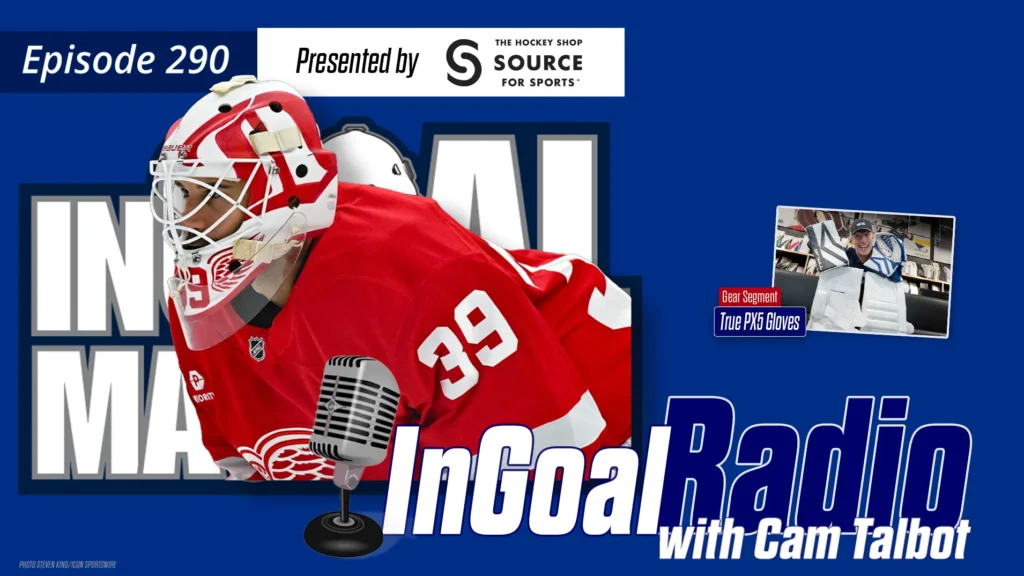
InGoal Radio Episode 290 with Cam Talbot of the Detroit Red Wings

Please subscribe and leave a rating — it helps us reach more goalies!


In Episode 290 of InGoal Radio, Detroit Red Wings goaltender Cam Talbot explains how working with four different goalie coaches over four seasons helped him identify which techniques truly stuck in his game. Talbot credits daily Vizual Edge vision training with contributing to two NHL All-Star Game appearances in three seasons, and details how he uses it specifically during the regular season.
- Cam Talbot describes how adapting to multiple goalie coaches across four teams helped him filter and retain only the ideas that genuinely improved his game.
- Talbot credits daily Vizual Edge vision training as a key factor behind two NHL All-Star Game appearances in the past three seasons.
- Knowing shooter handedness is critical for penalty killers, and a strong lateral push technique is essential when defending a backdoor one-timer option.
- Goalie parents should find a clear boundary between the coaching role and the parenting role to avoid putting undue pressure on their child.
- True Catalyst PX5 gloves and blocker feature the new Opti-Angle design, highlighted in the latest Hockey Shop Source for Sports gear segment.
Episode 290 of the InGoal Radio Podcast, presented by The Hockey Shop Source for Sports, features 12-year NHL veteran Cam Talbot of the Detroit Red Wings.
Feature Interview
presented by NHL Sense Arena
In the feature interview presented by NHL Sense Arena, Talbot shares great advice and insights into working with new voices and incorporating new ideas when you work with a new goalie coach, something he’s done a lot with four different teams over the past four seasons. He explains what ideas have stuck and remained a part of his game now during a great starts with the Red Wings, and how his work with Vizual Edge has led to two NHL All Star Game appearances in the past three seasons, as well as how he uses it daily during the season and how specifically it has helped.
Parent Segment
presented by Stop It Goaltending U
In the Parent Segment, presented by Stop It Goaltending U the App, we dig a little deeper into finding the right balance when you are trying to be both a goalie coach and parent to your child.
Pro Reads
presented by Vizual EdgeWe also review this week’s Pro Reads, presented by Vizual Edge, which also appropriately features Talbot and a breakdown on the importance of knowing handedness while killing penalties, as well as the keys to a good lateral push when that includes a one-time option on the backdoor.
Weekly Gear Segment
presented by The Hockey Shop Source for SportsAnd in our weekly gear segment, we go to The Hockey Shop Source for Sports for a look at the new True Catalyst PX5 gloves and blocker, featuring the all new Opti-Angle.
Episode Transcript
Intro
It's actually hilarious. I always count from three down before we start recording and do the intro for InGoal Radio, the podcast presented by the Hockey Shop Source for Sports Langley, the hockeyshop.com. Always mention the sponsor. We love you guys over at the Hockey Shop. But every time I start counting three, two, one of the two, David Hutchison or Kevin Woodley has something to say.
And it's usually Hutch. Like, Hutch, today you started mumbling or doing something. Right as I said, like, two one. And I'm like, do I stop or do I keep going? I thought, no.
I'm gonna keep going and I'm gonna call you out. Doing it.
I don't even know what you're doing.
Up, but you were mumbling something.
I was probably talking to myself like I do half the day. Working alone in the home office. Three
quarters of the time, it's one of us asking, does everybody
hit record too? Yep. Did you hear it?
That's probably what it was.
Woody, did you hear mumbling and do doing whatever? Oh, I did.
I did. I I did my bad Frangley response that I am also recording.
No. There was something else beyond that. Like, you had you had one more thought that you wanted to get in before we started recording.
I no. It's probably the voices in my head, I promise. Or your head, Daren.
Rattling around in there. Yep. Maybe we're all excited about
Hey. Let's be honest. Everybody's just impressed it wasn't me.
Yeah. We didn't even
go there, did we? Well, we wouldn't have started the show yet. You'd still be talking.
You know, I think most people would have thought that it would be you, Woody. That's right. One more thing. One more thought before we get going. I have a new I have a new phrase, save it for the show.
And we were just talking about a potential conversation for this episode. And Woody was doing his research on the fly and, like, save it for the show.
Otherwise, we end up it turns into a, like, a four hour recording.
Well, that's fun.
Because we're we're just hanging out, which we love to do. Hang out. We got the Four Nations face off right around the corner. You guys okay? I'm gonna put you on the spot here.
But can you pick the starting goaltenders for each team in their opening games? You okay to do this exercise?
Sure.
This is topical, and it's not controversial, but it's fun. And I think there's a couple of the teams. There's legitimate options there where I don't think the coaching staffs right now have firmly made a commitment as the teams get ready to arrive in Montreal for the the tournament openers.
Well, that's gonna be a problem for me because I'm supposed to do a breakdown on the starting goalies for nhl.com. So if the coaches don't know, my best guess is probably not gonna help.
Knows who's gonna start game number one right now?
I think there's a good I think there's a good chance that three of the four do. I really don't. I have no clue about my home country, to be honest.
So that's a no. They don't know.
I bet they do. I bet they do.
K. So who who would you pick, Hutch, as the four starting goaltenders in the tournament openers? It's Sweden, Canada, Finland, Team USA.
Oh, I think we should just do a draft and then we should leave Hutch with the hardest choice.
Oh, we could do that. Yeah.
Because I hope I'll take the because you'll go I'll take the easy one. The Americans are starting Hellebuyck. That one, I'm pretty confident on. That'll be the first breakdown I do.
Okay. So we're all Hellebuyck for Team USA?
Yes.
Yeah. For sure.
It worried me that Hutch had a little bit of a pause there.
No. The only blip was you started asking me the question, who would I start? And I think there's a chance, especially Mr advanced stats over there with the hood on right now, might come up with a different answer than who the coaches would start.
For Team USA?
In any case, like, the whole the whole debate. Like, there's a difference between who you, the individual, would start versus who you think the coaches will start. I don't necessarily mean Team USA. I just you asked why I hesitated. It's because of the whole conversation.
Maybe. But the the that one, I think, is pretty straightforward. Despite the fact that Jake Oettinger and Jeremy Swayman, even though neither statistically are in that same stratosphere right now, are incredibly talented goaltenders with proof of concept in the playoffs. I think that just what Helly's done over the last two years can't be ignored.
We should clarify the parameters then because Hutch has somehow wiggled this out into giving himself options and being able to throw two names in there, who I would start and who he he thinks they'll start.
I always sit on the fence, but no. That wasn't you that's not the point.
That's that was brilliant of you to manage to leave yourself a little bit of wiggle room.
I think I know what that sound was he was making when you were counting three two one. It was the sense
of He was climbing on the fence.
It was hurting because he was sit sitting on it so hard. It hurt
butt. Boost up here. Alright. Who do you think will start for the respective nations at the Four Nations?
Thank you for clarifying the question. As a onetime research guy, that is important.
We all believe Connor Hellebuyck will start for team USA. For team Finland, who do we believe will be the starter? Woody.
Juuse Saros. I had to get it in before Woody or I might not have been able to talk for a while.
I'm gonna I'm gonna agree on that one. And I know he hasn't had the year that a lot of people expect from him, but his adjusted numbers, still despite a really tough environment at times in Nashville are better than the other two finish options right now. Ukko-Pekka Luukkonen and Kevin Lankinen, and he's had a hell of a season here in Vancouver, but it's still Juuse Saros' crease in my mind.
Who do you think the Fins would use as their backup?
That's that might be the better question.
It's an excellent question.
You got a style style difference too. Right? You got a very there's a very unique style difference between Lankinen and UPL. There's a difference between Saros and UPL. Right?
Size and style for both of those guys. So I've heard some things from people with connections to the Finnish team that they think it would be Ukko-Pekka Luukkonen and that he may even be an option to start. But let's just say when I do my pre scout based on who I expect to start game one, it'll be U. Saros. Sweden.
Jake Markstrom is not available to play. Samuel Montembeault has been named to the team, and that gives you maybe a little more options for going down a different path, Hutch.
What? Are we assuming because Linus Ullmark played this week for the Ottawa Senators as he's back and healthy and a part of the four nations?
Ullmark's played one game. You're right. And he and he was good.
Since since December?
I'm going to go with Gustafsson. I believe Sweden will start Gustafsson because of Ullmark's lack of playing time.
Well, then then I won't sit on the fence, and I will say I believe they will start Linus Ullmark because of his past performances. And I think coaches often rely on that.
Oh, deciding vote.
Go Woody.
I'm like the JD Vance of this thing up here. American political reference from a Canadian. You didn't expect that one, did you? I will go with you know what? I'm the I'm the math geek.
I'm gonna go with Filip Gustavsson because the numbers in a very marginal way tipped towards him. The interesting thing is, like, this is gonna be a really tough decision for them. It's gonna be a really tough decision for me in terms of who I do a breakdown on because Gus, if since form has fallen a little bit, and he's out of the top 10 and adjusted save percentage after being in the top five for much of the year. So there's a bit of a a recent slip in his play. Ullmark was rocket ship to the moon before he got hurt in terms of his performances, but he's played once since December 22.
And I I wonder, you know, how much faith they'll have in in in sort of, you know, that that that rust that may be on his game a little bit. So I'm gonna go with Gustafson. The numbers say Gustafson by a hair. I'm with Hutch that coaches tend to look at other things, but I'm gonna go with Filip Gustavsson.
I just purely went with the lack of
playing as Well, I'll be watching Sweden's first game because I would like to win.
For Team Canada, Hutch, we go back to you. Yeah.
Isn't this the tough one? So I have no good rationale other than I think coaches still go back to what happened in the past even if he may have struggled a little more recently. So I'm going Adin Hill.
I'm with you. I Adin Hill starts the opener.
Thank you. There will be no arguments for me.
Well, that was a very controversial bit we just did, those selections.
It's interesting that the one that we thought would be the hardest to pick was the one we all agreed on. I think statistically, overall in the season, Adin's got the best numbers of all three, followed by Montembeault, and then Jordan Binnington's been a top 10 goalie for the last five years, but not this year. He's forty fifth in adjusted save percentage. And I think the one thing that might concern fans of Canada, is since January 1, so over the past month, none of those guys having a a say a save percentage that is
They've all hit flat spots.
Yeah. They've all kinda the wheels have wobbled.
They're due. They're due.
Yeah. It's it's been tough. Like, Canada Canada's three guys. And, hey, listen, like, not alone since January and this is the thing. Like, we talked about how everyone's
doing a rabbit hole, Hutch. He's he's gone. He's he's dough right in.
Love it. Here we go, Woody. Start wait. Wait. Let me let me just get my stopwatch here, Woody.
Well, I I actually wish I'd I hadn't given something away to you guys earlier. Maybe I should have saved it for the show as Daren suggests because I wonder how many of our listeners could tell us how many goalies in the Four Nations are in the top 10 in adjusted save percentage in the National Hockey League right now.
As presented by Clearsight Analytics because everybody else is probably now checking their publicly available stats. And then I
don't know how different it would be any other year.
Right. Just because they are that early.
And there's and there's no and there's only four four teams. Like, we're we've we've excluded Russia from this tournament. Cechia is not in it. Like, there's there's limited options.
Fair. Fair.
I I still think people would be a little surprised to know that not a single one of the goalies taking part in the Four Nations is in the top 10 in
adjusting for percentage in the end. Are eligible to play?
Which three of them are Canadian, Daren. There's three. We have a couple of Americans. Although one is just coming off an injury in Anthony Stolarz. We have Dustin Wolf.
We have three Russians, Igor Shesterkin, Ilya Sorokin, and this may surprise some people, but Pyotr Kochetkov from Carolina has really risen up the ranks. And then we have Karel Vejmelka. So, obviously, his team's not in it. And the other one is is, you know, we talk about how good Omar has been when he's been healthy. Leevi Meriläinen has been exceptional for Ottawa.
He's actually in the defense. Way smaller sample of
top 10 are not even eligible to play in the tournament.
Yeah. But if you're Canadian and if you're Canadian and there's three guys in the top 10 after we've been hammering on Canadian goaltending and, oh, none of them happen to be on the roster right now, that's a little disheartening. And I think, you know, it's funny as much as we looked at how maybe the Canadian goaltenders over the since January 1 haven't performed and what is you know, is it alarming that they're all under expected, you know, basically playing below league average? Connor Hellebuyck has dropped significantly since the calendar change to 25, at least from a statistical perspective with the Winnipeg jets. He's well under expected since
Who are the three Canadian goalies?
Interesting times. Where are the three Canadian goalies?
Canadian goalies.
Oh, sorry. Logan Thompson, who is, as we've said last week, having an exceptional season. Darcy Kuemper, who's got a Stanley Cup. And the third one is Mackenzie Blackwood, who is rising fast with the Colorado Avalanche, playing behind a team that has couple of guys who are gonna be a part of this tournament.
I understand the excitement about Logan Thompson because the numbers are great, but it's been a fabulous first half that to me doesn't earn you a spot on team Canada. Kemper and Blackwood, more body work. And I know Blackwood was in the conversation during the summer, but there was concern, like, what would he be like on a really good team? Because he's he hasn't played on really good teams in the National Hockey League.
Right.
Is his first chance. He's been good with with Colorado.
Yep. I think what you're saying, Daren, makes sense in justifying the selections that were made at the time. And while I appreciate you saying that maybe half a year doesn't earn you a spot on team Canada, Honestly, at this point, if you could pick it today for a tournament about to start, you you'd still stick to the guns that are there? You wouldn't take Thompson?
I I would go Blackwood. Yeah.
I just think The I just think, like, you wouldn't pick based on somebody playing really well the last two weeks, but if they're hot for the whole season to this point and the tournament's about to happen and it's a short tournament, I think you go with the hot hands. But, of course, they don't have that luxury.
Right. And the and the argument with Canada is, like, it's not like, I don't even know this is I don't know if this is this isn't an Adin Hill argument. I don't even know if it's a Jordan Binnington argument.
No. No. No. I wasn't being personal there.
It's probably more of a and it's not even personal. It's more of a Sam Montembeault, like, who they pick for the three. Right? You know, like
Well, for me, I was just
purely track record of success there.
Yeah. I wasn't even looking at any of those three. It was purely just the question of whether you would take somebody based on half a year's body of work because Daren brought that up, and I thought that was an interesting way of looking at it.
And I still wouldn't. Yeah. Okay. Now next year, if this continues, he's on my team. Oh, he's He's on my team.
Yeah. He's he's he's in the mix for the Olympics if he keeps us up. It'll be hard to ignore. Like, it'd be If this season ends as well as it's gone so far at a, like I said, a a Vezina Trophy type level, it'll be hard to ignore this time next year.
Ilya Sorokin's having a a great season. For for a player that's not going to be in this tournament, he is lighting it up right now for the New York Islanders and not getting a lot of attention. We know that there's been some injuries there that's forced him to play a little bit more, and he has embraced that woody.
Yeah. He's, he's sizzling. You know, since January 1, the only guy with better numbers than him, speaking of sizzling, but in a much smaller sample is Spencer Knight of the Florida panthers. Nice to see him coming on. He has been Sorokin's been unreal.
Even, you know, since January 1, Logan Thompson is up there. Darcy Kuemper's up there. Charlie Lindgren's up there in terms of top numbers. Friend of the program, friend of ProReads, Alex Lyon. We had him up on ProReads recently.
He's up there. You know, it's it's interesting to sorta look at who's hot and who's not over the past month. Very few as hotter or hotter than Ilya Sorokin. And another guy who I this is sound gonna sound weird, but I had him in that top 10 list, and I feel like he's being overlooked this year. And he's he became the highest paid goaltender in the NHL this year, so maybe that doesn't make sense.
But I almost feel like we've forgotten how good Igor Shesterkin is because he's having a hell of a season as well.
Alexander Ovechkin's on a tear. I want you to think about this for down the road. Alright?
I was told there'd be no math and no thing.
There's no math on this.
Says the guy who pulls out all the numbers. You're so funny.
But as as we approach Ovechkin setting the all time goals record, how much do guys fear being that goaltender in net or that moment.
Should ask Kirk Mclean, you will give him see him because he's the guy he's the guy for the grads.
There's there's all kinds Hirsch and the postage stamp. I mean, there's a lot of those.
Yeah. Yeah. But there's there's infamy there, and
I'd take it. You're not you're
not allowing a a bad moment. Like, you're you're part of an one of the greatest moments in NHL history.
As long as he doesn't score it from center ice, I'd be happy to have my name as I'd be proud to have my name associated with that goal. But
But better better question for you guys. What if it's an empty net? Is is the goalie's bear down and it gets harder and harder? What happens if it's an empty net?
I don't care.
Does he does does he bury it, or does he just say, want this to be on a goalie and pass
He buries it
wants he wants this thing constant. I
don't blame him. He's been so good. It's yeah. No. It's I think goalies for sure, Daren, are not gonna want to be I mean, I don't know that you Oh.
What are they? A 180 plus of them that he scored on over his career? Like, there's nothing to change. That's for sure.
But are you Right.
Oh, nobody wants to allow the one that's gonna be on highlight reels for ever
group? Because I I disagree.
Of course. Of course, he's he's
Of course, you bear down and the last thing you want us to be scored on, you're gonna do everything you can to prevent it. But at the end of the day, if I'm on the highlight reels given that goal up, it's an honor. It's okay.
Puck goes into here like, oh crap. It's be everywhere forever.
Yeah. I don't I like, there's no shame in it. He's there's a reason he's gotten to where he's gotten. So but, yeah, I think guys are gonna bear down a little bit and not wanna be on that on that front.
Coaches will adjust their assignments for their goaltenders at all.
Here's the thing. None of it matters. Like, none of it matters. You can bear down all you want. We've known where he shoots from on the power play Yeah.
Since he came into the freaking league. Nobody can do anything about it. Nobody can stop it. It still goes in in part because it curves. We've had that conversation before how the toe hook actually makes it like a a breaking ball that goes down and away from your blocker and around your glove when you think it's going wide.
I've had goalies tell me that. Ryan Miller, Braden Holtby, the guys that played with and against him for many years. It doesn't matter if you wanna bear down, if you know it's coming, if the coaches know it's coming. Because we've all known it's coming for so long, and it still goes in. It's remarkable.
Throw it out there. Send us your comments. Love to hear from all of our listeners about if you were the goaltender playing the game where he could set the record. Are you nervous about being the guy that lets it in, or you're like, if it goes in, a part of history. Love to hear from you.
Gear
Here we are in the InGoal Radio Podcast presented by the Hockey Shop Source for Sports Langley, the hockeyshop.com. Our Gear Segment focusing on the True PX 5 gloves as we check-in with everybody over at the hockey shop. What's happening? You guys were over there yesterday.
We had a nice visit with Cam. We spent the morning over there yesterday. It's always great to get on the ferry early, hang out with Woody a little bit, and pick Cam's brain. Goalie gossip.
And lots going on. Busy, busy, busy store. Staff clearing out old stuff to make room for the new stuff. We're into that time of year, the sort of excitement percolates for new lines, new launches, new equipment, and you know that means sales on the old equipment. They gotta make room at the store.
So make sure you check it out. There's still bargains to be had leftover even even dating back for boxing day and Black Friday. There are because they're such a big store, because they stock so much, it means that it takes them a while to sell through on the sale item. So make sure you check it out. There's still great deals to be had as well as as we'll see another example of this week, last week continuation, the True PX 5, the Catalyst line, new equipment coming all the time.
So it's a busy time at the hockey shop. Feels like it's always a busy time at the Hockey Shop Source for Sports, but for the goalie world right now in particular, and it makes it a great time to check them out at the hockeyshop.com.
Welcome back to the Hockey Shop Source for Sports where we are talking about the new true Catalyst PX5 line today with Cam Matwiv in Goalie Utopia. Let's talk about gloves really quick. Not a whole lot has changed here. Again, the glove itself is gonna stay the same as what you've seen in previous true models. What has changed, that same finger rail that we found in the PX 4 where this does open up a little bit more, you can kinda create a little bit better drying, I guess you can call it.
Some of you saw in the PX 4, not in the PX 3, so that's transferred over to the PX 5. Other than that, it's your angles that change the glove. 590, 600. What stock? 580.
I mean, there for PX5, there isn't technically a stock. So they didn't just pick one that you they were basically giving you obviously, on a customizer, you always have the choice, but you're you're stocking all different brakes in store That's great. In the PX5. Exactly. Even 600.
Personal favorite, Cam?
I'm more of a five ninety kind of guy.
Okay. There we go.
And pro palms. I mean, I noticed it was a little bit stiff to close, but that's because it's a pro palm. Guys are breaking that out. Alright. Blocker.
Blocker. Blocker. Blocker.
This is
the big change. Here we go. Here we go. Big change. This Opti Angle.
Don't have to yell. That's exciting. You are excited. I know. Pushes your hand out forward.
All the blockers we ordered don't have it. No. But if you're gonna do custom, it's talk to Cam and you can order. So the idea is they put a wedge almost and and maybe an oversimplification on my part. Been calling it a wedge.
It basically helps create a little bit forward angle and a little bit of a turned angle. Correct. To optimize your angle towards the shooter. Okay. And so that's new this year.
Available in the PX 5. You don't have it in stock, but you can do it in custom orders. Thanks to True. Interesting. They're doing great.
Would probably prevent pucks. I'm curious because it is new. And we did talk about Joey Daccord switching out of a true blocker into a Bauer blocker this year. And one of the things that I learned about that switch was not having an option at the time to prevent pucks from sort of hitting the top of the board on his older true one and riding up and over, this would kick it forward and help eliminate that. So I'm I'm I don't know.
I'm curious if that was a solution they were working on for him that ultimately because this is this is this is what you want. Right? You want feedback from pros that ultimately ends up at retail, and it sounds like Opti Angle at least has the potential to be something like that. I you guys hear it here. You heard it here.
I don't like I said, I don't know. I don't know if that's the case. But as I heard about it and remembered that conversation with Joey, it kinda reminded me that, hey. Like, that would solve the problem that he had. Unfortunately, it's time to bring story time with Kevin to an end.
So we're gonna wrap up our segment here. But that said,
Catalyst PX five
Yes. From true. New pads, stiffer profile, new Diamond Glide, slides better. Catalyst PX five blocker glove, including Opti Angle available. If you've got questions, call Cam and his crew here at The Hockey Shop for ordering to see what they have in stock, different colors, different breaks, and the gloves we talked about.
Where do they get ahold of you? Six zero four five eight nine eight two nine nine or 180567790. That's what the, you know, the thing pops up. The thing.
Yeah. That's the number.
Anything jump out at you about the p x five catalyst gloves?
Well, we talked a little
bit about the blocker and the Opti angle. And as much as I I it's funny. I felt a little skeptical of it at first because I I didn't realize what it was. And once it was explained to me, the idea of sort of having something a pad between your hand and the blocker just to help change the angle a little bit. We've seen others do this.
I think Warrior's had something similar that they've run-in the past. I think it used to be a pad, and now it's built in. Just it is it is a good idea. It's not a bad not a bad thing to
sort of I honestly thought most companies were already doing that.
The way they're doing it is a little different here.
Okay.
And and that's what, you know, like, so important to recognize that. You know, like I said, there there are some companies that have similar things. I talked a little bit in the video there. And reminder folks, we didn't have the video last week for the PX five cause we had technical difficulties. If you go to our YouTube now, you will get the combo.
The pads are up and the gloves follow. So we split the pads and the gloves in terms of talking about them, but we'll have one video up at YouTube. So you can go check it out and see what we're talking about a little bit on there. Yeah. And and the the the downside, Daren, was didn't have one to try in store.
Not everyone on the retail side was made aware that this was gonna be an exciting new feature, so not everyone ordered it. And you can custom order it, but we didn't have a chance to try it there. You know, the one thing that, you know, and I think you've experienced this too, the the new gloves, off the rack, they've got Pro Palms in them. Like, Cam's ordered Pro Palms for their true line, their their highest end line, including the Catalyst PX five. And it's it's it's stiff.
Like, it's, you know, it's like you you feel like you're doing one of those grip tests on Instagram trying to close it out of the box. So I think it's good to let people know when they go in store and grab it off the rack, and it is a little harder to close. Like, there's a break in process there. That's a pro palm. It's gonna take a little longer, but as you see right up to the NHL, like, guys love them once they are broken in, and that's sort of what you hear.
Yeah. It takes a little bit. It's kinda like the old days. You gotta do a little work to break it in, but once you get it there, you know, there's a reason it's such a popular glove.
What's the method to breaking in a modern glove like that?
Oh, it's well, you see it. What are guys doing in the locker rooms? We used to have Carey Price use to
put I skate was about to say. Definitely.
Like sticking your hand in a hot stick of butter.
Yeah. I think it was a hot wolf of butter. That's what it made it
really That's what Carey said.
Yeah. It was good. But, yeah, definitely, if you have access to a skate oven, use it before every skate and play a lot.
Don't put it in your oven oven.
May have done that. I've done it. I've just done like the skates. As long as it's on the lowest lowest setting And
Can put it on
a I was putting a pan with one of those silicone sheets. But we are not encouraging anybody out there to try that. Nope. Do not do it. Do we're just telling you
what we did. We've just done it. Yep.
Yeah. InGoal Magazine says do not put it in the oven because we do not want. We are not paying for the one when you crank it up to four fifty because you think it's like your tater tots. You need them crisp.
That's right. Yeah. But they are heat moldable, most gloves these days, and it still helps with that break in process. So
I do the, I don't know about you guys, but I do the, like, wrap it closed with a pucker or ball in there one day, and then usually butt end of a stick to open it up wide the next day. So, like, have it one day where it's fully extended open, one day where
it's fully
extended closed.
I use chopsticks for that.
Chopsticks. That's an interesting one. I I we I've got a butt end on an old player stick that just fits in there perfectly for most most models of gloves.
Yeah. I I rotate between wrapping it closed and having it wide open. I think that's my there. Yeah. But it's still like Takes time.
Choose our stick.
Takes time.
Yeah. Yeah. No. And I think that's but like, again, like, that's that's sort of p that's our PSA for the day, our public service announcement.
Do not judge your gloves.
You're in the store and
Early.
Yeah. Don't judge it. Yeah. Don't judge it based on it being a little tough to close early. That one's gonna break in beautifully.
Parent Playbook
Don't judge. The parent segment brought to you by Stop It Goaltending U, the app. All kinds of advice in this area of our podcast. What's happening over at Stop It Goaltending U?
We always tell you about Stop It Goaltending U, the app, and how they have fresh content every week, and they divide it into three unique segments. There is the daily primers, quick hits, one minute videos. This this week right now, we're towards the end of it here, they focused on creating consistency. So five quick one minute videos you can watch every morning to help you become a more consistent goaltender. Their quick video, their five minute video for the week, Kelly Hogarth from Merrimack going over overlap.
How to use it? When to use it? Technical, tactical, and then their full goalie system breakdown, their twenty minute breakdown is an RVH comparison. How different goalies at different levels and then up to the National Hockey League, including video demonstrating it, use and execute their reverse VH or RVH. So just another great example of how Stop It Goaltending U, the app, gives you new content weekly, and you can digest it in small bits daily or deep dive and go back through the archives and basically lose a whole weekend trying to become a better goaltender.
There's twenty five years of goalie coaching experience built into this app, and you could probably spend twenty five years going through it all. But I love the way they do it for daily quick hits. You can digest it at your speed when you need it. It'll help you become a better goaltender much like ingoalmag.com. InGoal premium will help you become a better goaltender.
And when you buy a subscription to Stop It Goaltending U, the app, you get a subscription to InGoalmag premium, the best of both in the goalie world combined through your membership, through your subscription to Stop It Goaltending U, the app.
I become a big overlap guy. I just love it.
Where were you all my life?
Yeah. Yeah. And it took me a long time to really figure out how to use it properly instead of just sliding over more. But it's given me confidence in certain place to slide through.
Okay. So what place are you using overlap, Daren? Let's have it. Let's dig in.
I use it as almost a replacement for the RVH.
On dead angles.
Yeah. Yeah. On that side. I try not to
Both sides or just or do you like it more on one side than the other?
I definitely use it more on the glove side, but I consciously try to encourage myself to get into it on on the on the blocker.
Interesting. I I find myself tending into it more on the glove side too. I wonder if there's a
I don't Probably It might be a lack of confidence in my glove. To be to be quite honest. Like, that might be totally it.
It's totally fair. They call me Dan Blackburn out there because it's like I have two blockers on, so that would apply for me too, buddy.
I wanna use two sticks and two blockers.
See if I can That would be fun.
We have dominant Edward Scissor hands.
We have dominant legs just like we have dominant hands, so it would make sense that you would feel more comfortable going into RVH on one side versus the other and hence why you might choose overlap on maybe the opposite side. Just a crazy thought.
I hadn't thought of that. Nice. I've only got one leg that works. I'm pretty sure that's my dominant leg. There
you go.
What's happening with the parent segment?
Well, I've had a few questions again about, being a goalie coach to your child. And, look, maybe it was just because of the USA hockey, symposium or at least the coaching course and having taken the Canadian one. And then these questions about being a coach and parent and, not to get too philosophical, but into my head pop the phrase goaltending is a metaphor for life. Or at least the way the coach athlete relationship evolves kind of mirrors the journey of a parent and a child in in any quick case in life. So first I want to say, if you are considering coaching, even if you just want to volunteer because your child is new to the game, I would like to encourage everybody to take that step.
You don't have to have played the game yourself. Just as we all began parenting without any experience boys, you can begin coaching the same way. You learn, you adapt, you grow with your child, and of course, we end up with this cool experience and bond with our kids that we wouldn't trade for anything. There are lots of great resources available. As I was mentioning, having taken that Hockey Canada, course and then having taken the USA hockey course, what stands out in both cases is that there were a lot of parents taking the class along with us and wanting to be able to help out their kids.
And I think that's a great role of that program. We were also, as I said, all new parents one time and made some mistakes and we learned and we raised our kids that we're proud of regardless. And I think coaching can be that same kind of journey for you. In the early years when your kids are just taking their first strides on the ice, you're, I would argue, the most influential person in their development as a goalie, obviously, as you are as a parent with a young child. But as they grow, your role has to evolve.
And being a goalie parent and coach means finding the right balance. You've got to support their growth without overshadowing their independence. Personally, I think I've said it on here before, I didn't ever wanna jeopardize my relationship as a parent with my child. So I probably pushed less than others might have. And there were times I know my kid got frustrated that I wasn't more hands on and I let him work out some things on his own.
Another theme that popped into that USA hockey coaching course was not dictating too much to the kids out there. So maybe I was doing something right. But looking back, I think what I did made him a better goalie. He became independent. He did value coach feedback, but he also really liked working on his own and and still does.
If I'd been that overbearing taskmaster trying to control every bit of his development or every bit of every drill, he wouldn't turn out to be as self sufficient and confident, as he is today. So parents, don't stress about pushing too hard out there. Your role as a goalie coach is gonna last for a couple of years, but your role as a parent is gonna last for a lifetime. Some of us have the experience to remain as a coach for a lot of years, or maybe we choose to continue longer because we commit to that learning and development along with our child. And it's totally possible.
Lots of great coaches have climbed the ranks without much of a goaltending background. On the other hand, maybe you just might choose to help out for a few years, in which case that's fantastic as well. However, however long you choose to go, that parent coach relationship faces a transition at some point. Just like we prepare our kids to go off to school and learn from experienced teachers, we also have to prepare for them to learn from other coaches. That moment comes at different times for everybody, as I said.
Maybe it's just a few seasons for that volunteer parent at the u eight level or later on maybe as a teenager for us that came at, the u 18 level. It was admittedly hard for me to make that change, not unlike dropping our kid off at school for the first time. It came earlier than maybe I'd hoped, but at the same time, I was really excited for my kid to have that new experience of working with a different team coach. You know, throughout their childhood as parents, guys, we work to expose our kids to all sorts of different experiences. Take them to skating lessons, they go to preschool, maybe dance classes.
There's all sorts of different social and skill development opportunities. And those are not all about just giving parents a break. They're there because we want to help our children develop skills and develop independence. And parenting, of course, is about preparing our kids to leave the nest and thrive. Maybe not easy for us, but it is a sign of parental success when they do that.
And I think that applies to goaltending as well. From an early age, I made my sure my son worked with all sorts of different goalie coaches. He was exposed to different perspectives. He learned about himself as a goaltender from other people. Playing other sports also played a role in shaping that development.
And all of it built a strong foundation so that when the time came, he was ready to move forward on his own. As he grew older, for us working together, that relationship evolved. I didn't have all the answers as he got much better and learned a lot of things from a lot of other people. Other people taught him things I couldn't. But we worked together, we discussed ideas, we learned from each other, and it was a pretty cool experience.
If I'd tried to control too much of as he was growing up or worse, if I'd been his only coach, I think he would have missed out on a lot of those invaluable learning opportunities. No matter how well he may have played at the time, he wouldn't have been prepared to stand on his own going forward. So now he's out of the nest. He works really well with his team goalie coach. He thrives when he's training on his own.
We still talk about goaltending, but now he leads those conversations. And I think that makes him a stronger goalie and a stronger person. But all of it was built on the foundation of the years we spent together on the ice and that relationship we nurtured along the way. So for those of you who are navigating the balance of being both a coach and a parent, I hope those thoughts maybe offer a little bit of perspective. And for those of you who are hesitant to coach your young child, I would encourage you to give it a try.
The unfortunate reality right now is that without you, your kid might not get the support that they need because we know goalie coaching is in short supply. More importantly though, coaching is gonna give you that unique opportunity to build a bond with your son or daughter that's gonna last a lifetime.
Just to jump in on this. I get to watch through being in Vegas. Sean Burke, the director of goaltending for the Golden Knights, not only work with the National Hockey League, but his son Hudson, 11 years old, is a aspiring goaltender. And I've talked to to to Berkey about this because he he's on the ice with with Hudson all
the time.
And Sean's goal is for him to have fun and explore the position. He teaches him a couple of fundamentals, but then allows him to have room to try different things and and isn't turning him into a robot or a blocker or this save selection at 11. It and this is a guy at the highest level of of our our game and and coaching platform in Sean. And I I think that's an amazing lesson that that all of us can take when when we're talking to our goaltenders and not having them so structured.
I'd be interested to have a conversation with Sean and ask him if that philosophy or or if that relationship evolved based on experience. Because, of course, his son Brendan was a goaltender as well. Yeah. And did he take a different approach with Brendan, or did he just learn that something worked well?
I think it was very similar.
I I I agree. I think it sounds like the most healthy way. And as you remember from that USA hockey coaching course, having that ability for goaltenders to figure things out on their own while still learning the fundamentals is really, really important. So if I had it to do all over again, I'd I'd I like to think I did it similarly, but if I had it to do all over again, would certainly wanna take that approach. I do think that goalie coaches get a bad rap for creating robotic goaltenders and too much technique because there are so many other sports where we drill technique into kids from a young age.
And and I don't think that you're quite right. I don't mean you, Daren, but people are quite right when they they jump too much on goalie coaches creating robotic goaltenders. But that's just a just one of those little bugbears, but I'm not gonna get onto my woody high horse here.
Well, no. Interestingly enough, I've seen the same with Ian Clark And his son Blake, who plays locally here in Vancouver for for an academy and and was drafted by WHL team, you know, up until a certain age, just left him to his own devices, was there supportive, worked with other goalie coaches, just didn't try and over structure thing. And and I think it's a matter of sort of knowing when the ages are where you start to add certain things. And I I would encourage anybody that wants to get involved. And we saw this on the USA hockey call.
There were parents on there. Right? It's just a matter of giving yourself a little bit education. So in situations where your kid doesn't have an advocate on the ice, doesn't have anyone to make sure they're not just a target for twenty minutes and standing there freezing cold for the next twenty, to take that course or course like it. You know, we have one in here in Canada as well.
First level course that just to help make sure you're bringing something to the table. Not to, you know, pat our own backs as well, but if you're looking for drills and ideas like, you know, InGoalmag premium's got lots. You know, we just had one last week, on the premium subscription site with the Edmonton Oilers, and it was just a very simple warm up drill to sort of help the kids get moving. And there was no, this is how you should make the save. It was just, you know, a a series of movements that that gets them ready for a game that you could use at any level in terms of, hey, guy here.
We're moving. We're moving our feet. We're getting our hands active. You know, those types of things. There are things we see at the NHL level that aren't about refined technical applications that can just be about going and competing and playing.
Heck, what do we see when the PWHL came into town? Some saw them play in rebound. Right? Like, as a game that just, you know, gets the competitive instincts going as well. So there's lots of different ways to do it, and there's lots of resources out there, including us, to sort of find, you know, new or different elements or just to give you some support in that journey as a parent who wants to add a little goalie coaching to the to the resume and repertoire.
Glad you stood up for the goalie coaches, Hutch, because you're right. They do. They they get they get a bad rap. And for for being too structured. And it's it's not fair because they're doing a great job, and we we need more of them.
And balance balance that out was was great.
Thank you. I watch a tennis player from a young age learning this is how you hit a forehand. You watch a baseball player learning the correct footwork as they're going to pick up a grounder. I mean, the the basics, the fundamentals are really important, and jumping on goalie coaches for teaching those fundamentals is is unfortunate. I think one of the things they addressed in that USA hockey course is that we can't have too many drills that are too predictable.
You know, if you're learning to hit a forehand in tennis, not every ball arrives in exactly the same place. Although there's a lot of repetitive work in it, of course, but we do have to create some unstructured ways for our kids to work. But, I I don't I've not been on the ice with many coaches that are prescribing this is exactly how you must make a glove save and turning them into robots. And I haven't been on the ice with a coach who creates blocking goaltenders. I don't think we've seen that for a very long time, or maybe I'm just lucky with my experience.
I think there's a lot of great coaches out there, and you have to teach those fundamentals so that when they stop thinking or when they're playing in the way we want them to, which is to not be thinking out there, then they have that foundation to rely on. And I think a lot of great coaches out there are doing that now.
Woody, why were you laughing?
Because I'll I'll play devil's advocate. I'm not naming names, but I have seen coaches who are getting paid a lot at a really high level, at the minor level, absolutely turn kids inside out by doing a lot of things that, right down to how you hold your glove and and things like that. So, there are there there's two sides of every coin, and it's not painting them all with the same brush, but I I've definitely I've heck, I've seen goalie coaches turn junior kids inside out with overcoaching. So it's it's there's not a one size fits all approach. There are more than not that are doing exceptional things.
It's just a matter of finding them.
What I think turns kids inside out is an unfortunate habit of a lot of goaltending coaches and perhaps other sports as well, is every single shot that goes in finding a reason that it went in. And I know it's trying to be helpful, but it creates this overthinking environment. If only you'd done this, if only you'd done that, there you should have done this. And the the two problems with that is that, one, as I said, it makes you overthink, and two, it creates no focus in any practice. I I think it's in this week's feature interview, in fact, we hear, Cam Talbot talking about going out into practice with just a couple of focuses for that day.
And a lot of young coaches, especially, feeling they have to help all the time, end up creating this practice where the kid's thinking in a thousand different directions and overthinking every single thing they do.
K. Let's focus. ProReads presented by Vizual Edge.
We got a nice little tie in here. I feel like the Vizual Edge reads is just the feature interview. It's just the ProReads for this week because Cam Talbot is not only our feature guest on the podcast. He is our ProReads feature guest this week at ingoalmag.com, and he is a Visual Edge user as you are gonna hear in our feature interview. And in some of his other ProReads, there are saves he makes in ProReads.
We get into some traffic stuff later, not this week. We get into some traffic stuff later where, yeah, that in his mind is a visual edge save. He started using the program four years ago. He is twelve years into his NHL career. He's been an NHL All Star Game participant twice in there in the last three years, and he sees a direct link between those two things.
His use of visual edge, his focus on his eyes, the way he gets ready for games using visual edge, using the glasses, using the program rather than juggling balls, he sees direct correlation between some of the results. He finds pucks faster. He sees pucks better. He finds them through traffic, through screens. So it's really fascinating to have that conversation.
And now we've had the discounts. You get the public one. Use the code InGoal. We've got the private one. For anyone that doesn't know, go read a ProReads in the private code.
That means you're an InGoal member if you can read one of our ProReads. And all the new ones have the private code embedded in there so you can see it, so you can save even more money. And now they've changed the way they offer their program at Vizual Edge. No longer do you need to commit to a minimum of two months or six months or a year. You can go monthly like a subscription.
So test it out for a couple of months. And if you, Cam Talbot, start to see the results, we think that you, Cam Talbot, will continue to use it. So a new and exciting way to get access to Vizual Edge and give it a try without having to commit to it long term. I think once you hear or see Cam Talbot talking ProReads or hear him talking on the podcast, you'll understand why.
Before we get to the feature interview, just what's the angle on ProReads?
Cam leads us into his first ProReads or actually, it's not his first because we did do three with him back when he was with with the Minnesota Wild. So his fourth overall, but his first one, in this new segment with the Detroit Red Wings. We get into sort of the importance of handedness awareness on the power play. He's facing Sidney Crosby, of Evgeni Malkin, Erik Karlsson, and the Pittsburgh Penguins power play, and recognizing early which hand each shooter is and how that allows him to proceed in terms of choosing his depth, choosing his save selections, knowing what threats are one timers and not. So he walks us through that, and then he gets into how he pushes across on a backdoor chance, this particular backdoor chance.
The importance of how he leads the push with vision. Now so, again, kinda ties into Visual Edge, how you lead your lateral pushes with vision and with your head and how that creates rotation, something you hear him talk about working more in his game since he arrived in Detroit, leads to better rotation, which allows him to arrive more square, which gives him a better chance to make an incredible save at the end of this week's ProReads.
There's no tool better than ProReads for for a goaltender to be able to dive into things. It just it's unique.
How far has the game come? I grew up. I played all the way to a very tiny cup of coffee in university. Nobody ever explained why handedness mattered to me. Yeah.
And, I mean, there wasn't a whole lot of goalie coaching at the time anyway, but, I love every time. For for whatever reason, I remember growing up thinking this has to matter, but nobody's explained it to me. And, now as an adult, I love being able to watch those ProReads and learn from the guys.
Yeah. But back when the dinosaurs roamed the earth, were they allowed to take one timers hatch?
Well, they were definitely just using old fur sticks they'd ripped off a tree at the time.
So Those T rexes had a wicked back end.
Which was incredible because they have the short little arms.
Just like me. Just like me.
Feature Interview - Cam Talbot
And small hands. Okay. Our feature interview brought to by NHL Sense Arena is Cam Talbot. This is is just eavesdropping. And on a National Hockey goaltender having a regular conversation.
That that's the best way I can put it with how comfortable Cam is in this conversation brought to us by NHL Sense Arena.
Yeah, Daren. As parents, as I've already mentioned, we're always looking ways to help our kids succeed, especially in a position as demanding as goaltending, and that is why NHL Sense Arena is such a game changer. It's not just another training tool. It's real goalie development in a virtual environment. Your young goalie can sharpen their tracking, their decision making, their puck reading skills, all without the wear and tear of extra ice time and without the added cost of expensive extra on ice sessions.
It's so realistic that it's used by NHL teams and top goalies. NHL Sense Arena is designed to build the mental and visual skills that separate great goalies from the rest. It's training that fits into your home, on your schedule, and at your child's pace. Guided in fact by expert coaches if you choose to use one of their many included training programs. So give your goalie every advantage.
Check out NHL Sense Arena today. And remember, use the code I g m 50 at checkout to save even more.
Anything we should be looking for or listening for, in particular today with Cam?
You know what? He did we'd get into a lot of different stuff. We get into the importance, you know, like, how he approaches. This is his fourth team in four years. How he approaches working with new coaches.
There's advice there that I think should resonate with every parent and young goalie that goes through that, you know, whether it's going to a new summer camp or, you know, a new coach, a new goalie coach on a new team at various levels. There's some great advice there. Some of the specifics, I asked him for some specifics that he's taken away from each guy. You know, he started his career with Benoit Allaire. He he, you know, he talked about Bill Ranford's net play system, which, of course, is available to all InGoal subscribers on the InGoal premium site, and how he added that in Los Angeles working with Mike Buckley, added the Bill Ranford net play system, and still uses it to this day in Detroit because he feels it's not only simplified his approach to pucks behind the net, but it's that much easier on his 37 year old body.
So those are just two of the many things we get into in with Cam in this interview. Very gracious with his time. Not only did he he spend a a a long segment talking to me here, but as I mentioned, folks, make sure you check out ProReads. We spent forty minutes going over video after this, so we've got one that's up and much more coming.
Cam Talbot to the NHL Sense Arena feature interview on InGoal Radio, the podcast.
Really excited to welcome back to the InGoal Radio Podcast. It's we've kinda touched base with you a couple minutes here and there. Came in with LA, but we haven't had a good sit down in a while. Cam Talbot now with the Detroit Red Wings, having a great season in Detroit. I guess let's start with you've done this a few times now.
Advice to goalies that are going to a new team. Like, how do you adjust to new teammates, new system in short order so that you can get off to the kind of start you did?
Yeah. You could say I'm getting kind of used to it. It's been fourth team in four years, so it's becoming a little bit more like second nature to me. But, you know, I feel like the biggest thing is every every summer, the biggest thing for me is get to that city as quick as possible. Get to know your teammates.
Get on the ice early with them in the summertime. And, you know, get to know them outside of the ring too. The more that you can get to know everybody and know how people think, you know, see how they play on the ice a little bit before training camp starts. It just eases the whole transition once training camp comes. You don't wanna be that guy that shows up the day before training camp, haven't met anybody yet, and, you know, they wanna meet you too.
They wanna integrate you into the team as quick as possible and and you wanna be integrated as quick as possible. So I think that's one of the biggest things. And obviously, I've been part of a lot of different systems, lot of different teams. For me at this point, it's just, okay, which one am I going back to now? So, obviously, every team plays situations a little bit differently.
So, like I said, the the quicker that you can get there and get acclimated is, the biggest thing.
We've had some guys say, like, there are only so many different systems in the league and, you know, different tweaks. Is it more getting used to what guys do within that system, the personal tendencies, especially defensemen?
Absolutely. I mean, you know, some guys, how they block shots, do they go one knee down, do they leave their feet on two on ones, and, you know, every situation is a little bit different and every guy plays those situations different. So it's getting to know the guys in in front of you and and their tendencies. And again, the quicker you can pick up on those things, the better off we're all gonna be.
Was there a point as you went through this process within like, when did you learn that I need to get there early? Because I think a lot of goalies have their guys in the summer and their routines, and that's important to them too. When like, where how do you balance those two things? And is it still Hamilton for you and the quote unquote dungeon? Is that still part of the off season?
That is still part of the off season. The dungeon is getting less and less time these days, I think, because now that I have kids, I'm getting older, and, you know, I don't need to be on the ice at the beginning of June anymore. So now, like, you know, my timeline gets pushed back, and and, my body only needs so much in the summer now. So, yeah, I still work in the dungeon with, with my goalie coach Pat back home, before I head down to, down to whatever city I'm in that year. But, obviously, with the kids having to start school, you know, sometimes before Labor Day and everything, you know, you're down there second or third week of August these days, and, you know, that gives me a full month in my new city to, again, skate with the guys, meet the new teammates, and and get acclimated before training camp starts.
What about building a new relationship with a new goalie coach? You like you said, you've been doing this for a while, and you've and you have swapped some teams, new voices, a lot of guys have new ideas. I think I think we've asked you this one before, but this is something that a lot of kids go through too. Like, somebody wants me to do something different. At this stage of your career, you know what works for you.
How do you find that balance? Is it important to be a sponge, but also sort of stick to your principles?
Absolutely. I think that, you know, at 37 years old, no one's trying to, you know, overhaul my game at this point. But, like you said, every goalie coach kinda has different philosophies. Maybe they've got a different idea that could improve my game. And, my goalie coach and I back home always talk about, you know, every tool we can add to our toolbox just gives us more options to make saves.
If a new goalie coach wants me to try and work on something throughout the summer, that's what's so great about Pat back home. The first thing he does when I sign a new team goes, I need the goalie coach's number. I need to know what he wants us to work on this summer to get you ready for camp or what he sees in your game. Now we need to clean up or just continue to work on. So, that's one of the best things about him.
There's no ego there. He always wants to know what all these other guys are thinking because ultimately, I'm working with those guys for ten months of the year and Patty for about a month. So, having that relationship between all three of them, is is huge for me.
We need to get him on because I he's picked so many different brains. Right? He's talked to all these different guys and learned all these different things. Yeah. Can you give me an example of one thing that, you know, maybe not change, but a different something you maybe are thinking of in a different way under Westy than anyone before?
Westy is really big on on your rotations and stuff like that. Just rotating back to the puck. You always want head, eyes, head, chest, everything just he wants that that initial rotation after, you know, a a butterfly drop, whether it's a save or not a save. He would just want everything moving in the same direction. And, you know, sometimes in the past, you just kinda react.
And as opposed to Just go. Just go. And, I think one of the biggest things that I've tried to clean up in my game, I think that's working for me a lot lately, is those rotations, you know, rotating, getting right back to the post square or rotating on a lateral and having my chest to the puck as opposed to just opening up and trying to reach with the blocker. So, I think that's one of the biggest things that we've really worked on, and, you you know, it's been helping my game quite a bit.
What's that adjustment been like? Because, like, there's times where you still do just have to go. Right? Anytime you learn something new, there can be a process of where you're thinking about it. Right?
And then you've been through this a few times. How do you get to that point where it becomes innate and you can still go with them play on instincts and the instincts you've developed over all these years having success in the NHL while still adding an a new piece?
Well, that's the thing. Right? It's it's all situational. You still have to play with your instincts, but the the more you can, you know, work on in practice every day. In practice, I have a mindset where I'm gonna focus on one or two things, and that's gonna be my mentality through practice. Like, it doesn't matter what the players in front of me are doing. It's just something that I can control, and, you know, it's like anything else, it's muscle memory. So anytime that I'm out there, I'm focused on one or two things and, you know, for the last little while, that's been one of them. And, you know, then it just becomes second nature in the game. Like you said, sometimes you have to make the the big sprawling save and there's no way around it.
Well, that's the thing. Right? It's it's all situational. You still have to play with your instincts, but the the more you can, you know, work on in practice every day. In practice, I have a mindset where I'm gonna focus on one or two things, and that's gonna be my mentality through practice. Like, it doesn't matter what the players in front of me are doing. It's just something that I can control, and, you know, it's like anything else, it's muscle memory. So anytime that I'm out there, I'm focused on one or two things and, you know, for the last little while, that's been one of them. And, you know, then it just becomes second nature in the game. Like you said, sometimes you have to make the the big sprawling save and there's no way around it.
But, if you can control, you know, 90% of your game and use the 10% when you really need to, I think that's, what the best goal is usually do.
I love that practice approach, by the way. Did it take you a while to get to that? Cause I'm thinking, like, early in early in your career, coming into the league, like, guys can get really focused on results even in practice. I've had this conversation with lots of guys over the years because the coaches are watching. The goalie coach is watching.
They make the decision on who to start. Can you get too focused on results in practice, and how'd you learn to let that go and focus on what you needed to do? Because, I mean, practice can be wide open and, you know, guys get shots they don't get all year.
Yeah. I mean, sometimes practices aren't exactly goalie friendly anyway. So, again, it's just trying to balance that as well. I'm not going out there saying I'm just gonna let in a bunch of goals and I'm only gonna work on what I'm gonna work on because I don't wanna let in goals in practice either. But these are just things that, you know, I can work on while I'm making these safes in practice.
So, it's just yeah. I I think it's I started that kind of like with with Benoit Allaire's back in New York, and he was just like, take a couple things that you wanna work on today, focus on those. And, you know, once I left New York, I kinda got away from that a little bit, and I was like, gonna go back to this philosophy and just work on a couple things every practice, whether it be, you know, something that shows up in video, you know, sometimes maybe your your hands start drifting back. You want to keep your hands more forward in in practice and that it could be something as simple as that.
Do you find yourself, like, you've had different voices and some of, like, some incredible coaches over the years. Do you find yourself still going back and, like, finding those moments, like you said, where it's like, hey. Yeah. This really worked with Benny or this really worked with this guy or, you know, even Mike Buckley last year in LA were like, do you still use motion in your game? All those evolution things, do you find yourself like are there some that jump out more than others that have become part of the anchors or
Yeah. I'd say one of the biggest things working with Bucks last year is like he always said that he uses the term motion like you just said, but I already had natural motion in my game. So it wasn't something he necessarily had to teach me, but he just he showed me a lot of video on, like, when I do it and how I do it naturally. But one of the other things is post play with Bucks. And I know Billy Ranford, worked on a lot with Quickie and, like, going into your your post and kind of, like, opening up and basically turning
into your Yeah. Staying on your blocker side.
Yeah. Staying on your blocker side. So I've really integrated that into into my game and that was one of the things that, you know, was a big adjustment for me last year, but I'm, like, seeing a lot of dividends pay off now.
So you're still so there's an example of something new that you've adopted. Yep. Billy's actually walked us through it. We've got video at ingoalmag.com. So shameless plug for everybody that's listening to go check out the website.
You can learn it yourself We got on the ice with him. What does it do for you? Like, is it a simplification thing or is it also like, it feels like it might be a little easier on the body sometimes.
That's the biggest thing for me at this point. You know, save the hips, save the groins a little bit, and you can just hang out on one post. You're not spread out across both. And and, yeah, it's easier on the body, and I feel like it's easier to just pick up the puck behind the net. You're not constantly changing shoulders looking for the puck.
You can just stay over your glove side shoulder. You know your blocker side is protected. If it gets past half the net, you just push across to your glove side and your stick follows, everything follows, you're just already compact. So one, it's just a great tool to use and the other one, it does save the body a little bit.
You can just stay over your glove side shoulder. You know your blocker side is protected. If it gets past half the net, you just push across to your glove side and your stick follows, everything follows, you're just already compact. So one, it's just a great tool to use and the other one, it does save the body a little bit.
You feel it. Yeah. I've I've had a few guys say that and it's interesting because the game has become so dynamic, teams are using behind the net so much more, so the idea of simplifying it would probably makes a lot of sense.
Absolutely. And that was one of the biggest things that Billy said. It's like a Quick said that it was, like, helping him so much more the, you know, the older we get and I'm getting up there too. So anything I can do to save the body a little bit and squeak out an extra couple years is I'm definitely gonna do it.
I think most 37 year olds would like take your physique and the and your ability to play at such a high level at this point. So it's funny you keep saying that. How have you adapted how you take care of yourself? Because you've always taking care of yourself has always been something that stood out. Like like, it it sort of facilitates your athleticism.
Your compete has always been something I think every every person sort of associated with Cam Talbot as a goalie, that battle level. How have you adapted? How you take care of yourself and prepare to play, whether it's on a game to game basis or in the off season?
Yeah. I think in the off season, at this point, there's not a whole lot of heavy lifting anymore. Back in the day, it's just like, you know, put as much weight on the bar as you can possibly do and and back squatted, you know, four to five times and put it down and do it again. So, now I'm just I'm a lot smarter with how I train. A lot smarter with my diet these days.
Obviously, the the older you get, the easier it is to put put the weight on. It doesn't come
off as quickly. So just being more health Yeah.
Being more health conscious, being smarter about my training. And again, like, I'm I'm I got to the NHL based on my battle, my compete, my resolve. And I always told myself the moment that I lose any of those things is the moment that it's time to retire. And, you know, for me, the fire still burns and and that's what got me here and that's what's kept me here and that's what I'm gonna continue to do.
We've talked in the past about how the dungeon and Pat sort of fuel that as well. Like, you work on things technically and tactically, but that compete is always a big part of it. As you backed off that time, like, are there triggers? Because there's gotta be times where we get through the grind, like, I don't know, say, early February in Vancouver on the second end of a back to back where it would be easy to just the dog days. Right?
We see that in the NHL. It's a real thing. Like, do you have triggers that get you to that sort of compete balance that your ultimate compete level? And have you had had any points in your career where you wanted it too much? Like, can you get because because we think of competitiveness.
Sometimes that can be for some guys, it can be low and wide and locked in and a little too tense. Like, how do you find that balance, Cam?
I mean, there's definitely parts of the year where, like, you can you can overdo it for sure. Like, you you're you're trying to do too much at certain points, you know. You have you have an off game, you go out there the next same practice and you're doing too much. And then as goalies, we know that doing too much is usually, you know, it's not what you need to do. You need to usually take a step back, play more simplified when things aren't going well.
But we have a tendency as competitors to wanna do more and to do everything that you possibly can to put your body in front of the puck, and sometimes that's when things start opening up. So for me, like you said, through the through the dog days and stuff like that, sometimes it's taking a step back, getting perspective, and you know what? It's like, I'm in the NHL. There's nothing better than this right now. And I tell some of these young kids, like, you know, after a bad night or something like that, it's like, hey, sun comes up tomorrow, you can't change what happened tonight, you can change what happens next game.
And that's, you know, maybe it's my old age talking, maybe it's the the experience, but, for me, it just gets a little bit easier now to to let the bad ones go and to focus on the future.
K. It's funny. I think of when we talk about sort of body and rest and and compete and all those things, I think physical. But is I was just thinking to your use of visual edge as a training tool, has that changed some of the things you do, say, on a game day basis?
Yeah. Absolutely. And that's one of the biggest things I think has evolved my game as well. I started using it when I was in Minnesota, and, every team I go to now, I I bring it along with me. And it's I've integrated into my my off days.
Like today, even though I'm not playing, I'll go up. I'll still do my training session and stuff like that. And, yeah, game days, I do the game day training sessions and stuff like that. And, you know, it's just a it's a great tool that when you're on the road or even at home, get the mind going, get the eyes going before the game. I do it usually do it right before I take my nap.
Take my nap, get the eyes going, wake up, and I'll do the game day training as well. So sometimes do two sessions a day.
Okay. How'd you how'd you get introduced to it?
It was actually, Frederic Chabot in, in Minnesota, the goalie Yep. So he brought it in for myself and, Kaapo Kahkonen at the time, and, I think they ended up getting it for the entire organization the following year. But I think because, my first year in Minnesota was the COVID year, so, you know, we're stuck in stuck in hotels all the time, not a lot of time to so it's just something that we could build into our game and we could do it on our own time, on our own schedule. You just need an iPad and the three d glasses, and it's just it's an easy thing to take on the road with you, and it's a great tool to have, and I think it's helped my game immensely.
How did you like, did you notice a difference? Like like and was there a point where how like, I guess, how would it manifest itself? Like, when you're first starting say, someone's considering it right now and they're like, oh, like, Cam Talbot was talking about how Vizual Edge has made a huge difference in his game. How'd you feel it? Like, how'd you when did you first first sort of feel like, hey.
Like, wow. Do I feel sharper on finding pucks? How did it manifest itself?
I think that's one of the biggest thing. Finding pucks, obviously, as a goaltenders, one of hardest things to do, especially through all the screens and and everything like that nowadays, and the game has become so quick and so fast paced, so skilled. And if you're not keeping up with the puck and and your eyes aren't moving, before your head does and stuff like that, I mean, it it can be tough to track because the puck's moving so much quicker these days. So, I honestly think that it's helped me pick up releases faster, pick up pucks through screens, especially, you know, you get a shot from the point, you get a flash screen, you got a guy in front of you. You know, sometimes it's tough to find those pucks, I feel like I'm finding them cleaner.
I'm executing my saves cleaner because of that. And, you know, putting pucks in better spots on rebounds and stuff like that. So it's kinda helped me throughout many aspects of my game. And like I said, I've been using it for four or five years now, and I'm gonna continue to use until my career's done.
Did you not to add, I'm not gonna ask you your scores, but when you first did it and when you first tested into the Edge test and then started working on it, like, was there a competitive nature too? Like, here's where I am and I wanna keep getting better because we're keep I mean, kids, right, we always wanna beat ourselves. Right? Like, not beat ourselves up, but keep beating or setting new highs.
Absolutely. And at first, like, my scores weren't very good. Mean, yeah, they they were not good. I'm like, man, like, should I even be a goalie at this point? Like, I was like, I looked at my score. I'm like, wow, I'm not very good in about four out of these seven categories. And, you know, you you do, I think it's three training sessions a week and it's a six week program. And then you do another evaluation after that. And every single time I've done it, my evaluation score goes up and now I'm into low to mid nineties and stuff like that.
I'm jealous by way of that.
It's crazy the difference from when I started to where I am now. And, obviously, nothing's changed except for that. I just continue to to press on with it. And, like I said, I think it's helped my game immensely and something I'm just gonna continue to use.
It's interesting you said like, I think a visual, like obviously Vizual Edge and I think a lot of people like, but you said wake your brain up. Mhmm. Like get the mind going too. You you feel the benefit from the cognitive side?
Absolutely. Yeah. I mean, you know, just as it's muscle memory and memory functions and stuff like that, they they throw some of those, throw some of those exercises in there too. So it's not just for your eyes, it's to wake up your brain as well. So if you can get your eyes, your brain, and, your hands going at the same time, I feel like that's just great for any goalie before the game.
And, again, just such a great tool that you can use anywhere.
K. So has it ever been harder to find a puck in the NHL than it is right now? It feels like I've talked to a few guys about this recently. It's not it used to be go to the net. They're coming with purpose now, and the purpose is to make you not just take your eyes away as a goalie, but it feels like sometimes to purposely move you in specific directions based on what they're doing.
How have you seen that evolution, and how do you combat it as a goaltender? Because it there's times where I watch the replays from behind the net and I'm like, how does anybody see anything back there?
Yeah. I mean, I was just doing video right before this with our goalie coach, from the game last night in Calgary, and there we had about 15 clips where there's point shots through about three or four guys and he's like, did you even see this one? Like, he looked at all the certain angles. I'm like, well, I picked it up at the release point and then this guy comes through and then another guy comes through and then I just like, once it if you can find the release and you can push to the area that it's going to, I mean, again, that's part of the the tracking. The I think where Visual Edge really kinda helps me pick up the release points and tracking through screens and stuff like that.
But, yeah, there's like probably 15 clips we had where he's like, I don't even know how you found this one. And like you said, they're they're shooting with a purpose now. They're waiting for guys to go through your eyes. They're waiting for guys to get in front. There's not really many wasted shots in the NHL anymore.
And I think that's why, you know, save percentage numbers are dropping and, shot shots are down per game, but goals are up because no one's just taking a shot unless they know that there's a chance that it's gonna go in the net.
So And it's a two part challenge for you as a goalie. It's not just that save percentage comes down, but it's also you don't get those feeler shots anymore. Is that hard? Like, how much harder is that? Like, it used to be not that it was easy.
No. You know, teams would come down the wing and you'd make a save that I you know, I know some teams would do it more than others that have goalies be like, I'm tired of watching my team warm up the other guy.
Yeah. Obviously, you you wanna feel the puck and, you know, when every chances or every shot that's coming down is a grade a chance, you know, sometimes they're passing off a grade a chance for grade a plus chance these days. So, yeah, teams, like I said, they're they're not it anymore. So you're not getting those feeler shots and, sometimes it makes you feel like you're not even engaged in the game because sometimes the puck's just moving around you. You know, seems like you're getting a ton of zone time, but the puck doesn't even come to you and then, you know, the next shot you gets, two on one.
You just have to be ready for anything because like you said, there's there's no not too many feel good shots anymore. Guys aren't wasting it. So, you just have to be prepared for anything at this point.
Are the flash screens the hardest? The ones that come across your eyes as like you you've seen the release. It's one thing to move around a screen that's stationary. Like, you see the release and you know you have to go to the other side of a screen, but when it's moving, is that the toughest one?
I think so. Yeah. Moving side to side, like like you said, through your eyes as they're as they're shooting it or even drifting away from you, sometimes I feel like it's hard because they're drifting away from you, they're becoming bigger. And if they do tip it four or five feet away from you, it gives the puck a lot more space to move. So, Joe Pavelski is one of the best at that, and, he scored quite a few goals in the NHL doing that.
And, you know, I feel like if you're just stationary, like you said, goalies can track it, they just push the other side, usually just hits them. But if you're gliding out and tipping it as you're moving towards the puck, I mean, that just puts the goalie in a tough spot too.
I feel like if there's a goalie NHL goalie group chat out there somewhere when Pavelski hung him up, they all cheer. Like, it was like a yes, thank you.
I'm sure there probably was. Yeah. The amount of times that guy pulled the puck from going six feet wide to posting in. Oh, man. He got a got me a few times.
Special talent.
Yeah. Last one, scrambles. Because with the traffic and the increased purposeful traffic, it's one thing to have a rebound. You know where a rebound's going because you felt it hit you, hopefully.
Hopefully.
When it hits everything in front of you and it turns into a scramble and you can't find it, are there ways as a goalie for you to find the puck even when you can't see it? Are there things you've looked for after all these years of experience? Like, I can't see anything, but this guy over here is lifting a stick like he's like, are there things, cues, even auditory?
There are. And I feel like one of the biggest things you just mentioned is like, okay, what are the players on the ice doing? Like, what where are the skates facing? Well, where are the sticks going? If they're all going to the left, you know, puck, you naturally just move that way.
But I think the biggest thing for goalies is until you find the puck, just stay down. Because a lot of times in those scrambles, they're probably just hacking and whacking it back into you. So the more you open up, the more holes there's gonna be. Until you find the puck, stay as compact as possible, stay as calm as possible. And then once you find it, then you can make your move.
Because I'm guilty of it myself. Sometimes you make the move and the puck just ends up going in right where you just were. So find that puck first, then make your move, but just stay as quiet and compact as possible until you until you can locate it.
And of course, the challenge is to move, you have to lift a leg, which means you break a seal.
Exactly. Do you
have to paddle down on that at all yourself? Like, know some guys are yes, some guys are no.
I feel like it's situational.
Situational. Yeah.
Yeah. So but I I have in the past and again, like you said, sometimes you you push, you lift a leg and it still goes in. So, that's why, like, I try to to preach, like, if until you actually find the puck and know where it's gonna be, just stay down, seal the ice, and most of the times, they're just trying to just put it back into you one way or another.
Yeah. So but I I have in the past and again, like you said, sometimes you you push, you lift a leg and it still goes in. So, that's why, like, I try to to preach, like, if until you actually find the puck and know where it's gonna be, just stay down, seal the ice, and most of the times, they're just trying to just put it back into you one way or another.
What's that chaos like? Like, I think we've all experienced it as goalies, but not at the level. Like, you're on your knees, you can't see the puck, and everyone's trying to get to it. Like, can you describe that for us? At the NHL, you just looking at a bunch of butts?
Yeah. It's in real time, it's only like one or two seconds, but it feels like a lifetime until you can actually find that puck, you know. When those scrambles and stuff are happening in front, you don't know where it is or you've located it, but you can't get to it in any way and you're just kind of a sitting duck. I mean, it it feels like a lifetime, but it's only two or three seconds of the game. So, again, just you just gotta stay as calm and as patient as possible and let the game come to you.
That's probably a learning thing too. Like you said, like, because the temptation is to I gotta go. Yeah. Right? But you gotta let it come.
I love it. Cam, so much great advice here. Thank you so much for spending the time with the InGoal Radio Podcast today.
I appreciate it. Thanks for having me.
Outro
I can listen to you guys all day. I really could. That was fun.
I could talk to guys like Cam all day. So good thing for him we had to get to the ProReads or he would have been there for another two hours.
I love the interviews when it's a goaltender that Woody's known for a lot of years, bumped into him in the ring so many times because they've gotten over all that just get to know each other, and then they just get down to having a goaltending chat. And that that was one of them.
Yeah. A conversation. Exactly. Not an interview. A conversation.
There's and we like the interviews too. We're we're meeting new people. For sure. But the the discussions, the the natural organic, you don't know where it's gonna go. It just is two guys talking.
I like the origin story stuff when we get into how'd you get started and some of the and we've done that with Cam already. The problem is 290 interviews in with a lot of different guests. I sometimes forget who we haven't and and let's be honest, too many pucks off the head for me. I sometimes forget who we've done the deep dive origin stories with and who we haven't. So it was great.
We just got into like I said, there there's a there that that is twenty three minutes of takeaways. Right? Like, that is pretty much every every answer he gave had a lesson attached to it. It's he's one of those guys that really thinks the position, that's how you have a career like he's had. He's still playing and playing at an exceptionally high level.
Him and Alex Lyon, big part of the Red Wings winning seven in a row as we record this right now, under Todd McLellan in a playoff spot on a role. Goal tending is a big part of it. And, it was I didn't get a chance to see Alex in person, but those two have been very good to us over the years. So, Cam Talbot and Alex Lyon doing a great job for the Detroit Red Wings and a great job for InGoal Magazine.
Be a sponge, soak it up. You guys ready for the Four Nations? I'm really excited to watch best on best. Even though it's it's trimmed down, we we don't have some of the higher profile or competitive nations that will be at the Olympics, it's still going to be a great appetizer.
So I'm gonna be honest with you, Daren. I'm an old man.
Mhmm.
And maybe I got a little cynical and hadn't thought about it. Maybe I'll be honest with you. It's been a heavy season here in Vancouver covering the Canucks. Like, that is not a fun place to be or hasn't been for much of the year in that locker room. And so maybe that dragged me down.
I had a conversation yesterday with Jimmy Howard, former Detroit Red Wings goaltender, about the four nations. Because he didn't play, but he was I was trying to talk to goalies that had been a part of the Last Olympics in 2014, which was the last time we had a midseason tournament. I was curious, like, what are the unique challenges of this event to go best on best in the middle of a season? And forget his answers to those questions. His excitement for the four nations jumped through the phone.
It was not only, like, palpable, but it was contagious. And so now after hearing that from a guy who had a hell of an NHL career and was a part of the Olympics the last time the NHLers were involved, how excited he is as a fan for this hockey. And as a guy who coaches kids, now he's coaching his his kids in hockey, how ex the excitement that they have for it, Hunter, I'm with you. I'm on board. I am I am all in.
Can't wait to see it.
It's gonna be truly exciting. And to see players like McDavid and Matthews and Eichel who haven't been able to play for their country before at this level experience it along with the the Crosby's being able to still be out there. And Nathan MacKinnon, more of a Canadian angle because of my nationality, but Cale McCar, Quinn Hughes.
How about the idea of a Nate Crosby, Marchand, all maritimes, you know, going back to your summers in the Maritimes, Daren, like an like, sort of an all Maritimes line for Canada. Like, that's
It'll happen. I don't know whether it'll stick, but they'll get they'll get a couple of shifts together.
There's there's gonna be so many different angles and so much yeah. I I have parked the cynical Woody, and I am into excited Woody mode. And maybe that's not a phrase I should repeat.
Yeah. But you know you know, Hutch, he's leaving the car running in the in the cynical Woody. Like, he's not he's parking it, but he's leaving the Yeah. Know that.
That's fair.
That's fair.
Heck yeah. Heck yeah. The funny thing is, as much as we talk goaltending all the time, you know, we get to see a goaltender face great players all the time in the National Hockey League. My excitement over this tournament is, as you say, the players that get to be together for for the maybe not the first time, but in many cases for the first time. Seeing those combinations out on the ice and what these guys can do together, for me, that's the real excitement.
It it was interesting. Like, I you know, we talk about the trade deadline and how goalies you know, you better make your move like Colorado did. If you wanna upgrade or change your goal thing, you better do it long before the trade deadline because the trade deadline doesn't give you enough time to get comfortable behind new teammates in a new system. Right? And that's 15 games for some guys, 12 games.
And and we continuously hear teams and goalies say it's just not enough time. Oh, these guys are gonna have two days. And so that was the question I was getting at. Like, how like, are you adjusting? And Jimmy Jimmy Howard, the comparison he made was going to the NHL from the American League.
Going from the NHL to this type of event is like Because not only is everyone better attacking you, the shooters are better, it's the elite of the elite, but they're all doing what they're supposed to do and where they're supposed to be. The hockey IQ is so good. There whereas the American League is a game of mistakes, then you get we have a of goalies get to the NHL, and they're like, yeah. The shooters are all better and the offense is better, but everything is everybody's where they're supposed to be doing what they're supposed to be. It's more controlled.
It's not a game of mistakes. He thinks that's the similarity between being a long time NHL goalie and going into these events. And I just found it interesting that we say it takes two weeks, three weeks, 20 starts for a goalie to get comfortable with a new team. And now these guys got to face the best in the world and here's a couple of practices, boys.
Maybe it's something we get into at the beginning next week, so Woody doesn't go too far down the rabbit hole. But I've heard you talk horses for courses before. In a similar vein, is there a goalie amongst this list that might play in a way that he can adapt more quickly than others?
It's a good question. Maybe we'll get into it next week when we have a little proof of concept. I have some theories on that. I do think there are goalies in this tournament who have some of the success they've had because their system in terms of how they play very much fits the system of their teams in terms of what they do give up. Everybody gives up high danger, but the ones they do versus the ones they don't.
And if I was a coach on that team, I would make sure I was cognizant of that, and my system and my structure better match it if I'm starting that goalie in the four nations because the numbers say if they don't, you are exposing him. Like, at the end of the day, we all wanna play to our strengths, and that includes goaltenders. If your team is set up to give up the chances that you struggle with the most, you're not being set up for success. And I'm very curious to see I would think that's a part of these conversations. Frankly, if it's not, then somebody's not doing their job because you could see goaltenders get very exposed.
I was I mean, that would be a really cool discussion. I'm also thinking just in a different respect, Woody, like, is there a guy who is more adaptable or plays in such a way that he could fit behind multiple different structures, somebody who'd be safe to trade for at the trade deadline, maybe regardless of what your team offers?
Well, interesting enough, we'll have some deep dives coming up at ingoalmag.com on depth and how we think of depth and how we need to start thinking of it as not just North south, but East West. And I do think some of the guys that are actually among that top 10 list, seven of them among that top 10 list in the NHL right now are using a system like that. And I think that system might be one that allows you again, it's got exposure to certain things, but I think it's more adaptable because it doesn't put you to me, anybody who plays on the extremes is gonna struggle more when things change, and anybody who plays a more neutral game is probably gonna be able to let things come to them a little more. Again, it's not an absolute, more of an overriding theory. Be fascinating to see how this all goes down.
Who do you think has the most pressure on them from a goaltending perspective? Canada. At the Four Nations.
Canada.
I was gonna say Connor Hellebuyck.
Oh, that's a really good answer to
to be able to to be able to win at at a higher level.
I was just thinking how many people are sort of doubting the Canadian goaltending and Yeah. Depending on what the guys are listening to that sort of layers on the pressure.
You're not wrong. I'm just right.
Yeah. Alright. Well
Let's be honest.
It comes down to the individual and how they feel pressure. Right? Like
There is there is not a crease in this tournament in this event that doesn't come with pressure. Mhmm.
Well done. Nice of you to, share the fence with Woody. Hutch.
I I at least took a side a little bit there. Oh, yeah. I handed it over to him, I think.
Yeah. You helped him up.
When he pushed me off the fence and sat on it himself.
Enjoy the Four Nations. I'd love to be
able to do a a pseudo watch party with you guys, during one of
the games where we're just chatting back and forth, texting, if we can set that up.
We should do a manning cast and just stream the thing.
Yeah. That'd be fun too. Yeah.
Sounds like I you what is all this manning cast crap? Let's go to Vegas.
Yeah. Come on now. Stream lime for live from I'll shut up.
Live from Daren's
Thank you.
Yeah. You're welcome anytime. Thanks for everybody for listening and the homework there. Give us your thoughts on what's happening with the four nations face off and, which direction you think, some of the teams will go. Love to hear from you.
On InGoal Radio, the podcast presented by The Hockey Shop Source for Sports Langley, thehockeyshop.com.
Comments
Comments are for InGoal members.