
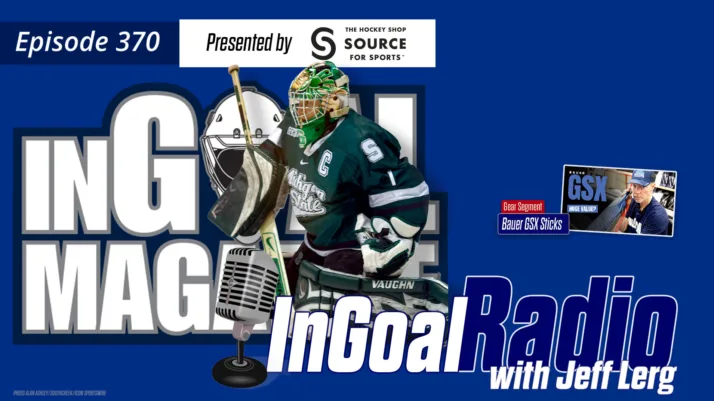
Jeff Lerg: How a 5-Foot-6 Goalie Built Bulletproof Self-Belief (Ep. 370)

Please subscribe and leave a rating — it helps us reach more goalies!


Jeff Lerg, standing just 5-foot-5.5, overcame severe asthma and a vision issue in one eye to win a USHL MVP, an NCAA Championship at Michigan State, and sustain a 10-year professional career despite two torn ACLs. Now a goalie and mindset coach and owner of Future Pro USA, Lerg teaches goalies to develop genuine self-belief through his Dialed and Driven Success Formula.
Episode 370 of the InGoal Radio Podcast, presented by The Hockey Shop Source for Sports, features a fantastic interview with NCAA star turned goalie and mindset coach Jeff Lerg.
Feature Interview
presented by NHL Sense Arena
In the feature interview, presented by NHL Sense Arena, Lerg shares stories and lessons from an incredible career in which he overcame the odds as a 5-foot-5.5 goalie with severe asthma and vision issues in one eye to become a USHL MVP, then an NCAA champion, captain and star at Michigan State before overcoming two torn ACLs to carve out a 10-year pro career. The drive and mindset mastery required to do so has led Lerg into a second career coaching goalies as an owner of Future Pro USA, and helping them master the mental game and achieve true self-belief through his Dialed and Driven Success Formula and a podcast of the same name. This is a can’t-miss interview for goalies, parents and coaches alike.
Parent Segment
presented by Stop It Goaltending U
In the Parent Playbook, presented by Stop It Goaltending U the App, Hutch tackles the always difficult question of how to split playing time for goalies in minor hockey.
Pro Reads
presented by Vizual EdgeWe also review the latest Pro Reads, presented by Vizual Edge, featuring the return of San Jose Sharks goalie Alex Nedeljkovic with a lengthy masterclass on tracking plays from behind the net.
Weekly Gear Segment
presented by The Hockey Shop Source for SportsAnd in our weekly gear segment we conclude our Bauer GSX series with a look at a great value $139.99 stick, including a breakdown of weight and material differences, curve and color options.
Episode Transcript
Intro
Got a list of names to get into. We'll run down and tell you what it means on InGoal Radio Podcast presented by The Hockey Shop Source for Sports Langley. It's thehockeyshop.com. The Gear Segment coming up. Kevin Woodley, David Hutchison also talking about the parent segment and Vizual Edge ProReads, and we have our NHL Sense Arena feature interview with Jeff Lerg.
And just before we get into some news happening around the league, quick comment, Woody, on Jeff Lerg. This interesting journey for the former NCAA goaltender.
Yeah. Former NCAA star. Let's make that clear. And if you're a younger person, younger goalie listening to this, maybe that name doesn't pop off the page, but I remember covering the league in the early 2000's, like he dominated the NCAA. Won a national championship, he was a captain, Some of the numbers that he posted in college were, like, video game numbers, and he did it all while being listed at five foot six.
As he tells us in the interview, actually more like five foot five and a half. We get into sort of how some of the stigmas and stereotypes, which don't don't forget, we're just starting to come into the league around then, affected his chances in pro. He was derailed early by a couple of really serious knee injuries, had some success overseas, had some success later in his career in the ECHL, but just had one cup of coffee in the American League, never gave up a goal, never got another shot. So, we get into some of the size stereotypes, but I think more than anything, this is a guy who and this I didn't realize. At one point had as he he to paraphrase his words, was close to legally blind in one eye, severe asthmatic, needed a nebulizer before every time he went on the ice, overcame a ton of things to carve out a ten year pro pro career.
And like I said, when he finished in college, he was second all time in saves at the NCAA level. He dominated in college, and he did it in his mind all based on mindset. So he's got a podcast he does called the Dialed and Driven mentality podcast. He also has, lessons that are tied around that where where you can work with him. And then he works as one of the co owners of Future Pro Goaltending USA.
So this guy's seen it all from some unique perspectives, and the interview is just loaded, like loaded with great stories, great anecdotes, and great advice for goalies, goalie parents, and goalie coaches about not just what he overcame, but why and how in his mind he was able to do so. So it's a fantastic feature interview. I can't wait till we get to it.
One of the best hurdlers I've ever seen play goal, overcoming obstacles all over the place. And what we will hear from with our feature interview today with Jeff Lerg, five foot five. That that that's And a and a half. That that's Darren Peng territory.
Yes. There you go.
Like Mike Vernon's Mike Vernon was five nine. And then there you go, like like But those were the guys, Vernon, Osgood, you're right, they're bigger than five foot six Jeff was but not much. Right? And those guys were still having success in the National Hockey League as Jeff was coming up and and prepare it wasn't until right around them we started to see, you know, we started I remember writing the stories, certain teams not even looking at goalies on their draft list unless they were six foot two. Like, this is the start of that era.
And then the irony is now, looking back, he retires at 32, and we're starting to see as the game's gotten so quick East West, we're starting to see guys that are at at six foot and a and a Juuse Saros at five foot eleven have a lot of success. But for for basically the prime of Jeff Lerg's pro career, the stereotypes and biases against smaller goaltenders were probably at the, you know, most severe or most extreme they've ever been.
What do you remember about, like, Mike Vernon? Hutch. Did did you think of him as small at the time? Because I didn't.
Oh, there were so many Yeah. Small goalies in that era. I mean, even and long before that. Right? So it's the Monsters.
I mean, Ken Dryden was really the first big big goaltender. Cesare Maniago, I believe, also fairly tall.
Well, remember Cesare Maniago telling us that like he was considered too big because at six foot three, he was too far from the ice. Like it was
a Well, if you can't go down detriment. Then that's probably true.
Exactly. So it's it's amazing how much it's changed and and again, Jeff just openly gets into all of it. It's it's a great like I said, great interview.
Looking forward to it. We've got our Gear Segment coming up in just a little bit, but first, the long list that is the waiver wire going into the National Hockey League regular season. Now some teams got proactive and were hoping to slide some people through early as teams would wait to see what would happen on the waiver wire and they were successful. But the the bigger list comes on this last weekend before the start of the regular season and several names jumping out at us.
Well, some claims already. Right? So, the Canucks claim Leevi Merilinen from the Ottawa senators when they tried to waive him. Ottawa then goes and makes a trade with Tampa Bay or Jonas Johansson who had already cleared waivers. So if you're the Senators, it's a perfect situation.
You acquire him, you can put him right in the American Hockey League and leave your tandem in the NHL as Linus Ullmark, and Sam Ersson. No need to worry about claiming a guy and and then putting him down and losing him again. So Dennis Hildeby gets the backup job in Tampa Bay. There's so many machinations as you move around the league. The one that's got me scratching my head a bit is New Jersey claiming Remy Poirier from the Dallas Stars.
He's had some really good seasons in the American Hockey League, but, you know, on the same day that they're waving David Rittich. And in theory, you've gotta keep Remy Poirier in the National Hockey League because it presumptively, if you put him back down to the American League after a short period of time, Dallas just reclaims him. And you've also got Nico Daws. Like, is this New Jersey saying we're gonna carry three with Allen, Dawes and Poirier, or would they risk putting Nico Dawes on waivers? So, that's the thing about waivers.
There's a lot of attractive goalies out there, and we'll get to the list of everybody who's on there today, but you gotta have a spot for them. I thought more teams might be willing to carry three. Maybe New Jersey is, maybe that's why they claim Poirier, they have no intention of waving Dawes. I thought that might change some of the math. But I thought frankly the New York Rangers would consider carrying three.
Instead, they waved Dylan Garand despite having a lot of success in in an admittedly tiny sample at the end of last season. So, you know, there's some names on there today. We can go through the Clay Stevenson jumps out. There's a handful that jump
Broissoit, Tomkins, Kokko, names that you will know. I mentioned, Rittich Vanecek is waived, and Samsonov in San Jose, Romanov, Sogaard, Tolopilo, and Garand is is really the one where I would take a good strong look at picking him up. Now, the fly in the ointment or the challenge is you do, when you pick up somebody off waivers, to keep them in the National Hockey League.
And there's only one team that, you know, at least right now looks like they need need is not a fair term, but looks like they're probably gonna want to add to their depth chart with somebody who has more experience and that's the Winnipeg Jets with no Connor Hellebuyck in camp, Stuart Skinner's the number one and and very limited NHL experience on their own depth chart and Thomas Milic and Domenic DiVincentiis is not that they can't do the job, I would think they'd wanna flush that out with a little more experience, which makes this all very interesting. Like, you know, very familiar with Laurent Brossoit, had his best years in Winnipeg alongside Connor Hellebuyck, but more to the point with Wade Flaherty as the goalie coach, is there an interest there? Again, we've we've talked about I think the size bias comes in here. You know, we just finished talking about Jeff Lerg. Like, based on again, tiny sample, but based on the success that Dylan had last year with the New York Rangers at the end of the season, and I think you see this echoed on social media, a lot of people think it's a no brainer that he'll get claimed.
If he doesn't, I'm gonna point at his size at a time when Leevi Merilinen in at six foot three gets claimed. Poir actually, I'm not sure how big Remy Poirier is. He might be like six foot one, six foot two. It's just to me, could a Clay Stevenson who also had success late last year, could he be a guy that's ahead just based on square footage? So I'm curious to see where this goes.
Do teams look for somebody with NHL experience like a Laurent Brossoit, or we've seen Eric Comrie all get already get through waivers in San Jose. They they put him down earlier. Or do they go for projects? Guys who they see upside in that have only had a cup of coffee. Leevi Merilinen was the first example.
Clay Stevenson, again, like I said, from Washington will be high on my list as likely to get claimed. I'm fascinated to see where this goes, fascinated to see if it's only the Jets looking or if there are other teams willing to grab a guy and keep three look at the Canucks. They grab Merilinen in, and with Demko not likely available any anytime soon, I thought they might keep three and have Tolopilo's stay, but they need a guy in the American League with some more experience, that's a. And b, Ryan Johnson's been open about not really wanting to have three goaltenders. So Tolopilo is another guy in waivers today.
Finished poorly by the raw numbers last year, but midway through last season, his adjusted numbers were really good behind a bad team. And I know from conversations around the league that he opened some eyes at that point. Enough to get claimed? I have my doubts.
The interesting part is Winnipeg's approach to this, knowing that the Hellebuyck trade could happen at any time, and there could be a goaltender coming back. So how much do you want to put into your depth of goaltender right now with Hellebuyck situation unresolved?
But there's no risk in taking somebody off the waiver wire to fill that role. It can just be a temporary thing. We saw that when Eric Comrie was the pinball going all around the league for a while that one year. They they lose almost nothing if they have to then waive whoever they bring in and he goes back to his original team. So it's kind of a nice safe way to actually go about things.
For me, the interesting thing is, you know, a guy like Garand who we see as having huge up side and as Kevin said, showed very, very well in his initial appearances in the National Hockey League last year. In order to take somebody on like that, who doesn't have the experience that you're certain they can handle that number two role for a full season, You've probably got to have that guy that you're willing to ride as a workhorse, which we said is sort of on the way out as a concept. The one team that might be really good for him in that sense would be, I don't know, the New York Rangers where Shesterkin could play a ton.
Yeah. It's it's it's a really good point. And, you know
Islanders, but they've already got they've got their goaltending covered.
Varlamov, them off spat with Warrior back that that changed the math there. There's just not a lot of spots. Right? And this is the challenge. Right?
Guys who are ready for the NHL. You know, Hutch, that's a great point, and the prime example is actually the guy that Vancouver claimed. Leevi Merilinen, two years ago, posted the second best adjusted save percentage in the entire National Hockey League, minimum 250 chances. Like, was really good two years ago. Coming up as a third, getting his first taste.
Last year, he started as the backup, expectations are different, and he had the worst numbers among 71 goalies to see 250 chances last year in adjusted, say, percentage. So the it's sometimes it's not just ability, it's it's, you know, it's the pressure that comes with different situations, and the uncertainty of a young goaltender who hasn't been in that situation before is something that I think scares teams away, which is why I'm curious if some of these veterans that haven't played as much, does the Laurent Brossoit end up getting claimed off waivers? Ilya Samsonov, although his year in the KHL probably hurt some. Chris Driedger, who we had on, you know, on the podcast here, still on a PTO with Vancouver. I think they're gonna keep him around to see if Tolopilo clears.
If Tolopilo doesn't clear, if he gets claimed, like, you'll see them sign Driedger and put him down to add their to their experience in the American Hockey League. If not, he joins the list of unrestricted free agents that has still has names like Petr Mrazek, James Reimer, you know, guys that you can have for free right now. I'm missing one there on that list. And it was Murray. There you go.
There's the third. So at the end of the day, it's interesting, the talent level of the depth has risen and there's the gap between starters and backups has shrunk, but there 's also these guys in the three roles that you're sort of trying to place these bets on. The reason I placed the bet on Garand personally is the style of play that he has, the focus he has on how he plays, and how it relates to some of the other guys at his size that we've seen pop recently. Dustin Wolf, we did our skating video with Garand from two summers ago and he talked about learning all those drills from Wolf and the time he spent with him. Jet Greaves.
Right? Like, so some ties to Greaves. He was in Montreal skating with Marco Raimondo who's been a guest of the show before who also works with Devon Levi. Like, and Garand have remained close. They skate.
They work on the same things. I think Levi's ready to pop in Edmonton. And if that cold's true, do you wanna be the team that gets in early on Garand or the one that waits too long to give them that chance? So, again, I don't know what the answers are. I'm fascinated to see where this goes.
But the only thing I've been able to predict so far when it comes to the goaltending carousel is as far back as this summer, I said Leevi Merilinen would not get through waivers and he didn't.
Given what I was saying about Winnipeg and there being no risk really to taking a guy off waivers and giving him a look, you wonder why another team wouldn't do the same thing with a guy like Garand or who else? Like, give him a look for a month or two. If it doesn't work for you, okay, you tried.
I think that it's I talked about the stereotypes against size.
Yeah.
I think it's the stereotypes against numbers. Like, you know, I pointed Ryan Johnson's conversation with us. Don't like it for the goalies. Don't like it for the coaches. Three doesn't go into two.
Despite the fact we've seen other teams have success, Buffalo last year carrying three goalies, managing it, pointing to it as something, a strength.
Would Buffalo take something?
I think the well, they've they've got some injuries right now. Luukkonen, Alex Lyon left the game early. So their number one and two goaltenders are currently at least out
Banged up. Questionable.
I don't know about how serious or how long term is. Banged up a great term, Daren. Might they take a temporary flyer as a team that, you know, is not afraid of having depth, and yet a team that's not afraid of having depth but traded Devon Levi because they didn't wanna lose him for nothing on waivers. So it's, you know, it's tough decisions for these teams. I I just I I wish more might be a little more patient with the con like you said, Hutch, like take a flyer, give him a shot, and most won't because they don't want to risk putting their guy down to the minors and losing him on waivers, and that's because they're also not willing to live with three.
Right? Canucks prime prime example. Gonna risk losing Tolopilo rather than carry three goalie.
Yeah. Why not do it for a month or two and see?
Do we think Broissoit winds up in Winnipeg though with the history there?
I mean, the history certainly would make it make sense if it happened. And and also Winnipeg being a team that, you know, is very much appears to be trying to prove something in a win now mode. Right? Like for the Canucks to grab, Levi, Leevi Merilinen, it makes all the sense in the world. Like, it's an extra.
And I'll I'll say this about Merilinen. Two years ago for nhl.com, I was asked to put together a top five or top 10 list of goalies under the age of 25. Now Leevi Merilinen was just coming off that fantastic season I mentioned where his adjusted numbers were off the charts in his first taste of the National Hockey League, but I pulled 10 goalie coaches, 10 goalie coaches, directors, and goalie scouts in the National Hockey League. I asked 10 of them for a list because the hell does it mean if I put together a top 10 list? Let's get the experts involved.
And Merilinen and appeared in the top five on seven of the 10 ballots, and in the total voting finished fourth. So, you know, like, for the Canucks, they don't have to worry about wins and losses right now. They see Merilinen as a guy with all the tools. They think they might have to reorganize how they how he utilizes them, how, you know, how he pulls them out of the toolbox at times, but they've got all the time in the world to to try and figure that out. If you're the Winnipeg Jets, you probably want more of a proven commodity.
You don't have a you don't have time for him to learn on the job per se. You wanna win now. The Canucks aren't winning now.
Jumps jumps over Driedger, who is on a PTO.
Mhmm. Merilinen jumps over Nikita Tolopilo, who is scheduled to be the backup to Kevin Lankinen and and Driedger, who's on a PTO.
And if Ryan Johnson doesn't like three goaltenders on a roster, what happens when Demko comes back?
I I think that's the one where I remember he said to me that, he understood he might have to, and I think that was in relation to that. Like, you can't have Demko come back and like automatically waive Leevi Merilinen into the American Hockey League because you don't want three and have Demko only last a month again. Right? Like, that's the biggest thing. Oh, is that they were carry three.
Right. That's what I mean. And you can't risk that. So I I think Demko is going to have to have a long run of health before they would risk sending Levy back down to the American Hockey League and so they will carry three. But with an option to not to, that's gonna be the preference and we see that in their move today.
Does that suggest the Canucks are gonna take a very cautious approach with Demko? The timeline might be
I don't expect to see him for, let's just say a while. That, yeah, we could be talking into November and maybe even longer based on again, not reporting, just based on some of the things I hear around it. So the goal very much seems to be when he's back, he's back. No chance that rushing it is going to be a reason for him to exit quickly. Again, although I would I would caution the longer you wait, the faster the like, we've seen it around the league.
Right? Like, even Jeremy Swayman missing camp two years ago. Like, once that train starts to build momentum in terms of the pace around you and the intensity of the games, coming in cold with no camp and an extended period missed, it's really hard to
joke about. Conversation after we visit with the Hockey Shop Source for Sports Langley, the hockeyshop.com, give us an idea of what's happening.
Gear
Well, we got a special guest today, Daren. Cam is, as we like to say, on assignment. So there was no Cam Matwiv this week. So we went into the bullpen. We did we tapped the right arm and we we pulled out Jonathan Holloway.
Jono, as he was known, you you see him on their social media all the time. Does a really nice job there. We brought him out of the bullpen to talk about the Bauer GSX sticks. We've done the pads and gloves. We've done the chest and the pants.
Today, it was time for the sticks. And to be honest with you, this wasn't even on the schedule, but I in the shop looking at the stick rack trying to come up with ideas. And man, I tell you, like, five deep in the stick rack, double sided, they've got everything. And these Bauer sticks really sort of popped off the wall. Like, they they jumped based on the appearance.
You'll see it. For those of you that are just listening, you go to the YouTube page and you'll see it in the video. Nice matte finish, full bright colors, just loved it. Loved it. And so we decided we would conclude the series by talking about it.
I think it's an example of two things though before we get to our our new friend, Jono. One, just how deep the inventory is. Because one of the reasons it popped off the shelf was there was a ton of them. And I'm going through, like I said, like five different racks of sticks, so much inventory there. That's why The Hockey Shop Source for Sports is the place to get your gear for the upcoming season.
If you haven't already, they will have not just a size and a style for you, but chances are a colorway that fits your new team or the team you've always played for. They'll have it in stock. Two, as we're about to hear, this is not a staff of just people plucked out of high school. These are people that are passionate about the position. It comes through in Jono's knowledge.
He used to work on the floor as well, and it's sort of a great hint at the level of knowledge of everybody else in the store in the goaltending department. They all play the game, they love the game, and they'll help you find gear that will help you continue to love it and play it for a long time, including this week's feature, the Bauer GSX Sticks.
Let's head over to The Hockey Shop Source for Sports Langley, thehockeyshop.com.
Welcome back to the hockey shop, Source for Sports here in Langley where we are gonna continue our look at the Bauer GSX line with sticks. Pretty actually good looking sticks. I kinda like in the car guy myself. Love the matte finish. But before we get into all the specs and details, we have a special guest with us today.
You may have noticed Cam got better looking and younger since our last episode. With us today, Jonathan Holloway, Jono as he is known around these parts, social media specialist here at The Hockey Shop Source for Sports. But as I always tell you folks, the reason you shop here is because they have people that know the position. So my guy here, he had a junior career. Hockey DB, look him up.
He played a little. He's got some expertise, not just a pretty face on social media. Are you the Wally Pip cam here, John?
You're flattering me here. I'm excited to be here and usually I'm behind the camera with Hutch, so it's nice to be in front of it here.
Well, know, we we do like to pump Cam's tires. You know, we worry about the head fitting through the door, so I think think we do the same thing with you. And I gotta be honest, perfect stick. Grab one.
Yeah.
Show it off because I think this is, you know, like I don't want to say like the comparison is that you're a lower price point Cam, but this is a pretty good looking stick for a lower price point. So GSX, we did the pads, we did the gloves, we did the chest, we did the pants. Let's finish with the stick. Tell me what this is all about.
Yeah. Well, first of all, I really like just all the colors that they got and They kind of pop, They are they they're bold. Right? And they're gonna stand out against the gear. Last iteration of GSX, the gear was full color and now it's white with just some, you know, different colored accents and these sticks are gonna stand out really nice with it.
So I think they look really nice. And then as we get into the specs with the sticks Yeah. We've got a shortened shaft so it's 28 inches, nicer for playing the puck, kind of helps you get a bit more leverage on the stick which is perfect for that entry level goalie. Keeps the
weight down too a little bit.
It does, which is really nice. Weight, we weighed it earlier.
Yeah. 720 grams.
Yeah. Which is not bad for a stick at this price point.
Coming in
at $140.
A $140 Canadian folks. A $140 Canadian. So that's like, I don't know, that's like two cups of coffee in The States right about now. That price point, that weight you're talking about what wait, about a 120 grams for a top price stick? Like in terms of when you feel it, watch about the end. Normally, I just give cams about the end but with you I'm trying to be respectful. You're being nice. You could probably handle an extra 120 grams in your hands. It does feel a little bottom heavy compared to something that like a little less balanced. Like the balance point is probably a little lower down the stick.
But just overall a really nice feeling. Yeah. For a really good price point.
Well exactly and at that price point you're gonna get a good life out of it too and it comes with a carbon carbon glass over the entire stick so it does have that added durability factor which is really nice. Obviously, we're always careful when we say that word but that's a nice addition this year with this GSX line. And then you've got that expand cell core in the paddle which also gives you really nice just rebound the feel when you get a rebound off your stick. It's gonna kill that vibration. So definitely some nice upgrades this year too.
Okay. And then the the other part about that, like we we tend to we have to be a little careful with this but the reality is sometimes when you get into the lower price points, you get a little thicker carbon layup and it it's a little more durable, right? Like it's heavier but it lasts a little longer. So I mean that's just the reality. Curves stock is p 31.
Is that the only one available?
Yeah. That's gonna be the only one. Size wise, you get junior, you get intermediate, you get senior. So it's available in all sizes. We've got both left and right handed as well.
Red, blue and black. Like I said, if you're a car guy, you like the matte finishes like me, I like it. If you've got any questions, we're putting you on the spot here. Oh no. Like Oh dear.
Took time forever to memorize these numbers.
I don't have the number down. I You can reach us at goalie@hockeyshop.com. THS goal on all of our social medias or you can give us a call, but you're gonna have to go to Google for that one.
I think we can get Hutch because we make him do all the hard work to like put a like number. Please just look it up
here or something.
Oh, we put you on the spot. We caught you with one of I was thinking about Hey listen, at least the social guy knew all the social channels. Make sure you check out all of Jono's work. We're gonna actually do a few things here today. Put a little he does a lot of stick taping on their social media.
It's really cool. Like not just advice on how to tape your stick, but also like sort of mimicking some of the pros. So we're gonna get him later on to sort of show us some of the options. Because a stick like this, the one thing it doesn't come with, you don't have the custom sort of grips or any of the Yeah. The custom options you get in a higher end bar. Just really plain simple stick but a really good value.
Yeah. Exactly. And one thing I want to touch on with that is just that with that matte finish, I actually really like the feel because it does offer a little grip but it makes it really easy to slide your hand for a poke check or anything like that.
See? There you go folks. Like I said, not just a pretty face. What's inside this again?
Expand Cell Core. So you're gonna get that vibration down. You think Cam
the the the Expand Cell Core?
I don't doubt my boy Cam. I I would I'll give him the credit that he would definitely know that.
You're on the clock Cam. Volley Pip right next to me. Alright. Check it out at thehockeyshop.com. Hockey Shop Source for Sports, all their social media channels and you know the number.
Can we call him Jono or do we have to meet him first?
Well, I call him we call him Jono. We we we went with the formal name at the beginning, but he's dressed a little less formally than Cam. Cam's got the you know, he's on the floor all the time, so he's got the Hockey Shop, you know, golf shirt on with the logos. Jono's a little more casual, so I think we go with casual on the name. I I got a question for you, Daren, because I think I referenced it in there.
I hope I referenced it in this one. I know I referenced it. We did a few when we were over. Do you know what it means to get Wally pipped, Daren Millard? Oh, yeah.
Thank you. Hutch did not know the phrase that Jono did not know the phrase, which is understandable because he's one of the he's But one of the
Like, I I didn't watch Wally Pip ever play, but I know the reference.
Thank you, Daren. I thought I was losing my mind. That's just not enough of a baseball guy.
No, you're not.
I appreciate it.
People just are not engaged with society. That's hilarious. Because I've probably been to
more baseball games than either of you. That's the funny thing.
And now, you remember do you remember this It really has nothing
to do with baseball anymore.
It's just That's what I mean. I thought it transcended baseball. That's what I thought to get Wally's This
is probably this is probably sports broadcaster insider stuff, so you've got cool things to say. You all think the whole world knows what you know, but they don't.
But okay. So here's the other question,
the most disappointing thing I've ever heard from David Hutchison.
Oh, that was just a one one lesson in broadcast journalism school for the two of you probably.
I didn't go to broadcaster. In case you couldn't tell anytime I take over the show, clearly, I did not go to broadcast journalism school. Daren, here's the question for you. Because at that moment in the shop after we stopped recording and these guys don't understand the reference, I had to explain it. I I rack my like
And he used it in about four different videos.
Do wanna explain it right now, dude?
But like my There's nobody else I don't know. Putting you on the spot, Daren. Do you know the exact reference? Yeah. The Yankees.
Right. And and and the the streak that starts Yeah.
Joe DiMaggio.
Right. DiMaggio's streak, which starts with him replacing Wally Pip. Was it DiMaggio, or was it no. I'm Lou Gehrig. Right.
Right. Lou Gehrig's disease. Right. There's Gehrig had the all time
Hey.
I'm I'm here to help you too, with your
Well, I'll Hutch you that only I actually got it right the first time I explained it live. Thank you very much.
Wally Pip was the Actually,
I had to help you when you explained this well.
Wally Pip got hurt. You didn't know what
position they
were. I forgot the position.
And then and then he went went off.
That's right.
Wally Pip never got his job back after he got hurt.
Wally Pip. So I'm not saying that Cam just got Wally Pip ed, but we just spent five minutes breaking down who Wally Pip was and why that reference matters just in case. Because Jono did a really nice job there. Good job, Jono. We love Cam though.
I've probably said Wally Pip's name through references than I ever have brought up Lou Gehrig's name.
That's true. Like, it's just a it's a common thing. Are you about to get Wally Pip? Yeah. Yes.
Now, you know Cam is is at home listening because he gets back from us
He's like, I knew that.
He gets back from assignment before we finish running all these segments. So he's gonna have to sit and stew on this a little bit. I wonder how long he takes him to go to Google and figure out who Wally Pip is. He's he's
I don't know if he listens to the show.
Of the Utes too, you know.
Samuel Montembeault is not getting Wally Pip
He is not.
Because he's in the National Hockey League with the Montreal.
Yeah. Speaking of names going to the American League without requiring waivers, this one is probably the biggest, you know, raise the eyebrow rock style, like, Jacob Fowler going in the American League. Guess
Key point being no waivers.
Waiver exempt. You know, sometimes teams make this move, they'll send a guy down that doesn't require waivers, set their roster, and then make different moves once the season starts. But there seems to be a sense in talking to people around Montreal that they believe they can rehab the vet they don't wanna give Samuel Montembeault away. He's on a very reasonable contract if he can have any type of bounce back from last year. They don't think that's indicative of his that one year is is not the like, that's the outlier and the three or four previous are are what he's capable of.
And if they can get him back to that level, they have an asset. So in the meantime, Jacob Fowler goes and plays in the American Hockey League rather than being part of a three goalie rotation and not getting in very often. That said I don't mind this from Montreal's
point of view from the organizational standpoint.
Man, like, I get it, but I also you know, I guess, hey, we use the Merilinen an example, and and Fowler was a similarly small sample
one bad year for for Montembeault.
I'll give you this. Statistically, it's only one bad year, but the three previous were largely environment. Like, he never outplayed it by a significant significant margin. It largely was but he wasn't that bad. No question.
Like, he's a better goaltender than he showed last year. I believe that completely. But the reality is, Jacob Fowler there was only one goalie in the league last year that had better adjusted save percentage than Jacob Fowler, and that was Devin Cooley. Again, small sample size, I get it. We just cited the tiny small small Similar to Merilinen when he popped, but you know what?
You're right, Daren. Tiny sample size and yet pedigree. Like, you know, we were on the ice with him and and and Jeremy Swayman in Boston this summer, and you listen to Jeremy Swayman talk about Jacob Fowler and how good he thinks he's going to be. You hear that from other goalies around the league. There's an appreciation for what he does well.
And so the fact he's not in the league is is gonna raise eyebrows from from several people. So, you know, up to Samuel Montembeault to to win some games for the Canadians early and and prove that they made the right move, and, hey, depth is never a bad thing if you're the Habs. But if there's a chance your best goalie is not on your team, then we'll see how the results go because that that's also, you know, there's a risk and it's not a it's not a big risk. Yeah. That that's a great way to put it.
But also
There's no risk where
you don't lose them. Nothing against Jacob Fowler because I also believe he's gonna be great. But how much time has he really spent in the American Hockey League?
No. That's it. He needs
And how many and how long have we been saying about it being a good thing, if anything, to overcook down in the American Hockey League? It's not a bad thing and I'm sure it's gonna be hard for him. But to get down there, get the reps is not a bad thing. And I am not saying this with respect to Jacob Fowler, but man I hate that term pedigree. I actually think it holds back development in our position because they start talking pedigree when kids are freaking 12 years old.
And oh, he was on this team, he was on this team, he was on this team. How many guys go all the way up and through the world juniors and then don't make it in the National Hockey League? There's a lot. I hate the term pedigree. I love I I liked what you did, Woody, when you were talking about the best young goaltenders and you went and talked to the goalie coaches.
Because as much as I'm a math and science guy, I believe in the eye test far more than I believe in the numbers that people are relying on and that term pedigree, I can't
stand. Well, when I say pedigree, I don't because the irony is like Fowler's not a guy who followed that path up until he got to Boston College. Like, was not on that chart, on that route, in that pedigree at an early early age. When I see pedigree, I'm referring more to that same list that I put together. I that where that where Merilinen as a pro and in the NHL to surpass what Merilinen had did in his tiny sample.
So that Yeah. Enough. But that's
he did it.
Said that. Where that's where I like, you know, he's he's on that list. Right? That one of those top young goaltenders along with, you know, Trey Augustine and guys like that. Hey, it's the other part of the list.
Like, there's a couple guys that were down further below on this list when it was done two years ago. Jet Greaves in the NHL established. Jesper Wallstedt in the NHL established. So I'm with you. I hear you.
I I understand it. I think when we talk to other goalies around league two, like, hear how big they are on what Jacob Fowler does well.
And I was not talking about him. I agree with you, 100.
I have a question regarding the Vezina Trophy race this year. That's coming up after ProReads brought to us by Vizual Edge.
And this week's we got We've got the return. I actually can't believe it took me this long to get back to him. And as soon as I finished
I'm disappointed in you too.
Soon as we finished the video session, I was like, how how how have I waited five years and three teams to have you on here? Alex Nedeljkovic with the San Jose Sharks, who by way had the best numbers of any San Jose Sharks goalie last year. I know everybody's looking at Askarov to be the number one, but all Ned does is outperform his environment.
I watched Askarov last night last night and he was incredible.
He's got that potential for sure. And hopefully this So
widest butterfly why does butterfly in the league?
And at times, that no longer works in the league. Like that's the there's the we get into a we could get into a different discussion. Right? But as as that as guys have to narrow, like the things that made us scare off when we talk about pedigree, a first round pick were his ability to move around on the ice from his knees, that butterfly, the athleticism. But is that the number one trait for goalies that succeed in the NHL right now?
I would argue that that shifted a little bit. So it's interesting. Back to my ProReads. I digressed as I tend to do. Alex Nedeljkovic was fantastic breaking down a play from behind the net.
I'm not gonna quiz you today, Daren. I'm just gonna highlight because this was there's no way to quiz this. This was basically like a five minute master class on playing pucks behind the net, tracking movement, the way the head leads everything once the puck goes from behind to the front. He walks through two different scenarios. He breaks down everything including windows, blocker side dominant looks over the left shoulder.
I mean, he gets into all of it. Hold your skates, go to your knees, all the decision making required. And and he adds, this is for him, not for everyone. As a goalie who, you know, like we've seen from Wolf and Comrie in the past month, not the biggest guy, prefers to hold edges, just a complete breakdown on all of those elements, not over pushing on low high passes because the short side is what players look for. I mean, he gets into it all.
It's one of the best ProReads we've had in a while. First one we've had in five years from Alex Nedeljkovic and more importantly, the first of many, which is why you should subscribe to InGoal Magazine to get access to ProReads, access to all this advice how to read and anticipate the game from some of the biggest names in it. Over 40 NHL's have taken part. There's over 350 closing on 400 actual videos online for you to learn how to read the game. There's also a discount because ProReads is sponsored by our friends at Vizual Edge.
And as part of that, you can save 20% on a Vizual Edge membership. Not a member? Use the code InGoal, I n g o a l, to save 10%. Are a member? Go to ingoalmag.com, click on any ProReads, and you'll see an exclusive member discount to save 20%.
Why do you need to do it? Because we all want the puck to look like a beach ball, and we've all had those nights where it does, the way it did to Alex Nedeljkovic in this breakdown with multiple saves. Every goalie has that night here and there where that puck looks huge. You're ahead of every play. You feel calm.
You feel patient. You're in total control. Then there are the nights where you're half step late. You see it, but you don't really see it. You're reaching, you're guessing, you're fighting it.
That's not your technique. It's how your eyes and brain are processing the play. And in that case, it's not doing it fast enough. Vizual Edge fixes that. It measures how well your eyes track and process then gives you a custom plan to train improvement.
Three fifteen minutes sessions a week, that's all it takes on your laptop or tablet. What NHL goals you goalies use to make the game slow down when it matters most, and that includes, a gym where you can go do drills for your eyes, as well as a perfect game day routine used by goalies such as Jordan Binnington. So check it out and remember, check out the ProReads, get your member exclusive discount code and save 20% off Vizual Edge.
What was that you said about over pushing and guys liking short side?
On low high on low high pop passes like it's, you know, I like I I'm gonna paraphrase because Ned does a much better job of breaking it down, but just how subtle a shift it is and how some guys want to push into the middle or push out at guys rather than just shifting down, not recognizing how much net coverage they already have on a low high. And that quite often shooters are taught as much as that goalie's on the post, he's going to come off it to come out to you and going back against the grain is a great way to score between the goalie and the post. Basically shooting where he's moving out of the space.
Hadn't thought of it, but it
makes sense. And goalies exploit it all the time or sorry, shooters exploit it all the time and and Ned is conscious of that as he breaks down these videos.
We have a good drill from several years ago with Brady Robinson, who's the development coach for Philadelphia Flyers. And it's not the same situation as Ned, but it is trying to help goaltenders with a similar sort of mistake. Because when you're on the post, just the way your blade is against the post, it's very difficult to just step out without creating some lateral movement and coming off the post, especially young goaltenders. And but as as Ned was saying in this case, that kind of thing can happen in the National Hockey League as well. So would highly suggest people go check out Brady's video where he's working with goaltenders to help them learn to just take some depth without changing their angle.
Oh, wish.
Really interesting.
Great stuff on that.
Never thought of that. The National Hockey
League will start the season minus a three time Vezina Trophy winner. Does that make the reigning best goaltender in the National Hockey League the favorite to run it back, or who do we have our eye on? At the start of the campaign in the Vezina Trophy race?
You do this every year and you usually give us a week.
Yeah. But the sea yeah. But the season's gonna be like we're gonna be a week into the like, it starts on Tuesday, man. Like, by the time we record next time, we're gonna have too big a sample. I'll go first.
I'll let I'll let Hutch do a little research and check his odds. I'll go first here. I'm taking Logan Thompson. Cool. Yeah.
I'm taking Finished fourth last year
Should've been a in in the And if
you've read our breakdown based on the numbers, he should have absolutely been a top three guy in the best in droppery race last year. Logan was fully deserving. He's been the best goalie by adjusting numbers since he was I'm not sure
Logan did himself any favors calling out GMs either.
Yeah, probably not. You should leave that to me. I call them out all the time for their poor voting. I've all Hey, listen. Listen.
I gotta be careful here, but I once because I get these inquiries from goalie coaches every once in a while at the end of the season, what do the clear sight numbers say? Because not everybody has access to them. And in some cases, the GMs ask their goalie coach who should be on their ballot. And so some some of them, not all of them, but a handful will reach out and ask what the numbers say. And there was a year where I gave them a number and the literal response was, I can't have that guy first on my list.
My GM really doesn't like him. Maybe if I put him second or third, he'll leave him on his ballot rather than taking him off completely. This is an actual conversation with the NHL people and an example why Logan isn't wrong and why those votes should probably be conducted by somebody else.
Hey, did the have GM's got it wrong the last few years with the Vezina trophy?
I I'm trying to remember who won them all. Actually, if you wanna know, just go to ingoalmag.com because we've got breakdowns that really They've gotten it they've gotten it really wrong a few times. I think for the most part, like, have no arguments. Like, I'm not arguing against Andrei Vasilevskiy.
I think the GM's got a bit of a bad rap. I'm gonna stand up for them.
Look at you. Look at you. Okay. I appreciate that. They mostly get it Where they often get it wrong is guys that should have been finalists aren't finalists, but we're picking nits at that point.
Yeah. Maybe that. Maybe the top five could be debated.
Yeah. You know
In different should
have won it the year. There's there's a handful of examples around. There there's times where guys win it that that we don't even have as a top fiver. So it happens. When?
Now When did that happen?
Ingoalmag.com and I'll and I'll find I I know there's one somewhat recent, where that's the case. Now you know you got me looking.
I just don't think that it's been that big of a miss.
I think we've had some Logan absolutely should have been a finalist last year. Yes. And and a bunch of them clearly cast their vote in their mind last year long before the season ended and for Ilya Sorokin to fall off the cliff he did and still be a finalist was a bit of a surprise to me. That smelt like not paying attention to the final whistle.
I'm a firm believer in in any of these awards that that there's there's voting on, the first three months of the season is the most important. That that's where you can win or lose that award because there's there's nothing to gauge it against and everything's so new, so you get off to a fantastic start before Christmas, everybody's already talking about you and you're gonna stay in that in that realm of the of the discussion.
Yeah, you know what? I'll I'll give you some examples and you're right, Daren, like like winners versus non winners, things like that. It's usually down the depth chart like
a guy should have been a finalist if he he finishes sixth for the final.
Things like guys being a finalist and they're not even in the top 10 of adjusted numbers. I don't wanna call out specific names, but I like, I have a half a dozen examples where guys aren't even top 10 in the league. And based on reputation, wins, and raw numbers, they end up being finalists. There's a lot of that. And there's a couple of winners in there too where their actual performance was largely based on the way the team defended in front of them.
Stop it Goaltending the app. These are parents
Well well done. You shut me up.
With David Hutchison. We're going to talk about splitting games, so first dimension from Stop It Goaltending U.
Well, if you wanna know who should be really voting on the Vezina Trophy, I'm gonna go with Directors of goaltending, although we don't even have one on every team. But you can access the expertise of one of them and twenty five years of NHL goalie coaching experience at your fingertips with the Stop It Goaltending U app. You wanna get into the goalie parenting expertise that helped Joey Daccord reach the NHL? That's what you get with a subscription to the Stop It Goaltending U app. All the knowledge from Brian Daccord has been an NHL goalie coach, scout, and director, including currently with the Detroit Red Wings, as well as the insights and expertise from his staff at Stop It, which includes a long list of minor pro and veteran NCAA coaches, all delivered in easy to digest chunks including five short daily primers, weekly style analysis, and breakdown videos, as well as drills you can take onto the ice with your team and coach.
Plus, you get a subscription to InGoal included, So check it out at the App Store or Google Play and get the best of both worlds with a subscription to Stop It Goaltending U the app and a subscription to InGoal Magazine. Hutch.
Parent Playbook
Daren, when our son was 11 or 12 years old, he played for a head coach who had no goaltending experience, and he announced at the beginning of the year that the two goalies would split every game right down the middle. Neither goalie really loved it. They both wanted to play the whole game, but in retrospect, I think it was actually really good for both of them and and for us as parents. One weekend that season, we drove a thousand kilometers to watch him play hockey. And on the way home, I was very thankful that both kids got to play.
And and that's where I land on today's question, which came from a parent who reached out. He runs a goalie committee for the local association. You know who you are. I did not ask permission to use your name. We've actually had some back and forth in a Zoom since then.
They worked hard at being a goalie friendly association and it's paid off. They went from not having enough goalies to now having two and verging on a problem of having too many. A nice problem to have. Really good problem. But now they're asking me how to split games.
He actually laid out his options really well. He had a good plan in place which was for the youngest kids, switch every few minutes. But people say goalies never find a rhythm that well that well. Maybe you could switch at the half and but then the parents are saying, well, then the hot hands getting cut short and the cold body's never getting warm and so on. Some, of course, wanna switch every other game, and then you break the rule that the kid who comes to the rink should play.
So his conclusion, of course, what was that there isn't a right answer for every team, and and I might get in a in a minute to what they're doing. But before I do, I wanna start with the part that I personally am not flexible on. I do not support a starter and a backup in minor hockey. I really struggle with it at any level where families are paying a lot of money for their kid to play hockey. I know in junior hockey, it's the norm.
But before junior, if you have two goalies, I believe they should both be playing. Not necessarily every day, of course, when when they get to that age. Steve Thompson, of course, who runs goaltender development for USA Hockey has said on this podcast that other people in other sports do not believe that we let kids drive two hours to sit on the bench. He said, and I quote, they say that's like child abuse. If you're a youth athlete playing a sport you love, you should play every single time you go to the rink.
And then of course, there's Brian Daccord who mentioned of Kevin mentioned a few minutes ago. He's the director of goaltending for the Detroit Red Wings and, of course, Joey Daccord's father. He had two coaches, two of Joey's coaches tell him growing up that full games were better for goalies. So he said, quote, your son plays on the team too. If he plays every other game, my son will play every other game too.
Of course, the coach's response was, well, that's impossible. To which Brian said, well, there you go. It's youth, it's development, it's sports. I'd be willing to bet on the way growing up, Joey probably could have laid claim to being a starter on some of these teams too, but Brian was not putting that ahead of anything else. Of course, there's a bonus that people miss.
Alex Auld, who has coached youth hockey for a while, made the point that a goalie who plays the whole game is the only player who gets no coaching during the game. Skaters hear something from the bench after every shift, so a switch after I think Kevin it was ten minutes he was doing, he would swap his goalies. One guy comes in, has a little chat with him on the bench, send him back in after ten more minutes. So how should you split it? As I said, the association I was talking about sent me their plan and I wouldn't change it much.
For the youngest squirts, they were swapping about every six minutes. Keeps those little kids busy and engaged in the game. As you move up, they start swapping every period. Nobody ends up sitting cold for more than a period and the goalie gets to start on a face off at center ice when he comes in. Half a game as you get a little bit older works as well at just about any level in fact.
And then as you get to the highest levels, it is reality. It's time to start alternating full games as long, at least in my opinion, is that it's an even split. Now, of course, the objections. Rhythm is a real thing. My son and his partner when they did this would tell you that.
But every goalie has to learn to come in cold eventually, and it's better to learn it at eleven than it's 17 in a playoff game. The hot hand, well, at this age, I'm not sure it's a reason to change the plan. The plan protects the kid who isn't hot that day as well. And the next week, that could be your kid. If if that kid's struggling, he doesn't have to face the embarrassment of getting pulled because you know halfway through the game, you're gonna be making a switch anyway.
And pulling young goalies is is a whole topic all to itself. Which opinion you you or excuse me. Which option you choose to pick matters a lot less than this. I would say decide before the season, tell the goalies and the parents and stick to it. Don't just sort of spring this on them and and have it suddenly happen.
Call it a guideline though. That was one thing I did tell our friend who wrote in. Don't call it a policy because that's something that get people's backs up really quickly. And I certainly wouldn't die on this hill. Any of these though beats a kid sitting on the bench all the time for a game.
So parents, ask about the plan in September, not January. Treat the other goalie as your kid's teammate because that's exactly what they are. A thousand kilometers in our case and they both got to play. That's the whole point for me.
What's your preference for splitting games? The breakdown. Is it is it half and half right down the middle? Is it is it period one period on and off? And one person gets two periods every second game?
For me, it's
age dependent. You know, with the youngest kids, I I think Of course, it depends on how long the game is, so it's hard to stick to a a time count. But you know, if you're playing twelve minute periods, then maybe it's Maybe they swap every six minutes with the youngest kids. As they get a little bit older down the middle. I I'm not particularly worried about them having to come in cold.
It's been a while. I'm sure there's a sorry. I should be careful. I spoke to a coach who was interested in bringing InGoal to all of their associations goaltenders about a month and a half ago. But their season doesn't start for a while because they're so far north that none of their rinks have cooling in them.
They just go with they are indoor rinks, but they need the outdoors to keep them cold. So there are some situations where standing on the bench probably is asking a little bit too much of a goalie who's not gonna go in, but or who will be going in. But for the most part, I don't think you're gonna get all that cold.
Well, I've been in those rinks growing up.
Oh, We me
we we're inside the viewing area. There's the backup goaltender.
Yeah. There you go. There you go.
The backup goaltender stayed in there because there's no sense just standing on the bench freezing when everybody else is staying active.
Oh, and then you have some coach that he needs to be on the bench with the team. It's a really
good I I I do think it's sorry. Just to go back to the the time period, like the one thing that you mentioned Alex Auld's example, like the beauty of him was he was coaching as they came off, right? Like they'd be able to get Yes. And so we get to the point, which is obviously the goal of USA hockey, stated goal, you know, obviously Hockey Canada trying to increase the numbers as well, but not maybe not at the same level right now where you have a goalie coach with at with at least some idea what he's doing, at least some certification specific to the position on every team, whether it's between period swap or the kid coming to the bench, you can actually have a quick conversation. Hey, did you see this?
What did you think of that? Like, and and actually coach them as opposed to just pull you know, having them swap.
They can get a drink of water too. I remember when our son was quite new to the game, so think sort of squirt level here, came to the bench to get a drink of water and the referee threatened to give the team a penalty. And I said, he's just coming to get a drink of water. What's going on? He should keep it on his net.
He can't reach the top of the net.
Another case for smaller nets.
Yeah. There you go.
And if it's up north, the water might be frozen.
That's true. That's true. I do remember going to a tournament up north when my father's heater in the car didn't work. That was a frigid, frigid game of the tournament.
Would have been screwed because I need the heated seats, that's my warm up.
You had you had the car with the massaging seats too.
Oh, yeah. He did massage I don't have that anymore, but the heated massage seats on the way to the game in a red.
You had massage seats in your car?
He did. They were nice too, Hutch Hutch.
I didn't even know that was a That
was a I I haven't let him pick me up at the ferry since he got rid of that car.
Yeah. It's true.
I've heard heated seats and cooled seats, but not massage seats in the vehicle.
Yeah. It's quite nice, Daren. It was a great way to even postgame too, you get the little lower back lumbar massage vibrating up and down as it rolled up your spine. It was all fantastic.
This is how Woody rolls.
Yep. Fantastic. I wanna
be Woody when I grow up.
Shout out Audi on their high end on their on their s series vehicles for the massage seats.
Jeff Lerg coming up on our NHL Sense Arena feature interview, brought to us by NHL Sense Arena.
Sure is. As always, this week's feature interview is brought to you by NHL Sense Arena 26, which is the next generation hockey training platform. And we are in the midst of week four of Sense Arena's back to hockey month, and I think there's only one more ahead of us here. This is the week we've been waiting for because the season is here. There are games at every level back on the ice, and your moment is coming.
For all of us in the goalie reunion, that means walking into your first game already sharp. You can put on the headset now and you'll be in the crease getting real reps from home to be ready for that time you step on the ice. You get to track the puck off the stick, read a shooter's release, you get to get set and square before the shot comes. For the start of the season, Sense Arena has specialized training plans as well, so you're not just putting the headset on and trying a bunch of different things. You get real pregame work following a plan instead of just random reps.
And with back to hockey month, the giveaways keep rolling. This week, could win $300 worth of beauty status hockey apparel and the grand prize still live, a Sparks skate sharpener as part of the ultimate back to hockey package. You wanna get in on the giveaways? Go follow NHL Sense Arena, Instagram, Facebook, YouTube, TikTok, Discord. Lots of ways to get in on the giveaways, and then go check out NHL Sense Arena 26.
Use the code IGM 50 to save even more. The season is starting soon.
Feature Interview - Jeff Lerg
NHL Sense Arena presenting our feature interview, which features Jeff Lerg this week.
We talked about it off the intro. This is just a fantastic interview from a guy who has a very unique perspective on the game, but at the end of the day was driven largely by his mindset and his mentality and that's where a lot of the focus on this interview is. He's got a podcast, the Dialed and Driven Mentality podcast that includes, you know, a sports, like sports psychologist consultant that works with him as well. We get into that a little bit. We get into his career, record setting career in the NCAA, into minor pro for close to a decade, now coaching, now doing, you know, the the mindset stuff, all in the show notes.
So make sure you check it out. I think everybody, parents, goalies, goalie coaches, there's a lesson in here for you, so enjoy. Incredibly excited to welcome our guest today. I feel like it's an omission that we're 370 episodes in, and we haven't had him on before. One of the greatest goaltenders in NCAA history, had an incredible career, and also in the USHL before that, just dominated, pro career, now has been coaching for over a decade, and has a new podcast himself, which has been fantastic for goalies and actually probably goes well beyond goaltending, but that's our focus today.
Dialed and Driven Mentality Podcast, which he, he has a cohost Chris Palmer is a a mental performance specialist, but let's get to our guest today. That is Jeff Lerg. Jeff, I the introduction was so long, I almost forgot to put you as a part of it. How are you?
No problem. Thank you for having me. When I when you're doing something your whole life, you you can tend to stack up a few different hats within the game, and that's that's what I did. As you mentioned, I had a good opportunity. Like, I grew up in the Detroit area, found my way into the USHL.
Had a great coach in Mike Hastings in Omaha, which molded me to then, get on to Michigan State at the division one level. And we found the ultimate success there, which was winning a National Championship, one of my childhood dreams. And then I found a way to carve out ten years in in the minors. But with the history that I had, and that's that's the reason I went down the path that I that I'm on now with this dialed in driven mentality, You know, I'm I'm proud to come on shows like this and meet up with the goalie nation and and kinda share my story.
Okay. You missed one there. Captain too at Michigan State. Like like number like, record setting numbers throughout, but also captaincy. I wanted to get into that as we go through too because that's a different role, probably ties to a different mentality and a different approach.
Let let's start with where you are now. Not just the coaching, let's maybe start with the podcast. And the fact that it's focused not necessarily on technique or anything like that, but it's more about the mentality. Maybe walk me through why you've taken that focus and how it relates to the the career you had at every level and the way you were able to carve that out?
Yeah. My my personal path, and some of the medical, I guess, issues or things that I went through, you know, I was a five foot five and a half on a good day, a severe asthmatic, someone who had to do a nebulizer breathing machine before every single skate all the way to my very last game at 32 years old, doing a machine before just to be able to get enough oxygen in. And then at one point when I was younger, grade school, I was diagnosed to be legally blind in one eye. The doctor said I'd never play competitive sports, would never drive a car. I had to wear an eye patch as a kid.
it became very clear to me that I didn't just survive in pro hockey or make it to pro hockey just due to my quick feet. I mean, it was purely due to this kind of mindset that at times felt bulletproof.
And so as I looked back and and kinda saw and was able to kinda collect some of the experience they had in the position, it became very clear to me that I didn't just survive in pro hockey or make it to pro hockey just due to my quick feet. I mean, it was purely due to this kind of mindset that at times felt bulletproof. Like, I didn't want to let anything get in my way. And I know my surroundings and my coaches and the people had a great, impact on that to help me build my self belief. And I also know that I had to work hard at it as well.
So with all that, that's why I went down this path, kinda using the the hockey phrasing of dialed in. You know, obviously, it's a kind of a kind of a hockey phrase. I said the dialed in driven mentality.
There's so much focus on so many different aspects, especially in goaltending. Right? It's quite a specialized position, equipment technique, but mindset we're only I think starting to touch on. Like, I think we, you know, we've seen an increased focus, but it always seems to be the last box that gets checked quite a bit. What's been the feedback to the podcast, to the way thing the way you're approaching the messaging there?
Like, how important is this to start early as opposed to a tool that people just add or try to add in their twenties or in their late teens after they've hit high performance? Like, how important is it to start earlier than that?
Yeah. Certainly. And that's and that's where I think that I've been trying to get out and explain that from the elements and the programs, whether it's a program that we have called the Dialed and Driven Success Formula or the podcast, it's a way to be proactive. It's not that, Hey, something's wrong with you. That's not the point of where I'm spending my time.
It's really to try to teach these skills that help me persevere and use that grit and determination to accomplish my goals. And a big piece of that is really kinda just teaching how you build belief. You know, what does it mean to be focused and prepared consistently? You know? How do you set goals and then methodically work toward accomplishing them?
So mentality is a, you know, can be used as a tricky is kind of a tricky word. You know, some people view it as, must be something wrong, I gotta go practice it. No. This is just as important or more more important than the new set of custom paths, be honest with you.
Okay. So building a belief. Maybe you can give me some examples there. Because for you to go from where like, being told forget sports, you you'll never drive a car wearing an eye patch. Never mind being a five foot six goaltender, as you said, five foot five on a on a good day, which as we know in this position is probably one of the toughest obstacles to overcome, or at least I did.
I thought that was one until you told me about the eye patch and and, you know, the nebulizer. How do you how did you build your belief going through that to go from those challenges to, like you said, dominating in The USA channel to dominating in the NCAA, winning in Natty, being a captain, all those things. Where how do we start building that belief in self?
Yeah. I think the biggest thing that, of course at the time I didn't know I was building my belief. It was just after I looked back and realized, it was just I understood the task at hand, and I went to execute it at the highest level. You know, I never spent time comparing myself to others. I didn't spend time really taking long to reset after a tough game or tough practice.
It was always like, okay, what's next? And I believed in myself because time after time after time, I executed. And it was due to the fact really because I worked my butt off in practice. And I built that belief in practice. And I was very fortunate.
I played in a very, very good youth hockey team growing up in the Honey Baked organization. We won the Quebec tournament. We went to the Nationals in USA. We were highly competitive every year. And I think that that practice environment and me just bringing it over and over, I was always confident when I was put in difficult situations.
And then of course, you go from youth into the USHL, certainly a learning curve. But I just looked back and the one thing that I could always control, and that was my consistency in really showing up to practice every day and really being an extremely hard worker and high executor in practice that when the game time came, it didn't matter if I was looking across the ice at a first round NHL draft pick. Like, I believe I was gonna win.
That task you mentioned task and identifying tasks and then how am I gonna do this. Is that a key to sort of like, we we hear there's a lot of different sort of thoughts like like staying in the moment. Right? Like, the easiest thing next shot mentality. We hear it in golf and we hear it in goal tending to, you know, somewhat similar sports, I think, in terms of the the individual nature of it.
Even if goal tending exists within a team environment, you're still sort of alone back there. It's the easiest thing to say and the hardest thing to do. How did you you know, that that task mindset, how did you how how did you and the did you recognize it in the time, or is it just something you did? And now that you look back, how would you teach others to sort of achieve the same thing?
Yeah, certainly I I think the biggest skill that just helped me take care of that organically was that element of preparation. Know, it's like when a kid is in school and they have a test. You know, if you haven't paid attention in class and you haven't spent any time studying, the teacher passes out the test. You don't feel confident. You don't really have a belief.
Right? And so for me, I think I was fortunate in a sense that I wasn't always the main sought after person as kind of recruiting landscape started to be navigated. So that kind of forced me to really just be like, hey, prove it. Bring it. Prove it.
Bring it. And then I kind of built this big chip on my shoulder that, you you guys don't think that I can play at this level. Just watch. You know? And that's what really propelled me to have success in the USHL.
You know, I kinda went in there with a good youth background, and I'd kinda earned my minutes there. Mike Hastings really pushed us hard, and I had an older goalie partner there. But then once I kind of got a taste of, okay, this is what it takes to get playing time, and this is what it takes to win, I didn't let my foot off the gas pedal. And then I really kind of kept that mentality throughout from the days in junior hockey and to college hockey. And when I arrived on the campus at Michigan State, I had a goal to win a national championship.
It wasn't just a fluke. So I looked up in the banners, and I saw Michigan State at the time had two national championship banners, and and I was I looked at that thing every day, and I said, we're gonna get one.
Things have changed. It's been twenty years since since you're, you know, since your rookie year at Michigan State 2005, and I'm trying to I'm racking my brain a little bit. Like, nowadays, walking in as a first year freshman and starting would not be common. You posted a nine twenty eight, you paid played 31 games in your first season. Like, that transition, what enabled you to make it so quickly?
What were some of the challenges you had to overcome in your first year at Michigan State?
Yeah. I mean, honestly, was a repeat for me of my experience in the USHL where I did have an older, more experienced, and accomplished goalie partner. My goalie partner in my freshman year, he was a junior. But as a sophomore, he was an All American. So I was certainly not granted or gifted minutes.
I had to sit on the bench for a period of time. But I look back, and I had this winner's mentality where winning kind of became second nature. It was this kind of ultimate belief in myself of kind of what I explained previously of just working my butt off in practice, and I'd have good practices. And then if I'd go halfway through a game, I'd get a chance to play a half a game. I was just hyper focused on performing well during that half a game.
And then when you do that, nature of sports, you get more minutes. At some point, I think the other goalie was going to play a game and was injured or sick, and then I kind of just got on a roll and never looked back. But that's really where now what I'm trying to teach young athletes is that you never know when your number's going be called. But when it's called, you have to be ready, you have to be prepared, and you have to take advantage of your opportunity. Because at the end of the day, if I didn't do that in juniors, I probably would've made it to college.
And if I didn't do that into college, I wouldn't have said that. I would've been a part of a national championship there.
Is that where the practice habits come in? Is that is that a big lesson? Know, you work with future pro, goaltending schools, own future pro goaltending schools in the state. So you see goalies, I'm sure you have some coming to you from a mindset perspective to work with, but you've through the through the dialed in driven program, but also just like in a goalie school environment. That tendency to, like, wait for the games that this is where I'm gonna bring it as opposed to building those habits in practice.
We can, you know, as young goalies, maybe not approach practice with that same mindset.
Yeah, certainly. I think the biggest, one of the reasons that I developed that mentality, it was, and I remember this experience, I was, again, I'm from the Metro Detroit area. Grew up in the Red Wings. We're like the team, right? Yep.
And, Dominik Hasek was the goalie. And, my dad had left the newspaper out in the kitchen one morning, and I was just reading the sports section. And I remember a phrase from Dominik Hasek, and he said in his interview that he tried to allow five goals or less in a team practice. And I remember that, and I was like, I'm gonna try that. And then that became my mentality.
Because I mean, he's the Hall of Famer. He's hosting the Stanley Cup. You know, one of the greatest of all time in our position. And that's what really morphed me into even more of an extreme hard worker in practice. I already kinda had that characteristic, but think certainly from then on, I started to accomplish that.
I was letting up five goals or less in a practice. I would say fairly consistently. I was executing at a pretty high level. So that's one of the reasons why I was able to translate my success from juniors into college and then kinda grinding my way to the pro game. But as a coach and mentor right now, that's really where I kinda lay the hammer down.
Because I see, especially because the nature of the game in sports has changed, there's so many more offerings. There's so much more coaching that by the time players and goalies get to team practice, that might not be their first skate of the day. That might not feel like their most important time to really play at the highest level, but at the end the day, it is. I mean, that's when your coach is judging you and evaluating you. That's when you get the most game like scenarios, a lot of the reading and reacting.
As much as I love being a goalie coach, and certainly there's lot of great goalie coaches out there, we know it's not a predictable position. You have to read and react and battle and compete and play it out the last puck. So all those things, really is the are the way reason that I coach, how I coach and mentor how I mentor, and why I'm down this path. Because I certainly know I was I was not overcoached as a kid from the goalie perspective. It was kinda like, hey, little goalie in there, go figure it out and battle.
Okay. So I love that example from Dom. I can't believe I've never heard that quote or or saw that before. And also, my my brain is also sort of exploding a little bit at the idea of only five pucks going in in practice. And certainly, I've seen over the years, like, you know, I've watched Carey Price get angry at practice when pucks go in and the way he just automatically any puck that did get in his net was expelled sometimes angrily out of it.
Right? Like, he never kept them in there. But is that an example of taking something that is a little more maybe nebulous, like, I'm gonna really work hard in practice, and, you know, that you used the term task earlier, like giving it a sort of concrete goal or task to accomplish that you can tie the two in between. One requires the other, so to speak.
Yeah. Exactly. And that's how you build your belief, really. I mean, you you can't fake it. You go back into your experiences, and if you've accomplished something, that that task you're trying to accomplish over and over and over, of course, you feel like you're good at that role.
And that that's exactly how I started to do it, as the competition got, you know, more difficult and the pyramid kinda gets higher and you're trying to climb the ladder in the hockey world. And it was really this undeniable self belief I had. And I knew that no coach, no scout, no teammate, no one could measure my belief. And I love to kind of play that role because I could feel it that I was, the anomaly really during my playing days. I knew I was passed over only because of height, and that's okay.
I mean, I think a lot of that stuff drove me. But I knew that was the reason. So for me, I also knew if I didn't work hard and I kind of floated through the game or practice, that I was going to get lit up because I just wasn't big enough. So I knew I had to bring it, or I was just not going to be a good goalie. And so I think both of those things helped me stay consistent with that approach.
Because I and no one likes letting up goals, or a lot of goals in a practice or a game. So at the end of the day, I wasn't gonna have fun, if I didn't give my best. And I think that's the reason I I did play ten years at really not the highest of high pro levels, but it was really because I just love the game. I love the position. I I couldn't get enough of playing goaltender.
You know? And I I played at the double a pro rank equivalent for most of my time in the pro
Yeah. Some in Europe, some over here. I wanna get to that in a bit. But you've talked about the height a little bit. Was that I mean, I would have at pro for sure, like at what point along the path did that become, you know, the roadblock, but also as you said, the the one of the elements that that added a chip to the shoulder in your words?
Yeah. It was right when you get into the recruiting landscape of trying to get to the junior hockey level.
So it's already started then?
Started then. Because it exactly.
I'm trying to remember when it became you know what I mean? Like there's Yeah. It wasn't all we we had Cesar Maniago on, different era. He's six foot three. And he was told he was too big. Right? Like, so I know that the transition to size mattering was a lot sooner, but I couldn't remember how far back.
Like, how you know, at what point we had scouts literally ignoring people based on that?
Yeah. It it was certainly I I grew up right on the transition of it. You know, as a kid I'm watching Mike Vernon and Chris Osgood and Manny Legace hoist Stanley Cups for my hometown team. So of course, I'm like, hey, I'm gonna be like them. I actually won a speech competition in grade school, and I have a red wing jersey on Chris Osgood jersey.
And the whole speech was the premise of when I grow up, I'm going to play pro hockey. Like that was my speech. And so internally in my mind, that's what I mean. I was driven to do it. I had this high level of self belief.
Some of that was because I watched those type of goalies. Another piece of that was because I felt myself having success. I mean, we won the Quebec tournament as a 13 year old. I was a starting goalie. Obviously I had a level of success.
And so there was almost like this, Well, what do you mean I can't play at that level? Of course I can. I'll show you. Right? And so I think there's just some of my experiences, and where I try to spend my time now with so many youngsters.
I can see the pressure that many young goalies feel. And part of that is because maybe they're exposed to such a competitive landscape too young, or they just do so much physical training that they feel like they have to do it. And I never felt that. I felt I can't wait to get to the rink. This game is so fun.
I can see the pressure that many young goalies feel. And part of that is because maybe they're exposed to such a competitive landscape too young, or they just do so much physical training that they feel like they have to do it. And I never felt that. I felt I can't wait to get to the rink. This game is so fun.
You know, of course you have bad days, but I just couldn't wait to play the position. And I know balancing the fun with kind of the hyper focus to do my best was certainly the recipe that kinda helped propel me through the through the years and really when times get tough. Because times do get tough as a goalie.
From a tactical standpoint, you also you're coming up, you're starting Michigan at a time when roughly when I started sorta, quote, unquote, covering or talking to goalies around the NHL, and it was a real transition phase, I think, for goaltending into the technical. We started to have more full time goalie coaches. I mean, some of those names you mentioned, they're guys that are hall of famers that, you know, didn't do things, quote, unquote, technically correct. They got to the highest levels of the game in the NHL getting up off the wrong leg or their dominant leg every single time. Right?
And I'm I'm in the NHL, and I'm covering this, and I'm starting to have some of these guys say things like, yeah, I watched this goalie school this summer, and these 12 year olds move better than I do. Right? Like, about that side of the game? Like, you were kind of right in a in a transition period that way as well.
Gosh. Hey. That you hit the nail on the head. That and that's exactly, again, to kind of reiterate why I've gone down this path with such passion, is that certainly from the coaching perspective, and I've actually started I've been coaching for twenty four years on some level or another. I'm 40 years old now.
But at 16 years old, my uncle was a coach of a youth team. I was playing juniors or just about to play juniors. He gave me $30 to come work with his goalies at a team practice. And I was like, Oh, this is pretty cool. I can get paid to go be a goalie coach.
Right? So that's what kind of started my journey that way. But I know from a playing career perspective, I played in the USHL where the team's top league. I had three great coaches. Zero goalie coaching.
None. Like not even a sense of let's watch your saves from last game, right? I was at division one level at Michigan State. Our assistant coach Brian Renfrew, great person. He's the reason I really got my foot in the door there.
He did a great job of doing enough, but not to be overbearing. Know, it was very much kind of, hey, just a little touch up here and there, but certainly not to the level of detail there is now. So I know that the mentality piece and watching the type of goaltenders that you just referenced, you know, they didn't always have the best technique, but gosh you watch those guys battle and compete and read the play and kinda have a little flair to their game, right? I mean it was fun to watch.
Where so where like, now, like, have we lost a little bit of that? Like like, as as you're coaching, obviously, efficiency matters, getting places that like, there's a technical element that is beneficial to goalies of all ages, but the compete, the the mindset, the mentality of battling, like, you know, is that something is that something that can be coached? Is that something you find yourself, you know, trying to put into kids where it might not be as innate as it was for you?
Yes. Yes. Certainly, for me as a coach and mentor, that's what I try to pull out of them. Not as easy, I don't think, as now that there's so much goalie coaching opportunities to touch the ice and work on the physical aspects. But I'm certain I know you guys have a lot of great NHL goaltenders that come on this show and give their wisdom.
I'm certain that the guys that make it to that level, they have both. Right? They have that level of compete that can bring it, and then they have that technical aspect that helps them build a net and be efficient and certainly find a way to rise up when the play needs to be made. So I think at the highest levels, of course, it's an element of both. From a youth perspective, I can certainly feel youngsters and families, parents that have kids in the sport, that they'll spend thousands and thousands of dollars on the new gear, the new custom helmet, the new pads, the matching colors for the new team, And then nothing on finding an environment that helps them develop an ability to reset, develop an ability to come prepared, really develop an ability to find what I have the most important skill is that self belief.
Like what's gonna make you believe that you can do it.
I love that. When it comes to the compete side and building that belief, what are can you give me an example of some of the ways you might try and like, say we're in a you're in a future pro environment, and you're in a in more of a drill coaching environment. Are there ways you can set things up to create some of that battle, some of that competitiveness? You know, what would because it probably parents listening right now and they're like, hey, like, yeah, like, my kid's great at this, but boy, would I love to see him compete more and hey, we don't wanna create let's not go too far with this, but examples, ways you can bring it out of kids a bit.
Right. Yeah. Bare bare minimum is really just that will internally to find a way to get something in the way of the puck going over the goal line. Some goalies now, they're coached so young from the very first time they touch the ice, they forget that they can throw throw an arm, throw a head, throw a skate, get your stick on it. They're waiting to try to push perfectly and get up with the correct leg.
So, of course, we try to, not only in private lessons, but camps environments that we operate, to to try to build that up. Right? First shot, second shot, play it out. You know, if it goes below the goal line, you're watching it, you're following it. I think one of the skills that's kinda gone by the wayside is that aggressive stick, poking pucks away, pulling it in.
You know, just having that battle like this is your house, and no opponent should come in your house. That's your zone. That's your puck. Nothing goes over that goal line. Like, and that's where the mindset comes in.
It's just setting kids up to develop those skills in in the environment, I guess in a nutshell.
Okay. After college, I get actually, before we get a I wanna I wanna skip it that fast. Captaincy from, you know, the I saw it here in Vancouver, the only time we've had it in the NHL in the last in in a long time with Roberto Luongo getting to see, and he put it on the mask. What are some of the unique challenges? If you were a goalie coach now at the highest level, is that something you'd consider for a guy?
I would say as a leader, I think that was the reason I gained the captaincy at my time at Michigan State. It was my senior year. And I was a leader in the sense not only just by example. You know, of course I had really good practice habits and played a ton of games up to that point, I was certainly kind of a go to guy in big scenarios. But I also, you know, I think brought my best every day as a person around our club culture, and I think that was, another reason why, my senior year at Michigan State, I went my junior year, was an assistant captain.
And then most of the veteran guys all left graduated or signed early in the NHL. And so there might have been a little bit of a sense of, well, I guess he's the one guy left that that we can give it to. But it was a challenge, though. It certainly was a challenge because on a game day, you know, I'm hyper focused on the goalie preparation and taking care of the things that make goalies successful. You know, if there's a conversation that a captain needs to have with the ref, you know, I certainly wasn't that person.
We had to get the assistant captain out there. So it was by committee, but I did take pride in it. I did take pride in trying to help our team find success. I do think the goalie position in general, though, we're leaders by design. Just the nature of that position, we have more impact on the game than any other position in the sport.
I mean, at the end of the day, you look at the score sheet, there's only one person that has a W or an L against it. Next to it is the goalie. Right? So we are the leaders in a sense, and so, yeah, it it was a unique experience. I I enjoyed it.
I relished it. But, yeah, multiple aspects, and and it was certainly a good experience.
I think one of the toughest aspects at the pro level is the the idea that the captain speaks to the media on a regular basis. I know that was the challenge in the NHL because now you're being asked as a goalie, and and you are anyways regardless, but on an almost game by game basis to assess the performance of your team. And every goalie knows that goaltending doesn't exist in a vacuum. We are in large part a function of what's going on in front of us, and any criticism can just be seen as you know bailing yourself out. Right?
So that can be a bit of a tough spot.
Right. No. No. It certainly is. And there's times from the goalie position where we might have a kind of an average to bad game, and the team might play great.
And they might bail us out and win, or vice versa. We might have an amazing game, 50 saves, and the team was really structurally terrible or bad effort. And that's certainly a tough message to give because it's not always parallel on on how we play as compared to how the team plays. So yes.
Yeah. A little tough as a goalie to in that latter example to come out to the media and say, thank God I was there.
Right.
Yeah. Like a But tough on a serious note, like the way you talk to the players around you as a goaltender, the way you and maybe even on nights where they weren't great in front of you, the way you find ways to whether it's a tap on the pads, a pat on the butts, positive words in the meet like, how important is building that relationship? Is it we're dependent on them and their effort level in front of us. Is are there ways we can make sure that they're they're battling for us as hard as we battle for them as goalies from a mindset perspective in terms of how we manage them or deal with them? Or is does that once again come back to practice?
If they say see us competing at the highest level, they're gonna want to battle for us too.
Yeah. Great question. And you you just answered the first part. Certainly, you gain your street cred with your teammates, I believe, in practice and how you bring it and how you perform. And there's no one on any team at any level that wants to just shoot on their goalie in practice that doesn't try.
You're not going to gain the street cred there. But the other part of that is exactly what you mentioned. How do you treat them? How do you communicate with them? Are you the goalie throwing your arms up in the air when they're screening you?
Or are you that communicator, that positive person back there? And I found just through my playing days that when you gave your all on a day to day basis and when you, kinda were a good teammate even when you weren't playing, that went a long way for when it was your time to play for teammates wanting to block shots or battle or, you know, maybe die face first to get out in front of one where where they really disrespected you. Behind them, they wanted you to have success. So I think, you know, and understanding the the individual success that players have too is important. Right?
There's there's times as a goalie, you might have a tough game, but a goalie or a player on your team might have a hat trick or four goals. Like, you you gotta give your stick taps to your teammates and understand, the bigger picture, and I think that goes a long way for when, you need them to support you.
Transition to pro. You start you signed with the devil's affiliate in the Hockey Hockey League coming out of your senior year at Michigan State. Injuries, ran into some injuries early on. Just walk me through that transition because I think a lot of people if you look at the HockeyDB, the story isn't there. Right?
Especially the story of the injuries and everything you had to overcome. First off, was it harder than you expected to get the opportunity given everything you did at Michigan State? I'm assuming that's based on size, but then you add the injury challenge. Just walk us through those first couple of years and then the decision to go overseas.
Yeah. I I appreciate the time to do that because I'm I'm sure many people have kinda potentially looked at my HockeyDB and wondered, what the heck happened to that little good goalie at Michigan State? And, you know, I am proud of the fact that because I had to earn my keep to get into college hockey, and I did not get a full ride scholarship to go to Michigan State, even though I was the USHL League MVP. That's a side story.
I said you dominated at every level. I didn't realize there wasn't a scholarship when you went to
Well, wasn't full. Wasn't wasn't full. Wasn't full. But anyways, it is what it is. But I finished my playing career at Michigan State in in NCAA.
If you look it up, I'm second all time in the history for career saves. Yeah. I I'm I don't say that to be arrogant. No. I'm I'm proud of that because of the stuff that I mentioned, you know, physically, in fact I found my way.
And so with that, National Championship All American, athletic, academic All American, zero zero zero zero interest from NHL teams.
Not a sniff.
Not a sniff. But to make that worse, about a week and a half left in my senior year, I tore my ACL. So I played my final three games on a torn ACL. And I got lit up a couple times, but so the numbers kinda dipped and the final year.
I mean, the fact you played through an ACL is, yeah, I'm sure anybody's gonna recommend that these days.
No, no, I had some mental fortitude, and it was like, I'm gonna keep pushing. So I have surgery, end up getting a minor league contract with New Jersey, which I'm grateful they did offer me an American League, two way deal. Again, give me an opportunity. But I'm coming off one ACL surgery, so I'm already this five foot five and a half goalie that no one wanted. Now I got an ACL surgery, major injury.
So I rehab all summer.
2005, those were, you know, like, I tore my ACL around the same time, and that is back then people forget now, but back then, you're like you were in, like, the hip to foot cast for, like, six months and on crutches. Like, that was not a quick recovery injury, especially back then. It isn't now, but even more so twenty years ago.
Yeah. Yeah. Yeah. It was it was I went from never being injured in my life to that. Right?
And so
That's a big one.
Yeah. Then it doesn't it doesn't stop there. Then I'm getting ready to attend the NHL training camp. They're gonna invite six goalies to their NHL training camp, of course. The legend Marty Brodeur is one of them.
I think it was Scott Clemmensen, Kevin Weekes, big time goalies. I was gonna be one of the six, which obviously I knew where I was falling, right? But I was excited. So I was a few days away from going to that. I rehabbed this knee.
I was probably about eight months out of surgery. I would say my level of play, if I'm honestly evaluating, was probably not ready for an NHL training camp. But three days before I'm leaving, I was skating down in Detroit. A friend of mine, Justin Abdelkader, he was playing for the Red Wings. He was a teammate of Michigan State.
And Chris Osgood was the other goalie down there. They needed another goalie to come, so now I'm skating with my childhood hero. And I slide into the post, I tear my other ACL. So eight months apart, I tore both ACLs. So now that first year, if you look at my year that I played two games in Trenton, that was because then I had another surgery.
I didn't get to Trenton, New Jersey, the ECHL affiliate, all the way until closer to March. Played a couple of meaningless games at the end of the year from a standing perspective. And that was my first year pro. So I really from there, it was all about kinda digging myself out of this hole of the pro landscape. Right?
And so that's really where my pro career started. It wasn't it was certainly not this Cinderella story that envisioned of me kinda repeating my previous history of finding my way into the pro game and magically pushing through to elevating to the next level, because that's what I did envision in my mind. And so it did take me a little bit of time to kind of get healthy and find my game, and eventually then I went to Europe. That's one of the primary reasons too, to kinda just get a healthy year because the season after that was not healthy either. Had a couple various injuries that put me out for some time.
So there's kinda this two year span of like, geez, I just don't I don't have this isn't the Jeff Lerg that played every game of every or every minute of every game at Michigan State. So I got my groove back, my game minutes back when I went to Europe. I had a season in Italy, and then, two seasons in France. And anyone who's seen those type of schedules, they are a little bit less labor intensive in terms of number of games and kind of the travel in between. And for me, that was probably the best thing for my body at the time because it kinda you know, was able to play.
Yep, stayed healthy, played a lot of minutes, played on some teams that weren't really exceptional, but I got peppered, which which was good for me.
And and hey. Listen. Like, life experience too. Like, I I mean, a whole separate thread to pull on, but, there's some incredible opportunities to go see some incredible places and embed yourself. And and just given you talked about Academic All American and your approach to life, I'm imagining you had some some pretty amazing life experiences while you were there.
As much as that wasn't necessarily where you where you wanted to be at that point, I'm guessing you soaked it in.
That's a great point and that's exactly what happened. Right before my first season in Europe, I got married. So we were married and then two months later going to move to Italy. So that was a fun year. You know, you're young, you're married, you're playing in the pro game over there.
You know, some beautiful places living in the mountains. Then so, yes, we did get a little taste of that and it was fun. And I mentioned I played the position in the game for a long time because I was having fun, and that was fun. And and we did the same thing in, the two years in France. We lived in the French Alps.
We had free skiing if we wanted it. I I didn't do it during the year because I was
I was gonna say not with those ACLs either. I don't think skiing's a good a good idea.
Exactly. I just went up to the top of the mountain and and we we enjoyed it. You know, met some real really good people, got got a taste of a worldly culture. And I think that that type of experience though did help propel me to to wanna keep playing because I was healthy, I was feeling good, I was loving playing hockey. Every summer I'd come home and I'd run the goalie school, and I would work very hard during those, ten weeks of the summer with summer camps.
And I'd be up early working out before the camp, and then I'd be directing summer camps with 30 to 50 goalies every single week. And I'd be skating at lunchtime to get myself prepared for a pro season. And I'd be staffing everyone. I'd be dealing with parents. So So I was also developing a professional skill of what I am now as a business owner.
And some of the times, those ten weeks in the summer were probably just as meaningful financially as the nine months playing in the minors. And so I really kinda just opened my eyes to the more I play, the more interesting people I meet within the game. And that's exactly what happened. As my pro career advanced, then I came to the ECHL and Derek Lalonde was the head coach. Yep.
On his way up to be an NHL head coach and then
A former goalie?
A former goalie. That's part of the reason I got some love and opportunity from him is that he kinda understood my game and saw the success I had. And then Jeff Blashill was another coach that was in the Red Wing system at the time and got to play under him. So I started to really meet some influential people within the game, and I learned a lot too. As I kept playing and growing older, I learned a lot that I applied then back in the summer to all the goalies that I coached and trained.
So I kind of used that as I kind of went to the school of goaltending all those years and the school of hockey all those years. But in the summer, I had to put it to use and run a business. And so when my career was over at age 32, I was very fortunate that I didn't have any time to kinda have to sit there and figure out my next steps. It was like, okay. Let's run a goalie school.
Let's run a business. My wife, because of the travels that we had, she had stopped her career path and became really the primary administrative, personnel in our group. And off off and running we went.
Well, I wanted to ask you a little bit. Playing and having the success you had, as you watch the game change now at the highest levels, and it becomes so east west and so fast, and you hear constantly the talk about the importance of skating and patience and holding your edges, all things that you would have done at the nth degree to have the success. Do you watch the game and you're like, hey, I just missed my like, you were you were in the wrong time. Like, you either needed to be ten years sooner or right about now. Like, are we seeing goalies I think of Wolf, I think of Devon Levi getting a shot this year at six foot.
Mhmm. Jet Greaves.
And Askarov.
Askarov. Yeah. Like, are we seeing are we seeing maybe a shift back as the game changes around us, the ability to move, the ability to be patient, the ability to hold edges? How do how does it look from your lens? And what?
That's part one. Part two is gonna be I wanna know how you develop it for goalies, because you had to have it.
Yeah. Was gonna I was gonna go to that first. And and yes, well, I don't wanna say that making it to that level and being consistent at that level is easy. Certainly, no means. Those guys are all exceptional talents, and amazing skaters, flexible, reading the play at an absolute peak performance.
I think that the way that I developed the trust to do those type of things and movements though, is I mean that the off ice work, I think is I don't know if it's overlooked, but maybe it's not stressed on enough. I mean I go out to the local track and field, and it's 40 yard sprints, and it's 300 yard shuttles, and it's 110 yard sprints. I took a lot of value in that. I mean, that's just building up the core, the core and really the plyometrics back and forth, one foot left and right and up and down. Everything that goes along that nature, some of those old school training methodologies, I took a lot of pride in really doing those at a very high level, at a very intense level.
I used to stretch every night at home watching TV, watching the Red Wings on TV. I'd put myself through the goalie stretches ten, fifteen minutes a night, sitting there trying to stretch, you know, touch my toes in the splits. And so it wasn't anything overly scientific. It was just kind of this consistent workload of the important goalie muscles, I would say. And I think when you combine that with now what's evolved with goalie coaching, I'm certain that those goalies that you named have a very strong work ethic because that's the only way you survive at that level.
So I'm certain with them probably performing elite level off ice with the expertise in their technical games. I will say if I was in that position x amount of years ago and I was exposed to that level, I'm certain I would have at least given myself a chance to leave no stone unturned to to give it a good try.
Interesting that you talk about the the physical stuff. Like, that's I do think we end up with kids, you're seeing it now, like, on the ice so much, and thinking that that's the only way to get better. Like, foot speed and training it is important too off the ice.
Oh, The Quick Foot Ladder, I mean, these these drills are they might seem archaic now to some people who've been involved in sports, but but there's something to them. Right? They're like and and sometimes what the best thing is it is that time away from the ice. It is that time to put yourself in different, you know, body mechanics and scenarios that you don't overuse it. Certainly that's that's an area in youth sports and youth athletics right now, especially from the goalie perspective.
As much as I coach goalies and run goalie schools and teach private lessons and run a mentorship program, the advice I give to every single student is, okay where is your time off? Does it really make sense to go to this showcase in Boston that's going to cost your parents $2,500 in the middle of July? Not sure, right? I think getting time off, playing other sports, doing things that a kid would do, again, having fun when you do go on the ice, not feeling like it's a job at 12 or 13. And so all those things and more offerings have evolved, but certainly I keep going back to what my life experience was, not only as an athlete, but also now from the coaching perspective.
It is. It keeps coming back to what is your mentality? When you do skate and train, are you in it completely? And if you're not, you gotta find a different change with how much you're doing and kind of what you're doing within that.
Okay, wanna ask you one quick one about sort of the end of the career. Because you did, mean, you had in you had really incredible numbers. Again, HockeyDB doesn't tell the story, so I wanna make sure I ask. There's more to it. Like, you're posting nine twenties, nine twenty five in the ECHL.
You're playing a, you know, a lot of games and yet didn't seem to get any opportunities further up, and then you decided to go back to Europe. Is that related, in terms of like, do you think that was do you hit a point there? Especially now we're talking, you know, towards the end of the career, we're talking, like, 2016, 2015, like, times where that size thing had become so distinct and a nonnegotiable for a lot of teams in that era. Like, teams wouldn't even look at a goalie under six foot two for the draft. Like, did you feel like it didn't matter what you did at the ECHL, and was that at all a reason for heading back to Europe?
Yes. That that's exactly it. And, yes, that was a frustrating time period to really if actually tried to actually swallow the fact of it, it was like, it doesn't matter what you're doing. You're not going to get that opportunity, or at least I didn't have the right people in the right seats at the higher levels to do it. I mean, I won 60 games over a two year span in ECHL.
And Incredible number. Like I said, HockeyDB doesn't always tell this story, but like, I look at those numbers, and I'm like, why is this guy not getting a shot?
So the I'll tell you my one story. I mean, I I I had been backed up, called to back up in the American League for
Yeah. I saw the loans.
Many loans.
In Grand Rapids, you're you're you're this is
Yeah. Like, so
You know, this is and those were affiliate.
Those were day of a game. Right? Drive there, back up, get back the next day. It was never this extended trial period of, hey, let's see what he's got. I never played I never had one American League start.
The only American Hockey League time I had was when I was a a goaltender in Toledo 2017, think, somewhere around 16/17. We had played a road game in Indy Fuel Indianapolis. Our team was, set to get on the bus after to go to the next city. I got called in after the game and said, Hey. You got called up to San Diego in the American League.
So instead of coming with us, stay in Indy. You'll fly out at 6AM from Indianapolis, fly from Indy to Houston, Texas over to Bakersfield, California where the game is. The game is that night. But I come off a game day, no sleep, cross country trip, no affiliation, no team, no history with me, prepared like I would always prepare. It's a game day.
I'm back up in the American Hockey League. It's probably my tenth or twelfth time having backup duty. So I get there, of course, kind of by the afternoon of the game. As the game evolves, the team is down five-one in the second period. The goalie was having a tough night.
Team was having a tough night. I go in there, my first minutes ever in the American Hockey League. I had some tough pills to swallow injury after injury, thinking I was going to have these minutes. Now I'm 28 years old, I'm finally getting a chance. I go in there, 13 shots, 13 saves.
Laurent Broissoit is the other goalie on the other team. We come back, we lose five-four. So in my time, you know, I played really well. Some of the veterans go in after the game and say to coach, Hey, because we had a game the night, night, another nine hour bus trip to Stockton, said, Hey, give this little guy a chance. Like they literally went to the coach and said, Give this little guy a chance.
He was kicking the night, let him play versus Stockton. Didn't happen, two days later, sent back to the minors, never back up again. Right? So it was, I mean that was just the same old song
that And they it didn't matter what you did.
Didn't matter. I mean so I am, again, I'm proud of it. The only opportunity I ever got to step foot in the American Hockey League, there was not a goal that went by. Of course, we know over the long period you've to prove it a long period to show you can play at that level, but I did everything I possibly could, and that's how I define success to the youth generation. When you leave no stone unturned, and every opportunity that came your way you took advantage, and you reach your ultimate peak as a person, as an athlete, that's success.
And I will tell you, to my last day, I feel that's what happened in my athletic career. And that's why I'm proud to kinda have an opportunity now to have a voice to share that mindset mentality with the youth generation.
I think that is a perfect way to wrap this up, Jeff. That's a great story. I appreciate the honesty too. Like, and I I again, this is why I I'm so glad we caught up because the Hockey DB just never tells the full story. I knew you were perfect in the American Hockey League.
Yeah.
Thousands say percentage, 0.000 goals against.
That's right. Yeah. Even the men's league guys can do it with every now and then. But no, it was it was I mean, but for me it was a good experience. Right?
And and that that's all I can say that that the only time that I got, I was ready. I executed at the highest level. Again, when I set the start, I know the task
that In went some tough circumstances too, overnight flight like second
Oh, yeah. Yeah. Not not even no certainly no game preparation like you normally would or no week of practice to get ready for it. Right?
Systems Yep. Tendencies of defensemen, none of those things were available to you. It was just go.
It was just go and let let all the the old habits take over, and I believe that's why I had success in that brief opportunity. So
Okay. I think there's probably some great lessons from you about learning to read the game. Let's save let's save those. We'll have a part two one of these days, because I need to get you back on. The stories are great.
The lessons and examples are great. We'll save the how to teach yourself or how to learn how to read the game for another day. But in the meantime, can you just let people know. Obviously, the Dialed and Driven Mentality podcast. You mentioned Chris Palmer, mental performance coach.
You've also got Natalie Ferentz, a goalie who has worked with you at Future Pro. Mhmm. Find that on we'll put it in the show notes, but you can find that on, I'm guessing anywhere, Podcast, Spotify, Apple, all those regular spots?
Yep, exactly. All all the normal podcast spots and then on YouTube now as we've we've kinda gotten a studio that we're we
I'm a little jealous, I gotta be honest. My backdrop is just where my wife makes me hang all the jerseys she won't let me put anywhere else in the house. Yours is pretty sweet.
There you go. Yeah, so now on YouTube, we're proud to showcase kind of the whole operation and the purpose of that podcast and some of the programs and services that we do and offer are really just to share these type of lessons, to the youth athlete landscape. And certainly, as we know, many of the lessons you learn as an athlete need to be carried on over into the adult world. And it's all about, for me, being in a position to now hopefully positively impact, the youth landscape. I know I had a lot of people who impacted me and who helped me believe in myself, and I wanna be that voice, for someone else growing up.
And Future Pro USA, another place where they
can find you where you
can find
the GoalieMentor. Program. Yeah. Goaliementors.com is website where I operate, all of the programs and services I offer, primarily based out of Metro Detroit. So that's Goalie Mentors on social and goaliementors.com, for for all of the programs and services on ice coaching wise.
Then on the dialedanddrivenmentality.com and dialedanddriven on social for the mindset mentality proactive approach to build building your path to success. And and really, yes, goalie, because it's about goalies, but these are lessons that that we're we try to infiltrate to all athletes as they're growing up.
Love it. We'll make sure we have that in the show notes as well. Jeff, thank you for your time today. I really enjoyed this interview. I know our audience is gonna get a lot out of it.
A of parents, a lot of young goalies, a lot of times listening together. I think a lot of them are gonna be making notes as they go here. Thank you again.
Yeah. Thank you. I appreciate your time and yeah, keep keep growing the best position in all sports. Appreciate you guys doing what you do.
Good Spartan from back in the day, Michigan State.
Dominant Spartan from back in the day. So many different there are so many little threads we could pull on there and you know, the one thing I didn't, you know, I we I left it so we could have a part two down the road, you know, just sorta some of the things that allowed him to have success at that size. I think there are probably lessons there as well that that that others can take from it. So reading reading the read game the
game, read the releases like
Yeah. That's the one that we didn't have time to get into. And so again, like, obviously a really compelling guy who I really enjoyed talking to and so I figured we'd save that one for part two because we're already well over our time limit as I tend to do when we when we run across guys who are that well spoken.
Yeah. For One more question. One more episode.
The one more one more question was 100% going to be how he read the game, but I I I withdrew the question to to put it off for part two.
You're helping out John Shannon on 100% Canucks and I told him, as you guys were agreeing to partner up, I said, just just know, there'll be one more question and it's always a good question.
Our first player interview this week with Elias Pettersson, the defenseman of the Canucks, and I did not throw in one last question. You didn't? I did not. I had one too. I had one sitting there that I really wanted to ask, but I was being very respectful of a time limit that was placed upon us by the team.
question though. Oh, yeah. Yeah. You gotta you gotta abide by that too.
I think if we ever have a merch store, one of the first things will just be a t shirt or a hat, one more question, dot dot dot. And I would challenge Kevin to wear it into an NHL locker room because he'd probably get a few laughs from the boys.
Quite possibly. Or a few knowing looks, glares.
Yes. Yes. A mix.
Hey, if if it's a good question, I never mind it. If you're asking like a throwaway question and waste people's time or you should have asked the tough question earlier and you didn't and you're saving it for the very end and lobbing it out and running, I don't like that stuff.
I have in the past had to leave, no no, in a more of a scrum environment, that's different from a long form interview. But I have in the past had to leave the tough question for the end of the scrum. I've done that a few times. I usually warn the people I'm in this
You should never ask it early. You don't wanna be a scrum master and ruin
I've whole busted a few scrums, but I remember especially when I was doing PGA tour work and stringing for Sports Illustrated getting quotes, there was a couple of times where I was like, one was with Vijay Singh, coming off at the Air Canada championship and having to warn the group. I'm like, if I get this as soon as I get the sense he's wrapping this up, I'm asking my question and be forewarned, when I ask my question, this scrum will end. And it did.
Oh, really? Oh, yeah. Wow.
I told them, I'm like Walk away? I'm told I I I got a quick one word answer and I'll walk away. It was respectful, the question was asked respectfully and he was respectful in how he handled it, I wasn't surprised. Actually, it was more than one word, but it was pretty short. But I I warned the group.
I'm like, as soon as I get the sense that he's getting bored of your questions, I'm asking mine.
Just really bad when there's two words coming back at you.
I've had one of those. I've had one of those as well, but we'll we'll save we'll we'll save that. They weren't the only two words, but they were two words included in the answer that ended the scrum and it was the first time I ever asked a question in the National Hockey League after getting the job, I waited more than a month to ask my first question. I thought that I was putting a positive spin on a loss with a bit of a softball about a power play finally clicking, but the team lost. And I learned very quickly that Daryl Sutter is not interested in positive spins or questions about him at least being happy about the power play And those I will say this, Daryl was always great to me afterwards.
That was when he was in San Jose. Obviously, great time with the Flames and then back in LA. And he was always so kind to me afterwards that I think he knew he may have broken the spirit of a young reporter on that in that first occasion, and he was kind to me for the rest of his career. So I I actually have a lot of great like, respect, but also have had a lot of great experiences with him. But the first time I asked a question, yeah, that was part of the response and it was basically turned away and walked down the tunnel and this scrum was over.
Outro
Thick skin, buddy. I like it.
I didn't ask a question for another I'm
just glad you didn't take a couple of days off to to collect yourself because somebody would have come in and Wally pipped you.
That's right. I don't I'd never wanted to get Wally pipped.
Thanks to everybody for joining us on InGoal Radio, the podcast presented by The Hockey Shop Source for Sports Langley, thehockeyshop.com. When we join you next time, the National Hockey League season will be underway and we will have early season storylines, probably a couple of overreactions along the way, but it'll still be fun and the best part is we'll know everybody's kit, some of the mask ideas, we'll be able to bounce some of those conversations around that. Thanks to Kevin Woodley, David Hutchison, I'm Daren Millard. Talk to you next time on InGoal Radio Podcast.
Comments
Let's talk goaltending!
We welcome your contribution to the comments on this and all articles at InGoal. We ask that you keep it positive and appropriate for all — this is a community of goaltenders and we're here for each other! See our comment policy for more information.
You must be logged in to view and post comments.